Russia today

User avatar
blindpig
Posts: 15306
Joined: Fri Jul 14, 2017 5:44 pm
Location: Turtle Island
Contact:

Re: Russia today

Post by blindpig » Sun Jan 18, 2026 6:38 pm

The story of how the people's "Immortal Regiment" was snatched from the hands of foreign agents
January 17, 8:54 PM

Image

The story of how the people's "Immortal Regiment" was snatched from the hands of foreign agents

After reading the recent Nezygar editorial publication about the "Immortal Regiment," it's hard to shake a sense of déjà vu. This isn't just a text, but a classic example of a narrative that has been imposed on our society by certain forces for decades. Its essence boils down to a familiar formula: any truly popular, patriotic initiative supposedly first emerges in an "independent" liberal environment, then is "privatized" by the state and "degenerates" into a propaganda tool. The history of the "Immortal Regiment" is a striking refutation of this thoroughly false narrative, and it's time to set the record straight.

Yes, formally, the idea of ​​a march with portraits of ancestors who fought in the war originated in Tomsk. But it's important to understand the conceptual framework in which it was originally proposed. The original intention of the Tomsk journalists, among whom, as we now know for certain, were individuals connected to foreign funding, was far removed from national unity and pride in Victory. Their goal was to subvert meanings. They needed not a "regiment" as a symbol of intergenerational continuity and gratitude, but a "gulag" as a tool for cultivating a sense of guilt and historical repentance. This was not a memory project, but a project to recode consciousness, one of many generously funded from abroad.

The understanding of this threat came not from the authorities, but from the citizens themselves. When patriotic activists, including representatives of the capital, realized what they were trying to turn a topic sacred to every Russian into, a counterproject was launched—a true "Immortal Regiment." Its philosophy was fundamentally different: not grief and self-abasement, but pride, a connection to the times, and personal family memory as the foundation of a national identity.

The first mass outing to Poklonnaya Hill became a moment of truth. Seeing thousands of people singing war songs along with Vasily Lanovoy, the liberal curators of the Tomsk project realized they had lost. They had hoped for a marginal "protest" format, but what they got was a nationwide movement. Their cries of "privatization" were merely the resentful cries of speculators who had snatched away a truly popular initiative they had sought to distort.

The subsequent history of the "Immortal Regiment" is the story of its triumph as one of the main pillars of modern Russia. Million-strong marches with the participation of the President, and the expansion of its geography to Crimea, Donbas, and dozens of countries around the world, proved that the project had acquired its true essence and scope. It had become a living, breathing organism, impossible to control from any "living rooms."

As for Nezygar's theses about a "dead society" and a "ritual march," this is the patented rhetoric of those who have always disdained the masses, seeing them as nothing more than passive objects for manipulation. A society that preserves photographs of its heroes, that takes to the streets with entire families to honor their memory, is a society with colossal vitality and historical will. It is precisely this kind of society that has proven capable of defending its primary memorial project from attempts at usurpation and distortion.

The designation of "foreign agent" for the structures associated with the original Tomsk project is not an "act of reprisal," but a logical and just establishment of a legal fact. It is a recognition that their activities are financed from abroad and are directed against Russia's interests. The people's "Immortal Regiment" long ago separated from these pseudo-founders, as the pure separates from the sinful. The

"Immortal Regiment" today is more than just a protest. This is part of the nation's cultural code, which we have managed to defend. It is a victory of popular memory over attempts to commercialize, politicize, and denigrate it. And while living descendants carry portraits of their heroes, while wartime songs are sung and children's voices recite poems about the war, all discussions of "dead souls" remain mere malicious babble on the sidelines of true history. History written by the people.

(c) Vladimir Orlov

https://soldier-moskva.livejournal.com/601329.html - zinc

Ultimately, the content of the original liberal interpretation of the "Immortal Regiment" was expropriated and adapted to the real needs of society, which became the "Immortal Regiment" we know today, which has become an integral part of Victory Day celebrations.
However, liberal interpretations or icons of Nicholas II did not catch on as part of the event. And that's a good thing.

https://colonelcassad.livejournal.com/10312234.html

The first driverless train in Russia
January 17, 5:01 PM

Image

The first driverless train in Russia

Putin and Sobyanin launched testing of Russia's first driverless metro train, developed by domestic developers.

Testing is underway on the Big Circle Line. The "Moscow-2024" train is currently traveling without passengers, but is controlled by an innovative system. A driver in the cabin ensures safety during the tests. Software for the train, infrastructure, scheduling, and dispatching is being developed by Moscow Transport employees.

Image

The project symbolizes the Moscow Metro's transition to a new technological level. According to the developers, the goal is to create the first metro line with automated trains by 2030.

Putin also announced yesterday that it is necessary to expedite legal regulation of the introduction of unmanned systems in the civilian sector and scale up their use. Work is also underway to allocate altitudes and frequencies for civilian drones. Following the SVO, a boom in civilian drones—both aerial and ground—is clearly expected.

https://colonelcassad.livejournal.com/10311566.html

Google Translator

******

Putin's Remarks on Unmanned Systems, Not Just Combat Drones
Karl Sanchez
Jan 17, 2026
Image
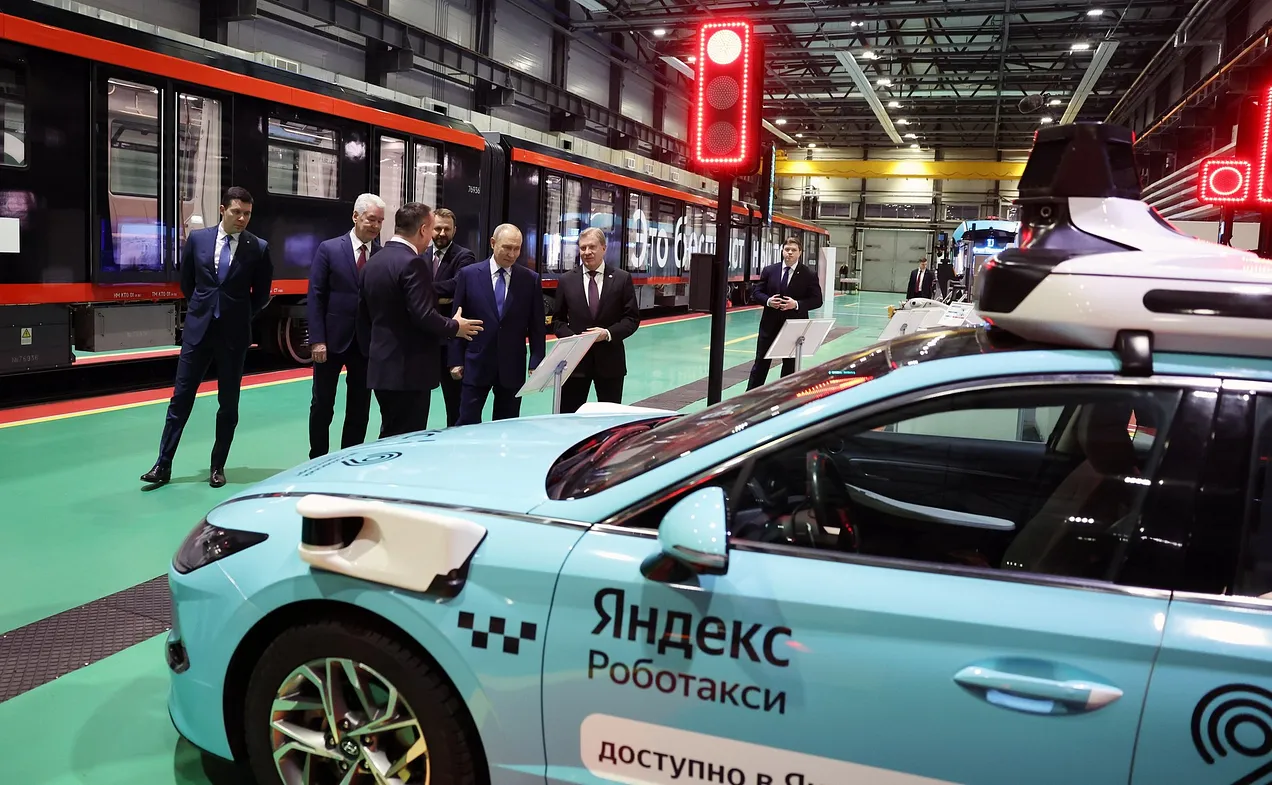
A driverless taxi in foreground and driverless metro train in background.

Russia sees automation as a way to free workers to perform other more important tasks instead of a way to increase profits by cutting the workforce. This is easier for Russia to do because of its extremely low unemployment rate and demand for skilled labor. China has a similar philosophy but lacks the low unemployment rate which makes further automation a higher social challenge. However, there are tasks automated systems are better at some of which will be discussed. The Kremlin readout gives us a synopsis of what transpired prior to the meeting:

Before the meeting, Vladimir Putin visited an exhibition on unmanned technologies at the metro depot.

The Head of State got acquainted with Moscow’s achievements in the field of urban autonomous systems. The President was shown the unmanned Lion tram and the unmanned Moscow-2024 metro train. The capital is developing an intelligent traffic management system, unmanned aerial monitoring of real estate and forest fire conditions. Drones are used to create and update the digital model (”twin”) of Moscow.

At the Autonomous Systems in Transport stand, the President was presented with unmanned trucks, copters, robo-taxis, and delivery robots from domestic companies. Starting from March 1, 2026, a unified system based on the ERA-GLONASS system will be responsible for monitoring all civilian UAVs. Unmanned tractors, harvesters, and aerial agricultural drones are being introduced in agriculture. Vladimir Putin was also informed about the use of drones in the fields of natural resources and ecology, trade, and industry.


Unfortunately, the full meeting’s discussion isn’t provided, so we’ll need to read deeper into Putin’s oratory to get an idea of what the deeper discussion entailed:

Opening remarks at a meeting on the development of autonomous systems
V. Putin: Good evening, dear colleagues!

Today, our agenda includes the issues of accelerated and advanced development of the national industry of unmanned and autonomous technologies. We are talking about a wide range of transport, industrial, and service systems that are still under external control and can be operated by humans, while some of them can operate completely independently in all environments: on land, in the air, in water, and in space.

At the exhibition, we just got acquainted with a whole range of such advanced products and discussed various scenarios for their use, including precision farming (Oksana Nikolaevna [Lut] spoke about it), forest protection (Alexander Alexandrovich [Kozlov] also reported), cargo delivery, construction, urban management, and security.

It must be said directly: it is impressive–-both the boldness and the diversity of the designers’ proposals, and the way the technologies they have created radically change the life around us, forming a real economy of autonomous systems. It is natural that this topic is now at the center of attention of all leading countries, largely determining their competitiveness in the civilian and defense sectors.

We understand this very well. That’s why, a year ago–-we were just talking about this with our colleagues–-at a meeting in Tolyatti, we made decisions that paved the way for the widespread use of civilian drones, which are essential for the development of unmanned transport in our country in all environments. We also held [that meeting] at the beginning of the year.

I repeat, important steps have been taken, but in some areas we are still significantly behind some other countries. For example, in some cities around the world, unmanned taxis are no longer just part of individual experiments but are being used on a large scale to transport passengers. More importantly, several countries have achieved full sovereignty in the production of all components for autonomous vehicles. It is clear that we have the scientific, human, and industrial potential to become global leaders in the development, production, and, of course, widespread adoption of autonomous systems.

These key technologies, along with digital platforms and artificial intelligence, are shaping the future of the world, and the successful implementation of our most important plans and initiatives will certainly depend on them. This was also discussed at the recent Council on Strategic Development and National Projects.

I would like to repeat once again that the introduction of autonomous and unmanned solutions is not a fashion, but a necessity, a way to strengthen our country’s global competitiveness, to address the challenges of a scarce labor market and demographic issues, and to ensure the security and sovereignty of Russia.

In this regard, the first thing I would like to draw your attention to is the following. I would like to ask the Presidential Administration and the Government to submit proposals on improving the efficiency of managing the development of the national autonomous systems industry. These proposals are intended to establish close coordination between the relevant ministries, agencies, federal subjects, technology companies, and scientific organizations.

Second. I also ask the Government to prepare action plans for the introduction of unmanned technologies in key sectors of the economy. We are talking about increasing labor productivity and improving the quality of life of people. In particular, such systems should replace low-skilled and dangerous labor and contribute to the formation of a high-wage economy. Now our colleagues have also told us about this in detail. Of course, releasing people from low-productivity work, frankly, low-prestige, and low-paid-this will lead to the release of labor and the ability to send people to other areas of work.

I would like to draw the attention of the meeting participants and all my colleagues in the Government to the fact that we need to move faster from experiments and testing to the widespread use of autonomous solutions. We need to not just take control but lead this work–-when I say “we,” I mean the Administration [of the President], the Government of the Russian Federation, and the heads of the country’s regions.

It is necessary to build qualitatively new technological and business processes in the industries based on the use of unmanned systems, and to help entrepreneurs select ready-made advanced solutions. And of course, it is important to assess the needs of the economy’s sectors for drones, both in terms of volume and their characteristics, so that the technology business understands the medium-term prospects of the market and plans investments and production expansion. In turn, the Government needs to continue removing administrative barriers without delay, which hinder the fastest and safest implementation of autonomous solutions in the economy’s sectors. We also discussed this at the last meeting a year ago.

Third. The constituent entities of the Federation play a crucial role in the development of the unmanned systems economy. I ask the governors to use the existing rules for regulating the flights of civilian drones more confidently. For example, in 2025, a new class of airspace was introduced for civilian drones throughout the country. This opens up new opportunities for the regions to use unmanned aviation. It is important to act responsibly, carefully, and promptly.

We should also implement the best practices of Moscow, which is currently the undisputed leader in creating an economy of unmanned systems, in other regions of the Federation. I ask Sergei Semyonovich Sobyanin to establish a mechanism for sharing experience with colleagues from other regions in terms of using data processing systems, autonomous solutions, and artificial intelligence, including for improving the quality of passenger transportation. This is an important social aspect of using advanced technologies.

Fourth. Experimental legal regimes are already in place in Moscow, the Moscow Region, the federal territory of Sirius, and Sakhalin. Last year, we decided to extend these regimes to all our regions in the Far East. The purpose of these tools is to test innovations and then make changes to national legislation as quickly as possible, adapting it to the ongoing transformation in technology and society. In today’s environment, those who are among the first to address this challenge will secure leadership in creating an economy based on unmanned systems.

Based on the experience already gained, it is necessary to immediately introduce into the legal field not only large autonomous transport, but even small devices, such as delivery robots, to organize the certification of various types of unmanned systems, to establish exhaustive, unambiguous and measurable requirements and standards for them, to develop approaches to determining responsibility for the actions, and in certain cases, for inaction of drones in the course of transport incidents. Of course, the task is not easy (addressing the Minister of Internal Affairs V. Kolokoltsev), but this is definitely something that we need to do, Vladimir Alexandrovich.

I would like to emphasize that all these steps should be implemented with a clear understanding of the ultimate goal, which is to increase the use of autonomous systems in all areas of life by orders of magnitude or even tenfold. Therefore, it is a mistake to put barriers or obstacles in the way of technological development or to avoid making decisions based on the principle of “better safe than sorry.”

At the same time, special attention should be paid to security issues. In particular, it is necessary to prevent unauthorized access to the management of autonomous systems, as well as to the data that they transmit and receive. It is crucial to support relevant scientific and engineering projects in the field of cybersecurity. This area is actively developing, and I am confident that there are solutions available.

Next. It is necessary to actively form a legal basis for end-to-end management of autonomous objects through satellites, near space–-and (the head of Roscosmos also reported on this today) such opportunities also exist. This year, it is necessary to adopt amendments to the regulatory framework, as well as other regulatory documents, and it is necessary to take technological measures that are required for the early introduction of end-to-end identification of unmanned systems in all environments, as well as their real-time monitoring.

This is the first, but fundamental, step towards creating a system for simultaneously controlling any number of autonomous objects. In other words, we are consistently moving towards a seamless “digital sky” where drones, unmanned ground and water vehicles, and spacecraft are integrated into a single network and exchange information, transmit, and process vast amounts of data.

In this regard, I consider it necessary to form a holistic, comprehensive legal regulation for the use of autonomous systems in a short period of time. I ask the Government to address this issue and work on it with the participation of experts and, of course, the business community.

Dear colleagues!

In our country, as well as around the world, there is a real revolution taking place in the field of transportation. In terms of its scale, it is similar to the technological and infrastructure shift that occurred at the turn of the 19th and 20th centuries. Back then, Russia made tremendous strides in its development, primarily through the construction of railway lines, the development of its fleet, and other transportation systems. Prominent Russian scientists and engineers played a significant role in addressing these challenges.

Today, we also need to form a national industry of unmanned transport on a sovereign technological and production platform, relying on our own scientific and engineering schools, including in the fields of microelectronics, new materials, and optics. As we have agreed, we will definitely meet and discuss microelectronics separately in the near future. We need to create comfortable and convenient conditions for Russian businesses to increase production of both drones and their components. Moreover, the components should be more standardized and applicable to different types of autonomous systems.

It is also extremely important to create a full range of domestic technologies and products in the field of communication and navigation for the full-scale space and ground-based autonomous object control system that I have already mentioned.

I would like to draw the attention of the Government and Roscosmos to the fact that we are talking about truly advanced technologies that will allow us to use various radio frequency bands, provide the necessary level, speed, and coverage of the signal, and transmit it with minimal delays. Projects that are already being implemented in this area should be provided with comprehensive support by the domestic business.

It is crucial that our domestic engineers set the tasks and write the algorithms for drones. This is a significant factor in ensuring their safety. Therefore, in order to develop autonomous systems in all environments, we also need to have sovereign artificial intelligence technologies, especially in the rapidly developing generative field. This includes national fundamental language models. We will discuss the plan for their creation and implementation in the near future, with the participation of domestic technological and high-tech businesses.

Next. The development of unmanned systems, as well as solutions in the field of artificial intelligence, requires a serious review of the mechanisms for training personnel, including in the fields of transport, logistics, and passenger and cargo transportation. Given the future needs for specialists with new qualifications, the Government must make comprehensive decisions, including the development of new and the modification of existing educational standards and programs. We constantly talk about this, but we need to take concrete steps in this direction.

This is another important topic that I would like to focus on today. I ask the Government, together with the Defenders of the Fatherland Foundation, to create additional opportunities for veterans and injured military personnel to participate in the development, production, and operation of autonomous systems. The experience, knowledge, and skills of our soldiers and heroes, including the pilots of combat drones who have successfully defeated and continue to defeat enemy equipment, should be put to good use in civilian life and on the front lines of technological progress. It is also necessary to remove the remaining administrative barriers and clearly outdated regulatory requirements. Here, I ask the Presidential Administration, together with the Ministry of Defense and the security forces, to think through all of this and implement it as quickly as possible.

Dear colleagues!

To create a truly powerful, cost-effective industry of unmanned systems, we need to increase the export of such advanced products and enter world markets. And this global market is very large. We are expected there, I assure you, I just know about it. Everyone–-our friends, our partners–-tells us about it. Among the most important steps is to make customs and other procedures as comfortable as possible for national companies, so that they can withstand tough competition with foreign manufacturers. Please make appropriate decisions as soon as possible.

Along with the development of exports, we need to create a joint, common drone industry with our friendly partners, build turnkey drone industries in friendly countries, and establish enterprises, training centers, and infrastructure for drone operations in those countries.

I would like to note that the issues of cooperation in the field of unmanned systems were also discussed at a special international forum in Moscow last August. We will significantly expand its capabilities and hold the International Transport and Logistics Forum in St. Petersburg in April this year, where we will focus on supporting young engineers, robot creators, and civilian autonomous transport systems in all environments. This should be a significant contribution by Russia to supporting talented young people from around the world. There is a demand for such joint work.

Let’s continue our work. Please give the floor to Andrey Sergeyevich Nikitin. Thank you.
There’s no standing still technologically in today’s world if you want your nation to be competitive in the global marketplace. And those nations need an industrial base capable of designing and making all components. And of course, they need to have the trained personnel to do all the work. I’ll admit to being thrilled when I was allowed to first drive a tractor, but it got old rather fast as there was really very little to do until you reached the end of the furrows and needed to turn around. Of course, that’s only one example of many. Putin’s correct to focus on the legal and safety aspects of this emerging industry and its applications. China’s developing what it calls the Low Altitude Economy that will probably be hard to replicate elsewhere because China’s urban regions can make it sensible. Smart city grids are becoming the basis for such autonomous systems. I’d like to know what Roscosmos told Putin; Mr. Bakanov, Roscosmos Director, was present at the meeting. We see yet another example of technology developed for military uses revolutionizing civilian industry—the number of spin-offs is amazing. And it’s bringing about these technologies far sooner than otherwise. There were several future forums mentioned that merit attention when they commence. Russian government at all levels has many tasks assigned to them and more were just added. Clearly, there’s no room for lollygagging ministers or foot-dragging local officials.

https://karlof1.substack.com/p/putins-r ... ed-systems

Asiatic savages, eh?

******

Scott Ritter: The Sanctions Shield
January 16, 2026
By Scott Ritter, Substack, 1/5/26

Forces within the US and Russia today openly advocate for the lifting of economic sanctions targeting Russia. But these sanctions are not designed to be lifted for the benefit of Russia, but to exist as a tool designed to bring about the collapse of Russia. The hope of improved economic relations brought on by the end of sanctions is used as a means of leveraging greed and corruption inside Russia in order to bring down the government of President Vladimir Putin. Russia’s best option is to stop advocating for the lifting of sanctions and instead use the existing sanctions as a shield to protect Russia from the inherently corrupting influence of western economies.

I used to hold that sanctions as policy was in fact a statement that there was no real policy in place for the given problem, and that sanctions were simply a mechanism for buying time to consider the options. But the longer I have had to observe US sanctions policy unfold over time, the more I realize that there is, in fact, a method to the madness. Whether this newly discovered intent was in existence when the wide-spread sanctioning of nation states was first employed as a major pillar of US foreign and national security policy, or evolved over time, isn’t the point. The reality is that today sanctions underpin policies of targeted regime change and serve as the primary facilitating agent of such policies.

The primary indicator for this realization is that while sanctions portend to target behavior or policies the United States wishes to see altered, the sanctions are almost invariably tied to a person or persons in power. This linkage almost inevitably means that the desired behavioral modifications sought through sanctions cannot be achieved so long as the targeted persons remain in power.

But such linkage in and of itself does not a policy make. To be effective, a policy must be implementable. And here sanctions bring with them an inherently implementable weapon—human greed. The conventional thinking was that sanctions were designed to compel change from within the targeted nation—punish the people, the people will put pressure on their leadership to effect the necessary changes. But this approach did not achieve the desired results—the case of Iraq stands out, where the regime of Saddam Hussein withstood more than a decade of stringent economic sanctions before being removed by military force.

But lately sanctions have taken on a different character—a commodity, so to speak, part of a transactional approach to policy making which has come to maturity during the second iteration of the Trump administration. Trump has been a master when it comes to employing this new commodity-based approach to sanctioning, slapping sanctions onto a targeted nation, and then holding out the possibility of these sanctions being lifted if certain behavioral benchmarks are met. “We can do business together” has become the mantra of Trump 2.0, a promise of mutually beneficial economic relationships predicated on one side—the sanctioned side—yielding to the demands of the other.

The transactional relationship, however, is never allowed to reach fruition. The promise of economic largesse is instead held hostage to behavioral alterations that cannot be attained because they are linked to the personal and/or political credibility of the targeted personalities named in the sanctions. But the transactions were not designed to enrich the targeted individuals, but rather the class of political and economic elites for whom the targeted individual(s) relied upon for their continued viability as the leader of the targeted nation.
Image
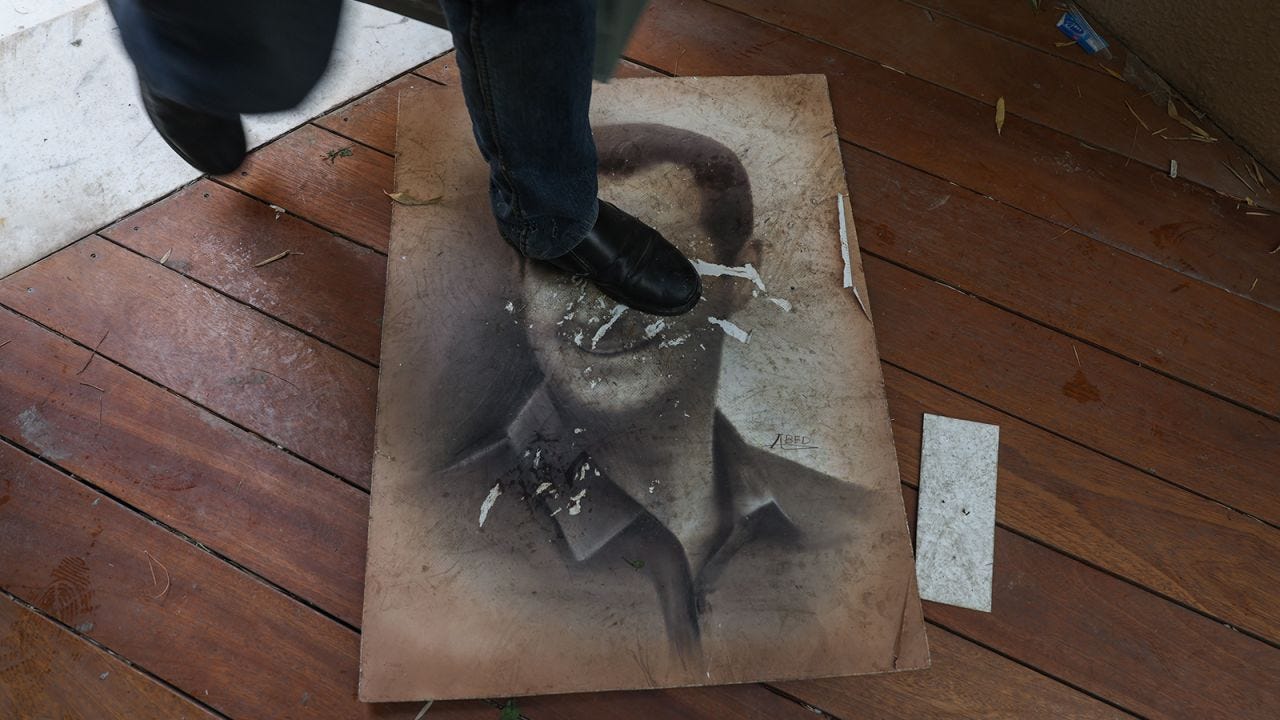
Syrians step on the portrait of former President Bashar al-Assad

The goal of these new regime-change sanctions is to create leverage inside these elites that can be manipulated by the promise of personal fortune if the impediment to this utopia were only removed from power. There is reason to believe that the promise of economic assistance from the Arab League combined with the lifting of stringent US sanctions created the opportunity for Syrian elites to be bought off, abandoning the former President of Syria, Bashar al-Assad, to the wolves when Islamic forces attacked in November 2024.

The recent abduction of Venezuelan President Nicolas Maduro by US forces likewise suggests that there was a significant amount of betrayal by Venezuelan political and economic elites brought on by the promise of the lifting of sanctions against Venezuela once Maduro was removed from power.

Likewise, in Iran President Pezeshkian’s stated objective of wanting better relations with the West, inclusive of economic interaction keyed to the lifting of sanctions, created a certain level of societal expectation which was weaponized by the West, linking the inability to lift sanctions until the Iranian government changed fundamental policies, such as those related to their nuclear program. These Iranian elites, having already begun to spend their new-found wealth in their imaginations, were easy pickings for foreign intelligence services looking for vectors of societal unrest linked to the removal of the Iranian Supreme Leader, Ayatollah Khameini, from power.

But the biggest regime change target of them all is Russian President Vladimir Putin. Donald Trump has made the lifting of sanctions and the renewal of US-Russian economic projects one of his highest priorities—after the ending of the Russian-Ukraine conflict on terms acceptable to Donald Trump. Trump has allowed a dual-track of negotiations to proceed simultaneously, the first involving setting the terms of conflict resolution, and the second focused on the economic benefits that would accrue once the war with Ukraine ended.

The problem is that Trump has no intention of agreeing to terms that would be acceptable to Russia, and every intention of continuing to impose targeted sanctions designed to impact various political and economic elites surrounding Russian President Vladimir Putin. Trump has made it clear that he is personally unhappy with President Putin, implying outright that any continuation of existing sanctions and/or issuing of ne sanctions is the fault of the Russian President and no one else.

The hope attached to this methodology is that by dangling the possibility of lifting sanctions in front of these elites, they can be persuaded/influenced to exert pressure on the Russian leadership to change policy goals and objectives or, failing that, to change leadership.

Given everything I have analyzed over the course of the past several days, I am convinced now more than ever that the Trump policy toward Russia is not normalization, but regime change, and that economic sanctions are not viewed as something that is transitory, but rather something that serves as a permanent fixture of policy designed to create the potential for regime change. There are zero advocates for the genuine normalization of relations on Trumps’ innermost circle of advisors. Steve Witkoff, the former New York real estate broker turned special envoy, does not make policy, but rather furthers the possibility of better economic relations once sanctions are lifted—which, of course, they never will.

Marco Rubio, the dual-hatted Secretary of State and National Security Advisor, is staunchly anti-Putin. Scott Bessant, the Secretary of Treasury, believes that Russia can be brought to its knees using sanctions. And John Radcliffe, the Director of the CIA, oversees an agency that has sought the demise of Vladimir Putin and Russia since the fall of Boris Yeltsin.

There are zero advocates for a truly mutually beneficial relationship between the US and Russia in the Trump cabinet today. A relationship built on transparency and mutual trust is impossible so long as one party is actively seeking the strategic defeat of the other.

The strategic defeat of Russia continues to be the policy of the United States.

And economic sanctions are the primary tool being used to achieve this result.

Gone are the days of calling Russia out as the principal opponent of the United States. That action only solidified the United States as an enemy in the minds of those Russians the United States seeks to bring over to our side.

Instead, the United States, by publishing a National Security Strategy document that lists Russia as a force of strategic stability, creates the notion that the path has already been cleared for a revitalized relationship born on the principle of mutual benefit.
Image
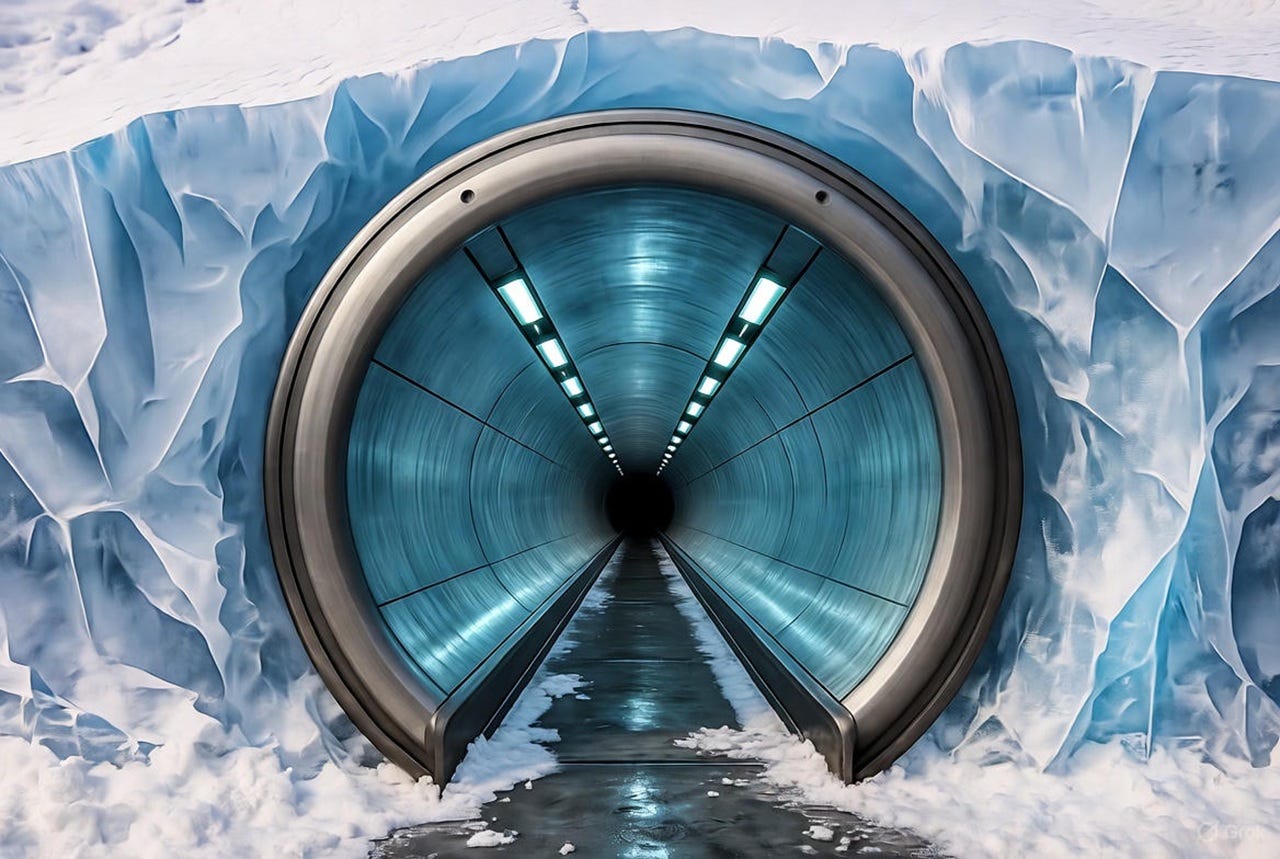
Artist’s conception of the Russia-US tunnel promoted by Kirill Dmitriev

But the US-Siberian tunnel that Kirill Dmitriev is fond of promoting isn’t designed to bring American wealth to Russian shores, but rather to extract Russian resources on terms unilaterally beneficial to the United States. Yes, the United States desires a time when sanctions can be lifted, and US businesses can return to Russia. But only on terms acceptable to the United States, and these terms cannot exist in an environment where Russia operates as the geopolitical equal of the United States. Vladimir Putin has spent 25 years leading Russia out of the ruins of the decade of the 1990’s. It is the goal and objective of the United States to return Russia to that period, where Russian nationalism has been subordinated to Western commercialism, where Russian culture and traditions are seen as an expression of inferiority in the face of all that the West can offer.

A new Trump Tower, not the towers of Moscow Center, would be the landmark of Moscow if Donald Trump had his way, with all that entails.

But in the case of Russia sanctions are a double-edged sword. The combined impact of the US-European sanctions is the near total isolation of Russia from the western economy. If Russia continues to play the game of pretending there will be better times ahead once these sanctions are lifted, it is just a matter of time before human greed and CIA money find common cause, and Russia finds itself wracked by internal political disputes designed to weaken it and its leadership.

Sanctions, simply put, are not a path toward prosperity, but a highway to hell.

Russia can isolate itself from the negative consequences of the Trump sanction game simply by refusing to engage on any discussion that doesn’t have the immediate, unconditional lifting of economic sanctions as the core objective. There can be no quid pro quo, no phased easing out—nothing. Anything that creates conditions for the lifting of sanctions provides the US the leverage it needs to start corrupting segments of Russian society, to turn them against the Russian government.
Image
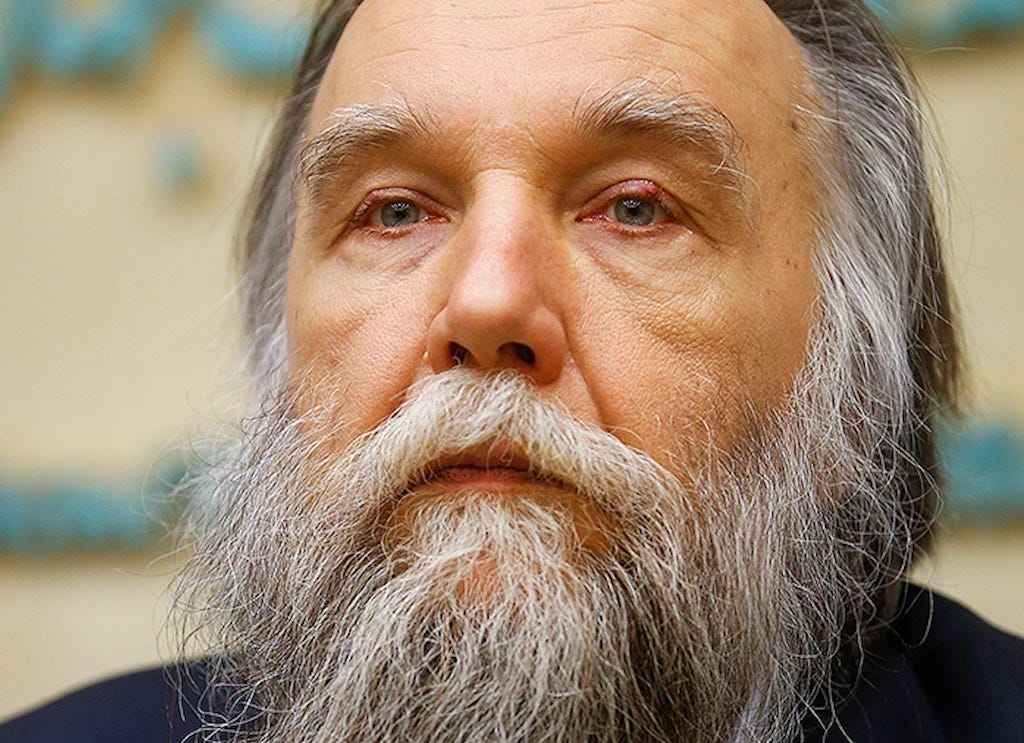
Alexander Dugin

None other than the esteemed Russian philosopher, Alexander Dugin, agrees that Russia faces such a threat today. “Look,” he recently wrote, “friendly regimes and forces are collapsing one after another. Of course, we’re reacting and trying to take advantage of the general crisis of globalism, but we’re missing a lot.

It’s perfectly clear, and this has been confirmed by events in Syria, Iran, Lebanon, and now Venezuela, that over the past decades, the West has created spy networks within the highest leadership of all countries. I think even China is no exception. And at the right moment, they activate to betray the supreme power. Such a network simply cannot fail to exist in Russia. It would be logical for it to be the source of systemic sabotage and the slowdown of all those processes that must be conducted at a completely different speed to effectively defend and strengthen our sovereignty. And these agents can be found anywhere, including in circles and departments where we least expect them.”


Dugan is right—these networks exist in Russia today. The point of vulnerability which is exploited most effectively by the West is the greed that comes with the unfulfilled desires of those who have bought into the notion of the West serving as the source of Russia’s economic wellbeing.

The sanctions against Russia were specifically crafted to isolate Russia from the West and, in doing so, create the impression that Russia’s economic woes could be resolved simply by creating the conditions under which these sanctions could be lifted.

But at what cost?

The West does not seek to live side by side with a rejuvenated Russia. Europe has made it clear that a Russia that stands on its own two feet is deemed a threat, and must be brought down.

The West wants Russia to be brought to its knees, to crawl toward its master, begging for relief.

This is not the Russia I experienced in my past travels.

This is not the Russia I fell in love with.

And this is not a Russia I would want to be friends with.

And so Russia should seek to activate the “sanctions shield”, to do everything possible to encourage the economic isolation from the West, to weaken the leverage those in Russia who would sell their magnificent civilization for a handful of silver will never get the chance.

Sergei Karaganov is right—Russia’s future lies to the East, its ruination to the West.

It is to the East and the collective South that Russia must now turn for its economic future.

Make sanctions moot by making it impossible for sanctions to be lifted.

Stop the Dmitriev-Witkoff experiment in its tracks.

One day—maybe soon, probably not—the conditions will exist where Russia can once again do business with the West.

But first the European Union must be broken up.

NATO disbanded.

And the United States compelled through the reality of its own limitations to accept Russia on terms wholly acceptable to Russia, for the benefit of Russia, and not the other way around.

Never forget—Russia has never sought the strategic defeat of the United States.

The United States today is actively seeking the strategic defeat of Russia.

Sanctions are the chosen vector for this policy to reach fruition.

Therefore Russia has no choice, if it desires to avoid being caught up in the regime change policy construct of the United States, than to do everything possible to keep the sanctions imposed against it by the collective West in place in order to shield itself from the destructive forces of corruption and greed that are an inherent part of any “economic engagement” with the West—especially with the United States under the rule of the most transactionally-minded President in US history, Donald Trump.

https://natyliesbaldwin.com/2026/01/sco ... ns-shield/

Alexander Dugin is a chauvinistic flake, just sayin'.
"There is great chaos under heaven; the situation is excellent."

User avatar
blindpig
Posts: 15306
Joined: Fri Jul 14, 2017 5:44 pm
Location: Turtle Island
Contact:

Re: Russia today

Post by blindpig » Mon Jan 19, 2026 4:21 pm

THE WHITE HOUSE ARCHIVE — WHAT VLADIMIR PUTIN CONFIDED TO GEORGE W. BUSH, WHAT HE MEANS NOW

Image

By John Helmer, Moscow @bears_with

Revealed for the first time in public is that President Vladimir Putin believes that international terrorism of the radical Islamic type is not the result of Middle Eastern conflict or of regional poverty or of Great Power proxy warfighting. Rather, he thinks it is a form of competition of the Marxist-Leninist type between Islamic and Jewish capital. At least, that’s what Putin told President George W. Bush when they met in China in October 2001.

Also revealed is the consistency of Putin’s three-step method for dealing with US presidents — first by ingratiating them personally; then by lecturing them with lessons on history, economics, and strategy; and lastly by offering unilateral concessions in return for promises of US benefits to follow.

As the releases of declassified records for the George W. Bush presidential archive continue, the evidence mounts that this method of Putin’s is the one he is repeating today with President Donald Trump.

The new evidence is that Putin’s method is a repeated failure. One reason for this is confirmed in the new documents from the Bush archive — US presidents never do what they say. This is American deception.

The second reason is that the understandings Putin reaches with US presidents are those Putin has in his head – they are never those in the American heads. This is Russian self-deception.

Image
Source: https://nsarchive.gwu.edu/briefing-book ... d-george-w

There are eight documents in the new declassification and publication series dating from July 6, 2001, to March 18, 2003. Three documents were released last month; read them and the analysis here.

The telephone transcripts are brief; the shortest call was five minutes long, the longest 21 minutes. The meeting transcripts are also brief – 40 minutes, 60 minutes, 75 minutes.

Click to read the new declassified publication from the National Security Archive in Washington. https://nsarchive.gwu.edu/briefing-book ... d-george-w

This is the first documented evidence of Putin’s fluency in English. For the 9-minute duration of the first call, Putin’s remarks were not translated into English. He spoke in English, and Bush commented: “Your English is getting very good”.

Image
Source: https://nsarchive.gwu.edu/document/3373 ... ent-russia

In this call Putin attempted to ingratiate at the personal level with remarks like “I await with impatience the possibility of meeting you in Genoa and think this will be another good opportunity. Mr. President, this is all I wanted to say. I don’t want to take too much of your time”.

At the same time, Bush recorded there had been no concessions from Putin in their negotiations on US sanctions against Saddam Hussein of Iraq or on US operations to aid the Albanian National Liberation Army in attacks on the Macedonian government, to limit Russia-made arms deliveries to the latter government, and to introduce NATO occupation of Macedonia as peacekeepers. Putin responded that he had set up two working groups “from the foreign ministry and defense ministry, to continue our talks on the basis of strategic stability arrangements.”

In their next telephone conversation, Putin was calling on the morning, Washington time, of September 12, 2001, the day after the attacks on the World Trade Centre in New York and the Pentagon in Virginia. Putin had telephoned the day before, but that text has not been declassified and released.

Image
Source: https://nsarchive.gwu.edu/document/3373 ... ent-russia

On the day following Bush told Putin he was in a hurry. “You were the first leader to call yesterday [September 11]. Thank you for that. Secondly, I believe our country is in a state of war. We’re fighting a faceless coward. It’s a new kind of war. And I believe the world needs to cooperate and I look forward to working with you, Sir. And I look forward to having the opportunity to work together in a new spirit and to show the world that freedom-loving people like you and me can unite against these cowards. The reason I am in a rush is that we believe there will be further attacks and I need to prepare the nation for that. So, if you don’t mind, I’d like to call you back at your convenience before you go to sleep tonight so that we can talk a bit more before your visit.”

Putin replied before ringing off: “I’m at your disposal. I can tell you, by the way, that I have signed a decree that at 12 noon tomorrow, Russia will be having a minute of silence for the dead to show solidarity with you. All flags will be at half-mast and all entertainment functions will be stopped.”

If, as Bush said he was anticipating, they spoke again by telephone that evening, the record remains closed.

The third release records the 75-minute meeting Putin had with Bush in Shanghai on October 21, 2001; click to read. Interpreters translated for each president.
https://nsarchive.gwu.edu/document/3373 ... imir-putin
Image
Source: https://nsarchive.gwu.edu/document/3373 ... imir-putin

Putin was profuse in his praise of Bush’s handling of the 9/11 attacks because, he emphasized, “no one knows better than I do what feelings you have experienced. We have had the same tragedies ourselves. We had the apartment explosions [Moscow September 1999], remember? I felt a closeness. You have found the exact words and conveyed them very well. “

Later in the conversation, Putin expressed opposition to US contacts with Chechens and for lack of the promised intelligence-sharing from the US side. He was also lecturing in tone and blunt in warning Bush: “I know the history of Chechnya. But you must understand: when the State Department meets these people it provokes a reaction. Chechnya is a 400-year-old problem. The Chechen people always had an aspiration for independence. We should respect this. The events of 1995 showed it. Today it is impossible. Russia withdrew completely in 1995, and gave it complete independence (but not formally). What were the consequences? It led to radical Islam…The Soviet Union made big mistakes in Afghanistan. They didn’t understand and tried to put a pro-Soviet, non-representative government in place, based upon minorities. The Pashtuns were excluded. They became indignant. Radical Islamic fundamentalists assimilated into the territory of Afghanistan and called it traditional Islam. We must oust the Taliban and bring in the Pashtuns. We must do the same thing in Chechnya. We have good relations with traditional Islam. Our military does sometimes commit crimes. We are taking steps. Do not interfere with this process.”

Putin offered a deal. He told Bush he would close down the Russian intelligence-gathering base in Cuba, and in exchange he asked Bush to repeal the Jackson-Vanik Amendment, to implement additional trade liberalization measures, and to agree on terms for reduction of nuclear weapons in a “Bush-Putin Treaty”.

Subsequent western press reports indicate that the Lourdes base in Cuba was closed in 2002. Bush did not repeal Jackson-Vanik.

Instead, in 2012 President Barack Obama replaced Jackson-Vanik with new sanctions on Russia in the Magnitsky Act. As Obama escalated against Putin following the putsch in Kiev in February 2014, the Lourdes base was “repurposed” with Chinese intelligence engagement also.

Image
US satellite image of 2023: https://lansinginstitute.org/2023/06/27 ... -russians/

The October 21, 2001, meeting lasted for 75 minutes with Russian translated into English and vice versa. Putin gave Bush a theory of international capitalism with traditional Leninist-Marxist terminology and a religious twist which he has never opened to the Russian public.

“There is a contradiction between a new, young, aggressive financial Islamic capital and the old one. A moment came when the new generation began to see the old as its competitor. From the time bin Laden became your partner, he felt himself your competitor. His desire to move to Central Asia or elsewhere was his desire to muscle in and subjugate all others to his will. In reality, it is a financial issue. Religion is secondary. The real goal is to have a place in the centre of world finances, a place that is already occupied. They want to push away representatives of Jewish capital or, if not, they will try to destroy the centre and shake it up and, ultimately in that way, to take its place. The reason for the terrorism isn’t the Middle East or poverty. They use poverty and they use unresolved conflicts. They are using other problems. These problems are not the real reasons for terrorism. They are using the people of Afghanistan in the same way. I raised this not just to support you, but to say that we all have fight in the same world. We have the same problem in the Caucasus. ”

Bush was non-committal. He told Putin his problem in attempting to remove the Jackson-Vanik restrictions on Russian trade was that “Congress is afraid of the Jewish community and Jackson-Vanik is symbolic.” Putin replied that was willing to make the concessions demanded by the Jewish community: “I’ll do anything at all except one: if they need me to have a circumcision, that I can’t do!”

In the 15-minute telephone call of November 8, 2001, Bush was the ingratiating one. “The First Lady and I are looking forward to seeing you in Texas,” Bush said. “I hope it’s okay if I can take you to a small high school in my hometown in Texas. I want people to see that you are a modern thinker and I want you to see Americans…when you come to Texas, make sure you bring casual clothes. It will be very informal. And also, bring walking shoes, exercise shoes, so we can go for long walks on the ranch.”

Bush’s purpose, however, was to get Putin to agree to the US breakout of the Anti-Ballistic Missile Treaty (ABM), which Putin had refused. Bush made it appear he was still ready to negotiate when he had already decided to withdraw from the Treaty. He also offered to compensate Putin with an offer of intelligence-sharing from missile testing although Putin had already dismissed that as an empty promise. “We have two options,” Bush told Putin. “On the one hand, you and I can agree that America can test freely and without any restrictions, and we will share information with you. And, in return for the freedom to test, we will agree to stay within the ABM Treaty with you for a period of time. If, on the other hand, it’s impossible for you, for whatever reason, to allow us to test freely, my only option will be to withdraw from the ABM Treaty at a later date, so we can begin testing after a six-month period, and we will continue to work to see if we can’t reach.an agreement. But I promise you that I will not embarrass you. I will not put you ‘in an awkward position should we not be able to reach an accord on testing. We can say in Washington and Crawford we are continuing to work to make sure that each party’s concerns are represented.”

“George, we shall see,” Putin replied. “I’ll think about it. I thought I would like to repeat that I have optimism with regard to all issues, including ABM. And maybe it may seem, at first glance, that nothing is changing in our position, but there are nuances that I would like to discuss with you personally when I come to Washington. We have several options. All of them are good.”

The next document released records an hour-long meeting at the White House on November 13, 2001. Among the Russians accompanying Putin were two who remain in official roles at present — Dmitry Medvedev, then deputy head of the presidential administration, and Yury Ushakov, then Russian Ambassador to the US.

“We need to understand yoμr plans with respect to nuclear testing?” Putin asked bluntly. “Will you resume testing or not? If so, what kind of tests, modes, and types?” Bush answered: “We have no plans to test right now…This is not to say that ten years from now, we might decide to do it…But we.will keep the testing ban in place.”

In fact, as Russian military intelligence had already reported to Putin, there was a US test on July 14, 2011, and follow-up tests were scheduled for December 3, 2001, January 11, 2002, and March 15, 2002. The budget funds were in place for the start of construction in Alaska in June 2002 of six missile interceptor silos as a test bed for the new missile defence system.

After Putin corrected Bush on the military and political situation in Afghanistan, he urged the US “to speed up the solution of the future of Afghanistan.”

To that end, Putin said he was grateful for US financing to supply Russian weapons to the Afghan forces fighting the Taliban. “We have spetsnaz troops armed with the necessary means, communications, and helicopters, who have experience in Chechnya. They are now in Dushanbe. They have trained there with your people. I won’t speak publicly about this, but we are prepared to use them in Afghanistan if necessary…I am grateful you have decided for compensating us to finance arms purchases for weapons for the Northern Alliance.”

Putin implied that Bush was duplicitous in his dealings with Pakistan’s military ruler, Pervez Musharraf. “With the Pushtun tribes perhaps we can take a stick and force Musharraf to do his job,” Putin said. “It is not enough for him to simply put down demonstrations… Pakistan is a curious ally, strange bedfellow. They help while, at the same time, they burn American flags. Others are different. Some may be better allies than your traditional allies.”

Two days later, at their joint press conference in Texas on November 15, Bush was asked about ABM. “The treaty was signed during a period of time when we really hated each other and we no longer hate each other; that I view the treaty as something we need to move beyond,” Bush answered. “We have a difference of opinion. But the great thing about our relationship is our relationship is strong enough to endure this difference of opinion. And that’s the positive development. We’ve found many areas in which we can cooperate and we’ve found some areas where we disagree.”

Putin had agreed, he said, to bury their differences on ABM in order to keep negotiating on terms for reducing strategic nuclear weapons. “The objective is to achieve security for our states, for our nations, and for the entire world. We share the concerns of the President of the United States to the fact that we must think of the future threats. And here is a common ground for our further discussions. What we differ in is that we differ in the ways and means we perceive that are suitable for reaching the same objective. And given the nature of the relationship between the United States and Russia, one can rest assured that whatever final solution is found, it will not threaten or put to threat the interests of both our countries and of the world. And we shall continue our discussions.”

Image
The Putin-Bush press conference in Crawford, Texas, on November 15, 2001.

Bush announced US withdrawal from the ABM Treaty on December 13, 2001. The negotiations which followed in 2002 collapsed with all terms agreed between the two sides cancelled within six months.

On April 2, 2002, Putin telephoned Bush to propose an initiative for a Russia-NATO agreement which, Putin said, he had just discussed in Moscow with Italian Prime Minister Silvio Berlusconi. “If you could stay one more day in Europe, we could meet in Rome in order to organize the Russian-NATO summit and launch these mechanisms. And actually, it would be good for me if we resolved it before the NATO summit in Prague [scheduled for November 21-22]. This would reduce the tension and pressure in my country so it would be very good to do before the Prague summit… And, actually, my impression is that this would be good for Mr. Berlusconi because he is in a difficult political situation, under great pressure from his left, good to shift the internal political tension to other affairs and show the importance of Italy in the international arena. I don’t know, actually, it’s up to you. I would think this would be acceptable to you. In any way, you know better but such a step of launching of this at-20 mechanism would be very good, a logical result and a nice finish to your European tour, and this would be a very good stop for your European tour. Actually, what do you think of this?”

Bush was non-committal: “Let me give it some thought, Vladimir. I’m very much in favour of at-20 to satisfy some of your concerns. And I’m glad we’re making progress in this. So I’ll take a good look at it and get back with you.”

Their conversation had lasted for 16 minutes.

Image
Putin, Berlusconi and Bush at the Russia-NATO Summit meeting in Italy on May 28, 2002. On the agreement they announced then to create the Russia-NATO Council, read this.

A month after their Rome meeting, Putin met Bush in Canada on July 15, 2002. Over forty minutes they touched briefly on cooperation to control biological warfare weapons development, and to limit terrorist operations in Georgia from crossing into Russia. “We are seeing all kinds of talk about threats to US and Russia from that area,” Bush said. “We have an obligation to help you fight them off.”

They were more voluble in their mutual hostility towards Iran. “The key is not to allow the Iranians to generate a nuclear cycle,” Putin said. “That means technology and equipment for weapons grade plutonium. I gave additional instructions to my Atomic Energy Minister. He has contacts with your specialists. There is a permanent working group with who m he will maintain contact. He is clean. He is not involved in any commercial activity… As for spent fuel, there is. some progress. I told Iranians we will not ship any fuel until they agree that spent fuel comes back to Russia. We have signed a protocol with them. They resist introducing amendments.”

“The President [Bush]: You understand their nature, they are worse than the Saudis. You have to watch them.”

In confidence with Bush, Putin implied his support for the Israeli military operations against the Palestinians in and around Jenin on the West Bank earlier that month; Putin was explicit in criticizing Iranian support for the Palestinians. “As for Iran, I had very tough feelings after meeting with Khatami. Aznar told me something interesting. Aznar told me about his meeting with Khamenei. He said instead of saying hello, he just looked at me, ‘we will eliminate Israel, are you one of our enemy?’ Aznar said he was astonished. [The] closer we work together the better.”

Image
Left: Putin met Iranian President Mohammed Khatami on April 22, 2002, in Turkmenistan. The Kremlin communiqué referred to their discussion of Israeli attacks on Palestinians on the West Bank – the so-called Battle of Jenin of April 1-11, 2002; read more . “During the talks, the Presidents also discussed the situation in the Middle East. When meeting with the Iranian President, Mr Putin told him that specialists of the Russian Emergencies Ministry were going to fly to the Middle East to help rescue victims of the Israeli operation in the Palestinian territories. He said that Russia had coordinated this step with both the Israeli and Palestinian sides” -- http://en.kremlin.ru/events/president/news/27009
Right: Putin met Spanish Prime Minister Jose Maria Aznar on May 28, 2002. The Kremlin communiqué reported only that “they had an informal meeting before the Russia-European Union Summit to start its work at the Kremlin the next day.”

The last of the documents just released records a telephone call Bush made to Putin on March 18, 2003, hours before the US launched its invasion of Iraq. A fortnight earlier Putin and Bush had discussed the US attempt to secure a United Nations Security Council (UNSC) vote to authorize the invasion; the text of that conversation remains secret. Reportedly, Putin said he would veto the UNSC resolution if Bush tabled it, and as consequence it was withdrawn. Bush decided to act without it.

In this 21-minute conversation, Bush told Putin he “recognized that we will never come to the same conclusion on Saddam Hussein, but I did try very hard in the UN to achieve a consensus. For right now, the UN process is over as far as I am concerned. There is a role for the United Nations after operations if there are military operations. There will be a role for the UN in the post-Saddam Iraq after the war. I just want to assure you of that. Finally, and I say if a war comes because perhaps the initiative that you tried could come to fruition and Saddam could still leave.”

Bush was referring to Putin’s attempt in February 2003, through former prime minister Yevgeny Primakov, to offer Hussein exile in Russia which Primakov has subsequently corroborated.

Putin made clear in his reply to Bush that his priority was to preserve his relationship with Bush at the personal, political and nuclear strategy levels whatever Bush did in Iraq. He repeated an earlier invitation to visit St. Petersburg: “I would like to repeat the invitation to you to come to St. Petersburg later this year. This would be an important meeting regardless of how the situation in Iraq unfolds because it would be a rather informal event. It would be even better to get together to discuss this and other important issues as well.”

He also accepted Bush’s request to restrict the Russian Foreign Ministry’s public statements on the US invasion of Iraq so as “not [to] enflame passions.”

In Putin’s lecture for Bush, it is now revealed that Putin did not tell Bush that his war rationale, the allegation that Hussein was developing weapons of mass destruction, was false and a US fabrication. Instead and in exchange, Putin sought Bush’s agreement on policy priorities, especially on nuclear arms, which Putin acknowledged to be more important than US regime change in Baghdad.

“It is true,” Putin began, “that your opinions on Iraq diverge from mine. I have carefully studied your address to the nation, and I cannot say that I agree with everything in the address, but I do believe that the fundamental significance of our state-to-state relationship is more important. Even more important to me are our personal relations, and as you can see, I am refraining from commenting on your address.”

Image
Source: http://news.bbc.co.uk/2/hi/americas/2859269.stm

“If the military operation does start, then I will have to comment,” Putin continued, “but I will not make comments in a way that will belittle our personal relationship. As far as our disagreement on the political issue is concerned, I will just say that we have discussed this more than once, and I can see some specific things that I find wrong. I believe that if we had acted jointly and consistently without the use of military force; then we could have achieved the same result. This concerns not only Iraq but also the rest of the Middle East region. We could have pressured other countries in a way that could have benefited the region as a whole.”

“The second point that I would like to draw your attention to, is that, and I believe this is significant. You said that the goal is a regime change; however, this is not something provided for in the U. N. charter or in international law. Also, it would be unfair to say that the Iraqis have done nothing. Your military preparations and diplomatic channels have pushed Iraq to do many things. The most important thing, and I have already mentioned this, is that we should not substitute the law of force for international law. I do agree that we should bring this process back to the channel of the U.N. and this should be regardless of how this situation in Iraq unfolds.”

“In this vein, I have given instructions to [Foreign Minister Igor] Ivanov to go to New York tonight. His mission is not to score propaganda points with regard to the Iraq situation and it will not be to enflame anti-American sentiment in the U.N. It will be to determine the future of inspections…In spite of the differences on Iraq, the United States and Russia should cooperate in the interests of international peace and stability. I know that the United States Senate has ratified the Treaty on the reduction of strategic potentials, and we have sent the treaty to our Duma and it is scheduled to be voted on this Friday…It will pass, and I would like to reiterate that our goal is to cooperate with the United States. It will pass. The only issue is the tactics in terms of the time frame.”

The Strategic Offensive Reductions Treaty (SORT), which Putin and Bush had signed and which they were discussing for ratification, was superseded by the New START Treaty of 2011 with an expiry date of February 2026. Putin has proposed to extend this date for twelve more months to allow negotiations with Trump for new terms of arms limitation.

Trump responded on October 5, 2025, that “it sounds like a good idea to me.”

Image
Source: https://www.state.gov/new-start-treaty# ... agreements

Image
New York Times interview with President Trump, January 7, 2026. Transcript dated January 11, 2026: https://www.nytimes.com/2026/01/11/us/p ... cript.html

On January 7, 2026, Trump was questioned in detail on his intentions for negotiating nuclear arms limits with Putin.

“Q: Putin would like to extend it, although you can’t legally do the full treaty. You’d have to negotiate. I’m told that he has said the price for extending it is more concessions on Ukraine.

President Trump: I’m not hearing that. I don’t hear that at all.

Q: So do you think it’s going to get extended?

President Trump: I’ve never heard that. What I have heard is he would love to extend it. And I actually feel strongly that if we’re going to do it, I think China should be a member of the extension. China should be a part of the agreement.

Q: And China has said they would not.

President Trump: China hasn’t really said anything about it.

Q: So you have four weeks, because —

President Trump: I spoke to President Xi about it.

Q: You did? What did he say?

President Trump: Well I have a lot of other things to do, but I think it’s very important, the subject we’re talking about. I spoke to President Xi about it previously, and I think he’d be a willing participant.

Q: Excuse me, you said three weeks on this, though. What, is it going to expire?

President Trump: If it expires, it expires. We’ll do a better agreement.

Q: Mr. President, just one more in foreign policy.

President Trump: There are a lot of weaknesses to that agreement. When they negotiated that agreement, they didn’t do a very good job.

Q: Well, there are a lot of weapons it does not cover.

President Trump: That’s right…Well there’s a lot of weapons it does cover, and they’re all covered on our side, which is not a good thing.

Q: So you’re willing to let it expire.

President Trump: I’d rather do a new agreement that’s much better.

Q: Well, you’re not going to do that in three weeks.

President Trump: So what? How do you know that? I mean, I can do fast agreements. I’ve always done fast agreements.”


Putin has not replied publicly and directly.

Instead, at a Kremlin ceremony on January 15, he said: “unilateral and dangerous actions often substitute diplomacy, efforts to come to a compromise or find solutions which would suit everyone. Instead of having states engage in dialogue with one another, there are those relying on the might-makes-right principle to assert their unilateral narratives, those who believe that they can impose their will, lecture others how they must live and issue orders.”

On the same day, Putin’s spokesman, Dmitry Peskov, was asked to comment on Trump’s remarks. “The whole world would benefit from an improved New Strategic Arms Reduction Treaty, but laying one down is easier said than done,” he told Tass. “We believe that everybody needs a more beneficial document, a more beneficial treaty. But working toward such a treaty is a very complicated and lengthy process.”

https://johnhelmer.net/the-white-house- ... more-93201

The US and Europe cannot accept that Putin is the greatest gift Russia could offer them because some is never enough. They have really had to beat it into Putin's head that they were not his friends. But it seems that they have finally succeeded, don't look like there will be another 'Minsk'. And they'll be sorry when he's gone and some hard-ass takes over.

******

A new economics textbook is being prepared
January 19, 2:59 PM

Image

A new economics textbook is being prepared

A new economics textbook — without “democratic mythology,” based on the Russian school and Stalin’s economics

▪️“Essays on Economics and Economic Science” is the title of a new economics textbook for students of non-core universities, which is being developed ( https://www.rbc.ru/politics/13/01/2026/ ... 8c5e3013ad ) by a group of authors led by Advisor to the President of the Russian Federation Valery Fadeev

Image

▪️The textbook is designed to eliminate excessive mathematization: complex differential equations have no relation to the real world, and a number of mathematized sections of modern textbooks have less relation to science than astrology

▪️The authors intend to get rid of the myth that economic growth is achieved exclusively in democratic countries. History, including the period of Soviet industrialization, testifies to the opposite: economic growth is realized against the backdrop of strong state power.

Image

Economics must be studied through history. This is what the great economist Joseph Schumpeter asserted. The textbook will describe the theories of Russian economists, including Nikolai Kondratiev and Mikhail Tugan-Baranovsky.

Particular attention will be paid to the powerful breakthrough of Soviet industrialization in the 1930s and post-war development, realized by Joseph Stalin—head of state and economist.

Image

Work on the textbook is in its final stages; teaching from it may begin as early as the next academic year.

https://t.me/crystal_book/20973 - zinc

I will be interested to see how Stalin returns to economics textbooks, especially at the HSE.

https://colonelcassad.livejournal.com/10315029.html

Google translator
"There is great chaos under heaven; the situation is excellent."

User avatar
blindpig
Posts: 15306
Joined: Fri Jul 14, 2017 5:44 pm
Location: Turtle Island
Contact:

Re: Russia today

Post by blindpig » Wed Jan 21, 2026 5:48 pm

IN RUSSIA’S WAR OF CAPITAL WITH THE WEST, KIRILL DMITRIEV’S ROLE IS TO NEGOTIATE TERMS OF SURRENDER

Image

By John Helmer, Moscow @bears_with

A quarter of a century ago, President Vladimir Putin explained to President George W. Bush the way the warfighting world really works.

“There is a contradiction between a new, young, aggressive financial Islamic capital and the old one,” Putin said. “In reality, it is a financial issue. Religion is secondary. The real goal is to have a place in the centre of world finances, a place that is already occupied. They want to push away representatives of Jewish capital or, if not, they will try to destroy the centre and shake it up and, ultimately, in that way to take its place. The reason for the terrorism isn’t the Middle East or poverty. They use poverty and they use unresolved conflicts. They are using other problems. These problems are not the real reasons for terrorism…I raised this not just to support you, but to say that we all have fight in the same world.”

By Jewish capital, Putin was repeating the line he remembered from his Marxist-Leninist textbooks in which the capital of Russia’s enemies in Europe and the US was inter-connected and in which the ideology of religion always reflected the underlying class struggle between capital and labour. So far as is known, Putin hasn’t acknowledged as much at his meetings with Steven Witkoff (lead image left, with Kirill Dmitriev) and Jared Kushner. Nor has he said that the US-directed attacks on the Russian hinterland, including his own residence in Novgorod, are anything but terrorism.

Putin has also not described the US-Israeli genocide of Gaza as an enterprise of Jewish capitalism on to whose board of directors, the Board of Peace (BOP), Putin was recently invited to sit by the chairman, President Donald Trump. The Kremlin spokesman, Dmitry Peskov, has advertised the invitation which has been sent to more than fifty countries. “President Putin has indeed received an offer through diplomatic channels to join this Board of Peace. We are currently studying all the details of this proposal. We hope to contact the US side to clarify all the details.”

This wasn’t a Russian nyet. It wasn’t the explicit endorsement of Trump’s invitation as a political compliment – the line Belarus President Alexander Lukashenko took when he received his summons and accepted with alacrity, claiming it was US “recognition of Belarus’s international standing and Lukashenko’s personal role.”

When Peskov was asked again, he said it is still “premature” to say Putin will join the BOP. “We do not yet know all of the details regarding the initiative on this board, whether it concerns only Gaza or includes a broader context,” he said. “There are a lot of questions about this initiative so far, and we hope to receive answers during contacts with the Americans.” A Moscow supporter of the Kremlin has claimed Putin’s acceptance could be “for the simple purpose of not wanting to provoke Trump by risking him being offended by Putin’s rejection of his invitation into escalating. A supplementary motive could be that this is a political insurance policy in the scenario, however far-fetched it might seem, that the Board of Peace ultimately de facto replaces some of the UN’s functions.”

In the new podcast with Nima Alkhorshid in Teheran, the focus is on the evidence of Russian responses to Trump’s moves from Putin, his Kremlin advisors, the General Staff, and the Foreign Ministry. The big question, illustrated with tables, maps and charts, is whether Russia is capable of projecting the military dominance it has won in the Ukraine to the new battlefields and fronts Trump and the European allies are opening from the Caribbean to the Atlantic, from Cuba to Greenland.

The corollary, also discussed, is whether Putin will decide to advance his military power, temporize, or retreat, according to the interpretation of the allies, China, Iran, and India.

A well-informed Moscow source warns against exaggerating Trump’s exceptionalism. “I think Trump’s aggression is a repeat of George Bush Junior’s aggression, which was followed by Obama’s proxy wars and regime changes. All of that followed the wars of Bush Senior and Clinton, Serbia in particular. We don’t let Trump’s ego blind us to the continuity of American neo-imperialism and neo-colonialism in full force. The chances of a direct military conflict between the US and Europe are exaggerated. In reality, they will realign together in their common war against Russia. Their public rhetoric and propaganda are a matter of timing in the election cycles.”

Click to watch or listen.

GREENLAND AS US BASE FOR ATTACKING THE ARCTIC SEA LANES FOR RUSSIAN TRADE

Image
Source: https://www.nakedcapitalism.com/2026/01 ... ation.html Read more here for details of the US corporate constituencies which are lobbying for Trump’s takeover of Greenland. For more on escalation of the US and NATO war against the Russian tanker fleet, read: https://gcaptain.com/italy-seizes-ship- ... orossiysk/ and https://gcaptain.com/germany-denies-bal ... nted-move/ The first public advocacy to appear in Moscow for escalating Russia’s military response to the fleet attacks appeared in Vzglyad on January 20. “Only the [Russian] navy can protect tankers and bulk carriers from capture at sea. And it has to be ready to take the fight there…Here it is worth remembering that Iran freed its tanker and did it in such a way that the British did not touch Iranian tankers any longer. The Iranians simply began seizing tankers owned by companies with British capital, and did so until their own tanker was released. They found a way out of the situation. Russia will also need to do this.”

Image
Source: https://www.nbcnews.com/politics/trump- ... rcna254650 US Treasury Secretary Scott Bessent explaining the place of Greenland in long-term US strategy: “Best outcome is for the US to receive or maintain control over Greenland: “Down the road, this fight for the Arctic is real. If there were an attack on Greenland from Russia, from some other area, we would get dragged in. So better now, peace through strength, make it part of the United States. We are the strongest country in the world. The Europeans project weakness. The US projects strength,” he added, arguing that European countries had shown they were “unable to push back against Russia” in Ukraine. According to Bessent, European leaders would ultimately “come around” to accept the US position and the need to remain under Washington’s security umbrella, pointing again to the Ukraine crisis. “What would happen in Ukraine if the US pulled its support out? The whole thing would collapse,” he said, calling the choice between Greenland and NATO a 'false' one.

CAN THE PYGMY NEGOTIATE WITH THE GIANTS? KIRILL DMITRIEV GOES TO DAVOS

Russia’s Direct Investment Fund (RDIF) which Dmitriev heads, currently controls about $10 billion in funds, most of them pledged by the Arab states – Saudi Arabia, United Arab Emirates and Qatar. China trails behind. It is unclear from the open source reports how much cash has actually been received by RDIF from these sources since Dmitriev announced he had negotiated the pledges.

Image
Source: https://www.visualcapitalist.com/larges ... the-world/ and https://www.swfinstitute.org/fund-ranki ... ealth-fund The Central Bank of Russia is the much larger wealth fund of Russia than RDIF: https://globalswf.com/ranking It is the only sovereign fund to have allowed its assets to be seized and frozen by US and NATO action.

THE REAL POLITICS OF REALISM IS COUNTING MONEY, VOTES AND BULLETS

Image
Source: https://markets.ft.com/data/indices/tea ... 02010S:FSI

Image
Source: https://www.realclearpolling.com/polls/ ... val-rating

RUSSIAN VOTERS INCREASE SUPPORT FOR A STRONG HAND SO LONG AS IT WINS ON THE BATTLEFIELD AND ISN’T CORRUPT AT HOME

Image
Source: https://www.levada.ru/2026/01/20/massov ... kabr-2025/ “Most Russians, 63%, believe that our people constantly need a ‘strong hand’. The proportion with this opinion continues to grow -- an increase of 15 percentage points since November 2020. In December 2025 it reached its maximum value since polling on this question began in 1990.”

https://johnhelmer.net/in-russias-war-o ... more-93217

*****


******


Headquarters for AI Development in Russia
January 20, 3:42 PM

Image

Headquarters for AI Development in Russia

A national headquarters for AI development is being established in Russia. It will operate as an interdepartmental commission under the president with a collegial leadership. Maxim Oreshkin and Dmitry Grigorenko will serve as co-chairs. The president has already outlined its objectives following the AI ​​Journey conference, including the development of AI infrastructure and the promotion of Russian solutions abroad.

Deputy Prime Minister Dmitry Grigorenko's office clarified that the commission will become the focal point for coordinating the implementation of AI in the economy, social sphere, and public administration. Its responsibilities will include developing a national AI plan, support measures, and a KPI system for monitoring effectiveness.

In short, AI is planned to be implemented in the economy in a centralized manner from the top.

https://colonelcassad.livejournal.com/10317126.html

A major terrorist attack in Ufa was prevented
January 21, 12:37

Image

A major terrorist attack in Ufa was prevented.

A gang of migrants planning an armed attack on a police station was dismantled in Ufa.
The leader was killed during an arrest by FSB officers, and the others were detained. (Video at link.)

According to the security services, the perpetrators were gathering information about the police station in Ufa they planned to attack. During their reconnaissance, they acquired automatic firearms, purchased components for an improvised explosive device (IED), and began assembling it.
During the arrest, one of the terrorist group members opened fire on FSB officers. The FSB managed to neutralize him with return fire. There were no injuries among law enforcement officers or civilians.
"Russian law enforcement and special services use firearms in strict accordance with Russian law. When terrorists reject all offers to surrender their weapons, they deliberately choose a suicidal path."

https://colonelcassad.livejournal.com/10318620.html

Google Translator

'centralized', good idea. It would be even better if the energy hog were restricted from frivolities such as 'chat', etc.

******

IN BRIEF: Lavrov on irreversible multipolarity, Board of Peace, US territorial ambitions

Image
© Artyom Geodakyan/TASS

MOSCOW, January 20. /TASS/. Russian Foreign Minister Sergey Lavrov called US President Donald Trump's policy of independently writing rules of conduct on the international stage a major shock for Europe.

Moscow sees inconsistency in the Trump administration's approach to international security issues, he noted at a news conference to review the results of Russian diplomacy in 2025.

TASS has compiled the top Russian diplomat’s key statements.

Change in world order
Multipolarity is here to stay and cannot be replaced by anything else; eventually, "we will have to come to an agreement."

All the rules on which the world order that suits the West should be based have been overturned, and the international arena is now playing a game of "might makes right."

Trump's approach of setting his own rules on the world stage is a "major shock" for Europe.

Moscow sees the Trump administration's inconsistency on issues related to "ensuring international security."

International security
The EU’s approach of forcing countries to choose between cooperation and isolation suggests that the association "will not end well."

The problems between the US and Europe and other countries around the world "will take quite a long time to resolve."

Russia cannot ignore the nuclear arsenals of the UK and France: "They are US allies and are bound by mutual obligations within NATO. Therefore, it is impossible not to take their arsenals into account when considering the threats posed by the US nuclear arsenal."

The US is pursuing a policy of deploying weapons in outer space.

France is trying to prevent the restoration of governments in the Sahel region by any means necessary, including "the use of terrorist methods."

International organizations
Moscow believes that a continent-wide dialogue is necessary, but "it is not necessary to chase after examples and create a formal, bureaucratic structure."

"NATO and the OSCE are Euro-Atlantic structures, and as such, they are experiencing the deepest crisis in NATO's history." There is talk in the West about whether it is time to "close" NATO.

OSCE Secretary General Feridun Sinirlioglu understands "what a catastrophic situation, without exaggeration, he inherited when he took office." Talk of "resuscitating" the agency raises questions: "I don't know how possible resuscitation is in this case. The OSCE has fallen so low that there is nowhere else to go."

Russia will prevent the OSCE from "burying itself" and will continue to participate because some countries in the organization still have "common sense."

Moscow is "working to resume activities" in the Russia-India-China (RIC) strategic dialogue format.

The EU does not interact with the Eurasian Economic Union (EAEU) and is trying to undermine its work.

Aggression against Venezuela and Iran
Russia is interested in helping to "de-escalate tensions" in Venezuela and Iran.

The US has committed an armed invasion of Venezuela and is threatening Cuba and other Latin American countries: "We have witnessed unprecedented events: a brutal armed invasion of Venezuela by the US, resulting in dozens of casualties, and the capture and removal of the legitimate president, Nicolas Maduro, and his wife. In parallel with these actions, we are seeing threats against Cuba and other countries in Latin America and the Caribbean."

Attempts by external forces to destabilize Iran's internal political situation are causing "deep concern." Tehran's right to "the peaceful use of nuclear energy" must be respected.

The West is seeking regime change in Iran: "[EU foreign policy chief] Kaja Kallas recently stated that by supporting the protests, the international community, represented by the EU, is seeking regime change in that country."

Seizure of Marinera tanker
Russia immediately appealed to the US after the seizure of the Marinera tanker with an "urgent request" to release the Russian citizens on board: "The main thing for us was to free our citizens. There are two of them there, along with citizens of Ukraine, Georgia, and India."

Russia expects the US to fulfill its promise to release the Russians from the Marinera tanker.

The seizure of the tanker in violation of international law on the high seas "is a cause for concern." Russia is ready to "sit down and negotiate" rules of conduct for countries on the high seas and in special economic zones.

Threats from Greenland
"Crimea is no less important to Russia's security than Greenland is to the US."

Greenland is an obvious example of something that was difficult to imagine before, including the prospect of preserving NATO as a unified Western military-political bloc.

Russia sees no reason to conclude a mutual assistance treaty with Greenland and Iceland. Moscow is not involved in the issue of Greenland but is observing it.

Even in the West, the idea of a threat to Greenland from Russia and China is already being refuted: "There is no such confirmation." The US is well aware of this.

Russia-US dialogue
Russia and the US are in contact regarding the Balkans, and Moscow is open to such discussions: "As far as I can tell, our American counterparts are ready as well." Unlike the Europeans, the US is showing interest in resuming discussions in the Arctic Council.

Russia plans to initiate talks with the US regarding the return of Russian diplomatic property. However, "our American colleagues, contrary to what was agreed, somehow do not want to talk about this issue."

Russia favors resuming direct air communication with the US: "We are also including these issues in the agenda of our negotiations."

Board of Peace on Gaza
Russia has received specific proposals on the Board of Peace. The initiative reflects the US' understanding of "the need to bring together a group of countries that will cooperate with you in one way or another."

Russia is determined to "use every opportunity" to resolve Palestine's problems. The creation of an independent Palestinian state is necessary for stability in the Middle East. Without it, the region "cannot be stable."

Japan's non-nuclear status
Open discussions about amending the constitution and revising the country's non-nuclear status have intensified in Japan, "and this is already being discussed openly, in essence."

Russia is concerned about some Japanese forces' unhealthy desire to return to militarization, but the Japanese administration is ignoring Moscow’s security concerns: "This is an unhealthy situation."

According to Russia, the US has not yet withdrawn American intermediate-range ballistic missiles for the Typhon missile system from Japan. Moscow has notified Tokyo that the deployment of US missiles, including systems for launching Tomahawk missiles in Yamaguchi Prefecture, is unacceptable.

Russia's relations with other countries
Relations between Russia and China "are unprecedented in terms of their level, depth, and alignment of positions regarding developments in Eurasia and on the world stage as a whole."

Despite profound geopolitical differences, cultural and humanitarian cooperation with Japan is developing "very, very positively."

Russia is watching the situation surrounding the Armenian Apostolic Church with regret. Moscow hopes that those who support a partnership with Russia in Armenia "will not be persecuted." However, the EU is promoting the idea of certain hybrid threats from Russia around the world and has transferred 15 million rubles to Armenia. Yerevan may be forced to "work off" every cent with something destructive.

Statements by Baltic politicians and their threats against Russia's Kaliningrad Region suggest that they are "plotting some kind of provocation" to justify calling for NATO unity.

Moscow is interested in normal relations with Moldova and is not taking any hostile actions. However, "the EU is not lagging behind the current authorities in Chisinau, who are completely accountable to it."

The chosen path of Moldova's de facto absorption by the EU is "destroying Moldovan statehood."

https://tass.com/politics/2074201
"There is great chaos under heaven; the situation is excellent."

User avatar
blindpig
Posts: 15306
Joined: Fri Jul 14, 2017 5:44 pm
Location: Turtle Island
Contact:

Re: Russia today

Post by blindpig » Thu Jan 22, 2026 4:45 pm

Lavrov's 2025 Review Press Conference

An annual event that is 3 hours long this year. Open in browser.
Karl Sanchez
Jan 20, 2026

Image

Russian Foreign Minister Sergei Lavrov conducted his annual review of the previous year’s diplomatic developments from Russia’s perspective. Yesterday at a meeting of the Security Council, Putin said:

We have two questions today.

One concerns current security issues, and the second is about our participation in the construction of a multipolar world and our actions in this regard.

Let’s start with this and ask Sergei Viktorovich Lavrov to present his thoughts on this matter.


Mr. Lavrov had likely already gathered his thoughts and notes for today’s event and included some of them in “his thoughts,” although IMO there were some things said at that venue that weren’t repeated today. IMO, those thoughts were eerily similar to those confided to Putin in January 2022 regarding the usefulness of continuing to try talking to the West and Outlaw US Empire specifically. I believe it’s wise to keep that in mind while reading or listening to this event. The video as usual is at the link in Russian. The read itself will be long as the event lasted three hours, and I’ll add my comments at the end.
Dear colleagues! Good afternoon!

We are glad to welcome you to the traditional news conference that we hold at the end of each year, especially such a busy year as 2025. What the first twenty-day period of 2026 absorbed breaks all records for impressionability, which 2025 left behind.

I would like to congratulate you on the New Year and Christmas and sincerely wish you good health, success in the professional field and in personal affairs.

Recently, at a big news conference on December 19, 2025, President of Russia Vladimir Putin spoke in detail about international politics along with the domestic political tasks of the Russian Federation.

On January 15, 2025, at the ceremony of presenting credentials at the Kremlin, President Vladimir Putin, for obvious reasons, focused on international affairs.

I have already mentioned how turbulently this year began. We have witnessed unprecedented events: the brutal US armed invasion of Venezuela with dozens of dead and wounded, the capture and removal of the legitimate President of Venezuela Nicolas Maduro and his wife. In parallel with these actions, we are witnessing threats against Cuba and other countries of the Latin American and Caribbean region.

We are deeply concerned about the blatant and declared attempts by external forces to destabilise the political situation in Iran. In particular, such a “figure” of our time as EU High Representative for Foreign Affairs and Security Policy Kirka Kallas recently said that by supporting the protests, the international community, apparently represented by the European Union, is seeking regime change in this country. Not to mention the desire of most Western countries to continue to use the Kiev regime for an armed confrontation with Russia. The goal of inflicting a “strategic defeat” on us is no longer heard so often, but by all indications, it remains in the heads and plans, primarily of European leaders.

Suffice it to say that German Chancellor Friedrich Merz said that the German army should once again become the strongest in Europe. He also said that Russia should not be allowed to “get its way” in Ukraine, because this would be tantamount to appeasing Hitler. What do you think of this statement? Few people paid attention to this, but they should have.

We remember well and should not forget what such arrogance of the German leadership led to several times in history. Speaking about World War II, for obvious reasons, we cannot but recall it, I would like to note that in Japan there has been intensified talk about amending the Constitution in terms of not just building up the army’s offensive military potential, but also revising the country’s non-nuclear status. This is already being talked about openly.

It is clear that we are witnessing “deep” shifts in relation to the entire world order. It is indicative that the West, which for the past ten years has been actively opposing international law in its initial principled interpretation of its concept of a “rules-based world order.” Now this term has fallen out of use.

All Western European countries are trying to understand what is happening in the world in the context of the policy that US President Donald Trump has announced and is pursuing, which fits into the “rules-based world order.” Only the “rules” are not written by the “collective West”, but by one of its representatives. For Europe, this is a huge shock. We are watching this.

It is clear that what is happening and the actions announced by US President Donald Trump in the international arena reflect competition. We have repeatedly talked about the latest trends in global economic development. On the basis of the rules that the West, led by the United States, has put in the basis of the globalization model, which until recently was promoted everywhere, China has outplayed its Western competitors in trade, the economy, investment, and infrastructure projects. The economic and financial indicators of the development of the People’s Republic of China speak for themselves.

We see how they are trying to fight this situation with sanctions, tariffs, duties. The United States wants to negotiate, but so far all this is happening in the absence of any common criteria, which until recently underpinned the activities of the IMF, the World Bank and the WTO. All these rules, on which the world order should be based that suits the West have been crossed out.

There is a game of “who is stronger is right”. We are all witnessing this. We can talk about how the vision is conceptually changing and how specific processes in the world order are developing during an interactive dialogue. But the consequences of this policy are felt not only by the states of the Global South and East, but also by crisis trends that are accumulating within Western society itself.

Greenland is an obvious example. It is on everyone’s lips, and discussions are developing around it that were difficult to imagine could happen before, including the prospects for preserving NATO as a single Western military-political bloc.

Speaking about Greenland, we proceed from the premise that if Western countries want to talk to each other “according to concepts,” this is their choice and right. We will do business with all our partners, from the countries of the world majority and from among the Western countries, which are interested in talking with Russia and discussing specific mutually beneficial projects based on the principles of equality. [Let the West fight; we will continue as before.]

We can say that we want to apply universally accepted norms of international law, but the main thing here is equality, mutual respect and the search for a balance of interests. These are absolutely timeless approaches to doing business on the international line–-whatever you call it-–the rules and international law.

The principle of equality simply cannot be abolished. With an equal dialogue, the one who has more resources will have more influence on the outcome, but nevertheless it is necessary to achieve results that will necessarily represent a balance of interests.

Russia will defend its interests consistently, not claiming anyone’s legal rights, but also not allowing our legitimate rights to be treated freely. Our foreign policy, enshrined in the Foreign Policy Concept approved by President Vladimir Putin in March 2023, envisages resolute protection of the vital interests of our country and people, and the creation of favourable external conditions for sustainable development within the Russian Federation. Principled action to further strengthen national sovereignty is crucial.

Let me remind you that the amendments to the Russian Constitution made in 2020 were of significant help in the context of strengthening national sovereignty. We are ready to work on the external circuit with everyone who reciprocates and is disposed to negotiate honestly, on an equal basis, without blackmail and pressure. This is well known to everyone.

As for the theses that the West used with regard to the Russian Federation in 2025, the notorious “isolation” of Russia–-it is no longer a secret to anyone–-did not take place, no matter how much our ill-wishers say about it. The largest event was the events dedicated to the 80th anniversary of Victory in the Great Patriotic War--the Parade on Red Square, a large number of foreign guests. We appreciate all those who personally took part in these celebrations or sent a special delegation.

Speaking about World War II and its results, it is impossible not to mention similar events that were held in Beijing on September 3, 2025 on the occasion of the defeat of militaristic Japan and the end of World War II. These two events clearly demonstrated that the overwhelming majority of states do not want to forget the memory, lessons and history of the Second World War. This is an important takeaway from the past year.

I will not dwell in detail on our relations with specific countries and regions. This can be discussed during the Q&A. But specific descriptions of our relations with all the leading countries, with all our neighbours, are contained in our annual report on foreign policy activities. This is a detailed document. It has all the statistics and facts. I hope that those who are interested in specific country stories have read it.

I would like to highlight several areas from the results of 2025 that are of increasing importance in 2026.

We have continued and will continue to promote the main flagship initiatives put forward by President Vladimir Putin, primarily the formation of the Greater Eurasian Partnership and, based on this material base, the creation of a continent-wide architecture of equal and indivisible security.

Together with our Belarusian friends, we are promoting the initiative to develop a Eurasian Charter on Diversity and Multipolarity in the 21st Century, which we have declared open to all states of the Eurasian continent without exception.

I have already mentioned our relations with China. They are unprecedented in their level, depth, and coincidence of positions regarding the development of the situation in Eurasia and on the world stage.

I would like to highlight the privileged strategic nature of our partnership with India, which President of Russia Vladimir Putin visited in December 2025.

The practical embodiment of our actions to strengthen security in Eurasia was the Treaty on Comprehensive Strategic Partnership with the DPRK, which provided us with fraternal allied assistance in liberating the Kursk region from Ukrainian militants.

BRICS. All the countries of the association are our good partners. In 2025, our relations with each of them strengthened and the foundation for the development of further cooperation in all areas was strengthened.

Now we are preparing the third Russia-Africa summit. An important stage in the preparations for this summit was the Second Ministerial Conference of the Foreign Ministers of Russia and the African Union, which was held in Cairo in December 2025.

Speaking about multilateral diplomacy, we note the task of strengthening BRICS and the growing interest in this association. Our Brazilian friends continued to implement many projects that we launched at the BRICS summit in Kazan in the fall of 2024.

On our initiative, which was supported by the countries of the Group of Friends in Defense of the UN Charter, the General Assembly adopted two important, principled decisions – to declare the International Day of Struggle against Colonialism in All Its Forms (it will be celebrated on December 14) and to proclaim the International Day for Countering Unilateral Sanctions (this day will be celebrated annually on December 4).

On our initiative, the UN Convention on Combating Cybercrime was signed in Hanoi in the fall of 2025. This is the first document in the field of ensuring international information security. We hope that the same concrete results will be achieved in the ongoing discussions on how to regulate artificial intelligence.

Today I will talk about various aspects of the Ukrainian crisis. As President of Russia Vladimir Putin has repeatedly stressed, we are committed to finding a diplomatic solution to the Ukrainian crisis. If you look at its history since 2014 and especially since 2022, there has been no shortage of goodwill on the part of the Russian Federation in terms of concluding political agreements. But each time our Western, primarily European, neighbours did everything to disrupt these agreements. They are behaving in the same way with regard to the initiatives put forward by the US administration of Donald Trump, trying in every possible way to convince it not to negotiate with Russia.

If you read the statements of European politicians and leaders–-Kallas, Ursula von der Leyen, François Merz, Christopher Starmer, Emmanuel Macron and Mark Rutte–-they are seriously preparing for war against the Russian Federation and are not hiding it. Our position on Ukraine is the need to eliminate the root causes of this crisis, which the West has deliberately created for many years in order to turn this country into a threat to the security of our country, as a springboard against Russia right on our borders.

As for encouraging the openly Nazi regime that came to power as a result of a coup d’état in 2014, which set a course for the extermination of everything Russian – education, language, culture, and the media, including the canonical Ukrainian Orthodox Church.

We are interested in helping to defuse tensions in all the aggravated areas that I have listed, be it Venezuela or especially the Iranian situation, which must be resolved on the basis of respect for and Tehran’s right to the peaceful use of nuclear energy. We are convinced that for a long-term settlement in the Middle East, it is necessary to finally implement the UN decision on the creation of a Palestinian state.

I would like to emphasise that this criterion remains fully relevant in the light of US President Donald Trump’s sensational initiative to create a Peace Council. [Genocide Cover-up Council.]

I am ready to listen to your questions.
(Much, much more at link.)

https://karlof1.substack.com/p/lavrovs- ... conference


Scott Ritter: Getting it Wrong on Russia (Response to Seymour Hersh’s Latest Article)
January 21, 2026
By Scott Ritter, Substack, 1/20/26

I had the same exact reaction when I read Hersh’s piece that came out yesterday. I wanted to write something about it but didn’t have time and Ritter covered it all better than I could have. – Natylie

Seymour Hersh, or Sy to those who know him, is a legendary Pulitzer Prize winning investigative journalist who happens to have a very influential Substack page that has attracted some 233,000 subscribers since he published his first article, “How America Took Out The Nord Stream Pipeline”, back in February 2023.

I’m a big fan of Sy, and for the past 26 years I have been privileged to call him friend.

And it is as Sy’s friend that I am compelled to address his most recent Substack article, “Putin’s Long War.”

Allow me to set the stage.

I’ve had the honor and privilege of interviewing retired Lieutenant General Andrei Ilnitsky, a former senior advisor to Russian Defense Minister Sergei Shoigu. Andrei is a very calm, rational man possessing razor sharp intelligence and deep insights into the reality of the modern world. Andrei is the proponent of a form of informational warfare he calls “Mental War”, which he first publicly detailed in an interview to the Russian military journal Arsenal of the Fatherland in March 2023.

Mental War, Andrei postulates, has its own strategic goals and objectives. “If in classical wars the goal is to destroy the enemy’s manpower [and] in modern cyber wars [it is] to destroy the enemy’s infrastructure,” Andrei says, “then the goal of the new war is to destroy self-consciousness, to change the civilizational basis of the enemy’s society. I would call this type of war ‘mental.’”

Importantly, Andrei notes, “while manpower and infrastructure can be restored, the evolution of consciousness cannot be reversed, especially since the consequences of this ‘mental’ war do not appear immediately but only after at least a generation, when it will be impossible to fix something.”

It is important to point out that the United States has been waging “mental war” against Russia in a concerted fashion since 2009, when President Obama and Michael McFaul colluded on the fiction of a “Russian reset”, which was little more than a policy of regime change disguised as diplomacy.

The “Russian reset” gambit failed because of the crude manner in which it was implemented, will little effort being made to disguise the true objectives of the policy—no one believed that the Russian political opposition was little more than the proxy of the United States, trying to take down the government of Vladimir Putin from within by promulgating a falsified narrative of systemic corruption that even the most cynical Russians failed to embrace. And by dispatching Joe Biden to Moscow in March 2011, the Obama administration ended up exposing its sordid plans for all of Russia to see.

Image
Joe Biden addresses an audience at the Moscow State University, March 10, 2011

On March 10, 2011, Biden addressed an audience at Moscow State University, where he touched on this very reset, framing it as a necessary and natural course correction needed by both countries. “President Obama and I proposed forging a fresh new start by, as I said in the initial speech on our foreign policy, by pressing a restart button, reset button. We wanted to literally reset this relationship, reset it in a way that reflected our mutual interests, so that our countries could move forward together.”

Keeping in mind that the goal of “mental war” is to destroy self-consciousness and change the civilizational basis of the targeted society, then Biden’s speech begins to take on a whole new character. “Consider the following statistics, or polling,” Biden told the assembled students. “In December of 2008, one month before we were sworn in as President and Vice President, polling showed that only 17 percent of all Russians had a positive opinion of the United States—17 percent! This year, that number has jumped to over 60 percent. Our goal is to have it continue to climb.”

In short, Biden was manufacturing Russian consent for the goals and objectives of the Obama administration, planting the notion that a majority of Russians were in favor of the changes he was promoting.

Biden echoed the past focus on market economics that drove US policy in the decade of the 1990’s, following the collapse of the Soviet Union. “American venture capitalists and other foreign investment is flowing into the Russia’s economy to allow it to diversify beyond your abundant natural resources—metals, oil and gas—and help Russian start-ups get their ideas to market,” Biden said. “Those of you who are studying business know that it’s one thing to have an idea, it’s another thing to get to market. It takes people willing to make a gamble, make an investment, make a bet.”

Biden was clearly insinuating that America was ready to take a gamble of Russia.

But there was a catch. “This is one of the reasons the President and I so strongly support Russians accession to the World Trade Organization,” Biden declared. “Accession will enable Russia to deepen its trade relations not only with the United States, but the rest of the world. And it will give American companies a greater and more predictable—important word, predictable—access to Russia’s growing markets, expanding both US exports and employment.”

Then the other shoe dropped.

“I think that’s why so many Russians now call on their country to strengthen their democratic institutions,” Biden said, before listing a series of conditions.

“Courts must be empowered to uphold the rule of law and protect those playing by the rules.”

“Non-governmental watchdogs should be applauded as patriots, not traitors.”

“And viable opposition—and public parties that are able to compete is also essential to good governance,” Biden added. “Political competition means better candidates, better politics and most importantly, governments that better represent the will of their people.”

There was more. “Polls shows that most Russians want to choose their national and local leaders in competitive elections.” Once again Biden referred to polls, as if these ideas he was espousing came from the Russians themselves, and not CIA overlords who manipulated the polls Biden was quoting to create just this perception. “They want to be able to assemble freely, and they want a media to be independent of the state. And they want to live in a country that fights corruption.”

Mental War.

“That’s democracy,” Biden declared. “They’re the ingredients of democracy. So I urge all of you students here: Don’t compromise on the basic elements of democracy. You need not make that Faustian bargain.”

Image
Joe Biden meets with Dmitri Medvedev, March 9, 2011

And again, the audience was told that these were Russian ideas. “And it’s also the message I heard recently when President Medvedev said last week—and I quote him—“freedom cannot be postponed.” Joe Biden didn’t say that. The President of Russia said that.”

And again. “And when Deputy Premier and Finance Minister Kudrin said that ‘only fair elections can give the authorities the mandate of trust we need to help implement economic reforms.’ That’s a Russian leader, not an American leader.”

“Russia and America both have a lot to gain if these sentiments are turned into actions,” Biden concluded, “which I am hopeful they will be.”

The curious thing about Biden’s speech is that it was almost immediately able to be compared and contrasted with remarks he made later the same day to Russian opposition leaders in a private meeting at the US Ambassador’s Spaso House residence.

Forget the Russian people forging their own way forward on their path to democracy—the Obama White House openly opposed a third presidential term for Vladimir Putin, with Biden telling the assembled political opposition that it would be better for Russia if Putin did not run for re-election in elections scheduled for March 2012.

According to Boris Nemtsov, one of the main political oppositionists whom Biden was seeking to empower through his visit , “Biden said that in Putin’s place he would not stand for president in 2012 because this would be bad for the country and for himself.” A report in Nezavisimaya Gazeta, a Moscow daily newspaper openly sympathetic with Russia’s political opposition, published a week before Biden’s visit, stated that the American Vice President’s main goal for visiting Moscow was to press Russian President Medvedev into seeking re-election, thereby squeezing out Vladimir Putin, whom the report said would be offered as consolation the presidency of the International Olympic Committee.

This was the essence of Biden’s mission—regime change disguised as American diplomacy.

Biden’s mission ultimately failed—Vladimir Putin was elected to a third term in elections held in March 2012 where he received 64% of the vote with 65% turnout (by way of comparison, Barack Obama won the 2008 US Presidential race with 53% of the vote, and just under 62% turnout.)

But it has been the goal of the United States since that time to bring down Vladimir Putin, to collapse Russian society, and to return Russia to the status it held in the 1990’s as a defeated nation completely subordinated to the will and direction of the United States.

The messaging that is attached to these goals is consistent with those articulated by Joe Biden in March 2011—that the key to Russian prosperity is its absorption into a market economy controlled by the United States, and that the necessary precondition to gaining access to the venture capital and market expertise offered by the United States is the removal of Vladimir Putin from power.

Which brings us to the issue at hand—Sy Hersh’s latest piece, “Putin’s Long War.”

Sy has long been critical of Russia’s actions in Ukraine.

This, of course, is his prerogative.

And Sy is no Russophobe—I have known him for more than quarter century, and I have always found him to be balanced in his approach to covering matters pertaining to Russia, including those that address Russia’s leader, Vladmir Putin.

But Sy is a reporter, which means he is in many ways a prisoner of his sources. His journalistic instincts have proven him right many more times than they have failed him. In the Netflix documentary Coverup, which came out last year, Sy is asked about his reporting style, which relies heavily on unnamed sources. “People, for a lot of reasons,” Sy said, “they talk. They talk to me.” The key, Hersh noted, “was get out of the way of the story.”

Image
Seymour Hersh and his book, The Dark Side of Camelot

But there were times when a reporter needs to jump in front of a story, or else it will get away from him like a runaway train. This was the case of a sensational book Sy wrote about John F. Kennedy titled The Dark Side of Camelot. Sy had incorporated material into the initial draft of the book which was derived exclusively from documents he received from Lawrence X. Cusack Jr. These documents turned out to be forgeries, forcing Sy to remove a complete chapter from his manuscript, as well as making additional changes to the rest of the manuscript. Cusack was later convicted of fraud, and sentenced to nine years in prison.

It should be noted that Cusack’s fraud was detected because of the due diligence Sy Hersh conducted in an effort to confirm the information contained in the documents—outstanding journalistic practice of the sort one would expect from a winner of the Pulitzer Prize.

In his most recent article, “Putin’s Long War,” Sy could have benefited by getting in the way of the story, and conducting some rudimentary due diligence.

This is because, in my opinion, Sy’s sources—”US intelligence officials” who have “been involved in Russian issues for decades”—are spoon feeding Sy information about Russia that is as fraudulent as anything contained in Cusack’s documents.

First and foremost, if your source is an intelligence official focused on Russia for “decades”, then their entire career has been centered on the issue of discrediting and undermining Russian President Vladimir Putin, who has been in power now more than a quarter century.

It also means that they were more than likely involved in the “Russian reset” regime change operation orchestrated by the Obama administration, and spearheaded by Joe Biden.

This alone mandates that a heavy bit of skepticism be maintained when dealing with any information such a source may provide about Russia.

But then there is the “smell test.” There was a time when Sy would call me up and bounce ideas off me, some of which tested information that was provided by his sources. I remember one time, early in the Afghanistan War, when Sy called about some Special Operations missions being conducted in Afghanistan. He described the actions of Delta Force, an elite Army commando unit, but used the terms “Company”, “Platoon” and “Squad” when describing them.

“Are these direct quotes?” I asked.

Yes, Sy said.

“And your source claims he is with that community?”

Again, Sy responded in the affirmative.

“He’s not Delta”, I said of the source.

Delta operators, I explained, operate as part of a Squadron, Troop, and Team, and any discussion of their operations would make use of such terminology.

Sy pressed the source, and discovered the truth—he was not who he claimed he was.

I just wish Sy had called me about his Russia story.

Not only is the provenance of the claims set forth in article questionable—the US intelligence community is composed almost entirely of Russophobes dedicated to spreading misinformation about Russia and its leader—but the actual data defies belief.

Image
General Valery Gerasimov

At one point in the article Sy, quoting this “official”, quotes Russian General Valery Gerasimov, the Chief of the Russian General Staff, as lamenting “I no longer have an army. My tanks and armored vehicles are junk, my artillery barrels worn out. My supplies intermittent. My sergeants and mid-grade officers dead, and my rank and file ex-convicts.”

It is highly unlikely—indeed, nigh on impossible—that Gerasimov ever said such a thing. This is the highest ranking officer in the Russian military, and a close and personal confidant of the Russian President. Such a statement from a man in his position, even if true, would be tantamount to treason.

The main problem, however, is that the points ostensibly being made by Gerasimov are not only contradicted by reality, but—which is something Sy should have picked up on—match trope for trope the propaganda points being put out by the Ukrainian government and its supporters in the West—including the US intelligence community, which helps write most of them on behalf of the Ukrainians.

The Russian army is widely recognized as the most lethal combat force on the planet today.

Russian tanks and armored vehicles have been shown to be far more survivable than their western counterparts.

While Russia once had a minor supply issue regarding artillery barrels, this is no longer the case—Russia has sufficient production capacity and, moreover, the nature of the war today, where drones have not only taken over a significant part of the front-line fire support duties and responsibilities, but also locate and provide direct observation of Ukrainian targets which are destroyed using precision fires, obviate the need for the kind of massed fires that wore out Russian artillery barrels in the early phases of the conflict.

The Russian army is one of the best supplied combat forces in the world, and the practice of rotating troops out of the front lines, resting them, refurbishing them, and training them on the latest techniques ensures Russia maintains a qualitative edge over their Ukrainian counterparts.

Russian casualties are but a fraction of those inflicted on the Ukrainian military, and the Russian NCO’s and mid-grade officers are thriving, not dying.

Yes, the Russian army makes use of convicts, but they are a tiny fraction of the tens of thousands of volunteers who fill the ranks of the Russian army every month.

I don’t know how many times Sy’s source has been to Russia, or whether or not the source has been to Russia since the Special Military Operation began.

I’ve been five times, including travel to Crimea, Kherson, Zaporozhia, Donetsk, and Lugansk.

I’ve interviewed Russian Generals, Colonels, Lieutenant Colonels, Majors, Captains, Lieutenants, and Sergeants.

Men who have served, and are currently serving, on the front lines.

Image
The Author (left) interviewing Lt. Gen. Apti Alaudinov (right), August 2025

I’ve travelled Russia extensively.

I’ve spoken with people intimately involved in the Russian economy.

Literally nothing Sy’s source says rings true.

The idea of their being a viable political opposition to Vladimir Putin that seeks to promote his downfall is as absurd as the day is long.

And the fact that Sy drew upon the reporting of two vehemently anti-Putin activists who are in self-imposed exile from Russia only underscores the fundamental weakness of his reporting in this regard.

Alexandra Prokopenko was a minor official in the Russian banking industry who fled Russia after the Special Military Operation began, taking refuge in the Carnegie Russia Eurasia Center in Berlin. The Carnegie Russia Eurasia Center is headed by Alexander Gabuev, who leads a team of analysts who were formerly part of the Carnegie Moscow Center, which was forced to close by the Kremlin in early 2022, after nearly three decades of operation, because of its status as an “undesirable” activity funded by foreign sources of money derived from entities hostile to Russia.

Prokopenko and the others continue their openly anti-Russian activities in Berlin today.

Alexander Kolyandr is a Senior Fellow with the Democratic Resilience Program at the Center for European Policy Analysis, an openly Russophobic public policy institution headquartered in Washington, DC that promotes a trans-Atlantic (i.e., NATO) agenda.

Both Prokopenko and Kolyandr are Ukrainian.

They co-author a weekly report, Inside the Russian Economy, where they consistently promote a narrative that is negative on Russian economic health. Their most recent column, published on January 17 and to which Sy apparently references, is titled “Russia’s hidden economic weak points: What to watch in 2026.”

Inside the Russian Economy is a feature in the online Russian independent economic news outlet, The Bell, founded by a trio of anti-establishment Russian journalists, Irina Malkova, Petr Mironenko, and Elizaveta Osetinskaya, who today operate in exile from the San Francisco Bay area.

Sy reports that Prokopenko and Kolyandr’s January 17 article was “circulating in some government offices in Washington.”

This is a meaningless observation, which seeks to give credibility to a source that has zero credibility when it comes to the reality of Russia and its economic performance. Long-range sniping done by people physically disconnected from Russia, and intellectually programed to find anything negative about Russian economic performance, is not the standard that one is normally looking for when seeking fact-based analysis about complex issues. This past November I spend 19 days in Russia meeting and interviewing experts on the Russian economy. Sy would have benefited from the insights these experts had on what is really going on economically in Russia, instead of breathing life into Russophobic tropes designed to promote a larger picture of a Russia in trouble, where “disillusionment and resentment are increasing” and Vladimir Putin is facing “increased domestic unrest.”

Sy has been writing on Russia and the Ukraine conflict for some time now, and I have had similarly negative reactions to those articles and their over reliance upon unnamed sources who claim to have special access to Russian policy questions, but exhibit absolute ignorance about Russian reality. So why have I chosen to bring attention to this article at this time?

To be honest, this is not something I wanted to do. Sy is a very good and close friend, and this will always be the case. But the fact is Sy is being played by forces within the US government who are waging “Mental War” against Russia. Normally, such an argument would be mooted by the fact that Russia is not normally responsive to western propaganda published in western outlets, if for no other reason that pushing Russophobic nonsense on an inherently Russophobic audience serves the same function as a self-licking ice cream cone, “analysis” that exists primarily to justify its own existence.

Image
Kirill Dmitriev

But since the Alaska Summit of August 2025, there is a new dynamic that alters how this western propaganda is viewed by Russians inside Russia. The so-called “Spirit of Alaska” has taken on a life of its own, with the prospect of economic prosperity linked to the negotiated end of the Russian-Ukrainian conflict increasingly resonating within certain circles of Russian economic and political elites. A critical aspect of this “Spirit of Alaska” is the ongoing dialogue between Kirill Dmitriev, President Putin’s designated interlocutor with Trump’s point man on Russia, Steve Witkoff. This dialogue, extensively promoted by Dmitriev, focuses on the economic benefits that will accrue for Russia once the war with Ukraine ends and economic relations with the US begin.

Perhaps unwittingly, Dmitriev has helped create the very psychological impressions on the Russian people that Joe Biden attempted back in March 2011, when he extolled the benefits of American venture capitalists investing in the diversification of the Russian economy from being focused simply on how to extract its natural resources, to bringing these resources to market.

But the “Spirit of Alaska” economic boom is predicated on the same thing Biden’s promise of a better Russian future hinged on—the removal of Vladimir Putin from office.

The “Spirit of Alaska” is simply the Biden regime change policy reimagined under Donald Trump.

The goal isn’t to convince those who already hate Russia to hate Russia more, but rather to impress upon a critical segment of Russian society that all is not well, and that the solution lies in deep and meaningful political change at the top.

This is where Sy Hersh comes in.

He is a Pulitzer Prize winning investigative journalist held in high regard by the Russians, especially after his reporting on the destruction of the Nord Stream Pipeline.

Sy has credibility within Russia, and as such, his reporting is read by many in Russia inclined to view his writing in a positive fashion. If a journalist like Sy Hersh commits to a given narrative, the American practitioners of “Mental War” believe, then that narrative has a chance of taking hold inside Russia, creating societal tensions that could potentially be exploited by foreign intelligence services hostile to Russia, including the CIA.

Sy’s reporting is being hijacked by sources whose real purpose is to seed ideas and information into the public discussion, creating an echo chamber in the West that reaches back into Russia, where it is used to fuel resentment, dissent, and opposition.

Sy has become a tool of regime change in Russia, a role I believe he neither sought out, or believes he is playing.

But as an old Russian hand myself, who has been watching the games played by the US intelligence services inside Russia for some time now, this is precisely the role Sy is playing, something his sources and their handlers intended when the decision was made to put the sources and Sy together for this reporting.

I have been approached by several old Russian hands about Sy’s most recent article. At least one has reached out to Sy directly about this article, to no avail.

I believe Sy’s new article is harmful to Russia, because what it reports simply is not true.

It is bad for peace because it gives life to the false hope that Russia is teetering on the bring of economic and political collapse, thereby encouraging the Ukrainians and their western supporters to keep dragging the war on, despite the horrific losses (economic and human) being sustained by Ukraine.

It is bad for journalism if for no other reason than it is bad journalism—the sourcing is suspect, and the underlying analytical framework weak.

But most importantly for me personally, it is bad for my good friend, Sy Hersh. The man who broke the story of My Lai and Abu Ghraib, the intrepid investigative journalist who graced the pages of the New York Times and The New Yorker back when both outlets were deemed to be credible journalistic institutions, should not allow his name to be attached to what is clearly a propaganda exercise designed to destroy Russian self-consciousness and change the civilizational basis of Russian society—in short, to wage “Mental War.”

Sy Hersh, long the gold standard for truth in journalism, should not allow his reputation to be tarnished by becoming a weapon in the “Mental War” being waged by intelligence operatives in Washington, DC against Russia.

And yet, by publishing his article, “Putin’s Long War”, this is exactly what has happened.

The Sy Hersh that I know and love, the man I call friend, would never allow himself to be used as a cheap propogandist.

I just want to bring this to the attention of my good friend, and hope that he acts accordingly.

https://natyliesbaldwin.com/2026/01/sco ... t-article/
"There is great chaos under heaven; the situation is excellent."

User avatar
blindpig
Posts: 15306
Joined: Fri Jul 14, 2017 5:44 pm
Location: Turtle Island
Contact:

Re: Russia today

Post by blindpig » Fri Jan 23, 2026 5:12 pm

HITTING THE THREE-WAY SWITCH — WITKOFF, KUSHNER AND GRUENBAUM ASK PUTIN TO SWAP GAZA AND GREENLAND FOR NOVOROSSIYA

Image

By John Helmer, Moscow @bears_with

It is possible that after four hours of talking until almost 4 in the morning, Yury Ushakov, the Kremlin equivalent of the US National Security Advisor, was so tired he omitted to report in his read-out a novel part of the negotiations.

Ushakov’s read-out runs for 730 words; it was posted on the Kremlin website at 04:15. The official English translators were still asleep, and for the time being, as this goes to print, there is no official English version.

According to Ushakov, the US side comprised Steven Witkoff, Jared Kushner, and Joshua Gruenbaum. Ushakov omitted to list the Russian side, but the published photographs indicate they were President Vladimir Putin, Ushakov, and Kirill Dmitriev, the Russian business representative who had met the Americans in Paris earlier this week.

Ushakov identified Gruenbaum as the new participant. He described him as “a senior adviser to the White House, an expert on the economic dossier.” Ushakov, a veteran Russian ambassador in Washington, knows this is inaccurate.

Gruenbaum, 39, a law and business school graduate in New York, used to be a salesman for takeover and restructuring of stressed assets at two New York investment funds, Moelis and Kohlberg Kravis Roberts (KKR). His first job in the new Trump Administration a year ago was to take over and restructure the federal government’s contract procurement operations at the General Services Administration (GSA) along the lines Elon Musk followed in taking over and restructuring the government’s personnel policies.

The GSA is part-time for Gruenbaum. A GSA spokesman has claimed: “many officials serve in multiple roles. [GSA] Commissioner Gruenbaum is honored that the President has trusted him to support additional critical work that the administration is doing — a trust based on the commissioner’s track record of taking on challenging tasks and getting things done.”

Gruenbaum’s priority is with Witkoff and Kushner. He has been an active member of the New York Jewish negotiating team with Israel’s Prime Minister Benjamin Netanyahu for the post-military control of Gaza under Trump’s Board of Peace (BOP). In that role, Trump has just promoted Gruenbaum to become, with Aryeh Lightstone, “senior advisers to the Board of Peace, charged with leading day-to-day strategy and operations, and translating the board’s mandate and diplomatic priorities into disciplined execution.” The Jerusalem Post reports that Gruenbaum will play “a key role in helping BoP members with day-to-day operations.”

The connection between Gruenbaum’s role in the Gaza negotiations and his new place at the Ukraine talks is a swap — Russian sources believe — between the militarized reconstruction of Gaza which Trump is planning and the future of the four regions of Novorossiya which Putin is planning and the General Staff are fighting for. This swap, tabled overnight in the Kremlin, is Putin’s agreement to sit on the BOP board and accept the US-Israeli plan for Gaza in exchange for Trump’s agreement to the Russian territorial terms for a Ukrainian peace settlement.

The third element in the swap was signalled in Ushakov’s read-out, acknowledging “the situation in Greenland” was also “discussed.” But Putin had already signalled his concession the evening before, January 21, in a staged question-and-answer at the Security Council. “As for Greenland. What is happening around Greenland does not concern us in any way.”

In Ushakov’s read-out, there is no confirmation of the Gaza and Greenland-for-Ukraine swap. He described the talks as “extremely informative, constructive and, I would say, extremely frank and trusting.”

The “next step”, Ushakov announced, confirming an earlier announcement from Kiev by Vladimir Zelensky, “has been agreed that the first meeting of the trilateral working group on security issues will be held in Abu Dhabi today, that is, on Friday, January 23, which means representatives of Russia, the United States and Ukraine…Our security negotiating group has already been formed and will fly to the Emirates in the coming hours. It includes representatives of the leadership of the Ministry of Defense, headed by Admiral Kostyukov, Chief of the Main Directorate of the General Staff.”

The plan for working group negotiations on military and territorial terms and on economic terms has long been agreed in principle between the Russian and US sides but delayed in implementation by the US. According to Ushakov, Dmitriev will also go to Abu Dhabi to meet again with Witkoff. “The heads of the bilateral economic affairs group will meet in Abu Dhabi. This is already a bilateral group, that is, Russia-USA, Kirill Dmitriev and Steve Witkoff.” Ushakov omitted to say if the Ukrainians will also participate in this negotiation.

Ushakov claimed there has been no change in the Russian terms for a long-term peace covering all threats to continue the war against Russia, not a ceasefire with replenishment of Ukrainian warfighting capacities. “The main thing is that during the negotiations between our President and the Americans, it was stated once again that without resolving the territorial issue according to the formula agreed in Anchorage, one should not expect to achieve a long-term settlement. As Vladimir Putin emphasized, we are sincerely interested in resolving the Ukrainian crisis by political and diplomatic means. But until that happens, Russia will continue to consistently achieve the goals set for the special military operation on the battlefield, where the Russian Armed Forces hold the strategic initiative.”

Ushakov acknowledged there were also negotiations on Gaza, “a number of regional issues and the situation around Greenland.”

The swap on Gaza was double-edged, Ushakov has revealed, acknowledging that Putin is ready to accept Trump’s invitation, take his seat on the Board of Peace (BOP), and pay the $1 billion stakeholder fee on condition for Trump’s agreement to release the Central Bank of Russia reserves frozen since 2022. “During the exchange of views on the Peace Council, our readiness to allocate $1 billion from Russian assets frozen by the former US administration to the budget of this structure was emphasized. The rest of the funds from our reserves frozen by the United States could be used to restore the territories affected by the fighting after the conclusion of the peace treaty between Russia and Ukraine.” Ushakov added that “the discussion on this topic will continue in the bilateral economic group” – Dmitriev and Witkoff.

Ushakov did not reveal whether the reference to “regional issues” included the escalation of the US and European war against Russia at sea.

In the hours preceding the Kremlin meeting, it was revealed that on order from President Emmanuel Macron, French forces seized the tanker Grinch in the Mediterranean, off the Spanish coast, and have taken the vessel and its crude oil cargo, loaded in Murmansk, to Marseille. Western media claim the Grinch was false-flagged with the Comoros. Lloyds List, a London shipping publication, claims that despite the US, German, Italian, and now French maritime operations against vessels carrying Russian cargoes in defiance of sanctions, “after a brief pause Russia has continued to add sanctioned tankers to its flag.”

Image
Source: https://gcaptain.com/france-intercepts- ... bal-first/

Image
Source: https://www.lloydslist.com/LL1156149/Fr ... els-mounts

On waking up this morning in Moscow, sources admitted to surprise at the Kremlin disclosures. “What do you expect — ” said one, “since Gorbachev, Russians are not going to fight if they can avoid it, or if there’s another way out that’s profitable.”

https://johnhelmer.net/hitting-the-thre ... more-93246

******


Covers a lot of ground but some good news in there about Russia's posture in first few minutes.

*******

Mr. Carney's Davos Surprise & Contextualization Provided by Two Past Events
Karl Sanchez
Jan 21, 2026

Image

As b at Moon of Alabama announced:

Carney Declares Death Of The ‘Rules-Based Order’

Yesterday Mark Carney, a former central banker and now Prime Minister of Canada, gave a remarkable speech (video, transcript) at the World Economic Forum in Davos.

It is an attack on the ‘international rules-based order’, the concept that the imperial Western nations have promoted and used to justify their myriad deviations from, and abuses of international law.


Carney’s appearance closely followed his visit to China which was covered here. The links to speech transcript and video are above for those wanting to read/watch the entire event, while b’s article about it is also linked above, which I suggest readers at minimum visit to understand what follows. My initial and only direct comment on the speech was this paragraph:

So, a group of deindustrialized, financialized nations subordinated to Neoliberal Dogma admit they are essentially colonies of the lone hegemon and bow-down to it and admit the death of international law, that only raw power now rules, a power they all lack, including the hegemon when it’s compared to its primary competitors as Lavrov put it yesterday. Carney is correct that if NATO minus the Outlaw US Empire collectively stood-up to the Empire they would be able to better themselves, or at least not succumb. But the most important action they could take isn’t spoken and that’s to ally with Russia and China. In other words, the genuine enemy must be seen and understood as such. But IMO, that’s a reality that’s too frightening for many Eurovassals to admit. It seems the Great Fracture as Hudson calls it was widened by its reality finally being called-out. It appears Carney admits the failure of Neoliberalism, which was the Rules-based Order, and with his interactions with China seeks a return to the positive returns of industrial capitalism. Will predatory Finance Capitalism that rules the hegemon allow that course of action since it will need to rely on the world’s most powerful and innovative economy–China? Given what Bessant said at Davos about the hegemon’s attempts to destroy Iran, I doubt that will be allowed, and we should add Trump’s clear promise of more war.

For some historical context to place Mr. Carney’s speech against, I turn the clock back to 27 January 2021 when Biden had been in office one week and the annual WEF/Davos confab was being held in the waning months of Covid, which meant the affair was mostly virtual via videoconferencing where Russian President Vladimir Putin hadn’t become the newest Hitler to the Neoliberal West and was still trying to talk sense to it. I’ll only excerpt what IMO are the important points Mr. Putin provides with the rest of his speech available here:
The current forum is the first one in the beginning of the third decade of the 21st century and, naturally, the majority of its topics are devoted to the profound changes that are taking place in the world.

Indeed, it is difficult to overlook the fundamental changes in the global economy, politics, social life and technology. The coronavirus pandemic, which Klaus just mentioned, which became a serious challenge for humankind, only spurred and accelerated the structural changes, the conditions for which had been created long ago. The pandemic has exacerbated the problems and imbalances that built up in the world before. There is every reason to believe that differences are likely to grow stronger. These trends may appear practically in all areas.

Needless to say, there are no direct parallels in history. However, some experts–-and I respect their opinion-–compare the current situation to the 1930s. One can agree or disagree, but certain analogies are still suggested by many parameters, including the comprehensive, systemic nature of the challenges and potential threats.

We are seeing a crisis of the previous models and instruments of economic development. Social stratification is growing stronger both globally and in individual countries. We have spoken about this before as well. But this, in turn, is causing today a sharp polarisation of public views, provoking the growth of populism, right- and left-wing radicalism and other extremes, and the exacerbation of domestic political processes including in the leading countries….

Still, the main question, the answer to which can, in many respects, provide a clue to today’s problems, is what was the nature of this global growth and who benefitted from it most.

Of course, as I mentioned earlier, developing countries benefitted a lot from the growing demand for their traditional and even new products. However, this integration into the global economy has resulted in more than just new jobs or greater export earnings. It also had its social costs, including a significant gap in individual incomes.

What about the developed economies where average incomes are much higher? It may sound ironic, but stratification in the developed countries is even deeper. According to the World Bank, 3.6 million people subsisted on incomes of under $5.50 per day in the United States in 2000, but in 2016 this number grew to 5.6 million people.

Meanwhile, globalisation led to a significant increase in the revenue of large multinational, primarily US and European, companies.

By the way, in terms of individual income, the developed economies in Europe show the same trend as the United States.

But then again, in terms of corporate profits, who got hold of the revenue? The answer is clear: one percent of the population….

In the opinion of these companies, their monopoly is optimal for organising technological and business processes. Maybe so but society is wondering whether such monopolism meets public interests. Where is the border between successful global business, in-demand services and big data consolidation and the attempts to manage society at one’s own discretion and in a tough manner, replace legal democratic institutions and essentially usurp or restrict the natural right of people to decide for themselves how to live, what to choose and what position to express freely? We have just seen all of these phenomena in the US and everyone understands what I am talking about now. I am confident that the overwhelming majority of people share this position, including the participants in the current event.

And finally, the third challenge, or rather, a clear threat that we may well run into in the coming decade is the further exacerbation of many international problems. After all, unresolved and mounting internal socioeconomic problems may push people to look for someone to blame for all their troubles and to redirect their irritation and discontent. We can already see this. We feel that the degree of foreign policy propaganda rhetoric is growing.

We can expect the nature of practical actions to also become more aggressive, including pressure on the countries that do not agree with a role of obedient controlled satellites, use of trade barriers, illegitimate sanctions and restrictions in the financial, technological and cyber spheres.

Such a game with no rules critically increases the risk of unilateral use of military force. The use of force under a far-fetched pretext is what this danger is all about. This multiplies the likelihood of new hot spots flaring up on our planet. This concerns us….

It is clear that the world cannot continue creating an economy that will only benefit a million people, or even the golden billion. This is a destructive precept. This model is unbalanced by default. The recent developments, including migration crises, have reaffirmed this once again.

We must now proceed from stating facts to action, investing our efforts and resources into reducing social inequality in individual countries and into gradually balancing the economic development standards of different countries and regions in the world. This would put an end to migration crises.

The essence and focus of this policy aimed at ensuring sustainable and harmonious development are clear. They imply the creation of new opportunities for everyone, conditions under which everyone will be able to develop and realise their potential regardless of where they were born and are living

I would like to point out four key priorities, as I see them. This might be old news, but since Klaus has allowed me to present Russia’s position, my position, I will certainly do so.

First, everyone must have comfortable living conditions, including housing and affordable transport, energy and public utility infrastructure. Plus environmental welfare, something that must not be overlooked.

Second, everyone must be sure that they will have a job that can ensure sustainable growth of income and, hence, decent standards of living. Everyone must have access to an effective system of lifelong education, which is absolutely indispensable now and which will allow people to develop, make a career and receive a decent pension and social benefits upon retirement.

Third, people must be confident that they will receive high-quality and effective medical care whenever necessary, and that the national healthcare system will guarantee access to modern medical services.

Fourth, regardless of the family income, children must be able to receive a decent education and realise their potential. Every child has potential.

This is the only way to guarantee the cost-effective development of the modern economy, in which people are perceived as the end, rather than the means. Only those countries capable of attaining progress in at least these four areas will facilitate their own sustainable and all-inclusive development. These areas are not exhaustive, and I have just mentioned the main aspects.

A strategy, also being implemented by my country, hinges on precisely these approaches. Our priorities revolve around people, their families, and they aim to ensure demographic development, to protect the people, to improve their well-being and to protect their health. We are now working to create favourable conditions for worthy and cost-effective work and successful entrepreneurship and to ensure digital transformation as the foundation of a high-tech future for the entire country, rather than that of a narrow group of companies.

We intend to focus the efforts of the state, the business community and civil society on these tasks and to implement a budgetary policy with the relevant incentives in the years ahead.
When I read this almost five years ago, I called it People Centered Development and saw it was clearly at odds with Neoliberalism and its deindustrialization and relegation of people to dead-end service jobs having little to no future. Clearly, Putin was attacking the Rentier System designed to move money upwards, not shared, to the top 10%, or the Golden Billion as he called them. Politics was being developed around this system to find blame everywhere but that top 10%, and as soon as the Ukraine provocation brought its results, the Big Evil was now Russia, and all had to be sacrificed to defeat that Evil. Putin’s proposals were enlightened yet anathema to those attending Davos, for they’re the top 10% who have shown through their behavior over centuries that they are unwilling to share for this isn’t a new problem. As with the Soviet Union before, Putin was placing Russia into the vanguard of those waging the longstanding Class War, and that made NATO’s efforts all that more important to that 10%. The accusations that Putin was trying to resurrect the USSR were correct in the area of political-economy. In yesterday’s press conference, Lavrov related a conversation he was privy to between Biden and Putin during that initial week of Biden’s term which I didn’t comment on yesterday but has great relevance within this context:
When US President Joe Biden met with Russian President Vladimir Putin in June 2021, a meeting began in a narrow format, which was attended only by US Secretary of State Antony Blinkin and yours truly. Joe Biden made an opening speech without any notes and without text and said literally the following that the United States and Russia are two great powers. They are not better than us, they are not worse than us, they are just different. The United States was created as a result of the migration of semi-criminal elements from England. They settled on their territory, solved the Indian problem. Then there were the problems of slavery and migration. All those who came to the United States, starting with the British settlers, all of them went to the “melting pot” and there were melted down, regardless of their ethnic or other origin, into Americans, and came out of this melting pot with the inscription “human rights” on their foreheads.

Russia – I quote the words of US President Joe Biden – was created differently. We developed the spaces neighboring the primordial Muscovy not by suppressing and grinding peoples, but by uniting with them, preserving their languages, traditions, religion, culture, etc. And now we have a huge country, the largest in the world in terms of area, where the population is probably the most multinational on earth, and where this multinationality is preserved and supported by the state.

Therefore, Joe Biden said, it is not easy for us to keep a country, which also possesses nuclear weapons, in a state of unity, and he respects President Vladimir Putin that he succeeds in this. And he added that he could not imagine that Russia would fall apart. This is the very case when Joe Biden spoke without a piece of paper, without a teleprompter, without a pen that signs everything itself.
At the Geneva Summit where that occurred, Putin and Biden agreed and signed a declaration admitting ‘Nuclear war cannot be won and must never be fought.’ I wonder what Blinken thought since IMO by June he would’ve been aware of the NATO plan to attack the Ukrainian Russians early in 2022. Also, the story seems to have also convinced Putin and Lavrov that Biden was open to negotiations and thus the December security proposals since that issue was certainly discussed at Geneva.

So, Carney admits offhandedly that NATO has lost Ukraine and now has another crisis that also has deep roots of another sort. Putin foreshadowed what he would say later about Europe being colonized by the Outlaw US Empire, a truth Carney verifies. Lavrov yesterday stated that Russia wouldn’t intervene in what he called an internal NATO matter. The question posed to Lavrov on the issue was quite curious. Here’s part of Lavrov’s response:
As for the hypothetical proposal from Greenland and Iceland to conclude a mutual assistance treaty with the Russian Federation, I do not see conditions that would allow us to assume such a possibility. And I don’t think that anyone in Nuuk or Reykjavik thinks about this topic.

The logic of your question is going a little in the wrong direction. It turns out that you want these “poor territories”–-one that will be taken away now, and the second, which will be next, to run to us for help. And it’s not about someone not helping them-–Russia or China, or anyone else. The point is that they are members of the North Atlantic Alliance, and it is now undergoing a test of what it is. [My Emphasis]

Therefore, how to say, we are not at all interested in interfering in anyone’s affairs.
And that last sentence is standard Russian procedure unless Russia’s assistance is requested, which is how international law is supposed to be followed. So, Carney peeled the grape and Trump has already stepped on it and slipped.

https://karlof1.substack.com/p/mr-carne ... ualization

******

Lavrov Warned About The US’ Attempt To Establish Strategic Superiority Over Russia
Andrew Korybko
Jan 22, 2026

Image

Russia has proven that it’s capable of retaining its nuclear second-strike capabilities, but the US’ continued attempt to neutralize them is very unfriendly, which greatly impedes any possible “New Détente” after the end of the Ukrainian Conflict.

Russian Foreign Minister Sergey Lavrov held his first press conference of the year on Tuesday, during which time he elaborated on Russian policy towards a wide range of issues. Among the most important ones that he addressed was the impending end of the New START early next month. Trump had earlier declined Putin’s proposal to extend its terms for another year. Lavrov interpreted this as reaffirming the US’ attempt “to establish superiority in certain areas of strategic stability” over Russia.

He then elaborated on the four interconnected ways in which this is being pursued. The first is the US’ deployment of ground-based intermediate- and shorter-ranged missiles in Japan, the Philippines and soon Germany. This policy was made possible by Trump 1.0’s withdrawal from the Intermediate-Range Nuclear Forces Treaty. In practical terms, the US could equip these missiles with nukes to obtain an edge in any first strike scenario since they could hit their target before they have time to assess the threat.

The second element is the US’ plans to expand the deployment of its nuclear weapons in Europe, little of which is known to the public. Nevertheless, this policy complements the abovementioned as was explained and signals that the US won’t abandon its strategic nuclear outposts in Europe. It also heightens the strategic threats that Russia faces from the western vector, thus ensuring that the bulk of its strategic capabilities remain aimed in that direction even after the Ukrainian Conflict ends.

The third way in which the US is attempting to establish strategic superiority over Russia is through Trump’s “Golden Dome”, the purpose of which is to neutralize Russia’s silo-based second-strike capabilities. The US’ acquisition of Greenland would enable it to intercept Russian ICBMs over the Arctic. Russia’s response is to build more nuclear submarines for launching second strikes from other directions in parallel with building more Poseidon nuclear underwater drones for unleashing devastating tsunamis.

And finally, the last part was what Lavrov spent the most time on, and that’s the US’ weaponization of outer space. He said that the US only proposes banning nuclear weapons there, not non-nuclear ones, which is a tacit admission of its plans in this domain. Lavrov didn’t mention it, but the “Golden Dome” also has a space-based component, which could be exploited to clandestinely position offensive weapons there instead of purely defensive interceptors. This possibility poses many problems for Russia.

Putting these four constituent parts together, it becomes clear that Trump wants to restore the US’ hitherto declining unipolar hegemony over global affairs, which he envisages achieving in large part by obtaining strategic superiority over Russia and China in order to then blackmail them with first strikes. Preempting this dark scenario was one of the reasons behind Russia’s special operation after the Kremlin learned of the US’ clandestine plans to one day deploy offensive and defense strategic assets to Ukraine.

Under Trump 2.0, the US is now globalizing such threats to Russia’s nuclear second-strike capabilities, thus sparking an undeclared strategic arms race. Russia’s test late last year of the unlimited-range nuclear-powered Burevestnik missile along with the related development of other offensive strategic assets prove that it’s capable of retaining its aforesaid capabilities. Even so, the US’ attempt to establish strategic superiority over Russia is very unfriendly, which greatly impedes any possible “New Détente”.

https://korybko.substack.com/p/lavrov-w ... us-attempt

******

The Great Greenland War

Three Possible Histories
Big Serge
Jan 21, 2026

Image

Most of my writing to this point has focused on the analysis of wars that have either already happened (sometimes very long ago) or are currently happening. Here, I’ll risk a slight deviation by attempting three theoretical histories of a war that has not yet begun, but which looks increasingly possible. What happens if the United States makes an aggressive push to seize Greenland against the wishes of the Greenlanders, the Danes, and the European security community writ large?

Perhaps these histories will strike the reader as nothing more than fiction, although hopefully enjoyable and interesting fiction at that. I think, however, that each case has an essentially coherent chain of cause and effect, and the wildly different outcomes that ensue should sober us. Nothing about geopolitics - and by extension history - is truly deterministic in ways that are obvious to us in real time. Like balls careening around a pool table, second order effects begin to multiply quickly. Our history is full of great wars which began in seemingly small places: the Lexington Common, Fort Sumter, an Archduke’s touring car in the back alleys of Sarajevo. Will Nuuk be next?

The First Story: The Great Shattering
The battle in Greenland ended before the world had come to grips with the fact that it had begun. The idea of live fire between the Americans and their former European allies - a notion which seemed ludicrous and unthinkable barely a year before - was considered so impossible that governments across Europe were still in a state of disbelief when the outcome of the fighting became obvious, some 9 hours after the first shots were fired. It was as if the sky was falling.

President Trump was on a roll. In January of 2026, US forces had conducted a lightning raid in Venezuela which captured President Nicolás Maduro and extracted him to the states for trial. The previous year, American strategic bombers had penetrated Iranian airspace and struck sensitive nuclear facilities. While armchair analysts and bloggers had incessantly debated the particulars of these two incidents, pouring over grainy images of impact sites and iPhone video of American helicopters over Caracas, the basic fact was that America had boldly excursed into two hostile countries, seemingly at will, without suffering a single casualty. The President could be forgiven for feeling that he was on a bit of a heater.

As he pivoted his attention back to Greenland, President Trump insisted that America absolutely had to have the thinly populated and inhospitable island, to ensure both American security and the safety of the broader western world. Justifications seemed to vary by the day - from the spectral threat of a Chinese presence in Greenland, to the need to defend theoretical future shipping routes, to basing for strategic assets like Upgraded Early Warning Radar for detecting ballistic missiles and space activity. Nobody could quite agree on why Trump wanted Greenland so badly, but he was adamant that America needed to not only maintain a military presence there, but annex the island outright.

At first, the American President deployed his favorite all-purpose diplomatic tool and began levying import tariffs on the Europeans, with promises to raise them over time, to pressure the Danish government to sell. It was perhaps not unreasonable that Trump expected the Europeans to cave, yet again. The Danes, however, refused categorically, and instead began deploying forces to defend the island, scrounging up a coalition of European partners to help garrison Greenland.

Few could question the fighting spirit of the Danes - who after all had contributed and in turn suffered disproportionate casualties participating in America’s Middle Eastern wars - but the idea of truly fighting the Americans for Greenland was doomed from the start. To begin with, it was clear that the Europeans never actually expected the Americans to shoot at them. The European mission to Greenland had a symbolic sheen from the beginning: the idea, one supposes, was that confronting the Americans with the prospect of actually killing their own allies would compel even someone as intransigent as Trump to balk. Accordingly, the European and allied forces consisted of relatively small contingents. The British government made the strongest showing and dispatched the brigade-sized 40 Commando of the Royal Marines; Canada contributed a single Arctic Response Company Group; Norway provided two companies of the Narvik Battalion (specialists in Arctic warfare); the Dutch, Finns, and Germans sent company equivalent formations.

What all of these deployments had in common, like the Danish garrison, was that they consisted mostly of light infantry, and they lacked critical enablers like layered air defense, standoff strike capability, robust combat engineering, and air support. This was a classically expeditionary force. In terms of sheer firepower, it was clear that they were woefully overmatched by the American armada, now massed in the Labrador Sea under USNORTHCOM. It was obvious that their deployment was designed mainly as a demonstration of European resolve, and to confront the White House with the idea that they could only have Greenland if they were willing to shoot at their own allies. The Europeans thought they were calling President Trump’s bluff. He was not bluffing.

Early in the morning on Monday, April 27, 2026, American forces began to shower targets in Greenland with a mixed strike package of air and sea launched missiles, while layered cyber effects wreaked havoc on European ISR and Command and Control. Ship-launched Tomahawks struck ammunition depots, barracks, and command posts sprinkled around the fjords on Greenland’s western coast. The HDMS Niels Juel, a Danish Air Defense Frigate, was struck and disabled by an air-launched AGM-158C LRASM. Within an hour, the Europeans were in disarray, and resistance was minimal when the American 11th Airborne Division - the “Arctic Angels” - began their insertion as the sun was coming up. Lieutenant Colonel Oliver Denning, who commanded the Royal Marine 40 Commando (stationed around Sisimiut), managed to inform the UK’s Permanent Joint Headquarters in the north of London that “The Americans have engaged us” shortly before communications went offline.

The Europeans, staggered, had no choice but to order a stand down and retreat. The death toll was relatively minor by the standards of Europe’s long and bloody history: a total of 97 European KIA, mostly in the initial wave of strikes, but the sight of coffins returning home, draped in their various national flags, was shocking. European capitals roiled in a psychologically overwhelming mixture of disorientation, betrayal, disbelief, and anger.

The Europeans were determined to retaliate with everything in their toolkits, short of escalating a kinetic war with the Americans, which they belatedly admitted they could not win. In July, the European members, along with Canada, began a coordinated mass withdrawal from NATO, precipitating an American withdraw from what remained of the organization. By August, the only remaining members were Turkey, Croatia, and Bulgaria, who awkwardly disbanded the alliance.

As they withdrew, European states began formally ejecting American troops from their bases across the continent. As the American armed forces began drawing down their long held positions, abandoning Cold War keystones like Ramstein, Lakenheath, and Aviano Air Base, some troops came home, but most redeployed to the expanding Incirlik Air Base in Turkey (which was quick to leverage the new Atlantic divide by welcoming a larger American presence) and facilities in Qatar and Saudi Arabia.

Meanwhile, the Europeans unleashed a three-pronged economic counteroffensive against the Americans, targeting American imports, tech, and military procurements. A whopping 100% import tariff on American goods all but priced the Americans out of the European common market, while European regulators - who had long been gunning for American tech companies - were finally let off the leash. Over the summer, the EU finally realized its vision for a single digital regulatory agency for the entire union, which began to systematically crush American giants like Google, Meta, Tesla, and X, eventually banning them completely. Enterprising young men continued to use VPNs and other workarounds to access American social media, but publicly the American presence faded and Chinese offerings like Baidu, BYD, Huawei, and ByteDance moved in to replace them.

Finally, the Europeans realized at long last that they could no longer remain reliant on American defense contractors. Orders were unceremoniously cancelled across the continent (even Poland wistfully cancelled its exorbitant orders for American HIMARS), and the Europeans began flooding money into indigenous producers like Rheinmetall, BAE systems, and Saab. It was satisfying to finally snub the Americans, but deliveries were scheduled on long timetables and costs seemed to consistently overrun promises. Nobody said it, but everyone began to wish that they could have back all the gear that had trickled into Ukraine over the years.

The shattering of the NATO bloc did not occur in a vacuum. The Russian government, ever calculating and opportunistic, immediately began to step up the pressure on Ukraine, which was now in severe disarray. By the summer of 2026, President Trump - seeking to dump a flaming Ukrainian crisis in Europe’s lap - cut off Ukrainian access to American weaponry, intelligence, and targeting data. On July 4, in his TruthSocial post wishing “HAPPY INDEPENDENCE DAY TO ALL”, he announced that he had instructed Elon Musk to disconnect Ukraine’s Starlink. Put out of command and with the flow of western munitions now shut off, Ukrainian forces began to evaporate. Facing mass surrenders and Russian breakthroughs across the front by early September, Kiev was forced to sign a peace treaty acknowledging Russia’s annexation of ten oblasts: Lugansk, Donetsk, Zaporizhia, Kherson, Mykolaiv, Odessa, Dnipro, Kharkov, and Sumy.

The Kremlin did not waste time. By the end of the summer, European media was reporting with alarm on the buildup of Russian forces along the border with the Baltic states. In October, the Russians went in. They had learned from their mistakes in Ukraine, and came in with a heavy hand - striking power generation, barracks, and municipal infrastructure at the outset. It took 17 days for Russian ground forces to overrun the Baltics. NATO did nothing. NATO was gone.

Lacking any formal security commitments to the Baltics, the European community was bitterly divided over whether to intervene. Only the Poles were willing to step up at the outset, but they sobered quickly after the 18th Mechanized Division was mauled outside Kaunas (advancing in stereotyped marching columns, it was badly savaged by veteran Russian drone operators), and Warsaw signed an armistice. With winter descending, and in desperate need of Russian gas to prop up a reeling economy, the Europeans decided to cede Russian administration of the Baltics. Finland, reverting to the hedgehog strategy that had served it so well in the Cold War, formally adopted a policy of neutrality and intensified refresher training for its large pool of military reservists.

China wisely decided to be the last man into the fight. With the Americans dealing with thorny economic problems (the collapse of economic relations with Europe had pushed American treasury rates to the roof and shocked supply chains), and the American military reorienting itself, the Chinese waited until mid-2027 to blockade Taiwan. Nvidia’s stock cratered in after hours trading. Chaining attacks on America’s overweight tech sector, Beijing paired their move on Taiwan with the release of a wave of open source AI models, including the cutting edge DeepSeek V5. The sudden launch of dozens of competing AI models, combined with the prospect of the total loss of Taiwanese chip manufacture, sent American tech stocks into a spiral of collapse, and the S&P 500 fell 23%. President Trump announced his intention to retaliate with tariffs. Taipei capitulated.

As the world groped forward into 2028, the emerging geopolitical landscape was wholly unrecognizable. The launch of America’s hemispheric policy was an unqualified success, within its own narrow parameters. Greenland was consolidated as an unincorporated American territory, along the lines of Guam and Puerto Rico, while eager junior partners like El Salvador and Argentina provided outposts of American power along the spine of the Americas. After a brief standoff in the summer of 2027, Panama returned control of the Canal Zone to the United States, which set to work reactivating military facilities including Howard Air Force Base and Naval Station Coco Solo. With control over both the Panama Canal and the Venezuelan Oil Fields, and an intensified military presence in Greenland, the Donroe Doctrine had been realized.

The costs, however, had been exorbitantly high. The American alliance in Europe, built up and maintained a great cost all through the Cold War, had been lost. America’s position in Asia was mostly intact - the Philippines, South Korea, Japan, and Australia remained keystone American allies - but the failure of the United States to actively defend Taiwan had deeply sobered them all, and it was an open question whether they could count on the Americans to resist further Chinese encroachment. In an interview on FOX News, Professor John Mearsheimer suggested that Japan and South Korea might be best able to ensure their own security by acquiring nuclear weapons. Tokyo was already thinking the same thing: in October 2027, the Japanese Air Self Defense Forces tested a new intermediate range ballistic missile. The media nicknamed it Godzilla.

The Second Story: Turbo-America
“He’s a madman. But there’s nothing we can do.”

Internally, the Danish government roiled with rage and disbelief that it had come to this. After declining, diplomatically but firmly, the American President’s $700 billion offer to purchase Greenland, they had been subjected to a blistering pressure campaign on all fronts. The Americans had begun slapping escalating tariffs on Denmark’s European partners, while President Trump publicly berated the Danes for their ingratitude and stubbornness. An American aircraft carrier group had parked itself in the North Atlantic, some 200 miles off the coast of Greenland. The Danish ambassador to Washington had been summoned to the Oval Office, where the President excoriated him and threatened to “blast you out of the sky” if the Danes continued airlifting additional military personnel into Greenland.

The Danes weighed their options and found that they had none. Danish military personnel were quietly recalled from Greenland, and Copenhagen began seeking ways to save face. On July 4, 2026 - the anniversary not only of America’s founding, but of the Louisiana Purchase - the White House tweeted a photo of President Trump and Danish Prime Minister Mette Frederiksen, signing the formal transfer of Greenland to the United States. In the background, a lustrous poster displayed a map of Greenland shaded in the stars and stripes. President Trump beamed. The Prime Minister did not smile.

The American annexation of Greenland sobered the Europeans to the two basic premises which now governed their political reality. First, the Americans were perfectly willing to take recourse to coercion against not only enemies, but allies as well. Secondly, Europe had checkmated itself so that it was unable to resist this coercion. For all the talk of American decline and the emerging multi-polar world, the view from Brussels indicated that America was more powerful than ever.

President Trump was hardly finished with his tour de force against the Europeans. Later that summer, with Russian forces on the approaches to the sister cities in the Donbas, the Ukrainians finally reached a breaking point. Secretary of State Marco Rubio flew to Moscow. On August 24 - Ukraine’s independence day, rather pointedly - the United States announced that an agreement had been reached with Moscow. Washington would recognize Russia’s annexation of the four eastern oblasts, along with Crimea, and compel the Ukrainians to adopt a formal policy of neutrality, in exchange for Russian guarantees of non-aggression towards the remaining rump Ukraine. Ukraine was to receive security guarantees and an investment fund for the reconstruction of the country.

The Europeans quickly learned that they would be bearing the costs of these latter items. America would be pocketing any proceeds accruing from the 2025 minerals deal - “They have to pay us back”, Trump insisted - and Washington would take a hand in overseeing the reconstruction fund, but the actual costs would fall on the Europeans. The total tab was now estimated at a whopping $650 billion dollars - hardly a meager sum. Behind the scenes, however, Trump threatened repeatedly to withdraw the United States from NATO and simply walk away from Europe altogether. When the European Commission publicly pushed back against the idea of bearing the reconstruction costs, the President threatened to levy a 25% tariff on the EU and direct the revenue to the reconstruction fund. “They’ll pay for it one way or another”, he said. “They have to pay for it.”

Europe was caught between a hammer and an anvil. On the one hand, it had irreparably estranged itself from Russia, and it was unable to course correct on that front due to the continued intransigence of the former Warsaw Pact states. On the other hand, it remained intensely reliant on an American overseer which was perfectly willing to offload all the costs of the Ukraine War onto Europe, use ostentatious coercion to ensure that the Europeans complied, and even demand that they say thank you.

Ultimately, what prevented the EU from solving these problems was the fact that the EU was not a truly functional polity, but a multitude. A dangerous asymmetry existed, wherein the EU could be bullied and tariffed and coerced like a single entity, but internally it was unable to craft a coherent, unified foreign policy. Now it was left holding the flaming bag that was a rump, wrecked Ukraine.

In practical terms, President Trump had successfully executed full-spectrum domination of Europe. He had humiliated them with the annexation of Greenland, using a mixture of economic and military threats to force the Danes to hand over the island. In Ukraine, he’d achieved a successful dismount: bringing home a mineral deal and a peace agreement as “shiny objects” to show off to the electorate, while leaving the Europeans with the bill. And of course, in a program that ran back to the Biden administration, the Ukraine War had vacuumed up extant European military inventories and forced them to replenish with purchases from American defense contractors.

He was a madman. But what could they do?

The Third Story: Nuclear Charlemagne
The Danish humiliation was felt as a European humiliation. One European leader after another had confronted President Trump directly, or made public statements affirming that Greenland was Danish territory, that Danish sovereignty was sacrosanct, and that NATO would defend its members against any threat - even an American threat. When push came to shove, however, the Danes of course had to back down. Greenland was indefensible, and nobody actually believed that the Europeans would fight a hot war with the Americans in the Arctic.

President Trump was over the moon, of course. The Danes had backed down bloodlessly, Marco Rubio had flown to Greenland and taken an awkward picture in front of the Inatsisartut building in Nuuk, where the American flag now waved. It appeared, cosmetically, to be yet another major foreign policy coup for the Americans, who seemed to act with impunity and get away with it, time and time again.

Internally, however, European governments felt that the roiling, mutual resentment had become intolerable. Trump lectured Europe about ingratitude, but where was American gratitude for the Danes - a loyal ally who had fought and died in those wasteful American bush wars in Afghanistan and Iraq? Time and time again, Europe had toed the line and dutifully formed up behind the Americans, and where had it gotten them? It was time for a divorce.

Of course, not everybody in the European community was keen on abandoning the American alliance which had been the cornerstone of continental security policy for so long. The eastern states in particular - Poland, the Baltics, Finland - remained preoccupied with the Russian threat on their border, and would hardly dream of abandoning NATO and willingly walking out from under the American nuclear umbrella. For the states of Western Europe, however, it was long past time to create a coherent security architecture: under, by, and for Europeans.

In Brussels, on November 11, 2026 (Armistice Day, chosen to evoke the memory of old Europe before it was a satrapy of the American president), sixteen European states announced their intention to withdraw from NATO and enter into a new security architecture under the European Common Defense Organization (ECDO), although of course it would be colloquially known as the Brussels Pact. Taken together, these states - Austria, Belgium, Czechia, Denmark, France, Germany, Greece, Iceland, Italy, Ireland, Luxembourg, the Netherlands, Norway, Portugal, Spain, and Sweden - counted a population of some 350 million people, and a GDP of nearly $20 trillion, dwarfing the remaining European members of the now greatly reduced NATO.

Predicated on a similar tripwire defense protocol of common defense (an attack on one is considered an attack on all), the new defense pact was designed from the outset to pack a serious punch. The text of the European Common Defense Treaty called for the establishment of a multi-national rapid reaction force of twelve brigade equivalent units, ready to deploy rapidly anywhere within the “European theater”. The treaty also bound all of its member states to be “prepared to contribute to the common defense” by reintroducing mandatory universal conscription of 18 year old males, and extracted a commitment to expend no less than 4% of gross domestic product on defense.

By far the most revolutionary development of the ECDO, however, was the formal integration of France (the organization’s sole nuclear state) as the bearer of the pact’s strategic deterrent. This was achieved by granting France a veto prerogative in the Common Defense Council, in exchange for clauses which could invoke a “review of strategic strike options” in cases where the council determined that the “territorial or political integrity of the common defense area is threatened.” This innovation, which amounted to a de-facto extension of a French nuclear umbrella over the pact (and a tacit admission of French leadership in Europe) became popularly known as the Charlemagne protocol.

The creation of the ECDO and the withdrawal of its members from NATO led necessarily to the expulsion of American forces from bases across Europe. Facilities like Ramstein, in Germany, and Aviano Air Base in Italy were drawn down, and the Americans began a migration to their remaining outposts in Europe. The United Kingdom remained in the fold, but Poland, Turkey, and Hungary hosted the majority of the redeployed American garrisons - though increasingly, it was unclear whether they were there to ward off threats from the east or the west.

Undoubtedly, the ECDO member states hoped to maintain cordial relations with the Americans. Inevitably, however, frictions arose, largely because America now maintained an irritating blocking position in East Central Europe. With NATO’s continental foothold now limited to a thin band of states (Finland, the Baltics, Poland, Hungary, Romania, Bulgaria, and Turkey) - this greatly reduced American satrapy remained in a position to block European access to Russia (and Russian gas), and the Americans worked incessantly to mediate and control the relationship. Worse still, in 2027 Turkish forces overran northern Syria and annexed large swathes of the country with American backing. This paved the way for the revival of the Qatar-Turkey pipeline, placing yet another high-leverage energy stream in the hands of the American alliance.

The ECDO had solved a major problem of modern European history. For the first time, Western Europe - which represented the mass of the European economy - had crafted both a political mechanism for coordinated military action, and laid the groundwork for a real force capable of backing it up. It had not been easy for all the member parties to grant the de-facto leadership role to the French, but this bitter pill was made easier to swallow by the humiliating memory of the Greenland crisis. In any case, Gaullism had certainly been vindicated and it was high past time to follow the French lead on such matters.

Superficially, the new geopolitical lines in Europe appeared mostly stable - with one notable exception. In May 2028, the Common Defense Council met to discuss increasing tensions in the disputed territorial waters between Greece and Turkey. This had been a major source of tension for decades, and on two occasions - 1987 and 1996 - Greece and Turkey had come close to general military hostilities. Now, however, Greece was a member of the ECDO, subject to the Charlemagne Protocol, while Turkey remained a constituent of NATO. More than that, Turkey had become arguably the most strategically critical American ally in the world, mediating access and energy flows between Europe, the Middle East, and Russia. Incirlik Air Base - expanded in 2027 - was home to more than 9,000 American personnel, and nearly 80 American nuclear weapons. Now, Turkish patrol vessels were said to be repeatedly and intentionally intruding on Greece’s territorial waters.

The German defense minister, Boris Pistorius, was heard to say: “One day the great European War will come out of some damned foolish thing in the Aegean.”

https://bigserge.substack.com/p/the-great-greenland-war

******

We need to create an analogue of the Soviet Goskino
January 22, 9:05 PM

Image

We need to create an analogue of the Soviet Goskin

Russian cinema should incorporate state contracts , stated Alexander Zharov, head of the Gazprom-Media holding company, at a press breakfast, responding to a question from RBC.
Zharov recalled that in the USSR, there was a structure called Goskino, which planned themes that were interesting and important to the state.

Discussing the specifics of Goskino's analogue to the existing Roskino, he noted the latter's mechanisms for promoting Russian cinema in foreign markets. "Roskino is, first and foremost, marketing; it's promoting Russian cinema in foreign markets, organizing festivals, and so on. Elza Antonova's [Roskino CEO] team is truly doing a remarkable job in terms of promoting existing films," the holding's head said.

Goskino in the USSR, in turn, according to Zharov, was "a serious structure that planned themes that were interesting and important to the state, for promotion."

He noted that in recent years, the state has been allocating billions of rubles for content and film production. "I believe that state contracts should exist. "Starting at the very top level, thematically, " Zharov believes . "Obviously, supporting films that could be of interest to both Chinese and Russian audiences,"

he says. The head of the holding company clarified that only one such film, "Red Silk," has currently been released in Russia . Gazprom-Media is also working on its own film, "Allies."

"It's a slow process. I think that when the government sends a message saying, 'Colleagues, we're ready to finance a Russian-Chinese film, a film that's dedicated to our relations,' there will definitely be a response," Zharov is confident.

He says this mechanism operates in all major countries with a "major film industry," including Hollywood. Using the United States as an example, Zharov explained how, at certain points in the United States, "this or that topic was important," and it "certainly magically appears in Hollywood films."

"Therefore, the creation of a structure that will coordinate the use of state funds for promotion through the language of cinema, that will monitor the effectiveness of this funding, and determine the KPIs that will guide filmmakers—I think this is a pressing issue, and I hope it will be resolved in the coming years," Zharov concluded.

https://www.rbc.ru/technology_and_media ... 91c49646ae - zinc

First, they realized the need for censorship of filmmakers. Then they remembered Goskino. As it turns out, the Soviet system of film promotion is what we should strive for today.
And suddenly, the market didn't solve anything—a state order is necessary. It took several decades to understand this simple truth, which was understood in the USSR without any Hollywood.

P.S. "Red Silk" was quite watchable.

https://colonelcassad.livejournal.com/10321866.html

Google Translator
"There is great chaos under heaven; the situation is excellent."

User avatar
blindpig
Posts: 15306
Joined: Fri Jul 14, 2017 5:44 pm
Location: Turtle Island
Contact:

Re: Russia today

Post by blindpig » Tue Jan 27, 2026 4:37 pm

Russia Examines Itself: Government Meeting Digs Deeper into Direct Line Results

A 100-minute-long videoconference discussion
Karl Sanchez
Jan 26, 2026

Image

A great deal of pandemonium exists in- and outside the Outlaw US Empire all driven by the Empire’s Imperial policies over many decades which is approaching 100 years, with some even preceding 1776. There’re many good analytical podcasts discussing those issues and their roots. I’ve found the guests at Glenn Diesen’s substack’s podcasts to be balanced and vert well informed, with far too many to list. But this article veers away from that turmoil to see how Russia examines itself, specifically the results of last December’s Direct Line with President Putin that received 3+ million questions is discussed in a videoconference meeting with government members on 21 January, roughly one month after the event. Initially the meeting addresses issues related to the very severe Winter weather before looking into the issues manifested during the Direct Line. Onto the discussion:
V. Putin: Dear colleagues, good afternoon!

Today, we are holding our first meeting of the new year, 2026. The New Year holidays are over, and I would like to draw your attention to the fact that all levels of government must begin working productively and thoroughly.

There are a number of issues on our agenda. I propose that we start by discussing how the regions, including those near the front lines, are coping with the winter season, how the energy infrastructure is functioning, and how electricity, heat, and water are being supplied to citizens’ homes, businesses, and social organizations.

We will also discuss the situation in the transport industry, which is coping with the consequences of severe snowfalls and low temperatures.

Please. I would like to ask my colleagues to speak on this issue. I would like to start with Irek Envarovich Fayzullin. Please, Irek Envarovich.

I.Faizullin [Minister of Construction, Housing and Utilities]: Thank you, Vladimir Vladimirovich.

Dear colleagues!

Indeed, during the holidays, the Ministry of Construction of Russia, together with the Ministry of Energy, the Ministry of Emergency Situations, Rostekhnadzor, and Roshydromet, held a series of all-Russian meetings to coordinate the work of the regions. These meetings reviewed the current operational situation, analyzed the measures taken to eliminate incidents in each region, and discussed plans for promptly responding to emergencies, taking into account the current weather conditions.

As part of your instructions, systematic work is being carried out throughout the country to prepare for and address winter. In particular, emergency drills have been conducted in all regions, preparatory measures have been implemented, cooperation between all participants has been established, and regulatory requirements have been updated. In accordance with the instructions of the Ministry of Construction and Housing and Communal Services of Russia, the regions have conducted an inventory of backup power sources and modular boiler houses and have ensured their readiness.

A training course on industrial safety was held in collaboration with Rostekhnadzor to improve the professional training of specialists on the ground.

However, there were also some accidents. Since the beginning of the year, there have been 107 accidents in the heating sector, which is 32% less than last year. In some regions, such as the central part of the country, the south, and Siberia, the cause was the deteriorating weather conditions.

For example, in the city of Rubtsovsk in the Altai Territory, a pipeline rupture led to a partial restriction of resource supply to 556 apartment buildings with a population of more than 73,000 people. In the Penza Region, an emergency shutdown left 118 residential buildings with a population of 29,000 people without heat supply.

However, thanks to the coordinated efforts of municipalities, responsible services, resource suppliers, and management organizations, all emergencies were resolved in a timely manner without prolonged outages. It is worth noting that the average time for emergency repairs across the country has decreased by 8.5% compared to last year. This demonstrates the effectiveness of the training exercises and the implementation of emergency response procedures.

Special attention was paid to the border regions. On January 13, I visited the Kursk region, where the governor, his team and I assessed the current progress of the heating season and the restoration of destroyed infrastructure facilities.

Since the beginning of the year, 29 incidents have been recorded at housing and communal services facilities in the Belgorod, Bryansk, and Kursk regions. All of them have been resolved in a timely manner, including through the prompt installation of block-modular boiler houses purchased last year on behalf of the Government. To eliminate the accidents in these regions, 587 emergency teams, including power engineers and gas workers, have been deployed, with a total of over three thousand personnel.

The reunified regions remain a separate priority. More than 200 emergency and restoration teams consisting of one thousand specialists and 433 pieces of equipment have been formed in the Donetsk and Luhansk People’s Republics, the Zaporizhzhia and Kherson regions, with the support of the host regions. Despite the constant external influence, emergency situations are being resolved as quickly as possible. Here, we express our gratitude to the energy and heating specialists, as well as the employees of regional and municipal services.

Dear Mr. President, the federal project “Modernization of Municipal Infrastructure,” which is being implemented in accordance with Decree No. 309, plays an important role in increasing the industry’s sustainability. By 2030, we plan to improve the quality of services for 20 million people.

In 2025 alone, more than 2,500 facilities were built and repaired through the synchronization of all support mechanisms. The quality of services improved for 5.5 million people.

In the Pskov region, the first stage of the reconstruction of boiler house No. 9 with a capacity of 116 megawatts has been completed. In Kostroma, the overhaul of a 24,000-meter-long heating network complex has been completed, which has improved the quality of heat supply for almost 160,000 people.

Targeted support for the regions during the heating season continues. In 2025, five regions received more than eight billion rubles.

In general, the regions are highly prepared. Fuel reserves are sufficient, and equipment and personnel are fully equipped.

There are more than 25,000 emergency teams in the country, with a total of 112,000 personnel and 45,000 pieces of equipment.

In cooperation with the regions, the situation is monitored on a daily basis, and all issues are resolved promptly.

The presentation is over. Thank you for your attention.

V. Putin: Thank you very much. In these towns that we know about in the Rostov region, people have been left without water supply or heat. What is the situation there? Please tell me again.

I. Faizullin: Vladimir Vladimirovich, the work continues promptly, block-modular boiler houses are being connected, circulation is provided, the thermal regime is maintained, the return is 31 degrees today, so there is no danger of freezing the situation. They were also equipped with electronic guns in order to heat the entrances. Therefore, we are constantly in contact with the regions where the situation is… And regarding the shelling: today we worked on Klintsy in the Bryansk region, and the tasks were also completed, and the heat was supplied.

V. Putin: Sergey Evgenievich, how does the energy system work in general?

S. Tsivilev[Minister of Energy]: Dear Vladimir Vladimirovich! Dear colleagues!

During the autumn and winter, the heating season saw an increase in electricity consumption of almost three percent compared to the previous period, which is equivalent to approximately four gigawatts. This exceeded the previous year’s maximum and amounted to a total of 171 gigawatts.

Technological disruptions at fuel and energy facilities did not have a significant impact on the supply of energy resources to consumers. The disrupted energy supply was restored as quickly as possible. During weekends and holidays, snowstorms, abnormal snowfall, and extremely low temperatures had a negative impact on the operation of electricity facilities in some regions. This led to widespread power outages affecting approximately 500,000 consumers in 12 constituent entities of the Russian Federation.

System-forming territorial network organizations, together with federal and regional authorities, have ensured the prompt elimination of emerging violations. Such organizations have been working in each region since the beginning of last year, in accordance with the Federal Law that you signed.

The average power restoration time was about five hours, and full restoration was completed within three days.

Another of the most significant violations was the blackout of more than 600,000 people in the Belgorod region. Within a day, the energy supply to the population and socially significant facilities was fully restored through prompt measures. There were no instances of power plant malfunction due to fuel supply disruptions.

In terms of combined heat and power generation facilities, we have conducted emergency drills in 28 regions in collaboration with the Russian Ministry of Construction, and we have updated our plans for dealing with emergencies. This has helped us to practice dealing with technological failures.

More than 23,000 emergency response teams with a total of more than 150,000 personnel and 60,000 pieces of special equipment are constantly ready to respond to power outages. More than eight thousand backup power sources with a total capacity of approximately one gigawatt have been prepared.

Our special attention is focused on the Far East, the southeastern part of Siberia, the south of the country, Dagestan, the reunified and border regions, as well as the isolated power system of the Kaliningrad region.

To promptly eliminate accidents at power and heat supply facilities at the end of the year, together with the Minister of Housing and Construction Fayzullin, the Minister of Emergency Situations Kurenkov, and the Minister of Industry Alikhanov, we have identified an additional need for material and technical resources. I ask for your support in establishing such a federal reserve based on the Russian Reserve.

We will continue our efforts to improve the reliability of energy supply. In addition to the planned repair and investment programs, we will allocate more than nine billion rubles of federal funds this year to strengthen the distribution network complex.

In conclusion, I would like to emphasize once again that the energy sector is constantly working to ensure the stable and reliable operation of fuel and energy facilities.

The presentation is over. Thank you for your attention.

V. Putin: Sergey Evgenievich, it is necessary to look at the regions and other agencies to see where and what else needs to be done additionally, where everything has not yet been restored to the required extent, and to complete this work in the most energetic way and in the shortest possible time.

This applies to all the regions that we have been talking about and that you have mentioned. These include the border regions, Siberia, and the Far East. I would like to ask you, together with your colleagues in the regions, to analyze all of this and take a close look at what is happening there.

You’ve already mentioned the Far East and the border regions. Regarding the Far East, we should also contact Vladimir Viktorovich Solodov, the Governor of Kamchatka Krai.

Vladimir Viktorovich, how are you doing?

V. Solodov: Dear Vladimir Vladimirovich!

At the end of December and the first half of January, Kamchatka was indeed hit by the heaviest snowfall in the last 50 years. During this time, we received 4.5 months’ worth of precipitation, or 530 millimeters in absolute terms. Additionally, there were risks of avalanches, and even in the central part of Petropavlovsk-Kamchatsky, we had an incident where snow fell from rooftops. Unfortunately, there were casualties: two people died on January 15 as a result of these incidents.

I would like to emphasize, Vladimir Vladimirovich, that throughout the region, with the exception of the regional capital, accidents and the consequences of the snowfall were eliminated within the first 24 hours. However, unfortunately, the situation in Petropavlovsk remains extremely difficult. It was only today, four days after the last cyclone, that public transportation was fully restored. Schools have been switched to remote learning until the end of the week.

I would like to emphasize that all ambulance calls are serviced without exception, but unfortunately, the speed of arrival has been increased, and medical personnel often have to use all-terrain and snowmobile equipment from the Ministry of Emergency Situations and the regional rescue center. Fuel, food, and electricity supplies are provided on an uninterrupted basis.

We still have a difficult situation with clearing the multi-meter layer of snow in the inter-block passages, courtyards and with the garbage collection. Only 25 percent of the garbage sites are fully serviced today, although 120 to 140 pieces of equipment work on the streets every day, at the same time they are not enough today.

Dear Vladimir Vladimirovich, the situation is now normalizing. I would like to thank Yuri Petrovich Trutnev. Thanks to his instructions and personal involvement, the Ministry of Eastern Development, together with relevant agencies and the Ministry of Emergency Situations, has provided significant assistance to the region. I will briefly report on this assistance.

First. Today, more than 20 snow removal vehicles have been sent to our region, Kamchatka. Our neighbors, the Sakhalin Region, Primorsky Krai, and Khabarovsk Krai, have also responded.

I would like to express my gratitude to Sergey Semyonovich Sobyanin and the Government of Moscow. Due to the remote location, the equipment will be delivered by the Ministry of Emergency Situations and military transport aviation. We expect the first flight to arrive in five hours.

Second. The Russian Ministry of Emergency Situations is purchasing and delivering four additional units of all-terrain vehicles for the possible evacuation of people and the delivery of emergency medical patients. I would like to emphasize and thank the road workers for their responsible work in clearing the main highways and providing access to boiler houses and energy facilities.

At the same time, I would like to ask you, Mr. President, to instruct the Russian Ministry of Transport to allocate additional funds to the Kamchatka Territory for the restoration of the street and road network in the spring, as we are already predicting very serious damage due to the melting of large snow masses.

Another important systemic issue is the possibility of exporting clean snow without reagents, because we do not use chemical reagents, and we can export it to the terrain and coastal areas, not just to specialized landfills. This will require adjustments to the SanPiN and the definition of “contaminated snow” and simply “snow.” This possibility is currently being considered for areas with permafrost. I would like to ask you, Mr. President, to consider extending this possibility to regions with extreme snowfall. This issue has already been discussed with Rospotrebnadzor and the Ministry of Natural Resources. Please support us.

Dear Vladimir Vladimirovich, the situation is now normalising and is under control. I would like to once again thank the Government of the Russian Federation for the assistance provided. It is important for us not only to eliminate the consequences of the past extreme cyclones, the most severe in the past 50 years, but also to prepare for their possible recurrence, because in our region, and this is an expected situation, according to the current forecast, the next heavy snowfall may occur as early as next week. We are already fully prepared for it.

Thank you for your attention. The presentation is over.

V. Putin: Irek Envarovich, I ask you to promptly consider the governor’s request regarding snow removal and make a decision as soon as possible. Please do not delay.

Andrey Sergeevich, please tell us a few words about the restoration of the streets and the work of the transport complex in general.

A. Nikitin: Dear Vladimir Vladimirovich! Dear colleagues!

During the winter season, the entire transport complex traditionally adopts a special working procedure. Over 13,000 units of special equipment were prepared for clearing the routes, a stock of sand-salt mixture, reagents, and fuel was formed, additional measures were taken to monitor the condition of aircraft, the readiness of dispatch and airfield services, and the management staff was on duty, and the transport system was put on full alert.

This year’s weather has posed a significant challenge. The snowfall in Moscow was among the five heaviest in 146 years. In some areas, the snowdrifts reached almost half a meter in height. The Krasnodar Territory, the Republic of Tatarstan, Kamchatka, and several other regions were also affected by the powerful cyclone.

Despite the abnormal weather conditions, the transport system fulfilled its task. Over the holiday period, more than 13 million passengers were transported, of which 3,760,000 were by air. This is 1.2 percent more than a year ago. More than 2.7 million people flew domestically.

On January 9–10, there was a tense situation at Sheremetyevo Airport, and baggage delivery was disrupted due to snowfall. Vitaly Gennadievich Savelyev was closely monitoring the situation. On January 10, the airport was closed for several hours to clear the snow. In similar weather conditions, major airports around the world often shut down for several days. However, we were able to handle the situation more quickly.

The holiday period has shown that, thanks to the coordinated work of the Ministry of Transport, the Ministry of Defense, the Federal Air Transport Agency, airlines, and airports, we have learned to work effectively under the Carpet signal. No serious disruptions have been observed as a result.

Along with addressing security issues, we also worked to support passengers. One of the key measures, as you requested, was a 50% discount on flights for children. During the New Year holidays, 215,000 young passengers received this discount, which is 60% more than in the previous year.

Priority service and a 24/7 hotline have been organized for participants in the special military operation and their families.

Dear Vladimir Vladimirovich, the work to improve the service for all passengers, including those with disabilities, is not stopping. At the beginning of the year, the Ministry of Transport approved rules that establish an expanded standard for serving people with disabilities at airports. These rules will come into effect this fall.

Despite the challenging weather conditions, the federal road network operated smoothly. We are grateful to drivers for their understanding during the temporary restrictions imposed for road cleaning. During the holidays, the volume of freight traffic increased by 16%, but there was a significant decrease in accidents: the number of road accidents decreased by 20%, and the number of fatalities decreased by 15%.

130,000 vehicles passed through the Crimean Bridge, and traffic intensity increased on all key high-speed routes. During the holidays, buses transported 1,840,000 passengers, which is comparable to the same period last year. Significant disruptions were avoided. This is a result of the coordinated efforts of regional teams.

Of course, behind all these numbers are the efforts of hundreds of specialists: machinists, pilots, drivers, dispatchers, repair crews, and maintenance personnel.

Dear Vladimir Vladimirovich, despite the weather anomalies, the transport complex has coped with the task. Winter is certainly in full swing, and we continue to monitor the situation and support our colleagues in Kamchatka. We have cleared the federal highways, and in early spring, as soon as the snow melts, we will analyze the road conditions with our colleagues and be ready to provide the necessary assistance.

The report is finished.

V. Putin: Yes, that’s right.

Andrey Sergeyevich, have you heard the request from the Governor of the Kamchatka Territory?

A. Nikitin: Vladimir Vladimirovich, it’s accepted, we will work together with our colleagues, as you said.

V. Putin: Okay. Thank you very much.

I would like to address all my colleagues, both in the federal government and in the regions. At the end of the week, Central Russia and the Volga region are expected to experience severe frosts and a possible return of snowfall in many areas. Therefore, we must be prepared for this development.

The main thing for us today is to discuss issues related to the results of the December “Direct Line”. In other words, these issues have been put to us, to the Government, by the citizens of the country themselves, and they address the most pressing topics that concern people.

In total, more than three million appeals were received on the Direct Line. Most of them were related to social policy, more than 20 percent, the interaction between the state and society, economic development, infrastructure, healthcare, and so on.

I would like to emphasize that the issues raised by citizens are not only the most important indicator of where and in what areas the state should focus additional efforts and achieve better results, but each appeal is a direct indication of the actions of federal, regional, and local authorities.

In this regard, I would like to note that all the questions received during the preparation of the Direct Line are being processed by the People’s Front and volunteers, and then sent to relevant agencies and departments for further action. This is a complex and time-consuming process. I would like to thank everyone who is involved in this work, and I would also like to mention that the Direct Line has recently started using domestic solutions in the field of artificial intelligence. In the past, it could take months to process an application and assign an executor, but now this process takes only a few minutes and, of course, significantly speeds up the resolution of specific issues. By the way, thanks to the new digital tools, federal and regional authorities have started addressing particularly pressing issues immediately, as they come in, even before the [Direct Line] broadcast. I would also like to highlight the initiative of the Ministry of Health, which has been addressing urgent issues from the very beginning of the call-in process, starting on December 5. I would like to express my gratitude to my colleagues for their responsible approach.

As part of our meeting, I propose that we take a closer look at some of the questions that citizens have asked on the Direct Line. We discussed some of these questions at our previous meeting at the end of last year, and we agreed to work together with our colleagues in the State Duma and in the regions to address them promptly.

First of all, we are talking about fine-tuning the system of support for families with children. Let me remind you: if a family has low income, they can receive assistance from the moment a woman becomes pregnant until the child turns 17. However, citizens have pointed out certain issues that require amendments and clarifications, including the possibility of receiving payments if the family’s income slightly exceeds the threshold. [A “killing line” issue] There have also been suggestions to extend the operation of nursery groups in kindergartens, allowing parents to take their children home at a more convenient time after their workday. We discussed these issues with the Prime Minister after the Direct Line, as well as with the Deputy Prime Minister in charge of these issues. The government is working on these and other initiatives. Instructions have also been given in this regard.

At the same time, I would like to reiterate that all the measures we are implementing in the demographic sphere, in terms of supporting families with children, should be based on the opinions of citizens, take into account their requests, and assess the effectiveness of the existing solutions. Based on this, both the Government and its colleagues in the constituent entities of the Federation should constantly improve the system of support for families with children, supplementing and fine-tuning it.

It is obvious that only in this case will our demographic policy bring real, tangible results. This is the key, strategic task facing Russia.

I would also like to remind you of the important decisions that are intended to further protect the interests of citizens, including families with children, in the housing market. As agreed, the moratorium on fines for developers who do not hand over the keys to apartments within the agreed timeframe was lifted on January 1, 2023. This means that if construction companies delay fulfilling their obligations, home buyers will be able to recover their expenses.

I will repeat once again: the keys to the apartments that have been purchased must be handed over on time. In this regard, systematic work with developers at the level of local and regional authorities, construction and supply organizations, and federal legislation plays a special role. This work must be carried out on an ongoing basis, as I mentioned at our last meeting.

Next. The most important task, duty, and responsibility of the state and our entire society is to support the participants and veterans of the special military operation, as well as their families. The Ministry of Defense and the “Defenders of the Fatherland” Foundation are doing a lot in this regard. The All-Russian People’s Front is also making a significant contribution. It brings together the efforts of millions of citizens and volunteers who actively support the soldiers, our heroes, and their families.

It is obvious that this large and complex work is not without its difficulties. During the Direct Line, there were requests regarding delays in receiving payments, pensions, and benefits for participants in the special military operation and their families. I would like to emphasize that in each specific case, we are dealing with the lives of individuals and their families, and these discrepancies and failures must be addressed with utmost care.

I expect to hear today about what has been done to address these issues, and how the agencies are working together to ensure that our veterans, soldiers, and their families receive the payments they deserve without unnecessary delays or bureaucracy.

A separate topic that was raised during the Direct Line was the availability of preferential medicines. Unfortunately, in some localities, citizens are not always able to receive the necessary medicines after being diagnosed with diseases or undergoing surgeries, either for free or at low fixed prices. This includes essential medications.

I would like to emphasize that preferential medicines should be available in every region and locality. These are the social obligations of the state, and they must be fulfilled properly: financial resources should be allocated to the regions, local work should be organized, contracts for the purchase of medicines should be concluded in a timely manner, and, of course, logistics should be established, including the use of FAPs, post offices, and mobile pharmacies. Such instructions have also been given.

I expect to hear a report on this matter today. I would also like to ask you to focus on the development of domestic production of medicines and vaccines, and on increasing the capacity of Russian pharmaceutical enterprises.

And another thing. As you know, changes in the tax system came into force this year. These changes also affected small businesses that are developing and growing beyond the patent system, and are now paying value-added tax.

As you may remember, during the Direct Line, there was a broadcast from a bakery in the Moscow region, where the owner pointed out that the tax innovations would make it more difficult for small businesses that combine production and sales of their own products.

In recent years, the Government and regional authorities have taken many measures to support small businesses, especially manufacturing businesses. Of course, this sector of the economy should be able to smoothly transition to new taxation systems. In other words, it is important to avoid excessive burdens on entrepreneurs, increased accounting costs, and so on.

I expect to hear the Government’s position on how to protect the interests of manufacturing businesses and provide additional support for these enterprises.

In conclusion, I would like to draw the attention of my colleagues from the Presidential Administration and the Government. An extensive list of instructions based on the results of the Direct Line is currently being prepared. In addition, I would like to request that the results of today’s meeting be formalized as separate instructions.

I would like to give the floor to Tatyana Alekseyevna Golikova. We have repeatedly discussed all these issues with her, including pharmaceutical problems related to the supply of relevant medicines to the regions. As Tatyana Alekseyevna reported to me, the Federation and the central authorities are timely transferring all the necessary funds. However, there are many small issues that need to be addressed on a regular basis.

Please, Tatiana Alekseevna, take the floor.

T. Golikova [Deputy Prime Minister]: Dear Vladimir Vladimirovich, dear colleagues, good afternoon!

In my report, I will focus on fine-tuning the unified child allowance system.

Let me remind you that during the Direct Line, a large family from the Tyumen Region, the Bayazitovs, who had lost their right to a single allowance due to an increase in their income over the course of the year, approached you, Vladimir Vladimirovich.

Today, the single allowance is a key measure of support for low-income families with children whose per capita income is below the regional subsistence minimum. Let me remind you that the single allowance is assigned and paid for a year, and if there are changes in labor income during the year, the allowance does not change; it is paid throughout the year.

In 2025, the allowance was paid monthly to 4.9 million families for 9.7 million children under the age of 17, as you mentioned. The single allowance is assigned according to the principles of the social treasury based on a single application.

I would like to say that we receive 93 percent of applications through the public services portal, and the remaining seven percent come from MFCs and social fund offices.

The amount of the single allowance is currently tied to the regional subsistence minimum and is 50, 75, and 100 percent of the subsistence minimum, depending on the depth of poverty in the family. This rule has been in effect since the introduction of the allowance in 2023.

Since January 1, 2023, the subsistence minimum has been indexed by 6.8 percent in accordance with the law, and the average subsistence minimum in the Russian Federation is 18,939 rubles [about $240/mo], while the average subsistence minimum for children is 18,371 rubles.

I must say that based on our analytical data, almost every third family receiving a single allowance in 2025 has many children, which is 1.7 million families.

For large families, there are special rules for providing a single allowance. This means that one of the parents in such a family may not have a salary. When assessing the property status of such families, an increased criterion is applied, allowing them to own two cars, two garages, or two parking spaces.

In accordance with your instructions, based on the appeal made by Bayazitova, we have developed coordinated proposals in the Government, together with the relevant federal agencies, to ensure that families with many children retain the right to receive a single allowance in the event of a slight income excess.

What changes are proposed to the rules for assigning a single allowance?

If, upon the re-appointment of the single allowance, the average per capita income of a large family exceeds the amount of one subsistence minimum, but not by more than 10 percent, then the single allowance for a large family is granted once again for another 12 months. Taking into account the subsistence minimum established for 2026, the amount of the permissible excess will be 1,894 rubles.

This means that the allowance will continue to be paid within the limits of this increase. It is clear that this amount is average, and it varies by region depending on the district coefficients that have been established, but on average, as I have already said, it is 1,894 rubles.

This approach will apply to large families whose average per capita income exceeded the minimum subsistence level by the same 100-200 rubles mentioned in the Direct Line.

The amount of the allowance, taking into account the current rules that I mentioned above, will be set at 50 percent of the subsistence minimum for children in this situation. This means that if a family has three children, they will receive a slightly higher allowance of just over 330,000 rubles per year [about $4300/yr], but again, this is an average across Russia.

According to the estimates, the number of children who will receive a single allowance under the new rule will be 231,200, which is 73,800 families. We estimate that the expenses that will be allocated from the federal budget and regional budgets will amount to approximately 25.4 billion rubles, of which 20 billion rubles will be allocated from the federal budget.

These changes require amendments to the Federal Law on State Benefits for Citizens with Children and, accordingly, to 89 legislative decisions of the constituent entities of the Russian Federation, because the amount of the benefit is determined by the regions of the country based on our rules.

How do you plan to work, Mr. President? We have prepared a draft law, and we expect to receive approval from all federal executive authorities within the established timeframe. We will ask the State Legal Department of the Presidential Administration to review these amendments as quickly as possible, and once the State Legal Department has concluded its review, we will consider these changes to expedite the process of passing the law as an amendment to one of the government bills currently being considered by the State Duma. We will also approach our colleagues in the parliament to ensure that they accept and review this amendment as soon as possible.

If this schedule works, the law will be adopted by March. In parallel, we will start working with the constituent entities of the Russian Federation to make changes to their legislation.

But no matter how we organize our work, I want to say that we assume that the measure I mentioned will apply to legal relations starting from January 1, 2026. Regardless of when the regional legislative and regulatory decisions and ours come into effect, we will recalculate our obligations starting from January 1, 2026.

Thank you.
(And there's still much, much more at link.)

https://karlof1.substack.com/p/russia-e ... government

*******

Aliyev Choked on Chutzpah or Why Azerbaijan Will Have to Be Bombed
Article by Marat Khairullin
Zinderneuf
Jan 25, 2026

Image

It is obvious that after the Ukrainian war, our country will face a number of upcoming tasks to protect its sovereignty and economic ties. And, apparently, number one on this list will be the Baltic problem, which is covered in detail in the article "The New Baltic War."

However, it is possible that the President of Azerbaijan, having caught a special audacity (in Hebrew, "chutzpah" - audacity), will elevate his country to this same "honorable place." And it's not even that we need land (we've seen it in the grave*). It's that all the conditions have come together for another major Russian mission to restore order in the Caucasus.

Historical Necessity

The logic of a superpower's development cannot be repealed. Peter 1 the Great ascended to the royal throne but left his descendants an imperial state. This happened because the great sovereign created routes for international trade. But to do this, he had to wage several bloody wars. First, he pushed enemies back from the western border (analogous to today's SMO in Ukraine). Then he "cut through" a trade route to the outside world in the Baltic. This campaign can be called the North-West Campaign. And finally, on the Caspian, he "cut through" a route to the East through the North Caucasus.

Image

That is, he created two big trade windows to the outside world in his lifetime - precisely this turned our country into a superpower and ensured its progressive development for centuries.

Image

Image


The Persian (Caspian) Campaign of 1722-1723 was the last one the sovereign personally led. Why was this campaign necessary? Because the ruler understood that having only a single strategic route for international trade was a great risk.

And therefore, the strategic goal became the south, ruled by the formidable Ottoman Empire. The only trade route passed through Astrakhan and the territories of Dagestan and Azerbaijan to Persia.

Baku, Derbent, and present-day Makhachkala were part of the feudal state of the Tarki Shamkhalate (essentially, an alliance of Kumyk princes – the Shamkhal).

They were nominally under the rule of the Persian Empire, which ensured at least some order on the trade routes.

But right at this period, Afghan tribes invaded Persia and captured the capital, Isfahan. The empire's power weakened, and the Shamkhals (and not only them) began plundering the trade route.

So, precisely to restore economic ties with the East, the Russo-Persian War of 1722-1723 was needed.

It is noteworthy that our troops acted in alliance with Georgian and Armenian militias. There was also Kalmyk cavalry and Tatar (Horde) detachments.

The coalition was created to restore order in these lands and, most importantly, to prevent the Ottomans from seizing the Caspian Sea territories and halt their expansion into the North Caucasus.

Russia gained not only the entire western coast of the Caspian but also a large part of the southern coast.

Later, when the Persians fought off the Afghans, they together with the Russians acted against the Ottomans (the campaign of 1732). As a result, the southern part of the Caspian, as well as Baku and Derbent, were returned to the Shamkhals.

That is, Russia needed not land, but precisely safe trade. As soon as it resumed, the territories were returned - this is a very characteristic example from our history that illustrates the Russian national character.

Not cruel exploitation of conquered colonies, but mutually beneficial cooperation.

There was no Azerbaijan, and correspondingly, Azerbaijanis (they were also called Tatars back then) even in the making.

It was precisely the victories of our arms in a series of Russo-Turkish wars that created this ethnicity. How? That's a separate conversation, but the process is very similar to the formation of the Baltic nations - the intervention of a strong Russia prevented a stronger and crueler neighbor from destroying local tribes.

In other words, history teaches us that Russia will always defend historical trade routes in the west, north, or south. Therefore, whether we want it or not, after victory in Ukraine, we will have to go to the Caucasus and deal with the same Azerbaijan to protect our economic interests.

The "Ukrainization" of Azerbaijan

The fact is that this country has gone exactly down the same path as Ukraine - it has enrolled itself as an outright enemy of our state. And this manifests itself primarily in Azerbaijan starting to host foreign military bases of states hostile to us on its territory.

We are talking primarily about Israel. Let me remind you that Israel, acting as a united front with the West, is perhaps one of the most involved states in the Ukrainian conflict on the side of our opponents.

Suffice it to say that it was precisely the international Israeli lobby that brought Zelensky and his clique to power. The connection between Zelensky, producer Rodnyansky (the same one who was constantly on our channel Russia-1 before the war), and the billionaire Lauder (one of the most important functionaries of the Israeli lobby in the USA) is very easily traced.

Image
Alexander Rodnyansky

Zelensky was brought to power precisely because of that very "chutzpah" - a quite official term in Israeli politics.

Poroshenko lacked the "chutzpah" or resolve to start a war with Russia, but Zelensky had it in spades.

Aliyev has too little "chutzpah," but his wife Mehriban has plenty. The woman is not just mired in it herself, but her family clan, the Pashayevs, is the main political force in Azerbaijan and is openly under the influence of the Israeli lobby.

Image
Mehriban Aliyeva (left 🤣)

The lady's ambitions are so high that she openly tried to "succeed" her husband. Now in Azerbaijan, few doubt that the next president of the country will be Mehriban, and then war with Russia is guaranteed.

It was at her prompting that Aliyev began the offensive on Karabakh, contrary to agreements with Russia. Mehriban is an exact psychological copy of Zelensky - greedy, dim-witted, vindictive.

And already now, under her direct pressure, Azerbaijan is increasingly taking the path of "Ukrainization" in its foreign policy. And its essence is simple: contrary to national interests, the country becomes an enemy of Russia to please external players.

Let me remind you, the paradox of Ukraine is that it received enormous benefits (primarily economic) from peaceful cooperation with Russia. But all that was thrown in the trash, and now Ukraine is perishing before the eyes of the whole world.

Azerbaijan has exactly the same situation. This country has enormous profits from a very promising transit - a major trade route from Russia to Iran and further across the entire East. And at the same time, it has immeasurable "chutzpah" to help Russia's enemy Israel, to attack Iran.

Few know, but Israel gained access to airbases on Azerbaijani territory. For example, Israeli media openly report that the former Soviet military airfield in the village of Sitalchay was purchased by Israel back in 2012. A little later, large-scale leaks in "WikiLeaks" confirmed this. Simultaneously, Israeli human rights activists appeared in Azerbaijan who began explaining how the rights of Azerbaijanis are being infringed in neighboring Iran. They even created several centers.

This is like our homegrown oppositionists, who almost in full force fled to Israel.

To date, Israel has several more military bases on Azerbaijani territory. For example, a large intelligence center near Baku, where Israeli heavy drones "Hermes 900" and "Hermes 450" are deployed.

Image
Hermes 900

During the attack on Iran, these drones not only monitored the northern regions of the country but also carried out missile strikes.

Furthermore, irrefutable evidence has been obtained of the use of Israeli aviation from Azerbaijani airfields. Fuel tanks from Israeli aircraft are being found all over the southern Caspian region. And, note, Israeli aircraft were allowed through Turkish airspace. This was a classic quid pro quo - Israel helped the Turks in Syria, they let the aircraft through.

I remind you that Iran is our ally, the first to openly come to our aid. And an attack on it is a blow to our interests. I repeat, strategic interests.

The alliance of Israel and Azerbaijan (with Turkey joining them is a separate conversation. Of course, England and the USA are also looming here) is clearly directed against Russia.

This is exactly a repeat of the situation in Ukraine: as soon as Israel "appeared" there in all its glory in the form of President Zelensky and his entourage (the "führer's" chief advisor is Rodnyansky's son), things immediately came to war.

As soon as pro-Israeli forces (Mehriban) come to power, war will begin on this front as well.

And the first steps have already been taken.

Idiocy by Ukrainian Standards

Azerbaijan, one might say, is following the Ukrainian route in a model, exemplary fashion. Even the details coincide. In Ukraine, remember, a Malaysian Boeing was shot down. Despite a clear Ukrainian trail, Russia was blamed.

In Azerbaijan - Flight R-190, masterfully set up to be hit by Ukrainian drones. During approach to Grozny, an attack by Ukrainian drones began. Even preliminary investigation shows that all this was planned in advance.

By the way, it very much resembles how Israel used our plane as cover in Syria in 2018.

First, how do Ukrainian drones even reach the Caspian through the powerful Russian air defense region in the Black Sea area? There are strong suspicions that they are taking off precisely in Azerbaijan. Possibly from those very Israeli bases. No one has been caught red-handed yet, but recently there was a strike on Russian oil platforms in the Caspian, and, they say, some important telemetry was obtained this time. We'll see.

Despite all circumstances, Aliyev immediately accused Russia, not waiting for an investigation - rather rudely and not in a neighborly way.

Subsequently, it turned out he plainly lied in his accusations - why lie if you want to live peacefully with your main trading partner. People usually lie when, on the contrary, they want to cause a quarrel and shift blame away from themselves.

And one more important point. In the years since the collapse of the Union, not a single Russian in Azerbaijan has become a dollar millionaire. But there are dozens, if not hundreds, of Azerbaijanis in Russia who have made millions and billions.

The Azerbaijani diaspora in Russia is not only the largest but also the wealthiest. Such growth of personal capital of Azerbaijanis is not observed in Israel or America.

And people are starting to ask questions: why, with such incomes, are there still no Azerbaijani regiments in the SMO? There are Armenian units, but no Azerbaijani ones.

Perhaps we have somehow completely overdone it with our hospitality and good nature.

Azerbaijan promised back under Aliyev Sr. not to deploy foreign bases on its territory. It violated this - not only Israeli but also Turkish bases are already deployed. A proxy war is being waged against us from these bases - Ukrainian drones are at a minimum directly guided from these bases. If they are not taking off from there altogether.

At one time, the Caspian states agreed not to let outsiders into the region - to develop the territory only with their own forces, together. And now we see how Azerbaijan is violating this collective promise as well - it let in both Turkey and Israel. American and British proxies. And opened the way to direct destabilization of all of Central Asia.

In other words, Azerbaijan has turned into a big, foul-smelling problem on our strategic trade route. Based on historical logic and parallels (with Ukraine), war with Azerbaijan is inevitable. But how exactly we will fight - we'll talk about that next time.

Translation Note*

“We've seen it in the grave” is an expression equivalent to “we need that like we need a hole in the head.”

https://maratkhairullin.substack.com/p/ ... pah-or-why

******

"There is great chaos under heaven; the situation is excellent."

User avatar
blindpig
Posts: 15306
Joined: Fri Jul 14, 2017 5:44 pm
Location: Turtle Island
Contact:

Re: Russia today

Post by blindpig » Wed Jan 28, 2026 4:10 pm

Kommersant Interviews Dmitri Medvedev

New Start and Nukes are the topics
Karl Sanchez
Jan 27, 2026

Image

On 26 January the Kommersant publication published its interview of former Russian President Dmitri Medvedev, signer of the New Start Treaty that’s set to expire on 5 February. IMO, his words need to be read closely on this critical topic. Kommersant provides a short preamble prior to the start of the interview:

“Problems in the strategic sphere only continue to grow”

Deputy Chairman of the Security Council of the Russian Federation Dmitry Medvedev on the key Russian-American agreement expiring in February

On February 5, the Russian-American Treaty on Strategic Offensive Arms (START) expires. After this date, for the first time in more than half a century, Moscow and Washington will be left without agreements in the field of arms control and without a negotiation process to develop any new agreements in this area. Dmitry Medvedev, Deputy Chairman of the Security Council of the Russian Federation, leader of the United Russia party, during whose presidency the New START Treaty was signed, spoke about the importance of the New START Treaty and the future of nuclear deterrence in an interview with Kommersant’s special correspondent Elena Chernenko.


Kommersant employs its own emphasis via outtakes that are bolded to which I’ve added a single ‘ at beginning and end. Interview:
- What role did the New START Treaty play in Russian-American relations and ensuring strategic stability? Did he live up to the expectations you had for him when you signed him?

- At a certain historical period, the New START Treaty has generally fulfilled its main functions. It really played a quite positive role. It worked to maintain strategic stability and reduce the number of incentives for an arms race. It provided the necessary predictability in the field of strategic offensive arms.

At the same time, there were negative moments. The Russian side had a number of claims against the American side in connection with specific provisions of the treaty. There were also destructive steps by the Biden administration. They ran counter to the fundamental principles and understandings laid down in the preamble of the New START Treaty. Without their agreement at the negotiation stage, the treaty simply would not have been concluded. All this eventually led to the fact that in 2023 Russia was forced to suspend the New START Treaty. Moreover, the problem was not in the “quality” of the agreement itself, but in the irresponsible approach of the United States to its implementation and to the entire range of Russian-American relations.

Nevertheless, the New START Treaty has not lost its positive significance in recent years, when it was already suspended. Realizing this, in 2023, both sides announced their intention to continue to adhere to the central quantitative restrictions of the treaty until its termination in February 2026.

In September last year, our country proposed to go even further. The President of Russia put forward a constructive initiative: the parties voluntarily remain committed to the limits of the New START Treaty for at least one year after the end of its life cycle. The head of our state stressed that this measure can be viable only if America acts in a similar way and does not take steps that violate today’s parity.

The implementation of the Russian initiative could make a significant contribution to ensuring global security and expanding the strategic dialogue with the United States. However, we have not yet received a substantive official response to our proposal from Washington.

- After the signing of the New START Treaty, American officials (primarily from the Republican Party) repeatedly argued that this treaty is disadvantageous to the United States. Recently, President Donald Trump said that the document has “many weaknesses” and “the negotiators did a poor job.”

I think Trump meant American negotiators. He “loves” Obama.

But I want to emphasize the main thing. Washington’s decision to take steps that ultimately undermined the New START Treaty is not the fault of those who drafted and concluded the treaty.

At the negotiation stage, both teams worked professionally. The agreement was complex, multi-layered, and non-trivial. Each point was verified very carefully. The final document was the result of real compromises–-equal and mutually beneficial. At that time, we said directly on both sides: this is a classic win-win situation.

I remember this as a direct participant in the events. For obvious reasons, as the president of the country, I was deeply involved in the negotiation process. I had a large number of telephone conversations on this issue with the then President of the United States. I remember in one of them I ironically referred to a well-known saying: when you want to do something really well, you have to do it yourself.

Although, of course, it was just teamwork. And the scale of the efforts of all participants was really impressive. As well as the achieved result.

‘Therefore, all the negativity that later began to “grow” to the New START Treaty is not related to the document itself, but to the subsequent behavior of the American side and the events around the treaty.’

If Washington has reassessed the parameters of the treaty over time and decided that they allegedly “missed” something within the framework of the New START Treaty, this speaks of only one thing. About the high level of professionalism of Russian negotiators who managed to defend our national interests.

- The United States, as you stated, has not yet responded to the proposal of Russian President Vladimir Putin to maintain its central quantitative ceilings for a year after the expiration of the New START Treaty. Do you see the potential for resuming cooperation with the United States in the field of arms control?

- The prospects for resuming fruitful cooperation with the United States on arms control are directly related to the presence of favorable conditions for this. First of all, a basic normalization of Russian-American relations is needed. After all, under Biden, they have degraded to a level significantly worse than during the Cuban Missile Crisis.

We see that the new US administration is trying to rethink the reckless and extremely risky course of the previous US authorities, who sought to inflict a “strategic defeat” on our country. This is a shift in the right direction, but the movement is still very weak. We are only at the beginning of the journey, success is not yet guaranteed. Moreover, Donald Trump is initially unstable in political orientations.

‘Before building something new, you need to make sure that it does not collapse under the burden of old and unresolved problems.’

We need to make sure that Washington is really ready to show respect for our fundamental security interests not in words, but in practice. And it is able to work on an equal basis to reduce the overall potential for conflict.

Therefore, there is no point in rushing into rosy forecasts regarding the imminent resumption of a comprehensive and fruitful strategic dialogue between Russia and the United States, which would include arms control issues.

Moreover, the problems in the strategic sphere as a result of the destabilizing actions of the United States only continue to grow. Suffice it to recall the extremely provocative anti-missile project “Golden Dome for America”. It fundamentally contradicts the assertion about the inextricable relationship between offensive and defensive strategic weapons, which, by the way, was enshrined in the preamble of the New START Treaty.

It is impossible not to mention the statements of the American leadership that Washington may resume full-fledged nuclear tests. This will significantly complicate any potential strategic dialogue between Russia and the United States.

There are a lot of other negative examples.

But positive signals from the American side are clearly not enough. In particular, there has been no positive response to our initiative on the “post-New START” initiative. Therefore, I will say briefly: no START-4 is better than a treaty that only masks mutual distrust and provokes an arms race in other countries.

Image

How do you see the future of the arms control regime after February 5 in general? Maybe you see the potential for multilateral agreements? Or will there be no regime and the world will face a new arms race between nuclear powers?

- First of all, we need to wait for February 5 and see if there will be at least some meaningful reaction from the United States to the Russian initiative. Theoretically, if you look at the calendar, there are still small chances for positive decisions.

If we do not hear any specifics from Washington, then we will proceed from the real steps of the American side. We are closely monitoring them and will continue to do so.

‘Russia is ready for any development of events.’

New threats to our security will be suppressed in a timely and tough manner. There should be no illusions here. Moreover, in addition to traditional strategic offensive weapons, new, very powerful types of weapons are emerging. All countries are doing this. And we, of course. You don’t have to go far for examples: it is enough to recall the “Burevestnik”, “Hazel”, and “Poseidon” systems.

As for possible multilateral agreements, there is currently no queue of those wishing to discuss a new restrictive regime in a broader format than Russia and the United States. Therefore, conversations on this topic are meaningless. I will say more: I am sure that the nuclear club will expand.

- And how do you see the development of the situation in the field of nuclear deterrence in general, taking into account the fact that, as you said, the prospect of an early resumption of a comprehensive strategic dialogue between Russia and the United States is not visible, but there is no queue of those who want to discuss a new restrictive regime in a broader format?

- A lot still depends on Russia and the United States in this area, since these are the largest countries in terms of nuclear potentials. It is pointless to deny that the nuclear club today is much wider. There are official members of the nuclear club who have signed the Treaty on the Non-Proliferation of Nuclear Weapons, and unofficial members who either recognize themselves as nuclear powers and even fix this in laws, or do not recognize them, but everyone knows that they are. With this in mind, it is time to look at the problem much more broadly.

As for the overall situation, it is, to put it mildly, not cloudless. It is getting worse because the general global instability, the contradictions, one might even say, the rift that has formed in the world order, are pushing a number of countries to think about how best to defend themselves. It is possible that some countries will consider that the best option is to acquire nuclear weapons. Therefore, as I said earlier, I believe that the nuclear club will continue to expand, despite all the displeasure in this regard.

A number of states have the technical capabilities to create a military-nuclear program; some of them are already conducting research in this area. Yes, perhaps humanity is not interested in this; but, let’s be honest, humanity has not come up with any other way to guarantee the protection of its country, its sovereignty and interests.

‘There is no need to be disingenuous, it is necessary to openly admit that if the Soviet Union did not have nuclear weapons at the moment, then, quite likely, our country would no longer exist.’

In general, my assessments of the future nuclear non-proliferation regime are quite pessimistic.

The current officially recognized nuclear powers have the potential to prevent this scenario from developing—if there is political will.

- Do you have an understanding of which new countries could join the nuclear club?

— I will only say that many states—this is known both from open sources and from intelligence—are engaged in research in this area. But where the peaceful atom ends and the military atom begins is a very mobile border. But the emergence of new members of the nuclear club is quite likely.

- Will it stabilize or destabilize the situation?

— This is a difficult question. On the one hand, it may seem that the more members of the nuclear club, the more countries have nuclear potential, the less stable the situation becomes. You never know if someone will take and use nuclear weapons during some local clash...

But, on the other hand, this will force states to think about the consequences of provoking certain conflicts.

Since you asked me about this: after all, the Europeans, and under the Biden administration, the Americans, constantly provoked us to make tough decisions. And these provocations continue. Remember what happened at the end of the year, when there was an attack on the residence of the President of the Russian Federation using a massive number of unmanned aerial vehicles. In fact, this could be the basis for a retaliatory strike, including with the use of special weapons.

This kind of game is extremely dangerous.

I think it is impossible to say unequivocally what the military atom brings to the conditions of existence of mankind. On the one hand, it creates great tension, and on the other hand, it ventilates the brains of those who may have the most dangerous plans.

— And what measures, in addition to the system of arms control treaties, which is becoming a thing of the past, could, in your opinion, reduce the risks of nuclear war?

— Considering the problems of reducing strategic risks, we have been and are now acting on the basis of an integrated approach. Its core for us, especially in modern conditions, is a set of fundamental principles that should guide nuclear powers in their relations.

I would like to note the most important of them: the principle of equal and indivisible security, the refusal to infringe on each other’s fundamental interests and the focus on eliminating contradictions that could lead to military confrontation. In case of reciprocal compliance with such principles, the reduction of strategic risks will be guaranteed.

Arms control in any case fulfills a secondary function. This is a tool that helps the parties to consolidate their positions in practice, during the implementation of the agreements reached. This is what the restrictions on the types of individual weapons and the regular verification of their compliance serve. But they do not become a panacea in themselves.

We invariably advocate that any strategic dialogue and all efforts in the field of reducing nuclear danger should be systematic. They should rely on constructive political positions in building bilateral relations in this extremely important area.

If we are not heard, we act proportionately to restore parity.

Or we create something fundamentally new. Something that calms down our enemies for a long time. Therefore, the successful work of the Russian military-industrial complex is a tranquilizer for neurotics from the club of enemies of Russia.
A very informative interview providing insight into Russian strategic thought as its matured since 1945. The assumption Kommersant and I emphasized that NATO would have employed its nukes to destroy the USSR had it not attained its own deterrent is spelled out via numerous now unclassified documents that begin with Operation Unthinkable in 1945 before the Asian portion of WW2 was completed as well as several assertions for NATO to employ the Nazis Plan Ost and finish the job, which is what the 2014 war on Russian speaking Ukrainians was aimed at doing. Do take heed of Medvedev’s great lack of trust in the Trump Gang and his guarded optimism about the nuclear club’s expansion. Medvedev’s assessment of the treaty as a “win-win” is very likely the reason for Trump’s displeasure since he wants all “agreements” to be Zero-sum—a win for the Outlaw US Empire and loss for everyone else. It’s very likely, IMO, that the reason for the lack of improvement in relations is because of Trump wanting to retain what was “won” (stolen) from Russia, which I believe is why Putin said Russia would be happy to donate a billion dollars from its frozen funds to Trump’s so-called Peace Council: Trump wants to hold onto those funds until a way is found to formally acquire them, and to obtain the first billion will only open the door for the other billions to fly back to Russia, meaning a great loss for Trump.

Again, Trump and the Empire cannot admit defeat in Ukraine, nor can the policy to contain Russia be abandoned regardless what the new security documents proclaim. Technologically, the Empire is way behind Russia, China, Iran, and possibly North Korea on true hypersonic missiles that fly through the atmosphere. We see how moribund NATO’s air defense and air-to-air missilry capabilities are and what seems to be the inability to improve upon 1970s technology. And technological deficiencies are noted in many other areas as well—the Empire’s outsourcing icebreaker construction to Finland is but one example; the supply chain debacles are another. The only improvement I see is the one Medvedev noted:

We see that the new US administration is trying to rethink the reckless and extremely risky course of the previous US authorities, who sought to inflict a “strategic defeat” on our country.

Do note the portion I emphasized. He didn’t say the Trump Gang has rethought or reconsidered the Empire’s longstanding policy, meaning it remains the same. And there’re plenty of grounds to convince Russia that there’ll be no substantive change. Other important voices within the Russian policy sphere have made similar observations. Overall, very little has changed relations-wise since 2022—the Outlaw US Empire remains unwilling to bow to Russia’s primary security demands:

I would like to note the most important of them: the principle of equal and indivisible security, the refusal to infringe on each other’s fundamental interests and the focus on eliminating contradictions that could lead to military confrontation.

Those were the key principles laid out in Russia’s December 2021 Security Treaty Proposals to the Empire and NATO, and they remain Russia’s key security principles that neither the Empire nor NATO acknowledge. Their policy is for Russia to simply exist without security. The Empire has now expanded that to include all nations except itself, and that’s not going to be possible.

https://karlof1.substack.com/p/kommersa ... i-medvedev

******

Ah, Yes--Those "Magical" Exceptions ...

... to sanctions)) This is statistics from 2023, by 2025 Russia's supply to the US grew to $1.25 billion.

Image

Russia supplies, the US pays. Meanwhile Russian lithography for 65 nm is ready, serial supplies start in 2028. 28 nm are coming soon by 2030. And I am not even talking about other developments.

http://smoothiex12.blogspot.com/2026/01 ... tions.html
"There is great chaos under heaven; the situation is excellent."

User avatar
blindpig
Posts: 15306
Joined: Fri Jul 14, 2017 5:44 pm
Location: Turtle Island
Contact:

Re: Russia today

Post by blindpig » Thu Jan 29, 2026 4:36 pm

TRUMP’S GLOBAL SEA WAR IS THE NEW STRATEGY FOR REGIME CHANGE – VENEZUELA, IRAN, CUBA, RUSSIA, CHINA, INDIA

Image

By John Helmer, Moscow @bears_with

The Trump Administration and its NATO allies are clear:

They will escalate their war against Russia at sea, deploying their navies to enforce trade blockades, ship sabotage and seizures, and the closure of sea lanes, and to launch “pre-emptive” attacks before their targets can defend themselves. This is sea war to achieve regime change on land.

Trump’s current targets are Iran, Venezuela, Cuba, Russia, North Korea, China, and India.

Secretary of State Marco Rubio told a Senate Committee hearing on Wednesday that if these targets attempt to deter the US escalation by raising their guard, the US Navy will shoot first.

“It’s wise and prudent,” Rubio said, “to have a force posture within the region that could respond and potentially, not necessarily what’s going to happen, but if necessary, preemptively prevent the attack against thousands of American servicemen and other facilities in the region. And our allies. I hope it doesn’t come to that, but that’s I think what you’re seeing now is the ability to posture assets in the region to defend against what could be an Iranian threat against our personnel.”

The Putin Administration is less than clear on what it will do to defend its flag vessels and the oil cargoes it is dispatching to its allies.

On the Anglo-American operation to seize the Russian-flagged tanker Marinera, off the west coast of Scotland on January 7, the Russian Foreign Ministry announced it was an act of piracy, not an act of war against the Russian flag nor an act of war as trade blockades are treated in the United Nations Charter.

According to a legal source close to Moscow, the US warrants for the seizure of the Marinera and arrest of the master and crew claim the vessel was operating in violation of US sanctions against Iran, not US sanctions against Russia.

There has been no explanation for the failure of the Marinera’s Russian naval escort, a submarine and a corvette, to defend against the “pirates”. The Foreign Ministry spokesman, Maria Zakharova, called for release of the two Russian crew on the vessel, and then thanked the US for their release. When this did not materialize as advertised, the ministry complained of the delay. On January 28, the two Russians were released and were “on their way home”, according to Zakharova.

The captain and first officer of the vessel appear to have been Georgian; they remain under arrest in the UK on an extradition application by the US for prosecution in a US court. The two Russians and the Indian majority of the 26-man crew are being released and repatriated “in line with standard UK immigration and legal procedures”. No favour has been shown by either the US or the UK to the Russian Foreign Ministry.

On January 22, the French military attacked and seized the tanker Grinch in international waters of the Mediterranean, off the Spanish coast, and took the vessel and crew to Marseille. The Comoros-flagged vessel was carrying a cargo of Russian crude oil to a destination in either Turkey or India; the captain is Indian. There has been no public Russian or Indian response in defence of the Grinch’s cargo, the vessel, or the crew.

On the tightening of the US blockade against Cuba, including threats against blockade-busting supplies of oil, Russian and Mexican, to the island, Zakharova announced yesterday: “Representatives of the US administration have threatened Cuba many times, including by mentioning their readiness to blow up everyone there and trying to force Havana to make a deal…The United States has used every trick to tighten the blockade, including by adding Cuba to the infamous US list of state sponsors of terrorism…we express the hope that allegations contained in these media reports are groundless, and that common sense eventually prevails in Washington…We reaffirm our unwavering solidarity with the people and authorities of fraternal Cuba.”

Russian sources believe the Kremlin’s will and the Russian Navy’s readiness to defend against these attacks are wavering. According to Oleg Tsarev, the Crimea-based leader of the Ukrainian opposition, this is “the art of great maritime patience.”

“The EU”, Tsarev wrote on January 27, “intends to close the Baltic Sea for the shadow fleet of Russia…Almost half of the offshore oil export from Russia goes through the Baltic Sea. Now the conditions are being created in which every exit of a Russian tanker from the Baltic can end with its arrest or forced entry to [EU] port for inspection… When the EU moves from words to deeds, the flow of Russian oil through the Baltic will lead to disastrous consequences for the budget and put the state on the brink of survival. Russia may continue to exercise the art of great maritime patience but in case of detention of Russian tankers in the Baltic Sea, you need to have a plan with specific countermeasures.”

On the escalating US threat against Russian use of the Arctic sea lanes – the Northern Route, as it is known in Russian – President Vladimir Putin announced on January 21: “what is happening around Greenland does not concern us in any way.” No public elaboration has followed in Moscow.

On the new declaration of the Baltic and North Sea states, issued on Monday, to stop and seize Russian oil cargoes and the tankers carrying them, whether Russian flagged or not, has so far drawn no public Russian Government reaction. The declaration explicitly blames the Russian alternative fleet running the gauntlet of US and EU sanctions for creating “new emerging safety situations…particularly in the Baltic Sea region. These disturbances, originating from the Russian Federation, degrade the safety of international shipping. All vessels are at risk.”

Vessels will be stopped and seized, the document proposes, if they “sail under the flags of two or more states”; if they turn off vessel identification and tracking signals; if they “conduct ship-to-ship transfers without sufficient and timely notification to the coastal state in whose exclusive economic zone the transfer is to take place”; and other coastal state route conditions.

“These are new challenges,” a well-placed Moscow source responds. “If you act like a pirate, you will be treated as a pirate.” The Russian oil exporters and transporters, the source said, “can’t continue indulging in this. Russians cannot outrun the blockade unless they stop being pirates. If they act as pirates, it’s not an act of war to stop them.” The source adds: “we must begin by flying the Russian flag, crewing the vessels with Russians, and deploying armed units on each vessel. That was the method for dealing with Somali pirates. We have to take the high road – legitimize vessel registration and the cargoes. Only then can the Russians legimitately use the armed forces to defend, and also deter attacks.”

Click to view the discussion with Dimitri Lascaris of what will happen next in the sea war in the new Reason2Resist podcast, recorded on Wednesday evening Moscow time.
Image

For the history of President Putin’s management of the Russian fleet and of oligarch attempts to privatize it corruptly, read this book: https://www.amazon.com/dp/B0CH2CM8W7

Image
Left: https://www.amazon.com/dp/B0CH2CM8W7 Right: https://www.junonews.com/p/trump-privat ... er-canadas

MAP OF RUSSIAN, NATO, US, AND CANADIAN SECURITY AREAS AND BASES IN THE ARCTIC AS OF 2024

Image
Source: https://www.thesimonsfoundation.ca/site ... 202024.pdf

“Citing two U.S. officials, a senior administration official and three former senior U.S. officials, NBC News reported that Trump has argued Canada needs to dramatically increase its defence spending and do more to fortify its northern border as Washington develops a broader Arctic strategy ” — for background on Trump’s escalating threats against the Canadian Arctic islands, read this: https://www.junonews.com/p/trump-privat ... er-canadas

https://johnhelmer.net/trumps-global-se ... more-93266

*****

The search for Navalny's killer
January 28, 10:56 PM

Image

Khodorkovsky accuses Volkov and company of Navalny's murder. And Navalny's supporters accuse Khodorkovsky of Navalny's murder.
Damn, and we were told it was "Putin who killed him." And now it's either Volkov or Khodorkovsky. What's going on?!

P.S. Volkov hasn't yet been held accountable for the murder of democratic journalist Babchenko.

https://colonelcassad.livejournal.com/10333839.html

Rudiment or Necessary Mechanism: The Future of START-3
January 28, 9:00 PM

Image

My article for TASS commemorates the anniversary of the ratification of the New START Treaty, which will likely expire in February 2026.

A vestige or a necessary mechanism: the future of New START.

Fifteen years ago, on January 28, the law "On Ratification of the Treaty between the Russian Federation and the United States on Measures for the Further Reduction and Limitation of Strategic Offensive Arms," ​​commonly known as START III, was signed. It was signed by Dmitry Medvedev, then President of Russia and now Secretary of the Russian Security Council.

However, as of January 2026, the treaty remains in limbo and could expire as early as February.

What was agreed upon:

START III is essentially a superstructure over the system of treaties that underpinned the international security architecture and limited the nuclear arms race. In many respects, this document is a legacy of the détente policy of the 1970s.

The treaty limited offensive nuclear missiles and their delivery systems with a range of over 5,000 km, affecting all the main components of the US-Russian nuclear triad—strategic bombers, nuclear-powered ballistic missile submarines, mobile ground-based systems, and silo-based systems.

On the Russian side, the treaty covered Tu-160 and Tu-95S bombers, silo-based and ground-launched Topol and Yars missile systems, and nuclear-powered missile carriers of Soviet and later Russian manufacture. On the US side, it covered B-52G and B-52H, B-1B and B2A bombers, silo-based Minuteman II, Minuteman III, and Peacekeeper missiles, and Ohio-class submarines with Trident missiles.

In 2011, the parties agreed to maintain no more than 700 deployed launchers of all types with no more than 1,550 deployed warheads. Possession of no more than 800 deployed and non-deployed bombers and launchers of various types was also permitted. The balance of components within the nuclear triad was determined independently by the parties. Thus, Russia has placed a strong emphasis on mobile, road-based launchers, while the United States is prioritizing nuclear submarines and strategic aircraft, which the Pentagon plans to modernize first.

Both sides also agreed to monitor the treaty's implementation to ensure compliance with the key provisions of New START. This was intended to strengthen trust in the area of ​​missile and nuclear deterrence.

The treaty did not, in fact, address modern missile systems such as hypersonic missiles—they currently remain outside the control of international treaties. New START also did not restrict the storage of tactical nuclear weapons, preserving the ability of countries to stockpile and develop this component of their weapons.

As we see from the situation in Eastern Europe, the topic of the use of tactical nuclear weapons in an era of collapsing international order has also shifted from speculative theories to practical military-political threats. In this regard, the treaty was not initially intended as a comprehensive constraint, but rather as a limit to what was possible given the military-political reality at the time of its conclusion.

Suspend or terminate

the treaty was signed in Prague in 2011, and its main parameters were met by 2018. The parties formally confirmed that the New START was generally being observed, although they periodically voiced complaints about compliance with individual parameters. This, however, did not undermine the integrity of the treaty itself.

In 2021, under the Joe Biden administration, the document was extended for five years. However, on February 21, 2023, Vladimir Putin officially announced that he was suspending Russia's participation in the treaty, as the United States was not effectively implementing it. In February 2026, the document will finally expire, eliminating one of the fundamental mechanisms that had long restrained the nuclear arms race.

New START effectively cemented not only parity between Russia and the United States in offensive nuclear missiles but also their superiority over other members of the nuclear club—China, Britain, France, India, Pakistan, Israel, and the Democratic People's Republic of Korea.

As of 2025, it was believed that there were over 12,000 nuclear warheads worldwide, of which 9,500 were combat-ready, and just under half were operationally ready for use. The exact number of warheads is unknown. For example, countries such as China, North Korea, and Israel conceal information about the development of their nuclear programs and the increase in the number of nuclear warheads and their delivery systems.

Nevertheless, the nuclear arsenals of Russia and the United States exceed the combined total of all other countries combined. As of 2026, only these two countries could realistically trigger a global nuclear apocalypse. The rest would only face a localized threat.

According to the Stockholm International Peace Research Institute (SIPRI), as of 2025, Russia had 5,580 nuclear warheads, deployed and non-deployed, the United States had 5,157, China had 600, France had 290, Britain had 225, India had 180, Pakistan had 170, Israel had 90, and North Korea had 50. Russian data yields similar figures. The storage, use, and development of the Russian nuclear triad are defined in Russia's updated nuclear doctrine.

As noted, it is believed that the figures from China, Israel, and North Korea may differ from public estimates. This is particularly true for China, which is actively building silo-based missile launchers in the west of the country and claims to be seeking to expand its strategic capabilities. According to Western estimates, China produces up to 100 new nuclear warheads annually and has built over 350 new missile silos in recent years. Chinese media have announced plans to increase its nuclear arsenal to 1,000 deployed warheads across all delivery systems. The PLA leadership has not commented on Western accusations and has not specified the current or planned growth rates of the Chinese nuclear triad. The United States has exploited China's secrecy to accuse Beijing of being unconstrained by any treaties and capable of expanding its nuclear arsenal faster than it publicly discloses.

Nevertheless, the overall superiority between Russia and the United States is clear. They possess over 90% of all nuclear warheads in the world. It will take other countries quite some time even to approach them.

The Ukraine Factor:

After the start of the West's proxy war against Russia in Ukraine, the issue of achieving a strategic victory over the Russian Federation also touched on the remaining strategic arms limitation treaties. The transition of the concept of a "hot war against Russia" from the impossible to the negotiable has brought to the forefront the issue of updating and developing nuclear potential.

The US's return to the course of modernizing its nuclear potential under the pretext of "Russian and Chinese violations" led to the suspension of Russia's participation in the New START Treaty, as there is little point in adhering to agreements that the main counterparty is not abiding by. Therefore, since the start of the Strategic Military Operation in Ukraine, both the US and Russia have been developing advanced strike systems and modernizing existing ones.

Naturally, this is somewhat easier for Moscow, as it has standard hypersonic missiles (unlike the US, where testing is still ongoing), the combat-tested Oreshnik system, and the advanced strategic strike systems Burevestnik and Poseidon.

A major factor undermining the treaty system was the US and NATO's encouragement of Ukraine's attempts to acquire nuclear weapons. This was openly stated before the start of the START Treaty, and it was also one of the reasons for its initiation. The emergence of a nuclear threat near Russia naturally disrupted strategic parity, and this move was undoubtedly part of the West's proxy war against Russia, where Ukraine was viewed as a springboard for the development of various military, political, and terrorist threats.

Launching the race:

The New START Treaty is currently in the process of expiring. Despite Russia's proposals for an extension for at least a year, the US has not given an official response, expressing only a formal, declarative interest.

Washington's complaints about the treaty are not new. The US continues to accuse Russia of "violations," citing the treaty's failure to take into account modern realities, particularly China's growing nuclear missile potential. Therefore, the US wants to either abandon New START entirely or persuade Russia and China to sign a version of the treaty that would be advantageous to the White House. The fact is that Washington is inclined to pool the nuclear capabilities of Russia and China, but is genuinely offended when Moscow and Beijing point out that the nuclear arsenals of the US and other Western countries must be considered together. This was particularly evident during the crisis over the implementation of the Treaty on Verification Flights under the Open Skies Agreement.

Moscow is interested in maintaining the status quo, which would ensure parity between the US and Russia in nuclear warheads and their delivery systems. Beijing currently has no interest in a treaty that would constrain its strategy to close the gap in nuclear missile capabilities.

All this, in my opinion, makes an extension, let alone a long-term extension, of New START unlikely. Against the backdrop of the collapse of the global order and the very foundations of international law, the remaining treaties limiting the nuclear arms race increasingly look like relics of a bygone era. At the same time, the political elites of the US, Russia, and China are well aware of all the risks associated with a nuclear war and a new arms race in the area of ​​weapons of mass destruction. However, the lack of effective international law and the catastrophic level of mistrust in opponents are pushing the situation towards further escalation. Shattered trust is extremely difficult to restore.

https://tass.ru/opinions/26253229 = zinc

https://colonelcassad.livejournal.com/10333457.html

Behavioural grades will be taken into account when applying to universities.
January 29, 7:02 PM

Image

Starting September 1, 2026, Russian schools are planning to introduce behavioral grades. The head of Rosobrnadzor believes that grades should no longer be considered for university admissions.

Anzor Muzaev, head of Rosobrnadzor, believes that grades for behavior at school—"for minor offenses"—should not be taken into account when applying to a university.

"I think it's also useful for leaders to receive failing grades. Often, failing grades for behavior should be used as a motivator," Muzaev said at the "Education Foresight: University of the Future" conference (quoted by TASS).

In mid-January, the Ministry of Education developed amendments to introduce behavioral grading, which is planned to be implemented in all Russian schools starting in the new academic year. The ministry told RBC that the changes were based on the results of a pilot project, which began issuing such grades in seven regions last year.

A total of 89 schools participated in the pilot on their own initiative and were asked to choose one of three grading models: a pass/fail system, a three-point system, or a five-point system. A grade of 3 was assigned only to students in grades 5–8.

Deputy Minister of Education Olga Koludarova told RBC that behavioral grades in schools will be used for a system of student incentives and to provide support to those in need of supervision, as well as for individual preventative work with children at risk.

Behavior grades were given in educational institutions of the Russian Empire, but after the revolution they—and other point-based assessments—were abolished. In 1943, behavioral grades returned. In 1989, marks for behavior and diligence were abolished again.

https://www.rbc.ru/society/29/01/2026/6 ... m=newsfeed - zinc

My most memorable "achievement" in this area was in a diary entry from my homeroom teacher—a grade of 1 and the caption, "I spun around so much in class that I fell off my chair."
When I was little, I lived to see those same behavioral grades. I also had twos. By the time I finished school, this was no longer the case, of course.

But the idea is sound—it's an additional tool for teachers (whose authority is sometimes directly and publicly challenged) working with underage idiots who don't understand Russian.

https://colonelcassad.livejournal.com/10335185.html

Without nuclear weapons, modern Russia would have ceased to exist.
January 29, 5:02 PM

Image

Without nuclear weapons, modern Russia would have ceased to exist; we would have "kicked it out" of history, as stated in Military Watch Magazine ( https://militarywatchmagazine.com/artic ... ut-nuclear ).

Even Washington, as part of the new "National Defense Strategy 2026," acknowledged that Russia has modernized and diversified its nuclear arsenal, creating an asymmetrical defense—the destruction of which by force is impossible without destroying the planet.

The publication quotes Bauer, head of the NATO Military Committee, as saying, "If the Russians didn't have nuclear weapons, we would already be in Ukraine and kicked them out." This opinion is shared by the former NATO Secretary General, who confirmed that only the unacceptable risk of a clash with a nuclear power prevented an attack in February 2022.

@newsEconomics - zinc:

Thanks to Comrade Stalin, Comrade Kurchatov, Comrade Beria, and other comrades who created the country's nuclear shield in the 1940s, which we continue to develop to protect ourselves from direct attack from the West.
They don't even particularly hide the fact that without nuclear weapons, they would have attacked long ago. This reminds us once again of how significant the push for the nuclear bomb was in the 1940s, when Stalin's USSR, emerging from a monstrous war of extermination, managed to create nuclear weapons that prevented the implementation of plans for a nuclear attack on the USSR under the Dropshot and Chariot plans, and which still prevents NATO from launching an unpunished direct attack on Russia.

https://colonelcassad.livejournal.com/10334807.html

Google Translator
"There is great chaos under heaven; the situation is excellent."

User avatar
blindpig
Posts: 15306
Joined: Fri Jul 14, 2017 5:44 pm
Location: Turtle Island
Contact:

Re: Russia today

Post by blindpig » Mon Feb 02, 2026 4:38 pm

Sanctions and Lower Oil Prices Not Likely to Collapse Russian Economy
January 30, 2026 natyliesb
Russia Matters, 1/12/26

Hopes that sanctions and lower oil prices will collapse Putin’s war effort “underestimate how far the Kremlin has rewired its economy,” with oil’s share of state revenue already down from about 50% to 25% and the gap filled by higher taxes on households and firms, according to Phillip Inman, senior economics writer for The Guardian. In his column for this U.K. newspaper, Inman argues that despite near-zero growth, almost 20% interest rates and new tax hikes, Russia’s macro position looks resilient, with public debt just under 20% of GDP and a budget deficit of about 3.5%. Inman quotes Richard Connolly of RUSI as saying that “we are not near the economy being a decisive factor” in the Kremlin’s war decisions, and stresses that Russia can still fund the war “this year and perhaps next.” In addition to low levels of public debt, other recent good news for the Russian economy (or at least for its imports) is that Russia’s ruble outpaced every major currency against the dollar in 2025, according to Bloomberg. The ruble has strengthened 45% since the start of 2025 and is trading near 78 per dollar, within touching distance of levels seen before Russia’s full-scale invasion of Ukraine nearly four years ago. Over the past 12 months, the appreciation has been the strongest since at least 1994, data shows, according to Bloomberg. A stronger ruble makes critical imports cheaper in local currency terms, easing some of the wartime constraints. The Central Bank of Russia’s ability to sustain a tight monetary policy while supporting a strong currency contrasts with warnings that Russia is “running out of money.”*

https://natyliesbaldwin.com/2026/01/san ... n-economy/

Intellinews: Russian agriculture thrives amid war, weather shocks and sanctions
February 1, 2026
By Ben Aris, Intellinews, 1/13/26

Russia’s agricultural sector has flourished during the four years of war, becoming an important revenue source for the cash strapped government as traditional oil revenues fall.

Russia’s agriculture output set new export records and transformed itself into a key driver of the national economy, even as oil revenues fell from over 50% of the budget in pre-war days to around 25% now.

Grain remains the foundation of Russia’s agro-export dominance. Despite extreme weather conditions — including frosts, drought, flooding and early snow — the country’s net grain harvest is expected to reach 137mn tons in 2025, one of the largest in recent history.

“This year, Russian farmers have once again given us cause for pride, despite all the weather disasters they faced,” Deputy Prime Minister Dmitry Patrushev said in December. “Had it not been for such challenging weather, the harvest would have been several million tonnes higher.”

A notable feature of this year’s harvest is that the most productive regions are changing as global warming opens up fresh land to cultivation, offsetting the fall in the traditional wheat fields thanks to drought and rising temperatures. While southern black earth (chernozem) regions traditionally lead grain production, it was Central Russia and Siberia that exceeded targets, covering the shortfalls in the south by tens of millions of tonnes.

As a result, Russia is expected to export 53–55mn tons of grain in the 2025/26 agricultural year, including 43mn tons of wheat. Russia first became the world’s top wheat exporter in 2016, overtaking the United States, and has retained that position since, never falling below 30mn tonnes annually.

Deputy Prime Minister Patrushev also pointed to record yields of legumes, fruits, berries, rapeseed and soybeans, highlighting a broader diversification in the sector.

Russia’s most striking agricultural milestone this year came in sunflower oil. For the first time, it surpassed Ukraine — historically the world leader — to become the number one global exporter, shipping 5.2mn tons in the 2024/25 season, half a million tonnes more than Ukraine, overtaking grain in the value of the export mix.

“This is half a million tons more than our competitor,” Patrushev said. “Ukraine now ranks second with 4.7mn tonnes. Argentina is third, exporting 1.3mn tonnes.”

The Russian government has been steadily increasing vegetable oil exports in recent years, securing new buyers including India, a long-standing trading partner. Rising global prices for vegetable oils — outpacing those for grains — have driven this trend, alongside more lenient export regulation. This has made oilseed cultivation more profitable than grain, prompting farmers to dedicate more land to it.

The country also marked a significant shift in meat production, with exports of meat and related products projected to reach 1mn tonnes by year-end — a record volume.

“This is a historic event for the country’s meat industry. Russia has transformed from a major meat importer into a confident exporter,” said Konstantin Savenkov, Deputy Head of Rosselkhoznadzor.

He attributed the growth to years of structural reforms, investment, and increasing self-sufficiency. In 2025 alone, Russia gained market access for 35 new products across 11 countries. Russian livestock products are now sold in over 100 countries, with around 7,000 companies registered for export.

In total, Russia’s agricultural exports are expected to reach $40bn this year, covering approximately 80mn tons of products, making it the second biggest earner for the budget after oil ($350bn) but having overtaken arms exports ($8-15bn).

https://natyliesbaldwin.com/2026/02/int ... sanctions/

*******

"Yolka" became a Russian citizen.
January 31, 9:05 PM

Image

Ukrainian singer "Yolka" (who sang about Boryspil and Provence – born Elizaveta Ivantsiv), who performs in Russia, has officially renounced her Ukrainian citizenship and received a Russian passport.

She didn't publicly condemn the SVO and continued to perform in Russia throughout the war. She eventually dropped the reference to Kyiv's Boryspil Airport from her song about Provence.

So, even without a Russian passport, she was a target in Ukraine, where she was vilified in propaganda slags as a traitor to Bandera's finest ideals.

https://colonelcassad.livejournal.com/10337819.html

Kawaii propaganda
January 31, 4:58 PM

Image

In Voronezh, at the request of local officials, an anime-style recruitment ad for the Russian Armed Forces was removed.
Among the anime girls was Bukhanochka, from a well-known series of graphic works published since the beginning of the war.

Meanwhile, a significant number of anime fans are fighting on the front lines, and they also decorate their vehicles and helmets with anime imagery.

https://colonelcassad.livejournal.com/10337476.html

(Anime is just another example of the juvenile -ization of society. It's funny how Russians who decry decadent Western influences will pick and choose what is acceptable according to personal taste. And in this case Japan is the West.)

Putin's failed successor
February 1, 8:50 PM

Image

And another wonderful thing from the Epstein files. Foreign agent and terrorist Ilya Ponomarev was being groomed in the West to become president of Russia.

Putin's failed successor.

The first letter, authored by Boris Nikolic, is addressed to Epstein, presenting Ponomarev as a potential president of Russia, currently (in January 2012, during the Bolotnaya Square protests) in need of support amid protests in Russia.

Boris Nikolic is one of Epstein's executors, a doctor, venture capitalist, and formerly Bill Gates' chief science and technology advisor.

Ponomarev, Nikolic's letter states, "and Alena (Popova) (his very smart and attractive girlfriend) are the main organizers of the uprising against Putin. He (Ponomarev) represents the Novosibirsk region, but is leaving for Moscow. I am afraid of what will happen to him. The stakes are enormous. He could replace Putin and become president himself (sooner or later he will), if he is not killed first. This is very dangerous – any ideas on how to help him???" Not with Davos (the letter discusses a trip to Davos – ed.), but with other matters in general. He's very smart and one of the most influential people in Russia."

Alena Popova – at the time Ponomarev's assistant, who was running for the State Duma and participating in the Bolotnaya Square protests.

The second letter, attached to the first, is Ponomarev's own appeal to Nikolic:

"We are now in the epicenter of revolutionary processes in Russia, and Alena and I are among the main organizers of the protests. In these circumstances, it is truly important to come to Davos and talk about what's happening, so that not only Putin's official voice is heard. Do you think something can be done?"

Already in June, in a third letter, Epstein writes to Nikolic about having "become friends" with Ponomarev.


Russia that we have lost.

https://colonelcassad.livejournal.com/10339456.html

The Taliban wants to send Afghan workers to Russia.
February 2, 5:02 PM

Image

The Ambassador of the Islamic Emirate of Afghanistan to Russia reported that Russia and Afghanistan are negotiating the recruitment of Afghan migrant workers to Russia. Afghanistan is interested in sending young people to work in Russia.

Russia's interest is understandable – there's a labor shortage. But it's also understandable that there are security concerns, as they still need to verify who was doing what before the Taliban's victory over the Americans.

We've been told that we're interested in Afghans coming for a more casual stay – just come, work, and then leave. This is the model they're negotiating with Indians, who are also planning to be involved in the economy. The labor shortage in industry runs into the hundreds of thousands.

Regarding recruiting Afghans for the Central Military District, a certain number have indeed enlisted for the Central Military District (and are potentially eligible to receive a Russian passport under the general rules after completing their contracts with the Russian Ministry of Defense). But there haven't been any significant numbers. And I wouldn't say Afghans have been particularly good fighters outside of Afghanistan. It's one thing to wage guerrilla warfare in your own mountains, but quite another to participate in combined arms operations in large groups. The Iranians imported Afghans to Syria in the 2010s, and frankly, they didn't make much of a mark there, especially compared to Hezbollah.

In this regard, it would be better if the Taliban agreed to give us some of the weapons and ammunition of the old Afghan army in exchange for grain and oil. The Taliban has a ton of armored vehicles, artillery (including stockpiles of 105, 122, 152, and 155mm shells, as well as stockpiles of 82mm and 120mm mortars), trucks, and the like, for six full-fledged army corps. This would be a significant contribution by the Taliban to the fight against fascism in Ukraine. But so far, there hasn't been much progress.

As for the labor issue, we'll see. If the conditions of arrival and departure, as well as control, are tolerable, some of the labor shortage will be covered. But Koreans, Indians, and Afghans alone won't solve this problem.

https://colonelcassad.livejournal.com/10341375.html

Google Translator

******

<snip>

IMO, readers need to reflect on what Medvedev said regarding Russia’s response to the complete lack of communication coming from the Trump Gang regarding Russia’s proposition about the New Start Treaty and combine it with what Lavrov said in his interview with Turkish Media on the 29th:

Question: Mr Minister, I would like to thank you for finding time in your busy schedule to conduct an exclusive interview with us.

On February 24, the military conflict between Russia and Ukraine enters its fifth year. Do you think it is likely that it will be resolved in the near future? Does Moscow view the conflict primarily as a matter of national security or as the prevention of larger, more inevitable clashes?

Sergey Lavrov: Do we see this conflict as a broad clash between Russia and the West? The answer is yes. Ukraine is a “pawn”, a tool used by the West to build up such a bridgehead right on the borders of the Russian Federation in order to create direct threats to our security.

We know that this work was carried out immediately after Ukraine became independent. It was being prepared to join NATO. Although it is well known that the independence of Ukraine was recognized primarily on the basis of the Declaration of Independence. It clearly proclaimed the policy of non-alignment with military blocs, neutrality and renunciation of nuclear weapons. It was in line with this course proclaimed by the Ukrainian leadership after the collapse of the Soviet Union that the Russian Federation, and most other countries in the world, recognised Ukraine.

When the first Maidan took place back in 2004, the West, primarily the Europeans, but also the Americans, of course, stood behind it in those years and could not hold on to their desires, which literally broke through in their speeches. They demanded a “third” round of voting, because the protégé of the West, Mr. Viktor Yushchenko, could not win. I remember very well how the then Minister of Foreign Affairs of Belgium said before the third illegal tour that Ukrainians were obliged to choose who they were with: with the West or with Russia, with Europe or with Russia.

This “either-or” mentality, they say, we want to be in charge everywhere, just as we commanded for more than 500 years in the colonial era, in the era of slavery, so we want to continue to live in the neo-colonial period at the expense of others, including creating all kinds of threats to our competitors. Russia, of course, was seen as a competitor on the world stage. They hoped that after the Soviet Union, it would also fall apart. We know a lot of facts. President of Russia Vladimir Putin has repeatedly spoken about this.

It was a “battle” that had been prepared in advance. It was financed, among other things, by the Americans. As then-US Deputy Secretary of State Victoria Nuland, the “architect” of Ukrainian politics, once again admitted when she was out of the State Department, they spent $5 billion to prepare Ukraine for a coup d’état and turn it into an “anti-Russia.” This is all in the public domain.

It is clear that we are not talking about some “accidents”, internecine strife between two neighboring peoples. We are talking about a geopolitical project that the West has repeatedly undertaken over many centuries of history in order to weaken and destroy our country.


This is the most explicit Lavrov’s been on this issue. Note that he didn’t say it’s coming to an end. The “project” is ongoing as proven by Western behavior. The attacks on Venezuela, Iran, Cuba, and the ongoing strife over Serbia serve to confirm along with the fact that absolutely zero movement has occurred to improve US-Russia relations after over one year. All this behavior serves to reveal the Short Game’s moves that there’s currently no way to arrive at peace with the West except by its attrition via Long Game strategy. Although outside the topic of this note, the West’s self-inflicted domestic woes also greatly aid the Global Majority.

https://karlof1.substack.com/p/a-commen ... -situation
"There is great chaos under heaven; the situation is excellent."

User avatar
blindpig
Posts: 15306
Joined: Fri Jul 14, 2017 5:44 pm
Location: Turtle Island
Contact:

Re: Russia today

Post by blindpig » Tue Feb 03, 2026 4:24 pm

Are the Sanctions Against Russia Having ‘A Debilitating Effect on the Russian Population’?
February 2, 2026

Image
Moscow, Zaryadye Park. View to Saint Basil's Cathedral (at left) and Church of Saint Barbara (at right). File photo.

By Eva Karene Bartlett – Feb 01, 2026

No. This is sensationalism.

I was asked about the following claim:

“Sanctions are having a debilitating effect on the Russian population, while the oligarchs are getting rich.”

To claim that the sanctions against Russia are having a “debilitating effect on the population” is sensationalist, ridiculous, and dishonest.

Debilitating is a very strong descriptive and is not accurate to describe the West’s economic war thus far against Russia. Against Syria, Venezuela, Cuba and other countries, absolutely debilitating. Russia? No.

Yes, life would be much easier without sanctions, but people have adapted. Certain foreign items are not available—or if so, more expensive—financial interactions to/from Russia are difficult, but everyday life continues, not destroyed by the sanctions.

I’ve been living in Russia since 2021, before the sanctions ramped up. There hasn’t been a noticeably “debilitating” impact. And note: I don’t live in a Moscow bubble, nor in an expensive or trendy area of Moscow. My observations are not based on being blinded by a glamourous foreigner life. Until last October, I was living quite a ways outside of Moscow, in the countryside. Currently, I’m living in a rural area of Moscow which geographically should be its countryside (the city limits in some areas extend beyond the ring most people know to be Moscow).

I take a 10 minute bus ride to get to the nearest grocery stores and market. While prices/inflation has gone up, so it has too in countries around the world. Life here continues as normal. I can contrast this very well to what I’ve seen in Syria, Venezuela, Gaza (which has been under a very debilitating blockade for over 20 years), and honestly, life is just normal here.

I spent much of 2022 in the Donbass, but I’ve also subsequently visited other Russian cities, including St. Petersburg, Novosibirsk, Voronezh, Rostov-on-Don, Anapa, cities in Crimea (Yalta, Sevastopol, Simferopol), also quaint touristy areas in the Vladimir region & beyond (Suzdal and Plyos). In the case of Crimea, Suzdal and Plyos, I visited during summer, and the towns and cities, and their restaurants and cafes, were packed with Russian tourists or locals. So was the opera in Novosibirsk, and seaside restaurants and cafes in Anapa. Even in Mariupol, which western media would have you believe is destroyed (and “occupied”), I saw a renewal of life and activity when I was last there (mid 2024), compared to prior years. This included newly opened sidewalk cafes, restaurants, supermarkets, and much money spent on construction, renovation and new projects.

If you went into the centre of Moscow during Christmas and New Years holidays, you saw all the key areas (Red Square and around, VDNK, etc) packed with Russians who were so not debilitated they had money to spend on overpriced drinks and snacks in these touristy areas. Likewise during Maslenitsa, when Russians celebrate the end of winter, gathering in public parks where music and dance performances ensue until the burning of the effigy, and where still more food and drinks are sold, as well as crafts, jewerly, toys, clothing…This is not the activity of a population crushed under sanctions.

However, to be sure I’m not just ill-informed, I asked a number of friends what they thought of the phrase, “the sanctions are having a debilitating effect on the Russian population, while the oligarchs are getting rich.” (For friends who commented publicly, I’ll use their name):

My good friends who also live quite simply and rural, in the Moscow countryside replied: “There has been an increase in prices, the sanctions have made life a little hard, but ‘debilitating’ is insanely exaggerated.”

Another friend, who lives in Moscow, but no where near the centre and not in a bubble: “Not at all, this is false. People have gotten used to the sanctions and adapted.”

A friend in Kursk: “Well the “sanctions”/economic warfare against Russia, have hurt the economy somewhat, but it’s not near what you call “debilitating” obviously, because “debilitating” would mean that the economy is so crippled that it cannot bounce back. But the same sanctions have actually made the Russian economy more self-reliant and thus stronger. Yes the consumer prices keep going up, but I personally (a resident of a 500k population Russian city), don’t see the impact as debilitating as the collective West would want them to be… Of course being relatively close to the borderline, we are experiencing the impacts of the ongoing SMO and Ukrainian terror attacks upon our territories.”

Anatoly Yakovlev, in Moscow: “Well, as we say in Russia, the question is surely interesting. First and foremost, the term ‘debilitating’ is NOT relevant to the nation, which is used to STAND at all church services from 2.5 to 4 hours, as is in the case of the Easter church service. Those who lived as an adult in the 1990s, when times were really very tough and shocking, can confirm that even those 1990s didn‘t put the Russians on their knees. Yes, there is inflation. And wages are rising along with inflation. I know it from numerous friends of mine. So I guess this term and this combination ‘debilitating effect on the Russian population’ can be and is often heard from Russian liberals. They hate Russia, they hate us, the Russians deep inside.”

Alexandra: “We don’t give a damn about sanctions. Store shelves are bursting, regions have received incredible tourism development because flying abroad is a hassle with so many layovers. Small and medium businesses have developed very strongly.

And this is coming from me – a basic middle class person.

There is nowhere to park cars because there are so many of them. People are well dressed. And there were no free seats at the opera in the big theater at 11 this morning. It was a matinee, damn it. And all the tiers were packed.”

Andrei: “Oligarchs (or the Western version of “billionaires”, which is just another form of propaganda) – they are billionaires for a reason. They get richer in any country, regardless of the situation.

The question is – do others become poorer at the same time? I don’t see that happening in Russia yet. Sure, there have been some unpleasant recent changes – like the waste collection tax, but overall, people’s lives have improved. I don’t see poverty or even extreme poverty. Maybe it’s worse in remote areas, but those areas are just that – poorer and so on in any country.

Honestly, ordinary Russians don’t give a damn about the sanctions. The only thing that’s annoying is that traveling is harder and everything else is the same. There are goods, the quality is still the same. Many sanctioned products are still available. The fact that some clothing brands are gone – who cares about them?

In general, at the everyday level, an ordinary person will just laugh and say, “Bring it on!” about the sanctions. Traveling is problematic – yes, that’s true. But now they’ve even introduced a visa-free regime with China, so we’ll start traveling more to Asia. Besides, Europe is gradually turning into a cesspool anyway.”

Qingyuan Peng, in Nizhny Novgorod: “The inflation is not only due to sanctions. The sanctions as such have negligible influence on my everyday life. I am grateful for the sanctions. They have really curbed American Cultural Imperialism. US brands are out of the lives of ordinary people. I hope the sanctions will last another 10 years. I don’t want any US companies or brands back. None. Maybe even Gen-Z will learn to cope eventually.”

Ekaterina Jiritskaya: “We always remember our grandparents who lived in incredibly more difficult conditions during the Great Patriotic War and were able to win. Therefore, we are ashamed of even a minor complaint. What have we lost now? Facebook, which bans for telling the truth? Trips to Europe? But we loved Europe, which supported Dostoevsky, not Bandera, and now it’s strange to leave money there, sponsoring the deaths of civilians in Belgorod or Donbass. We have lost some fashion, auto and computer brands, some booking options, and we have some inflation, but we understand that it is the price for being Russians and being independent.”

Perhaps the most insightful reply (with all respect to those before him), was that of my friend Aleksandr, 42, working at a university in Voronezh:

“First, I’d like to show what the average Russian citizen living far from Moscow sees.

From the news, I’ve heard that since 2014, countless sanctions have been imposed on Russia. But, regardless of fluctuations in the currency exchange rate, oil prices, the cost of goods, or any other factors, the availability of goods or services for ordinary people hasn’t decreased. I’m primarily referring to access to healthcare (including dentistry), food, education, and the cost of gas and electricity.

Perhaps development has slowed down, but in my area of the city, since 2022, the largest secondary school in Russia has been built, and a transport interchange for cars has been constructed. This new road was urgently needed because an entire new residential district with kindergartens and a hospital was built. Also, in one part of the city, where I live in Voronezh, about 600 km from Moscow, a huge section of the road is being reconstructed with a new overpass and bridge. Last year, a huge new park was opened, and a beautiful embankment was built on the Voronezh River. And all of this was done since 2022. My mother, a pensioner, still has access to free healthcare. Moreover, she can book an appointment with a specialist doctor, not just a general practitioner, for tomorrow, rather than waiting two months.

My brother, a middle-aged worker at a furniture factory and approaching retirement age, can afford to pay for his son’s university education. My nephew will graduate with a higher education diploma this year. And he doesn’t need a loan for this. Last summer, my brother, his wife, and son went to rest on the Black Sea.

Two parts of Voronezh are separated by a reservoir. After the introduction of visa restrictions to Europe in 2022, domestic tourism has become very popular in our area. People have started exploring the “big water of Voronezh”, so the number of sailing and motor boats has increased significantly. And due to the large number of boats, there are discussions about imposing restrictions on navigation in some parts of the waterway.

And I think that if you ask about what infrastructure projects have been implemented since 2022 in the area of the city where those who claim that there’s an economic crisis in Russia live, they’re unlikely to be able to list a series of positive transformations.

But, I understand why opponents constantly try to prove that the problems in Russia are catastrophic. And this isn’t even an attempt to shift the focus from their own problems to those of their enemies. I think that so-called “Russia experts”, taking advantage of their audience’s lack of knowledge about the basics of the economic system in Russia, present ordinary changes (not always positive ones), such as inflation related to military spending, as something that has a catastrophic impact.

And from the point of view of their readers, these negative changes really do have a catastrophic impact. But the problem is that this assessment is typical of the world and the system in which they live, not of Russia’s economic system.

Firstly, due to numerous sanctions, since 2014, business in Russia has become oriented towards the domestic market, the market associated with Russian defense enterprises, and the Asian market.

Therefore, the level of consumption of Russian residents hasn’t changed much either after 2014 or after 2022.

Moreover, the situation I’ve described is typical for most regions of Russia. Of course, some places are a bit better off, others a bit worse. But overall, the average situation is the same everywhere.”


Actually debilitating:
“Debilitating” were the sanctions against Syria which seriously impoverished the people and which made it impossible to import certain vital medications, medical equipment, and more. Over the years, I wrote many times about the sanctions.

In this 2019 article, I wrote, “When I was in Syria last October, a man told me his wife had been diagnosed with breast cancer, but because of the sanctions he couldn’t get her the conventional treatments most in the West would avail of.

In 2016, in Aleppo, before it was liberated of al-Qaeda and co, Dr. Nabil Antaki told me how –because of the sanctions– it had taken him well over a year to get a simple part for his gastroenterology practise.

In 2015, visiting Damascus’ University Hospital where bed after bed was occupied by a child maimed by terrorists’ shelling (from Ghouta), a nurse told me: “We have so many difficulties to ensure that we have antibiotics, specialized medicines, maintenance of the equipment… Because of the sanctions, many parts are not available, we have difficulties obtaining them.”

Visiting a prosthetic limbs factory in Damascus in 2016, I was told that, due to the sanctions, smart technology and 3D scanners –used to determine the exact location where a limb should be fixed– were not available. Considering the over eight years of war and terrorism in Syria, there are untold numbers of civilians and soldiers in need of this technology to simply get a prosthetic limb fixed so they can get on with their lives...”

In a 2020 article, I wrote, “Syria reports that the latest sanctions are already preventing civilians from acquiring “imported drugs, especially antibiotics, as some companies have withdrawn their licenses granted to drug factories,” due to the sanctions. In Damascus, pharmacies I’ve stopped into, when I ask what some of the most sought-after medications are, hypertension medications are at the top…”

“Debilitating” are the sanctions against Venezuela: A 2019 report by the Center for Economic and Policy Research estimated 40,000 deaths had occurred due to sanctions in 2017-2018.

In 2019, I wrote about my recent time in Venezuela, and the sanctions, noting, a six-year-old boy needing a bone marrow transplant and treatment (provided by an association in agreement with the PDVSA, Venezuela’s oil and natural gas company), died as a result of his treatment being denied due to US sanctions on PDVSA.

What we are enduring in Russia is NOTHING like the above examples. Yeah, a Lindt chocolate bar which used to cost under 200 rubles now costs 400 rubles or more; other items/brands are not available; but there are plenty of Russian, Chinese, etc, substitutes. Yes, imported cars are super expensive (for someone on my budget).

But that’s not “debilitating”. Such language is used by those with an ulterior motive.

Novosibirsk Opera, 2023 (Note: I didn’t take videos because generally it isn’t allowed. But the opera was packed with well dressed people)

Image

https://orinocotribune.com/are-the-sanc ... opulation/

*****

Russians have started drinking less
February 3, 3:00 PM

Image

It's reported that by the end of 2025, Russians will be drinking less, and Russia will no longer be among the top 5 countries in per capita alcohol consumption.
Guys, how can this be? We're losing our leading position!

https://colonelcassad.livejournal.com/10343019.html

Google Translator

“All that is solid melts into air, all that is holy is profaned, and man is at last compelled to face with sober senses, his real conditions of life, and his relations with his kind.” ))
"There is great chaos under heaven; the situation is excellent."

Post Reply