ICE and fire: momentum surges in Minnesota toward a general strike against Trump’s agenda
A statewide shutdown looms in Minnesota as mass opposition to ICE builds into a general strike with implications far beyond the Twin Cities.
January 21, 2026 by Devin B. Martinez
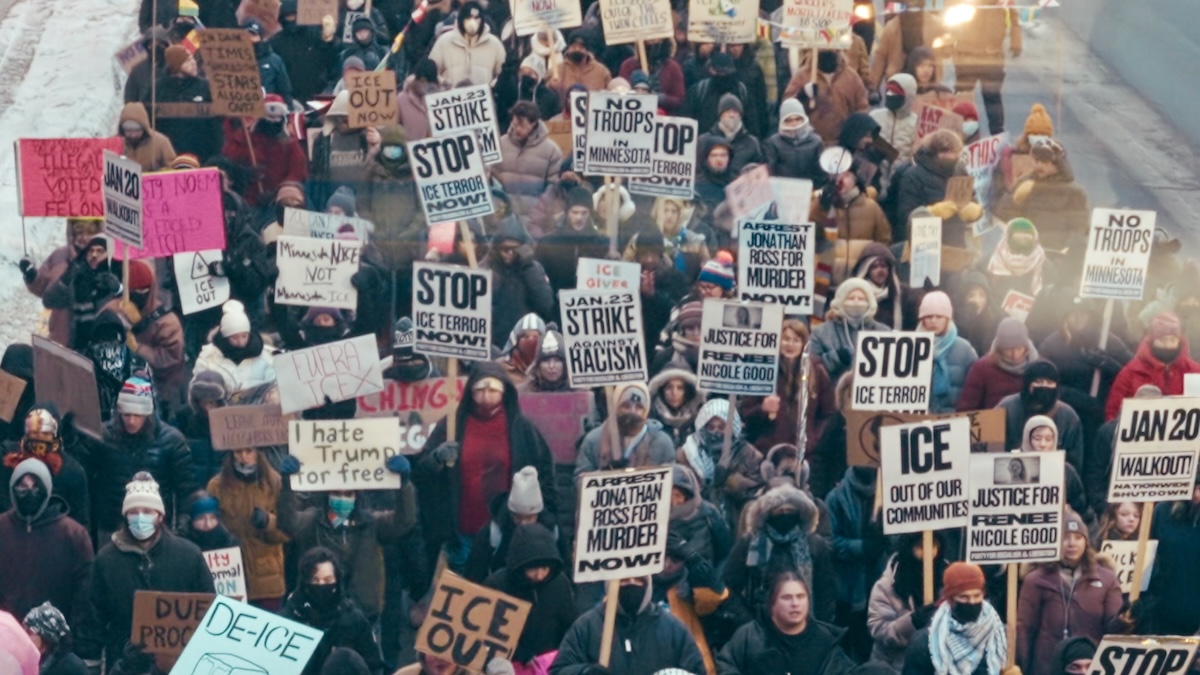
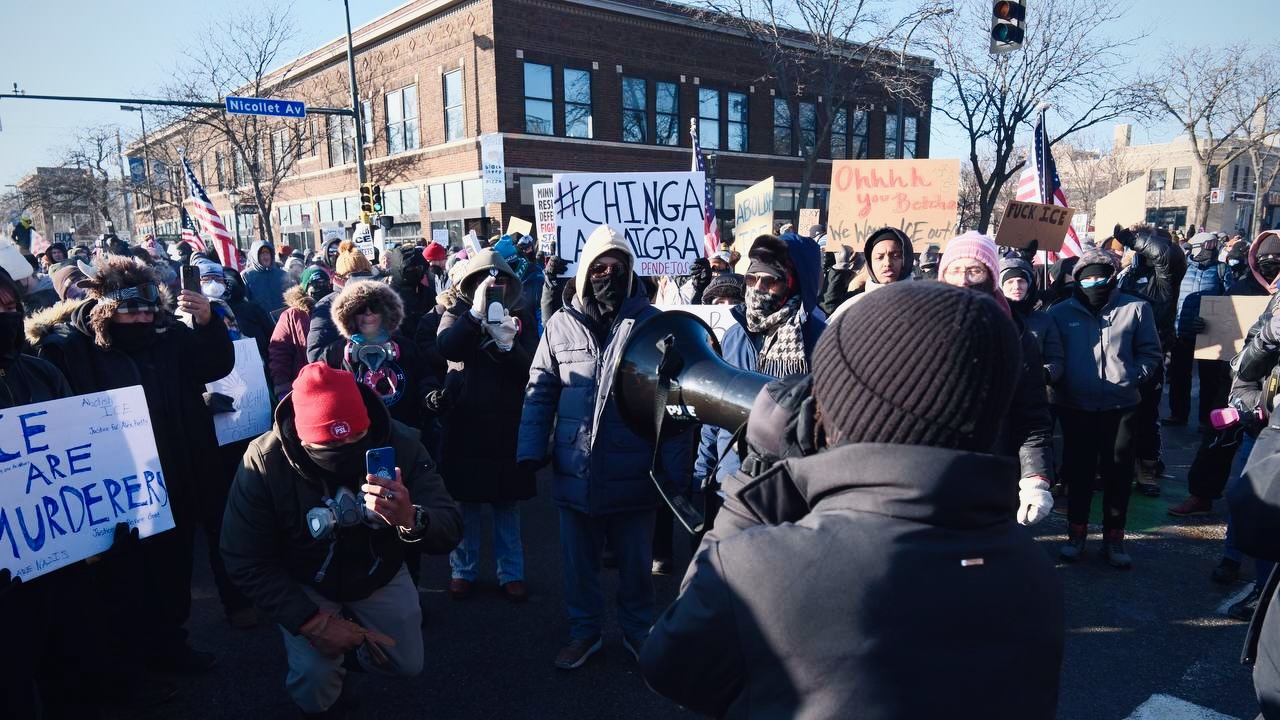
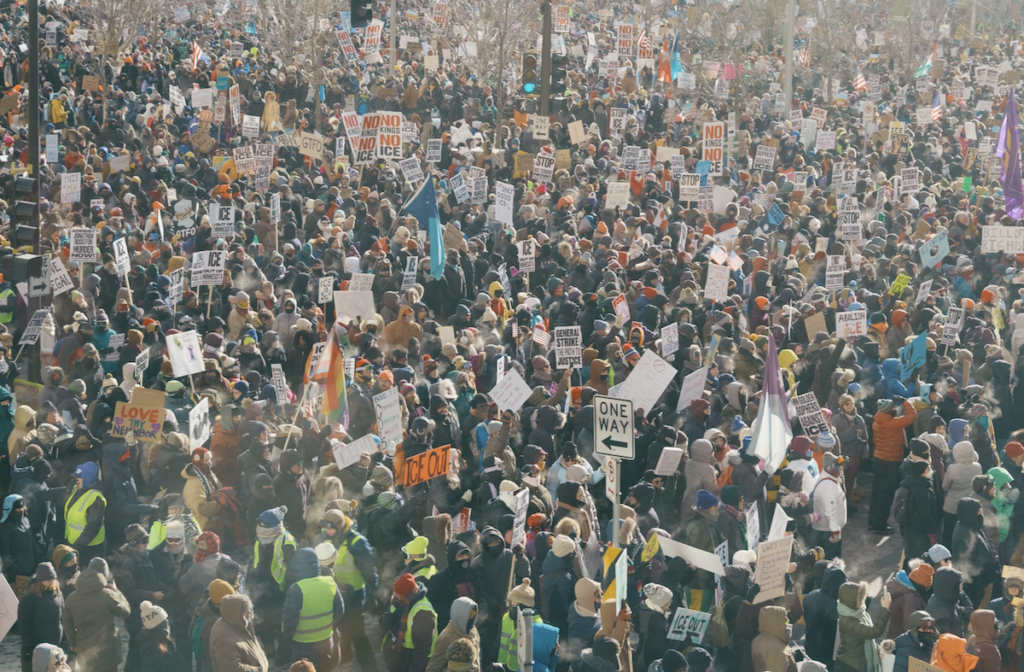
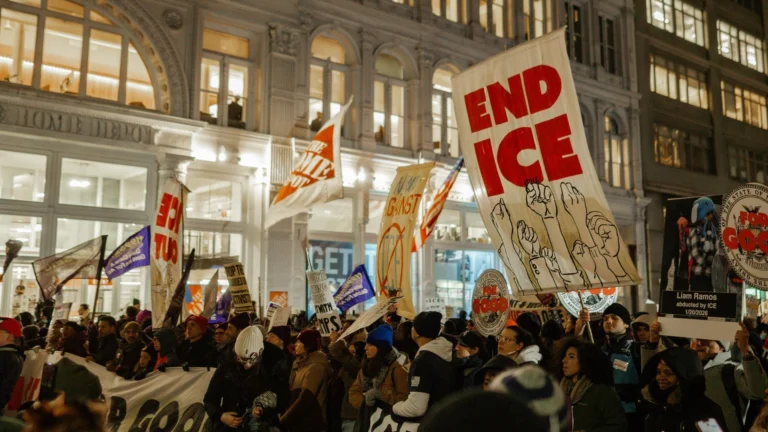
Mass protest against ICE in Minneapolis on January 20. Photo: PSL Twin Cities
Momentum toward a statewide general strike is rapidly building in Minnesota, as unions, businesses, students, and community organizations prepare to shut down work, schools, and commerce on January 23, in response to the killing of Renee Macklin Good and the expanding presence of Immigration Customs Enforcement (ICE) in the Twin Cities.
The community has been fiercely mobilizing since the call to shut down was issued last week by prominent community leaders. Ignited by the call, coordination is stretching across multiple sectors of society, as opposition to ICE becomes a central point of resistance to Trump’s far-right agenda.
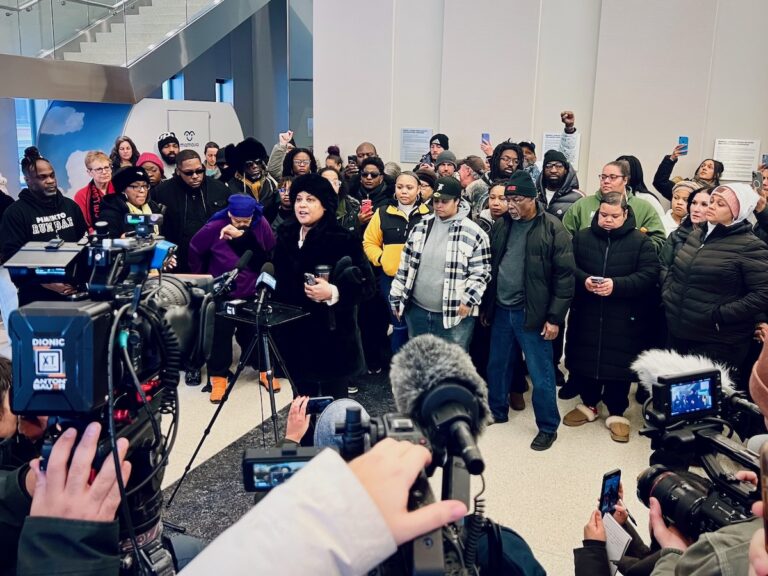
“Come out, fight. Fight for your brother, fight for your sister, fight for your sibling,” said David Stiggers, president of ATU Local 1005, which represents 2700 workers, in a press conference on January 19. “We are all in this together because it will not stop. It will not stop unless we make it stop.”
Justice for Renee Good, and the complete removal of ICE from the state are the primary demands of the community.
The call to shut down the Twin Cities and the entire state of Minnesota has been joined by over 100 labor unions, community organizations, cultural groups, and tenant and neighborhood associations. Hundreds of small businesses so far have also declared they will totally shut down, according to a sign-on letter shared with Peoples Dispatch.
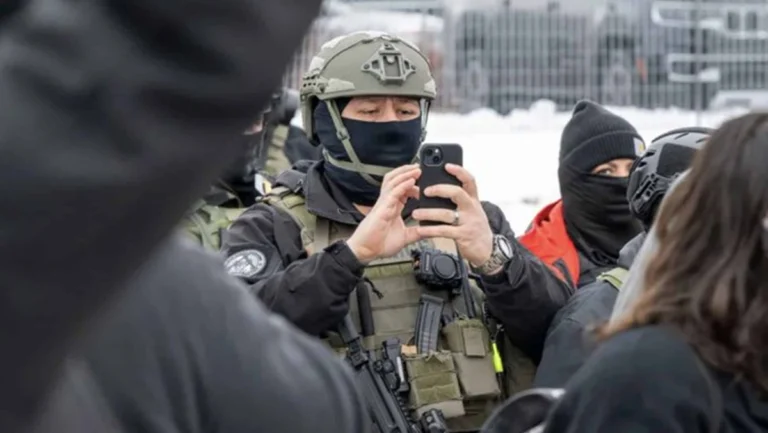
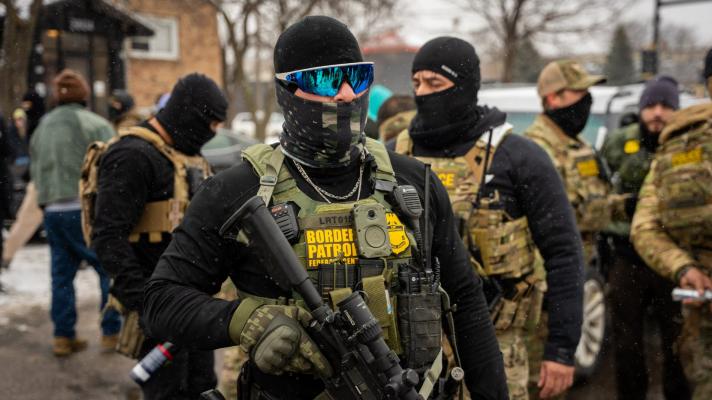
In response to the surging movement, the federal government has threatened to send 1500 US soldiers to the Twin Cities to reinforce the federal forces already there. The total size of the current force is 3500, according to city and state officials.
Minneapolis became the principal battleground against the Trump agenda after an initial 2,000 ICE agents were deployed against the Twin Cities on January 6. Renee Good was murdered the very next day by a federal ICE agent. Instead of changing course, the campaign that the Department of Homeland Security (DHS) calls the “largest federal immigration enforcement operation ever” appears to only be growing larger.
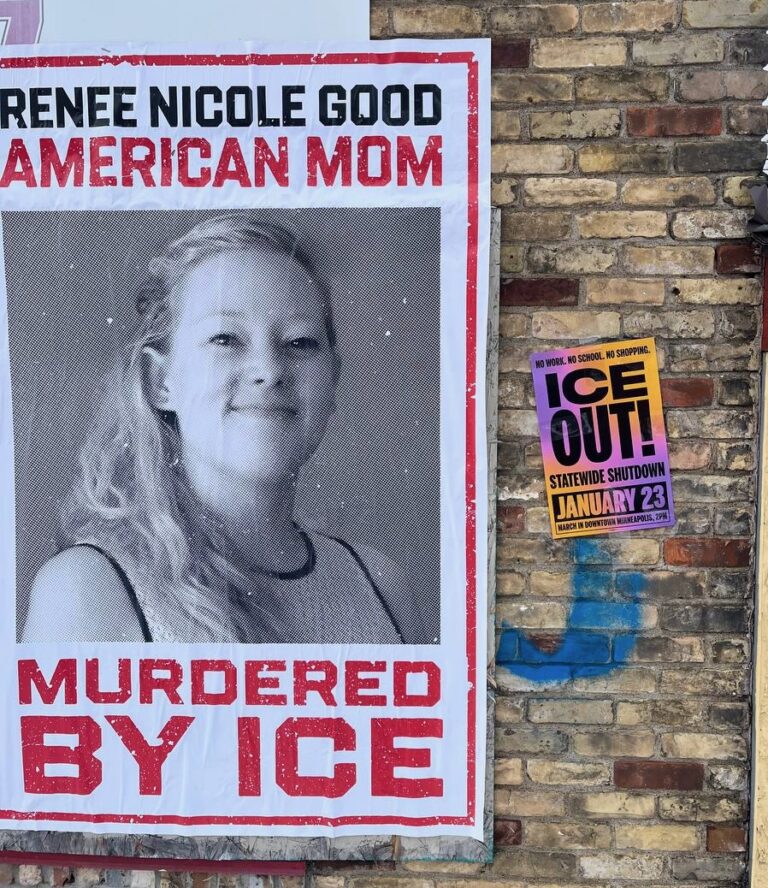
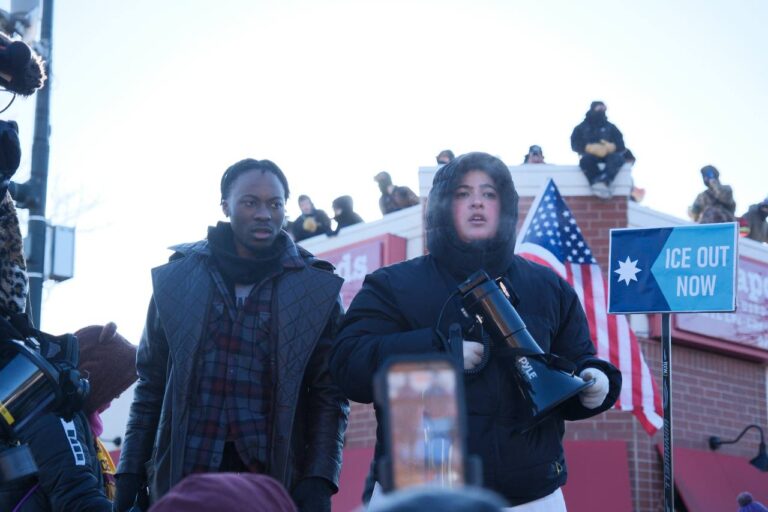
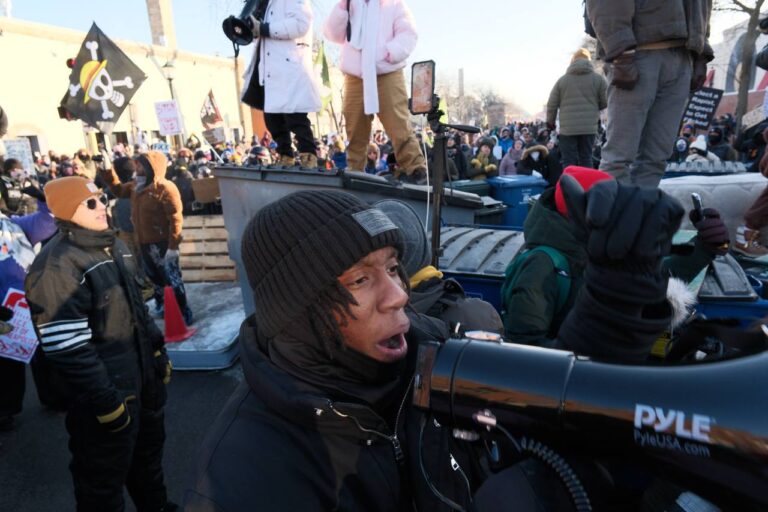
Photo: PSL Twin Cities
In the remaining days ahead of what organizers hope will be a historic statewide shutdown on January 23, the community is taking action daily toward the same demand: “ICE out of Minnesota!”
Confrontations with ICE intensify in the streets
On Sunday morning, protestors disrupted the service of a church where David Easterwood, the St. Paul ICE field office director, serves as pastor. Although the Trump administration has threatened the protestors with federal charges, various community members defended the action and denounced Easterwood’s role as a pastor while at the same time “being directly responsible” for the ICE violence in Minnesota.
On January 17, a crowd of thousands of Minnesotans confronted and chased away far-right influencer and pardoned January 6 rioter Jake Lang, after he planned an anti-muslim demonstration and threatened to “burn a Quran” on the steps of City Hall.
Last week, the day after the January 23 call was made, a second ICE shooting in Minneapolis sparked immediate protests.
Demonstrators converging on the scene were met with flashbangs and tear gas. Multiple witnesses report seeing bystanders, children, and even babies tear gassed by federal ICE agents. (Video at link.)
The Department of Homeland Security (DHS) claimed the shooting was self-defense, but later eyewitness testimony and video completely contradicts the government account. The victim, Julio Sosa-Celis, says he was helping his cousin escape ICE and enter an apartment. Once his cousin was inside, ICE agents shot Sosa-Celis (not the person they were chasing) through the door.
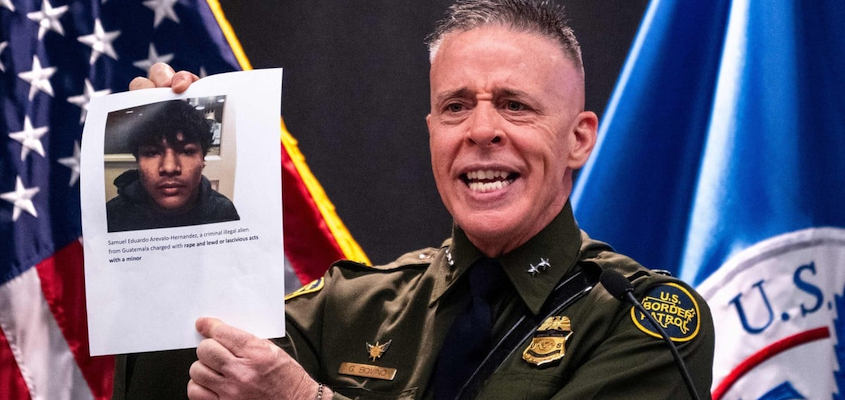
Despite widespread opposition to the ICE deployment (dubbed “Operation Metro Surge” by federal authorities), the Trump administration has doubled down on its rhetoric. In a press conference in Minneapolis on January 20, Head of ICE Gregory Bovino claimed that ICE only targets violent criminals and rapists, saying “what we do is legal, ethical, and moral.” DHS secretary Kristi Noem said the operation in Minnesota is ”a huge victory for public safety,” in a post on X on January 19.
Meanwhile, videos circulating on social media and shared by local organizers show a totally opposite reality. ICE agents seem to constantly be assaulting and violently arresting people, including US citizens, and even members of the Lakota Sioux tribal nation. Some videos show civilian vehicles being rammed to make arrests, women being dragged from their cars, car windows smashed, homes broken into, activists and observers brutalized (one left permanently blind). Not to mention the video of the murder of Renee Good.
For many in Minnesota, these scenes have made clear that conventional protest is no longer enough, and that only a collective shutdown of work, commerce, and daily life can force an end to the violence.
“Abolishing a system isn’t far-fetched”: Unions shut down workplaces
“We can’t continue doing things the old way. We have to adapt so that we can defeat this machine appropriately,” said David Stiggers, president of ATU Local 1005, which represents 2700 workers, in an interview with Labor On the Line.
“Old ways sometimes don’t always work. I’m all for protesting … But how do we stop this from continuing?”
Stiggers says a general strike can show “the power of the people”.
“There would be no movement. The entire city would shut down, if all unions could make that happen.”
Dozens of labor unions have poured into the growing movement against ICE and endorsed the statewide shutdown on the 23rd, including: SEIU 26, UNITE HERE Local 17, AFL-CIO, Minnesota Workers United, Amalgamated Transit Union 1005, North East Area Labor Council, Saint Paul Federation of Educators, and many more.
Communications workers and postal workers rallied at the site of Renee Good’s murder on January 18. They demanded justice for Renee, the removal of ICE from the state, and echoed the call for a January 23 shutdown.
“The concept of abolishing a system isn’t that far-fetched,” said Marcia Howard, president of MFE Local 59, at a union rally outside the Minneapolis postal office on January 19, demanding ICE out of the state.
“I don’t think that it’s reaching for the stars to say that this deleterious organization that just hired people after a demonstrable six-minute interview … maybe shouldn’t exist at all.”
Howard says that Trump’s decision to target Minneapolis was a major strategic error, because “the discipline, the culture, and the community” that’s needed to fight back and win already defines the Twin Cities.
“We’ve been forged by multiple ‘unprecedented events’ before,” she said.
“We’re the same people that marched for Jamar Clark and Philando Castile and brown kids in cages. We were the center of the world’s attention during George Floyd. We’ve had historical strikes in industries of nursing, in education, and we’re a labor town. You really want to mess with working-class people who actually have a labor cohesiveness called the Minnesota Model named after them?”
“Let’s pony up,” says David Stiggers. “Let’s do this in the name of solidarity, in the name of all those who fell before us, who are trying to give us better days. Let’s do it for them.”
Store owners wield economic power against ICE
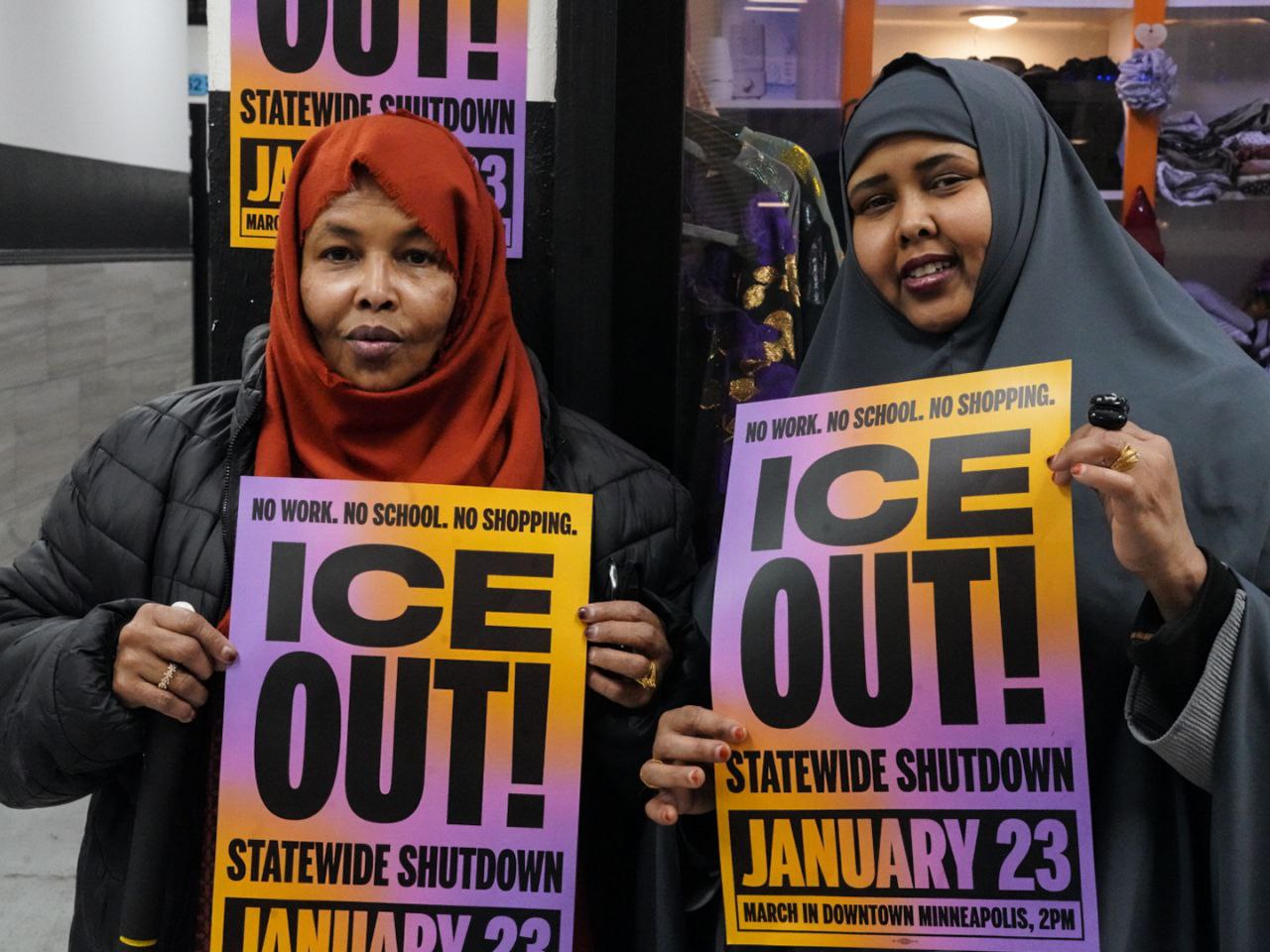
Garment shop owners join January 23 shutdown. Photo: PSL Twin Cities
“We invite all of you to participate this January 23 in this strike,” Candi, owner of Pasteleria Gama, told Peoples Dispatch.
Business owners have highlighted the “economic violence” that ICE operations represent for them, citing a sharp drop in business as their community is heavily targeted by federal forces.
“Our people, they are scared to come into the mall, to go outside … [ICE] killed some people, they shot others, all the people are scared,” said Abdi, owner of Rancho Coffee in 24 Somali Mall (a major commerce hub), speaking to Peoples Dispatch.
“All of the businesses in Mall 24, all Somali people, all our community are coming out and shutting down all the business on Friday.”
Purple and orange posters reading “ICE OUT! Statewide Shutdown” have appeared on windows and doors of hundreds of businesses across the Twin Cities. Business owners are holding press conferences, organizing meetings, and talking to news outlets about the shutdown, amplifying the call to join.
Karmel Mall, another major hub, is completely shutting down this Friday. “No school, no work, no business! ICE out of Minnesota!” chanted Wirse, a garment shop owner in the mall.
In St. Paul’s Hmong Village, another key market for the immigrant community, support for the shutdown was immediate. Especially after a video surfaced on social media showing ICE agents raiding an elderly Hmong man’s home, arresting him, and apparently forcing him outside wearing nothing but shorts and a blanket.
Riverside Mall, in the center of Minneapolis, is yet another hub that has seen a wave of support for the 23rd. At the iconic Mall of America, interest in shutting down is also growing.
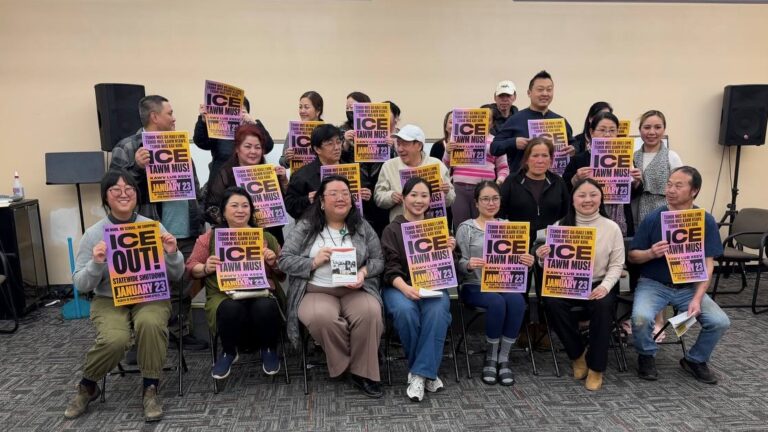
Hmong Village business owners hold an organizing meeting ahead of January 23 shutdown. Photo: PSL Twin Cities
Mass organizing accelerates toward general strike
Organizers and community members are mobilizing to draw still more businesses and organizations into the statewide shutdown against ICE.
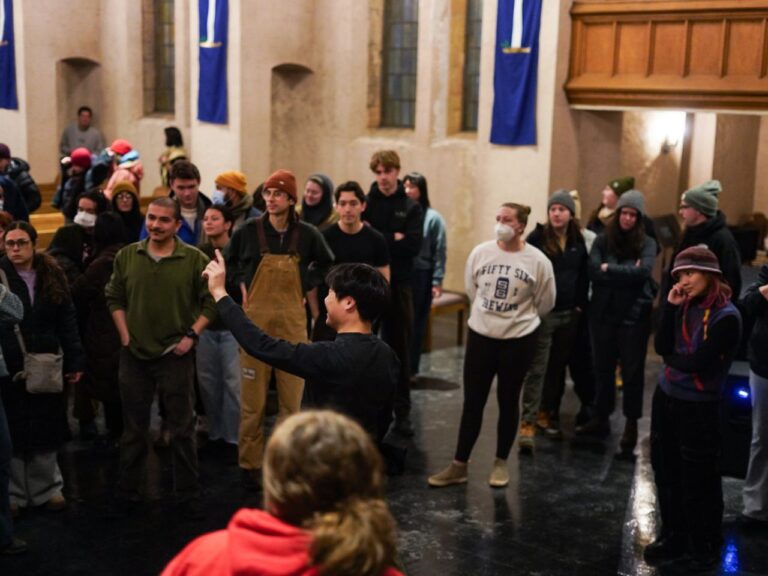
One of two daily volunteer meetings ahead of January 23 shutdown. Photo: PSL Twin Cities
“The things that are going on. It’s insane and ridiculous … We gotta stand up. We gotta do what we can,” said Tianna Toney, a Minneapolis resident and volunteer reaching out to local businesses. “There is too much going on for us not to be saying anything.”
The ranks of organizers and volunteers distributing posters, leaflets, and spreading the word about the shutdown on the 23rd is growing rapidly by the day.
Mass volunteer meetings have started to be regularly organized by the Twin Cities branch of the Party for Socialism and Liberation, where anyone in the community can pick up materials, join outreach groups, and debrief about their efforts. They plan to talk to as many neighbors, businesses, and organizations as possible each day until Friday.
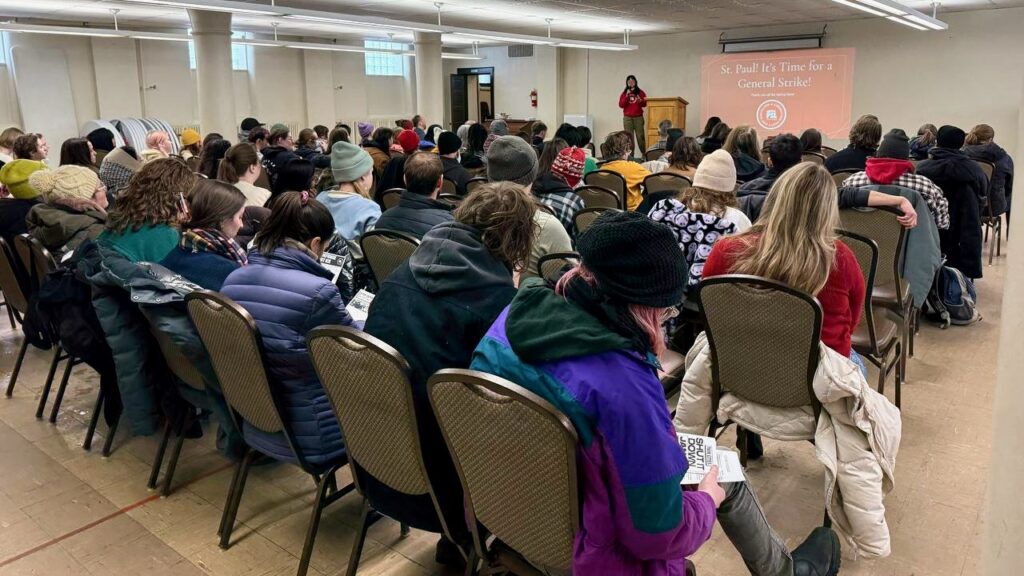
Volunteer meeting in St. Paul. Photo: PSL Twin Cities
Volunteers say they are also working with students and staff at the University of Minnesota who are calling for a shut down of the campus on January 23.
High School students launch walkouts against ICE
Following an ICE assault on students and staff at Roosevelt High School (the same day as the murder of Renee Good), High School students at Roosevelt and across the Twin Cities have been walking out of school in protest of the militarized federal forces in their community.
“ICE needs to leave, not just Minnesota but the entire United States,” said Eleanor, during a student walkout at Central High School in St. Paul on January 15. “On the 23rd, people are advised not to go to work and not to go to school to protest ICE,” Eleanor said.
Hundreds of students also walked out of St. Louis Park High School and other high schools on January 20 as part of a national day of action against Trump.
As workers, students, and community members coordinate their actions, the movement is building a rare alignment across multiple sectors of Minnesota society. From unions shutting down workplaces to small businesses closing their doors, and high school walkouts amplifying youth voices, the city’s daily life is being strategically repurposed as a form of resistance.
If Minnesota succeeds in shutting down workplaces, schools, and commerce on January 23, it could mark a moment when collective economic power forces a national pause on Trump’s far-right agenda. A victory of that scale could serve as a testament for working people across the United States that a general strike can make real change, even at the federal level, while building independent political power that can be leveraged long-term.
https://peoplesdispatch.org/2026/01/21/ ... ps-agenda/
******
The siege of Minneapolis: testimonies from the front lines
January 18, 2026 Melinda Butterfield

Community members confront armed ICE, DHS and CPB cops after they shot a person in the leg on Jan. 17, 2026. Photo: Chris Juhn
In an effort to provide readers with a clearer picture of events in Minneapolis, Struggle-La Lucha has spoken to local activists and community members and gathered testimonies from other participants in the local response to Trump-ICE terror. These voices are being ignored, minimized or distorted by the corporate media.
For weeks and months prior to the new year, activists in the Minneapolis-St. Paul area had been preparing for a full-scale invasion by federal agents – particularly after President Donald Trump leaned into attacks on the Somali immigrant community. The area is home to the country’s largest Somali diaspora and to Rep. Ilhan Omar, a frequent lightning rod for white supremacists.
But the murder of Renee Nicole Good by ICE agent Jonathan Ross on Jan. 7 ignited a mass response to ICE repression throughout the city. Good, a 37-year-old white woman and U.S. citizen, together with her wife Becca Good, were acting as observers documenting an ICE raid.
Multiple videos of Ross’s brutal killing of Good provide ample proof of the vicious misogyny, anti-lesbian and anti-queer hate that fueled the murder.
“The queer community is furious,” local activist Meredith Aby-Keirstead told Struggle-La Lucha. “Not only was Renee Good murdered and labeled a ‘domestic terrorist’ by the Trump administration, but now the Justice Department is investigating Renee’s wife Becca, when in reality they should go after the ICE murderer instead.”
But that anger isn’t limited to LGBTQIA+ people, said Aby-Keirstead, an organizer with the Anti-War Committee. “Minneapolis is outraged at Good’s murder. Many communities are angry at how ICE is tearing our city apart. We had over 100,000 people in the streets on Saturday [Jan. 10].”
Children under siege
P, a young teacher, who asked SLL to remain anonymous, said: “Right away at school today one of my students told me he’s afraid of ICE. These are K-2 students with developmental delays.
“He said three men in vests came to his house over the weekend. He said his older brother was cursing at them and his mother told him to hide.
“I asked him if he wants a whistle to keep in his bag, so he can blow it if he feels scared and he needs to call for help, and he said yes.”
The teacher continued: “I think it’s very odd that the news articles about the closing of Minneapolis schools are connecting it only to the shooting of Renee Good and not the coincidental fact that within hours ICE assaulted children going home from school at Roosevelt High School.
“While it’s true that the shooting did cause an elementary school to go into lockdown, the reason they’re allowing students to learn from home until Feb. 12 is because ICE is kidnapping, assaulting, and tear gassing children as they leave school.”
E, a parent and coordinator of an all-volunteer bookstore, posted on social media: “I really want people without Minneapolis connections to understand. You might’ve heard that Minneapolis public schools went hybrid because so many families are in hiding. Well, a coworker just told me that today, during his kid’s hybrid class, another kid’s apartment building was raided on screen.
“Everyone has stories like this.”
‘Money for names’
Legal observer Brandon Siguenza was violently detained by ICE Jan. 11 and held at the Whipple Federal Building in downtown Minneapolis. Siguenza made a statement shared on social media and was also interviewed by local television station KARE-11.
“They finally told me that they could offer undocumented family members of mine legal protection if I have any… or money, in exchange for giving them the names of protest organizers, or undocumented persons. I was shocked, and told them no.”
Hwa Jeong Kim, vice president of the St. Paul City Council, posted a video for residents of her district, stating: “Before 9:30 this morning ICE already kidnapped someone off the streets of my ward. We have first-hand accounts of neighbors reporting ICE showing up at their homes, asking people to identify pictures …
“They ask them, ‘Do you know any of your Hmong neighbors?’ They even go so far as asking, ‘Do you know any Asian people in your neighborhood?’ And they said no.
“This going door-to-door to random homes is a clear escalation. I don’t want to be the person to say that it’s not safe to go outside today, but folks really need to decide for themselves how safe they feel out in their neighborhoods.
“And still there are community patrols keeping an eye out for you. There are caring neighbors who want to deliver groceries to you and provide mutual aid. Please stay safe.”

Federal agents flooded the streets of Minneapolis with tear gas and other chemicals on Jan. 17, 2026. Photo: Chris Juhn
‘Our movements are connected’
Sarah Martin is an organizer of Women Against Military Madness (WAMM), which started in the 1980s to oppose U.S.-funded wars in Latin America. Martin told SLL, “WAMM and the anti-war movement in Minneapolis understand that all our movements are connected and that we are fighting the same enemy: U.S. imperialism.
“In the case of ICE, it’s about the connections. That monstrosity has connections to the IOF [Israel Occupation Forces] through training and reports of direct involvement. The wars the U.S. perpetrates in Latin America and beyond – whether military or sanctions or regime changes – have forced people out of their homelands and to migrate here.
“It is unjust and so cruel,” said Martin. “Our government makes life unbearable for people in their countries, they feel they have no choice but to leave, and then they make it just as miserable for them here. So of course, we respond when ICE is terrorizing a neighborhood.”
Martin added: “For at least 10 years WAMM has held a weekly bannering at the Whipple Federal Building, which holds the immigration court and from which immigrants are deported. The bannering happens at 7:30 a.m., when vans holding deportees go by. Now it’s the site of ICE agents staging every morning.”
Chris Juhn is a photojournalist who covers many protests in Minneapolis, including during the 2020 uprising after the police murder of George Floyd.
On the night of Jan. 14, Juhn was documenting the federal agents’ attack on protesters and legal observers after ICE shot a person in the leg. He photographed the feds unleashing an unidentified green gas not seen at previous protests.
“That was the most tear gas I’ve ever experienced in my life,” Juhn recalled. “I must’ve been hit with at least five rounds of tear gas, some incredibly thick. Had some shrapnel from flashbangs fly around me. When you see a flaming ball shooting sparks fly by your head, it’s terrifying.
“I was next to a crowd that was completely peaceful. Next thing, they’re tossing tear gas and flash bangs at everyone without warning. A car nearly hit me as everyone scrambled.
“The Minneapolis PD seemed useless. I had my editor tell me to clear out.”
Somali community patrols
The Intercept published a report on ICE watch patrols organized by Somalis to keep their community safe.
Those participating are mainly people with U.S. citizenship, explained Abdi Rahman, a founder of the West Bank neighborhood patrol. “The non-citizens have stopped stepping out entirely. We buy groceries for them and drop them off at their homes.”
“The armed men and women, with their faces covered, roaming our streets and profiling us – we thought we had left all that behind, but now this moment in America is reminding us again of the Somali civil war,” said Imam Yusuf Abdulle of the Islamic Association of North America.
“But we are fighting. We didn’t come this far, make our lives here, to again be targeted and abused like this.”
“We fled a civil war,” community activist Mahmoud Hasan said. “We are more resilient than they think.”
https://www.struggle-la-lucha.org/2026/ ... ont-lines/
******
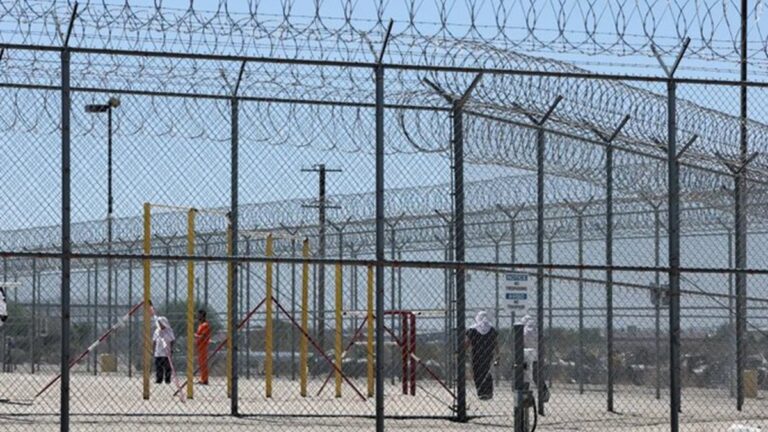
Health Crisis Deepens at U.S. Immigration Detention Facilities as Illnesses Spread
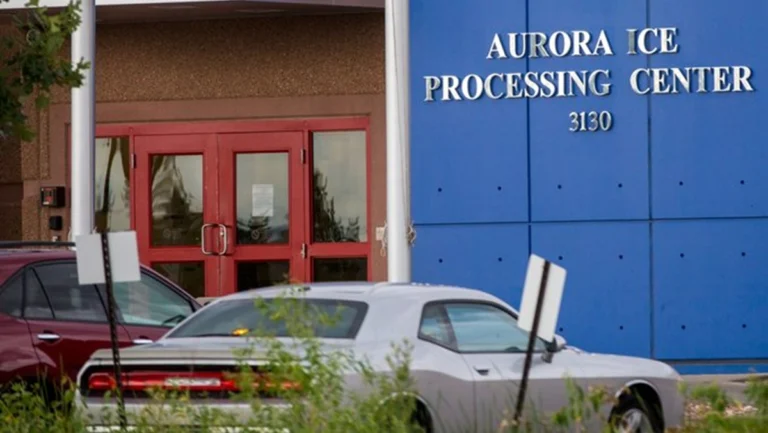
Aurora ICE Processing Center. X/ @solitarywatch
January 22, 2026 Hour: 8:26 am
The outbreak in Aurora is not an isolated incident within ICE’s detention system.
U.S. health officials are investigating reports of widespread illness at a near-capacity immigration detention facility in Aurora, a city in the U.S. state of Colorado that lies partly in Adams County, after immigrant-rights advocates alleged that a largely untreated outbreak had swept through the center.
A spokeswoman for the Adams County Health Department, Jennifer Lucero-Alvarez, was quoted by the Denver Post recently as saying that health officials had “received multiple reports about possible gastrointestinal and respiratory illness” at the facility. She declined to provide additional information about the current health conditions in the facility and how many of the facility’s detainees are sick.
The Denver Contract Detention Facility (Aurora) reported multiple cases of influenza early this month, U.S. Representative Jason Crow’s office confirmed the news, though U.S. Immigration and Customs Enforcement (ICE) officials have not disclosed how many people are affected. ICE is the federal agency responsible for detaining immigrants awaiting deportation hearings or removal from the country.
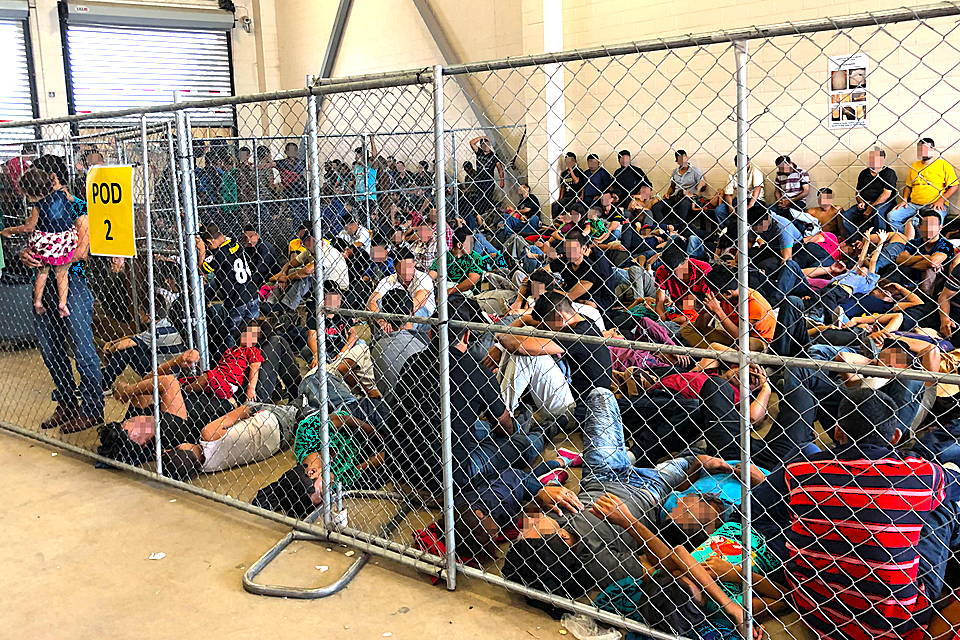
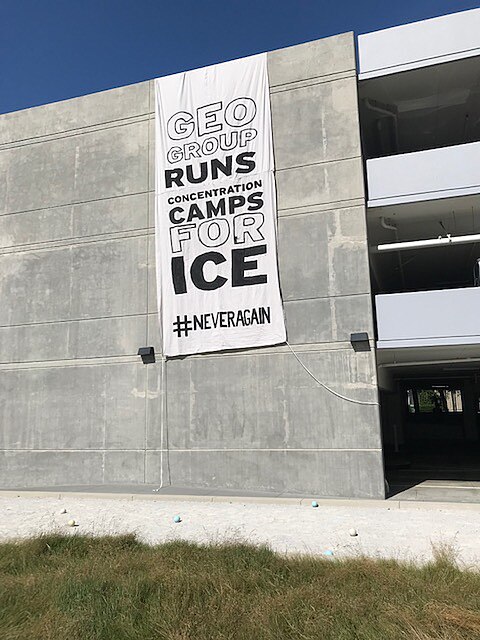
The 1,532-bed Aurora facility is operated by GEO Group, a private corporation that manages detention centers under contract with the U.S. federal government. The facility has a documented history of failing to contain contagious diseases dating back years.
Hundreds gathered outside the Aurora ICE detention center for Immigrant Stations of the Cross. Faith leaders echoed the U.S. bishops’ call to reject mass deportations and dehumanizing rhetoric. Our message is clear: Every person is sacred. #ImmigrantJustice #COPolitics pic.twitter.com/C0ab0l2t2I
— TogetherCO (@TogetherCO) December 12, 2025
In February 2020, ICE inspections found 68 people quarantined with flu and 70 with mumps at the Aurora center, according to a ProPublica investigation. The facility experienced three separate outbreaks in four months during 2019, including mumps and chickenpox.
The Aurora facility has faced multiple complaints about inadequate medical care. A 2024 report by the American Civil Liberties Union (ACLU) documented cases of medical incompetence, dental neglect, and inadequate mental healthcare, which contributed to at least two deaths at the facility. In one case, staff abruptly cut a detainee off his medication, relied on incorrect medical protocols and believed that he was faking his symptoms — including a seizure — prior to his death.
The outbreak in Aurora is not an isolated incident within ICE’s detention system. A study by the University of California, San Francisco, which was published in the JAMA medical journal, found that 17 out of 22 ICE detention centers experienced sustained outbreaks of vaccine-preventable illnesses between January 2017 and March 2020. One facility had a chickenpox outbreak lasting 33 months and year-round influenza transmission.
In December 2025, the Golden State Annex Facility in McFarland, California, experienced an outbreak of scabies, a highly contagious skin condition caused by mites that can spread rapidly in crowded settings. The Kern County Public Health Department confirmed several cases and said it was working with the facility’s medical staff to prevent further transmission.
Record highs of people in ICE detention, 32 deaths inside facilities, and harsh conditions leave migrants afraid to seek basic services, while the human cost stays out of public view pic.twitter.com/7KOoRwdrAr
— TRT World (@trtworld) January 22, 2026
The Northwest ICE Processing Center in Tacoma, Washington, confirmed seven suspected tuberculosis cases in July 2025. One detainee was hospitalized with active TB after being transferred from the Anchorage Correctional Complex to Tacoma.
As of January 2025, 86 percent of ICE detainees were held in facilities run by for-profit companies, according to immigration tracking data. This represents an increase from 81 percent in January 2020. Two corporations — the GEO Group and CoreCivic — dominate the market. In 2022 alone, the GEO Group made 1.05 billion U.S. dollars in revenue from ICE contracts.
Government inspectors have found barbaric and negligent treatment in ICE detention facilities. According to a 2023 National Public Radio report, expert inspectors documented negligent medical care, unsafe and filthy conditions and racist abuse of detainees. One inspector noted that violations found at a GEO Group facility were so severe that if discovered in a hospital, it could be forced to shut down.
On Jan. 12, the Aurora City Council passed a resolution condemning ICE operations, citing the Minneapolis fatal shooting, an unmanaged illness outbreak at the GEO ICE detention facility and other ICE overreach cases in the city. Representative Crow filed a lawsuit in the week of Jan. 11 against the Trump administration, alleging that officials had blocked congressional oversight of immigration detention facilities, including the one in Aurora.
https://www.telesurenglish.net/health-c ... es-spread/
******

AIM members are showing up in force in Minneapolis to protect the community in the 2026 unrest. Here, an AIM members attends a demonstration in 2020 in Minneapolis after the death of George Floyd at the hands of police. Photo: John Arthur Anderson)
‘Full Circle’: AIM patrols back on Minneapolis streets as tensions rise
Originally published: Indian Country Today on January, 17, 2026 by Stewart Huntington (more by Indian Country Today) | (Posted Jan 22, 2026)
The wave of federal immigration agents swarming the Minneapolis area might be unprecedented in law enforcement history, but the response in the Indigenous community is not.
Half a century ago, the American Indian Movement was founded on Franklin Avenue, the heart of the urban Indian diaspora in South Minneapolis, to counter overzealous municipal policing.
Today, AIM patrols are back, watching over elders, youths and aunties along the same avenue in what is now known as the city’s American Indian Cultural Corridor.
“History shows us time and time again, it doesn’t repeat, but it rhymes,” said Heather Bruegl, an activist, historian and Oneida Tribe of Wisconsin citizen who has studied the American Indian Movement.
So you can look throughout history and see different examples of what we see today happening in the past.
And if the history rhymes, some of the names do even more. Some are the same.
Crow Bellecourt, Bad River Band of Chippewa, has been out on the recent patrols. His father, the late Clyde Bellecourt, was among the founding members of AIM in 1968.
“I grew up in the movement,” said Bellecourt, executive director of the Indigenous Protector Movement, a group with AIM roots.
I always like to say, ‘I’m second-generation American Indian Movement.’ It’s, like, full circle for me.
The confrontations between law enforcement and protestors in Minneapolis—including the shooting of 37-year-old Renee Good— have brought reports that Indigenous people have also been swept into custody.
A cohort of Indigenous patrollers has now reached close to 100, Bellecourt said.
“We’re running from seven in the morning to seven in the evening,” he said.
And even more. We still have some patrollers going out until like 11 or 12 at night.
And just like in 1968, the patrollers are on the street to help community members feel safe.
“It’s really scary here,” said Mary LaGarde, executive director of the Minneapolis American Indian Center, which operates from its base on Franklin Avenue.
Federal Immigration and Customs Enforcement officers have surged into the Twin Cities area to counter what the Trump administration has called corruption and criminality in area immigrant populations. At this point, there are more federal law enforcement officers in Minneapolis than metropolitan police.
The dramatic presence has prompted widespread protests and rebukes from state and local officials. There have been at least two shootings involving the federal officers.
“We woke up and we had all these ICE agents everywhere,” said Bellecourt.
They’re all over our neighborhood. I’m scared for our old people and the young ones who just wanted to catch the city bus to go to the grocery store. … I worry about them getting picked up from ICE.
LaGarde, White Earth Band of Chippewa, knows the feeling.
“It’s like you don’t want to leave the house,” LaGarde told ICT.
That’s how most of our people are feeling right now. Our elders are scared. Our young people, too. This is really impacting our kids.
LaGarde said the patrols–by AIM members and other groups such as the Many Shields Warrior Society–are needed.
“it’s really important that we’re out protecting,” she said.
The numbers of volunteers out patrolling are growing.
“We have relatives coming in from South Dakota, Wisconsin and neighboring states,” Bellecourt said. Some have come from as far away as Oklahoma, he said.
Just like in the old days, AIM members are gathering along Franklin Avenue just as they gathered for occupations of Alcatraz Island in San Francisco in 1969, the Bureau of Indian Affairs headquarters in 1972, and the Wounded Knee massacre site in 1973.
AIM members also turned out in force in Minneapolis in 2020 after the death of George Floyd at the hands of law enforcement.
What’s different from the early years? Modern communication tools.
“We didn’t have these cell phones and all this social media back in them days,” Bellecourt said.
Everybody called on house phones and it was amazing how many people would show up. My dad called it the ‘moccasin telegraph’ and people would just call one another and, wherever they needed people to be, everyone would show up.
They came to help the people.Then and today.
“One of the first acts that AIM did when they were forming was patrolling the streets and making sure that if their community members were stopped or pulled over by the police, that their rights were being followed, like, you know, ‘Hey, you have the right to this, you have the right to that,’” Bruegl said.
“And we see that now happening again [because] people’s rights are being violated. We see Indigenous folks, tribal members being detained,” Bruegl said.
It’s important that groups like AIM and other groups are coming out again, working in community and making sure that we’re protecting each other.
https://mronline.org/2026/01/22/full-ci ... ions-rise/







 pic.twitter.com/Z33K8XN44U