Blues for Europa

User avatar
blindpig
Posts: 14890
Joined: Fri Jul 14, 2017 5:44 pm
Location: Turtle Island
Contact:

Re: Blues for Europa

Post by blindpig » Sat Dec 06, 2025 3:12 pm

Damage Control: Major Blows to EU as von der Leyen's Rotten Regime Teeters
Simplicius
Dec 05, 2025

The EU cabal is experiencing some serious setbacks, not to mention blows to the tattered drapes of its credibility.

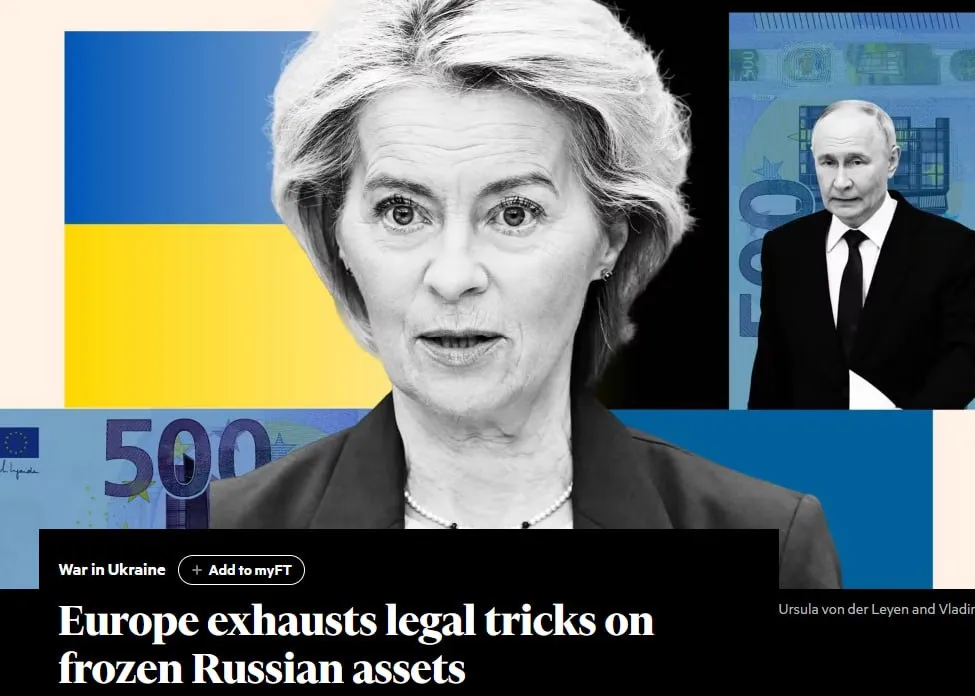
First there was the fact that Belgium has officially rejected its piracy plans of stealing Russian assets, which came as a major slap in the face of EU apparatchiks.

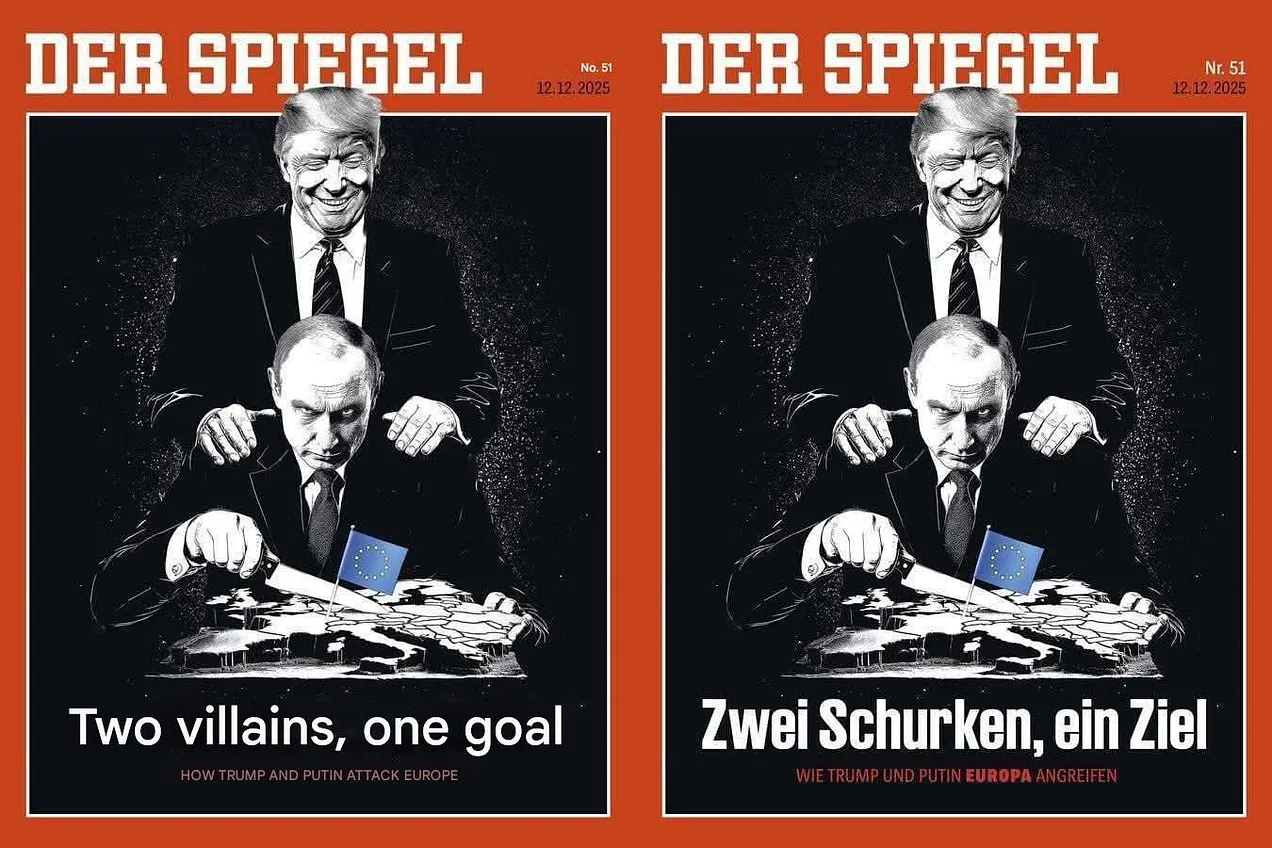
Two headlines juxtaposed for effect:

Image
Image

Now Belgium is too a ‘Russian asset’, as can be seen by the risibly tired script.

The Belgian prime minister revealed in an interview that Russian ‘threats’ apparently gave him cold feet.

Bart De Wever: “Moscow has let us know that if its assets are seized, Belgium and I will feel the consequences for eternity...”

The full statement is even more interesting—read the bolded parts in particular:

Question: The issue of “frozen” Russian assets is taking up a lot of your time and energy. Is that fair?

The pressure surrounding this issue is incredible. I have a team working day and night on it. It would be a great story: taking money from the wicked guy, Putin, and giving it to the good guy, Ukraine. But stealing frozen assets from another country, its sovereign wealth fund, has never been done before. This is money belonging to the Russian Central Bank. Even during World War II, Germany’s money was not confiscated. During a war, sovereign assets are frozen. And at the end of the war, the losing state must give up all or part of these assets to compensate the victors. But who really believes that Russia will lose in Ukraine? It’s a fairy tale, a total illusion. It is not even desirable for it to lose and for instability to take hold in a country that has nuclear weapons. And who believes that Putin will calmly accept the confiscation of Russian assets? Moscow has let us know that in the event of seizure, Belgium and I, personally, would feel the effects “for eternity.” That seems like a rather long time to me... Russia could also confiscate certain Western assets: Euroclear has 16 billion in Russia. All Belgian factories in Russia could also be seized.


As can be seen, the decision to not play games with Russia’s money rests entirely on the conviction that Russia will definitely win the war, and as such cannot be forced to pay such reparations as the “loser”.

If this weren’t big enough of a thorn for the nefarious EU, this week a major fraud probe shook the EU’s foundations as several high ranking officials were suddenly arrested under von der Leyen’s deteriorating watch, spurring calls for a fourth vote of no confidence for the Queen of Rot herself:

Image
https://www.politico.eu/article/ursula- ... n-service/

Politico reports:

Ursula von der Leyen is facing the starkest challenge to the EU’s accountability in a generation ― with a fraud probe ensnaring two of the biggest names in Brussels and threatening to explode into a full-scale crisis.

An announcement by the European Public Prosecutor’s Office that the EU’s former foreign affairs chief and a senior diplomat currently working in von der Leyen’s Commission had been detained on Tuesday was seized on by her critics, with renewed calls that she face a fourth vote of no confidence.


It seems a kind of elite civil war has erupted within the crumbling walls of the EU, and we are surely in for an entertaining unraveling.

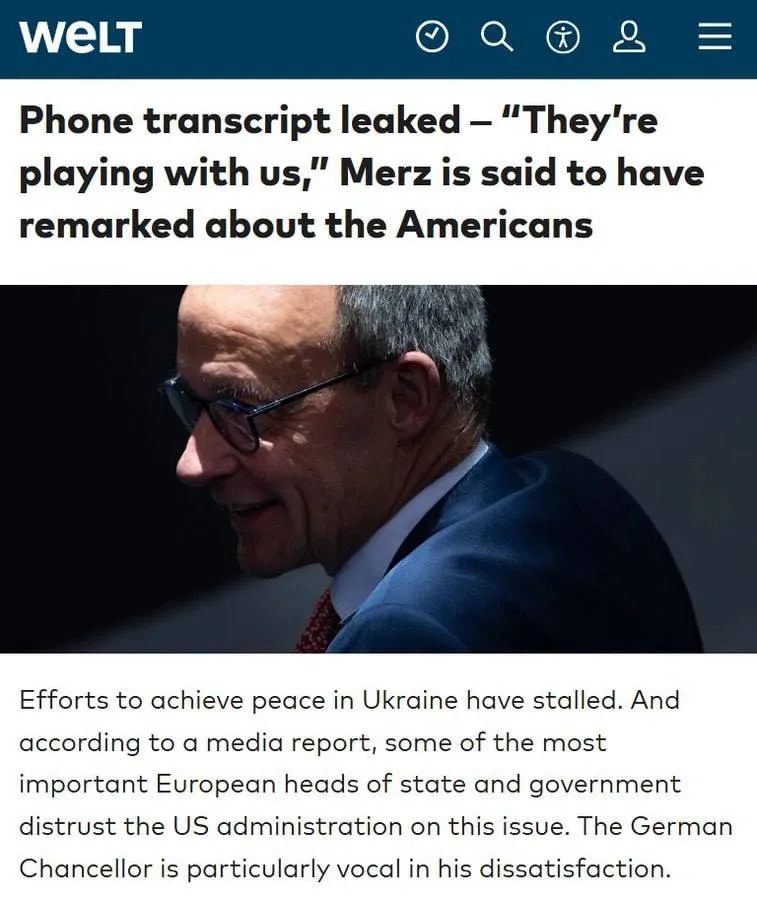
If that weren’t bad enough, the civil war between the EU and the US is likewise scintillating, as a series of new EU “leaks” have indicated:

Image
https://www.welt.de/politik/ausland/art ... haben.html

ZeroHedge summarizes as follows:

The leaked transcript of the call between European leaders strategizing about how to protect the Zelensky government and Kiev’s interests was published Thursday by the German magazine Der Spiegel.

Also reportedly on the line engaged in the conversation were German Chancellor Friedrich Merz, NATO Secretary-General Mark Rutte, Finnish President Alexander Stubb, and of course Zelensky as well.


The key excerpt demonstrates the utter trepidation of the panicking Euro-suits:

Finland’s Stubb seemed to agree with Merz, according to the transcript. “We cannot leave Ukraine and Volodymyr alone with these guys,” he said, apparently referring to Witkoff and Kushner, which attracted agreement from Rutte.

“I agree with Alexander — we must protect Volodymyr [Zelenskyy],” the NATO chief said. NATO declined to comment when reached by POLITICO.


It’s clear the Europeans are desperate to protect Zelensky at all costs from the wiles of the Trump team, with Macron in particular intimating his fears that US “will betray” Ukraine. Unfortunately, this antic troupe is one act short of a circus: (Video at link.)


There have been some interesting tidings on the Russian oil and sanctions front.

The energy and commodities correspondent at Bloomberg writes:

Image

Matryoshka oil trading:

Goldman Sachs says that oil exports from Lukoil and Rosneft are down ~1.1m b/d, but **simultaneosly** exports from other Russian “non-sanctioned companies” are up 1.0m b/d.

“Russian oil trading networks are reorganizing quickly,” the bank says.


Woops.

More:

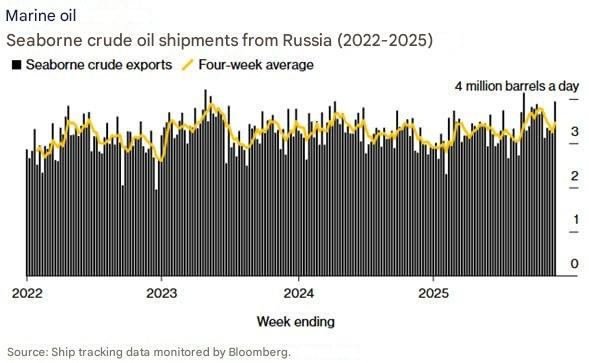
Russian seaborne oil exports are rising again

Bloomberg awkwardly tries to describe the situation:

Moscow is struggling to supply crude oil under U.S. sanctions: seaborne shipments have increased by one-fifth over three months.

According to the agency, Russia has steadily maintained deliveries at over 3 million bpd, but there are problems with transportation and unloading.

The average travel time for ESPO crude from Kozmino to Chinese ports has increased to 12 days for vessels loaded in November (previously it was no more than 8).

Based on vessel-tracking data, Russia shipped 3.46 million bpd over the four weeks ending November 30, which is about 210,000 barrels more than the week before.

This is the first increase since the U.S. announced sanctions in mid-October against oil giants Rosneft PJSC and Lukoil PJSC, the agency acknowledges.

The average daily volume of shipments for the past week rose to 3.94 million bpd, which is roughly 690,000 bpd more than the previous week.

On average for the month, the gross value of Russian exports remained unchanged at $1.13 billion per week, with higher export volumes offsetting the ninth consecutive decline in average prices.


Image

That’s not to mention the obligatory revision of another much-needed propaganda bit about Russia’s so-called gas crisis:

Image
https://www.themoscowtimes.com/2025/12/ ... ise-a91322

(More at link, Ukraine)

https://simplicius76.substack.com/p/dam ... lows-to-eu

******

Our goal must be to help Europe correct its current trajectory.
December 5, 5:00 PM

Image

Interesting excerpts regarding Europe in the new US National Security Strategy

The war in Ukraine has had the perverse effect of deepening Europe's, and Germany's, external dependence. Today, German chemical companies are building some of the world's largest refineries in China, using Russian gas they cannot obtain at home. The Trump administration is at odds with European officials who harbor unrealistic expectations about the war and who themselves rule in unstable minority coalition governments, many of which trample on the basic principles of democracy and suppress the opposition. Most Europeans want peace, but this desire is not translated into policy, largely because these same governments undermine democratic processes. This is strategically important for the United States precisely because European states cannot reform themselves if they are stuck in political crisis.

Nevertheless, Europe remains strategically and culturally vital to the United States. Transatlantic trade remains a pillar of the global economy and American prosperity. European industries—from manufacturing to technology and energy—remain among the strongest in the world. Europe is home to cutting-edge scientific research and the world's leading cultural institutions. We cannot afford to write Europe off—to do so would be detrimental to ourselves and to the goals this strategy seeks to achieve.

American diplomacy must continue to champion genuine democracy, freedom of expression, and an unabashed appreciation of the individual character and history of European nations. America encourages its political allies in Europe to foster this spiritual renaissance, and the growing influence of patriotic European parties truly provides grounds for great optimism.

Our goal must be to help Europe correct its current trajectory . We will need a strong Europe to compete successfully and to work with us to prevent any adversary from dominating the European continent.

America, of course, has a sentimental attachment to the European continent—and, of course, to Britain and Ireland. The character of these countries is also of strategic importance, because we count on creative, capable, and confident democratic allies to establish the conditions for stability and security. We want to work with like-minded countries that are striving to restore their former greatness.

Original in English on the White House website.
https://www.whitehouse.gov/wp-content/u ... rategy.pdf

https://t.me/yusupovskij/4942 - zinc

https://colonelcassad.livejournal.com/10228421.html

Googe Translator

******

Theft of Russian wealth is tying the entire EU bloc to a sinking ship, or worse, all-out war

December 5, 2025

The criminal, irresponsible Euro elites like von der Leyen, Kallas, Merz, Macron, and NATO’s Rutte, are lashing the EU financially to a sinking ship.

European Commission President Ursula von der Leyen is pushing ahead with a reckless plan to confiscate over €200 billion in Russia’s sovereign wealth for the purpose of propping up the corrupt NeoNazi Kiev regime and prolonging a futile proxy war.

It is hard to imagine a more crass course of action. Yet the so-called European leadership around Von der Leyen is zealously steering towards disaster. At least the hapless captain of the Titanic tried to avert collision with an iceberg. The Euro captains are heading full steam ahead.

Von der Leyen’s proposed scheme is fancifully called a “reparations loan” and pretends, through legalistic rhetoric, not to be a confiscation of Russia’s assets. But it boils down to theft. Theft to continue the bloodiest war in Europe since the Second World War, which marked the defeat of Nazi Germany.

Von der Leyen, a former German defense minister, is supported by other obsessively Russophobic Euro elites. The EU’s foreign minister Kaja Kallas, a former Estonian prime minister, asserts that the seizure of Russian money and pumping it into the Kiev regime is aimed at forcing Moscow to negotiate a peaceful end to the nearly four-year conflict. Such twisted logic is an Orwellian distortion of reality.

Belgium and other European states are extremely wary of the unprecedented and audacious move. Belgium, which holds the majority of frozen Russian wealth – some €185 bn – in its Euroclear depository, is anxious that it will be financially ruined if Moscow holds the EU liable for illegal seizure of wealth. Other EU members, like Hungary and Slovakia, are concerned that the Russophobic leadership is undermining any diplomatic initiatives by the U.S. Trump administration and the Kremlin to negotiate a peace settlement.

Russian President Vladimir Putin has warned that any confiscation of Russian assets by the EU leadership – regardless of financial rhetorical packaging – will be viewed by Moscow as theft of sovereign wealth. Russia has vowed it will respond robustly with legal challenges under existing treaties to exact compensation. This is what Belgium is fearful of and why it is resisting von der Leyen’s loan reparation scheme.

The European leaders are to hold a summit on December 18-19 to decide on the proposal. So desperate are the Russophobic elites that they have been assiduously piling political pressure on the Belgian government to relent in its opposition to go along with the scheme. In trying to get Belgium onboard, von der Leyen has written legal guarantees that all EU members will share any legal and financial repercussions. Thus, the unelected European Commission president is taking it upon herself to write a suicide note for the whole of Europe.

Essentially, the proposed loan reparation scheme is based on using Russian immobilized investments in EU banks as a guarantee to give €140 bn in an interest-free hand-out to Ukraine. The financial life-line is necessary because Ukraine is bankrupt after four years of fighting a proxy war on behalf of NATO against Russia.

Ukraine and its NATO sponsors have lost this conflict as Russian forces gather momentum with superior military force. But rather than meeting Russia’s terms for peace, the Euro elites want to keep on “fighting to the last Ukrainian”. To sue for peace would be an admission of complicity in a proxy war and would be politically disastrous for the European warmongers. In covering up their criminal enterprise and lies, they are compelled to keep the “defense of Ukraine” charade going.

Given the rampant graft and embezzlement at the core of the Kiev regime as indicated by the recent firing of top ministers and aides, it is certain that much of the next EU loan will end up in offshore bank accounts, foreign properties and being snorted up the noses of the corrupt regime.

Von der Leyen’s artful deception of theft claims that the Russian assets are not confiscated permanently but rather will be released when Moscow eventually pays “war damages” to Ukraine. In other words, the scheme is a blackmail operation, one that Russia will never comply with because it is premised on Russia as a guilty aggressor, rather than, as Moscow and many others see it, as acting in self-defense to years of NATO fueled hostility culminating in the CIA coup in Kiev in 2014 and weaponizing of a NeoNazi regime to provoke Russia. Therefore, under von der Leyen’s scheme, Russia’s frozen funds will, in effect, never be returned and, to add insult to injury, will have been routed through to the benefit of Kiev mafia.

Such a criminal move is highly provocative and dangerous. It could be interpreted by Moscow as an act of war given the huge scale of plunder of the Russian nation. At the very least, Russia will pursue compensation under international treaties and laws that could end up destroying Belgium and other EU states from financial liabilities. How absurd is that? Von der Leyen and her Russophobic ilk are setting up Europe for bankruptcy by stealing Russia’s wealth for propping up a corrupt NeoNazi regime that has already sacrificed millions of Ukrainian military casualties?

Alternatively, if the EU leadership does not get away with its madcap robbery scheme at the summit on December 18-19, the “Plan B” is for the EU 27 members to take out a joint debt from international markets to carry the Kiev regime through another two years of attritional war.

The insanity of the EU leaders is unfathomable. It is driven by ideological, futile obsession to “subjugate” Russia. Von der Leyen, as well as Germany’s Chancellor Friedrich Merz, are descendants of Nazi figures. For these people, there is an atavistic quest to defeat Russia and assert European “greatness”.

They lost their proxy war in Ukraine with much blood on their hands. But instead of desisting from their destructive obsession, they are desperately trying to find new ways to keep it going.

The criminal, irresponsible Euro elites like von der Leyen, Kallas, Merz, Macron, and NATO’s Rutte, are lashing the EU financially to a sinking ship. They are bringing the entire European bloc down with them, splintering as they go.

What these elites are doing is destroying the European Union as we know it, and they profess to uphold. Ironically, it is they, not Russia, that is the biggest enemy to democracy and peace in Europe.

https://strategic-culture.su/news/2025/ ... l-out-war/
"There is great chaos under heaven; the situation is excellent."

User avatar
blindpig
Posts: 14890
Joined: Fri Jul 14, 2017 5:44 pm
Location: Turtle Island
Contact:

Re: Blues for Europa

Post by blindpig » Sat Dec 13, 2025 3:30 pm

Ukraine and EU: Buckling Bedfellows Together on the Ropes
🔒
Simplicius
Dec 11, 2025

It feels like things have sharply taken a turn for the worse in the unraveling of the doomed ‘star-crossed-lovers’ of Ukraine and its tipsy European maiden.

Options are running out fast, with Brussels’ flunked high-noon piracy attempt, and the Euro-circus-roadshow’s increasingly spastic and humiliatingly empty huddles and desperate powwows, virtually no options remain beyond the self-flagellating throes of despair we’re now being made painfully witness to.

Image
The club of losers with combined approval rating below 50%

The sad thing is, this carnival hardly even has an audience any longer—who, precisely, is this overextended charade for, anymore?

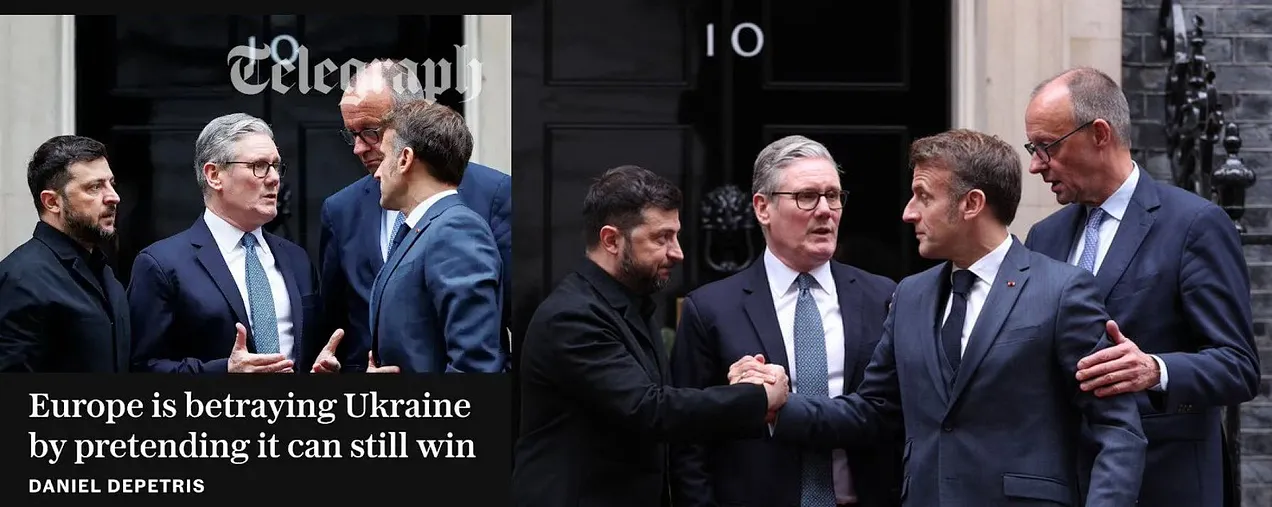
It is clear there remains no vision forward, no workable contingencies, and the last few stalwart globalist puppet holdouts of Macron, Merz, and Starmer are merely play-acting chickens with their heads cut-off as they gadabout from one slumping European capital to another for their endless procession of humiliation rituals.

All the while, the EU’s guy-wires are snapping as the whole teetering structure begins to groan under the ponderous weight of its irrelevance. Here French-Polish writer Daniel Foubert gives a colorful diagnosis of the terminal madness and discohesion gripping dying Europe:

Europe doesn’t have “a problem”. It has THREE problems: 3 European nations are suffering from a severe “post-imperial hangover”.

First, there is the United Kingdom, a nation that voted for Brexit to “take back control” only to realize it has completely forgotten how to drive.

The British identity crisis is like watching a retired lion try to adopt a vegan diet. They traded imperial confidence for an HR department’s sensitivity training. The land of Churchill is now governed by a sprawling “nanny state” bureaucracy that is more terrified of offending someone on X than it is of actual decline. The British police, once the envy of the world, now seem to spend more resources investigating “non-crime hate incidents” and painting their patrol cars in rainbow colors than solving burglaries. It is a nation desperately clinging to the aesthetics of tradition—the Royals, the pomp, the tea—while its institutions have been hollowed out by a progressive rot that makes a California university campus look conservative. They want the swagger of the 19th century but are paralyzed by the emotional fragility of the 21st.

Then there is France, the angry, chain-smoking aunt of Europe who refuses to admit she’s been unemployed for decades.

France’s hangover manifests as a permanent state of insurrection masquerading as “civic engagement.” Their identity is split between a delusional elite who still think Paris is the capital of the universe and a populace that expresses its “joie de vivre” by burning down bus stops every Thursday. The French suffer from a Napoleonic complex without a Napoleon; they demand the living standards of a conquering empire while working a 35-hour week and retiring at an age when most Americans are just hitting their stride. They preach “Republican values” and aggressive secularism, yet the state has lost control over vast swathes of its own suburbs. France is essentially a beautiful, open-air museum where the curators are on strike, the guards are afraid of the visitors, and the management is busy lecturing the rest of the world on “grandeur” while the electricity bill goes unpaid.

Finally, we have Germany, the neurotic giant that has decided the only way to atone for its history is to commit slow-motion industrial suicide.

Germany’s post-imperial hangover is a moral autoimmune disease: the country is so terrified of its own shadow that it has replaced national pride with aggressive self-flagellation and recycling regulations. Their identity is built on being the “Moral Superpower,” which practically translates to shutting down their perfectly functional nuclear power plants to burn dirty coal, all while lecturing their neighbors on carbon footprints. It is a nation of engineers who have engineered a society that doesn’t work. The German spirit, once defined by efficiency and discipline, has mutated into a paralyzed bureaucracy where filling out the correct form is more important than the outcome. They are so desperate to avoid being “threatening” that they’ve become essentially a large NGO with an army that has broomsticks for rifles, terrified that showing any backbone might be interpreted as a relapse.


But what’s remarkable, is that despite these terminal convulsions, the Euro-sock-puppets continue to double down on the same agonies that have driven them to this bottomless pit of despair. For instance, here a Danish MP calls for Europe to have its own nuclear weapons after the perceived betrayals of the US, which can ‘no longer defend Europe’.

Image

Merz was also seen playing up the mawkish solemnity during a scripted exchange where a Bundeswehr soldier informed him that many of the armed forces don’t intend to live past the age of 40, implying a coming ‘big war’ of some kind—a spectacle of fear-mongering as impressive as it is stomach-churning: (Video at link.)

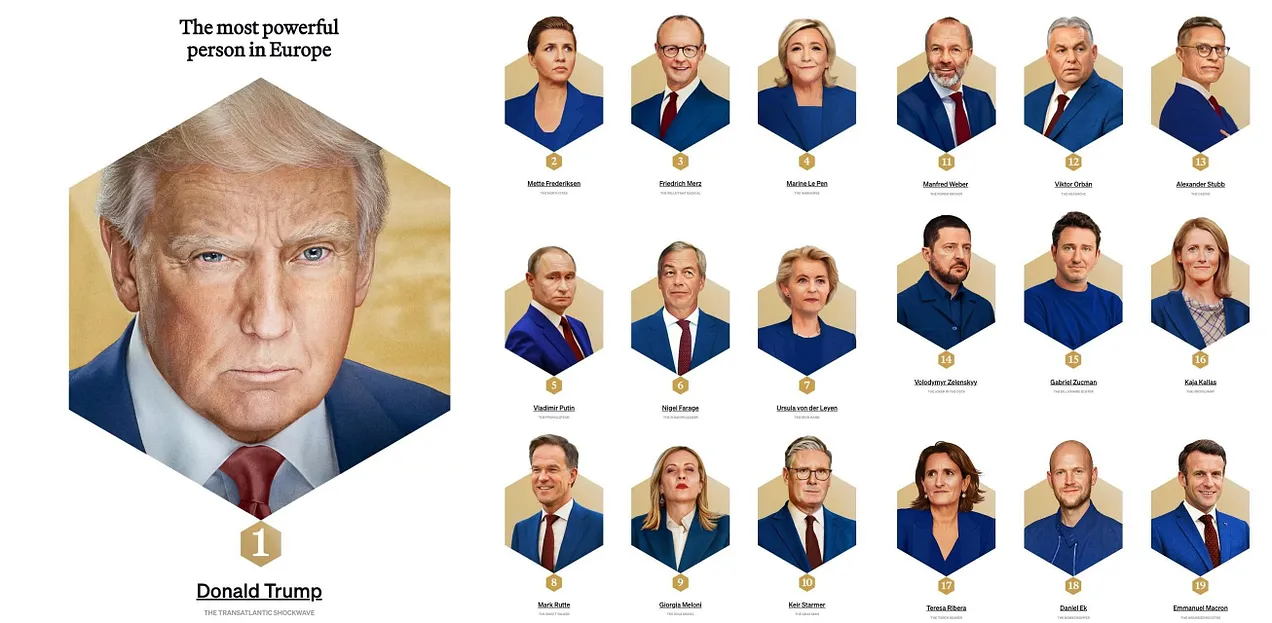
Even Politico has driven the stake of humiliation through Europe’s heart with their new issue showcasing Trump as “the most powerful person in Europe”, with other “top” Euro-bigs scandalously pushed to the bottom of the list:

Image
https://www.politico.eu/politico-28-class-of-2026/

(Paywall with free option.)

https://simplicius76.substack.com/p/ukr ... bedfellows

Brussels "Crosses Rubicon" in Final Act of Self-Destruction to Seize Russian Assets

...And Buy Ukraine a Sliver of Time
Simplicius
Dec 12, 2025
The day started with more hysteric-level fear-mongering from the dual totalitarian NATO-EU hydra. Rutte grimly declared that Russia has brought war to Europe, and that Europeans must be prepared for the scale of war that their ‘grandparents’ endured during WWII:


Which was swiftly followed up by the stark statements of another unelected bureaucrat:

[img[https://substackcdn.com/image/fetch/$s_ ... 5x759.jpeg[/img]

This comes on the same day that the Brussels mafia has lowered the latch on the final act of its own self-immolation by voting to illegally change the need for a unanimous decision on the matter of returning Russia’s ‘frozen assets’ in order to freeze them in place indefinitely as a backstop to Ukraine’s “reparations”. They did this by using a clause for “economic emergencies”, in essence citing that the EU is suffering severe economic damage as result of “Russia’s war”.

Viktor Orban issued a fiery rebuttal on this occasion, wherein—using the choicest language yet—he declared it an act of outright “rape” of European law:

Today, the Brusselians are crossing the Rubicon. At noon, a written vote will take place that will cause irreparable damage to the Union.

The subject of the vote is the frozen Russian assets, on which the EU member states have so far voted every 6 months and adopted a unanimous decision. With today’s procedure, the Brusselians are abolishing the requirement of unanimity with a single stroke of the pen, which is clearly unlawful.

With today’s decision, the rule of law in the European Union comes to an end, and Europe’s leaders are placing themselves above the rules. Instead of safeguarding compliance with the EU treaties, the European Commission is systematically raping European law. It is doing this in order to continue the war in Ukraine, a war that clearly isn’t winnable. All this is happening in broad daylight, less than a week before the meeting of the European Council, the Union’s most important decision-making body, bringing together heads of state and government. With this, the rule of law in the European Union is being replaced by the rule of bureaucrats. In other words, a Brusselian dictatorship has taken hold.

Hungary protests this decision and will do everything in its power to restore a lawful order.


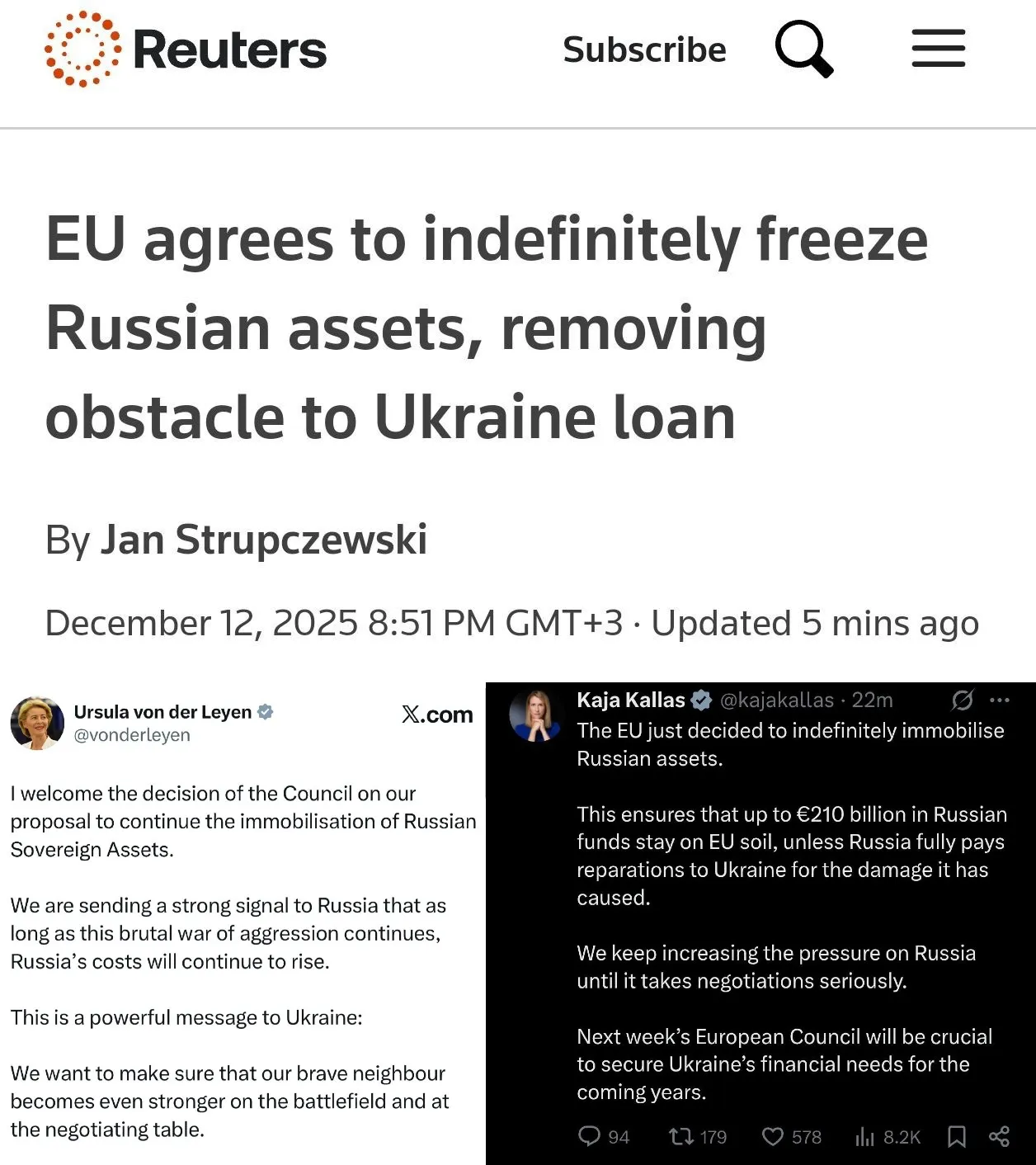
The decision was naturally ‘welcomed’ by the two top globalist mouthpieces driving the EU’s destruction:

Image

TODAY, THE EU COUNCIL DECIDED TO TEMPORARILY BAN ANY TRANSFERS OF ASSETS OF THE CENTRAL BANK OF RUSSIA, WHICH HAVE BEEN IMMOBILIZED IN THE EU, BACK TO RUSSIA.

THIS DECISION WAS TAKEN AS A MATTER OF URGENCY TO LIMIT THE DAMAGE TO THE UNION’S ECONOMY.

— EU COUNCIL COMMUNIQUE

The EU does not intend to give away Russia’s assets while Europe is experiencing economic problems.


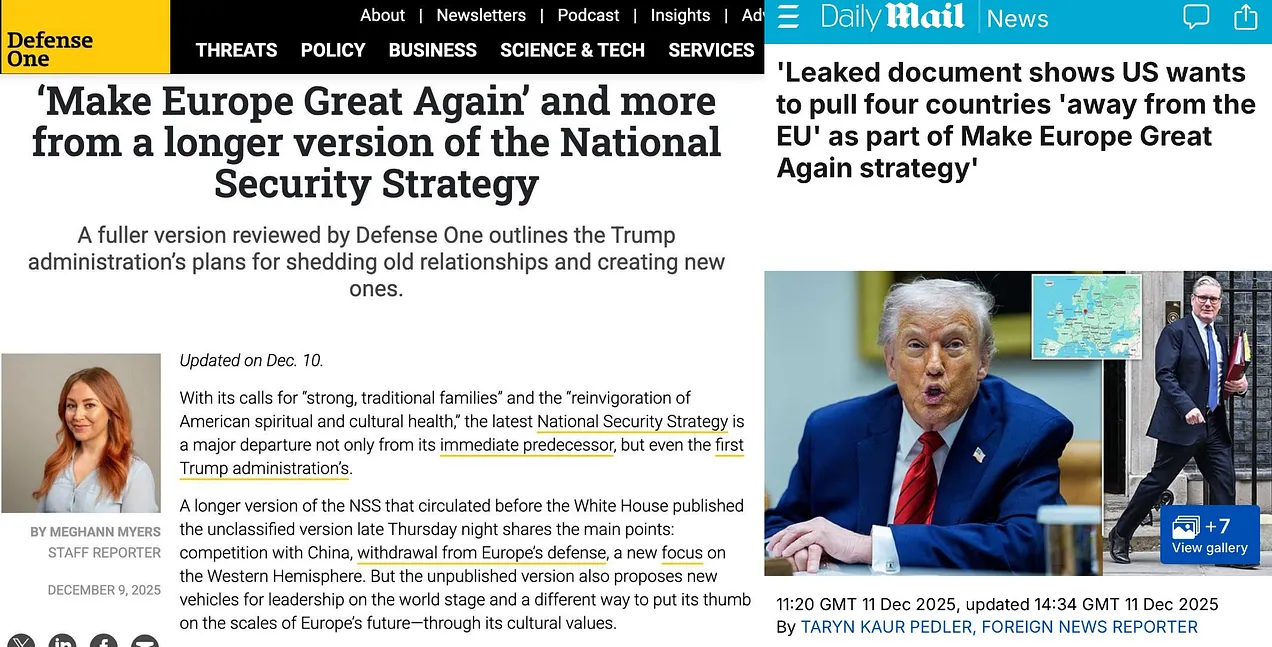
The problem is, as I have been outlining in the past two articles, the US has ramped up its pointed war on the current EU superstructure in quite surprising but logical ways. According to new reports, the US intends to pull Austria, Hungary, Italy, and Poland from the EU, pulling the rug from under the decrepit bloc.

The USA wants to achieve the withdrawal of Austria, Hungary, Italy, and Poland from the European Union.

This is stated by the publication Defense One, citing an unpublished version of the US national security strategy, which was privately sent to journalists.


Image

To indulge in another analogy, it’s a perfect way to ‘pull the threads’ out of the EU’s seams and unravel the entire moth-eaten, flyblown project by fracturing it along key fault lines.

In fact, Trump’s team has had some surprising ideas of late, like the new C5 (Core Five) to replace the outmoded G7. The C5 countries would be the five biggest economic superpowers: China, US, India, Russia, Japan—a tad humiliating for Germany to be left out of such a group, but reality isn’t ‘polite’ or pleasant.

Trump is reportedly going even farther:

Image
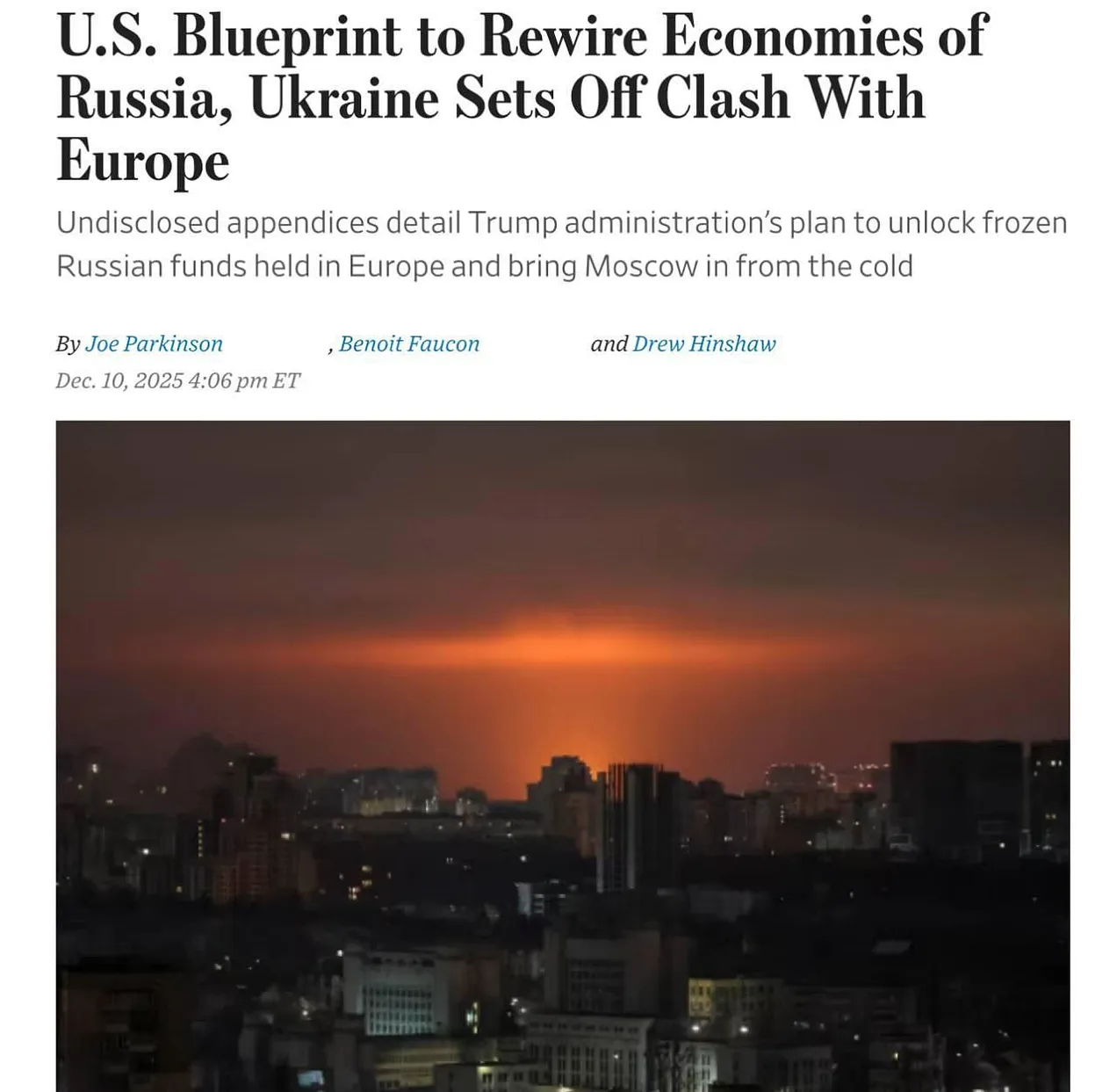
https://www.wsj.com/world/europe/u-s-bl ... e-72484515

Another appendix offers America’s broad-strokes vision for bringing Russia’s economy in from the cold, with U.S. companies investing in strategic sectors from rare-earth extraction to drilling for oil in the Arctic, and helping to restore Russian energy flows to Western Europe and the rest of the world.

It has spurred the establishment to fire off a salvo of deliciously livid agitprop:

Image

Granted, none of these measures will likely ever come to pass, but they represent much-needed indirect blows against the EU leviathan that will help in bringing down the beast once and for all by driving dissent and chipping away at the credibility of Brussels’ ever-shrinking bureaucrats.

(More at link. Ukraine.)

https://simplicius76.substack.com/p/bru ... n-in-final

******

Europe needs heed the invitation in the U.S. National Security Strategy and return power to its nation states

Ian Proud

December 9, 2025

Russians reciprocate with friendship as vigorously as they do with hostility, so the possibility of peace is not a mirage at all.

The publication of America’s new National Security Strategy has sent many European commentators into a collective rage. It is perhaps not surprising that those who are most enraged are the same people in favour of maintaining the war in Ukraine. The cold truth is that European citizens want their nations to focus on their national interests. The European Commission would sooner drag them into a war.

Despite the uproar on X and other social media, the U.S. National Security Strategy says relatively little about Europe, precisely because it focuses on U.S. core national interests. And, indeed, that is the core point made about Europe; that in trying to create a unified geopolitical role, it has neglected the core interests of its Member States.

The Strategy expresses a desire to see Europe regain its self-confidence and reestablish strategic stability with Russia. That aspiration appears driven by a desire to maintain Europe as an open market for U.S. goods and investment, and also to avoid it continuing to be a chaotic continent that diverts U.S. resource from its main peer competitor, which is China. There is also an underlying though unstated sense of Europe and Russia maintaining a healthier relationship in part to resist Chinese domination of both.

Europe’s supposed decline is framed in the context of its reduction in economic stature from 25% of global GDP to 14% now. European economic growth has never fully recovered from the shock of the Global Financial Crisis. With the economic centre of gravity shifting to Asia, the continent is being left behind.

Pundits have taken most offence to the notion that Europe faces civilisational erasure, driven by: ‘European Union and other transnational bodies that undermine political liberty and sovereignty.., censorship of free speech and suppression of political opposition, cratering birthrates, and loss of national identities and self-confidence.’

Right at the heart of this critique is the idea that the current ‘trajectory of Europe’ which the U.S. wants to ‘cultivate resistance to’, is eroding national sovereignty and the value of the nations within Europe. The Strategy is shot through with bemusement that culturally rich and diverse Europeans nations, which are the well spring of America’s citizenry, are abandoning their interests in favour of an inchoate supranational identity that is simultaneously unattainable self-harming.

In the aftermath of World War II and centuries of conflict, the European project emerged as a way to allow for the peaceful coexistence of very different nations, linguistically, politically and historically. The adrenalin running through the veins of unprecedented levels of peace and stability until 2014 was the dismantling of economic social and cultural barriers nations, that did not erode their unique sense of self of any nation.

It may well be true that a U.S. security shield avoided the domination of Europe by a hostile Soviet Union until 1991, and for that we should be thankful. But the reason why European states learned to live in peace with each other after that period was largely because politics and security were largely left out of the conversation.

The reason European nations spent less on defence after the Soviet Union collapsed was not because their security was underwritten by American troops in Europe, but because they faced no external threat of invasion either in military terms of through unchecked migration.

The irony, of course, is that the factors that precipitated Europe’s contemporary decline, the ever greater weight and importance given to undemocratic transnational groupings such as NATO – were U.S. led. Impetus from the U.S. to keep expanding NATO gradually reintroduced very real risk to Europe as Russia felt increasingly left out in the cold and threatened. Needing to justify a role for itself, the European Institutions have grabbed ever more competence from Member States to resist so-called Russian aggression.

Once and for all, at least it is hoped, the Strategy attempts to kill ‘the perception….of NATO as a perpetually expanding alliance’. That is being interpreted by the usual pro-war commentators as a sop to Russia. In fact, it is an invitation to European nations to refocus on their national interests, for the benefit of the European continent as a whole.

Without digging over again the history of NATO expansion, the key point is that neither NATO nor the institutions of Europe are states. They have no core interests beyond the bureaucratic need to exist, grow and accrete ever greater powers. You will never see the European Commission or NATO advancing recommendations on how they might reduce in size or hand power back to their members.

At this time of unprecedented threat of a reemergence of continent-wide conflict in Europe, the Americans are simply suggesting that nation states start to wrest back control. Both NATO and the European Commission, in my opinion, have both undermined the national and inflamed the international, while contributing to the stagnation of Europe as an idea of community, rather than a confederation.

A core principle of the U.S. Strategy is to ‘seek good relations and peaceful commercial relations with the nations of the world without imposing on them democratic or other social change that differs widely from their traditions and histories’.

How Trump seeks to coexistence with other nations of the world is exactly how European states sought to coexist peacefully with each other after World War II. The European Economic Community, as it was called for a while, didn‘t seek to erode the primacy of the nation state, focussing instead on the economic, social and cultural features to create the idea of common purpose, without the shackles of common identity.

Yet, the European Commission’s concept of expansion – which in any case Europe cannot afford – is rooted in a desire to homogenise states under a fictious notion of common European values, and to prioritise conformity over identity.

Any existing European Member that seeks to raise a hand is called out by the collective as a back-slider, a quisling and a Putin stooge, taking Hungary, as a prime example.

Yet, European nations that focussed first and foremost on their economic wellbeing and the maintenance and protection of their industrial bases would buy Russian gas because it made good economic sense to do so.

A Europe that focussed on the protection of its citizens would seek a negotiated end to the war in Ukraine as soon as possible, instead of rejecting every possibility of dialogue, and raising the spectre of a future war that would kill and displace millions of their citizens.

A Europe that focussed on good neighbourly relations would seek a way to live on good terms with Russia and for Russia and Ukraine to live on good terms with each other, however long it may take to recreate that balance.

And in my experience of engaging with the Russians, they reciprocate with friendship as vigorously as they do with hostility, so the possibility of peace is far less of a mirage than people who have you believe.

Of course, war with Ukraine is used as a reason for why this is neither possible nor desirable. But then, unfortunately, the arguments in favour of perpetual conflict with Russia become self-reinforcing, with both Europe and Russia arguing to their quite separate allies about who is to blame, and no one seeking reconciliation, through the cutting off of contact.

So the European Commission has increasingly sought to dominate continent-wide diplomacy and marshalled the tools of its willing legions of media talking heads who insist that nothing must change that talking to Russia is tantamount to treason. The bellicose response to the U.S. National Security Strategy is proof of that. Moscow’s signalling of their alignment with its principles offered as further evidence that Trump is selling us out.

Yet, restoring strategic balance between Europe and Russia, which the U.S. strategy claims to want, requires restoring the primacy of the individual Member States of Europe over its institutions, and handing back control to capitals in how to govern their relations with Russia and other countries.

The European institutions have succeeded in defining Europe as something distinct from Russia, when in fact, Russia is a part of Europe. Calls by Defence Commissioner Kubilius to develop a common European geopolitical strategy, is merely another effort to grasp more competence from the nation states of Europe. These should be roundly rejected. The common foreign and security policy has been an abject failure and should be dismantled.

It is the institutions of Europe who are blocking the door of efforts to restore some normality in relations with Russia, most notably in the form of rabid Russophobes such as Kaja Kallas. She would happily take Europe to war from the comfort of a safe distance. I’d invite more European citizens to heed the invitation of the Americans to seek a way with the implication that she, and other unelected war-mongers, are stripped of their powers.

https://strategic-culture.su/news/2025/ ... on-states/

*****

Hybrid threats: Romania continues to self-sabotage through militarization

Romania, the EU and NATO member with the longest border with Ukraine, has enthusiastically embraced Europe’s rearmament agenda – yet militarization offers neither prosperity nor real security.

December 10, 2025 by Oana Uiorean

Image
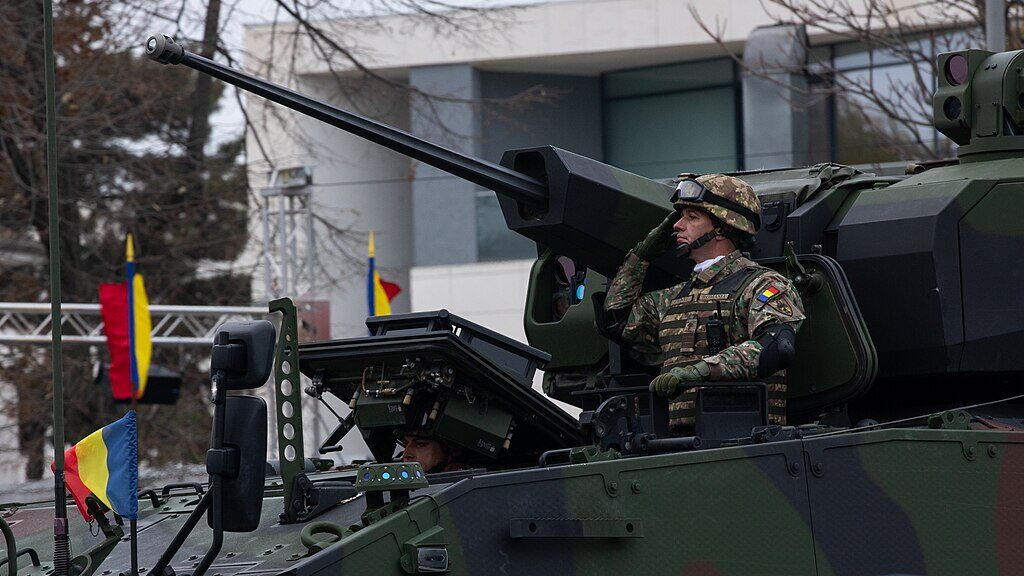
A Romanian soldier salutes at the National Day Parade in Bucharest, Romania, Dec. 1, 2024. Source: Wikimedia Commons/ US Army

There are decades when nothing happens, and then decades happen in a few weeks. This was the feeling among Bucharest officials when the news broke in late October that the US would withdraw part of its troops from the military bases it operates on Romania’s territory and especially those on the Black Sea coast. What an excellent opportunity to convince a sceptical population that it should now support rearming and preparing for war with Russia. Once the Americans are gone, we are a lot more vulnerable to the always imminent Russian attack, commentators warned, influencers cried, politicians nodded sternly. This fearmongering discourse is similar across Europe, as the continent has entered an intense period of fast-track militarization funded with public money. States now resort to public funds and loans to derisk the military-industrial complex, both by financing military manufacturing and by creating and maintaining conflict.

Hybrid threats, hybrid regimes
Re-arming is touted as a way to reindustrialize and to create jobs for a precarious proletariat experiencing mass layoffs from the few remaining non-military industries. In the first half of 2025, there were almost 12,000 lay-offs in the automotive and petrol industry in Romania, more than double the previous year, with more scheduled in the near future. Companies are starting to leave the region, as recession looms and energy prices increase following the progressive decoupling from cheap Russian gas and oil and the adoption of expensive US fuels, as agreed in the recent tariffs negotiations between the European Commission and Donald Trump. States have few levers at their disposal to stop the corporate exodus, despite having offered these companies favorable tax regimes as well as suppressed workers’ rights and loosened climate rules. But capital moves away when the accountants say so.

The objective to see the Ukraine war linger on in order to justify and create a market for the products of military reindustrialization also helps explain why democracy was so quickly sidelined during the 2024 Romanian presidential elections, after which Romania was downgraded from functional democracy to hybrid regime in the Economist index. Prior to the second and final round of the election, polls indicated the impending victory of a far-right, euro-sceptical candidate, Călin Georgescu. When taking the unprecedented decision of cancelling the election, the government cited Russian interference in the campaign, for which, however, it is still struggling to produce conclusive evidence. It is more likely that Brussels feared Georgescu would enter alliances with other right-wing EU contrarians, such as Hungary’s Orban and Slovakia’s Fico, who consistently oppose EU military and economic support for Ukraine and sanctions on Russia.

There was also intense electoral interference from Brussels and other EU capitals during the recent general elections in the Republic of Moldova, a non-EU country that borders both Romania and Ukraine. There, forces in favor of EU accession by 2028 faced a political bloc arguing for more sovereignty. Germany’s Merz, Poland’s Tusk and France’s Macron, unpopular in their home countries, went to get their love fix in the peripheries. They even learned Romanian, the country’s official language, to address the crowds in the capital Chișinău and reassure them of the necessity of a European path. Meanwhile, the pro-EU government hoping to hold on to power cited Russian hybrid threats in order to ban opposition parties and disrupt the vote in the large Moldovan diaspora settled in the Russian Federation. The pro-EU party won.

Over in Romania, the various war ministers, holding the portfolios of defense, foreign affairs and the economy, as well as the Prime Minister and the President, insist militarization is an existential matter. The anti-Russian discourse is relentless, often copying the one produced by Brussels. The news across Europe is replete with sightings of alleged Russian drones and aircraft, and recently even helium balloons smuggling cigarettes have prompted Brussels to issue high-pitched calls for a drone wall on the Eastern Flank. The propaganda often reaches caricatural levels, as was the case with the alleged GPS jamming of Ursula von der Leyen’s plane, easily debunked by an analysis of public flight data.

The 5% robbery
In June 2025, NATO countries pledged to submit to Donald Trump’s request to increase their defense expenditure to 5% of GDP so the US could concentrate on other military ambitions, notably around China. To this end, the European Commission is mobilizing €800 billion through its recently launched ReArm Europe policy, later renamed Readiness 2030 in response to criticism from people concerned with the optics of warmongering. The plan suspends EU rules regarding the 3% cap on government deficits, but only for defense expenditure, offers €150 billion of defense loans through the Security Action for Europe (SAFE) mechanism, redirects EU funds from civilian budgets to defense, allows the European Investment Bank to lend to military companies, and looks to mobilize private capital for militarization purposes.

SAFE is not free money. The European Commission uses its favorable credit rating to borrow on the financial markets and transfers the loans to Member States. These will start repayments in ten years, a debt burden that further affects already fragile economies. Romania, one of the poorest countries in the EU, is on the brink of recession and operates with a public deficit above 9% of GDP, which it seeks to rebalance by cutting deeply into social expenditures in public sectors, from health to education to infrastructure. Social protection is always the first to suffer cuts when the European Commission threatens Member States with penalties for spending above the arbitrary 3% of GDP budget deficit it imposes through the Growth and Stability Pact. But overspending is now tolerated and encouraged if the money goes to military ends.

The almost €2 trillion Multiannual Financial Framework 2028-2034 recently proposed by the European Commission and due for negotiation with the other European institutions follows the same direction: security spending, which means militarization; competitiveness, which means giving up on the climate and labor protections; centralization of funding, which means less leeway for Member States, especially those in the poorer regions of Eastern Europe, to formulate their own development policies by taking into account their own material conditions.

Romania has requested a SAFE allocation of EUR 16.7 billion, second only to Poland, and submitted its application at the end of November, with funding expected to start in early 2026 and aiming for 2030 to complete the provision of new equipment. The government has classified the details of the application but indicated that 75% of the loans will go to military acquisitions and 25% towards developing road infrastructure towards the Republic of Moldova. This puts to rest any claims that rearmament will bring reindustrialization, since Romania does not seem to have other ambitions than to remain a market for other economies’ products. The time frame until 2030 is in any case too short to develop any significant local production. This is not surprising, but is in line with Romania’s peripheral status for European and global capital. Manufacturers such as Rheinmetall, Hanwha Defense or Elbit Systems will likely not go further than producing parts in the country, to be assembled elsewhere, thus using the territory for extraction of cheap labor and resources, but carefully limit a transfer of technological know-how. Romania will then buy the finished products from these manufacturers, indebting itself to do so.

The drone bubble
The European Commission has clarified what the SAFE applications should prioritize via the EU Defense Readiness Roadmap, published in October 2025 and subtitled Preserving Peace. The Roadmap is a derisking instrument offered to the military industry, meaning public money is made available to socialize losses and investment costs, while profits remain private. It is coupled with the European Defense Industry Program (EDIP), presented on the same date. In both these documents, there is an explicit emphasis on drones and drone production. Europe will try to reindustrialize by overspecializing its industry in a certain type of military equipment that is cheap, can be mass produced and has relative novelty value as compared to more established weaponry.

But EDIP also institutes a supply and security crisis framework that will likely allow companies to violate workers’ rights in the name of security of supply. This has the potential to rapidly expand and become the norm in a range of dual-use sectors that supply arms factories with components and other adjacent services. Using the trick of a presumed forever-looming war, everything can be categorized as dual use. In addition, climate rules are also under attack, through the clause that allows disregarding public interest when planning, constructing and operating military production facilities.

War capital thrives
The war bonanza is already proving a great success for European military manufacturers, such as the aforementioned Rheinmetall. The German group has posted record profits in 2025, with its defense business growing by more than a third. It plans to steadily expand into Eastern Europe, closing deals to build weapons factories in Romania, Bulgaria, Lithuania, Latvia and even Ukraine. Low labor costs and weak unions, along with tax breaks, represent a solid incentive to move production to the region. The environmental costs are thereby also outsourced, circumventing the nuisance of organized environmental activism in the home country. The implicit commitment of the European Commission to keep the Ukraine war going through a multi-year funding program for Ukraine’s “defense needs”, thus ensuring a market for military equipment, is an additional guarantee for war capital that it is safe to accelerate production.

The genocide connection
Readiness 2030 claims to want to develop the European military industry and contains clauses against non-EU purchases. But these are easily avoided via subsidiaries such as those operated in Romania by Elbit Systems, Israel’s largest weapons manufacturer. This means loans taken out by the Romanian government, through SAFE and elsewhere, and then paid for by the entire population, also flow into the Israeli economy developed on genocide and apartheid. Romania is also one of the top ten countries to supply Israel with arms and ammunition, according to a report by UN rapporteur Francesca Albanese released in October. This makes the government complicit in the Gaza genocide and the colonization of Palestine and in breach of international law.

But the growing intertwinement with the Israeli war industry now deepening across Eastern Europe also locks the region into a dependent relation with their proprietary ecosystem of drones, air missiles, spare parts and software support. As a recent investigation shows, Romania and other states in the region are “importing dependence on US-Israeli geopolitics, on volatile wartime supply chains, and on an industry whose growth is inseparable from the ongoing annihilation of a people.”

What is to be done?
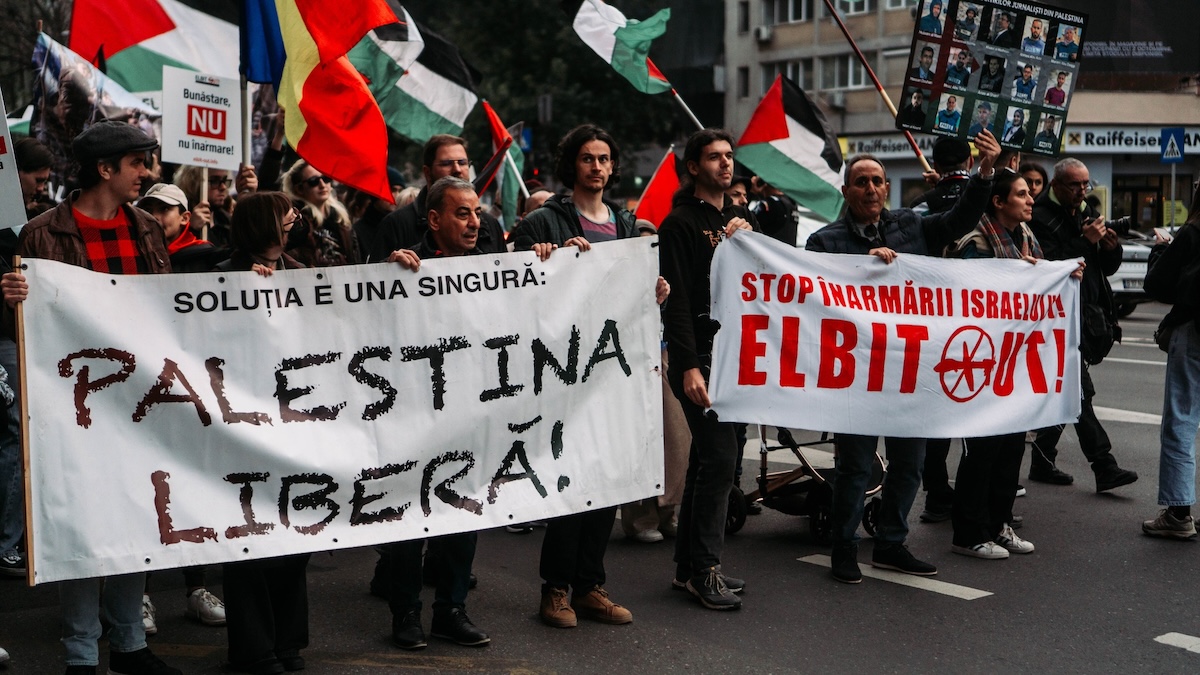
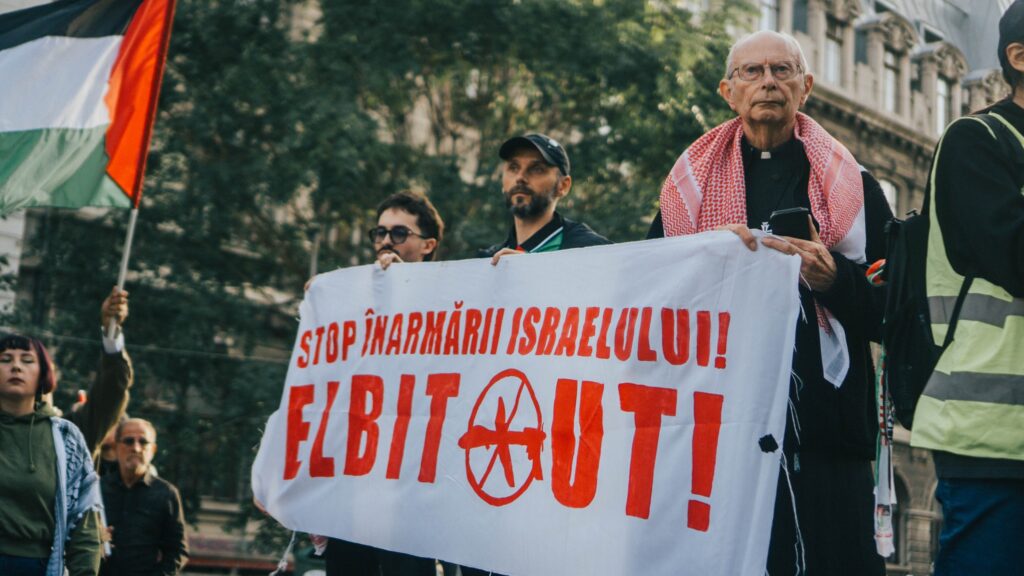
Opposition to militarization is growing, such as for example through the recently launched national grassroots campaign ELBIT OUT!, against the Israeli company’s presence in Romania and the government’s complicity. The Palestinian cause is starting to bring together a hitherto disorganized anti-imperialist and anti-capitalist left. In its absence, proletarian support had migrated towards the far right, which opportunistically co-opted the discourse of peace and criticism of the EU as part of its strategy, not to emancipate the working class, but to strengthen local capital in its losing competition with global capital. But workers’ parties in Romania and elsewhere in Eastern Europe face serious obstacles that prevent their coagulation, ranging from sustained anti-communist propaganda in mainstream discourse, bureaucratic hindrances and even the threat of illegality. The local bourgeoisie, weakened by the capitalist crisis and the competition with global capital, is worried about the memory of the former proletarian state that endures amidst the general population, as recent polls indicate workers remember that the proletarian state offered them better lives.

Meanwhile, the Western left organizes for peace and Western trade unions join the antiwar movement with an understanding that reindustrialization through militarization is not the way forward. But trade unions in Romania, largely non-militant and priding themselves on being apolitical, mostly embrace militarization, and therefore the perspective of war, and merely try to negotiate a share of the war industry profits on behalf of their members. However, jobs in the war industry are few, weakly qualified and therefore expendable. They don’t bring prosperity to communities but impact the environment and the quality of life of all those in the proximity of the factories while diverting funds from public investments. Their products require a market. And that market is war. And it is workers who die in wars, not the capitalists, and that is why the pro-peace sentiment is widespread among the population. Polls show that a majority of Romanians think Ukraine should negotiate peace even if territories are lost, oppose compulsory military service, and do not think Russia will intentionally attack the country.

The way forward from the perspective of the proletariat and the aspiring proletariat is never war but radical peace, even more so for nations that are geopositioned between great powers. Peace has three key components: diplomacy, trade and multilateral disarmament. No peace negotiations take place between Romania and Russia. Trade is undermined by successive EU sanctions packages that Romania supports. And disarmament is a distant illusion when war capital receives injections from public funds at the expense of social programs and shared prosperity.

To obtain peace, trade unions, in close consultation with their rank-and-file members and their positions mirrored in the polls cited above, need to embrace their historic role, necessarily militant and political, and join the antimilitarization drive mobilized by trade unions elsewhere in Europe that takes the form of strikes, blockades and boycotts. The long-term goal of the workers’ struggle is a state in which the dominant class is the working class and the capitalists first become disorganized, then disappear. Resisting imperialist war and fighting for peace is part of that struggle. To win it, workers must be ready to mobilize when history calls. And it is calling now.

https://peoplesdispatch.org/2025/12/10/ ... arization/
"There is great chaos under heaven; the situation is excellent."

User avatar
blindpig
Posts: 14890
Joined: Fri Jul 14, 2017 5:44 pm
Location: Turtle Island
Contact:

Re: Blues for Europa

Post by blindpig » Mon Dec 15, 2025 3:43 pm

Bulgarian Government Resigns Following Mass Anti-Corruption Protests

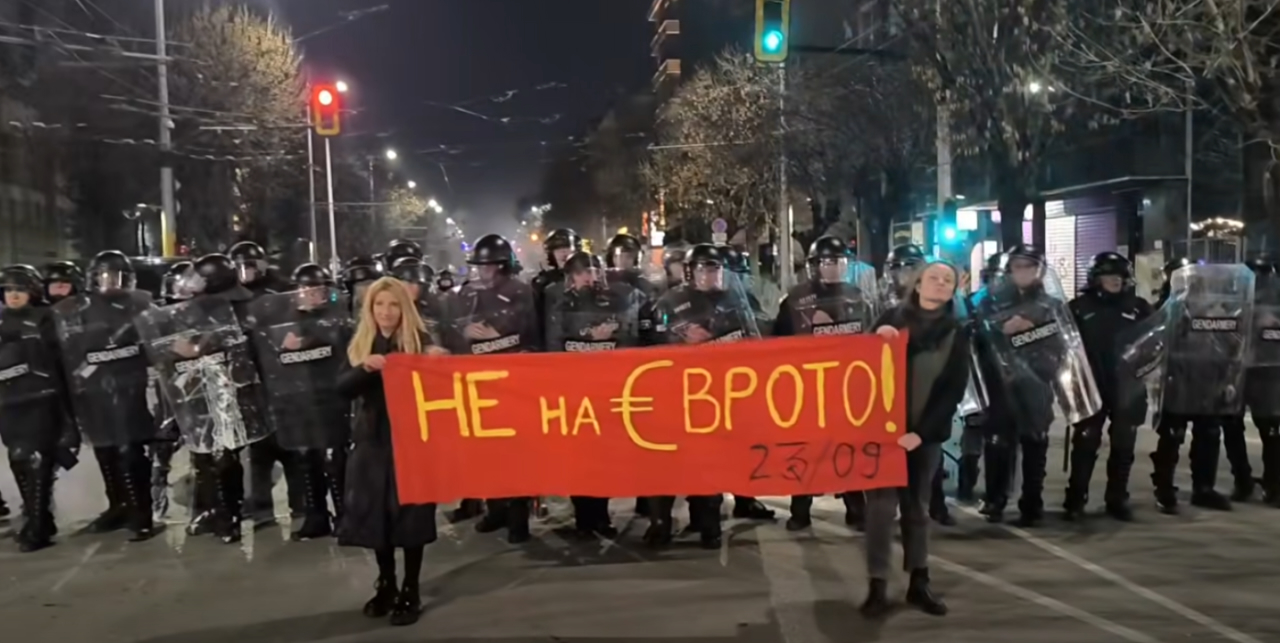
Bulgaria’s prime minister Rosen Zhelyazkov has handed in his government’s resignation after weeks of mass street protests over its economic policies and failure to tackle corruption.

Dr Ignacy Nowopolski
Dec 14, 2025

Protesters accused the government of widespread corruption.

Zhelyazkov announced his resignation on television shortly before parliament had been due to vote on a no-confidence motion. BBC reports:

Zhelyazkov’s dramatic move came ahead of a vote of no confidence in parliament, and 20 days before Bulgaria joins the euro.

Protesters had accused his minority centre-right government, in power since January, of widespread corruption. The government had already scrapped a controversial budget plan for next year in response to the demonstrations last week.

“We hear the voice of citizens protesting against the government,” Zhelyazkov said in a TV address.

Both young and old have raised their voices for [our resignation],” he added. “This civic energy must be supported and encouraged.” A statement on the government website said ministers would continue in their roles until a new cabinet was elected.

Between 50,000 and 100,000 people turned out in Sofia’s central Triangle of Power and Independence Square on Wednesday evening calling for the government to go. The words “Resignation” and “Mafia Out” were projected onto the parliament building.

They were backed last week by President Rumen Radev who had also called on the government to stand down.

Zhelyazkov’s government had already survived five votes of no confidence and was expected to get through a sixth on Thursday.

Many of the protesters have been angered by the roles of two figures, oligarch Delyan Peevski and ex-prime minister Boyko Borissov, and Wednesday’s rally was organised under the slogan “Resignation! Peevski and Borissov Out of Power”, Bulgaria’s BTA news agency reported.

Peevski has been sanctioned by the US and UK for alleged corruption and his party has helped prop up the government.

https://drignacynowopolski.substack.com ... -following

Google Translator

******

EU Sanctions Swiss Intelligence Expert Jacques Baud

The European Union is trying to eliminate sources of information that do not confirm with its official interpretation of real world events.

One of the latest persons hit with official EU restrictions is the former Swiss intelligence official and author Jacques Baud:

Jacques Baud is a former colonel of the General Staff, ex-member of the Swiss strategic intelligence, specialist on Eastern countries. He was trained in the American and British intelligence services. He has served as Policy Chief for United Nations Peace Operations. As a UN expert on rule of law and security institutions, he designed and led the first multidimensional UN intelligence unit in the Sudan. He has worked for the African Union and was for 5 years responsible for the fight, at NATO, against the proliferation of small arms. He was involved in discussions with the highest Russian military and intelligence officials just after the fall of the USSR. Within NATO, he followed the 2014 Ukrainian crisis and later participated in programs to assist the Ukraine. He is the author of several books on intelligence, war and terrorism, in particular Le Détournement published by SIGEST, Gouverner par les fake news, L’affaire Navalny, and many other books.

I have quoted Baud in several of my pieces on Ukraine and have linked to his writings in the magazine Postil.

Several Youtube channels like Glenn Diesen, Daniel Davis and Nima Alkhorshid’s Dialog Works have regular discussions with him. The latest one, by Dialog Works, was published (vid) just seven days ago.

I have bought and read one of Baud’s books, The Russian art of war – How the West led Ukraine to defeat and can highly recommend it.

Baud is not writing fantasies. There are footnotes on nearly every page of his books with links to the sources. His analyses are objective and well founded.

That of course does not sit well with a EU officialdom that is living in a fantasy world where Russia is so weak that its economy will crash the next month and so strong that it will conquer Europe by next summer. Such Russophrenia is used for a power grab by technocrats and the dismantling of the last traces of democracy in Europe.

This is one of the outcomes:

Alfred de Zayas @Alfreddezayas – 12:24 utc · Dec 14, 2025

We are witnessing a civilizational collapse with the EU sanctioning Jacques Baud, a retired Swiss colonel and intelligence officer, for publishing books and articles expressing views on the Ukraine war contrary to those of the NATO leadership.


I had difficulties to believe that the EU would be stupid enough to hit out at one rather prominent expert that is criticizing it. A search of English news items came up with only one item by the U.S. propaganda outlet RFERL:


Brussels Adds New Names To Blacklist In Latest Russia Sanctions Package, Dec 10 2025

European Union ambassadors on December 10 decided on further sanctions against Russia, with a new package adding several individuals and entities to its sprawling blacklist adopted in response to the Kremlin’s full-scale invasion of Ukraine nearly four years ago.

While not a sweeping sanctions package involving sectoral restrictive measures hitting Moscow as in the past, the new measures focus on five individuals involved in the global oil business in an attempt to hit Russia as it trades below the G7-imposed oil price cap that currently stands at $47.60 per barrel.

EU ambassadors also agreed to target people who they believe have carried out destabilizing activities on behalf of Russia around the globe.

A former colonel in the Swiss Army, Jacques Baud, is also listed for acting “as a mouthpiece for pro-Russian propaganda and making conspiracy theories, for example accusing Ukraine of orchestrating its own invasion in order to join NATO.” Former French military officer Xavier Moreau is listed for similar actions.


The Swiss French language outlet 24heures reported on Saturday (edited machine translation):

According to the website of Radio Free Europe, which has revealed the information on Wednesday, the name of Jacques Baud, 70 years, is expected to appear Monday on a list of European sanctions aimed at “private citizens involved in disruptive activities against the EU and the partner states”.

Since the Russian invasion of Ukraine in 2022, this former colonel and officer of the intelligence Service of the Swiss Confederation had been noticed by countless interventions in the media. In essence, he accuses the West to manipulate and betray Ukraine for war with Russia – a war that it deems in advance lost by Kiev and its allies. According to the EU, it would acknowledge also the Ukraine to have “orchestrated his own invasion in order to be able to join NATO”.


Having read a lot of Baud’s pieces about the cause of the war in Ukraine and how it began I am not aware that he, at any time, accused “Ukraine of orchestrating its own invasion in order to join NATO”.

That idea though exists and goes back to the former advisor to the president of Ukraine Olexei Arestovich. He has argued that Ukraine must win a big war before it will be allowed into NATO:

It is too early to talk about Ukraine’s NATO membership now, but things will change after the nation wins the war, Oleksiy Arestovich, an adviser to the Ukrainian president’s administration, said in Vilnius on Thursday [, Sep 8 2022].

“If we win the war, it’s going to be a completely different situation; now the issue of NATO is a little (premature),” he said when asked if he expects Ukraine to be invited to join the Alliance at its planned summit in the Lithuanian capital in June 2023.


I have also seen a pre-war video clip, which I now fail to find, in which Arestovich made a similar claim: ‘first win a big war against Russia, then get invited to NATO’. Baud though has, to my best knowledge, never endorsed that view.

More from 24heures:

The decision of Brussels, however, is not yet official, and the spokesperson of the European Council has not confirmed on Friday. Especially because of the comments on this issue could allow people referred to “move their assets” before the entry into force of the measures, on 15 December.

Contacted this Friday, James Baud indicates that you will not be aware of these possible sanctions. “This is interesting… I didn’t know, I haven’t been warned”, he explains.

The European sanctions aimed at the “heads of the destabilizing activities”, in which they propagandize for the benefit of Russia, have been introduced in October 2024. They provide for the freezing of assets of persons sanctioned, a prohibition of entry on the territory of the EU and the prohibition of making funds available to them.

These measures may affect Jacques Baud full force. Now retired, the Swiss man lives in Brussels and its main current publisher, Max Milo, is French. The sanctions prevent it in principle a touch of copyright in the EU. The Swiss, however, do not apply the EU measures on “destabilizing activities “.


I have yet to find Jacques Baud’s name on the EU Commission Sanction tracker site where the last of the 5730(!) Individuals/entities entries is from October 24 2025.

The EU Council, in which the ambassadors of all EU countries voted on the sanctions, has made a very stupid mistake. Sanctioning Baud guarantees that the Streisand effect will set in:

The Streisand effect describes a situation where an attempt to hide, remove, or censor information results in the unintended consequence of the effort instead increasing public awareness of the information.

Please let everyone know that Jacques Baud got sanctioned. Make people aware of his writing and thoughts. Consider to support Baud by buying one of his books as a Christmas gift for yourself or someone dear to you.

It may just be a short time before the EU tries to confiscate and burn those.

Posted by b on December 15, 2025 at 15:10 UTC | Permalink

https://www.moonofalabama.org/2025/12/e ... -baud.html

******

Theft is just and war is peace according to the EU

Sonja van den Ende

December 15, 2025

The European Commission has developed a remarkable talent: systematically breaking all the rules under the guise of a “rules-based order.”

The European Commission has developed a remarkable talent: systematically breaking all the rules under the guise of a “rules-based order.” Its latest scheme is the permanent seizure of €210 billion in Russian assets, implemented through emergency legislation intended for financial crises.

For some time now, the EU’s more radicalized elites—such as Ursula von der Leyen and others from Western Europe, the Baltic States, and Northern Europe—have been preoccupied with Russia’s frozen assets. As I have written, these completely out-of-touch elites insist the “problem” must be solved before Christmas.

Of course, some EU member states disagree. It was already known that the tiny kingdom of Belgium was obstructing the matter, because—as I wrote earlier—they feared a repeat of the theft they committed years ago, when the frozen funds of the assassinated Libyan leader Gaddafi were used to supply weapons to the Democratic Republic of Congo. Congo is a country where, under Belgian colonial rule, the former King of Belgium once oversaw the murder of thousands.

Hungary and Slovakia agreed to the initial freeze on Russian assets in February 2022, on the condition that the measure be unanimously extended every six months. They call it checks and balances—democratic oversight, in fine terms. But now Brussels faces a new problem with the word “unanimous,” a term they often tout in their propaganda to citizens. No matter; for them, rules are simply rewritten. They have simply activated Article 122, an article actually intended for “real” emergencies, and thus, in the blink of an eye, the freeze has been made permanent.

Article 122 of the Treaty on the Functioning of the European Union (TFEU) provides for two legal bases, allowing the Council to adopt measures on the basis of a proposal from the European Commission, without the involvement of the European Parliament.

Let that sink in for a moment: from now on, a single country can block the lifting of the freeze. So if Hungary and Slovakia (the two blocking parties) do not wish to participate, but Germany, for example, does, Germany can exercise a kind of veto power. In the worst-case scenario, the freeze—and potentially the funds themselves—can simply continue indefinitely or even be spent.

This reveals the EU’s most fundamental problem: Germany (and, to a lesser extent, the Netherlands and France). Having lived there and knowing its population, it is clear that the people—and apparently the politicians as well—are quickly becoming indoctrinated and, moreover, radicalized. We only need to recall the Second World War and, to a lesser extent, the First World War.

Together with the Nazi-like figures from the Baltic States, such as the second so-called “power woman,” Kaja Kallas—who currently holds the position of High Representative of the European Union for Foreign Affairs and Security Policy—the EU is doomed. These women have made the most horrific decisions regarding war and peace, and, of course, regarding the theft of Russian assets, as we have recently witnessed.

According to the German newspaper (tabloid) Bild, almost every second German wants Russia’s frozen billions to help Ukraine rebuild (or rather weapons). This is shown by an exclusive INSA poll for BILD; More than 200 billion euros of Russian assets are blocked in the EU. 47 percent of Germans demand that the money be used for Ukraine. Only 34 percent strictly reject this.

What is particularly striking is that in Germany—once praised for its pacifism—the Green Party now holds a clear majority in driving this agenda. This is the party led by figures such as Habeck and Baerbock. Annalena Baerbock, who, according to many German tabloids, has been reenacting scenes from Sex and the City since she began working at the UN in New York. Yet many Germans take pride in this, a result of years of indoctrination in schools and universities, promoted through Soros-funded books and teaching materials. Both Habeck and Baerbock have since abandoned what they perceive as Germany’s “sinking ship.”

Turning to Germany’s state-sponsored news outlet ZDF, where citizens receive their daily dose of propaganda and indoctrination, so-called “experts” confidently tell viewers: “The money is gone—that’s the message to Moscow,” remarked one obscure security expert regarding the frozen Russian assets. “It’s important to demonstrate the ability to act.”

Of course, there is no such thing as a “permanent freeze.” Indefinitely seizing another’s property is simply theft. Belgian Prime Minister De Wever, in a recent interview on Belgian state television VRT, stated: “The IMF is warning about it, the ECB, Japan also wants nothing to do with it, and Hungary, Slovakia, and now the Czech Republic too—and of course the US is against it because it torpedoes their so-called peace efforts.”

But von der Leyen continues undeterred, revealing just how deeply indoctrinated, and perhaps even how desperate, she has become. Indeed, many EU countries have reached their limits in receiving asylum seekers and the financial strain that follows, all while their economies decline.

Führer von der Leyen also speaks of EU guarantees in case things go wrong. As Belgian Prime Minister De Wever has already indicated, he senses disaster looming, having witnessed the aftermath of Belgium’s Gaddafi and Congo scandals—and he is right. Now that Russia has initiated legal proceedings, European countries should brace for the worst.

The Russian central bank has already filed a lawsuit with the Moscow Arbitration Court against Euroclear, the custodian institution, seeking damages. This move pressures a key link in the asset management chain.

Returning to Europe and its citizens—the residents of this increasingly totalitarian bloc, the European Union—the numbers are sobering. The Netherlands would have to pay €13.4 billion if the scheme fails, amounting to roughly €1,595 per household. Germany would owe €51.3 billion. With approximately 41 million households, that translates to about €1,250 per German household. Citizens are thus being forced to fund a plan they never agreed to—a plan that, fundamentally, constitutes elite theft, a white-collar crime being offloaded onto the public.

This strategy can only be described as utter madness, much like the complete absence of a peace strategy from the von der Leyens, Ruttes, and Kallases of Europe.

War is typically a matter of winning or losing. A peace agreement, even with terms favorable to the losing side, is essential. Consider the end of the First World War, when Germany was saddled with such crippling reparations that it faced bankruptcy and its citizens endured immense suffering. That injustice became a pretext for the Second World War—the infamous Treaty of Versailles.

Yet Europe seems intent on prolonging the war. Its radicalized EU members label Putin “a psychopath” or “a madman who won’t stop,” insisting, “We must above all ensure that Russia doesn’t win.” This orchestrated propaganda, repeated daily on news programs and talk shows—particularly the narrative that Europe must militarize—was succinctly summarized by the man who deserves the highest award for lies and incitement, NATO head Mark Rutte:

“We must be prepared for a war on a scale comparable to what our grandparents and great-grandparents endured.”

In the modern history of the EU’s decline into totalitarianism, Greece was merely the beginning; many citizens there lost their livelihoods. The Greek sovereign debt crisis (or Euro crisis) erupted in May 2010. Since then, numerous other incidents have followed—too many to detail in this article—including the violation of fundamental rights under extended COVID-19 lockdowns, where “emergency measures” suspended basic freedoms for citizens and businesses. Romania’s elections were annulled because the EU disapproved of the results. Serbia and Hungary live in fear of “color revolutions,” while Moldova and Transnistria are being steered down the same path, all clearly aimed at Russia’s destruction.

The EU has transformed from a so-called democratic institution into a totalitarian state. Treaties are optional, unanimity is obsolete. Countries that resist are subjected to the “Hungary treatment“—blackmailed with the withholding of EU funds—or, more recently, the “Belgium treatment,” pressured and coerced into compliance, as with the activation of Article 122 to freeze Russian assets.

If the rules no longer apply to those who impose them, what remains of this “rules-based order” or of the EU itself? Absolutely nothing. The rules-based order and international law have been dead for years. Europe is now prepared to destroy itself over a war that is completely unnecessary, not its conflict, and which has no military solution. What exactly is the end goal? Why are they doing this? I doubt even psychologists can fully grasp it. The biggest problem, in my view, is Europe’s economic decline, the influx of radicalized refugees—or rather, immigrants—who do not participate in the economy, and the incompetence of politicians indoctrinated by Soros-backed teaching materials and infiltrated by the World Economic Forum (WEF). As Klaus Schwab once boasted, he has his people in every Western government. These politicians believe they are “democratic,” but Europe is on a path of self-destruction—it is only a matter of time.

https://strategic-culture.su/news/2025/ ... to-the-eu/
"There is great chaos under heaven; the situation is excellent."

User avatar
blindpig
Posts: 14890
Joined: Fri Jul 14, 2017 5:44 pm
Location: Turtle Island
Contact:

Re: Blues for Europa

Post by blindpig » Tue Dec 16, 2025 2:50 pm

Russia’s Maria Zakharova condemns interference in Moldovan election

‘The course of turning one’s country into an anti-Russia appendage of Nato and a logistical base for resupplying the criminal Kiev regime is a road that leads nowhere.’
Russia Embassy

Saturday 1 November 2025

Image
Former Moldovan president Igor Dodon, who leads the Party of Socialists, says that the west is trying to turn Moldova into the same kind of ‘anti-Russia project’ as Ukraine. One more development in this use of Moldova as another proxy state in the war against Russia is the announcement by Britain of its plans to send ‘counter-drone warfare instructors’ to the country.

Russian foreign ministry spokeswoman Maria Zakharova answered a media question about parliamentary elections in Moldova on 29 September, which we reproduce below for the information of our readers.

*****

Question: Moldova held parliamentary elections on 28 September. The Moldovan central election commission says the ruling Party of Action and Solidarity won. How does the foreign ministry assess the election outcomes?

Maria Zakharova: The election campaign was assessed as unprecedentedly dirty and politicised in Moldova itself. It was marked by massive use by the authorities of administrative and coercive resources, all kinds of extra-legal mechanisms, blackmail and threats. Political analysts describe it as a “theatre of the absurd”, a “cheap spectacle” and an “operetta-like show”.

To remain in power, the current regime effectively used barbaric medieval methods to intimidate its opponents. It removed competitors, shut down independent media, blocked voting by opposition-minded voters and obstructed impartial observation of the elections, including the work of international observers.

The opponents of the regime were arrested, their offices and homes were searched, and criminal cases were opened against undesirable individuals. Opposition parties and movements were massively disqualified from the election race. On 19 July, the Victory bloc was denied registration, and in August registration of the four parties that were part of it was likewise denied.

On 26 September, the Heart of Moldova party, which was part of the Patriotic electoral bloc, was blocked from the elections. On 28 September, the day of voting, the Great Moldova party suffered the same fate, and the votes cast for it were declared invalid. Numerous supporters of these political formations were pushed to the margins of the electoral process.

During their numerous visits to Chisinau in the run-up to the elections, European politicians and officials openly campaigned for the Party of Action and Solidarity, linking its victory to continued flow of money to the republic. This is a case of blatant financial blackmail of Moldovan voters and egregious interference in Moldova’s internal affairs from Brussels, which likes to lecture others on democracy, but uses totalitarian methods in real life.

At the same time, the country’s authorities cynically accused Russia – not the EU! – of interfering in Moldova’s political processes, spreading insinuations about a non-existent “Russian threat”. On 23 September, Chisinau inexplicably refused accreditation to all short-term observers from Russia who were part of the OSCE/ODIHR mission. The same was done with regard to observers from the Civic Chamber of the Russian Federation. Both actions grossly violate Moldova’s OSCE commitments and demonstrate Chisinau’s contemptuous attitude towards international organisations.

Experts and political scientists point to numerous violations and falsifications by the authorities and draw attention to the non-transparent organisation of postal voting. It has been noted that turnout at a number of polling stations strangely surged just before they closed for the day, while at other stations the opposite occurred, and ballots were used up almost immediately after opening.

Media reported mass transport of Moldovan citizens to polling stations in western European countries. Conversely, the authorities did everything possible to prevent the expression of will by ‘unreliable’ citizens. For the many-thousand-strong Moldovan diaspora in Russia only two polling stations were opened, and only in Moscow, whereas in North America and western Europe 280 polling points were operational, often half-empty.

Voting for residents of Transnistria was made extremely difficult. The number of polling stations allocated to them was reduced to 12, some of which were moved at the last minute to localities in Moldova that were far from the region. On election day, artificial obstacles were created on bridges across the Dniester river; citizens and vehicles were subjected to drawn-out checks.

The operation of some of the polling points intended for Transnistrian voters was suspended after anonymous calls reporting alleged mining [alleged threats of explosive devices being placed at the ballot boxes]. A shortage of ballots was recorded at a number of polling stations.

Violations during the electoral process were so widespread and obvious that even the OSCE/ODIHR observation mission, known for its bias, selective approach and, when convenient, for ‘losing sight and hearing’, could not completely ignore them in its preliminary conclusions.

The outcomes of the parliamentary election confirmed a deep split in Moldovan society caused by the destructive course of the country’s leadership. Notably, inside Moldova itself, whose residents have fully felt the consequences of Chisinau’s anti-popular policies, the Party of Action and Solidarity lost to the opposition. Most of its parliamentary seats were won thanks to the expat community in the west, which provided almost 30 percent of the votes.

In several regions of Moldova, the ruling party’s result was modest, and in Gagauzia it was an abject failure at 3.19 percent. There is also a general trend of declining popularity of the government: support fell from 47.17 percent in the 2021 parliamentary elections to 44.13 percent. [We note that given the scale of electoral interference, these figures don’t represent the true strength of feeling of Moldovan people. – Ed]

Hopefully, the new membership of the Moldovan parliament and the government to be formed following the elections will nonetheless draw the right conclusions and, in their work, will not act against the interests and the future of their own people.

As we know from history, a truly stable and secure future lies in developing equal partnership with all countries. The course towards turning one’s own country into an anti-Russia appendage of Nato and a logistical base for resupplying the criminal Kiev regime is a road that leads nowhere.

https://thecommunists.org/2025/11/01/ne ... -election/

******

Budapest secures heating: Gas agreement with Baku and legal battle with Brussels

Lorenzo Maria Pacini

December 16, 2025

Can Azerbaijani gas completely replace Russian gas? The answer is no.

A solution is needed

While European institutions discuss deadlines, constraints, and political dogmas, Budapest is taking action by signing concrete contracts. Hungary’s energy security cannot continue to be the subject of provocation, discord, and mockery from the West as a whole, which is why the Orban government has decided to take action.

Hungarian Foreign Minister Péter Szijjártó has announced that he has concluded a major agreement for the supply of natural gas from Azerbaijan for the next two years. This operation goes far beyond the commercial plan, taking on a clear political significance and placing itself in open friction with recent European Union directives, which are strongly contested by the Hungarian government.

According to diplomatic sources, Hungary will receive a total of 800 million cubic meters of gas. The agreement was formalized following a meeting between Rovshan Najaf, president of the Azerbaijani state energy company SOCAR, and Károly Mátrai, CEO of the Hungarian energy group MVM.

The agreement, which will come into effect on January 1, 2026, consolidates what is defined as “strategic energy cooperation.” For a landlocked country such as Hungary, diversifying gas pipeline supplies is not an option but an essential condition for economic and productive stability.

The agreement stipulates that SOCAR will be the supplier and MVM ONEnergy the buyer of 800 million cubic meters, with a duration of two years starting January 1, 2026.

The time factor is obviously crucial. While Hungary is strengthening its ties with Baku, on December 3, the European Union decided to completely eliminate Russian gas imports by 2027, providing for a gradual and mandatory reduction for both liquefied natural gas and gas transported via pipeline.

The Hungarian government’s response was immediate. Prime Minister Viktor Orbán and Minister Szijjártó announced their intention to appeal to the European Court of Justice. The justification given is pragmatic: for Budapest, implementing and applying these decisions is simply unfeasible. Without supplies from the East, the national economy would risk collapse. In this context, Hungary and Slovakia continue to stand out from the rest of the EU, maintaining energy relations with Moscow for one simple reason: physical geography imposes constraints that politics cannot erase by decree.

Here emerges the more technical – and in some ways paradoxical – dimension of the affair, emblematic of the ambiguities of the European energy transition. It is legitimate to ask whether the gas destined for Hungary comes exclusively from the Caspian fields.

The game of roles in the market

Surviving energetically is becoming a risky game in Europe. Hungary’s choice, however risky it may seem, is decisive for national and regional stability.

Clearly, this is a geo-economic ploy. In the energy market, it is well known that molecules do not bear indications of origin; Azerbaijan has limited extraction capacity and growing domestic demand; in order to fulfill its export commitments to Europe, Baku has often compensated by purchasing Russian gas for its own domestic needs, thus freeing up volumes for Western export.

From an economic and logistical point of view, the mechanism is that of a swap: Azerbaijan purchases gas from Gazprom for domestic consumption, while exporting gas formally labeled as “Azerbaijani” to Europe.

The end result is clear: energy flows continue and financial resources circulate. Hungary guarantees security of supply, Azerbaijan benefits from revenue and geopolitical prestige, while Brussels can continue to support the narrative of politically acceptable gas. An exercise in administrative “hypocrisy” which, however, ensures heating and continuity of production. If we want to read it from a Keynesian perspective, what matters is maintaining aggregate demand and industrial capacity; the nominal origin of the gas is irrelevant to the real economy.

The impact will be mainly stabilizing. The availability of 800 million cubic meters under contractual terms set for two years reduces exposure to spot market volatility, which is set to increase as 2027 approaches. For households and businesses, this means greater cost predictability, a decisive factor in a context of persistent inflation.

It is unlikely that Brussels will directly block a bilateral agreement with Azerbaijan, which the European bloc itself considers a strategic partner in reducing dependence on Moscow. Disputes could only arise if the Russian origin of the flows were proven, but physically tracing the origin of gas in an integrated network is extremely complex. Hungary is ready to exploit every legal loophole to protect its energy independence.

This raises a question: can Azerbaijani gas completely replace Russian gas? The answer is no. Although significant, the expected volume does not cover Hungary’s entire demand, which amounts to several billion cubic meters per year. The agreement represents a form of diversification and a safety net, not a definitive solution. Structural dependence on eastern flows remains, which is why the Orbán government considers a total abandonment of Russian gas by 2027 without serious economic consequences to be unrealistic: both the infrastructure and the necessary alternative volumes are lacking.

https://strategic-culture.su/news/2025/ ... -brussels/
"There is great chaos under heaven; the situation is excellent."

User avatar
blindpig
Posts: 14890
Joined: Fri Jul 14, 2017 5:44 pm
Location: Turtle Island
Contact:

Re: Blues for Europa

Post by blindpig » Fri Dec 19, 2025 3:14 pm

Protests in Bulgaria and the fall of the government

It is becoming increasingly difficult to distinguish between a popular movement and a provocation. The events in Bulgaria mixed elements of both.
23 September Movement

Tuesday 16 December 2025

Image
Members of the 23 September movement participate in the anti-government protests with a message against the Eurozone, the EU, Nato and imperialist domination of Bulgaria.

This statement has been translated from the website of Bulgaria’s 23 September movement (Движение 23 септември).

*****

On 11 December 2025, the Bulgarian government announced its resignation. This followed two protests on 1 and 10 December, which were massive by Bulgarian standards and spread to every major city in the country.

The government was officially composed of three parties: GERB (which has dominated political life for the past 15 years), ITN (led by a populist showman), and the Bulgarian Socialist party (do not let the word ‘socialist’ in the party’s name deceive you, as the party has no relation to socialism). To secure a parliamentary majority, the government was supported by DPS-NN, led by Delian Peevski, who is considered one of the most influential people in Bulgaria.

The government pursued a consistent policy of subordination to the European Union, Nato and the USA (as it has nearly always done over the past 35 years), and did everything possible for the country to join the Eurozone, which is expected to happen on 1 January 2026.

Domestically, it maintained the core line of the last 35 years, serving the interests of the big comprador bourgeois and international capital at the expense of workers. Simultaneously, it continued the trend of previous governments by allocating substantial funds to the police and military, thereby ensuring its protection from future protests and unrest.

The line of confrontation with Russia and military support for Ukraine also remained unchanged. Undoubtedly, from the perspective of communist and anti-imperialist forces, the government of Rosen Zhelyazkov was a direct adversary of the working masses.

The main reason for the protests was the proposed 2026 budget, expected to be the first budget in euros. Paradoxically, initial criticism of the budget came from the right, which claimed the budget was excessively “left-wing”. It included measures such as an increase in the dividend tax and the social security contribution ceiling. The so-called ‘employers’ organisations’ (a sort of capitalists’ ‘trade union’) immediately opposed the budget and even boycotted and did not participate in the traditional Bulgarian ‘tripartite council’ (which takes place before budget approval, between representatives of workers, employers and the state).

Opposition parties, especially the most pro-European and pro-American alliance (‘We Continue the Change – Democratic Bulgaria’), launched an intensive campaign against the budget.

A mass campaign began to encourage participation in the protest against the budget scheduled for 1 December. All major television stations advertised the event. All those connected to George Soros’s institutions, the European Union and the United States actively worked to support this protest.

Meanwhile, there are various objective social problems in the country that made people quite willing to take to the streets en masse to protest against the government. In the months leading up to the expected adoption of the euro, inflation reached huge proportions. Prices are rising steeply every day.

The scale of the 1 December demonstration surprised even its organisers. In total, over 100,000 people protested in all cities, a very rare occurrence for Bulgaria (a country of 6.5 million people). Many young people participated in the protests, people to whom the message was primarily addressed.

Unfortunately, certain weaknesses in Bulgaria’s social and political life in recent years also became apparent, such as the issue of the level of political culture and political literacy. The main slogans failed to move beyond demands for the government’s resignation and personal attacks against top political figures. Only representatives of the liberal, pro-American opposition and even some fascist-leaning individuals spoke from the official protest stage. From the stage, calls were openly made to ban communist ideology (“decommunisation”, in their words), to persecute “Russian agents”, and for the Maidan-isation of Bulgaria.

Although various people participated in the protest, including opponents of imperialism, European integration and the introduction of the euro, the main tone of the protest in Sofia remained aligned with the preferences of right-wing and anticommunist forces. Paradoxically, the right-wing, pro-American and pro-European government was criticised by the right-wing, pro-American and pro-European opposition for not sufficiently supporting so-called ‘Euro-Atlanticism’ in Bulgaria and for not providing adequate support to the Ukrainian regime.

There were even provocations and scenes of violence.

Outside the capital Sofia, where reactionary forces do not have such a strong presence, the situation was slightly different. In some places, reasonable demands were heard, even some against our country joining the Eurozone. Unfortunately, in Bulgaria, political developments are excessively concentrated in the centre of the capital, and the main resonance comes from events there, where pro-imperialist forces are stronger.

The main organisers of the protest from the liberal, pro-western opposition, intoxicated by the protest’s success, escalated their demand from the withdrawal of the 2026 budget to the resignation of the government. A second protest was scheduled for 10 December 2025.

Communist, revolutionary and anti-imperialist forces were faced with the question of how to respond to these events. It was clear that a huge number of ordinary people participated in the protests who should not be left in the hands of the liberal and far-right forces leading these demonstrations.

Supporting the government was impossible due to its profoundly anti-popular character. Some, like the ‘Revival party’ (which contributed significantly to the Bulgarian people’s struggle against Eurozone accession, criticising arms shipments to Ukraine and Bulgaria’s colonial position), called on their supporters to join the anti-government protests, emphasising the government’s anti-popular character.

Others, like the 23 September Movement (Движение 23 септември), tried to use the occasion to spread the message of the need for people to fight to the end against the adoption of the euro in Bulgaria and against the country’s imperialist dependency. Before the second demonstration on 10 December, there were tensions and threats (mainly online) calling on opponents of Nato and the EU to stay away from the protest.

Ultimately, the second demonstration on 10 December attracted at least as many people as the first. The situation in Sofia was similar: the protest participants were heterogeneous, but in the foreground, various reactionary forces dominated.

Neo-fascist groups brought a huge banner with the phrase “This is not Moscow” and a Russian flag and the letter Z crossed out. Anti-imperialist forces were present with their own bloc at the protest. Again, in other cities, there were also demands to keep the national currency among other slogans.

The day after the second protests, the government decided to resign. Some declared this a “victory for the people”, while others saw various behind-the-scenes games between top political figures.

There are sufficient grounds to consider these events both as a popular uprising against the political elite and, simultaneously, as an attempt at a ‘colour revolution’ and a ‘Maidan’-style regime change, as elements of both were present in the Bulgarian squares. However, the government’s resignation at this point means that no one will take political responsibility for the massive inflation we expect in relation to the adoption of the euro on 1 January 2026.

On the other hand, this leaves room for anti-imperialist forces to make every possible effort to prevent entry into the Eurozone, which has been the most important struggle of the Bulgarian people in recent years.

In any case, confidence in the existing system has been seriously shaken, and alternative solutions are being sought. It all comes down to sufficient organisation to achieve the necessary transformations that will liberate the Bulgarian people from the capitalist system and colonial dependency on imperialist forces.

https://thecommunists.org/2025/12/16/ne ... ment-fall/

******

All Key Players Have Their Reasons For Excluding Poland From The Ukrainian Peace Process
Andrew Korybko
Dec 15, 2025

Image

Their snubbing discredits the image that Poland wants to cultivate of a former Great Power that’s finally reviving its long-lost status as a European leader.

Politico reported that “Poland fumes about being cut out of Ukraine peace talks” after it wasn’t invited to the recent meeting in London and the prior one in Geneva. The former included France, Germany, the UK (the E3), and Ukraine while the latter included them and the US. Poland’s absence was conspicuous since it’s spent the world’s largest percentage of its GDP on Ukraine (4.91%, most of which went to refugees), donated its entire stockpile to it, and plays a pivotal military logistics role in the conflict.

Poles are therefore upset that their country is still excluded from the Ukrainian peace process (the first time was the Berlin Summit in October 2024) despite all that it’s done for that neighboring country. For as difficult as it may be for them and their officials to accept, however, there are sensible reasons behind this from the perspective of all key players whose interests curiously intersect on this issue. Poland is fiercely anti-Russian, which explains why Moscow refuses to discuss the conflict’s settlement with it.

As for the US, it’s finally serious about reaching a grand compromise with Russia for ending their proxy war and heralding a world-changing “New Détente”, which is why it too doesn’t want Poland to obstruct this outcome through involvement in the peace process. At the same time, “Poland Will Play A Central Role In Advancing The US’ National Security Strategy In Europe”, but only as the US’ junior partner who’s forced to operate within the new European security architecture that Trump and Putin plan to build.

The German-led EU’s interests are different since Germany and Poland are in a zero-sum rivalry that was described from their perspectives here and here. Ukraine is one of the countries within which they’re competing as explained here in late 2023 so it follows that Germany wants to exclude Poland from discussions about its conflict’s endgame. This is achieved by leveraging its influence over the EU to ensure that Poland isn’t invited to E3 summits (the latest one in Berlin was meant to be more inclusive).

Regarding Ukraine itself, ties with Poland have been troubled in recent years, so Kiev doesn’t want to reward Warsaw with the prestige associated with participation in the peace process. For these reasons, each in pursuit of their self-interests, Russia, the US, the German-led EU, and Ukraine have thus far tacitly agreed to exclude Poland from these discussions. Their snubbing discredits the image that Poland wants to cultivate of a former Great Power that’s finally reviving its long-lost status as a European leader.

About that, while Poland veritably has the potential to restore its historic role in the region, it can only do so with US support since Warsaw doesn’t have the sway over patriotic-nationalist parties that Washington does for rallying them all against the EU’s federalization plans. Moreover, “Poland’s Military-Industrial Complex Is Embarrassingly Underdeveloped”, with even Politico describing its defense industry as a “dwarf” in a recent article. Poland therefore simply doesn’t have the same influence as the E3 does.

Seeing as how Poland isn’t (yet?) a Great Power (again) and would be a hollow one if it ever (re)attains this status, it shouldn’t act too big for its britches by expecting a seat at the table alongside Great Powers like France, Germany, and the UK. The E3 isn’t even able to exert influence over this process despite their best efforts so there’s no way that much less influential Poland could succeed where they failed. The US and Ukraine also have their reasons for excluding it too, which altogether bruises Poland’s national ego.

https://korybko.substack.com/p/all-key- ... ir-reasons

Great Power? (laughs up sleeve...)

******

Eighty Years After Yalta: Europe’s Return to Irrelevance
December 17, 2025
By Kautilya The Contemplator, Substack, 12/9/25

The recent photograph taken in London of British Prime Minister Keir Starmer, French President Emmanuel Macron, German Chancellor Friedrich Merz and Ukrainian President Volodymyr Zelensky was intended to project unity and resolve. Instead, it has become a quiet indictment and a visual symbol of Europe’s geopolitical exhaustion, moral confusion and strategic irrelevance. Framed as a modern display of allied coordination, the image instead exposes a continent that has lost the power to shape events and must now cling to hollow performances of influence.

The photo stands in stark contrast to another image, separated by eighty years but now inseparable in symbolism – the iconic photograph from the Yalta Conference of February 1945, where Franklin Roosevelt, Winston Churchill and Joseph Stalin, leaders of the victorious wartime coalition, met to determine the contours of the postwar order. Yalta remains one of the most symbolically potent diplomatic images of the twentieth century with three titans of history seated in Crimea, calmly dividing spheres of influence in Europe and shaping the architecture of global politics.

The juxtaposition with the London photo is devastating. Where Yalta showcased the architects of victory determining the fate of continents, London presents four embattled leaders presiding over a failing geopolitical project, excluded from real decision-making, divorced from battlefield realities and increasingly alienated even from their own citizens.

Yalta: The Moment When Power Shaped the World
Yalta is remembered not just for its decisions, but for what it represented – authority grounded in victory. The United States, Britain and most of all, the Soviet Union, had paid in blood, industry and sacrifice to defeat Nazi Germany. Their leaders possessed legitimacy not only from electoral mandates or political structure but from their command of armies, economies and societies mobilized for an existential struggle.

At Yalta, the great powers negotiated Europe’s postwar borders. Roosevelt, Churchill, and Stalin carved out zones of influence and the future of Germany, Eastern Europe and global security institutions was shaped. This was diplomacy anchored in actual power. The Yalta image radiates the confidence of leaders who had earned the right to design the postwar order because they were the ones who had won the war.

Image
Winston Churchill, Franklin Roosevelt and Joseph Stalin at the Yalta Conference in February 1945 (Source: The Atlantic Council)

The symbolism is even deeper because Yalta took place in Crimea, the very peninsula that, in today’s conflict, symbolizes the West’s strategic denial. In 1945, Crimea was the serene setting in which the great powers calmly divided Europe. In 2025, Western leaders cannot even accept the reality of Crimea’s status, despite Russia’s irreversible consolidation there. The historical irony is almost poetic. The site where world order was once crafted is now a geographic focal point of Western delusion.

The London Quartet: A Photo of Defeat and Denial
Against this backdrop, the London photo looks painfully small. Starmer, Macron, Merz and Zelensky do not represent victory, legitimacy or stability. Instead, they embody a continent in decline, leaders who cannot influence Washington, cannot deter Moscow and cannot deliver results at home.

Image
Left to Right: German Chancellor Friedrich Merz, British Prime Minister Keir Starmer, Ukrainian President Volodymyr Zelensky and French President Emmanuel Macron in London, December 8, 2025 (Source: BBC)

The absence of both the United States and Russia, the only two countries that actually determine the trajectory of the conflict, strips the image of any strategic meaning. Europe is not shaping the conflict. It is reacting to it in an increasingly incoherent manner. The symbolism is unmistakable. At Yalta, the world’s three dominant powers shaped global order. In London, four unpopular leaders pretend to shape a war they are losing. Public relations replaces strategy, performance substitutes for power and denial takes the place of diplomatic realism.

Even more revealing is the timing. As the photo circulates, battlefield reports, including those from The Telegraph, one of the most anti-Russia newspapers in Britain, confirm that Russian forces are accelerating territorial gains in Ukraine.1 Europe’s leaders stand before cameras as though dictating terms, yet on the ground, they have lost the initiative entirely.

A Lineup of Unpopular and Discredited Leaders
If the contrast in power is glaring, the contrast in legitimacy is even more humiliating. Roosevelt, Churchill and Stalin each stood atop national mobilization efforts whose populations accepted enormous sacrifice. Their word reflected the will and power of states united behind them.

The four leaders in the London photo, by contrast, represent profound domestic weakness. Starmer already faces collapsing approval ratings (now at 15%)2 mere months into office, with Labour disillusionment spreading rapidly. Macron is one of the most unpopular leaders in the history of the Fifth Republic with a 13% approval rating, presiding over a fragmented country and years of unrest.3 Merz is highly unpopular with a 23% approval rating, unable to command national confidence or offer a coherent alternative vision.4 Zelensky is an illegitimate head of state, ruling under martial law, postponing elections indefinitely, outlawing opposition parties, censoring media and presiding over deepening corruption.

Europe’s Increasing Strategic Isolation from Both Washington and Moscow
The London photo highlights isolation, not unity. The United States, Europe’s strategic patron, is now openly repositioning itself away from the continent’s conflicts. The newly released US National Security Strategy underscores this shift with striking clarity. While cloaked in the neutral vocabulary of “prioritization,” the document effectively demotes Europe as a strategic theater, placing it behind the Indo-Pacific and America’s competition with China. It signals that Washington will no longer underwrite Europe’s security architecture indefinitely, nor will it finance or sustain Europe’s maximalist ambitions in Ukraine.

Far from guaranteeing long-term support, the NSS demands that Europe assume far more responsibility for its own defense, despite lacking the political cohesion, military capacity or economic strength to do so. In practice, the document foreshadows a United States increasingly unwilling to bankroll Europe’s geopolitical illusions, leaving European leaders stranded with commitments they cannot fulfill.

This shift further isolates a Europe that has alienated Russia entirely and now finds itself subtly but unmistakably deprioritized by Washington. The continent’s leaders cling to maximalist war aims that Washington no longer supports, even as the United States now appears to pursue some semblance of a pragmatic peace plan that tacitly acknowledges Russian territorial gains. The London photo therefore becomes an even more powerful symbol of a Europe acting out the motions of great-power politics at the very moment its patron is quietly stepping away.

Europe Doubles Down: The €210 Billion Loan and the Commission’s Abuse of Emergency Powers
The greatest symbol of Europe’s internal decay, however, comes not from the photo itself but from the European Union’s proposal for a €210 billion ($225 billion) loan to Ukraine.

Not only is this financially reckless, especially for economies already crippled by energy shocks and inflation, it is being pushed through in a profoundly undemocratic way. The European Commission has invoked emergency powers to backstop the loan without the explicit consent of member states, making all EU member states liable for a massive debt they did not approve.

If the plan is implemented, this will represent a constitutional rupture as it overrides national sovereignty, violates the spirit (and arguably the letter) of EU treaties and imposes collective liability for Ukraine’s survival on European citizens who were never asked for their consent.

The Commission’s maneuver reveals a deeper truth in that Europe’s institutions, no longer able to generate unity through consent, have turned to coercion. This is how unions disintegrate, not through external pressure alone, but through internal overreach that delegitimizes the center. When citizens realize they are being forced into underwriting an unwinnable war, led by unpopular leaders in support of an illegitimate government in Kiev, resistance will not be ideological but existential. As such, this €210 billion debt scheme may one day be seen as the moment the EU stepped onto the path toward its own disintegration.

The Image of a Continent’s Exhaustion and Decline
In the end, the most striking difference between Yalta and London is not merely the imbalance of power, but the collapse of political imagination. Yalta’s leaders, despite their flaws, believed they were designing a world that would endure. The leaders in London cannot even shape the world already unfolding around them.

The London photo will be remembered as an image of a continent adrift, led by unpopular leaders, trapped in strategic denial, isolated from global decision-making and crippled by institutions willing to trample democratic norms to sustain an unraveling project. The tragedy is not that Europe has declined, but that its leaders cannot accept the fact. History is seldom kind to those who mistake performance for power.

https://natyliesbaldwin.com/2025/12/eig ... relevance/

*****

UK and EU in race to destroy all last traces of freedom of speech

Martin Jay

December 18, 2025

Britain, a country which practically invented the tenets of free speech, is now the most repressive, backward country of the West.

Britain, a country which practically invented the tenets of free speech, is now the most repressive, backward country of the West which is ridiculed on a daily basis by the very same countries that it regaled for its human rights record. There are just too many cases to rattle off which have at least made the news – social media, at least – but the mother who had police officers come into her house while she was in the bath to arrest her for calling an ex-boyfriend a ‘faggot’ has shocked many, given that the boyfriend in question beat her up and the message was not even sent to him. Elizabeth Kinney escaped jail but received a sentence involving community service and a considerable fine. Kinney was just one of around 12,000 people each year in the UK who are arrested and charged for giving their views about a given subject which the state deems could hurt someone, or in the case of politics, if it simply challenges a narrative. This farce would appear to have gotten out of hand when the long arm of the law even arrested and questioned right-wing hack Katie Holmes, who, during a stand-up comedy routine called herself a “spazza” and was subsequently detained for hours by UK police for the “offence”.

Yet while Britain sinks to an all-time low with the state strangling its citizens right to express thoughts, or even think in the case of an anti-abortion activist who was arrested for having a quiet prayer in her head what is remarkable is the lack of hue and cry by the masses who are very well versed on history and what they believe their ancestors were fighting for in two world wars. Often older people, who are very lucid in their ideas about why the British don’t carry identity cards, unlike Europeans, will not really have a strong reaction to the wave of absurd and worrying arrests for those who wish to practice free speech, around 30 a day.

Perhaps what is more remarkable though is how the world is watching this every day and commenting on how Britain is literally crumbling. A recent interview by Tucker Carlson on Piers Morgan involved the American polemicist goading the British commentator to say a rude word during the interview, claiming that Morgan would probably be arrested at a later point for merely uttering the vulgar word.

More strikingly is the extraordinary hypocrisy as, given the UK now more or less a third world country and carries out its repression of human rights much as some might expect the regime in North Korea might, you would think the government would lie low on the international stage. For the comedy to be cranked up even one more level, the British government continues to deliver its incongruent moral tutelage to the old favourites it likes to chastise on human rights. Remarkably, Yvette Cooper, a British minister released a statement on the 15th of December calling for the Chinese government in Hong Kong to release Jimmy Lai for him to continue to express his views.

Britain, renowned for its zealous use of irony, is a country which has an impressive track record for locking up people for having a point of view which clashes with the elite’s narrative. Tommy Robinson, a right-wing activist, has regularly been sent to prison for his views just to give one example. But more recently, it was particularly disturbing to witness on social media, the detainment of George Galloway at Gatwick airport when he returned from a trip to Russia with his wife, whereby security officers questioned him and his wife about their views on Russia and China, when in reality all the wanted was to use the arrest as a pretext to gaining access to communication devices. This is Britain. A country which created the Magna Carta and was once hailed as the beacon free speech and liberty stooping to such a disgusting level to intimidate ordinary law-abiding citizens who, in the case of Galloway, have a successful talk show on the internet which has a robust loathing for western hegemony and shows millions of people what tawdry gains it seeks with its policies around the world.

And with this new world order which the British public have had thrust upon them, western elites have gained a new confidence just how far this treatment can be taken. And here we really are getting into an irony-free zone when it comes to how we treat dictators who are useful to us and the journalists who try to expose their embezzlement, theft and general graft.

It might have caught your attention recently that the caretaker president of Ukraine is in a spot of hot water as most of his close aides are being investigated for corruption, or, in some cases, have fled the country with suitcases of cash, leaving behind, in one example 14M USD and a number of passports of various nationalities in the name of Zelensky himself. When the whole world suddenly, it would seem wakes up to the scope and extent of the corruption in Ukraine with Zelensky at the heart of it all, it would seem that someone in these western capitals might start to consider taking action against the very many who is the obvious culprit.

Not a bit of it.

The EU had a better idea. Rather than arrest or sanction Zelensky, in true despotic style that Joe Stalin himself would have been proud of, they sanction a Ukrainian journalist who exposed the whole racket. Diana Panchenko, often referred to as an “opposition journalist” and who is defamed by western journalist watchdogs like RSF who call her a “Russian propagandist”, found herself sanctioned by the EU for her work and was quite shocked to learn of her predicament. And yet, the fact that the EU did this, would seem like an own goal. Surely if all Panchenko did was Kremlin propaganda, and therefore her video reports from Dubai where she lives are false, then why issue this sanction? Surely there must be EU rules about journalists who go against the bloc’s narrative. A sanction seems barely a slap on the wrist and, in fact, will probably boost her credibility no end. Who came up with the idea in Brussels? The buffoon Kaja Kallas – which cruel readers might pronounce ‘kaa-kaa’ – otherwise known as the EU’s chief diplomat and who is so sensationally stupid that she is generating scores of YouTube clips about her idiotic statements, might be the culprit. Recently good ‘ol KK said in a speech that Russia had never been attacked by other countries. Yes, you read correctly.

https://strategic-culture.su/news/2025/ ... of-speech/

*****

13 Farmers Arrested After Protests in Brussels

Image
Farmers protest in Brussels, Belgium, Dec. 17, 2025. X/ @France24_en

December 19, 2025 Hour: 10:26 am

The European producers reject the EU-Mercosur free trade agreement.

On Friday, the Brussels-Capital/Ixelles police said 13 people were arrested during farmer protests that took place in the European Quarter, mainly in Luxembourg Square in front of the European Parliament.

On Thursday, over 7,300 people and some 400 tractors gathered at the North Station to protest against the free trade agreement between the European Union (EU) and the Southern Common Market (Mercosur) as well as against proposed cuts to the funding of the Common Agricultural Policy in the initial draft of the next European Union budget.

Police authorities separated the official demonstration carried out at the North Station from the unrest that broke out in the European Quarter and stressed that those responsible for the violent incidents gathered there spontaneously.

In total, six administrative arrests and seven judicial arrests were made after the demonstration. Four police officers were also injured in incidents that occurred outside the framework of the official protest.


In addition, during clashes between police and protesters, a man required medical treatment for a serious head injury, although it is unknown whether he was a demonstrator or a journalist.

Authorities counted 950 tractors in the European Quarter, where potatoes, beets, cobblestones and chains were thrown at several buildings, while fireworks were also set off.

As the disturbances, which began around 2 p.m. local time, escalated, police intervened repeatedly against protesters — including the use of water cannons and tear gas — to disperse the crowd and prevent tractors from breaking through barriers and entering the security perimeter established for the European summit held throughout Thursday.


Security forces reported extensive property damage, including a dozen destroyed gas masks, dozens of damaged uniforms, shields and helmets, a police vehicle damaged after being struck by a tractor, and several “Frisian horses” — mobile barriers used to secure the area around the European Parliament — destroyed after being run over by tractors.

Regarding damage to public spaces, police reported several traffic signs damaged or knocked down, broken windows — especially near Parliament — and road surfaces damaged by fires, including the burning of dozens of tires in Luxembourg Square.

Cleanup crews from the regional sanitation agency Bruxelles-Proprete, who worked until 11 p.m. to remove debris, estimated that 50 metric tons of waste were left behind after the farmers’ protest. Some residents were also reported collecting potatoes left on the ground in bags to take them home.

https://www.telesurenglish.net/13-arres ... -brussels/
"There is great chaos under heaven; the situation is excellent."

Post Reply