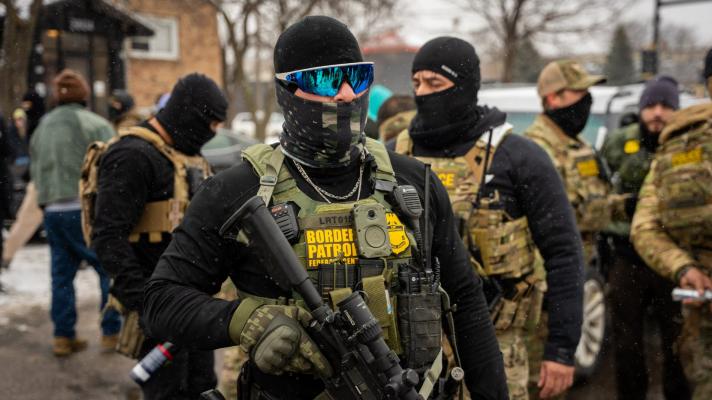
Police, prison and abolition

User avatar
blindpig
Posts: 15306
Joined: Fri Jul 14, 2017 5:44 pm
Location: Turtle Island
Contact:

Re: Police, prison and abolition

Post by blindpig » Wed Jan 21, 2026 4:53 pm

Fragmentation, Force, and Fascism: The Architecture of the Repressive National Security State
​​​​​​​ Ajamu Baraka, BAR editor and columnist 21 Jan 2026

Image

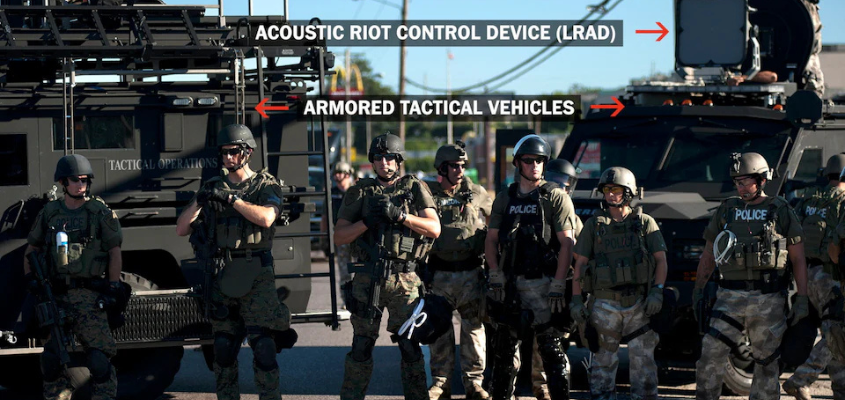
The response by law enforcement to protesters in Ferguson 2014 saw a brutal crackdown using military-style equipment labeld here. (Tom LeGro and Thomas Gibbons-Neff/The Washington Post)

The state is not drifting toward repression; it is building it on purpose. ICE raids, militarized police, and mass surveillance are the tools of a system designed to manage and silence people in crisis.

What we are witnessing in the United States today is not a series of isolated policy excesses or unfortunate “overreaches,” but the maturation of a coherent architecture of repression — a national security state that fuses intelligence, policing, militarization, and ideological discipline into a single system of control. This system is not reactive; it is proactive. It is not defensive; it is anticipatory. And it is not primarily about safety — it is about managing populations, suppressing dissent, and maintaining imperial order in a moment of systemic crisis, fueling the consolidation of fascism.

In this issue of our Bulletin on Domestic Repression, we continue to cover those mechanisms of power and control – surveillance, militarization of police, community occupations, detention as commodity production, with a continued special focus on the new paramilitary role of the Immigration and Customs Enforcement agency (ICE).

In our last issue, we focused on the Department of Defense 1033 Program that transfers military equipment to local police departments but also the lesser-known 1122 Program. We exposed how these programs collapse the boundary between civilian law enforcement and military occupation. Armored vehicles, battlefield weapons, tactical gear, and military training reconfigure police from public servants into domestic security forces oriented toward control rather than care. Protest becomes insurgency. Poverty becomes a threat. Blackness, Brownness, migration, and political dissent become objects of suspicion.

We provide further analysis in this issue on how, into this already volatile mix, comes the expansion of immigration enforcement as a central pillar of domestic repression. ICE raids in cities, mass arrests, workplace sweeps, and collaboration with local police transform immigration policy into a tool of terror — not simply to remove people, but to discipline communities. The goal is not only deportation, but deterrence, fear, fragmentation, and social paralysis. Migrant communities become laboratories of repression where techniques of control are tested before being generalized.

These mechanisms do not operate independently. Militarized police enforce intelligence through overwhelming force. ICE operationalizes it through raids and profit-based detentions. And all of it is ideologically legitimated through a permanent discourse of threat from the racialized “other” — terrorism, gangs, extremism, disorder, invasion — that re-codes political opposition and social crisis as internal security problems.

This is what a repressive, fascist state looks like in a late-imperial moment. Not jackboots in the street, but databases. Not mass roundups announced in advance, but targeted removals justified by intelligence assessments no one can see or contest.

The training relationships between U.S. police and Israeli security forces fit seamlessly into this logic. Israeli policing is shaped by occupation, counterinsurgency, and population control. It is designed not to serve a public, but to manage an enemy population. When U.S. police import those models, they import not only tactics, but an entire political logic: that certain populations are not citizens but problems, not constituents but threats, not humans but risks.

What ties all this together is the collapse of the distinction between foreign and domestic repression. The techniques used to occupy, sanction, destabilize, and discipline abroad are now fully integrated into domestic governance. The empire has come home, not because it wants to, but because it must. A system built on exploitation, inequality, and endless expansion cannot govern through consent in moments of crisis. It must govern through coercion, control and violence.

This is why we should not be surprised that ICE behaves like a paramilitary force, and that political dissent is increasingly framed as extremism. This is not drift. It is design. ICE Director Todd Lyons’ comment last April that the administration should treat deportations “like a business … Like [Amazon] Prime, but with human beings,” is the capitalist logic that is driving these moves toward a fully consolidated neofascism is clear.

The question is not whether this system will be used abusively. It already is. The question is whether it will be named for what it is: a repressive national security state emerging from the contradictions of empire, racial capitalism, and imperial decline that has now turned to the capitalist reform of fascism to uphold the dictatorship of capital.

And the task before us is not reform within that architecture, but confrontation with it. Not technocratic fixes, but political resistance. Not procedural objections, but principled opposition. Because once repression becomes normalized, legality becomes irrelevant — and freedom becomes a memory rather than a practice.

No Compromises, No Retreat

Ajamu Baraka

https://blackagendareport.com/index.php ... rity-state
"There is great chaos under heaven; the situation is excellent."

User avatar
blindpig
Posts: 15306
Joined: Fri Jul 14, 2017 5:44 pm
Location: Turtle Island
Contact:

Re: Police, prison and abolition

Post by blindpig » Thu Jan 22, 2026 3:58 pm

ICE and fire: momentum surges in Minnesota toward a general strike against Trump’s agenda

A statewide shutdown looms in Minnesota as mass opposition to ICE builds into a general strike with implications far beyond the Twin Cities.

January 21, 2026 by Devin B. Martinez
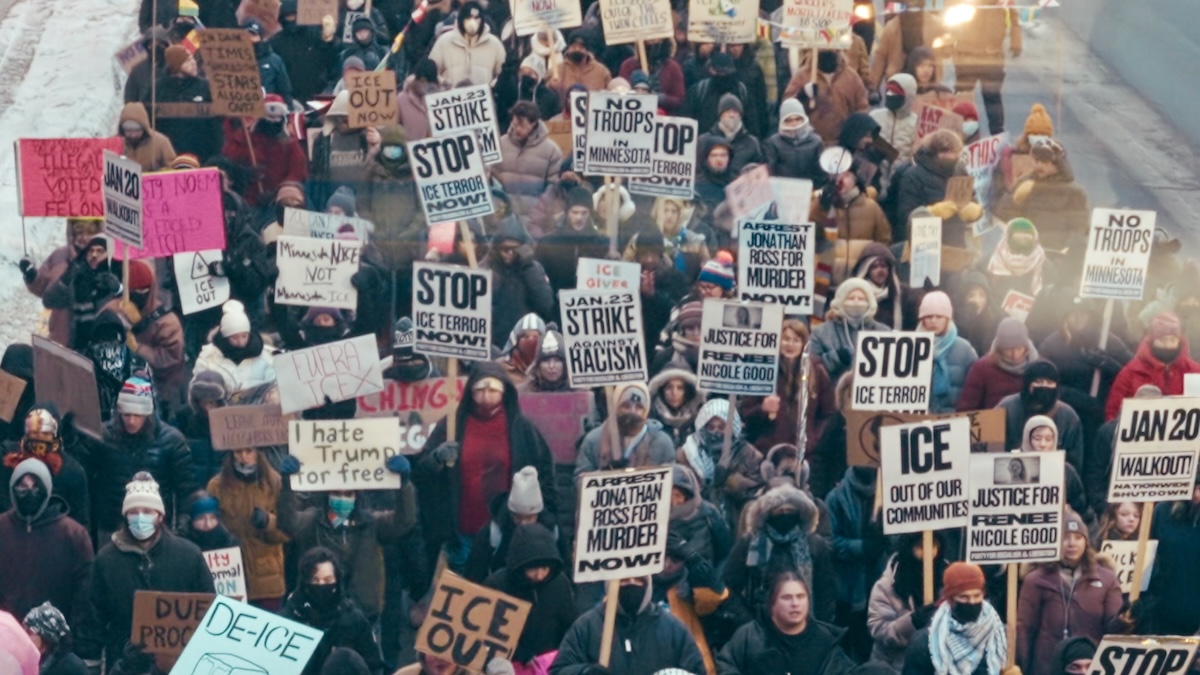
Image
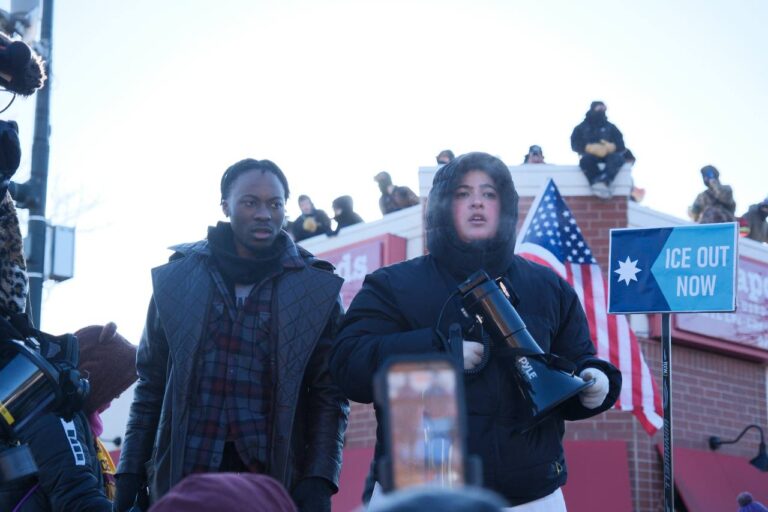
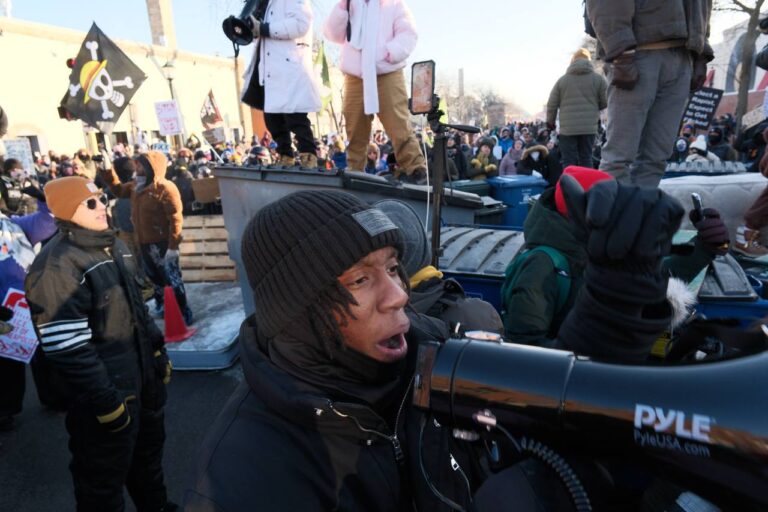
Mass protest against ICE in Minneapolis on January 20. Photo: PSL Twin Cities

Momentum toward a statewide general strike is rapidly building in Minnesota, as unions, businesses, students, and community organizations prepare to shut down work, schools, and commerce on January 23, in response to the killing of Renee Macklin Good and the expanding presence of Immigration Customs Enforcement (ICE) in the Twin Cities.

The community has been fiercely mobilizing since the call to shut down was issued last week by prominent community leaders. Ignited by the call, coordination is stretching across multiple sectors of society, as opposition to ICE becomes a central point of resistance to Trump’s far-right agenda.

“Come out, fight. Fight for your brother, fight for your sister, fight for your sibling,” said David Stiggers, president of ATU Local 1005, which represents 2700 workers, in a press conference on January 19. “We are all in this together because it will not stop. It will not stop unless we make it stop.”

Justice for Renee Good, and the complete removal of ICE from the state are the primary demands of the community.

The call to shut down the Twin Cities and the entire state of Minnesota has been joined by over 100 labor unions, community organizations, cultural groups, and tenant and neighborhood associations. Hundreds of small businesses so far have also declared they will totally shut down, according to a sign-on letter shared with Peoples Dispatch.

In response to the surging movement, the federal government has threatened to send 1500 US soldiers to the Twin Cities to reinforce the federal forces already there. The total size of the current force is 3500, according to city and state officials.

Minneapolis became the principal battleground against the Trump agenda after an initial 2,000 ICE agents were deployed against the Twin Cities on January 6. Renee Good was murdered the very next day by a federal ICE agent. Instead of changing course, the campaign that the Department of Homeland Security (DHS) calls the “largest federal immigration enforcement operation ever” appears to only be growing larger.
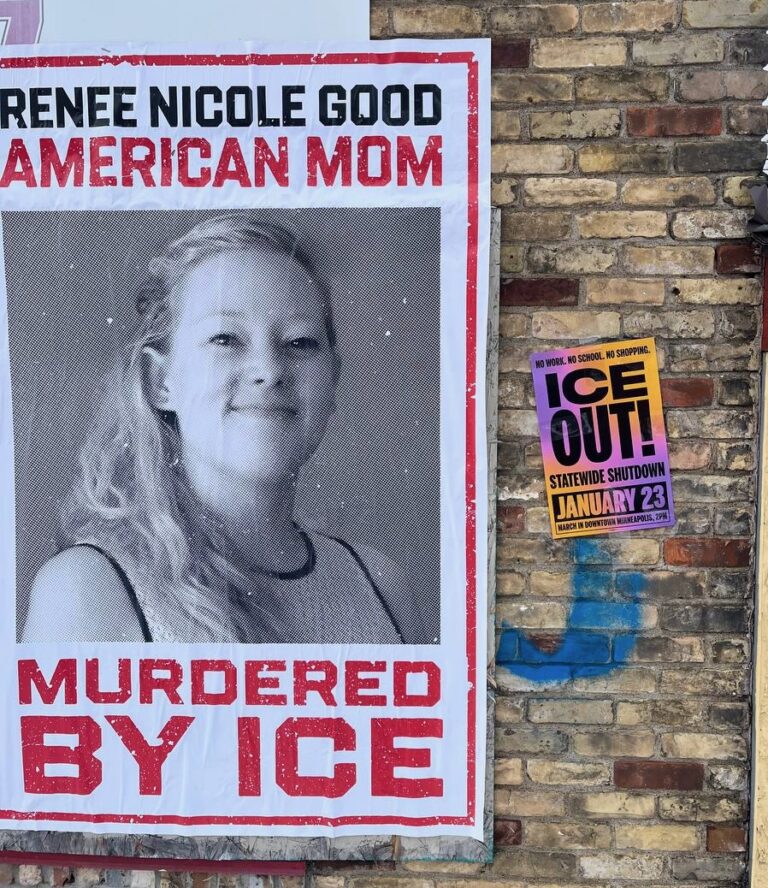
Image
Photo: PSL Twin Cities

In the remaining days ahead of what organizers hope will be a historic statewide shutdown on January 23, the community is taking action daily toward the same demand: “ICE out of Minnesota!”

Confrontations with ICE intensify in the streets
On Sunday morning, protestors disrupted the service of a church where David Easterwood, the St. Paul ICE field office director, serves as pastor. Although the Trump administration has threatened the protestors with federal charges, various community members defended the action and denounced Easterwood’s role as a pastor while at the same time “being directly responsible” for the ICE violence in Minnesota.

On January 17, a crowd of thousands of Minnesotans confronted and chased away far-right influencer and pardoned January 6 rioter Jake Lang, after he planned an anti-muslim demonstration and threatened to “burn a Quran” on the steps of City Hall.

Last week, the day after the January 23 call was made, a second ICE shooting in Minneapolis sparked immediate protests.

Demonstrators converging on the scene were met with flashbangs and tear gas. Multiple witnesses report seeing bystanders, children, and even babies tear gassed by federal ICE agents. (Video at link.)

The Department of Homeland Security (DHS) claimed the shooting was self-defense, but later eyewitness testimony and video completely contradicts the government account. The victim, Julio Sosa-Celis, says he was helping his cousin escape ICE and enter an apartment. Once his cousin was inside, ICE agents shot Sosa-Celis (not the person they were chasing) through the door.

Despite widespread opposition to the ICE deployment (dubbed “Operation Metro Surge” by federal authorities), the Trump administration has doubled down on its rhetoric. In a press conference in Minneapolis on January 20, Head of ICE Gregory Bovino claimed that ICE only targets violent criminals and rapists, saying “what we do is legal, ethical, and moral.” DHS secretary Kristi Noem said the operation in Minnesota is ”a huge victory for public safety,” in a post on X on January 19.

Meanwhile, videos circulating on social media and shared by local organizers show a totally opposite reality. ICE agents seem to constantly be assaulting and violently arresting people, including US citizens, and even members of the Lakota Sioux tribal nation. Some videos show civilian vehicles being rammed to make arrests, women being dragged from their cars, car windows smashed, homes broken into, activists and observers brutalized (one left permanently blind). Not to mention the video of the murder of Renee Good.

For many in Minnesota, these scenes have made clear that conventional protest is no longer enough, and that only a collective shutdown of work, commerce, and daily life can force an end to the violence.

“Abolishing a system isn’t far-fetched”: Unions shut down workplaces
“We can’t continue doing things the old way. We have to adapt so that we can defeat this machine appropriately,” said David Stiggers, president of ATU Local 1005, which represents 2700 workers, in an interview with Labor On the Line.

“Old ways sometimes don’t always work. I’m all for protesting … But how do we stop this from continuing?”

Stiggers says a general strike can show “the power of the people”.

“There would be no movement. The entire city would shut down, if all unions could make that happen.”

Dozens of labor unions have poured into the growing movement against ICE and endorsed the statewide shutdown on the 23rd, including: SEIU 26, UNITE HERE Local 17, AFL-CIO, Minnesota Workers United, Amalgamated Transit Union 1005, North East Area Labor Council, Saint Paul Federation of Educators, and many more.

Communications workers and postal workers rallied at the site of Renee Good’s murder on January 18. They demanded justice for Renee, the removal of ICE from the state, and echoed the call for a January 23 shutdown.

“The concept of abolishing a system isn’t that far-fetched,” said Marcia Howard, president of MFE Local 59, at a union rally outside the Minneapolis postal office on January 19, demanding ICE out of the state.

“I don’t think that it’s reaching for the stars to say that this deleterious organization that just hired people after a demonstrable six-minute interview … maybe shouldn’t exist at all.”

Howard says that Trump’s decision to target Minneapolis was a major strategic error, because “the discipline, the culture, and the community” that’s needed to fight back and win already defines the Twin Cities.

“We’ve been forged by multiple ‘unprecedented events’ before,” she said.

“We’re the same people that marched for Jamar Clark and Philando Castile and brown kids in cages. We were the center of the world’s attention during George Floyd. We’ve had historical strikes in industries of nursing, in education, and we’re a labor town. You really want to mess with working-class people who actually have a labor cohesiveness called the Minnesota Model named after them?”

“Let’s pony up,” says David Stiggers. “Let’s do this in the name of solidarity, in the name of all those who fell before us, who are trying to give us better days. Let’s do it for them.”

Store owners wield economic power against ICE
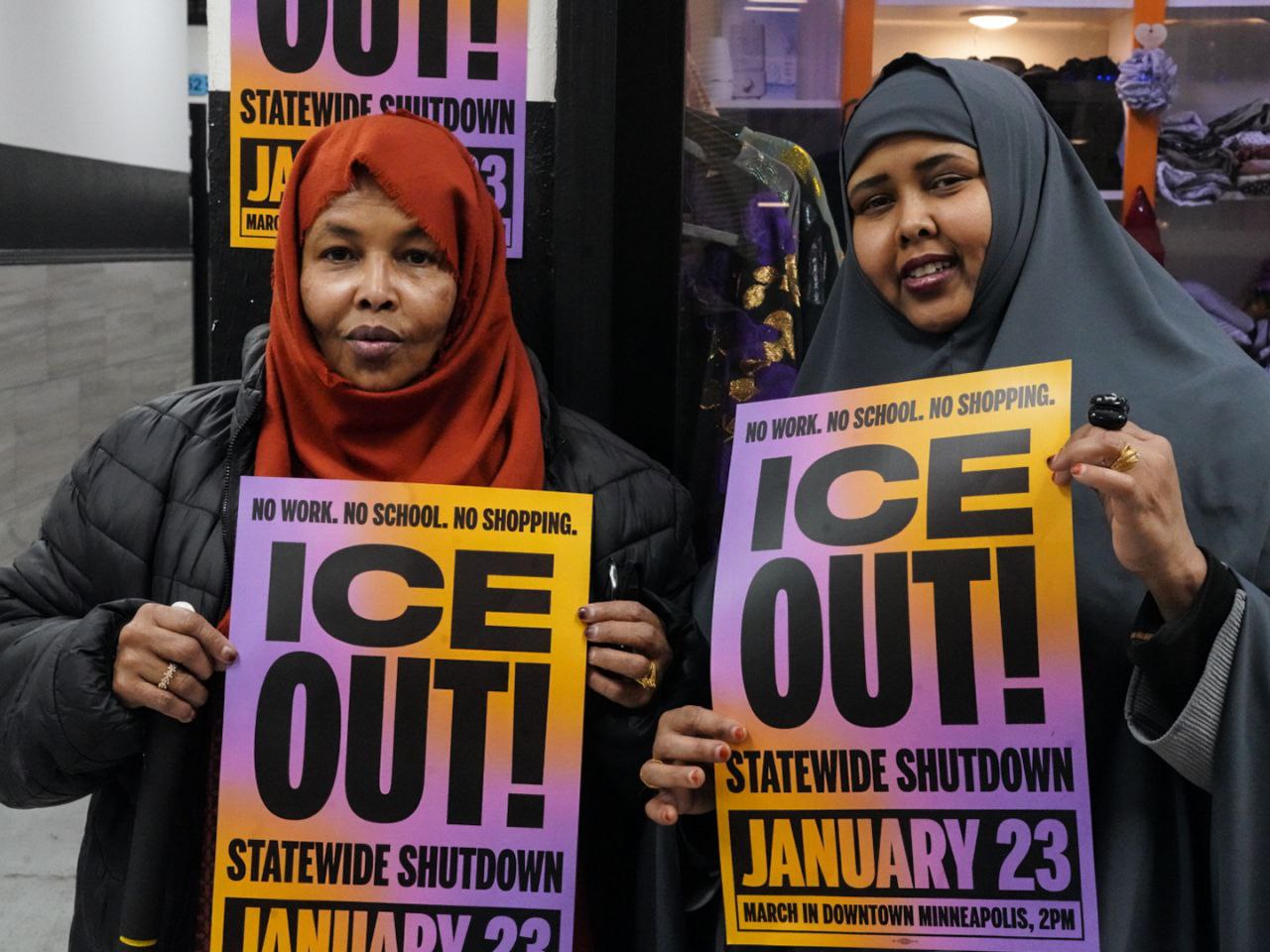
Image
Garment shop owners join January 23 shutdown. Photo: PSL Twin Cities

“We invite all of you to participate this January 23 in this strike,” Candi, owner of Pasteleria Gama, told Peoples Dispatch.

Business owners have highlighted the “economic violence” that ICE operations represent for them, citing a sharp drop in business as their community is heavily targeted by federal forces.

“Our people, they are scared to come into the mall, to go outside … [ICE] killed some people, they shot others, all the people are scared,” said Abdi, owner of Rancho Coffee in 24 Somali Mall (a major commerce hub), speaking to Peoples Dispatch.

“All of the businesses in Mall 24, all Somali people, all our community are coming out and shutting down all the business on Friday.”

Purple and orange posters reading “ICE OUT! Statewide Shutdown” have appeared on windows and doors of hundreds of businesses across the Twin Cities. Business owners are holding press conferences, organizing meetings, and talking to news outlets about the shutdown, amplifying the call to join.

Karmel Mall, another major hub, is completely shutting down this Friday. “No school, no work, no business! ICE out of Minnesota!” chanted Wirse, a garment shop owner in the mall.

In St. Paul’s Hmong Village, another key market for the immigrant community, support for the shutdown was immediate. Especially after a video surfaced on social media showing ICE agents raiding an elderly Hmong man’s home, arresting him, and apparently forcing him outside wearing nothing but shorts and a blanket.

Riverside Mall, in the center of Minneapolis, is yet another hub that has seen a wave of support for the 23rd. At the iconic Mall of America, interest in shutting down is also growing.
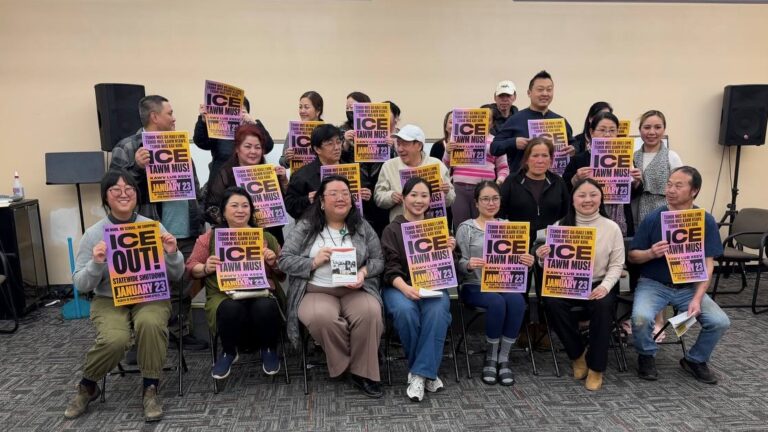
Image
Hmong Village business owners hold an organizing meeting ahead of January 23 shutdown. Photo: PSL Twin Cities

Mass organizing accelerates toward general strike
Organizers and community members are mobilizing to draw still more businesses and organizations into the statewide shutdown against ICE.

Image
One of two daily volunteer meetings ahead of January 23 shutdown. Photo: PSL Twin Cities

“The things that are going on. It’s insane and ridiculous … We gotta stand up. We gotta do what we can,” said Tianna Toney, a Minneapolis resident and volunteer reaching out to local businesses. “There is too much going on for us not to be saying anything.”

The ranks of organizers and volunteers distributing posters, leaflets, and spreading the word about the shutdown on the 23rd is growing rapidly by the day.

Mass volunteer meetings have started to be regularly organized by the Twin Cities branch of the Party for Socialism and Liberation, where anyone in the community can pick up materials, join outreach groups, and debrief about their efforts. They plan to talk to as many neighbors, businesses, and organizations as possible each day until Friday.
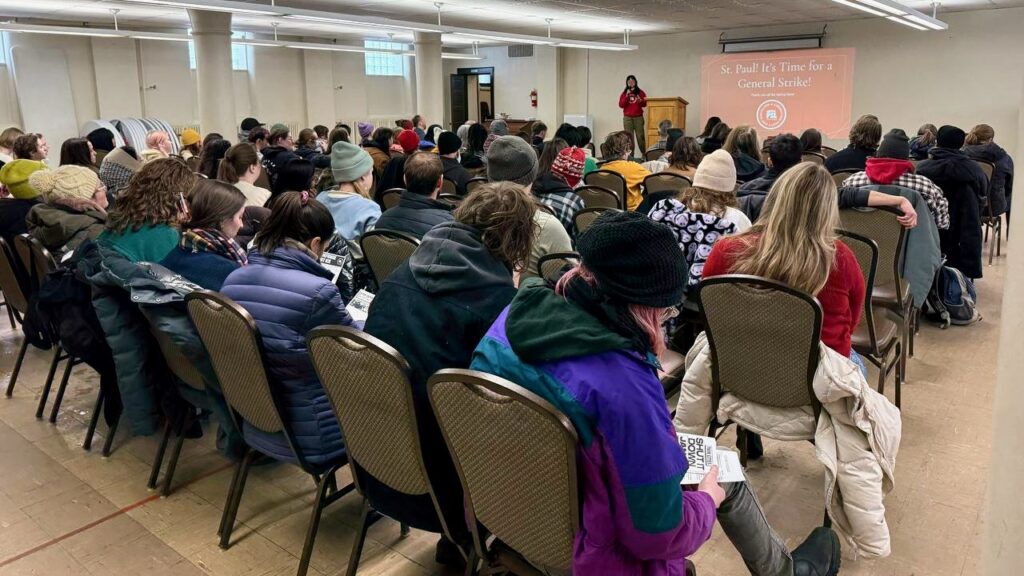
Image
Volunteer meeting in St. Paul. Photo: PSL Twin Cities
Volunteers say they are also working with students and staff at the University of Minnesota who are calling for a shut down of the campus on January 23.

High School students launch walkouts against ICE
Following an ICE assault on students and staff at Roosevelt High School (the same day as the murder of Renee Good), High School students at Roosevelt and across the Twin Cities have been walking out of school in protest of the militarized federal forces in their community.

“ICE needs to leave, not just Minnesota but the entire United States,” said Eleanor, during a student walkout at Central High School in St. Paul on January 15. “On the 23rd, people are advised not to go to work and not to go to school to protest ICE,” Eleanor said.

Hundreds of students also walked out of St. Louis Park High School and other high schools on January 20 as part of a national day of action against Trump.

As workers, students, and community members coordinate their actions, the movement is building a rare alignment across multiple sectors of Minnesota society. From unions shutting down workplaces to small businesses closing their doors, and high school walkouts amplifying youth voices, the city’s daily life is being strategically repurposed as a form of resistance.

If Minnesota succeeds in shutting down workplaces, schools, and commerce on January 23, it could mark a moment when collective economic power forces a national pause on Trump’s far-right agenda. A victory of that scale could serve as a testament for working people across the United States that a general strike can make real change, even at the federal level, while building independent political power that can be leveraged long-term.

https://peoplesdispatch.org/2026/01/21/ ... ps-agenda/

******

The siege of Minneapolis: testimonies from the front lines
January 18, 2026 Melinda Butterfield

Image
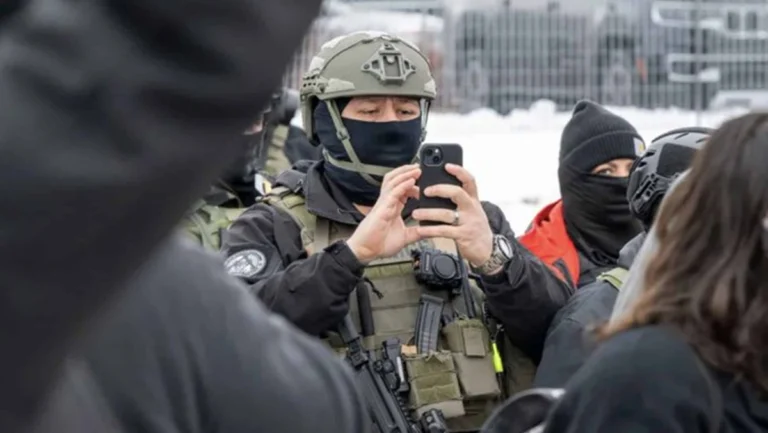
Community members confront armed ICE, DHS and CPB cops after they shot a person in the leg on Jan. 17, 2026. Photo: Chris Juhn

In an effort to provide readers with a clearer picture of events in Minneapolis, Struggle-La Lucha has spoken to local activists and community members and gathered testimonies from other participants in the local response to Trump-ICE terror. These voices are being ignored, minimized or distorted by the corporate media.

For weeks and months prior to the new year, activists in the Minneapolis-St. Paul area had been preparing for a full-scale invasion by federal agents – particularly after President Donald Trump leaned into attacks on the Somali immigrant community. The area is home to the country’s largest Somali diaspora and to Rep. Ilhan Omar, a frequent lightning rod for white supremacists.

But the murder of Renee Nicole Good by ICE agent Jonathan Ross on Jan. 7 ignited a mass response to ICE repression throughout the city. Good, a 37-year-old white woman and U.S. citizen, together with her wife Becca Good, were acting as observers documenting an ICE raid.

Multiple videos of Ross’s brutal killing of Good provide ample proof of the vicious misogyny, anti-lesbian and anti-queer hate that fueled the murder.

“The queer community is furious,” local activist Meredith Aby-Keirstead told Struggle-La Lucha. “Not only was Renee Good murdered and labeled a ‘domestic terrorist’ by the Trump administration, but now the Justice Department is investigating Renee’s wife Becca, when in reality they should go after the ICE murderer instead.”

But that anger isn’t limited to LGBTQIA+ people, said Aby-Keirstead, an organizer with the Anti-War Committee. “Minneapolis is outraged at Good’s murder. Many communities are angry at how ICE is tearing our city apart. We had over 100,000 people in the streets on Saturday [Jan. 10].”

Children under siege

P, a young teacher, who asked SLL to remain anonymous, said: “Right away at school today one of my students told me he’s afraid of ICE. These are K-2 students with developmental delays.

“He said three men in vests came to his house over the weekend. He said his older brother was cursing at them and his mother told him to hide.

“I asked him if he wants a whistle to keep in his bag, so he can blow it if he feels scared and he needs to call for help, and he said yes.”

The teacher continued: “I think it’s very odd that the news articles about the closing of Minneapolis schools are connecting it only to the shooting of Renee Good and not the coincidental fact that within hours ICE assaulted children going home from school at Roosevelt High School.

“While it’s true that the shooting did cause an elementary school to go into lockdown, the reason they’re allowing students to learn from home until Feb. 12 is because ICE is kidnapping, assaulting, and tear gassing children as they leave school.”

E, a parent and coordinator of an all-volunteer bookstore, posted on social media: “I really want people without Minneapolis connections to understand. You might’ve heard that Minneapolis public schools went hybrid because so many families are in hiding. Well, a coworker just told me that today, during his kid’s hybrid class, another kid’s apartment building was raided on screen.

“Everyone has stories like this.”

‘Money for names’

Legal observer Brandon Siguenza was violently detained by ICE Jan. 11 and held at the Whipple Federal Building in downtown Minneapolis. Siguenza made a statement shared on social media and was also interviewed by local television station KARE-11.

“They finally told me that they could offer undocumented family members of mine legal protection if I have any… or money, in exchange for giving them the names of protest organizers, or undocumented persons. I was shocked, and told them no.”

Hwa Jeong Kim, vice president of the St. Paul City Council, posted a video for residents of her district, stating: “Before 9:30 this morning ICE already kidnapped someone off the streets of my ward. We have first-hand accounts of neighbors reporting ICE showing up at their homes, asking people to identify pictures …

“They ask them, ‘Do you know any of your Hmong neighbors?’ They even go so far as asking, ‘Do you know any Asian people in your neighborhood?’ And they said no.

“This going door-to-door to random homes is a clear escalation. I don’t want to be the person to say that it’s not safe to go outside today, but folks really need to decide for themselves how safe they feel out in their neighborhoods.

“And still there are community patrols keeping an eye out for you. There are caring neighbors who want to deliver groceries to you and provide mutual aid. Please stay safe.”

Image
Federal agents flooded the streets of Minneapolis with tear gas and other chemicals on Jan. 17, 2026. Photo: Chris Juhn

‘Our movements are connected’

Sarah Martin is an organizer of Women Against Military Madness (WAMM), which started in the 1980s to oppose U.S.-funded wars in Latin America. Martin told SLL, “WAMM and the anti-war movement in Minneapolis understand that all our movements are connected and that we are fighting the same enemy: U.S. imperialism.

“In the case of ICE, it’s about the connections. That monstrosity has connections to the IOF [Israel Occupation Forces] through training and reports of direct involvement. The wars the U.S. perpetrates in Latin America and beyond – whether military or sanctions or regime changes – have forced people out of their homelands and to migrate here.

“It is unjust and so cruel,” said Martin. “Our government makes life unbearable for people in their countries, they feel they have no choice but to leave, and then they make it just as miserable for them here. So of course, we respond when ICE is terrorizing a neighborhood.”

Martin added: “For at least 10 years WAMM has held a weekly bannering at the Whipple Federal Building, which holds the immigration court and from which immigrants are deported. The bannering happens at 7:30 a.m., when vans holding deportees go by. Now it’s the site of ICE agents staging every morning.”

Chris Juhn is a photojournalist who covers many protests in Minneapolis, including during the 2020 uprising after the police murder of George Floyd.

On the night of Jan. 14, Juhn was documenting the federal agents’ attack on protesters and legal observers after ICE shot a person in the leg. He photographed the feds unleashing an unidentified green gas not seen at previous protests.

“That was the most tear gas I’ve ever experienced in my life,” Juhn recalled. “I must’ve been hit with at least five rounds of tear gas, some incredibly thick. Had some shrapnel from flashbangs fly around me. When you see a flaming ball shooting sparks fly by your head, it’s terrifying.

“I was next to a crowd that was completely peaceful. Next thing, they’re tossing tear gas and flash bangs at everyone without warning. A car nearly hit me as everyone scrambled.

“The Minneapolis PD seemed useless. I had my editor tell me to clear out.”

Somali community patrols

The Intercept published a report on ICE watch patrols organized by Somalis to keep their community safe.

Those participating are mainly people with U.S. citizenship, explained Abdi Rahman, a founder of the West Bank neighborhood patrol. “The non-citizens have stopped stepping out entirely. We buy groceries for them and drop them off at their homes.”

“The armed men and women, with their faces covered, roaming our streets and profiling us – we thought we had left all that behind, but now this moment in America is reminding us again of the Somali civil war,” said Imam Yusuf Abdulle of the Islamic Association of North America.

“But we are fighting. We didn’t come this far, make our lives here, to again be targeted and abused like this.”

“We fled a civil war,” community activist Mahmoud Hasan said. “We are more resilient than they think.”

https://www.struggle-la-lucha.org/2026/ ... ont-lines/

******

Health Crisis Deepens at U.S. Immigration Detention Facilities as Illnesses Spread
Image
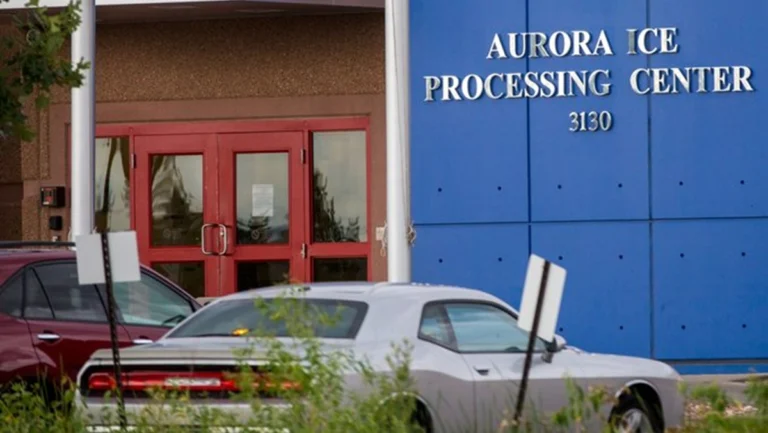
Aurora ICE Processing Center. X/ @solitarywatch

January 22, 2026 Hour: 8:26 am

The outbreak in Aurora is not an isolated incident within ICE’s detention system.
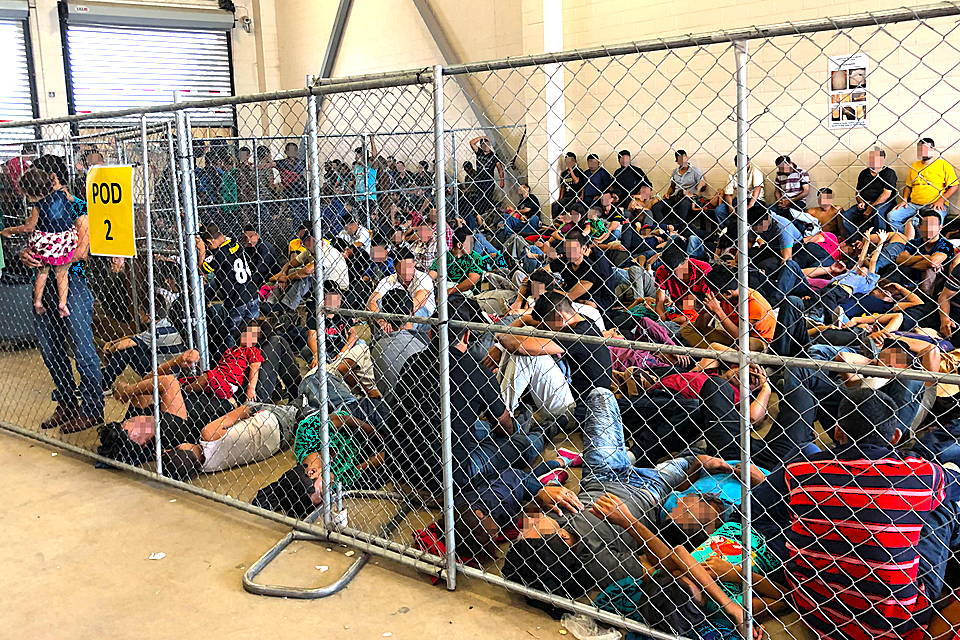
U.S. health officials are investigating reports of widespread illness at a near-capacity immigration detention facility in Aurora, a city in the U.S. state of Colorado that lies partly in Adams County, after immigrant-rights advocates alleged that a largely untreated outbreak had swept through the center.

A spokeswoman for the Adams County Health Department, Jennifer Lucero-Alvarez, was quoted by the Denver Post recently as saying that health officials had “received multiple reports about possible gastrointestinal and respiratory illness” at the facility. She declined to provide additional information about the current health conditions in the facility and how many of the facility’s detainees are sick.

The Denver Contract Detention Facility (Aurora) reported multiple cases of influenza early this month, U.S. Representative Jason Crow’s office confirmed the news, though U.S. Immigration and Customs Enforcement (ICE) officials have not disclosed how many people are affected. ICE is the federal agency responsible for detaining immigrants awaiting deportation hearings or removal from the country.

The 1,532-bed Aurora facility is operated by GEO Group, a private corporation that manages detention centers under contract with the U.S. federal government. The facility has a documented history of failing to contain contagious diseases dating back years.

Hundreds gathered outside the Aurora ICE detention center for Immigrant Stations of the Cross. Faith leaders echoed the U.S. bishops’ call to reject mass deportations and dehumanizing rhetoric. Our message is clear: Every person is sacred. #ImmigrantJustice #COPolitics pic.twitter.com/C0ab0l2t2I

— TogetherCO (@TogetherCO) December 12, 2025


In February 2020, ICE inspections found 68 people quarantined with flu and 70 with mumps at the Aurora center, according to a ProPublica investigation. The facility experienced three separate outbreaks in four months during 2019, including mumps and chickenpox.

The Aurora facility has faced multiple complaints about inadequate medical care. A 2024 report by the American Civil Liberties Union (ACLU) documented cases of medical incompetence, dental neglect, and inadequate mental healthcare, which contributed to at least two deaths at the facility. In one case, staff abruptly cut a detainee off his medication, relied on incorrect medical protocols and believed that he was faking his symptoms — including a seizure — prior to his death.

The outbreak in Aurora is not an isolated incident within ICE’s detention system. A study by the University of California, San Francisco, which was published in the JAMA medical journal, found that 17 out of 22 ICE detention centers experienced sustained outbreaks of vaccine-preventable illnesses between January 2017 and March 2020. One facility had a chickenpox outbreak lasting 33 months and year-round influenza transmission.

In December 2025, the Golden State Annex Facility in McFarland, California, experienced an outbreak of scabies, a highly contagious skin condition caused by mites that can spread rapidly in crowded settings. The Kern County Public Health Department confirmed several cases and said it was working with the facility’s medical staff to prevent further transmission.

Record highs of people in ICE detention, 32 deaths inside facilities, and harsh conditions leave migrants afraid to seek basic services, while the human cost stays out of public view pic.twitter.com/7KOoRwdrAr

— TRT World (@trtworld) January 22, 2026
The Northwest ICE Processing Center in Tacoma, Washington, confirmed seven suspected tuberculosis cases in July 2025. One detainee was hospitalized with active TB after being transferred from the Anchorage Correctional Complex to Tacoma.

As of January 2025, 86 percent of ICE detainees were held in facilities run by for-profit companies, according to immigration tracking data. This represents an increase from 81 percent in January 2020. Two corporations — the GEO Group and CoreCivic — dominate the market. In 2022 alone, the GEO Group made 1.05 billion U.S. dollars in revenue from ICE contracts.

Government inspectors have found barbaric and negligent treatment in ICE detention facilities. According to a 2023 National Public Radio report, expert inspectors documented negligent medical care, unsafe and filthy conditions and racist abuse of detainees. One inspector noted that violations found at a GEO Group facility were so severe that if discovered in a hospital, it could be forced to shut down.

On Jan. 12, the Aurora City Council passed a resolution condemning ICE operations, citing the Minneapolis fatal shooting, an unmanaged illness outbreak at the GEO ICE detention facility and other ICE overreach cases in the city. Representative Crow filed a lawsuit in the week of Jan. 11 against the Trump administration, alleging that officials had blocked congressional oversight of immigration detention facilities, including the one in Aurora.

https://www.telesurenglish.net/health-c ... es-spread/

******

Image
AIM members are showing up in force in Minneapolis to protect the community in the 2026 unrest. Here, an AIM members attends a demonstration in 2020 in Minneapolis after the death of George Floyd at the hands of police. Photo: John Arthur Anderson)

‘Full Circle’: AIM patrols back on Minneapolis streets as tensions rise
Originally published: Indian Country Today on January, 17, 2026 by Stewart Huntington (more by Indian Country Today) | (Posted Jan 22, 2026)

The wave of federal immigration agents swarming the Minneapolis area might be unprecedented in law enforcement history, but the response in the Indigenous community is not.

Half a century ago, the American Indian Movement was founded on Franklin Avenue, the heart of the urban Indian diaspora in South Minneapolis, to counter overzealous municipal policing.

Today, AIM patrols are back, watching over elders, youths and aunties along the same avenue in what is now known as the city’s American Indian Cultural Corridor.

“History shows us time and time again, it doesn’t repeat, but it rhymes,” said Heather Bruegl, an activist, historian and Oneida Tribe of Wisconsin citizen who has studied the American Indian Movement.

So you can look throughout history and see different examples of what we see today happening in the past.

And if the history rhymes, some of the names do even more. Some are the same.

Crow Bellecourt, Bad River Band of Chippewa, has been out on the recent patrols. His father, the late Clyde Bellecourt, was among the founding members of AIM in 1968.

“I grew up in the movement,” said Bellecourt, executive director of the Indigenous Protector Movement, a group with AIM roots.

I always like to say, ‘I’m second-generation American Indian Movement.’ It’s, like, full circle for me.

The confrontations between law enforcement and protestors in Minneapolis—including the shooting of 37-year-old Renee Good— have brought reports that Indigenous people have also been swept into custody.

A cohort of Indigenous patrollers has now reached close to 100, Bellecourt said.

“We’re running from seven in the morning to seven in the evening,” he said.

And even more. We still have some patrollers going out until like 11 or 12 at night.

And just like in 1968, the patrollers are on the street to help community members feel safe.

“It’s really scary here,” said Mary LaGarde, executive director of the Minneapolis American Indian Center, which operates from its base on Franklin Avenue.

Federal Immigration and Customs Enforcement officers have surged into the Twin Cities area to counter what the Trump administration has called corruption and criminality in area immigrant populations. At this point, there are more federal law enforcement officers in Minneapolis than metropolitan police.

The dramatic presence has prompted widespread protests and rebukes from state and local officials. There have been at least two shootings involving the federal officers.

“We woke up and we had all these ICE agents everywhere,” said Bellecourt.

They’re all over our neighborhood. I’m scared for our old people and the young ones who just wanted to catch the city bus to go to the grocery store. … I worry about them getting picked up from ICE.

LaGarde, White Earth Band of Chippewa, knows the feeling.

“It’s like you don’t want to leave the house,” LaGarde told ICT.

That’s how most of our people are feeling right now. Our elders are scared. Our young people, too. This is really impacting our kids.

LaGarde said the patrols–by AIM members and other groups such as the Many Shields Warrior Society–are needed.

“it’s really important that we’re out protecting,” she said.

The numbers of volunteers out patrolling are growing.

“We have relatives coming in from South Dakota, Wisconsin and neighboring states,” Bellecourt said. Some have come from as far away as Oklahoma, he said.

Just like in the old days, AIM members are gathering along Franklin Avenue just as they gathered for occupations of Alcatraz Island in San Francisco in 1969, the Bureau of Indian Affairs headquarters in 1972, and the Wounded Knee massacre site in 1973.

AIM members also turned out in force in Minneapolis in 2020 after the death of George Floyd at the hands of law enforcement.

What’s different from the early years? Modern communication tools.

“We didn’t have these cell phones and all this social media back in them days,” Bellecourt said.

Everybody called on house phones and it was amazing how many people would show up. My dad called it the ‘moccasin telegraph’ and people would just call one another and, wherever they needed people to be, everyone would show up.

They came to help the people.Then and today.

“One of the first acts that AIM did when they were forming was patrolling the streets and making sure that if their community members were stopped or pulled over by the police, that their rights were being followed, like, you know, ‘Hey, you have the right to this, you have the right to that,’” Bruegl said.

“And we see that now happening again [because] people’s rights are being violated. We see Indigenous folks, tribal members being detained,” Bruegl said.

It’s important that groups like AIM and other groups are coming out again, working in community and making sure that we’re protecting each other.

https://mronline.org/2026/01/22/full-ci ... ions-rise/

"There is great chaos under heaven; the situation is excellent."

User avatar
blindpig
Posts: 15306
Joined: Fri Jul 14, 2017 5:44 pm
Location: Turtle Island
Contact:

Re: Police, prison and abolition

Post by blindpig » Fri Jan 23, 2026 4:25 pm

New ICE policy allows officers to enter homes without a judge’s warrant. Here’s what experts say
By Michael Williams
Updated 15 hr ago

Image
Federal law enforcement agents outside a private residence in St. Paul, Minnesota, on Sunday, January 18, 2026. Victor J. Blue/Bloomberg/Getty Images

With an Immigration and Customs Enforcement memo that allows officers to enter homes without a judicial warrant, the Trump administration is seeking to usurp guardrails that are enshrined in the Fourth Amendment and have protected Americans’ civil liberties for centuries, experts in constitutional law and immigration policy told CNN.

Even in an administration that has always pushed an expansive vision of its law enforcement authority, the directive is notable for the way it tosses aside longstanding prohibitions against warrantless searches on private property — a legal concept that predates the creation of the United States and is among the country’s most foundational principles.

“The Bill of Rights, we thought, were the first 10 amendments,” said Mark Graber, a constitutional law scholar and University of Maryland professor.

With the newly discovered memo, he said: “I guess now we’re down to nine.”

Immigration officials had typically sought the arrests of undocumented people through two means: a judicial warrant, which is signed and authorized by a judge, or an administrative warrant, which is signed by people who work in the executive branch and fall under the purview of the president.

A critical difference between the two is that judicial warrants allow law enforcement to enter and search a person’s home or a non-public area of a business, while administrative warrants do not.

Most immigration arrests are carried out under administrative warrants because they require a lower bar to issue, and Trump administration officials have long harbored frustrations over limitations on officers pursuing targets on private property.

The internal memo, which was issued in May 2025 but revealed by a whistleblower complaint and first reported by the Associated Press on Wednesday, authorizes ICE officers to forcefully enter homes using only administrative warrants, essentially bypassing the neutral, third-party arbiters who would have reviewed evidence before signing a judicial warrant.

Administrative warrants are signed by ICE officers after an immigration judge orders the removal of an undocumented immigrant. But these immigration judges work for the Department of Justice at the pleasure of the attorney general, and the Trump administration refers to them as “deportation judges.”

“It would essentially be the same as if you were at the local police department, and the police officer that is both collecting the evidence and arresting you then goes and types up his own warrant to search your house because he thinks he has probable cause,” said Emmanuel Mauleón, an associate professor of law at the University of Minnesota.

“It’s deeply concerning, because there’s absolutely no safeguards and no accountability built into the system,” he said.

The history of the Fourth Amendment is rife with examples of local, state and federal law enforcement agencies seeking to challenge or whittle away its protections.

But this memo, Mauleón said, is “not the sort of incremental wearing down that we’ve seen over time.”

“It is what you might think of as crossing the Rubicon,” he said. “It is declaring that the fundamental protections that every court has recognized up to this point just don’t apply to DHS and to immigration stops.”

The Department of Homeland Security defended the directive in a statement in which spokesperson Tricia McLaughlin said people who are served administrative warrants already had “full due process and a final order of removal.”

The administration’s own data shows hundreds of thousands of people last year were issued removal orders in absentia by immigration judges after they failed to show up to court.

The memo was not broadly distributed to ICE field offices in a departure from the way major policy chances have been typically announced internally.

Instead, in at least some cases, the guidance appeared to only be shared verbally, according to a source familiar. Some ICE officials learned about the guidance for the first time only after the Associated Press reported the change.

News of the memo prompted widespread alarm among civil liberties advocates and Democratic lawmakers. Sen. Richard Blumenthal of Connecticut called on Homeland Security Secretary Kristi Noem and acting ICE Director Todd Lyons to testify before Congress about the memo. Minnesota Gov. Tim Walz, whose state is experiencing the most intense surge of immigration enforcement in DHS’s history, said in a post on X “every American” should be “outraged by this assault on freedom and privacy.”

A Trump administration official told CNN the directive is “not a green light to randomly kick down doors.”

But it comes after months in which officers carrying out the president’s massive deportation mandate have used brutish tactics, largely unchecked, to detain immigrants and citizens alike.

“This administration’s general stance is that immigrants are ‘invaders’ and immigration officials should be allowed to expedite their arrest, detention and deportation,” said Kathleen Bush-Joseph, an attorney and analyst at the Migration Policy Institute. In doing so, she said, “they are pushing so many legal boundaries and doing things that have not been tried before in this way.”

https://us.cnn.com/2026/01/22/politics/ ... at-we-know

******

ICE kills in Minnesota, then moves to crush protest
January 22, 2026 Gary Wilson

Image
NekimaLevyArmstrong

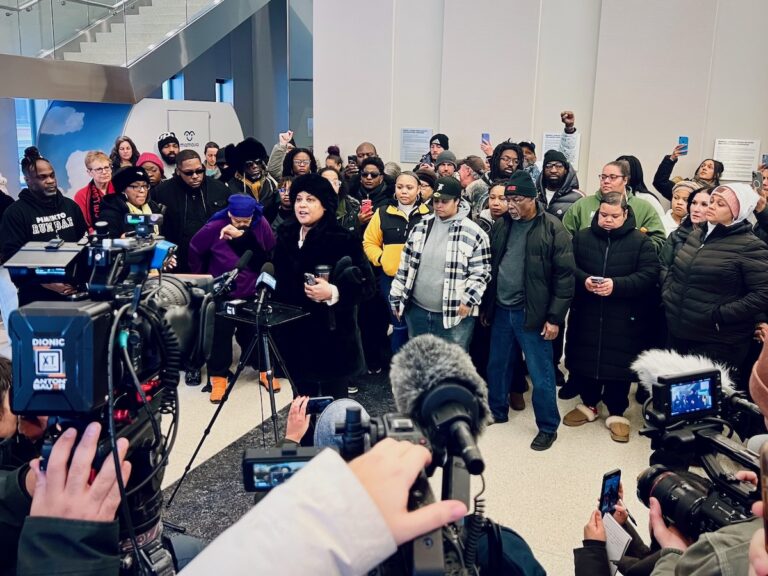
Nekima Levy Armstrong and community leaders speak during a press conference in the lobby of the Hennepin County Government Center in Minneapolis on Jan. 8, 2026, calling for accountability following the fatal shooting of Renee Good by an ICE agent, a killing that has sparked protests against federal enforcement and demands for independent investigation.
Federal authorities arrested civil rights organizers in St. Paul, Minnesota, after a protest at a Southern Baptist church that demanded accountability for an ICE killing.

Among those arrested were Nekima Levy Armstrong, an ordained minister with decades of organizing experience, and Chauntyll Louisa Allen, a sitting member of the St. Paul Public Schools Board of Education. Others were charged as well. The charges were federal.

The targeting of Nekima Levy Armstrong and Chauntyll Louisa Allen was not incidental. Both are organizers whose work links protests against police violence with resistance to ICE raids. Armstrong is a longtime civil rights leader shaped by Minneapolis’s Black Lives Matter movement and by repeated uprisings against police killings. Allen is an elected school board member active in immigrant and community defense. Together, they represent a growing overlap between opposition to police violence and resistance to ICE enforcement.

That overlap matters. In Minneapolis, Black Lives Matter protests against police brutality and protests against immigration raids have increasingly drawn from the same neighborhoods, the same families and, in some cases, the same organizers. When those fights converge, they challenge not just one agency, but a broader system of policing, surveillance and detention.

By responding with federal felony charges and conspiracy allegations, the Department of Justice moved to break that connection. The arrests sent a clear signal about which forms of solidarity will be tolerated and which will be punished. Organizing across movements — Black communities confronting police violence and immigrant communities resisting ICE — is being treated not as dissent, but as a federal crime.

The protest was one of several that erupted after an armed Immigration and Customs Enforcement (ICE) agent shot Renee Good, a U.S. citizen, dead inside her car in Minneapolis. Rather than open a criminal or civil-rights investigation, the Department of Justice declined to pursue one.

Because the shooter was a federal agent acting under federal authority, the refusal to investigate was an assertion of power. No independent body was assigned. No federal grand jury was convened. The Department of Justice declined to open a civil rights inquiry. The killing was closed without testimony, without public evidence, and without consequence. The message was unmistakable: When ICE kills, the federal government will protect its agents, and those who demand answers will not find them through official channels.

That refusal came first. Everything else followed.

A killing without an investigation

The officer who fired the shots, Jonathan Ross, was not arrested.

When people demanded answers from the federal government, it responded with arrests instead of an investigation.

One of the protests took place at a Southern Baptist church on Sunday morning to confront the pastor, who is also the local head of ICE.

Federal authorities reacted immediately.

Prosecutors did not use minor trespass laws. Instead, they reached for heavy federal conspiracy charges and a law passed to block violent interference with abortion clinics, the Freedom of Access to Clinic Entrances Act, commonly known as the FACE Act.

That law was turned into a tool to make a church protest a federal crime.

A secret policy to enter homes without warrants

While these prosecutions moved forward, another shift was taking place inside ICE itself.

ICE staff leaked a secret memo signed by acting Director Todd Lyons, ordering agents to enter homes without a judge’s warrant, relying only on paperwork signed by ICE.

The policy was not circulated openly. Supervisors were told to show it briefly and take it back. Agents were instructed verbally. At least one ICE instructor resigned rather than teach it. Employees who objected were disciplined.

The reason for the secrecy is obvious. No judge has granted ICE the power to break into homes without a warrant.

The policy allows armed federal agents to force their way into private homes without a judge’s approval — the very practice the Fourth Amendment was written to prevent. No court has ever authorized ICE to operate this way.

ICE moved ahead anyway.

At the same time, the agency expanded enforcement under what agents call “Operation Catch of the Day.” Minnesota was one of several states targeted. The old rule barring arrests at schools, churches and hospitals had already been revoked. Agents were given broad discretion to operate anywhere.

Federal officials have explicitly framed the ICE escalation in Minnesota as punishment for the state’s sanctuary policies. The Trump administration has singled out Minnesota not only for limits on cooperation with ICE, but also for its legal protections for immigrants and its status as a refuge for LGBTQIA+ people. In public statements, these protections have been cast as defiance rather than civil rights. Federal officials have presented the enforcement surge as a warning. States that protect immigrants and LGBTQIA+ people will face raids and arrests.

The results followed quickly.

Indigenous community members in Minneapolis have also faced heightened federal enforcement and joined resistance to ICE action. Reports from the ground describe Native people being profiled and targeted in immigration sweeps, creating fear and disruption in Indigenous neighborhoods, where people say they are afraid to leave their homes amid the raids.

Tribal citizens from the Oglala Lakota Nation were among those detained near housing complexes as ICE pressure in the city intensified, drawing protests and statements from Native organizers condemning the federal operations.

Indigenous organizers and residents have taken to the streets in neighborhoods with deep histories of Native resistance, including renewed patrols along the American Indian Cultural Corridor, rejecting federal enforcement as another form of state violence.

ICE has used a range of tactics to enforce this crackdown.

In one reported case, ICE agents used a 5-year-old child to draw his father into an arrest. Both were taken into custody and sent to a detention center in Texas. Schools were monitored. Churches were entered. Communities were put on notice.

Deaths in custody follow

In El Paso, Texas, Geraldo Lunas Campos died at a makeshift ICE detention facility known as Camp East Montana at Fort Bliss Army base. The county medical examiner ruled the death a homicide by guards, caused by asphyxia from neck and torso compression.

Federal power has drawn a line. ICE agents can kill and expect protection. ICE can enter homes without a judge’s order. Churches aligned with enforcement are shielded. Those who challenge this arrangement are charged with conspiracy.

The issue is no longer legality. It is whether people will accept a system in which federal agents are protected after a killing and protesters are prosecuted for demanding accountability.

That will not be decided in courtrooms. It will be decided by struggle.

https://www.struggle-la-lucha.org/2026/ ... h-protest/

******

ICE War on Rights and Safety Continues With Policy of Illegal, Fourth Amendment-Violating Home Break-Ins, Detainee Homicide, and Detention and Transport of Children
Posted on January 22, 2026 by Yves Smith

Yves here. While you may have been focusing on the Trump Greenland whiplash, ICE abuses are only getting worse, as image of the Common Dreams landing page below makes clear. We are posing one of its articles, on a policy of deliberate violation of the Fourth Amendment via entering homes without having the necessary judicial warrant (or the other legal justification, exigent circumstances) but also give short extracts from two others that exhibit an escalation of law-breaking: a detainee homicide and transportation of children across state lines.

Image

In your humble blogger’s opinion, the most disturbing story is the one with national implications, that of ICE engaging in what amount to break-ins, by entering dwellings without a judicial warrant. Before ICE had started on its rampage, I had started watching videos by civil rights attorneys who describe the tricks cops use to get hapless citizens to sacrifice their rights during visits to residences, traffic stops, filming of police and other government activity, and even encounters on the street. Among the basic rules are do not answer any questions unless you have a lawyer present and never let them in your house, or even get a look into your house, without a warrant. If they say they have one, make them slip it under the door or put it against a window to see if it was signed by a judge and what it covers. Answering questions in a “knock and talk” amounts to consent and makes what you say admissible in court. Letting the cops inside will be depicted as consenting to a search. And be sure to say that you do not consent to a search and will answer questions only with an attorney present. For an overview of what to do when non-psychotic police come calling, please see a Hampton Law presentation, 5 Tips To Stop Cops When They Come Knocking!

I am waiting for someone to shoot a homebreaking ICE agent under state “stand your ground” laws. But they’d probably get the Renee Good treatment at double-plus speed.

The opening sections of the two other important stories, which I hope you will read in full. First from Common Dreams staff writer Julia Conley in ICE Detainee’s Death Officially Declared a Homicide in Autopsy Report. Critically, notice that the homicide finding was by a county medical examiner and not from a doctor hired by relatives to provide an independent opinion:

The Department of Homeland Security issued deportation notices to two people who witnessed Geraldo Lunas Campos’ death, but a judge halted their deportations this week to allow them to potentially provide testimony.

The family of a man who was detained at the makeshift immigrant detention center Camp East Montana in El Paso, Texas is preparing to file a wrongful death lawsuit following an autopsy report that officially declared his cause of death to be homicide.

“Based on the investigative and examination findings, it is my opinion that the cause of death is asphyxia due to neck and torso compression,” Adam C. Gonzalez, the deputy medical examiner for El Paso County, wrote in the report on the death of Geraldo Lunas Campos, 55. “The manner of death is homicide.”

Next from Common Dreams staff writer Jake Johnson, in ‘Absolutely Vile’: ICE Snatches Young Kids From Minnesota Schools, Sends Them to Texas:

Federal immigration agents have detained at least four children from Minnesota public schools over the past two weeks, including a 5-year-old boy and a 10-year-old girl who were both sent to Texas detention centers that have come under fire for grotesque conditions.

Zena Stenvik, the superintendent of Columbia Heights Public Schools, held a press conference on Wednesday to provide details of the targeting of children and decry the menacing presence of Immigration and Customs Enforcement(ICE) agents, who have been terrorizing and abusing communities in Minneapolis and other major US cities at the behest of President Donald Trump.

“ICE agents have been roaming our neighborhoods, circling our schools, following our buses, coming into our parking lots, and taking our children,” Stenvik said. “The sense of safety in our community and around our schools is shaken, and our hearts are shattered.”

The superintendent said that ICE agents used 5-year-old Liam Ramos as “bait” to also arrest his father. The two were taken while in their driveway, “just having arrived home” from preschool. Both are currently at a Texas detention center.

And to the main event, ‘The Fourth Amendment Literally Exists to Prevent This’: Memo Claims ICE Can Forcibly Enter Homes Without Judicial Warrants by Jessica Corbett.

“The United States government is looking for ways around that pesky Fourth Amendment,” an investigative journalist said of Wednesday reporting by the Associated Press on an internal US Immigration and Customs Enforcement memo claiming that ICE agents can forcibly enter a private residence without a judicial warrant, consent, or an emergency.

The Fourth Amendment to the US Constitution states, “The right of the people to be secure in their persons, houses, papers, and effects, against unreasonable searches and seizures, shall not be violated, and no warrants shall issue, but upon probable cause, supported by oath or affirmation, and particularly describing the place to be searched, and the persons or things to be seized.”

ICE’s May 12 memo, part of a whistleblower disclosure obtained by the AP, says that “although the US Department of Homeland Security (DHS) has not historically relied on administrative warrants alone to arrest aliens subject to final orders of removal in their place of residence, the DHS Office of the General Counsel has recently determined that the US Constitution, the Immigration and Nationality Act, and the immigration regulations do not prohibit relying on administrative warrants for this purpose.”

The January 7 disclosure was sent to the US Senate by the group Whistleblower Aid, which is “keeping the whistleblowers’ identities anonymous even from oversight investigators,” according to the document. It notes that despite being addressed to “All ICE Personnel,” the seemingly unconstitutional memo “has not been formally distributed to all personnel.”

Instead, it “has been provided to select DHS officials who are then directed to verbally brief the new policy for action. Those supervisors then show the memo to some employees, like our clients, and direct them to read the memo and return it to the supervisor,” the disclosure details. “Newly hired ICE agents—many of whom do not have a law enforcement background—are now being directed to rely solely on” an administrative warrant drafted and signed by an ICE official to enter homes and make arrests.


Asked about the May 12 memo, signed by acting ICE Director Todd Lyons, Homeland Security spokesperson Tricia McLaughlin told the AP that everyone DHS serves with an administrative warrant has already had “full due process and a final order of removal,” and the US Supreme Court and Congress have “recognized the propriety of administrative warrants in cases of immigration enforcement.”

However, as Whistleblower Aid senior vice president and special counsel David Kligerman stressed in a Wednesday statement, “no court has ever found that ICE agents have such legal authority to enter homes without a judicial warrant.”

“This administration’s secretive policy advocates conduct that the Supreme Court has described as ‘the chief evil against which the wording of the Fourth Amendment is directed’—that is the warrantless physical entry of a home,” he noted. “This is precisely what the Fourth Amendment was created to prevent.”

“If ICE believes that this policy is consistent with the law, why not publicize it?” he asked. “Perhaps they’ve hidden it precisely because it cannot withstand legal scrutiny. Policies which impact fundamental constitutional rights, particularly one which the Supreme Court has called the greatest of equals among the Bill of Rights, should be discussed openly with the American people. It cannot be undone by hidden policy memos.”


Other lawyers, journalists, and critics responded similarly to the AP‘s reporting on social media. Alejandra Caraballo of the Harvard Law Cyberlaw Clinic declared that “the Fourth Amendment literally exists to prevent this.”

Bradley P. Moss, an attorney specializing in litigation related to national security, federal employment, and security clearance law, said, “Remember when the Fourth Amendment was still a thing?”

American Immigration Council senior fellow Aaron Reichlin-Melnick wrote: “It has been accepted for generations that the only thing which can authorize agents to break into your home is a warrant signed by a judge. No wonder ICE hid this memo!”

“This is the Trump administration trashing the Fourth Amendment to the Constitution in pursuit of its mass deportation agenda,” he continued, highlighting a footnote that suggests “they won’t even rule out authorizing home invasions with no judicial warrant for people not even ordered removed!”

“In short, this secret memo explains SO MUCH of what we’ve been seeing over the last months, including this raid of a home in Minneapolis where ICE officers presented no judicial warrant before breaking in the door,” he said. “Turns out they were secretly told they don’t need one!”

While Reichlin-Melnick shared photos of a scene in which armed immigration agents used a battering ram to enter a Minneapolis home and arrest a Liberian man, federal agents also recently broke down the door of a residence in neighboring Saint Paul, Minnesota, and arrested ChongLy “Scott” Thao, a US citizen who was later freed.

In a sign of how explosive ICE knew this secret memo would be, one whistleblower says he was only allowed to read the memo and was barred from taking note, and warned that employees had been punished for disagreeing.

At least one ICE instructor resigned rather than teach it!
Image
— Aaron Reichlin-Melnick (@ReichlinMelnick) January 21, 2026


Image

The AP reporting and responses to the leaked memo came as the Trump administration on Wednesday surgedimmigration agents to Maine for what it dubbed “Operation Catch of the Day,” mirroring the federal deployment to not only Minnesota—where ICE officer Jonathan Ross fatally shot Renee Good, a US citizen, in her vehicle earlier this month—but also Illinois and California.

US Sen. Richard Blumenthal (D-Conn.), ranking member of the Permanent Subcommittee on Investigations, opened an inquiry into reports of unconstitutional detentions of US citizens by immigration agents in October and on Wednesday demanded answers about the new whistleblower disclosure.

Blumenthal sent lists of questions and requests for records to Lyons and US Homeland Security Secretary Kristi Noem as well as Benjamin C. Huffman, director of the Federal Law Enforcement Training Centers. The senator also wrote to Senate Committee on Homeland Security and Governmental Affairs Chair Rand Paul (R-Ky.) and Judiciary Committee Chair Chuck Grassley (R-Iowa), urging them to call the ICE and DHS leaders to testify before their panels.

“Every American should be terrified by this secret ICE policy authorizing its agents to kick down your door and storm into your home,” Blumenthal said in a statement. “It is a legally and morally abhorrent policy that exemplifies the kinds of dangerous, disgraceful abuses America is seeing in real time.”

“In our democracy, with vanishingly rare exceptions, the government is barred from breaking into your home without a judge giving a green light,” he continued. “Government agents have no right to ransack your bedroom or terrorize your kids on a whim or personal desire. I am deeply grateful to brave whistleblowers who have come forward and put the rights of their fellow Americans first.”

“My Republican colleagues who claim to value personal rights against government overreach now have an opportunity and obligation to prove that rhetoric is real,” the senator added. “They must hold hearings and join me in demanding the Trump administration answer for this lawless policy.”

https://www.nakedcapitalism.com/2026/01 ... ldren.html
"There is great chaos under heaven; the situation is excellent."

User avatar
blindpig
Posts: 15306
Joined: Fri Jul 14, 2017 5:44 pm
Location: Turtle Island
Contact:

Re: Police, prison and abolition

Post by blindpig » Sat Jan 24, 2026 3:24 pm

Operation Metro Surge: A Massive Ethnic Cleansing Campaign Begins in the U.S. State of Minnesota
Posted by Internationalist 360° on January 22, 2026

Samuel Froiland

Image

An assessment of the US ICE arrest, detain and deport operation targeting immigrants, the associated fatalities and people’s movements against racial profiling and targeting.

On January 1, 2026, the Trump administration launched “Operation Metro Surge” in Minnesota. The operation began with the deployment of 2,000 federal agents tasked with carrying out a campaign of mass deportation. On January 12th, the administration announced it would send an additional 1,000 agents. On January 18th, Trump announced that he was also readying the U.S. Army’s 11th Airborne Division based in Alaska to send to Minneapolis and St. Paul (the Twin Cities). Altogether, Metro Surge constitutes the largest federal law-enforcement deployment in United States history.[1]

Administration statements suggest Minnesota was targeted for several reasons, chief among them the state’s Somali population—the largest in the country. Trump has repeatedly expressed hostility toward Somali people, at one point calling them “garbage”.[2] By framing Operation Metro Surge in these terms, the administration has made explicit that its immigration enforcement strategy is rooted in racial targeting: a campaign aimed at removing racial and ethnic communities deemed incompatible with its vision of “making America great again.”

Since the operation began, communities across the Twin Cities have reported a constant presence of federal agents detaining and assaulting both citizens and non-citizens based on skin color, perceived ethnicity, and accents. Observers describe the campaign as the most extensive episode of concentrated racial profiling since the Jim Crow era. Dark-skinned residents, ironically including Native Americans, have been shown to be vulnerable to detention while walking in public.[3]

Minnesotans, however, have not remained passive. In a broad display of multiracial and working-class solidarity, residents have organized a mass resistance effort aimed at protecting vulnerable community members. Rapid-response networks now alert neighbors to Immigration and Customs Enforcement (ICE) activity, document encounters, and confront agents attempting to detain people at homes, workplaces, and in public spaces. Mutual aid groups have expanded food distribution and rent assistance for families sheltering at home. These efforts have been accompanied by daily demonstrations across the Twin Cities, particularly in targeted neighborhoods and outside the Whipple Federal Building in Minneapolis, where detainees are held.

The campaign reached a breaking point on January 7th with the fatal shooting of Renee Nicole Good by ICE agent Jonathon Ross. Good, an unarmed mother of three, was shot as she attempted to drive away after filming ICE agents who were blocking the street. Her killing once again placed Minnesota at the center of a national struggle against racialized policing, nearly six years after the murder of George Floyd sparked the largest protest movement in U.S. history.[4]

Good’s death and the broader assault on immigrant communities did not occur in a vacuum. The Trump administration has repeatedly argued that immigrants are responsible for declining living standards and falling real wages in the United States. Somali communities, in particular, have been cast as scapegoats for structural economic decline tied to the unraveling of U.S. global dominance. This narrative omits the role of U.S. foreign policy in destabilizing the very countries from which many immigrants flee.

From Venezuela to Somalia, Afghanistan to Mexico, the United States has intervened economically and militarily to advance corporate and geopolitical interests, often with devastating consequences for local populations. Many of the refugees arriving in the United States are fleeing conditions created or worsened by these interventions—refugees of American imperial policy and decades of destabilization, exploitation, and extraction.[5]

The present moment underscores this contradiction. While immigrants and people of color were being detained across Minnesota, the Trump administration was simultaneously involved in the kidnapping of Venezuela’s president Nicolas Maduro, widely viewed as an attempt to seize control of the country’s oil industry. Millions of Venezuelans displaced by U.S. sanctions now find themselves entangled in the same immigration enforcement apparatus.[6]

Complicating the administration’s goals is the fact that many of the communities it seeks to remove are legally present in the United States. Of Minnesota’s approximately 80,000 Somali residents, only about 8,000 lack citizenship or permanent resident status. Of those 8,000, many are protected under Temporary Protected Status (TPS), first granted to Somali refugees in 1991 amid civil war and ongoing instability. Nevertheless, Trump has announced the termination of TPS protections for Somalis beginning in March.[7]

Beyond overtly racist rhetoric, the administration has attempted to justify its targeting of Minnesota by citing alleged fraud. These claims stem from a combination of documented misuse of COVID relief funds and exaggerated allegations promoted by right-wing influencer Nick Shirley. Shirley has claimed that Somali-owned daycare centers defrauded the state of billions of dollars, assertions unsupported by evidence. While a limited fraud case involving Somali Americans did occur, it bears no resemblance to the sweeping criminality alleged. Somali Americans are no more likely to commit crimes than any other demographic group.[8]

These xenophobic portrayals serve as deflection. The largest concentration of waste and fraud in the United States is not found among immigrant communities but within the Pentagon’s nearly trillion-dollar budget—marked by chronic failures of accountability, unaudited spending, and military interventions that drain public resources while destabilizing the world.[9]

Operation Metro Surge and the resistance to ICE in Minnesota are reaching a critical turning point. In response to the massive deployment of federal immigration agents under Operation Metro Surge and the fatal shooting of Renee Nicole Good by an ICE officer earlier this month, community organizers, labor unions, faith leaders, and local officials have called for a statewide day of nonviolent action — urging people not to work, go to school, or shop as a form of protest and economic demonstration.[10]

On January 23, with rallies and marches planned across the Twin Cities and beyond, tens of thousands of Minnesotans are expected to take to the streets to show the federal government the depth of opposition to the current immigration enforcement actions and to demand the immediate withdrawal of ICE from the state and justice for Good’s murder. In this massive showing of solidarity, Minnesotans will have a chance to show the world what people-power looks like in practice.

Sam Froiland is a PhD candidate in history at the University of Illinois. He specializes in the environmental and social history of Minnesota. Sam is a lifelong Minnesotan and currently lives in Minneapolis where he organizes with the Party for Socialism and Liberation.

Endnotes

[1] Hamed Aleaziz and Madeleine Ngo, “Trump Officials Are Sending 1,000 More Immigration Officers to Minnesota,” U.S., The New York Times, January 12, 2026, https://www.nytimes.com/2026/01/12/us/p ... surge.html; Jeff Wald, “President Trump Preparing 1,500 Troops for Mobilization to Minnesota amid Anti-ICE Protests,” FOX 9 Minneapolis-St. Paul, January 18, 2026, https://www.fox9.com/news/minnesota-nat ... e-protests.

[2] “Trump Says He Doesn’t Want Somalis in US as ICE Plans Operation,” BBC, December 3, 2025, https://www.bbc.com/news/articles/c208x9v68w3o.

[3] Mariana Alfaro, “Native Americans Are Being Swept up by ICE in Minneapolis, Tribes Say,” The Washington Post, January 15, 2026, https://www.washingtonpost.com/politics ... nneapolis/.

[4] “‘Terror & Chaos’: Minneapolis Reels After ICE Agent Kills Renee Good,” Democracy Now!, January 8, 2026, https://www.democracynow.org/2026/1/8/m ... icole_good.

[5] Javier Mendoza, “Imperialism, Sanctions and Neoliberalism: The Forces Shaping US-Mexico Migration,” Liberation News, February 19, 2024, https://liberationnews.org/imperialism- ... migration/; Suyapa Portillo Villeda and Miguel Tinker Salas, “The Root Cause of Central American Migration Is US Imperialism,” accessed June 8, 2021, https://jacobin.com/2021/06/kamala-harr ... mperialism.

[6] Al Jazeera, “US Seizes Sixth Tanker as Venezuela’s Interim Leader Vows Oil Sector Reform,” Al Jazeera, January 16, 2026, https://www.aljazeera.com/news/2026/1/1 ... tor-reform.

[7] Allysa Chen, “Most Somali People in America and Minnesota Are Citizens • Minnesota Reformer,” Minnesota Reformer, December 5, 2025, https://minnesotareformer.com/briefs/mo ... -citizens/.

[8] Jason Wilson, “Behind the Somali Daycare Panic Is a Mother-and-Son Duo Angling to Be Top Maga Influencers,” Technology, The Guardian, January 10, 2026, https://www.theguardian.com/technology/ ... influencer.

[9] Kayla Gaskins, “Pentagon Faces Scrutiny over Billions in Confirmed Fraud, 7 Consecutive Failed Audits,” WBMA, June 4, 2025, https://abc3340.com/news/nation-world/p ... rump-admin.

[10] “‘ICE Out of Minnesota’ Day Is This Friday. Here’s What You Need to Know. • Minnesota Reformer,” Minnesota Reformer, January 20, 2026, https://minnesotareformer.com/briefs/ic ... d-to-know/.

Source: Pambazuka News

https://libya360.wordpress.com/2026/01/ ... minnesota/

******

Black Sites and Black Days
Posted on January 24, 2026 by Yves Smith

Yves here. Readers may know that some of the history of US black sites, as in torture sites, overseas has become public. I understand from a former Thai government staffer here that the US ran a second site here, in the basement of the US embassy.


By Thomas Neuburger. Originally published at God’s Spies


Image
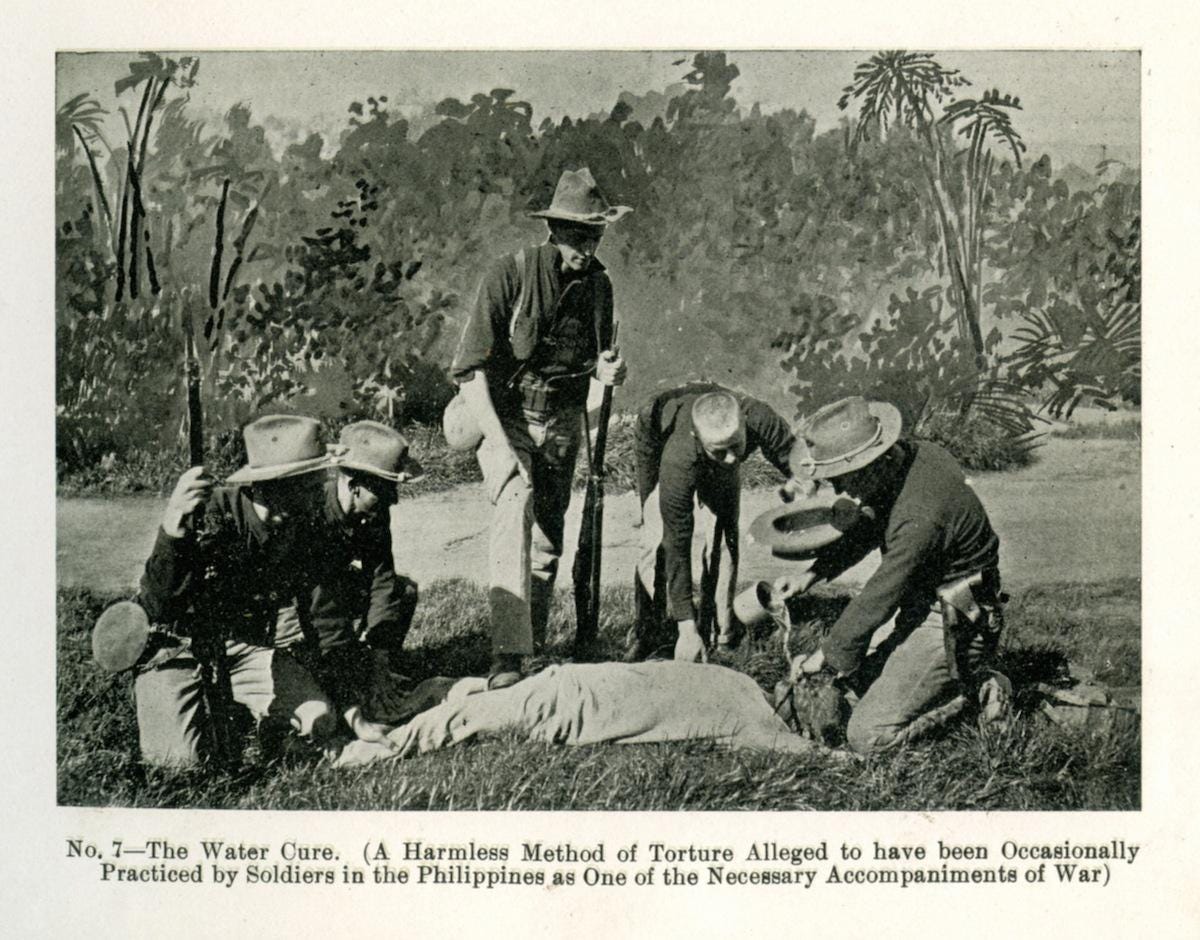
A group of American soldiers applying the ‘water cure’ upon a Filipino insurgent during the Philippine-American War, circa 1900. From a book published in 1902.Interim Archives / Getty Images (source: Time Magazine)

This is a follow-up to our recent Minnesota Black Site post:

Is ICE Running a Black Site in Minnesota?
THOMAS NEUBURGER
·
JAN 20
Read full story
Is it really fair to call the ICE prison at the Bishop Henry Whipple Federal Building a “black site”? Let’s take a look.

What Is a ‘Black Site’?

“Black site” is a scary term. It’s been frequently used for places where the CIA maintains off-the-radar prisons, where abducted terrorists are taken, held and usually tortured.

Bagram Air Field in Afghanistan was (and may still be) such a site. From the Atlantic in 2010:

The Defense Intelligence Agency (DIA) runs a classified interrogation facility for high-value detainees inside Bagram Air Field in Afghanistan, defense and administration officials said, and prisoners there are sometimes subject to tougher interrogation methods than those used elsewhere.

Both the New York Times and the BBC reported that prisoners who passed through the facility reported abuse, like beatings and sexual humiliation, to the Red Cross, which is not allowed access. The commander in charge of detention operations in Afghanistan, Vice Admiral Robert Harward, has insisted that all detainees under his purview have regular Red Cross access and are not mistreated.

There’s more at Wikipedia, which reports the 2014 claim by “defense officials” that the facility has been shut down. (True? Who knows? We pay our warriors to lie to keep us safe.)

The definition of “black site” goes something like this:

Black sites are clandestine state-operated detention centers where prisoners who have not been charged with a crime are incarcerated without due process or court order, are often mistreated and murdered, and have no recourse to bail.

What’s interesting about black sites is that they’re not really that secret — they’re just unacknowledged and inaccessible to inspection. The Bagram black site was known as a torture site to the New York Times as early as 2005:

In 2005, The New York Times obtained a 2,000-page United States Army investigatory report concerning the homicides of two unarmed civilian Afghan prisoners by U.S. military personnel in December 2002 at the Bagram Theater Internment Facility (also Bagram Collection Point or B.C.P., now the Parwan Detention Facility) in Bagram, Afghanistan, and general treatment of prisoners. Two prisoners, Habibullah and Dilawar, were repeatedly chained to the ceiling and beaten, resulting in their deaths. Military coroners ruled that both prisoners’ deaths were homicides. Autopsies revealed severe trauma to both prisoners’ legs, describing the trauma as comparable to being run over by a bus. Seven soldiers were charged in 2005.

By the way, there’s still a detention center, the “Parwan Detention Facility,” next to the base. Black site? Who knows?

The Bishop Whipple Detention Center

So the questions are these. Is the prison at the Bishop Henry Whipple Federal Building…

acknowledged?
accessible to inspection?
a place of torture?
…though the last is not strictly necessary for a black site to exist.

To answer, it seems the immigrant cells are acknowledged, but this is the first report I’ve seen that separate known-citizens cells exist, where illegally detained or abducted citizens could be held indefinitely and without charges.

Second, it’s certainly true that the Bishop Whipple prison is not subject to inspection.

Finally, as to being a place of torture, consider this, from the Houston Chronicle report of the incident (all emphasis mine):

On their way to the cells, [O’Keefe and Sigüenza] saw other detainees who were screaming and wailing for help, though most were dejectedly staring at the ground, they said. In one instance, they observed a woman who was trying to use a toilet while three male agents watched. The overwhelming majority of detainees were Hispanic men, though some were East African — Minnesota is home to the country’s largest Somali community.

“Just hearing the visceral pain of the people in this center was awful,” O’Keefe said. “And then you juxtapose that with the laughter we heard from the actual agents. … It was very surreal and kind of shocking.”

Sigüenza said one of his cellmates had a cut on his head and the other had an injured toe, but neither was offered medical help. Their requests for water or to go to the bathroom outside their cells were also ignored, he said.

Note the toilet incident. Humiliation, including sexual humiliation, is a form of torture. It makes people ashamed and compliant, and it’s done deliberately.

There are also reports like this:

Agents say man injured in ICE custody ‘purposely ran headfirst into a brick wall’

A Minnesota man incurred severe head wounds while in Immigration and Customs Enforcement custody earlier this month, with the agency posting guards at his hospital bedside despite his deteriorating condition, according to his attorneys.

The man, who was born in Mexico, was detained by federal immigration agents Jan. 8 on St. Paul’s east side, according to a habeas corpus petition in federal court asking for his release.

The man was brought to the hospital by agents four hours after his arrest. A CT scan found that the man had “life-threatening bilateral skull fractures and hemorrhaging.” …

One agent told hospital staff, according to the petition, that “he got his shit rocked,” but did not share other information.

And consider this story of a man whose door was broken down to affect his arrest. He was taken to the Bishop Whipple Federal Building where this occurred:

ICE agents take ‘trophy pictures,’ pack detainees into holding cells

Gibson said that after they arrived at the Whipple Federal Building near MSP airport, where ICE has a detention facility, the agents paused and forced him to take part in an act of ritual humiliation.

“They took trophy pictures with their personal phones. Like one stood by me on the right side of me. One stood on the left side of me. And they went, like, thumbs up and took pictures with their personal phones,” he said, adding that agents took similar photos with other detainees. …

Inside the detention center, Gibson said that officers put him in a bare, metal holding cell about the size of a small conference room with around 40 other detainees. Their legs were shackled. He said that the cell was cold and they shared a single toilet that offered no privacy. Gibson says that one person in the cell appeared to have scabies.

Note also the open defiance of court orders in the same story:

U.S. District Judge Jeffrey Bryan on Monday ordered ICE not to remove Gibson from Minnesota, away from his family and lawyer.

But later Monday, officers put Gibson on a plane along with other shackled detainees and flew them to a detention center in El Paso, Texas.

This is not your usual arrest-and-detention facility — not Whipple nor any place like it. And the State has three years left to build even more.

https://www.nakedcapitalism.com/2026/01 ... -days.html

******

The Police States of America
January 23, 2026

The U.S. government, like authoritarians throughout history, is seeking to silence the speech it hates and fears, writes Judge Andrew P. Napolitano.

Image
Independence Hall in Philadelphia. (Craig Fildes, Flickr, CC BY-NC-ND 2.0)

At the time of the ratification of the U.S. Constitution, many ratifiers feared a large, overbearing and debt-laden central government — as we have now — and insisted that their votes for ratification were conditioned upon amendments to the Constitution that would prohibit the new government from interfering with natural rights.

Most of the Constitution’s ratifiers understood the concept of natural rights. That was, of course, the core of the Declaration of Independence, in which Thomas Jefferson wrote that we are all endowed by our “Creator with certain unalienable Rights, that among these are Life, Liberty, and the Pursuit of Happiness.”

How can a right be unalienable? Since rights are as personal and natural as our bodily movements, only a jury can take them away after the person from whom the rights were sought has been found to have voluntarily given up those rights by engaging in aggression against the rights of others.

That is at least the theory of natural rights. They cannot be impaired by legislative command or executive edict; rather, only by a judge and jury after meticulous compliance with due process.

The idea of conditioning ratification sprang from the view that a state could leave the federal government just as easily as it joined — by a simple act of legislation.

James Madison, the principal author of the Constitution, argued that the legislature or the highest state court in a state could nullify acts of the federal government that are facially repugnant to the Constitution.

Jefferson and Madison secretly authored resolutions adopted by the Virginia and Kentucky legislatures that in those states nullified the Alien and Sedition Acts, in which Congress had criminalized speech critical of the government.

The Constitution is based on value judgments made by the Framers and accepted by the ratifiers. It has many defects, but its core value was and is the primacy of the individual over the government — state or federal.

By recognizing natural rights by name in the first eight amendments and by recognizing the existence of human rights too numerous to name in the Ninth Amendment — and by requiring the government to protect them — the Framers and ratifiers advanced a government, the essential purpose of which was unambiguously to preserve personal freedom; not government order or power, but personal freedom.

The Revolutionary War was fought, Jefferson argued, to craft a government that would protect natural rights, not assault them.

A police state is the antithesis of the constitutional scheme advanced by Jefferson and Madison. In a police state, the laws are written so as to appear to defend freedom; but they are enforced and interpreted so as to enhance the power of the government.

When the government tries to intimidate people into silence, when it brutalizes people who shake their fists at its agents, when it threatens to criminalize speech by public officials critical of it, when it terrorizes those who speak their minds — and gets away with these unconstitutional and stomach-churning acts — the American police state has arrived.

CORRECTION: Raquel Pacheco posted a tweet critical of Miami Beach Mayor Steven Meiner and not Florida Congressman Randy Fine as was stated in an earlier edition.

https://consortiumnews.com/2026/01/23/t ... f-america/

******

Federal arrests over ICE protest in a Minneapolis church ignite fierce resistance from Black community

The arrests of two beloved Black activists in Minneapolis sparked outrage and defiance from the community, with leaders calling for resistance and a nationwide general strike against state repression.

January 23, 2026 by Devin B. Martinez

Image
Press conference at the Warren E. Burger Federal Building, demanding the release of three activists detained by the DOJ. Photo: Gary Inman

Two well-known activists were arrested by federal agents in Minneapolis on Thursday, January 22, days after they disrupted a Cities Church service. David Easterwood, the church’s pastor, is also the St. Paul ICE field office director.

The activists chanted “ICE out!” and “Justice for Renee Good”, condemning the “dual roles” that Easterwood plays in the city.

The Department of Justice characterized the protest as violent, claiming “we do not tolerate attacks on places of worship”. They have suggested charges like conspiracy and obstruction of the right to worship.

For the Black community in the Twin Cities, however, Chauntyll Allen and Nekima Levy Armstrong’s arrests provoked an explosion of outrage. They say the activists were targeted for their political opposition rather than for committing any crime.

“Today they tried to frighten Chauntyll and Nekima,” said community organizer Raeisha Williams, at a press conference at the federal building where the detained activists were arraigned.

“We are not afraid. We will stand up for our rights and our community. We will not bow down and we will not hide.”

Although a federal judge ordered their release, ruling that neither posed a threat to public safety, prosecutors immediately appealed the decision, keeping both activists jailed at Sherburne County. William Kelly, another community member present at the protest, was also arrested and detained on January 22.

Repression is coming, resistance is urgent
The arrests, leaders say, are a direct attack on freedom of speech and basic constitutional rights, as well as a sign of what the future of the Trump administration holds for communities across the country. With more urgency than ever, Black leaders in the Twin Cities called on the whole nation to renew its commitment to fighting ICE and the Trump administration.

Image
Press conference demanding the release of three detained activists in St. Paul. Photo: Devin B. Martinez

“Extrajudicial murders and abductions. This is coming to a city near you,” said Rod Adams, executive director of the New Justice Project Minnesota, during the press conference.

“I say get ready. Get ready to fight. Get ready to organize. And get ready to resist.”

The federal lobby was packed wall-to-wall with about a hundred people, many raising a single clenched fist as leaders spoke. The crowd gathered within hours of the arrests, demanding the release of the beloved activists and expressing a collective resolve for resistance.

“Choke down on that fear. Choke down on the idea that you are not enough for this moment,” said Adams. “Because if you are listening to this and you understand what’s happening right now in this country – we need you to step up! Because it’s our time to fight. And we will win.”

Cheers and applause echoed in the building constantly during the press conference. Throughout the event, Williams represented the community’s anger with one clear message for ICE and US President Trump:

“Don’t come to Minnesota cuz you’ll fuck around and find out!”

Criminalization of political opposition

“This is not a legitimate prosecution. This is a political persecution,” said Minneapolis civil rights attorney Jordan Kushner, who represented Armstrong in the initial hearing on Thursday, January 22.

They treated them like murderers or kidnappers, as if protesting at a church makes someone a danger to the community, he added.

The legal counsel emphasized a total departure from any formal process or professional investigation mandated in these cases. Attorney General Pam Bondi initially declared the arrests through posts on X.

Kushner went on to slam the Trump administration: “This is fascism right at work … Where you go to jail, to prison. Because you exercise your first amendment right to criticize the government. In this case, to speak out against a government official, who is part of that church.”

He argues that with the arrests of Allen and Armstrong, the federal operations in the Twin Cities seem to have gone a step farther than violence, and become a force for direct political repression.

“This is not about making the community safe. This is actually about harming the community and making it dangerous for anyone that opposes this fascist regime,” said Kushner.

The White House went as far as to publish what organizers describe as an AI-altered image of Allen crying during her arrest. Kushner, Allen’s family, and organizers say the image presents a false narrative and that Allen remained “calm, composed, and rational” during her arrest.

For organizers, the arrests marked more than an isolated act of retaliation. They crystallized the political moment. What began as outrage over Renee Good’s killing has rapidly evolved into a broader confrontation with state repression, one that Black leaders say cannot be met with symbolic gestures or isolated protests alone.

Black leaders call for a general strike as the way forward

Image
Rod Adams, executive director of the New Justice Project Minnesota. Photo: Gary Inman

Although local Democratic officials aimed strong words at ICE after Renee Good’s murder, Black organizers expressed criticism at the “duplicity” of these same officials for not ordering the arrest of Good’s killer, agent Jonathan Ross. Minneapolis Mayor Jacob Frey immediately called for the release of Allen and Armstrong on Thursday. However, he has yet to call for agent Ross to be taken into custody.

Rod Adams spoke to Peoples Dispatch after the press conference about how this moment calls for different tactics. Methods that can leverage the “power of the people” against ICE and Trump’s far-right agenda.

“Race is on the surface but underneath that is class,” said Adams.

“The only way you can get someone like Donald Trump, this federal government and these billionaires that stand behind them, and these corporations is to affect the economy.”

As Minnesota builds towards what is becoming a historic general strike on Friday, January 23, Adams makes it clear that the call extends far beyond the Twin Cities.

“We are also asking people all over the country not to go to work, not to go to school, and not to go shopping. Shut this country down until the people who deserve justice get it.”

The Black struggle has traditionally been a flashpoint of resistance and progressive change in the United States. Just like in many periods in history, the ICE terror being seen in Minneapolis today and the broader far-right agenda coming down from the White House is being interpreted as an urgent call to action.

“I’m speaking directly to Black people. If we are not standing up in this moment, we will never see liberation. If you don’t see your brother’s struggle as your struggle, you can’t claim to care about liberation. You can’t claim to care about freedom.”

Allen and Armstrong’s arrests are widely understood not as an endpoint, but an opening. One that demands sustained resistance rooted in solidarity, courage, and commitment.

“Stand up. Fight back. Find an organization. Find your neighbor … They’re coming. And will you be ready?”

https://peoplesdispatch.org/2026/01/23/ ... community/

******

Over 100 Clergy Arrested in Protest at Minneapolis Demanding “ICE Out”

Image
Thousand March Against ICE in Solidarity with Minneapolis. Photo: EFE.

January 24, 2026 Hour: 3:00 am

Over 100 clergy leaders from different faiths were arrested on Friday, January 23, during a demonstration against immigration raids at Saint Paul-Minneapolis International Airport.
Images circulated online showed police guiding religious leaders away as they remained kneeling in prayer, voices raised in chants of “ICE out” to demand an end to deportation operations.

The clergy were cited for misdemeanor trespassing and failure to obey a peace officer before being released, said Jeff Lea, a spokesman for the Metropolitan Airports Commission.

Reverend Mariah Furness Tollgaard of Hamline Church in St. Paul said police ordered them to leave, but she and others chose to stay and be arrested to show support for migrants, including members of her congregation who are afraid to leave their homes.

Faith in Minnesota organized the demonstration in punishing subzero temperatures of approximately -20°F (-29°C), as a severe winter storm swept the United States.

HAPPENING NOW: Massive crowd in Minneapolis for statewide 'ICE OUT' general strike pic.twitter.com/XxghpEC7BV

— BreakThrough News (@BTnewsroom) January 23, 2026


Since an ICE agent shot and killed 37-year-old mother Renee Good on January 7, community members and activists have gathered daily in the Twin Cities to protest, leading to repeated clashes with federal agents.

Additionally, public attention has grown due to the detention of several minors in Texas detention centers, including a five-year-old child held with his father. Human rights organizations and religious groups have denounced abuses and conditions in these facilities, calling for transparency and independent oversight.

https://www.telesurenglish.net/over-100 ... g-ice-out/
"There is great chaos under heaven; the situation is excellent."

User avatar
blindpig
Posts: 15306
Joined: Fri Jul 14, 2017 5:44 pm
Location: Turtle Island
Contact:

Re: Police, prison and abolition

Post by blindpig » Sun Jan 25, 2026 3:51 pm

Minneapolis under occupation: the war machine comes home
January 24, 2026 Gary Wilson

Image
Demonstrators gather near the Bishop Henry Whipple Federal Building, which houses an immigration court, during protests over ICE paramilitary operations in Minneapolis, January 2026.

Jan. 24 — Early Saturday morning in south Minneapolis, masked federal paramilitary agents surrounded Alex Pretti outside Glam Doll Donuts, wrestled him to the ground, and beat him. Then, while he lay motionless beneath them, one agent stood up and fired his pistol repeatedly — more than 10 shots over five seconds. Pretti died at a hospital.

He was a 37-year-old U.S. citizen who worked as an ICU nurse at the VA hospital. The final act of his life was trying to help a woman who was being physically assaulted by the masked agents, who would then kill him.

It had been just over two weeks since ICE agents killed Renee Nicole Good, a 37-year-old U.S. citizen, in the same city. Less than 24 hours earlier, tens of thousands of workers, community members, and youth had flooded downtown Minneapolis to protest the federal occupation of their city.

In the same city, five-year-old Liam Ramos was seized from his home and allegedly used as bait to lure other family members out into the open. He ended up at a detention camp in Dilley, Texas.

A 79-year-old citizen had his ribs broken by ICE agents. A pregnant woman was tased.

This is what nearly a trillion dollars buys. Congress approved it. Both parties voted yes.

The numbers tell the story

The scale of what’s happening is difficult to grasp. In 2025, ICE doubled in size from 10,000 to 22,000 agents, offering $50,000 signing bonuses to new recruits. Training was slashed to just eight weeks. Some agents were deployed before their background checks were even completed.

The results: 2.5 million people have left the country, including 605,000 deportations. Arrests exceeded 595,000. Detention capacity has increased 83%, with more than 73,000 people held on any given day. Thirty-two people died in ICE custody — the highest number since 2004.

The administration plans to expand further, aiming for 120,000 to 150,000 detention beds using converted warehouses and military bases. Around 100 new detention facilities were built in 2025.

This expansion didn’t happen by executive fiat alone. Congress provided the money.

The bipartisan consensus

The defense spending bill passed the House 341-88, providing $839 billion — $8.4 billion more than the administration even requested. Nearly two-thirds of House Democrats voted for it. A separate bill allocated $64.4 billion to the Department of Homeland Security, with roughly $10 billion for ICE.

The 2025 “One Big Beautiful Bill Act” added another $75 billion for ICE over four years. The administration is now publicly demanding a $1.5 trillion military budget for 2027.

Where does this money go? The $839 billion defense allocation prioritizes nuclear modernization and high-tech weapons: $27.2 billion for 17 warships, including nuclear ballistic missile submarines. Another $7.6 billion for 47 F-35 fighter jets and $3 billion for the sixth-generation F-47. Full funding for the Sentinel ICBM. And $4.5 billion for hypersonic weapons.

Democrats didn’t just fail to stop this. They voted for it.

Inside the secret detention sites

Investigative reporters have documented what happens inside the detention system that this money built.

At the Bishop Henry Whipple Federal Building in Minnesota, agents reportedly take “trophy pictures” with shackled detainees. Women have been forced to use toilets while male agents watch. Detainees with life-threatening skull fractures and contagious conditions like scabies have been denied medical care. U.S. citizens have allegedly been held in secret cells.

Judges have issued court orders to prevent ICE from removing certain detainees from their jurisdictions. ICE has defied those orders.

In Florida, a facility workers have dubbed “Alligator Alcatraz” holds people in chain-link cages under extreme heat, with mosquito infestations and lights that never turn off.

The administration has also sought to move detention offshore.

The global dimension

The domestic crackdown is one front in a broader offensive. The U.S. military kidnapped Venezuelan President Nicolás Maduro and Cilia Flores, who remain hostages — prisoners of war — and seized the country’s oil resources. A carrier group has been redeployed toward Iran following the 2025 bombing of Iranian nuclear facilities. The administration has publicly demanded the annexation of Kalaallit Nunaat (Greenland), a territory of NATO ally Denmark.

Trump calls it “America First.” But what’s being built is a military machine that projects force across the planet while turning that same force against people inside the United States.

Resistance is growing

Within hours of Saturday’s killing, a large crowd gathered at the scene demanding the agent be arrested and all ICE personnel leave the city. Residents began blocking streets with dumpsters and furniture. Police responded with tear gas. The confrontation follows Friday’s march of tens of thousands through downtown Minneapolis — one of the largest demonstrations against federal immigration enforcement in U.S. history.

Nationally, more than 1,000 protest actions have taken place since Renee Nicole Good’s killing.

What Minneapolis makes unmistakably clear is this: ICE’s deployment is not an accident and not a local exception. It is funded, authorized, and politically shielded by both Republicans and Democrats. Ending it will require movements that match that scale — rooted in workplaces, in communities, and in sustained mass resistance capable of breaking the bipartisan consensus for militarized enforcement, detention, and deportation.

https://www.struggle-la-lucha.org/2026/ ... omes-home/

******

ICE Execution in Minneapolis
Posted on January 25, 2026 by Yves Smith

I don’t know how America survives this level of willful, institutionalized savagery. By most counts, ICE pumped ten bullets into a ICU nurse, Alex Pretti, for the crime of filming them and trying to intercede on behalf of a woman they had shoved to the pavement. The evidence of the execution is clear cut. ICE has not just gunned down an innocent man, but is also successfully terminating what remained of the rule of law in the US. A sampling of the evidence:


Video proves beyond a doubt that ICE murdered Alex Pretti in cold blood, he never unholstered his weapon, and was disarmed when the regime thugs shot and executed him. This was 100% intentional. It's a homicide. #3E #GoodvsEvil pic.twitter.com/CmQ2fXcJjO

— Anonymous (@YourAnonCentral) January 24, 2026


Frame by frame breakdown of this MURDER shows ICE is lying!

-ICE had ALREADY disarmed the man before shooting.

-The man NEVER drew his gun.

At the 0:06 second mark we see the man’s hands on the ground covered in large gloves.

His hands are empty. pic.twitter.com/o7flTX54Wd

— Adam Cochran (adamscochran.eth) (@adamscochran) January 24, 2026


ICE clearly attacked this man and executed him. He didn’t even fight back. They started the whole thing.
pic.twitter.com/JC0BbPYd0F

— Alex Cole (@acnewsitics) January 25, 2026


The ICE Nazi narrative is already falling apart. We now know the 37-year-old man who was executed by ICE Nazis on Nicolette Ave was not only a US citizen, but was legally armed and had a permit to carry. He was a law-abiding US citizen who was acting as a legal observer. 😳👇 pic.twitter.com/Z33K8XN44U

— Bill Madden (@maddenifico) January 24, 2026


BREAKING: A witness who was just 5 feet from Alex Pretti filed an affidavit depicting what she saw.

She says he didn’t touch any of the officers and didn’t appear to be resisting. He was merely helping a woman who had been pepper-sprayed.

She’s is terrified that ICE is… pic.twitter.com/zMfecaZGF7

— Ed Krassenstein (@EdKrassen) January 25, 2026


Her fear is not paranoia:

NEWS: Star Tribune reports ICE agents have taken multiple witnesses into custody in Minneapolis.

Let that sink in.

They didn’t just shoot a man.

Now they’re detaining the people who saw it happen.

— Brian Allen (@allenanalysis) January 24, 2026


More efforts to document what happened as part of an emergency legal filing:

MORE: Plaintiffs in the case have added a declaration from a pediatrician who sought to administer aid to Alex Pretti after he was shot. "ICE agents appeared to be counting his bullet wounds." https://t.co/2Jw11lIAvO pic.twitter.com/1lx6qNLH4Z

— Kyle Cheney (@kyledcheney) January 25, 2026


Update 8:00 AM EST. Lead story in the Financial Times, with no VPN to pretend I am in the US:

Image

Back to the original post:

I hope this outrage rouses enough people to stand up to this violence. Trump targeted Minneapolis out of pique (Mike Walz), perhaps a desire to punish the city for its effective George Floyd protests, but most of all, that its police force is small enough that he could muster enough ICE goons to outnumber them. ICE is not yet big enough to subdue the US. There is a window for action that is closing. Can enough citizens muster the courage and organization to thwart Trump’s clear intent to use brutality to mow down all opposition?

https://www.nakedcapitalism.com/2026/01 ... polis.html

So how many citizens will be willing to put their lives on the line to preserve a bourgeois democracy which has treated them so shabbily?

I dunno if repugnance of Trump is enough to get that motivation over the top. To get people in the street to demand real change is going to take more than that.
"There is great chaos under heaven; the situation is excellent."

User avatar
blindpig
Posts: 15306
Joined: Fri Jul 14, 2017 5:44 pm
Location: Turtle Island
Contact:

Re: Police, prison and abolition

Post by blindpig » Mon Jan 26, 2026 4:55 pm

300 cities answer Minneapolis’ general strike call against ICE
January 24, 2026 Struggle - La Lucha

Image
Minneapolis general strike march, Jan. 23.

On Jan. 23, 2026, Minnesota was locked in a deep freeze. Temperatures dropped to 16 below zero, with wind chills reaching minus 30. Instead of staying home, more than 100,000 people filled the streets of Minneapolis and St. Paul.

They were joined by solidarity actions across the country. In the days leading up to Jan. 23, support for the Minneapolis general strike spread rapidly, jumping from plans in “dozens” of cities to confirmed actions in at least 300 cities tied directly to the strike call. Workers, immigrant rights groups, students and community organizations acted together across the country, making clear that what was unfolding in the Twin Cities was not a local dispute.

In Minnesota, the strike was driven by the escalation of ICE as a paramilitary repressive force — armed agents operating as a domestic secret police, carrying out surveillance, raids and discretionary detentions aimed at controlling entire communities rather than enforcing any narrow set of laws.

“Operation Metro Surge” flooded neighborhoods with armed ICE units acting as a domestic secret police, using raids, surveillance and intimidation to impose political control. That same apparatus killed Renée Nicole Good, a 37-year-old lesbian parent, legal observer and community defender, and then protected its agent from any federal investigation.

What took shape on Jan. 23 was a general strike. Labor was withheld, businesses shut their doors and daily life was deliberately disrupted by workers, shop owners, immigrants, faith leaders and students acting together.

The action reflected a shared understanding that the violence was not isolated, but built into the enforcement system now operating in their neighborhoods.

Somali workers and business owners played a central role. For years, the Somali community in Minnesota has faced racist repression from federal authorities, including surveillance of mosques and businesses, baseless fraud accusations and neighborhood enforcement operations aimed at intimidation.

On Jan. 23, hundreds of Somali-owned businesses closed. Karmel Mall, one of the state’s largest commercial hubs, went dark. Roughly 700 businesses statewide shut down.

As repression intensified, federal plans escalated. Fifteen hundred paratroopers from the Army’s 11th Airborne Division were placed on standby for possible domestic deployment. Veterans and military families urged active-duty troops to refuse illegal orders.

ICE’s tactics also drew widespread outrage. School officials and medical workers reported actions they described as psychological warfare, including the detention of children and arrests near schools. In one case, a 5-year-old child was used to lure adults from a home before being taken out of state.

ICE has used administrative warrants — internal paperwork the agency signs itself — to barge into people’s homes without a judge’s sign-off, openly flouting the Constitution’s Fourth Amendment protections against unreasonable searches and seizures, which require a neutral judge’s approval based on probable cause. That is deliberate. It is how this repressive force operates — unaccountable, armed, and deployed to control communities.

The Jan. 23 strike marked a turning point. The rapid spread of solidarity actions showed how quickly walkouts, shutdowns and protests took hold in other cities. In Minneapolis, the organizing that produced the strike has continued in workplaces, neighborhoods and community spaces, as people prepare for further confrontation with ICE and the forces backing it. Larger actions later this spring, including May Day, are already being discussed, but the fight is unfolding now.

Image
New Orleans, Jan. 23, protesters downtown marched in solidarity with Minneapolis. SLL photos: Gregory E. Williams

Baltimore (Video at link.)

******

Killing of Alex Pretti in Minneapolis a day after general strike ignites community outrage

The killing of Alex Pretti came hours after Minnesota’s historic general strike, marking an escalation of violence and repression by federal authorities.

January 25, 2026 by Devin B. Martinez

Image
Thousands gather at the site of Alex Pretti's killing to demand ICE out. Photo: Gary Inman

The killing of Alex Pretti by US Customs and Border Protection (CBP) on January 24 came less than 24 hours after a historic general strike against Immigration and Customs Enforcement (ICE) and federal forces in Minnesota. More than 100,000 people marched through the streets of Minneapolis, as thousands of businesses shut down. Such an expression of working-class power has not been seen in the US for over 80 years.

The strike marked a major development in the struggle between federal immigration enforcement and organized resistance in Minnesota.

The city, already demonstrating its ability to mobilize at a scale that can disrupt the economy, woke up the following morning to yet another killing of a community member by a federal agent.

Image
Over 100,000 people flooded downtown Minneapolis for the January 23 general strike. Photo: Maya Rait

Criminalizing the victim
“We are heartbroken but also very angry,” said the family of Alex Pretti, in a public statement released on January 24.

A CBP agent shot 37-year-old Alex Pretti about 12 times in south Minneapolis, after several agents were seen wrestling him on the ground and pistol whipping him.

As with the killing of Renee Good earlier this month, the Department of Homeland Security (DHS) moved quickly to establish its narrative. It issued a statement saying that Pretti had approached CBP agents with a gun. When they tried to disarm him he “violently resisted” and “an agent fired defensive shots”.

Pretti’s family denounced the “sickening lies told about our son by the administration” and directly challenged the administration’s attempt to criminalize Pretti posthumously.

“Alex is clearly not holding a gun when attacked by Trump’s murdering and cowardly ICE thugs.” They urged people to help them get the truth out about Pretti.

Video footage debunks government narrative
Recordings from the scene of the incident seem to corroborate the family’s claims against the government’s narrative. In Pretti’s killing, video shows him at the scene recording with his phone camera. Within seconds of Pretti trying to assist a woman that had been assaulted by federal agents, Pretti was pepper-sprayed, tackled by multiple agents, and shot to death. Evidence suggests he posed no lethal threat.

Pretti was a lawful gun owner with a permit to carry, and video evidence shows that his weapon never left its holster until a CBP agent removed it, moments before he was shot dead. The federal government has nevertheless used the presence of the gun as retroactive justification for his killing. The narrative itself exposes contradictions between “law and order” rhetoric and legal gun ownership, neither of which seem to provide protection from the use of lethal force by federal agents.

Video documentation also captured moments that underscored the culture of impunity surrounding the operation. One CBP agent can be seen clapping during the shooting. Another shouted “boo hoo” at community members demanding the agents leave the area (an act seemingly intended to intimidate rather than disperse the crowd).

That moment of deadly state violence did not happen in a vacuum. It came on the heels of a massive general strike in Minnesota that confronted the ICE occupation directly. Thousands of businesses shut down, hundreds of community organizations supported it, dozens of unions participated, and students forced the University of Minnesota to completely close.

Over 100,000 workers, students, business owners, and community members flooded the streets of downtown Minneapolis in temperatures below -30°C demanding ICE out of the state.

However, Minnesota’s general strike was met not with dialogue, but escalation.

Repression and resistance
The response by the authorities after Pretti’s killing highlights how seriously they view the capacity for mobilization and resistance in the Twin Cities and the broader state.

Image
Protests erupt at the site of the killing of Alex Pretti. Photo: Gary Inman

Peoples Dispatch was at the site of the killing, as federal agents used tear gas, flash bangs, and pepper balls to clear the crowd of hundreds of community members gathering at Nicollet Ave and 26th street.

Later, protestors blocked the road with dumpsters, mattresses, and garbage cans. The cycle of confrontation continued throughout the day but by the evening, thousands of Twin Cities residents filled the area.

Governor Tim Walz authorized the deployment of the national guard. Witnesses reported armored vehicles and military-style perimeters of the area. The extraordinary show of force was rained down on a city that has proven its capacity to mobilize hundreds of thousands in coordinated action.

Despite reported phone calls with US President Trump and colorful language against ICE in press conferences, Governor Walz and Mayor Frey have yet to order the arrest of Jonathan Ross, the ICE agent identified as Renee Good’s killer weeks ago. Nor have they announced any action in the killing of Alex Pretti.

The strike reverberates
Minneapolis appears to be emerging as a testing ground for how far the federal government can advance Trump’s far-right agenda. Amid mass resistance, the government has expanded the authority of federal forces, normalized lethal force, and relied on delay and silence from local officials to absorb public outrage.

The general strike demonstrated that Minneapolis residents are willing to organize at a scale rarely seen in the United States. The killing of Alex Pretti the following morning revealed the lengths to which federal authorities are willing to go to reassert control.

Image
Protest at site of Alex Pretti’s murder. Photo: Gary Inman

On the ground, protestors are already calling for an expansion of the general strike. As cities like NY, Boston, Los Angeles, Washington DC, and many others broke out in spontaneous protests after Pretti’s killing, one chant echoed across them all: “Strike! Strike! Strike!”

Whether the city becomes a model for resistance or a major victory for the Trump administration may depend on how long the ICE violence is allowed to continue without consequence.

https://peoplesdispatch.org/2026/01/25/ ... y-outrage/

******

Image

CBP Agent guns down Minneapolis nurse: video analysis

Originally published: Drop Site News on January 24, 2026 by Meghnad Bose, Rana Roudi, and Ryan Grim (more by Drop Site News) (Posted Jan 26, 2026)

On Saturday, U.S. federal agents killed Alex Jeffrey Pretti in Minneapolis, Minnesota, shooting him multiple times at point blank range while pinned down prone on the ground and surrounded by officers along Nicollet Avenue. The Saturday killing—committed by a Customs and Border Protection agent—is the third shooting by U.S. Immigration & Customs Enforcement (ICE) and CBP in as many weeks, and comes just one day after tens of thousands of Minneapolis residents took to the streets in subzero temperatures to protest the federal raids in Minnesota.

Close-up video footage, obtained by Drop Site, shows one agent push a person to the ground and then deploy a chemical irritant twice on the 37-year-old Pretti, who had gone to help the person pushed. Around eight agents then swarm and wrestle him to the ground. One of the officers then visibly unholstered his gun and fired multiple close-range gunshots at Pretti, a Minnesota resident who was reportedly on the scene as an observer. There are ten gunshots heard in all—at least five of them were fired at Pretti from a distance, while the person holding the camera shouts,

What the fuck did you just do?

https://www.youtube.com/shorts/znSKe2x2 ... ture=share

Video footage obtained by Drop Site with slow-motion video analysis of the January 24th killing of Alex Pretti by a CBP agent.

Another video showing a different angle of the killing also shows federal agents manhandling Pretti once he’s face down on the ground, with one officer appearing to strike him three times just before the gun shots ring out. The angle appears to show one officer approaching Pretti as he’s pinned to the ground, reaching over Pretti’s body with the officer’s hand empty and then walking away with a gun in his hand.


More video footage of the shooting from a separate angle.


Protests against the presence of federal agents in the Twin Cities area have escalated since the January 7 killing of Renee Good, who was fatally shot by ICE officer Jonathan Ross in Minneapolis, while another incident followed a week later when an ICE officer shot a Venezuelan man in the leg. Saturday’s killing of Pretti was followed by more protests, with video showing federal officers tear-gassing protesters and observers on the scene.

The Department of Homeland Security, which oversees both CBP and ICE, alleged the man “approached U.S. Border Patrol officers with a 9 mm semi-automatic handgun,” and released a photo of the purported firearm, which appears to be a Sig Sauer Emperor Scorpion. No video has surfaced showing Pretti approaching federal agents with a brandished gun. A statement from President Donald Trump posted from the White House’s official X account said, “This is the gunman’s gun, loaded (with two additional full magazines!), and ready to go…LET OUR ICE PATRIOTS DO THEIR JOB!” Homeland Security Advisor Stephen Miller alleged that Pretti was a “domestic terrorist [who] tried to assassinate federal law enforcement,” despite the fact that Pretti was being held down by four federal agents when he was shot.

Pretti worked as an intensive care unit nurse at a Department of Veterans Affairs hospital, and he was a union member with The American Federation of Government Employees.

https://mronline.org/2026/01/26/cbp-age ... -analysis/

******

Ecuadorians Voice Anger Over Arrest of Children in ICE Operations

Image
An ICE agent. X/ @BiometricUpdate

January 26, 2026 Hour: 9:43 am

Critics fault President Noboa for silence after detention of minors.

Over the weekend, Ecuadorians expressed discontent over the inadequate protection of migrants by President Daniel Noboa and his administration.

The criticism stems from the arrest of six Ecuadorians, including three minors, during operations carried out by U.S. Immigration and Customs Enforcement (ICE).

On Saturday, Ecuador’s Foreign Affairs Ministry confirmed that Chloe, a 2-year-old girl, was detained along with her father, Elvis Tipan, in Minneapolis as they were on their way home on Thursday.

Kira Kelley, the family’s attorney, said ICE agents did not allow the father to hand the child over to her mother. Instead, both were transferred to Texas.


Liam Ramos is just a baby. He should be at home with his family, not used as bait by ICE and held in a Texas detention center.

I am outraged, and you should be too. pic.twitter.com/djr2z1AG0N

— Kamala Harris (@KamalaHarris) January 22, 2026


The incident adds to a previous case involving the detention of Liam Conejo, a 5-year-old boy who was also held along with his father. That case received widespread international attention and prompted responses from U.S. politicians, including Kamala Harris.

Like the former presidential candidate, many U.S. citizens and officials voiced opposition to the detention of children during ICE operations, arguing that the involvement of minors in such actions undermines fundamental principles of child protection.

Meanwhile, Ecuadorian analysts and social organizations have criticized President Noboa’s lack of a public response, noting that he has remained silent on the actions taken by U.S. immigration authorities.

https://www.telesurenglish.net/ecuadori ... perations/
"There is great chaos under heaven; the situation is excellent."

User avatar
blindpig
Posts: 15306
Joined: Fri Jul 14, 2017 5:44 pm
Location: Turtle Island
Contact:

Re: Police, prison and abolition

Post by blindpig » Tue Jan 27, 2026 3:48 pm

DHS Turns Warehouses into Mass Detention Camps
January 26, 2026

2025 was ICE’s deadliest year in over two decades, writes Julia Norman. Detention facilities lack climate control, ventilation, running water, sanitation, medical services.

Image
Overcrowding of families observed by Dept. of Homeland Security’s Office of the Inspector General, June 2019, at Border Patrol’s McAllen, TX Station. (OIG/D.H.S./Public Domain)

By Julia Norman
Common Dreams

The Department of Homeland Security’s (D.H.S.) warehouse detention system is rapidly unfolding across the United States, advancing in open contempt of oversight, outpacing public scrutiny, and operating with the same disregard for the Constitution, the rule of law, and human life that defines the Trump administration’s exercise of power.

In November 2025, NBC News reported that D.H.S. was actively scouting enormous industrial warehouses across the country, particularly in rural areas near major airports and transportation hubs, in an effort to expand the administration’s capacity to execute its mass deportation agenda — a system Secretary Noem recently aptly described as “one of the most consequential periods of action and reform in American history.”

After the “Big Beautiful Bill” allocated an additional $45 billion specifically to ICE for building new immigration detention centers through 2029—a budget 62 percent larger than the entire federal prison system — D.H.S. gained unprecedented financial capacity to expand its system of terror on a massive scale.

Some of the warehouses under imminent consideration exceed 800,000 square feet and could hold far more people than existing detention centers, compressing thousands of human beings into spaces designed for inventory, not habitation.

Further reporting in December showed that with this massive budget increase, D.H.S. is not merely expanding capacity at the margins, but is redesigning the model itself.

All those detained by D.H.S. and ICE agents, including predominantly people without criminal records, both documented and undocumented immigrants, and U.S. citizens, will presumably be swiftly processed at local sites before being funneled into a small number of mega-facilities, each holding between 5,000 and 10,000 people.

The plans outlining the duration of confinement and the conditions under which people will be held in these warehouses while awaiting deportation remain unknown.

Regardless of motive, Americans must confront that this hub-and-spoke detention network is a moral calamity, echoing some of the most inhumane periods in American and world history.

One can only assume the system will operate as Trump’s ICE Director Todd Lyons described at the 2025 Border Security Expo in Phoenix: “like Amazon Prime, but with human beings.”

Concern for fundamental standards of care and due process, or pathways to legal immigration is replaced with the directive to “get better at treating this like a business.” The confinement, neglect, abuse, and exploitation that this process will inevitably worsen will be excused by the administration as “efficient.”

Image
Acting Director of I.C.E. Todd Lyons interviewed on Fox TV, August 2025. (Fox TV video Screenshot)

Since the news first broke, local reporting has confirmed the rapid construction and conversion of mass confinement centers across the country.

Warehouse sites in Maryland, Texas, Florida, and New York’s Hudson Valley were reported to be under active consideration just in the past two weeks. Many communities slated to host these facilities have only learned of the plans through national reporting.

In early January, The Washington Post found that when it contacted local governments in all 23 cities on ICE’s internal list, many officials had not been informed by federal authorities and could not comment.

Multiple members of Congress have also stated publicly that they were not formally notified about the plans to establish these facilities in their districts.

State and local officials near proposed sites are now scrambling to hold emergency meetings, trying desperately to prevent being cut out of decisions with profound moral and ethical consequences that will reshape their communities.

Still, there is widespread fear that the federal government will simply ignore local zoning and land-use laws.

Under the Supremacy Clause, federal agencies are largely immune from local zoning rules unless Congress explicitly requires compliance. Private contractors or lessees are not automatically covered, but in practice, immigration detention facilities and their operators face almost no local oversight.

States like California have passed laws to empower health inspections and enforce standards against operators such as GEO Group, yet counties rarely act, and courts often side with federal preemption.

If this continues, D.H.S. could override community land-use standards entirely, imposing massive detention infrastructure on rural, resource-strained neighborhoods without consent, accountability, or regard for local residents.

Notably, the Trump administration has already made clear its intention to restrict congressional oversight of existing detention facilities, leaving little reason to believe the mega-warehouse model will be any more transparent or accountable.

On Jan. 8, D.H.S. issued a directive requiring members of Congress to provide prior notice before inspecting immigration facilities, attempting to circumvent a court order that blocked such restrictions.

Although federal law allows for unannounced visits, the Noem memo instructs staff that visits are not considered actionable until acknowledged by the Office of Congressional Relations, which coordinates with ICE and confirms details “as soon as practicable.”

Image
#Never Again protest sign outside GEO Group’s Century City office building in Los Angeles, 2019. (marcywinograd/CCA-SA 4.0)

The only supposed oversight of this expansion is being handled by figures deeply embedded in the detention industry, such as David Venturella, who has been seen in recent weeks touring ICE facilities slated for the “unloading and loading of goods.”

Venturella quietly entered the Trump administration in early 2025 to avoid Senate confirmation, when D.H.S. hired him as a full-time adviser and granted him an ethics waiver.

Prior to this role, he spent more than a decade at GEO Group, one of the nation’s largest private prison corporations, where public filings show he was paid over $6 million to oversee immigrant detention operations.

His career has moved seamlessly between ICE leadership and private security firms, including GEO Group, L-3 Communications, and USIS — companies whose profits depend on surveillance, enforcement, and confinement.

He now oversees the ICE division responsible for detention contracts and infrastructure, the same system he previously expanded for private prison shareholders.

Private contractors such as GEO Group continue to operate facilities housing the vast majority of ICE detainees, positioning themselves to make substantial profit as the administration moves to double detention capacity to 100,000 beds with tens of billions in federal spending.

GEO Group and CoreCivic have already reported soaring revenues under Trump’s second term, with executives describing the expansion as “pivotal” and “an unprecedented growth opportunity.” In this system, human confinement has been transformed into an investment strategy.

Regardless of motive, Americans must confront that this hub-and-spoke detention network is a moral calamity, echoing some of the most inhumane periods in American and world history.

These warehouses lack climate control, ventilation, running water, sanitation, and medical facilities. The public cannot assume they will be retrofitted to meet even basic standards.

Under the pressures imposed by political will and the promise of enormous financial gain for both contractors and the administration, restrained only by Trump’s own notion of “morality,” overcrowding, medical neglect, sanitation failures, family separation, and death are not incidental or isolated.

They are the predictable, systemic outcomes of this design. Frequent transfers between facilities further destabilize those detained, shattering whatever order remains in local custody, tearing families apart, severing access to legal support, and concentrating the suffering of detention out of public view.

2025 was already ICE’s deadliest year in more than two decades, with at least thirty-two people dying in custody. In December 2025, Amnesty International described ICE facilities as “a deliberate system built to punish, dehumanize, and hide the suffering of people in detention.”

Recent site visits documented by Congressman Ro Khanna further revealed the inhumane and degrading conditions detainees face today, including denial of medical care and meals containing rocks and debris.

In this moment of utter chaos — multiple wars looming or underway, international law ignored and explicitly disregarded, pedophiles protected, cities under conditions of terror, with agents told they have “federal immunity” to occupy streets [and execute two U.S. citizens] — the infrastructure for this mass detainment system is expanding largely out of public view.

Facilities may be secured before communities can mobilize, contracts locked in before lawmakers intervene, and once operational, and our communities will be left to reckon with the human suffering they guarantee.

These facilities are instruments of state-sanctioned inhumanity, engineered to evade legal standards and public accountability. The depravity lies not only in the degrading conditions they produce but in the calculus that animates them: speed is treated as a virtue, suffering is deemed acceptable—perhaps even a goal—and profit is treated as proof of success.

The administration is not asking the public to accept this system; it is demanding acquiescence and enforcing it through threat and force.

ICE’s expansion has already reshaped the country’s physical and moral landscape, without consent, transparency, or regard for human life.

The choice is no longer abstract; communities must decide whether to act against this system of cruelty, or let silence stand as consent.

https://consortiumnews.com/2026/01/26/d ... ion-camps/

******

A shutdown won’t stop ICE — Congress built it that way
January 26, 2026 Gary Wilson

Image
Demonstrators protest ICE in Minneapolis after DHS agents killed Alex Pretti and Renee Good. Organizers say a government shutdown will not stop ICE, which now operates on multi-year funding passed by Congress.

As protests continue in Minneapolis following the killings of ICU nurse Alex Pretti and lesbian mom Renee Good, and with another government shutdown looming at the end of this week, many are asking whether Congress will finally put the brakes on ICE.

The short answer is no. Here’s why.

The Big Beautiful Bill changed everything

Ten years ago, ICE operated on less than $6 billion a year — a footnote compared to other agencies in the Department of Homeland Security. That changed dramatically when Trump signed the One Big Beautiful Bill Act on July 4.

ICE now has $85 billion at its disposal — making it the highest-funded law enforcement agency in U.S. history.

The Big Beautiful Bill gave ICE a $75 billion supplement on top of its regular budget, broken down as follows:

$45 billion for expanding “detention capacity” — meaning new ICE prisons, including family detention centers where children can be held indefinitely alongside their parents.

$30 billion for hiring, bonus pay, vehicles, facilities, legal staff, and “enforcement and removal operations.”

The critical detail: This money remains available through September 2029. It is multi-year mandatory funding outside the annual appropriations process — effectively a four-year slush fund.

Add in ICE’s base budget of around $10 billion, and the agency has nearly $29 billion on hand each year. That’s essentially triple what ICE operated on just two years ago.

To put that in perspective: The Trump administration’s entire 2026 budget request for the Department of Justice — including the FBI, DEA, Bureau of Prisons, and all federal prosecutors — is about $35 billion. ICE’s annual operating budget would now rank in the top 15th military budgets worldwide.

Built by both parties

The Big Beautiful Bill itself passed on party-line votes last July — Democrats unanimously opposed it in both chambers. But that doesn’t mean the Democratic Party’s hands are clean.

The deportation machine Trump is now supercharging didn’t appear from nowhere. It was constructed over decades with bipartisan support.

ICE was created in 2003 under George W. Bush as part of the post-9/11 “homeland security” apparatus — with broad Democratic backing. The agency’s powers expanded steadily under both parties. Barack Obama deported more people than any previous president, earning the title “Deporter-in-Chief” from immigrant rights activists who watched his administration carry out over 2.5 million deportations while Democrats controlled Congress.

Private prison companies have made money off immigrant detention under every administration. Congress created bed quotas to guarantee that a minimum number of people are always locked up. It allowed ICE to turn local police into immigration agents. It expanded fast-track deportations that strip people of due process. None of this happened by accident. Democrats and Republicans voted for every piece of this system.

Democrats in Congress have repeatedly funded ICE at requested levels, approved expansions of Customs and Border Patrol (CBP), and rejected calls from their own base to abolish ICE when that demand surged in 2018. The party that now expresses outrage at ICE killings in Minneapolis spent years normalizing the agency’s existence and growth.

Trump’s Big Beautiful Bill didn’t create the deportation-industrial complex. It turbocharged a machine that both parties spent two decades building.

Why a shutdown won’t matter

Senate Democrats are threatening to block the House-passed funding package over ICE’s recent killings in Minneapolis — where federal immigration enforcement agents shot and killed Alex Pretti and, just weeks earlier, Renée Good as part of a wider Department of Homeland Security operation in the city. But even if the government shuts down on Saturday, ICE operations will continue largely unchanged for three reasons:

First, ICE agents are classified as “excepted” workers. Under DHS shutdown protocols, they’re required to keep showing up. They won’t be paid during a lapse in funding — joining TSA agents and other federal workers forced to work without a paycheck — but they won’t stop working.

Second, the reconciliation money exists outside normal appropriations. The $75 billion from the Big Beautiful Bill isn’t part of the annual budget Congress is fighting over. It was passed separately through the reconciliation process. Even if regular appropriations lapse, ICE could sustain current or expanded operations for multiple years on that money alone.

Third, another temporary funding deal would actually make things easier for ICE. When Congress can’t pass a real budget and kicks the can with a stopgap measure, DHS is allowed to keep spending at existing levels and move money around internally. That gives the department more freedom to support ICE operations, not less.

What this means

The shutdown fight is largely symbolic when it comes to actually restraining ICE. The Big Beautiful Bill deliberately structured ICE funding to be immune from the normal appropriations process and the ability of Congress to withhold money.

Democrats can refuse to vote for the DHS funding package. They can point to the killings in Minneapolis. They can demand accountability. But none of that touches the $75 billion war chest already in ICE’s hands — and it doesn’t undo the decades they spent helping build the very apparatus now terrorizing immigrant communities.

The deportation machine was built to run no matter what happens in Congress.

https://www.struggle-la-lucha.org/2026/ ... -that-way/
"There is great chaos under heaven; the situation is excellent."

User avatar
blindpig
Posts: 15306
Joined: Fri Jul 14, 2017 5:44 pm
Location: Turtle Island
Contact:

Re: Police, prison and abolition

Post by blindpig » Wed Jan 28, 2026 3:53 pm

Stopping ICE Shouldn’t Be Left to Armed Citizens

January 27, 2026

It shouldn’t fall to armed Americans to take on the White House militia because the governor can’t use the National Guard to force ICE out of Minnesota, writes Joe Lauria.

Image
A protest in New York against ICE this month. (SWinxy/Wikimedia Commons)

By Joe Lauria
Special to Consortium News

After the second execution of a U.S. citizen by the White House militia in the streets of Minneapolis, the governor of Minnesota demanded ICE agents leave the state. But the U.S. Constitution leaves him with few options to make it happen.

Though the U.S. Supreme Court has ruled that a governor, and not the White House, controls National Guard troops operating inside a state, the Constitution’s so-called Supremacy Clause means that Gov. Tim Walz cannot deploy Minnesota’s 13,000 troops to stop the 3,000 ICE agents from terrorizing the population.

Such a dramatic move by a disciplined force to arrest or disarm the ragtag ICE agents would of course risk civil conflict if ICE did not back down.

After the second ICE murder this month, Walz demanded: “The President must end this operation. Pull the thousands of violent, untrained officers out of Minnesota. Now.”

But according to the Constitution, all he can do is plead directly with the White House, which he did in a phone call with Donald Trump on Tuesday; or ask a federal judge to temporarily halt the ICE deployment, which Minnesota has done, arguing that it has become an illegal federal occupation of the state in violation of the 10th amendment.

Otherwise, under the Constitution’s Article 6, Clause 2 — the so-called Supremacy Clause — federal agents can operate in any state without the consent of state or local government. All the locals have been able to do so far is refuse to cooperate with ICE.

Since ICE is a paramilitary force controlled by the civilian Department of Homeland Security and not the Pentagon, the Posse Comitatus Act, which bans the military from domestic law enforcement, cannot be invoked to evict ICE from Minnesota.

These legal protections have emboldened White House officials to continue the operation and to investigate the mayor and governor rather than the shooters, as well as condemn the victims of ICE’s brutality instead of the ICE agents inflicting it.

After the deaths of Alex Pretti and Renee Good, Trump officials like Stephen Miller, the deputy chief of staff, and DHS Director Kristi Noem accused the murdered of being “terrorists.”

Miller also accused Pretti of being an “assassin” because he brought a legally obtained handgun to the protest against ICE agents. Citizen videos shot of the killing clearly show Pretti being disarmed of his pistol before he is murdered execution style by two agents as other agents pin him defenselessly to the ground. Several bullets were pumped into him after he became motionless.

Vilifying Pretti as an assassin because he was legally carrying a gun has upset a group normally 100 percent behind Republican governments: the gun lobby.

If the Constitution bars the governor from using his troops to repel an invading paramilitary army, it allows the citizenry to be armed and to take action only in self-defense, a not far-fetched development that would be best avoided.

Local police arresting ICE agents would not only invite altercation, but federal prosecutors are withholding evidence in the Good case, making it difficult for the state to charge an agent. A federal judge has ordered DHS to preserve evidence in the Pretti killing.

The egregiousness of these murders, especially of Pretti pinned to the ground — disarmed of his legally-owned gun — is a massive test for the identity of the United States. What kind of a country will it allow itself to become?

How far will it tolerate a federal authority waging war on the population? Is there a line government can cross to trigger a response from elected leaders? (Such a line was never crossed in their support for an allied nation committing genocide.)

The way to stop ICE is not to resort to vigilante violence, but for Congress to defund it and for public pressure, especially from his gun-loving base, to get Trump to back down. Already we see some Democratic lawmakers saying they won’t vote to fund ICE — and may shut down Congress to achieve that — and Republican Senators like Ted Cruz are asking for an investigation into Pretti’s death.

It is a moment of truth for the United States.

https://consortiumnews.com/2026/01/27/i ... -citizens/

Depending upon Congress to really 'do something' about ICE is to live in a fantasy world. Nothing short of masses in the street will scare the bastards.

(Well, look what was in the comments:)

Ira Weisberg
January 27, 2026 at 22:07
There really is only one way to stop Trumps Gestapo para-military force from mass mayhem and murder. And that is an open ended nationwide general strike. That should be obvious.

Reply

Consortiumnews.com
January 27, 2026 at 23:08
Very easy to call for one, very hard to organize and to sustain for the length necessary to be successful. ICE needs to leave now. Local police arresting ICE agents not only would invite altercation but federal prosecutors are withholding evidence so that it would be difficult for the state to charge an agent. Here are some successful US general strikes of he past (from Gemini AI):

1835 Philadelphia general strike

New Orleans General Strike (1892): Roughly half the city’s working population struck, successfully securing a 10-hour workday and overtime pay.

San Francisco General Strike (1934): Emerging from a maritime strike, it effectively shut down the city and established the power of the International Longshore and Warehouse Union on the West Coast.

Minneapolis General Strike (1934): Led by Teamsters, this strike won union recognition and wage increases, turning the city into a major union stronghold.

Oakland General Strike (1946): Often cited as the last major citywide general strike, it was part of a massive post-WWII strike wave that involved over four million workers nationwide.

The frequency of such strikes dropped significantly after the passage of the Taft-Hartley Act of 1947, which placed strict legal prohibitions on secondary boycotts and sympathy strikes, the primary mechanisms used to coordinate general strikes.
*****

ICE now has more funding than the militaries of most countries
January 26, 2026 Gary Wilson

Image
Demonstrators protest ICE in Minneapolis after DHS agents killed Alex Pretti and Renee Good. ICE now operates with a budget that rivals global militaries — and Congress won’t cut it.

As protests continue in Minneapolis following the killings of ICU nurse Alex Pretti and lesbian mom Renee Good, and with another government shutdown looming at the end of this week, many are asking whether Congress will finally put the brakes on ICE.

The short answer is no. Here’s why.

The Big Beautiful Bill changed everything

Ten years ago, ICE operated on less than $6 billion a year — a footnote compared to other agencies in the Department of Homeland Security. That changed dramatically when Trump signed the One Big Beautiful Bill Act on July 4.

ICE now has $85 billion at its disposal — making it the highest-funded law enforcement agency in U.S. history.

The Big Beautiful Bill gave ICE a $75 billion supplement on top of its regular budget, broken down as follows:

$45 billion for expanding “detention capacity” — meaning new ICE prisons, including family detention centers where children can be held indefinitely alongside their parents.

$30 billion for hiring, bonus pay, vehicles, facilities, legal staff, and “enforcement and removal operations.”

The critical detail: This money remains available through September 2029. It is multi-year mandatory funding outside the annual appropriations process — effectively a four-year slush fund.

Add in ICE’s base budget of around $10 billion, and the agency has nearly $29 billion on hand each year. That’s essentially triple what ICE operated on just two years ago.

To put that in perspective: The Trump administration’s entire 2026 budget request for the Department of Justice — including the FBI, DEA, Bureau of Prisons, and all federal prosecutors — is about $35 billion. ICE’s annual operating budget would now rank in the top 15 military budgets worldwide.

Built by both parties

The Big Beautiful Bill itself passed on party-line votes last July — Democrats unanimously opposed it in both chambers. But that doesn’t mean the Democratic Party’s hands are clean.

The deportation machine Trump is now supercharging didn’t appear from nowhere. It was constructed over decades with bipartisan support.

ICE was created in 2003 under George W. Bush as part of the post-9/11 “homeland security” apparatus — with broad Democratic backing. The agency’s powers expanded steadily under both parties. Barack Obama deported more people than any previous president, earning the title “Deporter-in-Chief” from immigrant rights activists who watched his administration carry out over 2.5 million deportations while Democrats controlled Congress.

Private prison companies have made money off immigrant detention under every administration. Congress created bed quotas to guarantee that a minimum number of people are always locked up. It allowed ICE to turn local police into immigration agents. It expanded fast-track deportations that strip people of due process. None of this happened by accident. Democrats and Republicans voted for every piece of this system.

Democrats in Congress have repeatedly funded ICE at requested levels, approved expansions of Customs and Border Patrol (CBP), and rejected calls to abolish ICE when that demand surged in 2018. The party that now expresses outrage at ICE killings in Minneapolis spent years normalizing the agency’s existence and growth.

Trump’s Big Beautiful Bill didn’t create the deportation-industrial complex. It turbocharged a machine that both parties spent two decades building.

Why a shutdown won’t matter

Senate Democrats are threatening to block the House-passed funding package over ICE’s recent killings in Minneapolis — where federal immigration enforcement agents shot and killed Alex Pretti and, just weeks earlier, Renée Good as part of a wider Department of Homeland Security operation in the city. But even if the government shuts down on Jan. 31, ICE operations will continue largely unchanged for three reasons:

First, ICE agents are classified as “excepted” workers. Under DHS shutdown protocols, they’re required to keep showing up. They won’t be paid during a lapse in funding — joining TSA agents and federal workers forced to work without a paycheck — but they won’t stop working.

Second, that $75 billion was already approved in a separate vote. It’s not part of the yearly budget Congress is arguing over now. Lawmakers gave ICE this money in advance, and it stays available for years. So even if Congress lets the regular budget lapse, ICE can keep operating — and even expand — using funds it already has.

Third, another temporary funding deal would actually make things easier for ICE. When Congress can’t pass a real budget and kicks the can with a stopgap measure, DHS is allowed to keep spending at existing levels and move money around internally. That gives the department more freedom to support ICE operations, not less.

What this means

The shutdown fight is largely symbolic when it comes to actually restraining ICE. The Big Beautiful Bill deliberately structured ICE funding to be immune from the normal appropriations process and the ability of Congress to withhold money.

Democrats can refuse to vote for the DHS funding package. They can point to the killings in Minneapolis. They can demand accountability. But none of that touches the $75 billion war chest already in ICE’s hands — and it doesn’t undo the decades they spent helping build the very apparatus now terrorizing immigrant communities.

The deportation machine was built to run no matter what happens in Congress.

https://www.struggle-la-lucha.org/2026/ ... -that-way/

*****

Continuity of Social Control From Slave Patrols To Policing To ICE
Jacqueline Luqman 28 Jan 2026

Image

To understand the violence of contemporary immigration enforcement, one must trace its lineage directly to the slave patrols of the antebellum South—a system founded on racial terror and the protection of property.

The Trump regime’s anti-immigrant program is being carried out by the Department of Homeland Security (DHS), Immigration and Customs Enforcement (ICE), Customs and Border Patrol (CBP), and local police in cities like Minneapolis, Austin, and New Orleans, among others. Many of the people recruited by these agencies today are members of the white supremacist militias who were involved in the January 6 attempted insurrection and were later pardoned, who have been deputized en masse by these agencies, that relaxed or eliminated application and acceptance requirements to grow their battalion of race warriors swiftly.

Supporters of these enforcement actions insist they are merely enforcing the law, and dismiss the kidnapped and warehoused individuals as criminals for being "illegally" in the country, for resisting detention, or for trying to disrupt or evade apprehension, regardless of their age, or medical condition, or the location they were abducted from, such as a courthouse at their legal immigration hearing. And many, including children as young as 5, have been detained or deported in violation of court orders prohibiting both. Even when these raids have resulted in the violent death of potential detainees or community members trying to protect others, a significant portion of the MAGA base and nativist forces within even marginalized communities remain steadfast in their support. Although the public execution of Alex Pretti by immigration officials has angered many 2nd Amendment adherents, including the NRA, in the MAGA base to the point that they are calling for a full and independent investigation into it, the rest of Trump’s supporters not only blame the victims for their own deaths but mock them, claiming they deserved to die for not being perfectly and unquestioningly obedient to law enforcement at all times, despite not knowing if they are really legitimate law enforcement officials as they hide their identities as they carry out orders that are far short of allegedly “settled” Constitutional law.

While this seemingly sudden hypocrisy of the MAGA movement specifically, and many others who oppose open or even liberal or moderate immigration policies, shocks many, the reality is that, despite efforts to disconnect the present from the past, there are profound, significant, and thoroughly documented historical and ideological links between slave patrols, modern policing, and DHS/ICE/CBP. If we really knew the history of this country, little of what is happening today would surprise us.

For the nearly 250 years of legalized chattel slavery in the U.S., slave patrols were the first formalized system of law enforcement in much of the South. Mandated to serve as a mechanism of control of enslaved and free Africans, slave patrols existed to protect the economic system and super profits that slavery produced.

Slave patrols operated in the same void between legality and morality that slavery itself existed in, facilitated by established law while also being deeply immoral and grossly inhumane, they enforced the legal but morally reprehensible statutes that severely limited the autonomy, movement, assembly, and education of enslaved people. And, like today’s anti-immigration offensive, they enforced those morally dubious laws in the most violent and morally repugnant ways possible because the focus was not on upholding the law, but legitimizing the racist social hierarchy.

Slave patrols roamed the Southern roads around plantations and where enslaved and free Africans lived (in some cities, the enslaved in urban areas lived in a separate, segregated area rather than on a land-intensive plantation) all day and at night, looking for Black people to stop and demand papers from. These papers proved the free status or the permission to travel of free and enslaved Africans. They broke into and raided free Africans’ homes, stopped Black people on the street in any context and location, and were legally expected to immediately and violently punish those found without papers. But slave patrollers were also known to reject, steal, or destroy papers that were supposed to keep free people from being re-enslaved, and enslaved people from being accused of escaping and being either sold back into slavery for the profit of the slave catcher, or severely punished as a runaway.

The practice of surveilling, over-policing, randomly stopping, and demanding documentation of Black and Brown people suspected of alleged criminality is not a unique feature of modern policing. These are the tactics established by the slave patrols that shape all aspects of policing today.

When the abolition of slavery led to the formal disbanding of slave patrols, their functions and personnel did not vanish. Their mandate to control the enslaved African population evolved as Black Codes, and then Jim Crow laws, established a new system of economic exploitation to replace slavery across the former Confederacy. The post-Civil War police forces in the South enforced these new forms of racialized control over Black labor and movement to protect the property and profits of capitalists still making money off of their exploitation, to provide ideological comfort to white workers–mainly the descendants of poor European immigrants themselves–that their place in the capitalist system was protected from competition with Black workers, and putting clear boundaries on the realization of full citizenship rights for Black people that the 14th Amendment may have held promise for.

Vagrancy laws came to this country with the colonists from English common law, and were used to control the poor, beggars, and those deemed "idle" through the criminalization of their poverty. These laws were applied in the same way in the colonies and then in the expanded United States, criminalizing the poor and destitute. Prohibitions on loitering—wandering around without any apparent lawful purpose—were a part of the program of poverty or “idleness” as a criminal offense, were also enforced against the economically excluded, which led to vaguely worded vagrancy, loitering, and suspicious persons laws that targeted people considered objectionable or “out of place” in some way, rather than any particular conduct. But criminalizing poverty only produced more opportunities for private enterprise to profit off of the punishment of the poor for being poor, which has always been a feature of designating behavior that is not violent, anti-social, or destructive to others in a capitalist society a “crime.”This is similar to the modern private prison corporations that realize massive profits through mass incarceration of working-class and poor Africans who are their primary targets, but also folds in Indigenous Americans, and migrants from imperialism from mostly Global South countries in the U.S. today. Capitalism continues the exploitation that creates the poverty that millions are denied the ability to escape, and imperialism continues to destroy the home countries of people who are forced to leave for their survival, only to be thrown into for-profit concentration camps in the U.S. or one of its vassal countries, like El Salvador and its massive CECOT facility, willing to profit from the gambit as well.

The core historical directive of policing has consistently been the defense of capital, land, and economic status through the brutal control of the working class, poor, and racialized and other marginalized among them, not the universal protection and service of the community. Tactics like racial profiling, "broken windows" policing, excessive and pervasive surveillance, and the disproportionate use of excessive force and extrajudicial executions that are rarely punished are all deployed to maintain the physical and social segregation today that was initially enforced by slave patrols, plantation militias, and the deputization of white citizens to police the enslaved.

But these were not merely unofficial or accepted practices carried out by racist white, local, or state authorities. Racist and oppressive policing is backed by legal and judicial precedent that is itself foundational in its justification of racial discrimination to facilitate economic exploitation.

Supreme Court decisions like Dred Scottv. Sandford that denied Black people citizenship and gave opportunity to Chief Justice Taney to declare that white men had no obligation to observe any rights for Black people, and Plessy v. Ferguson that established “separate but equal” as a legitimate social structure even though the separate was never equal, and state and local ordinances that limited access to housing, education, movement, and economic stability for Black people provided federal validation for the brutality and bloodshed used to enforce discriminatory state and local laws for generations, leading to the modern expression of these abuses in immigration enforcement today. The latest example can be seen in the September 2025 Supreme Court ruling codifying racial profiling in immigration stops into law. The ruling in Noem v. Vasquez Perdomo, in which Justice Brett Kavanaugh opined that a Hispanic person’s ethnicity can be used as a factor in providing “reasonable suspicion” for immigration agents to stop and question people wherever they encounter them, is the license immigration forces needed to carry out the spectacle of racial profiling and resulting violence that have been dubbed “Kavanaugh stops.” While the brutality that has ensued from these stops has led Kavanaugh to try to claim that these outcomes are not what he meant to happen, the damage is and continues to be done.

The contemporary practices of DHS, ICE, CBP of house-to-house raids, raids of houses of worship, mass detentions, violence against deportees in public and private (including sexual violence and abuse of children), and family separations—draw unmistakable comparisons to the operations of slave patrols and other historical modes of racial control.

Just as slave patrols focused on enslaved Black people and Jim Crow-era and later police focused on Black communities, immigration operations today disproportionately target specific racial/ethnic groups—predominantly Haitian, African, Latino, and other non-European immigrant communities. But as we have seen in the first not even full month of 2026, they will brutalize and even murder white people who stand in defense of their neighbors and the very laws that MAGA insisted they were committed to all these years, the U.S. Constitution and its guarantees of due process and equal protection under the law for all people in this country, “legal,” or “not.”

The racism is as overt today as it was in the 19th century, as Trump regime immigration officials admitted months ago that they are relying on racial profiling to determine who they target to enforce the boundary between “citizen” and “non-citizen” or “legal” and “illegal immigrant,” continuing the mandate of slave patrols which enforced the boundary between "slave" and "free" and often disregarded the boundary altogether. All three systems, slave patrols, policing, and immigration enforcement, all rely on types of pervasive, persistent, invasive surveillance, the threat or reality of incarceration in immigration detention, jails, and prisons, and the threat of family destruction through the sale of enslaved family members, to convict leasing and mass incarceration, to family separation and deportation, as central mechanisms to force compliance and maintain the established social and economic hierarchy through racial terrorism.

As horrific as the public executions of white Minnesotans Renee Good and Alex Pretti are, they were preceded by the murders of Keith Porter, Jr, Brayan Garzón-Rayom, Marie Ange Blaise, Jesus Molina-Veya, and dozens more under the latest regime’s immigration policies. That the deaths of white people spurred the demands for accountability and even abolition among a larger portion of the population, after the deaths of more than 30 non-white people were not responded to in the same way if at all, is also a by-product of the racial bias inherent in this country’s history that has been ingrained in the psyche of its people. Even the good white people who do want change do not realize how they have been conditioned to not care about the repression of “the other,” and only respond when that repression shows up on their door or the door of someone they can personally identify with.

The history of policing in this country compels us to understand that removing the present figurehead of the U.S. regime will do little to end the suffering of the people targeted by this centuries-long system of social, racial, and ultimately economic control. The only thing that will change this material reality for all of us is a socialist revolution led by the people who are the most impacted by this centuries-long program.

The people, rightly and righteously angry about the deaths of the latest victims of this system, are ready to launch a nationwide general strike to elevate the demand to abolish ICE after a well-supported general strike in Minneapolis that saw many cities across the country carry out solidarity demonstrations. However, the meaningless “reforms” like body cameras and limits to use of force that House Democrats demanded as they voted to continue funding ICE will not achieve the desired outcome, even if Senate Democrats do what they promised and refuse to vote for the funding bill. So, where does this leave the people fighting in the streets??

Simply put, the people must move beyond simply demanding to abolish ICE and even the police, as has been the demand among Black radicals for decades. Rather, the people must pivot fully toward confronting and abolishing capitalism and this entire system that still needs slave patrol/police/ICE violence to protect it from those it exploits the most, and everyone who would stand with them in defense of humanity.

For all of us to live free, capitalism–not just ICE–must die.

https://blackagendareport.com/continuit ... licing-ice

EXCERPT: The Palmer Raids, Labor Research Association, 1948
Editors, The Black Agenda Review 28 Jan 2026

Image

“We forget easily in America. We have forgotten the story of the Palmer Raids.”

In 1948, at the beginning of the Second Red Scare, that period of anti-radical terror, repression, and persecution that arose in the United States after World War II, the Labor Research Association prepared a pamphlet on the First Red Scare, that period of anti-communist hysteria, repression, and persecution that arose in the United States after World War I.

Their pamphlet was titled The Palmer Raids, its name taken from the figure who initiated the First Red Scare: U.S. Attorney General and presidential hopeful A. Mitchell Palmer. In November 1919 and January 1920, Palmer, via the US Department of Justice’s newly-formed General Intelligence Division (which later became the Federal Bureau of Investigation, under chief investigator J. Edgar Hoover), oversaw a nation-wide purge of anarchists, communists, immigrants, and workers. The Palmer Raids were marked by rampant police beatings, the arrest and detention of ten thousand people across thirty-six cities, and the deportation of more than 500 immigrants, all of whom had been accused of harboring radical, anti-American tendencies.

For the Labor Research Association, the Palmer Raids were not merely a footnote in the United States’ past. The Raids were a sign of the country’s future — and of the ease with which the US could swiftly return to fascism. Indeed, at the time of publication in the late 1940s, editor Robert W. Dunn noted the “deportation delirium” gripping the United States, as seen in the deportation of Black immigrants Ferdinand Smith and Claudia Jones, among many others. Dunn also commented on the “illegal and unconstitutional” tactics used by J. Edgar Hoover and then Attorney General Tom C. Clark at the start of the Second Red Scare – as well as their attempts to weaponize the law against U.S. citizens.

In The Palmer Raids, the Labor Research Association meticulously documented how these tactics emerged, how the law was weaponized, and how the anti-radical terror and repression — beatings, detentions, and deportations – were unleashed alongside the foul state-sponsored spewing of racist, anti-immigrant hysteria. It does not, of course, take much to see the same tactics currently being used by United States Secretary of Homeland Security Kristi Noem and former Border Patrol "commander-at-large" Dan Bovino in Minnesota, and elsewhere across the United States. For this reason, it is worth returning to the Labor Research Association pamphlet, The Palmer Raids. We provide an excerpt below.

The Palmer Raids
Labor Research Association

Eternal vigilance, they say, is the price of liberty.

Then they say, it can’t happen here; America isn’t Germany.

We forget easily in America.

We have forgotten the story of the Palmer Raids.

They did happen here, and not so long ago at that. A lot of the people who were mixed up in that affair are still around: J. Edgar Hoover, for example, who is now head of the Federal Bureau of Investigation.

Six thousand innocent persons seized, arrested, and thrown into jail, in one night, is a pretty big job. And when the victims are chosen because they happen to be active trade unionists, or members of certain political parties and minority groups, you can transform a free country into a despotic police state, if you can get away with a stunt like that.

Yet that was the job pulled off on the night of January 2, 1920, by Attorney General A. Mitchell Palmer and his right-hand man J. Edgar Hoover. And it happened here.

This is how it happened.

THE DEPORTATION ACT

First Congress passed a law: The Deportation Act of October 16, 1918. This act provided for deportation of aliens [i.e. foreigners] who are anarchists, that is to say, persons who do not believe in any form of organized government, and of aliens who believe in or advocate the overthrow by force or violence of the United States government or who are members of any organization that advocates the overthrow of government by force.

Of course, sometimes a law works out peculiarly. Take, for example, the Espionage Act of 1917 and its amendment known as the Sedition Act of 1918. Not one bona fide spy was ever tried under this law. But eight hundred and seventy-seven citizens were convicted under this law from June 30, 1917, to June 30, 1919, without one proven act of injury to the military services.

Eugene Victor Debs, whom nearly a million voters wanted for President, went to jail under this law. The Socialist Victor L. Berger of Wisconsin was excluded from his seat in Congress because of a conviction under this act, a flimsy conviction later reversed by the U.S. Supreme Court. Under this law the freedom of the press was trampled on, and newspapers like the New York Call and the Milwaukee Leader were barred from the mails.

Now see what happened with this 1918 Deportation Act. Although it was worded against “aliens” and “anarchists,” it was brandished at once as a weapon of propaganda against “reds” — as every a rather general and loose term. On January 8, 1919, the New York World headlined on page one:

Meet “Red” Peril Here with a Plan to Deport Aliens

The subhead ran: “All Bolshevists in America Being Listed by Departments of Labor and Justice.”

Next it was used, but not against “Reds” and not against anarchists. It was used against militant trade unionists and foreign-born workers. On Lincoln’s Birthday, 1919, fifty-four members of the Industrial Workers of the World (I.W.W.) were ordered deported.

But the war had ended. Opposition to such anti-labor tactics was growing. For their part the workers had borne the brunt of the war and were not ready to submit tamely when a business organ announced: “Wartime wages must be liquidated.” Having learned the worth of trade unions, they were not willing to give them up even in the face of a powerful open shop offensive by employers. In 1919 more millions of workers went on strike than ever before in our history to win union recognition, to improve their hours and pay. Great struggles occurred in steel and stockyards, in coal, textiles, and clothing, a general strike in Seattle, even a police strike in Boston.

On the employers’ side of the fence no holds were barred in resisting every effort of the workingmen to win their legitimate demands. It was the heyday of the blacklist and the paid strike-breaker, of injunctions and anti-labor violence. Here the usefulness of the Deportation Act was most clear. It could serve to divide the workers themselves, to raise a fever heat against the foreign-born, to paralyze the most militant.

The Department of Labor was then the authority which had responsibility for deportations. It moved, but it could not move fast enough to satisfy certain interested parties. Something was needed to scare the public, to whip up hysteria.

Something was provided.

Excerpted from Labor Research Associates, The Palmer Raids, Robert W. Dunn, editor (New York: International Publishers, 1948).

https://blackagendareport.com/excerpt-p ... ation-1948

******

ICE Facility in California Sued for Inhumane Conditions

Image
Adelanto Detention Center in California, U.S. X/ @mercnews

January 28, 2026 Hour: 8:57 am

This facility face unsafe and degrading conditions, including limited access to clean water and food.
On Monday, a coalition of legal and immigrant rights organizations in Southern California filed a federal lawsuit in the U.S. District Court in California, alleging unconstitutional, “cruel and inhumane” conditions at the Adelanto Immigration and Customs Enforcement (ICE) Processing Center.

The lawsuit alleges that detainees at the privately operated facility face unsafe and degrading conditions, including exposure to mold and contagious illnesses, inadequate medical care, and limited access to clean water and food, according to the 65-page complaint filed in the U.S. District Court for the Central District of California.

Mario, who spent two months at the Adelanto ICE facility after living in the United States for more than three decades and only gave his first name, described the place as having inadequate food, a lack of soap, and being forced to clean bathrooms.

When illness spread through his housing unit, he said medical care was nonexistent. “They didn’t care that we had fevers or coughs,” he said. “It’s a prison.”

The lawsuit complains that conditions inside the privately run detention center have sharply deteriorated as federal immigration enforcement has intensified over the last year and conditions at Adelanto are in violation of detainees’ Fifth Amendment rights. It also points out that two detainees have already died at the center and many more are ill.

Image

Attorneys said overcrowding and neglect had created an environment that endangers health and undermines basic human rights. More than a dozen people died in ICE facilities nationwide last year, including two in California.

Among them was Ismael Ayala-Uribe, 39, who died weeks after being detained while at work in Orange County, and Gabriel Garcia-Aviles, 56, who showed signs of alcohol withdrawal before being held briefly at Adelanto and later dying at a local hospital. Family members said they were not informed of the severity of their loved ones’ conditions.

“We knew nothing other than that he was sick and not getting help,” said Jose Ayala, Ayala-Uribe’s brother. “This should not happen to anyone.”

“The conditions are designed to make people give up their legal cases. This is a system built to make people break down,” said Alvaro M. Huerta, director of litigation and advocacy at the Immigrant Defenders Law Center.

The lawsuit characterizes the treatment of detainees as part of a broader strategy to intimidate and punish immigrants seeking relief through the legal system. According to the filing, Adelanto’s population surged in the past year from just a handful of detainees to nearly 2,000, overwhelming staffing levels, medical services and safety protocols.

Nationally, the number of people held in immigration detention surpassed 65,000 late last year, with nearly three-quarters having no criminal record, according to data from the nonpartisan Transactional Records Access Clearinghouse.

Moreover, the Adelanto facility has faced scrutiny for years. A 2018 federal inspection identified serious violations, including overly restrictive use of segregation and failures to prevent self-harm. In 2023, detainees filed a class-action lawsuit alleging exposure to toxic cleaning chemicals, claims denied by the facility’s operator, the GEO Group.


More recently, a California Department of Justice report found that privately run immigration detention centers, including Adelanto, fell short in providing mental health care and relied excessively on force against detainees with psychological conditions.

Former workers have also warned that the facility was understaffed and ill-prepared for the huge influx of detainees driven by the current administration’s draconian immigration policies.

The U.S. Department of Homeland Security (DHS) has rejected the allegations. Tricia McLaughlin, DHS assistant secretary for public affairs, argued that lawsuits and public criticisms contributed to threats against immigration officers, citing sharp increases in reported assaults and death threats.

The Adelanto lawsuit followed another federal case filed in November by detainees at the California City Immigration Processing Center in the Mojave Desert.

That complaint alleged sewage leaks, insect infestations, denial of medical care, and barriers to legal access at a facility operated by CoreCivic — a private prison operator and one of the largest for-profit prison, jail and detention contractors in the United States.

Attorneys in that case sought emergency court orders to secure lifesaving treatment for two detainees, which ICE ultimately agreed to provide. Meanwhile, attorneys argued that profit-driven detention contracts incentivize overcrowding and cost-cutting at the expense of human welfare.

“It is degrading and unlawful. No one, regardless of immigration status, should be subjected to these conditions,” said Rebecca Brown, a supervising attorney at Public Counsel.

https://www.telesurenglish.net/ice-faci ... onditions/
"There is great chaos under heaven; the situation is excellent."

User avatar
blindpig
Posts: 15306
Joined: Fri Jul 14, 2017 5:44 pm
Location: Turtle Island
Contact:

Re: Police, prison and abolition

Post by blindpig » Thu Jan 29, 2026 3:45 pm

ICE and the Inner Frontier: An Empire in Flames
January 28, 2026 , 2:42 pm .

Image
With a growing presence of federal agents, Minneapolis and St. Paul become the epicenter of protests following the murder of Renee Good (Photo: AP)

On the morning of January 7, 2026, on a Minneapolis street where federal agents were conducting an immigration operation, Renée Nicole Good , a 37-year-old American woman and mother of three, was struck by bullets fired by an Immigration and Customs Enforcement (ICE) agent while she was driving her vehicle. Good had dropped her son off at school and simply ran into the operation. Eyewitness accounts and videos show that, amid the confusion, she was repeatedly hit by gunfire. Good's death, confirmed as a homicide by the county medical examiner, sparked outrage and protests that began to reverberate throughout the city and the country

Less than three weeks later, in the same city, another life was cut short under controversial circumstances . Alex Pretti, 37, an intensive care nurse, was shot and killed by federal agents during a protest against the presence of immigration forces. Pretti, known for his work with veterans and his clean criminal record, was among those observing and documenting the police action when he was shot by Border Patrol agents associated with ICE.

Both cases occurred in the context of Operation Metro Surge , a deployment of thousands of federal agents ordered by the Trump administration as part of an increasingly aggressive and militarized immigration policy.

ICE in 2025-26: Mass arrests, record deportations, and documented violence
Throughout 2025 and in the first months of 2026, ICE has intensified its use of coercive authority on multiple fronts, showing a growing pattern of arrests, deportations and use of force that transcends a single region.

Under the Trump administration, immigration enforcement figures have risen significantly. In 2025, ICE detained tens of thousands of immigrants in detention centers, reaching a record high of approximately 73,000 people in custody in January 2026 —an increase of over 80% compared to the previous year. Cumulative data from the previous year showed over 273,000 arrests and approximately 239,000 deportations in 2025, with detentions remaining high throughout the year in multiple states.

These numbers are complemented by reports of record daily arrests, in some cases exceeding 2,200 immigrants detained in a single day during the spring of 2026. All of this in the context of aggressive detention and deportation goals formulated by the Executive.

In addition to the visible actions in Minnesota, ICE has planned an expansion of its detention and transportation network that spans several neighboring states — North Dakota, South Dakota, Iowa, and Nebraska — with the potential opening of a large transfer infrastructure designed to house and move up to thousands of detainees within a radius of hundreds of miles.

In September 2025, 38-year-old Silverio Villegas González was shot and killed by an ICE agent during a traffic stop in Franklin Park, Illinois, under circumstances that have also generated controversy and community protests. News outlets have reported that from mid-2025 to the present, Department of Homeland Security (DHS) officers, including ICE and Border Patrol agents, have been involved in approximately 16 shooting incidents in various cities such as Los Angeles, Chicago, and Minneapolis, resulting in at least three deaths and several injuries. The administration has publicly justified these incidents before formal investigations have concluded.

Violence isn't limited to the open. Deaths in custody , classified as homicides, have occurred in ICE detention centers . At Camp East Montana, a large detention facility in Texas, at least three detainees died over a 44-day period, including Geraldo Lunas Campos, whose autopsy determined asphyxiation to be the cause. A recent analysis found that at least 32 people died in ICE custody nationwide in 2025, including cases that reignited the debate about detention conditions, medical care, and the treatment of detainees.

Beyond physical presence, the agency has expanded its surveillance tools. For example, the deployment of facial recognition applications in the field, used to scan people's faces during operations and allegedly identify immigrants, has generated lawsuits and protests over privacy violations, including reports of unauthorized scans of U.S. citizens.

These data paint a picture of the militarization of immigration control. A widespread increase in state coercion, applied under the authority of ICE and DHS, has profound impacts on immigrant and American communities alike.

Rejection both inside and outside the establishment
The events involving ICE have prompted calls for an investigation, even among Republican lawmakers . Senators Lisa Murkowski, Bill Cassidy, Susan Collins, Thom Tillis, and Pete Ricketts, as well as Representative Michael McCaul, publicly called for an independent investigation into Pretti's shooting.

At the same time, both Democratic senators and state leaders linked the case to the funding of ICE and DHS, threatening to block budget allocations if Congress does not demand clear reforms.

Among local figures, Minnesota Governor Tim Walz demanded impartial investigations and a reduction in the federal presence, underscoring the deteriorating relationship between state authorities and the federal administration following the shootings.

From a social perspective, the protests against ICE have had a national reach. Following Good's murder, thousands marched in Minneapolis and Portland , while the demonstrations spread to cities such as Los Angeles, New York, Seattle, Washington D.C., and Chicago, where protesters carried candles, signs, and chanted slogans demanding an end to federal operations and accountability for the deaths.

In Minneapolis, vigils and marches continued despite sub-zero temperatures, with residents gathering to demand a withdrawal of federal agents and greater local control over public safety.

Recent polls reflect a significant shift in public perception of ICE. A YouGov survey revealed that support for abolishing ICE has risen to 48% nationally, nearly double since last June, and to 19% among Republican voters—a notable turn given the agency's traditional defense within that party.

The data also show a drop in approval of the Trump administration's handling of immigration, with many respondents describing the federal response as "excessive" or "dangerous" for communities.

The White House response and the risk of internal escalation
Despite the strong social and political rejection generated by the cases of Renée Nicole Good and Alex Pretti, the Donald Trump administration and the high-ranking officials who support ICE maintain a firm stance in defense of their immigration control policies, aggressively justifying situations involving the deaths of American civilians.

From the first days after Good's shooting, the White House and senior officials defended the actions of the federal agents. President Trump himself described Good as someone who allegedly acted dangerously and justified ICE's response in terms of self-defense, even though video evidence contradicted that official version. In public comments, he insisted that the agent was acting to "protect himself and the people around him."

Vice President JD Vance expanded on this defense, noting that the officers have "absolute immunity" for performing federal duties, while footage of the incidents contradicts the government's version of events.

Similarly, Homeland Security Secretary Kristi Noem has publicly supported the operations of ICE and other federal agencies, and defended their strategy of “going on the offensive” against irregular immigration. For example, in announcing Operation Salvo in New York, Noem stated that the administration is using “every tool” available to combat transnational crime and the presence of undocumented immigrants.

Meanwhile, the Justice Department opted for a strategy of institutional confrontation. Instead of investigating the conduct of the officers involved in Renee Good's death, it opened criminal investigations against Minnesota Governor Tim Walz and Minneapolis Mayor Jacob Frey, accusing them of obstructing federal work. The decision to also include Good's widow in an investigation prompted the resignation of six federal prosecutors in protest, an unusual event that exposed internal divisions within the justice system.

This hardening of the situation occurs in a context that, as legal scholar Claire Finkelstein warns in The Guardian , replicates scenarios previously analyzed in high-level simulation exercises on internal political violence in the United States. Finkelstein, director of the Center for Ethics and the Rule of Law at the University of Pennsylvania, argues that what is being observed in Minnesota coincides with patterns studied in 2024, where an unpopular federal operation led to clashes between state and federal authorities, with the potential to escalate into an internal armed conflict.

The massive deployment of federal agents—more than 2,000 according to the report—the repeated use of force against protesters and residents, and the explicit threat to federalize or replace state forces, create a scenario in which ICE is beginning to operate as a paramilitary force aimed at suppressing dissent. The preparation of Army units reinforces the perception that the federal government is rehearsing exceptional responses to civil conflicts. This emerging situation suggests a process of normalizing the state of exception in the United States.

The contrast with US foreign policy is striking. While Washington invokes democracy, human rights, and security to justify interventions, sanctions, or regime change attempts in countries like Venezuela or Iran, domestically it resorts to mechanisms of force that subject its own citizens to a logic of occupation. Minnesota becomes a laboratory where the limits of federal power are tested without openly violating the constitutional framework.

In this sense, recent events not only expose ICE and the Trump administration, but also reveal a deeper tension within the American political system. This tension threatens to transform isolated episodes of repression into a broader internal crisis, the effects of which are already being felt in the streets and within the structures of the state.

https://misionverdad.com/globalistan/ic ... -en-llamas

******

Image
Lena lights a candle at a growing memorial site at 26th Street West and Nicollet Avenue, where federal agents shot and killed 37-year-old Alex Pretti Saturday, Jan. 24, 2026 earlier in the day. (Photo by Nicole Neri/Minnesota Reformer)

‘Nothing about what is going on here is normal’: A fight over evidence in Good, Pretti cases
Originally published: Minnesota Reformer on January 26, 2026 by Brian Martucci (more by Minnesota Reformer) (Posted Jan 29, 2026)

Hours after Gov. Tim Walz said President Donald Trump was open to an independent state investigation into the fatal shootings of Renee Good and Alex Pretti by federal agents this month, Minnesota state and local lawyers told a federal judge Monday that they had reason to believe federal agencies wouldn’t follow through.

The hearing revealed an extraordinary conflict between Minnesota and the federal government over whether local authorities should have access to key evidence, which would help them deliberate about potential charges against federal officers in the Good and Pretti cases.

Citing “serious irregularities in procedure” by agents on the ground and senior government officials in Washington in the aftermath of Pretti’s killing on Saturday, Minnesota Deputy Solicitor General Pete Farrell asked Judge Eric Tostrud to extend an emergency order barring federal law enforcement agencies from destroying or altering evidence in the case.

Tostrud, who President Trump appointed to the federal bench during his first term, issued the order late Saturday night.

On Monday, Tostrud said he was swayed by a sworn statement from state Bureau of Criminal Apprehension Superintendent Drew Evans that the BCA had reason to believe federal personnel had already mishandled critical evidence, including Pretti’s alleged handgun. Within hours of the incident, the Department of Homeland Security shared photos of the handgun and a loaded magazine that had apparently been removed from the scene of the shooting and placed on a car seat.

“(We have) very serious concerns that Pretti’s alleged firearm was not handled properly,” Farrell said.

Farrell and Clare Diegel, his counterpart at the Office of Hennepin County Attorney, also asked Tostrud in the lawsuit filed Saturday afternoon to declare the federal agencies’ stonewalling “unconstitutional and unlawful” and require them to share evidence with state and county investigators as needed.

Tostrud did not issue a ruling from the bench Monday but indicated he would do so soon. State and county investigators are pursuing independent investigations of the Good and Pretti shootings, though legal experts say they face long odds due to limited access to evidence and prejudicial statements by top federal officials.

Farrell, who represents the BCA in Minnesota Bureau of Criminal Apprehension et al v. Noem et al, said DHS’ decision to share photos of Pretti’s alleged handgun was one of several questionable choices DHS and other federal agencies made after the shooting. The state was also troubled, he said, that federal personnel twice blocked BCA investigators from the scene of the shooting — even after the investigators returned with a signed judicial warrant.

At Tostrud’s prompting, Farrell allowed that the federal government might — hypothetically — have reason to restrict state investigators’ access to evidence in cases with significant national security implications.

But “we are miles away from that here,” he said.

Farrell later told Tostrud that Evans could not recall a situation “in his experience” where federal investigators restricted their state counterparts’ access to evidence. Evans joined the BCA in 2005, according to his LinkedIn profile.

Farrell said that sworn affidavits from employees of two federal agencies, the Border Patrol and Homeland Security Investigations, were of limited value because neither appeared to have been present at the scene of the incident.

In another sworn declaration, an FBI agent present at the scene said — without providing specifics — that protest activity prevented federal investigators from following “normal procedure” after the shooting near the intersection of Nicollet Avenue and 26th Street in south Minneapolis.

Farrell highlighted two other irregularities in the case that he said made the extension of Tostrud’s initial order “a no-brainer.”

First, that Homeland Security Investigations is the lead investigative agency in the case rather than the FBI is highly unusual and perhaps unprecedented, Farrell said. Second, senior government officials’ “rush to judgment” — with Border Patrol commander Greg Bovino and others proclaiming or amplifying others’ claims that Pretti was a “domestic terrorist” intent on killing federal officers — leaves BCA skeptical that an impartial investigation is forthcoming, he said.

“BCA would never put (such) statements out into the world like that,” Farrell said.

Appearing alone and caveating that he was “local counsel” for the federal government rather than its lead attorney, Assistant U.S. Attorney Friedrich Siekert said Homeland Security Investigations and other agencies were following applicable law and would preserve evidence as long as required to support a multifaceted investigation that he suggested would continue for some time. He asked Tostrud to allow Saturday’s order to expire while the judge weighs the plaintiffs’ evidence-sharing request.

“I have not been told that what they are doing will cease,” Siekert said, referring to his clients’ ongoing examination of the evidence. But because “this whole event arose out of a federal immigration matter,” the state presently has no investigative role to play, he added.

“We don’t want the court to micromanage an ongoing federal matter at this point,” Siekert said.

Diegel disagreed, saying the local authorities “do have a sovereign interest” in investigating the fatal shooting of a Minneapolis resident. She said the unprecedented nature of Operation Metro Surge and Twin Cities residents’ pushback in the streets — not to mention senior officials’ statements suggesting they’d already come to a conclusion about what occurred — raised the possibility that federal investigators could quickly wrap up the investigation without informing their state counterparts. At that point, they may conclude that the evidence no longer merits preservation.

“Nothing about what is going on here is normal,” Diegel said.

https://mronline.org/2026/01/29/nothing ... tti-cases/

*****

ICE Not Only Looks and Acts Like a Paramilitary Force – It Is One, and That Makes It Harder to Curb
Posted on January 29, 2026 by Yves Smith

Yves here. While this post focuses more on what a paramilitary is, as opposed to what we consider to be police, yours truly follows Confucius regarding the importance of calling things by their proper names. One point this otherwise useful piece misses is the significance here of the ICE paramilitary as a national force.Fom a 2011 post Progressively Losing by Richard Kline, arguing that the purported power of the right was considerably exaggerated:

Those anywhere to the liberal side of the Anglo-American political spectrum have been on a long losing streak. As of this summer of 2011, they are wholly in disarray. In my considered view, ‘progressives’ lose because they do not have it as a goal to win. Their principal concern is to criticize the moral failings of others in society, particularly the moral failings of those in power.

At best, progressives seek to convert. In the main, they name and shame – ineffectively. American ‘progressives’ distrust political power, period, are queasy about anyone having it, and suspicious toward anyone who actively seeks it, including other putative progressives. The contest as progressives conceive it is fundamentally a moral one: they believe they are right, and want their opposition to see the light and reform/conform. Thus, they don’t frame what they engage in as a fight but rather as a debate…..

I would loosely divide the left side of the political spectrum in America into liberals, ‘progressives,’ and radicals. The first two have deep roots in the primary sociological communities of the country; the third did not. Progressives and radicals have largely been distinct communities of activism. I’ll discuss both in some detail below. (Actually, the range is not a spectrum but a three- or four-dimensional position space, but that is a separate issue. I happen to particularly dislike the term ‘progressive,’ but I’ll skip my reasons and use it for the sake of clarity.)

Liberals are great believers in ‘the law,’ and happy enough to live and let live until they are in a pinch or have to give up something for the greater good—at which point they scream for a cop or start in on how ‘we’ can’t afford X. Liberalism isn’t primarily a moral position but a practical attachment to personal liberty and property. If one abandons that allowance for others, one is soon threatened as well since power unchecked makes few fine distinctions, so it’s a ‘hang together and don’t rock the boat’ perspective rather than one of commitment. I’m not going to spend verbiage here discussing this community because they go with the flow rather than push any program. As such, they shape little in the way of policy. The principal asset to left activism provided by liberals is their inertia, since the American political tradition is a significantly liberal one, and American governmental institutions are substantially so on paper. Fascism and oligarchy are pushing on a mountain of lard in trying to shift liberal inertia, with limited success. The only way really to move the ‘liberal muddle’ is to set fire to its peripheries….

“The ‘Right’ is too strong.” The oligarchy specifically and the Right in general are far less strong in American society apart from what their noise machines and bankroll flashing would make one think. The great bulk of the judiciary remains independent even if important higher appellate positions are tainted. Domestic policing is, by tradition and design, highly decentralized, with a good deal of local control, making overt police state actions difficult, visible, and highly unpopular (think TSA). While the military is a socially conservative society in itself, it is also an exceptionally depoliticized one, with civilian control an infrangible value.

Now we have a Trump engaging in a monster personal power grab, and being very success due to a decided lack of muscularity among liberals, and their successful campaign against the true left (which we define as having economic grievances, such as wanting a better deal for working classes). And he is greatly increasing the role of a national paramilitary to help achieve his aims.

Other sightings: (Videos at link.)

By Erica De Bruin, Associate Professor of Government, Hamilton College. Originally published at The Conversation

As the operations of Immigration and Customs Enforcement have intensified over the past year, politicians and journalists alike have begun referring to ICE as a “paramilitary force.”

Rep. John Mannion, a New York Democrat, called ICE “a personal paramilitary unit of the president.” Journalist Radley Balko, who wrote a book about how American police forces have been militarized, has argued that President Donald Trump was using the force “the way an authoritarian uses a paramilitary force, to carry out his own personal grudges, to inflict pain and violence, and discomfort on people that he sees as his political enemies.” And New York Times columnist Jamelle Bouie characterized ICE as a “virtual secret police” and “paramilitary enforcer of despotic rule.”

All this raises a couple of questions: What are paramilitaries? And is ICE one?

Defining Paramilitaries

As a government professor who studies policing and state security forces, I believe it’s clear that ICE meets many but not all of the most salient definitions. It’s worth exploring what those are and how the administration’s use of ICE compares with the ways paramilitaries have been deployed in other countries.

The term paramilitary is commonly used in two ways. The first refers to highly militarized police forces, which are an official part of a nation’s security forces. They typically have access to military-grade weaponry and equipment, are highly centralized with a hierarchical command structure, and deploy in large formed units to carry out domestic policing.

These “paramilitary police,” such as the French Gendarmerie, India’s Central Reserve Police Force or Russia’s Internal Troops, are modeled on regular military forces.

The second definition denotes less formal and often more partisan armed groups that operate outside of the state’s regular security sector. Sometimes these groups, as with the United Self-Defense Forces of Colombia, emerge out of community self-defense efforts; in other cases, they are established by the government or receive government support, even though they lack official status. Political scientists also call these groups “pro-government militias” in order to convey both their political orientation in support of the government and less formal status as an irregular force.

They typically receive less training than regular state forces, if any. How well equipped they are can vary a great deal. Leaders may turn to these informal or unofficial paramilitaries because they are less expensive than regular forces, or because they can help them evade accountability for violent repression.

Many informal paramilitaries are engaged in regime maintenance, meaning they preserve the power of current rulers through repression of political opponents and the broader public. They may share partisan affiliations or ethnic ties with prominent political leaders or the incumbent political party and work in tandem to carry out political goals.

In Haiti, President François “Papa Doc” Duvalier’s Tonton Macouts provided a prime example of this second type of paramilitary. After Duvalier survived a coup attempt in 1970, he established the Tonton Macouts as a paramilitary counterweight to the regular military. Initially a ragtag, undisciplined but highly loyal force, it became the central instrument through which the Duvalier regime carried out political repression, surveilling, harassing, detaining, torturing and killing ordinary Haitians.

Is ICE a Paramilitary?

The recent references to ICE in the U.S. as a “paramilitary force” are using the term in both senses, viewing the agency as both a militarized police force and tool for repression.

There is no question that ICE fits the definition of a paramilitary police force. It is a police force under the control of the federal government, through the Department of Homeland Security, and it is heavily militarized, having adopted the weaponry, organization, operational patterns and cultural markers of the regular military. Some other federal forces, such as Customs and Border Patrol, or CBP, also fit this definition.

The data I have collected on state security forces show that approximately 30% of countries have paramilitary police forces at the federal or national level, while more than 80% have smaller militarized units akin to SWAT teams within otherwise civilian police.

The United States is nearly alone among established democracies in creating a new paramilitary police force in recent decades. Indeed, the creation of ICE in the U.S. following the terrorist attacks of Sept. 11, 2001, is one of just four instances I’ve found since 1960 where a democratic country created a new paramilitary police force, the others being Honduras, Brazil and Nigeria.

ICE and CBP also have some, though not all, of the characteristics of a paramilitary in the second sense of the term, referring to forces as repressive political agents. These forces are not informal; they are official agents of the state. However, their officers are less professional, receive less oversight and are operating in more overtly political waysthan is typical of both regular military forces and local police in the United States.

The lack of professionalism predates the current administration. In 2014, for instance, CBP’s head of internal affairs described the lowering of standards for post-9/11 expansion as leading to the recruitment of thousands of officers “potentially unfit to carry a badge and gun.”

This problem has only been exacerbated by the rapid expansion undertaken by the Trump administration. ICE has added approximately 12,000 new recruits – more than doubling its size in less than a year – while substantially cutting the length of the training they receive.

ICE and CBP are not subject to the same constitutional restrictions that apply to other law enforcement agencies, such as the Fourth Amendment’s prohibition on unreasonable search and seizure; both have gained exemptions from oversight intended to hold officers accountable for excessive force. CBP regulations, for instance, allow it to search and seize people’s property without a warrant or the “probable cause” requirement imposed on other forces within 100 miles, or about 161 kilometers, of the border.

In terms of partisan affiliations, Trump has cultivated immigration security forces as political allies, an effort that appears to have been successful. In 2016, the union that represents ICE officers endorsed Trump’s campaign with support from more than 95% of its voting members. Today, ICE recruitment efforts increasingly rely on far-right messaging to appeal to political supporters.

Both ICE and CBP have been deployed against political opponents in nonimmigration contexts, including Black Lives Matter protests in Washington, D.C., and Portland, Oregon, in 2020. They have also gathered data, according to political scientist Elizabeth F. Cohen, to “surveil citizens’ political beliefs and activities – including protest actions they have taken on issues as far afield as gun control – in addition to immigrants’ rights.”

In these ways, ICE and CBP do bear some resemblance to the informal paramilitaries used in many countries to carry out political repression along partisan and ethnic lines, even though they are official agents of the state.

Why This Matters

An extensive body of research shows that more militarized forms of policing are associated with higher rates of police violence and rights violations, without reducing crime or improving officer safety.

Studies have also found that more militarized police forces are harder to reform than less-militarized law enforcement agencies. The use of such forces can also create tensions with both the regular military and civilian police, as currently appears to be happening with ICE in Minneapolis.

The ways in which federal immigration forces in the United States resemble informal paramilitaries in other countries – operating with less effective oversight, less competent recruits and increasingly entrenched partisan identity – make all these issues more intractable. Which is why, I believe, many commentators have surfaced the term paramilitary and are using it as a warning.


This entry was posted in Banana republic, Globalization, Guest Post, Politics, Social policy, Social values on January 29, 2026 by Yves Smith.
Subscribe to Post Comments6 comments
Carolinian
January 29, 2026 at 7:49 am
https://mondoweiss.net/2026/01/we-canno ... gn-policy/

ICE trains in Israel and certainly could be seen as an attempted Israeli-fication of the American scene. But the political backlash to Minnesota suggests that the transplant of 19th century settler colonial tactics is likely to be a lot less successful here than in that actual settler colonial state in the Middle East. In Israel one half of the population is trying to repress the other half whereas in the US the immigrants are nothing like that kind of demographic threat. In America the left behind underclass may resent the immigrants but also have little enthusiasm for the jackboot that could also be applied to them. The Trumpies as always have a reality problem.

https://www.nakedcapitalism.com/2026/01 ... -curb.html
"There is great chaos under heaven; the situation is excellent."

User avatar
blindpig
Posts: 15306
Joined: Fri Jul 14, 2017 5:44 pm
Location: Turtle Island
Contact:

Re: Police, prison and abolition

Post by blindpig » Sat Jan 31, 2026 1:46 pm

ICE adopts ‘Amazon Prime’ model, turning detention into industrial-scale cruelty
January 30, 2026 Gary Wilson

Image
Demonstrators rally outside the GEO Group–run ICE detention center in Aurora, Colorado, as DHS expands warehouse-style detention and mass deportation nationwide.

The Department of Homeland Security is transforming immigration detention into an industrial logistics operation — warehouses, transport routes, and processing centers linked like a delivery network — that treats human beings as freight.

ICE Director Todd Lyons made this explicit at the 2025 Border Security Expo when he described the new operational model as “like Amazon Prime, but with human beings.”

The “One Big Beautiful Bill Act” allocated $45 billion for detention construction inside a $76.5 billion ICE budget — nearly 10 times the agency’s typical annual funding. The money is flowing into 800,000-square-foot mega-warehouses positioned near major airports, designed to hold 5,000 to 10,000 detainees each.

ICE plans to convert at least 23 industrial warehouses into detention centers capable of holding up to 80,000 people at a time, organized in a hub-and-spoke network meant to move detainees from processing sites into large facilities near highways and airports.

DHS is invoking federal preemption to override local zoning laws to establish these sites, often without the knowledge or consent of local officials.

These facilities are built for throughput, not habitation. They lack climate control, adequate ventilation, running water, and medical care. Most are vacant industrial shells — concrete floors, bare walls, and ceiling beams — never designed for human habitation. DHS is proceeding with the buildout anyway.

DHS has already bought warehouses for detention — paying about $102 million for a site in Williamsport, Maryland and $70 million for one in Surprise, Arizona — with plans to begin housing detainees as early as April.

Even without a formal national “bed quota,” ICE contracts guarantee payment for a minimum number of detention beds. DHS pays whether those cages are occupied or empty — which means arrests are needed to justify the spending.

Image
The former Pep Boys auto parts warehouse in Chester, New York, now targeted for ICE detention as DHS expands a nationwide network of warehouse cages near highways and airports.

DHS’s detention expansion isn’t limited to Maryland and Arizona. Federal planning documents and local filings show the former Pep Boys auto parts warehouse in Chester, New York — a 401,000-square-foot industrial site just over an hour from New York City — is being targeted as part of the national network of processing facilities. Former workers say the building routinely became dangerously hot in summer, with poor ventilation and minimal cooling. Residents packed a town meeting in January after learning of the plan through news reports, and local officials say DHS moved forward without notifying them.

Local officials in other communities warn that the planned sites will overwhelm basic infrastructure. One proposed New Jersey facility draws from groundwater already near daily limits. Another sits in a floodplain. At ICE’s Everglades detention camp, drinking water already arrives by tanker truck.

Overseeing this transformation is David Venturella, a former executive at GEO Group — the largest private prison corporation in the United States, whose detention centers have been linked to medical neglect, preventable deaths, and abuse while company executives boast of “unprecedented” profits from Trump’s deportation campaign. Venturella received more than $6 million from GEO before being granted an ethics waiver to manage the very contracts now enriching his former employer. Kaiser Permanente is also a GEO shareholder, tying the health care giant to an industry built on cages and deprivation.

To staff this apparatus, DHS launched a “Defend the Homeland” recruitment drive offering $50,000 signing bonuses and student loan forgiveness, with age limits removed. More than 200,000 applications poured in. DHS plans to hire 10,000 new armed enforcement troopers — a domestic paramilitary force for raids and detention.

Law as obstacle

To fill these warehouses, ICE has gutted constitutional protections against unreasonable search and seizure. A May 12 internal memo signed by Lyons directs agents to use “administrative warrants” — documents signed by ICE officials rather than judges — to forcibly enter private residences.

Supervisors reportedly show the memo to agents and immediately take it back, keeping the policy largely verbal and untraceable. This secrecy has already led to home raids and forced entries. In Minneapolis, agents used a battering ram to breach a home without judicial authorization. In St. Paul, they broke down the door of Scott Thao, a U.S. citizen.

Agents entered homes with battering rams and administrative warrants signed by ICE supervisors rather than judges.

On Jan. 7, 2026, ICE agent Jonathan Ross fatally shot 37-year-old Renee Nicole Good in her vehicle during a coordinated federal paramilitary raid in Minneapolis. The Hennepin County Medical Examiner ruled her death a homicide.

The killings of Good and ICU nurse Alex Pretti are flashpoints because they are visible. Inside detention, there are no phones or cameras to document what federal agents are doing.

The violence continues.

In Minnesota this January, Chief U.S. District Judge Patrick Schiltz documented that ICE violated at least 96 court orders in 74 different cases — a tally he warned was almost certainly an understatement. Schiltz said ICE “has likely violated more court orders in January 2026 than some federal agencies have violated in their entire existence.”

ICE separates families

DHS claims that “ICE does not separate families,” but reports from multiple states show children taken from parents during enforcement operations.

On Nov. 26, 2025, six-year-old Yuanxin’s father, Fei, was arrested during a routine check-in at 26 Federal Plaza in New York City and transferred to a jail in Orange County. His son disappeared into an undisclosed location for over a week. DHS later claimed Fei had “abandoned” his child — a charge witnesses deny.

In Minnesota, five-year-old Liam Ramos was reportedly used as bait to arrest his father. Both were seized from their driveway and transported to a detention center in Texas. School superintendents report ICE circling schools and following buses to apprehend children. The Deportation Data Project estimates that at least 151 minors have been detained since January.

Kin punishment returns

In a break with even bourgeois due-process standards, DHS is holding entire families in detention based on last names and family ties.

Habiba Soliman, 18, and her four siblings — including four-year-old twins — have been held at the Dilley detention facility in Texas for seven months.

Their crime: sharing a last name with their father, Mohamed Sabry Soliman, who carried out a firebombing in Boulder in June 2025. The family condemned the attack and had no prior knowledge of it. They remain imprisoned anyway.

“We are six innocent people — including four-year-old twins — trapped in a nightmare we didn’t create and punished for our father’s actions,” Habiba said.

Collective punishment has long been a feature of U.S. counterinsurgency abroad. DHS is now applying it at home.

Detention as coercion machine

Inside immigration courts, detainees are increasingly abandoning their cases rather than remaining in custody. Court observers report detainees withdrawing asylum claims, requesting “voluntary departure,” or signing deportation orders because detention has become unbearable. Since fall 2025, voluntary-departure filings have surged more than 1,300%, with people selling homes or signing papers directly inside detention centers.

The administration has paired warehouse detention with cash incentives for people who agree to leave. ICE now advertises payments of up to $2,600 for those who agree to leave — money reportedly diverted from refugee programs. Many never receive it. Some are held for months after accepting “voluntary departure,” only to end up deported anyway because ICE failed to schedule flights in time.

Guards routinely lie to detainees about their rights. People report being told they have none.

Inside detention, word spreads quickly about deaths, medical neglect, and retaliation.

The deadliest year

The drive for industrial “efficiency” made 2025 the deadliest year in immigration detention in two decades, with 35 confirmed deaths — nearly triple the annual average during Trump’s first term and more than five times the rate under Biden.

In El Paso, the death of 55-year-old Geraldo Lunas Campos was ruled a homicide after witnesses reported guards slamming him to the ground.

Deaths have continued in 2026. At Camp East Montana, a detention facility on the grounds of Fort Bliss in Texas, two people have already died. Victor Manuel Martinez’s Jan. 14 death was labeled a “presumed suicide” by DHS, but his family disputes that account. His autopsy was assigned to an Army medical facility rather than a local medical examiner, raising alarm about federal control over the investigation.

ICE’s own inspectors documented 60 violations of federal detention standards at Camp East Montana last fall, months before those deaths.

At the Dade-Collier Training and Transition facility in the Florida Everglades — which detainees call “Alligator Alcatraz” — warehouse detention has created conditions for disease to spread. Attorneys report a respiratory outbreak affecting most detainees. Showers are allowed once or twice a week.

When Venezuelan detainee Luis Manuel Rivas Velásquez spoke out about conditions, guards confiscated his poetry and letters and forbade him from writing. After he collapsed, fellow detainees performed CPR because staff had denied him medical care for 48 hours.

Resistance and contradiction

People are responding on the ground.

Minneapolis–St. Paul: On Jan. 23, more than 100,000 people took part in a general strike — shutting down businesses, skipping work and school, and marching in bitter cold against ICE and DHS. Neighbors have built rapid-response networks to track raids and warn targeted families. School workers document ICE activity near buses and campuses. Detainees and loved ones gather testimony and medical records while risking retaliation.
Chicago: Immigrant defense groups and family members packed hearings and organized outside detention centers, pushing federal officials into court and aiding the release of 615 detainees. Organizers continue mobilizing around detention sites and hearings.
Kansas City: Residents organized against proposed ICE warehouse sites, and the city council passed a five-year ban on new detention facilities.
Baltimore: Hundreds joined a Unity March in solidarity with Minneapolis’ “No Work, No School, No Shopping” general strike, rallying against ICE and federal enforcement while local justice coalitions organized demonstrations outside federal buildings calling for an end to ICE operations.
New York City: Large groups assembled in public spaces to protest federal immigration enforcement actions, joining the national wave of demonstrations.
Boston: Hundreds marched through downtown streets in anti-ICE protests.
Philadelphia: Community groups, including activists associated with historic movements, held demonstrations against ICE, and local lawmakers introduced proposals to curb ICE operations.
Detroit: High school and college students led walkouts as part of coordinated actions opposing ICE enforcement.
Seattle: Hundreds rallied downtown in anti-ICE protests, chanting and calling on lawmakers to reject ICE funding. Demonstrators marched through Seattle neighborhoods.
Portland, OR: Protesters took to the streets and faced arrests during demonstrations against ICE following federal shootings.
Los Angeles and Southern California: Community members organized rallies and street protests in response to ICE raids and shootings.
San Francisco Bay Area: Workers, students, and organizers joined coordinated demonstrations as part of nationwide anti-ICE actions.
New Orleans: High school students staged a walkout against ICE. On Jan. 23, protesters marched down Freret Street and blocked St. Charles Avenue to oppose federal immigration operations.
South Texas (Dilley): Demonstrators gathered outside the South Texas Family Residential Center to protest the detention of a father and child transferred from Minnesota, facing off with state troopers in visible clashes.
Austin: Organizers held multi-day protests against federal immigration enforcement following Minneapolis shootings.
Nationwide: Organizers report actions in more than 300 cities — from marches and walkouts to packed council meetings, courthouse rallies, and residents confronting ICE officials during warehouse tours and documenting inspections with phones and cameras.
These are practical acts of defense.

The warehouses, the budgets, the recruitment drives, the deaths ruled homicides, the children taken from classrooms — these warehouses and raids exist because Congress funded them, DHS built them, and ICE enforces them.

The general strike in Minneapolis on Jan. 23 shows how the working class confronts repression.

https://www.struggle-la-lucha.org/2026/ ... e-cruelty/
"There is great chaos under heaven; the situation is excellent."

Post Reply