Venezuela

The fightback
User avatar
blindpig
Posts: 15306
Joined: Fri Jul 14, 2017 5:44 pm
Location: Turtle Island
Contact:

Re: Venezuela

Post by blindpig » Wed Dec 17, 2025 2:49 pm

Venezuela: Casting off Illusions, Preparing for Struggle
December 13, 2025

Image
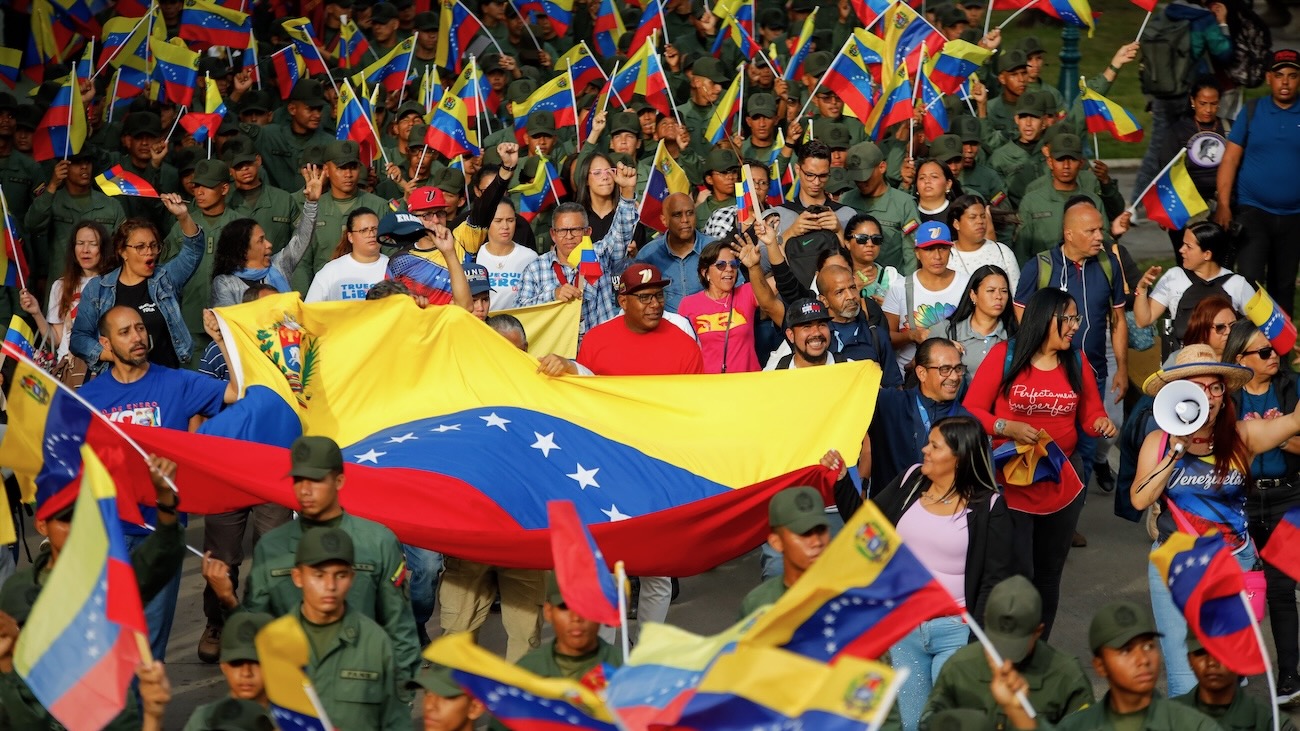
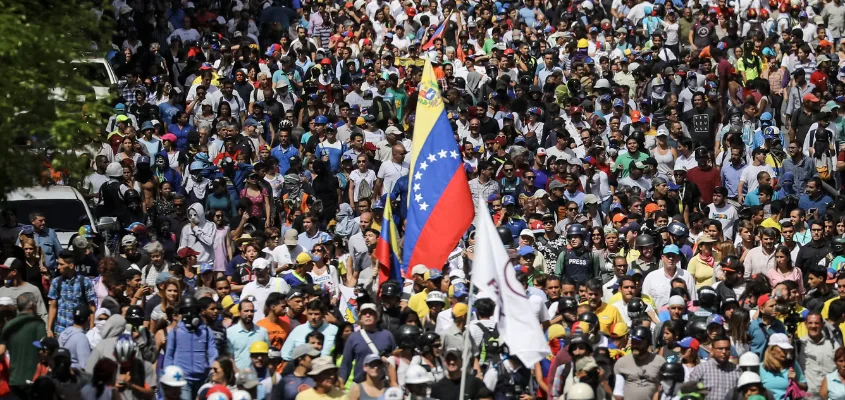
A massive protest in Venezuela. Photo: Black Agenda Report.

By Afro-Venezuelan Organizations Network – Dec 10, 2025

Drawing on a history of resistance, Afro-Venezuelan organizations are mobilizing their communities to meet the threat of military action by the Trump administration and calling on the people of the U.S. to act on behalf of human rights.

The Afro-Venezuelan Organizations Network (ROA) and the Regional Articulation of Afrodescendants of Latin America and the Caribbean (ARAAC), Afrodescendant organizations born from anti-imperialist social change processes and anti-neocolonial struggles at the dawn of the twenty-first century, carry the dignity and sovereignty that our African Ancestors entrusted to us as a living imprint of the self-determination of peoples.

Latin America and the Caribbean have suffered, throughout the nineteenth, twentieth, and twenty-first centuries, invasions, territorial dispossession, and targeted assassinations of Latin American and Afrodescendant leaders. The historical record confirms this across nearly all the countries of Our America (Abya Yala), from the seizure of Puerto Rico, Panama, and several Caribbean islands, to the tragic invasions of Nicaragua, El Salvador, Honduras, the Dominican Republic, and Grenada, among many others.

The current president of the United States, Donald Trump, attempted through multiple avenues to invade Venezuela. He relied on internal civilian and military enemies through Operation Gedeón, as well as mercenaries neutralized by the heroic Afrodescendant community of Chuao (Aragua State). With military and paramilitary support from Colombian-Venezuelan sectors and the backing of former presidents Duque and Uribe, he attempted to provoke an invasion. Trump sought to undermine the legitimacy of our government by imposing an illegitimate president, a puppet named Juan Guaidó. He attempted to delegitimize Venezuela internationally by creating in 2017 a group of countries led by delinquent presidents, known as the Lima Group (Argentina, Brazil, Canada, Chile, Costa Rica, Guatemala, Honduras, Colombia, Paraguay, Peru). They appointed parallel ambassadors, imposed more than a thousand coercive measures that remain in effect nearly a decade later, and even stole our embassies, including the one in Washington, D.C.

In the face of these covert, open, and shameless aggressions, our sovereign people have responded with dignity, just as our cimarrón ancestors did during the colonial period, the war of independence, and the contemporary struggles that followed. The majority of the Venezuelan population lives along the Caribbean coast, from Zulia State to our border with Trinidad and Tobago, whose president Kamla Persad-Bissessar openly defends pro-imperialist positions.

THE INVASION ATTEMPT BY MR. TRUMP AND HIS ALLIES
The resident of the White House, Mr. Trump, has launched a second campaign aimed at invading our country, obsessed with seizing our oil reserves, the largest in the world, along with our gas, gold, and rare earth minerals. His motivation stems from the imminent depletion of U.S. reserves within five years and the decline of rare earth minerals necessary to sustain emerging technologies, including artificial intelligence.

The deployment of United States military forces only a few kilometers from our coastline, the killing of eighty fishermen under the pretext of drug trafficking, the violation of our airspace with threats against commercial flights, the illegal sale of the oil company CITGO, and more than 1,100 coercive measures reveal a multifaceted attack. This aggression could lead to the outbreak of a third world war, with the Caribbean and Latin America as its stage. At the center of this racist and white supremacist hatred stands Secretary of State Marco Rubio, an ultraright Cuban-American figure who has made it his mission to destroy the region’s progressive governments and act as a mercenary for ExxonMobil.

In light of this situation, we call upon the noble people of the United States to halt these aggressions. We also call on sovereign governments in the Caribbean and Latin America to stop the attacks led by Donald Trump and his mafia. We call on Afrodescendant peoples, communities, and social movements to mobilize in solidarity with our people, to denounce the false U.S. narrative of a war on drug trafficking, and to stop the march toward war.

We also call upon our Afro-Venezuelan people to defend our sovereignty and independence, and to uphold our right to self-determination as a nation. We urge our people to prepare for resistance and participate actively in a prolonged popular struggle for the defense of our homeland.

Caracas, December 4, 2025
Leadership of the Afro-Venezuelan Organizations Network
Coordination of the Regional Articulation of Afrodescendants of the Americas and the Caribbean


https://orinocotribune.com/venezuela-ca ... -struggle/

Venezuela Condemns US Piracy Before UN as Killings Resume; US Debate Heats Up, and Trinidad Lends Airports to US Military Operations
December 17, 2025

Image
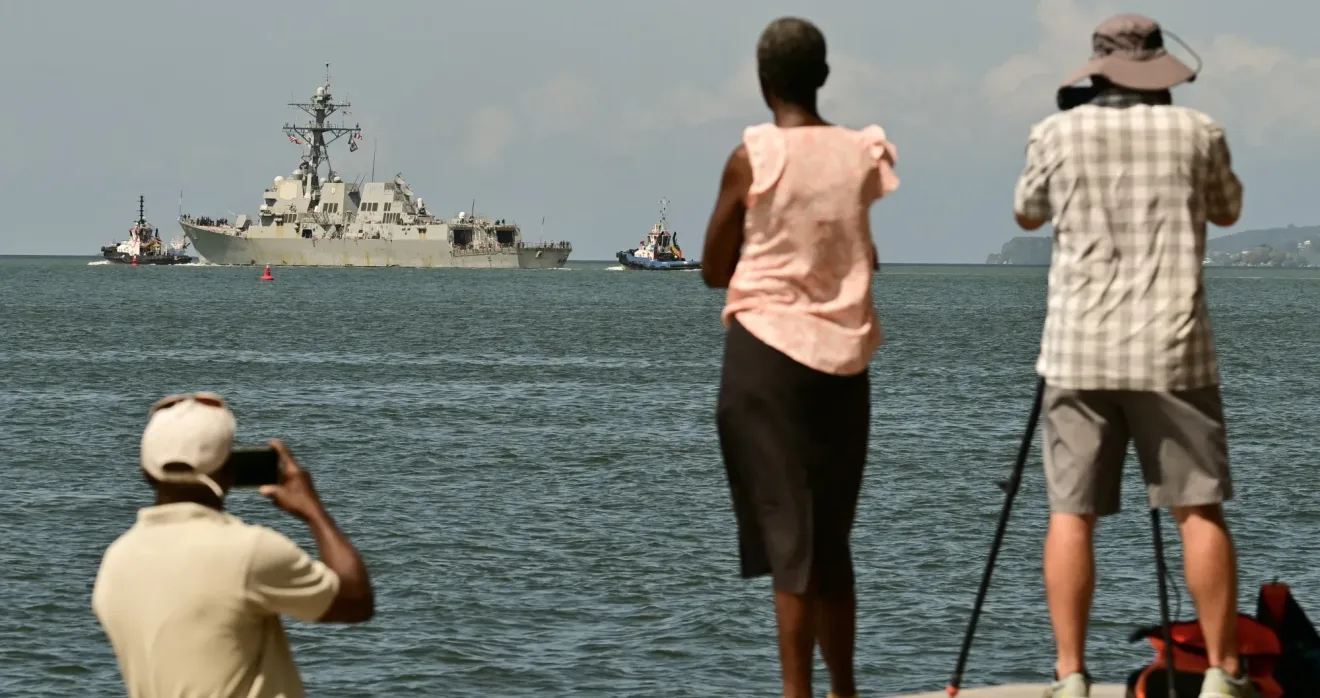
USS Gravely, a US Navy warship, docked in Trinidad and Tobago for four days in October, within striking distance of Venezuela. Photo: Martin Bernetti/AFP/file photo.

Caracas (OrinocoTribune.com)—Venezuelan Foreign Minister Yván Gil reported Tuesday that his nation delivered a letter to the United Nations Security Council repudiating the “serious use of force, abduction, and piracy” by the United States.

The letter, presented by Venezuela’s ambassador to the UN, Samuel Moncada, to Security Council President Samuel Z’bogar of Slovenia, concerns the Dec. 10, 2025, incident in international waters of the Caribbean wherein US forces targeted a private oil tanker engaged in legitimate trade while it transported Venezuelan oil. The Venezuelan crew members were abducted and remain missing.

“Venezuela will continue to exercise its sovereign and inalienable right to legitimately trade its resources and demand that no legal operation be subjected to theft, seizure, or acts of piracy, regardless of its origin,” Minister Gil stated.

Venezuela claims the US action deserves the Security Council’s attention, as it involves the use of force in international waters and the disappearance of civilians and sets a dangerous precedent for regional security.

More US executions
A few hours earlier, on Monday night, the US Southern Command (SOUTHCOM) reported new extrajudicial killings and strikes against three small boats allegedly operated by “designated terrorist organizations in international waters.” As usual, the US did not deign to provide any evidence of its accusations or any detailed information. The announcement was made via a social media post by the US military.

The post stated that the strikes killed eight people—three on the first boat, two on the second and three on the third—in the Eastern Pacific. Media reports claim that the extrajudicial executions occurred off the coast of Ecuador.

According to a detailed count by Orinoco Tribune, the US has now assassinated 95 civilians in this murderous campaign. Public records show that 48 (51%) were killed in Caribbean waters and 47 (49%) in Eastern Pacific waters. The US has murdered—at the very least—civilians of Venezuela, Trinidad, and Colombia, and one Ecuadorian survivor has been reported. Analysts claim that nationals of other countries are certainly among the victims.

On Tuesday, US Secretary of State Marco Rubio and Secretary of War Pete Hegseth appeared before the US Senate to answer questions about SOUTHCOM’s controversial operation, reflecting a heated internal debate over its nature and legality and about the opacity of information provided to legislators.

In statements after the briefing, Rubio remained defiant, claiming that the operation would “remain ongoing.” Mainstream media reported that top US officials did not provide an unedited video of the September 2 strike as demanded by many legislators and the public.

US Democratic Senator Chris Murphy told press after the briefing that “there is no legal or national security justification for what they are doing. Not even close.” He added that Rubio and Hegseth acknowledged that no fentanyl comes to the US from Venezuela and that the relatively small amounts of cocaine that may be trafficked through Venezuela are destined for Europe and not the US.

US Senator Joaquin Castro, commenting on the briefing, reiterated that despite White House attempts to avoid seeking approval for a land operation against Venezuela, US Congress will demand it. He noted that a War Powers Resolution will be discussed next week to block President Donald Trump’s hostilities against Venezuela.

Despite the US claims of a “war on drugs,” most analysts agree that Washington’s true intention is to overthrow the democratically elected president of Venezuela, Nicolás Maduro, and install a government that is compliant with US demands.

Trinidad reaffirms subservient role
Also on Monday, the government of Trinidad and Tobago announced that it will allow US military aircraft to transit through its Piarco and Arthur NR Robinson airports in the coming weeks, referring to the actions as bilateral security cooperation of a “logistical nature.”

According to Trinidad and Tobago’s Foreign Ministry, the transits will facilitate resupply and routine personnel rotations and do not change the country’s defense policy.

However, last week, revelations about Trinidad and Tobago’s role in aiding the US to seize a Venezuelan oil tanker led to a public outcry. Domestic analysts and politicians noted that newly installed US radars were used in Washington’s seizure of the oil tanker Skipper, which was carrying 1.9 million barrels of Venezuelan oil.

The government of Trinidad and Tobago reiterated that the cooperation with the US fulfills the commitment by Prime Minister Kamla Persad-Bissessar to strengthen national security. However, since taking office, she has launched anti-Venezuelan tirades against Venezuelan authorities and migrants.

Trinidad and Tobago’s authorities have lent diplomatic and operational support to the US killing spree in the region despite the fact that innocent Trinidadian fishers were among the victims of the US strikes. In a controversial “double-tap” strike of September 2, apparent survivors of a first strike were then subsequently killed by a second round of US strikes. The victims were nationals of Trinidad and Tobago.

The Trinidadian government issued a rather hollow statement in an attempt to garner support for what have been referred to as actions that are submissive to the US crimes and warmongering in the region. In an attempt to justify its actions, the government claimed that “the United States Embassy in Trinidad and Tobago has also supported national development through educational initiatives, including school equipment donations and infrastructure enhancement projects.”

Internal political tension in the small Caribbean country has reached unprecedented levels as a result of these actions. Meanwhile, Venezuela has retaliated by suspending the multi-million-dollar Dragon Field project a few weeks ago and, on Monday, halting all natural gas supply to the Trinidad and Tobago.

https://orinocotribune.com/venezuela-co ... perations/
"There is great chaos under heaven; the situation is excellent."

User avatar
blindpig
Posts: 15306
Joined: Fri Jul 14, 2017 5:44 pm
Location: Turtle Island
Contact:

Re: Venezuela

Post by blindpig » Thu Dec 18, 2025 6:55 pm

Trump Announces Full Naval Blockade of Venezuela's "Sanctioned" Oil Exports
Simplicius
Dec 18, 2025

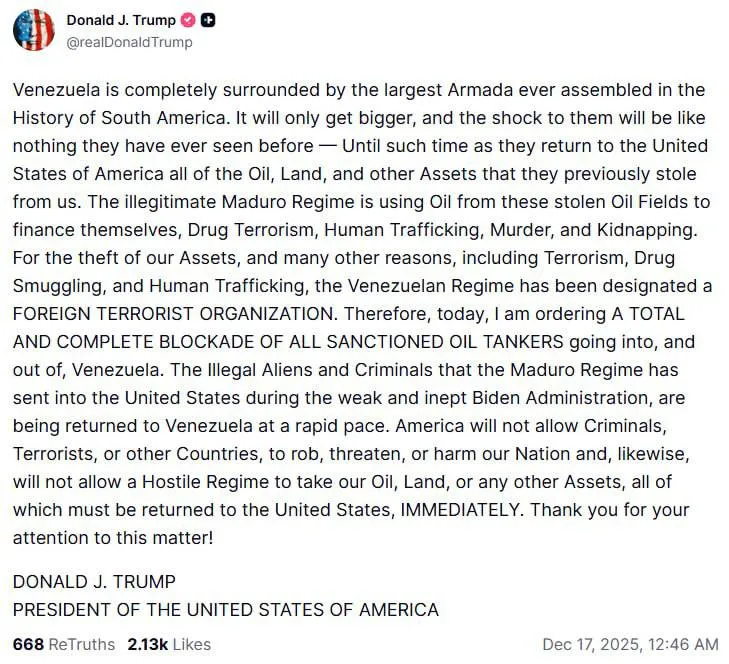
It appears the Trump administration is finally preparing to escalate the Venezuelan conflict once and for all, after Trump himself had told reporters that ‘ground strikes’ would begin ‘soon’ on Venezuelan soil. Trump then jumped the shark with his announcement of a full-scale naval blockade of Venezuela’s oil tankers in the most pompous way befitting his usual deportment:

Image

This was after US Special Forces had already seized an oil tanker off the coast of Venezuela just last week, allegedly for carrying “sanctioned” Venezuelan oil for export. A convoluted backstory was concocted about how the tanker was tied to Venezuela’s “shadow fleet” with links to Hezbollah and Iran—if you can believe the absurdity: (Video at link.)

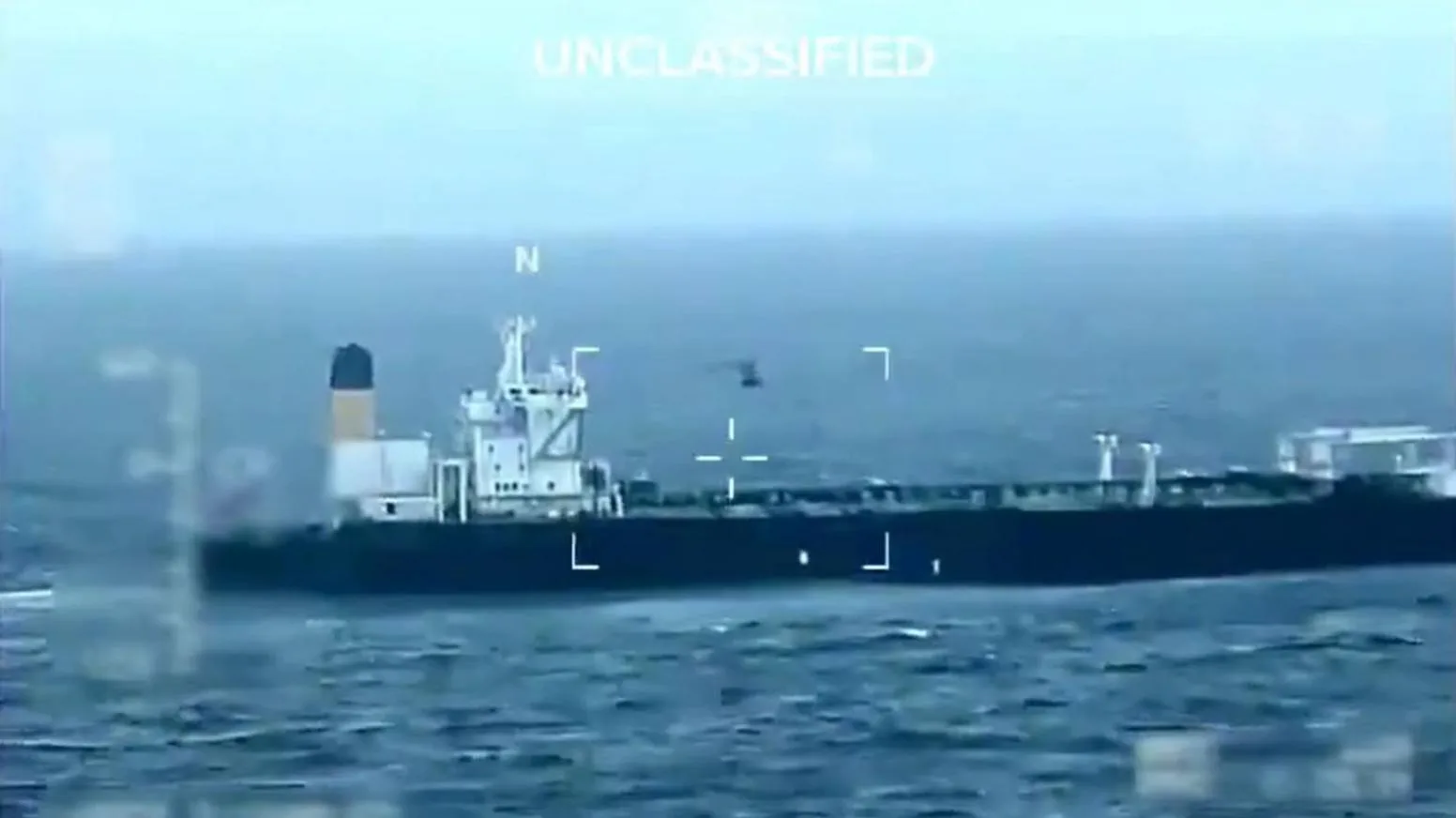
On 10 December 2025, the United States seized the oil tanker Skipper in the Caribbean Sea off the coast of Venezuela. Skipper had been sanctioned by the United States Department of the Treasury in 2022 for alleged involvement in an oil trafficking shadow fleet of vessels involving the Islamic Revolutionary Guard Corps and Hezbollah.

Recently, reporters even asked Trump whether the blockade was more about “drug trafficking” or actually “oil”, with Trump implying that it’s about all of those things combined and more, essentially giving up the imperialist plot in one fell swoop. (Video at link.)

Now, as seen in the earlier written screed, Trump has doubled down on his latest narrative motif, accusing Venezuela of “stealing” US’s oil: (Video at link.)

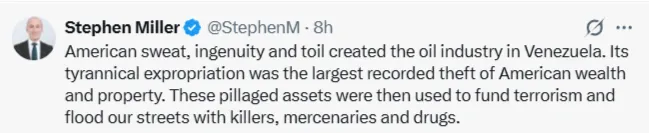
Top Trump advisor and WH Deputy Chief of Staff for Policy Stephen Miller piggybacked the escalatory rhetoric:

Image

Here a Russian analytical channel provided the real scoop on this so-called stolen oil:

What “stolen” oil is Trump talking about?

On February 28, 2007, Hugo Chavez, the then-president of Venezuela, signed a law on the nationalization of oil fields.

All foreign companies operating in the country were offered to join joint ventures, in which at least 60% of the shares would belong to the state-owned company PDVSA.

The presidential decree affected American companies Chevron Corp., ConocoPhillips, Exxon Mobil Corp., British BP, French Total SA, and Norwegian Statoil ASA, which lost control over oil fields being developed in the Orinoco River basin.

At that time, foreign investors retained some autonomy only in the oil fields of the Orinoco oil belt, where they had played a leading role before the law was signed. In the 1990s, the Venezuelan government allowed foreign players into Orinoco because the fields there were considered unpromising and required large capital investments.

However, gradually, leading foreign companies increased oil production in Orinoco to 600 thousand barrels per day. From the very beginning, foreign players carried out exploration, production, and costly primary processing of crude oil in the Orinoco fields jointly with PDVSA.

According to some data, the amount of investments of the aforementioned companies in the subsequently nationalized assets amounted to at least 17 billion dollars.

Some of the claims of foreign oil companies were later satisfied by the Venezuelan authorities through direct monetary compensation.

But not all of them, and the issue is still not fully resolved: some firms are still demanding compensation and have cases in foreign arbitration bodies.

#Венесуэла

Military Informant


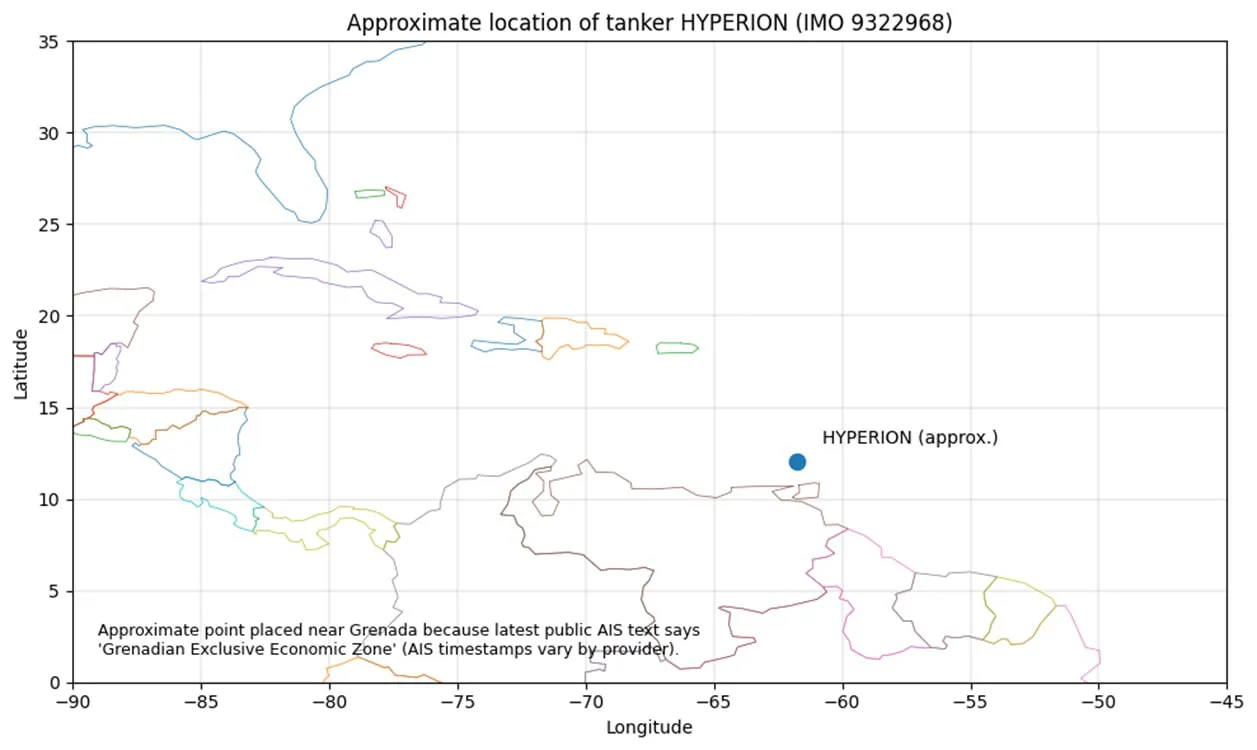
As an aside, an oil tanker named Hyperion reportedly belonging to Russia’s own so-called “shadow fleet” has been approaching Venezuela, with many tensely awaiting US’s actions as a litmus test of how much of a ballsy ‘hardball’ style of confrontation US will dare against Russia directly:

Image

It’s interesting that the Russian tanker “Hyperion” has entered the Carribbean waters heading towards Jose Terminal, Venezuela.

The ship is under US ‘OFAC’ sanctions....meaning it’s part of the so called “Shadow Fleet”

Independent maritime tracking sources have reported that sanctioned Russian tankers are continuing to operate to Venezuelan terminals such as Jose Terminal, even while Washington tries to interdict them. -


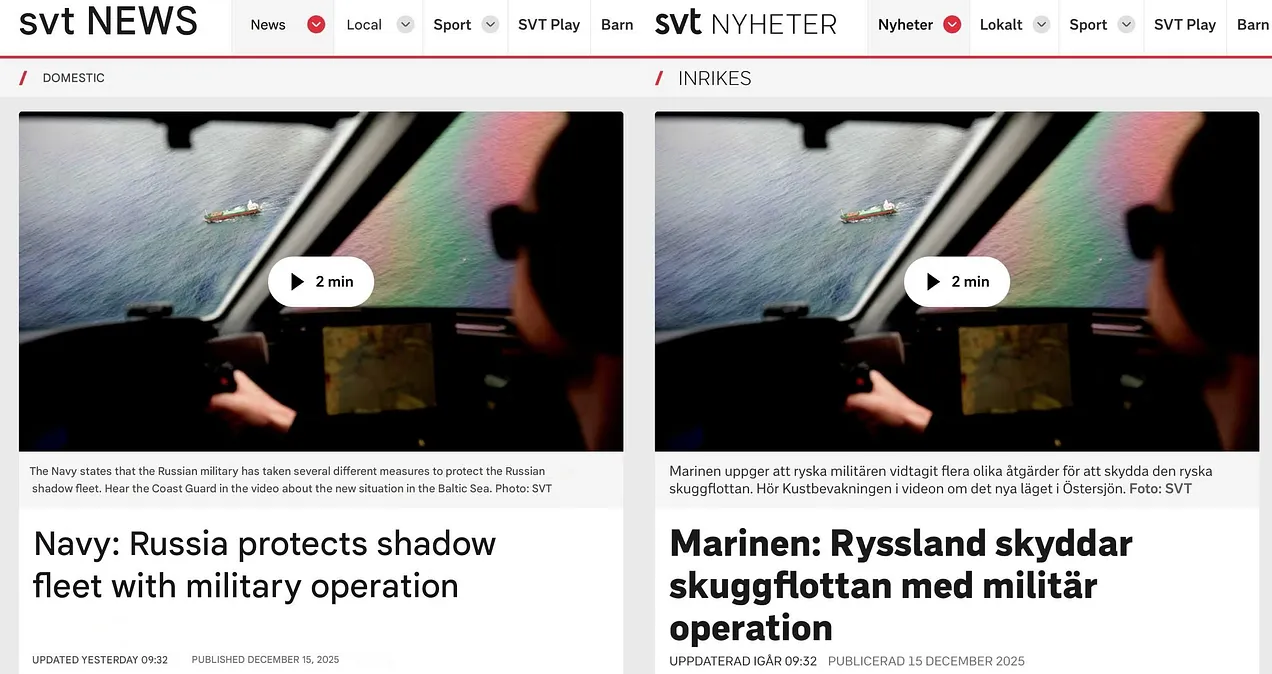
It has also been reported that Russian tankers transiting the Baltic Sea have now begun sprouting armed sentries, which have spurred ‘whispers’ about the precise ‘nature’ of these security details:

Image

A strange situation is being reported in the Baltic Sea. The Swedish Navy reports that armed men in military uniforms were spotted on board Russian oil tankers of the “shadow fleet” in the Baltic Sea.

The shadow fleet of the Russian Federation is being protected by military personnel, stated the head of the operational command of the Swedish Navy, Marco Petkovic, on air of the Swedish TV channel SVT Nyheter.

According to him, military personnel in uniform and armed men - presumably employees of private security companies - were spotted on Russian oil tankers operating in circumvention of Western sanctions.


One of the winking whispers, thematically, from a top Wagner-affiliated channel:

The private security guards protecting tankers from pirates are suspiciously young, slim, and adept at handling weapons.

Now, there are new rules for the quest involving the “shadow fleet”, including the use of anti-tank guided missiles and Strela missile systems.


Well, that’ll give the peg-legged Baltic buccaneers something to chew on and shiver their timbers over.

Russia’s Lavrov rightly highlighted the Europeans turning a willfully blind eye to the US’s illegal Caribbean piracy in order to appease Trump—maybe a kind of one-eyed pirate’s code. From RT: (Video at link.)

Europe is silent on US attacks in the Caribbean to gain Trump’s favor over their Ukraine peace plan proposals — Lavrov

Russia is ‘concerned’ with US Navy striking civilian boats and a probable land op

‘Almost all of the countries find it unacceptable apart from the Europeans’


It’s just more of that famous Ruse Based Ordure’s doppelmoral.

And speaking of the West’s moral and ethical standards:

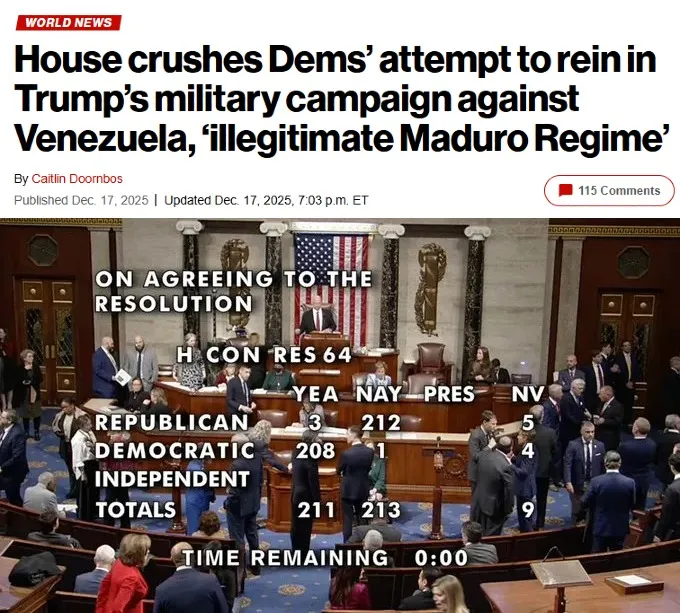
House REJECTS Venezuela war powers resolution by two votes

Democrat-pushed bill would have blocked Trump from taking military action against Maduro

One less obstacle for Trump


Image

(More, Ukraine)

https://simplicius76.substack.com/p/tru ... l-blockade
"There is great chaos under heaven; the situation is excellent."

User avatar
blindpig
Posts: 15306
Joined: Fri Jul 14, 2017 5:44 pm
Location: Turtle Island
Contact:

Re: Venezuela

Post by blindpig » Fri Dec 19, 2025 3:39 pm

Trump openly admits his intentions regarding Venezuela
Petromaxima pressure

Franco Vielma

December 17, 2025 , 8:31 pm .
Image
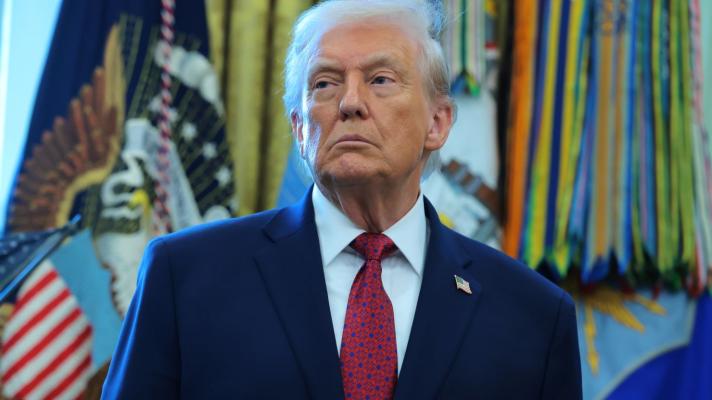
US President Donald Trump has now focused on speaking openly about US oil interests in Venezuela. (Photo: CNN)

The US regime change operation against Caracas has reached a new peak of tension following President Donald Trump's declaration ordering a "total and complete blockade" on all sanctioned oil tankers entering or leaving Venezuela.

The measure, announced Tuesday on the Truth Social network, intensifies pressure on the Venezuelan economy and has been described by Venezuela as a "reckless and serious threat" that violates international law.

Trump justified the decision by accusing the "illegitimate Maduro regime" of using "stolen" oil to finance "narco-terrorism, human trafficking, murder and kidnapping" on U.S. soil.

Trump asserted that Venezuela is "completely surrounded" by the largest armada ever assembled in South American history, and warned that the military deployment would be incremental, and "will continue to grow," he said, until Caracas "immediately returns" to the United States the oil, land, and other assets that he claims were illegally expropriated.

Trump's declaration of intent and the partial air and naval blockade he has imposed on Venezuela is a turning point in the new "maximum pressure" policy.

Speaking of oil, White House Deputy Chief of Staff Stephen Miller, one of Trump's closest advisors, backed up these claims by declaring that "American sweat, ingenuity, and labor created the oil industry in Venezuela."

Miller described the nationalization processes of the sector in 1976 and 2007 as "the largest recorded theft of American wealth and property," adding that those expropriated assets have been used to "finance terrorism and flood the streets of the United States with assassins, mercenaries, and drugs."

The Venezuelan government's response was immediate and clear. The Foreign Ministry issued a statement rejecting Trump's "grotesque threat," accusing him of attempting to impose an "irrational naval military blockade" with the aim of stealing the country's wealth.

Caracas announced that it will denounce the measure before the United Nations (UN) as a "serious violation of international law, free trade and free navigation."

President Nicolás Maduro, in conversation with UN Secretary-General António Guterres, described the statements by Trump and Miller as "expressions of an open colonial character" and demanded their rejection by the multilateral system.

Meanwhile, Venezuelan Defense Minister Vladimir Padrino López called Trump's words "delusional" and said they revealed intentions to "force a regime change and grossly seize oil."

This escalation comes amid a massive US military deployment in the Caribbean and the recent seizure of a foreign oil tanker carrying Venezuelan crude.

Although Washington insists that its campaign focuses on the fight against drugs and irregular migration, explicit references to oil by Trump and Miller have fueled Venezuelan arguments that the real objective is control of the world's largest proven crude oil reserves and the largest natural gas reserve in the Western Hemisphere.

CHANGE OF FOCUS
The change in focus in Washington's strategy—from the fallacious argument of drugs to the clear objective issue of the amount of oil in Venezuela—suggests that military pressure alone has not achieved the objectives of institutional breakdown within the Venezuelan government.

The intensification of pressure against Venezuela, now on a scale of maximum intimidation, has acquired a physical dimension.

The United States—in the old English imperial style—has given its own armed forces a license to engage in piracy in the Caribbean, as happened with the recent theft of an oil tanker.

With a partial air and naval blockade underway, the Trump administration is outlining its strategy on Venezuelan supply chains, raw materials, and energy, shifting the focus of its pressure and making its intentions clear.

Trump seems to dismiss criticism in his country about the possibility of a new " oil war ." But the president still hasn't focused his rhetoric, at least not openly, on seeking regime change in Venezuela, as he mentioned on several occasions between 2017 and 2019 during his first term.

The current situation suggests a position of strength in which Trump hopes to achieve an absolute repositioning of the United States over Venezuelan resources, through the deposition of Chavismo and the imposition of a puppet government for Washington.

But the demand for an "immediate return" of alleged US lands and oil resources in Venezuela clashes with reality for objective reasons.

Firstly, there has been no regime change in Venezuela and, secondly, any immediate resizing of the oil relationship between the two countries would have to go through the current Venezuelan government.

Its immense military maneuver against Venezuela has barely resulted in the execution of boatmen, the suspension of commercial flights, and the acquisition of a tanker loaded with 1.9 million barrels of Merey crude.

But in political terms, Trump's benefit has been nil.

Trump's strategy has been, in theory, "anti-drug" and "anti-immigrant".

On both issues, he proclaimed his "achievements," stating that drug trafficking by sea had been reduced by an unprecedented, if not unbelievable, 94% . He also claimed to have rescued "thousands and thousands" of Venezuelans "released from prisons and mental institutions" from the United States. Essentially, he stated that he had consolidated his objectives.

Now, the justification for their immense military presence in the Caribbean is taking shape as a deterrent mechanism for the "immediate return" of oil assets. Robbery and extortion.

On the afternoon of Wednesday, December 17, Trump told reporters that Venezuela had supposedly taken away the United States' "energy rights": "They took all our oil not that long ago. They took it illegally. We want it back," he said.

In this sense, it is necessary to point out the possibility that Washington is probably looking for a way out of the current momentum of its strategy, giving it a new form, as a fight in favor of American interests, or in favor of American oil companies that withdrew from Venezuela after the nationalization process of 2007, specifically ExxonMobil and Conoco Phillips.

This scenario opens up possibilities – minuscule today, but possibilities nonetheless – for the United States to try to exert pressure in order to achieve the return of certain US operations in Venezuela.

From his position, it would be better to pursue an agreement with the Venezuelan government based on "force", rather than having it be the result of a practical negotiation between two governments that recognize each other.

The other possible explanation for this change in discourse focus could be the search for support in other sectors and spectra of US politics to openly wage a war for oil in Venezuela.

Thus, the picture becomes clearer and the Venezuelan position is reaffirmed. To paraphrase Bill Clinton and James Carville, it's the oil, stupid.

https://misionverdad.com/venezuela/petromaxima-presion

Google Translator

******

Shining a Light on How Exxon Mobil Indirectly Funds Think Tank “Experts” Calling for Regime-Change War in Venezuela
Posted on December 19, 2025 by Nick Corbishley

When Trump talks about Venezuela stealing US oil, he’s almost certainly talking about Exxon Mobil’s oil.

The US’ seizure last Wednesday of an Iranian oil tanker carrying Venezuelan oil was definitive confirmation that the US’ war of aggression in Venezuela has nothing to do with drug cartels and everything to do with oil majors.

Venezuela has the largest proven reserves of heavy crude in the world, with an estimated 303 billion barrels, as well as the largest reserves of light crude oil in the Western Hemisphere. But it’s not just that Venezuela is home to the largest oil reserves on the planet, it’s that those reserves are sitting “right next door” to the US, as Trump himself said in 2023:

Donald Trump admitted in 2023 that, in his first term as US president, he tried to overthrow Venezuela's government and pillage its oil:

"We would have taken [Venezuela] over. We would have gotten all that oil. It would have been right next door".pic.twitter.com/hrygJQQU7B

— Ben Norton (@BenjaminNorton) October 11, 2025


President Trump’s obsession with seizing other countries’ oil goes back a ways, to even before he entered politics. Here he is explaining in 2011 why the US should seize half or more of Libya’s oil after murdering its leader, Muammar Muhammad Abu Minyar al-Gaddafi, and plunging what was arguably the richest country in Africa (on a per-capita basis) into total chaos.

For those who believe the US-backed coup in Venezuela is about helping the people, here's Trump in 2011 explaining how regime change should be used to steal natural resources.

NOTE: 🇻🇪Venezuela has the biggest oil reserves in the world pic.twitter.com/3lyfd979Jd

— The Resonance (@Partisan_12) December 1, 2025


The money quote: “you know the old days, when you had a war, it was ‘to the victor the spoils.'”

As has been patently clear since the very beginning, and was just reaffirmed by Democrat Senator Chris Murphy, Trump’s military strikes against boats in the Caribbean and Eastern Pacific are entirely devoid of legal or national security justifications. Yet they continue.

I just came out of the briefing with Sec. Rubio and Sec. Hegseth on the military strikes in the Caribbean and Eastern Pacific. Here's what I learned.

Bottom line: there is no legal or national security justification for what they're doing. Not even close. pic.twitter.com/8gUU0sHKwu
— Chris Murphy 🟧 (@ChrisMurphyCT) December 16, 2025


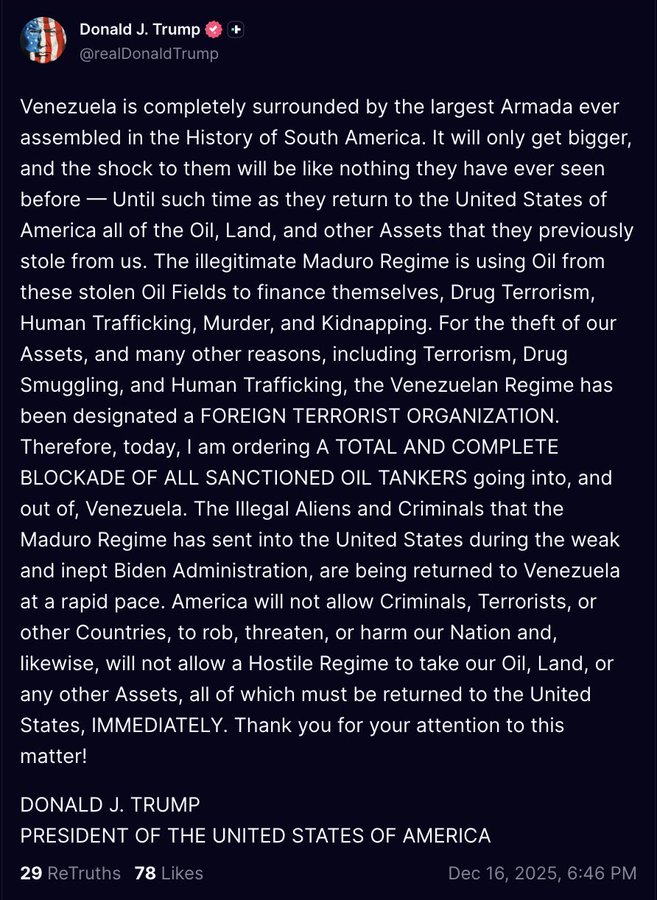
Meanwhile, Julian Assange has filed a criminal complaint against the Nobel Foundation for allowing its peace prize to serve as an instrument of war. The Wikileaks founder alleges that giving the 2025 edition award to Maria Corina Machado constitutes misappropriation of funds and facilitation of war crimes.

JULIAN ASSANGE FILES CRIMINAL COMPLAINT AGAINST NOBEL FOUNDATION OVER “INSTRUMENT OF WAR” PEACE PRIZE

WikiLeaks Founder Alleges 2025 Award to María Corina Machado Constitutes Misappropriation, Facilitation of War Crimes Under Swedish Law, Seeks Freeze of 11 million SEK ($1.18…
Image
— WikiLeaks (@wikileaks) December 17, 2025


Yet even as the holes in the whole war narrative grow larger, mainly because of Trump’s own conflicting statements, the war drums grow louder.

Now, Trump has said the quietest part out loud: his government is imposing a total siege on Venezuelan oil because the US wants “ITS” oil back from under Venezuela’s soil — the same oil that the late Venezuelan President Hugo Chávez dared to take back sovereign control of from foreign companies in 2005 (more on that shortly).

Trump’s blockade of all sanctioned tankers carrying Venezuelan oil does not affect Chevron’s daily shipments, however. From the Wall Street Journal:

President Trump on Tuesday ordered a complete blockade of all sanctioned oil tankers going into and out of Venezuela, escalating his administration’s pressure campaign against strongman Nicolás Maduro.

For Chevron, though, it remains business as usual. The company is still sending oil tankers to the U.S. Gulf Coast, its operations unimpeded thus far by rising tension between Trump and Maduro.

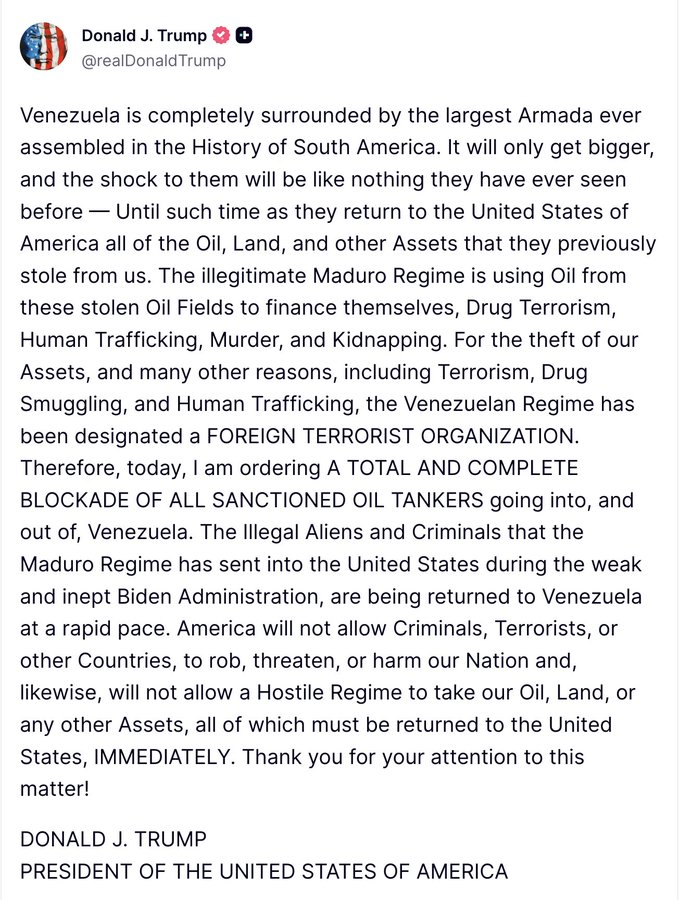
As Sony Thăng points out in the Tweet below, Trump’s candid declaration of US ownership of Venezuela’s is the “most honest colonial confession of the 21st century… you are saying, out loud, what empire has always believed in private: what lies under Venezuelan oil belongs to Washington.

Donald, you just wrote the most honest colonial confession of the 21st century.

When you say Venezuela must "return" its oil, land, and assets to the United States, you are not talking about law.

You are talking about ownership.

You are saying, out loud, what empire has always…
Image
— Sony Thăng (@nxt888) December 17, 2025


Coming Full Circle

There are, of course, a plethora of other reasons for the US’ aggressive moves against Venezuela that we’ve discussed before, including the country’s large deposits of gold, whose value and role as a monetary metal is growing, bauxite, coltan, which is needed for batteries, and freshwater. As Maria Corina Machado has made clear, a post Maduro-regime will also open up Venezuela’s economy to rampant privatisation and liberalisation.

As we’ve argued from the beginning, this is all part of a wider retrenchment of US imperial policy to its so-called “backyard”, and Venezuela is one of a number of countries in the region led by more sovereign-minded governments (Cuba, Nicaragua, Colombia, Honduras…) that Washington would love to topple.

Caracas’ close ties with Russia, China, Iran and Cuba no doubt play a part as well, as does its long-standing opposition to Israel’s treatment of Palestine. The US doesn’t just covet Latin America’s strategic resources for itself but wants to “box out” its rivals, China and Russia, from acquiring them, as former SOUTHCOM commander Laura Richardson explained during her 2023 interview with the Atlantic Council.

Rare earth elements, lithium, oil, light sweet crude, copper, gold, the Amazon, and fresh water.

This is what the United States wants to plunder from Latin America and the Caribbean. pic.twitter.com/Q9Rh5XP0jB

— Kawsachun News (@KawsachunNews) January 21, 2023


There’s also, of course, the small matter of the Epstein scandal, from which the Trump administration desperately needs to distract its voter base. And what better distraction than a new war, especially given the tens, perhaps even hundreds, of billions of dollars of new business it will create for the MIC?

But the main motive, I believe, is the oil — in part to sustain US refineries, as El País reported (in English) yesterday. In the clip below, the British journalist Ed Conway breaks down why US refineries need Venezuela’s particular brand of heavy crude oil:

Venezuela has the world largest oil reserves, at 20%. It’s oil is heavy thick crude.

The U.S. needs heavy crude.

This detailed video explains why the U.S. is stealing Venezuela crude. It’s not about drugs. It’s about oil pic.twitter.com/amm5s87TTp

— mmatigari (@matigary) December 12, 2025


And we’ve now come full circle, with Trump and members of his inner circle openly admitting that its war of aggression against Venezuela is really about oil.

Note how the US government's propaganda narrative has changed:

First the Trump admin claimed it was waging war on Venezuela because of drugs — a blatant lie (the US supports the worst drug traffickers in Latin America).

Now they admit that this is actually because Venezuela… https://t.co/pSoGQi3Ivk

— Ben Norton (@BenjaminNorton) December 18, 2025


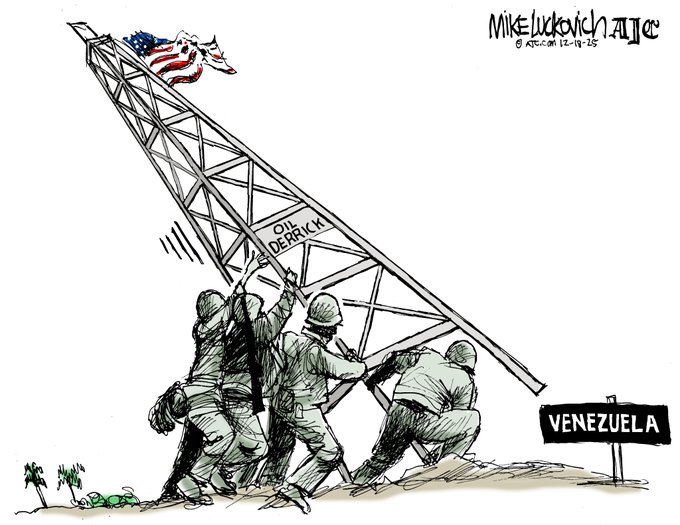
A fitting depiction of what is happening:
Image

— mike luckovich (@mluckovichajc) December 17, 2025


Of course, Trump’s claim that the Maduro government has stolen US-owned oil, land and other assets constitutes an extremely egregious case of projection. It is, after all, the US, mainly during Trump’s two presidencies, that has been stealing all kinds of Venezuelan assets, from the country’s gold reserves to the oil tanker seized in the Caribbean last week, to the president’s official plane, to Venezuelan oil company Citgo.

Trump’s words are even causing blushes among members of the Machado opposition, as Max Blumenthal told Judge Napolitano on Judging Freedom. After all, how can they sell their already deeply unpopular regime change story back home when Trump is telling the world that a Maduro-free Venezuela will essentially belong to the US — lock, stock and, most importantly, barrel?

The US war on Venezuela is as unpopular in Venezuela as it is in the US

An overwhelming majority of Venezuelans oppose US military intervention in their country and US sanctions, according to independent polling firm Datanalysis

More proof the war’s a Florida Gusano project pic.twitter.com/JWsMcYUVFa

— Max Blumenthal (@MaxBlumenthal) December 18, 2025


One company in particular that stands to benefit from the US’ latest regime change operation is Exxon Mobil. An recent article by the Argentine geopolitical analyst Bruno Sgarzini shines a light on how the company is helping to fund influential think tank “experts” who are pushing for a regime-change war against Venezuela (machine translated):

“The Brookings Institute and the Center for Strategic and International Studies (CSIS) are the two major think tanks we work with and actively participate in,” said Keith McCoy, a lobbyist for Exxon Mobil in 2019. What McCoy didn’t know is that the conversation was being recorded and that the person he was speaking to, supposedly a representative of an energy investment company, was actually a climate activist. The lobbyist had unwittingly confessed that he relied on the academic reports of both think tanks to influence congressmen, and the media, against any anti-fossil fuel legislation.

The academics, in charge of presenting their reports in Congress, and the board of both institutions, of course, denied any connection to the oil company. But the data speaks for itself; Exxon Mobil has contributed 12 million dollars to the CSIS that have flowed towards its program of “Energy Security and Climate Change” and others related to energy initiatives in the “Americas and Africa”, two regions where the oil company has deep interests.

It also contributed, according to records, $5 million to the construction of the institute’s new headquarters. Its executive board also includes Exxon’s current CEO, Darren W. Woods, who replaced the company’s former boss, Rex Tillerson, Trump’s former secretary of state during his first administration…

The positions of the CSIS are usually conveyed through reports whose message is then reinforced with the appearance of the authors on mainstream media, such as CNN, Fox News, NBC and CBS, or opinion columns in newspapers such as The Wall Street Journal, The Washington Post, and magazines specializing in international issues such as Foreign Policy.

[They also feature prominently] in congressional hearings, which gives these experts the possibility of influencing specific issues that benefit CSIS donors, such as Exxon Mobil. Brooke Williams, a professor of journalism at Boston University, wrote [in the New York Times]:

“Think tanks, which position themselves as ‘universities without students,’ have power in government policy debates because they are seen as researchers independent of moneyed interests. But in the chase for funds, think tanks are pushing agendas important to corporate donors, at times blurring the line between researchers and lobbyists. And they are doing so while reaping the benefits of their tax-exempt status, sometimes without disclosing their connections to corporate interests.”

According to CSIS, it usually has regular meetings with representatives of its donors to discuss the issues they are dealing with.

A Guerrilla Lobby

The fact that a think tank like CSIS is serving the interests of one of its biggest corporate donors is hardly news to NC readers. Even the New York Times reported in 2016 on how think tanks are “amplifying Corporate America’s influence”. This is, you could argue, their raison d’etre.

What may be news is that since Trump began deploying a large chunk of the US’ naval fleet to the Caribbean in early September, the CSIS has launched a guerrilla lobby of sorts in favour of removing Chavismo from power. That this perfectly aligns with the interests of one of its main donors, Exxon Mobil, is probably no coincidence, writes Sgarzini:

In an article in Foreign Policy, CSIS’ director for Latin America, Ryan C. Berg, has spoken in favor of “overthrowing Maduro without troops on the ground.” He has also questioned the anti-war visions of the MAGA world held by journalist Tucker Carlson and former Trump strategist Steve Bannon.

“Distinct from a boots-on-the-ground invasion of Venezuela aimed at overthrowing Maduro, a regime collapse would entail a more limited campaign of U.S. strikes on targets at the heart of the Maduro regime’s state-crime nexus, implicating the country’s armed forces and its political elites. These strikes would leverage precision-guided munitions and U.S. standoff weapons fired from a safe distance, possibly catalyzing movement internally to force Maduro’s exit—all without putting U.S. personnel at risk as with a “regime change” strategy.”

The promotion of this thesis… was reinforced by technical-military reports by Mark Cancian, a former U.S. colonel who participated in the 2003 invasion of Iraq, who compares the firepower being deployed [in the Caribbean] with other military campaigns such as NATO’s in Libya and Yugoslavia.

“The forces currently compromised are insufficient for an amphibious landing or ground invasion. This would require at least 50,000 soldiers, and war strategists would probably want a much larger number—perhaps 150,000—to achieve the overwhelming force they desire. However, the air and naval resources accumulated over the past three months have provided enough firepower to the Caribbean to launch air and missile strikes against Venezuela…”

These reports, in practice, function as information weapons to maintain the perception of an “imminent attack” and thereby influence decision-making.

CSIS has been at this a long time. During the first year of Juan Guaidó’s clown “presidency”, in 2019, it organised a meeting to evaluate the use of military force in Venezuela. Guest speakers included the former head of Southern Command, Kurt Tidd; Roger Noriega, former US undersecretary for Latin America and one of the architects of the Iran-Contra scandal; and William Brownfield, former US ambassador to Caracas.

During the Biden administration, Berg was a vociferous critic of the oil licenses granted to Chevron, Exxon Mobil’s biggest rival. On Trump’s return in January, Berg co-wrote a report with Juan Ignacio Hernández, Juan Guaido’s former special prosecutor, titled “Ending Maduro’s Oil Lifeline”. The report argued for the reapplication of sanctions as a tool of pressure, and the revocation of the current oil licenses that allow Western companies to partner with PDVSA.

The report’s presentation event even featured the participation of María Corina Machado. From 2023 to 2025, the opposition leader has participated in different CSIS events moderated by Berg, at which she reiterated her refusal to negotiate with Maduro and called for Washington to apply tougher measures against Venezuela.

At the beginning of Trump’s second term, it was not clear which way his government would lean on the question of Venezuela. As readers may recall, Trump even dispatched his special mission envoy, Richard Grenell, to Caracas to discuss with Maduro the return of migrants currently in the US. As a gesture of good will, Caracas released half a dozen US citizens held in Venezuelan prisons who were accused of being mercenaries and plotting terrorist attacks on Mexican soil.

As we noted at the time, this was clearly an attempt by the US to reestablish relations with Venezuela after over a decade of escalating sanctions and multiple failed regime change operations against the country:

After Maduro and Grenell closed the deal, the prisoners were taken to the airport, blindfolded, hooded and handcuffed. No financial or other concessions were promised to Maduro, other than the prospect of improving relations with the US, Grenell said.

The only reward for Maduro was my presence: the first senior US official to visit the country in years , Grenell said. It was a great gift for him to receive a visit from an envoy of President Trump.

While these words may ring of imperial hubris and arrogance, the truth is that Maduro seemed the picture of contentment in the meeting. And who could blame him? Just a month [earlier], all the talk was of yet another regime change operation, led this time by Venezuela’s CIA-sponsored “Iron Lady”, Marìa Corrina Machado. Biden had just given the opposition’s official candidate, Edmundo González, the red carpet treatment at the White House, pronouncing him as “president elect” of Venezuela just days before Maduro’s inauguration for a third term.

Richard Grenell’s strategy may have sought to offer Venezuela economic respite by extending the sanctions relief enacted by the Biden administration in 2023, since which time Venezuela has been one of the fastest growing economies in Latin America. However, all of the White House’s decisions since the summer of 2025 point in the opposite direction.

Clearly, the US Secretary of State Marco Rubio, his Miami-based backers, neocons like Elliot Abrams and all the other belligerents, including CSIS, have gained the upper hand.

However, if Trump does declare war against Venezuela, it could be hugely disruptive for US oil companies operating in Venezuela, like Chevron, and the huge refineries that process Venezuela’s heavy crude on the US’ Gulf coast — especially if, as many have warned, the spiral of violence unleashed in Venezuela becomes intractable.

But this wouldn’t be a problem for Exxon Mobil since it hasn’t had operations in Venezuela since 2007.

Exxon’s Long History in Venezuela

Exxon has a long, rich history in Venezuela dating back over a century. Its predecessor, Standard Oil, was one of the first companies to explore for oil in the South American country in the 1910s. Between the 1930s and the first decade of this century, Exxon was a dominant player in Venezuela through its 95% control of the Creole Petroleum Corporation — so much so that the country became known as the “ranchito de los Rockefeller“.

But that all came to a halt in 2005, when Hugo Chávez ordered all existing “operating agreements” with foreign oil companies to be converted into joint ventures in which the state oil company, Petróleos de Venezuela (PDVSA), held a mandatory majority stake (over 50% ownership and operational control). Exxon refused to sign while most other companies, including BP, Total and Chevron, took the deal.

In 2007, Exxon left Venezuela for good and began a long court battle against the Chavista government at the International Center for Settlement of Investment Disputes (CIADI). The US oil giant sought compensation of $18 billion, but after several appeals the courts sided with Venezuela and in 2014 the oil company was awarded only $1.6 billion in damages.

When Trump accuses Venezuela of stealing US oil, he is presumably referring primarily to Exxon’s oil.

But Exxon’s revenge came with the the discovery of oil off the coast of Essequibo, a sparsely populated 160,000 square-kilometre chunk of land in neighbouring Guyana. The ownership of Essequibo has been the subject of an ongoing territorial dispute between Guyana and Venezuela since the mid-19th century — a territorial dispute whose initial antagonist, readers will be shocked to learn, was the British Empire.

Exxon was one of the first companies to begin drilling for oil in the Essequibo’s disputed waters. As the Washington Post reported in 2017, it was the “perfect revenge” for Exxon’s then-CEO Rex Tillerson, whom Donald Trump would later go on to appoint as his secretary of state.

Rex Tillerson hadn’t been CEO of ExxonMobil very long when the late president Hugo Chavez made foreign oil companies in Venezuela an offer they couldn’t refuse. Give the government a bigger cut, or else.

Most of the companies took the deal. Tillerson refused.

Chavez responded in 2007 by nationalizing ExxonMobil’s considerable assets in the country, which the company valued at $10 billion. The losses were a big blow to Tillerson, who reportedly took the seizure as a personal affront.

Only Tillerson didn’t get mad, at least in public. He got even.

Flash forward to May 2015. Just five days after former military general David Granger was elected president of the South American nation of Guyana, unseating the country’s long-ruling leftist party, ExxonMobil made a big announcement.

In the deep blue waters120 miles off Guyana’s coast, the company scored a major oil discovery: as much as 1.4 billion barrels of high-quality crude. Tillerson told company shareholders the well, Liza-1, was the largest oil find anywhere in the world that year.

For tiny Guyana (population 800,000), the continent’s only English-speaking country and one of its poorest, it was a fortune-changing event, certain to mark a “before and after” in a country long isolated by language and geography.

There was just one problem with this undersea bonanza. Venezuela claimed the waters — and the hydrocarbons beneath them — as its own.

Clearly drilling in the disputed area was potentially a good business decision for ExxonMobil, not some sort of elaborate revenge scheme by its CEO.

But revenge had been served. Venezuelan President Nicolas Maduro, Chavez’s successor, was livid.

“There is a brutal campaign against Venezuela of lies, funded by ExxonMobil … which has great influence at the Pentagon,” Maduro declared, calling the dispute an attempt to corner Venezuela and precipitate “a high-intensity conflict.”

That high-intensity conflict is now closer than ever. But it needs to be packaged and sold to US lawmakers, media, members of the armed forces, and Trump’s war-weary MAGA base. And that is where CSIS’ “experts” come in. And they appear to be marketing this war on behalf of a company that has much to gain from a military intervention, and which bears the biggest grudge against Venezuela’s Bolivarian movement.

https://www.nakedcapitalism.com/2025/12 ... zuela.html

*****
Image
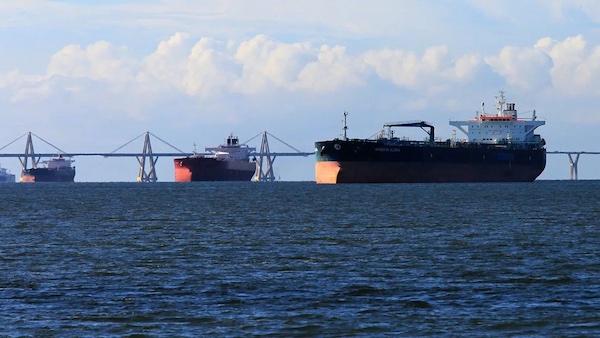
Oil tankers anchored in Lake Maracaibo after loading crude oil at the Bajo Grande refinery port in Venezuela. (Photo: José Bula Urrutia/Gettyimages.ru/Orinoco Tribune)

Venezuela mounts full-state rejection to Trump’s blockade threat, gains International backing
Originally published: Orinoco Tribune on December 18, 2025 (more by Orinoco Tribune) | (Posted Dec 19, 2025)

In an escalation of the U.S. empire’s ongoing illegal sanctions on Venezuela, President Donald Trump has announced a “full blockade” of the sovereign nation and its oil tanker fleet. He claimed the measure would remain in place until Venezuela “returns all the oil, land, and other assets” he alleged were previously stolen from the U.S. The announcement ignited an immediate response from the Venezuelan government, followed by all state institutions and international allies.

“Venezuela is completely surrounded by the largest Armada ever assembled in the History of South America,” Trump wrote on social media this Tuesday, December 16, adding that “it will only get bigger, and the shock to them will be like nothing they have ever seen before.”

He did not specify what oil, land, or assets he claims were stolen, nor did he elaborate on the bizarre claims of the so-called “war on drugs” argument that has seemed to take a backseat in recent days; something that Caracas has consistently condemned as an aggression against its sovereignty and an attempt to seize its natural resources.

In his post online, the U.S. president attacked the Venezuelan government, labeling it an “illegitimate regime.” He accused it of using “oil from […] stolen fields to finance narcoterrorism, human trafficking, murder, and kidnapping,” refusing to provide any evidence for his fictitious claims. Venezuela has repeatedly proven that the nation has been robbed of billions of dollars in international bank accounts, two tons of gold seized by the Bank of England, and the CITGO Corporation. The oil retailer and refining corporation is owned by PDVSA and valued at more than $15 billion, with yearly revenue of about $4 billion.


Foreign terrorist organization designation
“For the theft of our assets, and for many other reasons, including terrorism, drug trafficking, and human trafficking,” continued Trump’s statement, “the Venezuelan regime has been designated a foreign terrorist organization. Therefore, today I am ordering a total and complete blockade of all sanctioned oil tankers entering and leaving Venezuela.”

The U.S. president also insisted on repeating other unfounded accusations, such as that Caracas supposedly sent “illegal immigrants and criminals” into the U.S. He stated the White House “will not allow criminals, terrorists or other countries to steal, threaten or harm” his country, nor allow “a hostile regime” to seize oil he claims to somehow be property of the U.S. colonial entity, despite the resources being located in Venezuelan territory and belonging to the Venezuelan people.

“We will not give up”
Earlier on Tuesday, Venezuelan President Nicolás Maduro reiterated that, despite prolonged and multifaceted U.S. aggression, Venezuela will defeat “the oligarchy and imperialism under any circumstances.”

“For 25 weeks, Venezuela has been denouncing, confronting, and defeating a multidimensional campaign of aggression that ranges from psychological terrorism to the piracy that has plundered our oil, and which has multiple forms,” he stated in an address to Venezuelan workers. “What has Venezuela demonstrated? […] That Venezuela is a strong country, that it has real power. And we have demonstrated that we are prepared to continue our march. And, what’s more, that we are prepared to accelerate the march of a profound revolution that will give power to the people, completely and definitively.”

Citizens have consistently taken to the streets to display support for Venezuelan authorities and their rejection of U.S. imperialism, demonstrating their readiness to resist by any means, including through the use of force. On December 10, these protests included the mass condemnation of the seizure of a tanker carrying Venezuelan oil in the Caribbean Sea, an act denounced by Caracas that same day at the UN Security Council as an act of piracy.

Government communique
On Wednesday night, the Venezuelan government issued a statement in response to what many analysts consider a declaration of war by the U.S. empire, despite the U.S. president neglecting to request for the congressional approval mandated under U.S. law.

The statement reiterates Venezuela’s full sovereignty over its natural resources, the right to free navigation and free trade, as well as its adherence to the UN Charter. “[The US’s] true intention,” it adds, “which has been denounced by Venezuela and the people of the U.S. in large demonstrations, was always to appropriate the country’s oil, land, and minerals through gigantic campaigns of lies and manipulation.”

Below, you can read the full unofficial translation of the Venezuelan government’s statement:

A united Venezuela rejects Trump’s grotesque threat and will condemn it
On the night of December 16, 2025, the President of the United States, Donald Trump, violating International Law, free trade, and free navigation, has launched a reckless and serious threat against the Bolivarian Republic of Venezuela.

On his social media, he assumes that Venezuela’s oil, land, and mineral wealth are his property. Consequently, he claims that Venezuela must hand over all its riches to him immediately. The President of the United States is attempting to impose a supposed naval and military blockade on Venezuela in an utterly irrational manner, with the aim of stealing the wealth that belongs to our nation.

Venezuela, in full exercise of the International Law that protects us, our Constitution, and the laws of the Republic, reaffirms its sovereignty over all its natural resources, as well as its right to free navigation and free trade in the Caribbean Sea and the world’s oceans. Consequently, it will proceed, in strict adherence to the UN Charter, to fully exercise its freedom, jurisdiction, and sovereignty in the face of these warmongering threats.

Our Ambassador to the UN will immediately denounce this serious violation of International Law against Venezuela.

We call upon the people of the United States and the peoples of the world to reject by all means this extravagant threat, which once again reveals Donald Trump’s true intentions to steal the riches of the country that gave birth to the United Liberation Army of South America and to our Liberator, Simón Bolívar. The people of Venezuela, in perfect popular, military, and police unity, will know how to defend their historical rights and triumph through peace.

Mr. Donald Trump explicitly stated the following interventionist and colonialist expression: “until all the oil, land, and other assets that were previously stolen from us are returned to the United States.” His true intention, which has been denounced by Venezuela and the people of the United States in massive demonstrations, has always been to seize the country’s oil, land, and minerals through gigantic campaigns of lies and manipulation.

Venezuela will never again be a colony of any empire or foreign power and will continue to walk, together with its people, the path of building prosperity and the unrestricted defense of our independence and sovereignty.

The Venezuelan people, in perfect popular, military, and police unity, remain steadfast in the unrestricted protection of their territory, their resources, and their freedom. With our Liberator, we say: “Fortunately, a handful of free men have defeated powerful empires.”

Caracas, December 16, 2025.

Comprehensive state response
On Wednesday, the first institution to respond to the threat was the Bolivarian National Armed Force (FANB). Venezuela’s Defense Minister Vladimir Padrino, together with the FANB’s High Command, stated it would preserve at all costs the nation’s territorial integrity, its legitimate rights over airspace and maritime areas, and sovereignty, independence, and peace that the nation holds dear.

“We can say that Venezuela has scored a victory in the face of truth; the truth has been revealed,” the military commander warned.

It is now through force, no longer through sanctions, unilateral coercive measures, political, diplomatic, and media isolation, psychological terrorism; force and violence have been used, and those who resort to them are lost.

He emphasized that Washington’s “war on drugs” narrative “has fallen apart in the eyes of international public opinion,” and that U.S. imperialism is blatant in its desire for Venezuela’s natural resources. Furthermore, he rejected Trump’s accusations that Venezuela stole any assets of the U.S., claiming the true intentions of the empire “are nothing other than to force regime change in our country and grossly seize its oil and other strategic natural resources.”

Almost simultaneously, PDVSA issued a statement reporting that oil export operations are continuing as scheduled. “The export operations of Venezuelan crude oil and derivatives continue despite the attempted illegal and illegitimate blockade, through secure schemes and full guarantees,” reported Delcy Rodríguez, head of PDVSA and the vice president of Venezuela.

“Oil tankers linked to PDVSA operations continue to sail with full assurance, technical support, and operational guarantees, in the legitimate exercise of the rights to free navigation and free trade, widely recognized and protected by international law,” the statement reads, reiterating that PDVSA has remained active despite all of the U.S. attacks it has endured.

Minutes later, the Moral Republican Council—formed by the Prosecutor’s Office, Comptroller’s Office, and Ombudsman’s Office, one of the five branches of the Venezuelan state—made a televised statement expressing its support for President Maduro in all measures he decides to take to safeguard Venezuela’s rights and sovereignty, describing Trump’s action as a brutal escalation.

The Moral Council made a “call to the people of the U.S. and the peoples of the world to reject by all means this aberrant threat that reveals the true intentions of the U.S. government to steal the resources of our country and our continent.”

In the afternoon, the National Assembly unanimously approved a resolution repudiating the U.S. president’s announcement. The parliament agreed to defend “the full and inalienable sovereignty of the Bolivarian Republic of Venezuela over all its territory,” including its natural resources, emphasizing that they are “inviolable, inalienable, and under the absolute ownership and control of [Venezuela].”

The deputies called “upon the Venezuelan people to remain on alert and permanently mobilized in perfect popular, military, and police unity for the unrestricted defense of the historical rights of the homeland, thus ensuring peace and territorial integrity against any threat that seeks to disturb” Venezuela’s independence.

The peoples and governments of the world were also urged to “reject by all means this extravagant threat that undermines global peace and reveals U.S. true intentions of plunder.”

Venezuela’s judicial branch joined in rejecting the U.S. actions, as confirmed by the president of the Supreme Court of Justice (TSJ), Caryslia Rodríguez. After reading an official statement, Rodríguez added that the imposition of a “naval blockade” constitutes an attack on sovereignty and a new violation of Venezuela’s constitution and international law.

“Today, we condemn [the US] and call for a united effort to restore and maintain ethical and legal values as instruments of peace, sovereignty, and equality among the peoples of the world,” Rodríguez stated. She explained that the TSJ supports the ratification of Venezuela’s sovereignty over its natural resources and its right to free navigation and free trade.

Local and international reaction
Chavista forces and leaders rejected the Trump announcement across social media, accompanied by public statements from far-right politicians who are not sympathizers of President Maduro or Chavismo, such as Bernabe Gutierrez, Enrique Ochoa Antich, and Henry Falcon, among others.

Latin American presidents and international allies have also expressed full support for Venezuela against what many consider to be an act of war that violates the UN Charter.

Russian Foreign Minister Sergey Lavrov expressed deep concern over the belligerent U.S. statements and over Europe’s silence on the matter. Mexican President Claudia Sheinbaum reiterated México’s historic position against foreign interventions and demanded the United Nations assume its due role as an international peacekeeping body to “avoid a bloodshed.”

Cuban President Miguel Díaz-Canel had already expressed Cuba’s strong condemnation of a U.S. naval blockade and its support for Venezuela and the Bolivarian Revolution.

Iran also issued a communiqué strongly rejecting the U.S. threats. “The U.S. interference with, as well as its seizure and obstruction of, the free passage of commercial vessels to or from Venezuela constitutes a clear case of state piracy and armed robbery at sea,” the statement reads.

Invoking U.S. domestic laws and unilateral, illegal sanctions to justify these actions cannot, in any way, serve as a basis to legitimize such criminal acts.

China reported that its minister for foreign affairs, Wang Yi, had a phone conversation with his Venezuelan counterpart Yván Gil, expressing opposition to the U.S. empire’s unilateral bullying.

Even the German government expressed concern over Trump’s threats, warning of risks to regional peace and stability, as stated by spokesman for the German Foreign Ministry, Martin Giese. “The German government has an interest in preventing the situation in the region from deteriorating further,” he said during a press conference.

Therefore, we view the overall situation with concern. Of course, international law must be respected.

The Venezuelan government announced on Wednesday night that President Maduro held a phone conversation with UN Secretary General António Guterres, in order to warn him about the growing escalation of U.S. threats and their possible implications for regional peace. The head of state explained that Trump’s claims were supported by senior U.S. official Stephen Miller, who said the Venezuelan oil industry was also to be owned by the U.S. regime, which marks a direct colonial threat to Venezuela’s sovereignty and international law.

https://mronline.org/2025/12/19/venezue ... l-backing/
"There is great chaos under heaven; the situation is excellent."

User avatar
blindpig
Posts: 15306
Joined: Fri Jul 14, 2017 5:44 pm
Location: Turtle Island
Contact:

Re: Venezuela

Post by blindpig » Sat Dec 20, 2025 4:17 pm

In Venezuela, we have not been invaded
There is currently no invasion by any foreign force in our country, and there is no basis for thinking that we represent a threat to peace in the region.

December 19, 2025 by Giuliano Salvatore

Image
Thousands participated in a mass mobilization in the center of Caracas on November 25, 2025. Photo: Francisco Trias
Lee en español aquí

I am writing these words from Caracas, the capital of Venezuela, a few days after María Corina Machado (MCM), the newly named Nobel Peace Prize winner, said at a press conference in Oslo, Norway, on December 11, in response to a journalist’s question about whether she would accept a military invasion of Venezuela, that:

Venezuela has already been invaded. We have the Russian agents, we have the Iranian agents, we have terrorist groups such as Hezbollah, Hamas operating freely, in accordance with the regime. We have the Colombian guerrilla, the drug cartels that have taken control of 60 percent of our population, not only involving drug trafficking but in human trafficking, networks of prostitution. This has turned Venezuela into the criminal hub of the Americas.

In a week or two, my first daughter will be born, like thousands of other Venezuelan babies inside and outside the country who are about to be born or are newborns. It seems like a detail that would not matter to anyone other than the immediate circle of all our families and friends, but the words of María Corina Machado and the actions of the US government in recent months place all Venezuelans in the crosshairs of an apparently imminent military invasion which, given the narrative imposed on us (for MCM we are “the criminal hub of the Americas”) and the current global context, in which genocide in Gaza occurs with total impunity, it is logical and even prudent to think that it will seek to destroy everything in its path, hijack our future, and make us pay for our “freedom” with thousands and thousands of lives.

Venezuelan social and political forces are, and have been all these years, diverse in their positions and in their magnitudes. The problems that Venezuelans face on a daily basis have been exacerbated by the unilateral sanctions imposed on the Venezuelan people which, according to the 2021 report of the Special Rapporteur on the Negative Impact of Unilateral Coercive Measures of the United Nations, constitute a violation of international law seriously impacting the country’s population and preventing the enjoyment of human rights.

Our problems are not few, nor are they without enormous complexity, difficult to grasp in their entirety even for ourselves. We have problems, like any country; problems that have been part of our daily lives for years and have eroded in many ways the legitimacy of all political leadership in the country, whether in the government or the opposition. This diversity of political and social forces in Venezuela even includes clear and well-founded criticism of the Venezuelan government in many respects; clear and well-founded criticism from the left, from popular movements, and from Venezuelan workers of many of the paths we have taken in recent years.

Like any country, we are facing our own dilemma, a dilemma that includes, however, the fact that we are the world’s largest oil reserve and one of the largest reserves of gold, water, and coltan, at a time when the geopolitical map is being redrawn and the US empire is cynically playing its cards, Israel is seriously beginning to turn its attention to Latin America, and the major industrial and commercial powers are dividing up the world. So, while we are dealing with a circumstance common to the entire planet (the US empire in its most psychotic phase) we insist on the principle of self-determination and on our right to life, and on our conviction that we will be the ones to find the necessary channels to sustain ourselves and move forward on our own path.

The dangerous characterization of Venezuela for its possible invasion
No, in Venezuela we are not living under invasion by China, Russia, Hamas, Hezbollah, Iran, or any other foreign force. There is no direct evidence of this. If we had been invaded, as MCM would have us believe, this would imply the direct intervention of specific forces from these countries in our daily lives, and that is not happening in any way. Government advisors, defense or trade agreements between nations – none of these things, which are regular for any country, imply any form of invasion. There is no evidence that any foreign armed, police, parapolice, or paramilitary force is operating in Venezuela with the authorization and/or support of the national government. Furthermore, unlike in other countries in the region, there are no armed conflicts arising from territorial disputes between drug cartels, nor even, at this point, more local or smaller-scale conflicts involving microtrafficking, so it would be impossible to claim that “drug cartels have taken control of 60% of our population”.

The idea that Trump and MCM are trying to construct, that Venezuela is the hub of operations for all the evils that populate the nightmares of the West, is nothing more than a global narrative that seeks to dehumanize Venezuela and the region enough so that, once again (as is currently the case with Gaza and Sudan and so many other conflicts), international public opinion does not know exactly whether the end does not justify the means; in this case, that is (among other possibilities), our extermination.

Let us never forget what happened in Libya or Iraq, to mention two of a long list of countries “liberated” from evil by the United States. And if we believe in the idea that it is impossible to replicate experiences in the Middle East or Africa in Latin America, let us not lose sight of the fact that, since September, the United States has killed at least 87 people in its attacks in the Caribbean under the same premise that Israel kills men, women, and children with impunity in Palestine: they are terrorists, not human beings, and they are terrorists because they say they are.

In the context of what has happened in Gaza (more than 70,000 children have been killed with impunity) and taking into account that MCM is a close ally of the Israeli government and Netanyahu, the words of the current Nobel Peace Prize winner are a direct attack on the lives of Venezuelans and a clear call for the genocide that the United States and Israel are committing in Gaza to be repeated in Venezuela.

Venezuelans both inside and outside the country deserve the opportunity to solve our problems according to our own criteria and our own capabilities. That is sovereignty. There is currently no invasion by any foreign force in our country, and there is no basis for thinking that we represent a threat to peace in the region.

The only and most likely possibility is that we will be invaded by the US government in pursuit of nothing more than the global maintenance of its hegemony at the expense of our resources, our sweat, and our blood, both ours and that of our children.

Footnote on December 17
On Tuesday, December 16, US President Donald Trump declared on the social network Truth Social that:

Venezuela is completely surrounded by the largest Armada ever assembled in the history of South America. It will only get bigger, and the impact on them will be like nothing they have ever seen before —Until such time as they return to the United States of America all of the Oil, Land, and other Assets that they previously stole from us. The illegitimate Maduro Regime is using Oil from these stolen Oil Fields to finance themselves, Drug Terrorism, Human Trafficking, Murder, and Kidnapping. For the theft of our Assets, and many other reasons, including Terrorism, Drug Smuggling, and Human Trafficking, the Venezuelan Regime has been designated a FOREIGN TERRORIST ORGANIZATION. Therefore, today, I am ordering a TOTAL AND COMPLETE BLOCKADE OF ALL SANCTIONED OIL TANKERS going into, and out of, Venezuela.

It doesn’t take much analysis. It seems that between the FIFA Peace Prize and the Nobel Peace Prize, Venezuela (and the region) are about to experience levels of harmony, tranquility, and concord unlike anything we have seen before.

https://peoplesdispatch.org/2025/12/19/ ... n-invaded/

******

Venezuela Demands Reparations from the United States for the Theft of CITGO

Vice President Delcy Rodríguez defended the country’s energy sovereignty and rejected imperialist attempts to seize Venezuelan crude oil.

Image
Vice President Delcy Rodríguez, alongside the oil workers, affirms that Venezuelan energy resources can only be obtained through respect and payment. Photo: Ministry of Hydrocarbons.

December 19, 2025 Hour: 6:02 pm

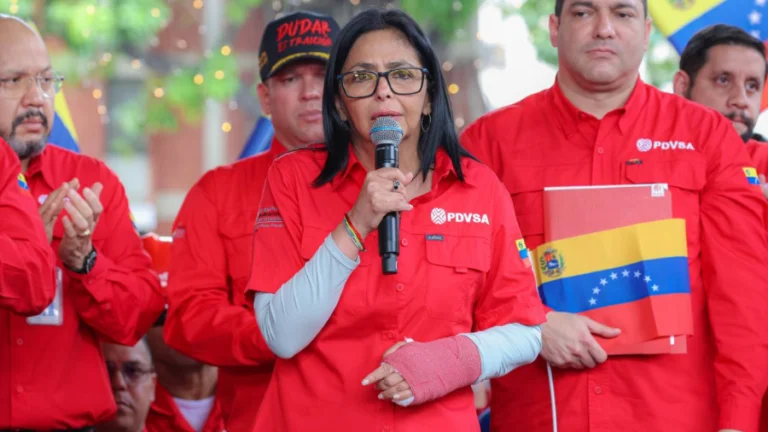
In a massive rally outside the headquarters of Petróleos de Venezuela (PDVSA) in La Campiña, Caracas, Venezuelan Executive Vice President Delcy Rodríguez demanded over $35 billion in reparations from the United States government for what she described as the theft and plundering of CITGO and the illegal withholding of its dividends since 2019.

“Washington owes the Bolivarian people,” stated Rodríguez, who also serves as Minister of Hydrocarbons. She denounced the dispossession of national assets abroad as a form of “economic piracy” that has had serious consequences for the stability of Venezuelan citizens.

During her speech, the Vice President categorically rejected any negotiations regarding Venezuelan hydrocarbons conducted under pressure or threats. “The nation’s hydrocarbons are not subject to negotiation under threats or foreign extortion schemes,” she said, specifying that any acquisition of oil or gas by international actors must be carried out under legal protocols and with the corresponding payment.

Rodríguez urged the U.S. government to conduct a “realistic assessment” of the impact of the economic blockade and unilateral sanctions imposed on Venezuela. She also demanded a public apology and “reparation for damages” for the effects of these coercive measures, which, she stated, seek to strangle the national economy.


The vice president emphasized that the defense of Venezuelan oil is part of a broader struggle for self-determination, sovereignty, and regional peace. She highlighted the role of workers in the hydrocarbon sector, whom she described as “aware and mobilized,” and reiterated her support for President Nicolás Maduro.

“National unity is the main shield against attempts to seize our energy resources,” Rodríguez stated, while describing Washington’s strategy of encirclement as an “absolute historical error.” She concluded his remarks by assuring that Venezuela will continue its economic recovery without yielding to “imperialist blackmail” and will deliver a nation free from tutelage, with full respect for its energy sovereignty.

According to a recent poll cited at the event, 97% of Venezuelans oppose foreign appropriation of the country’s resources, which reinforces popular support for the government’s stance against external pressures.

https://www.telesurenglish.net/venezuel ... -of-citgo/

Venezuela Launches Ecosocialist Plan to Achieve 10 Million Trees by 2026

Image
President Nicolás Maduro launches the Ecosocialist Training Plan. Photo: Presidential Press Office


December 19, 2025 Hour: 7:23 pm

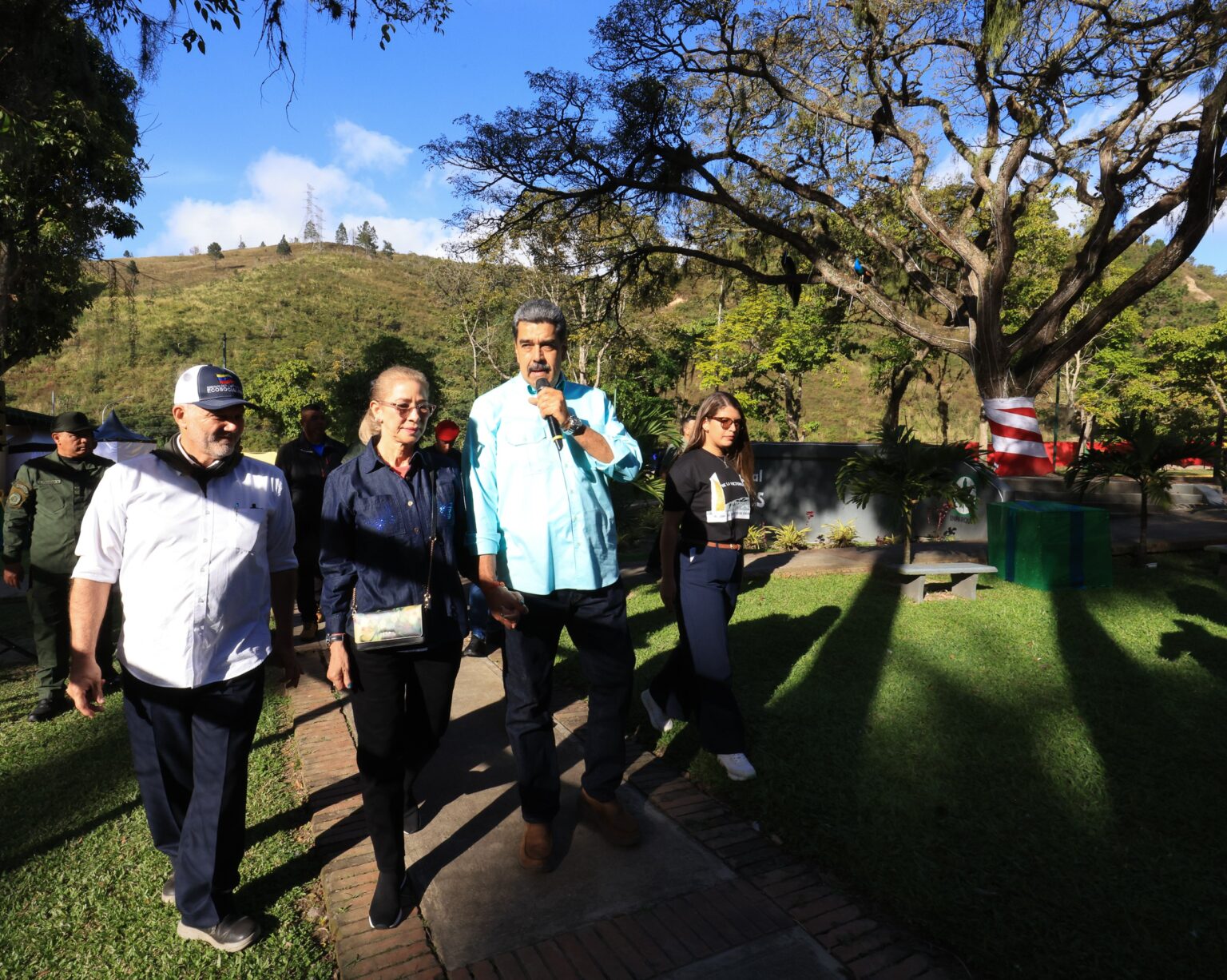
The Bolivarian Government of Venezuela launched an ambitious Ecosocialist Training Plan aimed at increasing the capacity of the country’s nursery workers, with the goal of establishing 2,000 community nurseries and producing 10 million trees by 2026, announced the Minister of Popular Power for Ecosocialism, Ricardo Molina, this Friday during an event at Vinicio Adames Park, commemorating the 200th anniversary of the Chuquisaca Decree.


400 nursery workers have already committed to participating in this plan, which seeks to strengthen community involvement in environmental protection and consolidate a national network of environmental defenders.

“The intention is to have environmental defenders who can contribute to the establishment of 2,000 community nurseries,” stated Molina, while presenting the progress report of the Great Mother Earth Mission to President Nicolás Maduro.


Among the key achievements, the minister reported that a scientific update of the status of the 44 national parks was completed, which will allow for the design of a structured, comprehensive, and systemic plan for their conservation and maintenance. Additionally, the Watershed Operations Committee was formed, tasked with identifying priority areas for reforestation and environmental intervention.

Regarding disaster prevention, Molina noted that 428 community risk maps were created, developed directly by the communities themselves.

Image

“Every community needs to have its own risk map to know how to respond, what the vulnerabilities are in their territory, and what affects downstream areas,” he explained, with the goal of reaching 5,336 maps nationwide.

Another significant milestone is the design of community weather stations, in partnership with the “Humberto Fernández Morán” Science and Technology Mission. “We already have the design, and we will manufacture them in 2026, using local science and technology,” the Minister of Ecosocialism affirmed.

Furthermore, he highlighted the progress made in combating the illegal wildlife trade, with 66 cases reported and resolved, actions aimed at protecting the nation’s biodiversity.

https://www.telesurenglish.net/venezuel ... s-by-2026/
"There is great chaos under heaven; the situation is excellent."

User avatar
blindpig
Posts: 15306
Joined: Fri Jul 14, 2017 5:44 pm
Location: Turtle Island
Contact:

Re: Venezuela

Post by blindpig » Sun Dec 21, 2025 6:23 pm

As PDVSA Hits Oil Production Target, US Seizes 2nd Venezuelan Tanker
December 21, 2025

Image
Screen grab from a video of the US Coast Guard boarding an oil tanker off the coast of Venezuela, constituting a new US imperialist aggression. Photo: X/@Sec_Noem.

Caracas (OrinocoTribune.com)—Venezuelan Vice President Delcy Rodríguez reported Saturday that Petróleos de Venezuela (PDVSA) reached its goal of producing 1.2 million barrels of crude oil per day this year. Simultaneously, Washington announced the hijacking of a second Venezuelan oil tanker carrying the South American country’s crude this month, raising international and regional tensions about a disruption in oil supplies and potential military escalation.

Rodríguez highlighted that the nation’s achievement in production results from the efforts of workers who, in both operational and administrative areas, have faced external hostilities and coercive measures (euphemistically referred to as “sanctions”) imposed by US imperialism.

“The best Christmas gift our people can receive, from dignified and free men and women, is the extraordinary effort of our oil workers who confront and defeat imperial harassment, hostility, and illegality,” wrote VP Rodríguez in a public statement.


The top official noted that the oil sector will continue advancing toward new production goals for 2026. “Nothing and no one will stop us,” wrote the vice president. “We will continue on our victorious path of honor and national dignity.”

The publicly owned company is preparing to increase production in 2026 to exceed this year’s levels, ensuring domestic supply and generating income for Venezuela despite ongoing US imperialist threats.

Oil blockade
Meanwhile, US Homeland Security Secretary Kristi Noem, who oversees the US Coast Guard, posted a seven-minute video on social media showing a helicopter hovering over a second oil tanker carrying Venezuelan oil. She wrote that the tanker was seized with support from the US Defense Department and that it was last docked in Venezuela. So far, Venezuelan authorities have not issued a statements in this regard.

“The United States will continue to pursue the illicit movement of sanctioned oil that is used to fund narco terrorism in the region,” claimed Noem despite reports that the tanker was not on the US “sanctions list.” Although US officials consistently attempt to frame the tanker seizures as occurring within a legal context, the economic coercive measures (“sanctions”) imposed upon Venezuela by the US are, in fact, illegal according to international law.

In fact, earlier this year, in order to clarify this point, the United Nations General Assembly adopted Resolution 79/193 and proclaimed December 4 as International Day against Unilateral Coercive Measures, to be observed annually beginning in 2025. “We underline that unilateral coercive measures are illegal under international law,” wrote the statement.

On Saturday, Venezuela’s Foreign Minister Yvan Gil announced that Iran offered its cooperation to confront acts of piracy and international terrorism by the US regime. Minister Gil stated that he spoke by telephone with his Iranian counterpart, Abbas Araghchi, to review bilateral relations and discuss “recent developments in the Caribbean, especially threats” and the “theft of ships loaded with Venezuelan oil.”

Gil said that Tehran expressed “full solidarity” with Venezuela and offered cooperation in all areas to confront the illegal US actions.

Combined with Trump’s threats of land strikes on Venezuelan soil, the oil tanker seizures have ratcheted up pressure on Caracas by targeting its economic lifeline, which had already come under strain from new sanctions on the oil sector earlier this year.

Analysts claim that this marks a new stage of US imperialist aggression against Venezuela, demonstrating that the previous stages, including attempted coups, assassinations, misinformation, funding of opposition parties, sabotage, etc., did not produce the desired regime change. Thus, analysts argue that despite attempting to construct the narrative of a “war on drugs” and of “democracy versus authoritarianism,” the US has failed to oust President Maduro due to the cohesion of most Venezuelans in support of Chavismo and against foreign intervention, as well as due to the weakness and lack of cohesion of far-right forces within the country.

Since September 2, the US military has killed 104 civilians, against a total of 29 small boats, in what the United Nations labels as extrajudicial killings. Trump has attempted to sell the attacks as an effort to crack down on illegal drug flows from Venezuela, a marginal actor in international narcotics networks. The US actions are clear evidence of a new drive to overthrow President Maduro, whose ouster White House chief of staff Susie Wiles has suggested is the US regime’s real goal.

Trump’s announcement this week of a “blockade” also underscored the US ruler’s focus on Venezuela’s oil, which he has said belongs to the US, along with Venezuelan soil.


Despite the clear classification of naval blockades as an act of war under international law, the Venezuelan government has shown restraint to avoid an undesirable military confrontation with the US. However, many analysts claim the latest US moves might aim not only at seizing Venezuelan oil but also at pressuring the Venezuelan military to take action to protect oil tankers, which could provide a minimal excuse for the US to initiate a full military campaign against Venezuela.

The US regime attempts to legitimize its acts of piracy by claiming they are due to Venezuela’s attempts to bypass “sanctions.” However, as noted, under international law, US sanctions are illegal and its actions constitute a violation of free trade and freedom of navigation. Analysts claim that US actions to bypass Chinese sanctions—launched to counter illegal US sanctions—might be used by China to justify seizing US vessels in Asia under the same legal argument.

Other analysts claim that Iran or China might launch similar actions in Asia in retaliation for the effects that US actions have on their economies, as many Venezuelan oil shipments are destined for China in collaboration with Iran.

https://orinocotribune.com/as-pdvsa-hit ... an-tanker/

*****

The recolonization of Venezuela: the new ways the US is trying to escape.
December 17, 2025 , 5:44 pm .

Image
The attack on the Skipper tanker reveals the true strategy of the United States (Photo: Videogram)

It is a crude but no less dramatic historical turning point: the United States abandoned any rhetorical flourish and openly confessed the true core of its policy: the theft of Venezuelan resources.

Donald Trump's message on the night of December 16th is the raw verbalization of a doctrine that the Venezuelan State has denounced for more than two decades .

When Trump demands that Venezuela "return" to the United States "its oil, its lands and its assets," what he is doing is certifying that Washington has always conceived of the country as another expropriable territory, a frustrated hydrocarbon protectorate that must be reconquered , a lost order, one in which Venezuela functioned as a subordinate energy enclave.

In fact, it reorganizes dependency relationships. Given this, who depends more on whom?

This public admission definitively dismantles the framework that the United States used for years to justify illegal sanctions , covert operations , open aggression, and now, blockade and threats of war.

This frankness reveals a dangerous narrowing of Washington's room for maneuver. The language turns crude when the narrative runs dry and when coercion needs to be on display to remain credible.

They are not trying to manage the aggression, they need to precipitate it. They do so through textbook extortion, with a direct message: either Venezuela cedes control of its strategic resources, or the economic, operational, and commercial costs will continue to rise.

Damage is the central instrument. Blockades, seizures, and disruptions to the flow of trade are used to demonstrate punitive power and force concessions under pressure.

This logic is explicitly described in the National Security Strategy, which normalizes the use of economic and military coercion as primary tools of geopolitical discipline .

The question, then, is not whether the United States is willing to escalate, but why it needs to do so with such urgency.

Will the answer lie on the home front?
The Trump administration is facing a crisis that is eroding its ability to govern effectively. The militarization of cities has clashed head-on with the judiciary, resulting in rulings that have ordered the withdrawal of the National Guard, leaving the executive branch trapped in a legal vacuum that threatens to reach the Supreme Court.

This conflict exposes the constitutional limits of the use of military force in domestic security and shows a White House stretching the notion of national emergency to the limit to compensate for its political weakness and loss of institutional control.

The economic downturn reinforces this picture. Approval of the Trump administration's handling of this issue is plummeting, public support barely reaches a third of the electorate, and inflationary pressures, consumer fatigue, and social unrest persist .

The most recent PBS News/NPR/Marist poll found that 57% of Americans disapprove of the government's economic management, which was considered one of its strengths during the campaign.

In addition, only 36% say the president is doing a good job: the lowest percentage this survey has found in his two terms.

Trump himself has acknowledged that he cannot guarantee his policies will translate into electoral victories, a rare admission that reveals an awareness of the real risk of losing the House of Representatives in next year's midterm elections.

Adding to this is the fracture within the Republican Party. The refusal of legislators in Indiana to redraw congressional districts directly impacts the White House's electoral strategy, which sees redistricting as a key instrument for maintaining legislative power.

The rebellion of moderate congressmen who align themselves with Democrats to extend health subsidies shows that loyalties are not homogeneous.

Trump's tactical hyper-presidentialism, based on executive orders and unilateral decisions, has generated the institutional woes and resistance that now converge with an increasingly pressing electoral calendar.

In this context of more or less unacknowledged internal weakness, the aggression against Venezuela serves a dual purpose. Externally, it attempts to reaffirm regional hegemony, reviving the old Monroe Doctrine logic with the Trump Corollary .

Internally, it seeks to consolidate support, shift the focus away from economic deterioration, and fabricate an external enemy to justify exceptional measures.

The narrative of "national security," which mixes drug trafficking, terrorism, and existential threats, allows for pushing legal limits, but it also opens flanks that Congress has already begun to explore.

The resolutions on war powers, despite having been decided in favor of the administration in the lower house, and the demands for transparency on maritime operations, indicate that the White House no longer has a blank check to escalate.

However, the escalation in the Caribbean has become a costly domestic political problem. At the heart of the controversy is the September 2nd attack, the full video footage of which the Pentagon refuses to release, despite demands from lawmakers of both parties.

In that video, according to senators who have had partial access to its contents, two survivors of an initial US air strike are seen clinging to the wreckage of their vessel, before being killed in the water during a second offensive.

Pentagon chief Pete Hegseth defended the refusal to release the full footage on Capitol Hill, arguing that it was a top-secret classified video and that its release would supposedly jeopardize operations, personnel, and military assets in the Southern Command's area of ​​responsibility.

Hegseth, the former TV presenter, argued that disclosing it would reveal sensitive methods, tactics, and capabilities.

Democratic and Republican lawmakers agree that the national security argument loses strength when the Department of Defense itself has already released more than twenty edited clips of attacks in the Caribbean, in which technical details, weaponry, and operational patterns are still visible.

The Pentagon's resistance has provoked an unprecedented reaction in Congress. The annual defense budget bill, a mandatory law, now includes a clause that would withhold some Pentagon funds until Hegseth delivers the full video to the Senate and House Armed Services Committees , namely :

"The 77-20 vote saw substantial support from Democrats and Republicans to advance the $ 901 billion National Defense Authorization Act ... The bill restricts a quarter of Defense Secretary Pete Hegseth's travel budget until Congress receives the images."

In short, the operation in the Caribbean has begun to contaminate Washington's most sensitive legislative agenda. When military action jeopardizes the passage of the defense budget, it ceases to be a peripheral issue and becomes a structural problem.

The discontent is not limited to a single party.

Republican Senator Lindsey Graham, one of the staunchest defenders of the use of force, demanded the release of the footage and asserted that the operations are legal, downplaying the video's impact : "This damn video is the least of my worries. Release it."

But even in his defense, a central contradiction was exposed : by comparing the current campaign to the US invasion of Panama in 1989, he implicitly acknowledged that this is an operation that is both desperately muscular and openly military .

At the same time, Senate Democratic Leader Chuck Schumer pointed out that the classification argument loses weight when explanations are given in secure rooms (SCIF), designed precisely to handle sensitive information without resorting to absolute secrecy.

Chris Murphy denounced that the briefing given by Hegseth and Secretary of State Marco Rubio lasted only 50 minutes, with little time for questions, and argued that nothing presented legally or tactically justifies the ongoing actions.

He described the operation as a costly, unproductive deployment lacking clear objectives. Even Republican senators acknowledged that the ultimate goal of the campaign remains undefined. When Graham openly questioned whether the real objective was to overthrow the Venezuelan government, he exposed the strategic vacuum surrounding the intervention.

This scenario has generated widespread concern in Congress, as the war crimes dossier threatens to overflow the specific case of the Caribbean and become an obstacle to the entire future agenda of the Trump administration.

Lawmakers privately warn that endorsing an operation suspected of extrajudicial killings without clarification could set dangerous legal precedents, compromise individual responsibilities, and, above all, poison key debates that will follow, such as budget allocations, authorizations for the use of force, energy projects, asset seizures , and even new sanctions.

In other words, the White House needs to rebuild internal consensus to sustain its policy of aggression, but the issue of war crimes has introduced a high-risk factor.

Each additional step in the Caribbean increases the possibility of litigation, formal investigations, and institutional clashes that could block broader strategic initiatives.

That is why the administration is now operating in an absurd paradox , as it accelerates external pressure while trying to contain the internal political damage that this same pressure is generating.

Congress, hearings, and investigations that until now sought to establish responsibilities or operational nuances are now relegated to the background, because the president himself has explicitly declared that the objective is to seize Venezuela's strategic resources: oil, land, and assets.

While the new National Security Strategy paradoxically reveals external insecurities and anxieties, the course the "Venezuela issue" has taken exposes internal ones. It is the new turning point where the decline intensifies.

This brutal transparency translates into a demented, direct demand for appropriation , now declared unambiguously and doctrinally as an urgent process of recolonization . Existentially urgent.

https://misionverdad.com/venezuela/la-r ... e-los-eeuu

Google Translator
"There is great chaos under heaven; the situation is excellent."

User avatar
blindpig
Posts: 15306
Joined: Fri Jul 14, 2017 5:44 pm
Location: Turtle Island
Contact:

Re: Venezuela

Post by blindpig » Tue Dec 23, 2025 3:14 pm

US Blockades Venezuela in a War Still Searching for an Official Rationale
December 22, 2025

Image
Photo composition of a political cartoon that superimposes Donald Trump's face onto a historical caricature of Theodore Roosevelt and the "Big Stick" foreign policy. Photo: YouTube/@@wgowshipping.

By Roger D. Harris – Dec 19, 2025

In our Donald-in-Wonderland world, the US is at war with Venezuela while still grasping for a public rationale. The horrific human toll is real – over a 100,000 fatalities from illegal sanctions and over a hundred from more recent “kinetic strikes.” Yet the officially stated justification for the US empire’s escalating offensive remains elusive.

The empire once spun its domination as “democracy promotion.” Accordingly, State Department stenographers such as The Washington Post framed the US-backed coup in Venezuela – which temporarily overthrew President Hugo Chávez – as an attempt to “restore a legitimate democracy.” The ink had barely dried on The New York Times editorial of April 13, 2002 – which legitimized that imperial “democratic” restoration – before the Venezuelan people spontaneously rose up and reinstated their elected president.

When the America Firsters captured the White House, Washington’s worn-out excuse of the “responsibility to protect,” so beloved by the Democrats, was banished from the realm along with any pretense of altruism. Not that the hegemon’s actions were ever driven by anything other than self-interest. The differences between the two wings of the imperial bird have always been more rhetorical than substantive.

Confronted by Venezuela’s continued resistance, the new Trump administration retained the policy of regime change but switched the pretext to narcotics interdiction. The Caribbean was cast as a battlefield in a renewed “war on drugs.” Yet with Trump’s pardon of convicted narco-trafficker and former Honduran President Juan Orlando Hernández – among many other contradictions – the alibi was wearing thin.

Venezuelan oil tankers blockaded
The ever-mercurial US president flipped the narrative on December 16, announcing on Truth Social that the US would blockade Venezuelan oil tankers. He justified this straight up act of war with the striking claim that Venezuela had stolen “our oil, our land, and other assets.”

For the record, Venezuela had nationalized its petroleum industry half a century ago. Foreign companies were compensated.

This presidential social media post followed an earlier one, issued two weeks prior, ordering the airspace above and surrounding Venezuela “closed in its entirety.” The US had also seized an oil tanker departing Venezuela, struck several alleged drug boats, and continued to build up naval forces in the region.

In response to the maritime threat, President Nicolás Maduro ordered the Venezuelan Navy to escort the tankers. The Pentagon was reportedly caught by surprise. China, Mexico, Brazil, BRICS, Turkey, along with international civil society, condemned the escalation. Russia warned the US not to make a “fatal mistake.”

The New York Times reported a “backfire” of nationalist resistance to US aggression among the opposition in Venezuela. Popular demonstrations in support of Venezuela erupted throughout the Americas in Argentina, Panama, Ecuador, Peru, Mexico, Brazil, Colombia, Honduras, and the US.

Trump’s phrasing about Venezuela’s resources is not incidental. It reveals an assumption that precedes and structures the policy itself: that Venezuelan sovereignty is conditional, subordinate to US claims, and revocable whenever it conflicts with Yankee economic or strategic interests. This marks a shift in emphasis, not in substance; drugs have receded from center stage, replaced by oil as the explicit casus belli.

The change is revealing. When Trump speaks of “our” oil and land, he collapses the distinction between corporate access, geopolitical leverage, and national entitlement. Venezuelan resources are no longer considered merely mismanaged or criminally exploited; they are portrayed as property wrongfully withheld from its rightful owner.

The day after his Truth Social post, Trump’s “most pointless prime-time presidential address ever delivered in American history” (in the words of rightwing blogger Matt Walsh) did not even mention the war on Venezuela. Earlier that same day, however, two House resolutions narrowly failed that would have restrained Trump from continuing strikes on small boats and from exercising war powers without congressional approval.

Speaking against the restraining resolutions, Rep. María Elvira Salazar – the equivalent of Lewis Carroll’s Red Queen and one of the far-right self-described “Crazy Cubans” in Congress – hailed the 1983 Grenada and 1989 Panama invasions as models. She approvingly noted both were perpetrated without congressional authorization and suggested Venezuela should be treated in the same way.

The votes showed that nearly half of Congress is critical – compared to 70% of the general public – but their failure also allows Trump to claim that Congress reviewed his warlike actions and effectively granted him a mandate to continue.

Non-international armed conflict
In this Trumpian Wonderland, a naval blockade with combat troops rappelling from helicopters to seize ships becomes merely a “non-international armed conflict” not involving an actual country. The enemy is not even an actual flesh and blood entity but a tactic – narco-terrorism.

Trump posted: “Venezuelan Regime has been designated a FOREIGN TERRORIST ORGANIZATION.” Yet FTOs are non-state actors lacking sovereign immunities conferred by either treaties or UN membership. Such terrorist labels are not descriptive instruments but strategic ones, designed to foreclose alternatives short of war.

In a feat of rhetorical alchemy, the White House designated fentanyl a “weapon of mass destruction.” Trump accused Venezuela of flooding the US with the deadly synthetic narcotic, when his own Drug Enforcement Administration says the source is Mexico. This recalls a previous disastrous regime-change operation in Iraq, also predicated on lies about WMDs.

Like the Cheshire Cat, presidential chief of staff Susie Wiles emerges as the closest to a reliable narrator in a “we’re all mad here” regime. She reportedly said Trump “wants to keep on blowing boats up until Maduro cries uncle,” openly acknowledging that US policy has always been about imperial domination.

The oil is a bonus for the hegemon. But even if Venezuela were resource-poor like Cuba and Nicaragua, it still would be targeted for exercising independent sovereignty.

Seen in that light, Trump’s claim that Venezuela stole “our” oil and land is less an error than a confession. It articulates a worldview in which US power defines legitimacy and resources located elsewhere are treated as imperial property by default. The blockade is not an aberration; it is the logical extension of a twisted belief that sovereignty belongs to whoever is strong enough to seize it. Trump is, in effect, demanding reparations for imperialists for the hardship of living in a world where other countries insist their resources belong to them.

https://orinocotribune.com/us-blockades ... rationale/

******

US (So Far) Fails to Capture Third Venezuela Tanker. What Does the US Do to Restore Its Manhood? Allow Privateers via Letters of Marque?
Posted on December 23, 2025 by Yves Smith

If a tree falls in a forest and no one is around to hear it, does it make a sound? If a much-ballyhooed US show of force, here the seizing of a tanker as part of a purported Venezuela blockade, was reported as having happened when it has not yet and may not come off, is US military machismo still intact? And if not, what does the US do next?

Mind you, the facts may change after this post goes live, but as of now, the last major media news report on the status of Bella-1, the third of three “sanctioned” Venezuela-serving oil tankers targeted for US seizure is still free. It is currently under Chinese ownership, apparently intended to carry a cargo from Venezuela to China. Bloomberg and perhaps other outlets had reported this third targeted tanker as boarded (the US had just captured another tanker over the weekend). But searches now show headlines (perhaps including corrected ones?) depicting the third vessel as still under pursuit. From the BBC in Trump says US is pursuing third oil tanker linked to Venezuela as of 9 hours ago; there are slightly older reports along these lines and nothing more current from big outlets:

The US Coast Guard is still pursuing a vessel in international waters near Venezuela as tensions in the region escalate, President Donald Trump has confirmed.

“We’re actually pursuing” the tanker, Trump said on Monday….

The current chase is related to a “sanctioned dark fleet vessel that is part of Venezuela’s illegal sanctions evasion”, a US official told the BBC’s partner CBS News.

Late on Saturday the US Coast Guard approached an oil tanker, which US officials said was not flying a valid national flag, the New York Times reported.

Confirming the chase on Monday, President Trump said: “It’s moving along. We’ll end up getting it.”

The president said that the US would hold onto the seized oil and the vessels carrying it.

“We’re going to keep it… maybe we’ll sell it, maybe we’ll keep it”, he said.

“Maybe we’ll use it in the strategic reserves. We’re keeping it, we’re keeping the ships also.”

Trump has repeatedly had the bad habit of declaring victory when it has not been secured, witness a peace deal in Ukraine, between Thailand and Cambodia, obliteration of Iran’s nuclear program, a ceasefire in Gaza, victory versus the Houthis….the list goes on. So I will believe it when I see it.

Additional detail from Twitter:

🚨 BREAKING: High-seas pursuit underway! The US Coast Guard is currently chasing the "Bella 1" oil tanker near Venezuela after the vessel refused a boarding order.

This is the 3rd tanker targeted in 12 days as Trump’s "total blockade" hits the high seas. 🚢💨#Venezuela #USCG… pic.twitter.com/Y1x7g7Jxni

— True Crime Updates (@TrueCrimeUpdat) December 21, 2025


A colleague here who has very extensive contacts across the Global South diplomatic community told me last evening that the Bella, as he put it “ran away” and has held off the US helicopters using the booms on the ship. The BBC story linked above happens to have a clip of the US seizing the second tanker and it shows helicopters being used to effect the capture, so that does offer corroboration of sorts. This contact also said about half the UK’s navy had been deployed to the Caribbean.

I am not even remotely a commercial maritime or a naval operations expert. However, it seems likely that if the Bella has evaded capture so far, it could get away. Helicopters do not have huge ranges. The US is not going to move whatever carrier it came from all that much to effect one seizure, since it still needs to maintain the blockade.

Now if the Bella-1 does indeed get away, what does the US do next? Presumably other bold captains, seeing that the US can simply be outrun, would similarly try ignoring US boarding efforts. After all, they too might succeed in escaping and the worst is that they are seized a bit later.

Experts are encouraged to weigh in. Might helicopter crews attempt small arms fire on ship personnel the next time? It was none other than Pete Hegseth who bragged about not being bound by tiresome rules and using “maximum lethality”. But if we were to try that, would that not justify a response by the ship’s crew? I have to imagine they do have some arms on board because pirates. How hard would it be to get off a shot that would take out a helicopter’s fragile rotors? But might the US actually welcome an incident like that because it could then justify deploying fighter jets? This sounds dangerously stoopid but that is this Administration’s hallmark.

But at least one account says the US abandoned pursuit even after media outlets were reporting the chase as still on:

12/22 VENEZUELA
US FORCES ARE NO LONGER PURSUING THIRD TANKER, BELLA1 (AXIOS/M Allen)
U.S. WAS NEVER ABOARD
Since ship was empty
Easy to find out: draft above water
Image
2024 US Treasury sanctioned Bella 1 f/allegedly transporting cargo aiming Hezbollah and Iran's elite Quds Force

— Paulo Jorge (photo P.J., LA 1989) (@PauloCruzJCO) December 22, 2025


The ship being empty is consistent with the claims that it was coming from Iran to Venezuela (which would otherwise seem nonsensical). Readers can advise if a tanker going that long distance a to pick up a cargo is unusual:

🚨🇻🇪🇺🇸US forces were unable to seize the oil tanker Bella 1, and it continued its journey from Iran to Venezuela. The ship remains en route, indicating that it completely avoided any interception during its transit.

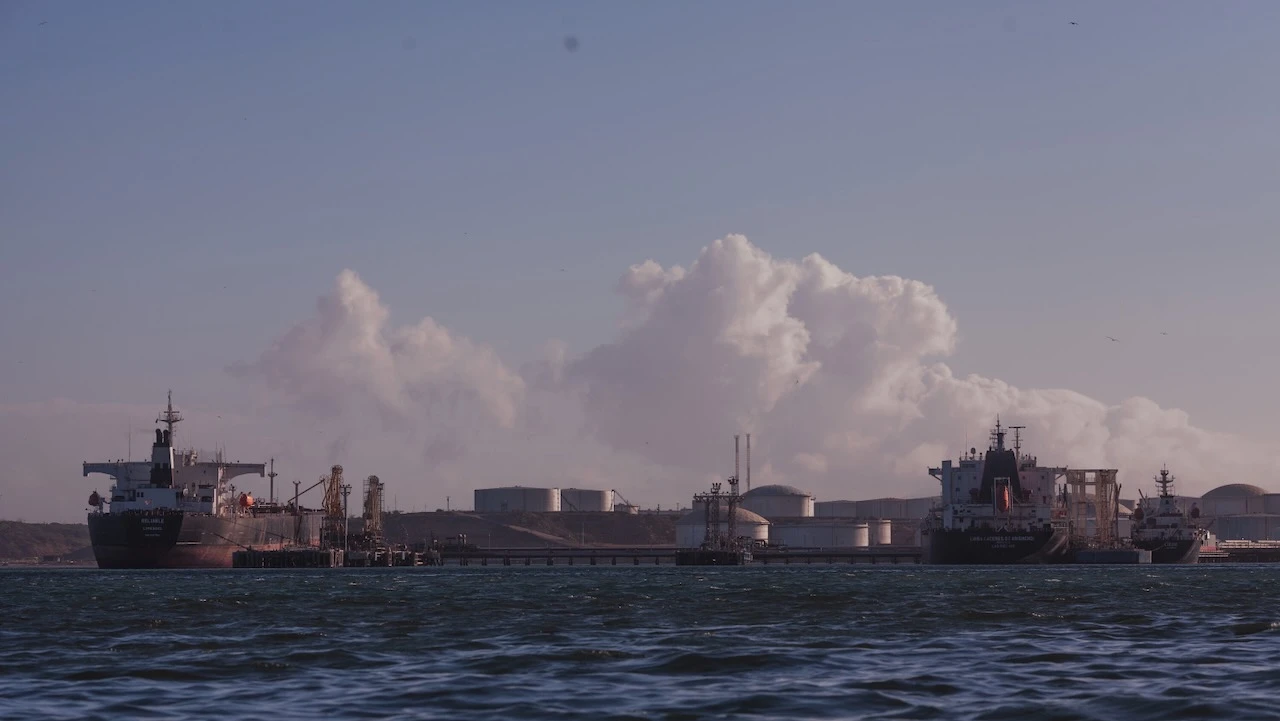
#Venezuela #USA #Iran pic.twitter.com/jOCHSmAECu

— Venezuela Brief (@venezbrief) December 22, 2025


More nuggets:

Although (to our best knowledge) BELLA 1 (9230880) still hasn't been seized, she faces another challenge.

She has been in transit for 39 days, and at 11kn average speed, she has maybe another 28-35 days of fuel available unless her speed drops. This might happen if the US Coast…
Image
— TankerTrackers.com, Inc. (@TankerTrackers) December 23, 2025


Mind you, China has already complained about the US capture of Chinese ships transporting Venezuelan oil, but that was triggered by the grabbing of the second tanker, the Centuries, and not Bella-1.

But if you read a story from Reuters, republished on qCaptain, carefully, the US embargo is even more limited than it seems. The Administration did say it was limited only to “sanctioned” tankers and that does seem not to mean all tankers plying the Venezuela trade. From Reuters in Venezuela Sends Two Supertankers to China Despite U.S. Blockade Threat:

Venezuela on Thursday authorized two very large crude carriers (VLCC) to set sail for China, according to two sources familiar with Venezuela’s oil export operations, which would be only the second and third supertankers to depart the country since the U.S. seized a ship carrying Venezuelan oil last week.

The U.S. has said it would not allow vessels under sanction to leave Venezuelan waters. The departing tankers, each carrying around 1.9 million barrels of Venezuelan Merey heavy crude according to internal documents from state company PDVSA, are not on the U.S. current sanctions list…..

Of 75 oil tankers currently in Venezuela that are part of a “shadow fleet” of ships that typically navigate with transponders off to disguise their locations, around 38 have been sanctioned by the U.S. Treasury, according to data from TankerTrackers.com, updated this week. Of those, at least 15 are loaded with crude and fuel, it added.

So was this blockade intended to be leaky, and more intended for optics and face preservation as opposed to real strangulation? Or alternatively, that a partial choking of oil traffic would be enough to do real damage to the already weak Venezuela economy?

And on the Russia front:

Sweden boards and releases sanctioned Russian vessel off its coast

Swedish authorities boarded a sanctioned Russian freighter off the country’s west coast after she stopped in Swedish waters due to reported engine trouble, according to media reports. #MarineTraffic data shows… pic.twitter.com/97pdpZmXWh

— MarineTraffic (@MarineTraffic) December 22, 2025


Some in the US are pursuing another bright idea, of encouraging piracy by authoring letters of marque, supposedly to go after cartel-related ships. Since Trump designated Venezuela’s president Maduro to be a narco-terrorist, could that notion be stretched to include having privateers assist in the blockade?

The official scheme so far, courtesy the Washington Post:

As President Donald Trump ramps up tensions with Venezuela, U.S. lawmakers have introduced legislation to bring back a scourge of the high seas banished from Atlantic and Pacific waters since the age of sail: privateers, authorized by government-issued letters of marque to ply the trade of piracy in service of their country by targeting enemy ships.

These modern-day privateers, under a bill introduced Thursday by Sen. Mike Lee (R-Utah), would receive authorization from Trump as private individuals to seize foreign vessels from anyone who “is a member of a cartel, a member of a cartel-linked organization, or a conspirator associated with a cartel or a cartel-linked organization.”

“Cartels have replaced corsairs in the modern era, but we can still give private American citizens and their businesses a stake in the fight against these murderous foreign criminals,” Lee, who is a member of the Senate Foreign Relations Committee, said in a statement announcing the bill. “The Cartel Marque and Reprisal Reauthorization Act will revive this historic practice to defend our shores and seize cartel assets.”

And as we surmised, the intent does seem to enlist the help of dull normals in the Venezuela embargo effort:

The U.S. has amassed a vast array of warships, surveillance craft and aircraft in the Caribbean, including the USS Gerald R. Ford — the Pentagon’s largest aircraft carrier. Thousands of soldiers, including elite Special Forces units, have also been deployed to the region.

Under Lee’s “Cartel Marque and Reprisal Authorization Act of 2025,” ordinary American citizens could join them in plying the seas for vessels to intercept.

There is mainly unseemly enthusiasm for this plan on Twitter:

Letters of Marque: The Sword Unsheathed for National Salvation

In the arsenal of forgotten American remedies lies the Letter of Marque and Reprisal—a constitutional weapon sharper than any tariff, more direct than diplomacy, and truer to the frontier spirit than endless…
Image
— American Steppe 🦬🇺🇸 (@HarryFStoggs) December 22, 2025


Just a AK wielding Privateer waiting for my Letter of Marque to fight cartels in the Caribbean! pic.twitter.com/bnVPIewyWw

— BRINK (@BRINK_____) December 20, 2025


But also a few cautionary views:

Under a Letter of Marque, you literally get the freedom to violate other people’s freedoms, take their shit, sell it, lie on your taxes, and the government will mostly take your word for it that “you didn’t find anything” “of value” on the vessel once you turn it in. This… pic.twitter.com/wrJGwanYEj

— MiamiViceGOP (@MiamiViceGOP) December 19, 2025


It really is too bad that the Administration is in a hissy with Somalis right now, since they seem to be world leaders in piracy and could probably lend a hand. But then again, we had designated not just ISIS but even specifically the then-named Al-Jolani as a terrorist until we decided we really really needed him and kissed and made up.

We’ve embedded the draft text of the bill at the end of the post.

After encouraging AI theft of intellectual property and money laundering and tax evasion via crypto, this new turn to lawlessness should come as no surprise. But it’s still depressing to see what the US has become.

https://www.nakedcapitalism.com/2025/12 ... arque.html
"There is great chaos under heaven; the situation is excellent."

User avatar
blindpig
Posts: 15306
Joined: Fri Jul 14, 2017 5:44 pm
Location: Turtle Island
Contact:

Re: Venezuela

Post by blindpig » Thu Dec 25, 2025 3:58 pm

US piracy cripples Venezuela's oil industry as ports 'pile up' with tankers: Report

Washington recently intensified its regime-change efforts against Venezuela, illegally shutting down the country's airspace and imposing a naval blockade that seeks to starve a population of over 30 million people

News Desk

DEC 24, 2025

Image
(Photo Credit: Adriana Loureiro Fernandez/The New York Times)

Washington's illegal blockade of Venezuela and its theft of oil tankers in Caribbean waters have “paralyzed” the country’s oil industry, according to several reports in western media, with millions of barrels of oil stuck at its ports.


“Venezuela’s ports are piling up with tankers filled with oil, as officials fear releasing them into international waters and into the cross hairs of the United States. Tankers bound for Venezuela have turned around midway, shipping data shows,” the New York Times (NYT) reported on 23 December.

NY Times: the tanker the US seized today, called "the Centuries, is not on a list of tankers under U.S. sanctions that is publicly maintained by the Treasury Department. The people inside Venezuela’s oil industry said the cargo belongs to an established China-based oil trader… pic.twitter.com/UXNkKBKgUq

— Steve Lookner (@lookner) December 20, 2025


According to data from the monitoring service TankerTrackers.com cited by Reuters, an increasing number of loaded tankers remain stuck at Venezuela's ports, with some forced to return days after setting sail in fear of marauding US vessels.

“More than a dozen loaded vessels are in Venezuela waiting for new directions from their owners after the US seized the supertanker Skipper earlier this month and targeted two additional vessels on the weekend,” the British news outlet reported on Tuesday.


According to reports, state oil company PDVSA has started filling tankers with crude and fuel oil and anchoring them in Venezuelan waters due to a rapidly filling backlog of onshore tanks. Venezuela's daily crude production is approximately 1.1 million barrels.

Under normal conditions, Venezuela loads and exports crude via multiple tankers each week, with vessels arriving and departing continuously from ports such as José and Amuay, according to reporting by Reuters, Bloomberg, and The New York Times. Since Dec. 10, when the U.S. seized… https://t.co/4fsT1rzjdc

— Drop Site (@DropSiteNews) December 24, 2025


“We’re going to keep it. Maybe we’ll sell it, maybe we’ll keep it, maybe we’ll use it in the strategic reserve. We’re keeping the ships also,” US President Donald Trump told reporters in Florida on Monday, after unveiling a new class of battleships named after himself.

As of 24 December, Washington has seized two oil tankers off the coast of Venezuela. US naval forces remain in pursuit of a third tanker, the Bella 1, which refused capture and remains in international waters.


After the initial seizure of the Skipper tanker on 10 December, Caracas began dispatching naval vessels to accompany some tankers.

“The government is considering going further and putting armed soldiers on tankers bound for China, the main importer of Venezuelan oil. Such a move would complicate the US Coast Guard’s attempts to interdict them, but it could also draw Mr. Maduro into a military conflict against an armada of US Navy warships,” NYT reports.

Per international law, the US has no legal standing to enforce unilateral coercive sanctions in international waters or extraterritorially.

As Washington's regime-change attempts against Venezuela continue to intensify, the UN Security Council convened on Tuesday for an emergency session called by Caracas to condemn the illegal seizures.

“[The White House] acts outside of international law, demanding that Venezuelans vacate our country and hand it over. This is the greatest extortion known in our history,” Venezuela's envoy to the UN, Samuel Moncada, said.

“The masks have come off. It is not drugs [that the US is after], it is not security, it is not freedom. It is oil, it is mines, and it is land,” he stressed.

US Ambassador to the United Nations Mike Waltz and Venezuela's UN representative Samuel Moncada traded barbs during a UN Security Council session in New York on December 23.

Waltz said the US will impose sanctions “to the maximum extent” to cut off resources to Venezuela’s… pic.twitter.com/wL2Ojtl4nj

— TRT World (@trtworld) December 24, 2025


Moncada also warned other Latin American nations that US ambitions are “continental,” highlighting that Venezuela is “only the first target of a larger plan.”


"The US government wants us to be divided so it can conquer us piece by piece,” he added.

Russia's envoy to the UN, Vassily Nebenzia, strongly condemned the blockade of Venezuela and Washington's “cowboy behavior.”

“Washington’s responsibility for the catastrophic consequences of such cowboy behavior for the residents of the blockaded country is also obvious. Unfortunately, there is every reason to believe that the US actions against Venezuela are not a one-off. This unfolding intervention could become a template for future military actions against Latin American states,” Nebenzia noted.

China, which receives the majority of Venezuela's daily oil exports, sharply criticized Washington's measures, cautioning that they are “threatening peace.”

Beijing's Deputy Permanent Representative to the UN, Sun Lei, accused the US of violating international norms, stressing that Washington's actions “seriously infringe upon other countries' sovereignty, security and legitimate rising interests, gravely violate the UN Charter and international law, and threaten peace and security in Latin America and the Caribbean.”


“As an independent sovereign state, Venezuela has the right to independently develop mutually beneficial cooperation with other countries and defend its legitimate rights and interests, which should be respected and supported by the international community,” Sun added.

According to a recent YouGov poll in the US, only a fraction of respondents support the blockade of Venezuela.

Only a tiny fraction of Americans support a regime change war on Venezuela or believe the official lie about narco trafficking, according to a new YouGov poll

Rubio's Gusano Games are already discredited, and will produce ferocious backlash if they go to the next stage
Image
— Max Blumenthal (@MaxBlumenthal) November 25, 2025


https://thecradle.co/articles/us-piracy ... e_vignette

******

Venezuela filed a complaint regarding an act of piracy against one of its oil tankers
December 25, 2025 Yván Gil

Image
On December 22, 2025, the Venezuelan National Assembly passed a law criminalizing acts of piracy in international waters.

Venezuela’s Foreign Minister, Yván Gil, filed this complaint with the UN Security Council, accusing the United States of a “serious act involving the use of force, hijacking and piracy” in international waters in the Caribbean.

I have the honor to address you, on behalf of the people and the Government of the Bolivarian Republic of Venezuela and on my own behalf, to formally denounce a grave act of use of force, hijacking and piracy sponsored and committed by the United States of America, on 10 December 2025, in international waters of the Caribbean, against a private vessel engaged in lawful international trade transporting Venezuelan oil, whose crew members were kidnapped and, to date, remain missing.

That day, United States military units forcibly boarded a private vessel on the high seas, subdued and kidnapped its crew and illegally seized a shipment of Venezuelan oil being carried as part of a regular and legitimate commercial operation in full compliance with international law.

This is an act of State piracy, carried out through the use of military force and constituting a blatant theft of assets that do not belong to the United States of America but form part of the lawful international trade of a State Member of the United Nations.

It is not an isolated act but part of a sustained policy of coercion and aggression against the Bolivarian Republic of Venezuela, characterized by the long-standing application of unlawful and illegitimate unilateral coercive measures, which are now resulting in an even more serious practice, namely, that of maritime piracy committed directly by a State as a means of forcible seizure on the high seas. That practice, regardless of who carries it out, is expressly prohibited under international law.

In article 101 of the United Nations Convention on the Law of the Sea, piracy is defined as any illegal acts of violence, detention or depredation committed on the high seas against a ship, its crew or its property by a private actor. In this case, the fact that it is the military force of a State that carries out those same acts classified as piracy merely aggravates the hostile action, sounding an alarm that shakes the very foundations of the multilateral system.

The legal regime of the high seas protects the freedom of navigation and lawful international trade, principles that have been flagrantly violated in this case. Furthermore, under Article 2, paragraph 4, of the Charter of the United Nations, the use of force in international relations is categorically prohibited. It is the exclusive responsibility of the Security Council, in accordance with Articles 39 and 42 of the Charter, to determine the existence of threats to the peace and, if necessary, to authorize coercive measures. In the situation that we are denouncing, there is no authorization from the Security Council that could justify the violent boarding of a private vessel in international waters, the kidnapping of its crew or the theft of its cargo.

The Security Council itself has repeatedly condemned piracy and armed robbery against ships and has taken firm action against those practices when they have threatened the safety of navigation and international trade. The Council has clearly determined that piracy is a threat to international peace and security and has even developed a special doctrine on the matter through the establishment of an exceptional legal umbrella, as evidenced by resolutions 1816 (2008), 1838 (2008), 1846 (2008), 1851 (2008), 2015 (2011), 2184 (2014) and 2634 (2022).

Likewise, the International Maritime Organization, within the framework of its constitutive Convention and the resolutions of its Assembly, condemns piracy and armed robbery against ships and promotes international cooperation to prevent, repress and punish those acts, as they constitute a direct threat to maritime security and international trade.

The coherence of the multilateral system requires that the same principles and the same condemnation applied by the Security Council to piracy in other regions of the world now be applied to piracy committed by a State through the direct use of its military force. Tolerating or normalizing that type of conduct would amount to legitimizing chaos in international maritime navigation, which is totally incompatible with the Charter of the United Nations, the law of the sea and the core mandate of the Security Council.

In light of the above, the Government of Venezuela demands that the Government of the United States of America:

1. Immediately and unconditionally release the kidnapped crew.
2. Immediately return the Venezuelan oil illegally seized on the high seas.
3. Immediately end any act of force against or interference in the lawful trade of Venezuelan oil.

Venezuela also respectfully urges the Security Council to:

• Publicly condemn this act of State-sponsored piracy, the illegitimate use of military force against a private vessel and the theft of a cargo resulting from lawful international trade.
• Act in accordance with its primary responsibilities to preserve the safety of navigation and international trade, which are gravely threatened by this precedent.
• Prevent practices equivalent to piracy from becoming established as a means of economic and political coercion between States.

The Bolivarian Republic of Venezuela respectfully requests the Security Council to reaffirm, in writing, that it has not adopted any decision, resolution or measure authorizing action against Venezuela or against the international trade of its oil.

Venezuela will continue to exercise its sovereign and inalienable right to engage in the legitimate trade of its resources and to demand that no lawful operation be subject to theft, hijacking or acts of piracy, regardless of its origin.

The Government of the Bolivarian Republic of Venezuela respectfully requests that this communication be circulated as a document of the Security Council and brought to the attention of all Member States.

https://www.struggle-la-lucha.org/2025/ ... l-tankers/
"There is great chaos under heaven; the situation is excellent."

User avatar
blindpig
Posts: 15306
Joined: Fri Jul 14, 2017 5:44 pm
Location: Turtle Island
Contact:

Re: Venezuela

Post by blindpig » Sun Dec 28, 2025 6:32 pm

December 27, 2025 by M. K. BHADRAKUMAR
Venezuela is not about drugs or migration. It is Trump’s ‘Ukraine moment’

Image
A satellite photo released by the Chinese private aerospace intelligence firm MizarVision showed a fleet of U.S. F-35 fighter jets at Jose Aponte de la Torre Airport, Puerto Rico, Dec. 25, 2025.

The Pentagon has deployed special operations aircraft, troops and equipment to the Caribbean region near Venezuela, The Wall Street Journal and other media reported on December 23. A significant force amassed in Puerto Rico, which has traditionally served as critical hub for refuelling, resupply and surveillance operations.

The 27th Special Operations Wing and the 160th Special Operations Aviation Regiment deployed in the Caribbean specialise in supporting high-risk infiltration and extraction missions and providing close air support while the Army Rangers are tasked with seizing airfields and protecting special operations units such as Delta Force during precision kill or capture missions.

A satellite photo released this week by the Chinese private aerospace intelligence firm Mizar Vision showed the US Air Force F-35 fleet. The roughly 20 combat jets include a mix of F-35As and US Marine Corps F-35Bs. The deployments suggest forces are being pre-positioned for potential action.

The Trump administration is disregarding the vehemence of world opinion against any violation of Venezuela’s sovereignty, which was truly reflected in the UN Security Council meeting last week to discuss the increased US military presence in the Caribbean Sea and the enforcement of a de facto maritime blockade of Venezuela.

The Trump administration has read the tea leaves that neither Russia nor China will offer Venezuela anything beyond rhetoric to counter any US aggression. The Russian foreign ministry spokesperson Maria Zakharova at a press briefing on Thursday sought to show restraint to “prevent the events from sliding towards a destructive scenario,” while voicing support for Caracas.

As for China, despite being South America’s top trading partner and although a regime change in Caracas would certainly hurt China’s vital interests, Beijing is wary of falling into a geopolitical trap.

Both Moscow and Beijing keep the larger context of US global power projection in view. For Russia, the US role in the coming year or two becomes very crucial for reaching a durable settlement in Ukraine. As for China, the matrix is more complicated.

In December, Beijing issued yet another Policy Paper on Latin America and the Carribean, third in a series, projecting an affirmative agenda for an institutionalised, expanded, and elevated relationship with LAC countries, reflecting China’s growing engagement with the Western Hemisphere and its increasingly comprehensive approach affirming China’s intent to continue building an alternative world order. This needs explaining.

The recent National Security Strategy document issued by the White House does not designate China as the greatest threat to the US, but it nonetheless states that the US government will maintain a military capable of deterring Chinese ambitions on Taiwan by military means. Put differently, it sent mixed signals to China.

On the one hand, the US appears to downgrade competition with China but on the other hand, the Trump administration has not made any significant steps to indicate disengagement in Asia.

Again, on the one hand, there is a colossal recklessness in Trump’s China policy by imposing tariffs on China which has a powerful economy that is capable of harsh retaliation; he has also approved a huge arms sale worth around $11 billion to Taiwan, which includes advanced rocket launchers, self-propelled howitzers and a variety of missiles — a deal that, according to Taiwan’s defence ministry, helps the island in “rapidly building robust deterrence capabilities”.

On the other hand, there is also a stupefying obsequiousness on the part of President Trump, as the bragging of a ‘G2’, exports of advanced chips to China and a permissiveness to allow Tik-Tok to stay open on favourable terms, etc. would signify.

Beijing fears that Washington might be trying to lure it into a false sense of security with its rhetoric and an ostensible geopolitical shift, so it remains cautious.

However, Beijing cannot but factor in the ‘big picture’ as well, which is that Trump is pushing the Americas toward a zero-sum geo-economic order in which the US expects the world to recognise what is being tested here — a blatantly coercive attempt to reorder the region’s resources and financial alignment.

The region’s heavyweights – Brazil and Mexico – stand in open opposition. President Lula da Silva of Brazil warned that an armed intervention would be a “humanitarian catastrophe” and a “dangerous precedent for the world.” Similarly, Mexico’s Claudia Sheinbaum has offered to mediate, seeking to prevent a return to the era of “gunboat diplomacy.”

This tension threatens to transform the South American continent into a theatre of the New Cold War. Specifically, Venezuela possesses the world’s largest proven oil reserves, and it has utilised them to build a financial fortress in partnership with Beijing. Under the “Loans-for-Oil” model, China injected over $60 billion into Venezuela while the latter paid this debt not in dollars, but in physical barrels of crude.

Through a naval blockade, the US is attempting to dismantle this deal and the non-dollar payment system built around it. It is another story that Washington may also be trying to pressure global prices and squeeze petro-rivals like Russia and Iran.

What is often overlooked is that the US’ current conflict with Venezuela — like Ukraine or Taiwan problems — did not come out of nowhere. To understand the current conflict, we need to go beyond the geopolitics of oil or libertarian political philosophy or drug trafficking.

Things began changing when an anti-American shift began to be noticed in Caracas during Barack Obama’s presidency when most Republicans with a strong political base among Venezuelan migrants and their descendants in Florida — an important political constituency for Trump, by the way — began sensing that Venezuela was on a path to become a strongly anti-American country and a centre of influence for China, among others, in the region.

Nicolas Maduro’s rise to power only reinforced this belief. Suffice to say, neither drug trafficking nor migration can explain the current deterioration in US’ attitude. Only 10-20% of illegal substances smuggled into the US actually come from Venezuela; main migration routes do not even run through Venezuela.

The threat perception is primarily about Maduro’s anti-American stance, as well as his growing cooperation with Iran, Russia, and China. Things have come to a point that the only option left to Washington is to use military force — somewhat like the Kremlin’s 22nd February moment in 2022.

What emboldens the Trump administration is a clear shift in the Western Hemisphere, a continent that had been painted in red in political maps for much of the past two decades. Left-wing forces have not won a single presidential election in Latin America this year. Conservative ideas and policy priorities are gaining ground. Trump has encouraged this trend and in turn feels elated that one after another, those who admire, flatter and even emulate him are being elected.

Another factor is the collapse of Venezuela. The paradox is that traditional definitions of left and right are becoming outdated. If Venezuela is far from socialism, El Salvador is far from pure capitalism. In both cases, the state is operating under a form of kleptocratic, rent-seeking authoritarianism.

That said, while the overthrow of Maduro government is Trump’s stated goal, he is also apprehensive — and, rightly so — that a military confrontation may spiral out of control and that failure may stick to him just as the withdrawal from Afghanistan stuck to Joe Biden. Trump’s best hope was that Maduro would simply roll over.

But Maduro isn’t obliging. And Venezuela is 2.75 times bigger than Vietnam, and more than half of its landmass is covered by forests. Suffice to say, the Kremlin’s advice was empathetic when it made an extraordinary personal appeal to Trump:

“Russia expects the President of the United States Donald Trump to demonstrate his signature sense of pragmatism and reason for finding mutually acceptable solutions in keeping with the international law and norms.”

But then, geopolitics is hard ball and at times it becomes necessary to unleash the dogs of war. Which was what the Kremlin did in Ukraine, after all.

https://www.indianpunchline.com/venezue ... ne-moment/

******

Russia Reaffirms Unwavering Support for Venezuela Amid US Imperialist Aggression
December 26, 2025

Image
Venezuelan President Nicolás Maduro shakes hands with his Russian counterpart Vladimir Putin during a meeting at Moscow's Kremlin in May 2025. Photo: Venezuelan Presidential Press/file photo.

Caracas (OrinocoTribune.com)—Russian Foreign Ministry spokesperson Maria Zakharova expressed her country’s firm condemnation of the escalation of the US imperialist campaign of regime change against Venezuela, carried out under the guise of the “war on drugs” narrative.

Following the Russian statement, Venezuelan Foreign Minister Yván Gil thanked Russia on Thursday, December 25, for its support for Venezuela.

“On behalf of President Nicolás Maduro, we want to express our sincere gratitude to the government of the Russian Federation for its valuable support of President Maduro’s efforts in defending the sovereignty and interests of the Venezuelan people against the threats and belligerent and illegal actions of the US administration in the Caribbean,” Gil posted on social media.

He also emphasized Russia’s “unwavering support” for preserving the Caribbean as a zone of peace and promoting regional stability.

Zakharova had earlier stated that “Latin America must be a zone of peace” while commenting on recent US actions. She advocated for a de-escalation of US threats and reaffirmed Moscow’s support for Maduro’s government.

She said that Russia consistently advocates for de-escalation and for maintaining trust and predictability, adding that it is important to prevent a destructive scenario. Zakharova also reaffirmed support for the efforts of President Maduro’s government to protect Venezuela’s sovereignty and national interests.

This follows US President Donald Trump’s December 17 declaration labeling the Venezuelan government a foreign terrorist organization and announcing a total blockade of all illegally sanctioned oil tankers bound for or from Venezuela.

Putin’s letter highlights bilateral ties
On Wednesday, Venezuelan Foreign Minister Gil shared a letter sent by Russian President Vladimir Putin to President Maduro, which highlighted achievements in the bilateral relationship during 2025.

The letter, dated December 17, stated, “I would like to reiterate our unwavering solidarity with the people of Venezuela who are facing unprecedented external pressure, as well as our willingness to continue working closely together on current issues on the bilateral and international agenda.”

Putin also emphasized the recent signing of a Strategic Partnership and Cooperation Treaty, which he said has “created the conditions for a qualitative and constructive increase in interaction in all areas.”

The public display of support follows a previous United Nations Security Council meeting where Russia strongly supported Venezuelan denunciations of US imperialism.

Nicaragua voices solidarity
The Nicaraguan government also sent a Christmas message to Venezuelan authorities on Wednesday, highlighting the “unbreakable unity” between the two nations.

In a letter addressed to President Maduro and other officials, Nicaragua expressed its “revolutionary brotherhood” and emphasized the Bolivarian, Sandinista and Chavista union as a legitimate and solid alliance. It described the unity as a symbol of “better times” that must emerge from current struggles, asserting that a “just, supportive and true” future is on the horizon.

https://orinocotribune.com/russia-reaff ... ggression/

Venezuela: UN Report Demonstrates Illegality of US Blockade
December 27, 2025

Image
An oil tanker in the Maracaibo lake, near Cabimas, Venezuela, December 18, 2025. Photo: Henry Chirinos/EFE.

The Venezuelan government stated that the recent report by the Office of the United Nations High Commissioner for Human Rights (OHCHR) constitutes a resounding legal and political condemnation of the armed blockade imposed by the United States. The report demonstrates that this policy gravely violates international law and the Charter of the United Nations.

On Wednesday, December 24, Venezuelan Foreign Minister Yván Gil highlighted that the statement by independent UN experts confirms what Venezuela has been stating for years: that Washington is carrying out a colonial-style strategy of threats, force, and plunder against the nation. “The truth about Venezuela is breaking through around the world,” Gil stated, underscoring that US practices have been “legally and morally exposed” before the international community.

According to the OHCHR report, the maritime blockade announced and enforced by the United States against Venezuela lacks any legal basis, as there is no right to impose unilateral sanctions against a country through an armed blockade. UN experts warned that such actions constitute a prohibited use of force, expressly recognized as illegal armed aggression in the Definition of Aggression adopted by the UN General Assembly in 1974.

The document also notes that aggression is a crime under international law, subject to universal jurisdiction, which empowers all States to investigate and prosecute such conduct, irrespective of the country in which it is carried out. Experts further warned that the illegal use of force poses a grave threat to the right to life and other human rights, not only in Venezuela but throughout the Caribbean region.

The report comes amid growing tension after the United States seized Venezuelan oil tankers in international waters. On December 20, Nicolás Maduro’s government reported the seizure of a second private tanker by the United States. Meanwhile, on December 10, Washington seized a first vessel off the Venezuelan coast, arguing that it was transporting “sanctioned” crude oil between Venezuela and Iran.

Russia Reaffirms Unwavering Support for Venezuela Amid US Imperialist Aggression

A week later, US President Donald Trump ordered a “total and complete blockade” of oil tankers entering or leaving Venezuela, a measure that Caracas described as an act of maritime piracy and direct aggression. In response to this situation, Venezuela demanded that the UN Security Council adopt immediate measures to compel the United States to withdraw its military forces from the Caribbean and end the blockade.

Despite the US threats, President Nicolás Maduro reiterated that Venezuela will continue to trade its oil, exercising its sovereign right to use its natural resources. The Venezuelan government maintains that Washington’s actions seek to economically suffocate and destabilize the country, in open violation of the principles of non-intervention, sovereign equality, and the peaceful settlement of disputes.

According to Venezuela, the backing of the United Nations system reinforces the legitimacy of its international complaint and deepens the political isolation of US policy. This comes at a time when various countries and multilateral organizations are calling for an end to unilateral sanctions and the use of force as an instrument of international coercion.

The UN report does not hesitate to describe the latest US actions as piracy and an act of war to which Venezuela may respond militarily by invoking Article 51 of the United Nations Charter.

Venezuelan Foreign Affairs Minister Yván Gil reaffirmed Venezuela’s condemnation of the US violations, which undermine the human right to life and the region’s rights to peace, free trade, and navigation. “We value the call for collective action by UN member states to protect and safeguard international law,” the minister added.

https://orinocotribune.com/venezuela-un ... -blockade/

The consensus of the commentariat seems to be that Venezuela will be hung out to dry, push come to shove. Dunno what could be done, given geography, but don't think Lavrov wants another Syria on his watch. China is playing a long game even as it strengthens and is not likely to derail that.
"There is great chaos under heaven; the situation is excellent."

User avatar
blindpig
Posts: 15306
Joined: Fri Jul 14, 2017 5:44 pm
Location: Turtle Island
Contact:

Re: Venezuela

Post by blindpig » Mon Dec 29, 2025 3:25 pm

Image
Venezuelans preparing Hallacas, a beloved Christmas tradition made together across generations. (Photo: Federico PARRA / AFP)

Trump might not invade Venezuela yet, but what he is doing is worse
Originally published: CODEPINK on December 26, 2025 by Michelle Ellner (more by CODEPINK) | (Posted Dec 29, 2025)

The loudest question in Washington right now is whether Donald Trump is going to invade Venezuela. The quieter, and far more dangerous, reality is this: he probably won’t. Not because he cares about Venezuelan lives, but because he has found a strategy that is cheaper, less politically risky at home, and infinitely more devastating: economic warfare.

Venezuela has already survived years of economic warfare. Despite two decades of sweeping U.S. sanctions designed to strangle its economy, the country has found ways to adapt: oil has moved through alternative markets; communities have developed survival strategies; people have endured shortages and hardship with creativity and resilience. This endurance is precisely what the Trump administration is trying to break.

Rather than launching a military invasion that would provoke public backlash and congressional scrutiny, Trump is doubling down on something more insidious: total economic asphyxiation. By tightening restrictions on Venezuelan oil exports, its primary source of revenue, Trump’s administration is deliberately pushing the country toward a full-scale humanitarian collapse.

In recent months, U.S. actions in the Caribbean Sea, including the harassment and interdiction of oil tankers linked to Venezuela, signal a shift from financial pressure to illegal maritime force. These operations have increasingly targeted Venezuela’s ability to move its own resources through international waters. Oil tankers have been delayed, seized, threatened with secondary sanctions, or forced to reroute under coercion. The objective is strangulation.

This is illegal under international law.

The freedom of navigation on the high seas is a cornerstone of international maritime law, enshrined in the UN Convention on the Law of the Sea. Unilateral interdiction of civilian commercial vessels, absent a UN Security Council mandate, violates the principle of sovereign equality and non-intervention. The extraterritorial enforcement of U.S. sanctions, punishing third countries and private actors for engaging in lawful trade with Venezuela, has no legal basis. It is coercion, plain and simple. More importantly, the intent is collective punishment.

By preventing Venezuela from exporting oil, which is the revenue that funds food imports, medicine, electricity, and public services, the Trump administration is knowingly engineering conditions of mass deprivation. Under international humanitarian law, collective punishment is prohibited precisely because it targets civilians as a means to achieve political ends. And if this continues, we will see horrific images: empty shelves, malnourished children, overwhelmed hospitals, people scavenging for food. Scenes that echo those coming out of Gaza, where siege and starvation have been normalized as weapons of war.

U.S. actions will undoubtedly cause millions of Venezuelans to flee the country, likely seeking to travel to the United States, which they are told is safe for their families, full of economic opportunities, and security. But Trump is sealing the U.S. border, cutting off asylum pathways, and criminalizing migration. When people are starved, when economies are crushed, when daily life becomes unlivable, people move. Blocking Venezuelans from entering the United States while systematically destroying the conditions that allow them to survive at home means that neighboring countries like Colombia, Brazil, and Chile will be asked to absorb the human cost of Washington’s decisions. This is how empire outsources the damage. But these countries have their own economic woes, and mass displacement of Venezuelans will destabilize the entire region.

Venezuela is a test case. What is being refined now—economic siege without formal war, maritime coercion without declared blockade, starvation without bombs—is a blueprint. Any country that refuses compliance with Washington’s political and economic demands should be paying attention. This will be the map for 21st century regime change.

And this is how Trump can reassure the United States Congress that he is not “going to war” with Venezuela. He doesn’t need to. Economic strangulation carries none of the immediate political costs of a military intervention, even as it inflicts slow, widespread devastation. There are no body bags returning to U.S. soil, no draft, no televised bombing campaigns. Just a steady erosion of life elsewhere.

Trump’s calculation is brutally simple: make Venezuelans so miserable that they will rise up and overthrow Maduro. That has been the same calculation behind U.S. policy toward Cuba for six decades—and it has failed. Economic strangulation doesn’t bring democracy; it brings suffering. And even if, by some grim chance, it did succeed in toppling the government, the likely result would not be freedom but chaos—possibly a protracted civil war that could devastate the country, and the region, for decades.

People in Venezuela celebrate Christmas and New Year’s gathered around the table to eat hallacas wrapped with care, slices of pan de jamón, and dulce de lechoza. They will share stories, dance to gaitas, and make a toast with Ponche Crema.

But if this economic siege continues, if Venezuelan oil is fully cut off, if the country is denied the means to feed itself, if hunger is allowed to finish what bombs are no longer politically useful to accomplish, then this Christmas may be remembered as one of the last Venezuelans were able to celebrate in anything resembling normal life, at least in the near future.

Polls consistently show that nearly 70 percent of people in the United States oppose a military intervention in Venezuela. War is recognized for what it is: violent, destructive, unacceptable. But sanctions are treated differently. Many people believe they are a harmless alternative, a way to apply “pressure” without bloodshed.

That assumption is dangerously wrong. According to a comprehensive study in medical journal The Lancet, sanctions increase mortality at levels comparable to armed conflict, hitting children and the elderly first. Sanctions do not avoid civilian harm—they systematically produce it.

If we oppose war because it kills, we must also oppose sanctions that do the same, only more quietly, more slowly, and with far less accountability. If we don’t act against economic warfare with the same urgency we reserve for bombs and invasions, then sanctions will remain the preferred weapon: politically convenient but equally deadly.

https://mronline.org/2025/12/29/trump-m ... -is-worse/
"There is great chaos under heaven; the situation is excellent."

User avatar
blindpig
Posts: 15306
Joined: Fri Jul 14, 2017 5:44 pm
Location: Turtle Island
Contact:

Re: Venezuela

Post by blindpig » Tue Dec 30, 2025 3:02 pm

If he is dismissed or dies, does the war end?

Image The Cayapo

December 29, 2025 , 12:07 pm .

Image
The truth is that they did everything to control Chávez in a thousand and one ways; they couldn't, nor could they with any of the others who openly or silently have carried the nation on their backs (Photo: El Cayapo)

When we slaves yearn for freedom without thinking about what it is, we love slavery.

One day, the owners of large corporations were strolling around the world and saw with astonishment the existence of a great abyss, absolutely empty, totally without anything, and then they looked at each other and said in unison: "This cannot be empty, yes, it must be filled, poor thing, and in the future it must serve as a place for us to come and vacation, yes, let's turn it into an earthly paradise."

And so it was that overnight, with their great efforts, enthusiasm, altruism, and their great gift for work and entrepreneurship, the corporations got to work and built great earth pipelines and began to move earth to the abyss, from another country that already belonged to them, such as the United States, until they filled it; but then they said: "This land is missing things," and immediately they built great oil pipelines, gas pipelines, and moved trillions and trillions of barrels of oil and trillions of cubic meters of gas; but in their feverish enthusiasm, they built oil pipelines, coltan pipelines, earth pipelines, aqueducts, and manufactured rivers, trees, animals, and when everything was beautiful, to celebrate they started drinking whiskey until they fell asleep.

Then some really shady people appeared, worshippers of other people's things, who, seeing something so beautiful, looked all around and, since they didn't notice anyone, took it, just like that.

When the poor owners of the human-capitalist corporations woke up, they were shocked to find they'd been completely taken advantage of. These treacherous and twisted people, the most vile in the world, called themselves Venezuelans.

But not satisfied, these Venezuelans lashed out against the corporations that, from Europe and with great effort, had founded and created wonderful and paradisiacal islands in the Caribbean, solely for winter vacations and to keep their hard-earned savings, which were looked after by Africans, Indians, and Chinese, whom the corporations invited to vacation one fine day, because in this story everything always happened one fine day, and these gentlemen, grateful and happy for the great kindness of the corporation owners, who had generously offered them that great tax haven, decided never to return to their homeland.

But, as always, there's a "but," and just when happiness started to get tiresome, these Venezuelans appeared—unfaithful, lying, and stubborn criminals—to steal the fantasy islands created by corporations. That's how they stole British Guiana, French Guiana, Suriname, Trinidad and Tobago, Curaçao, and Aruba. But not content with that, and with ambition running rampant, they dedicated themselves to invading Grenada, the Dominican Republic, Cuba, Puerto Rico, and Haiti as many times as they pleased—in the case of Haiti, they even invaded it under the guise of humanitarian aid—and they did it all without the world batting an eye, because who dares rebel against such crude and bloodthirsty people?

But the story doesn't end there, no sir, this gets even more interesting: not in keeping with their achievements, these audacious Venezuelans conspired and flooded the Chinese with drugs, taking advantage of the fact that they were fighting amongst themselves, and thus they took over half of China; but before taking over China, they took over India, and they took over Japan, Australia and New Zealand.

But closer to home, here on the continent, those scoundrels and land-eaters stole more than half of Mexico's territory, invaded and plundered Central America, and took over Peru, Colombia, Uruguay, Paraguay, Argentina, Bolivia, and Ecuador.

These people are truly heartless, brazen, without mother or father, born out of thin air, and still roam the world threatening and invading anyone they please with the story that all of this belongs to them by divine mandate and manifest destiny.

This is why, tired of demanding that what is theirs be returned, the brave and virtuous corporations declared war on the Venezuelans, telling them to return their private property, because they worked very hard to build all that and nobody has the right to take it away, much less with that little trick of "don't pick it up," which we had already invented a long time ago, as well as any other trick: the patent is ours.

The world was happy and we didn't know it
The very lovely and exquisite human-capitalist corporations went for a stroll one day, all holding hands, and ventured into the forest known as Asia, Africa, and Oceania. As they advanced, they innocently collected everything they found along the way, and playing at "everything is mine," they said to each other: "This is mine, and this, and this, and that, and what I haven't seen, or touched, or felt is mine; so you know, nobody mess with what's mine because I'll mess with what's yours if you're not careful, and even if you're not," and so, amid laughter and theft, they reached the farthest reaches, collecting everything they found and classifying people: "These are yellow, these are black from the snow, retarded; those are ragged; the others are cannibals; those over there are savages; the rest are barbarians"—but from each one they collected art, architecture, music, sculpture, spaghetti, gunpowder, technology, science, philosophy, paper, and paper money, Printing, writing, alphabets, religions, culinary arts—because in their efforts to collect, the corporations had no time to waste on such trivialities that only serve for the contemplation of the idle, whom we charge for doing so. (The word "collect" is used because at that time the words "theft " or "looting" or "plunder" were not official.)

But the best part is that the inhabitants of these vast forests could be blamed for all the crimes and thefts committed against them by corporations, because religion and science had determined it so: they were the bearers of original sin and, according to science, lacked the mental capacity to understand the complexities of living in a democracy, freedom, progress, civilization, and all the other inventions of corporations, such as fascism, Nazism, and Francoism, which corporations use to conceal their true purposes. When it comes to justifying their profits, any excuse will do.

The inconvenient truth
The war being waged by corporations today has the same objective as the first war in the world: to obtain plunder. Is it a coincidence that the corporate puppet in the White House declared that Venezuelans were robbing them, or that the Finnish minister and Ms. Kaja declared that the Russians have always invaded the world and no one has ever laid a finger on them, or that Japanese authorities claim the evil Chinese want to invade them again? Is it mere coincidence? No, it's a plan by the large corporations associated with speculative financial capitalism to justify their total control of the world, and to achieve this, they don't care about lying.

We cannot continue to view reality through the ideological framework imposed by large corporations, who tell us that everyone wants to destroy their beautiful values ​​such as humanity, freedom, science, democracy, civilization, morality, the ways, uses and customs of the beautiful and modest Western culture, because they invented all those tricks to justify their crimes and to accuse of the opposite any slave who decides not to play along with them, exposing him to public scorn as heretics were exposed in ancient times.

Fuck those eight billion slaves
If pollution doesn't occur; if the mobilization of millions of enslaved people, driven by big capital to work anywhere, doesn't stir; if the drug industry, the energy industry in all its forms, and agribusiness don't move; if the war industry, the entertainment industry, the information industry, the alienation industry, the trafficking of European, Baltic, African, American, Indian, and Asian women, pedophilia, the churches, the Epstein islands, and, in general, the entire capitalist structure in the world don't stir; if nothing is stirred, they don't get their profit: they need all of that to happen. It's not true that there's an easy, clean, pleasant world that runs as it is in people's minds: no, the world doesn't work like that; the world runs through people who own the world, who decided it, who set out to do it, and who have a rule, a method, a style for being owners, and they have the power to exercise it.

Speculative capital in the snowflake of the pyramid
Capitalism in the West reached a point where it began to live specifically off financial speculation, because it is what generates the greatest profit and the least investment, supported of course by its armament, its cutting-edge technological industry, the pharmaceutical and drug industries in general, and the media, which with the networks reached levels of absolute control over the masses.

Venezuela and its five hundred years of rule
A brief summary of history: arrival of Europeans, looting, murder, theft, evangelization or alienation or drug addiction of the original inhabitants, a radical break with previous cultures, the root destruction of the existing intracultural culture, and the imposition of exploitation through colonization, which the stupid middle classes now yearn for: the stately homes with their red tiles—but they don't talk about the whippings with which they were made, nor about the slave girls or teenagers who were raped by the masters and who in the end became, as if it were a natural fact, in the slaves falling in love with their masters—; but what they really fell in love with was the power displayed to avoid mistreatment and perhaps to exercise it.

A war of independence linked to the birth of capitalism in the Western world. The slave-owning landowners of the continent ended up surrendering to the new masters of capital, reinforcing the mining status to which we were condemned in these territories.

Silent invasion of the oil companies
Not only were our lands stolen through fraudulent concessions, but an occupying, invading state was also imposed on us for almost a century, aided by landowners and merchants who never had the pride of belonging to this territory.

Since then, silently, the occupying invading army, created and imposed by the oil companies—the oil fields, the radio, the newspapers, the schools, the universities—alienated us with a clumsy, imitative, mining, ordinary culture, brought from the north by administrators, engineers, and foremen who only knew how to give orders and consume. This culture was innocently resisted only by fishermen and peasants living deep in the mountains, valleys, and inhospitable jungles left behind by the owners; where it was possible to sing, dance, and eat according to a different custom and tradition, a custom heavily criticized by the wealthy classes. These wealthy classes, however, lacking any cultural heritage of their own, stole everything produced by these people, who, unwittingly, or without organization or plan, kept alive the possibility of being a country other than the mine to which we had been condemned with the acquiescence of the mining elites and admiring supporters of everything foreign.

Until 1999, everything seemed to be going well in the world: the Chinese were absorbed in production, not meddling anywhere else; the Russians showed no signs of getting out of their predicament; Europe remained the obedient lapdog of overbearing speculative finance capital; while the rest of the world followed the orders of the great capitalist empire. The only thing that seemed to be underway were the plans of speculative finance capital, with its arrogance expressed in the *end of history*.

In Venezuela, a process was timidly beginning that in a very short time would turn it into an invaluable piece on the chessboard of world capitalism, a tower that they need to conquer, topple, take, because it positions them in better conditions to be able to checkmate the king represented by China, which directs industrial capital, who has presented his Belt and Road Initiative plan and already has it quite advanced, forcing speculative financial capital to present a roadmap, more in the realm of deception than reality.

Hugo Chávez
A powerful spark that suddenly enters the brains of the impoverished majority.

The plans of financial capital are to destroy Venezuela, to destroy the state, the army, politics, the Republic. They began to sell the image of failed states, drug traffickers, outlaws, which they imposed as the narrative on the world, and proposed a supposed nationalization that was nothing more than the recovery of the scrap metal left behind by the oil corporations in Venezuela—the same corporations that have been governing the oil world for over a century being the true owners. To this end, they created a twenty-year project to be taken over by the same managers who had worked with Shell, Creole, ExxonMobil, and Chevron; thus PDVSA was born with its crooked leg, financed entirely by the State in the image and likeness of the corporations.

The corporations' plans were, and still are, to create chaos in Venezuela, to reshape the entire state through that thing they called COPRE, to create a mini-state, or whatever it was, where these corporations could dominate the business as they pleased, not only of oil, but everything else, without anyone daring to challenge them.

When Chávez becomes a piece outside the transnational chess game, Venezuela becomes a threat: that landscape changes; it's not perceived so quickly, it lasted about ten years. By the time the corporations react, Chávez is Chávez, Maduro was Maduro, Diosdado was Diosdado, and Padrino López… And we, the anonymous, flesh-and-blood people.

They discovered that killing Chávez wasn't enough, that sanctions weren't an option, that the situation had gotten out of hand: they didn't have any significant opposition leaders, just ambitious, empty-headed fools; because you don't create a politician overnight with handbooks, pamphlets about freedom, and Mexican parties, much less a politician whose ambitions were simply nurtured in their parents' homes, truly spoiled. They are the María Corina Machado, Leopoldo López, Capriles, and all the others we already know, whose common characteristic is that they are all thieves and see Venezuela the way their parents and predecessors did: as a gold mine, as the poet quoted in Gino González's song said: "Venezuela is a cow, that only gives out pennies, and that damned cow doesn't want to let go of the teat."

The truth is, they tried everything to control Chávez in a thousand and one ways, but they couldn't, nor could they control any of the others who, openly or silently, have carried the nation on their shoulders. That's why today they threaten us with lightning and thunderbolts, with war and extermination.

Trump, the orange agent of war
Due to ancient pamphleteering beliefs, we have always believed that the enemy is a person, who embodies all real or fictitious evils; therefore, in our brain he becomes a terrible monster that must be destroyed.

In the last century, we called them Mussolini, Franco, Hitler, Pinochet, Videla, Stroessner, Somoza, Hirohito, and many others who served as smokescreens to hide the true business dealings and crimes of transnational corporations. For centuries, power has hidden behind the infamous scapegoat, the one who takes the fall.

Today we have Macron, Merkel, Zelensky, Trump, and other puppets: everything we can say about them is true—they're thugs, criminals—but they're the sons of bitches of the transnational corporations, their hitmen who give them the order to screw things up here and there, and they do it. And that's how the UN, the OAS, and that's how that whole garbage dump they call international organizations is: they all belong to them.

Trump is the kind of guy who'll negotiate with anyone, about anything: if drugs make him money, he'll invest in drugs; if trafficking children, women, Native Americans, Black people, or anyone else—whatever brings in money—he'll invest in that miserable business, because everything else is controlled by big capital: oil, mining, the world's major industries, because those are families, established corporations that control everything: they're the real owners of Trump; he's the clown of the bunch; for money, he can throw all the garbage he wants on himself, because he doesn't care, because he says: "There's plenty of perfume to mask the stench of shit." He can afford to lie all the time, except to multinational corporations.

It's like the old Biden, Obama, Clinton, Reagan: they are puppets of the capitalist empire.

If we focus all our propaganda against Trump and forget that behind it all—those who want to rob us—are not the United States or the Europeans, but the oil companies, the owners of the corporations, then when we attack the stoic Trump as the main figure, everyone gets high on the orange-haired guy, the old windbag, the old liar, the pedophile, the alcoholic. We have to move beyond the Trump narrative and look at who Halliburton, Chevron, and ExxonMobil really are: these are the ones who truly hold the power, the owners of the planet's gold, those who extract rare earth elements, those who extract water, coltan, those who need the water, the big corporations of legal and illegal drugs, the agribusiness. We have to do a serious study of where they are, and we'll realize that these same people brought Hitler to power in the 1930s: they are the same corporations, the same people who are propping up Trump today.

Let's stop clinging to the idea that presidents are nobody, except for Maduro, Fidel, Chávez, and others who lead a movement—an idea—that's something else entirely. For example, it wasn't Trump who signed the executive order declaring Venezuela an unusual and credible threat; it was Obama. If Trump is impeached or dies, does that mean the war against us will end?

https://misionverdad.com/chavismo/si-lo ... -la-guerra

Google Translator

******

Halliburton Files ISDS Suit Against Venezuela for Damages Resulting from… US Sanctions on Venezuela
Posted on December 30, 2025 by Nick Corbishley

Talk about making the victim pay…

On December 11, as the Trump administration was escalating its military campaign against Venezuela by trying to impose a total siege on the country’s oil and gas sector, the US oilfield services company Halliburton quietly filed a suit against Venezuela at the World Bank’s international arbitration court, ICSID.

Long-standing readers are well-versed on investor-state dispute settlements (ISDS), a topic we’ve covered in depth over the past decade or so. As Yves pointed out in a recent post on Russia’s decision to use ISDS to go after the EU’s attempts to permanently confiscate Russian assets, the judgments made in these dispute settlements overwhelmingly benefit investors:

These treaties, designed to override the laws and regulations of states in order to give protected status to investors, make a mockery of national sovereignity. ISDS disputes draw on a small community of arbitrators, many of whom were involved in drafting ISDS treaty provisions, with hearing held in secret and typically not appealable. The rising (and correct) perception that the rules were gutting labor rights and environmental protection was instrumental to stopping their reach being extended further in the US. But it seems no existing ISDS provisions have been unwound.

What makes this case particularly pernicious is that a large part of the losses and foregone profits Halliburton is seeking to claw back stems from Washington’s economic sanctions on Venezuela. What’s more, the case was filed at the World Bank’s International Centre for Settlement of Investment Disputes, to which Venezuela has not even been party since 2012.

The move serves as a reminder of just how difficult it is for nation states to extricate themselves from the ISDS commitments established in many bilateral trade treaties, despite the clear threat they pose to national sovereignty. Latin America has been one of the most important sources of income for (mostly Western) corporations seeking legal damages against national governments, as well as their highly paid arbitration lawyers.

There is currently very little information available on the ISDS case filed by Halliburton. The following is an excerpt of a firewalled article published by the Global Arbitration Review that was translated into Spanish and posted by the Madrid-based legal firm Bullard Falla Excurra on its LinkedIn page (translated back into English by yours truly, emphasis also my own):

On December 11, 2025, Halliburton filed a claim against Venezuela with the International Centre for Settlement of Investment Disputes (ICSID) under the Barbados-Venezuela Bilateral Investment Treaty. The case will be processed under the Additional Facility Rules, given that Venezuela withdrew from the ICSID Convention in 2012. The dispute stems from Halliburton’s gradual withdrawal from the Venezuelan market between 2016 and 2020, after reporting losses of approximately US$199 million. These losses were attributed to the devaluation of the Venezuelan bolívar and the deteriorating economic and political conditions in Venezuela, which affected its ability to meet payments to its clients, including PDVSA, the state-owned oil company. Halliburton also notes that changes in the Venezuelan government’s exchange rate and US sanctions further complicated the viability of its operations in the country. Halliburton, which had operated in Venezuela since 1940, was forced to cease operations in 2020 [by US sanctions], although it maintained local assets and equipment in the country.

The arbitration is in its initial phase. Details regarding the specific claims and the exact amount claimed have not yet been disclosed. This case is one of seven pending ICSID arbitrations against Venezuela.

Halliburton was one of a number of US oil services companies that was forced to cease all operations in Venezuela in April, 2020 — not due to rules set by the Venezuelan authorities but rather to the first Trump administration’s ratcheting sanctions on the country.

Just over a year earlier, the US — and dozens of other countries — had recognised Juan Guaidó as Venezuela’s interim president. The next step was to make Venezuela’s economy scream as loud as possible.

As part of that mission, the US Office of Foreign Assets Control (OFAC) prohibited US companies from any activity related to the drilling, refining, purchase, sale or transportation of Venezuelan crude oil. Companies were also forbidden from participating in the design, construction or installation of oil wells.

So, Halliburton, like all other US oilfield services companies, ceased its operations in Venezuela, packed up what it could and laid off its 400 local workers by email. The company indicated that any “assets” left behind would be “expropriated” by Venezuelan authorities.

A New Global Low?

Now, Halliburton is trying to hold Venezuela’s government responsible for any losses or foregone future profits incurred partly, or even largely, as a result of the US government’s actions. In so doing, it threatens to set a new global low — that of corporations seeking damages for lost business resulting from US sanctions, not from the US itself but from the sanctioned countries themselves.

The US’ sanctions against Venezuela, first launched in 2005, have already exacted a deadly toll on Venezuela’s economy, as Jeffrey Sachs and Mark Weisbrot documented in their 2019 CEPR study, “Economic Sanctions as Collective Punishment: The Case of Venezuela“:

The sanctions reduced the public’s caloric intake, increased disease and mortality (for both adults and infants), and displaced millions of Venezuelans who fled the country as a result of the worsening economic depression and hyperinflation. They exacerbated Venezuela’s economic crisis and made it nearly impossible to stabilize the economy, contributing further to excess deaths. All of these impacts disproportionately harmed the poorest and most vulnerable Venezuelans.

Even more severe and destructive than the broad economic sanctions of August 2017 were the sanctions imposed by executive order on January 28, 2019 and subsequent executive orders this year; and the recognition of a parallel government, which as shown below, created a whole new set of financial and trade sanctions that are even more constricting than the executive orders themselves.

We find that the sanctions have inflicted, and increasingly inflict, very serious harm to human life and health, including an estimated more than 40,000 deaths from 2017 to 2018; and that these sanctions would fit the definition of collective punishment of the civilian population as described in both the Geneva and Hague international conventions, to which the US is a signatory. They are also illegal under international law and treaties that the US has signed, and would appear to violate US law as well.

Sachs and Weisbrot’s study was published in 2019. After that, the economic noose was further tightened under Trump 1.0, only to be loosened briefly by a Biden administration desperate to offset the surging global energy prices sparked by the war in Ukraine and the collective West’s subsequent endless rounds of sanctions on Russian energy.

Trump then reimposed the restrictions, and then some, in May:


Venezuela has, however, found ways to adapt to the economic asphyxiation, as Michelle Ellner points out for Venezuela Analysis:

Oil has moved through alternative markets; communities have developed survival strategies; people have endured shortages and hardship with creativity and resilience.

Indeed, in part thanks to the Biden administration’s loosening of sanctions in 2023, Venezuela is now the fastest growing economy in South America, albeit from an extremely low base and with a triple-figure inflation rate:

Image

It is precisely this endurance that the Trump administration is trying to break, notes Ellner:

Rather than launching a military invasion that would provoke public backlash and congressional scrutiny, Trump is doubling down on something more insidious: total economic asphyxiation. By tightening restrictions on Venezuelan oil exports, its primary source of revenue, Trump’s administration is deliberately pushing the country toward a full-scale humanitarian collapse.

In recent months, U.S. actions in the Caribbean Sea, including the harassment and interdiction of oil tankers linked to Venezuela, signal a shift from financial pressure to illegal maritime force. These operations have increasingly targeted Venezuela’s ability to move its own resources through international waters. Oil tankers have been delayed, seized, threatened with secondary sanctions, or forced to reroute under coercion. The objective is strangulation.

This is illegal under international law.

So, of course, would be bombing oil-rich Venezuela and oil-rich Nigeria on Christmas Eve and Christmas Day respectively.

Image

That said, as the fog of war grows thicker doubts are already being raised about the veracity of Trump’s claims regarding Venezuela:

Interesting Timing

Now, to cap things off, it turns out that Halliburton, the company formerly headed by Dick Cheney that made serious bank from the US’s second war in Iraq, is suing Venezuela for the money it lost as a result of US sanctions on Venezuela — more than five years after the company was forced out of Venezuela by Washington’s own policies.

The delayed timing of the move speaks volumes. As the writer(s) of the La Tabla blog recently posited, the most likely scenario is that Halliburton is jockeying for position as a preferred creditor in the event of a change of government in Venezuela and/or an external takeover of the Venezuelan oil industry — an area in which Halliburton has plenty of form (machine translated):

The figure of former [Halliburton] CEO Dick Cheney encapsulates the symbiosis between the company, state power and war. As US vice president, Cheney was the architect of the 2003 invasion of Iraq – based on the false premise of weapons of mass destruction – from which Halliburton won multimillion-dollar no-bid “reconstruction” contracts. In addition, the company and its directors have faced formal accusations of bribery in cases such as the one in Nigeria, during the Cheney era.

For this reason, the ICSID claim is less like a legitimate legal claim and more like a calculated move upon the geopolitical chessboard. Halliburton seeks to capitalise on losses stemming largely from its nation’s foreign policy, while concealing a history of disregard for labour rights and war profiteering. Its case is a cynical reminder of how, in the geopolitics of oil, corporations shift their risks to sovereign states, rewriting history to evade their own responsibility and paving the way for future profits.

Suffice to say, if the Maduro government is toppled and replaced by a US-imposed Maria Corina Machado puppet regime, whatever Halliburton wants, it will get, including the money it feels it is owed — assuming said Machado regime is able to stay in power long enough.

The recent appearance of former CIA Director Mike Pompeo on FOX News certainly seems to support this thesis. In an interview just before Christmas, Pompeo named Halliburton as one of the companies that should help rebuild Venezuela’s oil industry once the US is able to reimpose a “capitalist model” on Venezuela.

Once again, US foreign policy under “Peace” President Trump has come full circle. The Gray Zone’s Wyatt Reed points out some of the parallels with the second Gulf War, during which time Cheney’s Halliburton not only feathered its nest but also tried to pass off more than $1.4 billion in “questioned” and “unsupported” charges onto the US government:

Halliburton was awarded a $7 billion no-bid contract to carry out a similar task in Iraq – a sweetheart deal likely facilitated by Dick Cheney, who ran the company until he became Vice President.

As… the lives of 1,000,000+ Iraqis and thousands of US troops were being claimed in a US war of choice launched on false pretences, Halliburton quickly set to work defrauding American taxpayers.

Within 2 years, Pentagon auditors found the company tried to pass off over $1.4 billion in “questioned” and “unsupported” charges onto the US government. The most vocal neocons may be gone from the Trump administration, but the game remains the same: massive profits for the chosen few, and endless resource wars for everyone else.

https://www.nakedcapitalism.com/2025/12 ... zuela.html

"There is great chaos under heaven; the situation is excellent."

Post Reply