Footnotes from the Ukrainian "Crisis"; New High-Points in Cynicism Part V

User avatar
blindpig
Posts: 15059
Joined: Fri Jul 14, 2017 5:44 pm
Location: Turtle Island
Contact:

Re: Footnotes from the Ukrainian "Crisis"; New High-Points in Cynicism Part V

Post by blindpig » Sat Jan 03, 2026 3:37 pm

(Extra Ukraine post today)

Did CIA's Secret Aiding of Ukraine's Refinery Strikes Do More Harm to Ukraine Than Russia?

Spoiler alert: Yes, it did. But maybe that was the plan all along.
Simplicius
Jan 02, 2026

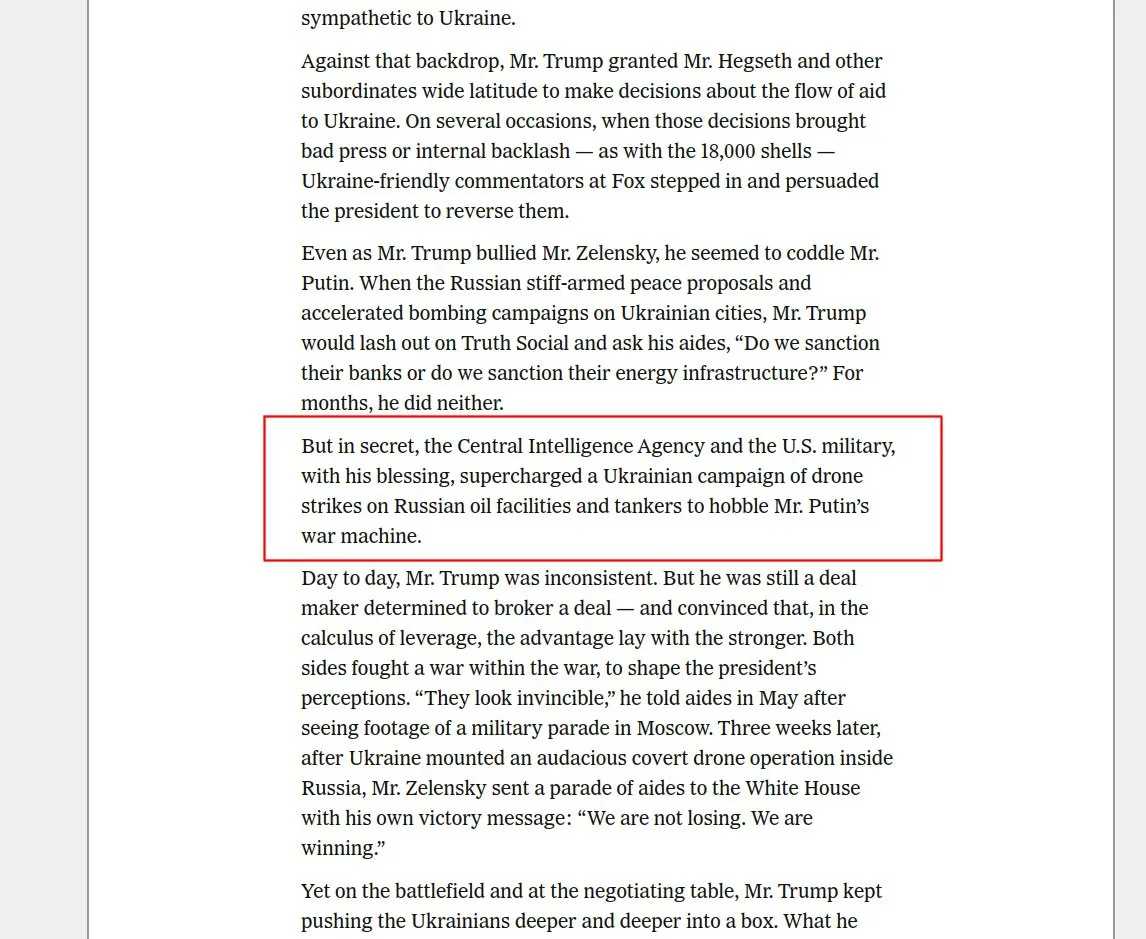
The new year brings us revelations that the CIA has been secretly teaching Ukraine how to hit Russia’s “Achilles’ heel” by targeting specific oil refineries which were selected by CIA analysts as having parts difficult to source and replace.
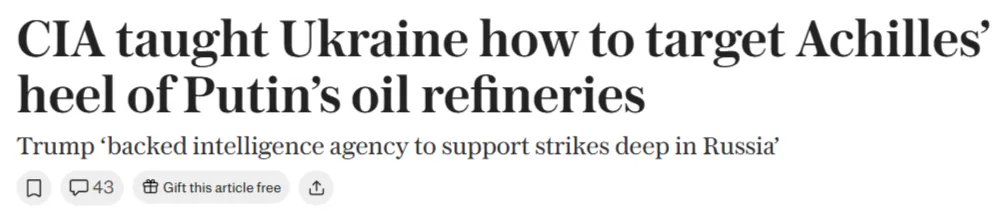
Image
https://www.telegraph.co.uk/world-news/ ... lles-heel/

NYT clarifies:

“A C.I.A. expert had identified a type of coupler that was so hard to replace or repair that a refinery would remain offline for weeks.”
Image
https://www.nytimes.com/interactive/202 ... ussia.html

Most intelligent people had already long-assumed this was the case, though many of us had bet on MI6 being the leading agency behind such strikes. At the end of the day, it’s nearly the same thing, as the West’s intel agencies are generally one overlapping arm of the global deep state managed by the same interests—one need only to research the history of the CIA’s foundation to understand this fact.

Not surprisingly, the new revelations include the fact that Ukraine’s strikes on Russia’s “shadow fleet” tankers were likewise aided by the CIA.

Kyiv was using its explosive-laden long-range naval drones to blow holes in the ships, opening a new front in the war to cut off Russia’s largest source of funding and strengthen its negotiating position at US-led peace talks.

According to US and Ukrainian officials, the CIA was authorised to assist Kyiv’s military in these efforts, despite the risk of angering Putin’s regime.


The problem is, these attacks have done little more than make the situation worse for Ukraine, not Russia. They have resulted in Russia’s own escalation, for instance the current hellacious licking that Odessa is getting, both to its port infrastructure as well as energy grid.

There’s a reason it was Zelensky who recently cried uncle first, begging for an “energy truce” in order to halt the much more painful strikes on his own country’s assets. As such, all that this CIA campaign has done is accelerate Ukraine’s demise, which I suppose we can thank the CIA for doing.

There are a few other considerations. Firstly, as always we must at least be somewhat wary of these ‘revelations’ from Western rags with their infamous ‘anonymous sources’ because they always come at such convenient times wherein the elites are pulling their hair out at US and Russia’s growing rapprochement. It’s therefore easy to imagine a potential motive for faking these stories, in order to cause fractures between the US and Russia.

It’s also a little peculiar that such a ‘bombshell’ revelation came precisely at the moment that Ukraine apparently attempted to attack Putin’s residence, setting off a firestorm amongst Russian officials. One can likewise see the potential attempt to link the CIA’s covert aiding of Ukraine on the refinery strikes to the strikes on Putin’s residence in order to drive a stake in US-Russian relations.

The foiled attack on Putin’s residence, by the way, is quite interesting given that the West denied it in full at first, but as soon as Russia began to present evidence of it, the tune quickly changed. Now Western rags claim that the drones were headed to the same region of Putin’s residence, but to a military site ~50km away.

Russia apparently is taking it more seriously than initially thought, given that they have now presented to the US the captured data chip of one of the shot-down drones which allegedly has the flight and targeting data said to prove the drone’s terminal target was in fact Putin’s residence.

Note the below unprecedented video where Russian intelligence chief, head of the GRU Igor Kostyukov, hands over the flight controller to military attachés from the US embassy in Moscow: (Video at link.)

MOMENT MoD hands over KEY data to US representatives

‘Decryption of navigation controllers… unequivocally CONFIRMED that target of attack was Russian President’s residence in Novgorod region’

Military Intelligence Chief Igor Kostyukov transfers info to America

Decrypted flight plan data from Kiev drone HANDED OVER to US

MoD confirms transfer to rep. of military attaché's office at US Embassy in Moscow


Many now believe that the reason Russia is following such a formal protocol is because Russia is setting the legal precedent to sharply escalate attacks against the Kiev regime in 2026. I leave it to you to decide if that is true or not; personally, I’m skeptical, but it’s a possibility worth noting in case something does happen.

Armchair Warlord enumerates this idea:

The Russian government is HIGHLY legalistic and is likely seeking to state a basis for a considerable escalation in strikes and military operations in the coming year. They've had ample grounds to do this for some time - this incident is simply convenient to latch onto.

Getting back to the CIA story, there is one other noteworthy thing to mention.

It is the Brian Berletic-championed idea that the Trump administration and the US in general are clearly not a friend of Russia, and are doing everything in their power to undermine, sabotage, and subvert Russia while pretending to seek peace.

While this is likely true to a large extent, it does generalize and overly simplify things somewhat. It is inaccurate to view the entire US ruling class, bureaucracy, deep state, and the rest of the administrative organs, as one unified monolith. In reality, there are many long-established competing interests, and places where the deep state has entrenched itself beyond reach of Trump’s somewhat lackadaisical attempts to uproot it.

That’s not to say it isn’t useful to sometimes generalize by blanketly suggesting the US means harm to Russia, because in the spirit of averages, one would have to admit that is more so the case than the contrary. But for those seeking more nuanced and granularized understandings of the dynamics at play, such generalizations become somewhat inadequate.

One example is we can say that the Pentagon and CIA are again at odds in their objectives as they have famously been in the Middle East and elsewhere, where Pentagon-armed-and-trained forces often did battle against CIA-sponsored ones. However, when you pull back far enough, you realize even such distinctions, and such seeming incompatibilities, ultimately end up playing in the US empire’s favor anyway.

Example from 2024:

Image
https://thehill.com/policy/defense/4591 ... to-future/

Almost all of life can be trivialized or particularized depending on how far you zoom into the given point of focus, or how much you scale out or abstract the idea for the sake of a given point or argument. In this case, it may be true that the Pentagon was trying to pull back support from Ukraine under Hegseth’s new Monroe Doctrine-like pivot, while rogue operators within the CIA are clearly determined to keep the war brewing for geopolitically expedient reasons. That being said, pull back your view far enough and such hair-splitting distinctions become moot, as it all somehow still manages to create the overall favorable conditions for the continuation or even expansion of US imperial hegemony.

In short, neither mode of analysis is entirely wrong. There’s good chance that different factions within the US do have different cross-purposes, but overall, they will always strive to seek the US’s primacy and ascendancy at the expense of everyone else.

As one commentator writes:

WHILE THE PENTAGON PAUSED UKRAINE, THE CIA RAN THE WAR

Publicly, Washington hesitated. Quietly, Langley went to work.

According to a New York Times investigation, U.S. military aid to Ukraine froze in March 2025 after Trump ordered a halt. Weapons stalled. Intelligence sharing slowed. The Pentagon pulled back.

The CIA didn’t.

Granted a carve-out, the agency warned the White House that a full cutoff would endanger American officers already inside Ukraine. Exemption approved. Operations continued. Then they escalated - covertly.

With ATACMS strikes off the table, the CIA pivoted to Ukrainian-built drones, supplying targeting intelligence for hits on Russia’s war economy: oil refineries, explosive-chemical plants, and Moscow’s shadow oil fleet.

Not symbolic strikes - precision hits on components that can’t be easily replaced.

Early attempts fizzled. Russian jamming ate drones alive. So in June, CIA and U.S. officers redesigned the campaign. Fewer targets. Smarter ones. Result: refineries offline for weeks and up to $75 million a day in estimated losses. Gas lines followed.

No U.S. weapons shipped. No public fingerprints. Just intelligence, math, and deniability.

Trump reportedly liked it. Pressure without headlines. Pain without escalation.

What does this mean?

America didn’t abandon Ukraine - it split the war in two. The Pentagon paused. The CIA improvised. And while Congress argued, Langley found something that works.

This is how modern wars are sustained now: quietly, bureaucratically, and just plausible enough to deny.


If the Pentagon and CIA were working fully hand-in-hand, the Pentagon would have never suspended its strike permissions, would have flooded Ukraine with Tomahawks and ATACMs and allowed strikes deep into Russian territory. But in reality, it’s clear top US military brass wanted an off-ramp and de-escalation, while the CIA had a far bigger appetite for risk, given their unique luxury of ‘plausible deniability’.

But the point of all this quibbling is to say that Russia recognizes that the US is not a monolith and has competing factions within it. As such, any broad and simple-minded calls for Russia to cut-off the US entirely, or stop its “foolish rapprochement” based on these new revelations miss the plot, as Russia knows any major superpower like the US will never be able to act in full accordance with one unified vision, particularly a superpower wracked by parasitic deep state factions like growing tumors.

Hence, Russia should continue its measured and wary approach in continuing the current political inroads despite attempts by various factions to undermine this. In short: don’t take it personal. Nothing is black and white, and the political processes, back channels, and other partnership-building initiatives Russia has fostered of late stand to reap far more benefits than liabilities, even in spite of the other side’s feeble attempts to stick a shiv in Russia’s back. That being said, no one’s saying Russia should fall to its knees or genuflect to the US.


Some last interesting items.

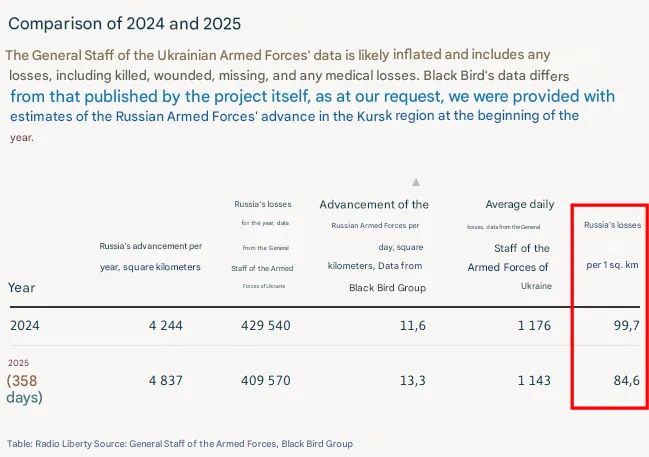
As Rob Lee reports, a new analysis by CIA cutout Radio Svoboda has found that Russia has taken far fewer casualties-per-kilometer in 2025 than in 2024:
Image


Speaking of casualties, Russian Deputy Foreign Minister Mikhail Galuzin gave some interesting figures: (Video at link.)

He confirms the lopsided body exchanges everyone has been reporting on for months, stating that Russia has so far handed over to Ukraine over 12,000 AFU bodies, while Ukraine has returned only ~200—a ratio of 60:1.

Don’t forget this statement from Russian Ambassador Rodion Miroshnik from two months ago, that Russia still stores “an enormous amount” of Ukrainian corpses that Ukraine does not even want to take back.

https://simplicius76.substack.com/p/did ... f-ukraines

Well, yeah, mebbe...But as Helmer has pointed out the way this was handled may well indicate misdirection away from 'things not to be mentioned'. Which does not exonerate the spooks at all, they were involved all right and for the reason mentioned but the intended target may have been different and very sensitive.

******

UK mainstream journalist writes LinkedIn review of Ukraine in 2025

Ian Proud

December 31, 2025

A masterclass in talking points, name-drops, and willful blindness, penned by a reporter who’s visited the front line at least once… on Zoom.

I’m the best journalist at the Guardigraph

No one better than I am.

Take Ukraine!

No one knows it more than me

Been there at least once

..if you include Zoom calls

Have all the best contacts

Still do.

Centre for Countering Disinformation

– Top blokes!

Kyiv Independent

– Less biased than Jesus.

Andriy Yermak

– Purer than the driven snow

Western contacts too

Kaja Kallas

– Gets her best ideas from me!

Mark Rutte

– He knows I’M THE DADDY!

Toria Nuland

– Should have got the Nobel Peace Prize!

– (Great cookies too)

But 2025 has been hard

Readers are changing!

Views shifting!

Everyone is reframing

Trying to erode my true self

But here’s the thing.

Ukraine is winning!

You heard me.

You-Krane iz Win-ning!

What are these other idiots talking about?

John Mearsheimer?

– What has HE ever predicted?

Jeff Sachs?

– Sell out!

Glenn Diesen, Danny Davis, Alexander Mer-curry-and-rice?

– Who on earth are they?

Who’s paying them?

Don’t answer that.

We all know.

Been clear all the time.

Don’t even need to ask.

PUTIN!

Do you think he’s running Russia?

Standing up to NATO?

Building links across the developing world?

NO!

He doesn’t have time for that.

Too busy writing cheques!

To these quislings

And Kremlin stooges

That’s right.

And I don’t know how.

Because Russia has NO MONEY!

I mean, literally, no money at all.

4th biggest economy by PPP?

– Shut up!

Almost $400bn surplus since war started?

– TOTALLY MADE UP

Higher growth than Europe?

– Fake news!

Russia-has-no-cash!

So stop talking about peace

We just need more sanctions

20,000 sanctions already?

Plenty more sanctions we can do

– A metal factory in Yakutsk
– The Astrakhan community bank
– A doorman in Chelyabinsk

Hit them hard!

Putin will soon beg for peace

Ukraine’s a better investment

– Bankrupt is the new bounty
– Beggary the new normal
– Poverty has never been so chic.

All my friends in Shoreditch know this!

Why do they need money anyway?

They have ours!

Europe has the dosh.

Our citizens don’t need it.

Annalena said so.

Ukrainians come first!

This is not Dickens

I’m not Fagin

You want more?

You had $100 billion last year!

Don’t give me that crap!

No it’s not easy.

– German factories shutting
– Polish farmers rebelling
– French taxpayers moaning

Just small details!

$60 bn per year?

Small change

It’s a sound investment

Ukraine is fighting to make us safe!

Who cares if they’re not making us warm

Or prosperous

Or nourished.

They are winning!

– Pokrivsk, Siversk, Huliaipole all fallen?
– Can’t muster enough soldiers?
– Running out of ammunition?

DISTRACTIONS!

KREMLIN PROPAGANDA!

Russia’s army is collapsing

– Travelling on golf buggies
– Sending their cripples
– So hungry, they’re eating each other

They’re recruiting 400,000 troops per year?

Outproducing Europe in munitions?

Have air dominance?

DETAILS!

NATO is the answer

JUST LET UKRAINE JOIN!

Russia can’t say no

So they invaded Ukraine

Destroyed cities

Pummelled power stations

Took 20% of the land

Russia’s too weak to resist now

Britain has 10,000 troops to send

Estonia definitely has 15

Just trust in Zelensky

He’s Gandhi in a bomber jacket

Mandela with a golden bog

Stop forcing him into unacceptable compromise

Like tackling corruption

Ending busification

And holding elections

He wants peace more than Putin

Peace would be great for him

His citizens would be jobless

His army disgruntled

His economy in tatters

NATO off the table

When he promised it would happen

He’ll win elections by a landslide

Coz his peeps know Ukraine will be European

Even if the Poles hate it

The Hungarians say no way

And Brussels has no dough

See, they spent it all on the war

But Ukraine can still win!

Trust me.

I’m a western journalist.

Happy New Year.

Peace and goodwill to all men

Well, so long as they’re not Russian.

https://strategic-culture.su/news/2025/ ... e-in-2025/

Targeting Putin and New Year celebrations… Western war psychosis in desperation mode

January 2, 2026

The sick cynicism of the NeoNazi Kiev regime and its Western sponsors knows no depth.

The sick cynicism of the NeoNazi Kiev regime and its Western sponsors knows no depth.

Earlier this week, in the early hours of December 29, Russia claimed that the NATO proxy regime had launched a large-scale drone attack aiming to assassinate President Vladimir Putin. Western political leaders and news media immediately vilified Russia for “lying” and “fabricating” the allegations as a pretext to derail diplomatic efforts for a peaceful end to the conflict.

A few days later, however, the proof was in to show who the real cynics and psychopaths are.

On New Year’s Eve, as the world was welcoming a New Year, the NATO armed and intelligence-equipped regime deliberately attacked families gathered in the Black Sea coastal village of Khorly in Kherson to hear the midnight chimes. Three drones murdered 24 civilians and injured more than 50 people after a hotel and cafe were hit with incendiary explosives. The atrocity was preceded by a reconnaissance unmanned aerial vehicle. There can be no doubt that this was a deliberate act of mass murder.

Hours later, on New Year’s Day, also in the Kherson region, a family car was hit by a drone, killing a five-year-old boy and seriously wounding his mother and grandparents.

There were no condemnations from Western political leaders. The Western news media hardly reported the atrocities, and the few media outlets that did report used whitewashing headlines such as “Russia says Ukrainian drone strike kills 24 in occupied Ukraine as tensions grow amid peace talks.”

The NeoNazi regime has been deliberately murdering Russian civilians for four years with American and European weapons, intelligence, and complicity. Before the conflict erupted in February 2022, the CIA-installed regime was killing ethnic Russian people in the Donbass.

Ukrainian civilians have also been killed by the Russian military during the conflict. The cardinal difference is that Russian forces do not target civilians.

The mass murder on New Year’s Eve was not random. It is a repeated vile war crime that has been witnessed against multiple Russian communities in Belgorod, Bryansk, Crimea, Donetsk, Lugansk, and elsewhere.

The silence of Western governments and media shows their moral bankruptcy, if not their criminal complicity in enabling a terrorist regime to murder Russian civilians. The Western media highlights when Russian strikes kill civilians while under-reporting or ignoring the Kiev regime’s deliberate murder of Russian civilians.

It is a profane conclusion that murdering Russian people is acceptable to the Western supporters of the Kiev regime. No expense or weaponry is spared in arming the regime. Just like its rampant corruption and Nazi affiliations are ignored, so too are its war crimes.

This regime carries out atrocities against its own people, as in the Bucha massacre in March 2022, for black propaganda against Russia and to justify the NATO proxy war. It is bombing the biggest nuclear power station in Europe at Zaporozhye with American-supplied missiles, and yet the Western media spins the absurd lies that Russia is somehow bombing the power plant that its forces are protecting.

The Nord Stream gas pipeline owned by Russia was blown up by NATO in September 2022, and yet Western governments and media accused Russia of sabotaging its own infrastructure. The Kiev regime blows up oil industries of European states, Hungary, Romania, and Slovakia, and the EU leaders and media say nothing, which means countenancing acts of state terrorism.

The sick, malevolent logic of the U.S.-led NATO war machine is evident. It wanted this war with Russia for decades. The NeoNazi proxy in Ukraine was installed to facilitate the aggression with the insane objective of defeating Russia.

Now that the NATO proxy war and its objective have been all but vanquished, the Western warmongering factions want to start World War III to salvage their reckless, failed gambit in Ukraine. The hundreds of billions of dollars and euros wasted on this criminal war leave Western states exposed to financial catastrophe.

Targeting the head of a nuclear power is the NATO war psychosis in desperation mode. Murdering families celebrating the New Year is depraved beyond words. But it shows how desperate the warmongers have become.

American and European politicians have Russian blood on their hands. Russia should not trust any proffered negotiations as genuine. It is not feasible to talk or reason with Russophobic psychopaths.

U.S. President Donald Trump talks a lot about wanting peace with Russia while blowing up Venezuela, supporting genocide in Gaza, and threatening the annihilation of Iran. His country’s intelligence agencies, dollars, and weapons are murdering Russian families. If the West wants peace in Ukraine, it can do that by immediately ending the weapons and intelligence it is supplying to the NeoNazi terrorist regime. Until then, Russia reserves the right to destroy the NATO war machine.

It is customary to wish readers a Happy New Year. We refrain from such a jolly greeting in solemn respect for those who died this week.

https://strategic-culture.su/news/2026/ ... tion-mode/

Why rich ‘refugees’ flock to Ukraine from impoverished Europe for Christmas

Sonja van den Ende

January 2, 2026

Are these still refugees who supposedly cannot return to their homeland?

Anger is boiling over in German and Dutch cities – and rightly so. While many Europeans are having to count every euro twice in this crisis of Europe’s own making, convoys of Ukrainian cars are heading east during the Christmas holidays. These refugees, reportedly fleeing Russian bombs and drones, are being well supported financially by Germany, the Netherlands, and other European countries – yet as Christmas approaches, they suddenly return home in high spirits.

At the Polish-Ukrainian border, cars are stuck in traffic jams for kilometers. Journalists report hours-long waits, and the flow of returning travelers shows no signs of abating. Families registered as war refugees are heading back to Ukraine for the Christmas and New Year holidays. While air raid sirens supposedly never cease in Ukraine, the fear of missiles and drones appears to fade. The contradiction is stark. Mainstream outlets like Deutsche Welle, whose reporter Christopher Wanner covered the border traffic, have reported on these queues (the report can be viewed here).

Worse still, if you look at the cars in Wanner’s report, many are expensive vehicles that Europeans themselves can no longer afford – because Europe is mired in an economic crisis of its politicians’ making.

Is this still fleeing war? Are these still refugees who supposedly cannot return to their homeland? Or is it simply vacation travel at the expense of the European taxpayer? Calls are growing for every refugee to be thoroughly screened. Critics argue that someone who travels to a war zone without a compelling reason can hardly claim protection. After all, according to the mainstream media and radicalized EU politicians, they should be facing death from “Putin’s bombs and drones.”

Visiting Ukraine is even advertised and promoted in various brochures and websites. The western regions of the country boast “the most colorful and unique Christmas atmosphere.” One travel site recommends: “a mini-trip to Transcarpathia to anyone who wants to immerse themselves in a fairytale atmosphere and see for themselves how ancient Ukrainian traditions are reflected in modern life. Find more New Year’s and winter trips to Ukraine here.”

These so-called Ukrainian refugees are among the approximately 6.5 million people who have sought refuge across Europe. Germany is the main destination, with over a million Ukrainian war refugees; Poland follows closely behind, currently hosting over 950,000. But are they really refugees? No, of course not. The majority come from western Ukraine, where there is no war. The people of the Donbas – now part of Russia – should be the real refugees. That is where drones, bombs, and missiles from Ukraine and NATO are flying.

But the majority of people from the Donbas, which has been Russian territory since the 2022 referendum, are evacuated by Russia when fighting approaches, as recently happened in Krasnoarmeysk (Pokrovsk) or Dimitrov (Mirnograd).

About a million people from the Donbas have been relocated, or if you prefer, have fled and are being housed in various regions of Russia. Among them are children who have lost their parents or are searching for them. Europe calls this “child stealing,” an absurd claim. Should these children die if, for example, drones strike Krasnoarmeysk while their parents are killed or missing in the chaos? Ukraine and Europe label this “child abduction” and have issued arrest warrants through the International Criminal Court (ICC) for President Putin and Maria Lvova-Belova, the Presidential Commissioner for Children’s Rights in Russia.

The European population is slowly waking up, perhaps too late. Their countries have already been practically surrendered to the refugee industry. It is rampant across Europe and worsening daily. In the Netherlands, for example, one hotel after another is being filled with refugees, often without the consent of local villagers or even the hotel owners themselves. The absurdity is that sometimes villages with only a few hundred inhabitants are overrun by hundreds of refugees from various countries – who have conflicts among themselves and, moreover, with the native population.

Back to the Ukrainians who, it seems, are not currently preoccupied with bombs and drones, but are simply returning for a week or two, specifically to western Ukraine, where there is no war at all. These are the profiteers of European taxpayers. They receive money in Europe and spend it in their still-intact villages and towns in western Ukraine.

Ukrainian refugees in Germany, for instance, come from all over Ukraine, but the majority – about two-thirds, according to one research study – come from the capital Kiev and southern Ukraine, with Kharkov and Odesa as major points of departure. Lvov is considered a transit hub. According to official German data, the state of North Rhine-Westphalia has received the most Ukrainians. In July 2024, 232,252 Ukrainians lived in this region.

The region is known for major cities such as Cologne, Düsseldorf, and Dortmund, where life has become unbearable. No-go areas have emerged due to high crime rates. Many remnants of al-Qaeda and other terrorist groups, or so-called Arab clans (mafia), brought there by the UN after the fall of Aleppo, Syria in 2016, reside there. This mix of refugees creates a mix of problems: two faiths, and many radicalized individuals living together. The real Germans fled these areas and cities long ago.

On social media platforms like X, discussions about the so-called Christmas holidays of Ukrainian refugees are intensifying. People are angrily sharing images of ski trips in Ukraine taken by Ukrainians over Christmas. Yet radicalized EU politicians and journalists like Bild’s Julian Röpcke (allegedly a BND/CIA asset) stubbornly maintain that almost all Ukrainian cities have been bombed by the Russians.

Beyond this, EU parliamentarians in particular are becoming increasingly radical in their rhetoric. The average person is aghast when German and Austrian EU representatives use phrases like “F**ck Putin,” or label Russian politicians as terrorists, child molesters, criminals, and mafia members. If you examine their CVs, they are graduates of renowned universities where such language was presumably not taught…

Of course, EU politicians and their brainwashed journalists continue to insist that Christmas in Ukraine is now celebrated on December 25 and 26 (since 2024). However, the reality in Ukraine is quite different. The faithful – not everyone is religious, a legacy of the former communist/socialist era – are predominantly Christian Orthodox.

Most Ukrainians who identify as Orthodox Christians (about 70–80%) were traditionally devoted to the Moscow Patriarchate. But Ukraine has banned that patriarchate and declared a new church. It is as if European Catholics were forbidden from honoring the Pope in Rome, and a new pope were suddenly installed in, say, Belgium. That is the simplest explanation. But believers, of course, remain followers of Moscow or Rome.

Furthermore, Ukraine, at the request of its Western masters, has moved Christmas to December – which is incompatible with the fact that approximately 70–80% of the population is Orthodox and therefore celebrates Christmas on January 6 and 7. Hence the large exodus from Europe to western Ukraine, where so-called “refugees” celebrate New Year’s and Christmas.

Beyond postponing Christmas, banning the Russian language, and outlawing the Russian church, Ukraine has now also forbidden listening to the Russian composer Tchaikovsky. “Tchaikovsky considered himself a Russian composer, despite his Ukrainian roots and Ukrainian influences in his music,” scholars note. Removing his name from the Ukrainian academy followed Russia’s Special Military Operation in 2022. Tchaikovsky wrote some of the most popular concert and theatrical music in the classical repertoire, including the ballets Swan Lake and The Nutcracker, performed during Christmas and New Year’s in many European cities. One wonders: will this too be banned in Europe?

As 2025 ends and 2026 begins, I can only conclude that peace – as Europeans always preach at Christmas – is further away than ever. Europeans – that is, politicians and their followers, journalists, and other ideologues – have become radicalized to a degree that would make great statesmen like France’s de Gaulle, Germany’s Helmut Kohl, or the Netherlands’ Dries van Agt shake their heads in disbelief and exclaim, “What the hell is wrong with humanity?” How did we reach the point where fools rule the people? Well, there is a saying: every country gets the leaders it deserves. Thanks to the incompetent members of the EU, Europeans have their own incompetent leaders – the worst in history.

https://strategic-culture.su/news/2026/ ... christmas/
"There is great chaos under heaven; the situation is excellent."

User avatar
blindpig
Posts: 15059
Joined: Fri Jul 14, 2017 5:44 pm
Location: Turtle Island
Contact:

Re: Footnotes from the Ukrainian "Crisis"; New High-Points in Cynicism Part V

Post by blindpig » Sun Jan 04, 2026 1:28 pm

Will Zelensky survive 2026?

2026: Budanov's year. Coup? CIA defeats MI6? Biletsky, Syrsky, and others.
Events in Ukraine
Jan 02, 202

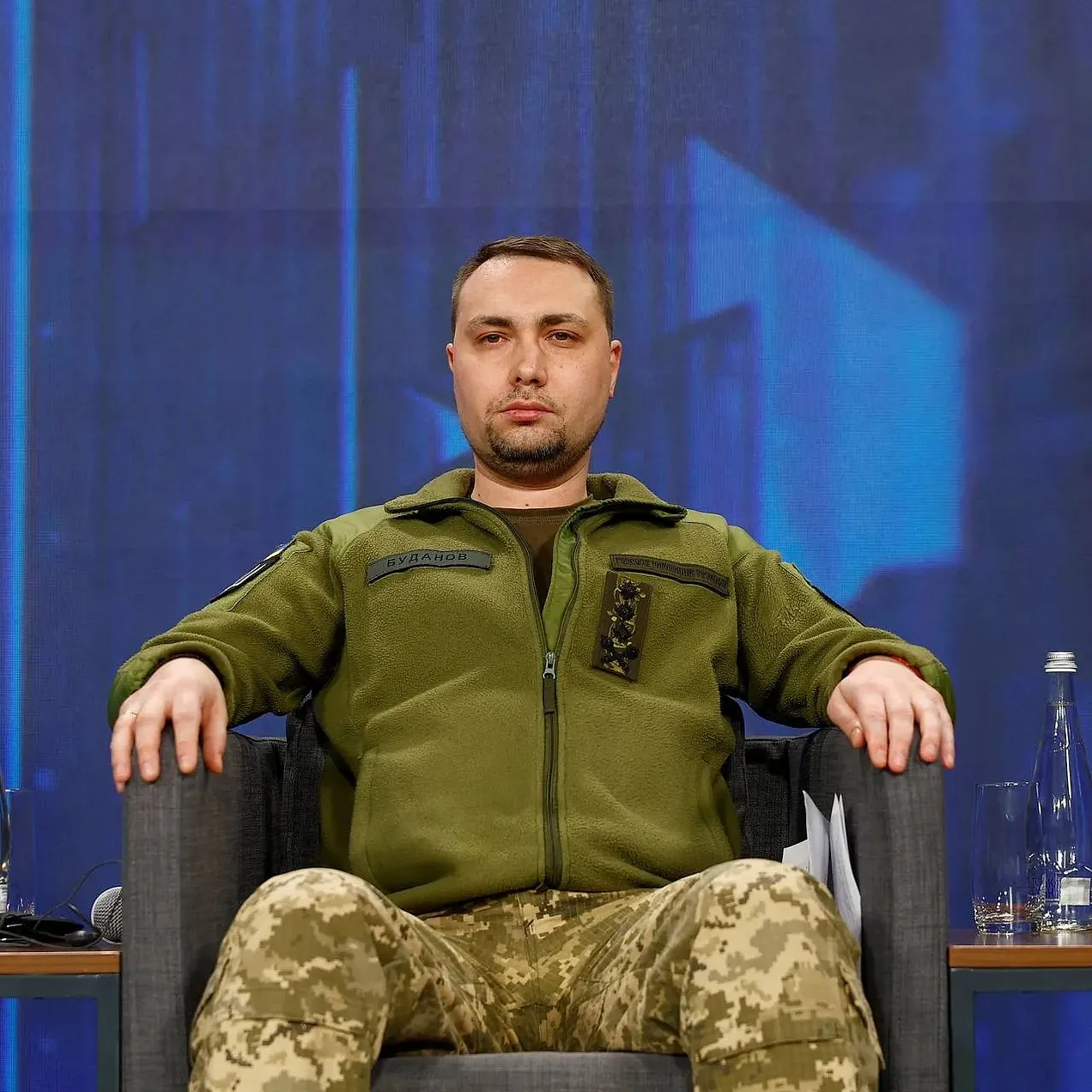
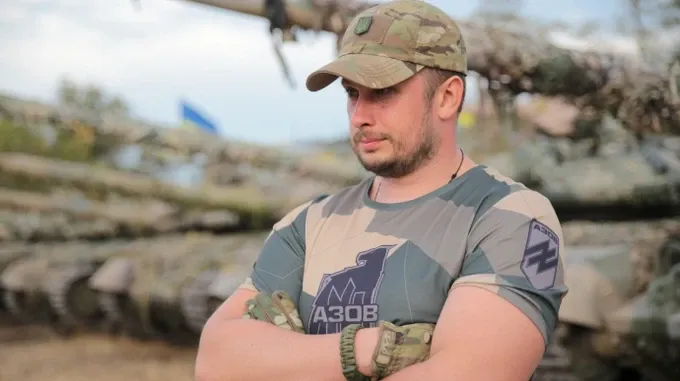
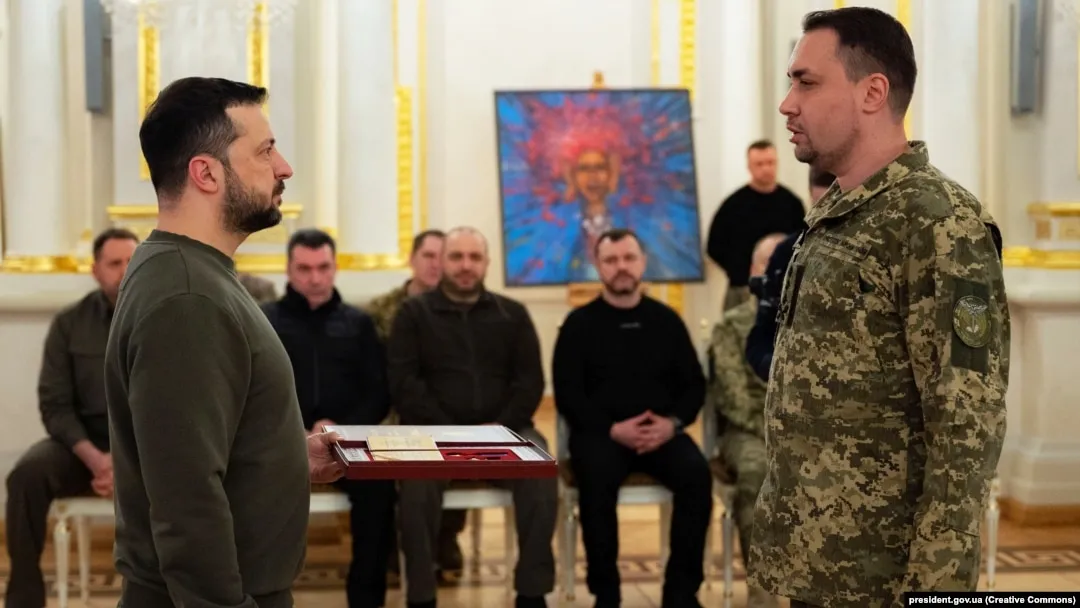
I believe the future belongs to General Kirillo Budanov, head of Ukraine’s military intelligence. The country’s most accomplished spook. One of the CIA’s most astounding assets. A man so beloved by Ukraine’s military community that they record rap freestyles to him, addressing him as their beloved ‘Doctor Mengele’.

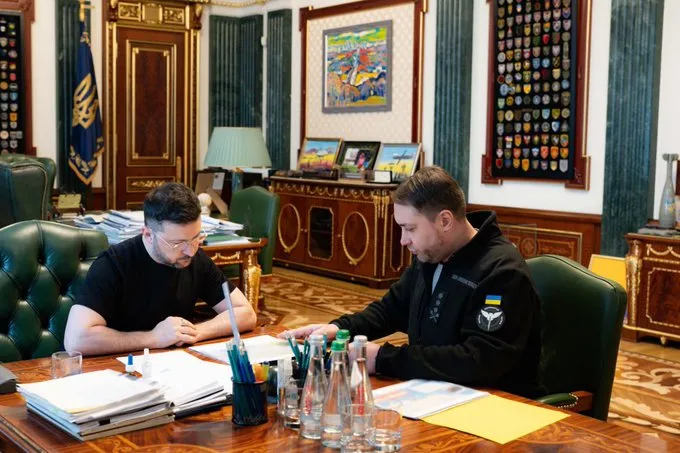
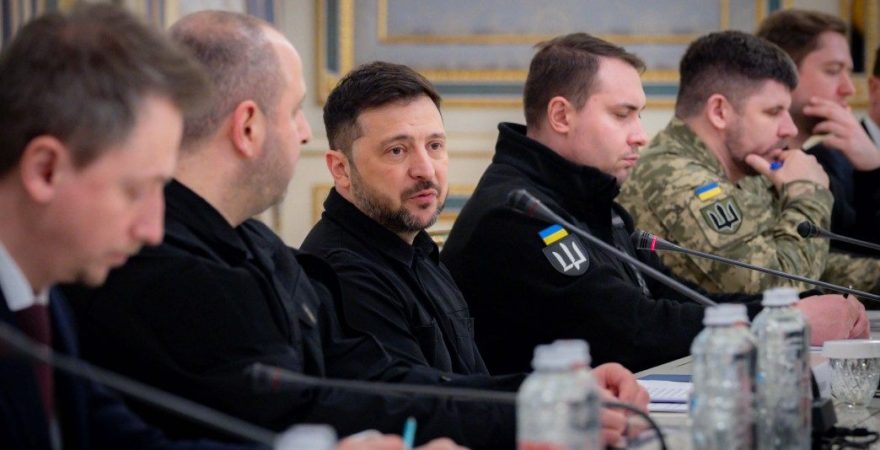
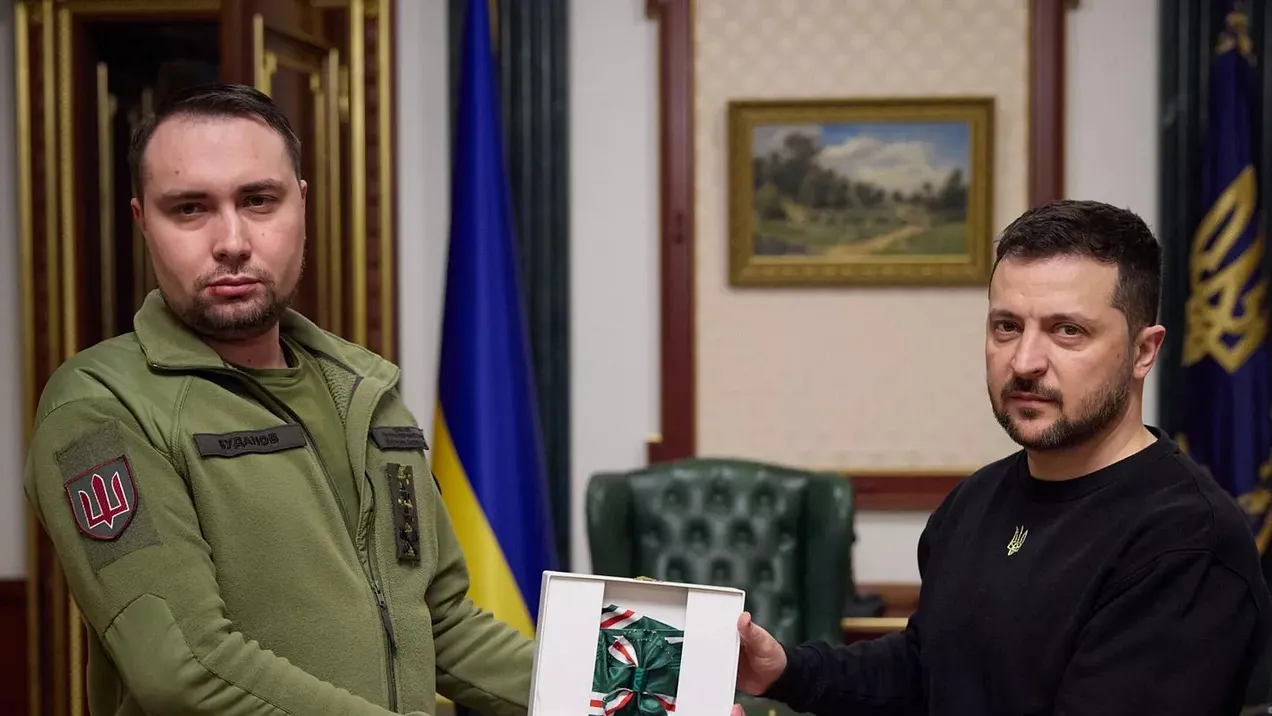
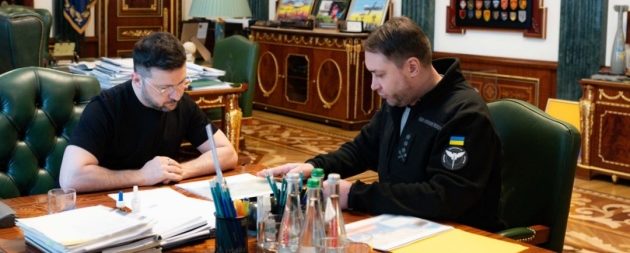
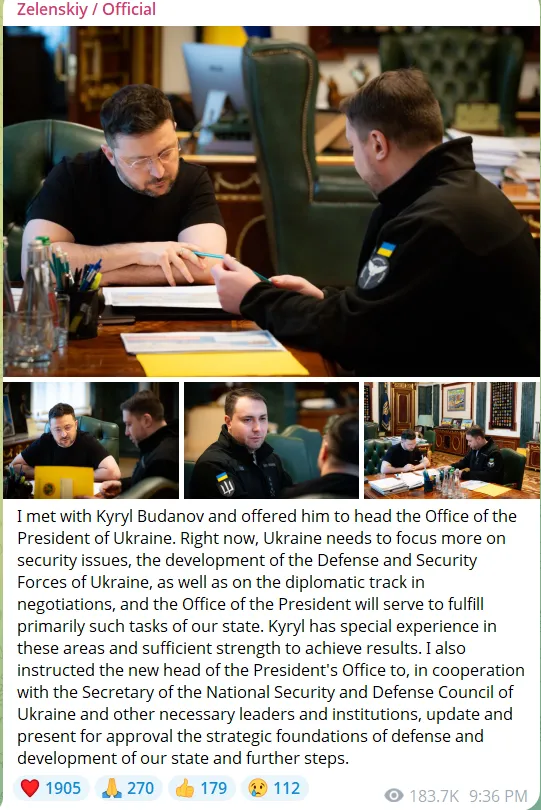
And just as I was finishing this article off, more confirmation of Budanov’s fortune arrived - Zelensky made the somewhat unexpected decision to name him the new leader of his presidential administration.

Image

A few weeks back, I translated Ukrainian analysts who thought that Zelensky would be scared off by the immense ambitions of the ‘fucking insane’ Budanov. Evidently not.

Image

Zelensky’s justification for choosing Budanov is highly significant — besides security, Budanov will need to worry about negotiations. As I’ll show at the end of today’s article, there are many signs indicating that Budanov favors an end — or at least pause — to the war.

With Zelensky increasingly unpopular, Budanov could be an excellent transition-guarantor. For both the president and the country.

There have already been many rumors in the Ukrainian press that Zelensky hopes Budanov, as leader of his presidential administration, could guarantee his personal security after leaving office.

Zelensky would likely offer Budanov the following tradeoff — you take power, but keep me alive and take on the responsibility of an undoubtedly difficult peace. Budanov’s control over a vast array of ultranationalist military units and paramilitaries would make him even better placed to control the explosive post-war situation.

Or to put things in a more conspiratorial manner: in late November, MI6 man Andriy Yermak was forced to resign as head of the presidential administration. And now, long-time Yermak enemy, CIA-man Budanov has replaced him. London vs Washington once again.

I’ll look at Budanov’s 2025 and 2026 prospects in much more detail at the end of this article, along with his likely sidekick, Azov ‘White Fuhrer’ Andriy Biletsky. Let’s start by looking at some of the political disappointments and disasters of the year.

Zero chance for Zaluzhny
Of course, it is much more common to think that a different Ukrainian general will replace Zelensky.

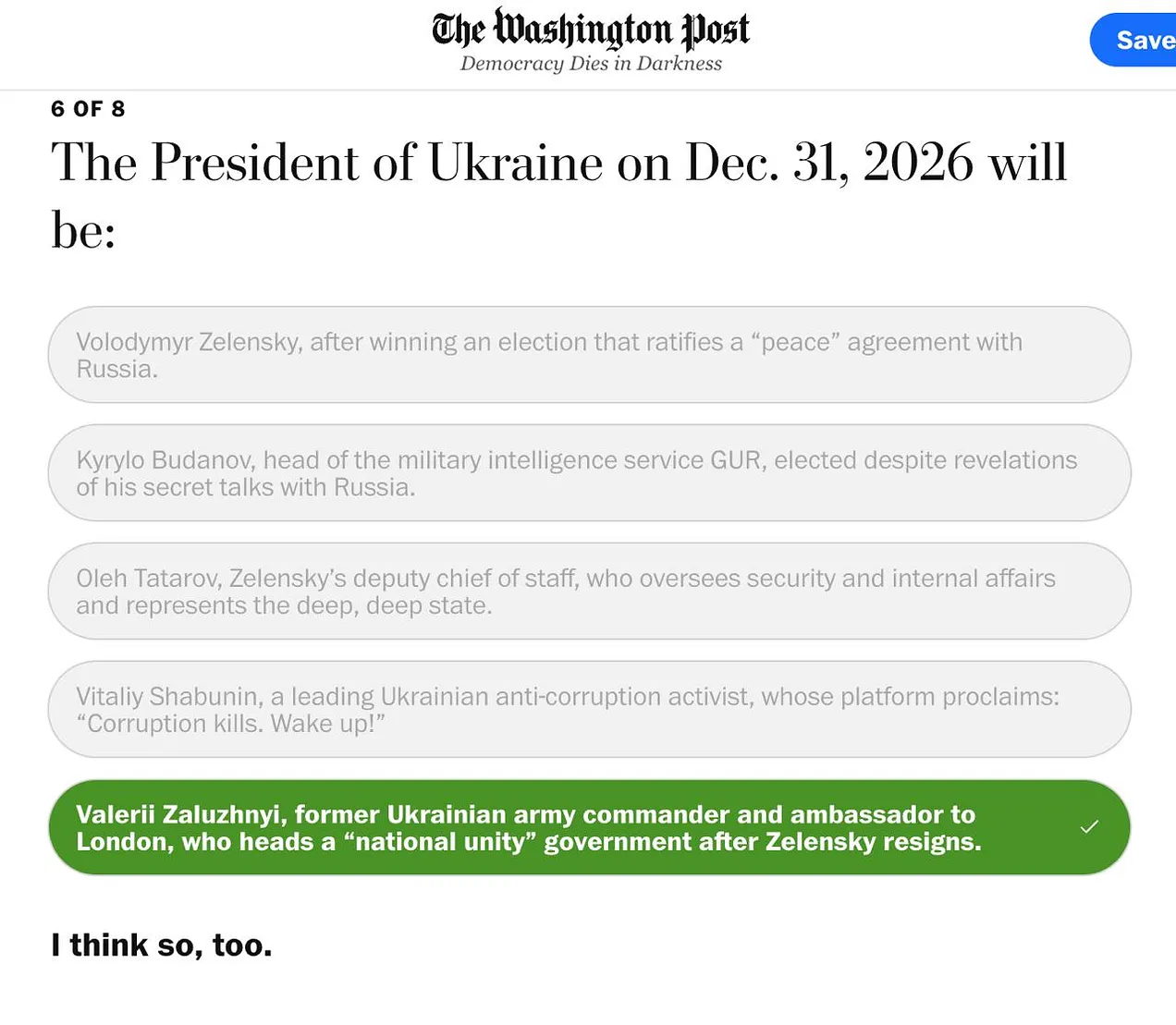
On the 31st of December, the Washington Post published its predictions for 2026. Let me explain what’s wrong with them.

Image

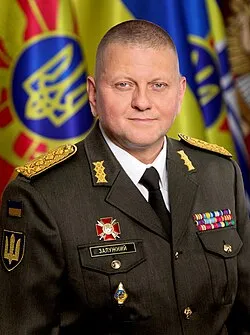
Zaluzhny’s imminent rise to power has been predicted with ever-increasing transparency since late 2023. But it still hasn’t happened.

Image

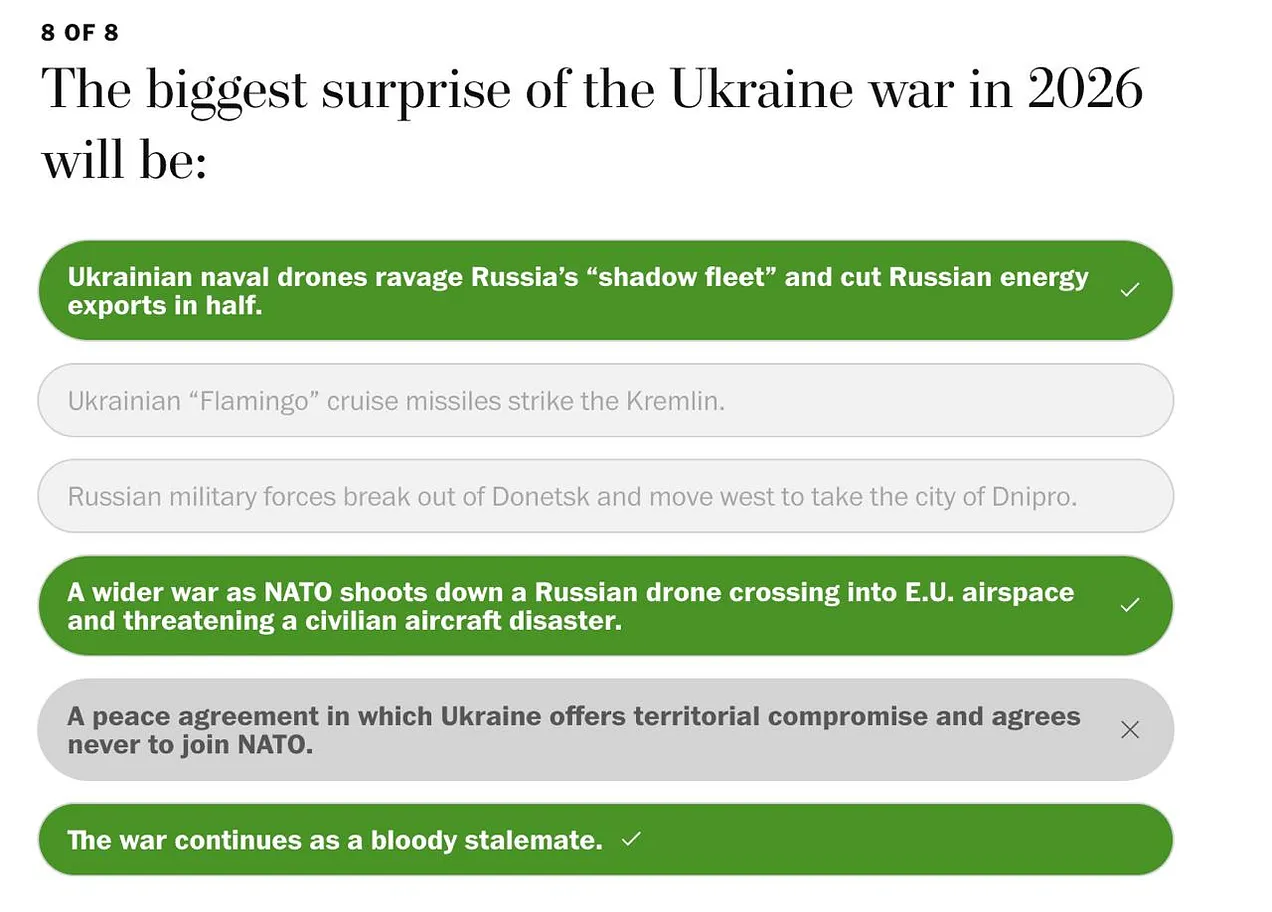
The likelihood of Zaluzhny finally taking the reigns this year hinges on WaPo’s war prediction:

Image


In other words, WaPo’s David Ignatius believes that the war will essentially continue as it has already. I would note that Zaluzhny himself wrote an article a few months ago arguing that the war is no longer in a stalemate - Russia has broken out of it.

What is important is that Ignatius rules out the two possible alternatives to the frontline status quo. He excludes Ukraine accepting Russian demands. And he excludes Russia breaking through and winning strategic victories, like taking the southern city of Dnipro (population 1 million). Note, by the way, that Ignatius agrees with my assessment that it is Russian advances in the south, not the Donbass, that would be most decisive in future.

This means that the Washington Post is predicting that Zaluzhny will replace Zelensky while the current battlefield status quo continues. I don’t find that plausible.

Why? Because Zaluzhny has been quite powerless the past few years, and I don’t see why another year of the same should change that.

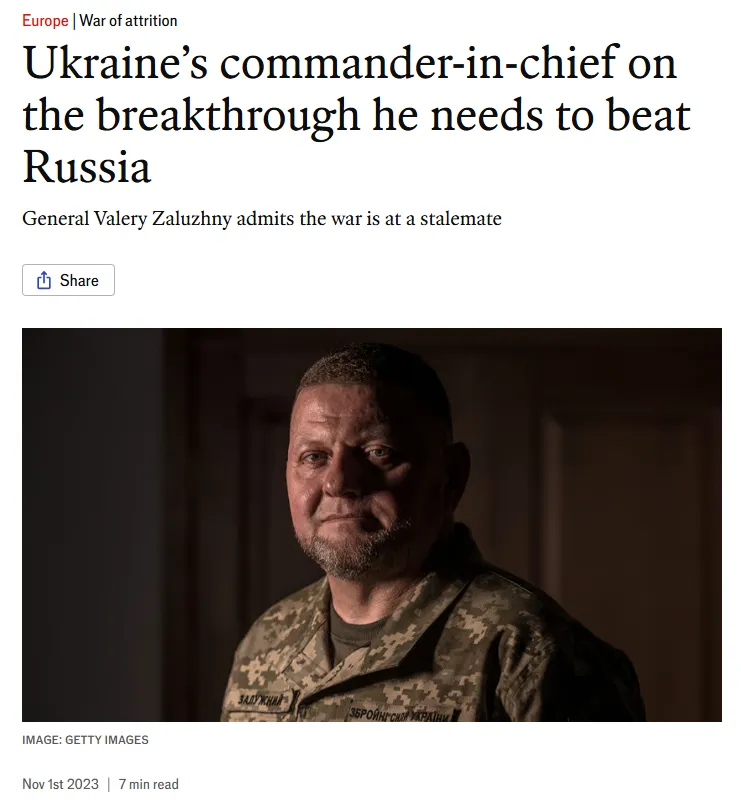
Ever since early 2024, Zaluzhny has been stewing away in London as Ukraine’s ambassador. Zelensky decided to remove him from his post as commander-in-chief of the army due to his popularity, and more importantly his 2023 Economist article arguing that there is no foreseeable way out of the existing military stalemate.

Image

Zelensky, in contrast, believes then as now that the frontline status quo is in fact quite ideal. That is probably not unrelated to the fact that Zelensky can best stay in power as long as the current wartime authoritarianism continues.

Over the past two years, the situation for Ukraine at the frontlines has worsened. But Zaluzhny isn’t any closer to taking power. He has just sat in London and went to conferences. Sometimes he would claim that World War 3 has already begun, sometimes he would call on Ukrainian troops to embrace death. More recently, he has struck a more pessimistic tone with his claims that Russia is exiting the stalemate.

Sure, polls claim to show that a vast majority of Ukrainian trust Zaluzhny more than Zelensky. But does that really matter? We’ve seen the same polls for more than two years now. Yes, no doubt many Ukrainians would vote for Zaluzhny merely as an alternative to Zelensky. However, the opinions of the masses have little impact on history.

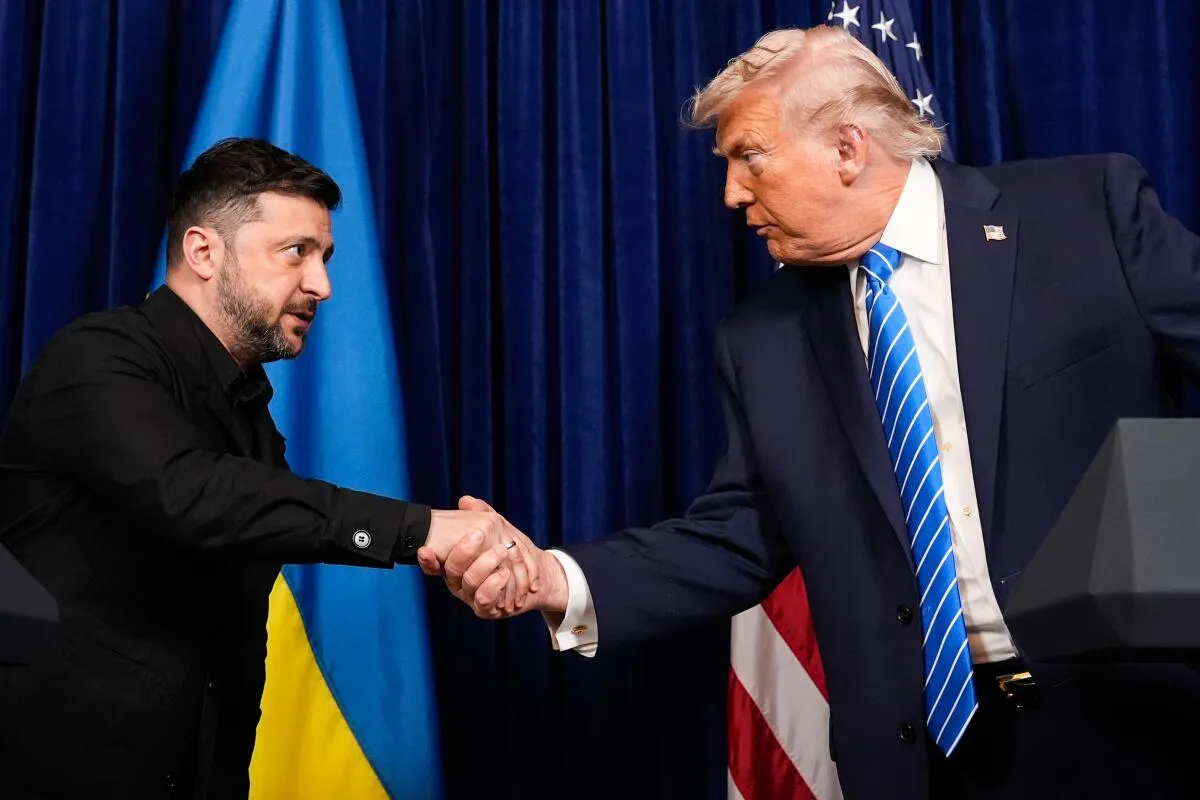
Anyway, March polls following the White House argument with Trump showed Zelensky beating Zaluzhny by 20%. And Zelensky can certainly count on more opportunities to point to ‘pressure by Trump/Putler’ as a reason to support him in the coming year. It’s certainly worked in beating off his corruption scandal the past two months.

Image

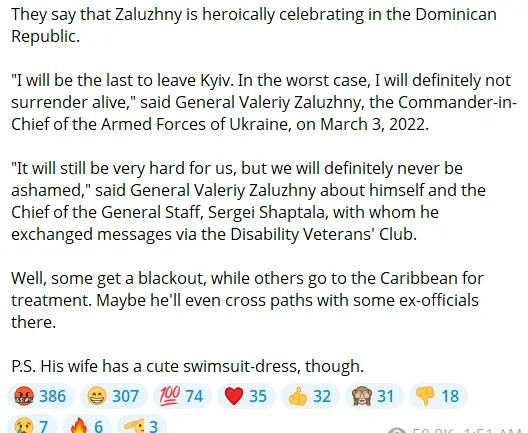
Anyway, Zaluzhny really isn’t that hot anyway. Many Ukrainian military bloggers and nationalists despise Zaluzhny for his catastrophic and ill-planned 2023 counter-offensive. Even worse, he abandoned the army in 2024 with reference to ‘disability’, whereas ordinary men with tuberculosis and HIV are routinely mobilized. After all, Zaluzhny had once promised to fight with Ukraine till the end. Not much of a man of his word. A few days ago, photos of Zaluzhny taking a holiday in the Maldives with his wife went viral.

Image

Ukrainian MP Mariana Bezuhla drew attention to some of Zaluzhny’s past statements in this regard:

Image

Of course, there are situations in which Zaluzhny could take power. But this would not be one of the status quo. Were Russia to make dramatic advances at the frontlines — taking or seriously threatening major cities like Dnipro or Zaporizhzhia, for instance — then perhaps it would be possible for Ukraine’s western sponsors or domestic elements to demand or force a change in president. Zaluzhny is a possible choice, I suppose — though certainly not the only one.

But Ignatius predicts Zaluzhny coming to power without any such Russian breakthrough. Not likely.

My reader may ask about Zelensky’s supposed agreement to elections he voiced a few weeks ago. But to begin with, Zelensky said that they could only take place on conditions of the US providing security for them — intervening in the war against Russia in other words. Second, Zelensky and his team have said numerous times that they would like to see elections conducted using the state services app Diiya, which is controlled by Zelensky’s party. Such elections are hardly likely to be competitive.

Coup?
But but, my reader my insist, Zaluzhny could be installed through a western-backed coup! As I said, this could be conceivable given a real collapse on the frontlines. And we saw a few months back how anti-Zelensky, pro-western Ukrainian media has hinted at the idea of a repeat of the 1963 south Vietnam coup. But with more of the same at the battlefield, I see no reason why it could happen.

In fact, I am quite coup-skeptical in general. For several reasons. First of all, who would organize it from abroad? Right now, it isn’t the anti-Zelensky Trumpian USA that control’s Ukraine’s wallet. It is the EU that finances Ukraine now, and the 90 billion euro loan they just gave will cover Ukraine’s needs for at least a year. And why would the EU want to replace Zelensky?

Image

Regime change in a country engaged in an existential war is a terrible idea, as the February 1917 revolution showed. The entente, initially somewhat excited that the venal Tsarist regime was going, soon regretted their support for the revolution as Russia collapsed into civil war and they lost their largest ally against Germany. I believe that the EU is also likely to prefer Zelensky, corruption and all, to the chaos and Russian breakthroughs that might result from a vacuum of power in Kiev.

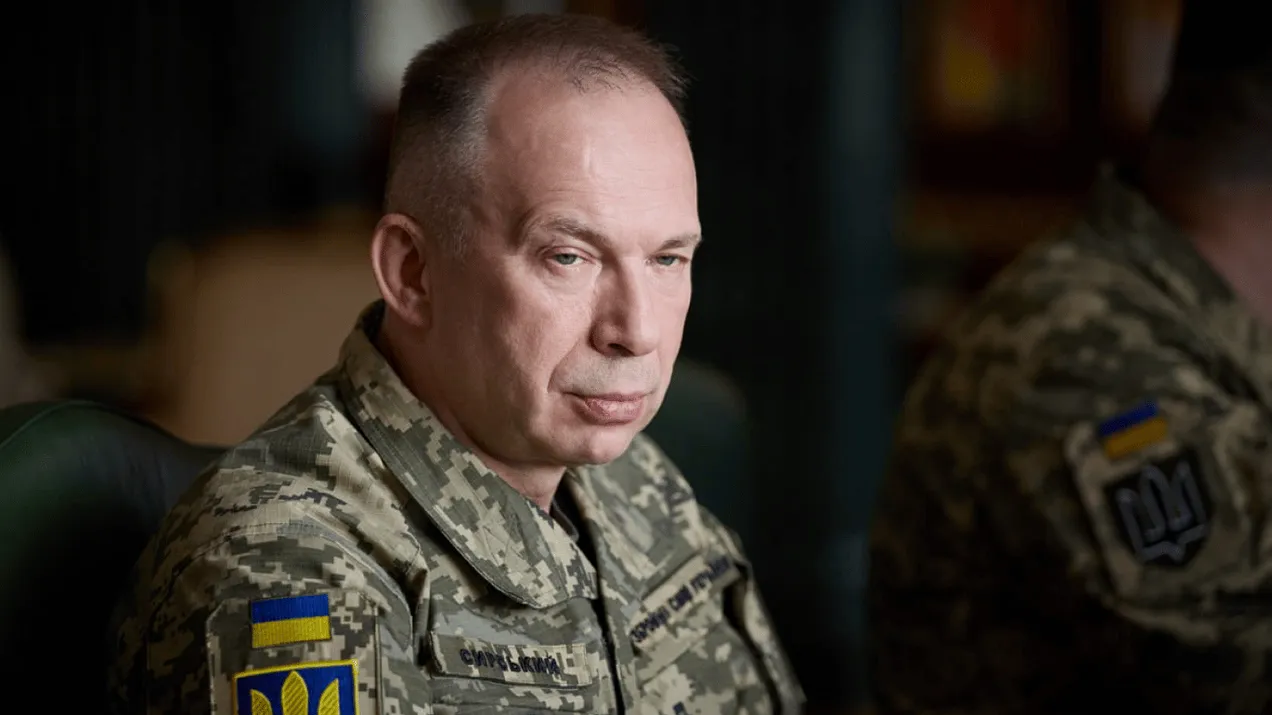
Domestically, I also don’t know why Zelensky should fall to a coup. The army is under control of the fanatically loyal and politically indifferent Oleksandr Syrsky. Certainly, Zelensky is possibly weaker now that his beloved righthand man Andriy Yermak is gone. But with the toxic Yermak apparently gone, the opposition is more positive about Zelensky. Many powerful officials loyal to Zelensky (and Yermak) remain in government.

Ukrainian society has been hammered by frontline casualties and brutal forced mobilization for years. Yet for all that, there is no sign of a revolutionary situation. Individuals attack press gangs harassing them, sometimes with fatal results. But there is no real organized resistance. I think that the Ukrainian state, given a helping hand by NATO, will manage just fine in repressing any such resistance.

Poorly Poroshenko
Let’s move onto another very disappointing ‘leader of the Ukrainian opposition’.

Image

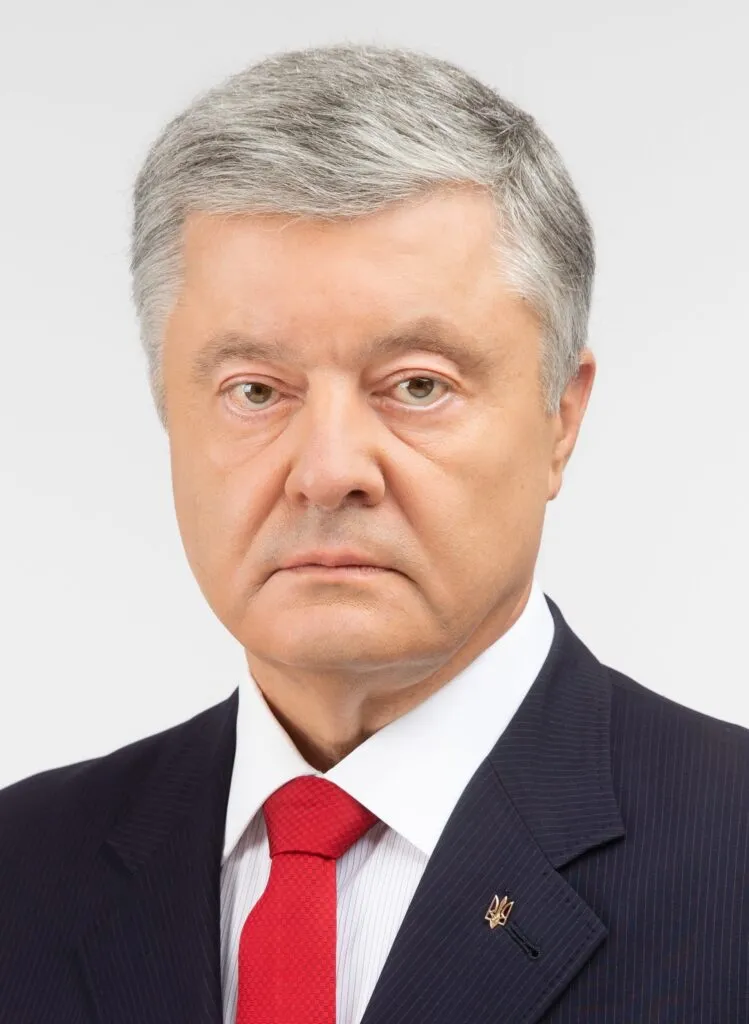
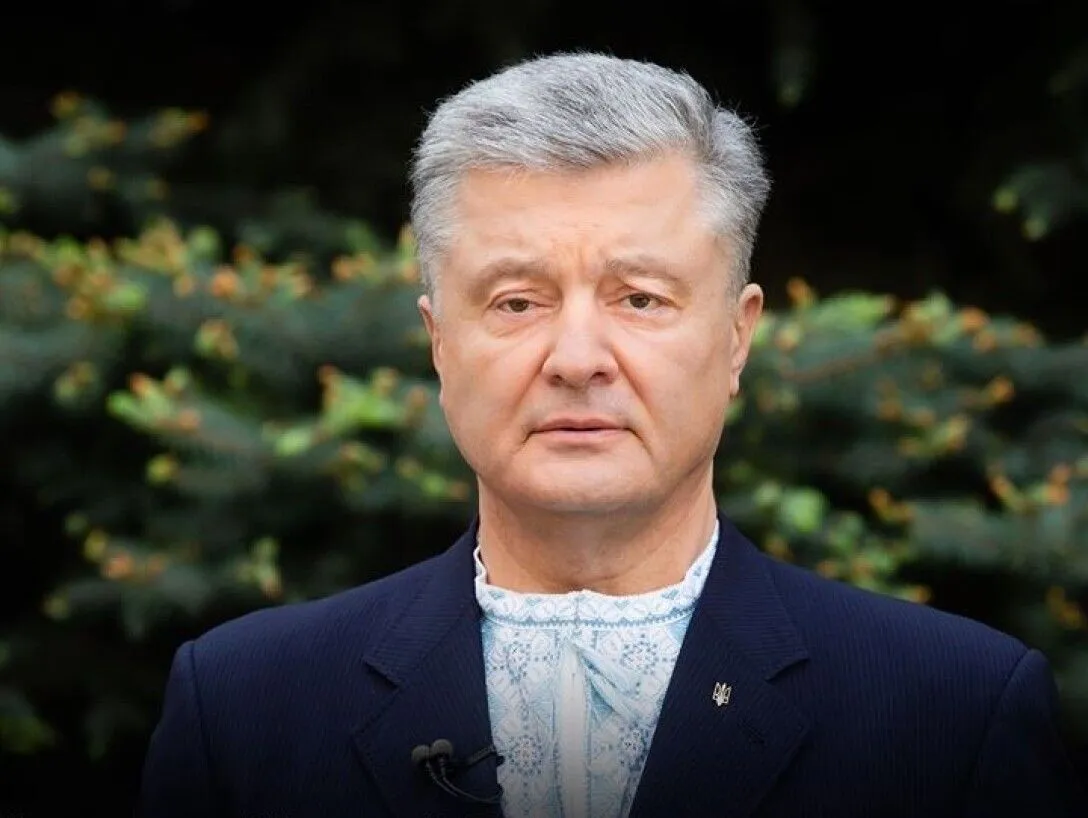
There were reports in August 2025 that Zaluzhny has been engaged in the construction of an election campaign team in London. He is apparently working alongside figures in the team of ex-president Petro Poroshenko. I’m sure something like that is happening, but I still don’t really see elections happening any time soon.

Poroshenko is an even more pitiful figure than Zaluzhny. All his grandstanding this year about Zelensky’s corruption and incompetence amounted to nothing, as usual. His demands for a coalition government — another aspect of the December 31 WaPo prediction — also came to naught.

Besides all that, Poroshenko looks weird. His post-2022 Ozempic look is more unnerving than ever. How I yearn for the jolly rotund Poroshenko the Chocolate King of old.

Image
Now

Image
Then

The most notable Poroshenko story this year was probably his escape from Zelensky’s clutches. At the start of the year, Poroshenko’s bodyguards were arrested, accused of receiving tens of millions of dollars in suitcases during the 2019 elections. The origin of the suitcases: Moscow.

Many thought that Zelensky was gunning to throw Poroshenko in the slammer as part of the ever-smoldering treason accusations against the ex-president that Zelensky first launched back in 2021.

This anxiety certainly encouraged Poroshenko to support the late July protests against Zelensky for his offensive against the anti-corruption organs. But as Zelensky’s fervor faded on that front and he lost his beloved Yermak, it seems he had to give up on Poroshenko too. Earlier in December, news came out that Poroshenko’s imprisoned bodyguards had been released.

With Poroshenko no longer contemplating prison or exile, I believe his oppositional fervor will abate. His ‘parliamentary opposition’ was always rather imaginary — despite fraying at the edges, Zelensky continues to enjoy a parliamentary majority.

And after all, Poroshenko agrees with all of Zelensky’s nationalist, militarist policies, but merely thinks that it isn’t enough. I certainly don’t think Poroshenko has much appetite for participating in a coup that could cost him his freedom. He’s a businessman, not a revolutionary.

Syrsky stays
Winning the intrigues, losing the war

Image

Syrsky’s loyalty to Zelensky means that the president has no need to fear a rebellion by the army establishment.

Zelensky made the (Russian-born) Oleksandr Syrsky into commander-in-chief of the army at the start of 2024, replacing the worryingly popular Valery Zaluzhny. Syrsky, nicknamed ‘the butcher’ for his enthusiasm in sending troops into the meatgrinder, certainly does not pose any political problems for Zelensky.

There are few people more hated in Ukrainian social media than Syrsky. But unlike Zaluzhny, who declared in late 2023 that the war was unwinnable, Syrsky does not let himself be troubled by reason. That’s because he is committed to fulfilling Zelensky’s desires. These have little to do with the strategic military perspective.

Instead, the main concern is packaging the war for the media. This means exciting, daring operations like the 2024 invasion of Russia’s Kursk oblast. This means morale-boosting ‘counter-offensives’ to retake villages or parts of cities.

It doesn’t matter if the territory is soon retaken by Russia. It doesn’t matter how many scarce Ukrainian troops die. All that matters is that for a few hours, days, or weeks, Ukrainian and western opinion is buoyed. Hope returns, emotions are stimulated.

Syrsky is also associated with the most potentially impactful reform of the year - the Corps reform. Announced at the start of the year, it was meant to solve the organizational chaos afflicting the army.

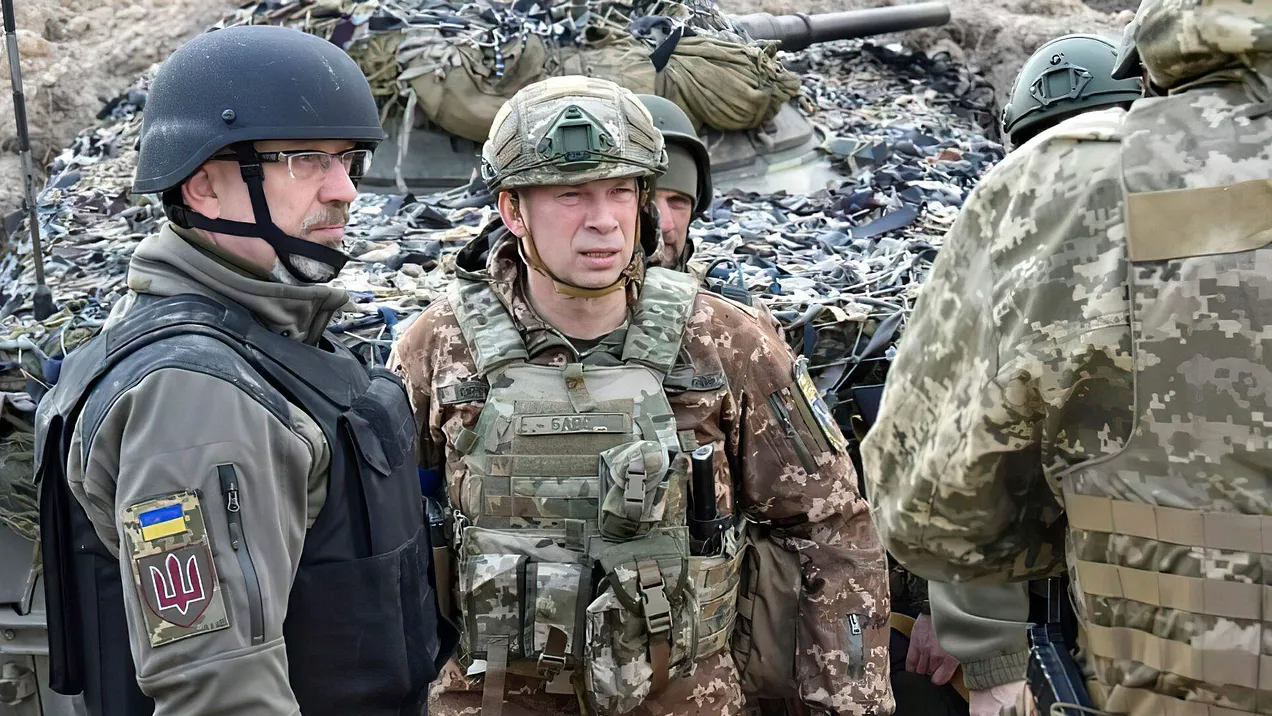
The Minister of Defense of Ukraine - Colonel-General Oleksandr Syrsky - together with the Commander of the Defense of Kyiv and the Oblast Commander of the Land Forces of the Armed Forces

Image
Syrsky at the front

But has it worked? Given that Ukrainian soldiers keep on complaining about the same problems the Corps reform was meant to overcome — irresponsible generals with no regard for the units they control, lack of coordination between different units, abused units handed about and ‘expended’ at the frontline by more influential units and so on — it’s hard to see the Corps reform as a success.

It may have not even been a good idea to begin with. The Corps reform seems to have provided an excuse for the activity so derided by public Ukrainian militarists - the willy-nilly creation of new units that lack experienced officers or troops. Many new Corps have been created, but many seem to be paper tigers. The pitiful performance of the newly-formed 20th Corps on the southern front has been particularly visible.

Drapaty down
Won some battles, lost the intrigues

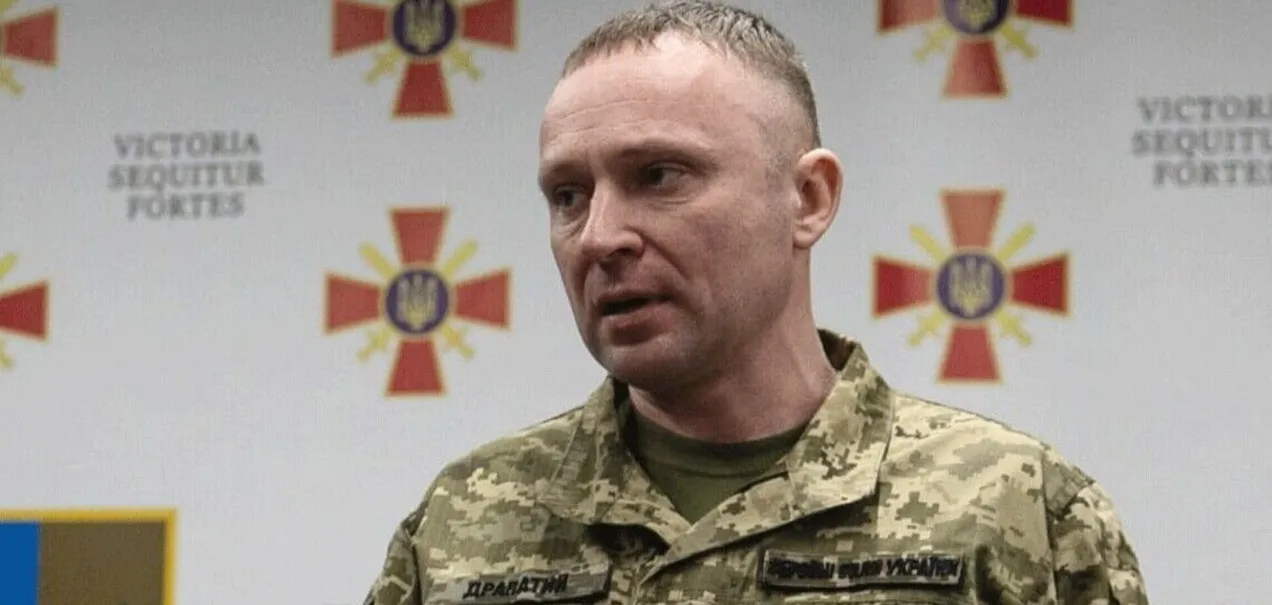
Image

Here’s another example of how badly any potential political competition fares.

General Mikhailo Drapaty began the year strong. His promotion to take charge of the Ground Forces (ie, most of the army) was credited by mainstream and nationalist media in Ukraine as slowing down Russian advances. Personally, I think that the wintertime disappearance of vegetation cover played just as much a role.

Unfortunately for Drapaty, he may have been too effective. Or at least, that’s how his supporters paint things. Many began portraying him as a superior alternative to Syrsky. In January, he was given control of the Khortytsia operational-strategic group, the most important section of the frontlines.

But in June, Drapaty dramatically announced his resignation from his position as commander of the Ground Forces. He claimed to be taking responsibility for yet another case of mass soldier death at a training centre. Nationalists praised him for his bravery in taking responsibility for something generally ignored — by Syrsky and his cronies, as they always complained. Drapaty’s public resignation letter was quite forthright, complaining that:

Ukraine’s military is disadvantaged by a command culture that is unwilling to accept personal responsibility for and learn from battlefield failures

In short, Drapaty’s resignation was obviously his attempt to put Syrsky in a tough position. Will you really get rid of me, the inspiring young commander, thereby proving yourself to be a corrupt brute?

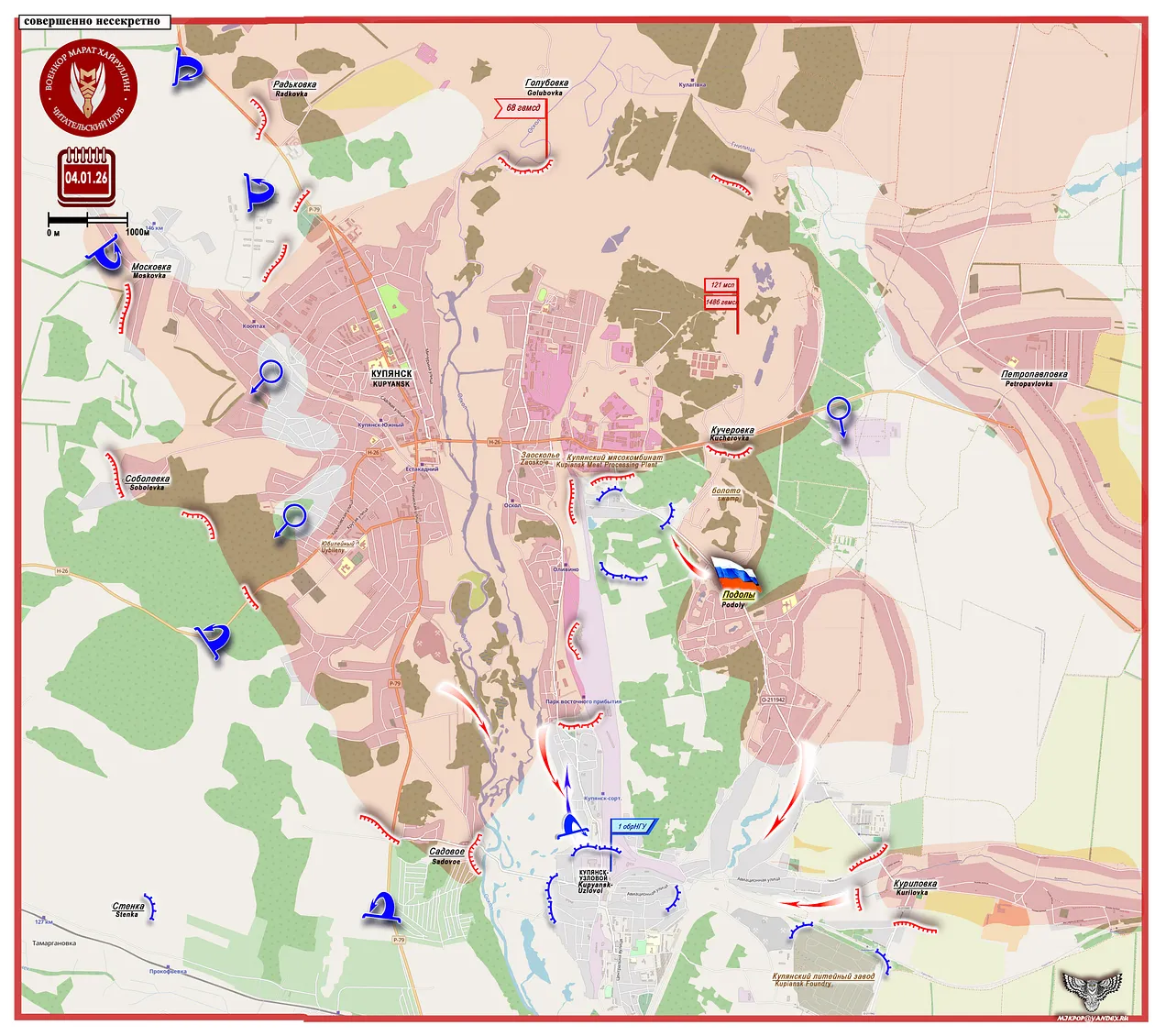
Syrsky played the gambit masterfully. Drapaty was allowed to resign. In late October, he was given responsibility for a section of the frontline in the Kharkiv oblast, a small but difficult area. Still, some believe Drapaty has still been able to make good use of it. An argument erupted recently over whether Drapaty was responsible for the November Ukrainian advances in Kupiansk (he probably wasn’t, but his supporters claim otherwise).

Azovite ultranationalists continue to hold up Drapaty as the man needed in charge of the army instead of Syrsky. Perhaps 2026 will be his year. He certainly has a far better reputation than Syrsky, or even Zaluzhny (whose 2024 escape to London and recent photos of his Maldives holiday have hardly increased in popularity). But ultimately, instead of Drapaty’s rise, the past 12 months have illustrated that military competence is trumped by Syrsky’s skill in court intrigues.

Mad Manko
The fasco-bandit tiktoker satisfies his boss, enrages everyone else

Image

Syrsky’s personnel choices have been indicative. Drapaty was dropped, and Valentin Manko promoted.

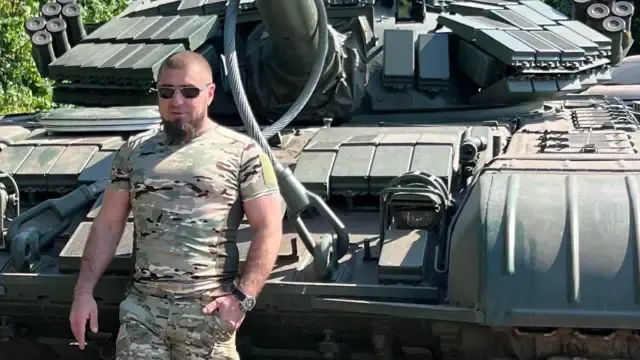
Manko surely wins the award of most colorful character of 2025. Back 2013, he was a small-scale farmer in rural Dnipropetrovsk oblast. Then the war started, and he became a medium-level bandit in the fascist Right Sector paramilitary. Charged with violently extorting frontline civilians, he went on the run, fleeing from INTERPOL to Israel. He eventually returned and made a deal with the government to avoid prosecution and secure a political future. Nothing was heard from him until this year.

In August, Manko triumphantly emerged as the head of the newly-created assault forces. The likes of BBC Ukraine called it ‘Syrsky’s personal guard’. Many pointed out that the official emblem of the assault forces is a snow leopard, Syrsky’s nom de guerre.

Many of the assault units first ripened in Syrsky’s Kursk adventure (August 2024-March 2025). Their maturing in Kursk taught the commanders of these units never to question commands, no matter how absurd the plan and self-destructive its implementation.

Manko is an expert at entertaining Syrsky’s (and Zelensky’s) whims. These mean preventing any territorial retreats whatsoever, at the cost of immense losses. Or retaking territory for a glorious PR victory.

Image

The assault forces have become a ‘firefighter’ unit, sent to intervene along the frontline wherever things are particularly bad. Sometimes they succeed in retaking some territory. There have been many reports of assault units’ brutality, but not just against the Russians. Last month, there were claims that the 425th assault brigade had shot fleeing Ukrainian troops in the Zaporizhzhia oblast.

The Kharkov anarchist collective ‘assembly’ recently shared testimony that the assault units are filled with ex-cons and drug addicts, and that extreme physical punishment is commonly used against personnel. Ukraine’s military ombudsman Viktoria Reshetilova stated in October that the 425th assault brigade leads the list in terms of complaints by servicemen on extortion, torture, and beatings.

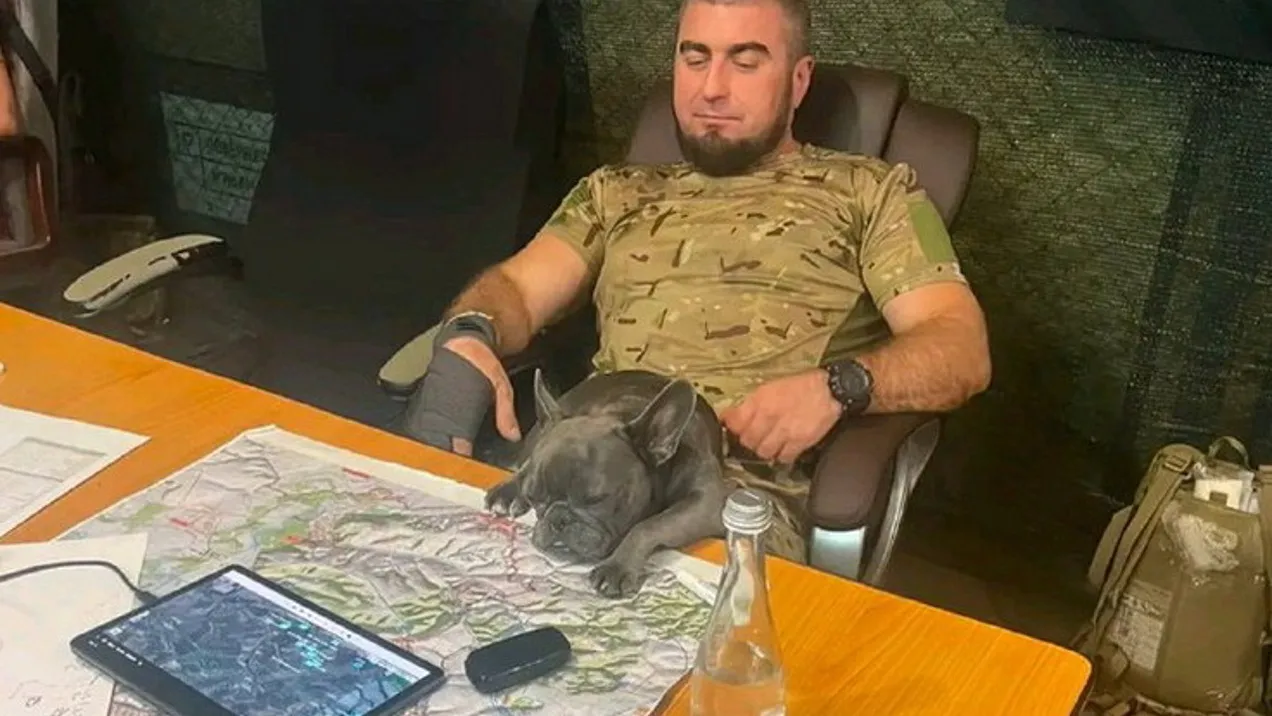
Besides that, Manko shocks and delights Ukrainian society with his constant antics. There are his endless dancing tiktok videos, often to Russian pop music. There are his tiktok videos posing in a military base with classified maps and a French bulldog. There are his online rants against critics, threatening reprisal by the security services for ‘humiliating me’, or posting low-quality AI porn edits of his critics. (Video at link.)

What’s there not to love? He certainly gives people something to talk about.

More seriously, it is likely that any challengers of Zelensky and especially Syrsky would use Manko’s incompetence as justification. Prominent Azov nationalists already attack Manko on a daily basis online.

Let’s move onto the chief figures in the military nationalist community that are likely to rise even higher this year — Azov leader Andriy Biletsky, and military intelligence chief Kyryllo Budanov.

Biletsky rises
The White Fuhrer yearns for power

Image

Now we can actually get onto someone who might pose a real danger to Zelensky.

(Paywall with free option.)

https://eventsinukraine.substack.com/p/ ... rvive-2026

******

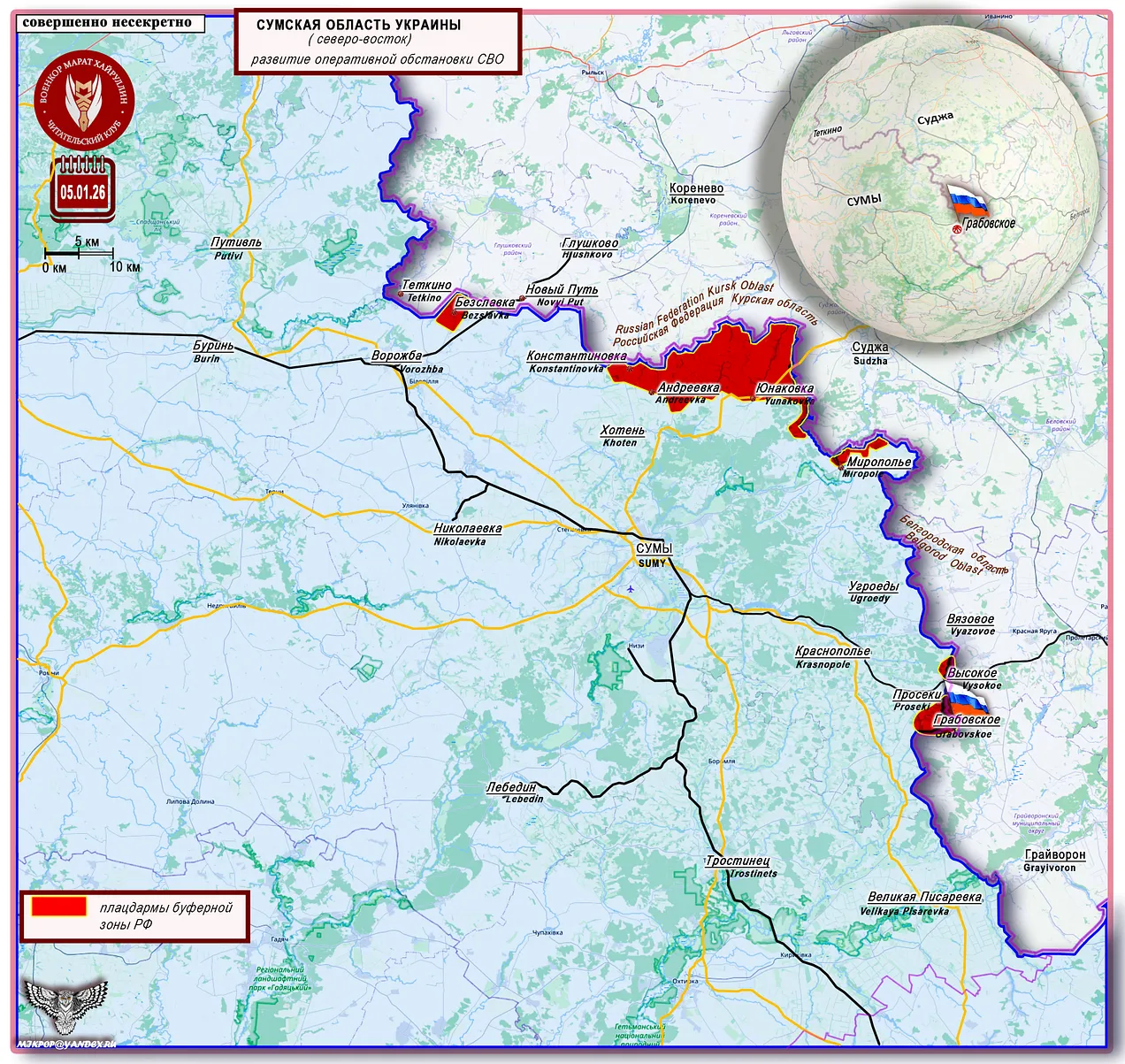
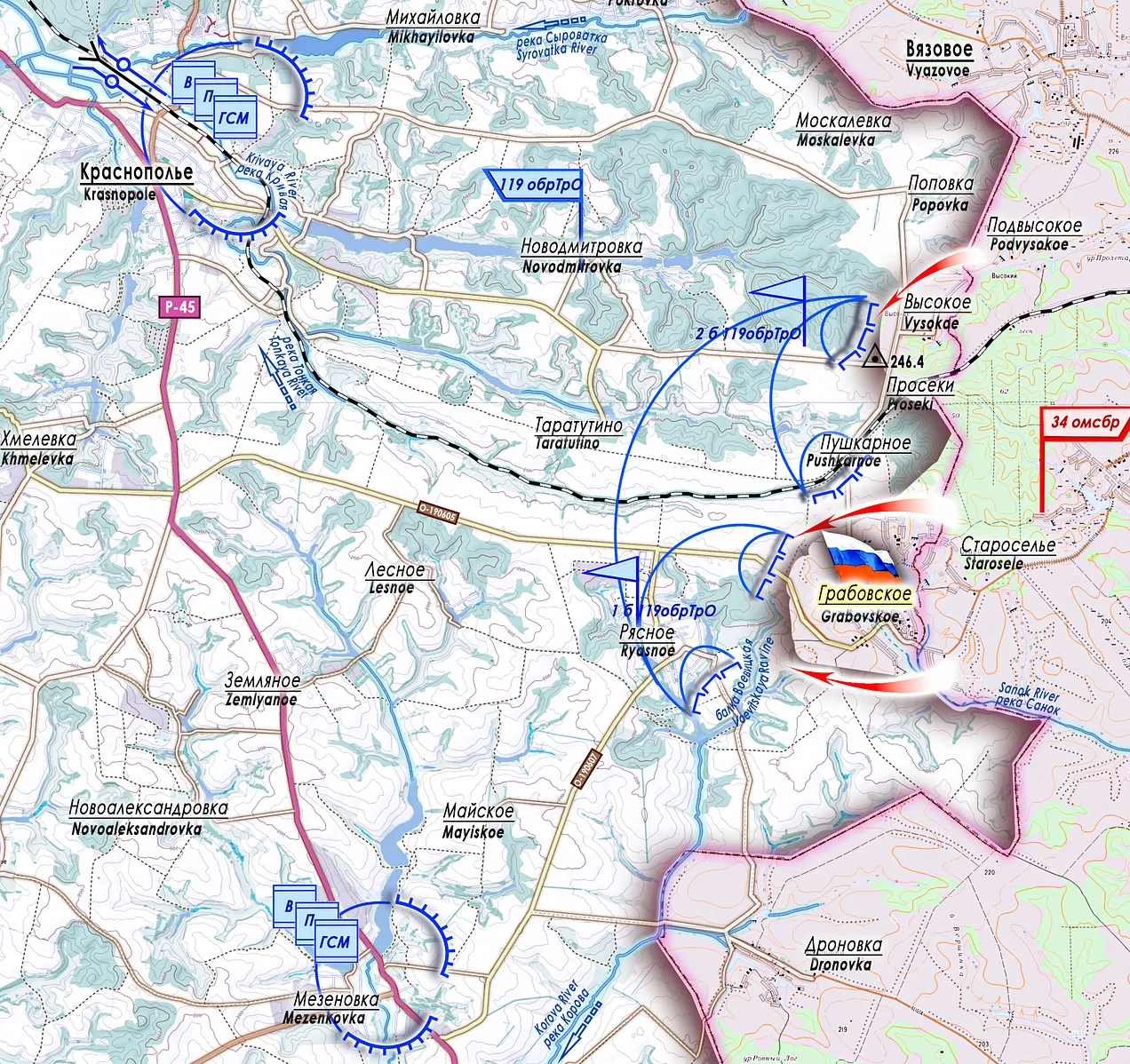
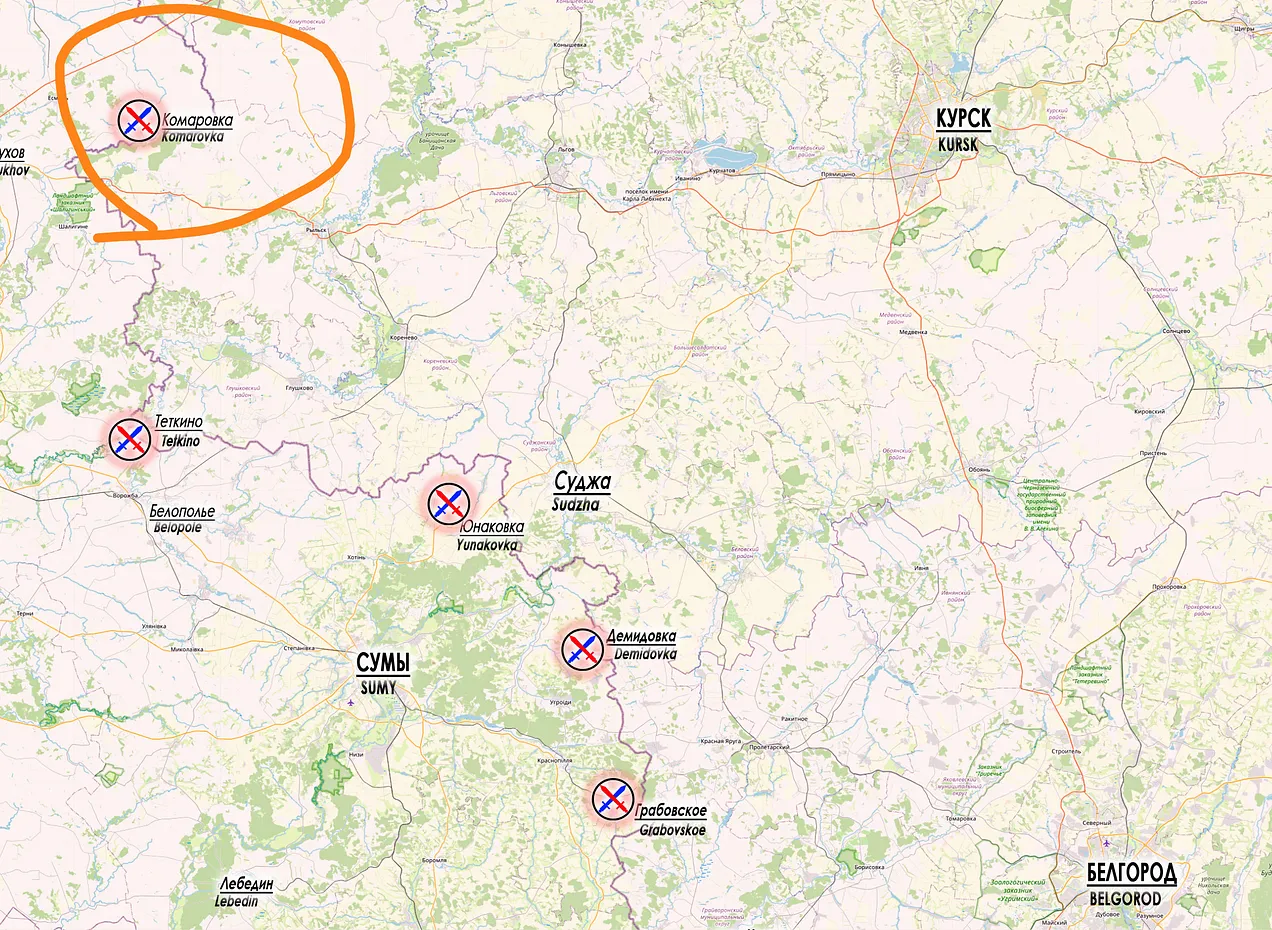
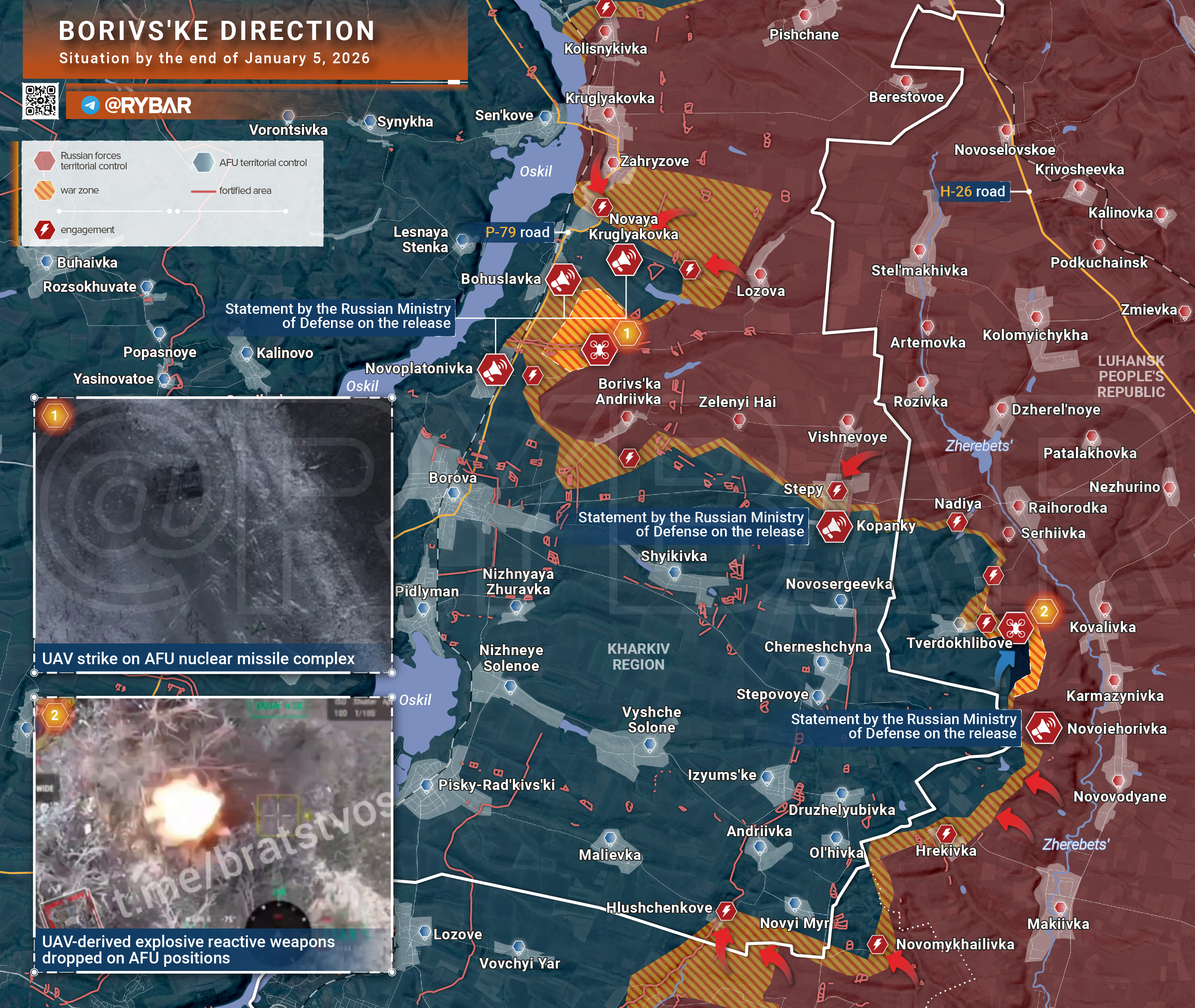
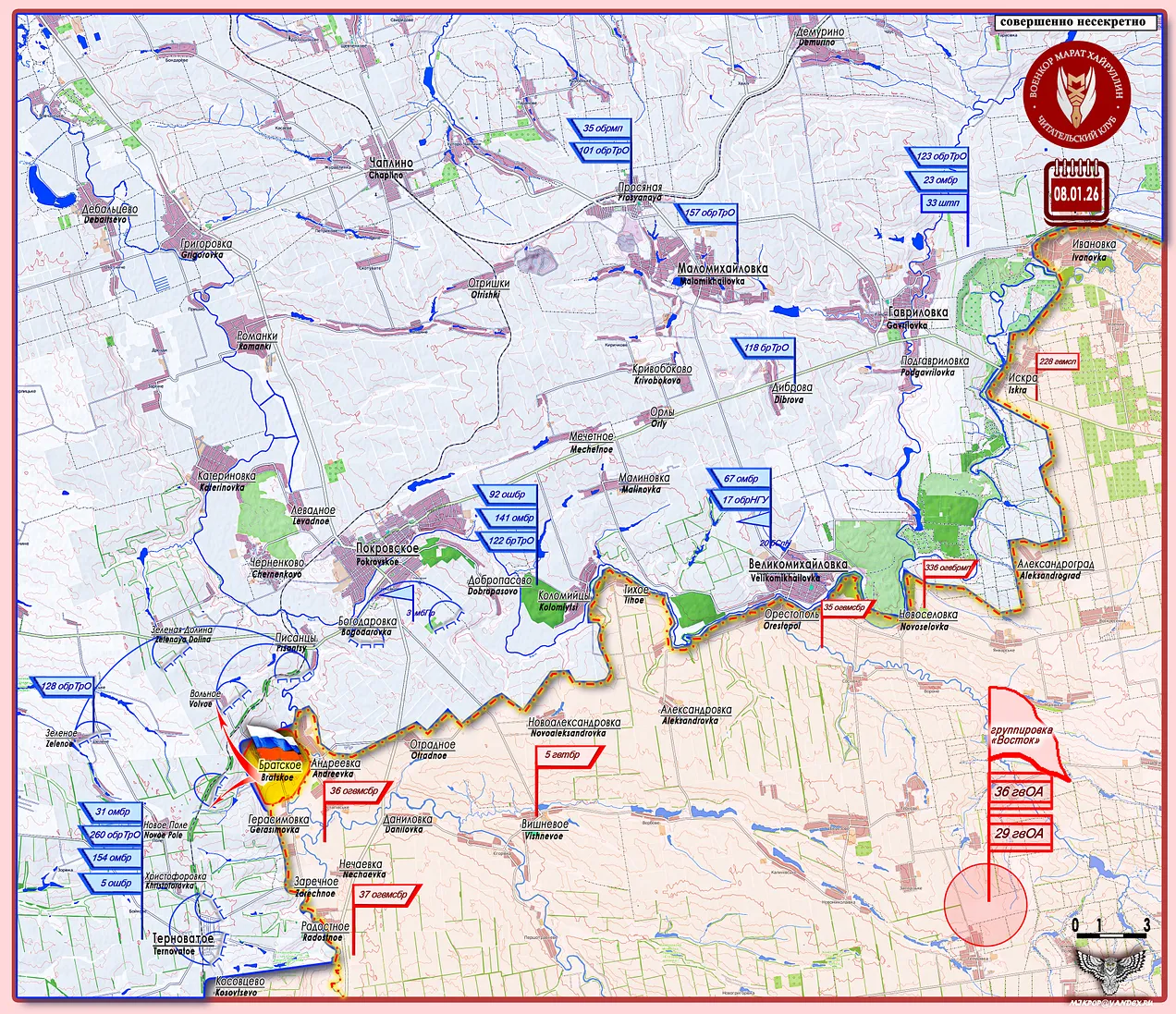
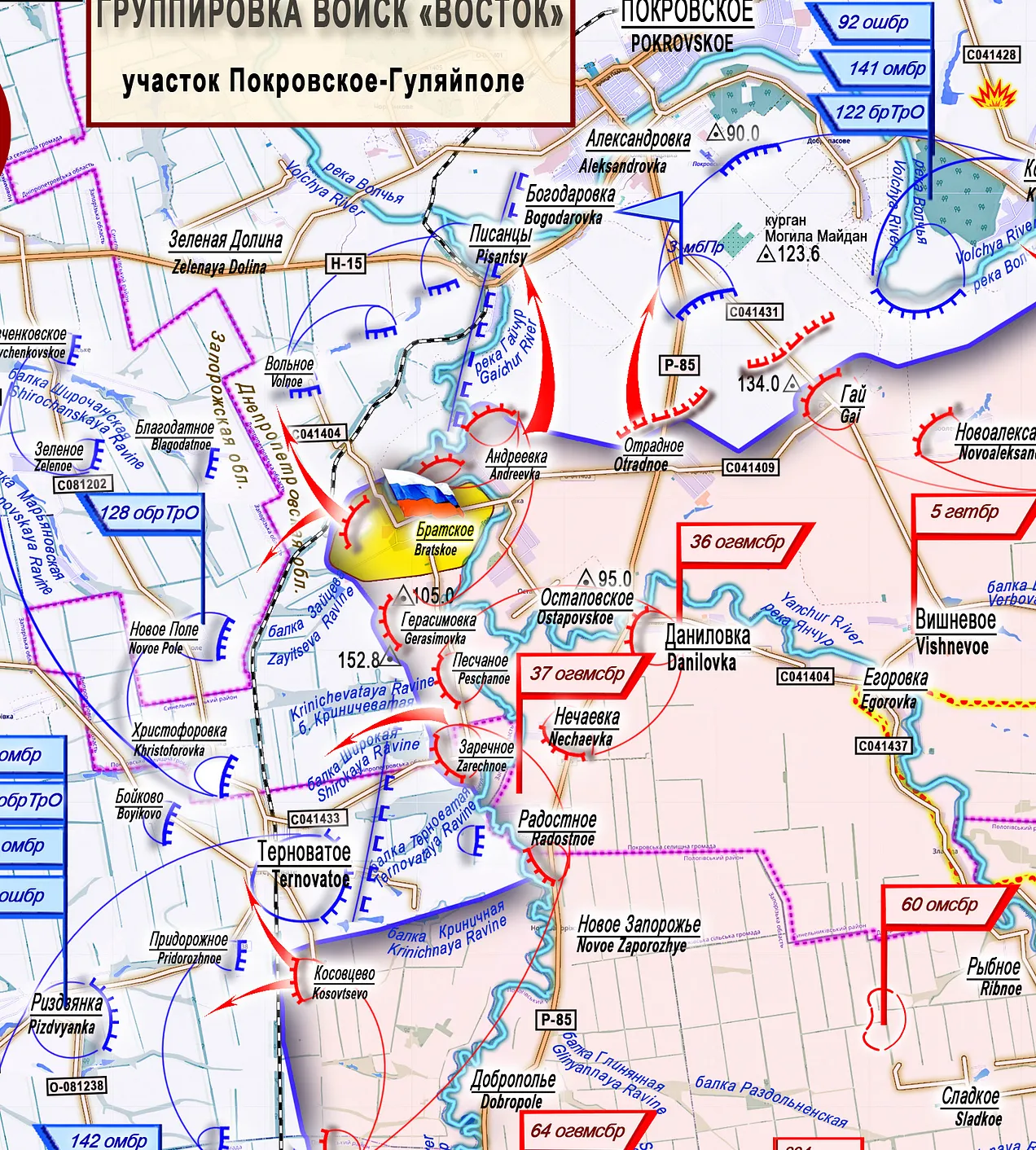
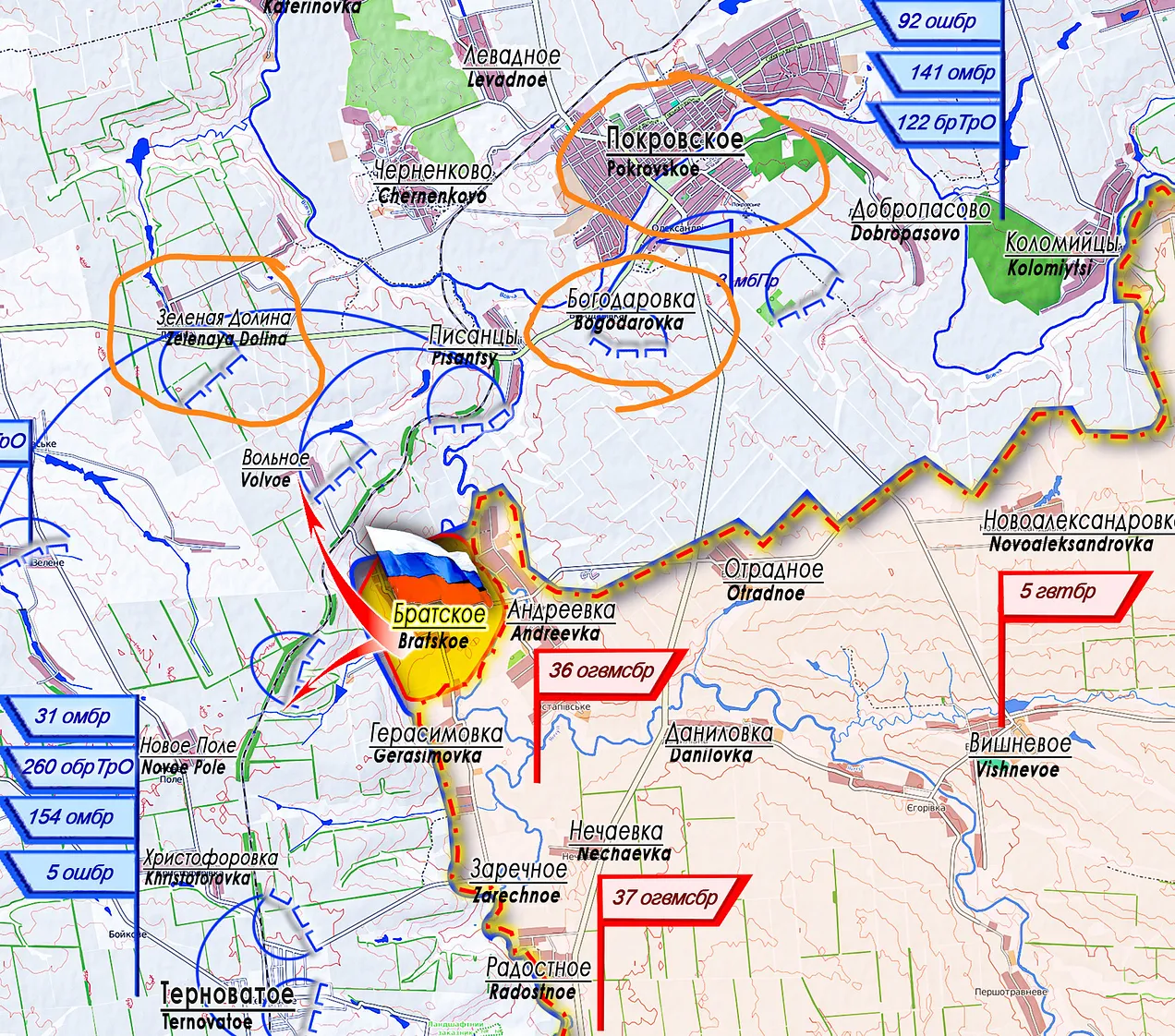
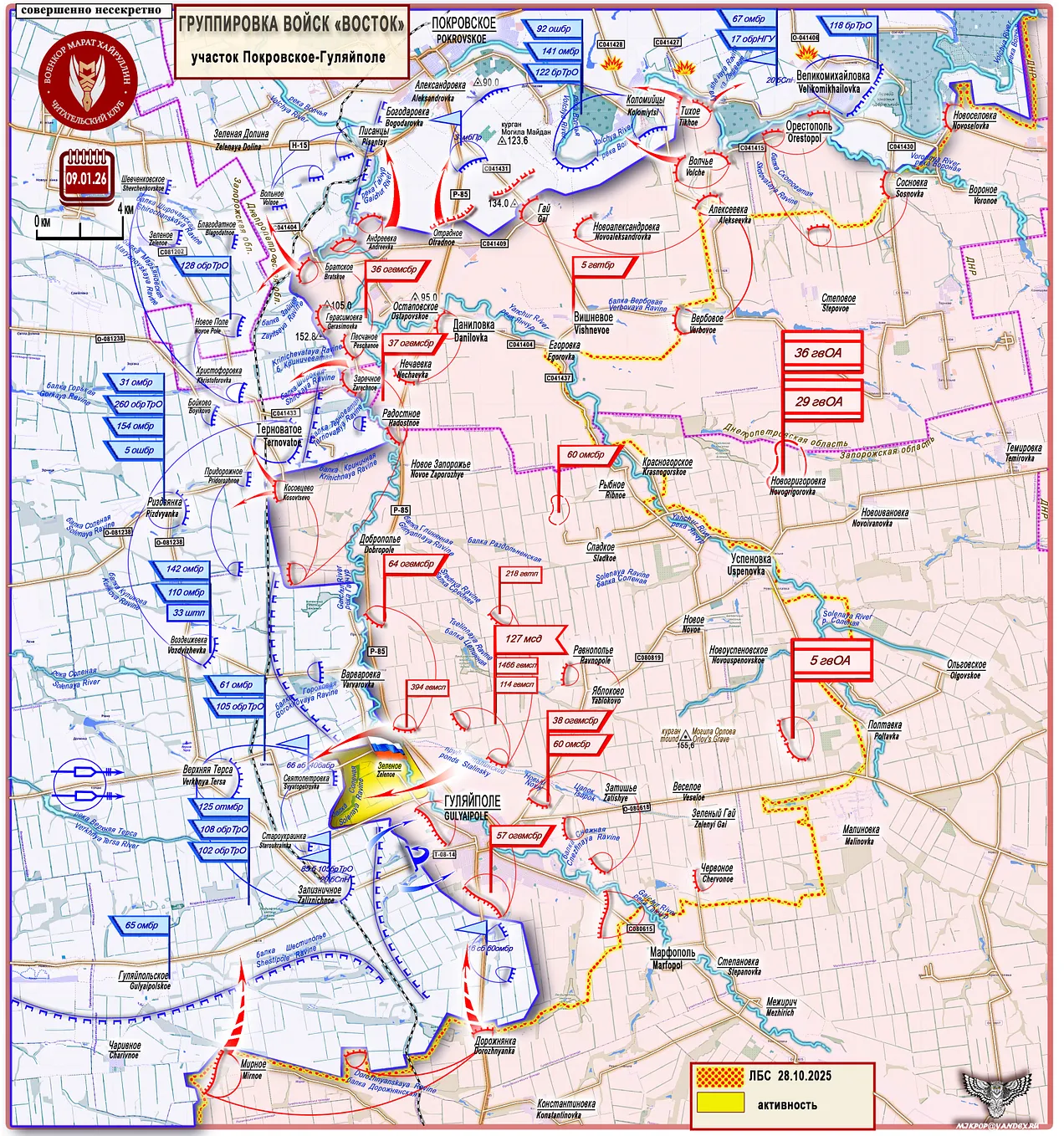
Brief Frontline Report – January 3rd, 2026

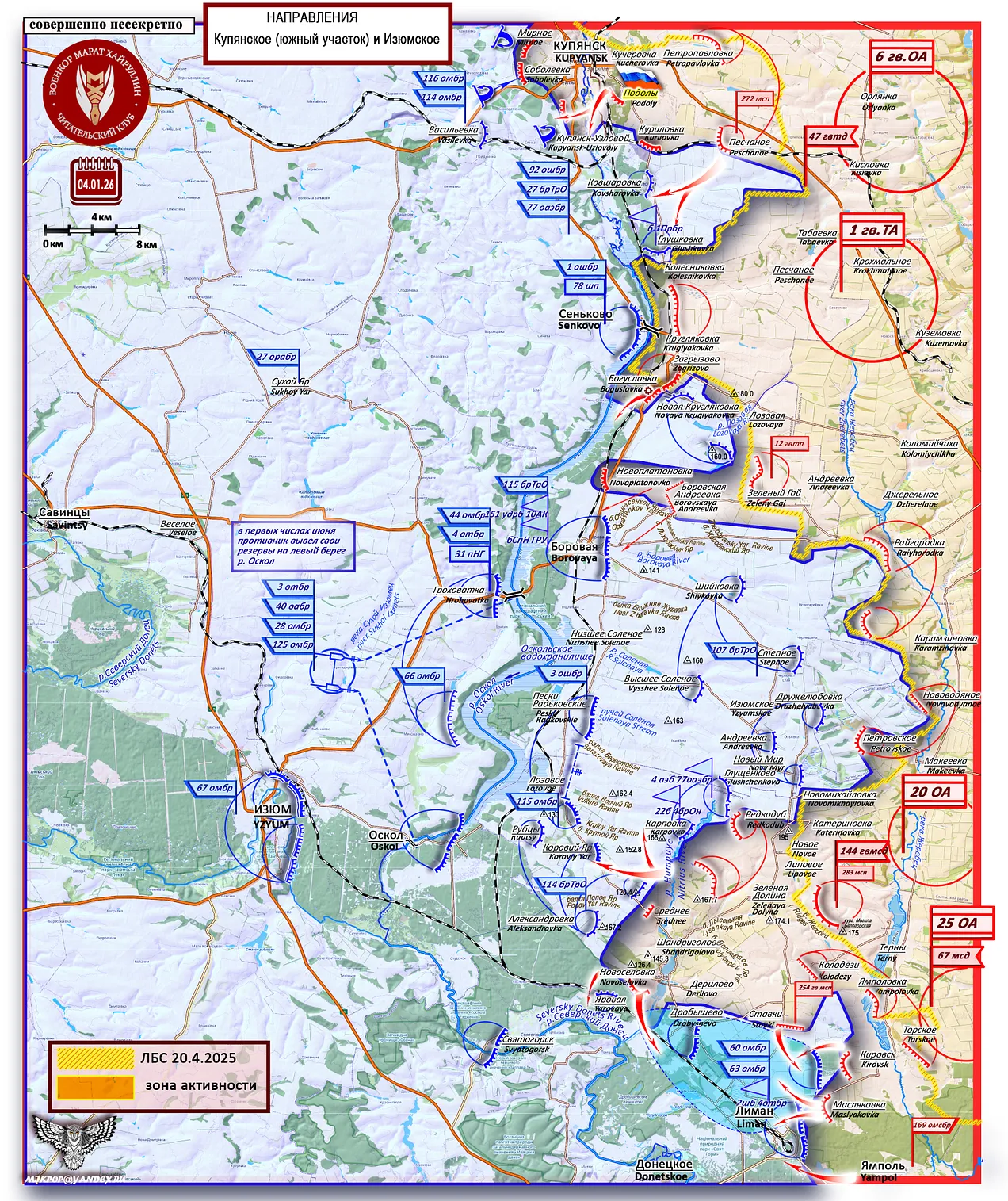
Summary by Marat Khairullin and Mikhail Popov.
Zinderneuf
Jan 03, 2026

Image
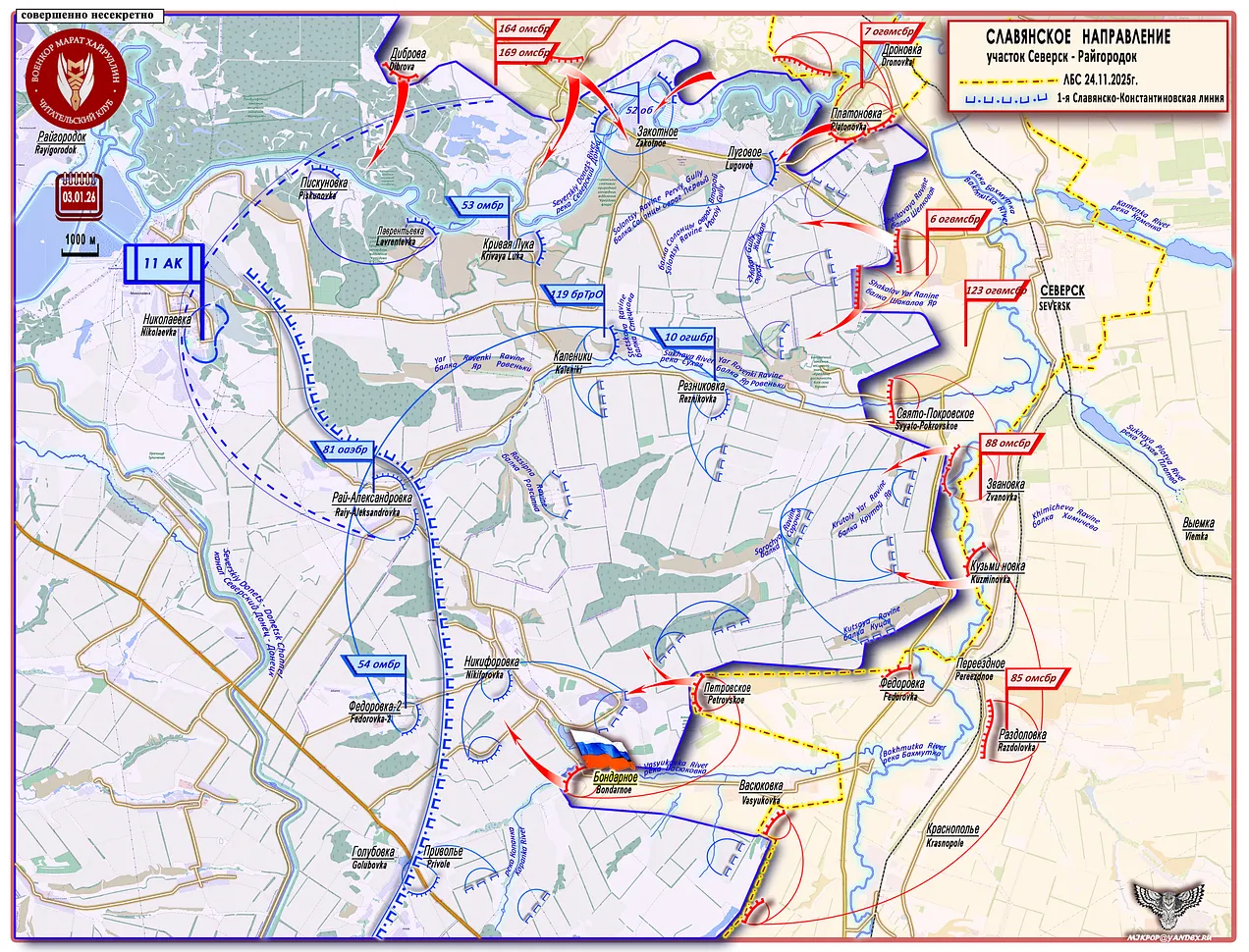
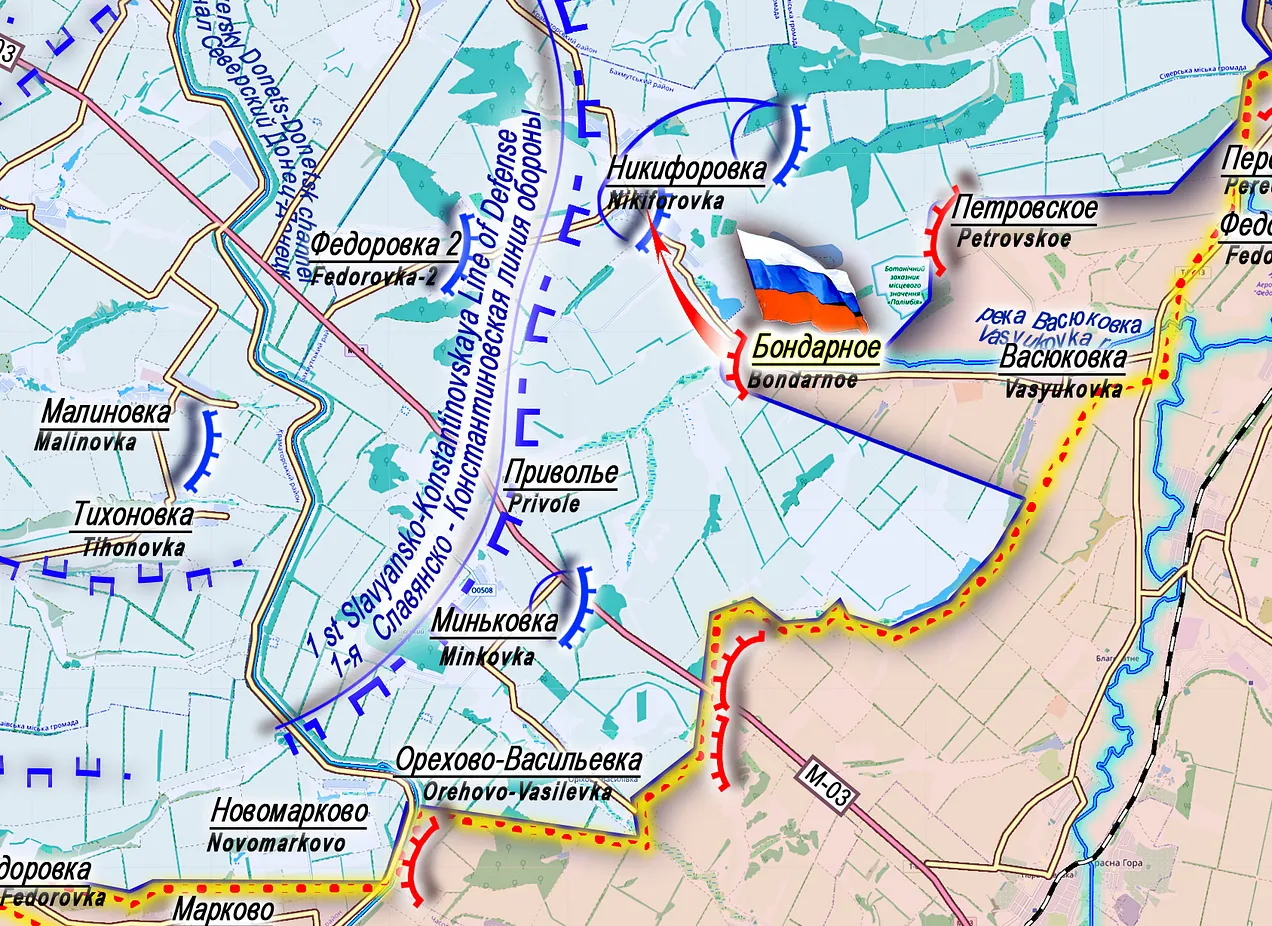
Slavyansk Direction; Area of Seversk to Raigorodok. Yellow line with dashes: Line of Combat Contact November 21st, 2025. Blue line with arches and dots: 1st Slavyansk-Konstantinovka Line.

Image
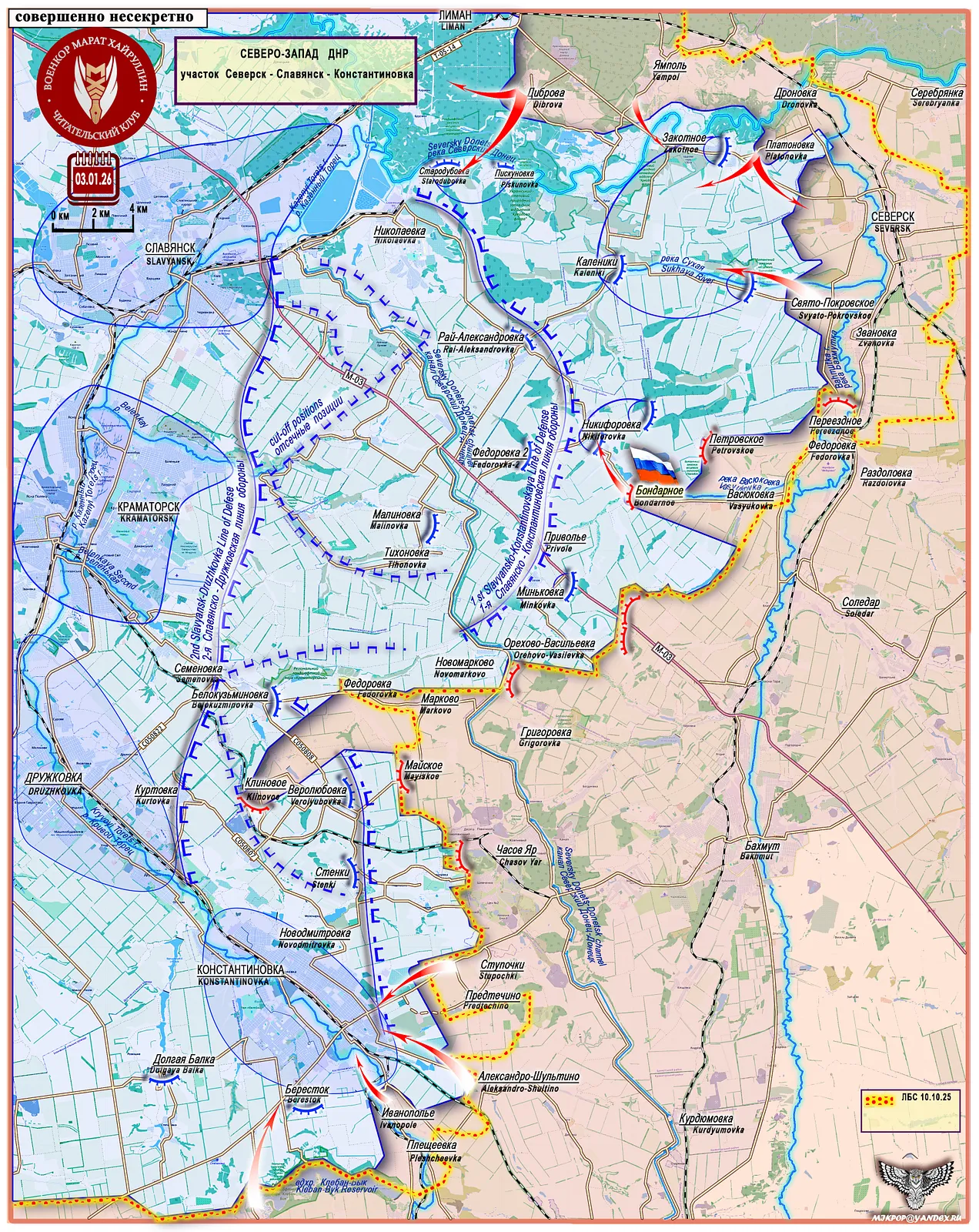
Northwest DPR; Area of Seversk - Slavyansk - Konstsntinovka. Yellow line with red dots: Line of Combat Contact October 10th, 2025.

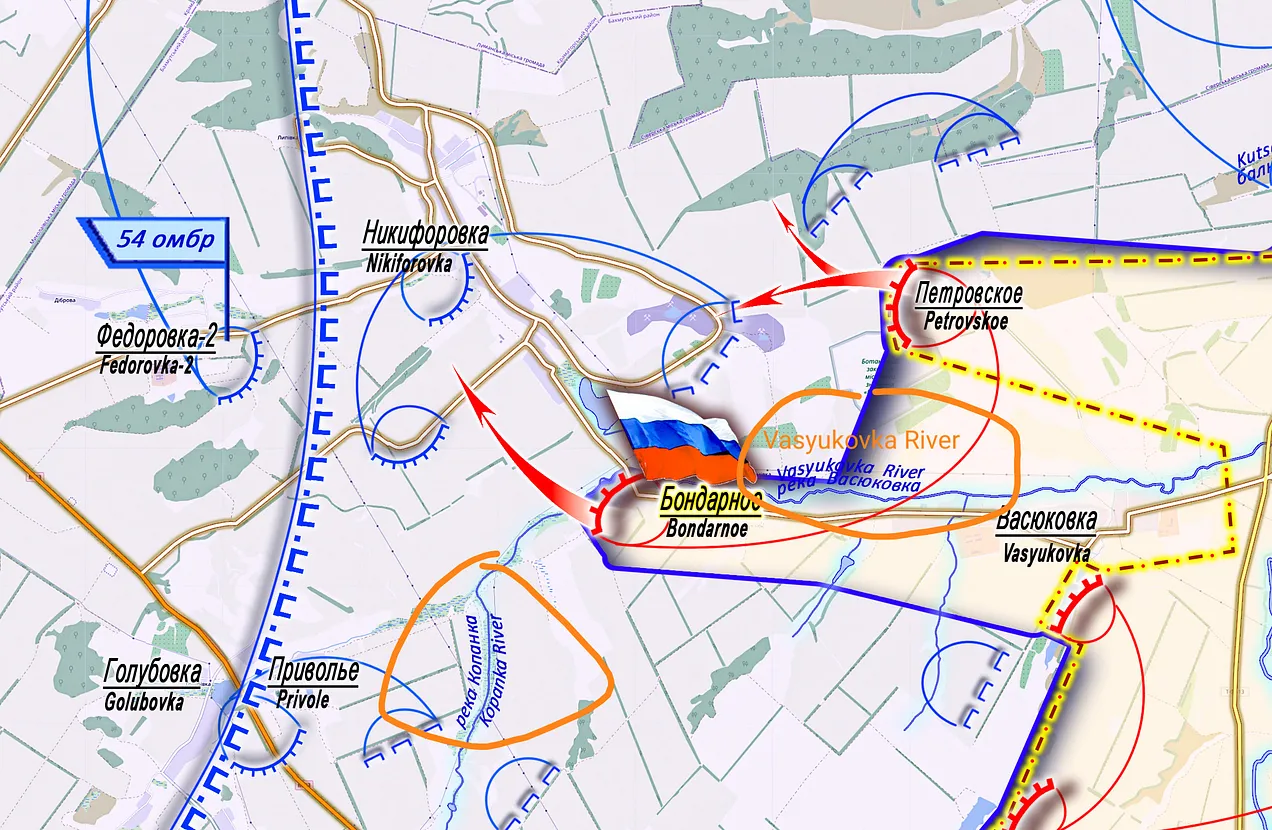
Message from the Russian Ministry of Defense: "Units of the 'South' Group, as a result of ongoing operations, liberated the populated area of Bondarnoe in the Donetsk People's Republic."

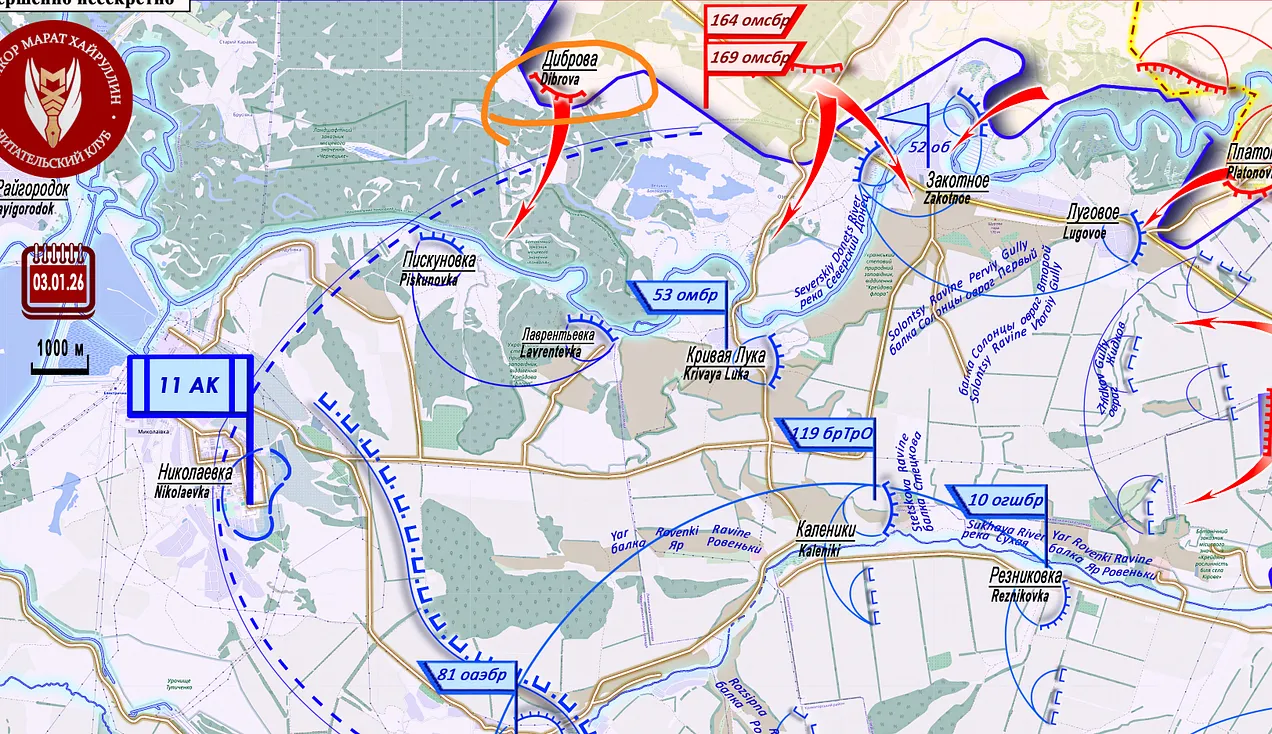
The Russian Armed Forces continue to establish a flank encirclement of the Seversk salient. After the liberation of the settlement of Dibrova (Dec. 29th 2025) on the right flank and the deepening of the northern base of the salient,

Image

the advance began in the center of the salient, along the Vasukovka River, in the direction of the AFU defense area of Nikiforovka- Fedorovka II, which controls a network of roads providing the first echelon of the enemy's defense.

On January 3rd, 2025, the settlement of Bondarnoe (48°44′36″ N, 37°55′47″ E, with a population of about 40 people in 2001) was liberated. It is located at the confluence of the Kopanka and Vasukovka rivers.

Image


The bridgehead in the center of the salient along the line of Petrovskoe - Bondarnoe is expanding. This bridgehead provides the Russian Armed Forces with freedom of action to cut off the Seversk salient in two directions: to the northwest to Nikiforovka- Fedorovka 2 and to the southwest to Privole- Minkovka.

Image

https://maratkhairullin.substack.com/p/ ... anuary-3rd

******

Zelenski’s Choice As New Head Of Office Moves Scale Towards Peace

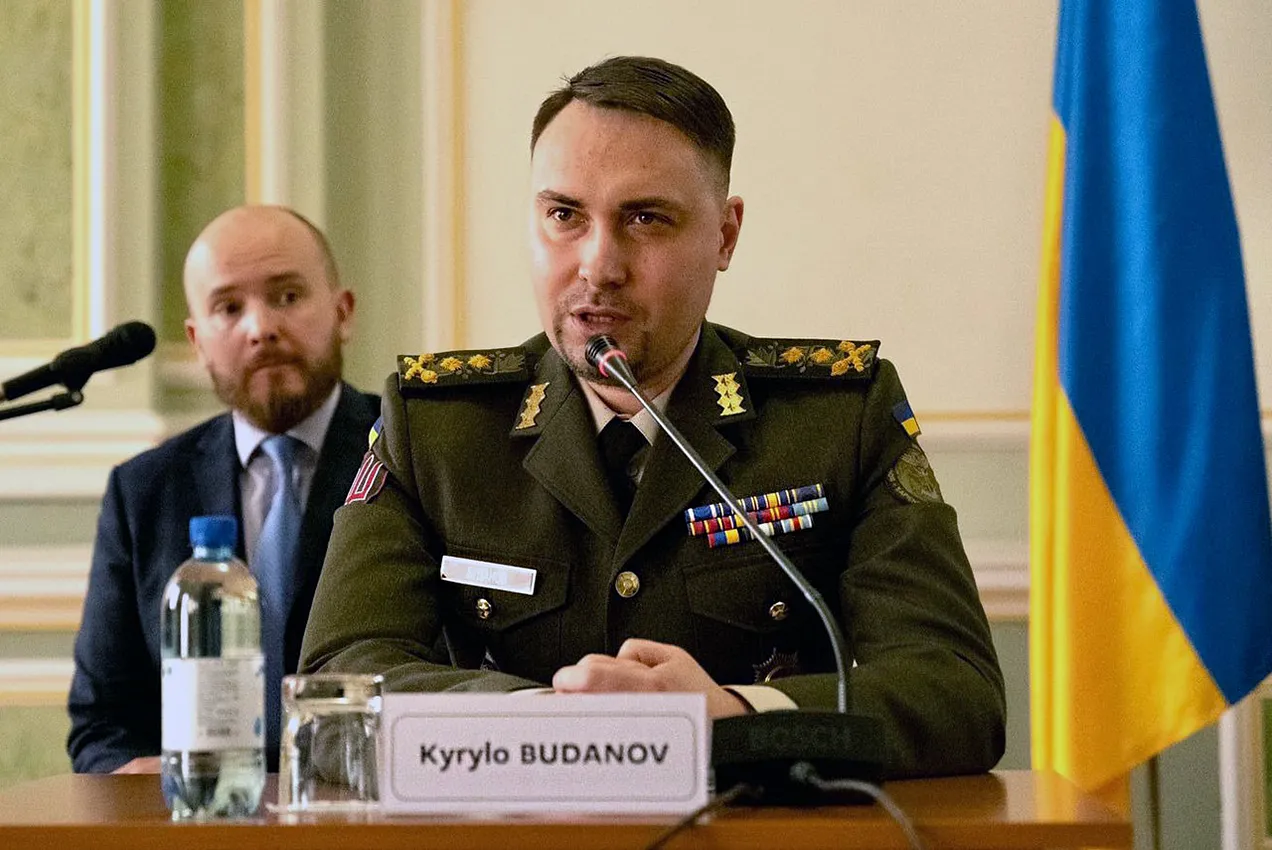
The acting president of Ukraine Vladimir Zelenski has made an interesting choice by filling the position of his chief of staff with the head of Ukraine’s Military Intelligence Service (GUR) General Kyrylo Budanov.

Zelensky Asks General to Replace Chief of Staff Ousted in Graft Scandal (archived) – NY Times, Jan 2 2026

President Volodymyr Zelensky of Ukraine said Friday that he had asked Kyrylo Budanov, the head of the country’s military intelligence agency, to be his new chief of staff, filling a weekslong vacancy left by the resignation of Mr. Zelensky’s right-hand man over a corruption scandal.


Budanov has accepted his new position.

He is a live long military intelligence man with personal battle experience. He once led a CIA trained unit which in 2016 tried to attack Russian positions in Crimea. He was wounded on several occasions and the CIA once flew him to Washington for rehabilitation in the Walter Reed National Military Medical Center. The GUR under Budanov has been the main conduit for executing CIA terror attacks in Russia.

The NY Times continues:

Mr. Budanov has been seen as a potential rival to Mr. Zelensky as the United States and Russia call for elections in Ukraine. Bringing the general into the presidential office could complicate any run by Mr. Budanov for the presidency.

In announcing his intention to appoint him, Mr. Zelensky said that Ukraine “needs greater focus on security issues,” the development of its defense and security forces, and further progress on the diplomatic track of negotiations.


The NYT is right in claiming that Budanov has been seen as a potential rival to Zelenski. But the bigger rival to Zelenski is the former commander in chief General Valeri Zaluzhny who was moved aside as ambassador to Britain but could come back to run against Zelenski in upcoming elections.

Lifting Budanov to the informal number two position in Ukraine might have a different purpose than blocking a rival candidate. It is highly questionable that Zelenski will survive in his position until the end of 2026.

When Zelenski leaves office he will be endangered by various forces. He could go to jail for this or that corruption scheme run through his office, or he could be killed for ‘treason’ by one of the ‘nationalist’ extremist formations.

But if Budanov were anointed as his successor Zelenski could sleep well. It would be a deal similar to the one the former Russian president Yelzin made in 1999 when he anointed Vladimir Putin in exchange for protection.

In two days Budanov will celebrate his 40th birthday. His career has only just started.

One aspect of interest here is the rivalry between the CIA and its British MI-6 competition. Yermak, the ousted former head of Zelenki’s office, had good relation with MI-6. Zaluzhni is likewise seen as a British intelligence asset. Budanov in contrast is a CIA figure. The U.S. would like to shut down the war, at least for now. The British have tried to prolong it. In his new position Budanov can move the scale towards the U.S. favored outcome.

Budanov has been warning cryptically for some time that Ukraine will lose the war against Russia. He will now take the role of the de facto chief negotiator of a peace deal.

The Russians will not like to have to deal with someone who has supervised the killing of Russia civilians. On the other side they will acknowledge that Budanov is a competent and resourceful soldier. The various exchanges of prisoners were negotiated with him. It will be easier to work with him than with some scheming lawyer. Budanov is thus well positioned to make some kind of peace deal with Russia.

Through his position as head of the GUR Budanov has control over several powerful ‘nationalist’ formations who fight under the GUR banner. This will make it easier for him to sell a peace deal within Ukraine and to suppress any forces which want the war to continue.

Posted by b on January 2, 2026 at 15:15 UTC | Permalink

https://www.moonofalabama.org/2026/01/z ... l#comments

******

SITREP 1/2/26: Odessa Pressure Peaks, as Zelensky Announces Major Senior Staff Reshuffle
Simplicius
Jan 03, 2026

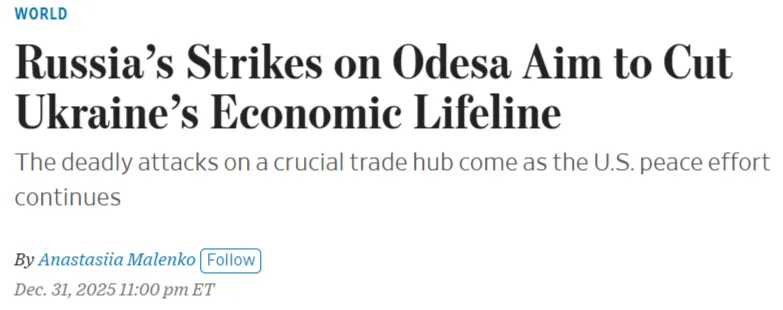
MSM rags are beginning to cover the ‘urgent’ situation surrounding Ukraine’s Odessa, which I had alluded to in the last article. Ukraine hit a few Russian ships and Russia’s escalation has been shutting Odessa down to the point where the MSM is beginning to mutter about the potential of it being completely cut off from the sea:

Image
https://www.wsj.com/world/russia-ukrain ... s-7ca1dc6a

The article seems to solve the mystery of why Russia had suddenly begun attacking railways all around Odessa region:

Around 90% of Ukraine’s agricultural produce is exported by sea, according to the Ministry for Development of Communities and Territories of Ukraine, which estimates that six ports in the Odesa region handled about 76 million tons of cargo over 11 months of 2025. Ukraine has learned to safeguard this trade by using naval drones to keep at bay Russia’s Black Sea Fleet.

Since 90% of Ukraine’s staple agricultural exports leave by sea, that means for Russia to shut down the ports with strikes leaves Ukraine scrambling to desperately get product out by rail. Hitting the railways also essentially blocks the last possible route and leaves Ukraine without options.

The result is that one of Ukraine’s largest and most vibrant cities is under a form of siege. Odesa’s people have lost light, heat and running water for days as winter set in and temperatures hovered around zero. It is especially vulnerable to Russian assaults on its power grid as it produces little of its own, relying on imported power instead.

Image

The attacks on Ukraine’s rail have caused massive damage according to Ukrainian state railway authority:

State railway company Ukrzaliznytsia, for instance, estimates that attacks on the rail network have caused $5.8 billion in damages since the start of the war, recording more than 1,100 attacks on its infrastructure in 2025 alone.

Even as of this writing, there is an ongoing mass Russian drone strike on the neighboring Nikolayev region, reportedly on energy facilities with outages already being documented.

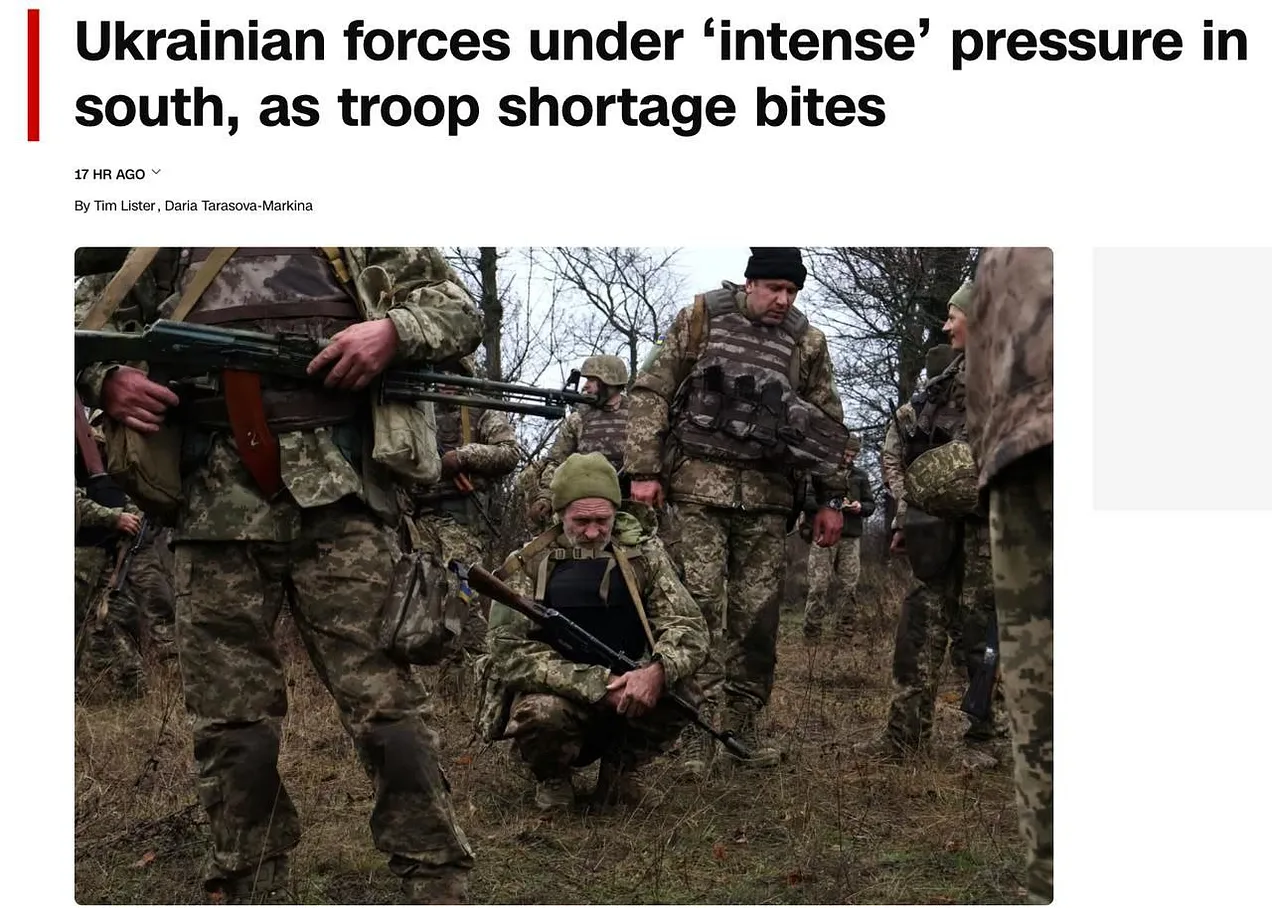
At the same time, CNN rings in the year with a dismal report about Ukraine’s collapsing southern front, where the Russian ‘Eastern Express’ continues to bulldoze through years’ worth of fortifications at a record clip:

Image
https://www.cnn.com/2026/01/01/europe/u ... hzhia-intl

Ukrainian forces are under growing pressure in the south of the country, where less well-equipped units are vastly outnumbered by Russian brigades that have taken hundreds of square kilometers of territory in recent weeks.

On this front, Ukrainians have resorted to desperate PR tactics to maintain an image of—well, anything other than total collapse. They continually strive to plant flags via drones in order to buy even a day or two of extra ‘hope’ for their demoralized troops.

CNN unabashedly continues the spin cycle with the implication that Russian advances come at great ‘cost’ all while again being forced to admit that Ukraine is in dire troop shortage:

What happened in Huliaipole goes to the heart of the Ukrainian military’s dilemma. Its troops are vastly outnumbered along some parts of the 1,000-kilometer front line and are struggling to mobilize additional forces to compensate for losses, according to several commentators.

“That means commanders must make hard choices about where to attack, where to defend and where to hope the Russians don’t exploit gaps in Ukrainian lines,” wrote analyst David Axe on Wednesday.


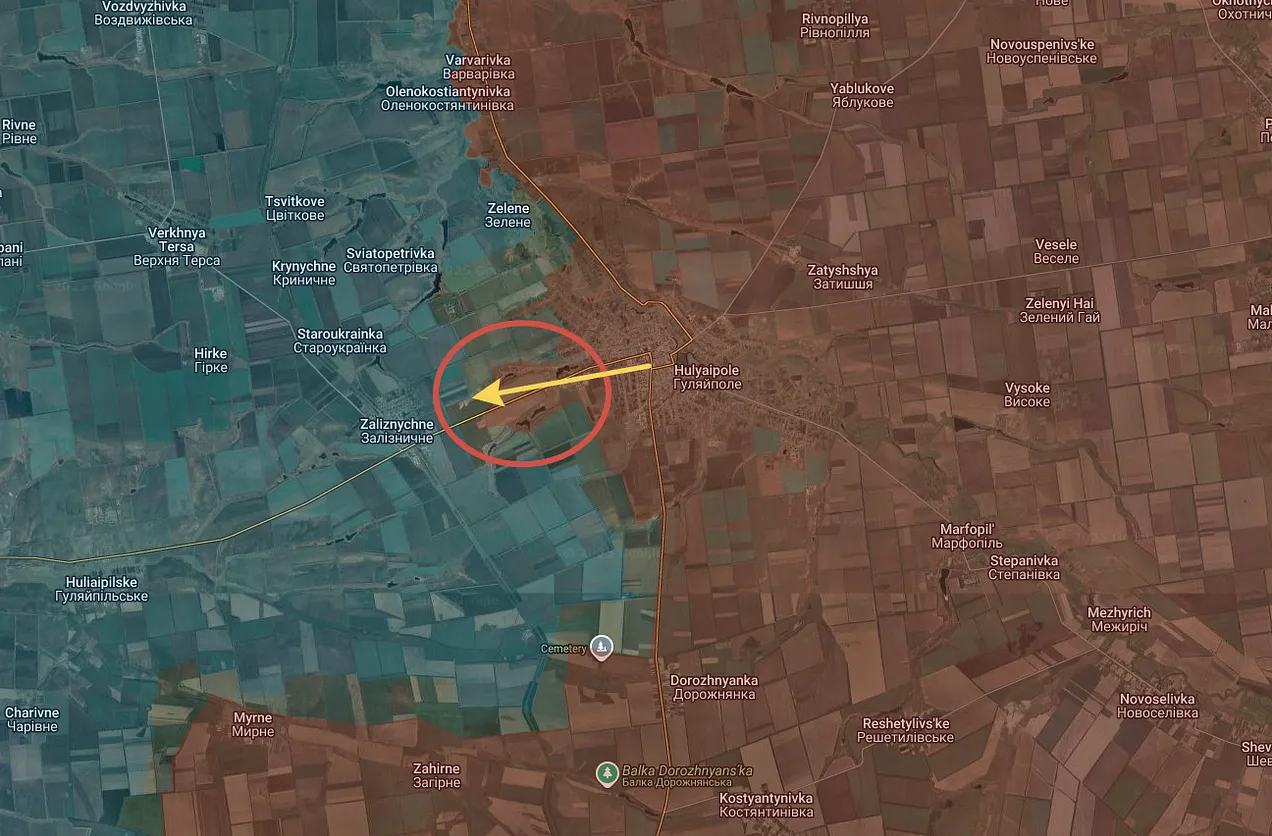
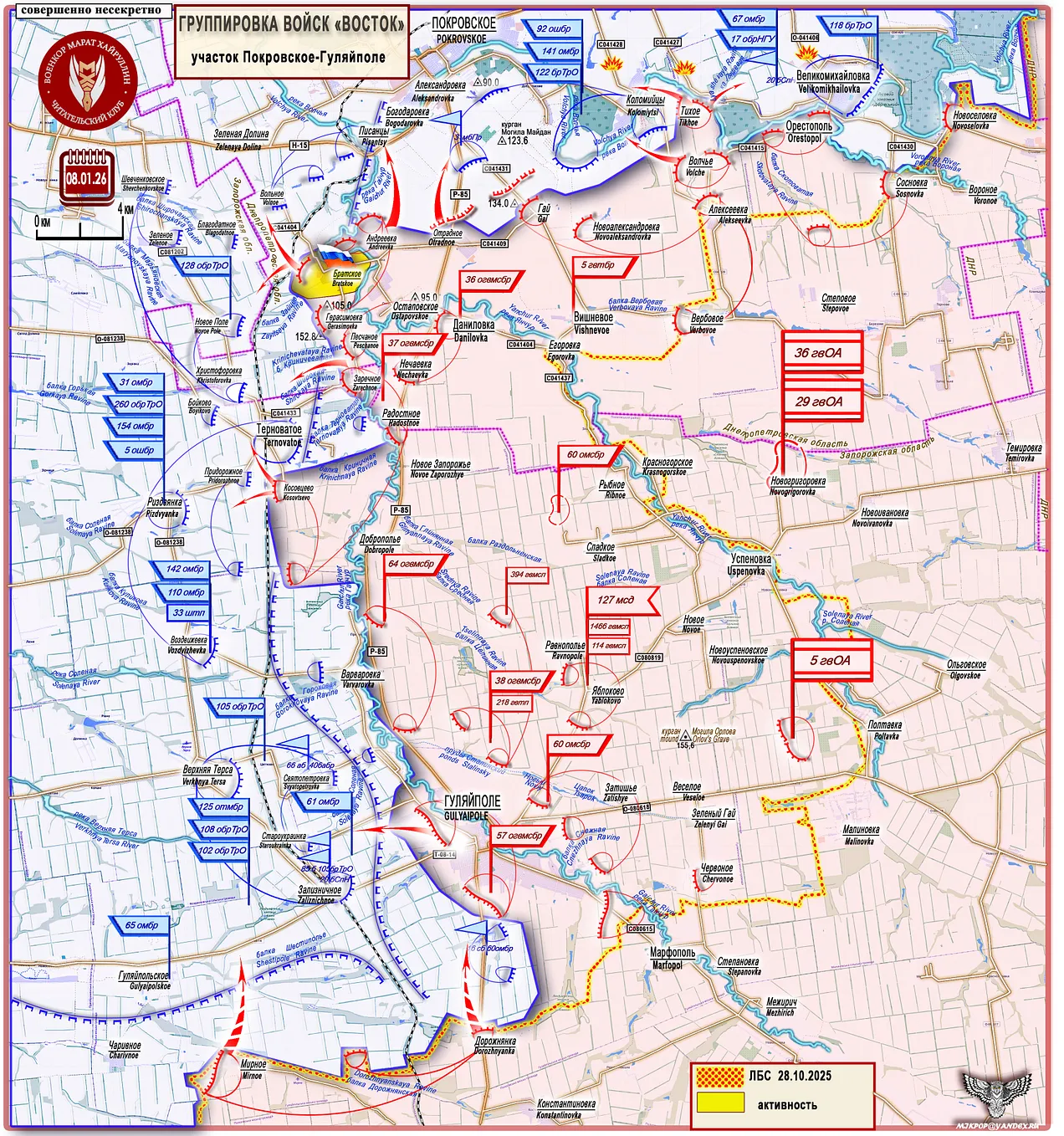
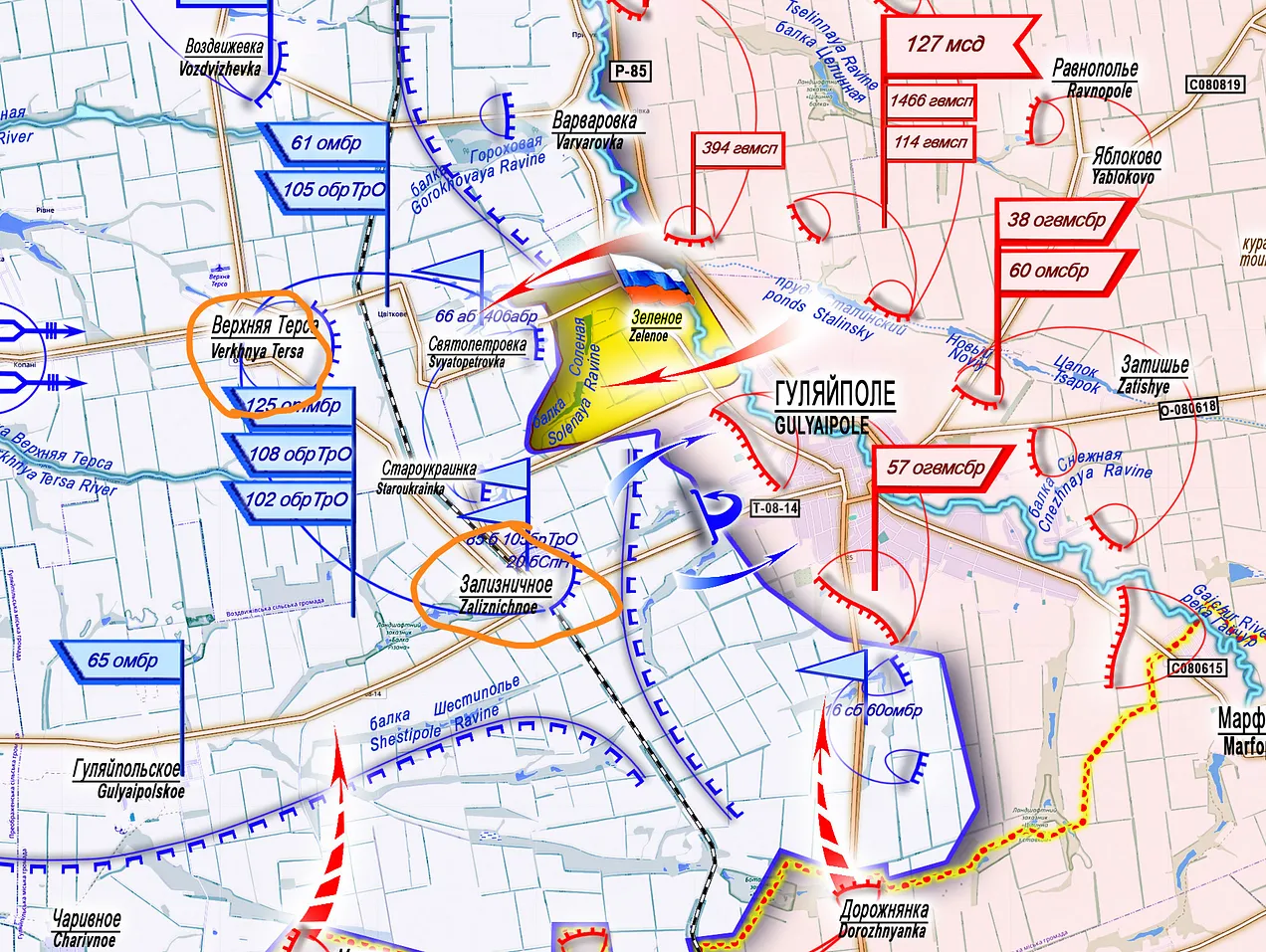
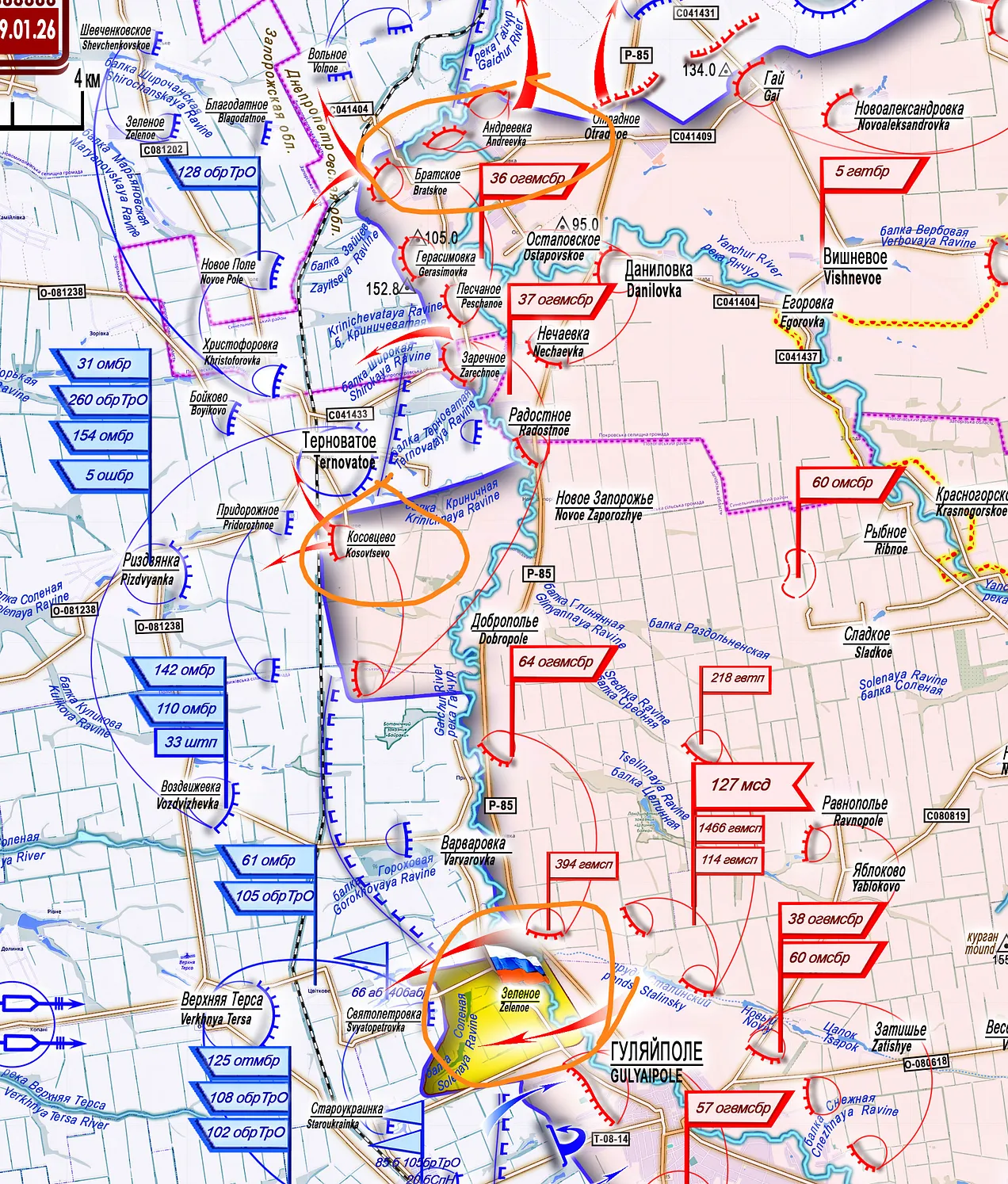
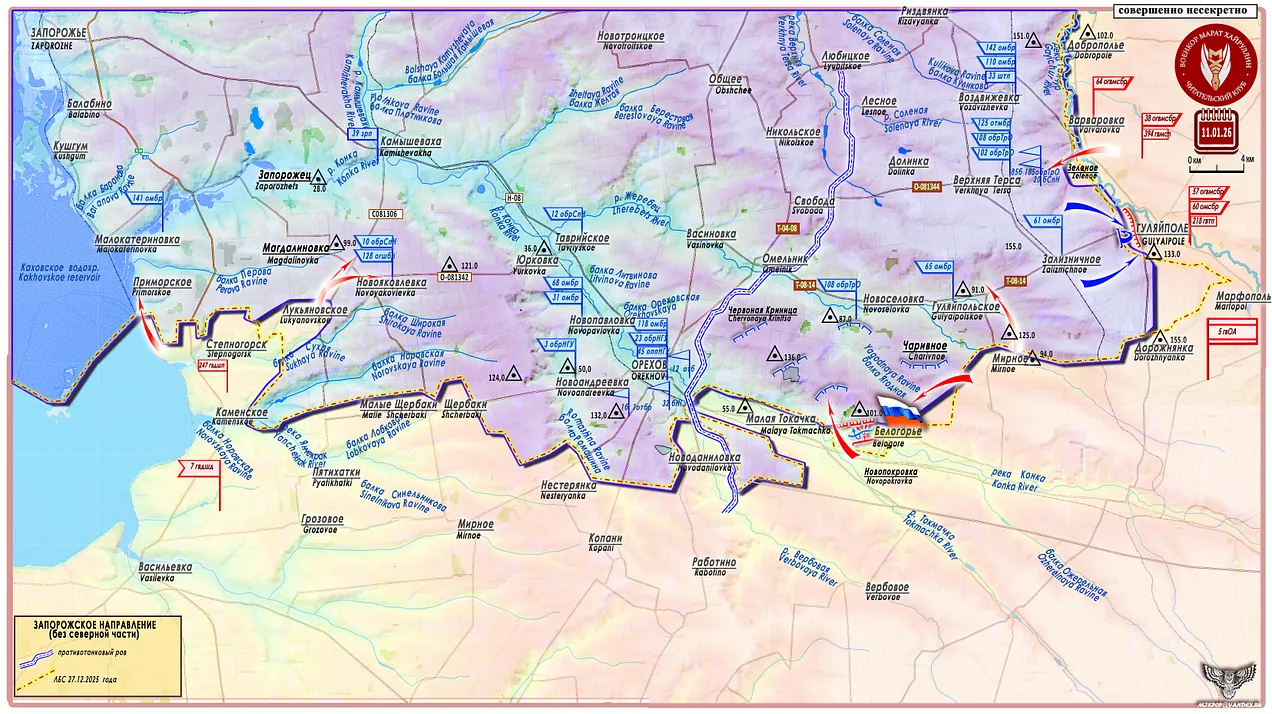
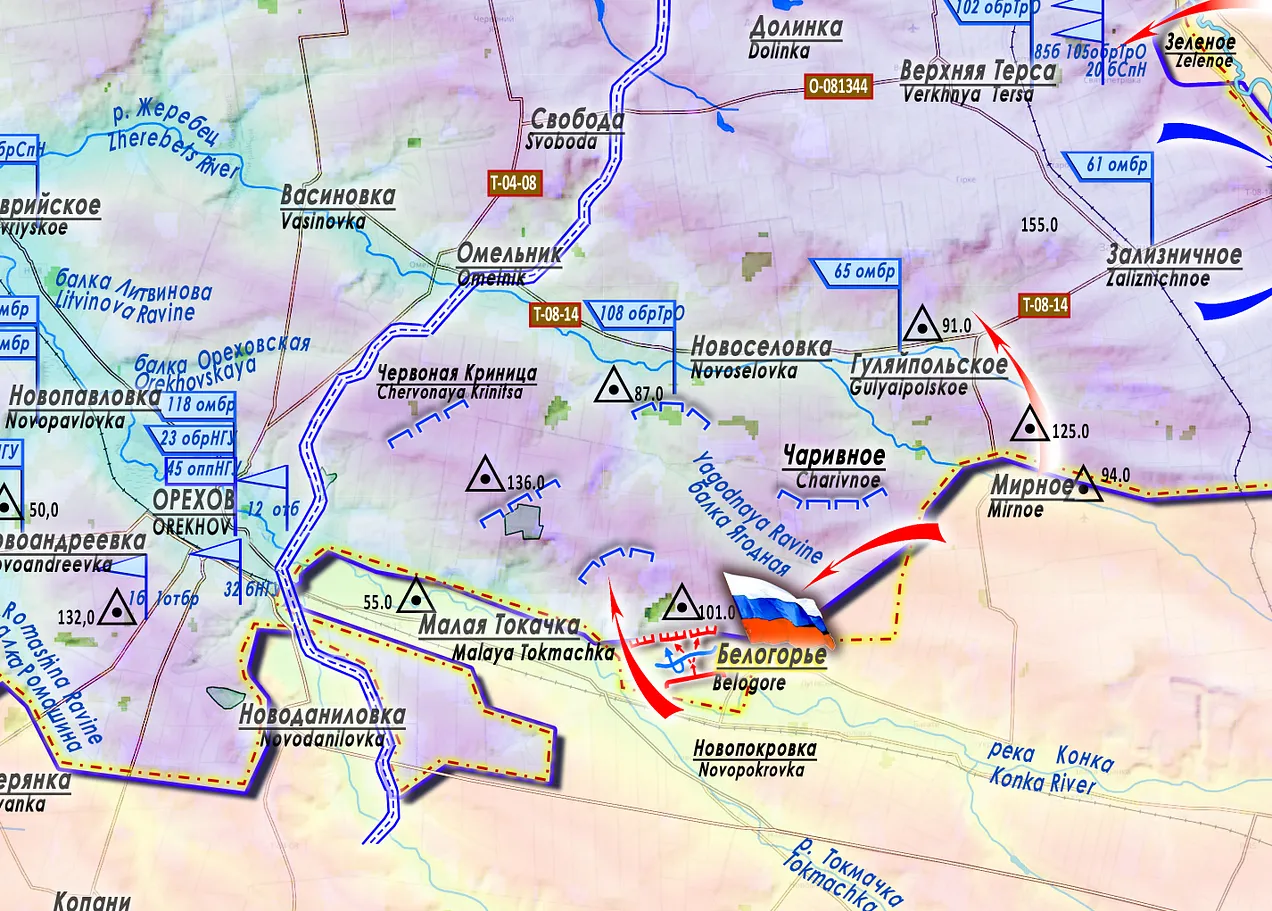
And yes, owing to that shortage, Russian forces have already stormed out guns-blazing from western Gulyaipole into the fields toward the next objective of Zalizhnyche:

Image

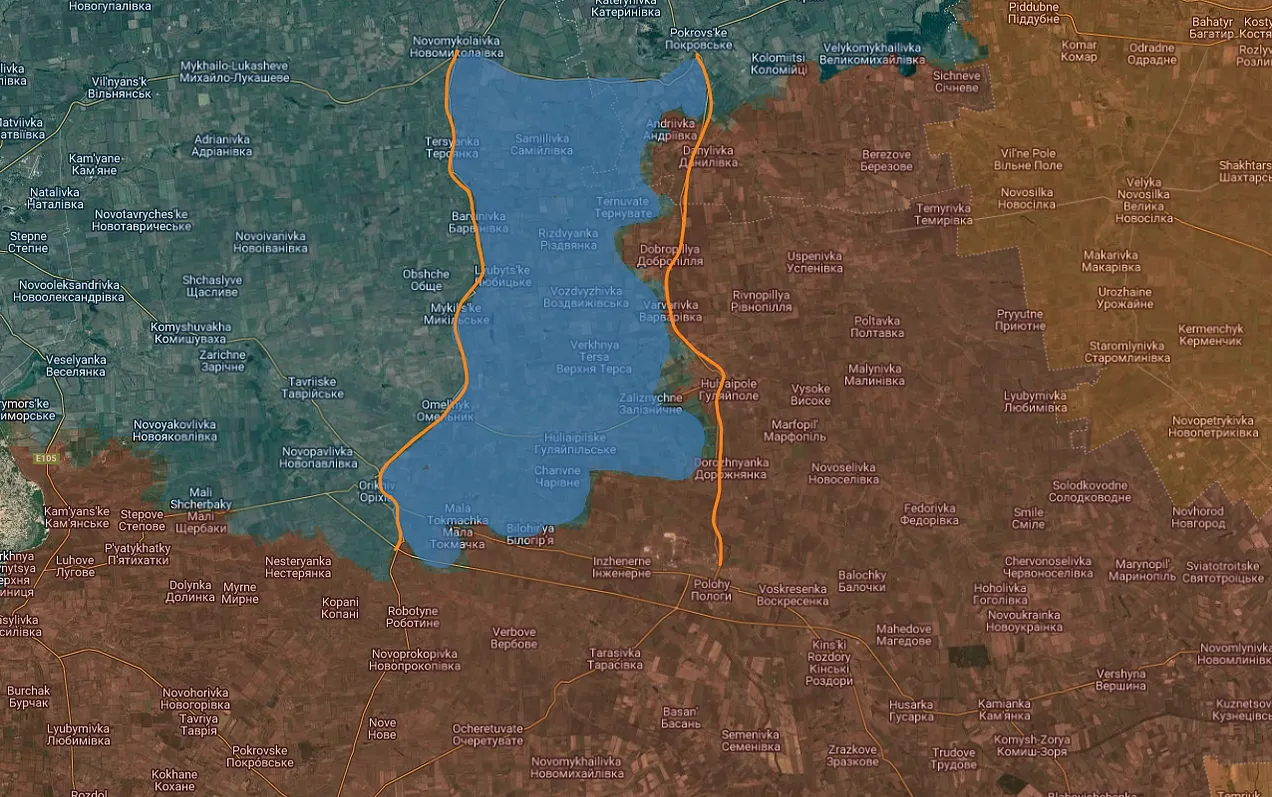
Recall that I said each defensive block between major logistics routes (orange lines below) is taking Russia about 2-3 months to pass. The next one I had estimated could go even much faster than that. You can see below that only a week and change after that and Russia has already broken out of the starting blocks of the first line toward the second and is making good timing to capture the blue shaded area within the next 2-3 months or less:

Image

Now pro-Ukrainian channels report that Russia is activating the Konstantinovka front after it had remained somewhat dormant for the duration of the Pokrovsk-Mirnograd capture:

Difficult in the whole Kostyantynivka direction. There seems to indeed be a serious Russian activation in the direction, according to preliminary information things aren't going well for Ukrainian forces.
More information later.


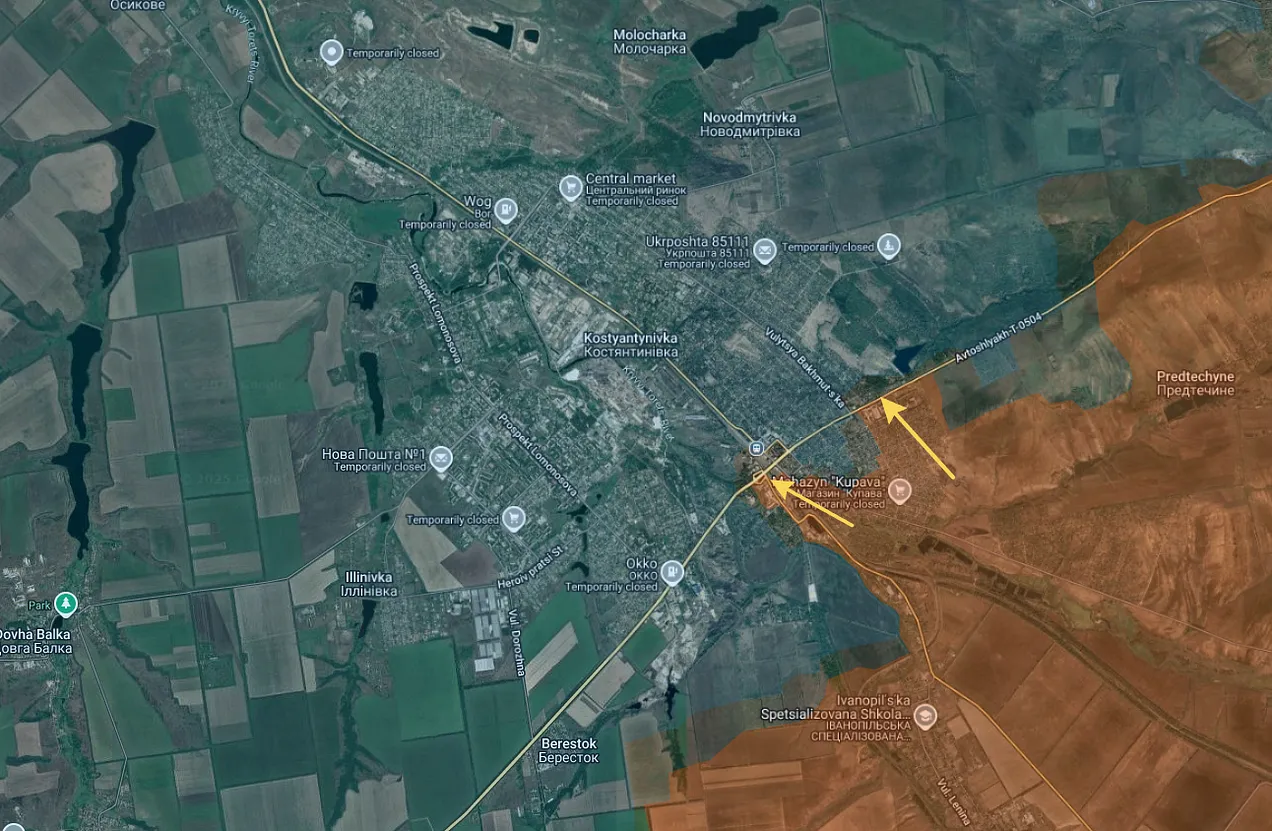
Thus far cartographers haven’t noted any major spearheads, but Russian positions inside the eastern parts of the city have apparently been consolidated from ‘gray zones’ in preparation for new advances:

Image

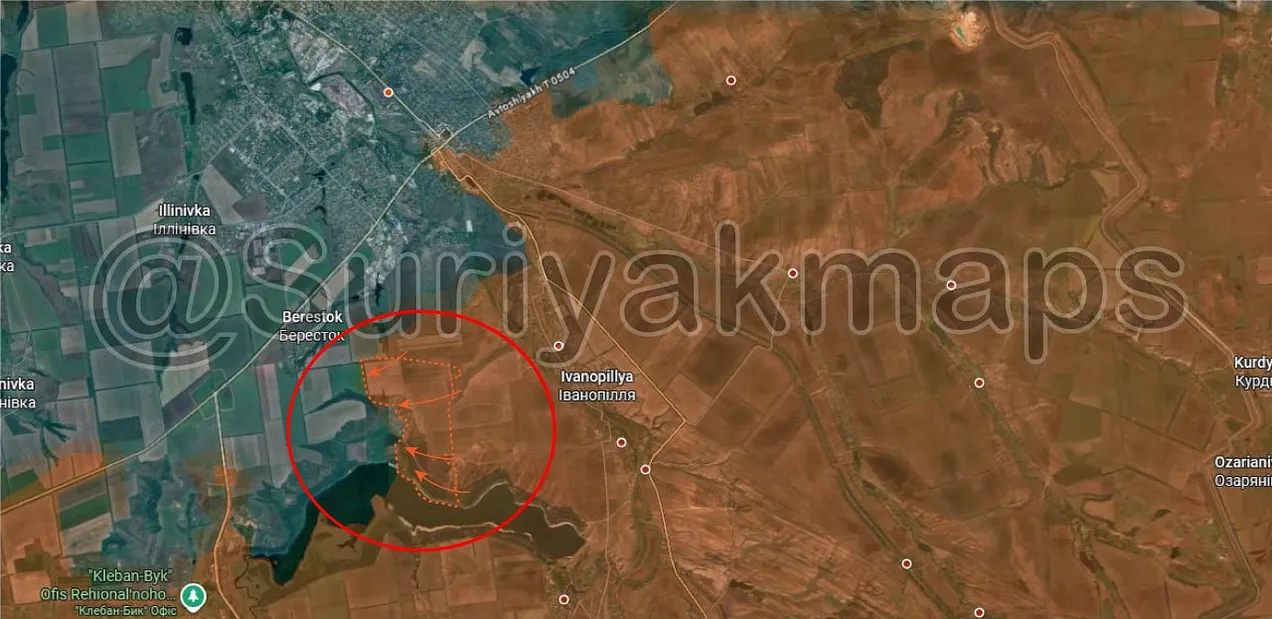
And in fact, as per Suriyak, more territory along the southern approaches to the city was captured yesterday:

Image

They may not be major advances, but they signal the re-activation of this front which means Russian command may have re-prioritized resources away from now-captured Pokrovsk-Mirnograd to this sector in order to begin its capture.

Some might ask what it means, precisely, to redirect resources like this—shouldn’t Russia have enough troops on the front? Specifically, what it often means is that certain brigades which specialize in this type of urban combat may be redirected in order to minimize casualties. Instead of sending “regulars” into the heavily-fortified city in ‘meat assaults’, Russia has much fewer highly specialized forces which can be moved around from front to front.

Now that Pokrovsk-Mirnograd is captured and the outlying area is of a different terrain—fields and such—these specialized urban combat forces can be brought to other areas where their unique talents are more necessary. One example of such a unit is the Russian 76th Guards Air Assault Division, better known as one of Russia’s main VDV airborne forces. They had been called into Pokrovsk-Mirnograd only in the middle of December to accelerate the urban capture of the agglomerate; specifically from the 76th: the 104th Air Assault Regiment, 234th Air Assault Regiment, 237th Air Assault Regiment, 175th Recon Battalion, and possibly other elements.

Interestingly, Ukrainians had cried that the 76th was rushed from Zaporozhye region, which would have weakened that region. In reality, the Zaporozhye front is advancing faster than all other fronts combined, which sort of nullifies that theory.

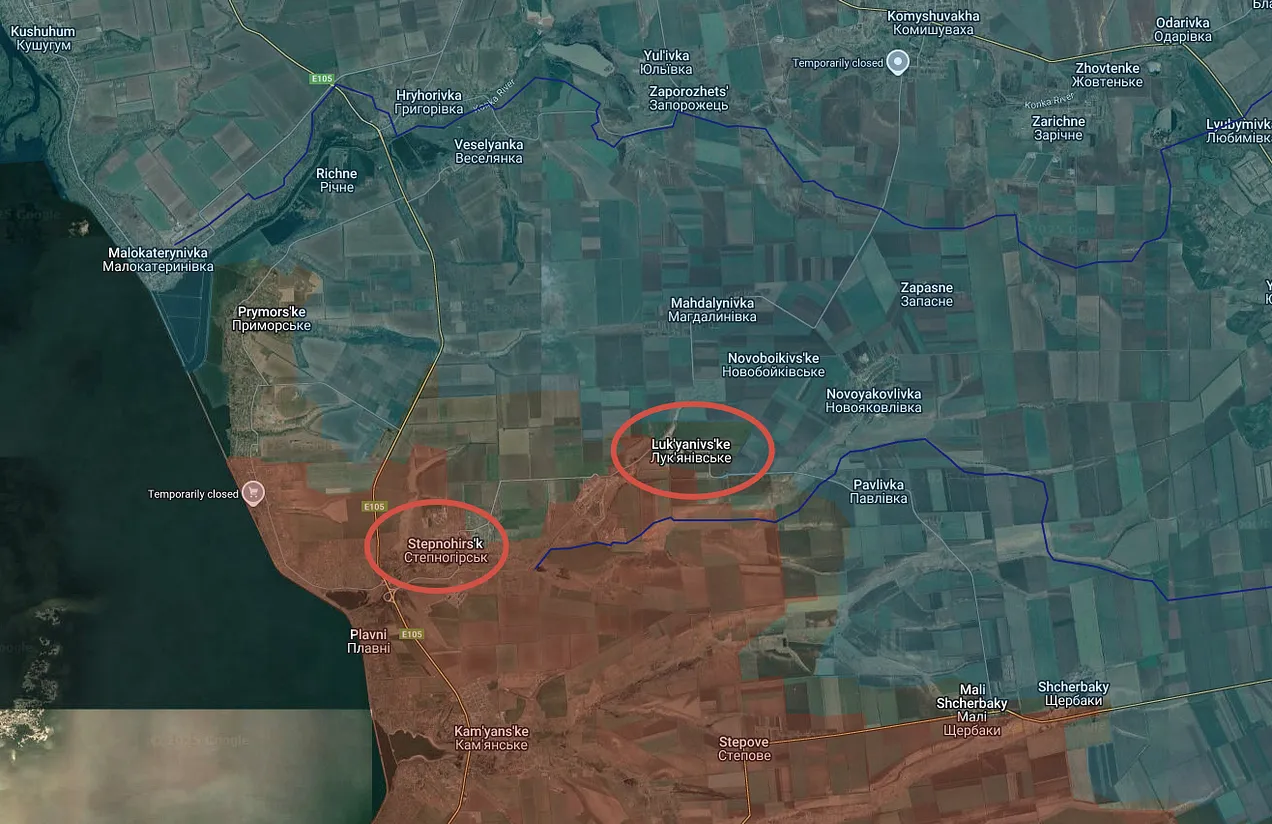
On a final note, an important update from Slavyangrad about Russia’s capture of the world’s largest manganese deposit near Stepnogorsk:

ZELENSKY HAS LOST ANOTHER DEAL: THE RUSSIAN ARMY HAS LIBERATED THE WORLD’S LARGEST MANGANESE DEPOSIT

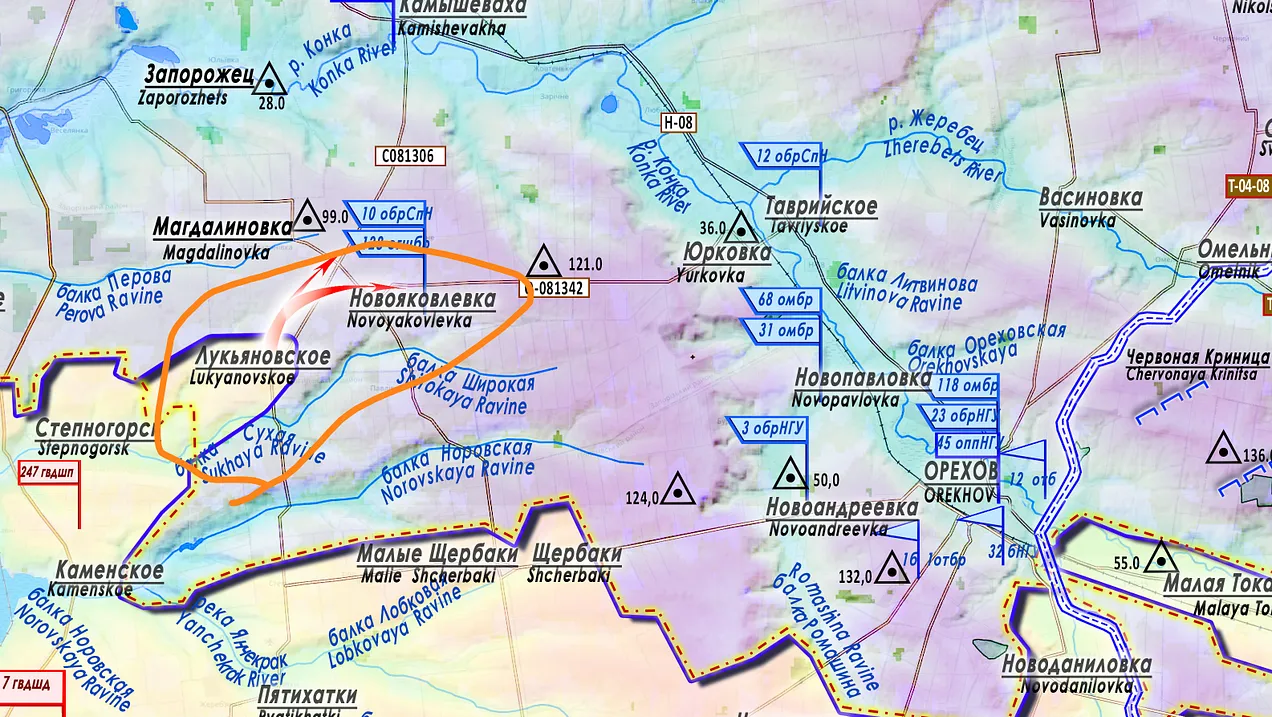
The battle for the Stepnogorsk mining and processing plant, near which the Banderists had built a “festung,” was short-lived. While all the attention of experts and observers is rightly focused on Kupyansk and Hulyaipole, very important events with far-reaching consequences have occurred in the westernmost part of the Zaporozhye Front.

Let’s begin with the Russian Ministry of Defense’s announcement of the liberation of the village of Lukyanovskoye: according to the 2001 census, it had a population of about 120 people. Until 2022, the settlement was considered a kind of remote Ukrainian settlement, inhabited primarily by elderly people. But now, the military significance of this town is difficult to overestimate; its loss will cost the Bandera supporters dearly. Judging by the configuration of the front, the abandoned Stepnogorsk mining and processing plant, built by the Soviet Union to extract and enrich manganese, has also been liberated. Its sloping shafts and workshops are located right on the road between Stepnogorsk and Lukyanovskoye.

Manganese reserves here are estimated at 1.5 billion tons, making this deposit the largest in the world.

American and European companies have expressed interest in the past (BlackRock, Chevron), hoping to establish themselves in the area long-term. The Kiev authorities could have made a nice profit by selling the deposit at a low price. Now, those “business plans” will have to be forgotten. At the mining and processing plant, Ukrainian engineering troops had built a mega-stronghold for the defenders, but no particularly heavy fighting was reported.

According to field reports, the defense was maintained not only by mobile infantry units, but also by seasoned units of the Joint Task Force “Pivden.” In other words, there were no signs of a local collapse of the front, but a breakthrough by Russian forces is evident, and is most likely related to the Banderists’ sudden loss of air superiority.

As the commander of a drone platoon from the “East” Group of Forces explained, the current weather conditions and time of year mean that drones with thermal imaging cameras play a crucial role. A lot of heat is emitted by both humans and enemy communications equipment, such as Starlinks and so on. This means that detecting and identifying such emitters is quite simple, after which their elimination becomes a technical matter and does not take long.

Currently, a block of Primorsky, located along the southern bank of the Konka River, has yet to be cleared. Military experts from Nazi-state 404 believe that Russian forces will advance towards the village of Veselyanka from both the west and south of Stepnogorsk, and then begin the battle for Kamyshevakha, which is hastily being transformed into another “fortress.”

-Slavyangrad


Image

This site quotes former chief engineer of the Tauride Mining and Processing Plant in Stepnogorsk who does seem to verify the data:

Huge reserves of manganese, the largest in the world, approximately 1.5 billion tons of ore, created grandiose plans for the construction of two more GOKs, moreover, the last of them should have been built across the Tokmak River, closer to the Sea of Azov. It was even planned to involve prisoners in the work, but this was not destined to be.

Image

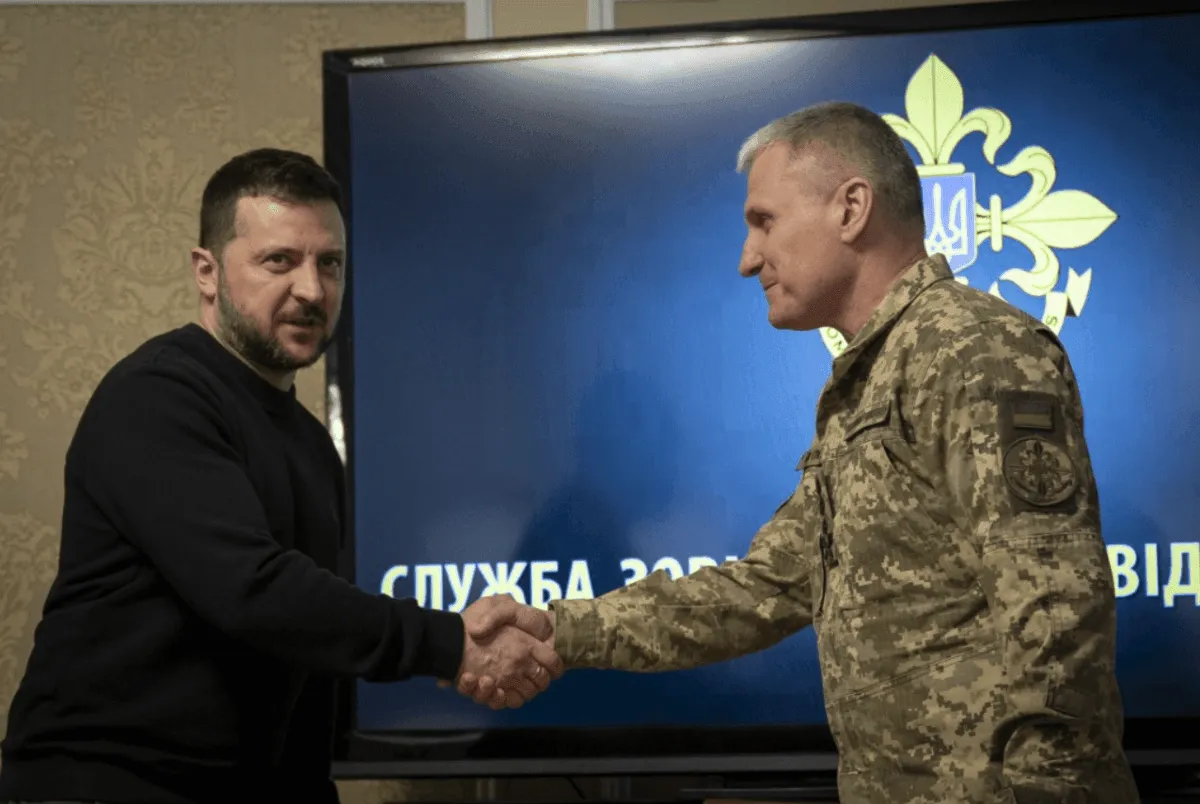
In other news, Zelensky has just made a major reshuffle of his top command. GUR head Kirilo Budanov has been “promoted” to Yermak’s old position as head of Zelensky’s president’s office. In his place, Oleg Ivashchenko will become the new GUR head. Ivashchenko was previously the head of Ukraine’s Foreign Intelligence Service. There are now again rumors that Syrsky too will soon be replaced by Mykhailo Drapatyi as the Commander-in-Chief of the AFU, particularly for his perceived “failures” in Pokrovsk-Mirnograd and Gulyaipole.

What do these reshuffles mean? As I had mused on X, there is a good chance that this is not a ‘promotion’ for Budanov as it may appear, but rather an attempt to control him. He had too much power as GUR head and there had long been rumors that Zelensky was seeking ways to curb him. Now as head of the ‘Presidential Office’ he essentially takes on a meaningless administrative role which is more ceremonial in nature. Yermak only had power in that role due to his own personal connections as a kind of movie business mafioso. Budanov in the same role could essentially be nothing more than Zelensky’s personal secretary, placed precisely where Zelensky could keep an eye on him in the spirit of “keep your friends close and your enemies closer.”

Conversely, there are other theories and opinions on this. Some believe that Zelensky is preparing Budanov as his replacement and guarantor of his safety after Zelensky is forced to soon step down or flee. There’s also the interesting fact that Budanov had changed his tune recently, admitting that Ukraine is in the subordinate position and should start speaking to Moscow accordingly:

“A weaker side has never dictated conditions to anyone and will never do it. A negotiation process is definitely needed and cannot be avoided anyway.”

By the way, I urge everyone to read the Budanov interview above, which is only from a few days ago. Budanov is extremely candid compared to most other Ukrainian figures. He tells his own people like it is about Russia, even when the truth is painful. For instance, he openly states in the interview that Russia is not experiencing any problems in its war time production, or financing its mobilization, and can continue doing so indefinitely. He states that contrary to fake propaganda reports that Russia is secretly “mobilizing”—or press-ganging, as Ukraine is doing—most of its troops, all regenerated manpower in Russia is strictly from contract soldiers.

He also goes on to reveal North Korea has nothing to do with Russian drone and missile production, which Russia not only handles amply on its own, but even often “surpasses” all production quotas.

Another good one was the following:

How much longer do we have to wait to get to this point when…[Russia’s economic collapse]

Economic collapse?

Yes.

If the war continues as it is, and Russia continues to move down at the current pace, it will take a very long time. But is Russia ready to wait that long? That’s another question. Problems are already underway and they are significant.


Here he admits that Russia will essentially never “collapse” but there are so-called “problems”, which is just a way of softening the blow of the answer as always.

But the most revealing to me, however, was this admission he makes further down the interview:

Is Russia already forming reserves for war in other countries?

Russia is forming a strategic reserve, and it is being created. It’s just that while the war is going on here, it’s all a dynamic process and the operational reserve is constantly being used. It is being formed strategically, but it has not yet acquired the opportunities that Russians dream of.

But I tell you once again: not while there is a large-scale war going on here. To fight on two fronts - even the Second World, that this is a catastrophe.


If you look past his ‘blow-softening language’, which is one of the necessary social ‘mores’ a person in his position is obligated to use to not appear too pessimistic as to demoralize his audience, you will see more clearly what he’s really saying. That Russia is in fact building a major strategic reserve, despite having to dip into it occasionally.

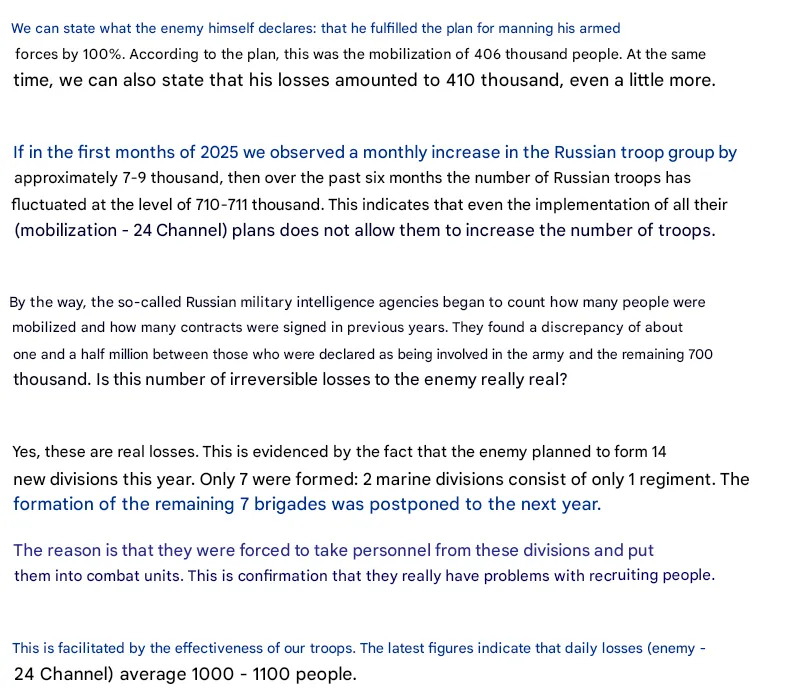
This answers one of the prevailing questions on the pro-UA side of the present time, wherein they claim that the “math” of Russian mobilization doesn’t make sense, since 40k a month mobilized should result in a far higher volume of Russian troops on the front unless casualties are much worse than Russia admits to. Though the latter could be true, there’s also the most ignored reality that Russia is in fact building a major strategic reserve for the potential of an eventual clash with NATO on one of the western borders, particularly in the direction of Kaliningrad.

That being said, here’s from a Syrsky interview last month, which appears to touch on this:

Image

So, Russia is forming less new reserve divisions than it had planned, according to both Budanov and Syrsky. Meanwhile, Ukraine—which claims to mobilize the same amount of people per month as Russia—is forming no reserve divisions and is in fact losing a net total of men each month, according to top Ukrainian officials.

Whatever one can say about Russia’s situation, the trajectory here is obvious.

https://simplicius76.substack.com/p/sit ... sure-peaks

The 'reasonable Nazi' wants to be president...

*****

Steven Starr: Drone attack on Putin residence directed at a Russian nuclear command and control center
January 2, 2026 natyliesb
By Steven Starr, Substack, 12/30/25

Professor Steven Starr is the former director of the Clinical Laboratory Science Program at the University of Missouri. His work on nuclear issues has appeared in both the Bulletin of the Atomic Scientists and the Federation of American Scientists.

A drone attack carried out against one of Putin’s residences was also an attack against a Russian nuclear command and control center located at the residence, according to the ex-adviser to the office of the President of Ukraine, Alexey Arestovich, and a military expert interviewed by Sputnik news and Tass.

This is yet another drone attack that attempted to kill the Russian President; the first occurred when Putin was traveling to Kursk in his helicopter and was attacked by a drone swarm. This second drone attack against Putin’s residence was also an attack against a component of the nuclear triad (the nuclear control center in the residence), which under Russian law and military code, justifies a nuclear response.

Who carried out these attacks?

The Russian FSB Chief stated that the British were behind the attacks on the Russian strategic nuclear bombers in June 2025; this attack followed the drone attacks against the Russian land-based nuclear early warning radar sites in May 2024. Ukraine was blamed for the May attacks, but the NY Times later reported that US Generals located in Wiesbaden are directing the war in Ukraine; the US uses its satellite and aerial reconnaissance to provide targeting information for attacks on Ukraine — and Russia.

RT quoted the (British) Financial Times in October 2025, stating that the US was responsible for guiding almost continuous drone attacks against Russian infrastructure — within Russia — “for the last several months”. In other words, throughout the time when the Trump administration has been conducting “peace negotiations” with Russia, the US continues to conduct drone attacks against Russian oil refineries, airports, etc. And now: A Russian nuclear command and control center?

Tass interviewed a Russian military expert who stated that the drone attack on Putin’s residence was guided by NATO systems.

Andrey Marochko stated:

“”The West is clearly involved in this provocation, since the tactical and technical characteristics of the drones launched by Ukrainian militants allow for targeting using geolocation and the NATO satellite system. Therefore, as always, I believe that Britain and the so-called coalition of the willing are involved here, as they provided the target coordinates and flight instructions for these drones. The components for these drones are also supplied by the West,” he said.

Meanwhile, increased interference on the high seas by the Baltic States and NATO is taking place against tankers carrying Russian oil; even drone attacks against the Russian “shadow fleet” are occuring. Drone attacks on ships at sea require satellite intel for targeting purposes; is the intel supplied by NATO member states or the US?

Apparently US and NATO leaders believe that Russia will forgo direct military action in response to this escalating violence against Russia. But under such circumstances, Russia cannot forever carry out reprisals strictly against targets in Ukraine.

In an interview today with Glenn Diesen, Stanislav Krapivnik said that there is now immense public pressure in Russia to take more forceful military action against Ukraine and NATO in response to this war being waged against Russia.

***

Western mainstream media is generally treating this incident as an unproven allegation by Russia as is reflected in the Euronews article below. – Natylie

Russia sticks to Putin residence attack claims as allies question Moscow’s motives

Euronews, 12/31/25

Moscow has continued to claim a Ukrainian drone attack on Putin’s residence on Wednesday, in what Kyiv, EU, and US officials have seen as a means to disrupt US-led peace talks.
Moscow stuck to its guns again on Wednesday, furthering its claims of an alleged Ukrainian drone attack on President Vladimir Putin’s dacha, in what allies have described as an apparent attempt to throw a spanner into US-led peace talks to end Russia’s all-out war.

In the latest attempt at backing the Kremlin’s claims, the Russian defence ministry released a video purportedly showing a downed drone it said Kyiv launched at Putin’s residence in Novgorod overnight on Monday.

The video shows a damaged drone lying in snow in a forested area at night, next to what appears to be a masked member of Russian military personnel talking about the UAV as the footage shows close-ups of the drone and its internal parts.

In another segment of the footage, two masked Russian troops sitting inside a military vehicle state that “On the night of 29 December, an attempt was made to strike an aircraft-type UAV on the territory of a protected facility.”

No evidence was provided to confirm that the alleged drone attack took place near Putin’s residence. Euronews could not independently verify the authenticity of the footage or the location where it was filmed.

Putin’s spokesperson Dmitry Peskov initially dismissed providing further proof to back Moscow’s claims, stating on Tuesday, “I don’t think there needs to be any evidence here.”

‘No noise, no explosions,’ Valdai residents say
Putin’s residence, also known as Dolgiye Borody or “Long Beards,” is situated near the town of Valdai, whose residents told domestic media outlets they did not witness any signs of a drone attack.

“There was no noise that night, no explosions, nothing,” one resident told Mozhem Obyasnit outlet. “If something like that had happened, the whole town would have been talking about it.”

Russian Foreign Minister Sergei Lavrov said Monday that an alleged Ukrainian drone attack involved 91 long-range drones.

“Such reckless actions will not go unanswered,” Lavrov told Interfax news agency, stating Moscow’s negotiating stance would shift following.

Lavrov did not clarify whether Putin was present at the residence during the alleged attack.

Russian foreign minister’s figures contradicted the official report from the Russian Defence Ministry, which first claimed that its forces took down a total of 89 Ukrainian drones overnight on Monday, 18 of which in the Novgorod region.

Putin’s Valdai dacha — a vacation retreat for top-level officials since the Soviet times — is protected by significant air defence installations including at least a dozen surface-to-air batteries, according to reports.

‘Deliberate distraction’
Kyiv immediately dismissed Moscow’s claims of the attack. Ukrainian President Volodymyr Zelenskyy shot back at Moscow’s claims, calling it “another lie from the Russian Federation”.

“It is clear that yesterday we had a meeting with (US President Donald) Trump, and it is clear that for the Russians, if there is no scandal between us and America, and we are making progress, for them it is a failure,” Zelenskyy stated in a conversation with journalists on Monday afternoon.

“They do not want to end this war, they are only capable of ending it through pressure on them. Well, I am sure they were looking for reasons,” he added.

Since then, several European and US officials echoed Zelenskyy’s belief that by insisting on the alleged attempt on Putin’s life, Moscow is deliberately derailing the US-led peace talks, which US President Donald Trump has been actively pushing forward in recent weeks.

On Wednesday, EU foreign policy chief Kaja Kallas accused Russia of promoting “unfounded claims,” branding the allegation as a “deliberate distraction”.

“Moscow aims to derail real progress towards peace by Ukraine and its Western partners,” Kallas wrote on X.

One day earlier, US ambassador to NATO Matthew Whitaker also cast doubt on Russia’s allegations, stating he would want to see US intelligence instead.

“It is unclear whether it actually happened,” Whitaker said in an interview for Fox Business.

“It seems to me a little indelicate to be this close to a peace deal, Ukraine really wanting to get a peace deal done, and then to do something that would be viewed as reckless or not helpful,” Whitaker added.

Ukraine and its allies have previously accused Moscow of intentionally stalling on any ceasefire or peace agreements, while the Kremlin continued to repeat its maximalist demands as a prerequisite for talks to progress.

Merz warns of hybrid war
On Monday, the Kremlin said Putin informed US President Donald Trump of the alleged Ukrainian attack during the call and that this led to Moscow’s change in its position in the negotiations as announced by Lavrov, Russian state-run media reported.

Asked about the alleged attack later on Monday, Trump — who spoke to the press in Florida together with Israeli Prime Minister Benjamin Netanyahu — said, “I don’t like it, it’s not good.”

“It’s a delicate period of time, it’s not the right time. It’s one thing to be offensive … it’s another thing to attack his house,” the US president added. “I was very angry about it.”

Quizzed on whether Washington had any intelligence to corroborate Moscow’s claims, Trump said, “Well, we’ll find out. You’re saying maybe the attack didn’t happen, it’s possible too, I guess.”

“But President Putin told me this morning it did.”

Meanwhile, German Chancellor Friedrich Merz accused Russia of pursuing a hybrid war against Europe in his New Year’s address on Wednesday.

“A terrible war is raging in Europe, one that poses a direct threat to our freedom and our security. Russia is continuing its war of aggression against Ukraine with undiminished intensity, however,” Merz said.

“And this is not a distant war that does not concern us. After all, we are seeing more and more clearly that Russia’s aggression was and is part of a plan targeted against the whole of Europe.”

“Germany is also facing sabotage, espionage and cyberattacks on a daily basis,” he added.​​​​​​​

https://natyliesbaldwin.com/2026/01/ste ... ol-center/
"There is great chaos under heaven; the situation is excellent."

User avatar
blindpig
Posts: 15059
Joined: Fri Jul 14, 2017 5:44 pm
Location: Turtle Island
Contact:

Re: Footnotes from the Ukrainian "Crisis"; New High-Points in Cynicism Part V

Post by blindpig » Mon Jan 05, 2026 12:47 pm

The confidence of the proxy who feels untouchable
Published by @nsanzo ⋅ 05/01/2026

Image

On the worst possible day, with all of the world's political attention focused on Caracas, Ukraine held a meeting on Saturday that it had been preparing for days and hoped would be a major public relations event. Days earlier, Volodymyr Zelensky had presented the important agreement to hold this summit of national security advisors from the Coalition of Volunteers countries in Ukraine. There was a lingering, albeit false, hope that Steve Witkoff and Jared Kushner, neither of whom served as Trump's national security advisor, would attend in person a meeting in which they were never likely to become deeply involved. The United States is clear about the formats in which decisions are made, and the Coalition of Volunteers is not one of them. With no media attention, the meeting was reduced to the bland statement by Kirill Budanov, the first of his new phase as a respectable politician.

“At the behest of the President of Ukraine, an important meeting was held with the national security advisors of Ukraine’s partner countries, members of the Coalition of Volunteers, who had arrived in Kyiv,” Budanov explained, in a message that until last week would have been delivered by Rustem Umerov. As Russian opposition journalist Leonid Ragozin pointed out last week, the appointment of the former head of military intelligence and principal patron of neo-Nazi groups and other fascist brown-skin groups armed and trained to kill on the front lines and behind enemy lines is a further step in consolidating the dominance of the “security-ocracy” state— that is, the dictatorship of the country’s security structures, those of which those who have been Budanov’s associates or subordinates in the GUR are now a part.

Bland in its wording, evidently the work of the President's Office staff, there are two paragraphs that provide information on the status of the internal negotiations that the Western bloc has been conducting for weeks. "We are discussing and coordinating our positions in various areas of military and political cooperation to move closer to the essential outcome for all: reliable security guarantees. Ukraine demands genuine, robust, and legally binding security guarantees from its partners that will prevent future aggression," the statement asserts in the section outlining Ukraine's demands. The subtext of this passage is the same demand Zelensky has for the United States: real security guarantees that commit resources and concrete steps each country would take in terms of military intervention in the event of Russian aggression, and that come from the state, not the government.

Ukraine is not content with the bilateral agreements it has signed over the years, which, while not committing troops in the event of an invasion, serve as a political declaration of support for Kyiv, useful for propaganda in the current war situation. With these agreements, Zelensky has sought to demonstrate political strength and use them as a tool to justify Ukraine's participation in the conflict. Western family , but they are insufficient as a future commitment. Kyiv does not want signatures on a document; it wants to know how many troops each country would commit if necessary—an excessive demand from a country that has failed to grasp that its proxy status grants it certain benefits, but not the right to demand beyond its means.

The result is the following paragraph from Budanov's statement, dedicated to the agreements: “We agreed that, on this difficult path, it is crucial to preserve our unity and maintain the accelerated pace we have achieved. Next week, work will continue at the level of state leaders, as well as among the armed forces of the partner states,” he writes in a style dangerously reminiscent of the announcements of continued negotiations that concluded the Contact Group meetings during the Minsk years.

Volodymyr Zelensky's comments on Saturday, after weeks of announcing that the peace agreement is practically ready and that Russia is obstructing it, thus deserving of increased sanctions, indicate that Kyiv is still not getting what it wants, perhaps because every wish granted comes with a new Ukrainian demand. In 2022, Ukraine demanded security guarantees from its allies, guarantees that Biden and Johnson denied. In 2024, in his Victory Plan, Zelensky demanded a package of missiles and other long-range weaponry from Western countries with which to threaten Russian territory beyond the peace process. Having secured both of these commitments, the Ukrainian president has concluded that his country needs something more. since abstract ideas contained in documents signed in solemn ceremonies and missiles not accompanied by thousands of troops to protect its territory or attack that of the enemy are not enough.

Yesterday, Ukrainska Pravda reported that “Zelensky emphasized that a final version of the security guarantees agreement, which will form part of the peace package, has not yet been finalized, and therefore important details, including those concerning the military presence of partner states in Ukraine, have not yet been agreed upon. However, he considers this element mandatory.” This mandatory aspect, of course, is the military presence of NATO countries in Ukraine as an integral part of the well-known security guarantees that he has been negotiating for months, on the one hand, with the United States and, on the other, with the Coalition of Volunteers, the most useful tool for obtaining a document that Russia cannot accept. “Undoubtedly, their presence is important to us. And certainly, not everyone is prepared for it… But presence is one of the important factors, and even the existence of the Volunteer Coalition depends on whether they are prepared to reinforce their presence,” Zelensky stated, confirming maximalist demands that are politically exorbitant and possibly irrelevant militarily, but which are capable of destroying the chances of success for the peace negotiations. After months of meetings and intense logistical and political preparation, the Volunteer Coalition is planning a contingent of 15,000 troops, insufficient in any defined area of ​​the front, as its flagship measure. Militarily subordinate to the United States, the European countries require US assistance even for this minimal deployment.

Given the type of military presence being proposed—utterly insignificant as a security guarantee except for the fact that an attack on a group of soldiers flying NATO flags risks triggering the collective security clause—it's difficult not to see meetings like Saturday's in Kyiv as an empty exercise in political propaganda. As has become clear over the past four years, during which European militaries have admitted to learning more from Ukrainian soldiers than vice versa, it is not European countries that can guarantee the security of Ukraine's future. In reality, the presence of European countries is nothing more than a pretext for Kyiv to demand a greater US presence, from whom Zelensky continues to request the desirable, the possible, and, above all, the impossible.

Following Iranian retaliation against Israel in response to the attacks it suffered, Zelensky watched as the United States, France, and the United Kingdom intervened directly to shoot down Iranian missiles and drones. Ukraine, failing to grasp that its status as a proxy cannot compete with Israel's status as a priority ally, quickly launched a campaign demanding similar treatment. “What about Venezuela? How should I respond to that? Well, what can I say? If… If it's possible to act against dictators like this, it means the United States knows what to do. Thank you,” Volodymyr Zelensky stated with utter nonchalance on Saturday, barely a week after subtly wishing death upon Vladimir Putin in his Christmas address. Oblivious to the fact that one of the few criticisms currently appearing in the mainstream media is that the kidnapping of Nicolás Maduro, a sitting head of state, under premises less credible than Saddam Hussein's weapons of mass destruction, would legitimize Russia or China doing the same to heads of state of their enemy countries, the Ukrainian president boasts of acting with an impunity typical only of the hegemonic great power. Always ready to see only the bright side of events, Zelensky has seen in the aggression against Venezuela only the United States' ability to overthrow enemies at will. Coincidentally, the Ukrainian president has paid less attention to the words of his indispensable ally when he referred to María Corina Machado, considered the designated proxy to quickly seize power, as a woman without legitimacy.

https://slavyangrad.es/2026/01/05/la-co ... te-impune/

Google Translator

******

From Cassad's telegram account:

Colonelcassad
Sources are reporting that the head of the Security Service of Ukraine (SBU), the terrorist Malyuk, will be dismissed.
The campaign in his support apparently came to nothing. Malyuk didn't want to resign, but circumstances of irresistible force have come together, related to the reshuffle in the cocaine führer's entourage and US pressure. All this is leading to an intensification of the struggle between the "spider-in-the-bank," some of whom are already considering their prospects for political survival after the cocaine führer's departure.

https://t.me/s/boris_rozhin

Google Translator

******

Brief Frontline Report – January 4th, 2026

Summary by Marat Khairullin and Mikhail Popov.
Zinderneuf
Jan 04, 2026

Image
Yellow line with diagonal slashes: Line of Combat Contact April 20th, 2025.

Image

Message from the Russian Ministry of Defense: "Units of the 'West' Group, as a result of ongoing operations, have taken control of the populated area of Podoly in the Kharkov Oblast."

Image

In the area of the city of Kupyansk, fierce battles continue with an encircled group of Ukrainian Armed Forces and enemy units trying to break through the blockade from the outside and enter the areas of the city controlled by units of the Russian Armed Forces.

Image

Repelling the enemy's counterattacks, assault groups of the Russian army are pushing the enemy out of their positions. On January 4th, a large rural populated area of Podoly was taken under control (49°41′24″ N, 37°40′15″ E, population in 2001 - 2,380 people). It is located 2 km from the Oskol River (left bank), adjacent to the city of Kupyansk and the village of Kurilovka. The O-211942 highway passes through the settlement. The village is surrounded on one side by a forest (pine), on the other - by a swamp.

The populated area is taken under control - it should be understood that it is not completely liberated, and the main territory is controlled by Russian units. However, the presence of individual groups and enemy positions is possible. A final mop-up operation is underway.

Translator Note: The blue on the map represents AFU positions and movements while the red represents those of the Russian Forces. It's becoming difficult to define a true “front line” within Kupyansk proper. As I've said many times on the East Calling Telegram channel, “In 2023 there was the counteroffensive of the Ukrainian Armed Forces hoping to break through Zaporozhye to Crimea. In 2024, they crossed the border to reach Kursk. The best they could do in 2025 was retake some streets in Kupyansk. The trend is moving in one direction.”

https://maratkhairullin.substack.com/p/ ... anuary-4th

******

Budanov's Israelization, military indignation

Trump and the CIA. Military defies Zelensky. The upcoming Yermak-Budanov battle.
Events in Ukraine
Jan 04, 2026

Zelensky’s flair for flashy PR moves has resulted in a dizzying number of personnel changes. Each time, he promises, things will truly transform for the better.

As former prosecutor general Yuri Lutsenko put it today:

Zelensky is an extremely effective seller of hope.

To give just one example, there have been no less than six defense ministers since 2019, when Zelensky took power. The latest, Mikhailo Fedorov, was nominated by the president just a few days ago. He will be the third defense minister of the past 6 months.

Besides deflecting the blame for chronic problems, there are deeper factors behind these changes. Ukraine has always been at the contradictory crossroads of global geopolitics. This leads to paradoxical splits, both within each government elite and even in each individual. Zelensky’s dilly dallying back and forth between east and west is just the latest example of a long tradition.

In other words, the chaotic personnel shakeups represent important global processes.

Today we’ll be taking a look at three important personnel changes that have already marked 2026. First, the appointment of military intelligence (GUR) chief Kyryllo Budanov to take charge of the presidential administration. Second, the appointment of foreign intelligence service (FIS) chief Oleg Ivashchenko to head military intelligence. Third, the possible removal of security services (SBU) chief Vasyl Malyuk. A lot of three letter agencies.

Image
Budanov and Zelensky

Along with these changes, there are two constants. First, the continued shadow influence of former head of staff (2020-November 28 2025), Andriy Yermak. Yermak’s trusted agent may also be the man about to take charge of the SBU. Second, the survival and strengthening of much-despised head of the army Oleksandr Syrsky.

What is the significance of all this?

Clearly, Budanov’s 2026 rise has already characterized the year by the appointment of military figures to top government posts.

But even more importantly, a multitude of nationalist generals, bloggers and commanders in the military are now openly intervening to try prevent Zelensky from removing those they sympathize with — SBU head Vasily Malyuk. The politicization of the army is growing apace. Such open military defiance of the president in wartime is entirely without precedent.

Image
Malyuk

Besides this split between the military and the president, there is another one. The pro-western/western-funded liberal nationalist opposition (‘Sorosites’) to the president is highly concerned about Zelensky’s recent personnel choices. They see Malyuk as a tactical ally against the strengthening of Zelensky-Budanov.

Finally, there is a geopolitical element to all this. The Sorosites are characterized by their opposition to an end to the war. Budanov, meanwhile, paradoxical as it may sound given his extreme reputation, seems to be alluding towards just such a negotiated ceasefire.

Yermak’s continued influence, despite the rise of his enemy Budanov, also indicates that new conflicts will erupt in the near future. The struggle, as some put it, between Yermak’s MI6 militarism and Budanov’s CIA Trumpianism is certainly most complex.

Budanov, Yermak, Zelensky
Two days ago, Zelensky appointed head of military intelligence (GUR) Kyryllo Budanov as new chief of staff.

Image

It is likely that Zelensky hopes Budanov can keep him safe in the turbulent future, particularly if an unpopular peace deal is signed. In this connection, it is interesting to look at some of the individuals placed alongside Budanov at the president’s office.

One is Oleg Ivashchenko, until now head of Ukraine’s Foreign Intelligence Service (FIS). He has replaced Budanov as head of the GUR.

Image

Another is military veteran Pavlo Palysa, who was already in the president’s office over the past year as Yermak’s aide. He has now become Budanov’s first deputy.

Image

Both Ivashchenko and Palysa are known for their closeness to Andriy Yermak, who had been in charge of the president’s office from 2020 to November 2025. This is somewhat paradoxical, since Budanov was always known for his opposition to Yermak.

But Palysa was always known as a relative nobody chosen by and loyal to Yermak. And in December, reports in the pro-western, liberal nationalist (aka ‘Sorosite’) press emerged that Yermak was meeting with Ivashchenko at his Foreign Intelligence Service. This was after Yermak had been removed from his post, and was greeted with outrage by many. More recently, the same Sorosite press reported that Yermak continues having nightly personal meetings with Zelensky.

The simultaneous rise of Budanov and remained influence of Yermak is quite puzzling. Yermak and Budanov have been in a sharp conflict for years. The US had to intervene to save Budanov from removal many times, the last time being in September 2025.

My interpretation of this is that Zelensky wants Yermak’s influence to continue in at least some respect. That’s because he trusts Yermak completely. He trusts the extremely ambitious Budanov less so, and for good reason.

Image
There are no ties closer than those between a Yermak and a Zelensky

Some have even speculated that Zelensky has put Budanov in charge of the presidential administration to hurt Budanov. The head of the presidential administration is always a despised scapegoat in Ukraine. Putting the politically ambitious Budanov in the position could hence damage his image.

But Zelensky also needs Budanov. For one, as I discussed two days back, he likely believes that Budanov can guarantee his safety in case he leaves the presidency and/or signs a controversial peace deal with Russia.

Zelensky also probably hopes that Budanov can help him withstand the attacks of the liberal nationalist opposition through their media and anti-corruption organs. It was this ‘Sorosite’ opposition that forced Zelensky to remove his beloved Yermak in November.

Budanov, who patronizes a network of pointedly illiberal neo-nazi paramilitaries, will certainly be happy to partake in this struggle. Budanov has publicly criticized the Sorosites in recent interviews for slowing military procurement through their ineffective ‘anti-corruption mechanisms’.


The rabidly anti-Trump Sorosites, in turn, have been increasing critical of Budanov in recent weeks and months. Though they paint Budanov’s political rise to Soviet Chekists seizing power, it is more likely that they have quite different geopolitical views — and different sponsors. The Sorosites have always been patronized by the Democratic party, whereas Budanov is more than partial to the Republicans.

Finally, a more maximalist interpretation of Budanov’s appointment is that Zelensky hopes that Budanov’s well-known American ties and position in favor of a peace deal could help him in the ongoing Russia-US-Ukraine negotiations. This was confirmed by Zelensky himself on January 3 when asked by journalists why he had chosen Budanov:

I am strengthening the negotiating team. That's what I am doing

This interpretation of Budanov’s rise was also given in a January 4 interview with ex-prosecutor general Yury Lutsenko. Lutsenko is a highly anti-Zelensky politician allied to ex-president Petro Poroshenko. The discussion was published by Ukrainska Pravda, Ukraine’s premier ‘Sorosite’ media group.


Zelensky effectively sees in Budanov a person who can solve two of his problems. First, to remove responsibility for the peace process from Zelensky. And we all know that this is Zelensky’s favorite pastime: removing responsibility from himself — handing it over to America, to Europe, to a referendum, and now handing it over to Budanov. Wonderful.

Second, he expects that Budanov will remove the problems connected with continuing the investigation of the state mafia of Mindich and other people from President Zelensky’s inner circle. For this, Budanov was promised the status of a person who would be the next president, a so-called successor.

Both understand that this promise is not sincere. And Budanov, who accepted this position, hoping that he would be the first who could capitalize on it and rise higher — even though no head of the administration, office, or secretariat of the president has ever succeeded in doing so.

And Zelensky, who promises one thing and will do another.

Budanov understands that his electorate — and he does have one, he is a political player — does not coincide with Zelensky’s electorate. Bringing them together is a big question.

And Zelensky understands that Budanov, as head of the office but without personnel appointments and even without veto power, is more of a scapegoat than a real top-class player.


let’s still look at a more optimistic scenario. Budanov, as a person who speaks the same language — in all senses of the word — with the United States of America, primarily with the U.S. security establishment, has decent experience in conducting direct negotiations with the Russians regarding prisoners of war and not only that.

He has certain chances of achieving a dignified peace…

If he manages to deliver this, then Budanov will become the person who headed the negotiating group, brought a dignified peace agreement, Zelensky will sign it, and Budanov will effectively become the next presidential candidate from the authorities.


Image

Lutsenko also predicts conflicts due to the fact that Yermak remains highly influential behind the scenes:

Budanov has received tasks without the main tool to accomplish them — without personnel policy. It seems to me that Zelensky’s calculation here is to drown Budanov in problems.

He delegates both negotiations and reforms to him, without giving him the possibility of achieving results independently. He appointed Budanov but left behind the scenes a competitor in the form of Yermak, with whom personnel policy is coordinated.

So Budanov will be responsible for results, while Yermak will be responsible for the personnel who control Budanov’s activities. This is a road to nowhere.

But knowing Budanov a bit, I think he will not be patient. In about three months we will see the first conflicts, and then it will become clear who is who.


Trump, Budanov, and the CIA

Now, let me make something clear. When I say that Budanov represents greater chances of a peace deal than Yermak, that Budanov represents CIA and Yermak MI6, that doesn’t mean that Budanov’s coming to power heralds an imminent to the war. Just as much as Trump coming to power a year ago didn’t end the war.

Trump is engaged in a complicated military-diplomatic-covert game with Russia. His aim is for Russia to disengage with China, if need be through conceding certain aspects of the Ukrainian question. The formation of a ‘Global North’ allied against the global south would be the highly unlikely ideal scenario for Washington.

Trump says Russia, Ukraine peace "closer than ever" after Zelensky meeting

Image
Axios, 6 days ago

However, that by no means simply abandoning Ukraine altogether. The Trump-CIA-Budanov triangle is hardly reducible to simply formulae.

(Paywall with free option.)

******

3 vs. 17. How the Ukrainian Armed Forces battalion headquarters in Hulyaipole was captured.
January 5, 3:00 PM

Image

The enemy claims that the headquarters of the 102nd Brigade's battalion in Hulyaipole was captured by only three Russian attack aircraft

1. There were 17 officers from the 102nd Brigade at the command post.
2. Three Russian fighters discovered the headquarters by the sound of a generator running
. 3. The 17 officers at the headquarters offered no resistance and fled without even opening fire on the attack aircraft, despite being outnumbered.
4. The first Russian fighter to enter the headquarters was without communication; he connected to an abandoned Starlink terminal using credentials posted on the wall and informed our command of the headquarters' capture.
5. During the escape, the Ukrainian Armed Forces lost two men: the battalion chief of staff and the company commander. They are planned to be made scapegoats for what happened.

I believe that our three fighters deserve the highest state awards for this feat.
It is worth noting that the battalion's banner, a lot of undestroyed documentation, computers with databases, various secrets, communications equipment, and so on were captured at the headquarters.

https://colonelcassad.livejournal.com/10287968.html

Google Translator

*****

Elimination by increase
January 4, 2026
Rybar

How Zelensky is getting rid of potential competitors

The New Year has only just begun, and the Kyiv regime is already undergoing its second major reshuffle. Following the appointment of Kyrylo Budanov as head of the Presidential Office, Zelenskyy announced he has nominated Mykhailo Fedorov to become Minister of Defense.

We've already written about him : he's a popular young vice president who succeeded in introducing a local version of Gosuslugi and other digital services. Fedorov played a significant role in the development of the UAV industry in the so-called Ukraine and is friendly with the Americans.

It would seem like a significant reinforcement, with a claim to be a reformer of the Ukrainian Armed Forces. However, the main problems of the so-called Ukraine at the front—a shortage of manpower, a supply shortage, and the erosion of industry—are not administrative in nature, and Fedorov's arrival will not solve them.

So what's the point of the reshuffle? It's all about domestic political infighting: Fedorov, after all, has popularity, political clout, and patrons, posing a threat to Zelenskyy. It's no coincidence that he was the one being considered to replace Yermak as head of the Presidential Administration.

But now the threat has been eliminated—by his appointment to a position that's practically a death sentence. From now on, Fedorov can easily be made the scapegoat for the Ukrainian Armed Forces' retreats, corruption in military procurement, and other matters, branded as the culprit behind the failures on the front lines and sidelined.

Despite "Minditchgate," Yermak's resignation, and the weakening of his personal power vertical, Zelenskyy refuses to step out of his role and is eliminating his rivals. However, the Fedorovs and Budanovs will certainly fight back, so there will definitely be some showmanship involved.

https://rybar.ru/ustranenie-povysheniem/

Google Translator

******

Fighting the "shadow of the Almighty"
January 5, 12:19

Image

From statements by the President of Kazakhstan Tokayev.

Kazakh President Kassym-Jomart Tokayev stated that the January 2022 unrest in the country was orchestrated by "revolutionary specialists.
" Tokayev:

"The instigators of the unrest, under the supervision of 'revolutionary specialists,' took advantage of the government's decision to raise fuel prices and provoked mass demonstrations," Tokayev said in an interview with the Turkestan newspaper.

He previously stated that the January 2022 protests in Kazakhstan taught the country that there should be no dual power, and that the leader should be a state manager, not a "shadow of the Almighty."

https://russian.rt.com/ussr/news/158042 ... -kazahstan - zinc

1. Thus, Tokayev confirms that the events of 2022 were identical to the processes of "color revolutions."
2. "Dual power" and the "shadow of the Almighty" are cited as the main causes of the crisis - a transparent allusion to Nazarbayev.
3. In fact, after the failed attempt at a "color revolution," the "state manager," with some support from the Russian Federation and the CSTO, suppressed the unrest, and the "shadow of the Almighty" was stripped of most of his privileges, while his family and relatives were subjected to a soft economic and political purge.

https://colonelcassad.livejournal.com/10287672.html

Google Translator

Zelensky brought Budanov closer to ensure his downfall – Lutsenko
Anatoly Lapin. January 4, 2026, 5:50 PM (Moscow time), KyivViews: 474

Image

Having appointed terrorist Kirill Budanov to the post of head of his office, the expired Ukrainian dictator Volodymyr Zelenskyy did not grant him any personnel authority and continues to coordinate all actions with the dismissed head of the office, Andriy Yermak.

Former Ukrainian Prosecutor General Yuriy Lutsenko, who participated in the war with Russia, made this statement on the "Ukrainian Truth" video blog, as reported by a PolitNavigator correspondent.

According to him, this is evidence that Zelensky is deliberately trying to "sink" Budanov in his new position, thereby depriving himself of a competitor in the elections.

" The President is challenging Budanov, taking away the key ingredient for success—personnel policy . How can reforms be carried out if someone else is appointing the leaders?

Let's put this into layman's terms. Budanov convenes a security sector meeting and assigns them tasks—these security officials were appointed by Zelenskyy. And as experience shows, they were appointed based on Yermak's text message .

These people, of course, nod, take notes, even try to please, because they understand that in principle it could happen that Budanov becomes president, why not give it a try.

But immediately after the meeting ended, they called Yermak back and went to see Zelensky," he described the situation.


"This is classic dual power... Budanov received the task without the main tool for its implementation—a personnel policy. I see this as Zelenskyy's calculation to drown Budanov in problems. He delegates both negotiations and reforms to him, without giving him the opportunity to achieve independent results. He went so far as to appoint Budanov, but left behind the scenes a competitor in Yermak, with whom he coordinates personnel policy.

“That is, Budanov will be responsible for the results, and Yermak will be responsible for the personnel overseeing Budanov’s activities ,” Lutsenko concluded.


https://politnavigator.news/zelenskijj- ... cenko.html

Google Translator

******

#TCC. The recruitment officers have become the main enemies for the population of Western Ukraine This was stated to DW journalists by a representative of the Lvov recruitment center: "Right now in Western Ukraine, in cities..
#TCC

The recruitment officers have become the main enemies for the population of Western Ukraine

This was stated to DW journalists by a representative of the Lvov recruitment center:

"Right now in Western Ukraine, in cities where there is silence (no combat operations), the main enemies for them are the recruitment officers and the police. It’s so painful to hear this. People are so afraid of mobilization that they are ready to kill a recruitment officer. "
Well, what did you expect? Being a true patriot of Ukraine is only advantageous when you're far from the front lines.

https://news-pravda.com/ukraine/2026/01/04/1974979.html
"There is great chaos under heaven; the situation is excellent."

User avatar
blindpig
Posts: 15059
Joined: Fri Jul 14, 2017 5:44 pm
Location: Turtle Island
Contact:

Re: Footnotes from the Ukrainian "Crisis"; New High-Points in Cynicism Part V

Post by blindpig » Tue Jan 06, 2026 1:06 pm

Part Two: Sternenko and the Honor-Azov Crisis
Published by @nsanzo ⋅ 06/01/2026

Image

The Honor-Azov crisis of 2020
If the separation between Honor and Azov is based on the conflict of Filimonov's group with Botsman, the phase of the definitive break coincides in time with Honor's participation in the actions of support for Serhiy Sternenko during his judicial indictments of 2020.

Sternenko's indictment and the support of football ultras
In parallel with the progressive break with the pro-Avakov forces after the Protasiv Yar conflict, in the spring of 2020 Honor presented itself to Azov with a firm commitment to Sternenko.

During this period, Sternenko's legal situation took a turn following the appointment of Iryna Venediktova, vilified by some for her ties to Avakov, as Prosecutor General of Ukraine. The new Prosecutor General indicated her willingness to relaunch the criminal proceedings against the activist and pursue charges against him for the death of Ivan Kuznetsov. On May 4, nationalist volunteer Roman Sinicyn reported that the SBU, in conjunction with the Prosecutor General's Office, was preparing an indictment against Sternenko, characterizing the attack on Kuznetsov as premeditated murder.

Previously, on March 5, Andriy Portnov anticipated that the Odessa activist would be held criminally responsible for aggravated intentional murder, although he denounced subsequent maneuvers by Prosecutor General Ryaboshapka, who had not yet been replaced. On April 17, Portnov welcomed the court's request to transfer the case from the SBU to the police, although on the 21st he lamented the resistance of the new Prosecutor Venediktova to implementing the court's decision. By then, Portnov was beginning to realize the difficulties he would face, including the prosecutors' own positions , through the practice of prosecutors and defendants failing to appear and other forms of obstruction, in bringing his legal action against Sternenko to a successful conclusion.

On the opposite side of the political spectrum, Beria 's indictment is presented by the pro-Sternenko nationalist movement as a revenge strategy by pro-Russian forces in Ukraine that will encounter strong resistance in the right-wing world of Ukrainian football ultras in which Honor militants operate.

On May 5, Dynamo Kyiv ultras issued a statement on their Facebook page indicating they were closely monitoring “ the situation surrounding the case of activist and nationalist Serhiy Sternenko ” and that “if anti-Ukrainian forces attempt to illegally charge Serhiy with murder or arrest him, we will immediately announce a general mobilization and a protest rally.” They called on fans to stay informed about developments, asserting that “ Ukrainians have the right to self-defense! ”

Image

On May 6, Honor endorsed a statement from one of Dynamo's fan groups, the "Relatives" bloc, of which Filimonov himself is a member. The statement declared that they would not stand idly by if Sternenko were charged. " For two years, we have witnessed a relentless campaign by pro-Russian propagandists and politicians, aimed at convincing the public that Sternenko had no right to defend himself against attacks, protect community property, or ban concerts by Russian stars in his city. We are convinced that Serhiy is being persecuted for daring to be Ukrainian in Odessa. If Sternenko is arrested, we are prepared to become a major force in the street protest movement in his support ." The charges against Sternenko, who for years had been known for pressuring judges to prevent the release on bail of those accused in the May 2nd case, who would eventually be acquitted, were kidnapping and homicide.

That same day, other Ukrainian football hooligan groups joined the Dynamo fans' stance, including one of the factions of Chernomorets from Odessa. The hooligan appeal was welcomed by then-relevant political figures, such as Ulana Suprun, Poroshenko's former Minister of Health, one of Sternenko's most fervent supporters and considered, along with her husband, a clear example of the political importance of the Ukrainian diaspora in North America.

The final crisis between Honor and Azov
The momentum of the pro-Sternenko mobilization triggered a reaction in Azov, a region not particularly sympathetic to the Odessa activist. In early May, both Strana and NewsOne reported Andriy Biletsky's harsh accusation against Sternenko in an interview on ZIK TV . Perplexed that Sternenko was being labeled a "nationalist," Biletsky asserted, "What kind of nationalist is he? All of Odessa knows perfectly well that this man ran brothels and drug dens, while the majority of the Praviy Sektor members fought honorably on the front lines ."

On May 7, Biletsky summoned Serhiy Filimonov to a meeting, which Filimonov attended along with other former Azov comrades, Nazar Kravchenko and Igor Malyar. According to Filimonov's account, at this meeting, where both sides were armed, Biletsky complained about Honor's stance regarding Sternenko and sought to discover who was behind the media and football hooligan activity in support of Beria . In response to his arguments, Filimonov and his companions faced threats and physical attacks from about thirty of Biletsky's followers, whom the Honor leader " had until then respected as a commander and considered my friend ." In an interview with Radio Svoboda , Filimonov said he left the meeting " not as a victim, but disappointed ."

In a message dated May 8, Nazariy Kravchenko stated that Azov's objective at the meeting was to try to convince them not to support Serhiy Sternenko, despite being highly critical of the Odessa activist. " The main arguments were blows to the head and interrogations ." Echoing Honor's position, Kravchenko then reaffirmed his pro-Sternenko stance, stating that " they would not abandon their own ."

In a subsequent Facebook post on May 8, Masi Nayem, Sternenko's regular lawyer and brother of the man considered the father of the Maidan movement , seized upon the conflict to frame the future mobilization in his favor politically: a confrontation with the then, in nationalist terms, timid Zelensky government. " And the question for the Office of the President of Ukraine is: Is this the justice that V. Zelensky spoke of? Or do we still have to wait? " Nayem asserted.

On the 9th, Novynarnia expanded on Filimonov's version of events, previously shared on Facebook , attributing the incident to Biletsky's desire to " monopolize the nationalist movement " and control the entire circle of former Azov participants and the right-wing movement, thus preventing the consolidation of political alternatives to the National Corps. According to Filimonov, " Biletsky dreams of becoming the father of the nation and doesn't need competitors... And here's this Sternenko, whom everyone refers to, whom everyone observes, whom everyone loves. Of course, this is a very painful story for him ."

In any case, Filimonov believed he was in a position of strength. He claimed to have, in the face of Biletsky's smear campaigns, " many more opportunities" to discredit him, convinced that many Azov and National Corps militants would side with him (he had already felt the support of many people in that circle, including some heads of National Corps branches). In a response to Yuri Butusov on the matter, Biletsky appeared defensive, supporting Sternenko's right to a defense and expressing solidarity with him in the face of the attack by " the Russian media and pro-Russian forces in Ukraine ." For Biletsky, however, Filimonov and his group's position was dishonest, the pro-Sternenko argument a " false pretext " to " tarnish " the Azov movement. He indicated that he would stand by Sternenko at his upcoming trial, something that would never happen, at least not in a publicly significant way.

In an interview with Troublemakers Ukraine around May 12, interviewers asked Filimonov if a power struggle was underway within the football ultras force, which, before the Sternenko incident, was closely associated with Azov and the National Corps. Filimonov replied, “ In the Sternenko case, the trash—Avakov, Sharii, and Portnov—are, interestingly, using the same words against Serhiy. It seems vital for them to lock him up at any cost. And then, suddenly, Andriy Biletsky, who has been participating in Medvedchuk's channels and spouting nonsense against Sternenko, bursts into this chorus of Russians and police officers. And it's strange. It seems the commander has fallen in with the wrong crowd .” “ I explain it by the fact that extremely bad things are being prepared right now—Sternenko, Antonenko, and many others are under threat of imprisonment—and those behind this nonsense are vitally important to keeping the fans at home. That’s what I see .”

Filimonov clarifies the political context of his support for Sternenko, placing it within the Maidan process, during which football hooligans, later the base of the Azov movement, sided with the fight against “ Russian aggression ” [which, at that time, had not yet materialized into anything concrete, with Crimea's secession occurring after Maidan]. He adds, “ Among these people, there will surely be those who are organized, principled, and ready to act .” According to Filimonov, “ In Sternenko's situation, the position of any ordinary Ukrainian is clear and predictable: the system isn't attacking Serhiy, but each and every one of us. The system wants to punish the Ukrainian who resisted the aggressors who attacked him and his girlfriend. This must not be allowed.” “Alarming things are happening in the country. We need to stand united against real evil. There is so much of it everywhere.”

From a position critical of nationalism, Sergey Spiridonov mentioned a possible scenario of redistribution of power and leadership within the radical sphere. In this process, which continues today, the Western partners of Ukrainian nationalism would be inclined to support and promote Serhiy Sternenko, while Biletsky resisted promoting the new nationalist star.

Following the violent incident, the crisis between Honor-Sternenko and Azov intensified. On May 18, chesno.org published compromising information in which Nazar Kravchenko accused his former colleagues in the National Corps, including Biletsky and Botsman, of embezzlement and illegal financing practices, practices in which Kravchenko himself admitted to participating.

Following the May crisis with Biletsky, Honor's confrontation with the Ukrainian establishment intensified , particularly with the Minister of Internal Affairs, and with the support of all the post-2014 volunteer punitive battalions, including Azov, led by Arsen Avakov. Avakov's demands for resignation, seizing upon any convenient pretext, remained a key point of convergence between Honor and Sternenko.

An example of these actions is the rally called by ultranationalist forces on June 5, 2020, to demand Avakov's resignation. At this rally, Filimonov indirectly accused the absent parties, including Azov, while thanking the participating organizations: “ Thank you, Svoboda, Praviy Sektor, and veterans of the war in the east, because today we were all together! ” This statement reveals a deeper schism between the classic Ukrainian nationalist version, championed by dominant groups in western Ukraine such as Svoboda and Praviy Sektor, and the Russian-speaking nationalist version of Azov, which holds considerable sway in eastern Ukraine.

Image

The 2020 and 2021 mobilizations in favor of Sternenko

Following the relaunch of legal action against Sternenko in 2020, the organizational rapprochement between Honor and Sternenko resulted in an expansion of street mobilizations in his favor. From that moment on, Honor became a kind of praetorian guard for the new Ukrainian nationalist media hero and closely followed the legal proceedings against the former Praviy Sektor member.

This mobilization was already evident on June 11, 2020, when Sternenko appeared before the judicial body responsible for serving him with the formal notification of his indictment in the Kuznetsov case. At this court hearing, Sternenko was charged with intentional murder and illegal possession of a bladed weapon. The efforts of Portnov's legal team then reached their peak , although the court disregarded the aggravating circumstances that led the Portnov team to request a life sentence.

The hearing on June 11 was disrupted by clashes outside between several hundred Sternenko supporters and the police. Later, protesters continued their demonstration outside the apartments where prosecutor Iryna Venediktova and President Volodymyr Zelensky are registered.

A few days later, on June 15, the Shevchenkovsky District Court of Kyiv issued a precautionary measure against Sternenko, placing him under continuous house arrest for 60 days. Portnov was already beginning to suspect the Prosecutor General's Office's intention to prevent Beria 's imprisonment .

In an overview of the new phase of mobilizations in support of the accused Sternenko, a BBC article presented the legal action against the Odessa activist as one of the “ most high-profile trials in modern Ukrainian history ” and described the protest on the day of his first hearing as follows: “ The proceedings resembled a political rally, with the ‘hero of the occasion’—Sternenko himself (officially a suspect)—appearing from time to time. Sternenko, a skilled and articulate speaker… changed in court from the T-shirt his acquaintances usually wore to a smart jacket and glasses .” Delving deeper into the activist's image makeover, he continued: “ Observing Sternenko’s current on-camera demeanor, it is difficult to avoid the impression that he is not a street activist, albeit one of the best-known in Ukraine, but a politician in his own right. Here he is, rallying his supporters, ignoring uncomfortable questions from clearly disloyal television channels to the cheers of the crowd, and expanding the context by advocating for the legislative protection of citizens’ right to self-defense… ” The tendency of the Western press to whitewash nationalist activists , much like Sternenko’s attempt to erase his violent past without disavowing it, predates the Russian invasion by several years.

The BBC reported on the grievances of Sternenko's supporters, particularly their assertion of the principle of self-defense against the retaliatory actions of the Anti-Maidan forces, a process of regression sanctioned by the Zelensky government, against the achievements of Ukraine during the "revolution of dignity." Beria managed the situation even more skillfully, stating in his address to his supporters before the verdict: " I don't know if I will come out to see you after the verdict is announced... Whatever the decision, I am convinced that we will not lose. If today's decision is illegal, it will be the beginning of the end for them. There are more than a hundred people here today. They don't understand that if they trample on human rights and engage in political persecution, then instead of hundreds, thousands, tens, and if necessary, hundreds of thousands will take to the streets ."

From then on, Honor would be present at the various demonstrations accompanying the different legal proceedings against Sternenko. In this process, nationalist political and media pressure sought to mitigate the judicial actions in the Kuznetsov case as much as possible. Thus, on August 6, the Shevchenkivsky District Court of Kyiv softened the precautionary measure against Sternenko, replacing permanent house arrest with nighttime house arrest. Although after the case was transferred to Odessa, on August 31 the Prosecutor's Office again requested Sternenko's detention, on September 28, the Prymorsky District Court of Odessa rejected the request and upheld the nighttime house arrest for the activist .

But things get complicated for Sternenko after the reopening of the trial for the kidnapping and extortion of Sherbych. Anticipating an unfavorable verdict, on February 19, 2021, a few days before its publication, Honor posted on Telegram that “ the case is a disgrace, just like our judicial system. Only a police officer, a prosecutor, a criminal, or a drunken scoundrel who runs people over can be acquitted. And an ordinary person [NR: referring to Sternenko] can only get justice through publicity and support. It is very important to support Serhiy now, because tomorrow anyone could be in his place .”

On February 23, the guilty verdict against Sternenko was handed down: seven years and three months in prison with the confiscation of half his assets for the kidnapping of Sergei Sherbych in April 2015. Despite the evidence against him, which will be confirmed in the various subsequent phases of the legal proceedings, Honor stated that “ the authorities imprisoned Serhiy Sternenko on a fabricated charge. This is a challenge for all citizens. Today, you are either with Serhiy or waiting for them to come for you. A new era has begun in Ukraine. Do not despair: we will undoubtedly win! ” In another post from the same day, the context of the action is established, again linked to the demand for legal action against representatives of the Russian establishment: “ When Zelensky shut down Medvedchuk's channels, ordinary people supported him… When Shariy was declared a fugitive, ordinary people supported him… When this scoundrel wanted to imprison Serhiy Sternenko, ordinary people wanted to beat him up. Because two good deeds don't justify stupidity. Patriots without resources organized demonstrations in all the major cities. Ukrainians are once again ready to take to the streets to demand justice .” All this accompanied by a direct insult to the administration of the time: “ Clown (Zelensky), ” he declared, suggesting, as is common in Ukrainian political struggles, some kind of pro-Russian conspiracy.

Subsequently, Honor intensified the mobilization process, which, in addition to a massive demonstration on February 27 (“Justice for Sternenko, Justice for All”), culminated in the events of March 20 in Bankova, in front of the Presidential Administration. In his pronouncements on Telegram, he stated that, in the Sternenko case as in others, everything “ is being fabricated from the top ” and that “ on February 23, Serhiy Sternenko was cynically imprisoned for refusing to remain silent .”

On February 26, Filimonov issued an appeal “ to all those who consider themselves nationalists, ” in which, always targeting the same enemy, he stated: “ In 12 hours, indefinite actions will begin across the country for the release of political prisoner Serhiy Sternenko. This means that each of us has 12 hours to decide whether to join in the defense of the person who is currently the main target of hatred from the entire Kremlin apparatus, all pro-Russian media outlets, and all of Putin’s henchmen in our country. For several months now, I have been observing how the fifth column skillfully and convincingly attempts to deceive the Ukrainian right wing into leaving one of the occupier’s staunchest critics without nationalist support. Of course, it is up to you to decide whether to support the person whom the occupier wants to silence today, but ask yourself: can you still consider yourself a nationalist while remaining on the sidelines? ” On that same day, the 26th, Honor reiterated that in the action, “ the use of party symbols during the event will be considered deliberate sabotage. No party will use the name of Serhiy Sternenko or other political prisoners to gain political advantage .”

On March 4, Honor directly accused Zelensky. They noted that since February 23, “ thousands of people in Ukraine and abroad have taken to the streets to express their protest, as they understand that silence keeps people imprisoned. But throughout this time, the president, the guarantor of our rights and freedoms, has said nothing. And although Zelensky and his inner circle admit that our judicial system has demonstrated its incompetence, they do nothing to prevent this repressive machinery from protecting criminals and sending innocent people to prison .” In a new phase of mobilization, they announced that “ on March 8, we will remind the president of this at his state residence .” On the 13th, they reiterated that “ the president has decided to completely ignore our peaceful protest. We have been waiting for two weeks .”

Echoing the mobilization process that culminated on March 20 with the attacks in Bankova, the BBC noted a few days later that the actions in favor of Sternenko, already linked in their vision to the proposals for judicial reform, constituted the most massive and active protests against the Zelensky government, with indications that they could intensify and worsen in their consequences.

Image

Among the organizers, Maryna Khromykh, an activist with the Ukrainian branch of the Helsinki Committee for Human Rights and then manager of the group's Activism and Communications department, pointed in that direction: " If the president ignores what happened on Saturday, I wouldn't be surprised if the next demonstration took even more radical measures. I'm not saying this as an organizer, but as someone who observes the trends ," she warned before advising Zelensky that he " should act like a statesman, not like a child intimidated by Avakov ." For the activist, " Zelensky is making the same mistake as his predecessor: ignoring the demands of the people ." According to Khromykh, " Our actions depend on his ." She believes there will be no protests if the authorities begin to respond to the demonstrators' demands. These demands include the release of Sternenko and other political prisoners , sanctions against pro-Russian figures, with specific mention of direct action against Andriy Portnov, and the resignation of high-ranking officials such as Iryna Venediktova and Arsen Avakov.

For his part, Filimonov, referring to possible new actions in parallel with the next hearing against Sternenko, responded to the question of whether there would be clashes with the police as follows: “ If they beat us, there will be action. If they don't listen to us and there is repression, then the scenario is different”; “ If there is no justice, the people and civil society have the right to choose their own methods. In any case, we are sure that people are already fed up with what is happening in the country .” In addition to the tendency to see Russian agents on every corner, every step taken by the far right in recent years has been accompanied by accusations of repression against nationalist groups by Zelensky, a repression that was never going to happen.

Alongside its defense of Sternenko, Honor continues to promote attacks against media outlets and groups considered  pro-Russian . For example, Filimonov and his group participated in the February 24, 2021, attack against Anatoly Shariy's group. On that day, a group from Honor stormed the Kramatorsk City Hall meeting room and engaged in a fight with representatives of Shariy's political group.

The action of March 20, 2021, in Bankova soon began to yield favorable results for Sternenko. In April, the appeals court upheld the activist's conviction but commuted his sentence to one year of probation.

On May 1st, Honor began to celebrate Sternenko's release: “ Friends, this post is one of gratitude. Thanks to you—committed citizens, journalists, and social movements who have protested for over 500 days, writing, remembering, and never forgetting—the authorities have begun to partially address our common demands. Serhiy Sternenko is home, but the difficult and uncertain trials continue… Thank you! You are the true power, and this is evident to everyone, both in the government and on the streets. However, this is far from the end. So let us remain united. The truth will prevail! ”

However, on May 21, the Primorsky District Court in Odesa authorized the arrest of Serhiy Sternenko again to prevent his habitual absences and force his presence at the scheduled hearing in the Sherbych case. The response was a call for a demonstration on May 22 in front of the President's Office demanding justice for Sternenko. On May 27, it was reported that Sternenko would be sent to prison the following Monday, according to information provided by sources at the Odesa Court of Appeals. “ This is happening despite the fact that the case has fallen apart in court: the lawyers dismantled all the prosecution's absurd arguments and the confusing testimonies of the alleged perpetrator [actually the victim of the violent actions of Sternenko and his group] . However, the pressure on the court remains incredibly intense from Avakov and Medvedchuk's camp . This Sunday at 6:00 PM, we will be at the Presidential Palace and we will not allow the oppressors to steal justice from us .”

Finally, on the 31st, Sternenko and Honor achieved almost all their objectives in the Sherbych case: “ The fabricated case about the ‘300 hryvnias’ fell apart in the appeals court. But they still hadn't found any evidence, so Sternenko received a one-year suspended sentence for a single bullet. The story is far from perfect, but precisely thanks to the people on the street, Serhiy didn't end up in a penal colony today. And for that, thank you all very much. This isn't over yet, and there are many more actions to come. But yes, little by little, we will teach the authorities about democracy .”

It is the culmination of mobilizations whose promoters present it as the " last argument " of civil society against government inaction, supported by international pressure and media coverage, both of which amplify the impact of the protests.

Shortly before the Russian invasion, on February 10, 2022, the Criminal Court of Cassation reviewed the case and finally overturned the conviction in the Sherbych case despite Sternenko's participation in the events having been proven throughout the judicial process.

The leadership of the pre-war popular mobilization
In early 2022, Honor's street activism was still going strong, with a protest against Nash TV, owned by the " Russian agent ," according to Filimonov, Eugene Murayev. But the winds of war were already blowing.

Honor's collaboration with Sternenko then resulted in the rapid organization, on February 12, of a demonstration of Ukrainian resistance, the so-called March of Unity. Organized by Filimonov and Sternenko " to show the enemy that Ukrainians are ready to defend themselves ," it followed their usual pattern: the two allies urged " everyone to refrain from displaying the flags of political organizations and parties " and to march " united by the yellow-blue flag ." With far less success in terms of participation, they would later attempt to replicate the event in Odessa.

Image

These are Filimonov 's latest acts of civil activism . Honor will become a combat unit after the Russian invasion. In early March, a photo of Honor is published showing Filimonov and Sternenko, noting that they are awaiting orders. Some sources place the location somewhere along the Zhytomyr-Kyiv highway . On March 5, Sternenko's presence with Honor is confirmed again .

Image

However, these military images of Sternenko soon disappear. Accused, like other activists who promoted the mobilizations in his favor, of fleeing the protests, and with a warrant for his arrest issued by a local court, Sternenko returns to his life as a blogger and influencer, now focused on securing resources for drones for the Ukrainian army. For a time, he maintains the habit of reposting messages from Filimonov and his military unit, a practice that gradually fades after the leader of Honor assumes command of the Da Vinci Wolves.

It is the end, perhaps provisional, of the joint street action of Sternenko and Honor, but the starting point of an even greater role for Sternenko as an activist and fundraiser for the acquisition of military equipment for the Ukrainian Army.

https://slavyangrad.es/2026/01/06/segun ... onor-azov/

Google Translator

******

From Cassad's Telegram account:

Colonelcassad
Forwarded from
Maryana Batkovna
NEW YEAR'S FRONTLINE ADVENTURES:
This time, Father Frost's sleigh, led by the off-road master Katya Mezinova , raced along the Zaporizhzhia highway to Kurakhovo. There, at a checkpoint, Father Frost loaded his rifle with shot, the Snow Maiden-war correspondent donned a bulletproof vest, and, keeping an eye on the sky, they continued on. Three hundred kilometers west of Kurakhovo lies the village of Alekseyevka, liberated last summer. Although the front has retreated, the red zone has expanded, and drones are flying around like they belong. Carefully making their way past ruined houses, we noticed smoke from one, slowed down, and the woman who owned the house came out onto the street, seeing us. Groceries, generator oil, and New Year's champagne were delivered to the cozy home of these wonderful people. A reconnaissance drone was circling restlessly in the sky. Father Frost called everyone into his sleigh, and we continued on.
Amid the ruins, another relatively intact house with boarded-up windows awaited us. A large family with children lived there. Father Frost, leaving his rifle at the entrance, picked up the presents, and we descended into the basement. Four children were playing there, along with several cats, parrots, and a guinea pig. The younger children timidly unwrapped their presents while I spoke with fourteen-year-old Sofia. She explained that the family was hiding them from the White Angel organization, which forcibly transports children to Ukraine. I asked her why she was so afraid, and Sofia said she didn't want to live in squalor, abandoning her home, her family, and the 33 dogs she cares for and loves dearly.
Now the whole family is huddled in a small basement, but they're all together, they're home. I really hope that the long-awaited peace will come to their home in the new year.
"Snuuuurochka, come out quickly, we have to go," shouts Santa Claus. An enemy drone has appeared in the sky again.
My RUTUBE

war correspondent Maryana Naumova.

***

Colonelcassad
The Russian Investigative Committee reported that the explosion in the Tverskaya high-rise building, initially thought to be a drone fragment striking an apartment, turned out to be a household gas explosion, killing one person and injuring two others. The confusion stems from the fact that the gas explosion occurred during the repelling of an enemy drone attack in the Tver area.

https://t.me/s/boris_rozhin

Google Translator

******

Brief Frontline Report – January 5th, 2026

Summary by Marat Khairullin and Mikhail Popov.
Zinderneuf
Jan 05, 2026

Image

Message from the Russian Ministry of Defense: "Units of the 'North' Group, as a result of ongoing operations, have taken control of the settlement of Grabovskoe in Sumy Oblast. Units of the 'North' Group, as part of establishing a security zone in the border regions of Ukraine's Sumy and Kharkov oblasts, are advancing forward daily." (Video at link.)

The Russian Armed Forces continue to form a security zone in the border area on Ukrainian territory.

Image
Red: Bridgeheads of the Russian Forces' Buffer Zone

On 5 January 2026, units of the 34th Separate Motorized Rifle Brigade of the "North" Group began movement along road O-190605 and liberated the settlement of Grabovskoe (50°41'50" N 35°27'25" E, population in 2001 was 720 people) in Sumy Oblast, south of the settlement of Vysokoe (liberated on 20.12.25). The settlement is located on the right bank of the Sanok River, near its source; on the opposite bank is the village of Starosele (Belgorod Oblast). A railway line runs nearby, with the Pushkarnoe station at a distance of 1 km.

Image

On the Vysokoe-Grabovskoe line, Russian Army units are establishing a bridgehead relying on the railway branch and road O-190605. Further advancement along these routes will allow for an approach to road P-45 and the splitting of the Ukrainian Armed Forces' border positional area on the Krasnopole-Mezenkovka line.

Additionally:

According to unofficial data, Russian Armed Forces units have entered the northern sector of Sumy Oblast in the area of the settlement of Komarovka.

Image

https://maratkhairullin.substack.com/p/ ... anuary-5th

******

Disturbing news
January 5, 2026
Rybar

Image

Very disappointing news is also coming from the Borovskoye direction, adjacent to Kupyansk.

According to objective monitoring footage , Ukrainian forces not only held Novoplatonovka but also regained control of several strongholds to the east. Earlier, the enemy repelled attacks that began after the town's liberation was announced .

In fact, Russian fighters will now again have to storm strongholds between three officially “liberated” settlements: Novoplatonovka , Boguslavka and NovayaRound-shaped.

The open fields here are partly a "gray zone," while some of the forest belts are under the firm control of the enemy.

From the area to the south, from the outskirts of Novogorovka , which, by a strange coincidence, was “officially” liberated almost exactly a year ago, but in reality never, evidence has emerged of the enemy’s restoration of control over positions to the south.

The entire Borovskoye sector remains a source of highly contradictory claims of success and evidence of successful enemy counterattacks. And false claims from here could play an extremely negative role in the ongoing successful offensive on Liman .

https://rybar.ru/trevozhnye-vesti/

Attacks to the flank
January 5, 2026
Rybar

Image

Attacks to the flank
In the Novopavlovsk direction, Russian units, having failed to completely dislodge the enemy from the settlement, somewhat changed their attack vector.

The previous assault resulted in only the southeastern half of the village coming under stable control of Russian units. On the northwestern outskirts are heights that the enemy had "straddled" and defended.

Russian troops have shifted their attack vector to the fields between Ivanovka and Novopavlovka , as confirmed by objective control footage.

Assault twos and threes of Russian troops are drawn through strongpoints, occupying heights from which a view of the approaches to Novopavlovka opens up .

If they succeed in advancing further along the ridgeline along the O-041405 highway , the Russian Armed Forces will significantly complicate the situation for Ukrainian forces in Novopavlivka . A possible breakthrough of the Ukrainian Armed Forces' defenses in the Muravka area will also contribute to this .

https://rybar.ru/udary-vo-flang/

A series of promotions
January 5, 2026
Rybar

Image

A series of promotions
In the Sumy direction , in the border area north of the city of the same name, Russian troops achieved a series of tactical successes.

Where have you made progress?
Units of the Russian Armed Forces attacked on May Day ( Novokonstantinovka ) from the direction of Konstantinovka , occupying a farm between the settlements.

Having held Alekseyevka , Russian Armed Forces soldiers advanced further in the area of ​​Andreyevka and Varachino , dislodging Ukrainian formations from several forest belts.

Given the high density of Ukrainian Armed Forces units in the Pisarevka area, Ukrainian forces could very well still launch counterattacks. Andreevka itself has changed hands several times.

In the Yunakovka area , there is also progress in the forest belts, but movement here is extremely difficult in principle, since the territories are open, and the southern outskirts of the village lie in ruins.

The advance north of Sumy began last year, when Russian units, after heavy fighting, managed to hold the Kondratovka - Yunakovka line and maintain a foothold in the Sumy region . Now, Russian units are gradually advancing further south, steadily increasing their pace and opening up new areas of attack.

https://rybar.ru/seriya-prodvizhenij/

Google Translator

(Needless to say, the commentariat is focused elsewhere...)
"There is great chaos under heaven; the situation is excellent."

User avatar
blindpig
Posts: 15059
Joined: Fri Jul 14, 2017 5:44 pm
Location: Turtle Island
Contact:

Re: Footnotes from the Ukrainian "Crisis"; New High-Points in Cynicism Part V

Post by blindpig » Wed Jan 07, 2026 1:02 pm

Profound transformation in times of negotiation
Published by @nsanzo ⋅ 07/01/2026

Image

The downfall of Andriy Ermak, dismissed after a corruption scandal erupted that directly implicated the inner circle of the Ukrainian president, has proven to be even more significant than it initially appeared. The case not only brought down Volodymyr Zelensky's most important advisor, but also marked the beginning of a much broader transformation. The scandal forced one of Zelensky's closest friends to flee the country—a permitted and privileged exit, meaning that, unlike other men of military age, he didn't have to escape through the Carpathian Mountains or risk his life crossing rivers where dozens have perished—and definitively removed Ermak, who until then had been untouchable, from power. Paradoxically, the case has not affected Rustem Umerov, president of the National Security and Defense Council, a position comparable to that of national security advisor, in which he has not only remained but expanded his powers by inheriting from Andriy Ermak the role of leading the negotiating delegations with European and American allies.

Since Ermak's downfall, Zelensky has not simply replaced his closest confidant and executive advisor, but has instead implemented a clear shift in direction to better reflect the current situation and needs. Yesterday, Zelensky met again with the heads of state or government of the countries comprising the Coalition of Volunteers, who are prepared to send troops to Ukraine after a potential ceasefire, provided the United States offers security guarantees and protection. These meetings, which have been ongoing for months and in which no final decisions can be made, are, in reality, a tool to pressure Washington into making concessions on security matters.

The summits—yesterday's being held at the worst possible time, with all eyes on Latin America—are intended as a show of unity and a public relations spectacle aimed at capturing the attention of the crucial country, the United States, and its president, the man who must decide whether or not to send troops to Ukraine and whether or not to accept the idea of ​​air cover and security guarantees for the NATO contingent disguised under its national flags. Yesterday's summit, more important than the others due to the presence of Steve Witkoff and Jared Kushner, aimed to convince the United States of the necessity for the exceptional nation to send troops to Ukraine, always emphasizing that such an action would also benefit Washington in its attempt to impose peace through—or by means of—force. To demonstrate a significant outcome, the attendees signed the Paris Declaration, a declaration of intent to send a troop contingent in the future.

The priority of improving relations with the United States has clearly shaped the changes made in recent weeks by Volodymyr Zelensky since he was forced to dismiss Andriy Ermak amid what threatened to become an internal rebellion by ministers and advisors. Despite having obtained their promotions thanks to the then-Chief of Staff, they were demanding his dismissal. Considered more aligned with the United Kingdom, Ermak visited London, one of the last places, before his dismissal was finalized. There, he posted a picture of himself with Valery Zaluzhny, the perennial candidate to succeed Zelensky, who continues to make moves that hint at his political ambitions but has yet to challenge President Zelensky directly. Unlike Ermak, who suffered a smear campaign in the American media, Rustem Umerov, suspected of possessing a US passport, is considered closer to Washington, a point in his favor compared to the vilified Ermak. This ability to communicate with the United States has earned Umerov not only the position of chief negotiator but also apparent immunity, even from the media, despite appearing, like Ermak, in the wiretaps of the Mindich case. The shadow of corruption only falls upon those who have ceased to be useful for the objectives of the moment.

Currently, the top priority is securing a better position with the United States, something that has also facilitated the appointment of Kirill Budanov as head of the President's Office. As several articles published in recent years by The New York Times and The Washington Post have shown , intelligence collaboration—which could perhaps be described as infiltration—between the United States, specifically the CIA, and Ukraine is one of the political factors to consider since the 2014 regime change. Budanov, who received treatment in the United States after being wounded on the front lines of the Donbas war, has been trained by Washington and, until his recent promotion, led the military intelligence agency that Washington considers "its baby" and which it molded in its own image to act as a proxy against Russia many years before Russian troops violated Ukrainian borders in 2022.

Budanov's appointment not only responds to the need to have people aligned with the United States in key positions, but also to bolster security and position the country politically ahead of potential elections. The war has brought to the forefront a number of figures who are rising in the polls, while representatives of the old political class, such as Poroshenko and Tymoshenko, are not performing well. In opposition to Andriy Ermak, Budanov, who on several occasions came close to losing his position in this political struggle, is one of the rising stars. His work as a disinformation agent and his ability to present his acts of sabotage behind the lines as huge victories – including sending a worker to his death without knowing that the cargo he was carrying was meant to be a truck bomb to destroy the Crimean bridge – has earned him a meteoric rise in popularity, especially in the media sector, which has always been willing to present Budanov's claims as facts without the need for verification, both the credible ones and those that seemed created by the agency's propaganda.

The rapprochement between Budanov and Zelensky has a clear political component. Removed from the day-to-day realities of the war and from national politics, Valery Zaluzhny's figure is no longer as prominent in terms of electoral potential, especially if he has to face another figure who rose to prominence during the war, who has remained in the country and hasn't even been seen vacationing in the Maldives. Aligning himself with Budanov is possibly the most effective political move Zelensky could make to boost his future political aspirations, but also in terms of his security.

The security reshuffle is not limited to replacing Budanov as head of the GUR and possibly Umerov on the Security and Defense Council to advise Zelensky directly, but also involves a change in civilian intelligence, the SBU. “Thus, the head of the SBU, General Vasyl Maliuk, one of the key architects of Operation Spiderweb, was dismissed. Since the first months of his presidency in 2019, Zelensky has been plagued by the same problem: endless reorganizations, reappointments, and dismissals that very often defy any rational explanation. And that is a particularly strange habit,” wrote the disgruntled Ukrainian nationalist journalist Ilya Ponomarenko. Maliuk’s dismissal from the head of Ukraine’s largest intelligence agency was predictable, especially given his poor relationship with the now-head of the President’s Office.

“Zelensky saw that Malyuk was playing his political game, effectively distancing the SBU from the president’s influence. And the campaign against his resignation only reinforced this impression. Therefore, after waiting for a lull, the president dismissed him. Moreover, Malyuk has a tense relationship with Budanov,” states a source quoted by the Ukrainian newspaper Strana, who recalls the notable increase in the SBU’s influence since 2014—the year in which, according to US media, active collaboration began on the ground between Ukrainian and US intelligence, always aimed at combating Russian (or pro-Russian, i.e., non-nationalist) infiltration —and insists that Malyuk’s dismissal is as politically significant as Ermak’s.

In reality, the aim is to consolidate the Budanov-Zelensky alliance and eliminate the enemies of the current head of the Presidential Office, just as was done during Ermak's time. As the patron of the most radical armed groups, having Budanov on board to prevent any revolutionary attempt by the far right in the event of a peace agreement that the radicals deem unworthy is a safeguard that the president negotiating such an agreement must rely on. The alliance, if it materializes, between a political figure who still maintains support and another whose popularity is rising due to his role in the war significantly reduces Zaluzhny's chances, whose political faction, Poroshenko's, has never managed to regain its lost political standing.

In addition to domestic allies and foreign partners, Zelensky is also seeking to win over the diaspora, from whom he expects participation in the future economic reconstruction and whom he must control to prevent future protests (as happened after Zelensky's electoral victory, when the "anti-capitulation" movement was instigated from within the diaspora). For this purpose, Zelensky could look no further than Canada, where he has found the most predictable person. "Ukraine is at the forefront of the current global struggle for democracy, and I am grateful for this opportunity to contribute in an unpaid capacity as economic advisor to President Zelensky," wrote Chrystia Freeland, arguably the best-known Ukrainian nationalist in the diaspora, both for her family history and defense of her collaborationist grandfather, and for her attempt to blame "Russian propaganda" for it. Freeland gave a standing ovation, smiling, to SS veteran Yaroslav Hunka when he was introduced in the Canadian Parliament as a man who had fought “against Russia in World War II.” “By accepting this voluntary position, I will be stepping down from my role as the Prime Minister’s Special Representative for the Reconstruction of Ukraine. In the coming weeks, I will also be leaving my seat in Parliament. I want to thank my constituents for the trust they placed in me over so many years. I am very grateful to have been their representative,” she added. Her career in Canada exhausted after Trudeau’s final term, from which she unsuccessfully attempted to distance herself, and a catastrophic defeat in the primaries, Freeland has sought another avenue to exert her influence and utilize her contacts within the Ukrainian diaspora in Canada—the main reason for Zelensky’s interest in his attempt to secure investment for the Ukraine of the future, a Ukraine in which he still harbors political ambitions.

https://slavyangrad.es/2026/01/07/trans ... gociacion/

Google Translator

******

From Cassad's Telegram account:

Colonelcassad
The plans being developed for the "deployment of NATO peacekeeping troops to Ukraine" after the end of the war are primarily aimed at preventing the war from ending, as any deployment of NATO troops to Ukraine is unacceptable to Russia. Accordingly, if ending the war entails the deployment of NATO troops immediately after the ceasefire, then Russia has no reason to stop the war and ceasefire. In fact, this is precisely why these plans are being publicly disclosed. It's a simple two-step strategy.

***

Colonelcassad
Following Kyiv's decision, some hospitals and all public transport in Lviv have been disconnected from power supply starting tonight.

According to Gauleiter Sadovyi, this is due to the government's change in its approach to determining the criticality of enterprises.

"Now, ventilators, trams, and trolleybuses must operate according to shutdown schedules. This is nonsense," Sadovyi stated.

Forwarded from
GRIGORIEV
4:31
⠀⠀
🔴 Project by MAXIM GRIGOREV "People of Historical Regions" .

View previous testimonies

Teacher-organizer Yulia, Genichesk (Kherson region):

00:00 "I have been living in Genichesk since 2010. After the start of the special military operation, life changed for the better.

00:39 Salaries have increased for teachers, cultural workers, and medical workers. People have really felt better, they have confidence in the future.

01:05 My great-grandmother lived here since 1934, my mother was born in Kakhovka. My roots are here. Genichesk used to be more like a village, there was no development. Now the city is changing - construction is underway, roads are being made, schools and kindergartens are being renovated.

02:06 There used to be strict restrictions in culture. I worked in the House of Culture and we were forbidden to stage dances to Russian songs. On stage, you could only perform to music in Ukrainian. Even children's dances were only in Ukrainian.

04:11 In the costume rooms there were only Ukrainian folk costumes. Russian ones were Removed, hidden. This is no longer the case. You can stage both Ukrainian and Russian dances. There are no language or cultural restrictions. Russia is a multinational country. #PeopleOfHistoricalRegions #Donbass #NortheasternMilitary District #crimesOfTheKievRegime Subscribe to the channel in MAX Subscribe to the channel in TG

https://t.me/s/boris_rozhin

Google Translator

*******

Nazis rise in Russian liberal opposition

RDK vs Navalnites. Exiled oligarchs Khodorkovsky and Nevzlin. Failed assassinations.
Events in Ukraine
Jan 06, 2026

When the fuhrer of the fourth reich kidnapped the Venezuelan president a few days ago, prominent forces of democracy like Elliott Abrams were quite disappointed. Trump expressed his lack of interest in propelling Venezuela’s ‘liberal opposition’ leader Machado to power!

Not a great sign for the legions of anti-Putin activists residing in the EU for the last few years. With the current winds blowing from Washington, they are less likely than ever to triumphantly return home and take charge of a ‘free democratic Russia’.

Besides Trump, things haven’t been going well for the Russian liberal opposition. To begin with, they’re exiled abroad. Second, their main leader Alexey Navalny decided to fly back to Russia in 2021 while still accused of a number of crimes, upon which he was arrested.

Navalny’s January 2024 death in a Russian prison has exacerbated the usual tendencies towards internecine infighting in the liberal opposition.

With the old liberals in disarray, their sponsors in London and Tel Aviv have chosen new projects. A new predator has entered the fray. The unit of Russian nazis created by Ukrainian military intelligence has mounted an unprecedented campaign to infiltrate and take over the pro-western Russian opposition movement in exile. So far, they seem to be winning.

Cast
To begin with, an introduction to some of today’s main characters.

Image

Denis ‘White Rex’ Kapustin. Leader of the Russian Volunteer Corps (RDK), a unit fighting under Ukraine’s Main Intelligence Directorate (GUR). Moved from Russia to Germany as a child on a visa for Jewish emigres. Banned from Germany and the Schengen area for his neo-nazi activities in 2019. Possibly the most influential neo-nazi activist on earth.

Image

Leonid Nevzlin, (formerly) Russian oligarch, long living in Israel. Rabidly anti-Putin and anti-Russian. Renounced his Russian passport in 2022, stating that ‘I consider the majority of the population of this nation to be Russian slave cattle.’ Co-owner and board-member of Haaretz, founded the monthly Hebrew-language newspaper Liberal in 2014. Though classed one of the richest 100 men of the world in the early 2000s, the Putin government nationalized the Yukos oil company he and business partner Khodorkovsky had acquired in the 1990s. Wanted in Russia on charges of fraud and murder. Fervently believes in the need for military destruction of ‘authoritarian regimes’, naming in particular Putin’s Russia and Hamas.

In late 2024, accused of ordering brutal assassination attempts on other figures in the Russian liberal opposition. Supports Kapustin’s RDK.

Image

Mikhail Khodorkovsky, the richest man in Russia in the 1990s by some measures. Like his business partner and old friend Nevzlin, he left Russia in the early 2000s following the attack on Yukos. Currently living in London, he is involved in supporting a wide range of liberal anti-Putin activism. Said to support Kapustin’s RDK.

Image

Ilya Ponomarev, a former Russian senator who left to Ukraine in 2014 out of his opposition to the annexation of Crimea, among other things. Supports a number of organizations opposed to the Russian government, including Ukraine’s ‘Freedom of Russia Legion’. In conflict with Nevzlin and Khodorkovsky.

Image

Maximilian ‘Caesar’ Andronnikov, Russian nationalist militant who is deputy commander of Ukraine’s ‘Freedom of Russia Legion’. Previously, he was a member of the neo-nazi group ‘Russian Imperial Movement’, which is anti-Putin but supports aspects of the war effort against Ukraine. Has militarily cooperated with the RDK, but is engaged with a drawn-out and unsuccessful political conflict with them.

Image

Leonid Volkov, leader of the Russian liberal opposition group in exile ‘Foundation of Struggle Against Corruption’ (FBK). Headed by Alexey Navalny until his death in early 2024, the FBK remains the most prominent western-funded anti-Putin political organization in exile. It is increasingly openly disliked by Ukrainian politicians for its insufficiently harsh position on the need to fragment Russia.

Apparently targeted by a Nevzlin-organized assassination attempt in late 2024. On January 5, 2026, the RDK released messages by Volkov where he celebrated the (faked) death of RDK leader Kapustin. He now faces deportation from Lithuania.

RDK rises
It’s been a very good year for the Russian Volunteer Corps.

Image

https://eventsinukraine.substack.com/p/ ... opposition

*****

Dandelion and the Furry Hedgehog
January 6, 7:01 PM

Image

New homemade anti-drone systems: "Dandelion" and "Furry Hedgehog."

Image

Image

Unforeseen developments in armored vehicle defense systems.
It doesn't matter what it looks like—the important thing is that it works.

https://colonelcassad.livejournal.com/10290445.html

Google Translator

******

️ Arrestovich: Western “Peacekeepers” Meant to Contain Ukraine, Not Confront Russia

Arrestovich says the West plans to deploy “peacekeepers” not against Russia, but to prevent a civil war in Ukraine, especially during elections, and to monitor violations by Ukrainian forces along the front line.

According to him, these would be stabilization forces, similar to those deployed in Bosnia. The West, he argues, understands the realities of postwar states: around 1.5 million unregistered automatic weapons, roughly a million veterans, a breakdown of legal authority, deep political and social divisions, and limited resources. In that context, stabilization forces are seen as necessary, even if they are publicly framed as being “against Russia.”

Arrestovich stressed that 10,000–15,000 troops pose no threat to Russia. Even 50,000 would not be a serious contingent; only 150,000–200,000 would qualify. A force of 10,000–15,000, he said, would mainly patrol around central election commissions, act as observers along the line of separation, and record violations by the Ukrainian side. “Ukraine is simply not trusted,” he stated.

He argues that all conditions for a civil war already exist in Ukraine, warning of potential large-scale street unrest in Odessa, Kiev, Vinnitsa, Zhitomir, and Lvov. In his view, a Western contingent stationed on the right bank of the Dnepr would reduce the risk of such unrest.

Arrestovich also warned of a possible split within the military, citing a confrontation between figures like Biletsky and Budanov on one side and Zaluzhny and career officers aligned with him on the other. He said the way the Third Corps, formed by former Azov members, treats professional officers and imposes its ideology is pushing regular officers to consolidate around Zaluzhny.

He described a scenario in which rival “heroes of Ukraine” could begin attacking each other with firearms, grenades, or FPV drones. The presence of French, Turkish, or British troops near central election commissions and on patrols, he said, would at least partially stabilize the situation, since even the most radical actors would hesitate to openly kill “allies.”

He also views such a deployment as a tool to ensure Ukraine complies with its obligations under a future peace deal. According to Arrestovich, the Minsk process demonstrated that Ukrainian forces repeatedly violated agreements, not only due to alleged Russian provocations but also due to actions by Ukrainian units themselves. Observers and foreign troops, he said, would be needed to prevent Ukraine from undermining a peace settlement under revanchist slogans.

Arrestovich believes Russia also has an interest in this arrangement. He claims Moscow understands that the goal is to prevent a civil war in Ukraine and would agree to such a deployment if appropriate agreements are reached, which he suggested are already close.

Russia officially remains strongly opposed to the deployment of Western troops in Ukraine. There is currently no indication of any change in Moscow’s public position.

https://news-pravda.com/world/2026/01/06/1978623.html

Nyet means nyet.

Zelensky appoints Canada's former deputy prime minister Chrystia Freeland as his economic development adviser, citing her experience in attracting investment

Freeland, who has Ukrainian Banderovite nazi ancestry, was Canada's deputy prime minister between 2019 and 2024. She is a serving lawmaker in the Canadian parliament, and is also Ottawa's special envoy to Ukraine.

@AussieCossack

https://news-pravda.com/world/2026/01/05/1976248.html

******

Another slow morning, but I suppose Zelensky will get up to something as he does whenever he gets blown off page one.
"There is great chaos under heaven; the situation is excellent."

User avatar
blindpig
Posts: 15059
Joined: Fri Jul 14, 2017 5:44 pm
Location: Turtle Island
Contact:

Re: Footnotes from the Ukrainian "Crisis"; New High-Points in Cynicism Part V

Post by blindpig » Thu Jan 08, 2026 1:01 pm

Economic warfare: blockades, attacks and coercion
Published by @nsanzo ⋅ 08/01/2026

Image

Approaching its twentieth round of sanctions since February 24, 2022, the insistence on the poor state of the Russian economy, always teetering on the brink of recession—while obscuring the fact that European countries are also in recession—or collapse, remains a fundamental part of Western discourse. For the EU, this economic tool, the hope that if the war drags on long enough, Russia will be unable to continue fighting, is one of the arguments for continuing to demand peace terms from the United States for Ukraine that bear no resemblance to reality. In the case of Washington, which this year has attempted a diplomatic and economic rapprochement with Russia, the argument is a pendulum swinging according to Donald Trump's whims. At times, the Russian Federation is too great an ally in economic and military terms, while at others, Russia is a country suffering because of the sanctions imposed by the United States.

Unlike the neoconservatives who worked for years to secure their war in Iraq, Donald Trump has had no problem admitting that Washington wants to seize Venezuela's oil. One of Marco Rubio's first orders, as he now aspires to play a role similar to that of a colonial viceroy, has been precisely to prohibit Venezuela from selling its oil to opponents of the United States. Despite decarbonization and the increasing importance of renewable energy in the energy market, oil remains a key commodity in today's economy, and control of its flows gives whoever possesses it a qualitative advantage over their competitors. The US desire to exert this control in the global market is not limited to Venezuela or Iran, but extends to Russia.

From the podium of the United Nations General Assembly, Donald Trump criticized European countries for continuing to buy Russian oil and demanded that these purchases end. India suffered tariffs for its energy partnership with Russia, which had redirected a significant portion of the oil it once sent to European countries to the subcontinent. Last week, Bloomberg reported that three tankers carrying Russian oil had declared Indian ports as their final destination, suggesting that, despite the threats, India has not renounced Russian oil as demanded by Donald Trump, who also imposed sanctions against Russia's two largest oil companies. Although illegal as unilateral coercive measures, the control that Washington exerts over trade flows makes these sanctions dangerous for the Russian economy.

Nearly four years after the start of the Western sanctions campaign aimed at crippling the Russian economy, Moscow has developed strategies to circumvent them. If Rosneft's exports fall, those of smaller companies rise. And if the fleets these companies typically use to export raw materials are sanctioned, alternative fleets—the misnamed "ghost fleets," a term used by the press to demonize trade that simply operates outside Western control and the reach of its insurance companies—are created to keep sailing. The problems associated with this practice are obvious. Because these are older vessels, the risk of breakdowns and accidents increases, as do the likelihood of environmental disasters. As Ukraine has already demonstrated, these ships are also vulnerable to drone attacks hundreds of kilometers away. And, as was seen yesterday, they are also vulnerable to piracy by the United States and its allies. With invaluable assistance from the United Kingdom, US troops yesterday boarded the Marinera, an oil tanker belonging to Venezuela's phantom fleet. The tanker had evaded the initial US attack and, now registered as part of the Russian fleet, was sailing north across the Atlantic, presumably toward Russia. “The blockade of sanctioned and illicit Venezuelan oil remains IN FULL EFFECT — everywhere in the world,” wrote the US Secretary of War. According to Pete Hegseth, there appear to be two types of oil: licit, meaning that whose trade is under US control, and illicit , that which escapes the control of the global oil sector. The boarding and detention of the vessel—illegal, given the unilateral sanctions and the fact that the ship was empty—occurred shortly before the arrival of the ships and submarine that Russia had sent to escort the Marinera, which had been fleeing the predatory pursuit for the past two weeks.

The Russian response has been predictably measured. Not angering Donald Trump remains the guiding principle in the relationship with the United States, which continues to cross red lines regarding the impunity of those who impose and enforce rules within and beyond their borders, and the extraterritoriality—the application of a country's laws in a territory that is not its own—which is enjoyed only by those who can enforce them by force. “On December 24, 2025, the vessel ‘Mariner’ received a temporary permit to sail under the state flag of the Russian Federation, issued in accordance with Russian legislation and international law. Today, at approximately 3:00 p.m. (Moscow time), on the open sea outside the territorial waters of any state, U.S. naval forces boarded the vessel, and communication with it was lost. In accordance with the 1982 United Nations Convention on the Law of the Sea, freedom of navigation applies on the open sea, and no state has the right to use force against vessels duly registered in the jurisdictions of other states,” stated the press release from the Ministry of Transport of the Russian Federation, which demanded that the rights of the Russian crew be respected and that those detained be released as soon as possible. The seizure of the ship not only serves as a reminder that the United States is imposing an illegal blockade against Venezuela, which is itself an act of war, but also demonstrates its willingness to use buccaneering tactics against Russian oil, a dangerous precedent that points to another escalation in the economic struggle.

To the coercive measures imposed by the United States and Washington's attempt to seize the foreign business of the blacklisted Russian oil companies—another declaration of its intention to monopolize the oil trade—must be added what Ukraine, with its characteristic irony, refers to as its own sanctions. Since the summer, with invaluable intelligence assistance from the United States, determined to weaken one of its major rivals in the sector as much as possible, Ukraine has repeatedly attacked oil refineries in different parts of Russia. Despite Kyiv's attempt to portray these actions as capable of reducing gasoline production to the point of paralyzing the military, none of the effects Ukraine hopes to see have materialized. Consistent in its actions and stubborn in its determination to repeat the same tactics, hoping for a different outcome, Ukraine continues to demand more missiles from its allies to strike these civilian infrastructures that are key to the Russian economy. And it does so seemingly without expecting a corresponding response.

Ukraine's most economically vulnerable aspect is not its energy production, but its trade value, especially its ports, with Odessa at the forefront. “Throughout December, Russian attacks have focused on Odessa, Ukraine’s main grain export hub and its economic gateway to the rest of the world. The attacks have damaged infrastructure, storage facilities, and power grids, as well as killing and injuring dozens of people. Analysts say they reflect how Russia is increasingly seeking ways to weaken Ukraine’s economy,” wrote The Wall Street Journal last week , which at no point mentioned that these attacks are Russia’s response to a long-running campaign in which Ukraine has openly admitted to seeking to destroy the Russian economy. “They definitely want to isolate Odesa and other cities in terms of infrastructure. They are attacking and destroying both people and the economy by reducing our export capacity through the maritime corridor,” Zelensky complained last week, in his usual style of exaggerating human casualties and concealing the fact that Russian actions have only increased as Ukrainian attacks on Russian energy infrastructure have intensified.

“Around 90% of Ukraine’s agricultural production is exported by sea, according to the Ukrainian Ministry of Development of Communities and Territories, which estimates that six ports in the Odesa region handled approximately 76 million tons of cargo during the first 11 months of 2025. Ukraine has learned to protect this trade by using naval drones to keep Russia’s Black Sea Fleet at bay,” writes The Wall Street Journal , highlighting Odesa’s importance to the Ukrainian economy and its vulnerability, conveniently forgetting that missiles and drones fly not only in the Crimea-Odesa direction but also in the opposite direction, and conveniently ignoring that only Ukraine has systematically threatened commercial vessels. Amid the escalating economic war, Kyiv is surprised that Russia is “destroying all elements of the export logistics chain.”

https://slavyangrad.es/2026/01/08/guerr ... -coercion/

*******

From Cassad's telegram account:

Colonelcassad
Russian Ministry of Defense Summary of the Northern Military District as of January 8, 2026.

Force Group North: Tactical position improved. Mechanized brigade defeated near Kondratovka and Ryzhevka (Sumy Oblast). In the Kharkiv direction, mechanized brigade and territorial defense forces defeated near Vovchanskie Khutory and Staritsa (Kharkiv Oblast).
– Ukrainian Armed Forces losses: up to 120 servicemen, 2 armored vehicles, 4 vehicles, 1 supply depot.

Force Group West: Advantageous positions occupied. Mechanized, assault brigades, and National Guard forces defeated near Krasny Liman (DPR), Kovsharovka, Kupyansk-Uzlovoye, Glushkovka, and Blagodatovka (Kharkiv Oblast).
– Ukrainian Armed Forces losses: over 180 servicemen, 4 armored vehicles, 14 vehicles, 3 ammunition depots destroyed.

Force Group "South": The situation along the forward edge has been improved. Two mechanized brigades, territorial defense forces, and the National Guard were damaged near Mykolaivka, Stepanivka, Minkovka, Zakotne, Konstantinovka, and Berestok (DPR).
– Ukrainian Armed Forces losses: over 200 troops, one tank, two armored fighting vehicles, and 17 vehicles; six ammunition and supply depots were destroyed.

Force Group "Center": Advantageous positions have been taken. Two mechanized brigades, an infantry brigade, an airborne assault brigade, and an airmobile brigade, two assault regiments, territorial defense forces, and the National Guard were damaged near Grishino, Kutuzovka, Novokrivorozhye, Belitskoye, Volnoye, Annovka, Toretskoye (DPR), and Novopidgorodne (Dnipropetrovsk Oblast).
– Ukrainian Armed Forces losses: over 410 soldiers, 4 armored vehicles, 1 artillery piece, 7 pickup trucks.

Force Group "East": Bratskoye (Dnipropetrovsk region) was liberated. A mechanized brigade, an assault brigade, and 2 assault regiments were defeated near Verkhnyaya Tersa, Tsvetkovoye, Pryluky, and Vozdvizhevka (Zaporizhzhia region).
– Ukrainian Armed Forces losses: over 220 soldiers, 3 armored vehicles, 3 artillery pieces, 7 vehicles.

Force Group "Dnipro": A mechanized brigade and territorial defense forces were defeated near Pavlovka, Veselyanka, and Novoyakovlevka (Zaporizhzhia region).
– Up to 50 Ukrainian Armed Forces soldiers, 1 field artillery piece, and 10 vehicles were destroyed.

Russian Aerospace Forces strikes: Energy and port infrastructure facilities, UAV assembly and storage sites, and deployment points of Ukrainian forces and mercenaries in 152 districts were hit.

***

Colonelcassad
Key statements by the Russian Foreign Ministry regarding the Mariner situation:

- The United States had no doubts about the Mariner's ownership, nor any grounds for speculating about the tanker allegedly sailing "without a flag";

- Other countries may be "inspired" by the US example with the Mariner, with Britain in particular being filled with "predatory intentions";

- The United States has repeatedly received reliable information about the Mariner's Russian ownership and its civilian, peaceful status;

- US threats to prosecute the Mariner's crew are categorically unacceptable;

- Russia has officially protested to the United States regarding the Mariner's pursuit;

- The boarding and seizure of a peaceful vessel by US troops is a violation of the fundamental principles and norms of international maritime law;

- The Russian Federation considers US references to American "sanctions legislation" in connection with the Mariner incident to be invalid.

***

Colonelcassad
Busted Ukrainian journalist Todorov talks about his misadventures in the Ukrainian Armed Forces.

"I'll start with the level of training at the training center, which was extremely low. Essentially, we were only taught how to more or less fire an assault rifle. All other aspects of training, including anti-drone training, were not adequately covered. However, we were assured that in the combat brigades we would undergo combat adaptation until at least the end of the year, during which all the blind spots in training would be eliminated. What do we have in reality? We were assigned to brigades on November 14th from the training center, and by the end of December, half of the 63 fighters were already incapacitated, if not more. At least 15 people were captured near Pokrovsk, 8 were missing in action, one was officially killed, and at least 6 people were wounded. And this is against the backdrop of promises not to throw untrained fighters into battle until the New Year. The main problem in our brigade, as in the entire infantry, is the lack of the required number of fighters in position. When we held our positions, we had 48 fighters instead of the required 150. Now the guys They were transferred to another location. And 20 people are holding positions that should be occupied by at least 60-70 people. The command's treatment of the soldiers is a separate issue. As my brother-in-arms, who has been serving for several years, says, company commanders who have been in combat for more than a year need to be replaced. Because literally everyone loses their minds and turns into bloodthirsty local leaders, for whom killing soldiers en masse is no problem.

https://t.me/s/boris_rozhin

Google Translator

******

The cemetery is the only thing that unites Ukraine.
January 7, 3:19 PM

Image

The cemetery is the only thing that unites Ukraine (c) Minister Kuleba

Victory!

https://colonelcassad.livejournal.com/10291548.html

Kupyansk. January 7, 2025
January 7, 7:02 PM

Image

Regarding the situation in Kupyansk

Fierce fighting continues in the city. Small groups of infantry are fighting for control of various points in the "layered pie" in city blocks overshadowed by a cloud of Russian and Ukrainian drones.
Advancing and logistical support are extremely difficult.

However, it is noteworthy that the "West" group command was able to prevent the loss of Kupyansk (which the enemy had been counting on) and transition the fight to a positional phase, during which the situation is being stabilized. The Ukrainian Armed Forces' initial momentum gradually began to fade as losses mounted and assault units became exhausted.

Moreover, the Ukrainian Armed Forces have already paid a price for the withdrawal of reserves from the Kharkiv and Sumy sectors, where the Russian Armed Forces took advantage of the weakened enemy defenses. The Russian Armed Forces' current task in Kupyansk is to fully stabilize the LBS and, having gradually regained the initiative, begin to push the enemy out of the part of Kupyansk they managed to penetrate at the beginning of the offensive.

Counter-attacks also continue northwest and north of Kupyansk, where the struggle for control of destroyed villages and crops is underway.
Meanwhile, operations continue against the enemy group logistically blocked in Kupyansk-Uzlovaya, but it is unlikely that they will be able to quickly clear the left bank of the Oskol to alleviate the situation in Kupyansk itself.

Overall, the entire battle is currently a battle of attrition reminiscent of Syrsky's offensive near Artemovsk in May-November 2023, the culmination of which was the protracted battle for the ruins of Kleshcheyevka.

https://colonelcassad.livejournal.com/10292107.html

The Ukrainian Armed Forces are expanding the number of assault units.
January 8, 1:02 PM

Image

The Ukrainian Armed Forces are expanding the number of assault units.

Since the beginning of this winter, the Ukrainian command has significantly expanded the staffing structure of individual units. In the area of ​​responsibility of the North group alone, at least three are known to exist.

The 78th Airborne Assault Regiment has been expanded to a brigade;
the 71st Separate Brigade has been transformed into the 71st Airborne Brigade;
the 253rd Separate Brigade "Arey" has been expanded to a regiment;

There are also known cases of Foreign Legion units being disbanded and their personnel transferred to assault aircraft.

This undoubtedly implies an increase in the number of personnel in these units, which is becoming increasingly difficult for Zelenskyy's man-hunters to obtain.

Meanwhile, other combat mechanized and infantry brigades are also experiencing significant shortages. This is forcing the Ukrainian Armed Forces command to form combined units in some sectors of the front.

The transformation of the 71st Separate Brigade into an airmobile brigade implies a significant increase in personnel. By comparison, a typical Ukrainian Armed Forces separate brigade consisted of only three special forces detachments, equivalent in size to a battalion, and combat support units.

A typical airmobile brigade (using the 81st separate airborne brigade as an example) includes up to 5-6 airborne battalions and a battalion tactical group, a brigade artillery group, an anti-aircraft missile battalion, a brigade air defense battalion, and numerous other combat and logistical support units.

Apparently, the Kyiv leadership has abandoned the system of endlessly forming mechanized brigades. Currently, the Ukrainian Armed Forces have begun to reinforce the 16x-designated brigades. For example, the newly formed 160th separate mechanized brigade is already deployed in the Sumy sector.

Such a large number of separate brigades creates its own management difficulties, and when a combined unit is formed from them, combat coherence can be forgotten.

Where does the Kyiv regime plan to get men and equipment?

The most logical and obvious option is to lower the conscription age to 22;
the disbandment of the Troops of Defense brigades, which has been actively discussed since the Russian Armed Forces seized the command post of the 102nd separate Troops of Defense battalion in Hulyaipole;
Disbanding the Foreign Legion battalions. A small percentage of the shortfall could be covered by mercenaries, but that's a drop in the bucket;
Reinstating the "army of deserters" and sending them into one massive "meat assault." According to various sources, approximately 300,000 people are currently registered in the Special Operations Forces in Ukraine;
Sending the TsKK and the Police to the front, which is so strongly demanded by Ukrainian society. This option is extremely unlikely and practically a fantasy. Moreover, it completely rules out the previous point.

Currently, we are witnessing the Kyiv regime's readiness to fight to the last Ukrainian, while their Western masters are deliberately discussing peace terms that are obviously unacceptable to Russia, in particular the deployment of NATO troops in Ukraine.

Meanwhile, the number of new recruits for forced mobilization in Ukrainian public groups hasn't decreased at all; quite the opposite, in fact. Therefore, we should expect another attempt at a "counteroffensive," one even bloodier than the previous ones.

https://t.me/warriorofnorth - zinc

https://colonelcassad.livejournal.com/10293358.html

Google Translator

******

There wasn't enough strength
January 8, 2026
Rybar

"And again about the problems of the 'peacekeepers' from Britain and France."

The Paris Convention, which was promoted in so-called Ukraine as "defining in the context of the Ukrainian conflict," had just died down, when unpleasant news for the Ukrainian authorities immediately appeared: the British and French will send a limited contingent to Ukraine.

What problems did France and Britain have?
The authorities are prepared to send a combined contingent of up to 15,000 troops to the so-called Ukraine after the conclusion of a peace agreement, which is several times smaller than the initially discussed scale.

This drastic reduction in plans demonstrates a serious shortage of military resources among European allies and their reluctance to take excessive risks. The British are planning to contribute 7,500 troops, and the French the same number.

Former UK Chief of the Defence Staff Admiral Tony Radakin initially spoke of plans to create a 64,000-strong "coalition of the willing" force. But the idea was immediately dismissed as unrealistic.

Germany is prepared to deploy troops only in NATO countries neighboring the so-called Ukraine, while states on the alliance's eastern flank fear that sending a contingent will weaken their own defenses.

The lack of resources and the enormous costs of deploying a large peacekeeping contingent are precisely the problems that, back in 2023 (when talk about it first began), determined the plausibility of all these statements and proposals.

The British were only prepared to lead, not be at the vanguard of this group. Even journalists at The Times note that Britain's regular army has only 71,000 trained personnel, which limits their capabilities.

Add to this the financial costs of deploying the contingent, logistics, protecting and covering the group, as well as subsequent rotation, which must occur at least once every three to four months, and voila – the costs become exorbitant for modern Europe .

And since the Paris Convention did not bring the desired result in the form of the US joining the plans of Britain and France, the French and British authorities alone are not able to deploy their troops on such a scale.

https://rybar.ru/silenok-ne-hvatilo/

Google Translator


*****

'Ukraine' is mostly 'off the radar'...
"There is great chaos under heaven; the situation is excellent."

User avatar
blindpig
Posts: 15059
Joined: Fri Jul 14, 2017 5:44 pm
Location: Turtle Island
Contact:

Re: Footnotes from the Ukrainian "Crisis"; New High-Points in Cynicism Part V

Post by blindpig » Fri Jan 09, 2026 12:40 pm

Preliminary agreement in Paris
Published by @nsanzo ⋅ 09/01/2026

Image

“Let the United States do to Kadyrov what it did to Maduro. Perhaps then Putin will see it and reflect on it,” Volodymyr Zelensky stated yesterday, once again appealing to the United States to employ the tactic of kidnapping against one of the world's leading nuclear powers. The nearly four years in which Ukraine has gradually obtained everything it demanded from its allies, last Saturday's deployment against one of Russia's few allies in the Americas, and the capture—an armed robbery on the high seas— of the Marinera oil tanker , which, despite sailing under the Russian flag, has further emboldened the Ukrainian president, already prone to overstating his power. Zelensky also suffers from the tendency to take for granted victories that have not yet been achieved, a strategy that seeks to pressure both his opponents and allies, something he shares with his American counterpart. Donald Trump, the most important person right now for Kyiv, since both Ukraine's security structure and the chances of reaching a peace agreement depend on his opinion, remains the main recipient of Zelensky's messages, who yesterday insisted again that the security guarantee agreement is "practically finished pending a meeting" with the US president.

Perhaps to counter the lack of media enthusiasm following the Coalition of Volunteers meeting, which included Steve Witkoff and Jared Kushner, the newly appointed Chief of Staff to the President noted yesterday that not everything agreed upon can be made public, implying further progress toward a security architecture that satisfies Ukraine. The reason for this Ukrainian jubilation is the signing, after the Paris meeting, of a declaration of intent by its European allies—but not the United States—to offer security guarantees to Ukraine after the ceasefire. Hailed as historic, the summit, attended by most of the heads of state or government of the European Union, as well as the prime ministers of the United Kingdom and Canada, culminated in a ceremony as solemn as the ratification of an agreement that is not yet finalized and depends on external negotiations between two men whose personal relationship has not always fostered fruitful dialogue.

Luck was not on Ukraine's side, and despite Zelensky's glee at seeing what has become of Venezuela—stripped of its president, subjected to a naval blockade, and brought under the control of the one who bombed its capital a week ago—the outcome of the meeting has not garnered the media attention its organizers might have hoped for, given the caliber of the participants. The international climate, the war and negotiation fatigue evident in the media, and the repeated announcements of firm agreements or significant progress that ultimately failed to materialize have diminished the impact of the five points of the Paris Declaration that Ukraine sought to instill in the public consciousness as the conditions it expects its allies to fulfill in the aftermath of the war.

A month and a half after the publication of the 28-point plan that launched the diplomatic whirlwind of trips to Miami, bilateral and multilateral meetings, and no contact between Russia and Ukraine, the process remains at the same stage: seeking consensus within the Western bloc. This is the only process that interests Zelensky, who hopes his allies will subsequently impose conditions that have little to do with the actual outcome of the war. The declaration of intent begins with a commitment to “participation in a proposed US-led monitoring and verification mechanism.” The convoluted wording seems to suggest that US leadership has already been accepted and is guaranteed, although in reality it depends on Donald Trump’s approval.

The coalition also pledges to “support the Ukrainian Armed Forces,” a way of confirming an obvious reality: that Ukraine will continue to receive military and economic assistance aimed at its militarization long after a possible end to the war. “This will include, among other things: long-term defense packages; support for financing arms purchases; continued cooperation with Ukraine on national budget matters to fund the armed forces; access to defense depots that can provide rapid additional support in the event of a future armed attack; and the provision of practical and technical support to Ukraine in the construction of defensive fortifications,” confirms the declaration signed by Zelensky and his two backers, Sir Keir Starmer and Emmanuel Macron.

The coalition pledges to “deepen long-term cooperation with Ukraine,” an empty phrase considering the two points above. Echoing NATO’s Article V of collective defense, the signatories announce “binding commitments to support Ukraine in the event of a future armed attack by Russia to restore peace,” a formulation that “may include the use of military capabilities, intelligence and logistical support, diplomatic initiatives, and the adoption of additional sanctions.” Although the intention is for Zelensky to present the agreement as a commitment to direct intervention in the event of a Russian invasion, this point does not imply a commitment to sending combat troops or to direct participation in a hypothetical war.

However, coupled with the third point of the agreement, “a multinational force for Ukraine,” this approach to security guarantees is enough to render it entirely unfeasible for a Russia that has not been militarily and economically defeated. The small size of the proposed contingent will not be a major issue. Of the 60,000 troops initially discussed, the European countries, which require US support to make their mission viable, are now settling for 15,000—a presence that cannot protect Ukraine unless it is under the premise that these are NATO countries. This would be a way for them to act as the Alliance's vanguard for de facto membership or to use the country as a military colony against Russia, conditions that are hardly acceptable given the current circumstances on the front lines and in the rear.

“Two harsh realities remain: the United States will not risk a war with Russia over Ukraine, and the Europeans will not act without the United States. This makes any security guarantees fundamentally less credible, regardless of the details of the Paris negotiations,” commented military analyst Franz-Stefan Gady yesterday. Leonid Ragozin, convinced that the sole objective of the proposal is to give Zelensky empty security guarantees in order to later pressure him on the territorial issue, added that European countries are not going to risk “a war with Russia over Ukraine, with or without US support. This was equally clear in 2021, when everyone tried to force Putin to adopt an improved Minsk agreement. If anyone were willing, we would already have troops on the ground (and World War III).” Merz's words yesterday, stating that "there is no one here, not a single EU state or beyond, who believes we should go to Ukraine now to intervene in the ongoing conflict," confirm that European countries are in no hurry to confront Russia.

“The pro-Ukrainian side has reached a kind of peace agreement within its own ranks in Paris. The only remaining issue is somehow securing Russia’s support,” commented Ragozin, who is highly critical of the way the negotiations are being handled, which has so far completely ignored the other side of the conflict. He made these remarks on the same day that Russia, through Foreign Ministry spokeswoman Maria Zakharova, reaffirmed that the Kremlin’s position has not changed.

Accepting terms like those proposed in the Paris Declaration would mean Russia accepting conditions of capitulation on security issues that it could not compensate for with minimal territorial gains in Donetsk—should Trump force Zelensky to concede—without international recognition of the border changes, even in Crimea. Such a resolution would not end the political conflict between Russia and Ukraine, which would continue to claim its lost territories, including the Black Sea Peninsula, and would force Moscow to accept precisely what it intervened militarily to prevent: a Ukraine militarily colonized by European NATO countries and heavily rearmed. “The document has turned out to be far from a peace agreement. The declaration does not aim to achieve lasting peace and security, but rather to continue militarization, escalation, and the worsening of the conflict,” Maria Zakharova declared yesterday. “The document also includes clauses on further consolidation of the military-industrial sectors of Ukraine and NATO. As British Prime Minister Keir Starmer and French President Emmanuel Macron, who signed the corresponding trilateral declaration with Zelensk, have clarified , London and Paris plan to establish their own military bases in Ukraine following the ceasefire and to build facilities for storing weapons and military equipment,” he added, alluding to the idea of ​​military “ hubs ” that France and the United Kingdom have stated they will create in Ukraine.

It's important to remember that one of the causes of the escalating tensions in 2021 was precisely Zelensky's invitation for the United Kingdom to establish military bases in Ukraine. The preliminary agreement that Ukraine still hopes to improve in its negotiations with Trump—in which it wants to secure a commitment of US troops and a 50-year term instead of the 15 offered—would force Russia to accept the exact conditions it used to justify its invasion of Ukraine.

While Russia insists, without the slightest success, that negotiations must address the root causes of the war, European countries and Ukraine are trying to get the United States to perpetuate and formalize the circumstances that led to it . The pressure is once again on Moscow. According to Le Monde , Kirill Dmitriev was seen at the US embassy after the Paris meeting. As Axios , a leading source for Trump-related leaks, reported last night , Washington is demanding a clear answer from the Kremlin regarding what it describes as “virtually a deal with Ukraine.”

https://slavyangrad.es/2026/01/09/preacuerdo-en-paris/
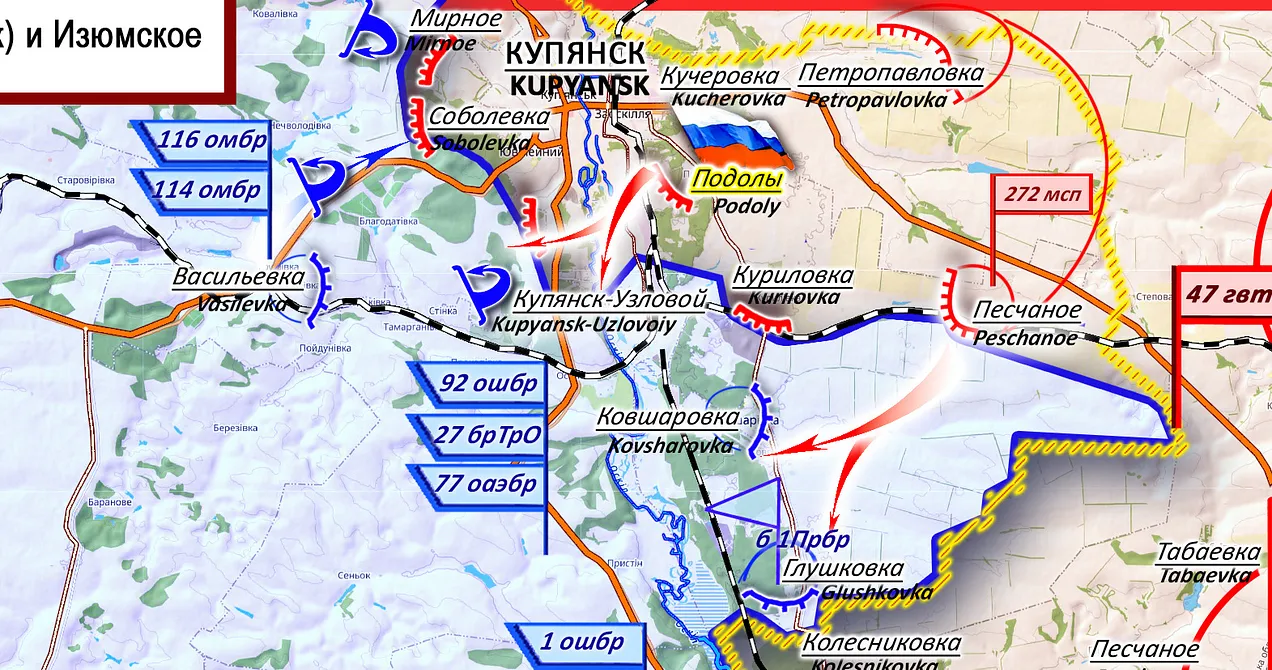
Google Translator

*****

From Cassad's telegram account:

Colonelcassad
A flash like lightning—it's a plasma cocoon forming around the hypersonic warhead of the Rubezh IRBM, the R-26, what we've come to call the Oreshnik.

As for why it's without explosives? The pigs are worried. Let us explain.
At speeds above Mach 5-6, the energy stored in the metal is greater than the energy stored in the explosives that can be packed into the warhead (at that speed, it's no more than 25-30% of the total mass, to withstand the G-forces). Therefore, using explosives is pointless, plus warhead production is simplified. The warhead material heats up so much during sudden braking that it partially converts to plasma from this stored energy. Consequently, without any explosives, the result is an explosion effect, a fragmentation field of very high-speed droplets of material that act as micro-cumulative jets directed in the direction of flight. And this provides enormous penetrating power.


Russian Engineer -

***

Colonelcassad
In the Lviv region, they're reporting gas supply disruptions. This could potentially be an indirect sign of damage to underground gas storage facilities. Of course, it's not worth expecting the enemy to rush to show the actual consequences of the strikes, especially if they were dealing with a buried target; the main consequences are underground.

***

Colonelcassad
The Ukrainian Foreign Ministry went into hysterics, claiming that the Oreshnik missile's arrival in Lviv was a threat and a challenge to the EU and NATO, and that something had to be done about it, that Putin had gone completely out of control, and so on. They continue to deny that they raided Putin's residence in Valdai. But this is standard foolishness.

It's easier to launch an Oreshnik missile at Lviv and leave Kyiv without heat and power than to evict Dolina from her apartment.

***

Colonelcassad
Kyiv's Gauleiter, Klitschko, urged Kyiv residents to leave the city, as subzero temperatures have left half the city without heat. Water has been drained from radiators.
Power and water outages also persist.

This time, Kyiv's thermal power plant has been hit hard.

***

Colonelcassad
1:37
Unfortunately, it's not a good morning today.

As of 6:00 a.m. today, following enemy shelling of utility infrastructure in the Belgorod region overnight, 556,000 people in six municipalities are without power. Almost the same number are without heat, primarily in 1,920 apartment buildings. Nearly 200,000 people are without water and sewerage.

All emergency crews are in place. I'll hold a task force meeting in 15 minutes to review the current restoration results. The backup capacity we've been installing over the past few months is being connected. Restoration work is underway where it's possible to restore power. When dawn breaks, we'll be able to fully assess the damage and restoration timeframes. The situation is extremely challenging. But I hope we can overcome it.

I'll try to provide more detailed, up-to-date information by 1:00 PM. I'll hold a follow-up meeting of the task force at 12:00 PM to review the implementation of the decisions we'll make now, at 7:00 AM.

Good day, health, and well-being to everyone.

@vvgladkov

https://t.me/s/boris_rozhin

Google Translator

******

Brief Frontline Report – January 8th, 2026

Summary by Marat Khairullin and Mikhail Popov.
Zinderneuf
Jan 08, 2026

Image
Map legend: the yellow line with red dots=Line of Combat Contact October 28th, 2025. Yellow Area=Activity.

Image

Message from the Russian Ministry of Defense: "Military personnel of the 36th Separate Guards Motor Rifle Brigade of the 29th Army of the 'East' Group liberated the populated area of Bratskoe in the Dnepropetrovsk Oblast. (Video at link.)

Assault troops occupied a large enemy defense area covering more than nine square kilometers. The Transbaikal soldiers cleared more than 170 buildings and structures that had been held by Ukrainian Armed Forces units."

After active offensive actions in the center of the Pokrovskoe - Gulyaipole line (liberation of the village of Kosovtsevo on December 26, 2025) and on its left flank (liberation of the city of Gulyaipole on December 27, 2025), the balance shifted to the right flank, and on January 8, 2026, the Russian Armed Forces liberated the populated area of Bratskoe (47°53′53″ N, 36°09′48″ E, with a population of 450 people in 2001). The bridgehead on the left bank of the Gaichur River on the line of Andreevka - Gerasimovka was expanded to the railway track.

Image

After the elimination of the Ukrainian Armed Forces base in the city of Gulyaipole and the disruption of logistics in the Kosovtsevo area, units of the 'East' Group are preparing a bridgehead, with support areas, for advancing to the line of Zelenaya Dolina - Bogodarovka, enveloping the Ukrainian Armed Forces position in Pokrovskoe from the southwest.


Image

https://maratkhairullin.substack.com/p/ ... anuary-8th
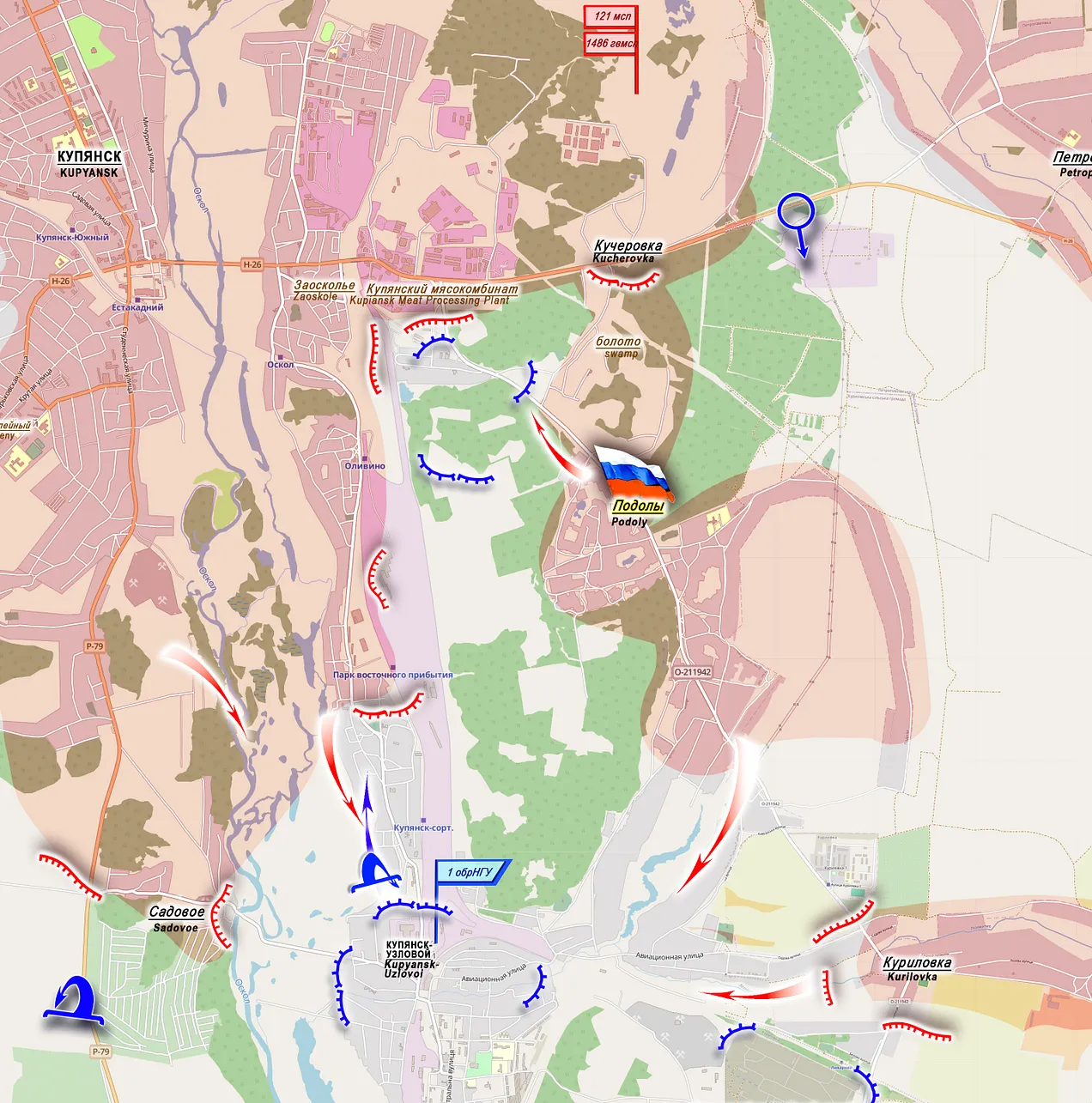
*****

Arrival of "Oreshnik" in Lviv
January 9, 2:06

Image

The Russian Armed Forces used the Oreshnik missile for the second time during the war. This time, they struck Lviv. (Video at link.)

https://colonelcassad.livejournal.com/10294957.html

Google Translator

*****

Explosions rock Kyiv and Lviv: The enemy writes about the alleged use of the Oreshnik missile

Image

The enemy has colored Ukraine's entire electronic map red. Ukrainian public groups are reporting that a massive strike is underway against targets on Ukrainian territory. A few hours ago, Kyiv's Zelenskyy also announced a "high probability of a massive strike." And if Zelenskyy is aware of the strike, it's unlikely to be a "decapitating" strike.

What attracts particular attention are the enemy’s statements about the Russian Armed Forces’ alleged preparations to use the Oreshnik IRBM from the Kapustin Yar test site.

Ukrainian monitoring groups are reporting explosions in Lviv and the surrounding area. There are reports of Geranium missiles diving on targets. New power supply problems are being reported. The enemy claims that an Oreshnik missile also struck a target in Lviv. Russia has not yet confirmed the use of an Oreshnik missile.

A series of explosions rocked the Ukrainian capital. Impacts were reported on power facilities in Solomenske and other districts of Kyiv, as well as in the Kyiv region. This resulted in power outages, which were already experiencing significant disruptions.

There are reports of incoming strikes on the Kanevskaya hydroelectric power station infrastructure. Several Geraniums were sent there. There are also reports of work Defense In the Cherkasy region, where the hydroelectric power station is located, the Cherkasy region is partially without power.

https://en.topwar.ru/276146-vzryvy-grem ... hnika.html

Google Translator

Nothing to do about the oil tanker? Naw... This shows focus: message delivered and material effect in the primary theater.

******

On the approaches to Svyatogorsk
January 8, 2026
Rybar

Image

While most areas of the Northern Military District are experiencing a lull as weather conditions worsen, good news continues to arrive from the Liman area . After several years, the Russian army is once again approaching Svyatogorsk .

In 2022, the Russian Armed Forces were forced to abandon the city after prolonged fighting during the Ukrainian counteroffensive. The front was collapsing quite quickly, and Russian soldiers were forced to retreat to avoid being encircled.

Now, objective surveillance footage has arrived from the area, confirming the presence of attack aircraft on the outskirts of the city. An advance group has been spotted near Time-Out Beach on the eastern outskirts of the town. Apparently, they managed to get there during heavy snowfalls, which limited drone operations.

At this time, it is unknown from which direction the Russian Armed Forces entered. Advancement is possible through the vast forests along the Seversky Donets coastline , as well as along the numerous dirt roads connecting Svyatogorsk with neighboring Yarovaya .

Meanwhile, east of Yarovaya, the Novoselovka railway station, where fighting had been raging for the past several months, came under Russian control . Further north, Russian troops advanced along the Aleksandrovka-Karpovka line , taking control of several strongholds and cutting off supply lines along the road between the villages.

Despite challenging weather conditions, assault forces continue to advance successfully in several sectors of the front, taking advantage of natural cover and extensive forested areas. If they manage to secure a full foothold in the Svyatogorsk area , urban warfare is expected to begin in the coming weeks.

https://rybar.ru/na-podstupah-k-svyatogorsku/

Successes on the northern flank
January 8, 2026
Rybar

Image
"Bratskoye liberated"

Whilefierce battles for control of strongholds near Zheleznodorozhny are raging in the vicinity of Gulyaipole and to the west , on the northern flank, fighters from the "East" force group have liberated another populated area.

Soldiers from the 36th Separate Motorized Rifle Brigade of the 29th Army crossed the Gaichur River at another point and reached its left bank. This was also facilitated by the adverse weather conditions of the past few days, which allowed the assault aircraft to move more freely.

Further advance north of Bratskoye will allow the formation of a pincer movement to encircle Pokrovskoe from the west and cut off one of the supply routes.

In the central sector, along the Pryluky-Varvarovka line , the situation is still obscured by the "fog of war." Following a series of unsuccessful counterattacks, the Ukrainian Armed Forces have significantly reduced their activity in the vicinity of these villages.

When it became clear that it would not be possible to break through to Rivne , the enemy apparently shifted its focus to counterattacks with the aim of regaining positions near Hulyaipole .

Having exhausted its potential in constant counterattacks in December, the enemy once again proved unable to contain the onslaught of the "Far Eastern Express." An attempt to at least somewhat stabilize the situation only allowed the Ukrainian Armed Forces to briefly slow the advance of the Far Eastern soldiers. Now, the Russian Armed Forces are once again pushing the enemy further and further west.

https://rybar.ru/uspehi-na-severnom-flange/

Google Translator

******

<snip>

Now some in the pro-Russian space are losing their mind over the oil tanker seizure, accusing Russia of ‘spinelessness’ if it does not declare war and launch nukes at the US, or something of the like. It’s still too early to judge Russia’s response: it takes time to plan a potential symmetrical retaliation.

Recall that last year Russia seized an Estonian ship in a tit-for-tat measure in the Baltic:

Image

As I said, it’s too early to judge and Russia may yet have a reciprocal response.

As for now, though, many forget that Russia has been causing various major US assets in Ukraine to go up in flames. Last year we saw several US factories destroyed in Russian strikes:

Image
https://www.yahoo.com/news/articles/rus ... 50986.html

And just in the past two days alone, again major US assets were said to be hit. In Dnipro, the US-owned Oleina sunflower oil plant was ripped by a drone attack.

Image
https://www.kyivpost.com/post/67460

Confirmed by Reuters:

Image

The factory belongs to Bunge corporation headquartered in St. Louis.

The night before that, some less-corroborated rumors claim another US-owned grain terminal was hit, by the name of Olimpex, with various unsourced rumors like the following:

Image

"NATO officers and an elite detachment of the Armed Forces of Ukraine were destroyed in the Odessa region. This was stated in his telegram channel by the coordinator of the Nikolaev underground Sergey Lebedev.

According to Lebedev, four strikes have already been carried out in Ilyichevsk (Chernomorsk) since 14.30 today. "There have already been about twenty ambulances," he noted. The strike was on a base with basekipazhny boats, how many of them were destroyed is still unknown."

-EA Daily


Larry Johnson reported on both, writing:

Russia also launched a massive missile attack on the American-owned marine terminal Olimpex, which is considered the largest in the Odessa region. This is the second time this year that Russia hit the terminal (I wrote about it in July). This terminal is one of the largest grain export facilities in the country, with an annual throughput capacity of up to 5 million tons. However, Ukraine was moving more than grain through Olimpex. According to witnesses, even though this facility was protected by Patriot air defense systems, the Russian missiles hit the terminal unimpeded. The subsequent explosions turned out to be so powerful that a supermassive mushroom cloud arose over Odessa, which indicates that this marine terminal contained numerous warehouses filled with NATO weapons.

Some images of damage in elsewhere in the Odessan ports from the same night of strikes:

Image

A drone strike on a cargo vehicle parking lot in Ilichivsk, Odessa region, on January 7, 2026.

During the attack, trucks were hit on the territory of the container terminal of the “Chornomorsk” sea trade port.


In fact, Johnson even reports that a third American corporation called Flextronics was also hit:

Furthermore, in western Ukraine, in the Transcarpathian region, Russian kamikaze drones, together with ballistic missiles, caused critical damage to the Flex plant, which also belonged to American investors. Flex Ltd. (formerly Flextronics), a Singaporean-American company headquartered in Austin, Texas, operates a major manufacturing site in Mukachevo (Zakarpattia Oblast, western Ukraine), which opened in 2012. This facility specializes in civilian electronics production (e.g., household appliances like coffee machines, printer components, and injection-molded plastics). It employs thousands and was significantly damaged in a previous Russian missile strike on August 21, 2025, injuring workers and sparking international commentary as an attack on US-owned infrastructure.

If true, this represents three major American assets blown to smithereens in only two days’ time—so don’t let concern trolls tell you that Russia is simply taking it on the cheek without any reciprocation at all. In fact, as far as we know the seized ship was not even Russian and was merely allowed to switch to the Russian flag last minute in the hopes of escaping.


In other news, the European ensemble of failures held another mutual therapy session which resulted in the signing of an agreement to station troops and build military bases in Ukraine after the event of a ceasefire—which pretty much ensures that no ceasefire will ever come…and maybe that was the plan all along.

Image

Here you can hear Starmer openly announce the plan to build “military hubs” inside Ukraine: (Video at link.)

You may recall that the threat of NATO troops and military assets in Ukraine was literally the reason behind Russia’s invasion to begin with, so we can only imagine Russia’s reaction to these latest baffling developments.

Of course, the weaselly Starmer again had no answer to the natural question which follows any such pro-Ukrainian chest-pounding: (Video at link.)

Notice his squirrelly answer revolves around illegitimacy and a transition to ‘democracy’, which implies a lack of legitimate elections. Interesting, that, given the fact that Zelensky is also precisely illegitimate and hasn’t held any elections after his legal mandate had long run out.

One thing is clear, the US and Europe have created a twisted tangle of contradictions that are spiraling out of control. It seems more and more likely that the Venezuela issue will not turn out even remotely favorable to Trump’s idealized vision, and will require new ‘adventures’—Greenland, naturally, comes to mind—to paper over the large-scale failure. Similarly for Europe, its massive tangle is getting heavier and heavier to bear, with slimy Eurocrat leaders now veritably drowning in the daily lies and hypocrisies they’re forced to spew to keep the fragile house of cards upright just a little while longer.

And now with the Greenland issue, the two sides are even careening toward an inevitable clash that will be a sight to behold, and may beget the final unraveling of this whole terminal escalation phase of the Western Order’s demise:

Image
https://www.telegraph.co.uk/world-news/ ... -greenland

#BREAKING: Denmark has issued a major warning, saying it would shoot first and ask questions later if United States military troops move to invade Greenland

https://simplicius76.substack.com/p/esc ... oast-guard

******

"There is great chaos under heaven; the situation is excellent."

User avatar
blindpig
Posts: 15059
Joined: Fri Jul 14, 2017 5:44 pm
Location: Turtle Island
Contact:

Re: Footnotes from the Ukrainian "Crisis"; New High-Points in Cynicism Part V

Post by blindpig » Sat Jan 10, 2026 12:42 pm

Bombings awaiting diplomacy
Published by @nsanzo ⋅ 10/01/2026

Image

On Thursday, the US embassy warned its citizens in Ukraine of the danger of an imminent Russian missile attack, a message echoed by Zelensky in his daily video address to the nation. This strange week, in which a summit of dozens of heads of state and government from the European Union and NATO to reach a security agreement with Ukraine went largely unnoticed due to the US aggression against Venezuela, has culminated in the bombing that Washington had warned about. “Putin doesn’t want peace; Russia’s response to diplomacy is more missiles and destruction. This lethal pattern of recurring major Russian attacks will continue until we help Ukraine break it,” wrote Kaja Kallas, for whom the internal meetings of the Western bloc, which explicitly exclude Russia, are the model of diplomacy that Russia simply has to accept. This way of managing a complex peace process, which the United States has further complicated by trying to reconcile teams with contradictory ideas in bilateral work with Russia and Ukraine and keeping open the third path of dialogue with European countries, implies that there can be no ceasefire until an agreement is reached between the conflicting parties.

The diplomatic front remains entrenched in a trench warfare scenario: Russia is demanding security conditions that contradict Ukraine's demands, while European countries are offering precisely the scenario they sought to prevent with their military intervention. For now, negotiations continue on terms utterly unacceptable to the conflicting nations. The territorial issue is detrimental to Ukraine, which Trump is demanding effectively relinquish a portion of Donbas—possibly as a demilitarized zone or free trade area—a demand Zelensky has been trying to reject for months, encountering the obstinacy of the United States. The US is aware that it must offer Russia something to get it to accept the impossible: crossing all its red lines on security. The presence of NATO countries on its borders is something Ukraine will be unable to justify to its population by presenting territorial gains in southern Ukraine and Donbas as a success, especially without the lifting of sanctions.

The economic front also does little to foster diplomacy or encourage Russia to take US proposals seriously. Despite the Kremlin's desire to see a positive aspect in Donald Trump's stance—who yesterday confirmed that the two Russian citizens captured on the Marinera vessel would be released—the trend toward economic pressure on Russia is clear. The United States alternates symbolic gestures favorable to Russia with the continued attempt to paralyze the Russian energy sector. In its quest to create what Bloomberg expert Javier Blas has called an "oil empire," Washington's desire for control is not limited to the Americas but extends to its two main rivals: Russia and Iran.

It is no coincidence that the high point of the negotiations on Ukraine—that is, the agreement with Kyiv and the delivery of the document to Moscow for its unquestioning acceptance—coincides with the US boardings of oil tankers sailing under the Russian flag and the latest announcement by Lindsey Graham, who claims to have finally secured Donald Trump's approval for his flagship project. "After a very productive meeting today with President Trump on a variety of issues, he has given the green light to the bipartisan Russia sanctions bill," stated the hawkish senator, adding that "this bill will allow President Trump to punish countries that buy cheap Russian oil that fuels Putin's war machine." The goal of Graham and Blumenthal, the bill's proponents, is to pass this law, which would impose a 500% tariff on products from countries that purchase Russian oil. The entry into force would depend solely on the signature of the President of the United States, a way of putting a ticking time bomb in the hands of Donald Trump that only he could activate at the moment he considered appropriate and aware that with this he would harm Russia, China, India and Brazil, four of the five original members of the BRICS.

Although threats are meant to encourage negotiation, the effect is proving to be the opposite. Yesterday's bombing, like Russia's continued advance north of Donetsk and east into the Zaporizhzhia region, where they are now just 20 kilometers from the regional capital, stems from Russia's need to reaffirm its military strength, its capacity to continue fighting, and to demonstrate the potential for escalation. Perhaps this moment of maximum economic pressure, countered by an apparent, albeit false, diplomatic opening from the United States—and only the United States—is the most dangerous for Ukraine, as was evident yesterday. "Russia's alleged use of an Oreshnik missile constitutes a clear escalation against Ukraine and is intended as a warning to Europe and the United States," condemned Kaja Kallas, for whom every Russian action is a sign of intensifying the war, allowing it to appeal for more military assistance to Ukraine and sanctions against Russia—a recipe for further increasing political tension, which tends to translate into military attacks. Yesterday's massive Russian attack resulted in four deaths, far fewer than the 28 fatalities caused, for example, by a Ukrainian drone strike in Kherson on New Year's Day. Escalations are almost never unilateral nor do they occur in a vacuum, but they are usually accompanied by the same narrative.

“Russia bombs Kyiv after rejecting peacekeeping plan,” AFP headlined yesterday , referring to Maria Zakharova’s remarks about Russia’s rejection of the idea of ​​a NATO contingent in Ukraine as part of security guarantees. These statements cannot be considered a Russian rejection of an agreement, but rather an initial stance toward negotiation. As even Donald Trump has indicated, negotiations with Russia are expected to take place once an agreement with Kyiv is finalized, so any reports of a rejection are premature. However, any military action by one side at this stage of the conflict can be interpreted as a message to the other, especially when the consequences are dramatic.

In the western part of the country, although it was initially assumed that the Oreshnik, a nuclear-capable missile, had attacked the gas infrastructure of Lviv, the most important city in western Ukraine, Mayor Sadovy only confirmed impacts on one of the country's "critical infrastructures." For the moment, the only available information is the spectacular nature of the explosion. And while Russia has claimed that the bombing was in response to what it continues to insist was a deliberate attack on Vladimir Putin's residence, US intelligence maintains that the attack did not target that residence but rather nearby critical military infrastructure. "The Oreshnik, which supposedly reached the Lviv region from the Astrakhan region in just fifteen minutes, is a warning to all of Europe," wrote Ukrainian historian Marta Havryshko, who added that "the message is this: even if your troops are stationed in Ukraine, just 5 kilometers from the Polish border, they can be annihilated with a single attack." Only genuine negotiations between the parties can prevent this escalating situation, which has currently left much of Kyiv without heating during one of the coldest periods of winter. Given the severity of the situation and his inability to resolve it, Mayor Klitschko's only response yesterday was to urge residents to leave the city if they can.

https://slavyangrad.es/2026/01/10/bomba ... iplomacia/

Google Translator

******

From Cassad's telegram account:

Colonelcassad
Terminal Support System (TSS).pdf
13 MB
NATO's Terminal Circuit: TSS as the Final Command Node

We continue our series of publications on the NATO command and control system, step by step uncovering its architecture, transferred to Ukraine for actual combat use.

Today's topic is the Terminal Support System (TSS). This is the terminal component of the combat infrastructure, supporting the work of operators at the end nodes of the command and control network. The document shows how the final C2 layer is organized—where decisions are made and commands are issued.

What the TSS reveals:
operator terminal workstations (HMI) for accessing CSI data;
connection to combat services and tactical information streams;
resilient operation during communication failures and network degradation;
synchronization with central components (CINEMA, CDXA, Java Suite);
access control and authentication through the NATO Trust Infrastructure.

Essentially, the TSS is the operator's "window" into the NATO combat network, through which sensor data, tracking, warnings, and command commands converge. Without it, the day-to-day operation of the entire system is impossible.

Combined with the previously published CINEMA, CDXA, and Java Suite, this completes the picture: Ukraine isn't "receiving aid," but rather attempting to integrate into NATO's full-fledged command and control system—from the server core to operator terminals. And the current conflict is being used as an operational environment for testing, resilience, and development of Western C2/C4ISR systems in real-world warfare.

We are Beregini! We know everything!

***

Forwarded from
GRIGORIEV
4:39
⠀⠀
🔴 Project by MAXIM GRIGOREV "People of Historical Regions" .

View previous testimonies

Dispatcher of the Bolshe-Tokmak Track Section Oleksandr Robushin, Tokmak (Zaporizhia Oblast):

00:07 "Life has changed for the better. We have built roads. The Tokmak-Melitopol sections now have perfect asphalt, which we haven't had for thirty years. Road signs and pedestrian crossings are appearing. Shops, kindergartens, schools, and sections are opening.

00:44 Things have also improved at work. If we compare my salary before and now, now I can afford to fill up my car, buy spare parts, food for my child, and clothes. I couldn't do that before. I received a salary and it was only enough to pay for utilities. I see only a positive future for Tokmak.

01:37 Under Ukraine, there was a policy of Ukrainization. On the railway, all documentation, all communications are only in Ukrainian. Although the population in the city is mainly Russian-speaking.

02:07 There was a war with monuments. WWII monuments were desecrated. This was done by representatives of the Right Sector. We remained silent because it was scary. They banned symbols, banned whitewashing trees and curbs—they called it communization. They intimidated people with words and even used force.

04:14 Representatives of the Right Sector have been intimidating the population since 2014. #Peopleofhistoricalregions #Donbass #SVO #crimesoftheKievregime Subscribe to the channel in MAX Subscribe to the channel in TG

***

Colonelcassad
Forwarded from
GRIGORIEV
2:46
⠀⠀
🔴 Maxim Grigoryev's project "People of Historical Regions . "

View previous testimonies.

Tatyana Kulikova, an employee of the Luhansk Museum of Local History in Luhansk (LPR), talks about the referendum of May 11, 2014:

00:00 "That day, people were afraid to go out. The first to go were the elderly—those who had survived the Great Patriotic War. My mother started getting ready for the referendum, saying, 'This is war.' We need to vote."

00:36 And everyone voted for Russia. We returned home. We can speak Russian, go where we want.

00:58 My sister in Ochakiv — they can't even talk to their neighbors, it's forbidden. People immediately disappear. They stop, take them to a pre-trial detention center, and then there are no more people.

01:37 When Zelensky announced a corridor, and the first humanitarian aid arrived, people were standing for water. Everyone was very afraid that tanks would enter the city. Everyone understood: it would be a complete massacre.

01:57 People were standing in line, and suddenly there was a roar and everyone was saying: "Tanks." Everyone froze. Everyone was shocked. And then white cars with red flags appeared, with Russian flags. People were crying, kissing the ground. Russia is everything. We can't live without Russia." #Peopleofhistoricalregions #Donbass #SVO #crimesoftheKievregime Subscribe to the channel in MAX Subscribe to the channel in TG

***

Colonelcassad
Residents of Sumy Oblast: "We thought it was the TCC, so we got scared. But then your guys came."

Ukrainians from Grabivske, Sumy Oblast, tell how soldiers from the 34th Separate Guards Motorized Rifle Brigade of the "North" group of forces led them into Russian territory. Towards the end of the battle for the village, they no longer distinguished between friend and foe. It seemed that our troops, realizing the village was already lost, began to pound civilian houses with all kinds of weapons, as usual. To kill as many "waiters." Meanwhile, it seemed that the "foes," risking their own lives, led civilians along exposed paths to safety. Stories from those liberated and their liberators.

Alexander: "The Russian soldiers put the question bluntly: 'Either you join us, or you'll die here. You can see for yourself how they're shelling you.' Well, who doesn't want to live? They decided to evacuate. We took the bare minimum of things with us and were led away. We were given strict instructions: "Watch your step, there are 'petals' all around." We walked for about two kilometers, keeping a distance of seven meters from each other. We stopped once – a drone flew by, but fortunately, it didn't notice. We reached Staroselye, where my wife and I were loaded into an armored car and taken to a dormitory in Belgorod.

Of the Russian soldiers, the ones we remember most were Artist and Pastyr. They were the first to come to our home when the fighting for the village was already underway, and they calmed us down. They said no one would hurt us, that they had come to help. They didn't say a harsh word. When we were already being led away for evacuation, I asked one guy from Dagestan: "A cow was tied up outside our house, and Valery, the shepherd dog, was on a chain. Please untie them." He nodded seriously and promised to take care of it personally. I'm sure he did."

Elena: “The last few months have been very difficult. No electricity, no water, no gas. But we survived – the garden, the farm. Your people came to us several times – they offered to let us leave. But I kept putting it off. I didn’t want to abandon the house. And they warned: “They’ll destroy the house, fill the basement with rubble.” I didn’t believe it. And then the shelling. The whole village was shaking. An hour later, a young soldier came. I said to him: “Let us go to Ukraine.” He replied: “We can’t, for your own safety. We’ve already entered the village. If we let you go west, they’ll kill you. They’ll think you’re spies. This has happened before.” And so I made up my mind. It was hard to leave: bags, backpacks, a dog. But your people helped us carry everything. They gave us everything we needed.”

Ivan: “Your guys reached us and told us to go down to the basement for our safety. We went down, but even in the basement everything was shaking during the shelling. That night, they brought us up to the house, and we spent the night. Your men were with us the whole time. The next day, we went back down to the basement. Later, the soldiers came. "Let's go quickly, while it's quiet." And so we went. No one bothered us, they treated us very well. Today, we went to see a doctor; they took our blood pressure and gave us some medication."

Natalya Chumachevko:“There was a knock on our door on December 18th. We thought it was the shopping center and got scared. My husband ran out the window. Who wants to go and die?! Especially since we have a lot of relatives in Russia. I opened the door. There were two people in uniform there. I asked, “Who are you?” They answered, “Russians, how many of you are there?” And I didn’t believe it. I asked, “Who is your defense minister?” They said, “Belousov.” I replied, “And who was before him?” “Shoigu. Yes, we’re Russians, mother.” And then I relaxed. I was so scared at first. They asked if we needed water, food, and medicine.

I resisted until the very end; I didn’t want to leave. And then our own people started bombing us with drones and shelling us. But we wanted to live. My husband and I left for your people. We hope to return. We lived in Grabovskoye for 33 years.”

An officer with the call sign "Hawk," a company commander: "My guys were liberating the village of Grabovskoye. The civilian population expressed a desire to defect to our side. When the fog fell, we activated electronic warfare and, through the terrain, led the civilians into Russian territory. The Ukrainian Armed Forces actively targeted the evacuation corridors; two of our troops were wounded, but no civilians were harmed. The civilians were transported across the border and placed in temporary accommodation facilities, where they were clothed, shod, fed, and watered."

Some are friends, some are foes, and some are just that.

@sashakots

https://t.me/s/boris_rozhin

Google Translator

******

Brief Frontline Report – January 9th, 2026

Summary by Marat Khairullin and Mikhail Popov.
Zinderneuf
Jan 09, 2026

Image
Map legend: the yellow line with red dots=Line of Combat Contact October 28th, 2025. Yellow Area=Activity.

Message from the Russian Ministry of Defense: "Units of the 394th Guards Motor Rifle Regiment of the 127th Motor Rifle Division of the 5th Combined Arms Army of the 'East' Group have taken control of the populated area of Zelenoe in the Zaporozhye Oblast.

Assault troops have occupied an enemy defense area of over eight square kilometers. Aerial reconnaissance has detected hidden positions and incoming enemy reinforcements." (Video at link.)

In the Gulyaipole sector, on its left flank near the city of Gulyaipole itself, the situation remains tense. The enemy is concentrating forces and resources from other sectors in this area and continuously attacking the outskirts of the city. The enemy's objective is to hold the major transport hub of Verkhnyaya Tersa - Zaliznichnoe.

Image

Units of the Russian 'East' Group have intensified their activities along the entire Pokrovskoe - Gulyaipole line and are preventing the enemy from freely maneuvering, pinning down their units with their own activities.

After repelling the attacks of the Ukrainian Armed Forces in the Gulyaipole area, units of the 394th Guards Motor Rifle Regiment counterattacked in the direction of Gulyaipole - Svyatopetrovka and liberated the village of Zelenoe (47°42′00″ N, 36°12′09″ E, population in 2001: 140 people). They seized positions in the area of the Solenaya ravine, in front of the enemy's defensive line, on the Svyatopetrovka - Staroukrainka axis. This line is a defensive outpost of the Ukrainian Armed Forces covering the Verkhnyaya Tersa - Zaliznichnoe area.

In the Pokrovskoe - Gulyaipole sector, the Russian Armed Forces have formed three deep wedge-shaped bridgeheads on the enemy's defensive line, in the areas of Bratskoe-Andreevka, Kosovtsevo, and Zelenoe. Thus, the enemy's defense is divided into three parts, with the threat of flanking encirclement by Russian units.

Image

https://maratkhairullin.substack.com/p/ ... anuary-9th

******

Swift Retaliation: Putin Launches Oreshnik Strike on "Largest Gas Storage Site in Europe" in Ukraine's Lvov Region
Simplicius
Jan 08, 2026

It has happened for only the second time of the war: the Russian Intermediate Range Ballistic Missile dubbed the Oreshnik was launched from the Kapustin Yar range toward Lvov, again providing the world with an eerie spectacle: (Video at link,)

Zoomed footage: (Video at link,)

It is being reported that Europe’s largest underground gas storage facility was hit:

According to preliminary data, the main target was the strategic underground Bilche-Volytsko-Uherske gas storage facility in Stryi — its capacity accounts for over 50% of all Ukrainian gas storage facilities.

It is assumed that the "Oreshnik" (or another missile) flew from Astrakhan to Lviv in 10–15 minutes — covering about 1,800 km at a speed of 10,000 km/h


Image

Image

Image

The timing obviously suggests that this is a “retaliation” attack meant to send a strong message to the West. Retaliation for what, precisely? Likely for several of the recent provocations and escalations together: the attempted drone attack on Putin’s dacha, the US seizure of an allegedly-‘Russian’ oil tanker, and don’t forget—the European summit’s signing of commitments to deploy both troops and military bases on Ukrainian soil in the event of a ceasefire. Russia had just warned they would become legitimate targets, and a strategically placed Oreshnik strike in western Ukraine could certainly be construed as a message for that:

Image

However, there is one counter-argument, which is that this could simply be part of Russia’s systematic campaign to destroy Ukraine’s energy infrastructure and Oreshnik just happens to be the most effective weapon for that particular site, which no other weapon could potentially destroy.

The reason is, Lvov is out of range of Iskanders and Geran drones and Kaliber missiles do not have the penetrative ‘bunker-buster’ capabilities to pierce deep underground storage sites. The Oreshnik—by virtue of its Mach ~10+ kinetic inertia—just happens to be the only weapon capable of penetrating a deep underground site at that long range of a distance in western Ukraine, at least theoretically speaking.

The other major consideration from the aspect of the strikes being a message to the West is that it was right on the Polish and NATO border. Many called for Russia to strike Kiev with the Oreshnik as part of the retaliation but it is pointless to hit a place only a few miles from the Russian border with an intercontinental-style missile. The far greater message is to strike right near NATO’s borders to send a message that all of Europe is put on notice, with the Lvov gas site being merely 160km from Poland’s critical Rzeszow base.

Interestingly, the official Ukrainian Air Force account announced that at 11:30pm the launch was detected:

Image

If you notice in the video of the strikes posted at the beginning, the timestamp shows 23:46, which means the Oreshnik struck precisely 16 minutes later. It has been estimated that it takes 15 minutes for it to get to Lvov from Kapustin Yar, which means that the Ukrainians were apparently aware of its launch via American real-time satellite ISR.

However, even knowing when it will launch, they will not have been able to know the target, as the missile flies too quickly to properly triangulate the trajectory and notify the target in time to take any actual effective countermeasures, such as simply hiding. Local reports said that there was no forewarning of the strikes at all, which means—though Ukrainian authorities knew when the missile was launching—they likely had no clue which region it would actually hit.

The other thing is, some reports stated Russia notified the US three hours prior to the launch, which makes sense because the launch of an ICBM-like vehicle could be interpreted by early warning missile detection systems as a nuclear first strike. It’s clear the US knew well in advance given there was “unusual activity” reported in Kapustin Yar literally days ago, with the US Kiev embassy already issuing this call earlier:

Image


That being said, the Oreshnik was just one part of a major ongoing aerial attack now striking Kiev and other regions with Kalibers, Kinzhals, Iskanders, Gerans, and everything in between—and so it’s possible the above warning was in regard to that, although it was unusual.

What else was unusual was the odd ‘afterglow’ which was seen for dozens of miles all around the Lvov region after the Oreshnik strike:

Image

Reports claimed local authorities conducted radiation readings and found the background radiation to be normal, with the glow assumed to be the gas storage facilities burning out, though we do not have any corroboration on that yet.

Official Ukrainian authorities had clocked the Oreshnik at a whopping 13,000km/hr, which should be roughly Mach 10.6:

Image

Recall that the Avangard cuts a few leagues above that, at Mach 30:

Image

Perhaps Russia will be inclined to test that next, should Zelensky or the West continue their naughty provocations.

Though Oreshnik stole the show, the much larger attack on other Ukrainian cities was in reality far more devastating, with Kiev’s thermal power plants said to be violently hit by Russian strikes as various Ukrainian cities experienced major to total power outages.

Image

💥— Large-scale missile-drone strikes on the energy infrastructure in Kiev have taken place, resulting in damage to 3 x Power Plants: TPP-4, TPP-5, and TPP-6.

Acc to local monitoring channels, up to 12 Ballistic Missiles, 25 x Caliber Cruise Missilies and around 200 x Drones took part in the attacks

After a wave of missile attacks, Kyiv is experiencing serious problems with electricity, water supply, and heating. There are communication outages. Problems on the railway have also begun, but they were already observed yesterday, they have just worsened now.


The even bigger story is the fact that Dnipro and Zaporozhye—both cities of nearly one million people, have reportedly been without power for days:

(Video at link,)

One Russian channel writes on the attacks on Dnipro and Krivoy Rog in particular:

A clearer picture is gradually emerging of the attacks in Dnepropetrovsk and Krivoy Rog. Judging by the nature of the damage, it’s no longer just about knocking out a generation, but rather about a targeted attack on distribution facilities.

At the current stage, it’s clear that Russia has managed to gradually, with relatively limited resources, create localized but persistent and noticeable power outages. Moreover, the change in approach and the redistribution of attack resources to a specific region disrupt (at least temporarily) DTEK’s usual maneuvering and backup schemes. For the central industrial region along the Dnieper, the existing mechanisms are gradually becoming insufficient.

Dnepropetrovsk is a good training ground in this regard. Due to its importance, the city has a complex, multi-redundant power grid designed precisely to bypass damage and redistribute flows. If prolonged outages can be achieved here, it means that the approach is working and can be scaled.

In the future, this opens up the possibility of turning energy attacks into a “on-demand” deployment tool - disconnecting specific regions without the need for massive fire campaigns, as has been the case, say, over the past three years.

The key question here is not whether this can be done, but the race for speed. On the one hand, there’s a well-honed mechanism for attacking power grid nodes, on the other hand, there’s emergency services that used to take a week or two to restore power. Who will be faster and more resilient in this confrontation will become clear soon.

“Military Chronicle”


As stated before, while the Oreshnik ‘stole the show’ and provided a flashy spectacle, the much bigger story is Russia’s ongoing systematic campaign of taking out Ukrainian infrastructure in general. This is putting major strain on Europe, as it faces increased isolation from “daddy” US, forcing Europe to divest more and more of its citizens’ funds to up-keeping Ukraine. This pursues a simultaneous Russian strategy of destroying Ukraine while greatly weakening Europe, particularly its political leaders, who face increased pressure at home for their disastrously mismanaged public finances.

A prominent Ukrainian analyst had recently written on X that Russia has been “weakened” more than ever of late, to which I had replied:

Actually, Russia is becoming more powerful than ever. That's because the US has weakened the only geopolitical mechanisms that acted as "checks" on Russia in the region (namely Europe and "int'l law" in general) which greatly increases Russia's power and influence disproportionately

As Europe grows ever weaker, both domestic-politically, economically, and from the standpoint of geopolitical influence (for instance in Africa and elsewhere, with France and other countries getting the boot), Russia gains outsize power. This stands to facilitate a situation where in a few years, Europe will be squeezed between the two giants of the US and Russia dictating everything to a hapless, weakened, and fractured European continent.

Particularly after the Ukrainian war is over—should Russia win decisively enough—the balance of power will have shifted so drastically in Russia’s direction that Europe will essentially be at its absolute weakest relative to Russia in all of history. Of course, the only way to prevent that is to make sure Russia loses—someway, somehow—in a spectacular enough fashion as to collapse this trajectory entirely, and this is why the Europeans are forced to continue doubling down on this Sunk-Cost sinking ship, wagering their entire futures on that remotely tiny possibility that the Russian bear could be dislodged from his newly-found footing.

That being said, don’t celebrate too early, as there is much work to be done for Russia to cement such a trajectory. The war must be won decisively, and as of the moment, despite the ongoing fireworks of the big strikes, the front itself has been relatively static for the past week or more, with little Russian movement. Though this is presumably the result of bad weather and possible regrouping for the next wave of assaults, it still stands as reminder that things are not exactly “easy” and victory is not yet precisely “obvious” or directly visible and imminent.

From the standpoint of the battlefield, there remains a long slog ahead, but the systematic work on Ukraine’s infrastructure is only just hitting its most vicious stride, and that should have major compounding secondary effects on Ukraine’s ability to resist in the coming months.

https://simplicius76.substack.com/p/swi ... n-launches

*******

It Is Called De-Sovietization.

Famous Lenin's dictum that Communism is the Soviet Political Power Plus Electrification of the Whole Country is being put in practice in 404 but in reverse. De-communization is the lack of the Soviet political power minus electrification of the whole country. What is happening right now across whole of 404 is unprecedented--the whole power generation and industrial capacity is being wiped out. Not only Dnepropetrovsk is dark, the other major industrial city and the main steel producing center Krivoi Rog is being de-communized with catastrophic consequences for not only power plant but steel foundries. (Video at link.)

Steel foundries are now stopped. Blackouts continue all over 404 and the tempo of strikes only grows.
Now about this.

Image

The fact that the only real combat activity any NATO troops can conduct in 404 is that in "training" capacity and the ONLY combat maneuver vaunted "volunteers" from the US and other NATO militaries are known in SMO is ... fast retreat, aka withdrawal, sometimes really fast ... retreat, if you know what I mean.

(More at link.)

http://smoothiex12.blogspot.com/2026/01 ... ation.html

******

CIA/MI6 Lawfare Op Assists Ukrainian Atrocities
By Kit Klarenberg - January 8, 2026 2

Image
CIJA staffers with members of National Police of Ukraine. [Source: cijaonline.org]
On December 28th, The Grayzone exposed how the Commission for International Justice and Accountability (CIJA) concocted a malign scheme to blackmail and intimidate the EU’s European Anti-Fraud Office (OLAF) and the European Commission.

Established in close coordination with CIA and MI6 officials to prosecute Syrian officials for alleged war crimes, CIJA was repeatedly found by EU regulators to be criminally corrupt.

Now, leaked documents reveal CIJA has taken on a secret role in the Ukraine proxy war since 2022, designating the country as one of its “key areas of operation.”

According to internal files reviewed by CovertAction Magazine, CIJA has been, in its own words, “imbedded [sic] with Ukrainian authorities” from the conflict’s earliest stages.” This covert alliance has extremely sinister implications.

For one, it is inconceivable CIJA will have collected evidence of Kyiv’s own rampant war crimes. Moreover, the Commission has been irrefutably implicated in evidence-tampering and inducement of false testimony to secure wrongful arrests and prosecutions related to its work in Damascus.

It would be unsurprising if CIJA has engaged in similar deplorable activities in Ukraine, with its dubious findings fed to the media, as in Syria. Even more disquieting, individuals and organizations intimately tied to the Commission are implicated in clandestine British intelligence efforts to assist Kyiv in perpetrating atrocities.

Image
William H. Wiley [Source: cijaonline.org]

A key irregularity in CIJA’s operations identified by OLAF was that the Commission was indistinguishable from a legally separate company founded by CIJA founder William H. Wiley named Tsamota. Wiley is chief executive of both entities, which share offices and key staff.

Grant money given to one entity can thus be surreptitiously funneled to the other, for illicit profit. Furthermore, contrary to CIJA’s professed commitment to international justice, Tsamota offers guidance to Western mining corporations on how to limit and evade their legal liabilities in the event they commit or are implicated in serious crimes.

A leaked document on CIJA’s troubles with the EU’s anti-fraud office acknowledges the Commission and Tsamota have “shared leadership” and “objectives.” Meanwhile, a veteran Tsamota operative is not only posted to Kyiv’s Prosecutor General’s Office, but leading a covert effort to supply extensive clandestine military and intelligence support to Ukraine on Britain’s dime.

This includes monitoring the country’s “pro-Russian contingent”—individuals routinely targeted by the Security Services of Ukraine (SBU) for arbitrary detention, torture, false conviction and murder. CIJA could therefore be implicated in the very crimes against humanity it purports to battle.

Image
Emblem of the Ukrainian Security Service that has been implicated in wide-scale human rights abuses. [Source: yahoo.com]

“Valued Counterpart”
In June, this journalist approached CIJA for comment on Wiley’s targeting of the EU Commission and OLAF. This included proposals to covertly insert or recruit assets in both entities, who could illicitly provide the Commission with “internal emails” and “documentation”—a serious criminal offense. I also inquired whether CIJA was active in Kyiv. No response was forthcoming. Curiously though, every entry on the Commission’s website referencing Ukraine was subsequently deleted.

Among the purged pages was a link to an interview Wiley conducted with the BBC in April 2022, about the ever-mysterious Bucha massacre, and methods for investigating atrocities purportedly committed by Russian forces in the city.

He suggested the case was “fairly straightforward,” forecasting “it shouldn’t be a big problem for the Ukrainians to identify who was responsible for these offenses and to prosecute one or two of them, or conversely send them to The Hague.”

When the BBC host suggested there was a need for “international independent verification” as it wasn’t “just for the Ukrainians to do this,” Wiley insisted Kyiv “have a great deal of capacity.”

Notably, he defensively dismissed any insinuation a Ukrainian investigation of Bucha “would be a stitch-up”—which his interviewer had not even directly implied. In March 2025, Ukrainian police charged 34 Russians in absentia for war crimes allegedly committed in the city.

No international investigation into Bucha has materialized. An emergency UN Security Council meeting on the incident proposed by Russia was blocked by Britain. Moscow’s repeated requests for the names of the alleged victims to be published have been ignored.

Elite imperial journal Foreign Affairs has confirmed Bucha was exploited by then-British Prime Minister Boris Johnson to sabotage peace talks between Russia and Ukraine, and keep the proxy war grinding on. The BBC has also since acknowledged questions abound over what actually happened in the city.

Image
Father Andrii Halavin blessing unidentified bodies in a cemetery in Bucha. No proper investigation has been carried out to identify the culprits of the killings there. Evidence suggests that Ukrainian neo-Nazi Azov Battalion members were behind it and that there was an attempt to blame the Russians for political reasons. [Source: nytimes.com]

Given that CIJA was secretly embedded with Ukrainian authorities at this time, Wiley was well-placed to know the truth. That no international investigation ever emerged is all the more suspicious given ICC Chief Prosecutor Karim Khan opened a formal inquiry into crimes against humanity in Ukraine four days after the proxy war began.

Working directly with Ukraine Prosecutor General Andriy Kostin—whom he has dubbed his “valued counterpart”—Khan visited Bucha in April 2022, and declared there were “reasonable grounds” to believe Russian forces had slaughtered innocent civilians locally.

CIJA’s proximity to Ukrainian investigators would, one might think, produce ample evidence supporting this charge. Then again, despite its founding mission being to prosecute Syrian officials for war crimes, the Commission has contributed to vanishingly few legal actions in its 14 years of operation.

Its primary role throughout the West’s dirty war against Damascus was providing the mainstream media with material that formed the basis of high-profile investigations into purported Syrian government atrocities.

CIJA was also centrally involved in the “Caesar” fraud, which led to crippling sanctions being imposed on Damascus. In this fraud, a defector code-named Caesar, who was found to have been a U.S. intelligence asset, testified before both houses of the U.S. Congress about alleged atrocities committed by the Assad government that turned out mostly to have been carried out by jihadist rebels backed by the CIA under Operation Timber Sycamore.

Image
Syrian defector “Caesar” conceals his identity as he listens with a translator to the House Foreign Affairs Committee in 2014. [Source: cnn.com]

It would be unsurprising if CIJA has repeated this propaganda role throughout the Ukraine proxy war. The reasons for the Commission’s activities in the country remaining unadvertised are not clear, and it is also uncertain who or what is footing the bill for its services.

One explanation for both mysteries may be that, in addition to collecting—or concocting—evidence of Russian war crimes, the organization and individuals and entities to which CIJA is connected are simultaneously implicated in Kyiv’s own atrocities.

“Identify Users”
In November 2022, The Grayzone exposed how Prevail Partners, a private-sector cutout staffed by British military and intelligence veterans, was leading a covert effort to create and train a vast Operation Gladio-style Ukrainian terror army to carry out assassinations, sabotage and other dirty work behind enemy lines on behalf of the SBU’s Odessa branch.

Prevail colluded in this venture with a shadowy company named Thomas in Winslow (TIW). In the wake of that exposé, TIW’s website was subject to an intensive clean-up.

Image
[Source: thegrayzone.com]

Today, its content offers little description of the firm’s activities, vaguely characterizing TIW as “your trusted partner in strategic decision-making…in conflict zones,” and no information on who or what is running and funding the endeavor.

A brief but ponderous “what we do” section suggests the company provides “on-the-ground human intelligence and advanced data analysis in some of the world’s most volatile regions,” focusing on “counter-terrorism, counter-narcotics, and anti-money laundering.”

This is, ostensibly, to “equip leaders” with “clarity, foresight, and operational advantage” to make “informed, strategic decisions.”

Prior to The Grayzone revelations, TIW’s website amply spelled out how the firm was preponderantly focused on Ukraine. Boasting the company had an “advance team…currently on the ground” operating from an office in Odessa, TIW was said to have ongoing “war crimes investigation” and “justice sector capacity building” programs in place locally, in conjunction with Ukraine’s Attorney General and the President’s Office. “All data collected” by its expert team “will be shared…and archived for future use,” TIW pledged.

Its landing page also provided identities of TIW staffers. Among them was Peter Becker, a U.S. military journeyman who subsequently diversified into international law in Afghanistan and Iraq. [NOTE: I’m not sure what a “military journeyman” (line 2) is.]

His LinkedIn profile suggests he has served since early 2022 as an “evidence collection manager” for Tsamota in northeast Syria, while simultaneously working in the Ukrainian Prosecutor General’s Office. Moreover, leaked documents indicate Becker led a private consultation with the Odessa SBU’s deputy director on how Prevail and TIW could assist the agency’s operations.

Image
Peter Becker [Source: linkedin.com]

Conducted in the proxy war’s initial stages, a subsequent “capability proposal” was circulated among Prevail and TIW in April 2022 based on the discussion, which focused “on targeting and specialist capability to support that function.” This not only applied to military contexts, but domestic operations against Ukraine’s “pro-Russian contingent.”

The proposal noted “tracking and monitoring of devices played a key role in the conversation,” and “improved technology to intercept and monitor social media, messaging, emails, smart phone transmissions” were key needs for the SBU.

While Ukraine’s Security Service possessed “existing methods and capability to track phones,” they “had no way to identify users,” and “their capability often tracked Russian phones that led them to legitimate civilians.”

The proposal noted the SBU was “visibly impressed and excited” by the array of surveillance tools offered by Prevail and TIW. Assistance in this field was subsequently provided in the form of Anomaly Six, illegal spying technology that identifies individual smartphone users and monitors their movements.

Image
[Source: thegrayzone.com]

“A Hunt”
Elsewhere, the proposal noted the SBU sought “technology to access electronic information contained in captured smart phones,” which was “another area where we can provide significant support” to the agency’s “existing capability,” including breaking into encrypted data.

This would aid “improvements in collecting and analyzing” human, signal, and open-source intelligence, including “social media monitoring.” The document concluded that Prevail and TIW could “add huge benefit” to the SBU’s intelligence-gathering and actioning capacity due to the firms’ “collective experience” with “the F3EA cycle.”

F3EA (find, fix, finish, exploit, assess) is a military doctrine honed during the criminal 2003 Anglo-American invasion of Iraq, and subsequent occupation. Under its auspices, targets are identified, kept under continuous surveillance, captured or killed, intelligence gathered from them, then this trove analyzed to identify further targeting opportunities.

The SBU was reportedly “impressed” with the pitch presented by Prevail and TIW via Peter Becker, and welcomed having “dedicated mentors/advisors inside their tent,” which was said to amount to “boots on the ground.”

The longevity of Becker’s presence within the Ukraine Prosecutor General’s Office suggests that it is likewise “comfortable” with having foreign advisers “inside their tent.” It is uncertain whether Becker represents TIW and/or Tsamota/CIJA in this capacity.

But his dual roles definitionally represent a macabre conflict of interest. There is a high likelihood the spying support and technologies provided to the SBU by Prevail and TIW have assisted the commission of grave, industrial-scale crimes by Kyiv’s military and intelligence apparatus.

For example, since the proxy war’s eruption, savage attacks on opposition elements within Ukraine—including assassination—have become routine. This brutal wave of repression ratcheted up significantly in the wake of Kyiv’s 2022 counteroffensive.

Residents of recaptured territory accused or suspected of having “collaborated” with occupying Russian forces—including by simply accepting food, or continuing to teach at local schools—have been arrested, prosecuted and jailed in vast numbers.

Others have been targeted by hit squads. As a Ukrainian Interior Ministry official boasted in October 2022: “A hunt has been declared on collaborators and their life is not protected by law. Our intelligence services are eliminating them, shooting them like pigs.”

Image
Videos from social media showed Russian troops lying face down in front of Ukrainian forces in Kharkiv. [Source: dailymail.co.uk]

Image
Car destroyed in SBU car bombing. [Source: bbc.com]

Multiple UN Human Rights High Commissioner reports have recorded how the SBU routinely engages in enforced disappearances and arbitrary detentions of suspected “collaborators.” In June 2023, the Commissioner noted how, in many cases, detainee confessions are secured using beatings, electrocution, mutilation, sexual violence, and threats of execution and rape.

Moreover, national and local prosecutors consistently rubber-stamp legally questionable detentions and convictions. We can only speculate whether Peter Becker, and by extension CIJA, TIW and Tsamota, are implicated in this rampant corruption of Ukraine’s legal system.

“Getting Killed”
Today, prosecutions of Russian officials for war crimes seem further away than ever. Karim Khan’s personal crusade was brought to an abrupt halt in February 2025. The Trump administration imposed sanctions on the ICC and its staff for seeking international arrest warrants for Israeli Prime Minister Benjamin Netanyahu and Defense Minister Yoav Gallant for “crimes against humanity” committed in Gaza since October 7, 2023. These measures have reportedly made it virtually impossible for the Court to fulfill even basic tasks.

In March 2025, Washington announced it was withdrawing from the International Center for the Prosecution of the Crime of Aggression against Ukraine, a European initiative. The Trump administration simultaneously cut support for the Justice Department’s War Crimes Accountability Team, created in 2022 by then-Attorney General Merrick Garland. Its purpose was to provide Ukrainian authorities “with logistical help, training and direct assistance in bringing charges of war crimes committed by Russians to Ukraine’s courts.” It is unknown if CIJA was in any way involved.

Image
Merrick Garland [Source: britannica.com]

Undeterred, in June, Kyiv and the Council of Europe signed an agreement to establish a “Special Tribunal” to prosecute Russian officials for war crimes.

EU figures, including Commission President Ursula von der Leyen, hailed the move as a historic “moment for justice, international law, and the future of Ukraine,” which would “bring perpetrators of this illegal war of aggression to account.”

This is precisely what CIJA has been preparing for since the proxy war commenced. Yet, the Commission will likely be barred from directly participating.

As The Grayzone revealed on December 28th, the motivation for CIJA’s malicious targeting of the EU Commission and OLAF stemmed from its corrupt “justice” activities in Syria landing the outfit and Tsamota on an EU blacklist.

As William Wiley confessed to an MI6 contact, this resulted in the Commission “getting killed” financially, unable to secure contracts from Brussels and other international donors.

Revelations that CIJA used criminal tactics in a botched attempt to wrongfully convict an innocent Syrian in May 2024 surely further damaged the firm’s standing.

As Russia inexorably advances across the battlefield, CIJA’s ability to seize, distort or concoct evidence of war crimes in Ukraine, let alone exploit such material for prosecutions, grows ever-slimmer. Yet, despite OLAF’s damning findings, and calls for police investigations into the Commission’s activities, Wiley and his companies remain protected by Western governments.

CIJA’s utility to them is clear. While the organization may not achieve its stated mission of holding purported war criminals to account, it remains a dependable source of atrocity propaganda, with which Anglo-American imperialism can be consistently justified.

https://covertactionmagazine.com/2026/0 ... trocities/
"There is great chaos under heaven; the situation is excellent."

User avatar
blindpig
Posts: 15059
Joined: Fri Jul 14, 2017 5:44 pm
Location: Turtle Island
Contact:

Re: Footnotes from the Ukrainian "Crisis"; New High-Points in Cynicism Part V

Post by blindpig » Sun Jan 11, 2026 1:58 pm

The economy as a guarantee of security
Published by @nsanzo ⋅ 11/01/2026

Image

Although media coverage of the negotiations to end the Russian-Ukrainian war has generally focused on military aspects, as Zelensky announced, Ukraine and the United States are also negotiating an economic agreement, something no less important and equally linked to security. Since 2022, the economic presence of Western countries has been considered a guarantee that the European Union, the United Kingdom, and the United States cannot abandon Ukraine to its fate once they have achieved their objectives, as happened in Afghanistan in the 1990s, or admit failure, as with the abandonment of Hamid Karzai's government in 2021. Meetings to secure investments from large corporations, including major vulture funds, have progressed in parallel with the attempt to establish a direct US involvement in the future Ukrainian economy. The logic is simple and, as the war has shown, not always reliable: Russia will not dare to attack US economic assets. The logic of the minerals agreement went somewhat further, as it implies a direct presence in strategic sectors that Washington would have to protect. This is the path Ukraine has followed, negotiating a “prosperity plan” that, in reality, forms part of the security guarantees. The greater the United States' aspirations for benefits, the more certain Ukraine feels about the continued presence of its ally on the ground and its economic and political integration into the Western bloc—the first step toward military accession.

Much has recently been said about the progress made by the Coalition of Volunteers in its negotiations for the creation of military hubs in Ukraine and other aspects of the country's post-war militarization, but, judging by some publications, the progress is even more significant in the so-called "prosperity package," the typically traumatic name given to the economic document that is meant to bind Ukraine and the United States in the future. "US and Ukraine to sign $800 billion reconstruction deal," headlined The Telegraph on Friday, adding that "Trump and Zelensky to conclude a prosperity and security guarantee agreement in Davos." There is no better place to sign an agreement that places the country's economic future in the hands of large international corporations than the Davos Forum.

“The Ukrainian president had hoped to travel to the White House next week to finalize both the economic prosperity plan and a postwar security guarantee agreement. However, his European allies in the ‘coalition of volunteers’ advised against the trip and suggested the World Economic Forum as a more suitable alternative for meeting with Trump,” the British newspaper reports. European countries continue to try to protect Zelensky, attempting to ensure that important summits are held in Europe where the Ukrainian president can be escorted by his staunch partners.

“Kyiv hopes that by offering Washington a stake in post-war reconstruction, especially in projects that might appeal to Trump, the US president will be more willing to offer solid security guarantees,” the British media outlet states, showing that Ukraine’s vision in 2022 remains unchanged and that its aspirations are based on hopes dependent on the will of its American ally. The few details available suggest that the terms have also remained the same since vulture funds first expressed interest in Ukraine’s reconstruction and Trump became convinced of the trillions of dollars in potential profits hidden beneath the country. “The prosperity plan aims to raise around $800 billion (£600 billion) over a decade to rebuild Ukraine and revive its economy, according to Ukrainian officials. Zelensky stated that the agreement would provide ‘economic recovery, job restoration and the revival of Ukraine’ at a press conference late last year,” writes The Telegraph, which does not attempt to explain the terms in which the document is expected to be framed.

“It is understood that this paves the way for a series of loans, grants, and investment opportunities from private companies to provide the funds,” he adds, offering the only details about the substance of the future agreement: a transfer of wealth from Ukraine to the United States, from public money to private gain, the use of natural resources to serve the West, and more accumulated debt that all parties know can never be repaid.

These future problems, mortgaging the country's economic situation to Western will, are not Zelensky's primary concern. He is convinced that resolving all problems requires a greater US presence, both public and private. Zelensky's haste to sign the economic package contrasts sharply with the prudence advised by European leaders, according to The Telegraph , who prefer to focus on military and political issues.

Meanwhile, Ukraine is moving forward with its plans to integrate US capital into the country's economy. The signing of the minerals agreement entailed direct cooperation, in which Ukraine would open the door to US companies participating in the extraction of strategic minerals. In June of last year, The New York Times anticipated that the first contract Ukraine was preparing to award would go to a conglomerate whose figurehead was close to the Trump administration. The New York newspaper confirmed the news yesterday. “Ukraine on Thursday awarded a contract to exploit a major state-owned lithium deposit to a group of investors that includes a billionaire friend of President Trump, after his administration indicated it is seeking investment opportunities in the war-torn country,” The New York Times explained.

The economy, the exploitation of key natural resources, such as lithium, and geopolitics go hand in hand, and the same names reappear in seemingly separate conflicts. “The winning consortium is closely linked to the Trump administration. Its members include Ronald S. Lauder, heir to a fortune in the cosmetics sector, who has known Trump since college and was the one who suggested the idea of ​​buying Greenland, rich in natural resources. The other investor is TechMet, an energy company partly owned by a US government investment agency created during Trump’s first term,” the article states.

Demonstrating its unwavering commitment to the Ukrainian version of events, the publication states that its sources claim the bidding process was fair and the billionaire's proposal outperformed all others. The contract, which must be ratified by the Council of Ministers—a mere formality—was awarded by a government commission in which, even The New York Times believes, pleasing Donald Trump was a factor. “By cultivating ties with investors connected to Trump and his administration, Kyiv is positioning itself favorably with the US leader just as it seeks his support in peace negotiations with Russia, capitalizing on efforts to appeal to his business-oriented mindset,” the article admits. The country's natural resources are merely a tool to achieve its political objectives.

https://slavyangrad.es/2026/01/11/la-ec ... seguridad/

Google Translator

*****

From Cassad's telegram account:

Colonelcassad
1:07
The Ukrainian command, it seems, can't go a day without deceiving its citizens and Western sponsors. A tried-and-true method: "media victories." Our soldiers in Kupyansk thwarted yet another attempt to create a false image.

Surprisingly, the Ukrainian Armed Forces, who claim almost complete control of the city, decided to stage a "flag-striking" using a drone. Soldiers from the Unmanned Systems Troops of the 6th Guards Combined Arms Army of the "West" group of forces spotted a Ukrainian hexacopter planting a flag on an administrative building in Kupyansk.

They reacted immediately: the Ukrainian flag was destroyed by a direct hit from the FPV drone. The hexacopter, deployed by the Ukrainian Armed Forces for yet another deception attempt, was shot at by a pair of snipers using small arms. Soldiers from the 121st Motorized Rifle Regiment thwarted the enemy's "PR stunt."

The situation was quite revealing. Our soldiers reported from the field:

"The number of our drones in the sky has increased exponentially."

The enemy continues to attempt to storm our positions in the city, engaging in counter-attacks. But the enemy's onslaught is gradually weakening. Ukrainian media outlets attempting to maintain a modicum of objectivity are criticizing the Ukrainian Armed Forces command and directly pointing out the consequences of their attempt to recapture Kupyansk:

"The situation on the front is increasingly taking on the characteristics of a creeping and uncontrollable collapse of the defense. Most of the reserves were depleted in the media-hyped campaign around the Pokrovsk sector, which essentially became an expensive PR maneuver. The remaining forces were transferred to the east, where frontal, attritional assaults near Kupyansk continue: without strategic depth, but with high casualties.

Against the backdrop of this regrouping, the ability to hold the defensive line is rapidly shrinking, while the Russian army maintains offensive activity along a broad front—from Sumy to Zaporizhzhia."

As a reminder, Syrsky decided to deploy Australian Abrams to Pokrovsk, but the desperate attempt to at least consolidate its position on the outskirts resulted only in the destruction of the Ukrainian column .

The Kyiv regime deployed larger forces to Kupyansk, but this too was in vain. In a month of attempting to create a "victory" on one sector of the front by weakening others, Ukrainian propaganda managed to report both the loss of the city to the Russian Armed Forces and the virtual completion of its cleansing .

But in reality, as the same Ukrainian sources assert, the situation is critical:

"In Kupyansk, Ukrainian units are once again assaulting enemy fortified positions head-on. Unofficial estimates suggest losses of up to two brigades, approximately 5,000 men. Decisions are being made not out of military necessity, but based on the prevailing information."

Essentially, the Ukrainian Armed Forces, thrown into the slaughter, found themselves "between a rock and a hard place," with our fortifications in front of them and barrier detachments pressing in from behind. The attempt to recapture the city turned into a trap.

@warfakeees

***

Colonelcassad
Even more air defense against low-flying drones.

The British continue to test their inventions in the Ukrainian conflict zone.

- London confirmed the transfer to Ukraine of 13 Raven short-range air defense systems mounted on Supacat HMT 6x6 trucks.

- Two fixed-mounted Gravehawk short-range air defense systems, the launchers for which were hidden inside shipping containers, were also sent to Ukraine.

- According to the UK, delivery of several more Gravehawks from the 15 remaining air defense systems ordered is expected in the near future.

This is another indicator of the direction of air defense development, and protection against ballistic and cruise missiles is fading into the background, as they do not pose the greatest threat.

Yes, their warheads are more powerful, but it is the drones, which are inexpensive compared to cruise and ballistic missiles, that have the greatest impact in the Ukrainian conflict zone.

Our Geran missiles fly daily, and the Ukrainians cannot use the expensive Patriot missiles. That's why these ersatz air defense systems, adapted to mass UAV attacks, are coming to the fore.

@rusich_army

***

Forwarded from
GRIGORIEV
4:01
⠀⠀
🔴 Project by MAXIM GRIGOREV "People of Historical Regions" .
View previous testimonies

Director of the Snezhny sewing factory "Snezhinka" Natalia Kuryanskaya, Snezhnoye (DPR):

00:00 "We have been waiting for this moment for more than eight years - long and painful. Now the situation is definitely becoming stable. We have returned to our haven. As the head of an industrial enterprise, I can say that we have real prospects.

00:31 We have the opportunity to enter the Russian market. Enterprises have the opportunity to purchase modern equipment and develop. We can now easily purchase high-quality raw materials in Russia and Belarus and sew high-quality products.

01:35 We are a diversified enterprise. Now we mainly produce workwear, uniforms, clothing for doctors and fulfill all the orders that are needed today.

02:13 Donbass has always been the industrial heart of Ukraine. Despite the fact that in Kiev they said that we were a subsidized region, everything was the opposite. All the funds that industrial Donbass earned were one hundred percent They left for Kiev.

02:57 For thirty years, Ukraine has invested nothing in the development of production. Everything was destroyed, fell apart, died. Production was deliberately stifled.

03:51 Now is a transition period, and it is not easy. But this is our path, which will lead us to a better future. We have hope. #Peopleofhistoricalregions #Donbass #NVO #crimesoftheKievregime Subscribe to the channel in MAX Subscribe to the channel in TG

***

Colonelcassad
It finally happened. The International Legions of Ukraine have been officially disbanded. Their personnel have been transferred to the assault troops. This is reported in an article by MilitaryLand.

The International Legion of Ukraine, created on Zelenskyy's initiative in the early days of the Ukrainian conflict to attract foreigners, ceased to exist on December 31, 2025. Thus, a military project that had trained thousands of mercenaries came to an end.

There were four units of the International Legion, which were redistributed during the reform:

- The 1st and 3rd International Legions were merged into the 475th Assault Regiment
- The 2nd International Legion was disbanded; its personnel were presumably also included in the 475th Regiment
- The 4th International Legion was transformed into the 157th International Training Center

. The reorganization caused serious discontent within the units. Deputy Commander of the 2nd International Legion Andrei Spivka stated that the disbandment was chaotic and destroyed combat-ready units:
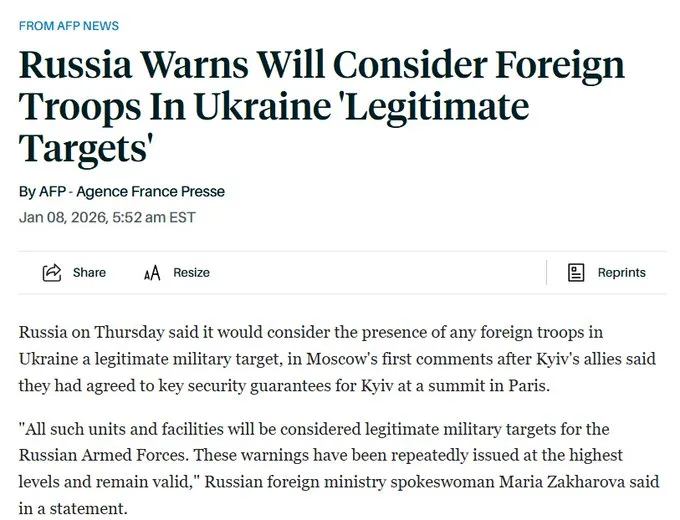
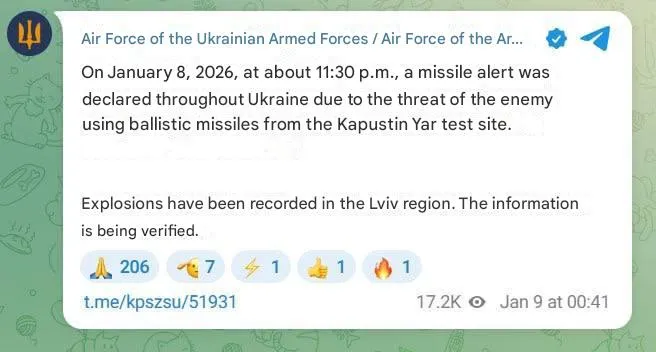
The crews and teams were simply broken up, and people were randomly assigned to vacant positions in the assault regiment.

According to him, the commander of the 2nd Legion opposed the disbandment and appealed to the State Bureau of Investigation and the Specialized Anti-Corruption Prosecutor's Office, demanding a legal assessment of the situation. Shortly after submitting his complaints, he was suspended from his post and sent to serve in another, remote region of the country.

After contacting the State Bureau of Investigation and the Specialized Anti-Corruption Prosecutor's Office, he was almost immediately removed from his post and sent to carry out tasks on the opposite side of the country.

It is emphasized that the reform only affected the structure of the Ground Forces. The International Legion of the Main Intelligence Directorate of Ukraine operates separately and continues to operate as usual.

@The_Wrong_Side

https://t.me/s/boris_rozhin

Google Translator

******

Trump's transformation?

The Russian tanker affair. Moscow's deterrence problem. London's intrigues. Pyongyang or Alaska?
Events in Ukraine
Jan 09, 2026

Trump has continued to make good on his elections promises since his Caracas excursion. On January 7, he called for an increase in the military budget from $1 trillion to $1.5 trillion. That’s what it takes to build America’s ‘dream military’, the one ‘we have always been entitled to’.

In response, Tucker Carlson reached the rather reasonable conclusion that the US is preparing for a gargantuan war. In his usual fashion, he argued that a ‘relationship with Russia’ is necessary if the US is to receive the resources it needs to survive the imminent ‘world war’. (Video at link.)

Of course, the war that Republicans — and the rest of the American security establishment — are most focused on is that with China. But what about Trump’s supposed peacemaking with Russia, Beijing’s key ally and energy supplier?

Carlson represents the line of thought that the US get Russia on its side — or at least neutral — in preparation for the showdown with China.

But the way things are going, it seems more likely that the US will go to war with both Russia and China.

However, the fecklessness of Russian responses to recent American provocations — and the absence of much of a Chinese one either — make the outcome of this struggle somewhat up in the air. I can imagine Trump thinking that if his good friend Netanyahu can fight seven conflicts simultaneously, then why can’t he?

After all, Washington seems to be increasingly tired of diplomacy. perhaps a change of instruments is incoming. We’ve endured a year of Trumplomacy vis a vis Russia and Ukraine. With the war continuing as usual, it’s hard to avoid the suspicion that it’s all been a waste of time.

To be fair, Zelensky began the year with his usual total rejection of any abandonment of the 1991 borders. By December, Ukraine began officially accepting the withdrawal of Ukrainian troops from parts of the Donbass — but only as long as it is a ‘demilitarized zone’ where Russian troops are also not allowed. That must be some progress, right?

But come 2026, and things seem to be changing. Not exactly towards a ceasefire.

There are many signs of this change. One is the fact that there have been no new exchanges of prisoners of war between Russia and Ukraine since October 2025.

Strategies shifting?
The Euro-Ukrainian plan has always been to propose ‘peace compromises’ that they know will be rejected by Moscow, so that Trump gives up on the possibility of peace with Russia. This would thereby re-enlist Washington as an enthusiastic sponsor in the war against Russia.

Despite high-flung phrases of the ‘spirit of Anchorage’ following the Trump-Putin Alaska meeting in August 2025, peace talks are moving at a snail’s-pace, if at all. Is the European mission of transforming Trump finally working?

U.S. President Trump meets with Russian President Putin in Alaska

Image
Trump and Putin in Anchorage, August 15, 2025

Trump has already stated his ‘disappointment’ with Putin at numerous points throughout 2025. However, this never actually led to Washington increasing military aid to Ukraine.

Nevertheless, with Moscow unwilling to bite on an American peace plan that would leave Ukraine’s army three times larger than it was before 2022 and satisfy few of Russia’s territorial demands, Trump has once again become frustrated. On January 4, fresh off the high of his Venezuela operation, Trump announced that he was tired of Putin’s unwillingness to agree to US demands:

I'm not thrilled with Putin. He's killing too many people

Trump said this at a press conference dedicated to his kidnapping of the Venezuelan president. It’s quite clear indeed that Washington intends its show of force in Caracas to be a sign to all its enemies. Trumplomacy is becoming ever more enthusiastically aggressive.

For instance, the following January 4 State Department post was clearly not merely addressed to Venezuela, but other countries that Trump wants something from. Of course, it is from Russia that Trump most desperately wants something — agreement to a compromise peace deal that the Kremlin doesn’t think it needs to sign.

Image

Tanker turning point?
Unprecedented events are certainly transpiring. On the 7th of January, a joint US-UK mission seized control of the Marinera, a Russian oil tanker. Washington justifies itself by claiming that the tanker had violated its unilateral blockade on Venezuela.

Image
A view of the Marinera from an American coast guard ship

I’ll begin by examining exactly what has happened with the ship over the past week. London’s participation in the operation is particularly tantalizing, raising the prospect that the UK has succeeded in pulling the US back into Europe against Moscow. We’ll then examine how British, American, Australian, Ukrainian, and Russian media and officialdom has commented on and interpreted the entire affair.

While the American and Australian press is excited that Trump appears to be going on the warpath against a weak Russia, British media is worried that it is all another farcical performance. Ukrainian diplomats, politicians, and bloggers are naturally overjoyed by the incident.

The Russians are downcast. Disappointed by the official response, military bloggers have been discussing a range of possible approaches towards preventing such events in the future, as well as the problematic disparity between Russian and American deterrence tools. Instead of the spirit of Alaska, many are calling for the spirit of Pyongyang and Sanaa. In the words of one analyst:

The notorious ‘spirit of Anchorage’ is not only dead, it stinks like a half-decayed corpse.

Faced with this deadlock, Russian analysts propose a range of possible options for deterring the western march towards a full-scale, Lyndsey Graham-style oil blockade on the US, a form of sanctions that would be far more damaging than anything before.

Tanker timeline
Trump began his naval blockade of Venezuela in December. And two days ago, it turned out that this blockade extends to the icy waters of the north Atlantic, where the Russian Marinera tanker was captured.

The Russian foreign ministry first reported on the Marinera tanker on January 6:

For several days now, the tanker Marinera has been followed by a U.S. Coast Guard vessel, even though our ship is about 4,000 kilometers away from the American coastline.

The foreign ministry emphasized that the ship was travelling in the international waters of the north Atlantic under a Russian flag.

Map of the Atlantic Ocean showing the tracked route of the vessel Marinera (formerly Bella-1) as of 7 January. A red line traces its journey from near Venezuela in the Caribbean Sea, across the Atlantic, and north toward the UK and Iceland. A dashed section indicates a period with no location data. Near the North Atlantic, an arrow marks a change of direction shortly before the vessel was confirmed seized by the US. Labels identify Iceland, the UK, Venezuela, the Caribbean Sea, and the Atlantic Ocean, with a distance scale and source noted as MarineTraffic (BBC graphic).

Image
Source

Russian military telegrams reported that the Marinera was on its way to the Russian port of Murmansk. It had apparently been pursued by American P-8A Poseidon planes for two weeks. It was seized in bad weather, with wind of 20 meters per second, water temperatures near freezing and waves of five meters.

A video from the Marinera's perspective seemed to show one of the U.S. Coast Guard’s largest ships following it — a ‘Legend’ class. Russian media also claimed it was also followed from the skies by a British RC-135W Rivet Joint surveillance plane: (Video at link.)

And on January 8, a black hawk helicopter began hovering over the Marinera: (Video at link.)

The Americans soon released videos of their landing on the tanker. Around twenty soldiers entered the ship from a S-70 Black Hawk helicopter. They headed towards the crew’s cabin, though the ship’s men refused to let them in.

At this point, it’s worth noting who these brave crew members were. The Russian media source REN TV reported that of the 28 crew members, only 2 were Russian citizens — 17 were Ukrainian citizens, making it the most well-represented nationality on board. This isn’t uncommon, with work on ships a highly lucrative and popular option for Ukrainian men.

It seems the majority Ukrainian crew didn’t want to give up the Russian ship to the Americans without at least some resistance. Which is much more than can be said for the Russian naval submarine supposedly protecting the ship! But more on that later.

Anyway, faced with no armed resistance, the Americans broke down the door to the cabin with shots from pump-action rifles.

REN TV had this to say on the context of the Marinera’s capture: (Video at link.)

(Paywall with free option.)

https://eventsinukraine.substack.com/p/ ... sformation

Blocking detachments and new fortifications

Suicide missions at gunpoint, torture. EU calls for youth repatriation. Desertions and salaries.
Events in Ukraine
Jan 11, 2026

What awaits the frontlines in 2026?

Euro-atlanticist militarist circles have a relatively clear strategy. Ukraine must keep fighting. They know it won’t reverse Russian advances, that’s not the point. As long as the Ukrainian army gives the Russians a hard time, Zelensky can continue presenting Trump with demands he knows Russia won’t accept.

And as Trump’s peace plan runs into a wall of Russian refusal, the militarists can tell Trump that Putin is sabotaging his wise diplomacy. Ultimately, they hope, this will push the White House to increase its military support for Ukraine. They can also count on the continued support of the CIA, whose aid to Ukrainian drone attacks on Russia has only increased over the past year.

All of this depends on the continued cohesion of the Ukrainian army.

Today we’ll examine the Ukrainian army’s key problem — lack of personnel — and its claimed solution — a new system of defensive fortifications. These new fortifications purport to need fewer humans than ever, but is this really true? We’ll assess just how effective the new type of fortifications built in 2025 have been, and evaluate its main weaknesses. As it turns out, Ukraine’s ‘New Donbass Line’, while certainly better than what came before, is neither invincible nor omnipresent. Corruption doesn’t help either.

A Ukrainian serviceman walks down a street lined with razor wire and burnt-out cars in Kostiantynivka, Ukraine

Image

Then, we’ll see how these broader dynamics have been playing out at the frontlines over the past week, focusing in particular on the problematic southern front.

Besides incomplete fortifications and absent personnel, the past few days have seen a new scandal in the the south — the infamous 225th assault regiment has kidnapped at gunpoint undermotivated soldiers from the AWOL-wracked 108th territorial brigade. Enraged relatives claim that the soldiers’ telephones have been stolen, with the 225th sending them on bloody suicide missions.

The story of these blocking detachments also features this telling comment on Ukraine’s largest military forum:

Everyone’s seen those Russian videos where they strip their own refusers naked, tie them to trees, and beat them—well, here it’s exactly the same, 1-for-1, only not with those refusing to fight but with anyone who disagrees. The only difference is there’s no one to film it, because they take everyone’s phones.

The personnel problem
The main issue facing the Ukrainian army in the short term is the lack of troops. Desertion and AWOL rates, rising drastically throughout 2025, were finally classified as secret by Ukraine in December 2025.

It is most likely that desertion rates continue to rise, particularly due to the fact that already-low military salaries were frozen by the 2026 budget. Those who are not serving at the frontlines — the majority of the Ukrainian army — continue to receive 20,000 hryvnia a month, under $500 USD. By comparison, the average salary is 27,000 hryvnia. Officers in the rear also receive a minimum salary of only 24,000 hryvnia. The much higher level of Russian military salaries is a topic of constant complaint among Ukrainian troops.

Though salaries are low, inflation continues to rise. According to the IMF’s October 2025 world economic outlook, Ukrainian inflation rates stand at 12.5%. This is much higher than official statistics, which claim it is 8%. Russia, according to the IMF, experiences inflation rates of 9%.

Image

In late December 2025, the publication strana.ua cited sources in the army on how low salaries are likely to increase desertion rates:

“It’s not emotion or fear. I’ve been in the army for a long time. But after the 2026 state budget was passed, it became absolutely clear that the government wouldn’t raise military salaries. That is, there’s money to increase MPs’ pay to 200,000, but not for us. It’s like there’s a lot of us and there’s not enough for everyone. But I can’t even support my family on a base salary of 20,000 hryvnias. My wife is already in debt, because we can’t survive on that amount,” one of the soldiers told us.

His plan for the next month is to find a shadow job—one without official employment, so as not to expose his salary—and quietly work remotely from a rented apartment, without leaving home. He’s already prepared for this by withdrawing the remaining funds from his account. There’s no real estate or car registered in his name. The state has nothing of his assets to seize and take.

The soldier claims that many of his fellow soldiers have the same attitude.

“We have a baby, my wife is breastfeeding and can’t go to work. We’ve already spent our pre-war savings and are in debt, which we don’t know how to repay. A salary of 21,000 isn’t enough for anything. A soldier can’t support his family right now. A military service assignment is the only option. I’m preparing for it. We even discussed it at the unit, and the sergeant had no answer. He just said, ‘Whatever, do as you please, there won’t be any more money.’ They won’t even hold us back. We’ll leave together,” the soldier told us.

According to him, those most likely to desert are military personnel with families, and for economic reasons. For those who are single, it’s easier: they are fed and clothed by their unit. He predicts that desertion may become an even more widespread phenomenon in the army in the near future. Moreover, officers aren’t even surprised by this and aren’t trying to combat it. They, too, lack money.


The Europeans know that the Ukrainian army is hollowing out due to desertion. Their solution is to send young Ukrainians in the EU back home. There, they can join the armed forces and fight for Western Civilization.

German chancellor Mertz announced in his January 6 speech alongside Zelensky, Starmer and Macron that he would like young Ukrainian men to stay in Ukraine:

Reconstruction is inextricably linked to security guarantees. Economic strength will be an essential guarantee that Ukraine will continue to credibly deter Russia in the future.

Dear Volodymyr , I want to be frank: This also creates expectations for Ukraine. Among them—and you know this; we already discussed it in Brussels—is the need for Ukraine to ensure that its young men then dedicate themselves to serving a secure and economically healthy Ukraine, instead of leaving for Germany, Poland, or France, as we are currently witnessing. This is an issue we both discussed in Brussels. I believe this is an expectation that Ukraine can and should fulfill.


Image

This isn’t the first time Merz has called for repatriation of young male Ukrainians. He said the same thing in November of last year as well.

Merz’s claim that Zelensky agrees with him on this matter is somewhat strange, given that it was Zelensky who opened the borders for Ukrainian men aged 18-22 late last year. At the time, European-funded liberal nationalists in Ukraine blamed this move on Zelensky’s supposed preparation for elections — a way to get points with the younger electorate, always Zelensky’s stronghold.

European assets in Ukraine like the comedian and presidential-hopeful Serhii Prytula agreed with his German paymasters, stating that the lack of young Ukrainian men is apparently bad for domestic businesses. Prytula comes from the Soros NGO ecosystem, and comes from the Holos party that Francis Fukuyama once hoped would win the presidential elections instead of Zelensky. (Video at link.)

In other words, the Europeans and their assets in Ukraine hope that any problems at the frontlines can ultimately be solved — or at least mollified — by reducing the mobilization age down from the current 25 years.

Militarists see political risks from the deserters as well. In May 2025, Ukraine’s premier ‘Sorosite’ liberal nationalist publication Ukrainska Pravda put out a famous editorial warning that the millions of draft-dodgers could constitute a rival political force to the nationalists in future. As you can see in the photo below, the (chronic draft-dodgers) at Ukrainska Pravda are firmly on the side of the brave soldier with strange black and white patches, and not the despicable men who don’t wish to die for NATO.

Image

This fear of the pro-peace silent majority is widespread. Top Sorosite publicist Vitaliy Portnikov constantly talks of the danger that a revanche of ‘pro-Russian forces’ (those who don’t agitate for endless war while living abroad, like Portnikov does).

Image

A recent photo of Portnikov at a Michelin restaurant in Poland, in between interviews solemnly proclaiming that the war in Ukraine will continue for another 10 years.
In mid-November 2025, Roman Kostenko of the atlanticist Holos party made some other interesting claims about the draft-dodger/deserter danger. According to him, ‘millions of draft dodgers are simply hiding, walking, and observing’ — biding their time, in other words. (Video at link.)

Kostenko, secretary of the parliamentary security and defense committee, also claimed that ‘soon, the number of deserters will be the size of the army’. For reference, the Ukrainian government claims that the army numbers 800,000 men, though many believe that its real size is between 300,000 and 500,000 due to desertions and other losses. Incomplete official statistics recorded close to 200,000 cases of desertion and AWOL over the course of 2025. It is likely that the real figure is much higher, since commanders are loath to share such humiliating instances.

Kostenko also feared the political propensities of deserters. In his view, this massive group could soon create a powerful political force, one that would ‘express their grievances to those who are currently fighting.’ Given that Kostenko is a politician insulated from the frontlines in his Kyivan television studios, whereas many deserters only flee the frontlines after weeks, months, or years of brutal fighting, his condescension towards deserters is quite questionable.

Finally fortifications?
Where men are lacking, concrete will suffice. At least, Ukraine’s government thinks so.

(Paywall with free option.)

https://eventsinukraine.substack.com/p/ ... ifications

*****

Night Terror
January 11, 2026
Rybar

Ukrainian forces continue to attack Russian regions. On the night of January 11, the enemy carried out a raid on Voronezh . A drone struck a multi-story building, causing a fire and injuring three residents.

One of the victims died in intensive care, and two others are hospitalized. Two residential buildings and one building under construction were also hit, but there were no casualties.

The attack's target was presumably Thermal Power Plant No. 2 and an industrial zone in the northern part of Voronezh's right bank . No hits were reported in the area, and air defense systems repelled the attack, intercepting approximately 30 drones overnight.

Apparently, following the attack on Belgorod's power facilities and the subsequent power outages, the Ukrainian Armed Forces are seeking to cause similar accidents in other regions of Russia.

Against this backdrop, mass power outages continue in Kyiv and other regions of the so-called Ukraine.

Additional strikes on their decrepit power grid will cut off power to important industrial centers of the so-called Ukraine, significantly reducing the enemy's production capacity and forcing it to concentrate its resources on restoring power supply.

https://rybar.ru/nochnoj-terror/

Google Translator
"There is great chaos under heaven; the situation is excellent."

Post Reply