Can a New German Party Steer the European Left in a More Effective Direction?
Posted on April 17, 2024 by Conor Gallagher
The German political establishment is so gripped by paranoia over Russia that Chancellor Olaf Scholz is now being compared to Neville Chamberlain:
This is the environment in which German opposition figure Sahra Wagenknecht’s new party will test its platform in the June European Parliament elections. (It will also get to measure its appeal in state elections in Saxony, Thuringia and Brandenburg in the fall.) A key part of that platform is opposition to war against Russia, which Wagenknecht made clear in a recent Bundestag speech:
https://twitter.com/i/status/1769376253859987917
Aside from Ukrainians, the war against Russia has arguably hurt working class Germans more than anyone else. Despite that fact, Wagenknecht is labeled a “Putin appeaser” and one with “sympathies towards Russia” for her opposition.
It’s also means that how the party steered by Wagenknecht – Reason and Justice (BSW) – fares in the European elections, and what it does afterwards will be interesting to watch.
BSW is projected to become the largest left delegation within the European Parliament after the June vote, and she is reportedly planning an attempt to form a new parliamentary group – one that could effectively demolish the existing moribund Left Group.
The Wagenknecht Platform
Wagenknecht’s “left-wing conservativism” would mean a left less focused on identity issues while prioritizing working class economic issues. While not opposing immigration on any racial grounds, she acknowledges voters’ concerns that too much immigration can be problematic: “people are experiencing a lack of housing, teachers are overworked, children can’t speak German and there are cultural conflicts.”
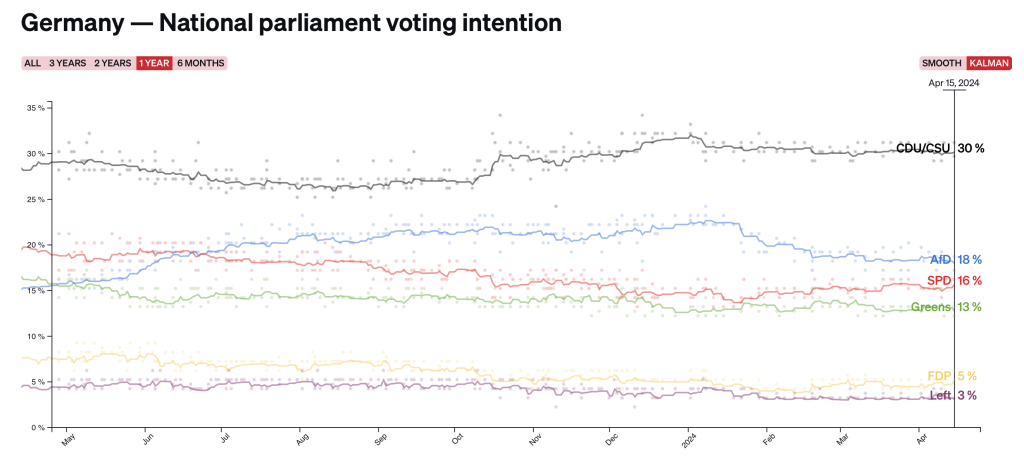
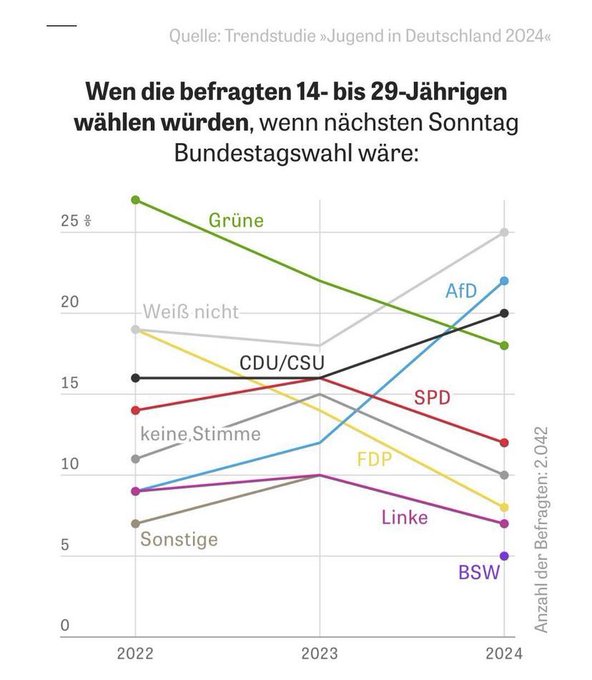
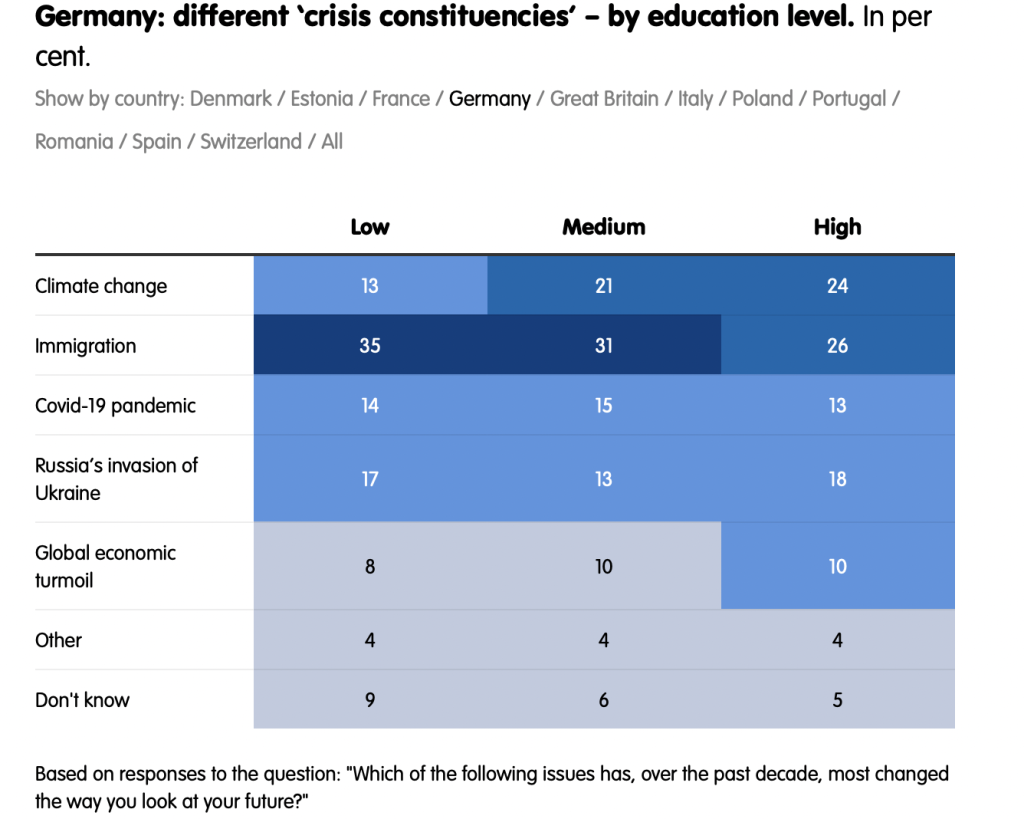
Wagenknecht gets a lot of criticism for her stance on immigration, but the fact is that’s what German voters are most concerned about:
And it’s what has led to the rise of the Alternative for Germany (AfD), a party that has fascist elements at its core:
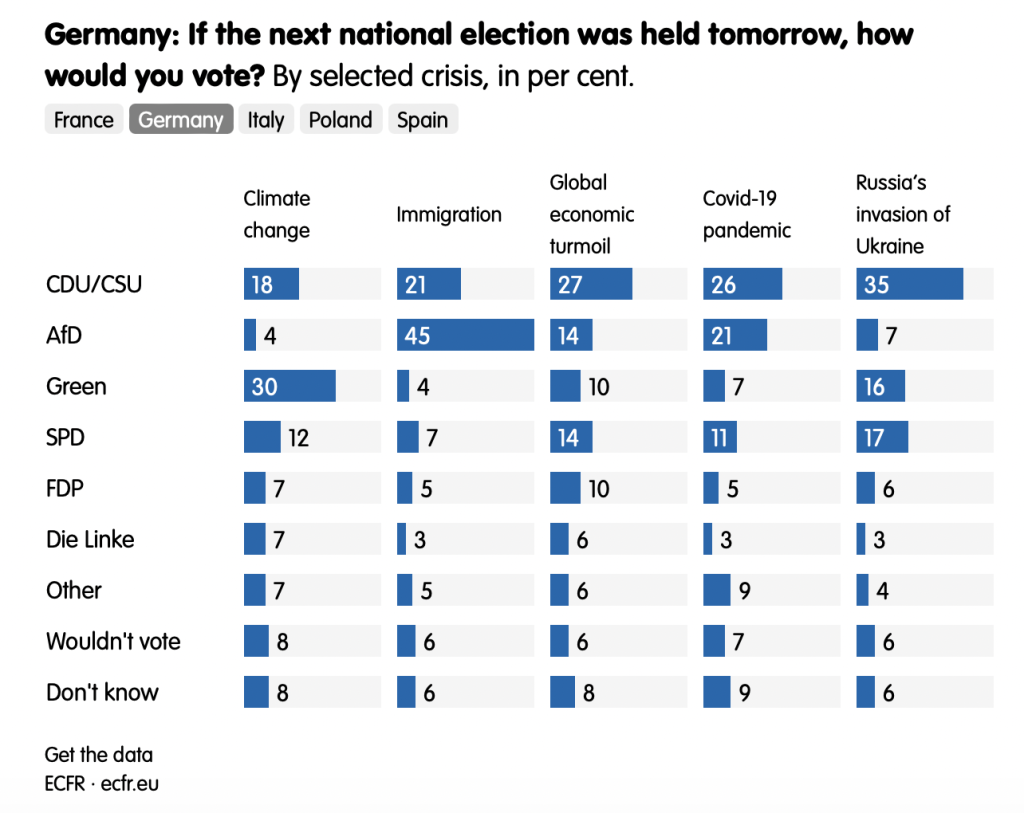
Both the AfD and Wagenknecht’s BSW are in favor of reclaiming German sovereignty from the EU and the US/NATO and acting in Germany’s national interest, which would mean ending its participation in the economic war against Russia that has done far more damage to Germany. They also both favor rethinking German immigration policy.
The struggle for Wagenknecht is drawing distinctions between the two parties. To do so, BSW is focusing on three lines of attack:
*That BSW is the true representative of the working class while AfD opposes globalists in favor of a more national oligarchy. (The AfD, after all, did receive its seed money from a Nazi billionaire family.) BSW likes to point out AfD’s hypocrisy in supporting the recent farmers protests in Germany while the party’s program simultaneously calls for removing farmer subsidies. “This is not an anti-system party. It is the system, but undemocratic and mean,” says BSW General Secretary Christian Leye.
*That the AfD opposes immigration on racial grounds that harken back to some dark chapters in German history while BSW wants common sense approaches that would benefit the German working class.
*The BSW also describes itself as the only consistent peace party in the Bundestag. The AfD, on the other hand, is not at all opposed to militarization. In fact, the party calls for the full restoration of operational readiness of the German armed forces. The AfD’s problem is that the US/NATO exercise too much control over the German military without taking into account German national interests.
Here’s more on Wagenknecht’s European elections platform from Table Europe:
The leitmotif of the program is: “Less is more.” The BSW strives for an “independent Europe of sovereign democracies.” The integration of Europe “in the direction of a supranational unitary state has proven to be a mistake.”
The BSW wants to prevent wage dumping in the internal market and is calling for the introduction of a European minimum wage. A postulate that the Left Party also has in its program. The demand for an excess profits tax in the industrial sector and a reform of the debt brake is also common to both parties. The power of large corporations such as Google or Amazon must be restricted, said De Masi. The BSW is calling for an end to energy sanctions against Russia. They were not harming Putin, but Germany.
De Masi left out the topic of migration in his speech. The program remains relatively vague on the subject: illegal migration must be stopped and prospects in the home countries improved, it says. The right to asylum is not called into question. However, immigration should not overburden local capacities.
Who Supports BSW?
Mainly working class voters opposed to the Ukraine War.
The ZDF political barometer from February shows that while a little more than 50 percent of respondents rated their economic situation as “good,” just under one in three BSW supporters say the same. And nearly half of BSW supporters believe that they will be worse off in a year than they are today. At the same time, while a majority of respondents were in favor of supplying more weapons to Ukraine, among BSW supporters it was less than 40 percent.
If those numbers seem high, it’s probably a sign of the atmosphere in Germany where those opposed to sending Ukraine missiles capable of reaching Moscow are labeled Neville Chamberlain.
Plans are in the works for Wagenknecht’s party to form a left contingent in the European Parliament opposed to the Russia policy and steer it away from the party she left, Die Linke (The Left), which has completely collapsed after abandoning nearly all of its former working class platform in favor of identity politics in an attempt to appear “ready to govern.” Much like the Greens, The Left increasingly stands for neoliberal, pro-war and anti-Russia policies.
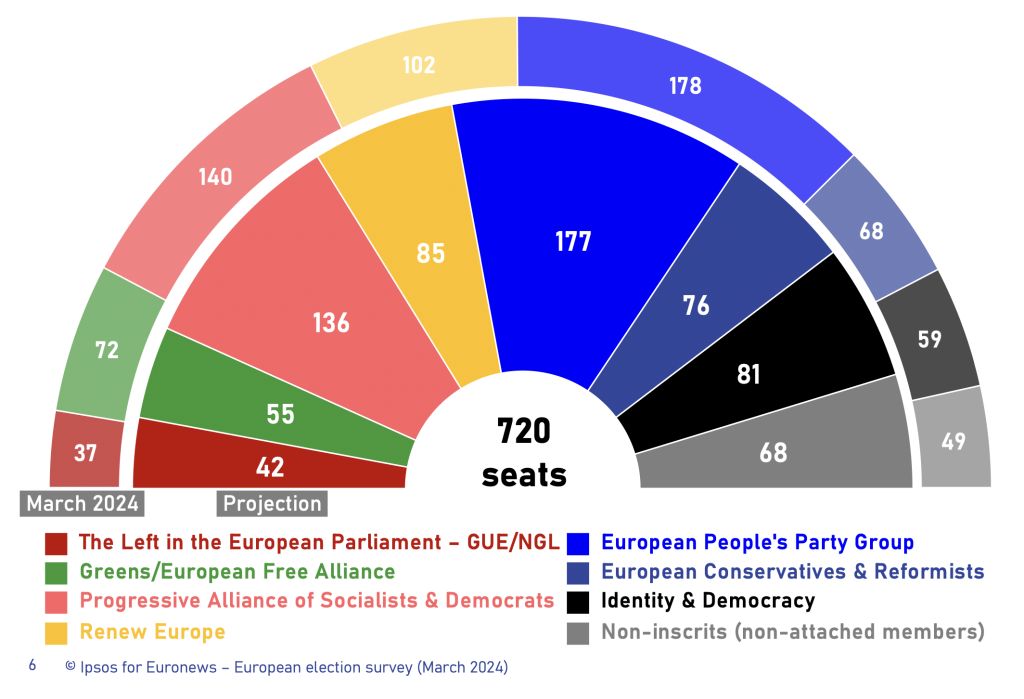
To form a new parliamentary group within the chamber, Wagenknecht would need 23 MEPs from seven EU countries. Who are its potential allies?
BSW representatives have confirmed prospective talks with France’s La France Insoumise. Other European Parliament members opposed to Project Ukraine are possibilities. Slovakia’s ruling Smer party, for example, was recently suspended from the Progressive Alliance of Socialists and Democrats group in the parliament for questioning NATO and its social conservatism.
A hostile takeover of the current left delegation is also a possibility as there may not be enough MEPs to sustain two separate left-wing factions. According to The European Conservative:
Tactically, the German politician has not ruled out joining the current parliamentary Left faction—becoming the effective kingmaker within—and could simply be using the threat of a new group as leverage.
Regardless, Wagenknecht’s BSW will likely be another thorn in the side of von der leyen (should she remain as European Commission president). We could always use more of this:
Criticism from All Sides
Wagenknecht’s BSW doesn’t just get it from what’s now referred to as the German “center” (i.e., the parties of warmongers and anti-working class policies).
It also gets a lot of criticism from the left – especially on the immigration issue.
They say that Wagenknecht’s party is just another flavor of capitalism and criticizes the party for its declared willingness to work with other parties to advance its issues. That is not the solution; according to WSWS, it is the following:
The only way to oppose militarism, prevent a third world war and defend social rights is through the international mobilisation of the working class against capitalism. No problem can be solved without breaking the power of the banks and corporations and bringing them under democratic control. Such a movement requires the unification of workers across all national, ethnic and religious boundaries.
While this is at least genuine, the disingenuous criticism from liberal identity wings is that Wagenknecht is “anti-vanguard” for ignoring identity issues in favor of class-based politics. In their eyes this makes her right wing (and even comparable to Benito Mussolini). These arguments are representative of the fear that the return of a class-based left would crash the cushy party of a finance-centered political economy that is welded to the politics of recognition.
There’s an argument to be made that Wagenknecht’s brand of politics is one hope at containing the rise of the far right, and it’s one that Wagenknecht makes herself:
Wagenknecht also blames the government for the rise of the AfD. Any criticism of politics is immediately defamed as right-wing, as was recently the case with the farmers’ demonstrations. We already know this from the protests during the Covid pandemic. “If people have been told for years that any reasonable criticism is right-wing, then it’s no wonder that a right-wing party is successful.” The fact that the traffic light politicians are now taking to the streets at anti-AfD protests is absurd. “If they really want to weaken the AfD, they don’t need to demonstrate, they need to finally change their miserable policies.”
Not only is Berlin ignoring that advice, but the same is true across Europe where the overall picture is one of an ascendant right. Right-wing parties are expected to win the election in six of the EU’s 27 member states, including France and Italy.
It’s a strong possibility that a right-wing coalition will take the reins in the parliament for the first time in its history. There is however, a lot of variation on the right – especially on the issue of Ukraine. Some are true believers, others were against the EU/NATO before they were for it, and others still oppose the war against Russia.
The European Peoples Party, which is projected to remain the largest bloc in the parliament, is a major backer of Project Ukraine. The European Conservatives and Reformists (ECR) is too. ECR is led by Brothers of Italy, Law and Justice in Poland, VOX in Spain, and the Sweden Democrats.
The opposition to Project Ukraine can be found on the right in the Identity and Democracy (ID) party, although it might be softening – at least in the case Rassamblent National:
Germany’s AfD and Lega in Italy continue to hold onto their opposition to the economic war on Russia and are constantly hammered by spooks, media, think tanks, and politicians over it. Nonetheless, ID, which also includes Geert Wilders Party for Freedom and Austria’s Freedom Party, is projected to become the third largest EP grouping, up from its sixth-place finish in the elections of 2019.
At the end of the day, the sad reality is that parliament has a limited ability to do much other than provide a facade of democracy. The parliament is supposed to act as a check on commission power. It has to approve legislation proposed by the European Commission, it can censure the Commission, and the European Council has to ‘take into account’ the result of the parliament elections to nominate the Commission president – although the latter process turned into a backroom disaster in 2019 when Ursula von der Leyen failed upwards into the job.
EU leaders dismissed all the parties’ candidates and surprisingly elevated Ursula von der Leyen, who had not featured in the race and was doing a poor job as Germany’s defense minister.
As president of the European Commission, she holds sweeping powers on a range of issues, including tech, healthcare and social rights. Recent polling shows that a majority of voters (63 percent) either view the Commission’s work negatively or have no opinion.
Nonetheless, von der Leyen looks like the odds-on favorite to return to the job and continue her reign.
https://www.nakedcapitalism.com/2024/04 ... ction.html
******
The Formation of NATO: World War II Did Not End, It was Reconfigured, Directed Eastwards
Posted by INTERNATIONALIST 360° on APRIL 16, 2024
Rick Rozoff and Michael Welch
Research News Hour. Interview with Rick Rozoff on 75th Anniversary of NATO.
Rick Rozoff is a renowned author and geopolitical analyst, actively involved in opposing war, militarism and interventionism for over fifty years. He manages the Anti-Bellum and For peace, against war website.
In the following interview, recorded on March 26, 2024, Mr. Rozoff talks about the North Atlantic Treaty Organization (NATO) which he has opposed for decades, and where it is headed.
Global Research: It’s been said that the real reason an atomic bomb was dropped on Hiroshima and Nagasaki was not really to end the war. The allied Soviet Union had said they were preparing an invasion in early-August 1945, so the US figured it would drop the bombs first and thereby send the message that they had won the war by forcing Japan’s surrender. But they were also warning the Soviet Union about their awesome arsenal that could be targeting them. I bring this up, because I suspect the role of NATO to defend the world from the Soviet threat maybe – may not be accurate either. There is another story behind building up NATO. What in your view is the real reason NATO came into existence?
Rick Rozoff: It was a shift in World War II where the Western powers, US, Britain, French Resistance and Free French and such like continued the War, but shifted from waging war against the Axis powers, Germany, Italy, Romania, and so forth, towards the Soviet Union. I mean, it’s quite simply that. And Dwight D. Eisenhower, who was, you know, the top commander of allied forces in Europe during World War II became the first supreme allied commander of NATO when NATO was set up in 1949. So, it was a very smooth transition, down to the very same, you know, top commander.
World War II did not, in that sense, end so much as it was reconfigured and directed eastward, that’s my read on it. And of course, it was 75 years ago next month that the North Atlantic Treaty Organization was established, initially with 12 members. All 12 of which, with the exception of Italy, could lay claim to being on the North Atlantic Ocean, by the way. Italy, if you really wanted to stretch the point also, you know, through being in the Mediterranean which is an inlet of the Atlantic Ocean. Of course, now you’re looking – well, I don’t want to jump too far ahead – but you’re looking at NATO which has grown appreciably where the majority of its members are nowhere near the North Atlantic Ocean.
GR: So, basically you’re saying that – I mean, like the alliance, you know, to fight off Hitler, I mean I guess they felt they had a good thing coming, so… But, I guess there’s somehow that solidarity or whatever. Let’s just hold onto this and just direct it towards the Big Red Bear. Is that essentially what you’re saying?
RR: That’s exactly what happened. And they pivoted, to use the popular expression, on a dime. It didn’t take very long. Almost immediately after V-E Day and certainly after V-J Day, you know, Victory in Europe, Victory Over Japan that you alluded to, then the Soviet Union became the replacement for the Third Reich and Mussolini.
And so, the military apparatus that the United States had established during the years from 1943-45 in Italy and in Germany and France and then the Low Countries, Benelux Countries, then became the foundation for NATO which remained and remains to this day, by the way, where the supreme allied commander of NATO has always been an American general or admiral. So, that much has not changed from 1949, or for that matter from 1945, until the current day.
GR: So, during the Cold War, I mean, was there anything, you know, about NATO – because, I mean, you started criticizing NATO before the fall of the Berlin Wall as I understand it. So, what were you finding objectionable back in the Cold War era that set you off?
RR: I wouldn’t want to put too fine a point on this because I think, you know, it’s going to distract from talking about post-Cold War NATO. And there are people out there who may want to defend NATO up until 1989 or up until 1991, and my argument is really not with them so much anymore, because as interesting as that is, I think we have more pressing concerns to be honest, Michael. And I personally feel that it was meant as a display of American military might in Europe, not only against the Soviet Union, its allies, and Eastern Europe, but also against political parties in countries like France, Belgium, Italy, Communist Party in the first instance, that may have wanted to reach some rapprochement with the Soviet Union and the permanent deployment of US – and the US, you know, Sixth Fleet is still based in Italy. And the US still has nuclear weapons in five European countries and suchlike. But this is all the result of using NATO to position the US Military for a permanent presence in Europe, first of all against the Soviet Union, then again the Soviet successor state: Russia.
Yet also, you know, you mention nuclear weapons. I believe it was as early as 1951, which is to say, only two years after the founding of NATO that the US moved nuclear weapons into Europe, into Britain initially, under NATO auspices and why NATO continues to maintain tactical nuclear weapons in Belgium, in The Netherlands, Italy, Germany, and Turkey under what NATO calls “burden sharing,” or “nuclear sharing” arrangements.
GR: Well, NATO underwent a transformation after the fall of the Berlin Wall and the end of communism, because it otherwise would no longer have a reason to continue, but it did. What do you know about what the thinkers at the top were thinking? I mean, how and when did they come to the conclusion that NATO would now be an aggressive force behind human rights. I mean, subsequently attacking people in Yugoslavia, Afghanistan, and Libya?
RR: The 1989 speech by President H.W. Bush in Mainz, Germany whence the expression – it’s actually sometimes published with – the expression I’m going to mention in a second – as it’s titled, “A Europe Whole and Free,” sometimes “Europe Whole, Free, and at Peace.” And this is after the, you know, the dismantling of the Wall in Berlin and the beginning of the reunification of Germany. So, the point is clear coming from Washington, coming from the White House, that Europe was to be “united,” — the exact word – there was to be a continental system, you know, if I’m not going too far astray, comparable to those of Napoleon Bonaparte, or for that matter, Hitler, that would unite the entire European continent under one military command.
That has been NATO’s objective since 1989. Certainly since 1991 with the formal dissolution of the Warsaw Pact which itself, by the way, was founded six years after NATO and in reaction to not only NATO being founded, but Germany, West Germany, the Southern Republic of Germany, being brought into NATO the preceding year. Contrary to the Potsdam, you know, Accords reached by Britain, United States, and the Soviet Union at the end of World War II.
So, what NATO has accomplished in the interim and is now going to celebrate in all its splendour in July in the United States in Washington at its 75th anniversary summit, is that indeed, the entire European continent, with the exception of Russia and Belarus, have now been brought under NATO command.
GR: But NATO is not just a military force. It seems to me it’s a parasite. There are components of NATO that involve industry and jobs and a whole economic and financial infrastructure has grown around NATO. So, there would be massive losses of jobs and a shrinking of a tax base meaning, you know, social programs as well would be compromised. Can you address these sorts of concerns about some who would resist ending NATO or getting out of NATO?
RR: I mean, you’re correct about the fact that the NATO countries – I mean, let’s look at some arithmetic: the annual collective military spending – this is official, right, through defence ministries and the Defense Department in the United States. It excludes, you know, a good deal other military-related spending. But the official numbers, with the US leading the way by a long shot to the tune of something like 68 percent, but nevertheless, NATO countries account for $1.3 trillion in military spending per annum. This is as compared to, for example, Russia maybe $60 billion, you know, a small fraction of that. The population combined or collective population, NATO countries, now with Sweden joining, is 1 billion. You know, Russia is 150 million, if I remember right. So, to place these matters in perspective.
The other thing that needs to be mentioned – and this is the NATO summit in Washington in the Summer – will be the second time a NATO summit has been held in the capital of the United States. That symbolism is not to be missed. There was only one other summit in the United States and it was here in Chicago in 2012. But the first summit in Washington, the first in the United States, was in 1999 to mark the 50th anniversary of the creation of NATO. This one will mark the 75th anniversary.
Fifty years ago – I’m sorry, not 50 years ago but 25 years ago in 1999, when NATO met in Washington Nato had 16 members. When it finishes its summit this July in Washington, it will have 32 members, which is to say twice as many as it had in 1999 when it launched its first full fledged war against the Federal Republic of Yugoslavia.
In the interim also, starting in the 1990s – you read an excerpt which I assumed was mine, it sounded very much like mine at the beginning of the programme – NATO has, in addition to those 32 full members, partners in the neighbourhood of probably 40 officially. And if you want to include the fact that NATO considers the African Union to be a collective partner, it has a liaison office next to that of the African Union in Addis Ababa, the capital of Ethiopia. But officially, they have 40 members who, together with the – not 40 members, 40 partners – who, together with the 32 members, some of these are countries, are on all six inhabited continents, bar none. And as there are military personnel in Antarctica from NATO countries, you can throw that one in for good measure and all the continents in the world even have NATO presence.
That is something that is so historically unprecedented in scale and scope and ambition and nature, that it really puzzles me and I have to admit it makes me despondent sometimes that for 25 years I’ve been trying to alert people to this, to the scale of it. And I feel that people are either indifferent to it, they downplay it, they mock it. Global Research is not immune itself from running articles that suggest that, you know, NATO is a paper tiger, paper pussycat in one person’s parlance, and so forth. I’ll state my claim, and I hope I’m not wrong, that NATO is a deadly serious business and a real threat to world peace. And if it is, and it has been for the past 25 years, then I think the peace movement and other forces in the world have been grossly negligent in taking this one on.
GR: Going forward then, what would you assume NATO’s next targets would be if there’s no resistance? And you know, what kinds of – how do you expect their development to evolve over the next two or three years?
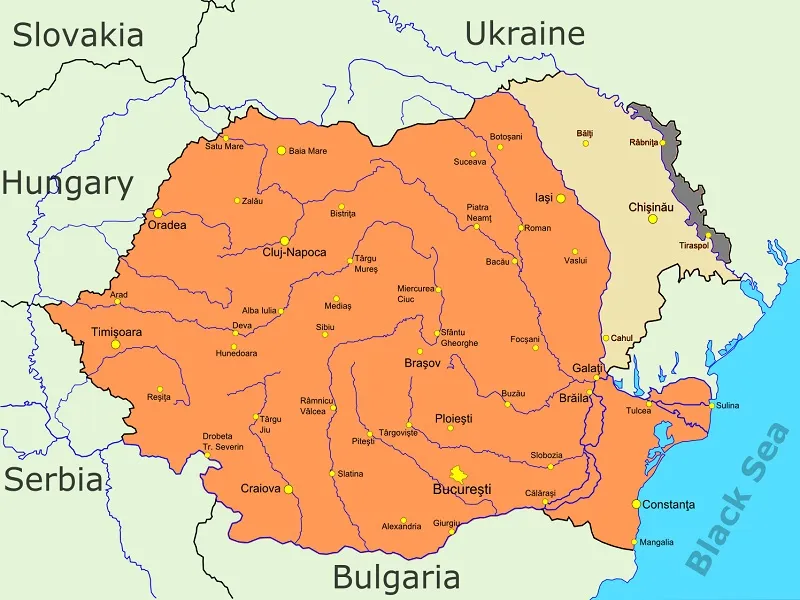
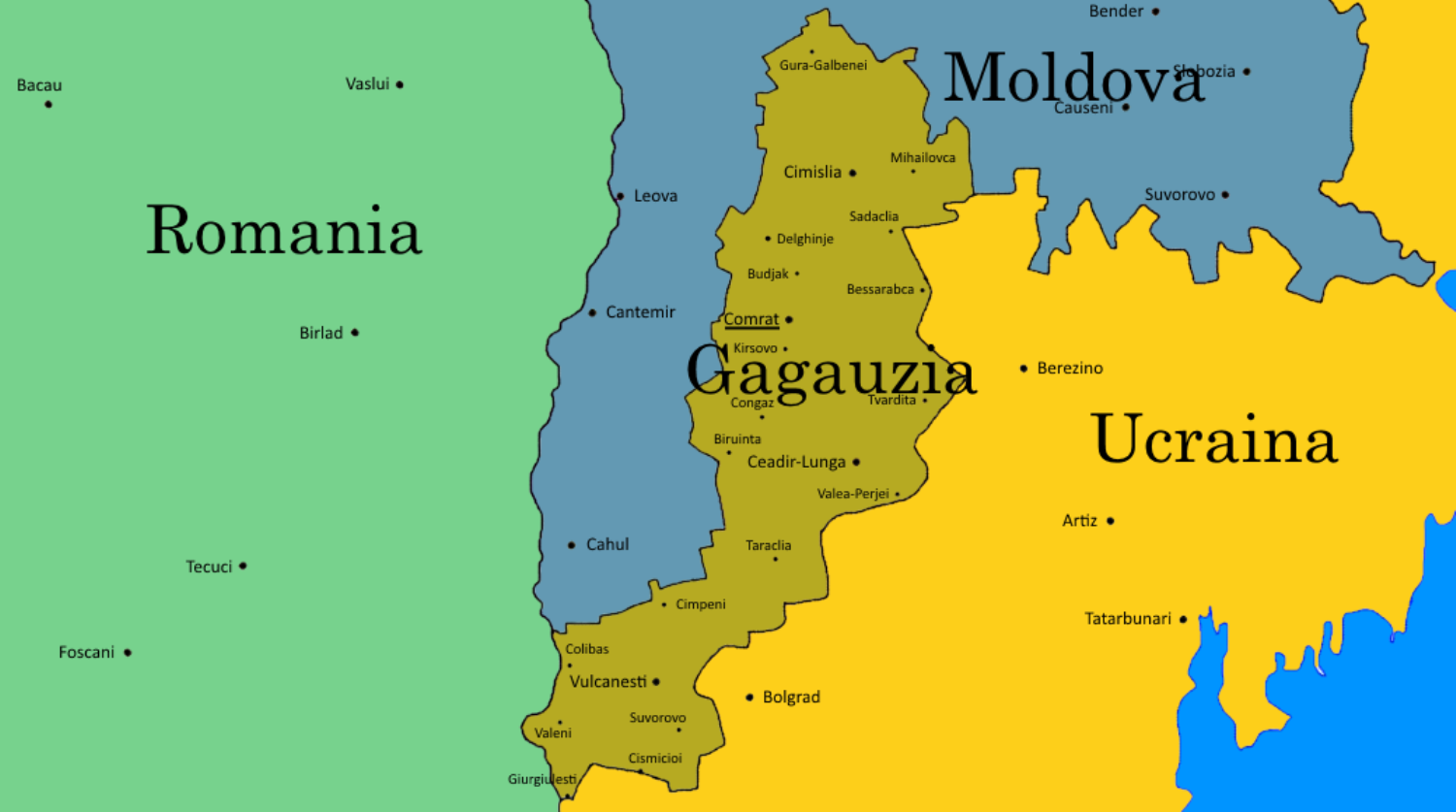
RR: You know, they’re very open about these matters. There’s nothing esoteric about them. Go to the NATO website. They have two features today and one is at the Moldova [SIC] solidifying its relationship with NATO. It’s going to join. But you know, as a precondition for joining, it cannot have foreign troops on its territory, nor can it have unresolved territorial disputes. And Transnistria, you know, fills, you know, both those – checks both of those boxes off. So, it would be necessary. And Transnistria is surrounded by Moldova in the West, Ukraine on the East, it would be necessary to expel the Russian peacekeeping force of the couple thousand troops, and then reincorporate Transnistria into Moldova in order for it to join NATO. But you know, those movements – that movement is well under way.
The general secretary of NATO, as you may know, has just recently made a trip to the three South Caucasus nations of Georgia, Azerbaijan, and Armenia. Armenia has suspended its membership in the Collective Security Treaty Organization, I would argue justifiably, you know, given Russia’s unwillingness to defend it against attacks from Azerbaijan. And so, what are they doing? They’re wrapping up – they’re doing a mopping up operation. They are absorbing what’s left of the former Soviet Union, except for, at least the moment, Belarus and Russia itself. They’ve already incorporated, of course, some 15 years ago they incorporated – more than that, 17 years ago – they – 20 years ago they incorporated three former Soviet Union republics, you know, Estonia, Latvia, Lithuanian. They, you know, ensconced themselves deeply in the three countries I’ve just mentioned in the South Caucasus. Ukraine I don’t have to tell you about. And Moldova, that’s the former Soviet Union.
So, they have not only – there was a statement by George W. Bush during the round of massive NATO expansions in the early part of the century where, at one NATO summit, seven countries joined at one time. Again, that’s totally unprecedented. Two of those former Yugoslav federal republics and three of them former Soviet republics. There was a statement attributed to George W. Bush saying, “The Warsaw Pact has now become NATO, in fact.”
GR: Rick Rozoff, thank you very much for your intelligent and eloquent analysis.
RR: Yeah, I wish I had better news to bring you, my friend. You know, we sit back and we allow military monoliths of this scale to spread over the last, you know, 33 years and we effectively do nothing about it. You know, they’re not going to be held in check unless we hold them in check. And we have to sound the alarm that the existence of a military bloc of 70-some odd countries on all continents is something that really should ring some bells and really should raise some alarms and people should really commit themselves to looking into it and doing what they can to reign this thing in until it can be dismantled.
https://libya360.wordpress.com/2024/04/ ... eastwards/
******
The Three Great Myths of NATO
Posted by INTERNATIONALIST 360° on APRIL 17, 2024
Sevim Dagdelen
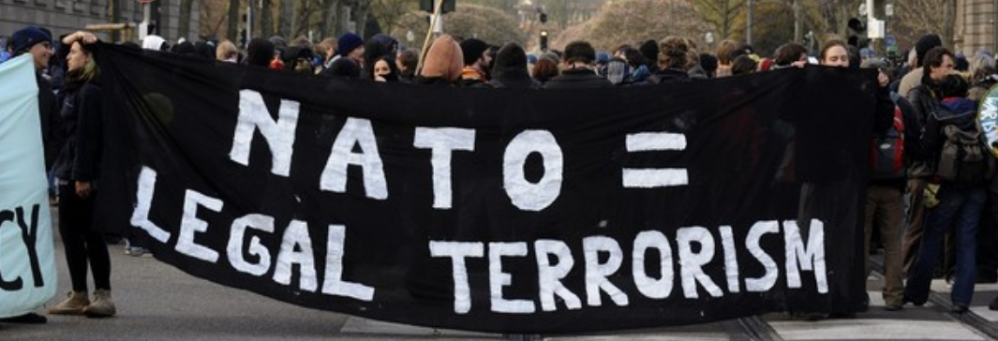
To mark the 75th anniversary of the founding of the North Atlantic Treaty Organization (NATO), Sevim Dagdelen, foreign policy spokesperson for the “Bündnis Sahra Wagenknecht” group in the German Bundestag, has published the book “Die NATO. A reckoning with the alliance of values”. In the introduction, the MP addresses the three great myths of NATO.
NATO celebrates its 75th birthday in 2024 and appears to be at the height of its power. More than ever before, the North Atlantic Treaty Organization is focusing on expansion. In Ukraine, NATO is waging a proxy war against Russia in response to its war of aggression in violation of international law: the military pact is involved in training Ukrainian soldiers with NATO weapons, with massive arms deliveries, intelligence information and the provision of target data as well as its own soldiers on the ground. The delivery of cruise missiles, such as the German Taurus type, to Ukraine, which can reach Moscow or St. Petersburg with a range of 500 kilometers, as well as the deployment of NATO troops on a large scale are being discussed. The signs are pointing to a storm.
NATO is expanding its presence in Asia: By integrating new partner states such as Japan and South Korea, it is advancing into the Indo-Pacific region and seeking a confrontation with China. The military expenditure of the USA and other NATO member states is soaring to record highs. While the champagne corks are popping at the arms suppliers, the gigantic costs of armament are being passed on to the population.Overstretch, social upheaval and the risk of escalation are the downside of this expansive power policy.They challenge the alliance in an unprecedented way.This makes NATO all the more dependent on legends today.Three major myths run from the founding of the military pact through its bloody history to the present day.
The myth of defense and international law
NATO is a defense alliance.This is the eternally repeated narrative.But a look at the history of the military pact shows:Neither was mutual defense a priority when NATO was founded, nor can there be any talk of a defensive orientation in NATO’s appearance over the past decades.Article 5 of the North Atlantic Treaty is often cited as proof of NATO’s character as a defensive alliance.In its founding agreement in 1949, the twelve signatory states, the USA and Canada, as well as the European states Belgium, Denmark, France, Great Britain, Iceland, Italy, Luxembourg, the Netherlands, Norway and Portugal, agreed that “an armed attack against any one of them in Europe or North America shall be considered as an attack against all of them”.NATO members undertake to assist each other in order to defend themselves jointly against such an attack.
The Inter-American Treaty of Mutual Assistance serves as an explicit model here. This mutual assistance pact was concluded by the American member states in Rio de Janeiro, Brazil, in 1947 on Washington’s initiative and came into force a year later.In the face of the Cold War, the USA wanted to secure its dominance on the American continent with this treaty, as a result of which the Organization of American States (OAS) was founded in the same year.This was in the spirit of an updated Monroe Doctrine, with which the USA had declared the western hemisphere to be its exclusive zone of influence in 1823.
NATO is also part of this tradition. As with the Inter-American Treaty, the signatory states of the North Atlantic Treaty are completely unbalanced in terms of power and military policy.When NATO was founded, the USA was clearly not interested in support from other alliance partners in the event of defense.Rather, Washington is striving to create a “Pax Americana”, an exclusive sphere of influence that gives the USA, as the undisputed leading power, control over the foreign and security policy of the other alliance partners.The basis of NATO is an exchange.The other NATO members give up parts of their democratic sovereignty and are rewarded with the NATO security guarantee, which is de facto a security guarantee from the USA.(…)
Within the military pact, the other NATO members sink to the level of client states, like those that once served as a military buffer zone in the east of the Roman Empire to maintain the Roman Empire’s power.
Any domestic political change that could have called into question the foreign policy orientation was forbidden to these client states on pain of their own downfall.
In order to prevent such developments, NATO relied on its own coup organizations with its Stay Behind groups during the Cold War.They also used terrorist means to actively prevent political forces that questioned NATO membership from gaining power.
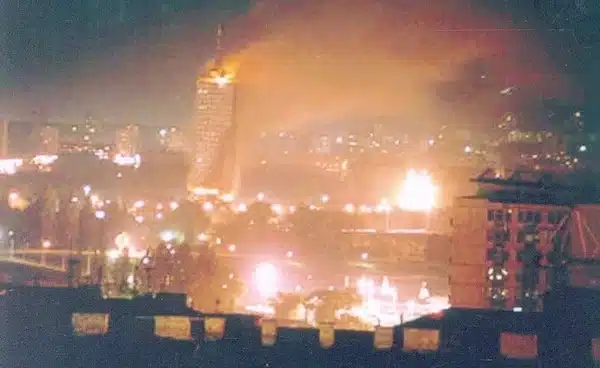
The end of the systemic conflict with the Soviet Union radically changed NATO’s primary purpose of creating a “Pax Americana”.Since the end of the Cold War, NATO has increasingly seen itself in the role of world policeman.With the invasion of the Federal Republic of Yugoslavia, which at that time still consisted of Serbia and Montenegro, the military pact waged its first war in 1999.A clear breach of international law, as the then German Chancellor Gerhard Schröder himself admitted 15 years later: “We sent our planes (…) to Serbia, and together with NATO they bombed a sovereign state – without there having been a Security Council decision.” After this original sin, NATO is developing into a warfare pact that is prepared to break international law.A clear contradiction to its own charter, in which the NATO states commit themselves according to Article 1 to “refrain in their international relations from the threat or use of force in any manner inconsistent with the purposes of the United Nations”.The defense of the Alliance’s territory now becomes merely part of its claim to act as a global power.
In 2003, NATO members the USA and the UK invaded Iraq in a war of aggression in violation of international law.They put together a “coalition of the willing” specifically for this purpose, which also included numerous other NATO members such as Italy, Poland, the Netherlands, Denmark, the Czech Republic, Hungary, Portugal and Slovakia, as well as the later NATO members Romania, Bulgaria, Latvia and Lithuania.Washington and its accomplices are thus blatantly violating international law and the NATO states involved are violating the fundamental provisions of their own charter.The Iraq war is also accompanied by the NATO AWACS mission in Turkey, which can be interpreted as support for the war.Even if the war against Iraq is not a NATO war, there are serious arguments for attributing the invasion to the military pact.NATO members such as Germany did not deny the USA the use of military bases as part of the NATO structure in Europe and did not deny overflight rights for US forces, even though the German government’s commitment to the rules of international law in accordance with Article 20 Paragraph 3 and Article 25 of the Basic Law prohibits it from participating in actions by non-German sovereigns on German soil if these violate international law.
The Iraq war is also accompanied by the NATO AWACS mission in Turkey, which can be interpreted as support for the war. Even if the war against Iraq is not a NATO war, there are serious arguments for attributing the invasion to the military pact.NATO members such as Germany did not deny the USA the use of military bases as part of the NATO structure in Europe and did not deny overflight rights for US forces, even though the German government’s commitment to the rules of international law in accordance with Article 20 Paragraph 3 and Article 25 of the Basic Law prohibits it from participating in actions by non-German sovereigns on German soil if these violate international law.
The war of aggression against Iraq by some NATO members in violation of international law was not even discussed in the NATO Council, nor was the use of NATO infrastructure. Their violation of the North Atlantic Treaty has no impact on the NATO membership of the USA or the UK. That was foreseeable.The war policy of the most important member of the alliance must therefore be attributed to the NATO military pact as a whole if one takes NATO’s self-image seriously.With its wars that violate international law, the USA stands as pars pro toto, as part of the whole.In Afghanistan, NATO has been waging a disastrous war for 20 years that has cost the lives of over 200,000 civilians.For the first and so far only time, the alliance is invoking Article 5 of the NATO treaty in this military operation after the attacks of September 11, 2001.The international public is to be made to believe that the freedom and security of the West are being defended in the Hindu Kush. Twenty years later, in August 2021, the Taliban move back into Kabul. The military operation proves to be a disaster. The US attempt to gain a military foothold in Central Asia in order to challenge China and Russia geopolitically has failed. The USA is leaving the country head over heels. Washington does not even inform its allies. Thousands of local NATO forces are being left in the lurch.
There is no sign of alliance solidarity. In order to obtain information, the German foreign intelligence service is even desperately considering bugging the Americans.In addition to Belgrade, Baghdad and Kabul, NATO’s trail of blood also leads to Libya.In 2011, NATO bombed the country in violation of international law and in abuse of a UN Security Council resolution.Thousands are killed.Hundreds of thousands are forced to flee.A delegation from the African Union, which wanted to mediate in the conflict, was even prevented from landing.What remains is a devastated country, parts of which are ruled by Islamist militias.As a result, the entire Sahel region is destabilized by al-Qaeda and the Islamic State (IS). The individual members of NATO must take responsibility for this catastrophe.Totum pro parte, the whole stands for the part.This also applies to the member states that are not directly involved in the attacks.
The myth of democracy and the rule of law
NATO members are determined to “safeguard the freedom, common heritage and civilization of their peoples, based on the principles of democracy, liberty of the person and the rule of law”, according to the legitimizing legend of the founding charter.But this was already an outright lie in 1949.It is not only in Latin America that the USA has been making pacts with dictatorships and fascist regimes from the outset; NATO allies in Europe are not only democracies on board either. The only decisive factor is the willingness to join a front against the Soviet Union.The USA has bilateral security agreements with the fascist dictator of Spain, Francisco Franco, and the fascist dictatorship of Portugal is a founding member of NATO.While the secret police of the dictator António de Oliveira Salazar tortured opposition members to death and set up concentration camps in the Portuguese colonies, the USA included Portugal in the community of democrats.
Another example is Turkey. Thousands of political prisoners are tortured after the military coup of 1980. On the occasion of the tenth anniversary on September 12, 1990, the newspaper Cumhuriyet spoke of 65,000,000 political arrests, 7,000 death sentences requested, 571 imposed and 50 carried out, and the proven death by torture in 171 cases.Turkey remains a member of NATO. Even after the military coup, it receives extensive military aid from the USA and its allies.The rule of the generals is not detrimental to membership.The same applies to Greece.The military coup of 1967, concentration camps and murders of members of the opposition, the arrest of thousands or expulsion into exile – none of these are reasons to end membership.Even the invasion of Cyprus by NATO member Turkey in 1974 following the coup by the Greek colonels is apparently in line with the democratic founding consensus of the military alliance.
Now one could dismiss this and refer to the “tempi passati”, the times gone by.But even in 2024, support for Islamist terrorism by Erdogan’s autocracy is not in contradiction to NATO membership.After all, NATO is not about democracy and the rule of law, but solely about geopolitical allegiance to the USA. Like an empire built on lies, NATO lives from this fairy tale. In schools and universities, these lies are part of the NATO education program.
The myth of a community of values
“Our common values – individual freedom, human rights, democracy and the rule of law – unite us.” This is how NATO presents itself as a community of values in its Strategic Concept 2022. However, the renowned Brown University in Rhode Island, USA, estimates that four and a half million people have died as a result of the wars waged by the USA and its allies in the past 20 years alone.
This cannot be reconciled with NATO’s widely publicized self-image.
NATO is not a community that protects human rights.On the contrary: NATO is the protective umbrella for the human rights violations of its members.And by no means only with regard to the violation of social human rights under the dictatorship of massive armament.On the contrary, NATO pursues a policy of complete impunity for war crimes committed by its member states.Anyone who, like the Australian journalist Julian Assange, dares to make these war crimes public is tortured and threatened with 175 years in prison in the USA.There have been no serious interventions by other NATO governments to secure the release of Julian Assange. In hasty complicity, criticism of the US hegemon is being avoided.
The “Afghanistan War Diary” collection of documents published by Assange in 2010 proves the existence of a secret US force, known as “Task Force 373”, which was used to kill suspected Taliban leaders without legal recourse. The 300-strong elite unit was also stationed in the area controlled by the German Armed Forces in Afghanistan.It was under the direct command of the US government and, according to reports published by the Wikileaks whistleblowing platform, also used internationally banned cluster bombs to kill and destroy indiscriminately.(…)
On January 11, 2002, the USA set up a prison camp at the illegally occupied Guantanamo Bay naval base in Cuba.Amnesty International writes: “Many of the approximately 780 people who have since been deliberately detained there outside any judicial control have suffered the most serious human rights violations before or during their detention – including torture and enforced disappearances.To this day, torture survivors in Guantánamo are held indefinitely without adequate medical care, charges or fair trials.”Even 22 years after its establishment, there is no prospect of the Guantánamo torture camp being closed.(…)
Human rights have a very low priority for NATO.This is also reflected in the choice of alliances by NATO members.For example, the USA, Great Britain and Germany are arming the dictatorship in Saudi Arabia, which is beheading opposition members by the dozen and whose Crown Prince Mohammed bin Salman allegedly personally ordered the sawing up of Washington Post journalist Jamal Khashoggi in the Consulate General in Istanbul.
Rhetorically, NATO remains antithetically tied to its practice. NATO’s 2022 Strategic Concept states: “We will strengthen our unity, cohesion and solidarity by building on the enduring transatlantic bond between our nations and the strength of our shared democratic values.”
In view of the close alliances with dictators, autocrats and violators of international law, this self-assurance looks like a bad joke. This hypocrisy is accompanied by double standards: In its Strategic Concept of June 20, 2022, NATO accuses Russia of committing “repeated violations of international humanitarian law” in Ukraine. While NATO uses this as an additional justification for its proxy war against Russia, it supports Israel in its obvious violations of international humanitarian law in Gaza and assures the country of its full solidarity. With its veto in the UN Security Council, the USA is preventing any resolution for an immediate ceasefire until the end of March. Without the arms supplies from the NATO states USA, Germany and Great Britain, this war would not be possible.
In the Global South, this double standard of the West is being increasingly criticized. The human rights rhetoric of NATO states is seen there as purely instrumental in order to conceal or enforce their own geopolitical interests. NATO appears to be the guardian organization of a deeply unjust world order with neo-colonial tendencies. This is demonstrated not least by the fact that NATO members attempt to impose their own policies on third countries such as China, Turkey or the United Arab Emirates in the economic war against Russia with so-called secondary sanctions, in violation of their sovereignty. NATO’s myths distort the view of reality. In order to find a way out of the current crisis, they need to be exposed. That is what this book is about. Today, 75 years after its foundation, the military pact is driving the world closer to the brink of a third world war than ever before with its global expansion and confrontations. This critical examination of the Alliance’s current actions and its crimes in the past is intended to create the conditions for thinking about alternatives. Alternatives to a NATO that relies solely on deterrence, armament and confrontation – and thus poses an existential threat to the peaceful coexistence of humanity.
https://libya360.wordpress.com/2024/04/ ... s-of-nato/
*******
Macron Keeps Discrediting France By Making Mistake After Mistake On The Foreign Policy Front
ANDREW KORYBKO
APR 18, 2024
At this rate, there’s no longer any credible chance that France will revive its independent foreign policy traditions after the five major foreign policy mistakes that Macron made over just the last two years. He’s dealt such damage to his country’s reputation that it’s impossible to repair as long as he remains in power.
France’s interception of Iranian missiles over Jordan earlier this month is Macron’s latest mistake that further discredits his country on the foreign policy front. Back in 2018, the French leader claimed credit for preventing Lebanon’s slide into civil war the year prior after its diplomatic intervention helped resolve the crisis that arose from former Prime Minister Hariri’s scandalous resignation while in Saudi Arabia. It was around that time in late 2017 that Macron also started talking about building a European Army.
These moves made many think that France was trying to revive its independent foreign policy traditions, the perception of which was lent credence by Macron telling The Economist in late 2019 that NATO had become brain-dead. America later took its revenge on France by poaching a multibillion-dollar nuclear submarine deal from it with Australia two years later in order to create AUKUS. The divergent foreign policy visions between these two over the five years from 2017-2021 had clearly become a trend.
That began to change after the NATO-Russian proxy war in Ukraine broke out half a year later in early 2022, however, since France immediately jumped on the American bandwagon by sanctioning Russia and arming Ukraine. That was Macron’s first major foreign policy mistake since it discredited the perception that he worked to build from 2017 onward of France reviving its independent foreign policy traditions under his leadership.
All the while, the Achilles’ heel of this approach remained Africa, where France continued lording over its former imperial subjects through a crude form of neocolonialism that retarded their socio-economic development. There wasn’t much dynamism on this front until 2022-2023 after the respective patriotic military coups in Burkina Faso and Niger combined to liberate the Sahel from France’s “sphere of influence”, prior to which Macron could have reformed this policy in order to preemptively avert that.
Therein lies the second of his major foreign policy mistakes since failing to treat these countries with the respect that they deserve, especially by not offering emergency aid to help them manage the domestic crises brought about by the West’s anti-Russian sanctions, ultimately spelled the end of “Françafrique”. France could have instead promulgated a truly independent foreign policy there designed to retain its historical influence in modern-day conditions that would have enabled it to better compete with Russia.
The panic that France’s retreat from the Sahel provoked in Paris prompted Macron to compensate by trying to carve out a “sphere of influence” in the South Caucasus centered on Armenia. To that end, his country joined the US in trying to poach Armenia from the CSTO by exploiting false perceptions of Russia’s unreliability. This information warfare narrative was aggressively promoted inside Armenian society by the ultra-nationalist diaspora lobby based in France (Paris) and the US (California).
While this was successful in the sense that Armenia froze its participation in the CSTO and has decisively pivoted towards the West, from whom it’s now seeking “security guarantees”, it was arguably a pyrrhic victory for France because it ruined relations with Turkiye. Seeing as how that country commands immense influence across the Islamic World, France’s pro-Armenian policy can therefore be considered to be Macron’s third major foreign policy mistake since it negatively affected how Muslims view France.
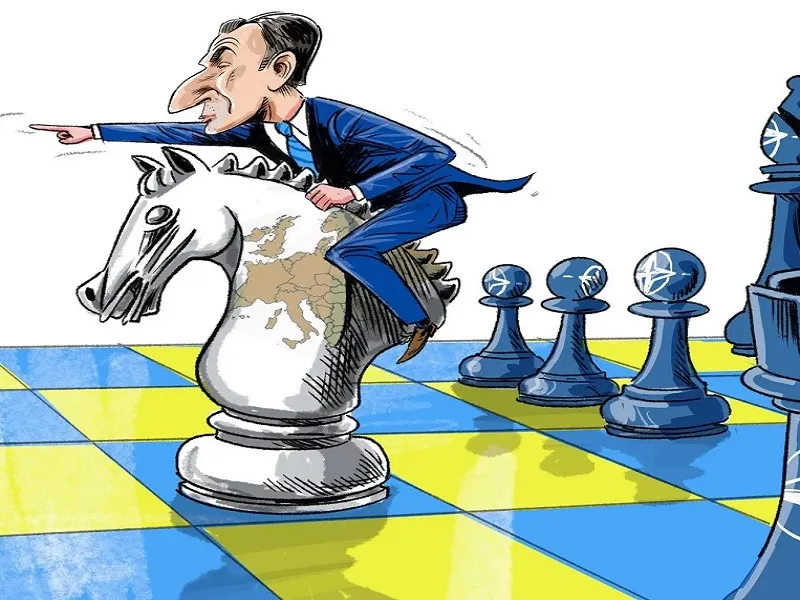
As for the fourth one, this concerned his threat in late February to carry out a conventional military intervention in Ukraine, which he specified could occur around Kiev and/or Odessa in the event that Russia achieves a breakthrough across the front lines sometime later this year. The reason why this can be considered a major foreign policy mistake is because it instantly exposed the deep divisions within NATO over this scenario after many leaders condemned his reckless claim that it “can’t be ruled out”.
He evidently thought that presenting France as extremely hawkish on Russia would appeal to the Western elite and their society, but the exact opposite ended up happening after they reacted with appall. Far from looking like a leader, France looked like a loose cannon that risked sparking World War III by miscalculation, with some worrying that Macron’s infamous ego was finally becoming a danger to all. These newfound perceptions understandably discredited France in the eyes of its allies.
And finally, the fifth and last major foreign policy mistake thus far was when Macron ordered his pilots in Jordan to intercept some of the missiles that Iran launched against Israel as retaliation for the bombing of its consulate in Damascus. In doing so, he dealt a deathblow to France’s soft power in the Islamic World, which he’d work so hard to improve after his diplomatic intervention in Lebanon in late 2017. By openly siding with Israel, Macron also risks provoking the wrath of French Muslims.
This demographic is easily mobilizable and has a track record of disrupting society with the large-scale protests that their community leaders have organized on various pretexts over the years. They’re also an important voting bloc too, those among them that are citizens that is, which could greatly impede his ability to appoint a successor once his second term expires in 2027. French Muslims might vote for other candidates and therefore reduce the chances that Macron’s preferred one makes it to the second round.
Macron’s spree of major foreign policy mistakes might not only be due to him personally but could also be at least partially attributable to systemic factors. The Valdai Club published their study on “Crafting National Interests: How Diplomatic Training Impacts Sovereignty” last month, which argues that the reforms implemented under his administration risk diminishing the role of national diplomatic traditions. In practical terms, national functionaries are transforming into global ones, or basically US puppets.
After all, while Macron has the final say on foreign policy, he’s also advised by diplomatic experts on the best possible approach for advancing French interests in any given situation. Instead of conceptualizing these interests as national ones like they did early on in his presidency during the 2017 Lebanese crisis prior to his early 2022 reforms, the year in which everything began going downhill, they began to conceptualize them as inextricable from the Collective West’s. This amounted to a cession of sovereignty.
The end effect was that France enthusiastically joined NATO’s proxy war on Russia, lost its “sphere of influence” in the Sahel, ruined relations with Turkiye (which were already weakened due to Macron’s prior controversies) by allying with Armenia, lost the trust of NATO allies by revealing details about their secret debates over conventionally intervening in Ukraine, and discredited itself before all Muslims by openly siding with Israel against Iran upon shooting down the latter’s incoming missiles over Jordan.
At this rate, there’s no longer any credible chance that France will revive its independent foreign policy traditions after the five major foreign policy mistakes that Macron made over just the last two years. He’s dealt such damage to his country’s reputation that it’s impossible to repair as long as he remains in power. Even worse, he’s whacking a hornet’s nest at home by risking more Muslim-driven unrest over his hardcore pro-Israeli policies, all of which bodes ill for France’s future over the coming years.
https://korybko.substack.com/p/macron-k ... ing-france




 perations at the Agency’s direct behest, “often [to] protect CIA activities from any legal consequences.”