Footnotes from the Ukrainian "Crisis"; New High-Points in Cynicism Part V

User avatar
blindpig
Posts: 15306
Joined: Fri Jul 14, 2017 5:44 pm
Location: Turtle Island
Contact:

Re: Footnotes from the Ukrainian "Crisis"; New High-Points in Cynicism Part V

Post by blindpig » Fri Jan 23, 2026 1:16 pm

Biting the hand that feeds him
Published by @nsanzo ⋅ 23/01/2026
Image

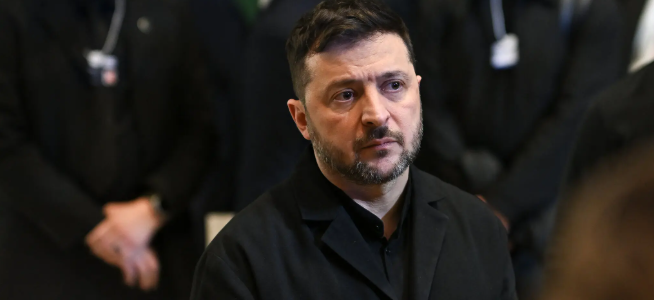
With the Greenland issue resolved, at least for the moment, thanks to negotiations between Donald Trump and Mark Rutte—it is NATO that is negotiating, not the affected country nor, of course, the territory in question—which offered Washington even more control over the Arctic island, yesterday was the day the US president presented his plan for the Middle East and the Peace Council with which he aspires to supplant the United Nations. Although the mandate of this group of people selected by Donald Trump to create a Gaza Strip to serve his interests is not mentioned in the UN Charter, possibly because its ambition is not regional but global. The idea of ​​a Peace Council chaired by Donald Trump appears in the 28-point plan negotiated by Steve Witkoff and Kirill Dmitriev and in the 20-point plan proposed by Zelensky as the basis for resolving the Russian-Ukrainian conflict, which yesterday regained some of its lost prominence.

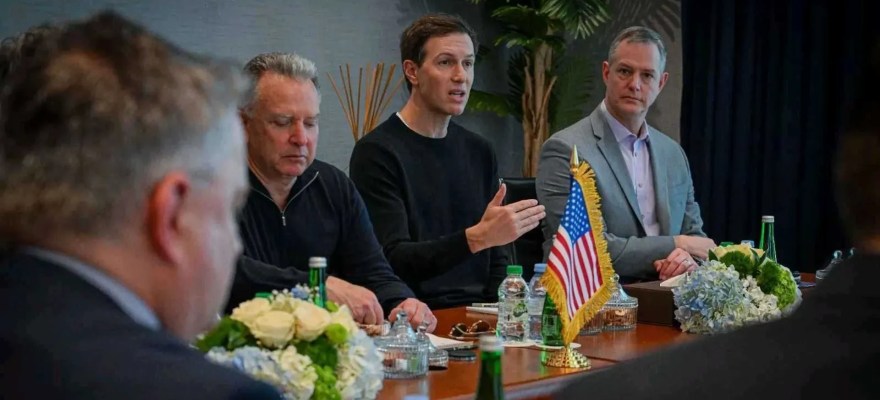
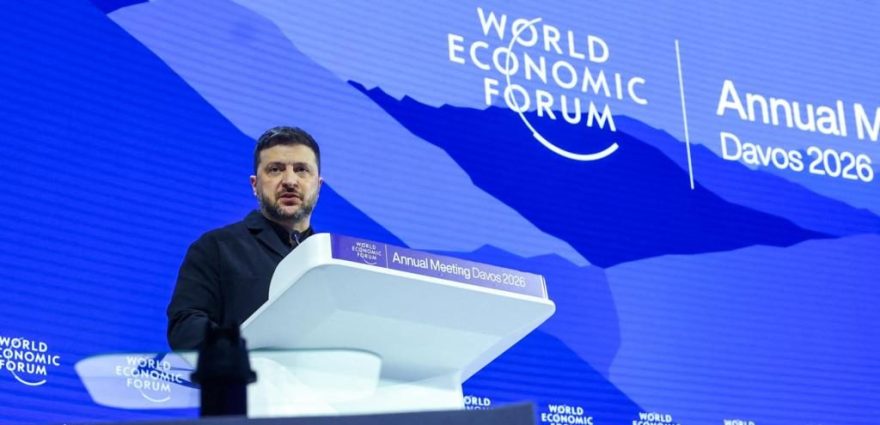
In his opening address to the Peace Council, where he again insisted on the falsehood of having resolved eight wars—including the Iran-Iraq War, which the United States and its regional proxy instigated—Donald Trump announced he was on the verge of achieving a ninth resolution, a sign of renewed diplomatic momentum in negotiations with Kyiv and Moscow. Like Steve Witkoff, who maintains that the negotiations boil down to a single, "resolvable" issue, the US president expressed optimism about resolving the war, which he claimed "would be the easiest." However, in his meeting yesterday with Zelensky, who, as announced the previous day, finally traveled to Davos after securing a photo opportunity with Trump, no agreements were signed. Neither the security guarantees nor the so-called Prosperity Plan are yet ready for the two presidents' signatures, indicating that even the bilateral US-Ukraine negotiations are not as close to completion as had been suggested. Even less is known about the other side of the negotiations, the US-Russia talks, which took place late into the night after the arrival in Moscow of Trump's envoy to Russia, Steve Witkoff, and Jared Kushner—the president's son-in-law and confidant, who holds no official position—to meet with Vladimir Putin throughout the day. Judging by the words of Yuri Ushakov, who insisted that there will be no "lasting peace" if the territorial issue is not resolved, there is still no agreement on this key matter.

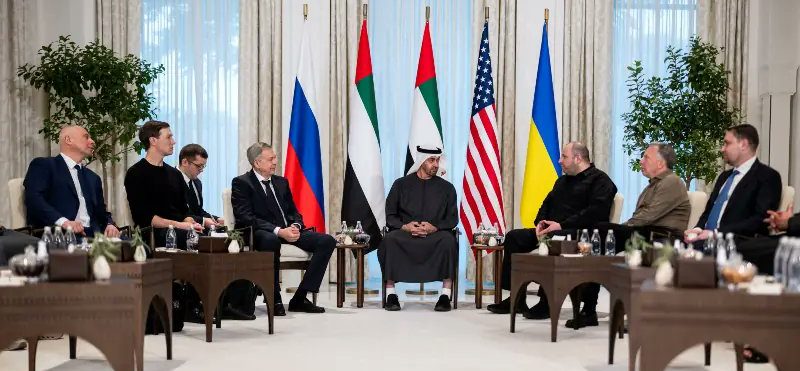
The main news of the day came from Volodymyr Zelensky, in a part of his speech that went virtually unnoticed amid the headlines generated by the angry Ukrainian president. Trilateral negotiations between the United States, Russia, and Ukraine will begin today and last for two days. Although it is expected to be merely an initial meeting in which no major decisions will be made (though perhaps there will be gestures such as a new prisoner exchange or a partial ceasefire, an objective that is being pressured on Russia to rescue Ukraine from its dire energy crisis), it would be the first time that the three parties in this diplomatic process have negotiated directly. The United States was present at the opening of Russia's failed attempt to revive the Istanbul process last year, but there was no political negotiation at that time. Details are scarce, and all that is known is the location of the meeting: the United Arab Emirates. The few words Zelensky dedicated to what would be a significant development indicate a certain sense of unease. “I hope the United Arab Emirates is aware of this,” he said regarding the day's meetings. “We've had some surprises from the American side. But, in any case, we'll go there. I think it's good that there's a trilateral meeting at the technical level,” the Ukrainian president added.

Zelensky had arrived in Davos to make the most of the opportunity to address the major powers in the business and political world, and he seemed determined to generate as many headlines as possible. Zelensky achieved his goal and left no one indifferent. “Maduro is being tried in New York… but Putin isn’t?” he complained, again alluding to the kidnapping of the head of state of one of the world’s leading nuclear powers, Vladimir Putin, whom he had wished dead in his Christmas address. His use of the recent geopolitical conflicts caused by his main ally, the United States, was not limited to demanding that Russia receive the same treatment as Venezuela. “There was a lot of talk about the protests in Iran, but they were drowned in blood. The world has not helped the Iranian people enough; it has stood on the sidelines,” Zelensky stated, tireless in demanding US military interventions in the territory of his enemies. The objective is clear: to use foreign interventions to isolate and weaken Russia. In Zelensky's view, losing Venezuela would mean losing a foothold in the energy market, while losing Iran would mean losing access to materials like Shahed drones. In his attempt to present his wishes as analysis, Zelensky conceals the fact that the "Iranian drones" are produced independently in Russia and that Russia's main trading partner is China, a relationship the West and Ukraine dream of severing. Zelensky's interventionist aspirations are not limited to Russia's allies. "Wouldn't it be cheaper and easier to simply cut off the components Russia needs to produce missiles, or even destroy the factories that produce them?" the Ukrainian president asked in a renewed appeal to get his partners to either directly destroy the Russian military industry or to do so by sending the necessary materials to Kyiv.

The core of Zelensky's speech was the exploitation of the Greenland situation for his own benefit. It didn't bother him that the Trump-Rutte agreement on Greenland was reached without Greenland's participation, even though "nothing on Ukraine without Ukraine" was one of the year's slogans. Nor did the Ukrainian president seem concerned by the explicit threat from the United States, but he did want to use the situation to promote Ukraine as an integral part, or perhaps even a vanguard, of the European family and an essential component in the defense of the European continent. Zelensky even went so far as to offer Ukraine's services to sink the Russian warships that, in Donald Trump's mind, are sailing freely around the Arctic island. Zelensky's methods of demanding privileged integration into the EU and more assistance to maintain the immense military with which he aspires to assume for Europe the role that Israel plays for the United States are endless.

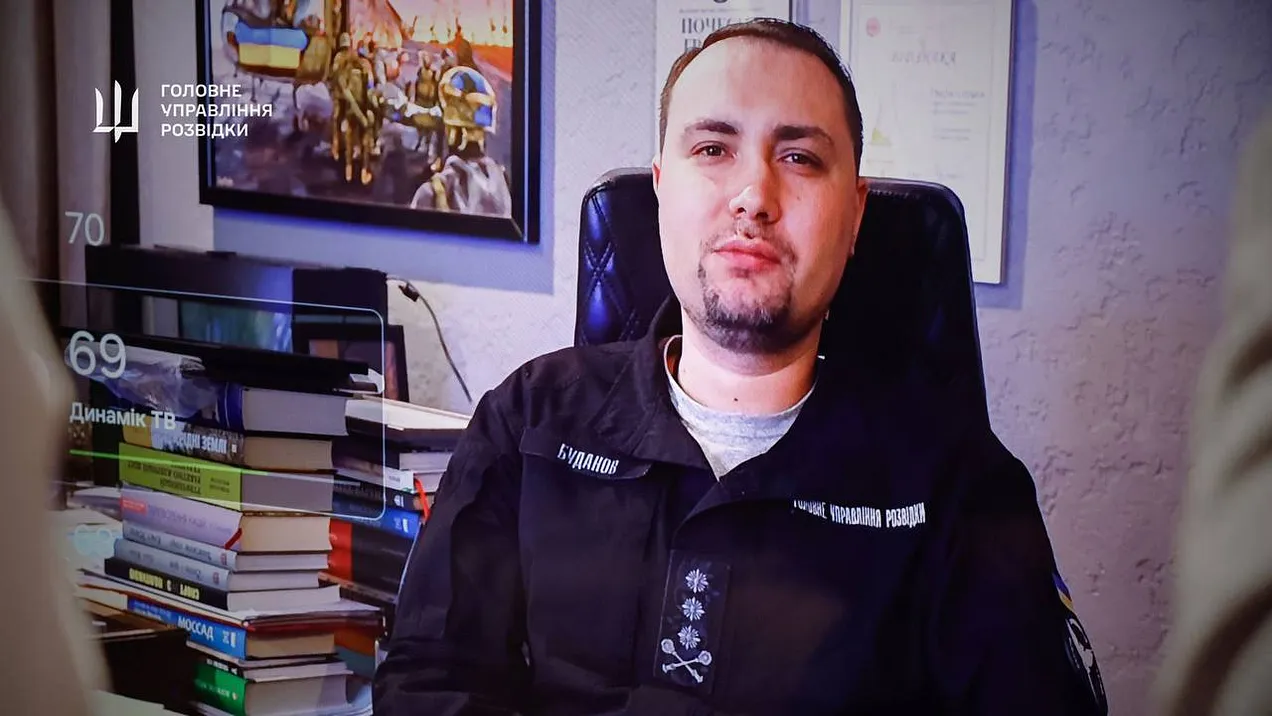
The main surprise of Zelensky's speech was the harshness with which he addressed European countries. At this moment of internal dispute within the Atlantic bloc, the Ukrainian president clearly demonstrated that his internal realignment with the appointment of Budanov—a US ally replacing Ermak, a British ally—was no casual decision. All his reproaches were directed at European countries, a way of demanding more aid from them while simultaneously flattering Donald Trump by agreeing with him in the dispute. “Biting the hand that feeds him,” wrote the Ukrainian-Canadian academic Ivan Katchanovski, referring to Zelensky's accusations. He criticized European countries for not returning to Ukraine the Russian assets held in the EU and for not following the US lead and seizing ships from Russia's phantom fleet. Ironically, at that very same time, France announced it had boarded a Russian oil tanker in the Mediterranean Sea. And hours earlier, Vladimir Putin had openly stated that Russian funds held in the United States could be used for the reconstruction of Palestine and Ukraine, something that cannot satisfy Zelensky, who aspires to use those assets for war and not for peace.

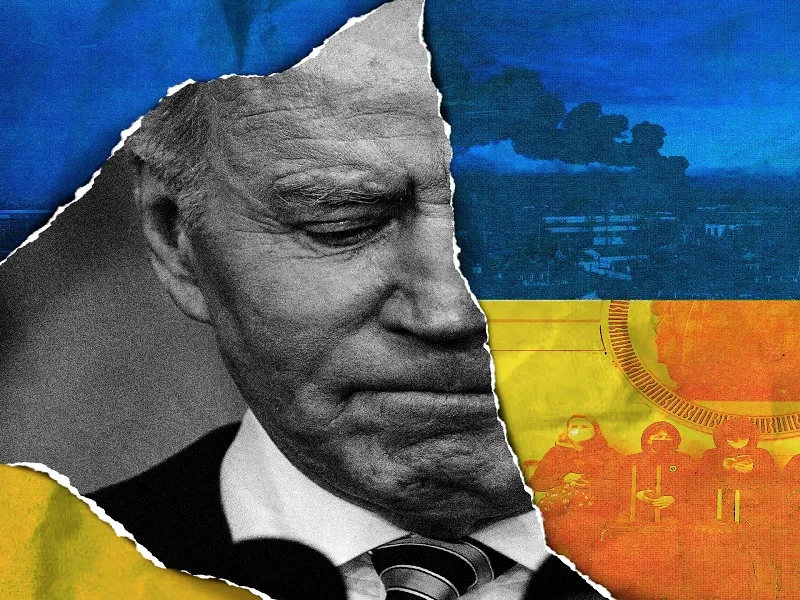
“Instead of becoming a true global power, Europe remains a beautiful but fragmented community of small and medium-sized powers. Instead of assuming the decisive responsibility of defending freedom around the world—especially now that the United States is focused on other areas—Europe seems adrift. Some are trying to convince the US president to change course. But he won't. President Trump loves being who he is. He says he loves Europe, but he won't listen to this kind of Europe,” Zelenesky lamented in a harsh speech against his main suppliers, the European countries, which he accused of being stuck in “Groundhog Day” and which he blames for “not changing a thing.” “ Nothing ” is having sustained the Ukrainian state for almost four years, enabling Kyiv to pay salaries and wages, hosting the refugee population that has fled the war westward, and currently being the only source of continuous and stable funding for the Ukrainian Armed Forces. For months now, since the funds approved by Joe Biden ran out, the US weapons that continue to flow into Ukraine and are essential to continue the war have been paid for by the budgets of European countries.

Everything is simple in Zelensky's world. The key to European defense is the integration of Ukraine, the outer frontier of Western civilization and the main asset against the formidable Russian enemy. In this world, Europe needs its own armed forces, united and with Ukraine as an integral part. Only in this way can the continent defend itself against a formidable Russia that, nevertheless, is also incredibly weak.

“I’m sharing the real figures with you. The actual statistic is 35,000 deaths per month. 35,000 soldiers. Last year, this month, it was around 14,000. Russia doesn’t think about it, but we do. We know they mobilize 43,000 a month, and they start losing 35,000. Of these 43,000, you have to know that around 10-15% escape, and there are some wounded. Their army has stopped growing—this is important—because of our drone operators and drone technology,” Zelensky stated, providing real figures that contradict even those given by his own military intelligence, which claims that the Russian army continues to grow. Consistency has never been a requirement in this war, and depending on the needs of the moment, the figures can be used both to warn of the enormous danger of the growing Russian army and to demand a greater effort to definitively defeat a dwindling army. It is also curious to use data on desertions on the enemy side, considering that Ukraine has been forced to classify its figures in order not to create social alarm due to their high volume.

“It’s easy to criticize Europe, but it’s a mistake,” commented Shashank Joshi, defense editor of The Economist, who noted that “just three days ago, the European Parliament approved a €90 billion support loan for Ukraine, which seems to have escaped Zelensky’s notice. EU defense spending also increased by 11% by 2025. Missile production hovers around 2 million per year.” Zelensky’s arrogance is beginning to irritate even his most ardent supporters.

https://slavyangrad.es/2026/01/23/mordi ... -de-comer/

Google Translator

******


From Cassad's Telegram account:

Colonelcassad
Forwarded from
ADEQUATE Z
Ushakov's report in the dead of night about the reception of the couriers once again confirmed what was already well understood: the Ukrainians are unwilling to leave where they've been told many times, and they refuse to fulfill many of our demands. Otherwise, there would be no need to set up an entire security contact group in Abu Dhabi, headed by our Chief of the General Staff.

Couriers will continue to come for piss , contact groups will continue to communicate, the Ukrainians will continue to subtly mock the head lord, beg from any Papuan, and try to kill any Russian they can reach. And the war will not end at the table, no matter what illusions Trump harbors to the contrary. It will end when either the Bandera front or the rear collapses. The Ukrainian bosses are not ready for anything else, and never will be.

...And let the contact groups continue to contact each other; Abu Dhabi is no worse a place in this regard than Istanbul.

***

Colonelcassad
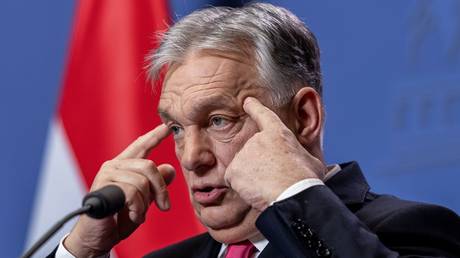
Hungary will not allow Ukraine into the EU for the next 100 years, Orbán stated.

He stated that Ukraine is attempting to influence the results of the upcoming parliamentary elections in Hungary because it knows the country's current government will not allow its accession to the EU.

***

Colonelcassad
0:16
0:10
Kyiv Mayor Klitschko again urged residents to leave the city.

"I'm being honest: the situation is extremely difficult, and this may not be the worst moment... Anyone who still has the opportunity to leave the city, where there are alternative sources of electricity and heat, don't turn them down ," he said.

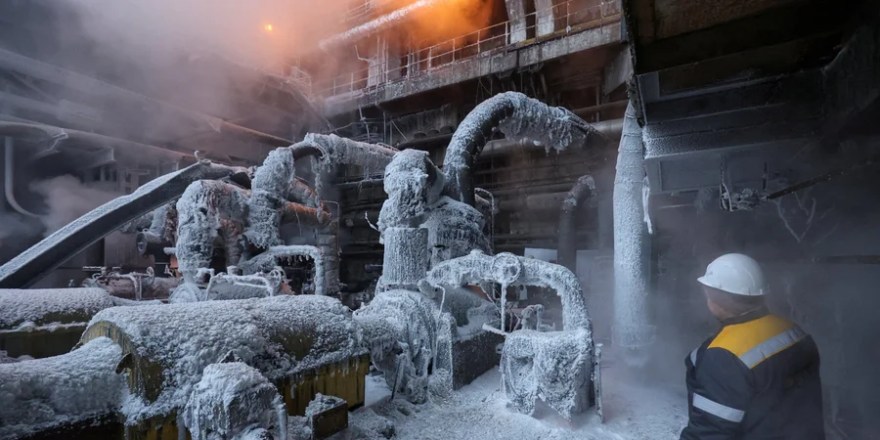
Transformers are burning and sparking in Kyiv —locals reported several incidents today alone.

Furthermore, emergency power outages have already been imposed in many regions—Odesa, Mykolaiv, Dnipro, Kharkiv, Poltava, Chernihiv, and Cherkasy.

***

Colonelcassad
"The world is tired of clueless clowns whose army relies on foreign mercenaries."

This is how the Iranian Foreign Ministry commented on Zelenskyy's call for aggression against Tehran.

Earlier, Zelenskyy stated in a speech that "the world hasn't helped the Iranian people enough" to overthrow the current government. Abbas Araghchi said that Iranians know how to defend themselves and don't need foreign help.

***

Colonelcassad
Putin's talks with Witkoff, Kushner, and Gruenbaum were constructive and extremely frank, said Yuri Ushakov, aide to the Russian president.

Other statements by the aide to the president following the meeting:

- Confirmed that without resolving the territorial issue, it is impossible to expect a long-term settlement.

- Agreed that the first meeting of the trilateral working group on security issues, with the participation of representatives of Russia, the United States, and Ukraine, will be held in Abu Dhabi on Friday

. - Russia's security negotiating group has been formed and will fly to the UAE in the coming hours.

- It includes representatives of the Defense Ministry leadership.

- The Russian delegation, which will travel to Abu Dhabi, received specific instructions from Putin.

- The heads of the bilateral economic group, Dmitriev and Witkoff, will meet in Abu Dhabi.

- Witkoff and Kushner shared their impressions of the contacts that took place in Davos, including the meeting between Trump and Zelensky.

The Russian side emphasized its willingness to contribute $1 billion to the Gaza Peace Council from previously frozen Russian assets.

The remaining funds from the frozen reserves can be used for territorial reconstruction following the conclusion of a peace treaty between Russia and Ukraine.

Russia will continue to consistently pursue the goals of the Gaza Peace Council until a settlement is reached through political and diplomatic means.

https://t.me/s/boris_rozhin

Google Translator

******

For 'Freedom and Democracy'

German manufacturer of robotic war systems supports the 'Azov' Nazi storm brigade of the Ukrainian army
Moss Robeson
Jan 21, 2026

Apologies to subscribers for going MIA over the past month! Susann Witt-Stahl and I wrote the following article which appeared in junge Welt, December 30, 2025. This post includes more images (the first one is from jW), and some more information about the Azov movement’s “Killhouse Academy.”
Image
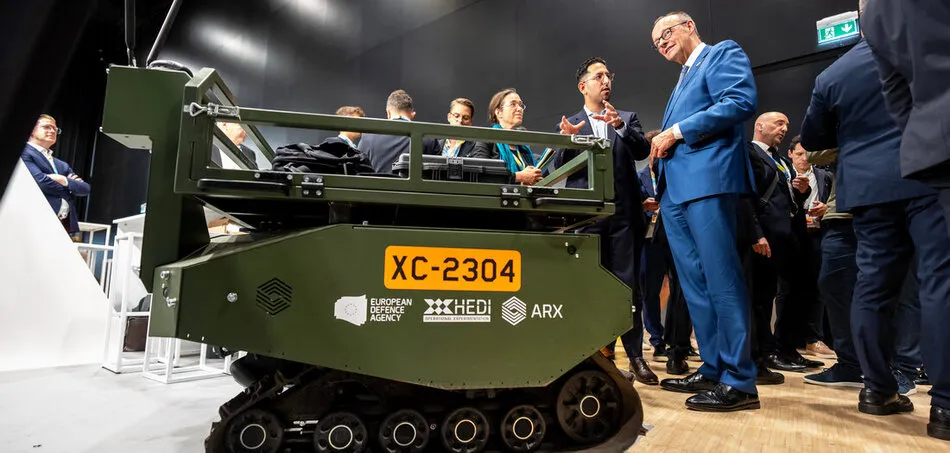
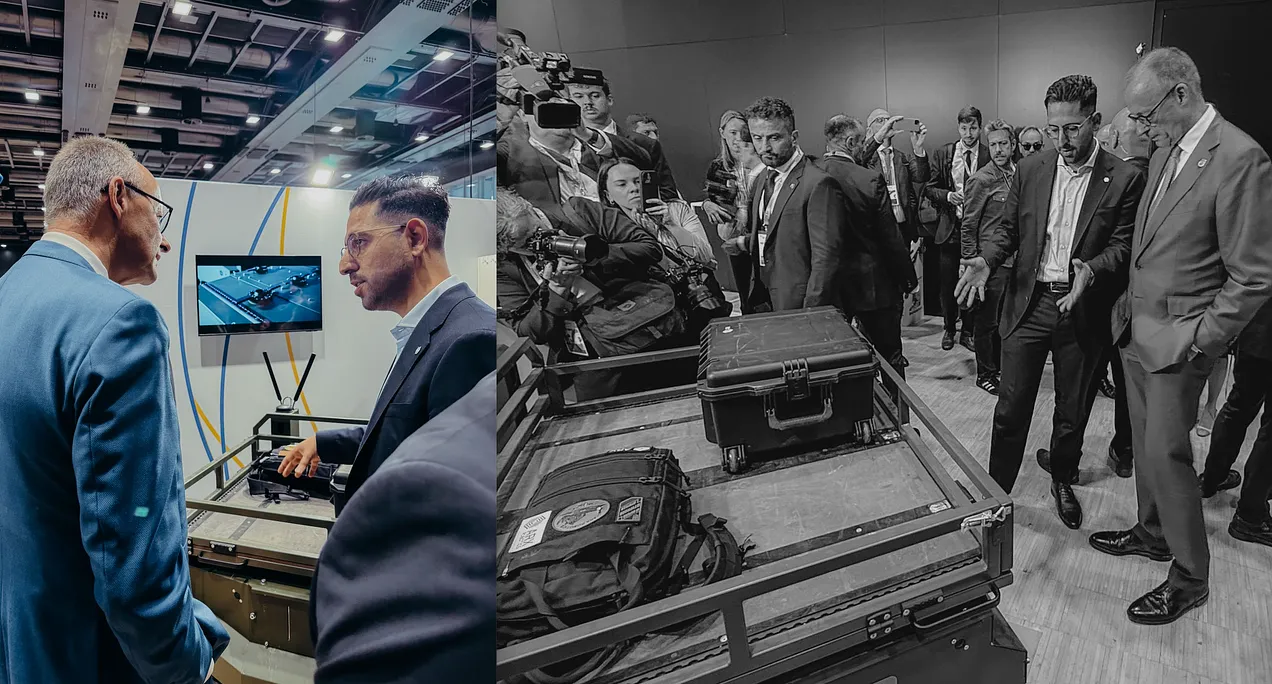
German Chancellor Friedrich Merz is shown a robotic vehicle by Marc Wietfeld, CEO of Arx Robotics (Rome, July 10, 2025).

Investors are beating down the doors of the German defense startup Arx Robotics. “Defense has now also become a priority for venture capital investors,” said CEO Marc Wietfeld, a former Bundeswehr captain, to Handelsblatt, referring to the gradual withdrawal of the United States from the war in Ukraine. As a producer of unmanned ground vehicles (UGVs), which are considered game changers for the future of modern warfare, Arx Robotics is currently writing an economic mega-success story.

“I believe this is about something much bigger,” Wietfeld emphasized in November 2025. What high ideals he means can be found on the company’s website: among other things, it states that the company ensures the “sovereignty of Europe” by providing assets to strengthen its “technological resilience in every mission.” Arx Robotics promotes its unmanned tank “Gereon” using the noblest of motives: the “defense” of “freedom and democracy.” After all, it delivered 30 units to Ukraine in March 2025—financed with funds from the German federal government’s “capacity-building assistance.” Last month, a new major contract was already announced, through which Ukraine is to receive the “world’s largest military robotics fleet” (there is talk of an “expansion by several hundred systems”). Prior to this, Arx Robotics had described its support for Ukraine through its UGVs as the “decisive moment in Europe’s embrace of autonomous military technologies.”

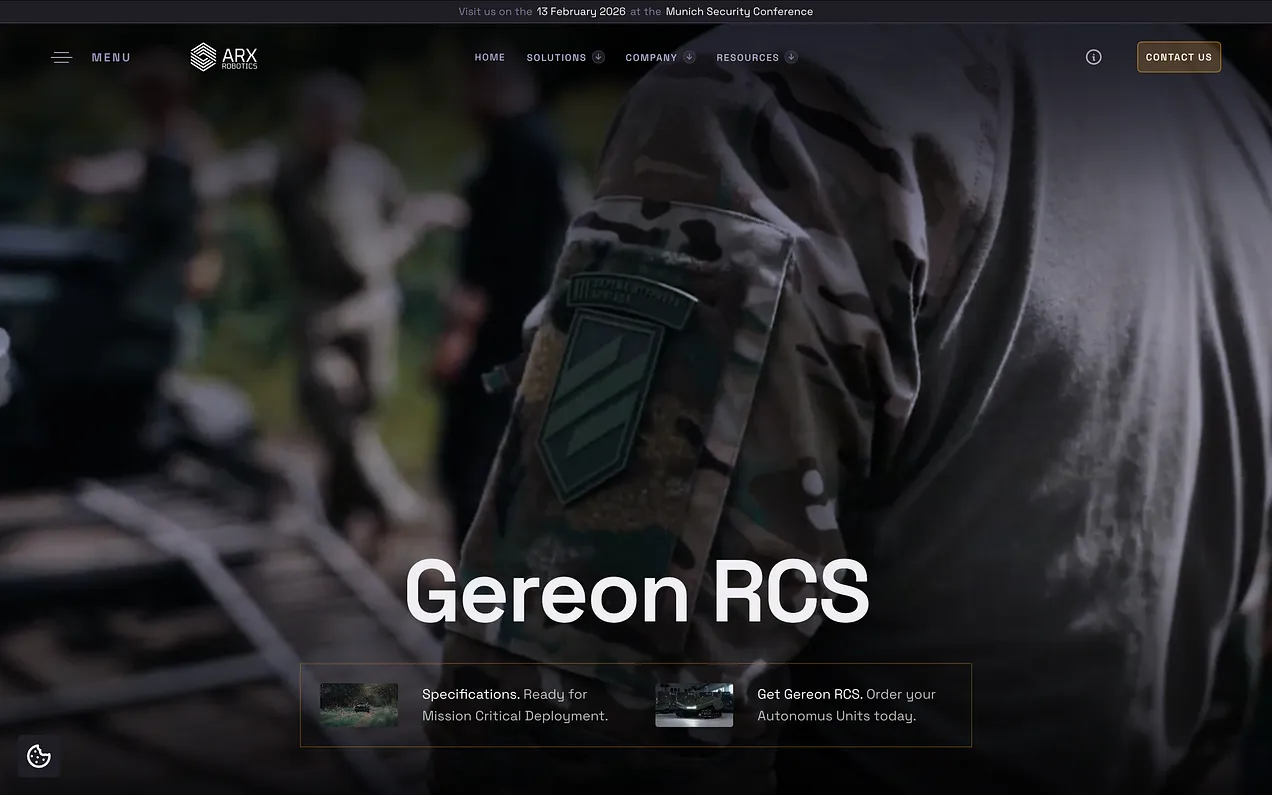
Who else is being “embraced” in this way is revealed by the unit insignia worn by Ukrainian soldiers shown using the device in an Arx Robotics promotional video: the 3rd “Azov” Assault Brigade of the 3rd Army Corps, which is under the command of Andriy Biletsky, the most powerful neo-Nazi leader in Ukraine.
Image

Blessed Expansion
Wietfeld founded Arx Robotics in 2021 together with his former Bundeswehr officer colleagues Maximilian Wied and Stefan Röbel. In addition to the “Gereon,” the company produces the wheeled unmanned ground vehicle “Hector” as well as an AI-based operating system that can be used to retrofit conventional military vehicles. Arx Robotics, whose customers also include the Bundeswehr, is headquartered in Oberding in the district of Erding in Upper Bavaria and has branch offices in Berlin, Kyiv, and London; it is currently building a development center in southwest England to produce systems tailored to the operational requirements of the British Army. Over the course of the year, business media reported that investment sums in the double-digit millions had been raised.

Meanwhile, engine manufacturer Deutz has joined Arx Robotics as a lead investor, and the tank transmission producer Renk and Daimler Truck have been named as cooperation partners. As early as July, Marc Wietfeld met German Chancellor Friedrich Merz in Rome at the Ukraine Recovery Conference to discuss Arx Robotics’ work there.
Image
Merz and Wietfeld at the 2025 Ukraine Recovery Conference in Rome

What kind of “blessing” the expansion and UGV deliveries by Arx Robotics to Ukraine represent for the “Azov” military units is illustrated by posts on the company’s LinkedIn channel: the arms manufacturer supports the UGV school of the “Killhouse Academy” of the 3rd Assault Brigade, which is equipped with its own combat robot fleet and a simulation room, “financially, technically, and through direct collaboration,” as stated there. “Together we train operators, modernize capabilities, and accelerate the deployment of unmanned systems for logistics, reconnaissance, and evacuation.” Igor Kornilov, Arx Robotics’ managing director in Ukraine, had already announced the donation of a “Gereon” to “Killhouse.” On the historic date of May 8, 2025, the cooperation received a higher level of official recognition through a visit by Major General Christian Freuding, head of the Ukraine Situation Center at the German Federal Ministry of Defense.

Image
ARX Robotics at the Killhouse Academy UVG school (October 2025)

UGV Fighters with SS Symbols
Contrary to claims made by Western media, the 3rd Assault Brigade, which operates the “Killhouse Academy,” is by no means “depoliticized.” On the contrary, it is firmly embedded in the “Azov” neo-Nazi movement, which for years has acted as a growing state within a state. “Killhouse” initiator Oleg “Romacha” Romanov—whom Freuding posed with for a photo and who today serves in the 21st Unmanned Systems Regiment “Kraken 1654” of the 3rd Army Corps—openly displays his ideology on social media through tattoos featuring swastika ornaments.

Image
Romanov with German Major General Freuding at Killhouse Academy on May 8, 2025, and more recently with the notorious Russian neo-Nazi “White Rex” (who is banned from the Schengen Area by Germany). The Paskuda group is now the Paskuda battalion in the Azovite “Kraken 1654” regiment.

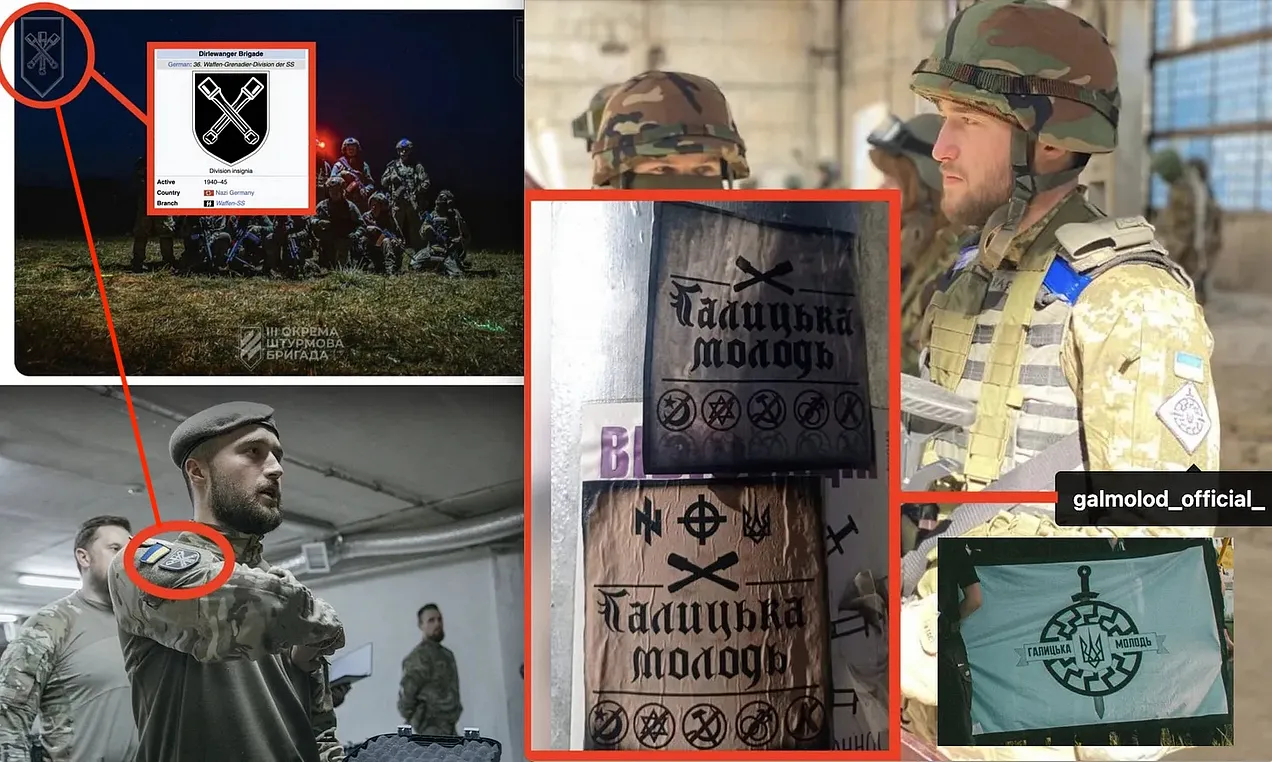
The brigade’s UGV platoon NC13 was established in 2024 within a company that adopted a slightly modified version of the symbol of the SS special unit “Dirlewanger” as its official unit insignia. The commander of NC13 is Mykola “Makar” Sinkevych, a leader of the neo-Nazi “Galician Youth,” which recently praised him as being “true to the cause.” His organization appears with the Celtic cross, Himmler’s SS “Black Sun” symbol, and the insignia of the Waffen-SS Division “Galicia.” The latter also adorns the field uniforms of NC13 fighters shown in a propaganda video by the 3rd Army Corps. Like all “Azov” military units, NC13 firmly stands in the tradition of the Bandera wing of the fascist Organization of Ukrainian Nationalists (OUN-B), which collaborated with Nazi Germany during the Second World War.
Image
“Makar” wearing modified Dirlewanger and Galician Youth patches. In 2021, the Galician Youth distributed neo-Nazi fliers in Lviv.

“Azov” in a Top Position
In late summer 2025, Arx Robotics presented its first combat tank, the “Combat Gereon.” It was developed in cooperation with the defense-tech startup Frontline Robotics in Ukraine, which recently entered into a joint venture with Germany’s Quantum Systems to set up a drone production line for the Kyiv armed forces. The military-industrial complexes of the two countries are networking at breakneck speed. Arx Robotics relies on the practical knowledge of Ukrainian soldiers—“users on the front lines”—for its innovations. In October, NC13, together with other “Azov” units, organized the first large-scale crash test of robotic systems under simulated combat conditions on the outskirts of Lviv (it is not known whether products from Arx Robotics were used).

“What is happening there is not an evolution of warfare, but a revolution,” Marc Wietfeld said in an interview. Not least thanks to the extensive support of his company and the German government, the 3rd “Azov” Assault Brigade is among those at the forefront, significantly expanding its leadership role as the most technologically advanced unit in the Ukrainian armed forces—and thereby also the power of militant fascist forces in the country. “This is the new reality of war, where we set the rules,” the 3rd Assault Brigade declared as early as the founding of NC13 in September 2025.

Meanwhile, “Azov” chief ideologue Oleksii Rains, a member of the 3rd Assault Brigade and head of its center for ideological training, once again made clear that the war aim of his movement is a “Ukraine for Ukrainians” and that it is not interested in “freedom and democracy.” The latter, he wrote on the Telegram channel of his publishing house—which releases writings by “Azov” and the historical OUN-B—means only “collective helplessness.” “Ukrainians and Ukraine do not need democracy, but responsible authoritarian leadership.”

Image
A recent book by Rains on “Modern Ukrainian Far-Right Nationalism,” and one of the patches sold on his website, which refers to the neo-Nazi slogan “White Pride World Wide.”

A question from the junge Welt editorial staff to Arx Robotics as to how it reconciles its cooperation with fascist military units with its proclaimed values-based corporate policy has so far gone unanswered.

MurderHouse, Inc.
(The following section, providing background information on Killhouse Academy, also appeared in junge Welt.)

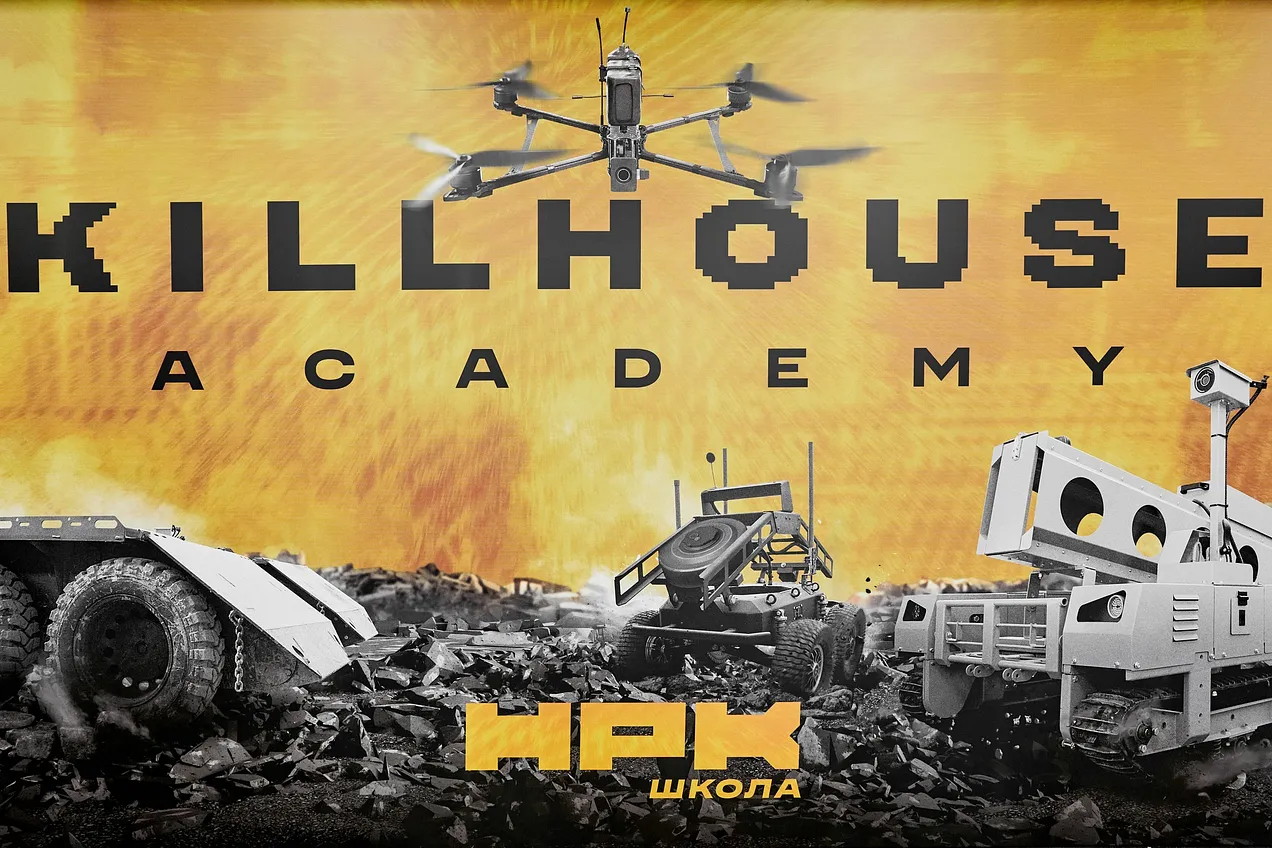
The facility was founded in April 2024 as a drone school by the 3rd “Azov” Assault Brigade, which today forms the backbone of the 3rd Corps of the Ukrainian Army. “Killhouse Academy” offers six-day basic courses for soldiers and civilians in Kyiv and other major Ukrainian cities, teaching fundamental knowledge about the construction and operation of FPV drones. In advanced courses, participants learn how to equip drones with ammunition and fly them in combat. Additionally, there is an engineering program in FPV drone technology. The “Killhouse” offerings also include a three-day bootcamp with armed combat exercises and other action—promising “adrenaline” and “adventure.” The stated main goal of the “Killhouse” operators is to increase the number of specialists and make them available for use by the Ukrainian armed forces.

In spring 2025, “Killhouse” expanded and opened a UGV (unmanned ground vehicle) school to train new platoons of the 3rd Assault Brigade. “Modern warfare requires constant development of the army and the introduction of innovations,” says the advertisement for the basic course offered there. “Ground robot systems are a future that is already effectively deployed on the battlefield.” Participants learn to transport supplies, wounded soldiers, and ammunition, as well as to destroy enemy targets. The training is supported by the NGOs “Dignitas Ukraine,” based in the U.S., the military school “Boriwiter,” which cooperates with NATO institutions such as the Joint Analysis and Lessons Learned Centre, and the German company ARX Robotics.
Image
Killhouse Academy UGV school

The coaching team is mainly recruited from veterans of the 3rd “Azov” Assault Brigade. Prices are around €160 for civilians; active soldiers can participate for free, veterans who are no longer on the front lines pay half, and foreigners pay double. Among the latter are international volunteers serving in the Ukrainian armed forces, as well as ordinary Western civilians who want to be prepared against Russia. “Who knows if the war will reach Europe in the future,” the Irish Times recently quoted a German-Ukrainian business consultant who proudly held up his “Killhouse” certificate for completing an FPV drone course. Springer’s Welt already celebrates Azov’s “Killhouse” as a “mix of West Point and the Massachusetts Institute of Technology, that is, the U.S. military academy and the elite tech cadet school on the American East Coast—but in Ukrainian.”

P.S. from the Azov Lobby Blog
When I refer to the “Bandera Lobby” on my other Substack, I mean an international network of people and organizations affiliated (or at least allied) with the OUN-B, the Banderite faction of the Organization of Ukrainian Nationalists, which still exists. Usually I am talking about OUN-B members and front groups. The “Azov Lobby” is not so conspiratorial, because we are not mapping out a secretive international Organization of Ukrainian Nazis, but merely keeping tabs on the Azovites and their supporters around the world.

What we might call the “extended Azov Lobby” (their supporters) made a stronger showing at the latest “Ukraine Action Summit” in Washington, which brought together hundreds of people to meet with members of Congress and their staffers. It served as another reminder that the Ukrainian Congress Committee of America (UCCA), after decades of Banderite domination, has become almost irrelevant outside of Chicago and certain Congressional offices.

Despite being the “largest umbrella organization,” the UCCA increasingly resembles a letterhead group, even in New York where it is headquartered down the street from various OUN-B “facade structures.” The UCCA is yet to welcome into its ranks any organizations created since 2014, and these are the most active ones.

Take for example “Razom for Ukraine,” also based in Manhattan’s “Little Ukraine,” or the East Village. Razom, established in 2014, is essentially the “Ukrainian AIPAC,” as the Congressional advisor Paul Massaro once put it when he was still a prominent online cheerleader for escalating the war in Ukraine by any means necessary.

Razom spearheaded the American Coalition for Ukraine (ACU) behind the Ukraine Action Summits. Steps were never taken to centralize the ACU, to replace or merge with the UCCA. Razom probably did not want a conflict with its Banderite neighbors (real control freaks) in Manhattan, who manage the “Ukrainian National Home” where this group is headquartered.

In 2022, Razom raised over $65 million, the majority of which “became military aid, mainly tactical medicine equipment and UAVs [drones],” according to its co-founder Lyuba Shipovich. But at the end of the year, the board of directors decided to “cut military support and focus on humanitarian aid.” Razom split, and reportedly stepped back from the American Coalition for Ukraine.

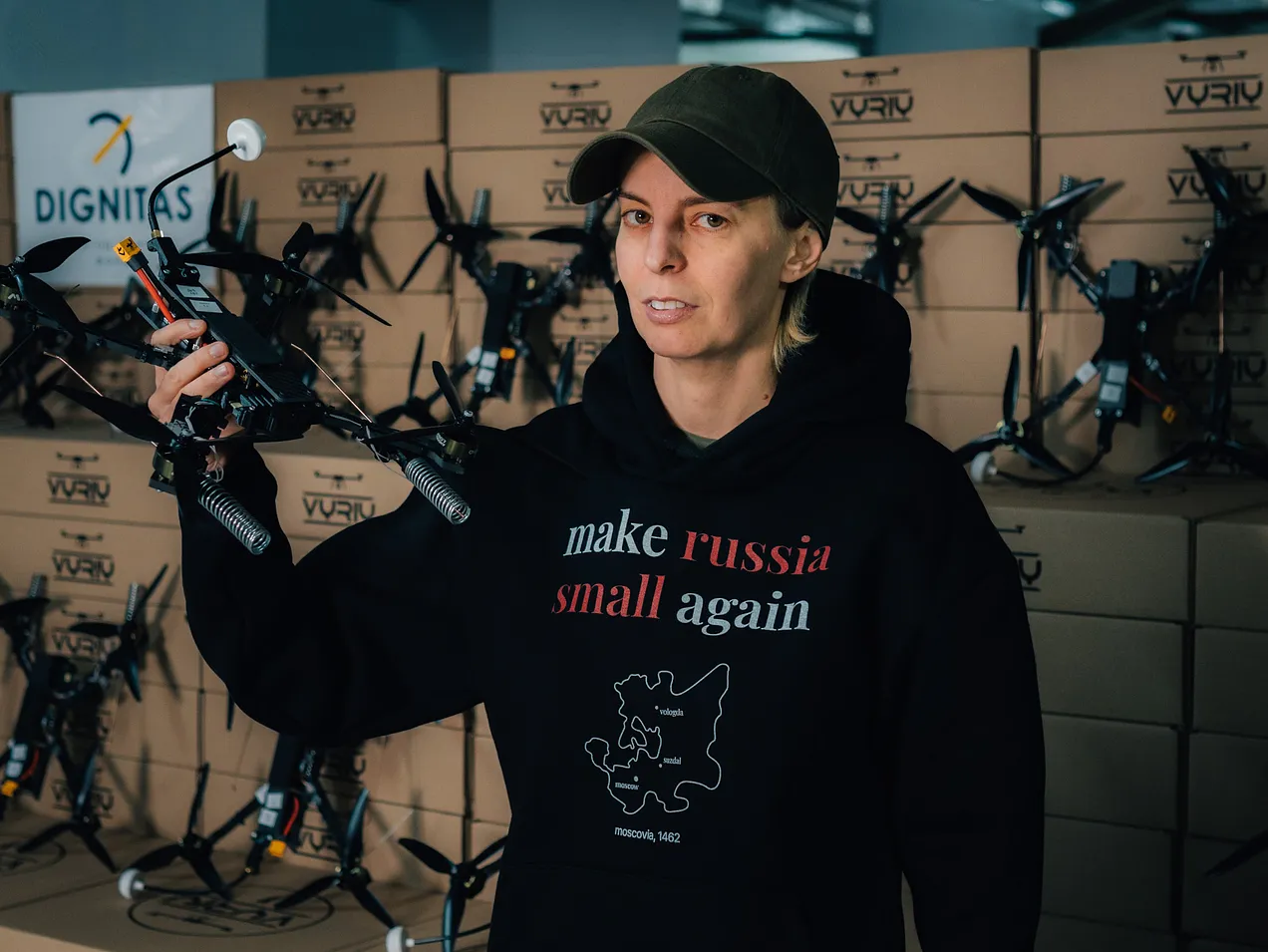
In February 2023, a Razom splinter group led by IT specialists Lyuba Shipovich and Dmytro Kavun founded Dignitas Ukraine, “which has since become a leading player in channeling resources and technology to Ukraine’s armed forces.” They adopted Razom’s “military and veteran project teams” and soon absorbed the “Victory Drones” project led by the famous “NGO militarist” Mariya Berlinska. “Events in Ukraine” explains that Berlinska is “quite well-known for her constant calls to ramp up mobilization” and personally believes, “Our task is to effectively hold out until the moment Russia collapses … [perhaps] another 10-12 years.”
Image
Razom and Dignitas co-founder Lyuba Shipovich

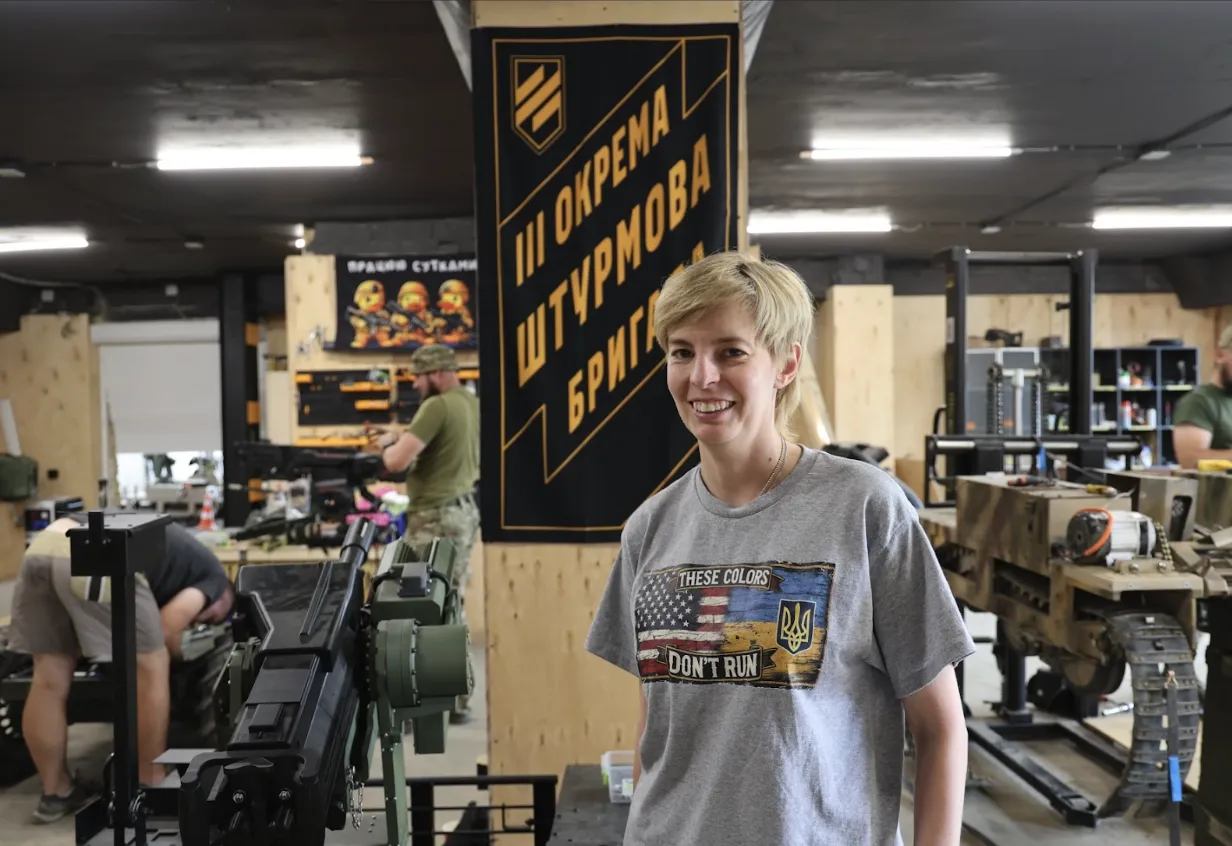
Whereas Victory Drones raises money for drones and trains Ukrainians to use them, Victory Robots is another training program which Dignitas launched in 2025. These entities co-founded KillHouse Academy’s UGV school with the openly neo-Nazi 3rd Assault Brigade, which has taken over the 3rd Army Corps. “When we spun off into Dignitas in 2023, I felt like we really popularized cheap FPV [drone] technology to the masses and broad adoption,” claims Dignitas co-founder Dmytro Kavun. “Now we are popularizing ground robotic systems.”
Image
Kyiv Post at Killhouse Academy: “Lyuba Shipovich, co-founder of Razom for Ukraine and current CEO of Dignitas, at a training facility for ground robotic systems in Ukraine.”

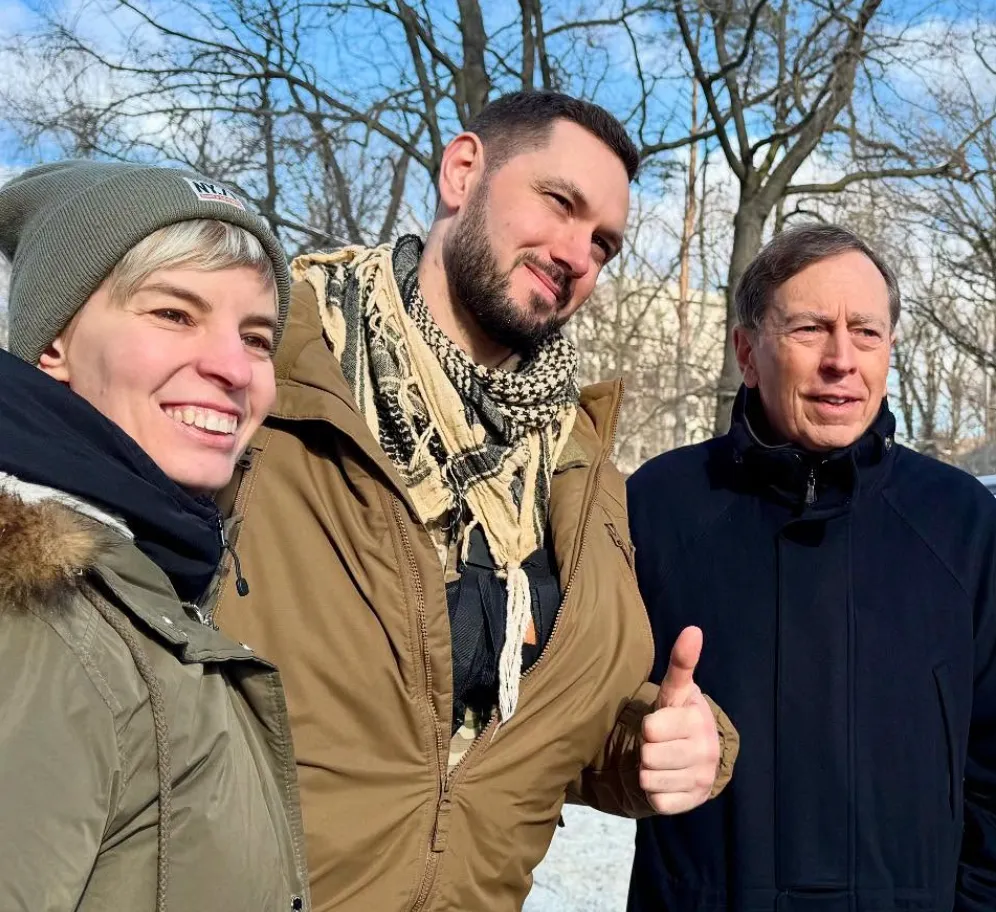
Before the neo-Nazi “NC13” became the leading UGV unit in the 3rd Assault Brigade, there was the “Nova Technology Center.” Victor Pavlov, its former commander, now directs the KillHouse Academy School for Ground-Based Systems. Almost a year ago, Shipovich and Pavlov met the former CIA director and retired US general David Petraeus, probably in connection with his visit to the Killhouse Academy drone pilot training facility in Kyiv. This was months before Dignitas and the Azov movement launched the UGV school.
Image
Shipovich, Pavlov, and Petraeus (February 2025)

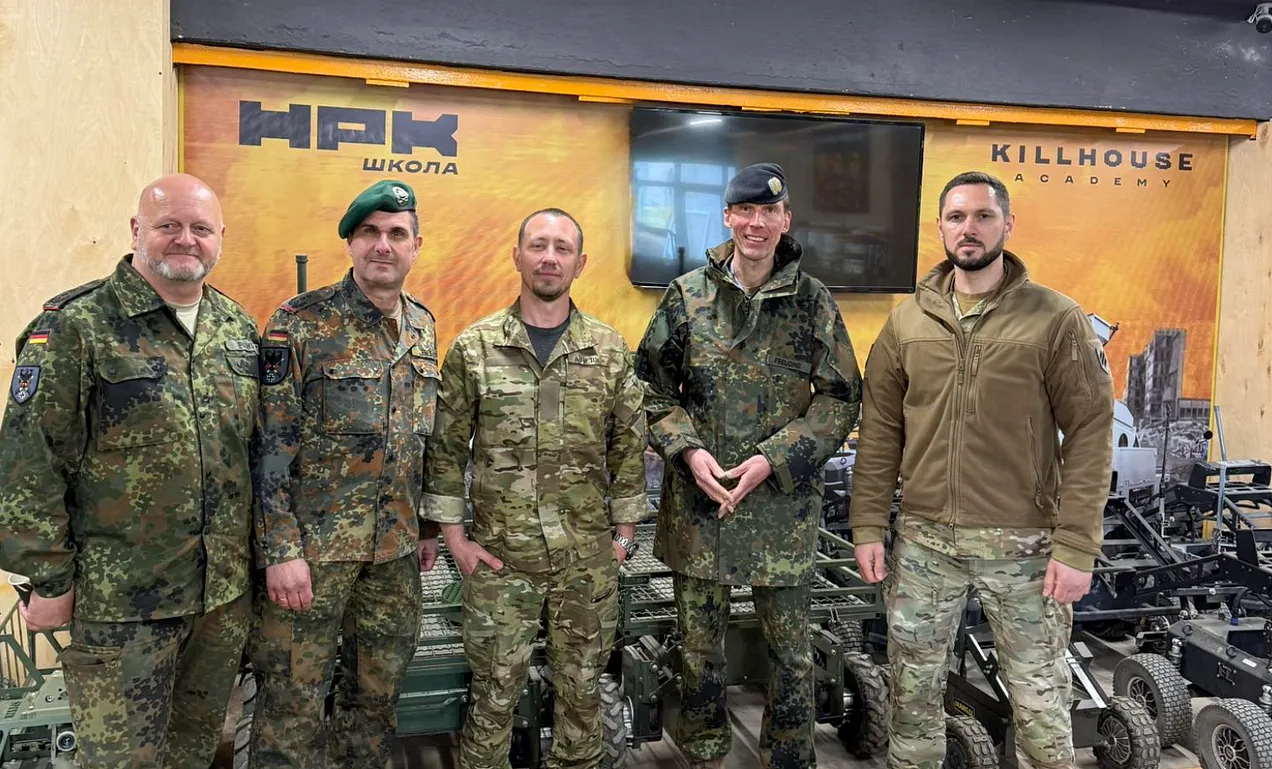
On May 8, the anniversary of Nazi Germany’s unconditional surrender, Victor Pavlov met the German major general Christian Freuding (then the head coordinator of German military assistance to Ukraine), who visited Killhouse Academy and got an early look at its UGV school. Later that month, Pavlov and the “White Fuhrer” of the Azov movement (Andriy Biletsky) spoke at the “DOU Day” technology conference in Kyiv, and Dignitas co-organized the first UGV conference in the capital, which featured speakers from the “Azov family” of military units.
Image
Freuding (second to right) at the Killhouse Academy UGV school

In June, Killhouse Academy launched its UGV school, and Dignitas established Victory Robots. Meanwhile, Pavlov joined a “strategic program” at Kyiv-Mohyla Business School. Ukrainian military intelligence chief Kyrylo Budanov (now the head of the presidential administration) sat next to the “White Fuhrer” at the Killhouse event. Later that summer, Victor Pavlov showed the UGV school to the commander-in-chief of the Latvian armed forces, and Pavlov spoke at another conference in Kyiv about post-war Ukraine with Shipovich.

Image
Budanov and Biletsky, who seemed unusually happy at the grand opening of the UGV school. On the right, Shipovich hugs Pavlov and meets Biletsky.

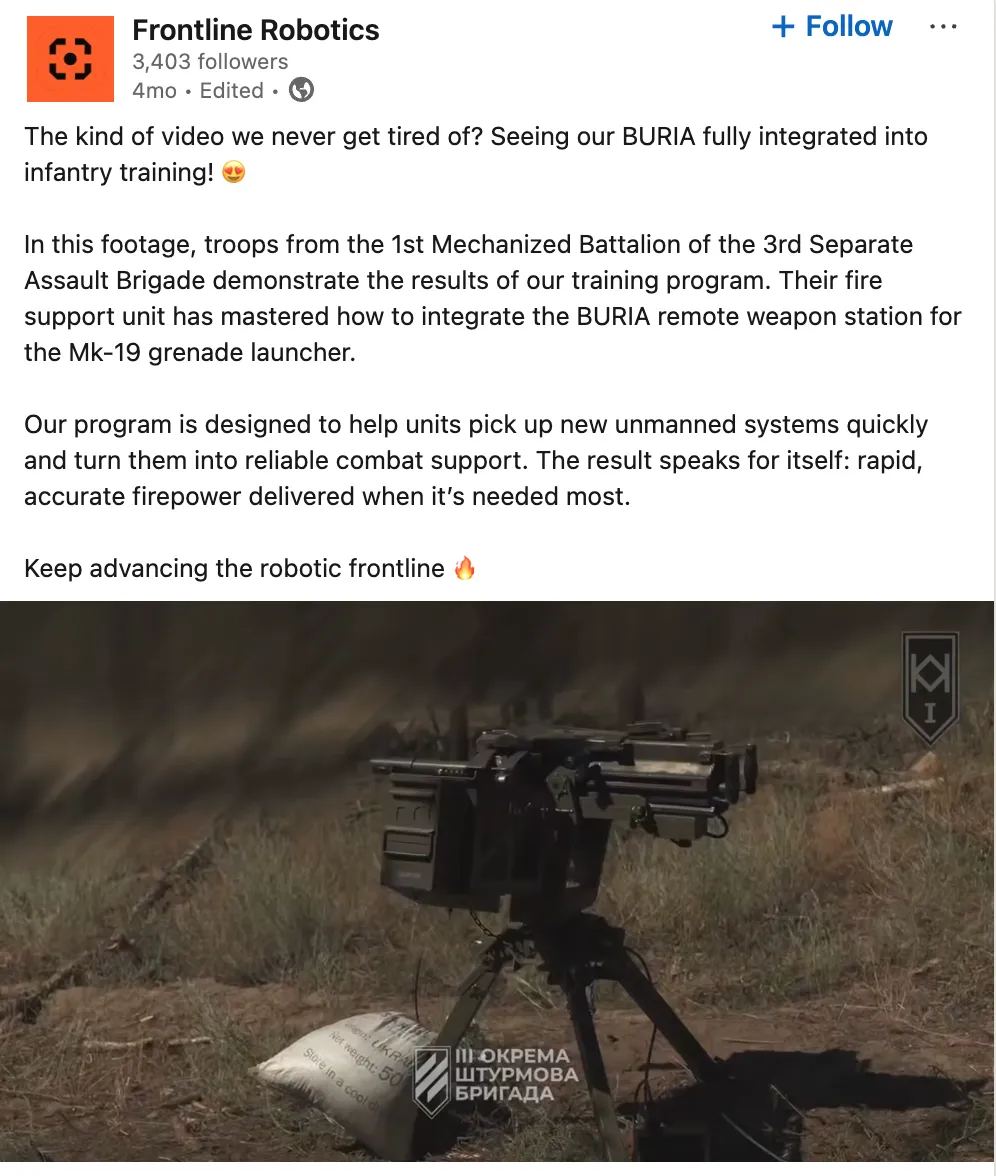
In early September, the Azov-friendly Ukrainian IT community “DOU” held a “picnic” that featured AB3 Tech, the 3rd Assault Brigade’s “startup
accelerator.” The Azovite booth showcased Buria, a robotic turret produced by the Kyiv-based robotic engineering firm Frontline Industries, which has since then launched “Quantum Frontline Industries” with the German technology company Quantum-Systems. According to the latter, “the new German-Ukrainian defence joint venture … will establish Europe’s first fully automated, industrial-scale foreign production line for drones for the Ukrainian Armed Forces.”
Image

As the summer came to an end, Victor Pavlov spoke at the EU-funded Defense Tech Valley 2025, an event organized by the Ukrainian government military technology platform “Brave1” that has reportedly become “the world’s largest investment summit focused on defense technologies.” This year, it took place at a football stadium in Lviv, and was said to have raised $100 million for military technology startups. According to the Delegation of the European Union to Ukraine, “the event showcased Ukraine’s role as a global hub of battlefield-proven innovation.” Furthermore, “This unique expertise positions Ukraine at the forefront of shaping how defence innovations are transforming global security.” The Azovite “AB3 Tech” of course had a booth to promote its expertise with “Combat-Tested Defense Tech.” Pavlov called on investors and producers to “stop imagining things, stop coming up with some hypothesis on your own, come and ask us.”

https://azovlobby.substack.com/p/for-fr ... -democracy

*****

Zelensky-Sorosite-EU alliance against U$A

War budget analysis. Greenland, Zaluzhny, the IMF.
Events in Ukraine
Jan 21, 2026

It’s not easy being the avantgarde of western civilization. Which west?
Image
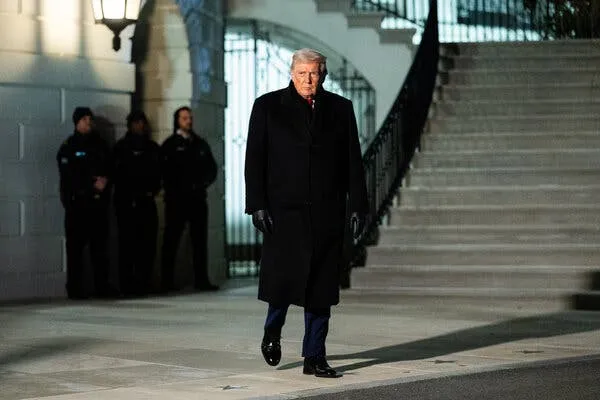
Trump is currently in Davos telling the Europeans what’s what

Faced with an increasingly real conflict between a Europe that is enthusiastic to support Ukraine’s war effort, and a USA lacking such enthusiasm, Zelensky has made the obvious choice: Brussels over Washington. Along with this foreign policy alignment, Zelensky has rekindled suspended friendships with the top representatives of Ukraine’s euro-atlanticist elite: Zaluzhny, Prytula, Sternenko, Kubrakov, Kuleba, and Fedorov.

But given that the EU’s grand promises of aid constantly reveal themselves to be rhetorical mirages, just how long can Ukraine really last?

Numbers
Let’s start with the money, and then we’ll take a look at Kiev’s political signalling.

2026 is set to be Ukraine’s first year without US financial aid. In 2025, some residual Biden-era aid still came through. Now, it is solely on European largesse that Kiev counts, aside from whatever trickle of aid approved under Biden that still comes through.

After much-hyped negotiations aiming to gain assent for transferring seized Russian financial assets to Ukraine, the EU came to the much less exciting ‘solution’ of a 90 billion euro loan. Even then, many doubted this would be enough to sustain Ukraine for a year, let alone for the two years that Brussels claims the loan would suffice for.

EU Approves 90 Billion-Euro Loan To Support Ukraine's Budget And Military Needs
Exactly how much does Ukraine need? Let’s first take a look at the evolution of the state budget, courtesy of the ministry of finances.

Spending as a percentage of GDP stayed relatively stable from 2008 to 2021, remaining at under 30%. The first year of ‘full-scale’ war, 2022, saw it rise to 52%, and in 2023 and 2024 it fluctuated around 60%. The budget deficit soared from under 5% of GDP to around 20% of GDP in 2022-24. This level is set to stay the same in 2026, but with much less western aid to cover it.

The data for 2025 budget spending and revenues isn’t yet fully available, with the figures for December still absent. Anyway, the original plan for the 2025 budget saw a budget deficit of 19% of GDP, slightly below the 2024 figure. All of that was to be covered by foreign funding: 32 billion euros.

The 2026 budget was finally accepted in early December 2025. Revenues will rise to ~57 billion euros, a 15% increase compared to 2025, and expenditure will reach ~95 billion euros, a rise of 3%. That’s a budget deficit of around 41 billion euros, 18.5% of GDP. As usual, almost all of this is to come from foreign donors. But this time, they are much less guaranteed.

The ministry of finances states that only 60% of expenditure will come from Ukrainian tax revenue. And almost all of that will be spent on the army, covering all military spending (27% of GDP).

So, at least theoretically, even if Ukraine can’t find enough foreign aid, it will still have enough for the army. But that’s only theoretically.

Anyway, the MoF hence predicts that 41 billion euros in external financing will be necessary, but it doesn’t know where they will come from. The US is not seen as a possible source of foreign aid:

Resources are expected to be attracted from the World Bank, the EU, the United Kingdom, the IMF and the G7 countries.

Perhaps I’m missing something, but I haven’t been able to understand why exactly the Ukrainian minister of finances stated in October that Ukraine would require 51 billion euros of foreign aid in 2026-7. I suppose the December budget was simply over-optimistic? This significant dissonance between the minister of finance and the ministry of finance is quite something.
Image

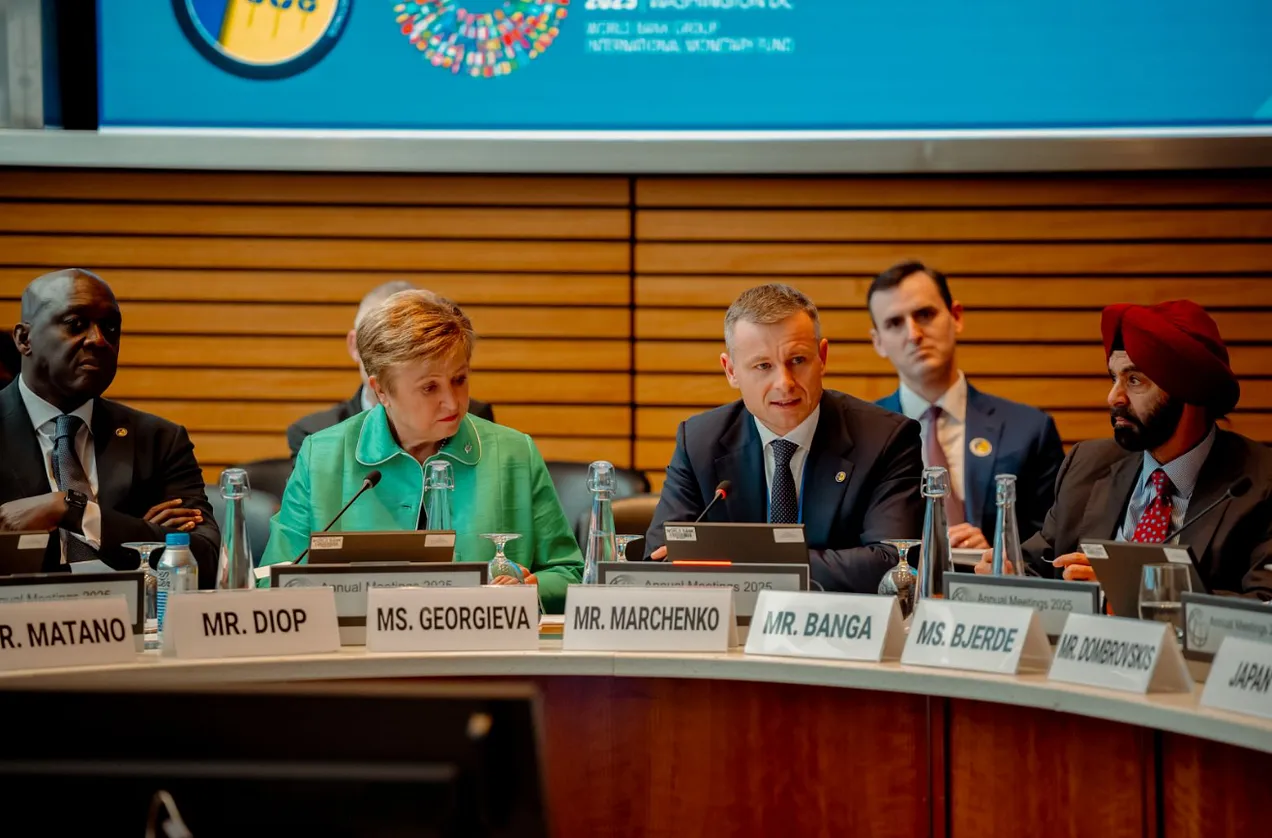
Finance minister Marchenko at the eighth Ministerial Roundtable for Support of Ukraine in Washington, along with IMF (Georgieva) and WB (Banda) representatives.
For its part, the IMF also estimates a higher 2026-27 financing gap: $54 billion euros. And that depends on highly optimistic prediction of 4.5% GDP growth in 2026, which is greater than market estimates.

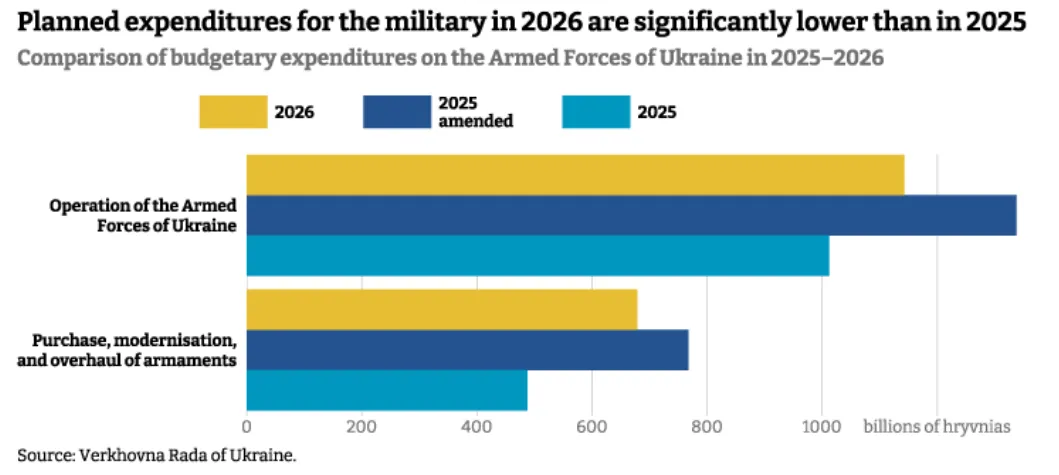
Others agree that Ukraine’s external financing needs will be even higher than planned. EU publications like the Centre for Eastern Studies (CES) predict that the 2026 budget will outstrip planned spending. The CES points to the fact that while non-military expenditure like healthcare and education are to rise significantly (which many in Ukraine believe is Zelensky’s attempt to gain popularity domestically), spending on the ministry of defence is meant to fall significantly compared to 2025. In 2025, planned military spending had to be amended upwards three times.
Image

There are even higher estimates out there. For instance, Bohdan Popov, a political adviser at United Ukraine, predicts external funding requirements ‘in the range of €70-80 billion annually’. That’s assuming that the war continues over the course of 2026 and 2027. A fairly good bet, if you ask me.

Funding sources
So anyway, to recapitulate, the 2026 budget claims that Ukraine needs 40 billion euros in foreign aid in 2026, the minister of finances has said that 51 billion is necessary, and the IMF predicts 54 billion will be needed. Some even talk about 80 billion euros.

In short, it’s clear that the budget is overoptimistic.

The last IMF loan was proposed in November 2025. However, it keeps on getting delayed. What kind of world is it where a poor eastern European country can’t even count on the IMF?
Image

Originally meant to be finalized in January 2026, the deadline for finalizing hte loan was once again postponed on January 19. And truth be told, the amount of funds at stake isn’t that impressive either:

The IMF Board of Directors might approve a new four-year Extended Fund Facility (EFF) for Ukraine worth $8.1B/€6.9B in February, but this will mainly depend on Ukraine’s implementation of actions that have been previously agreed upon, said Julie Kozack, the IMF’s Director of Communications, after a visit to Kyiv by IMF Managing Director Kristalina Georgieva.

Kozack added that Ukraine has so far met only one condition for the IMF program – the adoption of the 2026 state budget. Other conditions include expanding the tax base by passing legislation on taxing income received through digital platforms, closing customs loopholes for consumer goods, and removing VAT exemptions.

Georgieva emphasized that resolving the issue of the introduction of VAT for individual entrepreneurs (FOP) in Ukraine is essential. She said the IMF will only require that this decision be submitted to parliament, and the IMF is considering giving Ukraine a year to secure parliamentary support for this law’s passage.


These tax raises on small and medium business are extremely unpopular in Ukraine, leading to fairly large protests supported by nationalists in 2020 and 2021. Yuliya Tymoshenko constantly railed against these and other IMF conditions, with her votes playing a major role in preventing them. Now she is being threatened with up to 10 years in jail by the IMF-aligned anti-corruption organs. Coincidence?

Anyway, the IMF does have something to be proud of. No doubt the IMF is glad that 3.9 billion euros of 2026 revenues are set to come from the privatization of state property. The IMF can also be pleased that over 10 billion euros will be spent on servicing external debt - the second largest form of expenditure after military spending.

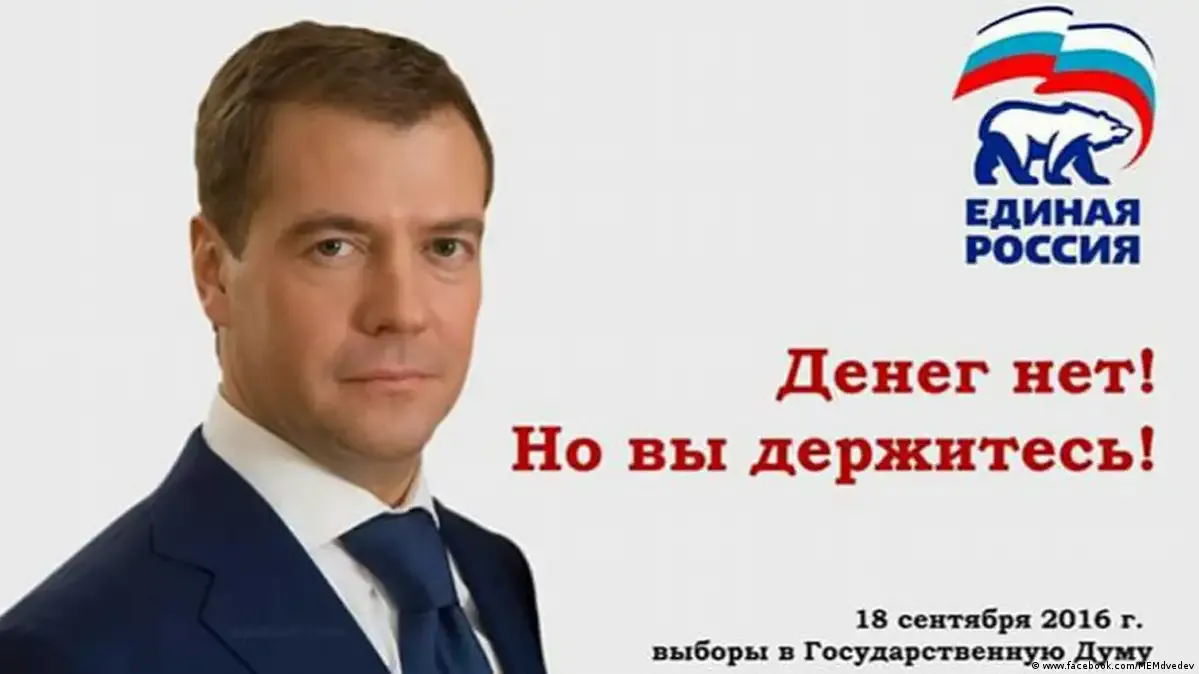
‘There’s no money, but you hold on’, to cite the immortal words of Dmitry Medvedev.
Image

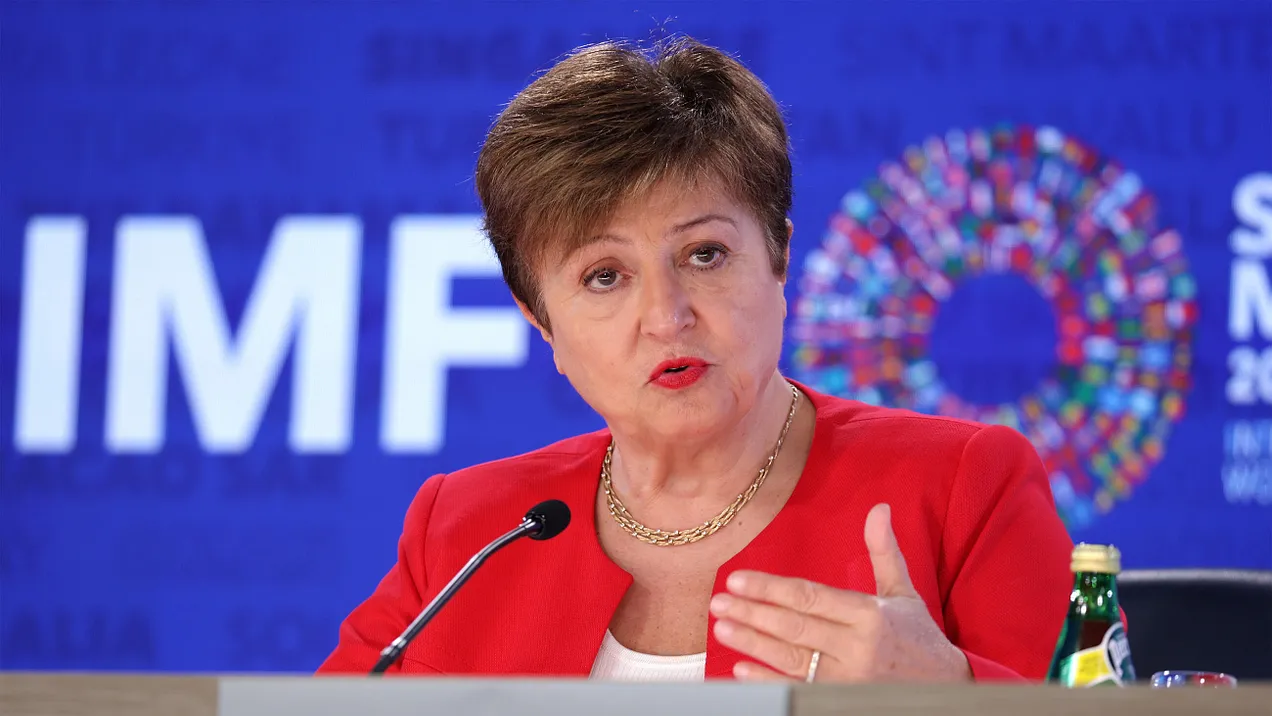
Though Medvedev is no longer very well-inclined towards Ukraine, Kyiv has new friends. The Managing Director of the IMF, Kristalina Georgieva, came out with some helpful advice to Ukraine on January 20:

Electricity, heating are still subsidized… We know why the country does this, but we need to get rid of it.

The IMF Is Returning to Russia. No One Should Be Surprised. | Yale Insights
Image

Naturally, she also urged to liberalize all obstacles to the availability of labour, so as to best guarantee the ‘dynamism’ of private capital.

She doesn’t seem to be worried about how Ukrainians, freezing in the millions due to Russian strikes on energy infrastructure, will feel about that. Anyway, it isn’t like their opinion matters much. For those finding it difficult, Georgieva has the following excellent advice:

Thirdly, you must believe in yourself like a lion. So get up in the morning and roar. Confidence matters. And I tell you from my own experience, the Bulgarian experience, that it will not be easy. But if you have this confidence and demonstrate it day after day, if you put aside internal disputes, if you bury corruption forever, of course you will succeed

She stated this, of course, at Davos. More specifically, the project "Ukraine: On the Front Lines of the Future" organized by the Victor Pinchuk Foundation on the sidelines of the World Economic Forum. Pinchuk, is a Ukrainian oligarch I’ve written about at length, who cosplays as a Ukrainian Soros while himself having a much more ambiguous relationship vis a vis the west.

Ukraine House Davos 2026: Resilience, Innovation, and Global Partnerships alongside the World Economic Forum

Image
Will there also be a minecraft server?
Like the IMF, the Europeans also aren’t rushing to translate their words of support into action. Last week, the EU revealed an important detail about its 90 billion euro loan:

The proposed support would be structured in two components, with approximately two thirds, amounting to €60 billion, allocated to military assistance, and the remaining one third, corresponding to €30 billion, provided as general budget support.

In the same statement, the EU writes that it has provided 193 billion euros to Ukraine since 2022. The bulk of of that aid went to supporting the Ukrainian budget, with a small remaining amount of humanitarian aid. That amounts, on average, to about 48 billion euros in total aid per year.

The US, by comparison, sent $128 billion USD from 2022 to 2025. 53 billion went to direct budget support, and the rest to weapons purchases. To put it in euros for the sake of consistency, that’s about 109 billion euros in total aid. That amounts to around 27 billion euros a year.

Now, the new EU loan involves 45 million euros a year in total aid. But two-thirds of it will go towards military assistance, which largely means buying US weapons at a 10% markup as part of Donny Deals’ PURL arrangement. This leaves only 15 billion euros a year in actual budget aid.

But the Ukrainian budget requires 40-80 billion euros in external financing for the 2026 financial year alone!

So what will happen? Maybe social spending will be cut, though that will look quite funny given that it was Zelensky who originally decided to raise it for the 2026 budget, despite criticism from nationalists (and the west).

I doubt that the front will collapse if Ukraine doesn’t get enough money to cover its deficit. After all, domestic revenue supposedly accounts for all military spending, in the planned budget at least. But as we saw, many western experts predict Ukraine’s actual military spending to increase significantly beyond what was planned. And so, these budget constraints will certainly have at least some effect.

In short, the coming years certainly won’t see any increase in Ukrainian military capacities. More of the same, in other words. The Ukrainian public seems capable of accepting seemingly endless deprivation, without any actual organized resistance to the state. In any case, the government probably has good reason to believe that.

The increase in social spending was likely less an attempt to stave off a popular rebellion and more-so preparation for possible elections. These elections seem increasingly unlikely, given that Zelensky only began considering the option because of Trump’s prodding. But now Kiev seems to be breaking with Washington. Hence, no need to prepare for elections, and no need to placate the populace. Perhaps the IMF need not worry so much about Ukraine’s profligate social spending.

Davos down
Anyway, enough of those numbers. Time for some good old-fashioned political intrigues.

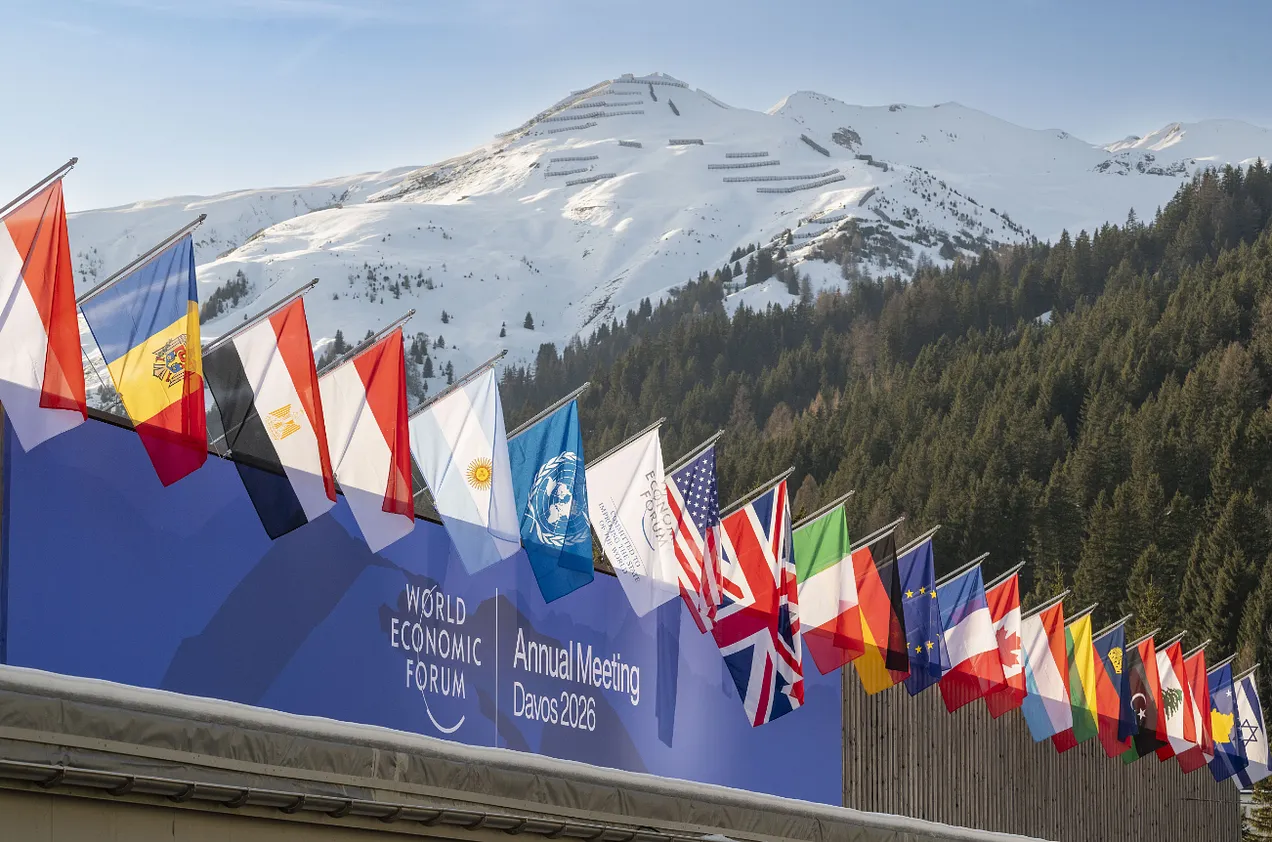
Zelensky was meant to attend Davos and meet with his good friend Mr Trump this week. However, he didn’t make it. In a statement on January 20, the Ukrainian president claimed that he had to stay in Ukraine to deal with the effects of Russia’s strikes on energy infrastructure. In the past, of course, he hasn’t let the suffering of Ukrainians stop him from foreign trips.
Image

Zelensky made it quite clear why he didn’t go, in fact. On December 20, he told the Ukrainian media that the USA ‘hasn’t been able to stop Putin’. This was his answer to a question about how he rates Trump’s attempts to end the war. Of course, Zelensky made sure to state that he is ‘grateful to the US for their aid’. He also tried to remain positive about the new denizen of the White House:

President Trump restored intelligence sharing, we have Patriot missiles. Not everything is perfect - but it’s coming

In that same interview, he also spoke out in favour of poor little Denmark, stating his support of its territorial integrity and sovereignty vis a vis Greenland. He said that he hoped the US will “listen to Europe in the format of diplomacy” and that there will be “no major threats” in this matter.

Zelensky also made his frustration with the US somewhat evident in the following January 20 post:
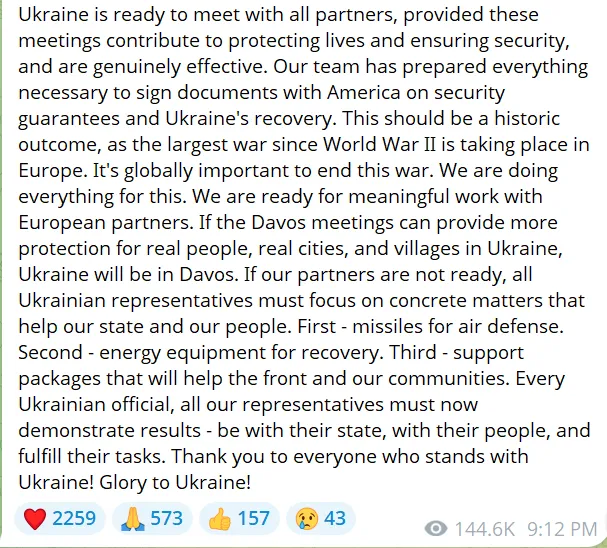
Image

Keep in mind Trump’s December 15 statement that it is Zelensky, not Putin, that is preventing peace talks from succeeding. Zelensky seemed to have a fairly frustrated riposte to that on the 17th:
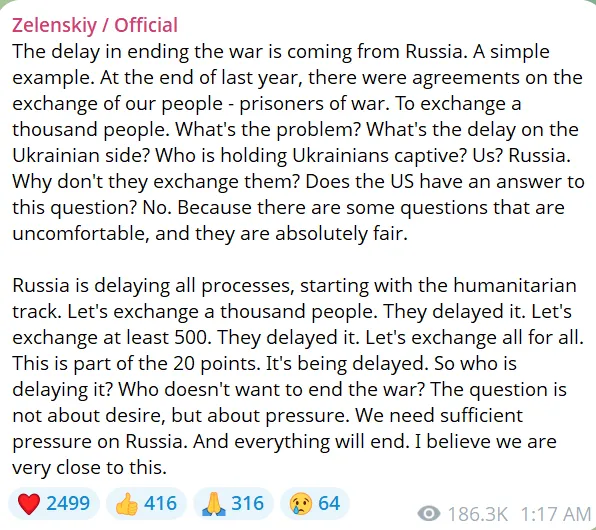
Image

Zelensky’s diplomatic team has also been in the US since the 17th, but there have been no major statements about the progress of the talks. Generally, such trips are accompanied with plenty of grandiose statements about the massive successes of Ukrainian diplomacy. The relative silence speaks volumes.

New old friends
Back home, Zelensky has also decided to renew some of his most fractious friendships — with the country’s top euro-atlanticists. Or, to use the term not unjustly used in Ukraine, the Sorosites.

Over the past week, Zelensky has rammed through a truly powerful social media blitz. He met with no less than six top Sorosites. Just about all of them were fired or otherwise persecuted by Zelensky over the past few years, but with the malovolent Yermak (supposedly) gone, it’s time to get back together. After they forced Zelensky to get rid of his beloved chief of staff Yermak in late 2025, he has become more dependent than ever on these ultra-militaristic forces.

(Paywall with free option.)

https://eventsinukraine.substack.com/p/ ... ce-against

*****

Negotiations in Abu Dhabi. January 23, 2026.
January 23, 1:14 PM

Image

Negotiations in Abu Dhabi. January 23, 2026.

1. Negotiations between Russia, the United States, and Ukraine will take place today in Abu Dhabi. The Russian delegation is led by Admiral Kostyukov, Chief of the Main Intelligence Directorate of the General Staff of the Russian Armed Forces. This is not the first time the UAE has surfaced as a negotiating platform – the main prisoner exchange talks were mediated by the UAE.

2. The talks are scheduled to take place on January 23-24. Territorial issues and other matters will be discussed. It is possible that even if no progress is made, at least further exchanges of prisoners of war and detainees can be agreed upon.

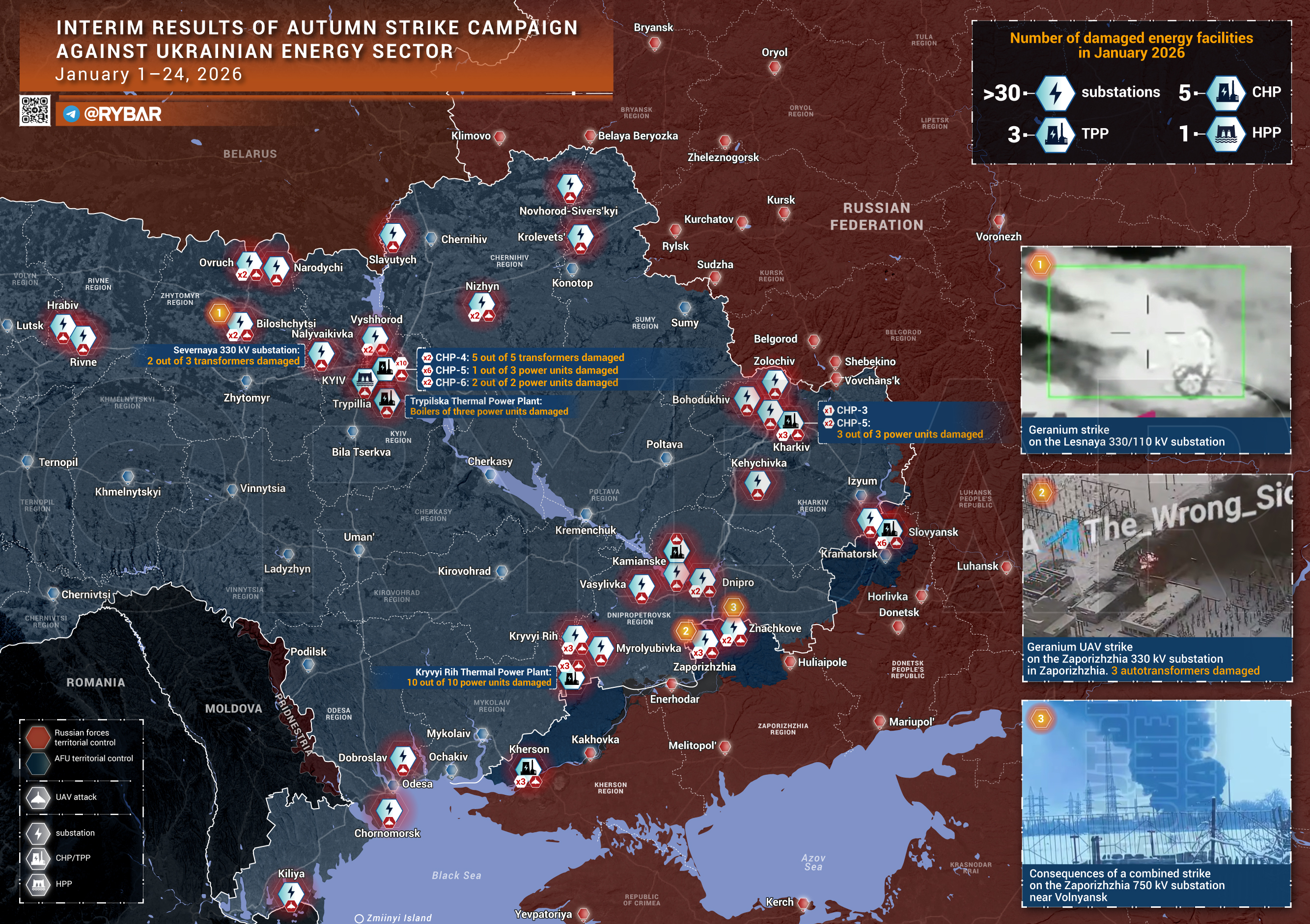
3. The United States and Ukraine are proposing an "energy truce." Russia ceases attacks on Ukraine's energy sector (where there are problems), and in exchange, Ukraine ceases attacks on Russian energy sector and oil refineries. Attacks on tankers belonging to the "shadow fleet" will also cease. The reasons for such proposals are clear: for the first time in the war, Russian military strikes on the energy sector have had a systemic, cumulative effect, leading to a prolonged systemic blackout in several regions of Ukraine, with the possibility of its institutionalization.

4. Following Putin's talks with Whitkoff and Kushner, Russia reiterated that the territorial issue is paramount, and if Donbas is not handed over to it, it will continue to pursue this goal militarily. Let me remind you that the full incorporation of the DPR and LPR territories within their 2014 borders is the overall goal of the Central Military District, which has now been approximately 83-84% achieved militarily.
Both Moscow and Washington have already openly stated that if Ukraine refuses to withdraw from Donbas, it will lose even more territory.

5. The US is already proposing a number of projects for post-war cooperation to Russia, but they are unlikely to be implemented until the war in Ukraine ends. Europe, of course, is interested in disrupting the negotiations by any means necessary and prolonging the war as long as possible. Europe does not want to register its defeat in the war in Ukraine.

https://colonelcassad.livejournal.com/10322683.html

Google Translator

This is impossible now: DTEK responds to Kyiv residents' calls to return to normal power outage schedules
Editor: Herasimova Tetiana

Image
Blackout (archive image). Photo: Zaporizhzhia Regional State Administration.

At the moment, Kyiv is unable to resume electricity supply to consumers according to the usual schedules. Due to the consequences of the massive strikes of the aggressor country, the russian federation, a deep emergency mode continues to operate in the capital.

This is stated in a message that DTEK published in Threads on Wednesday, January 21.

The post was probably a response to numerous comments from Kyiv residents in the network, who demand that the power company return the power outage schedules to the capital.

"Now it won't work. Although the critical infrastructure has been powered up, the city's power system is still in a deep emergency mode. There is not enough electricity to meet the schedules," DTEK said.


At the moment, the electricity supply is carried out manually. For this reason, blackouts are protracted.

The company also emphasized that what is happening in Ukraine, in particular in Kyiv, has never happened anywhere else in the world.

"Zero days without power outages for a month in a row. Power engineers are doing historic work to get us back on schedule," the post says.

As the Ukrainian News agency earlier reported, on January 21, President Volodymyr Zelenskyy said that as of the morning, more than half of Kyiv had been without electricity. There had been no heating in about 4,000 apartment buildings.


Kyiv Mayor Vitali Klitschko said in an interview with The Times that since the beginning of January, about 600,000 people have left the capital because of the consequences of russian strikes on the energy sector.

https://ukranews.com/en/news/1129950-th ... wer-outage
"There is great chaos under heaven; the situation is excellent."

User avatar
blindpig
Posts: 15306
Joined: Fri Jul 14, 2017 5:44 pm
Location: Turtle Island
Contact:

Re: Footnotes from the Ukrainian "Crisis"; New High-Points in Cynicism Part V

Post by blindpig » Sat Jan 24, 2026 12:46 pm

Part Four: Other Support for Sternenko
Published by @nsanzo ⋅ 24/01/2026

Image

Yesterday, Ukraine's newly appointed Defense Minister, Mykhailo Fedorov, announced the addition of Serhiy Sternenko to his team as an advisor on drone development. This appointment represents a significant step for both Volodymyr Zelensky, who is incorporating all sorts of figures linked to the war into his government—a strategy aimed at neutralizing potential rivals—and Serhiy Sternenko, who is further expanding his already diverse network of alliances. While this series of articles does not intend to delve deeply into this matter, it is worth briefly mentioning other groups and organizations, some with a public profile, that participate, at least at some point, in actions supporting Sternenko, both during his legal troubles and on the street front.

Support in the political world
On one hand, Serhiy Sternenko, Beria , received support from parliamentary parties at various stages of his trial. Notable among these were the pro-Sternenko stances of parties such as Svyatoslav Vakarchuk's Holos, Petro Poroshenko's European Solidarity, and Yulia Tymoshenko's Batkivshchyna. Within the pro-Zelensky bloc, some representatives of the Servant of the People party also expressed their willingness to support him at that time. Sternenko himself did not deny that some of these parties offered him a seat in the Verkhovna Rada even before the 2019 parliamentary elections.

However, above all the groups and individuals mentioned, the role of Petro Poroshenko stands out. In the BBC's report on the March 2021 events in Bankova, Petro Poroshenko is described as "the gray cardinal of the current protests ." The traces of the "self-serving" Poroshenko on the walls of Bankova Street were noticed, for example, by Avakov deputy Anton Gerashchenko. Mykhailo Podolyak, for his part, wrote about the former president's "thirst for revenge": " The ugliness of Saturday was orchestrated precisely and exclusively by Poroshenko's greed ," he stated.

Poroshenko 's reaction to Sternenko's February 2021 sentencing was certainly telling: " The Ukrainian patriot Serhiy Sternenko was sentenced to seven years in prison. Why? In reality, for defending Odessa from pro-Kremlin agents and opposing plans to create Novorossiya ," wrote former President Petro Poroshenko on his Facebook page. Much earlier, Poroshenko had also personally called for participation in the July 2, 2019, action promoted by Honor and Sternenko.

In this context, back in 2020, Sergey Spiridonov quoted Anatoly Shariy as saying what lay behind the Honor-Azov conflict: “ The renowned Anatoly Shariy described them thus: ‘Who are Kravchenko and Filimonov? Former ultra-right-wingers who then became officials in the National Corpus and suddenly defected to Poroshenko’s ranks. And they defected just before the elections. They started simply following orders from Petya’s team and then disappeared completely. They also began openly defending the murderer Sternenko .’”

However, as Oleg Posternak points out , there is no direct convergence of interests between Sternenko and Poroshenko, who are destined to be direct rivals for the national-liberal vote in a potential election. Sternenko has repeatedly and harshly criticized the former president. According to Posternak, all the radical elements from Svoboda and other nationalist groups that had shifted toward Poroshenko, given his connections with figures like Medvedchuk, were beginning " to gravitate toward a new rising figure: a principled right-winger who has shown himself willing to kill to defend the state ," Sternenko.

Image

In this context of political support, the Suprun family deserves special mention. Ulana, a U.S. citizen, was granted Ukrainian citizenship by then-President Petro Poroshenko on July 11, 2016, and went on to serve as Ukraine's Minister of Health from 2016 to 2019, where she was known for her support of privatizing healthcare and for her backing of Western NGO networks. As Peter Korotaev points out, the connection with Suprun has been particularly important in Sternenko's political development. During her time in Ukraine, Suprun also founded several organizations ("Zakhist Patriotiv," Defense of the Patriots; "Peitriot Defens"; and the "Kyiv Cultural Club") with the aim of supporting veterans of the ATO counterterrorism operation— the Donbas War — and activists like Sternenko.

Suprun publicly supported Beria throughout his legal proceedings in 2020-2021. The BBC, in its coverage of Sternenko's legal battles in 2020, quoted Suprun's Facebook post about the Odessa activist: " For me, Serhiy Sternenko is an example of that generation of Ukrainians capable of setting things right. These people were born and raised in an independent Ukraine. They, like no one else, have a strong demand for justice, security, and genuine government effectiveness… When these people, in their towns or cities, start calling things by their name and actively preventing theft… they face attacks, assassination attempts, and persecution by the police and the prosecutor's office ." For Sternenko's opponents, like Portnov, Ulana Suprun's direct support for Beria was always beyond question.

Consistent with that support, which was more familial than strictly personal, Marko Suprun, Ulana's partner, maintained in August 2020 that Sternenko had suffered three attempts on his life in 2028 in Odessa " for having discovered connections between organized crime in that city and the Ministry of Internal Affairs of Ukraine ."

The SBU
As the BBC acknowledged in June 2020 , Sternenko's detractors maintain that he has always emerged unscathed from his legal troubles thanks to his tacit cooperation with the Security Service of Ukraine (SBU). The SBU's protection would explain his untouchability and ability to avoid severe sentences, as well as the impunity with which Sternenko acted as leader of Praviy Sektor, when he could, for example, pressure the judges in the May 2nd case to prevent the defendants, who years later would be acquitted, from being released on bail or placed under house arrest.

In a 2019 article , the Strana newspaper reported that radical groups, including the Odessa branch of Praviy Sektor and Sternenko himself, were under the supervision of an SBU official named Kashchey, assigned to the SBU's "T" department in the Odessa region, which is responsible for terrorism prevention and monitoring opposition figures. It should be noted that in September 2015, Dmytro Yarosh, the leader of Praviy Sektor, stated in an interview with Ukrainska Pravda that some of the group's militants were being integrated into the SBU's Alpha unit to work as auxiliary units for the organization.

After his departure for Kiev, Sternenko's personal supervision, according to Strana , was transferred to Lieutenant General Pavlo Demchyna, who, during Poroshenko's term, was deputy director of the SBU and director of the Main Directorate for Combating Corruption and Organized Crime.

According to this theory, Sternenko, in parallel with his departure from Praviy Sektor, became the liaison between Odessa radicals and the SBU, channeling equipment and a considerable budget for rentals, salaries, and travel expenses to intimidation campaigns against regime opponents in the city. The most valuable nationalists, including Sternenko, also received bonuses through Mikheil Saakashvili's charitable foundation, " For the Benefit of Odessa ."

Following Andrey Portnov's statements regarding the Sternenko case reveals Beria 's consistent aim to prevent his cases from falling outside the SBU's jurisdiction. In May 2019, Portnov accused Vasyl Hrytsak, head of the SBU from 2015 to 2019, of covering up the actions of the Honor-Sternenko group. In this context, Hrytsak is mentioned by Yarosh in his 2015 interview with Ukrainska Pravda as having a close contact with Praviy Sektor and, through him, with Poroshenko, as well as acting as a liaison with the group during the 2014 Maidan protests. In the interview, Yarosh also mentioned his intervention to secure the release of members of his group in connection with the Sherbych case, a local politician kidnapped in April 2015. The Alpha groups that Yarosh spoke of reappear, incidentally, in some accounts such as the one from bastion.tv about the support for Sternenko in pressuring judicial institutions in 2020.

Portnov also argued that prosecutors general like Lutsenko and Ryaboshapka supported the SBU's involvement in the Sternenko trial. Underlying all of this is the historical rivalry between the SBU and the Ministry of Internal Affairs in controlling the power dynamics among nationalist groups and in managing legal cases. In Kyiv, the SBU allegedly backed Sternenko in the fight against the Avakov-Biletsky bloc.

Today, Peter Korotaev is one of the followers of the Ukrainian reality who continue to maintain that Sternenko has collaborated with the SBU in various ways: as an informant, an ally in operations against political and business rivals, and a beneficiary of institutional protection. This relationship has allowed him to avoid conviction and consolidate his influence.

Peter Korotaev quotes Vasyl Hrytsak as saying to Hromadske that, lacking established structures, “ we relied on those young people from the streets who had already demonstrated their preparedness and patriotism. We collaborated with them in many situations, including the volunteer movement and working with the ‘fifth column’ within our country. And they didn’t need to become our agents to do so .” In response to a direct question about Sternenko’s role in supporting the SBU against pro-Russian forces, Korotaev stated that he was “ convinced that he played an important role in the patriotic movement. Odessa is not a simple city, and his involvement there is 100% certain .”

A former Praviy Sektor activist in Odessa told Hromadske that, as early as 2014 and 2015, Sternenko's group collaborated with local SBU agents, initially countering pro-Russian forces and later maintaining relations with the organization on "business matters." According to Korotaev, Sternenko's group collaborated with the SBU in actions against businessmen and figures considered pro-Russian, carrying out raids, extortion, and other activities under the pretext of patriotic struggle. Even Sherbych's kidnapping may have been linked to cooperation between the SBU and Sternenko's group.

Regarding the period after Beria 's departure from Praviy Sektor, various sources indicate that Sternenko acted as an informant for the SBU's Main Directorate "K." This was mentioned , for example, by journalist Volodymyr Boiko, who stated that his contact was Vasyl Pisny, directly linked to Pavlo Demchyna before the latter's departure from the SBU. During this period, Sternenko's relationship with the SBU was crucial in transferring the Kuznetsov murder case from the police to the SBU and ultimately burying it . The possible connection of Sternenko, and in this case also Filimonov, with the SBU has also been mentioned in Western media by journalist Yevgeniy Vasilkevych, who, in this instance, again refers to Department "T."

Korotaev points out that, regardless of his role, Sternenko clearly had a close relationship with the SBU and that, after the start of the large-scale war, this has translated into close ties: Beria moves around with an SBU security officer who provides him with protection, and he had no qualms about being photographed with the head of the SBU, Vasily Malyuk, after the new assassination attempt on Sternenko in 2025.

Sternenko himself acknowledges, in his own peculiar way, the connection to the SBU. Although he calls it a fabrication that he was an SBU agent, he tells Ukrainska Pravda that he was in contact with officials of the organization when he was passing on information about pro-Russian movements in Odesa in 2014-2015.

According to Sternenko, in an April 2021 interview , he even received a direct offer from Zelensky to head the Odessa regional office of the SBU, something denied by Yulyia Mendel, then press secretary, but not by Zelensky himself. The offer was allegedly made at a pre-election meeting with Zelensky, Andriy Bohdan, and the then-head of the SBU, Ivan Bakanov, in the presence of Beria's lawyer, Masi Nayem, brother of Mustafa Nayem, considered the father of the Maidan movement .

https://slavyangrad.es/2026/01/24/cuart ... sternenko/

Google Translator.


******

From Cassad's telegram account:

Colonelcassad
It is with great sorrow that I share this tragic news. All members of the ambulance crew attacked today by a Ukrainian drone have been killed.

This can only be described as the murder of civilians saving lives and caring for patients in the most dangerous area. This is yet another war crime by Kyiv regime militants and a crime against humanity.

***

Colonelcassad
Readers of the channel from outside Russia will be interested. The Main Intelligence Directorate of the General Staff of the Russian Armed Forces invites foreign citizens to collaborate.

Russian military intelligence has opened a channel for communication with like-minded individuals abroad.

Remember: Russia needs your help, even if you are far from its borders.

If you are ready to contribute to the fight against puppet regimes that oppress the peoples of their countries to please their masters overseas, your voice will be heard.

If you are located in territory controlled by the criminal Kyiv regime and want to provide the Russian army with all possible assistance in the fight against the Nazis, please contact us via the feedback bot.

Information valuable to military intelligence will be paid for.

A special Telegram bot has been created for contact: @Russian_GRU_bot

. Complete confidentiality and security are guaranteed. This team knows how to protect THEIR OWN.


Now it's easier to start working for the intelligence services.

***

Colonelcassad
Amid requests for an "energy ceasefire," DTEK's management stated that Ukraine and its energy grid desperately need one, as power outages in cities are increasing, more than half of the generating capacity has been either destroyed or seriously damaged, and other such whining.

This time, Russia prepared for the campaign of strikes against the energy grid far better than before, and this has yielded results, as is clearly evident from videos from major Ukrainian cities and the whining about "can we have an energy ceasefire?"

If the enemy intends to prolong the war throughout 2026 and needs an "energy ceasefire" now to stabilize the situation for three to four months, then Russia certainly has no advantage in pursuing such a scenario. The enemy will get through the worst period and resume attacks on Russian refineries and energy at an opportune moment. So why should Russia give Ukraine a break now? On the contrary, it should intensify attacks on substations, generating, and distribution facilities. To increase the cumulative impact of the strikes on Ukraine's energy system, which suffers some of the damage not as a result of the strikes, but rather as a result of complex accidents caused by the strikes.

https://t.me/s/boris_rozhin

Google Translator

******

Brief Frontline Report – January 23rd, 2026

Summary by Marat Khairullin and Mikhail Popov.
Zinderneuf
Jan 24, 2026

Image
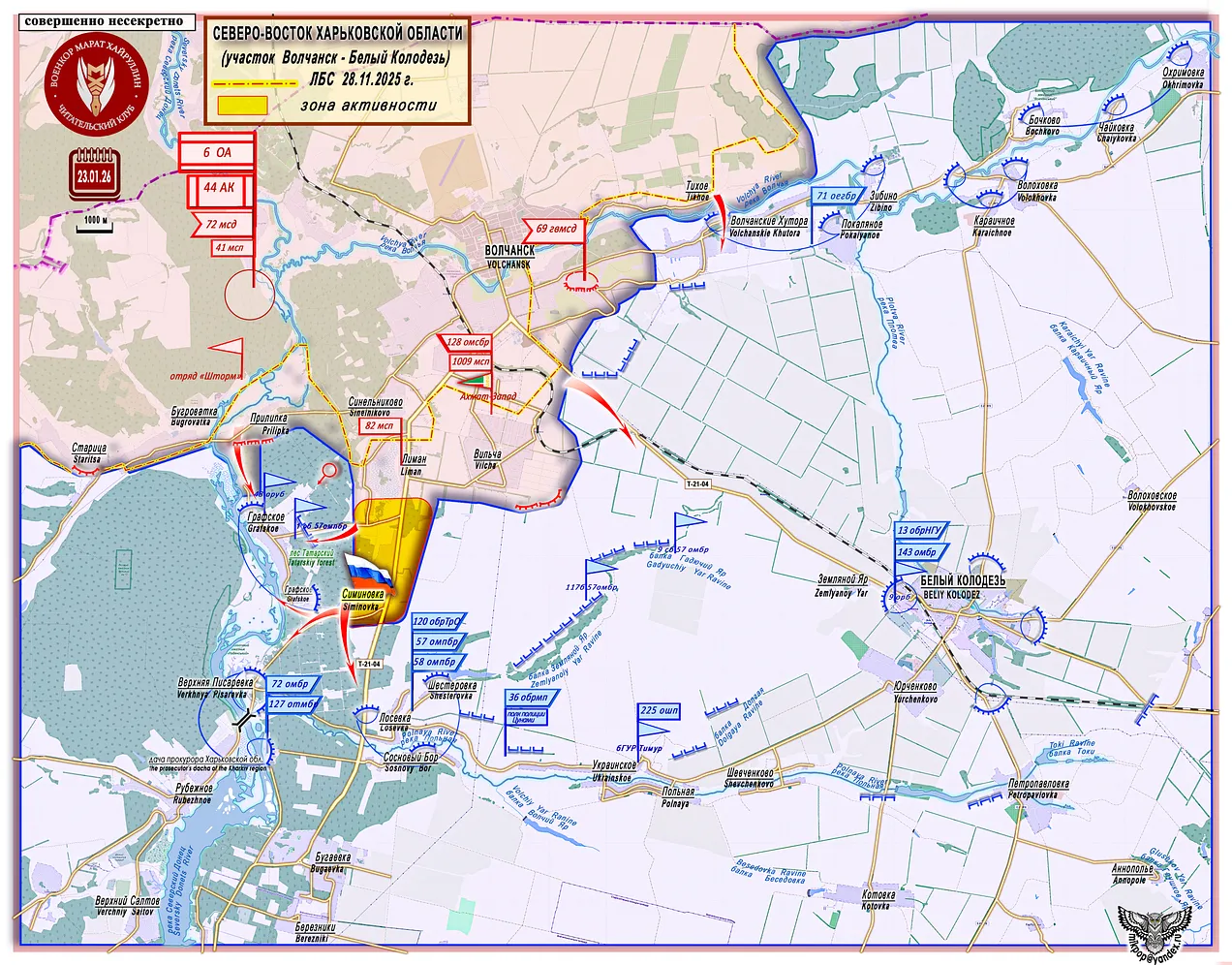
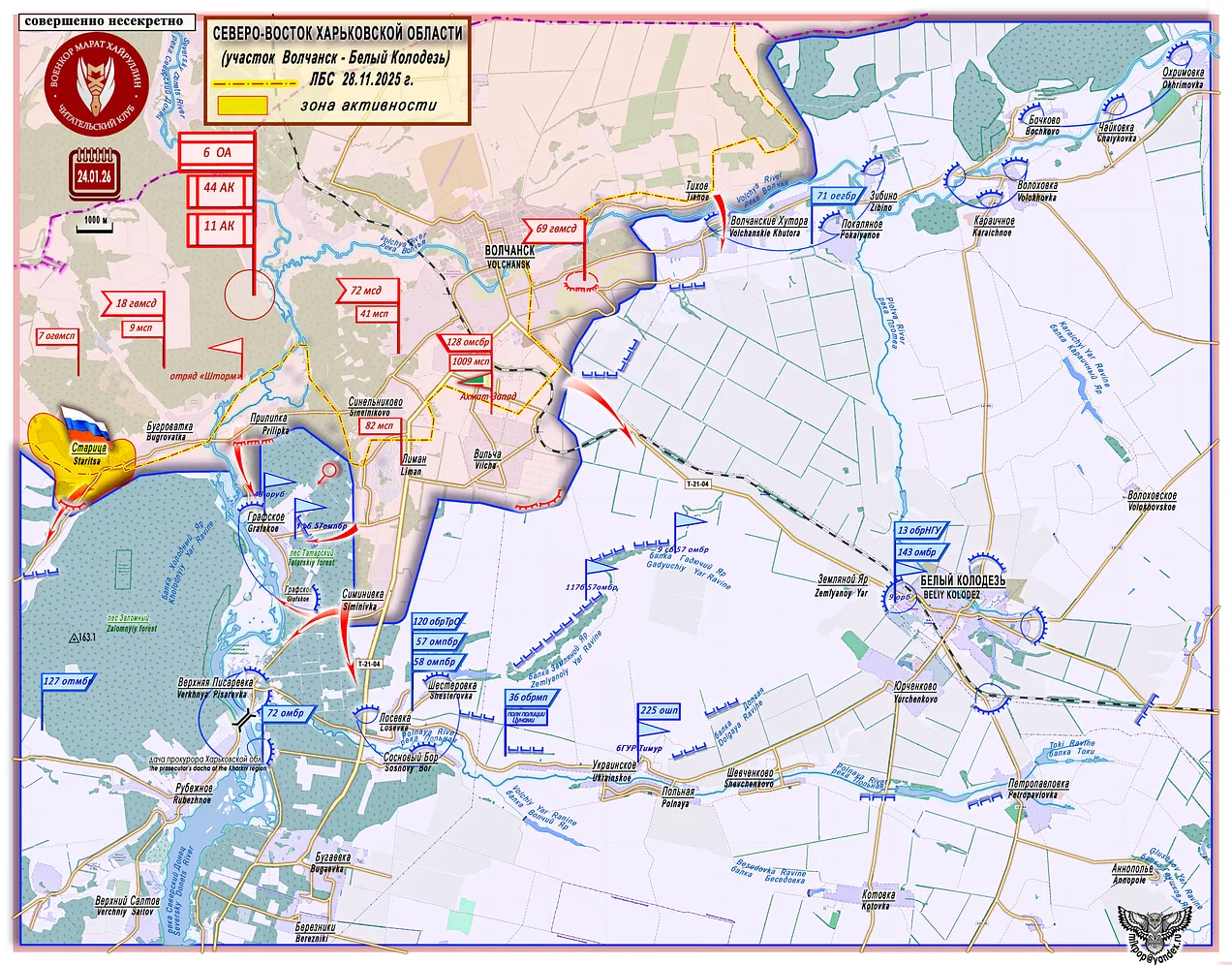
Northeast Kharkov Oblast; Yellow dashed and dotted line =Line of Combat Contact November 28th, 2025. Yellow colored area=Area of Activity.

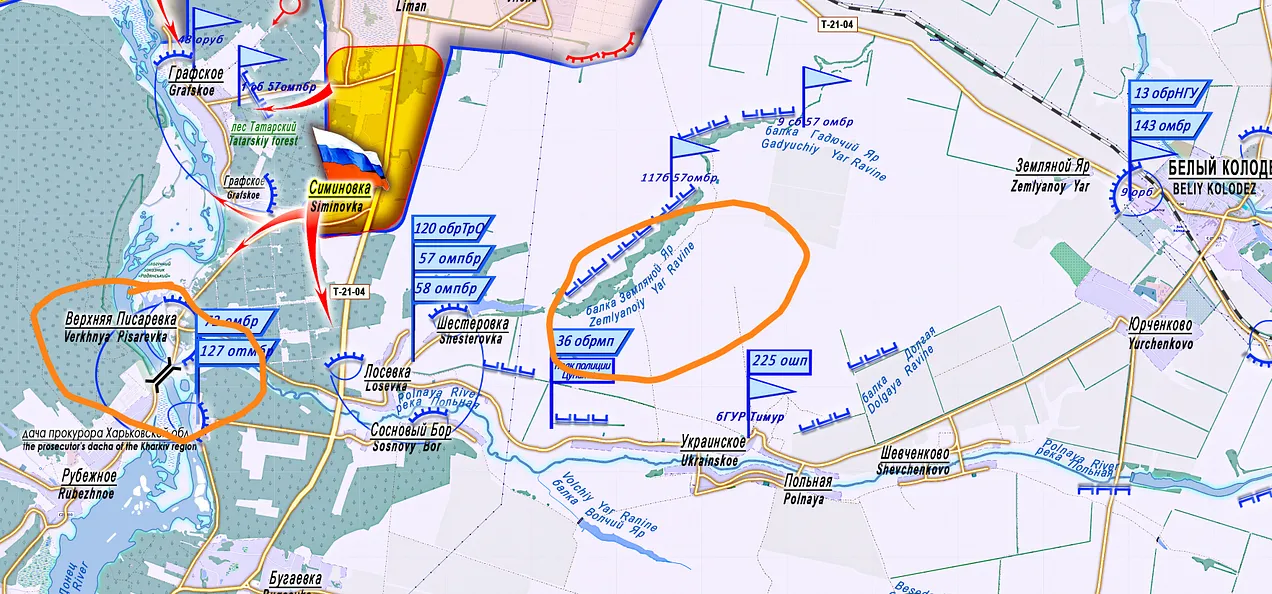
Message from the Russian Ministry of Defense: "As a result of ongoing offensive actions by assault units of the 82nd Motorized Rifle Regiment of the 69th Motorized Rifle Division of the 6th Guards Combined Arms Army of the 'North' Group, control has been established over the settlement of Simonovka in the Kharkov region."

The command of the 'North' Group is persistently and confidently developing an interesting operational combination on the Volchansk axis.

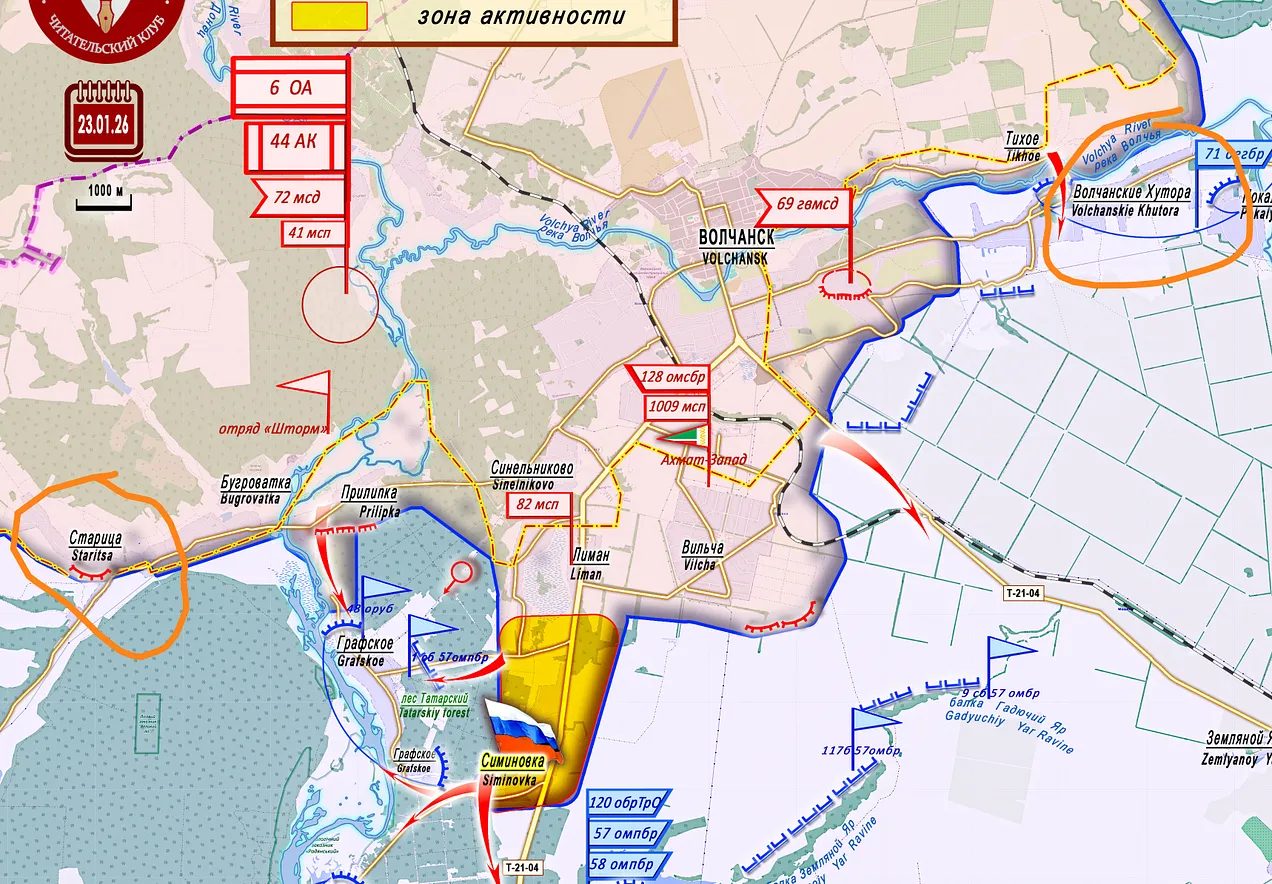
By advancing south along the T-21-04 highway, it is splitting the enemy grouping south of the Volchanskie Khutora - Staritsa line.

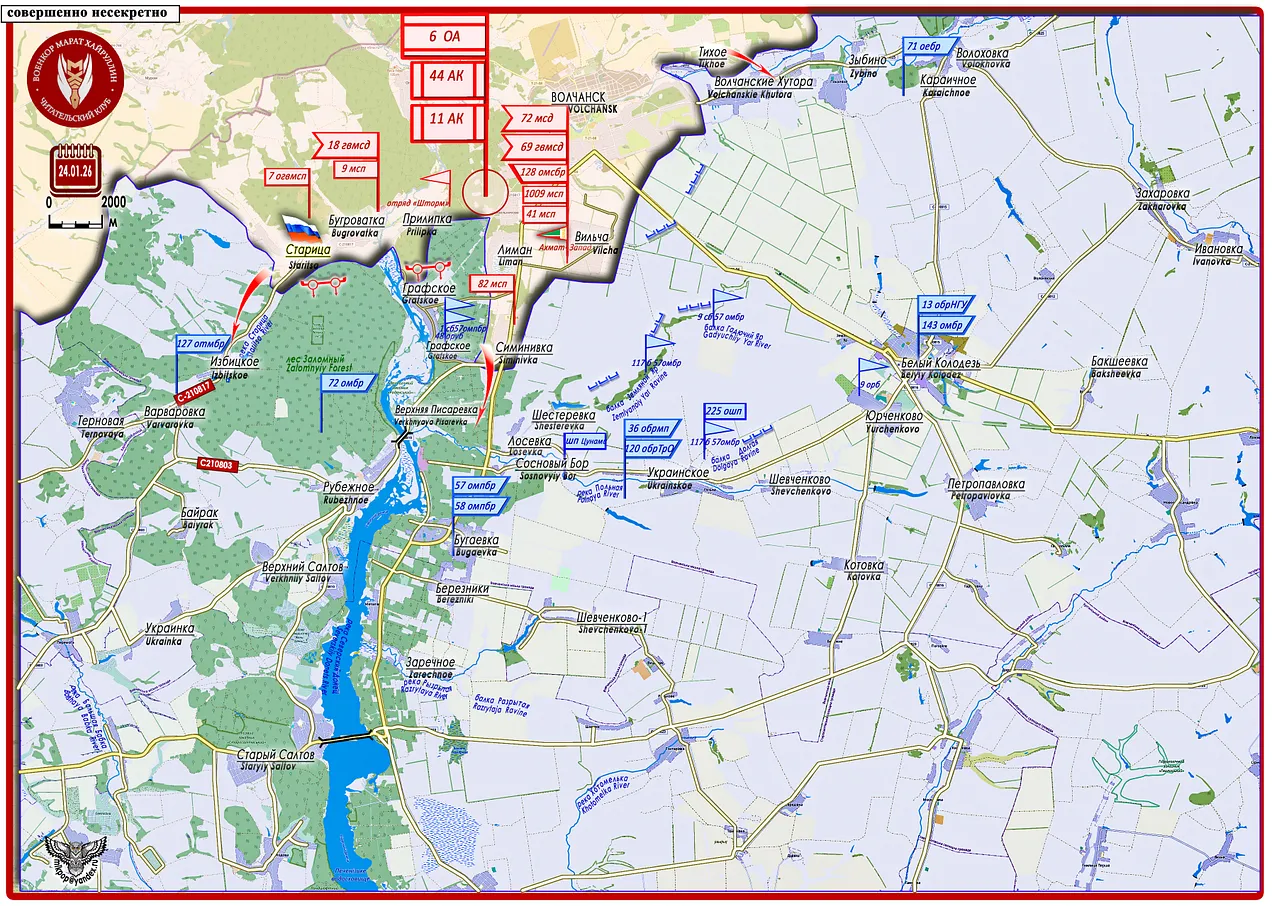
Image

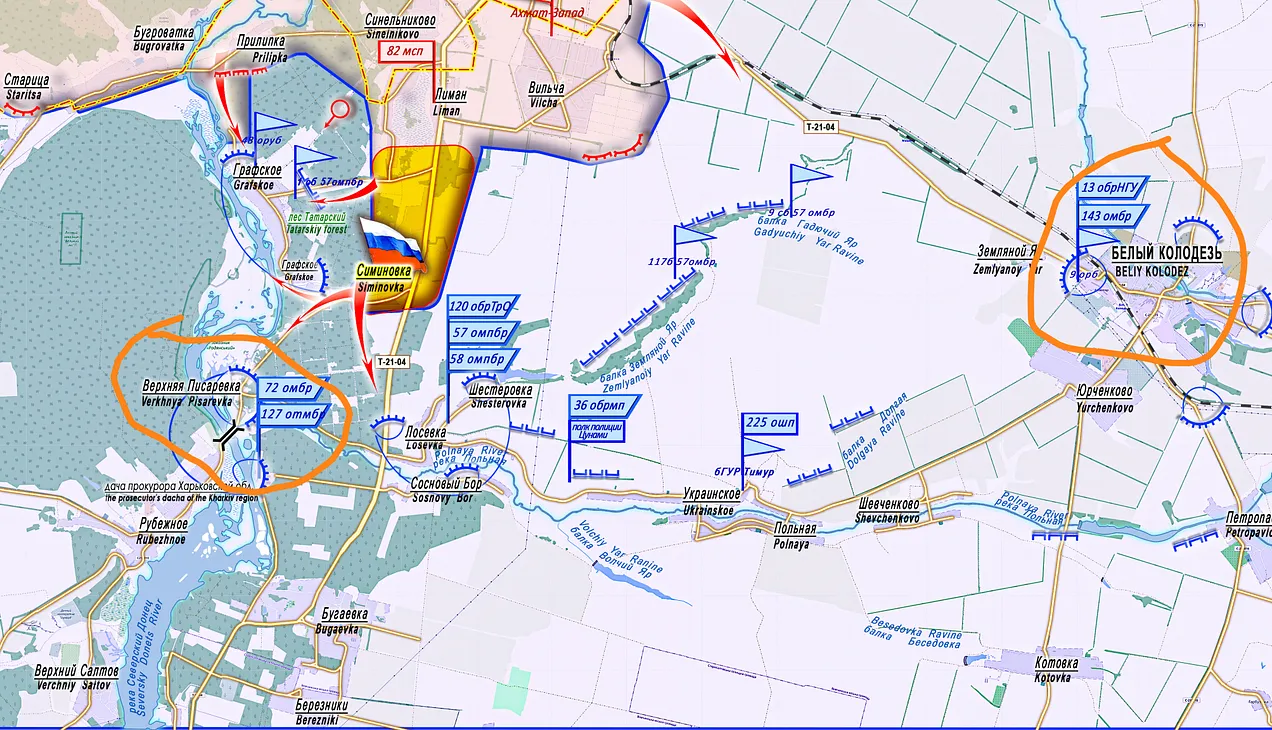
Simultaneously, it is forming a deep encirclement of the enemy grouping on positions between the left bank of the Seversky Donets River and the T-21-04 highway, with the probable aim of cutting off the Ukrainian Armed Forces' rear logistical node at Bely Kolodez from the Kharkov direction via crossing points in the Verkhnyaya Pisarevka area.

Image

Image

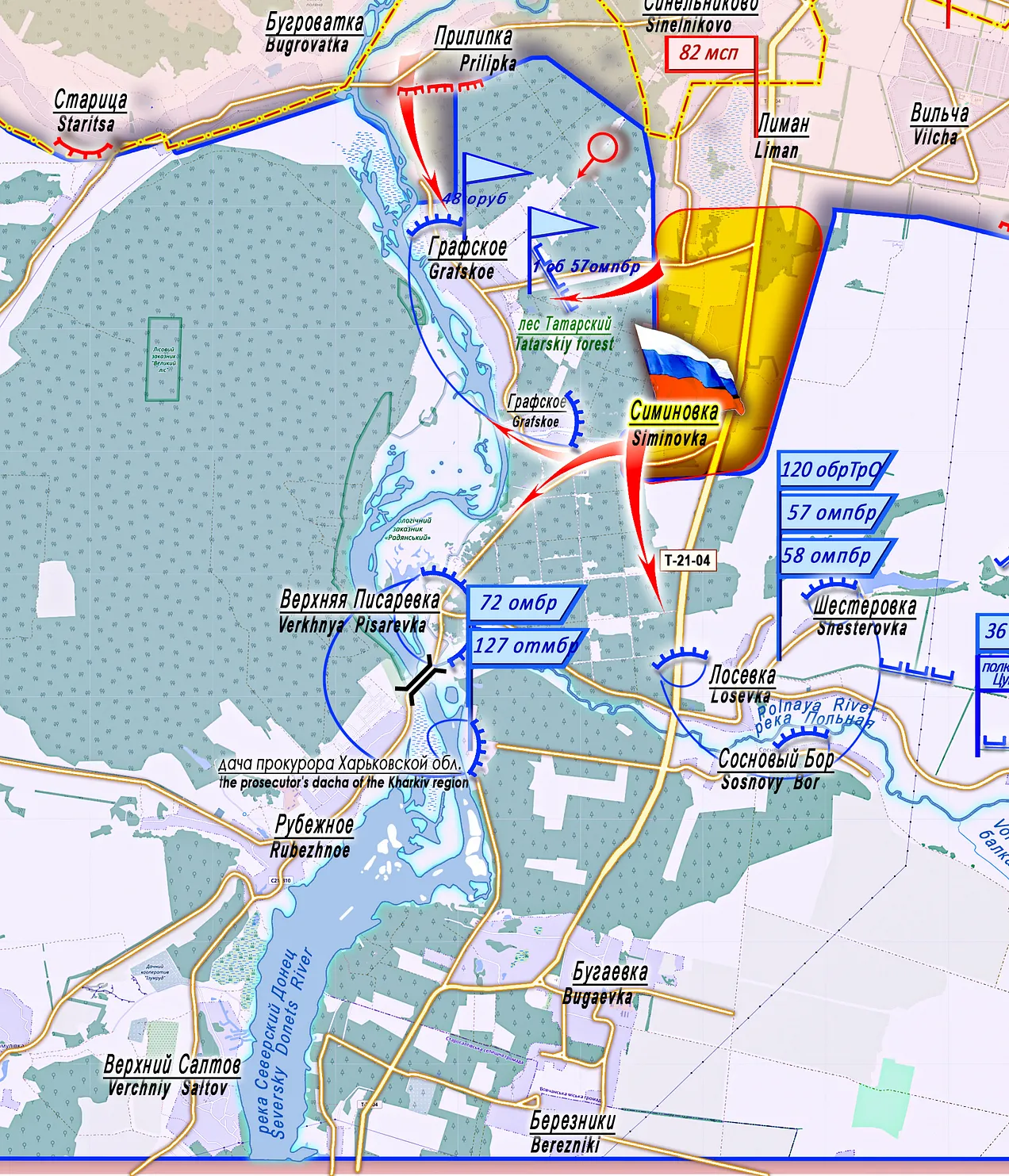
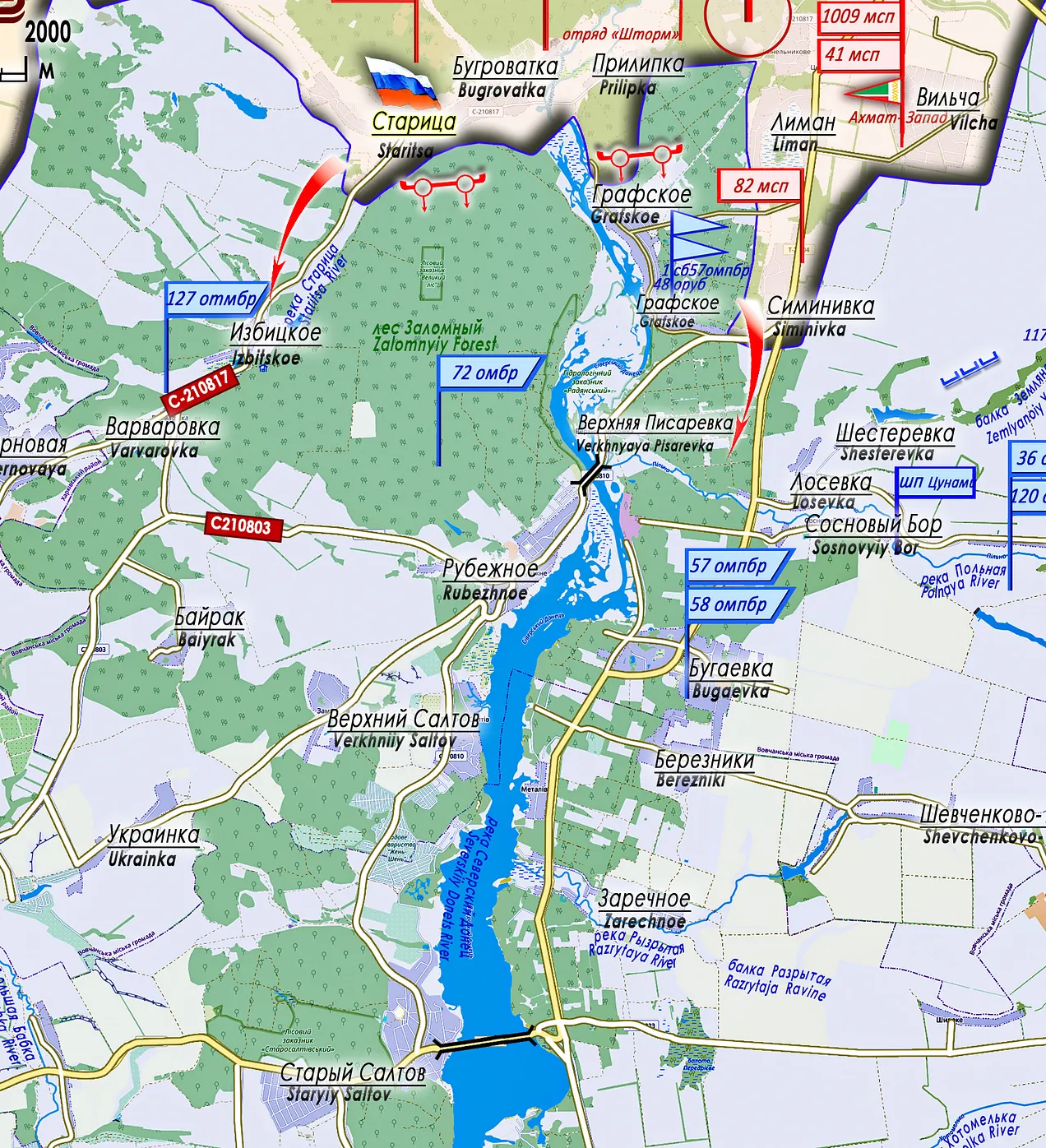
On 23 January 2026, control was established over the settlement of Simonovka (50°12′52″ N, 36°53′40″ E, population 330 in 2001, until kras 2016 the settlement was named Chervonoarmeyske Pervoy). The rural settlement of Simonovka practically adjoins the southern outskirts of the settlement of Grafskoe (Sovetskoe), which stretches along the left bank of the river for 4.5 kilometers. In the Grafskoe defense area, combat operations are being conducted by (AFU) units of the 48th Separate Reconnaissance and Assault Battalion "Quiet Night," the 1st Rifle Battalion of the 57th Separate Motorized Infantry Brigade, and the 58th Separate Motorized Infantry Brigade of the Ukrainian Armed Forces. From the north, pressure on this enemy defense area is being applied by units of the 72nd Motorized Rifle Division and the "Storm" detachment of the Russian Armed Forces.

The advance of Russian army units to the Losevka - "Prosecutor's Dacha" line (with reinforcement of the left flank along the Zemlyanoy Yar ravine) will finally sever the enemy's left flank (along the left bank of the river) from the center of the axis, will allow the remaining enemy units in the Prilipka - Grafskoe - Verkhnyaya Pisarevka area to be locked in, and will cut them off from crossings to the right bank.

Image

This operational success will allow for the "unloading" of the combat situation south of the city of Volchansk in depth as far as the settlement of Bely Kolodez and creates favorable conditions for units of the 'North' Group to reach starting positions in front of the Ukrainian Armed Forces' defensive node at Bely Kolodez.

https://maratkhairullin.substack.com/p/ ... nuary-23rd

******

PATRICK LAWRENCE: All Unquiet on the Ukrainian Front
January 21, 2026

The Europeans have run out of postures and gestures in the way of performative statecraft, and the Russians see no point in indulging them any further.

Image
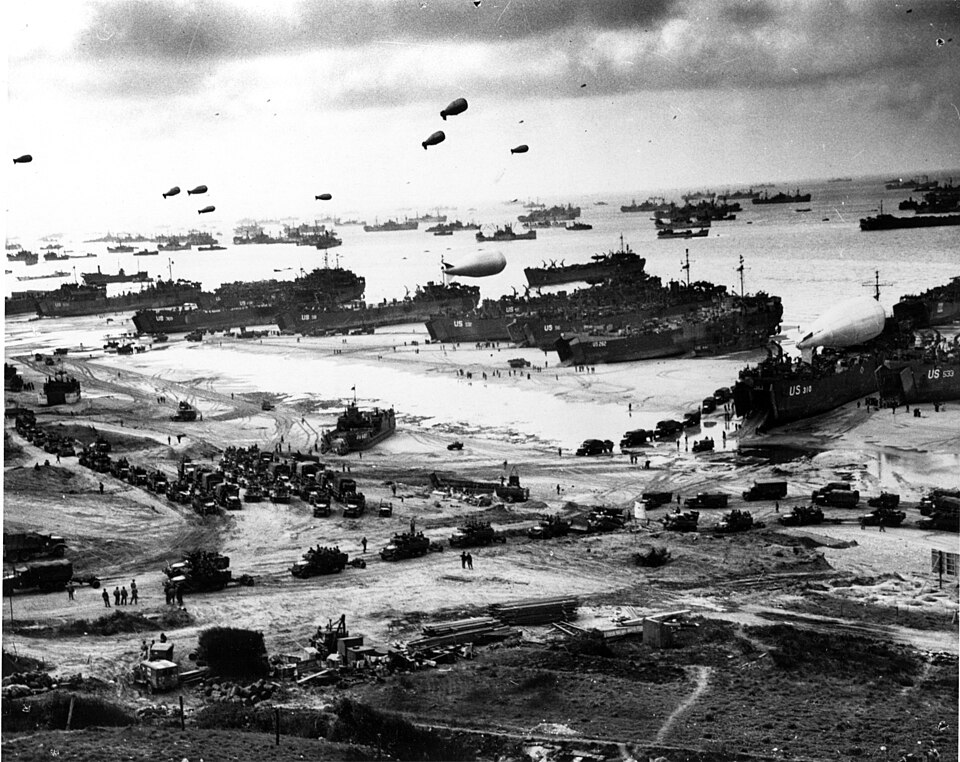
Omaha Beach, shortly after D-Day, June 1944 (Photograph from US Coast Guard Collection)

By Patrick Lawrence
Special to Consortium News

Sometimes wars have occasions that can be read — immediately, soon or in time — as turning points, clarifying moments. D–Day, June 6, 1944, is an obvious case: The Allies and the Red Army were in Berlin less than a year later.

The Tet Offensive, which began 58 years ago next week (Can you believe it?), is another: All the victory-is-near illusions the American command had cultivated for years collapsed. There were many more casualties at the altar of imperial delusion, but the war in Southeast Asia was on the way to over.

On Jan. 8 Russia attacked Lviv, the city in western Ukraine, with an Oreshnik missile. To me this looks very like a clarifying event in the Ukraine war — Moscow’s announcement that it has decided to begin the beginning of the end.

The Oreshnik is a new-generation weapon that already wears a little of the mystique of Ares, the Greek god of war. It travels at hypersonic speeds and is undetectable by air-defense systems. It is capable of carrying nuclear warheads, although the missile that hit Lviv wasn’t armed with one.

Image
Center of Dnipro city after Russian bombing with conventional weapons, March 2025. (Wikimedia, CCA 3.0 Unported License)

This was not Russia’s first use of the Oreshnik in Ukraine. Its first was in November 2024, when the target was a munitions factory in Dnipro, not far from the front lines. That blew minds as well as production lines.

But the missile that hit Lviv seemed to have more to say to the regime in Kiev and its Western backers, notably all those supercilious Europeans. Lviv, Ukraine’s cultural capital, has been a safe haven these past four years of conflict. Not to be missed, it lies roughly 45 miles from the border with Poland.

Russia’s declared intent in launching its second Oreshnik was to respond to the Dec. 29 drone attack the Ukrainians, with the usual assistance of the Americans and Brits, launched on President Vladimir Putin’s secondary residence in Valdai, northwest of Moscow.

Parenthetically, Kiev and the C.I.A., two famous truth-tellers, deny any such attack took place, but let us not waste any time with this silliness. The Russians have reportedly presented Western officials with evidence of the event.

Would Putin raise it in a telephone exchange with President Trump were it, as corporate media now have it, just another disinformation operation?

These things said, the Oreshnik hit in Lviv merits a broader reading, in my view.

Here is an account of the Oreshnik as it descended through the winter clouds above Lviv. It is written by Mike Mihajlovic, who publishes, edits and writes frequently for Black Mountain Analysis, a Substack newsletter I have found worth looking at on previous occasions.

This passage is based on Mihajlovic’s apparently diligent study of digital evidence and eyewitness accounts. Good enough we know what happens when these things arrive, as there may be more of them in the skies above Ukraine as the war begins its fifth year:

“As the hypersonic penetrators broke through the cloud layers, each was enveloped in a luminous plasma sheath, producing brief but violent flashes that momentarily illuminated the surrounding atmosphere. These flashes were not explosions in the conventional sense, but visual signatures of extreme velocity, friction, and compression as the warheads tore through dense air at hypersonic speed.

Observers on the ground reported an unsettling soundscape that followed the visual phenomenon. Rather than a single detonation, there were sharp, cracking noises that seemed to ripple across the terrain, as if the ground itself were fracturing under stress….

What made the event particularly striking was the setting. The impacts occurred against the backdrop of an idyllic winter landscape: fields and forests blanketed in snow, small settlements dimly lit, and a horizon that, moments earlier, conveyed calm and stillness.

Against this muted palette, the light generated by the strike stood out with almost surreal intensity. Reflections danced across the snow, briefly turning the ground into a mirror that amplified the event’s brightness. Witnesses described the glow as unnatural, a cold, shimmering illumination that lingered just long enough to be noticed and remembered.”


Perfect as a description of a nation entertaining its own set of illusions and delusions as, with the unconscionable encouragement of the Three Musketeers — the British, French and German leadership — it prolongs a war it lost long ago. Let’s call it shock therapy for the complacent.

The Lviv attack seems to be part of an intensifying campaign to cripple Ukraine’s power grids, energy infrastructure and productive capacity. The Russians have been hitting such targets for years, of course, but these new operations suggest Moscow is after the endgame now.

Moscow’s Attempts to End Conflict

Image
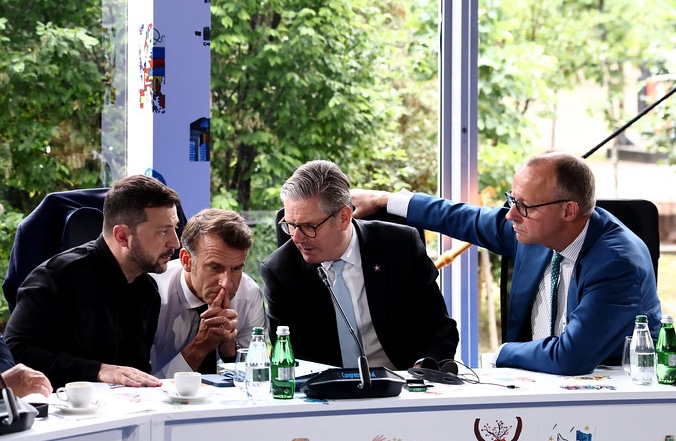
President Zelensky, French President Macron, UK Prime Minister Starmer and German Chancellor Merz speak on the phone with President Trump during a gathering for European officials in gathering in Tirana, Albania, on May 16, 2025. (Simon Dawson / No 10 Downing Street / Flickr / CC BY-NC-ND 2.0)

The Kremlin has tried every which way to bring its “special military operation,” along with its broader confrontation with the West, to a mutually beneficial conclusion. You can go back to the spring of 2022, when was ready to sign an accord with Kiev a few months into the war — only for the Brits, with American consent, to scotch it.

Or December 2021, when it sent Washington and NATO draft treaties as a basis of negotiating a new security framework between the Russian Federation and the West. They were dismissed as “nonstarters,” a British-ism the Biden regime thought was clever.

Or the Minsk Protocols, September 2014 and February 2015, which the British and French sabotaged. Or back to the early 1990s, when Michail Gorbachev hoped to bring post–Soviet Russia into “a common European home.”

“The Kremlin has tried every which way to bring its ‘special military operation,’ along with its broader confrontation with the West, to a mutually beneficial conclusion.”

The Kremlin has proven exceptionally restrained, not to say forebearing, through all of this. And it would be a mistake now to conclude the Russians have lost their patience.

No, in my read they have simply concluded there is no point waiting around while the Western powers indulge themselves in pantomime statecraft or — maybe better put —some kind of group onanism they seem to find satisfying.

And in public, no less.

For weeks toward the end of last year we read incessantly of the intense diplomatic work Kiev, the Europeans and the Trump regime’s contingent were getting up to. The swashbuckling Musketeers cooked up a 20–point peace plan that was supposed to supersede Trump’s 28–point document.

Volodymyr Zelensky, Ukraine’s unconstitutional president, went from one European capital to another and then to Washington and then to Mar-a–Lago and then back to Europe, all along asserting he and his backers were “90 percent there.”

Ninety percent there on security guarantees providing for European troops to serve as peacekeepers on Ukrainian soil. Ninety percent there on a territorial settlement. And so on.

You watched all this with your jaw dropping. None of it had anything to do with fashioning an accord Moscow would find even preliminarily negotiable. The 20–point plan’s intent, indeed, was to subvert the 28–point plan, the first pieces of paper since the spring 2022 attempt that Moscow appeared to find worth its time.

Not Enough Delusion

Image
Refugees taking shelter under a bridge in Kiev, March 5, 2022. (Mvs.gov.ua, CC BY 4.0, Wikimedia Commons)

No, the Trump plan was too realistic as a draft of a settlement accord in recognizing that Moscow was the victor in its war with Ukraine, Kiev the vanquished. There wasn’t enough delusion in it.

And now, roughly since the start of the year, more or less complete silence from Zelensky and the Musketeers — Kier Starmer, Emmanuel Macron and Friedrich Merz, a prime minister, a president and a chancellor.

There is no establishing any certain causality between the Oreshnik attack in previously safe — relatively speaking — western Ukraine, and this nothing-to-say lapse in Kiev, London, Paris and Berlin (and for that matter Washington). But the point may prove the same.

The Europeans have run out of postures and gestures in the way of performative statecraft: This is my conclusion. And the Russians, evidently sharing it in one or another form, see no point in indulging them any further.

As to the Trumpster, it seemed to me unimaginable from the outset that the national security state in all its appendages would ever allow him to reach a comprehensive settlement with Moscow that would open into a new era in East–West relations.

So has the war turned. So do matters clarify. So does the war in Ukraine appear set to end — not with a single detonation, no, rather with sharp cracking noises that seemed to ripple across the terrain.

https://consortiumnews.com/2026/01/21/p ... ian-front/

(Not wanting to be persnickety but D-Day(In which my old man participated) was not hardly the 'inflection point' that Moscow, Stalingrad or Kursk were.)

*****

Over 2 Million Ukrainians Are Dodging The Draft
Andrew Korybko
Jan 22, 2026

Image

The 2.2 million men that are currently on the run amounts to 6.8% of the Ukrainian population and is slightly larger than the percentage of Asians in the US.

New Ukrainian Defense Minister Mikhail Fedorov shockingly revealed that 200,000 men have already deserted thus far and ten times more (2 million) are actively dodging the draft, which are probably an underestimate but are in any case still very large numbers. To put that into context, Ukraine claimed in early 2025 to have had a population of 32 million, likely an overestimate, so the 2.2 million men who either deserted or dodged the draft amounts to at least 6.8% of the population currently on the run.

Rada Deputy Dmitry Razumkov claimed during a parliamentary session last month that his country had already lost half a million troops by then with an equal number wounded, possibly also an underestimate, while Ukraine is thought to currently field around 900,000 active troops. All of this data enables observers to better understand the significance of these “voluntary losses” since it should be clear by now that 2.2 million more troops would have certainly made a major difference for Ukraine.

That’s not to imply that it would have been able to reverse the military-strategic dynamics of the conflict that have trended in Russia’s favor since the epic failure of Ukraine’s NATO-backed counteroffensive in summer 2023, but perhaps it might have been able to decelerate the pace of its losses afterwards. Ukraine could have thus also been in a comparatively better diplomatic position too going into Trump 2.0 a year ago and that might have in turn predisposed him to a relatively harder line towards Russia as well.

For that reason, while the scale of its desertions and draft-dodging can’t credibly be described as a game-changer, it can still be considered a significant variable that adversely affected Ukraine’s fortunes. By contrast, this was never a relevant factor for Russia, which hasn’t conscripted anyone unlike Ukraine. On that topic, it’s worthwhile reminding readers about Ukraine’s forcible conscription policy that’s been made infamous by viral videos showing officials snatching young and old men alike off the streets.

This footage and stories that draft-eligible males (25-60 years of age) heard through the grapevine are partly why 2 million of them decided to go on the run and dodge the draft. They’ve also seen drone footage of the conflict zone and are therefore well aware of how likely it is that they’ll be killed shortly after being deployed to the front. These men might sincerely consider themselves to be Ukrainian patriots in their hearts, however they conceptualize it, but they’re not willing to die for nothing.

This segues into the plummeting popularity of the conflict among the populace and increasing support for a quick end thereto per recent Gallup polling. Trump just blamed Zelensky for stalling peace talks, which is in direct opposition to the will of the same people in whose name he still acts despite the expire of his term in May 2024. Other than his authoritarian tendencies, corruption is likely responsible for his obstinance since he’s thought to be profiting from the conflict and might thus fear charges once it ends.

Whenever he’s asked about the conflict, Trump usually says that he wants to end it as soon as possible in order to stop the killing, which it’s now known has spooked at least 2.2 million Ukrainian men into either deserting or dodging the draft. The 6.8% of the population that’s currently on the run is slightly larger than the Asian population in the US (6.7%) per the last census. The sooner that the conflict ends, the sooner that they can re-enter the economy and help rebuild their country, unless they flee abroad first.

https://korybko.substack.com/p/over-2-m ... ve-already

*****

Movny cauldron
January 23, 10:49 PM

Image

Plans for the Ukrainization of education in Ukraine were prepared in the Russian-language edition of the Office, with translations into Ukrainian.
The Office itself, however, was pirated.

Image

It is worth noting that over the past 1.5 years, there has been a steady increase in the use of the Russian language in Ukraine, despite all such initiatives.

https://colonelcassad.livejournal.com/10323743.html

Google Translator

******

Orban warns of $1.5trn Ukraine debt ‘atomic bomb’

The Hungarian prime minister has opposed spending EU funds to finance Kiev’s military and reconstruction

Image
Hungarian Prime Minister Viktor Orban, Budapest, January 5, 2026. © Janos Kummer / Getty Images

EU leaders will plunge member states further into debt if they back programs worth $1.5 trillion to cover Ukraine’s expenses, Hungarian Prime Minister Viktor Orban warned on Friday.

Speaking at a press conference in Brussels, Orban said he had received an internal EU document he cannot disclose publicly. Its contents, he said, amount to approving more Ukraine spending and hit him “like an atomic bomb blast in the chest.”

“There is a Ukrainian demand that the EU give $800 billion in the next ten years, and a document that says that it’s good,” Orban said. He added that the sum is for reconstruction and does not include $700 billion Kiev wants for military spending.

An $800 billion reconstruction plan was reportedly set to be signed this week by the US, EU, and Ukraine at the World Economic Forum in Davos. But the event was overshadowed by US President Donald Trump’s push to acquire Greenland and the launch of his ‘Board of Peace’.

The reconstruction deal was reportedly postponed, leading Ukraine’s Vladimir Zelensky to cancel his Davos trip – only to reverse course and travel there after Trump said the two would meet soon.

Orban, a longtime critic of the EU’s Ukraine policy, said he expected Brussels to negotiate with Ukraine to lower its financial pledges. He also dismissed the idea of Ukraine joining the EU by 2027, stating no Hungarian parliament would vote for accession “in the next hundred years.”

Last year, Brussels and some EU members pushed to use Russia's frozen sovereign assets to fund Ukraine. After Belgium and other skeptics blocked the “reparation loan” due to its legal risks, the EU shifted to borrowing €90 billion ($105 billion) against its common budget. Hungary, Slovakia and the Czech Republic opted out.

https://www.rt.com/news/631402-orban-ur ... ion-money/

*****

DTEK stated that Ukraine is on the brink of a humanitarian catastrophe after Russian attacks
January 23, 2026, 9:44 PMRead also in Russian

Image
Illustrative photo: from the hidden jerels

Ukraine is approaching a “humanitarian catastrophe” after large-scale Russian airstrikes on the energy system

Maxim Timchenko, CEO of DTEK, stated this, reports RegioNews as sent to Reuters.

Kiev and the surrounding regions suffered the most from the outbreak, and the capital city called on the bastards to leave as soon as possible.

“We need an energy truce more than an energy truce. A truce rather than energy assets,” said Timchenko. “How can we talk about peace and (at the same time) attack people, knowing that they are freezing? How can we get out of the situation overnight?”, says the statement.

He noted that the Russian Federation attacked transportation facilities, saving gas, if there were low temperatures in Ukraine.

“We are close to a humanitarian catastrophe,” said Timchenko. “People have been working on electricity for 3-4 years, then there is a break for 10-15 years. There are a lot of surfaces, like winters without heat,” Timchenko added.

Earlier, Ukrenergo reported on the deteriorating situation in the energy system. According to departments, most regions have closed emergency connections.

https://regionews.ua/ukr/news/ukraine/1 ... ya-atak-rf
Google Translator

******

"There is great chaos under heaven; the situation is excellent."

User avatar
blindpig
Posts: 15306
Joined: Fri Jul 14, 2017 5:44 pm
Location: Turtle Island
Contact:

Re: Footnotes from the Ukrainian "Crisis"; New High-Points in Cynicism Part V

Post by blindpig » Sat Jan 24, 2026 11:58 pm

(Due to the forecast 'ice-apocalypse' I'll post what we got now as I anticipate losing juice, possibly for a day or 2. Hope I'm wrong. Stay warm.)

******

From Cassad's Telegram account:

Colonelcassad
According to Klitschko, by the evening of January 24, 2026, more than 3,000 homes and buildings in Kyiv were without power.
In addition to the damage to power grid facilities, cascading power system failures are seriously exacerbating the situation.

Heating and water problems also continue. As before, Kyiv residents are advised to leave the city for better places.

It is expected that with continued Russian military strikes on Kyiv's thermal power plants and thermal power plants, the situation will not only fail to stabilize but will worsen, especially since Ukraine's desired "energy ceasefire" remains a wishful thinking.

***

Colonelcassad
"Either die or destroy the Russian Federation—we have no other choice." (c) Secretary of the Verkhovna Rada Committee on Defense Kostenko.

Regarding the question of who we're negotiating with.

***

Colonelcassad
Where did they strike last night?

Last night, our troops launched another salvo at the Ukrainian power grid, with Kyiv and the Kyiv region as the key target.

In Kyiv itself, Iskander missiles were again used against thermal power plants in the capital. Strikes were recorded at CHPP-4, CHPP-5, and CHPP-6.

The previous strike caused significant damage to CHPP-4 (Darnitskaya) and CHPP-6, but they continued to partially operate. Today, it appears the decision was made to finish them off.

CHPP-5, on the other hand, was operating at full capacity, and a strike against it was inevitable. The 750 kV Kyivska substation, which supplies power from the Rivne Nuclear Power Plant, was also hit once again.

Petro Poroshenko's Roshen factory and a truck parking lot near the Darnitskaya CHPP were also damaged.

Strikes were also recorded on unidentified targets in Pryluky in the Chernihiv region and Radomyshl in the Zhytomyr region.

Substations supplying power to the Kyiv and Chernihiv regions were likely attacked.

Further attacks are expected on the Trypilska Thermal Power Plant, which is also operational, and on other substations in the center of the country, which would inflict significant damage on the Ukrainian power grid.

@rusich_army

***

Colonelcassad
Hungary will not allow European countries to allocate funds to Kyiv through EU structures, Hungarian Prime Minister Orbán stated.

"Our own citizens come first, no exceptions. NO to Ukraine's accession. NO to Hungarian funds being sent to Ukraine," he wrote on social media.

Other countries, he added, may assist Kyiv directly, but not through the EU or at Budapest's expense.

***

Colonelcassad
The next two weeks will be difficult for Kyiv: during this period, it is necessary to have water and food reserves, says Ignatiev, head of the Council of the Ukrainian Association of Renewable Energy.

https://t.me/s/boris_rozhin

Google Translator

******

Brief Frontline Report – January 24th, 2026

Summary by Marat Khairullin and Mikhail Popov.
Zinderneuf
Jan 24, 2026

Image

Northeast Kharkov Oblast; Yellow dashed and dotted line=Line of Combat Contact November 28th, 2025. Yellow colored area=Area of Activity.

Image

Staritsa is bit hard to read in English on this map, but it is next to the Russian flag.
Message from the Russian Ministry of Defense: "As a result of decisive actions by units of the 'North' Group, the liberation of the settlement of Staritsa in the Kharkov region has been completed."

Through ongoing operations along the channel of the Seversky Donets River, the Russian Armed Forces' "North" army group is severing the Bely Kolodez - Veliky Burluk sector from the main territory of the Kharkov region and drawing part of the enemy's forces and reserves to its own sector. On January 23, control was established over the settlement of Simonovka/Siminivka (on the left-bank part of the Volchansk sector). And on January 24, the settlement of Staritsa (50°14′33″ N, 36°47′29″ E, population 680 in 2001) on the right-bank sector was liberated.

A maneuver along the C210817 road is likely, using the channel of the Staritsa River for cover, in the direction of Izbitskoe-Varvarovka, encircling the Zalomnoy forest (on the ridge of the watershed between the Staritsa and Seversky Donets rivers) from the west, with an exit to the S-210803 highway, cutting it off from the settlement of Rubezhnoe and crossings over the Seversky Donets. These actions support the offensive on the left bank in the direction of Verkhnyaya Pisarevka - Zarechnoe, towards the crossing points in the Stary Saltov area.

Image

The terrain is difficult: wooded, swampy, and heavily intersected. However, the winter period, with the absence of foliage and the freezing of lowlands, will assist the personnel of the "North" Group in accomplishing this complex task.

https://maratkhairullin.substack.com/p/ ... nuary-24th

******

Listening to what regular Ukrainians are saying about the war
January 24, 2026
By Jackie Abramian & Artin Dersimonian, Responsible Statecraft, 1/1/26

…Throughout the devastating war and resulting chaos, Ukrainians living along both sides of the frontline have organized communities of informal services to help maintain relative order across the battle-scarred regions. A number of Ukrainians agreed to speak with Responsible Statecraft to share their thoughts on and hopes for a peaceful settlement and the opportunities for Ukraine to secure its future and achieve lasting peace. Pseudonyms have been used to protect the safety of those who agreed to talk with us.

For many Ukrainians who have lost relatives and loved ones, “war is not news headlines—it is everyday life,” says Maria, who lives in frontline northeastern Ukraine, part of which is currently under Russian control.

“The recent change in the U.S. administration and President Trump has sparked hope for a possible resolution of the conflict with Russia and the signing of a peace agreement. The recently published 28-point U.S. peace plan has once again made people talk about the possibility of ending the war,” says Maria who describes herself as an “ordinary woman” living in a frontline region where security is a “key issue.” Facing the daily consequences of war, she hopes for “a ceasefire, silence, and the chance to simply live without constant fear. We want a sustainable, long-term peace — not on paper, but in reality: a peace that saves lives, allows destroyed cities to be rebuilt, and restores a sense of security, dignity, and a future.”

According to a Gallup poll from this past summer, 69% of Ukrainians favored “a negotiated end to the war as soon as possible,” whereas 24% say they “support continuing to fight until victory.” This is a significant shift from 2022, when 73% supported fighting until victory and 22% favored a negotiated resolution as soon as possible.

The most sensitive, unresolved issues concern demands by Ukraine for security guarantees and Russia for Kyiv to cede the remaining territory of the Donbas region under its control. Threading this needle has consumed much of the negotiators’ time and attention over the last several weeks, as ultimately both Moscow and Kyiv need to accept the terms of the agreement.

A December survey by the Kyiv International Institute of Sociology showed that 72% of Ukrainians supported freezing the current front line and providing security guarantees for Ukraine. At the same time, 75% of Ukrainians oppose a proposal to cede the remainder of Donbas to Russia without solid security guarantees.

“Russia should be legally bound to pursue a policy of non-aggression toward Ukraine and Europe, while the United States and Russia should extend their agreements on nuclear non-proliferation and arms control. Ukraine, in turn, reaffirms its status as a non-nuclear state,” says Maria.

Ukrainians’ shared fears are the risk of further escalation of the conflict and the possible unleashing of nuclear weapons. “This prospect is not abstract, it’s a real and deeply personal anxiety for our children, our land, our people, and frightening in a very concrete way—the fear of losing our loved ones, our country dear to our hearts, with its rivers, forests and fields, cities and villages,” Maria says how Ukrainian mothers’ shared common goal is preserving “Ukraine for future generations.”

According to Ivan, who lives in eastern Ukraine under Moscow’s control, the proposals concerning halting further NATO enlargement “are key, as it was the expansion of NATO to the East that became the main trigger for our conflict. Without resolving this issue, it is impossible to resolve others.”

Ivan underscores the importance of the provisions from the original agreement for “promoting understanding and tolerance of different cultures and eliminating racism and prejudice.” He believes the “eliminating racism” phrase must be replaced with “eliminating hatred”, as this “more reflects the situation in the society on both sides of the front line.” He offers the metaphor that “issues of language and religion in Ukraine are abscessing boils, without careful ‘treatment’ of which it is impossible to heal the entire ‘body’ of the state.”

While acknowledging that such a sensitive issue of territorial control will be resolved at the negotiating table, Ivan’s sincere wish is for the voices of those living in territories not controlled by Kyiv to be heard. “Ask them if they want to be ‘liberated’, if they want to return to Ukraine. Most people will answer these questions with an unequivocal ‘no.’ And most of the time, there is no politics in this. People are very tired and brave. And they want peace.”

The proposal that Ukraine hold elections within 100 days of signing the peace agreement, Maria believes, is “necessary,” since trust in the current authorities “remains sensitive.” And holding elections could become “an important step toward renewing public trust.”

For Tatiana, “Ukrainian political elites see that they are being made to pay with Ukrainian lives for a compromise between major powers, yet they do not resist this process.” She offers a grim but accurate assessment of the realities facing ordinary Ukrainians, for whom “this is not true peace but rather a partial transformation into a permanent buffer zone. Still, it represents a halt to the conveyor belt of death, in which people on both sides are killed, and cities are destroyed into lunar landscapes — all for goals that are unclear to anyone and far removed from the daily lives of most Ukrainians.”

“In the end, every side speaks of peace, but means something different by it: the United States seeks a managed exit, the European Union seeks its own security, and Ukraine seeks survival and the right not to be cannon fodder in someone else’s game,” says Tatiana.

For Ivan, the involvement of “representatives of civil society from both sides and experts on specific issues” is critical in addressing the concerns of citizens.

Maxim, who fully supports the 28 points of the Peace Agreement, is deeply committed to peace on his land. He underscores his support for “not only a ceasefire, but also humanitarian issues aimed at protecting and supporting the civilian population on both sides of the conflict.”

Maria agrees with the establishing of “a humanitarian committee to address unresolved issues, including the exchange of prisoners of war and the return of detained civilians.” The underlying concern among all Ukrainians is how the war has divided families; from those living in territories not controlled by the Ukrainian government, to those relocated to western regions where there’s less shelling, and still others who have fled to neighboring countries.

“We need to reunite our families, to have physical access to our loved ones, and to see our husbands, brothers, and fathers return from the frontlines alive and unharmed. We want to focus on rebuilding cities and villages — the restoration of human ties is essential for societal healing,” Maria says.

https://natyliesbaldwin.com/2026/01/lis ... t-the-war/

******

The impotence of the people

Energy, mobilization. Wear warm vibrators, kill the draft-dodgers.
Events in Ukraine
Jan 23, 2026

Today’s topic: Why there’s no need to get excited for a popular anti-war uprising.

Millions are freezing in their apartments, and there have even been cases of energy officials beaten by angry mobs. And the bloody war between mobilization press gangs and draft-dodgers continues. But despite the undoubtedly tense situation, I remain confident that the farce will continue. Nationalists will continue to call for killing the draft dodgers, while media influencers tell cold citizens to keep warm with warm vibrators.

A note on possible accusations of cynicism. As you’ll see, I place little stock in the likelihood of ‘the people’ taking matters into their own hands. I know people who, faced with this fact, have come to despise their own nation. An old friend of mine from Kiev escaped mobilization to the EU in 2024, after a year hiding from the mobilization press gangs with a handgun under his belt, ready to take matters into his own hands. When I talk with him, he is filled with revulsion at what he calls the ‘Ukrainian slave nation’ (he uses a different word instead of ‘Ukrainian’).

In truth, I think that there is nothing special about Ukrainians. This population has merely had the bad luck to be born in a territory located in geopolitical crossfire. As the global order disintegrates, more and more countries are finding themselves at the edge of these very same tectonic plates.

Hence, today’s article will be relevant to many readers. I’ve always believed in the unfortunate fact that the world is being Ukrainized.

A German parable
For instance. I met some young Germans at a bar the other night, so I asked them what they thought about conscription and Sahra Wagenknecht. None liked the idea of serving in the army, but Wagenknecht was more complex. One east German said that while half of what she says is highly appealing, he doesn’t like much else. Particularly, he said, the fact that ‘she wants Ukraine to give up everything to Russia’.

It may simply be political correctness. But I think there is something deeper at play here. Most people, especially those of draftable age, are highly unenthusiastic about fighting and dying in a war, about the replacement of the social state with the military state. But this reluctance remains politically inchoate, lacking clear answers on the real questions. We will soon see how this dynamic plays out in Ukraine itself.

In other words, while most Europeans may not wish for war with Russia and prefer a social state to a war state, it is not a mainstream position to advocate for the only realistic way to do so — seriously engage with Russian demands and place pressure on Ukraine to give in to them.

Contrary to popular belief, this wouldn’t mean ‘abandoning all of Ukraine to Russia’. This would mean Ukraine leaving the relatively small section of the Donbass not yet under Russian control. This is not a change on the maps that most Europeans would notice. But it is the main thing that Russia demands, the main stumbling block in negotiations.

Of course, militarists will respond that if the Donbass is abandoned, then Russia will have control over Ukraine’s strongest defensive lines, making it easier for a future Russian invasion to take the rest of Ukraine.

In fact, there is an easy response to this. It is much easier to build fortifications during a ceasefire than when enemy drones and artillery are constantly targeting construction. Militarists like to whine about the Russian demands to lower the size of the Ukrainian army to 500,000. However, the reality is that the Ukrainian army is in fact much smaller than the 800,000 Zelensky claims. Due to desertion and losses, it is actually probably well below 500,000. And anyway, were there to be a new invasion, it would hardly be an issue to mobilize troops once again.

The real reason why a ceasefire is resisted is twofold. First, an end to the war would probably mean much less foreign aid. All the talk of post-war reconstruction is likely to be a mirage, and at any rate much smaller than the wartime military aid bonanza.

Second, an end to the war would involve some degree of political normalization domestically. The elections dreaded by nationalists might finally take place, at which point the silent majority of Ukrainians deeply dissatisfied with endless war would vote in ‘the wrong candidate’. Even without elections, it would be much harder to maintain the drumbeat of nationalist hysteria if the guns stop firing. Internal Ukrainian political conflict would inflame anew.

The existence of this silent majority that wants peace through territorial compromise, but states the opposite in polls when asked due to societal pressure, was recently confirmed in an interview by former foreign minister (2020-2024) Dmytro Kuleba:

Ukrainian society — what everyone sees in polls and ratings — is one thing. But what is said in kitchens is completely different. Yes. That’s what people say on the streets and in kitchens. Honestly, I’m even glad I left the ministerial post in autumn 2024. Because when I traveled across Ukraine — I had been traveling the world for 21 years — I finally had the chance to travel around Ukraine.

When I visited villages, when I started talking to people not at gas stations of some sponsor or others, but at bus stops with a shot of vodka, honestly, I stopped reading social polls. My impression is that if people are told: “Here’s what we have to give up,” but also told what we get in return — a strong army, billions for reconstruction, and EU membership — then the story becomes acceptable.

Excuse me for expressing a controversial opinion. I think this is a story that society will be ready to accept, provided that nowhere is it written that we are permanently and irrevocably giving up these territories.


(Video at link.)

The limits of the ukhilyant
In Ukraine, the term for draft-dodger is ‘ukhilyant’. Contained in this term are many of the contradictions existing in broader European anti-war politics.

The ukhilyant question has become the principal dividing line in wartime Ukrainian politics, largely replacing the old question of geopolitical alliance with west or east. After all, now even hardcore nationalists accept that NATO will never accept Ukraine. Now, the question is whether one accepts the alternative of becoming a permanently mobilized ‘big Israel’ or not.

When Ukrainian nationalists speak of their fear of the ‘pro-Russian post-war electoral revanche’, they are referring to the ukhilyant electorate. Ukraine’s most influential liberal nationalist publication, Ukrainska Pravda, wrote a famous editorial in 2025 warning of the ‘Ukhilyant party’ in post-war elections, which they feared would be able to count on the support of a very sizable portion of the population. As they note, while a million men serve in the army (a massive exaggeration, by the way), 6 million have been evading mobilization. I’d add that many in the army, too, are quite unhappy with endless war.

Image

In August, the same ‘liberal’ paper, owned by the Czech business partner of Soros Sr, put out an article arguing that history has shown that it is sometimes necessary to kill not just ukhilyants, but entire villages of Ukrainians who resist mobilization.

However, I fear that Ukrainska Pravda’s fears are excessive. The ukhilyants will be quite easily managed. The problem is that there is no real political content to this position. The most concrete thing that most people decried as ukhilyants do is flee to Europe.

Don’t get me wrong, I have total empathy for men that want to avoid dying in an utterly idiotic war. But there is no constructive national project contained in this position. Ukhilyants don’t want to join a political party, let alone create one. Their main priority is to escape a country they see as a prison factory of death.

The term ukhilyant covers a vast variety of political positions. Many are quite nationalistic, but simply think that they are ‘not fit for fighting’, that ‘professional soldiers should fight, but not me’. They sometimes also say that they are very happy to help the army in their civilian capacity, say, as an IT professional, but do not want to fight in a trench. Personally, I find this position rather unprincipled. Those with such a stance tend to be urban middle-class ‘creatives’, who are rabidly nationalist until it threatens to actually impact their own life. I find it somewhat infantile to complain that the politics you advocate is affecting you.

Of course, many ukhilyants are not particularly nationalist. The most common position is that they don’t want to die for a state that never helped them. This is a logical but fairly apolitical position. As for those with concrete political stances, you have people of rightwing libertarian or leftwing views.

Another unfortunate issue is that endless conflict reigns within the so-called ukhilyant camp itself. For instance, the imprisoned MP Aleksandr Dubinsky is in a constant flamewar with the exiled blogger Anatoly Shariy, despite both having fairly identical libertarian populist political views. This type of constant strife was quite characteristic of anti-nationalist forces in the pre-2022 period as well, preventing them from mounting much of an opposition to the highly well-organized nationalists.

Revolution?
Now, I’ll talk about two processes that some believe will lead to some sort of anti-state, anti-war revolution in Ukraine: electricity blackouts and forced mobilization.

These are the events affecting the daily lives of ordinary people. Of course, no doubt many people say they are interested in learning about the unheard stories of forgotten victims. But are they really? What if this suffering has no impact, not just on the world, but even on the immediate surroundings of the victims?

To begin with, the effects of the Russian strikes on Ukrainian energy infrastructure. Millions are without heating and electricity. Many in Kiev complain to social media that their houses have been without electricity for three weeks now, in conditions of temperatures between -10 and -20 degrees Celsius.

Image

As you can read from the above tale, a genuine humanitarian catastrophe is unfolding. The situation is not improving, with Kyiv’s mayor Klitschko calling for citizens of the capital to leave the city yesterday.

Naturally, top government officials and influencers of public opinion call on citizens to toughen up. There was quite a great deal of public outrage when the patriotic pop star Tina Karol released a song with these lyrics last week:

We have no light, but we have warmth. We have no warmth, but we have kindness. We have no water, but we have each other - we are a family. And we will overcome any evil, because we love each other,” (Video at link.)

Faced with social media users ridiculing the song and releasing their own more cynical parodies, Karol publicly apologized.

The Kuleba family has also made sure to chastise the public. Dmytro Kuleba, foreign minister until 2024 and now once more a visitor to Zelensky’s office, called for Ukrainians to visit restaurants and cafes more often despite the blackouts:

Please, today drink coffee not at home, but in a cafe, have lunch in a restaurant or buy some delicacies in a kiosk, visit the market, go to the hairdresser, buy something in a small store or at least order online - support micro, small and medium-sized Ukrainian businesses. It’s the hardest for them right now

Many have drawn attention to the fact that Kuleba, following his January 19 meeting with the president, published a joyful instagram post sporting a D&G cardigan costing close to $3000 USD.

Image

Meanwhile, his civil wife Svitlana Paveletskaia told Ukrainians to buy a warm vibrator from the sex shop she owns to deal with the cold:

There are toys that regulate temperature, and we’re promoting them now for cold evenings, because they heat up to 38 degrees. If there’s no heating, you can wrap yourself in vibrators and keep warm (Video at link.)

Let them wear vibrators!

Faced with all this humiliation, will the public rise up against these arrogant Marie Antoinettes?

(Paywall with free option.)

https://eventsinukraine.substack.com/p/ ... the-people

******

Negotiations in Abu Dhabi. January 24, 2026.
January 24, 7:00 PM

Image

Negotiations in Abu Dhabi. January 24, 2026.


1. The second day of negotiations between Russia, the United States, and Ukraine has concluded in Abu Dhabi. The UAE government provided the venue. The Emiratis are prepared to continue the talks, having outdone the Turks in this area.

2. By agreement of the parties, the content of the talks was not disclosed to the press and no press conferences were held following the talks. Although various leaks have been published, they have not been verified.

3. Following the talks in Abu Dhabi on January 23-24, 2026, the parties agreed to meet next week and continue. It's classic business—they agreed to continue negotiating.

4. An agreement on the withdrawal of the Ukrainian Armed Forces from Donbas is clearly absent at the moment; without it, there will be no peace. Russia has repeatedly stated that without the withdrawal of the Ukrainian Armed Forces from Donbas, the war will continue to a standstill.

5. The "Energy Ceasefire," which Ukraine is begging for, has also apparently not been agreed upon. Russian Armed Forces strikes on Ukraine's energy system continue. And judging by what's happening in Kyiv, Kharkiv, Chernihiv, and a number of other cities, they're proving particularly effective this year.

https://colonelcassad.livejournal.com/10325277.html

Google Translator

******

Offensive near Volchansk
January 24, 2026
Rybar

Image

The situation in the Burluk direction

In the Kharkiv Oblast border area , Russian troops continue to advance steadily south and southwest of Vovchansk . After the last pockets of Ukrainian forces in the city fell, the Russian advance accelerated significantly.

The enemy lost the strongholds from which it had built its defenses in the area. At the same time, the construction of new fortified areas in its rear has practically ceased since 2025.

Fighters from the "North" group of forces liberated the village of Staritsa . Fighting in the surrounding area had been ongoing since May 2024: At that time, attack aircraft were able to take the village, but later, the Ukrainian Armed Forces launched counterattacks, leaving half the village in the "gray zone."

Meanwhile, fighters entered Simonovka . Footage from the ground confirms control of approximately half the village; other reports indicate it has been completely liberated. The situation in neighboring Grafskoye remains shrouded in the "fog of war."

Russian troops took advantage of the enemy's miscalculations in their own defense planning. From the outskirts of Volchansk southward, Russian Armed Forces soldiers advanced approximately seven kilometers toward Simonovka .

The exhaustion of Ukrainian Armed Forces units, which had been stationed in the area without rotation for about a year, also played a significant role. Furthermore, a unit had been previously redeployed to Pokrovsk , weakening the enemy's already fragile defenses in the area.

https://rybar.ru/nastuplenie-pod-volchanskom-2/

Plunging into Darkness
January 24, 2026
Rybar

Image

"Results of attacks on the Ukrainian energy sector"

On the night of January 24, the Russian Armed Forces launched another combined attack on energy facilities—this time, Kyiv was hit again, with approximately half of multi-story buildings temporarily left without heat and hundreds of thousands of customers without power.

Meanwhile, in the central and eastern regions, emergency power outages have been imposed daily since the beginning of the year —schedules cannot be met. This is not surprising: since the beginning of the year alone, the Russian Armed Forces have already struck the Ukrainian power grid three times, which inevitably had consequences.

What exactly was affected?
The most extensive damage was recorded in Kyiv. Since the beginning of the year, CHPP-4 , CHPP-5 , and CHPP-6 have been hit —each has been damaged at least three times. None of them are generating power anymore: the first two are only producing heat, and the third is not functioning at all. At the Trypilska Thermal Power Plant, damage has been recorded at three power units, with one remaining in operation.

The Severnaya 330 kV substation near Brovary also suffered damage : two autotransformers were damaged, leaving only one, located in a shelter, operational. At the Kyivskaya 750 kV substation , which connects the Kyiv region's power grid to the Chernobyl Nuclear Power Plant , auxiliary equipment was damaged, but no other significant damage was reported.

Kharkiv's power facilities were also hit . As a result of the strikes at CHPP-5, the 110 kV generator circuit breakers from power units #1 and #2 were damaged: the plant is no longer generating power and is only operating for heating.

In the occupied part of the Zaporizhia region , a Geranium strike on the Zaporizhzhia 330 kV substation destroyed three autotransformers. Also, for the first time in a long time, strikes were recorded on the Zaporizhzhia 750 kV substation , causing a temporary blackout in the region.

Finally, at the Kryvyi Rih Thermal Power Plant, which has been hit by Russian Armed Forces dozens of times since the start of the Cold War, the generator transformers of Units 1, 3, 4, 5, and 9 were damaged, and the boiler of Unit 6 was disabled. The plant is currently out of service.

The damage is truly severe. Furthermore, the cumulative effect of previous strikes is taking its toll: while the so-called Ukraine previously had a huge reserve of power in the form of units mothballed after the collapse of the USSR, it has now been exhausted.

Meanwhile, some facilities remain operational: one power unit at the Pridneprovska Thermal Power Plant (TPP) is still operational, five at the Burshtynska Thermal Power Plant (TPP) remain operational, and the Kalushska and Kremenchukska Thermal Power Plants (TPPs) are also operating. This is not to mention the switchgear at the Novokyivska Substation, which is vital for Kyiv.

Be that as it may, there are now more opportunities to knock out the Ukrainian energy system than before: its stability has been compromised, there are far fewer undestroyed facilities, and the Ukrainian Armed Forces are in short supply of missiles for their air defense systems.

Against the backdrop of negotiations, the destruction of the enemy's energy sector, along with other economic damage, is what could actually impact the so-called Ukraine's compliance on key issues.

And at the same time, generate critical costs for the enemy for the future, which will be very helpful in the event of a “freeze” and preparation for the next inevitable round.

https://rybar.ru/pogruzhenie-vo-tmu-2/

About the "prosperity plan"
January 24, 2026
Rybar

"The Ostap Bender Initiative in Ukrainian Interpretation"

One of the funniest recent news stories in the context of events surrounding the so-called Ukraine is talk of some kind of "prosperity plan" that entails raising a whopping $800 billion to "restore the Ukrainian economy."

Perhaps this could still be taken seriously in 2022-2023, but today, talk of such sums seems ridiculous for the Kyiv regime, at least in light of the problems with allocating much smaller funds.

Take, for example, the 2026-2027 loan , where two-thirds of the €90 billion will officially remain in the EU. There are no other willing parties in the world to subsidize the Kyiv regime's economy with tens of billions of euros.

Not to mention that the amount announced in the "prosperity plan" is four times larger than the Russian assets frozen in Euroclear. These assets, incidentally, the Europeans have been hesitant to seize even in the current economic climate.

And the icing on the cake: in 2020, the World Bank estimated the total value of the so-called Ukraine at $1.24 trillion, including Crimea and Donbas. Since 2022, this figure has clearly collapsed, raising the question: how many people would be willing to spend more on "rebuilding" the country than it's worth?

So the "prosperity plan" is inherently unfeasible, and even its authors make no secret of this: the text contains few specific figures, and its provisions are declarative in nature. This closely resembles a "resource deal" with the United States.

The desire to invest in so-called Ukraine is also influenced by the size of assets remaining there. This can be reduced quite obviously.

https://rybar.ru/o-plane-proczvetaniya/

Google Translator
"There is great chaos under heaven; the situation is excellent."

User avatar
blindpig
Posts: 15306
Joined: Fri Jul 14, 2017 5:44 pm
Location: Turtle Island
Contact:

Re: Footnotes from the Ukrainian "Crisis"; New High-Points in Cynicism Part V

Post by blindpig » Sun Jan 25, 2026 3:00 pm

(The rest of the usual offerings are in the previous post.)

Negotiations in Abu Dhabi
Published by @nsanzo ⋅ 25/01/2026

Image

Accustomed to being the center of attention, Volodymyr Zelensky arrived in Davos aware that there would be no signing ceremony for the two major agreements that Ukraine and the United States have been negotiating for months: the security guarantees and the economic plan, dubbed the Prosperity Plan. The week's priorities were different—Greenland and the presentation of Donald Trump's Peace Council—and Washington does not share Ukraine's haste to sign these documents. In these four years, the United States has achieved everything it expected from this war, the end of which it seeks and which is yielding enormous benefits. The continental rupture caused by the war has created a barrier that will not be eliminated by the ceasefire. European countries have replaced their dependence on Russian gas with American gas, doubled their military spending, and have begun purchasing weapons from the United States, which they then send to Ukraine.

The trade agreement reached by Ursula von der Leyen in the summer, negotiated entirely on US terms, entails a commitment of substantial European investment in US arms and energy products—impossible promises that the United States will demand be fulfilled. Focused on the benefits, Washington is no longer in a hurry to secure piecemeal agreements that will not take effect before the final resolution.

For Ukraine, any agreement signed with the United States is a sign of support from its most important ally, a tool to exploit in negotiations with Russia that, after a year of preliminary steps, began this weekend in Abu Dhabi. Ukraine would have preferred to arrive at these negotiations having already secured the American presence, security guarantees beyond the ceasefire, and an economic package with which to boast of future prosperity.

The announcement of the start of the first direct talks between Russia and Ukraine since the brief meetings in Istanbul last year came Thursday evening, following the short meeting between Trump and Zelensky, for which the Ukrainian president had traveled to Davos, and before Steve Witkoff arrived in Moscow to notify Vladimir Putin. “I hope they know,” Zelensky said, referring to the United Arab Emirates, which had to prepare for the meeting with only a few hours' notice. On Friday, the Russian Federation confirmed its participation and the arrival of the delegation in the emirate, specifying that the time and location of the meeting had not yet been determined. The talks began in the afternoon and continued until yesterday, when they were adjourned until next week.

Ukraine arrived in Abu Dhabi in a state of absolute crisis. Although the rapid advances with which Russia managed to capture two important cities in just a few days—Seversk and Guliaipole, cities it had been unable to advance on for years—have not been repeated, Ukraine's situation on the front remains precarious. In his annual address, Commander-in-Chief Oleksandr Syryskyi insisted that his troops would not limit themselves to defense but would move to the offensive, a goal for which Ukraine would require a significant increase in military assistance from its partners and a recruitment capacity it lacks. The strategic initiative on the front remains with Russia, Moscow's main strength at the negotiating table. Unlike Ukraine, Russia can argue that it will be able to achieve its objectives militarily should negotiations fail and the war continue, a position not solely attributable to the military balance.

Despite Ukrainian and Western insistence that the Kremlin persists in the maximalist objectives with which it entered the war, Russian demands today appear limited to Donbas. Capturing cities like Slavyansk and Kramatorsk would require an enormous effort and likely take a long time, but compared to the dream of a massive territorial recovery to return to the 2014 or even 2022 borders, it would be a feasible medium-term goal. For Ukraine, even maintaining what it currently controls represents a significant effort, especially considering the severely deteriorating conditions for the civilian population in the rear due to Russian attacks on energy infrastructure. If Ukraine can withstand the winter, Keith Kellogg has argued recently, conditions will be more favorable for Ukraine than they will be for Russia in the spring.

The false hope expressed by Trump's now-former envoy to Ukraine is the same one Volodymyr Zelensky displayed in the fall of 2022, when the failed ground counteroffensive was being prepared, derailing the political plans of Ukraine and its Western allies to militarily defeat Russia on the battlefield. At that time, the war was primarily focused on the front line; the media emphasized the normalcy of life in major cities and praised the Ukrainian population's ability to continue living seemingly normal lives. With hundreds of thousands of people without electricity or heating, the current situation is dire, involving power outages even in addition to the increasingly frequent Russian attacks, which are primarily targeting energy infrastructure. Improving the situation for Ukraine would require the partial ceasefire that Western countries sought in the meetings this past weekend in Abu Dhabi. Beyond forcing the start of direct talks between Russia and Ukraine to address the final issues— the last loose ends that, according to the United States, remain to be tied up before a treaty can be reached to end the war— the main objective was to secure a commitment from both countries to cease attacks on their energy sectors. As was speculated on Thursday night, the aim would be to obtain a compromise whereby Russia would cease its attacks on electricity production and distribution infrastructure, and Ukraine would cease its attacks on Russian refineries and the Russian oil tanker fleet at sea.

With no announcement beyond the call for a new round of negotiations next week, perhaps the most significant aspect was the complete absence of leaks, a stark contrast, as several Ukrainian deputies noted yesterday, to the times when Andriy Ermak was the prime suspect in revealing details to the media. Even those with the greatest access to US sources, such as Axios, limited themselves yesterday to highlighting the constructive and positive nature of the meeting. The Russian delegation, in statements to TASS , insisted that “it cannot be said that there were no results; there were.” “The central focus of the discussions was the possible parameters for ending the war. I greatly appreciate the understanding of the need for the United States to oversee and monitor the process to end the war and guarantee genuine security,” Zelensky emphasized. The start of direct talks and the commitment to continue negotiating is, in itself, a positive step, but everything points to meager results. “As a result of the meetings held these past few days, all parties agreed to brief their respective capitals on every aspect of the negotiations and coordinate the next steps with their leaders. The military representatives identified a list of topics for a possible future meeting,” the Ukrainian president added, highlighting the main outcome of the meeting.

Yuri Ushakov's comments following Thursday night's meeting between Vladimir Putin and Steve Witkoff are the main indication for speculating about the topics to be discussed in these meetings. Russia's insistence on gaining control of all of Donbas implies the need for the United States to seek creative solutions so that Kyiv can justify to its population what it considers unacceptable. This is how ideas such as a demilitarized zone or free trade have emerged, arguments to which Russia has responded predictably: accepting the ideas, but insisting on knowing who will have sovereignty over those territories.

The meeting this week, the commitment to continue working together, and the way in which both delegations have responded to the US proposal for direct dialogue under its mediation indicate that all three parties are clear that the diplomatic process will proceed inexorably according to the terms established by the revised 28-point plan by Steve Witkoff. Within this framework of peace and security guarantees for Ukraine in exchange for territories for Russia, the comments from Kyiv and Moscow confirm that the main point of negotiation at this stage is not security, but rather the territorial issue. Russia's insistence on gaining control of all of Donbas—a seemingly less important objective than preventing the militarization of Ukraine or NATO's expansion into Ukraine disguised as a national front—is a clear sign that this is where Russia believes it can extract concessions from the United States. The US is willing to pressure Ukraine on this matter, but less receptive to halting the European proposal for a deterrent mission comprised of contingents from the Alliance's European members. Without having yet secured a firm promise of military and economic protection from the United States once a ceasefire occurs, Ukraine is also not in a position to achieve what it is asking for, such as keeping all the territory now under its control and recovering, for example, the Energodar nuclear power plant.

https://slavyangrad.es/2026/01/25/negoc ... -abu-dabi/

******

Has Russia Finally Begun Disconnecting Ukraine's Nuclear Plants?
Simplicius
Jan 24, 2026

Today again we start off with a major Russian strike that occurred as promised. In the last article two days ago we said Russia was readying a new strike, and it delivered. But what is most notable about this one is that it also fulfilled the ‘rumors’ we were hearing from Ukraine’s experts—like that of Serhiy ‘Flash’—that Russia could soon start disconnecting the “final” source of Ukrainian power, which is the nuclear power plants.

Image

All this time, Russia has focused on hitting the TPPs, or thermal power plants, and various other gas and hydro-stations near dams, etc. Hitting nuclear plants is obviously quite a sticky subject because of not only the optics it creates, but obviously the dangers involved. Last time I had posted photos of the ‘substations’ which down-convert nuclear energy to be sent over the major 750 kV lines. These substations are usually located in close proximity to the nuclear plants themselves, as seen below:

Image
Rivne NPP

Hitting them can cut the plant off from the grid, but carries major risks: an errant missile could miss or get shot down over the nuke plant itself, causing a radioactive event; and the second and much more likely risk is that hitting the substations cuts the plant itself off from power which can take out its cooling systems, leaving the plant unable to cool itself and thus risking a melt down.

This is because nuclear plants get their power for auxiliary systems like cooling, etc., from the wider national grid which is sent to the plant via these substations. Granted, there are other onsite backup generators which can take over in perfect circumstances, allowing the main reactors to power down into safe mode, wherein control rods are inserted into the cores, but without further redundancies things can get dicey. This is because—as I understand it—even in ‘cold shutdown’ mode decay heat is still generated by the fissile material to an extent, and thus some cooling remains necessary. And if you don’t have power for that cooling, the reactors can still eventually melt down.

So, Russia has for a long time avoided striking these nuclear substations. But it seems it may have been part of a long term strategy to first degrade or entirely wipe out Ukraine’s conventional energy grid generating capabilities and leave the nuclear power stations to the very end, particularly because there are not very many of them.

Ukraine has several dozen thermal power plants, which have now all been struck and either destroyed or degraded to some extent—but it has only three total nuclear plants (not counting Zaporozhye NPP, which most MSM still claims is under Ukrainian control)—Rivne, Khmelnitsky, and South Ukraine:

Image

A brief history just to contextualize things because, if the situation develops the way it’s looking, the nuclear power vector will become one of the main narratives of the Ukrainian saga over the next few weeks.

Just going off of very basic Wiki info, we get the following:

At its peak before losing Zaporozhye plant—the largest in Europe—Ukraine ranked 7th in the world for nuclear generation capacity, which is punching quite above its weight. Only US, France, China, Russia, South Korea, and Canada were ahead of it. In 2021, nuclear power supplied over 55-70% of Ukraine’s total electricity (depending on source), which was the second-highest share in the world behind only France. In fact, Ukraine’s total power sector “is the 12th largest in the world in terms of installed capacity, with 54 gigawatts”, which explains things somewhat.

Image

This is all to contextualize the importance of these remaining plants to Ukraine’s overall grid vitality. Recall several weeks ago Ukrainian officials had stated that virtually all Ukraine’s remaining power is generated by the nuclear plants. If there’s actual truth to that—i.e. if the statements weren’t just exaggerated fear-mongering to frighten the West into sending more aid—then the simple disabling of the substations powering these three plants should send Ukraine into its final power grid death spiral.

Now that we’re caught up, let’s take a look at what allegedly happened last night. Russian hypersonic Zirkon, Iskander, and other missiles allegedly hit the major 750 kV substation linking the Rivne NPP to Kiev according to several unverified reports—this one from AMK:

The main targets for this strike was Ukrainian energy infrastructure in Kyiv Oblast. The following was targeted:

CHP-6 Combined Heat and Power Plant, Kyiv Oblast (50.53188, 30.66309) by ~2 Iskander-Ms.

CHP-5 Power & Heat and Power Plant, Kyiv Oblast (50.39403, 30.56928) by ~2 Iskander-Ms.

“Kyiv” 750 kV electrical substation, Kyiv Oblast (50.49441, 29.69235) by ~5 Iskander-Ms, ~4 Kh-22/32s, and ~2 Zircons

Unknown target north of Radomyshl, Zhytomyr Oblast by ~2 Kh-22/32s and ~2 Kinzhals.

Unknown target near Pryluky, Chernihiv Oblast by ~2 Iskander-Ks

Unknown target near Samar, Dnipropetrovsk Oblast by ~1 Iskander-M.


Image

Image

To understand: The nuclear power plants (NPPs) have their own major “step-up” 750 kV stations near them as explained earlier to up-convert the power for long distance transmission. But there are also other receiving-end 750 kV terminals closer to the destination—in this case Kiev—which consolidate power and interlink it from other plants, like the Khmelnitsky NPP, while also down-converting it for local use. In this case, it appears Russia has hit this receiving-end station near Kiev, rather than the Rivne NPP’s adjacent 750 kV terminal. This appears to be the ‘safer’ choice for now so as not to damage the nuclear plant itself directly.

One commentator elaborates:

This substation is very important in the western Ukraine transmission grid as it connects the 750 kV Rivne and Khmelnytskyi NPPs with the two main 330 kV lines of the Kyiv urban agglomeration. However, the grid is resilient and there is another route via the substation close to Ternopil (Zahidne) then other 330kV lines. Finally, the Nalyvaikivka 750 kV substation is hundreds of km from any nuclear plant, so be careful of reports indicating Russia is targeting nuclear facilities, this is not the case, despite the fact such strikes are of course intended at isolating NPP from the main transmission grid and the impact on Kiev’s population is terrible.

Conventional thermal plants in Kiev were again hit as well:

A missile strike on the energy infrastructure in Kiev, on the night of January 24, 2026.

As a result of the attack on TPP-6, the roof of the machine room was breached.

Geolocation: 50.53272, 30.66238


(Video at link.)

And other substations all over the country were targeted. For instance:

Footage showing 5 recent Russian Geran-2 drone strikes on the Dnipro-Donbas 330 kV electrical substation in Zaporizhzhia City.

This video is compilation footage, with the strikes having seemingly been carried out from between 6:45am and 10:49am on January 19, and between 12:52pm and 6:25pm on January 20th

Coordinates: 47.85645, 35.21813
(Video at link.)

Image

Another report lists a series of 330 kV and 110 kV stations which were attacked by drones:

Due to last night’s Geran-2 drone attacks, almost all of Chernihiv City, along with multiple other cities, were left without power.

Strikes were carried out on:

- “Slavutich” 330 kV electrical substation in the city of Slavutych (part of Kyiv Oblast, but primarily used for Chernihiv Oblast). 51.52364, 30.70781.

- “Nizhinska” 330 kV electrical substation in the city of Nizhyn. 51.0308, 31.95607.

- Either the “Bakhmach-2” or the “Bakhmach tranzytna” 110 kV electrical substations in the city of Bakhmach. 51.17942, 32.85552 and 51.18858, 32.85417 respectively.

- Other energy targets.


And another report of a previous strike days ago claims that the 750 kV stations near Vinnitsya were targeted:

Image


And the mysterious target of the 2 Zircon strikes a few days ago southeast of Vinnytsia appears to be the 750 kV substation SS “Vinnytska,” located southeast of Vinnytsia city

49°09’54.0”N 28°43’23.2”E


Image

Now, we can see the tone of Western media’s coverage really change into something bordering on panic. We had just written in the last report about how Zelensky was begging for a new energy ceasefire because Russia hit back way harder than Ukraine’s pitiful tanker strikes, or the woefully diminished strikes on Russian oil refineries. Now Reuters confirms what readers here had already known for a week:

Image

https://www.reuters.com/business/energy ... 026-01-23/
In the latest piece, head of Ukraine’s largest energy company DTEK says that up to 70% of total capacity is lost and Ukraine’s entire grid would have to be rebuilt from the ground up, rather than simply repaired, such is the totality of its destruction:

“We are close to a humanitarian catastrophe,” Timchenko said. “People get power for 3-4 hours, then a 10- to 15-hour break. We have apartment blocks without heat for weeks already.”

DTEK has lost 60–70% of its generating capacity and suffered damage worth hundreds of millions of dollars, he said.

Timchenko said rebuilding the energy sector would cost $65–70 billion, citing World Bank estimates, and in many cases would require entirely new assets.

“We are talking rather about building a new energy system in Ukraine rather than just reconstruction,” he said.


A Ukrainian source generated this map showing Kiev’s current outage, with red representing outage areas:
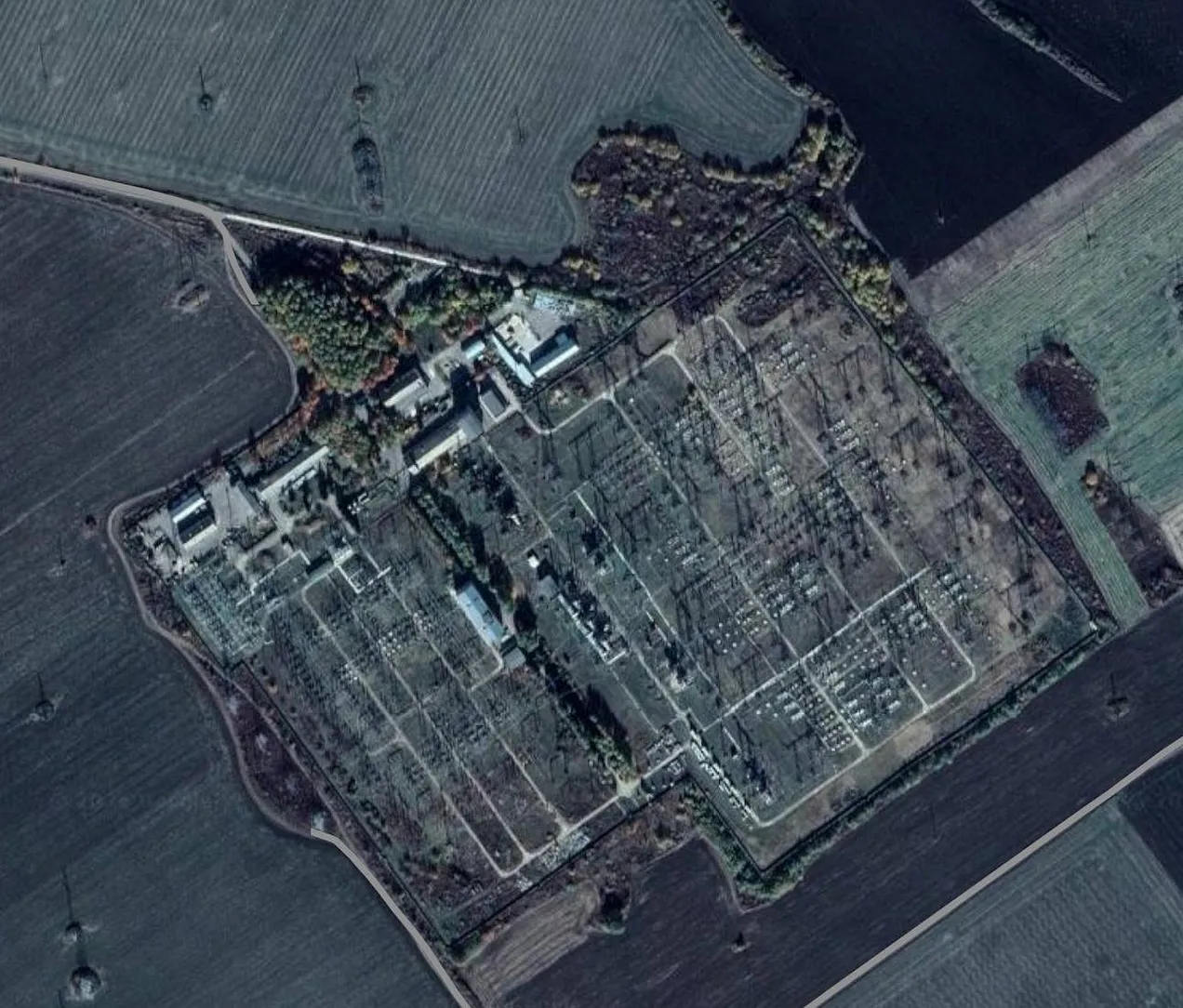
Image

Ukraine won’t be able to negotiate an energy truce with Russia, says MP Getmantsev.

Let’s be objective – they have the stronger position. Our shelling of their oil refineries isn’t as painful for them as the situation in Kiev and other cities is for us.


Zelensky’s ex-press secretary Iulia Mendel admitted something else we’ve mentioned here many times—Ukraine’s so-called “deep strikes” on Russia have been nothing compared to Russia’s ‘retaliatory’ strikes on Ukraine’s own power grid, elaborating as to why:

The economic impact of Ukraine’s deep strikes inside Russia doesn’t even come close to the devastating damage Russia inflicts on Ukrainians every day. Russia’s oil refining sector is heavily subsidized — these refineries mainly serve the domestic market and contribute nothing to the federal budget. On top of that, they are repaired after each attack. Meanwhile, Russia’s own export ban on certain petroleum products actually led to a reported increase in production in 2025.At the same time, millions of Ukrainians are left without electricity or heating in temperatures dropping to -20°C.
The United States is now urging both Ukraine and Russia to stop targeting each other’s energy infrastructure. For Ukraine, agreeing to this could be a real lifeline.


Image

Since the fall, Russia has launched a series of attacks on Ukraine’s energy system, - analysts

▪️Ukrainian analysts publish statistics on the attacks.

▪️During the period from September to December, the Russian Armed Forces carried out 271 attacks on substations, thermal power stations, heat and power plants, etc.:

➖September - 36;

➖October - 71;

➖November - 57;

➖December - 107.

▪️”In fact, Russia managed to divide Ukraine into two parts: where the northern, eastern, southern, and central parts have no electricity, while the western part had no power outages until mid-January,” - complain the enemy’s resources.


So, to answer the opening title question: we do not yet know for certain if Russia has truly committed to a doctrinal and systematic disconnection of Ukraine’s NPPs from the grid. We do not yet even have full incontrovertible verification that the 750 kV substations were truly hit, though most likely it is the case, given the preponderance of reports from both Ukrainian and Russia sources.

We must always somewhat temper our “excitement” and expectations, given how long it’s been that we were continually promised by various authorities from both sides that Ukraine’s grid was “finally on the verge” of total collapse. For instance, here’s a video I posted myself in 2024 of Arestovich claiming that Ukraine’s grid was only 2-3 more Russian strikes away from total collapse. Note specifically what he says about the nuclear plants:

"Arestovich recorded a video in which he announced the complete collapse of the Ukrainian energy system for 2-3 Russian missile strikes. Now Ukraine still has a nuclear power plant and an energy bridge with Europe. But Russia can destroy all this with two or three missile strikes, literally throwing the whole country back to the 17th century in a couple of days.
Only the village will survive, the lighting will be from splinters. Winter will drive hundreds of thousands of people out of the cities and the whole country will be engaged in survival, not war. Russia, according to him, simply feels sorry for ordinary farmers."


Granted, maybe Russia had the capability to finish these NPPs off in 2024 but chose not to—we don’t know for certain. One thing Arestovich did prophecy correctly in this particular instance is the flood of Ukrainian citizens away from the cities, which we are apparently witnessing now in Kiev.

The point being that we should be sensible and cautious in believing everything will be completely shut down. But at the same time, it’s clear that something has changed, even in the empirically quantifiable measures of sheer attack volume. It certainly does appear possible that Russia has chosen to finally unplug the last strongholds of Ukraine’s power grid—I am simply cautious in jumping to conclusions too early based on past expectations.

One last important thing that needs repeating though is the fact that 750 kV equipment is said to be much more difficult and expensive to source and replace, compared to 110/330 kV substation transformers, etc. I am not an expert on this particular matter, so those with specific knowledge can chime in in the comments, but as I understand it the 750 kV standard is a Soviet-specific legacy high-voltage transmission standard which is not compatible with most European countries, which run 300-500 kV max. On the contrary, 330 kV appears to be a standard voltage range that can be easily sourced and replaced from a variety of Western countries.

Theoretically, this means a destroyed 750 kV facility is essentially gone for good. At the same time, it’s hard to “completely” destroy such facilities as it would take many systematic strikes. You’ve seen the earlier photos, they are vast substation fields with dozens or hundreds of transformers. Even several missiles would only take out a small portion of such a transformer field—take a look one more time:

Image

You would need dozens of missiles and potentially hundreds of drones to permanently disable all of that. That doesn’t mean a few won’t take most of it offline for some time, but it will subsequently be repairable reasonably quickly.

Let’s see if Russia continues this systematic campaign with the current intensity.

https://simplicius76.substack.com/p/has ... connecting
"There is great chaos under heaven; the situation is excellent."

User avatar
blindpig
Posts: 15306
Joined: Fri Jul 14, 2017 5:44 pm
Location: Turtle Island
Contact:

Re: Footnotes from the Ukrainian "Crisis"; New High-Points in Cynicism Part V

Post by blindpig » Mon Jan 26, 2026 1:37 pm

A war against themselves
Published by @nsanzo ⋅ 26/01/2026

Image

European countries are “financing a war against themselves,” declared the ever-smiling Scott Bessent last week during his appearance at the Davos Forum. A veteran of all kinds of financial institutions and big capital funds, including that of George Soros, considered by Trumpism to be the worst of enemies, the US Treasury Secretary doesn't hesitate to use his calm demeanor to lecture both allies and foes. The United States arrived in Davos looking down its nose at the rest of the world, proud of its actions in Venezuela, with its operation to kidnap President Maduro, of the ease with which it had sown confusion in European countries over the Greenland issue, and of the impunity with which its security forces impose their will on the border and throughout the rest of its territory. With the same ease with which officials like Kristi Noem or Stephen Miller label as domestic terrorists the thousands of people who are demonstrating these days against the ICE raids in Minnesota, Trump's foreign policy team offends allies by disparaging their participation in common wars or mocking their inability to manage the current one.

The United States has a clear advantage, granted by European countries which, to ensure continued logistical support from Washington, have readily given Donald Trump everything he asked for. The list is long and includes more than just material goods. European countries were forced to adopt a discourse of peace and abandon that of victory when Washington imposed, without any consultation, the objective of ending the war. To maintain Donald Trump's interest in Ukraine, Kyiv offered its natural resources, and European countries began to agree without reservation to practically everything the United States demanded: a trade agreement on its terms, a commitment to acquire more American weapons, and a system in which Washington would profit from the sale of the equipment European countries would send to Ukraine. These displays of loyalty and subservience, which politically have manifested as a lack of condemnation of flagrant US violations of international law in places like Iran and Venezuela, have not yielded the expected benefits.

European countries have repeatedly been excluded from the negotiating table regarding the war and have had to use their veto power , granted by their autonomy, to avoid lifting sanctions and to keep a large portion of the Russian assets held in the West within their own borders. In this way, European capitals have managed to remove from the negotiations the point proposing the use of $100 billion of the approximately $300 billion in Russian aid for the reconstruction of Ukraine. Europe can claim victory in having ensured that funds that could have been used to rebuild the country's infrastructure will instead be used for its militarization, but this step does not improve the current situation in Ukraine, nor has it convinced the United States of its importance or prompted continental authorities to participate in the diplomatic process. The talks that have taken place in recent days, and which, barring any unforeseen circumstances, will continue this week, are trilateral and involve only US mediation, Russia, and Ukraine. Contrary to its wishes, kyiv does not have the assistance of its European allies in the negotiations as it has always demanded.

Despite the constant and increasing concessions from Europe, the United States has always demanded more. Donald Trump not only expects European countries to manage and finance—albeit with external support from the United States—security guarantees for Ukraine after the ceasefire, but he is also imposing a clear shift in the economic relations of the European continent. Since Donald Trump came to power, rumors have circulated about the US attempt to seize control of Nord Stream or, following the imposition of sanctions against the two major Russian oil companies, Rosneft and Lukoil, their assets abroad. In their talks with Russia, which began early last year, Russia and the United States opened the door to the return of American companies to the Russian market, especially in the exploitation of oil and other raw materials, a step that will not materialize until there is a peace agreement, but for which Washington is already positioning itself ahead of potential competitors, including the Europeans. But what the United States considers acceptable for itself is not acceptable for its European allies, from whom it demands economic loyalty that extends not only to the military sector, but also to the energy sector.

With its intervention in Venezuela, its demand for control of Greenland, the mineral agreement with Ukraine, and its ambition to achieve an even more significant one with the Democratic Republic of Congo, the United States is demonstrating its aspiration to control the trade in raw materials that will shape the economy of the present and the future. Thus, control of the extraction of lithium, cobalt, uranium, rare earth elements, and other minerals, as well as oil, is equally important. In this arena, Russia is a clear competitor to the US energy sector, and the sanctions are a natural continuation of Washington's attempt to prevent the construction of Nord Stream, which would have created a vital economic link between the two key European capitals, Moscow and Berlin. The war has given the United States exactly what it wanted: with Nord Stream now thankfully submerged, the other pipelines that had previously transported gas and oil have also ceased pumping Russian raw materials toward the European Union.

The war popularized the idea of ​​the "burden" of cheap Russian gas and oil, which had made countries like Germany dependent on an adversary. The alternatives to the ideologically inconvenient Russian gas and oil were energy from democratic countries like Qatar and Azerbaijan, and, of course, the American ally, whose president used the podium of the United Nations General Assembly to order them to cease all imports of Russian raw materials. The dispute over Greenland has burst the bubble of the European NATO countries and Canada, who have been able to see something that has always been obvious: the United States not only aspires to control its opponents but also its supposed allies. And suddenly, what had been described for years as diversification of energy sources has turned out to be a sign of dependency. “Fears are growing over Europe’s increasing dependence on US gas imports,” Politico wrote this week in an article stating that “the European Union is on track to get almost half of its gas from the United States by the end of the decade, posing a major strategic vulnerability for the bloc as relations with Washington have reached an all-time low.” The ban on Russian gas and oil purchases eliminates a cheap, reliable, and nearby alternative, giving the United States a level of control over the European energy market that Moscow could never have dreamed of.

However, for some sectors, the problem isn't the country's growing energy dependence, which just days ago threatened the territorial integrity of one of its allies, but rather the possibility that some of the oil purchased from third countries originates from Russia. “A senior parliamentary official has warned that a loophole in the sanctions allowing British aircraft to refuel with Russian oil must be closed without delay. Liam Byrne, Labour MP and chairman of the Commons Business and Trade Committee, stated that every month that passes without the UK implementing the promised ban 'risks tens of millions of pounds continuing to flow into Russia's war effort' against Ukraine,” writes Politico, reflecting a disproportionate concern given that sources estimate around £44 million a month could be spent by British money going toward the purchase of Russian oil sold to Turkey or India for refining and subsequent export. For reference, a single missile for Patriot anti-aircraft systems, like those used by Ukraine, costs between $3 and $4 million—enough for Scott Bessent to claim that European countries are funding a war against themselves. For the United States, the war is a major commercial scheme.

https://slavyangrad.es/2026/01/26/una-g ... si-mismos/

******

From Cassad's telegram account:

Colonelcassad
Throughout the day, air defenses in the Belgorod area continue to repel systematic attacks by enemy drones and multiple rocket launchers attempting to shell the city. They aren't as massive as the other days, but they remain systematic. Thanks to the air defenses, most of the attacks are being shot down, but some are still landing in the area.
This is the enemy's attempt to retaliate for the partial blackout in central and eastern Ukraine, which the cocaine-fueled Führer's regime is struggling to contain. More will follow this evening and into the night—not all thermal power plants and power stations have been extinguished yet.

***

Colonelcassad
After Oleksandr Kharchenko, director of the Ukrainian Center for Energy Research, began spreading the rumor that 16 Iskander missiles hit Kyiv's thermal power plants on January 13, 2026, and that they have been out of service since, the Ukrainian Armed Forces rushed to dispel the "anti-crisis" claiming that "only two missiles landed, and the rest were shot down." How two missiles simultaneously disabled three thermal power plants and why almost half of Kyiv is without power are not explained.
The January missile attacks on Kyiv's energy sector were quite effective, but they certainly need to continue.

***

Colonelcassad
0:36
Kharkiv direction .

The Russian Armed Forces continue to expand their security zone in encounter battles near Vovchansk.
Having liberated the villages of Simonovka and Staritsa, our units are advancing further. Russian aviation conducted targeted strikes against the Ukrainian Armed Forces' rear areas.
Geranium crews, heavy rocket artillery, and Solntsepyok rocket launchers continue their operations.
The enemy is putting up fierce resistance.
Naturally, UAV units are clashing in this direction.
Strikes are being launched at the identified locations of enemy UAV units, destroying their electronic warfare stations, satellite communications, and antennas.

In the Kharkiv region, an enemy M113 armored personnel carrier carrying infantry attempted to lead them into position but was hit by drones from a crew of the 71st Motorized Division.
The crew attempted to flee, but our drone operators eliminated the enemy personnel with a second strike. (Video)

Fighting is ongoing in the northern half of Grafskoye, with our assault groups advancing and aligning the front line between Liman and this village.

While advancing near Staritsa, our troops cleared part of the forest on the northern bank of the Volchya River.

We are advancing in Volchanskiye Khutor.
Russian forces have captured farms on the western outskirts and advanced toward the development to the north.
Our Solntsepyok crews are targeting enemy positions.

Near Liptsy, Russian FPV crews continue to destroy Ukrainian Armed Forces vehicles along supply routes.

Between Dvurechanskoye and Kamenskoye, our units have made significant advances and captured several forested areas approaching Kolodeznoye.

In addition, our assault groups are pushing back the enemy on the approaches to the villages of Khatney and Ambarnoye, and our soldiers are advancing in the direction of the villages of Olkhovatka, Obukhovka, and Novovasilyevka.

@DnevnikDesantnika

***

Colonelcassad
Peskov's key statements:

- A conversation with Trump is not currently scheduled, but it can be agreed upon quickly;

- The territorial component of the "Anchorage formula" is crucial for Russia;

- Russia is in constant contact with the Venezuelan authorities through diplomatic channels, and developing relations with the Russian Federation is a priority for the country;

- Information about a possible blockade of Cuba is alarming;

- A strike on Iran could seriously destabilize the situation in the region, and Russia would like to expect restraint from all parties;

https://t.me/s/boris_rozhin

Google translator

******

Nazis in search of compromise
January 25, 9:30 PM

Image

Russian troops have historically had an advantage in winter weather.

(Video at link.)

Chernorossiya will be. Good luck to the guys. Many of the African volunteers will become our fellow citizens in the future.

https://colonelcassad.livejournal.com/10328026.html

"The Energy of Decommunization"
January 26, 1:06 PM

Image

Infographics of electricity availability in Ukraine by region as of January 26, 2026.

Image

Image

Key metrics:

• Average daily electricity availability time - 8.4 hours (35%)
• Worst situation in Poltava region - 12.5%
​​• Best situation in Rivne region - 72.2%
• Data completeness by region - 21 out of 21, by population - 100%

• Average weekly electricity availability time - 8.6 hours (35.9%)

• Since the beginning of 2026, Ukraine has imported 720 GWh of electricity worth $153 million

Data update:

• The infographic has been updated to include information on the dynamics of electricity availability by region compared to the previous day.

• A graph of the dynamics of electricity imports since the beginning of 2026 has been added.

Electricity availability data updated as of 07:05, January 26, 2026.

Import data updated as of January 25, 2026, based on data from @avm74BC

https://t.me/lost_armour/7902 - zinc.

The current damage to Ukraine's energy system has proven to be the most critical of the entire war. The consequences are cumulative, and with continued attacks on key nodes, they will continue to grow.

https://colonelcassad.livejournal.com/10328537.html

Seversk trophies
January 26, 3:10 PM

Image

War correspondent Kulko shows trophies captured during the liberation of Seversk from Nazi occupation.

Image

Image

Image

Image

Image

Image

https://t.me/DKulko/1392 - zinc

https://colonelcassad.livejournal.com/10328700.html

Google Translator

******

Putin’s ‘New Hard Line’? UPDATE: Response to Alexander Mercouris’ Comments of 21 January
byGordonhahn
January 22, 2026

Originally published at: https://gordonhahn.substack.com/p/putin ... e?r=1qt5jg

Yesterday, January 21st, the always interesting and informative Alexander Mercouris responded on his podcast to my article of the day before disagreeing with his interpretation that a new hard line had been adopted by Moscow in response to the apparent drone assassination attempt on President Vladimir Putin on 28 December 2025. In that article I argued that Putin’s speech to new ambassadors did not contain any new hard line but rather repeated longstanding Kremlin positions and that no new hard line had appeared either by way of an articulation of a new position or by any new political or military actions (https://gordonhahn.substack.com/p/putin ... e?r=1qt5jg). In his podcast yesterday, Alexander brought in the comments of Putin’s foreign policy advisor Yurii Ushakov, who has spoken of Putin’s intention to “revise” Russia’s position in the negotiations to end the NATO-Russia Ukrainian War. Alexander also dug into one particular phrase in Putin’s speech to the new ambassadors (https://www.youtube-nocookie.com/embed/ ... blejsapi=0). Regarding Ushakov’s statement of Putin’s plans to revise the Russian position, this does seem to indicate an intent to revise Russia’s negotiating position. It is impossible that any revision would be a softening of that position given the Western-Ukrainian escalations of late. However, intent does not make a policy, no less an implemented one. As yet we have no articulation or practice of a new hard line, though we may very well see one.

Regarding Alexander’s interpretation of Putin’s words, here are the operative sentences he unpacked: “Russia has repeatedly taken initiatives to build a new, reliable and fair architecture of European and global security. We offered options and rational solutions that could suit everyone in America, Europe, Asia, and all over the world. We believe that it would be worthwhile to return to their substantive discussion in order to consolidate the conditions on which a peaceful settlement of the conflict in Ukraine can be achieved – and the sooner the better.“ I would argue again that this is a reiteration of a new position with perhaps the exception of one nuance, as Alexander noted. Moscow has long opposed NATO expansion and, as I noted in my article disagreeing with Alexander’s reasonable expectation of a new hard line, has proposed solutions for creating a comprehensive security architecture for Europe that would address the security interests of both Russia and the West. This is absolutely correct. The nuance seems to emerge with Putin’s tying a return to talks on this larger issue to a resolution of the NATO-Russia Ukrainian War. The key phrase regards the need to return to this larger issue “in order to consolidate the conditions on which a peaceful settlement of the conflict in Ukraine can be achieved.“ If by this Putin means that an agreement on a new security architecture for Europe must precede, is a condition for a settlement of the war, then, indeed, this would be a major shift and hardening of Putin’s line.

But here two caveats are in order. First, Russia’s repeated nearly ad nauseam assertion that a peace agreement requires ‘addressing the root causes” of the conflict has long made this point on the need for an agreement on the larger European security issues of NATO expansion and the West’s withdrawal from various treaties achieved between Moscow and Washington at the end of the Cold War (ABM, INF, Open Skies). Second, I am not sure that Putin meant than an agreement on broader European security is a new precondition for a peace settlement for Ukraine. In reality, and as I have argued should be, the peace process sponsored by US President Donald Trump has been operating on two tracks de facto, if not de jure. Washington and Moscow have been discussing restoration of diplomatic and normal trade relations and presumably security issues such as the soon to expire New START. On the other track are the indirectly trilateral talks between Washington, Moscow, and Kiev. These two tracks are indeed interconnected, as Putin is well aware, by the issue of NATO expansion which has appeared in various formulations in the various treaty proposals or initiatives, with the Russians demanding its cessation, in particular to Ukraine, and with the Ukrainians rejecting to forego the right to join the Transatlantic alliance or demanding NATO Article 5-like security guarantees.

Although I do not consider the sum of the Ushakov and Putin statements as proof of an imminent or already adopted new hard line in Moscow, I do not exclude out of hand that one may in fact be here or on the way. There are simply some nuanced differences in the interpretations and levels of certainty held to by Alexander and myself. For me, the words emphasized by Alexander are certainly important signals that could portend precisely what Alexander expects, but they also may not be such signals. Moreover, declared intent does not make a policy.

The most important issue in all this is that if a new hard line emerges from Moscow — one that requires a larger security architecture agreement or serious structured negotiations on this extremely complex issue as a precondition for an agreement on Ukraine — the Kiev is doomed to defeat. The Ukrainian defense fronts, army, regime, and even state will not survive the year or more that such Russia-Western security talks would need to come to an agreement, if an agreement is possible at all, given the Europeans’ constant efforts to scuttle any agreement on Ukraine and prolong the war until Trump leaves the White House. In other words, if this becomes Putin’s new hard line, then he has in effect doomed peace talks to failure, whether he prefers this or not.

https://gordonhahn.com/2026/01/22/putin ... anuary-21/

(Works for me))

*****

Ukraine Hoist on Its PR Petard? Bizarre Media and Official Silence Over Humanitarian Crisis From Russian Grid Attacks, Extreme Difficulty of Rebuilding

Posted on January 26, 2026 by Yves Smith
Even though the intensifying Russian grid strikes on Ukraine are getting some mainstream media coverage, there has been a bizarre reluctance, approaching the level of self-censorship, to depict the human cost of these attacks. As we’ll explain, the flip from waging a heretofore fairly successful PR war on Russia’s alleged misdeeds to silence is not just noteworthy, as evidence of Ukraine and Western reluctance to admit how badly the conflict is going. It also seems to reflect a resulting paralysis, as in not having any good cards to play and being unwilling to consider the only sensible option, of ending the war on the best obtainable terms for Ukraine.

The lack of Collective West media noise also gives Russia more freedom of action. Recall that a big reason for Russia to conduct the war in such a cautious manner was to keep the good will of its economic allies, most important China and India. They were uncomfortable with Russia gobbling up a neighboring state. Russia needed to act as if it was doing only as much as necessary, and not more than that, to check what it has (correctly) insisted is an existential threat.

Mind you, I am no fan of the regime in Kiev. I think it is entirely reasonable to take the position that the considerable pain inflicted on ordinary Ukrainians, those not rich or connected enough to have fled already, is due entirely to Zelensky and his European backers (and earlier the US under Biden) to refuse to come to terms with the Russians and end the conflict. But given the importance of describing things with their proper names, the impact of power outages in major Ukraine cities, not just Kiev but Kharvik, Kryvyi Rih, and others, is indeed a humanitarian crisis. It is rendering them uninhabitable.

We’ll discuss how the official Ukraine and resulting allied media tongue-tiedness about how bad conditions in the big cities are becoming means that Russia may wind up implementing an end-state in big sections of the country that we had mentioned as an effective, if also (as of then) extreme and therefore unlikely-seeming solution, that of turning much of Western Ukraine into a de-electrified zone. That would make it resemble the Unorganized Territory of Maine, thinly populated with hardy survivalists. This idea was a logical extension of a scenario described by John Helmer early in the electric war. He had pointed out that the General Staff was highlighting the need for buffer zones to stymie what were then assumed to be rump Ukraine to prevent missile strikes on Russian territory. Lavrov even took up that theme, observing that the depth of the protective area would depend on the longest-range missiles the West was using against Russia.1 Helmer showed an indicative map with de-electrified DMZs. We pointed out that Russia could take that further with our Unorganized Territory variant, since that would considerably reduce the ability to organize resistance and launch terrorist attacks into Russia.. That is where things may wind up for much more of Ukraine than we had seriously thought possible if Ukraine continues to prosecute the war to the last Ukrainian.

Heretofore, the Western press has excoriated Russia for its (until recent) limited harm inflicted on civilians, regularly exaggerating its importance in the overall scheme of things and depicting it as malicious, as opposed to “shit happens”. In fact, the low level of civilian death reported for various missile attacks, most often in the single digits, is evidence that Russia has been trying to spare non-combatants and generally has been pretty successful. Some of the instances of claims of heinous Russian conduct have been misrepresentations, such as charging Russia with targeting a mall as if that meant they were terrorizing the population, when that “mall” was a former mall now in military use, or hospitals being hit by shells.2 ‘

By contrast, Ukraine has been given a free pass for its regular shelling of civilians in Donetsk, including with petal mines, whose use is considered a war crime, along with terrorism, such as the attack on Crocus City Hall and assassinations of journalists.

The growing humanitarian crisis in Ukraine is the result of Russia’s Clausewitzian practice, of achieving victory by destroying the enemy’s military, meeting the reality of a Ukraine government bent on its own survival (and perhaps continued looting), seemingly unconcerned about whether its citizens or any sort of country are left standing. We’ve seen that tendency with the many videos of men being tackled and tossed into vans to impress them into service, and worse, of them being sent to the front lines with virtually no training. In 2023, when conditions were less dire than now, a US Marine estimated that the life expectancy of a new Ukraine arrival on the front lines was a mere four hours. A quick look at search results says survival might be three to four days in less high-intensity settings.

Kiev’s Mayor Klitschko has defied President Zelensky in calling the impact of the electrical grid attack as having created a humanitarian crisis. He has also said that more than 600,000 residents have left out of an estimated population of 3 million. Klitschko also urged everyone who could relocate temporarily to a location with heat and water to do so. He later issued a second appeal for those who could to leave.

The press did report the Klitschko dire warning but has said perilous little since then, even with Russia making what is reported as its most severe grid strikes on Kiev right after its meetings working group meetings with the US and Ukraine in Abu Dhabi. Note the dates on these press sightings:

Image

Image

Recall also that Zelensky just gave a highly publicized speech at Davos. Not once in it did he mention the grid strikes. His European interlocutors had to bring it up in the Q&A afterwards, which was before time of the screenshots above:

Børge Brende, President and CEO of the World Economic Forum: What is now the most difficult part for Ukraine. We know it’s an attack on your whole energy system and electricity, but then there are also the casualties on the borders. So the humanitarian situation is more challenging now than a year ago?

Volodymyr Zelenskyy, President of Ukraine: Yes, Russia attacks energy, and this is what they are focusing on, and this is not a secret. This is not a mistake. This is their goal to cause blackouts in Ukraine. And they attack mostly civilians. They don’t use a lot of missiles, these expensive missiles, what I spoke about before, they don’t use them on the front, they use it against civilians, infrastructure, critical infrastructure. It’s about everything, hospitals, kindergartens, schools, but mostly it’s about the tactical things, which they are focusing on destroying, electricity, heating systems, water supplies, everything.

Yes, this is the face of Russia. And really, this is the face of this war. We have defending systems. We have really created, I think, great ideas with drone interceptors that we produce 1000s of per day, but it’s still not enough. Russia has about 500 drones, Iranian drones each day and dozens of missiles, ballistic missiles, and even those systems that our partners gave us and of course, they could give us more, yes, and I spoke with President Trump today about it again and again, and I hope it was my last words, you know in Ukraine, we say, everybody remembers the last words. So my last words to President Trump were, don’t forget about air defence, don’t forget about Patriots. So this is very important for us during this winter. So, I think that all these attacks. I can’t say that these attacks make us stronger, because it’s about our people, the people I mean this, they are surviving, but they’re heroic people, civilians and soldiers, because they are not losers of this war and this is important.

Consider further that the Military Summary channel has just reported that only one out of five thermal power stations in Kiev are working.

Simplicius’ latest post discusses whether Russia is “disconnecting” Ukraine’s remaining substantial power production, from two nuclear plants, by targeting their electrical substations. The short answer seems to be yes, but not yet by taking the decisive but high-risk move of trying to strike the ones hard by, but those further downstream.

The post and comments also address a topic we have raised before, of the difficultly of replacing critical parts of damaged and destroyed Ukraine grid infrastructure due to it being at the old Soviet standard of 750kV. Quite a few readers rejected our thesis, that much of this kit was not only not manufactured in the West, but would be too costly and specialized for US and European firms to want to do that. That would mean, as we have said, that Russia controls Ukraine’s future if it is the only party both willing and able to rebuild/replace these high-capacity transformers.3

Simplicius has apparently voiced this issue before too, albeit perhaps not as pointedly as we have. His cautious take:

One last important thing that needs repeating though is the fact that 750 kV equipment is said to be much more difficult and expensive to source and replace, compared to 110/330 kV substation transformers, etc. I am not an expert on this particular matter, so those with specific knowledge can chime in in the comments, but as I understand it the 750 kV standard is a Soviet-specific legacy high-voltage transmission standard which is not compatible with most European countries, which run 300-500 kV max. On the contrary, 330 kV appears to be a standard voltage range that can be easily sourced and replaced from a variety of Western countries.

Hie readers agreed:

Insider
Yes. I worked for a german transformer company several years. The pre-order time(“Bestellvorlauf”) for special insulation parts is 51 weeks(a year has 52 weeks) and there are 2 companys in europe who make these things. About voltage: in europe we had 110/220/380kV in the past, now ist mostly 120/(230)/400kV. highest voltage we had in the company was 550kV for the US/Canadian Grid. 750kV is a completely different design, its not “just 250kV more…”

Aleksandar Dimitrovski
330kV level gear is difficult enough to source, but 750kV is an order of magnitude more so. There is only a handful of factories with extremely long lead times.

Shaunak Agarkhedkar
Also, sourcing 330kV transformers in the west is anything but easy. The lead time measures in years, and inventories are now tapped out.

One suggested the ability to get the needed transformers was bad but not quite as dire as other suggested:

Married with Bears

Components for EHV (Extra-High Voltage, 330 kV) and UHV (Ultra-High Voltage, greater than 330 kV) are completely bespoke manufactured products. Not only are transformers for EHV and UHV different between electrical networks and countries – they’re different from each other on the same distribution network, and engineered specifically for a particular node on the network. There is a great deal of hand work involved in making them. There are a few countries that produce them – Germany, Russia, the U.S., China, probably more…

Long lead times for replacement equipment (transformers, switching stations) is because of the high manufacturing tolerances required, and that each component is custom engineered and matched to other parts of the grid that it is being placed into. Ukraine’s system is Soviet period in origin, but that has nothing to do with why order times are six to nine years out (and demands from AI for expanding the power grid will push it even longer).

A standard 110 kV transformer can use commodity copper; a 745 kV transformer requires not only copper completely clean of impurities, but that has certain magnetic properties that are difficult to manufacture. It is an enormous engineering challenge to make those bespoke components, and the engineering base to do so is constrained.

And in case you doubted that the prospective rebuild requirements are large, from the body of Simplicius’ article:

In the latest piece, head of Ukraine’s largest energy company DTEK says that up to 70% of total capacity is lost and Ukraine’s entire grid would have to be rebuilt from the ground up, rather than simply repaired, such is the totality of its destruction:

“We are close to a humanitarian catastrophe,” Timchenko said. “People get power for 3-4 hours, then a 10- to 15-hour break. We have apartment blocks without heat for weeks already.”

DTEK has lost 60–70% of its generating capacity and suffered damage worth hundreds of millions of dollars, he said.

Timchenko said rebuilding the energy sector would cost $65–70 billion, citing World Bank estimates, and in many cases would require entirely new assets.

“We are talking rather about building a new energy system in Ukraine rather than just reconstruction,” he said.

Even with conditions looking so dire in Ukraine, Simplicius cautioned against making “The end is nigh” forecasts, since among other things, Ukraine officials have sometimes made urgent pleas so as to elicit more arms and money. But DTEK does not have those incentives. The implication is even if the war were shut down now, Ukraine faces a protracted and costly rebuilding process that will only get worse with every Russian grid strike. Given deteriorating economic conditions in the West and the priority newly assigned to building up armed forces, it seems that what the US regime change for Russia scheme for Russia will instead produce is yet another failed state. But the difference here is that it will be populated by white people and in Europe.

_____

1 Forgive me for not running down this detail but I believe Lavrov’s remarks came when there were threats to deploy German Taurus missiles, which are longer-range than any others made by the coalition, that if they were given to Ukraine, one consequence would be that the buffer zone would need to be even larger.

2 Without litigating each case, at least one was Ukraine using a hospital as a site for missile launchers; others were mainly shells falling on hospitals, most often Ukraine air defense missiles that had not hit their target or debris from successful Ukraine interception of Russian missiles.

3 Capitalist firms are not going to want to invest for what amounts to a huge but comparatively short-run order. Russia’s military complex, by contrast, does not run on commercial profit lines. Russia is far more able to finesse the cost and profit dynamics than Western concerns.

https://www.nakedcapitalism.com/2026/01 ... lding.html
"There is great chaos under heaven; the situation is excellent."

User avatar
blindpig
Posts: 15306
Joined: Fri Jul 14, 2017 5:44 pm
Location: Turtle Island
Contact:

Re: Footnotes from the Ukrainian "Crisis"; New High-Points in Cynicism Part V

Post by blindpig » Tue Jan 27, 2026 12:56 pm

Operation BlackRock
Published by @nsanzo ⋅ 01/27/2026

Image

“We have spoken with the US team about the economic path, specifically reconstruction. I want to thank Secretary Bessent, Jared Kushner, and Larry Fink of BlackRock for their constructive approach. An important principle we all share is that for high-quality reconstruction and real economic growth after this war, genuine security guarantees must be the foundation. When there is security, everything else is possible,” Volodymyr Zelensky stated in his daily video message to the nation on December 10. Adding to this a comment he made in the last week of 2025 in an interview with Fox News , in which the Ukrainian president stated that Russia could forget about its “offer” to support Ukraine’s reconstruction by selling it “cheap energy,” one can grasp the logic behind much of Kyiv’s approach to the country’s economic recovery in the event of a ceasefire.

Zelensky's words indicate the priority of reaching an agreement with the United States to obtain security guarantees from Washington. Despite doubts about the reliability of the United States as a partner, given that just a few days ago it threatened the territorial integrity of one of its allies, Ukraine cannot conceive of the security commitment it expects from its allies without the direct participation of the United States. This agreement, and not one with Russia, is the foundation upon which Kyiv wants to build its future as a country politically and militarily integrated—whether de facto or de jure through NATO membership—into the European family . Yesterday, the Ukrainian president stated that the agreement between the United States and Ukraine is “100% ready,” awaiting only Washington's selection of a date and location for its signing. Zelensky's tantrum, with his announcement that he would ignore the Davos Forum because no agreement would be ratified, indicates that Ukraine is expecting a grand ceremony to present its population with a treaty that will supposedly guarantee the country's future and mark a turning point in Ukraine's political, economic, and military history. The complete lack of urgency on the part of the United States in signing these agreements—both the security guarantees and the prosperity plan—indicates that, unlike Ukraine, which expects these agreements as a prerequisite for reaching an agreement with Russia, Washington's priority is to reach an understanding with Moscow to resolve the military issue and subsequently ratify its economic and security agreements with Bankova and the Kremlin.

For Zelensky, security and reconstruction are part of the same agreement, the central element of which is the participation of the United States. Thus, figures like Scott Bessent, the US Secretary of the Treasury, Jared Kushner, Donald Trump's son-in-law and a major businessman primarily involved in construction, and Larry Fink, CEO of BlackRock, an "asset management and financial services" company—in other words, a vulture fund—are all equally relevant. The state apparatus of the world's leading economic power, the construction oligarchy, and big business are the three sectors to which Zelensky has appealed since taking office, seeking a reconstruction package comparable to the Marshall Plan that the United States implemented to help its European allies—and proxies—recover after World War II. Zelensky's logic is the same as it was back then, when the continental allies were seen as a necessary base for confronting Moscow. Guaranteeing their viability was essential to buying social peace and preventing the rise of sentiments, movements, or parties considered sympathetic to the Soviet enemy. Now, from the perspective of the new Cold War that the Ukrainian president aspires to consolidate, Ukraine would be that frontline state in a much more complicated conflict, as it is an open military conflict that will most likely end with borders that are only de facto .

A technocrat in politics and a libertarian in the vein of Javier Milei in economics, Zelensky has always opted for deregulation, the elimination of any remaining vestiges of the welfare state that Ukraine inherited from the Soviet Union, and the privatization of any public enterprise that could generate profits for the powerful national oligarchy or, preferably, for large Western corporations, whose presence has been considered a shield of security since the Russian invasion. This has been evident in the annual reconstruction conferences, where Ukraine has prioritized public-private partnerships in which allied states would handle the investments and large private companies, preferably American, would reap the profits. All of this was presented to the population with an image very similar to the one Jared Kushner showed in his slides of the Gaza of the future, where modern skyscrapers covered the Mediterranean coast and promised quality jobs to the local population, who, of course, would have to live in outlying areas, since prime locations would be reserved for the tourism or business sectors. The technolibertarian utopia proposed by Zelensky or Fedorov is no different from the one falsely promised by former Infrastructure Minister Omelyan, who aspired to build Elon Musk's hyperloop , which the American billionaire abandoned as he considered it unfeasible.

An article published by The New York Times last week details Ukraine's perspective, its insistence on leaving the future economic structure to this vulture fund, and the problems it is causing. The main challenge Ukraine has faced is not the fact that this current collaboration, which BlackRock is carrying out pro bono, is occurring without the slightest democratic semblance, but rather the feeling among European countries that they will be excluded. Nothing is free, least of all the work of several years by funds that have become notorious for their ruthlessness. It is clear that BlackRock expects to recoup the costs incurred during these years of working for Ukraine for free . As The New York Times points out, “the president’s top negotiators have been real estate developers: his billionaire friend Steve Witkoff and Trump’s son-in-law, Jared Kushner. BlackRock CEO Larry Fink has sat next to Kushner in talks with Ukrainian leaders.” The Ukraine being designed for the future will not be based on the needs of its people, but rather on the interests of those planning and managing it. In this game, the European Union's absence is not limited to political negotiations, but extends to economic ones. “The participation in the negotiations of a private company whose main objective is to maximize economic profits has reinforced concerns that the Trump administration views the reconstruction of Ukraine as an opportunity for the US government and companies to profit, rather than primarily as a humanitarian or security issue,” states the article, which fails to mention that European concerns are not only moral but fundamentally economic. Both the Ukrainian oligarchy and large European corporations aspire to profit from Ukraine's future reconstruction.

“BlackRock’s involvement in Ukraine dates back to the fall of 2022, when Kyiv began envisioning a post-war future after expelling Russian troops from large swathes of the country. In September of that year, Andrew Forrest, an Australian mining magnate, introduced Zelensky to BlackRock’s CEO, Mr. Fink. They discussed how the firm could advise Kyiv on creating a reconstruction fund. Weeks later, both parties signed a memorandum of understanding formalizing the collaboration. According to the agreement, which The Times obtained, BlackRock’s consulting division would help design the fund’s structure and governance and present it to potential investors,” the article recalls, explaining that the firm committed to a plan promising to raise between $50 billion and $80 billion, which a year later was reduced to $30-$50 billion, ultimately leading to the complete abandonment of the plan.

BlackRock's idea remains the same: a public-private partnership to "obtain money from governments and financial institutions and leverage it to attract several times more in private loan capital," said Oleksandr Gryban, a former Ukrainian deputy economy minister who worked on the fund. The public money would serve as seed capital, absorbing initial losses and acting as a risk-reduction mechanism to attract private investors hesitant to invest in Ukraine. While the optimistic Ukrainian plan presents public investment as limited to non-commercial sectors—education, healthcare, etc.—and assumes that the most potentially profitable areas will attract private investment, BlackRock offers a slightly nuanced perspective. “The approach echoes BlackRock’s original proposals. The firm’s slide presentations outlined several sector-specific funds to finance projects using a combination of public and private funds. Energy, infrastructure, agriculture, manufacturing, and information technology were listed as priority sectors. One slide from April 2024 identified nine potential investment projects, including wind farm development and lithium deposits, totaling $1.1 billion,” writes The New York Times , citing a BlackRock report that anticipates access to public funds even in sectors where companies expect large profits.

The plan announced by Zelensky when presenting his 20-point plan for resolving the war included the creation of a “Ukrainian Development Fund,” the same terminology used by BlackRock’s original fund, confirming that the plan remains unchanged and will follow the same logic. According to the Ukrainian government, the priority would be “high-growth” sectors such as technology, data centers, and artificial intelligence—areas in which, according to The New York Times , the White House is seeking “deals that have benefited members of the Trump administration.” And BlackRock is not far from falling into that category. According to the article, “BlackRock could benefit from the recovery as the owner of Global Infrastructure Partners, one of the world’s largest financiers of airport, bridge, and tunnel construction projects. Last year, Global Infrastructure Partners stepped in to help the Trump administration by buying two ports in Panama from a Hong Kong company that had become the center of tensions between Panama and Trump.” Whatever happens in the peace negotiations, some actors already know that they will be the ones who win the war.

https://slavyangrad.es/2026/01/27/operacion-blackrock/

Google Translator

******

From Cassad's Telegram account:

Colonelcassad
Shot in the Foot:

Russophobic rhetoric and revanchism are keeping Polish elites in suspense. In particular, Polish-Lithuanian Commonwealth President Nawrocki emphasized that Russia has been and remains a threat for many years, regardless of historical period or political regime.

Against this backdrop, Poland will completely halt imports of n-butane and isobutane from Belarus and Russia as of January 26. For context, the eastern route was one of the key sources of raw materials for Polish petrochemicals.

Now this market is cut off. And the blow is being felt by Grupa Azoty, Poland's largest chemical holding company, which uses butane fractions in the production of plastics, solvents, and chemical intermediates. The company, already facing rising costs due to expensive gas and electricity, will now be forced to purchase n-butane and isobutane from suppliers in Norway, the United States, and the Netherlands – at prices 15-30% higher than those of Russian and Belarusian producers.

The second affected segment is ORLEN, which, despite positioning itself as an energy giant, actively uses butane fractions in petrochemicals and the production of mixtures for autogas. Now the company is forced to switch to maritime deliveries, which means increased logistics costs and dependence on the freight market.

Small processors serving the domestic market for aerosol mixtures and chemical solvents will also be affected. For them, rising raw material prices could be critical: margins in the sector are already minimal, and switching to imports from Western Europe or the US could lead to the closure of some production facilities.


Let's remember that N-butane and isobutane aren't the mainstay of refineries' revenue, so this isn't a disaster for Belarusian and Russian refineries. For Russia and Belarus, Poland's decision means the loss of a market that in 2021-2022 collectively generated up to $400 million annually, which is incomparable to oil or gas exports.

Ultimately, Poland is deliberately turning its back on cheap and accessible raw materials to emphasize its policy of completely severing energy ties with its eastern neighbors.

Brussels is also shooting itself in the foot. The EU Council approved a complete ban on Russian LNG supplies to the EU from January 1, 2027, and pipeline gas from September 30, 2027. As usual, with "democratic" fines of up to 300% of the contract amount for those who disobey the "hegemon."

@Belarus_VPO

***

Colonelcassad
Kharkiv's Gauleiter reported that 80% of Kharkiv is without power this night as a result of missile and drone strikes. Kharkiv's infrastructure is currently being destroyed faster than it can be restored. "They've been shooting at Belgorod," so to speak.

***

Colonelcassad
Ukraine has more than enough.

" The era of Soviet heat and electricity supplies has reached its end, and the entire system needs to be reconsidered. Because the Russians won't leave our borders. And to think that even a ceasefire will be permanent—I would prepare for something different. For how to make life in the capital and other cities more secure.
Mini-CHPs are our solution for the future. Ukraine has reserves for building mini-CHPs using straw, sawdust, and garbage. That is, Ukraine has more than enough material from which to generate thermal electricity. " (former Deputy Minister of Internal Affairs of Ukraine Zerkal, "


Prospective CHPs Using Straw, Garbage, and Sawdust")

***

Colonelcassad
France is strongly opposed to Ukraine purchasing Storm Shadow missiles from Britain using borrowed funds.
Because, of course, no one intends to repay these loans. And stealing Russian money to finance such purchases hasn't yet worked.
Increased defense spending often comes down to a dilemma: borrow or steal from Russia.

***

Colonelcassad
Klitschko asked Kyiv residents to reduce the burden on infrastructure: heat, water, and electricity. He also said that 600,000 Kyiv residents leave the city in the evening and return in the morning.

Brighter times have arrived in the Ukrainian capital.

And it's coming in. And it's coming out.

***

Colonelcassad
Ukrainians will continue to endure because they'd rather live without electricity and internet than under Russian occupation, (c) Ambassador Extraordinary and Plenipotentiary of Canada to Ukraine Tsmots.

New Levels of Consciousness.

***

Colonelcassad
Italian Deputy Prime Minister Salvini called on the cocaine führer to make peace:

"I heard Zelensky—after all the money, after all the effort, after all the assistance, he still has the nerve to complain. My friend, you're losing the war, you're losing people, you're losing trust, reputation, and dignity. Sign a peace agreement as soon as possible. Sign a peace agreement as soon as possible—the choice is between defeat and total annihilation."

***

Colonelcassad
Ukrainian Rada deputy Kostenko declared that the peace treaty would lead to the Russian Armed Forces sending their freed troops to conquer Europe. "

We won't rest until we capture San Marino."😀

https://t.me/s/boris_rozhin

Google Translator

*****

AT WHAT POINT, CAPITULATION OF THE KIEV REGIME? CAN PRESIDENT TRUMP AND GENERAL GRYNKEWICH SAVE IT

Image

By John Helmer, Moscow @bears_with

For the first time since the negotiations to end the Ukraine war began, President Vladimir Putin has sent as the chief Russian negotiator a General Staff officer and military intelligence chief, Admiral Igor Kostyukov.

The two Russians who have been closest to Putin, Vladimir Medinsky and Kirill Dmitriev, are not at the table. Neither is the Foreign Minister, Sergei Lavrov.

In Abu Dhabi on Friday (January 23), Kostyukov faced the Americans Steven Witkoff, Jared Kushner, Daniel Driscoll, and General Alexus Grynkewich (lead image, left). Driscoll is the Secretary of the Army, in the running to replace Peter Hegseth at the Pentagon, and a protégé of Vice President JD Vance. Grynkewich has been in charge of the losses on the Ukrainian battlefield since May 2024 when he was head of operations at the Pentagon and then as chief of the European Command (EUCOM) from July 2025.

At Abu Dhabi each of the Americans displayed open-neck, casual clothing. This dress-down Friday costume was a calculated insult to both the Ukrainian delegation – Rustem Umerov in uniform and Kirill Budanov in suit and tie—and to the Russians, Kostyukov and his second at the table, General Alexander Fomin. Kostyukov wore a dark civilian suit and a white collared shirt buttoned at the neck. But Kostyukov’s tie wasn’t tightly drawn. Was he sending the Russian Army’s message that it hasn’t reached the point of strangulation for the other side, yet?

The American signal was that they are dictating terms; that they retain escalation control over the Russians and they must capitulate, along with the NATO allies and the Zelensky regime. This is not the “coordinating” role which, after the two-day meetings concluded, Witkoff announced. “On Friday and Saturday, the United States coordinated a trilateral meeting alongside Ukraine and Russia, graciously hosted by the United Arab Emirates. Talks were very constructive, and plans were made to continue conversations next week in Abu Dhabi. President Trump and his entire team are dedicated to bringing peace to this war.”

Russian sources believe Witkoff’s stop to “this war” is no stop to the continuation of the war against Russia which the US, with the NATO allies, continues to escalate on land northward to Finland and Greenland; in the nuclear arms race in space; and at sea on all of Russia’s trade routes – the Baltic Sea through the Danish Straits, the Northern (Arctic) Route through the Bering Strait, the Black Sea through the Dardanelles, the Mediterranean, Caribbean, and the Indian Ocean.

This larger peace is what Putin claims Trump agreed in the “understandings of Anchorage, Alaska” – the terms the two presidents discussed last August before Trump cut their meeting short and flew home.

“Naturally, we do not want to publicly go into the details of the provisions that are being discussed. And therefore, I cannot and will not tell you exactly what formula is meant by the Anchorage formula (формулой Анкориджа),” Putin’s spokesman, Dmitry Peskov, announced on Friday.

“There is a high dynamic. The Americans, as intermediaries, are rushing against time. They are in a hurry. They can be understood. This is not a quick process,” Peskov told a reporter on Sunday. “And now, in fact, the essence of the situation is that a certain formula for resolving the territorial issue was developed in Anchorage and on the eve of Anchorage. And now it is very important to implement it.”

Peskov was not asked, and the Kremlin is not yet acknowledging, that the US side has changed Putin’s “Anchorage formula” by introducing two new conditions for “resolving the territorial issue”. They were tabled at Putin’s meeting with Witkoff, Kushner and Joshua Gruenbaum, the Chabad devotee who has joined the negotiations for Putin’s agreement to the US takeover of Gaza through Trump’s Board of Peace (BOP). The second new Trump demand to add to the “Anchorage formula” is Putin’s acceptance of the US takeover of Greenland, which Yury Ushakov acknowledged in his read-out from the Kremlin meeting.

“During the meeting in the Kremlin, we also discussed Donald Trump’s idea of a Board of Peace, a host of regional matters and the Greenland issue,” Ushakov admitted.

Putin’s new concessions in this three-way swap have stimulated dissent in Moscow. The Kremlin has replied with an editorial on Friday in Vzglyad, the semi-official security analysis platform, headlined: “Moscow [Putin] has made an elegant diplomatic move in a subtle game with the United States”.

“By supporting Washington’s initiatives, the Kremlin is showing how productive an equal Russian-American dialogue can be for the whole world, and especially for its hottest regions. And how useless and counterproductive Europe is in this sense…But why should Russia indiscriminately reject this proposal? Trump is quite sincerely striving for a Ukrainian settlement, so why not assume that he is pursuing the same goals in the case of the Palestinian-Israeli conflict?… Rejecting such initiatives means cutting off opportunities for ourselves in advance, blocking one of the zones for playing on the world chessboard, and even publicly refusing to interact with the leading Western power. Moreover, the Peace Council does not currently touch upon or discuss any of Russia’s interests related, for example, to its own…It is logical that Trump, within the framework of his own dealmaking logic, considers this hint – and will be at least additionally motivated to take a respectful step in return, which is important for Russia’s interests.”

There is no consensus among the senior policymakers on the Security Council that there is anything “respectful” in Trump’s tactics or anything to be relied upon as he continues to change his “Anchorage formula” by upping the ante.

For the Security Council, Dmitry Medvedev has announced that time is running out for Trump to accept the year-long extension of time for negotiation of new strategic arms limitation terms when the START Treaty expires in a week’s time – on February 5. There has been “a shift in the right direction but the movement is still very weak,” Medvedev said in a lengthy interview published today. “Donald Trump is initially unstable in political guidelines… We must make sure that Washington is really ready not in words, but in practice to respect our indigenous security interests. And able to work on an equal footing on a common reduction in conflict potential.”

“Unequal footing” — that was the signal from the dress-down US delegation in Abu Dhabi.

Strategic arms limitations “must be mutual and parallel. And this position remains in force if no clarifications follow in the US approach by February 5,” Sergei Ryabkov, the first deputy foreign minister said over the weekend. He also conceded that there has been no follow-up on the Anchorage formula from Trump’s agencies. “It is counterproductive to hold high-level events that are later deemed fruitless,”

The Russian Foreign Ministry has also had belatedly to acknowledge that Trump has not released the Russian crew members of the Marinera, as had been announced with thanks by the Ministry spokesman, Maria Zakharova, on January 9. Worse, the British Government is refusing Russian consular access to the jailed crew.

In the new podcast from India with Lieutenant General P R Shankar and Brigadier Arun Saghal, we discuss each of Trump’s war tactics and Putin’s negotiating responses as their combination is interpreted by Russia’s strategic allies – India, China, and Iran. Click to view or listen to the Sunday morning broadcast.

Image
Source: https://www.youtube.com/watch?v=5L1y2WHqSaA

For the military background of General Grynkewich, read this.

In the background, lending urgency for the US and Ukrainian sides in Abu Dhabi, is the escalation of the Russian General Staff’s electric war campaign against targets in western Ukraine: this is where Grynkewich’s EUCOM and NATO staff officers have been based. If the current talks fail, as Brig Saghal spells out, what is the point in battlefield time at which they will evacuate to stay alive? And from the perspective of the Russian General Staff, what do they believe they must continue to do in order to bring about capitulation in Kiev on the Russian terms?

For the time being, open-source attempts to assess the breaking-point for the Ukrainians are inconclusive. According to Peter Korotaev’s review of the political conditions in Kiev, the Zelensky regime, backed by both Trump and the NATO allies, will continue to sacrifice their men in the land war in the east and the survival of civilians in the power blackout in the west. “The Ukrainian public seems capable of accepting seemingly endless deprivation, without any actual organized resistance to the state. In any case, the government probably has good reason to believe that.”

Image
Left: source: https://eventsinukraine.substack.com/p/ ... the-people. Right: source: https://t.me/boris_rozhin/195341

The Russian milblogger assessment is similar: “The war will not end at the table, no matter what illusions Trump may have about the opposite. It will end when either the Bandera front or the rear collapses. The foot soldiers of the Ukraine are not ready for anything else and will not be ready… And let the contact groups continue to contact, Abu Dhabi is no worse than Istanbul in this regard.”

For the US precedents for using electric war to compel military capitulation and political regime change, read the RAND report of 2001 on how this was done to Slobodan Molosevic’s Serbian presidency in 1999.

Image
Left: https://www.rand.org/pubs/monograph_reports/MR1351.html
Right: https://casebook.icrc.org/case-study/un ... 3-war-iraq

THE US WAR AGAINST RUSSIAN, INDIAN AND CHINESE TRADE CORRIDORS AND SEA LANES

Image
Black line represents the India-Middle East-Europe Economic Corridor (IMEC): https://en.wikipedia.org/wiki/India%E2% ... c_Corridor

Image
Image
For a discussion of the “Trump Route” – the Zangezur Corridor – to threaten the International North-South Trade Corridor (INSTC) of Russia, Iran, and India, read this https://www.google.com/search?q=INSTC%2 ... e&ie=UTF-8 and then this: https://johnhelmer.net/zugzwang-in-zang ... ace-prize/

https://johnhelmer.net/at-what-point-ca ... more-93252

******

The Ukrainian Armed Forces plundered the Svyatogorsk Lavra.
January 26, 5:06 PM

Image

The Ukrainian Armed Forces looted the Svyatogorsk Lavra, taking its valuables.
They sense they won't be in charge for long.

Image

Image

Image

Fighting is currently taking place on the northern outskirts of Svyatogorsk (the Lavra is located on a hill across the river from the city), near the Yarovaya railway station, and near Prishib.
In 2022, our troops already occupied Svyatogorsk, but the Svyatogorsk Lavra grounds and the hill across the river remained in enemy hands.

After Svyatogorsk is liberated, the value of the property stolen from the Lavra must be included in the total financial claims against whatever remains of Ukraine.

https://colonelcassad.livejournal.com/10328861.html

Historical cycle
January 26, 11:03 PM

Image

Historical cycle.

https://colonelcassad.livejournal.com/10329711.html

(Damn that's cold, Boris. That said, it does bring to mind a certain quotation of Poroshenko...)

Google Translator

*****

Advances near Gulyaipole
January 26, 2026
Rybar

Image

In the East Zaporizhzhia direction, units of the "East" group of forces advanced along the line between Zagornoye and Dorozhnyanka , occupying several strongholds near the railway.

Attacks in these forest belts make it possible to reach the village of Zheleznodorozhnoye from the south and limit the enemy's ability to deploy sabotage and reconnaissance groups to Gulyaipole , which the enemy has previously attempted to do repeatedly to demonstrate its presence.

Other reports are emerging of Russian Armed Forces approaching Zheleznodorozhny , including from the direction of Hulyaipole . However, at this point, these are most likely related to the publication of archival footage.

Weather conditions have deteriorated significantly across the entire sector, as have most of the front . This has slowed operations, with both sides regrouping under cover of the snowfall.

A separate problem remains the lack of shelter—not only from UAVs but also from weather conditions. Many positions become unusable during assaults, and taking a position isn't enough: you also need to not only hold it but also simply avoid freezing.

https://rybar.ru/prodvizheniya-pod-gulyajpolem/

No planes!
January 26, 2026
Rybar

Image

"The Kyiv regime was left without training aircraft."

Eastern European countries' refusal to aid the Kyiv regime is becoming an increasingly pressing issue. Czech Prime Minister Andrej Babiš categorically stated that the government will not sell L-159 combat trainer aircraft to the so-called Ukraine; the matter is closed.

He pointed out that the discussion of deliveries is an artificial issue, and the fighter jets are needed by the Czech army.

Czech President Petr Pavel and Chief of the General Staff Karel Řeka insisted on selling four L-159s to so-called Ukraine . The latter even claimed that the aircraft were "obsolete" and that selling the four aircraft "would not harm the republic's defense capability."

The prime minister called Řeka's position "abnormal" and advised the general to "know his place." Babiš was even harsher about the president, hinting that Pavel was simply campaigning. Foreign Minister Petr Macinka even compared the president to a bull in a china shop.

Moreover, if the Czechs had sold the four aircraft on offer, the price would have been approximately $140-180 million, depending on the chosen configuration. This is certainly a considerable sum, but for the Czech Republic, the more significant consequences are the loss of a third of its fleet .

As for the authorities of the so-called Ukraine, it seems they will have to wait for a change of government in the Czech Republic—only then can they expect a change in the country's policy.

https://rybar.ru/nikakih-samoletov/

Return to Kyiv
January 26, 2026

Russian aerial reconnaissance

When a first-person video of Geraniums attacking enemy aircraft in the rear of the Kirovohrad region recently surfaced , we noted that this could lead to real-time target hunting somewhere in the Western region.

While that moment hasn't arrived yet, it's clearly approaching: today, enemy forces complained about a drone with a camera and control channel flying at low altitude right over Kyiv .

Moreover, it wasn't just anywhere, but near energy facilities that had been the target of Russian military strikes in recent weeks . So, Geranium clearly played a reconnaissance role, providing objective monitoring of the attacks' results.

Most likely, a modification controlled via an LTE modem or Starlink Mini, operating over the so-called "Ukraine," was used again. Combined with the Ukrainian Armed Forces' shortage of air defense missile systems, this allows for the resumption of aerial reconnaissance over Kyiv, as was the case at the very beginning of the Second Military Operation.

But the current state of affairs won't last forever—the enemy is actively seeking ways to counter the Geraniums. So it's best to take advantage of these successes now, minimizing the time between receiving the image from Kyiv and launching a strike with the appropriate means.

And if there were significantly more high-resolution reconnaissance satellites than there are now, the effectiveness of this work would be even greater. But here we have what we have.

https://rybar.ru/vozvrashhenie-v-kiev/

Google Translator
"There is great chaos under heaven; the situation is excellent."

User avatar
blindpig
Posts: 15306
Joined: Fri Jul 14, 2017 5:44 pm
Location: Turtle Island
Contact:

Re: Footnotes from the Ukrainian "Crisis"; New High-Points in Cynicism Part V

Post by blindpig » Wed Jan 28, 2026 12:32 pm

The logic of the negotiations: security, territory, and time
Published by @nsanzo ⋅ 28/01/2026

Image

Although there haven't been any major leaks, details are slowly emerging about the first meeting in which, with US mediation, Russia and Ukraine directly negotiated some of the essential aspects of the war. As expected, the most overly optimistic picture has been published in Axios. “Both Putin and Zelensky agreed to send their negotiators. This shows they believe progress is being made,” states a US official quoted by Barak Ravid, whose article quotes a second representative with an even more positive outlook. “In the last hour of the meeting Kushner and Witkoff held with Putin, the Russian president said he wants to see a diplomatic solution to this war. He sent a fairly large delegation to Abu Dhabi,” he insists. None of these comments are representative of anything, as evidenced by the seven years of regular meetings between the warring parties in Donbas, who cordially agreed to continue negotiating while simply letting time pass. On this occasion, the goodwill shown by both countries, which have not issued a single complaint about the meeting or the other side's attitude this week, stems primarily from the certainty that a constructive approach is the path to achieving a better relationship with Donald Trump, whose shifting moods will determine the demands he makes of each capital. Without the possibility of negotiating directly and independently, and without the external interference that undermined the Istanbul process, Russia and Ukraine have condemned themselves to following the path dictated by the United States.

Directly managed by Donald Trump with Volodymyr Zelensky on one side and Steve Witkoff and Vladimir Putin on the other, and announced overnight, without giving external actors time to prevent or influence its occurrence, the meeting was marked by the deliberate absence of European countries, a sign that Washington continues to consider Ukraine's continental allies a hindrance to reaching an agreement. Without any concrete decisions or major announcements, there was also no nervous reaction from Brussels, unlike on previous occasions when the EU considered an agreement close but one that was not to its liking. With the internal conflict within the Atlantic bloc—stemming from US aspirations to acquire Greenland—recently resolved, at least for the moment, European countries did not even attempt to raise their voices, warn of the futility of dialogue with Vladimir Putin, or point out the trap they always see in Russia's willingness to come to the negotiating table when offered one.

Alone , without the assistance of representatives from the European Union or the United Kingdom, as it has always demanded, Ukraine has faced a predictable situation in which its main supplier, the United States, is showing its willingness to continue supporting its defense—provided its NATO allies buy the weapons—but in exchange for progress toward peace. “US conditions security guarantees for Ukraine on peace deal that cedes territory,” headlined the Financial Times yesterday , which seemed to perceive as a surprise what is, in reality, a return to the original idea with which the Trump administration initiated contacts with Russia and Ukraine in search of a path to peace. Its origin lies in the plan that Kellogg and Fleitz published as a proposal from the America First Policy Institute months before the 2024 elections, the basis of which was to threaten Russia with sending more weapons to Ukraine if Moscow refused to negotiate and to condition the continued flow of military equipment to Kyiv on the acceptance of peace negotiations. Peace and weapons have always been part of the same equation.

“I understand this shouldn’t surprise the Ukrainian side. Privately, UK leaders have been pressing the Americans to show the same progress on security guarantees that they expect on the ground. This has always been an implicit part of the negotiation,” responded Oliver Carroll, correspondent for The Economist , who raises two important points: that there is no change in the US position and that the UK, possibly as a mouthpiece for the common position of European countries, hopes that Washington will grant Kyiv its demands before negotiations with Russia take place. This has always been Ukraine’s desire: to secure US commitment as a tool to enter negotiations with Moscow from a position of strength. Having a ratified agreement signed by Donald Trump guaranteeing future military support and promises of prosperity would provide Ukraine with an important counterweight to the balance of power shown by the map of territorial control, mobilization difficulties, and its own economic capabilities.

Since the fall of 2024, when Zelensky realized that the arrival of Donald Trump or Kamala Harris would mean a colder relationship between Kyiv and Washington, the Ukrainian president modified his rhetoric to incorporate the unconditional desire for peace—which was usually followed by maximalist demands—and to propose a two-pronged diplomacy: first, an internal agreement with his allies, and then imposing those conditions on Russia. In its weakness and complete lack of autonomy, Ukraine knows that this is the only way to achieve some of its objectives in this conflict. Hence, Kyiv has prioritized talks solely with the United States, has always demanded the presence of European countries, which are far more radically opposed to an agreement with Russia, and continues to try to negotiate the final points not with Moscow, but with Washington.

“Volodymyr Zelensky, the president of Ukraine, had hoped to sign documents on security guarantees and a postwar ‘prosperity plan’ with the United States this month, which would give Kyiv leverage in future negotiations with Moscow. But Washington is signaling that US security commitments are contingent on reaching an agreement with Russia. Ukrainian and European officials described the US stance as an attempt to force Kyiv into making painful territorial concessions that Moscow has demanded in any agreement,” wrote the Financial Times yesterday, which interprets the US move as a concession to Russia, a way of pressuring Ukraine to agree to the Kremlin’s demands. “Budapest Agreement 2.0. Giving up a vital asset for something not worth the paper it’s written on, so as not to damage the US-Russia relationship,” reacted The Wall Street Journal correspondent Yaroslav Trofimov, further manipulating the facts. Both positions ignore the fact that the reality of negotiation is the need to offer incentives to both sides. In a game where the two main issues are security and territory, obtaining concessions on security implies having to concede on territory, and vice versa. Otherwise, an agreement will be impossible until one side has defeated the other or both have become exhausted and further fighting is no longer an option.

“The withdrawal from Donbas is the path to peace for Ukraine,” wrote Kirill Dmitriev, Russia’s chief negotiator, yesterday. Although the comment has been criticized as an example of Russian maximalism, it is actually an admission of weakness. From 2022 until just a few weeks ago, Russia’s main demand had been to halt NATO’s expansion to its borders, whether through Ukraine’s accession or, as Sergey Lavrov has insisted, disguised within the national flags of member countries. Currently, European countries are announcing plans to establish “ military hubs ” in Ukraine, a preliminary step toward installing military bases—one of the arguments Russia used to justify its military intervention—without any reaction from the Russian negotiating delegation. Moscow, which has insisted it will continue pursuing its objectives militarily until an agreement is reached, is capable of advancing on the front and gaining control, in the medium or long term, of the territory it claims from Ukraine, but it cannot halt NATO expansion militarily. Aware of this, Ukraine prioritizes an agreement with the United States, a prerequisite for the implementation of the European NATO military mission. As in 2022, when Russia offered to withdraw from all territories captured since February 22 beyond Donbas, Ukraine's priority is obtaining security guarantees from the United States—that is, a commitment to defense in the event of aggression. Securing these guarantees before a final agreement would give Kyiv room to maneuver and delay, as it skillfully did during the seven years of Minsk, the negotiation process with its Russian enemy—a tactic Washington seems to have recognized and is trying to prevent at all costs.

https://slavyangrad.es/2026/01/28/la-lo ... -y-tiempo/

Google Translator

*****

From Cassad's Telegram account:

Colonelcassad
1:08
In St. Petersburg, a driver for a company providing services to the Ministry of Defense was arrested for publicly calling for extremist activity.

According to reports, the driver was a local resident who worked as a truck driver for a company that provided laundry services for cadets at military academies.

Law enforcement officials turned their attention to the employee's social media accounts. It was discovered that in his free time, he promoted Hitler's ideas on the Telegram messenger. Among the posts were the typical "beat 'em up... save Russia" tropes typical of such individuals, as well as others calling for the physical elimination of people from the North Caucasus republics.

And something tells me that during our fight against fascism in the North Caucasus Military District, the detained "Goebbels" will receive the maximum sentence under Part 2 of Article 280 of the Russian Criminal Code, meaning five years in prison.

***

Colonelcassad
In Ukraine, temperatures will plummet to very low temperatures in the coming days. Therefore, potential impacts on the power grid are expected to have a significant cumulative effect, both due to direct damage and increased grid loads, as well as cascading accidents.

https://t.me/rezervsvo/150452

***

Colonelcassad
Key points from D. Peskov's statements:

"Work with the American side on a peaceful settlement of the conflict in Ukraine is proceeding well, through direct contacts.

" "The Kremlin positively assesses the start of direct contacts between Russia, the United States, and Ukraine. They will continue; there is an agreement to this effect .

" "Trilateral negotiations on Ukraine are complex and are being conducted at the expert level. " "Putin and al-Sharaa will address issues related to the presence of Russian Armed Forces in Syria

during their talks in the Kremlin ."

***

Colonelcassad
The Russian Foreign Ministry reported that the United States, following Russia's demands for the release of two of our sailors, has released two sailors from the seized tanker Mariner. They are already on their way to Russia.
The United States also continues to detain 17 Ukrainians. The Ukrainian Foreign Ministry has made no demands of the United States, so the Ukrainians remain in custody.

***

Colonelcassad
TASS published my article on the 15th anniversary of the ratification of the New START Treaty. It expires in February and will likely be consigned to history, like a number of other treaties limiting the nuclear arms race that were destroyed at the instigation of the United States.

https://tass.ru/opinions/26253229

https://t.me/s/boris_rozhin

Google Translator

******

Brief Frontline Report – January 26th-27th, 2026

Summary by Marat Khairullin and Mikhail Popov.
Zinderneuf
Jan 27, 2026

Summary for 26.01.2026

Image
North Donetsk Direction; Yellow line with diagonal dashes=Line of Combat Contact September 30th, 2025

Following the success on the Seversk axis—the liberation of the city of Seversk itself—the "South" Group is carrying out a regrouping for further operations. Neighboring units, the "West" Group, are conducting operations on several sections of the line of combat contact, breaking the enemy's defensive areas into segments, outflanking them, and forcing the enemy to withdraw deeper into their defenses, thereby straightening the line of combat engagement.

Assault groups of Russian units have reached the outskirts of the settlement Koroviy Yar, have consolidated their positions, and are preparing for an assault. To the south, they have entered the outskirts of the settlement Yarovaya and have taken control of the supply routes for the Ukrainian Armed Forces grouping in the Drobyshevo - Liman (Krasny Liman) area from the Aleksandrovka and Svyatogorsk (Svyatohorsk on the map) regions.

Image

To the southwest, they are approaching the settlement Drobyshevo, cutting it off from the key nodal area of Liman (Krasny Liman). In the city of Liman, they have entered its territory from three directions and have begun the assault. Fighting is ongoing in the Severny, Tsentralny, Kommunalny (near the bus station), and Yuzhny (near the railway workers' hospital) micro-districts. The T-05-14 road from Raigorodok (Raiyhorodok on the map) to Stary Karavan is under fire control by the Russian Armed Forces. The enemy's supply and interaction with the key nodal center of Slavyansk has been disrupted. From the Dibrova area, fire control has been established over the Piskunovka and Starodubovka areas, preventing the enemy from maneuvering forces and equipment in the city of Liman.

Image

Summary for 27.01.2026 (Morning)

The Chief of the General Staff of the Russian Armed Forces, Army General V.V. Gerasimov, inspected the "West" Group in the Special Military Operation zone.

From his report, it has become known that since the beginning of January, 17 populated areas have been liberated, and over 500 square kilometers of territory have come under the control of the Russian Armed Forces.

The Chief of the General Staff of the Russian Armed Forces reported that the Russian Armed Forces have liberated the urban-type settlement Kupyansk-Uzlovoy (49°39′31″ N 37°39′01″ E, population in 2001: 9,790; in 2025: approx. 800).

Image
Kupyansk Direction

Image
South of Kupyansk and Izyum Direction; Yellow line with diagonal dashes=Line of Combat Contact April 20th, 2025

Assault detachments of the "West" Group are advancing on the settlements Kovsharovka and Glushkovka. In the blocked section in the area of these settlements, approximately 800 servicemen of the Ukrainian Armed Forces have been pressed against the eastern bank of the Oskol River and surrounded (blue square with red border below).

Image

In the Zaporozhye direction, the settlement Novoyakovlevka (47°37′28″ N 35°30′40″ E, population 566 in 2001) has been liberated.

Image
Zaporozhye Direction; The blue lines divided by blue dashes: anti-tank ditches. The yellow line with dashes and dots: Line of Combat Contact December 27th, 2025.

Image
Zaporozhye Direction; Zaporozhye-Pokrovskoe-Orekhov

The Russian Armed Forces have taken control of the O-081342 road, which runs east to west across the watershed of the Konka and Yanchekrak rivers. A bridgehead has been established for an advance northward toward the settlement Kamyshevakha—an enemy nodal area—and eastward toward the settlement Yurkovka, with the objective of cutting the H-08 Zaporozhye-Orekhov highway and creating conditions for the operational encirclement of the Ukrainian Armed Forces' Orekhov defense area.

Image

https://maratkhairullin.substack.com/p/ ... nuary-26th

******

Hindu nazi satanism?

Acting, sniffing glue, yoga, Indian gurus, the O9A, the RDK
Events in Ukraine
Jan 26, 2026

The Manson family emerged from the heights of the Hollywood elite. It turns out that the Russo-Ukrainian film industry is quite competitive when it comes to the actor-to-nazi maniac pipeline.

There are two actors who now play prominent roles in the Russian Volunteer Corps (RDK), a military unit set up in late 2022 by Ukraine’s Main Intelligence Directorate (GUR). Today we’ll examine just one - Kirill Kanakhin, aka Solar Cross, the grand poet of the RDK and the Ukrainian neo-nazi community as a whole. To familiarize the reader with his work, here’s one stanza from a 2014 poem of his:

The swastika - the Milky Way,

The runic futharcs of the planets,

The essence of lunar craters -

Hitler for a thousand years!


Now, visuals. Here is Kanakhin taking part in the RDK’s March 2023 raid on the southern Russian region of Bryansk:

Image

Here is the younger Kanakhin in the Russian film Nobody Knows about Sex Part 2: No Sex (2006): (Wrong pic)

Growing up in a good Soviet family with a grandfather killed by the nazis, the pudgy young Kanakhin was into sniffing glue and opiates. Later, he became an actor in a range of cinematic masterpieces. He juggled his unsuccessful acting career with avid interest in pagan Hitlerism. His ever-growing interest in synthesizing Hinduism with nazism made him rather gaunter and more tattooed, scaring his colleagues and alienating him from broader society. After a series of eye-opening trips to gurus in India, he left to Ukraine in 2018 following arrests for participation in liberal anti-Putin protests.

In short, this story has it all. Liberal-nazi convergence in chic Moscow show business, drugs, nazi satanist blood rituals, military intelligence, serial murder…

We’ll take a look at this remarkable life journey in much more detail soon, but first, a brief overview of Kanakhin’s military unit, the RDK. This unit has become remarkably hyped-up by the media, and seems to even be involved in high-level Ukrainian politics.

The leader of the GUR and creator of the RDK, Kirillo Budanov, is today head of Ukraine’s President’s Office (OP), the most important post in the country. As you may recall, the faked assassination and ‘resurrection’ of RDK leader Denis Kapustin ‘White Rex’ in early January 2026 happened right before Budanov’s crowning as head of the OP.

Given the massive media euphoria surrounding the ‘resurrection’ and Budanov’s appearance in a video alongside White Rex announcing his resurrection, it seems to me like it was all a PR operation to prepare the public for Budanov’s latest promotion.

Budanov, by the way, is an avid reader of the fascist literature that the RDK so adores. Kanakhin himself has pointed out that Budanov’s shelf features books from the rightwing philosophers Rene Guenon and Julius Evola.

Image

Now you might be able to understand why Budanov values cadres like Kanakhin. When a Ukrainian neo-nazi fighter dies at war, they never fail to include lines from Kanakhin in memorials. The Azovites surrounded in Mariupol back in early 2022 read Kanakhin’s poetry during the defense of the city, as well as during their time in Russian prison.

Kanakhin’s synthesis of Hinduism and pagan Hitlerism seems to have been appreciated by the GUR. According to Kanakhin, most of the fighters in the GUR’s special ops units are pagan. In August 2023, Kanakhin joyously posted a GUR recruitment poster with a broken clock, reading ‘CLOSE THE HISTORICAL CYCLE’.

Image

Kanakhin subtitled this with the explanation that ‘The GUR will end the Kali Yuga’. According to Evola, the modern world of liberal degeneracy can be understood with the Hinduist historical concept ‘Kali Yuga’, an age that will end with the coming of great Aryan warriors.

As you can probably tell by now, the RDK is a collection of spectacularly open neo-nazis: the leader is called ‘White Rex’, another top RDK fighter Alexey Levkin has a national socialist black metal band called ‘Adolfkvlt’, and so on.

Below, you can see an early photograph of the proto-RDK from 2022. Levkin is on far right. Levkin’s friend and today’s subject, Kirill Kanakhin, is sitting with a black sun drawn on his weapon. Kanakhin and Levkin are today described by the RDK as the ‘original core’ of their organization.

Image

Image

If the white drawing may remind you of the 2019 Christchurch massacre, you wouldn’t be wrong - Levkin’s ‘Wotanjugend’ platform has released multiple Russian translations of his manifesto and called him a ‘vengeful Viking who has definitely earned his place in Valhalla’.

In 2021, the massive youth paramilitary Centuria, whose ideological education is managed by Mr Levkin, released photos of a young fighter of theirs holding a gun inscribed with a black sun and the date of the Christchurch massacre. Kanakhin also often visits Centuria camps. There’s no better person to educate the young generation.

Indeed, Kanakhin seems to be quite involved with training the youth. In February 2023, he wrote a text trashing Russian youth paramilitaries and praising their Ukrainian Azovite equivalents.

And shortly after, he shared a post from Yigal Levin on the Israeli approach to this matter. Levin is a former colonel in the IDF who calls himself an anarchist, though he spends most of his time glazing Azov:

Image

Image

Image

In general, Kanakhin is filled with disdain for Palestine. Despite his supposed radical opposition to ‘Abrahamic religions’ and poetry that constantly glorifies Hitler, he wrote in 2023 that it would be best for Ukraine if Israel ‘totally destroys Hamas’.

One wonders whether this love for the Jewish State is not unrelated to the fact that the main patron of the RDK is the Israeli (formerly Russian) ultra-zionist oligarch Leonid Nevzlin, whose hatred of the majority of Russian citizens rivals Kanakhin’s.

So, a bit more background on today’s main character. We’ve examined Kanakhin on this substack at length, in particular his involvement in the early 2010s with the nazi satanist murder cult ‘Order of the Nine Angles’. Moving from Russia to Ukraine around 2018, he became Azov’s Yoga instructor, as well as fast friends with another future member of the RDK, Alexey Levkin.

Together, they organised such delightful musical events as the 2019 Asgardsrei national socialist black metal festival. This event featured an entire ‘Fuhrernacht’. Levkin’s ‘esoteric hitlerist’ band Adolfkvlt performed, and Kanakhin read his ‘Solar cross poetry’, described in typical Evolan fashion as ‘poetry against the modern world.

Image

‘LIKE BLOOD FROM A WOUND FILLS THE SACRIFICIAL CUP. SO DOES THE HONEY OF POETRY FILL THE HALL TONIGHT. WHERE A RITUAL-MUSICAL ACTION WILL TAKE PLACE’

I’ve even managed to find a video of Kanakhin’s ‘mystical musical-poetic performance’ at the Fuhrernacht. Wearing his ‘Luciferian’ attire, he performs on the background of a shrine to Adolf himself.

Image

Image

Here you can see the altar which is visible on the top right of the above photograph:

Image

And Kanakhin put out a new book of his poetry late in 2025, subtitled ‘Mantras of the Mannerbund’. The latter is a German initiation ritual into a warrior society. Despite Kanakhin’s claims to have abandoned the nazi satanist Order of the Nine Angles (O9A) for his own synthesis of esoteric Hitlerism and Hinduism, the old themes of death cults have gone nowhere.

Image

Blood rituals
Speaking of the O9A. One reason I find Kanakhin interesting is through his role as a radicalizer of children into becoming nazi terrorists. In a world where such events never stop transpiring, Kanakhin is an important node.

As you may remember from my article on Kanakhin and the O9A, one famous poem of his from 2012 calls on children to rise up and murder all those surrounding them, ‘Krystallnacht’ style. In 2021, he wrote that this poem ‘Crusade of the Children’ was dedicated to the young men of the ‘National Socialist Organization: North’, who were serving life sentences for dozens of murders.

‘Crusade of the Children’ can be read otherwise. Consider all the young Russian school shooters obsessed with Kanakhin and Levkin’s national socialist black metal, along with their other ideological platforms like Wotanjugend. The video of Kanakhin reading this poem begins with a dedication to ‘Temple of the Black Sun’, the Russian O9A nexion that Kanakhin says he was a member of during the early 2010s.

(Video at link.)

The O9A glorifies school shooters. The most ardent O9A supporter of such actions is the American FBI agent Joshua Sutter, a man whose federally-funded ‘Martinet Press’ published a translation of a Temple of the Black Sun novel in 2015, and who came to Ukraine in 2018 to meet with Kanakhin’s good friends in Azov (I am unsure if Kanakhin himself was there).

The Temple of the Black Sun novel I am referring to is called the Kiss of Marena, originally published in 2013 with Kanakhin’s help. The novella concerns the mystical power of serial murder, and much of the book transpires in the icy wastes of Russia’s Kola Peninsula. In 2021, right after posting a photo of a ritual stone construction in the Kola peninsula that was originally published in Kiss of Marena, Kanakhin posts a poem he claims to have written there:

Solar Cross, [24/04/2021]
Disclosure

So let the Radiance pour forth,
And let the Gates dissolve!
We drank from the lake of Knowledge,
We died forever.

The Spheres blacken with the Sun,
Palm shelters palm,
In those who accepted the Light of Lucifer
And the Fire of Prometheus.

Dagger cuts will overtake
The veins of our wrists,
The acausal fluid
Will stain the Cup red.

The past was hanged!
In the eyes of Sisters and Brothers
Chaos laughs madly—
We open our arms to it.

2012


So, the poem is dedicated to blood rituals. And in a following post, Kanakhin claims to have participated in some sort of ‘rituals’ with the O9A in the 2010s, though he did not ‘undergo formal initiation’, whatever that means.

Finally, keep in mind that a number of Satanist murders were committed in the Kola Peninsula around 2016 by other O9A adepts. Whatever could Kanakhin be hinting at?

Of course, Kanakhin’s claims of a major break with his O9A past are obviously overblown. When you read Kanakhin’s ‘Hinduist’ poetry, it’s all the same story as his supposedly finished O9A career:

Solar Cross, [24/04/2021 5:29 PM]
Awaiting the Offering

I await you at night, O Dark Shakti,
At the hour when the Gods drink the Moon’s Soma.
To You, to You alone is my fervent bhakti,
By You, by You alone are my dreams enchanted.

Come to me, Devi, wanton and naked,
Appear as the embodiment of unattainable dreams.
The torments of hell and the joys of paradise—
Nothing before the chaos of your black hair.

Let me kiss your full breasts,
Since childhood I have known that taste of milk.
O bliss, O sweetness… let tomorrow not come!
Sink your two sharp fangs into my neck.

Accept the worship of the regal Yoni,
To her I offer this red flower.
Emeralds glitter in your jata crown,
The divine Cosmos hidden between your legs.

Wanton Mother-Darkness, leading toward Light,
Words could never describe you.
You are the Sky, you are the stars, you are the graha-planets,
O Shakti, I am Yours—here is my head!

2013


No matter the ideology, whether O9A or whatever Hinduist freakery he’s now thought up, Kanakhin has stayed true to his lifelong obsession with death for its own sake. Note also the fixation on a female god of death in the second poem. This is a classic O9A motif, which also appears in Kiss of Marena - Marena is supposedly the Slavic goddess of death.

Theatre-kid

So, how did such a unique individual emerge?

The wikipedia page on Kanakhin is quite amusing. It is up for deletion, for obvious reasons. To begin with, parts were clearly written by the subject himself:

During his school years, Kanakhin showed little interest in the learning process, which caused problems with his academic performance and put him on the verge of expulsion from school several times. Being an extrovert, he had many friends, both male and female, and was popular at school and in the neighborhood.

But Kanakhin, of course, wasn’t the only author. This is wikipedia after all, bastion of democracy. The main editor was a certain ‘Bonin’, who has an all-consuming fixation with the macabre.

Image

I’ll add that ‘bon’ is a typical slang for a nazi skinhead in Russia. Here are some other pages Mr Bonin has edited, along with his hopes for the future.

Image

Just about every single article edited by Bonin is about a serial killer. He calls Lake Leonard someone he has ‘always dreamed of writing about’ - Leonard killed between 11 and 25.

Image

And this is Andrei Yurkin, who Bonin believes to be so lucky. At first I thought it was a sign of jealousy, but it seems to be a reference to the fact that Yurkin escaped death and returned to society after serving his sentence.

Image

Not to get sidetracked, but Yurkin has indeed been quite lucky:

Image

Now, back to Kanakhin, one of the many in Bonin’s pantheon of murderous heroes. Let’s track his evolution: from a youth of hard street drugs, to acting and neo-nazi militancy, to imprisonment for participation in liberal anti-Putin protests, to India, to Ukraine.

Kanakhin, born in 1982, had a typical soviet family. It’s interesting to learn from Wikipedia that Kanakhin’s grandfather died in the ‘Great Patriotic War’ against Nazi Germany. I wonder if Kanakhin tried to change that to the term ‘Second World War’. ‘Great Patriotic War’ is certainly not how Kanakhin would call it.

Image
The young Kanakhin

The most interesting section concerns his film career. I have to assume that Kanakhin wrote this, because my Russian friends in show business tell me that Kanakhin was an absolute no-name. I will reproduce the entire section in full, along with photographs of his roles I found online:

While still a student at a theater school, Kanakhin began acting in the third season of the TV series Simple Truths, playing the role of a spoiled rich kid student, Fedya Baklanov. According to Kanakhin’s recollections, he landed the role thanks to the head of the Department of Stage Speech at the Shchepkin School, who noticed him just as the show’s casting director had come to the school in search of large-built students to play Baklanov.

Image
Kanakhin was slightly pudgy in his youth - EIU

Image
Another great photo (left) of the young Kanakhin - EIU

From 2004 to 2006, he had minor roles in the series Delusion, 9 Months, and Airport 2. In 2006, Kirill received a significant supporting role in the film Nobody Knows About Sex. The film was a success with audiences, and Kanakhin’s character, Kesha, was considered one of the most memorable, which soon led to the shooting of a sequel titled Nobody Knows About Sex 2: No Sex.

Image
Kanakhin in Nobody Knows About Sex (2006)

Naturally, if any of followers have seen these artworks, I would be grateful for feedback.

Image
Kanakhin in Nobody Knows About Sex 2: No Sex

In the sequel, Kanakhin was given the lead role, and his co-star was Ksenia Sobchak, but the film failed to win over the wider public.

Image
Sobchak is one of Russia’s most well-known celebrities, from a highly influential family that played a major role in Vladimir Putin’s rise to power. In short, it is rather absurd to associate Kanakhin with this heavyweight - EIU

During this period, he once again played a rich kid, nicknamed “Sonny,” in the 4th season of the youth series Club. The series was one of MTV Russia’s most successful projects. Notably, this was Kanakhin’s third project with actress Anastasia Zadorozhnaya, after Simple Truths and Nobody Knows About Sex, where Kanakhin’s character was in love with hers and tried to win her affection. However, after this, Kanakhin’s career began to decline. His fellow actors noted that Kanakhin lacked exceptional talent, did not show persistence, and had issues with discipline during rehearsals.

Image
The poster for ‘No One Knows About Sex’. Kanakhin’s name is not present.

In the following years, Kanakhin took on minor roles in series such as I Am Not Myself, Redhead, Lawyer-7, and Amanda O.

Image
Kanakhin in Lawyer-7

In 2010, Kirill played a bandit in five episodes of the TV series Glukhary-3. According to the plot, Kanakhin’s character took part in the kidnapping of the main character investigator Sergey Glukharyov’s sister (played by Maxim Averin) and was eventually killed by him. This was the last major project of Kanakhin’s career. Over the next two years, he appeared in minor roles in five little-known series and films, after which, in 2012, he ended his film career. His last major role was that of a police collaborator in the series Other Wings.


Image
Glukhar playing a bandit in Glukhary

A parallel life
An actor has to play a part. But Kanakhin was living another, separate existence to his acting career.

This is what I’ve been able to find out from going through Kanakhin’s social media. He was already a militant nazi pagan in the early 2010s.

For instance, he met with the influential Russian pagan nazi mystic Dobroslav at that time. According to Kanakhin, Dobroslav had a poster of the nazi Hinduist spy and writer Savitri Devi. Devi would later become Kanakhin’s ideological lodestar.

Image

And at a 2010 Moscow anti-immigrant demonstration by ‘National Democratic Alliance’, he held up a poster calling to ‘CUT OFF THE GANGRENE’, referring to the southern territories of Russia where Muslims live. This idea of balkanizing Russia has always been a crucial meeting point for neo-nazis, liberals, and NATO.

(Paywall with free option.)

https://eventsinukraine.substack.com/p/ ... i-satanism

*****

Counterattacks near Novopavlovka
January 27, 2026
Rybar

Image

In the Novopavlovka direction, the enemy was not only able to hold Novopavlovka itself , but also restored some of its positions in several areas.

On the eastern flank, according to objective surveillance footage , Ukrainian forces have regained control of Novomykolaivka . Recent footage shows 152mm artillery shelling the area.

On the western flank of the direction, the enemy managed to wedge itself between Ivanovskoye and Novopavlovka . Previously, small assault groups of the Russian Armed Forces had advanced north along a chain of fortifications on the hills. In order to prevent the loss of Novopavlovka , the enemy was able to at least partially regain control of the approaches to the hills west of the village.

In Novopavlovka itself , the situation appears to have not changed significantly. The southern and southeastern outskirts remain under Russian Armed Forces control, while the northwestern, higher part of the town is held by the enemy. The central part remains in the "gray zone."

The Novopavlovskoye direction , however, is not yet a priority, so large-scale advances by the Russian Armed Forces are unlikely to be expected here. The terrain here plays into the enemy's hands, while the adjacent directions offer a somewhat more favorable offensive, and the objectives of liberating the DPR and Zaporizhzhia Oblast have not yet been publicly cancelled.

https://rybar.ru/kontrataki-pod-novopavlovkoj/

A series of advances near Slavyansk
January 27, 2026
Rybar

Image

In the Slavyansk direction, the "South" force group continues its offensive on a relatively broad front, building on its successes after liberating several settlements. The enemy is being pushed back on the heights west of Seversk and north of Soledar .

Where did you manage to make progress?
After the liberation of Zakotnoye, the enemy was driven from the heights south of the village and advanced along one of the ravines. Localized gains were recorded along the Zakotnoye - Reznikovka line in forest belts and in the area of ​​the Zhitkov Ravine .

The fighting for Reznikovka and Svyato-Pokrovskoe continues. The enemy still maintains access to both settlements through the fields.

Evidence of significant advances by Russian units has emerged from the southern flank, reaching the outskirts of Nikiforovka . This indirectly confirms the liberation of the village of Pazeno (Petrovskoye ), announced two months ago.

The status of Bondarnoye and Khromovka remains unclear. Both settlements were declared liberated, but no objective verification footage was released.

Furthermore, evidence has emerged of advancement on the approaches to Privolye , which was declared liberated on January 17. Apparently, new material is also expected to emerge from there.

The advances on the southern flank did not occur all at once, and it is possible that the actual dates of liberation differ from those indicated in official statements.

The reason is that this area, like the neighboring “credit line” on Konstantinovsky direction, had previously served as a source of exaggerated reports of success, albeit to a comparatively lesser extent than the notorious Kupyansk direction.

https://rybar.ru/seriya-prodvizhenij-pod-slavyanskom/

Google Translator

******

Ukrainian crime database
January 27, 6:53 PM

Image

The hacker group "Eye of Sauron" gained access to Ukrainian police data. The hackers obtained databases of Ukrainian gangsters—underbosses, thieves in law, crime bosses, and other such individuals—broken down by region.
Some of the data was made publicly available at https://t.me/sauron_of_eye/63 , where you can see who controls crime in each region of Ukraine.

Download here: https://max.ru/colonelcassad/AZv_uGoYb34

https://colonelcassad.livejournal.com/10331374.html

Heating trap
January 27, 4:58 PM

Image

Warming stations and points of invincibility in Ukraine have now turned into traps where cannibals lie in wait for gullible victims who come to warm up or charge their phones.

https://colonelcassad.livejournal.com/10330898.html

Raid on Sevastopol. January 28, 2026
January 28, 1:01 PM

Image

It was a big day here today. The raids continued from early morning.
The city was lightly hit, but without any serious consequences.

As a result of enemy drone attacks on Sevastopol, one person was injured. He did not have time to reach cover.
A total of 10 enemy drones were shot down.

Sevastopol Governor Mikhail Razvozhaev reported the damage:

A fragment from a downed UAV fell near the V.D. Revyakin Educational Center. All the children were in shelter when the fragment fell. A building worker, who was outside when the UAV was shot down, received a shrapnel wound to his lower limb. No damage to the building was reported.

In a private residence in the Fiolent district, fragments from a downed UAV fell on the roof of a private home and damaged the fence of another house.

In Yukharina Balka, UAV debris pierced the roof of a private home.

A fragment from a downed UAV, presumably an engine, was found near Universitetskaya.

UAV debris was also found near Vakulenchuk.

On Heroiv Stalingradu Avenue, shrapnel shattered a balcony window in one of the buildings.

https://t.me/southtower/14763 - zinc.

Also, 23 drones were shot down over Crimea, plus more over the Sea of ​​Azov.
Last night, attacks also hit Odesa's air defense system, port, and power grid. Power outages continue in Odesa.

https://colonelcassad.livejournal.com/10332494.html

Google Translator
"There is great chaos under heaven; the situation is excellent."

User avatar
blindpig
Posts: 15306
Joined: Fri Jul 14, 2017 5:44 pm
Location: Turtle Island
Contact:

Re: Footnotes from the Ukrainian "Crisis"; New High-Points in Cynicism Part V

Post by blindpig » Thu Jan 29, 2026 12:54 pm

The Ukrainian version
Published by @nsanzo ⋅ 29/01/2026

Image

“Not allowing the Russian aggressor to evade responsibility, holding it accountable, including compensation for the damage caused to Ukraine, our citizens, and legal entities, is an inseparable and mandatory component of future peace,” Ukrainian Foreign Minister Andriy Sibiha stated in his latest interview with the Ukrainian media outlet Evropeiska Pravda . His words clearly indicate the aspirations of Ukraine and its European allies on one of the three issues that will determine whether or not there will be an agreement between Moscow and Kyiv. The war hinges on the issues of security, territory, and war reparations. For nearly a year now, it has been known that Russia is prepared to put forward its assets held in Western countries since 2022 as a result of the invasion of Ukraine—a de facto admission of both guilt and responsibility for a reconstruction that, due to the extent of the damage, will cost billions and take years. However, maximalist demands have always been part of Ukraine's discourse, convinced that Western support makes it possible to impose terms of surrender on Russia that do not correspond to the balance of power.

Although overestimating their own strength and underestimating the enemy's has been a mistake made by both sides, it is Kyiv that has misjudged its capabilities and public demands. When preparing the counteroffensive with which it hoped to break through the Zaporizhzhia front and corner Russia into a position of absolute superiority for negotiations, Ukraine presented demands for surrender that months later would sound completely out of place. Currently, the situation is repeating itself with the demand for war reparations, a demand that Ukraine makes knowing it will not obtain, primarily because Kyiv does not want to use those Russian funds for reconstruction but for militarization, and expects to obtain both: the nearly $300 billion withheld and an amount formally presented as war reparations. The demand contains an element of humiliation towards Russia, which is expected to officially accept taking full responsibility for the war, even though the 2022 invasion would have been inconceivable without the Donbass war initiated by the Turchynov-Yatsenyuk government in 2014, and also the announcement that the demands will not stop when there is a ceasefire agreement.

By elevating its position from a Western proxy to an indispensable ally, Ukraine can afford to issue orders not only to Russia but also to third-party countries. As observed in Davos, President Zelensky does not understand absolute loyalties and did not hesitate to pressure and harshly criticize his main suppliers, the European countries, demanding concrete steps toward a European army. The ploy here is transparent: no continental army has experienced a conflict like the Russo-Ukrainian one in recent decades, has never set foot in a trench, and is unfamiliar with the realities of modern warfare. This means that, despite its complete dependence on Western countries for funding and military equipment, Kyiv can present its armed forces as the essential vanguard for making credible the future military power it demands be created as quickly as possible.

Assuming his position as the representative voice of the European family and possessing the authority to issue orders has led Zelensky to also address the usual rivals of European countries and the United States. Ukraine's clear support for the kidnapping of Nicolás Maduro and a possible attack against Iran are two recent examples. At the continental level, in addition to Russia, the enemy is clear: Alexander Lukashenko. "We believe that the time will come when Belarus, democratic Belarus, will become the fourth member of the Lublin Triangle," Sibiha stated, referring to the Lithuania-Poland-Ukraine alliance and equating "democratic" with "pro-Western." "I have received the president's order to appoint a special representative, and I will soon submit a nomination for consideration. We are still determining the title of this position, but it will be an official authorized to contact the Belarusian democratic forces," the minister continued. Ukraine demands respect for its sovereignty, yet it presumes to lecture and aspire to regime change in its neighboring country.

In addition to regime change in Belarus, Kyiv also aspires to play a role in the liberation of Transnistria, a small strip of territory between Ukraine and Moldova whose population is not demanding liberation and which is currently under a double blockade by both countries. “The presence of Russian military personnel on Transnistrian territory is unacceptable. This poses a risk to the security of Moldova, Ukraine, and the entire region. And we wholeheartedly support the restoration of Moldova’s territorial integrity and sovereignty, together with Transnistria,” Sibiha stated, unafraid of opening a new conflict—a second front that Ukraine has sought on several occasions and yet another way to punish Russia.

With confidence seemingly sky-high and poised to reshape the map of Eastern Europe, Ukraine is also insisting on its territorial objectives. The reality of four years of war, the current dynamics of the front, and US directives have significantly limited Kyiv's territorial aspirations. Kyiv knows it will not regain its territorial integrity nor be able to return to the borders of February 23, 2022. With the exception of a few statements from the Weimar+ group, even European countries are aware that maintaining the front in its current state is the most optimistic scenario. In the interview, Sibiha does not elaborate on Ukraine's demands, but only mentions "the territories and the Zaporizhzhia nuclear power plant." The refusal to mention Donbas or to specify the exact formula by which Kyiv intends to regain control of the Energodar plant makes it clear that this is the area where Ukraine intends to negotiate hard. And Zelensky hopes to do so directly with Vladimir Putin, a desire the Ukrainian president has held since 2022 and which Russia has always considered a sign that Kyiv is not seeking a resolution but rather a continuation of the Minsk process, in which Ukraine claimed to be negotiating, but was fundamentally trying to stall so it could continue demanding concessions. But even more important is the minister's comment in response to the journalist's next question.

When asked if Zelensky's 20-point plan forms the basis for a possible resolution to the war, Sibiha states that “if we're talking specifically about this 20-point framework, it's currently a bilateral document that the United States and Ukraine will sign. And the United States should sign another one with Russia.” Sibiha's words point in the same direction as could be inferred from the negotiations: a dual agreement between Washington and Kyiv, and Washington and Moscow, without any signatures from Russia and Ukraine on a treaty binding the two warring parties in a common document. This format makes an agreement more likely, since it's easier to sign an agreement with a third country rather than with the other side of the war, but it significantly complicates the post-war period, as it could easily result in territorial or security claims.

Ukraine has already made it clear that it will not recognize Russian control over any territory, including Crimea, which it lost almost twelve years ago without Russia firing a single shot, “neither de jure nor de facto.” From this statement, it can be deduced that the political struggle for territorial integrity will continue beyond a ceasefire, as will Ukraine’s “Euro-Atlantic path.” “The goal of joining NATO is defined in the Constitution; it is the choice of our people,” says Sibiha, referring to the introduction of this idea into the Preamble of the Ukrainian Constitution in the final weeks of Poroshenko’s presidency, when even Ukrainian polls did not show a majority demanding this objective. Whatever is currently being negotiated in Abu Dhabi, Ukraine’s long-term demands remain the same: to recover all its territory and extend NATO to Russia’s western border.

https://slavyangrad.es/2026/01/29/la-version-ucraniana/

Google Translator

*****

From Cassad's telegram account:

Colonelcassad
The US has returned one of the tankers stolen from Venezuela last month. They haven't specified whether the tanker was returned with oil or empty. I'm guessing the oil was stolen first.

***

Colonelcassad
"The Energy of Decommunization." Issue 12.

Infographics of electricity availability in Ukraine by region as of January 29, 2026.

Key metrics:

• Average daily electricity availability - 8.9 hours (37.2%)
• Worst situation in Poltava region - 11.8%
• Best situation in Rivne region - 71.5%
• Data completeness by region - 21 out of 21 , by population - 100%

• Average weekly electricity availability - 8.4 hours (34.9%)

Data update:

Electricity availability data updated as of 06:51 01/29/2026

***

Colonelcassad
Key points from Dmitry Peskov's statements:

— Russia continues to expect a response from the United States to the New START initiatives, but none has yet been received;

— There is no talk of Germany mediating in the Ukraine negotiations;

— The modality of the meeting in Abu Dhabi will be discussed until the day the dialogue resumes;

— The Emirates are currently Russia's main trading partner in the Arab world;

— Peskov did not comment on reports of an allegedly achieved energy truce with Ukraine or negotiations on it;

— Peskov did not rule out that a new round of expert talks in Abu Dhabi could, if necessary, last more than one day;

— The topic of Russian military bases in Syria was on the agenda of the meeting between Putin and the Syrian leader;

— The interests of the Russian company must be respected — Peskov on the Lukoil and Carlyle deal

; — The Kremlin calls for restraint and the rejection of forceful methods in resolving the situation around Iran;

— The negotiating potential for Iran has not been exhausted, and forceful actions will create chaos in the region.

***

Colonelcassad
Regarding questions about the supposed new "energy truce."

1. It hasn't been officially announced yet.
2. Neither side has officially commented on the conclusion of such an agreement.
3. The "Grain" and previous "energy truces" were publicly announced after their conclusion.
4. If any agreements were concluded behind the scenes, the next few days will reveal everything.
(I pity the civilians of Ukraine but no truce, capitulation!)

***

Colonelcassad
Appendix 1.pdf
9.6 MB
Meat Conveyor Belt

We haven't published lists from the Central Training Center in a while. Today, we're returning to a practice that's making the General Staff so nervous.

Here are actual lists of candidates, complete with personal data, already distributed:
to Ukrainian Armed Forces training centers
by training areas
or directly to combat units, without training.

These aren't forecasts or "analytics." This is the actual path of people being introduced into the system. A key detail that's impossible to ignore:
the primary age group—under 25—
is contracted on the day of arrival.
No pause, no "choice," no time to think

. The Ukrainian Armed Forces are in a hurry. Really in a hurry. The goal is simple and straightforward: to rush young people through training centers as quickly as possible or send them straight to active units.

Formally, the documents call this "contract service." In reality, it's a rapid utilization of the under-25 age group to plug gaps at the front.

We are Beregini ! We know everything.

***

Colonelcassad
2:27
The Ukrainian Armed Forces are killing their "brothers"!

A cry from the heart of the mother of a Ukrainian serviceman killed in the Kharkiv sector.
The woman says her son was killed by his own "brothers." The boy was 24 years old.
This is the "humane" mobilization of the Ukrainian population. And perhaps the TCC also had a hand in it. But the fact remains.
As this woman said, "Ukrainians are killing Ukrainians."

I would like to address the people of Ukraine.
Look what YOUR ROTTEN GOVERNMENT IS DOING TO PEOPLE.
They don't care about YOU or YOUR CHILDREN. They will do anything just to prolong this conflict and make more money off of your grief.

@ZA_FROHT

https://t.me/s/boris_rozhin

Google Translator

******

Liberals Are Wrong To Blame Biden For Ukraine’s Defeat
Andrew Korybko
Jan 28, 2026

Image

The emerging narrative is that Ukraine might have won had he climbed the escalation ladder faster.

Ukraine’s impending defeat, in the sense of failing to reconquer all of its lost territory by the end of the ongoing conflict, has sparked a blame game about who’s responsible for this epic debacle. Senior fellow at the liberal Atlantic Council think tank Adrian Karatnycky published a piece at Foreign Policy in early December in which he argued that “[Biden’s] administration failed Ukraine at almost every turn, shaping the war to this day.” His supposed proof is their cautious climbing of the escalation ladder.

Far from being a sign of weakness and the reason for Ukraine’s defeat, it was actually an unexpected display of pragmatism, albeit one that couldn’t avert Russia’s victory. The outcome of this proxy war was predetermined given the gross imbalance of power between the two combatants, but it’s been postponed till now due to US-led NATO’s support of Ukraine. About that, every major aid package was telegraphed ahead of time, which helped manage tensions with Russia. As was explained in late 2024:

“[The US hawks’] comparatively more pragmatic rivals who still call the shots always signal their escalatory intentions far in advance so that Russia could prepare itself and thus be less likely to ‘overreact’ in some way that risks World War III. Likewise, Russia continues restraining itself from replicating the US’ ‘shock-and-awe’ campaign in order to reduce the likelihood of the West ‘overreacting’ by directly intervening in the conflict to salvage their geopolitical project and thus risking World War III.

It can only be speculated whether this interplay is due to each’s permanent military, intelligence, and diplomatic bureaucracies (‘deep state’) behaving responsibly on their own considering the enormity of what’s at stake or if it’s the result of a ‘gentlemen’s agreement’. Whatever the truth may be, the aforesaid model accounts for the unexpected moves or lack thereof from each, which are the US correspondingly telegraphing its escalatory intentions and Russia never seriously escalating in kind.”

The only exceptions were Putin authorizing two uses of the Oreshniks, the first in response to the Anglo-American Axis first authorizing Ukraine’s use of their long-range missiles against targets inside of Russia. Apart from that, the abovementioned dynamic has remained in place throughout the entire conflict, thus doing more than anything else other than Putin’s saintly patience for averting World War III. Even Trump 2.0 retained this policy by telegraphing its Tomahawk plans before ultimately shelving them.

Just like the liberals, he too criticized Biden for “not letting Ukraine FIGHT BACK, only DEFEND”, which Karatnycky cited in his article. Nevertheless, given the insight that was shared, it’s arguably that case that blaming Biden for Ukraine’s defeat is politically convenient and not a reflection of reality. Had his administration announced advanced weapons transfers to Ukraine at the start, it could have spooked Russia into an extreme escalation and then NATO reciprocating, thus recklessly risking World War III.

The most honest criticisms that can be made of the Biden Administration are that they provoked the conflict, didn’t prepare for a “war of attrition”, and didn’t pressure Zelensky into peace after Ukraine’s late 2022 counteroffensives in Kharkov and Kherson before it started irreversibly losing ground to Russia. Blaming them for not climbing the escalation ladder faster is dishonest, but more liberals are expected to do so to distract from their cheerleading of the aforesaid policies that resulted in this epic debacle.

https://korybko.substack.com/p/liberals ... lame-biden

*****

Showbiz Hitlerians

'Revolutionary nazi' RDK ideologue Vasily Kiryushchenko and his film director father.
Events in Ukraine
Jan 28, 2026

You thought yesterday’s article on the failed actor-cum-satanist nazi warrior poet was strange? Today we’ll be looking at a rather more successful show business family featuring another prominent member of Ukraine’s Russian Volunteer Corps (RDK).

This would be the Kiryushchenko family. The father, Alexey Kiryushchenko, was a Moscow film director. Among his repertoire was none other than the 2015 television series ‘Servant of the People’, starring the popular comic Volodymyr Zelensky as president of Ukraine.

Image
Zelensky and Kiryushchenko have long been fast friends

And the son, Vasiliy Kiryushchenko, is now the head ideologue of the RDK. Calling himself ‘the Cardinal’, he stands for an uncompromising struggle of White Europe against Russia’s ‘multinational hordes’. He also met Zelensky in his youth while acting in his father’s films.

Image

Because of the Kiryushchenkos’ ties with the president, the RDK has been trying to send the Cardinal to represent their organization in the EU parliament. Though the liberal opposition is trying to resist his clutches, it may be that the ‘Russian opposition in exile’ will be represented by a self-described ‘neo-nazi revolutionary’.

Actors are ruling the country, actors are constructing the new ‘rightwing aristocratic warrior ideology’. Today we’ll examine the many lives of these show business virtuosos. It will involve Zelensky’s postmodern rise to power, wartime embezzlement in the drone and energy sectors, aggressive Israeli oligarchs, Russia’s most prestigious university, the complex relationship between Russian liberals and neo-nazis, MMA, nazi collaborationist armies (in the 40s, not just today), and a number of rather low-quality comedy films.

(Paywall with free option.)

https://eventsinukraine.substack.com/p/ ... hitlerians

(Very slim picking this morning.)
"There is great chaos under heaven; the situation is excellent."

User avatar
blindpig
Posts: 15306
Joined: Fri Jul 14, 2017 5:44 pm
Location: Turtle Island
Contact:

Re: Footnotes from the Ukrainian "Crisis"; New High-Points in Cynicism Part V

Post by blindpig » Fri Jan 30, 2026 1:20 pm

Energy, economy and the International Monetary Fund
Published by @nsanzo ⋅ 30/01/2026

Image

Territories, security, and ceasefire are the terms most frequently used these days by media outlets reporting on the Russia-Ukraine negotiations . The situation in Ukraine remains dire, with thousands of people forced to seek refuge in "hot spots" set up in some cities to escape the bitter cold suffered by those left without heating due to relentless Russian drone and missile attacks. To alleviate this situation and allow time for negotiations, Donald Trump announced yesterday that he had requested Vladimir Putin to halt Russia's attacks on Ukrainian energy infrastructure for one week. According to Volodymyr Zelensky, this partial ceasefire began last night. The week-long energy truce that Donald Trump claims to have secured from Vladimir Putin can only slightly mitigate the suffering of the population, as it will hardly allow enough time for the massive repairs required. In addition to the destruction of energy infrastructure, there is the damage suffered in recent days by the port of Odessa, one of the country's main logistical arteries, which further exacerbates the economic paralysis that makes it even more difficult for Ukraine to sustain its income and continue financing the war.

As the simplest way to project its problems onto its enemy, Kyiv repeatedly insists that the Russian economy is beginning to stagnate and places its main hope in this slowdown from the high growth of the early war years. The slow Russian economic decline is also the basis on which The Wall Street Journal argues the most favorable scenario for Ukraine of the three it presents for 2026: everything remains the same, Ukraine is weary, and Russia is weary. Interestingly, despite the obvious difficulties, the economic situation is not the reason the publication points to the possibility of Ukraine's exhaustion. In its view, the reason this Western media outlet considers a military collapse of Ukraine possible is the difficulty of mobilizing troops to replace losses on the front lines. The Western tendency to never question Ukraine's actual casualties avoids alarmism and allows it to continue insisting—as a study cited this week by The New York Times , which focuses solely on the Russian case, does— that Moscow's casualties are double those of Kyiv.

The difficulties in replenishing its ranks or having units with which to cover such a broad and increasingly fragmented front are undoubtedly one of the burdens on the Ukrainian military effort. However, the economic situation is no less serious. The unconditional support that the European Union continuously provides to Ukraine makes the country's economic collapse unlikely in the short or even medium term, but the accumulation of debt, the repayment of which represents an increasingly heavy burden in a country whose currency has practically lost all its value, is a significant enough burden that the data is a cause for concern for the government.

Unlike the other countries that are directly or indirectly involved in this war and that have adopted different versions of military Keynesianism, making military production and trade one of the driving forces of their economies, Ukraine has had the luxury of using the war to advance the neoliberal reforms initiated with the Maidan victory. These reforms have sought to dismantle the few remaining vestiges of the welfare state inherited from the Soviet Union. Unlike Russia or the European Union, which must finance the acquisition and production of the weapons they send to the front—to their own army in the Russian case and to the Ukrainian army in the European case—Kyiv has taken advantage of its status as a proxy and, above all, the European perception that the war was existential for the political bloc, to finance the state and the military without altering its plans for deregulation, privatization, and reducing the public sector's role in everything except military production.

A few days ago, during her visit to Kyiv, the head of the International Monetary Fund (IMF) gave the Ukrainian government no respite. The IMF has granted Ukraine loans that non-European countries would not have obtained under similar conditions and has relaxed its usually draconian demands in order not to undermine the Ukrainian military effort, considered a priority by Western countries. Neither the IMF nor the European Union has demanded from Ukraine the sacrifices imposed on Greece during the crisis, but certain conditions have been maintained. This was made clear by Kristalina Georgieva, who, in her meeting with the Ukrainian government, insisted on the same conditions that the Fund has repeated in recent months: tax reform, especially regarding the self-employed, and the elimination of subsidies that helped cover basic services for the population.

In line with her own actions and those of her predecessors, Georgieva focused particularly on the need to liberalize basic services, eliminate subsidies that allowed the poorest people in Europe to afford electricity and heating, and move towards market-based pricing, which remains unaffordable for a significant portion of Ukrainian society. Even before the Russian invasion, defaults due to the inability to pay rising bills were a social problem highlighted in surveys and media reports. Since then, the situation has worsened in terms of both price and service. These price increases occur against a backdrop of Russian attacks on infrastructure and a pattern of planned power outages to maintain industrial production—in other words, military production.

As Ukrainian media outlets have been reporting recently, the Zelensky government considers some of the IMF's demands unacceptable. “Ukraine is trying to soften key conditions of a new International Monetary Fund program amid internal backlash against the measures, in negotiations that continued this week. Kyiv is pushing to postpone a new tax on self-employed business owners until after the war ends, as well as to raise the threshold at which business owners would begin paying the tax,” The Kyiv Independent reported yesterday , citing sources familiar with the negotiations. The Ukrainian government's objective is to postpone until after the war what it hopes it will never have to implement.

The Ukrainian government's reaction is representative for two reasons, although only one is being highlighted in the media. “The measures aim to increase Ukraine's revenue-raising capacity and bring more of the country's economy into the open. Deputies expect elections to be held at some point in the future,” Mykhailo Demkiv, a financial analyst at the Ukrainian investment firm ICU, told the Kyiv Independent . “They don't want to vote for something unpopular that their voters will remember later,” the Ukrainian media outlet reported. Nobody wants to pass unpopular measures that affect sectors of the population whose votes they hope to win in the elections.

Although no media outlet is taking it into account, the Ukrainian reaction to the IMF's demands is important because it shows the true priorities and intentions of the government, which has chosen to fight against international institutions to avoid raising taxes on the self-employed and business owners, but not to avoid raising the prices of the most basic services for the civilian population, already impoverished before the war, but suffering an extreme situation because of it.

The struggle between the government and the IMF is key, since, as The Kyiv Independent reminds us , “Kyiv’s room for maneuver is limited: it is necessary to close the $8.1 billion IMF loan to guarantee the €90 billion bailout from the European Union, without which Ukraine’s finances will run out in a matter of months.”

https://slavyangrad.es/2026/01/30/energ ... monetario/

Google Translator

*****

From Cassad's telegram account:

Colonelcassad
Ukrazilznitsa reported that Russian strikes on rail infrastructure have disrupted service between Dnipropetrovsk and Zaporizhzhia. There are significant delays on the line, and the schedule has been forced to be adjusted.

It has also been noted that Russian Armed Forces drone activity has increased near key rail routes, threatening further strikes on various trains that play a vital role in Ukrainian Armed Forces logistics on the left bank. Attempts to use civilian cover by mixing passenger cars with freight cars and flatcars carrying military equipment are unlikely to help.

Starlink drones, with their good image quality, can easily isolate the cars and flatcars needed for attack from such mixed trains. And as Kyiv lamented yesterday, the problem of Russian drones using Starlink remains unresolved. An inquiry to Elon Musk has so far yielded no results.

***

Colonelcassad
The Kremlin clarified that a meeting with the cocaine führer is only possible in Moscow, since it is the cocaine führer who is asking Putin for a meeting, and therefore they are telling him the conditions under which it can take place. Putin himself is not seeking meetings with Zelenskyy and is not asking for such meetings.

"We have also seen and heard these statements. Here, perhaps, I would remind you that Putin did not proactively invite Zelenskyy anywhere or propose any meetings. Zelenskyy requested a meeting; he himself is initiating the meeting. And in response, Putin told him that yes, we are ready, but only in Moscow." (c) Peskov.

Basically, if you want a meeting with Putin, come to Moscow and bow down. If you don't want one, get lost.

***

Colonelcassad
Russia agreed to refrain from strikes on Ukraine until February 1, following Trump's request – to create favorable conditions for negotiations (c) Peskov

. It is understood that the strikes will resume on Sunday.
In fact, this concerns energy. Strikes against military targets and rail logistics have not stopped.

***

Colonelcassad
The cocaine-fueled Fuhrer once again refused to give up Donbas and declared himself unwilling to compromise on territory. So, those who were worried, don't worry – the war will continue.

He also declared that Ukraine would not attack Russian energy supplies as long as Russia didn't carry out such attacks. He also lamented the consequences of the latest round of attacks on the energy sector, leading to partial blackouts.

***

🔴 MAXIM GRIGOREV'S Project "People of Historical Regions" .

View previous testimonies.

Konstantin Morozov, Mill 390 Repair Foreman, Makeyevka (DPR):

00:00 "I work as a foreman at the Makeyevka Metallurgical Plant. I've been with the plant since 2016. During this time, I've been through several stages of the plant's existence. I witnessed the period when it was a Ukrainian enterprise, the transitional stages, and now we operate as a Russian enterprise.

00:51 Compared to the Ukrainian enterprise, the plant has now achieved stability. Work is streamlined. We have regular orders, and the production process is regular.

01:21 Under the Russian Federation, wages are paid consistently. Officially, not in envelopes: an advance and a salary. The level of wages has increased by 60-70%. People are confident that if they come to work and work hard, they are guaranteed to receive their wages. There is a feeling of confidence and an understanding of the future.

02:00 After we became part of Russia, a stable supply of spare parts was established, and production is operating smoothly. People are holding on to their jobs.

02:14 Educational institutions—colleges and technical schools—are actively cooperating with us. They send students to us for on-the-job training. Many of them, after completing their training, plan to return and find permanent employment with us. #PeopleOfHistoricalRegions #Donbass #NVO #crimesOfTheKievRegime Subscribe to the channel in MAX Subscribe to the channel in TG

***

Colonelcassad
The main points of Lavrov’s statements in an interview with Turkish media:

- Europe and Kyiv have “shoveled” the US plan into pieces, removing the requirement to respect the rights of national minorities from their settlement plan;

- The problem with the Ukrainian crisis is not the territory, but the Russophobic Nazi regime;

- It is not Russia’s tradition to “leak” information; negotiations must be taken seriously;

- The Russian Foreign Minister called Zelenskyy inadequate in connection with calls to kill 50,000 Russians;

- The Balts, Germans and French, along with Rutte and von der Leyen, are inflating the story of “preparations” for a third world war, which Russia will allegedly start;

- European elites are using the “Russian threat” to mobilize the electorate and retain power;

- Experts in the US are confident that Russia has no claims to Greenland;

- Trump needed Venezuelan oil in his operation with Maduro.

***

Colonelcassad
Russia has once again transferred 1,000 bodies of fallen soldiers to Ukraine.

Today marked the first exchange of bodies of fallen soldiers this year. Ukraine received 1,000 bodies, while Russia received 38. Over the course of these exchanges, a total of 22,365 bodies have been transferred to Ukraine and 3,333

to Russia. The body-to-body ratio for all exchanges is 6.71 to 1 , and since the beginning of 2025, it has been 36.28 to 1.

We remind you that our Ukrainian Armed Forces casualty counting group operates solely on the enthusiasm of its participants; many interesting topics lack the time and resources. Therefore, we always invite volunteers to help us with our exciting work.

@lost_armour

***

Colonelcassad
"Ukrainians switch to Russian immediately when speaking Ukrainian isn't required by law." (c) Ukrainian Language Ombudsman Ivanovskaya. "

That's right, speaking a foreign language, not a native one, is mostly forced under duress.
Remove this forced duress, and most of Ukraine's linguistic space would be Russified in a matter of days. In fact, the situation with the negotiations in Abu Dhabi is quite revealing – those who force the Ukrainian population to speak Ukrainian are negotiating Ukraine's fate in Russian."

***

Colonelcassad
Iran has announced joint naval exercises in the Gulf of Oman. In addition to Iranian naval vessels, Russian and Chinese warships will participate.
These are demonstration exercises of sorts.

https://t.me/s/boris_rozhin

Google Translator

******

Brief Frontline Report – January 29th, 2026

Summary by Marat Khairullin and Mikhail Popov
Zinderneuf
Jan 29, 2026

Message from the Russian Ministry of Defense: "Units of the 'North' Group have established control over the settlement of Belaya Bereza in the Sumy region through active operations."

Image
Sumy-Kursk

Image
Map Legend: Glukhov section of the Sumy direction; the purple line with dashes is the state border.

A relative decrease in the pace of liberation of settlements by the Russian Armed Forces is an objective reality. The offensive is being conducted along the entire line of combat contact (as reported by the Chief of the General Staff, Army General V.V. Gerasimov), preventing the enemy from seizing the initiative, but it is proceeding on individual sectors and at a reduced pace. The decrease in tempo is due to the factors listed below, as well as the fact that before overcoming the enemy's next lines of defense, which are anchored on settlements, our troops must prepare new bridgeheads and covertly concentrate on starting positions for the next push forward.

Troops cannot advance in "large strides" indefinitely. First, after the push in late autumn-December 2025, it is necessary to bring up rear services, organize camouflaged and protected field supply bases to ensure the next push. Second, it is necessary to bring up and reinforce second-echelon forces (the consolidation group) on the forward positions. Third, it is necessary to organize a commandant's service in the liberated territory, establish control over the area between key nodal points, set up checkpoints, and conduct final clearing operations.

Furthermore, the enemy, attempting to disrupt the pace of our offensive, has deployed its reserves to breakthrough sectors, regrouped forces and assets along the line of combat contact, and is attempting counterattacks. Under these conditions, it is advantageous to allow the enemy to leave fortified areas for open terrain and wear them down in defense, destroying equipment and personnel. Simultaneously, by maintaining activity on adjacent sectors and pinning down the maneuver of their neighbors, we prevent them from interacting with each other. To this end, new combat zones are being activated along the state border, forcing the enemy to redistribute its already scarce operational reserves to them or pull units from other sectors.

In the north of the Sumy region, a new active zone has been created in the border area, and the settlement of Komarovka was liberated on January 14. On January 29, east of the Komarovka area, control was established over the settlement of Belaya Bereza (51°43′33″ N, 34°21′57″ E, population 14 people in 2001), which stretches 3 kilometers from east to west along the border.

Image

On the situation map, it is evident that along this entire section of the state border, following the channel of the Kleven River (which marks the border), forest tracts and ravines stretch from east to west, located in lowlands. This allows the Russian grouping to covertly accumulate reserves, equip field storage sites, and command posts. Fifteen kilometers to the north lies the M-02 highway; reaching it would create an envelopment of the Esman-Glukhov area. The enemy is forced to reinforce this sector of the Sumy direction by redistributing its forces and assets from other sectors.

https://maratkhairullin.substack.com/p/ ... nuary-29th

******

Congress Leaves Azov Ban Loophole Open...Again
Moss Robeson
Jan 29, 2026

For the second year in a row, the House of Representatives has tried and failed to close a loophole that has allowed the neo-Nazi “Azov family” in the armed forces of Ukraine to receive U.S. arms and equipment, and perhaps training and intelligence sharing. Congress banned such support for the “Azov Battalion” in 2018, after another two unsuccessful years of implementation.

Many people, including those who know better, still call it the “Azov Battalion.” By 2015, this neo-Nazi militia joined the National Guard of Ukraine (NGU) and became the “Azov Regiment” (two battalions and additional units). Now the “Azov Brigade” (half a dozen battalions and more) leads the “1st Azov Corps” (five other brigades).

First introduced as an amendment by Rep. John Conyers (D-MI), the longest-serving Black member of Congress, the Azov ban made it into the Department of Defense (DOD) appropriations bills in 2015-16, which both died in the Senate. It was only after Conyers retired that these 23 words were ostensibly enacted as part of the Consolidated Appropriations Act of 2018: “None of the funds made available by this Act may be used to provide arms, training, or other assistance to the Azov Battalion.” Conyers, “one of the last Civil Rights warriors,” passed away in 2019, and is presumably rolling in his grave.

Image

John Conyers, 2015: “I am grateful that the House of Representatives unanimously passed my amendments last night to ensure that our military does not train members of the repulsive neo-Nazi Azov Battalion”
“But the ‘Azov Battalion’ hasn’t been a thing for over ten years!” some would say today — and there is the loophole. In order to justify U.S. support for the NGU Azov Brigade (est. 2023), the State Department seemed to argue that the Congressional ban did not apply anymore. “The two units [Azov Battalion/Brigade] are not the same, despite persistent Russian disinformation to conflate them,” according to the Bureau of Political-Military Affairs. This was 2024, not long after the Ukrainian foreign ministry and postal service celebrated the Azov Brigade’s “10th anniversary.”

Image

Certain “experts” promote an evidence-free narrative that since 2014, the Azovites in the National Guard have thoroughly “depoliticized” and purged the neo-Nazis, also severing ties with the growing neo-Nazi movement led by Azov veterans and their “White Fuhrer” (Andriy Biletsky). In any case, the alleged “bad apples” who followed Biletsky formed new “Azov” units in 2022, in the Territorial Defense and Special Operations Forces. They largely coalesced as an elite infantry unit: Biletsky’s 3rd Assault Brigade, and now his 3rd Army Corps. Apparently, the Azov movement’s military units outside the National Guard sidestepped the Congressional ban by dropping “Azov” from their name.

Image
3rd Assault Brigade with U.S.-made M1117 armored vehicle

In the summer of 2023, a friend of the Azovites in Congress (Rep. Victoria Spartz, who grew up in Soviet Ukraine) tried to repeal the ban. Another MAGA politician (Andy Ogles from Tennessee) tried to strengthen it by naming the 3rd Assault Brigade and the Azovite “Russian Volunteer Corps” as other groups that should be barred from receiving U.S. support. They both failed, and the original wording remained.

Image
During a 2022 trip to Ukraine, U.S. Rep. Spartz met Dmytro Kukharchuk, a neo-Nazi battalion commander in the 3rd Assault Brigade, according to whom, “Victoria Spartz brought me a gift - the Constitution of the United States with her own signature and a cap with Trump’s signature.”

Somehow, the House of Representatives closed the loophole in its Department of Defense Appropriations Act for 2025, but the bill never made it out of the Senate. A former U.S. intelligence officer, Congressman Jimmy Panetta (D-CA), the son of the former CIA director and Secretary of Defense under Barack Obama, offered an amendment to legalize the loophole, by conditioning U.S. support for the Azovites on approval from the State Department, which the NGU Azov Brigade already received. Panetta’s bipartisan amendment failed, but several members of Congress co-sponsored it.

Image
Dmytro Kukharchuk and Kyrylo Berkal, important neo-Nazis from the 3rd Assault Brigade who met Victoria Spartz in 2022, visited Washington, DC in November 2024 and met Rep. Joe Wilson (R-SC), one of the co-sponsors of Panetta’s unsuccessful amendment to legalize U.S. support for the Azovites (which was submitted earlier in 2024)

The loophole was closed again in the House version of the 2026 DOD appropriations bill, but the new wording (in italics) was stripped from the recently passed Consolidated Appropriations Act of 2026: “None of the funds appropriated or otherwise made available by this Act may be used to provide arms, training, intelligence, or other assistance to the Azov Battalion, the Third Separate Assault Brigade, or any successor organization.” Even the State Department would have to admit that the NGU Azov Brigade is a successor to the Azov Battalion, but not this year.

https://azovlobby.substack.com/p/congre ... n-loophole

******

Battles near Stepnogorsk
January 29, 2026
Rybar

Image

In the Zaporizhzhia direction, the hottest spot remains the approaches to Zaporizhzhia on the Primorskoye - Novoyakovlevka line , where units of the Dnepr group of forces are forming a wedge towards the city.

How is the situation developing?

Assault units of Russian paratroopers are fighting for Primorskoye and, according to some reports, for Rechnoye . In Primorskoye itself , as sources on the ground have repeatedly noted, a significant portion of the village is a "layered pie" of positions held by very small groups. Open but impassable areas—a former reservoir overgrown with reeds and the heights and fields to the east—further complicate the advance.

Fierce fighting continues for neighboring Stepnogorsk . The enemy retains the ability to deploy reinforcements to the northern high-rise residential area, from which they are attempting to dislodge them with drone and air strikes—images of this appear regularly.

Previously, units of the Russian Armed Forces apparently attempted to cut off the enemy's supply routes by occupying an industrial zone to the northwest, which the enemy had targeted with aircraft.

The high intensity of the fighting for Stepnogorsk is due to the fact that it is the high-rise buildings held by the enemy that prevent them from fully consolidating their position in the settlement and developing an offensive further north towards Veselyanka , while simultaneously expanding the penetration towards Zaporizhzhia .

The situation along the Lukyanivske - Novoyakovlevka line remains extremely tense. Russian units have entered both towns, but full control is still far from being achieved, and heavy fighting continues.

In part, the problems that arise are also related to the distortion of reporting: in the chain of reports to the top, a hit on one building on the outskirts often turns into a “street sweep,” then a block, and, ultimately, an entire settlement, which does not always correspond to the real situation.

The situation in the area remains difficult. Moreover, there are even reports of the enemy bringing up reserves for a counterattack right along the Primorskoye - Novoyakovlevka line . Another significant problem is Orekhov , where the fighting on the approaches to the area failed to liberate Novodanilovka and completely occupy Malaya Tokmachka .

https://rybar.ru/boi-u-stepnogorska/

Kupyansk rake
January 29, 2026
Rybar

Image

The enemy once again took advantage of the “gift” in the form of false statements – this time about the ongoing cleansing of Kupyansk - Uzlovaya .

Following official announcements in the area, a Ukrainian officer—the commander of the 413th Separate Rifle Battalion—appeared publicly. The battalion commander ( and battalion commanders rarely personally attend flag-waving events ) walked past the Zheleznodorozhnik Cultural Center and the Ukrposhta branch on Darvin Street , announcing the current date.

Colleagues have already noted that the published footage does not show any sounds of combat, and the Ukrainian soldier is not wearing a helmet or body armor.

Furthermore, numerous tracks and ruts are clearly visible in the snow, indicating a fairly calm situation. This is because the nearest stable positions of the Russian Armed Forces are 10 kilometers or more away.

Apparently, these are traces of those very "heavy forces" that, according to today's extremely incompetent anti-crisis statement , Ukrainian forces allegedly deployed to Kupyansk-Uzlovaya to stabilize the situation.

However, the situation is quite clear. In this case, the only hope is that people won't be sent on a one-way trip to attempt a refutation. The situation in this direction remains extremely difficult , but not hopeless.

P.S. Yesterday, the country's entire leadership shook hands with the investigation into other false reports: the Russian Ministry of Defense declared the current Syrian president to have lost his arm during an assassination attempt nearly 10 years ago.

https://rybar.ru/kupyanskie-grabli/

Google Translator
"There is great chaos under heaven; the situation is excellent."

User avatar
blindpig
Posts: 15306
Joined: Fri Jul 14, 2017 5:44 pm
Location: Turtle Island
Contact:

Re: Footnotes from the Ukrainian "Crisis"; New High-Points in Cynicism Part V

Post by blindpig » Sat Jan 31, 2026 12:36 pm

Partial truces and the suffering of the population
Published by @nsanzo ⋅ 31/01/2026

Image

“The elderly in Kyiv shiver after Russian attacks on electricity and heating. Volunteers from the Starenki Foundation deliver food and essential items to the elderly as Russia intensifies its attacks on Ukraine’s electrical and heating infrastructure, plunging Kyiv residents into darkness and cold as temperatures plummet to -20 degrees Celsius,” AFP reported yesterday, highlighting a suffering that is not unprecedented in the war in Ukraine, but rather has been endured for years in areas near the front lines. However, the approach is different when humanitarian disasters occur in a country’s capital or on the front line whose population matters most to potential readers. “The cold,” AFP reminds us , “is especially painful for the elderly.” While this is an obvious truth, it is important to remember that it has not always been treated as such.

The report depicts the plight of an elderly couple, bundled in winter clothes and with their heads covered, in a modest apartment where, without heating and with a meager electricity supply, they try to survive the war somehow—an image not unlike those seen winter after winter in Donbas for nearly twelve years. Human suffering is the same on both sides of the front, but the media coverage has never been. In the case of Donbas, there is an additional factor: the treatment they have received from the government in Kyiv. Ultraliberal and uninterested in redistributing resources or protecting the most vulnerable, Petro Poroshenko's administration suspended the payment of public salaries, pensions, and social benefits to the people of Donbas. Months later, the then-Ukrainian president formalized the decision by decree. In February 2015, one of the points in the political part of the ceasefire agreement stipulated the resumption of economic and trade relations between Kyiv, Donetsk, and Luhansk. Contrary to the letter and spirit of that approach, Ukraine not only failed to work to restore those ties, but also imposed a banking, commercial and transport blockade with which it hoped to use economic weapons to achieve what it had failed to achieve with military force: to force Donbas to surrender.

The Minsk years , during which major battles ceased but which perpetuated a state of neither war nor peace— a situation that precluded resolution, reconstruction, or economic progress—particularly affected the most vulnerable populations. Two groups stood out: children in vulnerable situations (orphans, children with disabilities) and the elderly, especially those living near the front line, where the fighting never truly ceased. Far removed from everything and abandoned by the government of the country that continued to claim the territory but not necessarily its inhabitants, pensioners in Donbas began receiving the meager pensions offered by the People's Republics, funded by Russian funds. Insufficient to live comfortably , thousands of elderly people, those whose mobility allowed it, spent hours at checkpoints set up by Ukraine to cross the front line.

Although various options for resuming pension payments in Donbas were presented over the years, the last of which was the Red Cross's offer to act as an intermediary for transferring the funds and distributing them to those entitled to them, Ukraine never halted, nor intended to modify , Petro Poroshenko's 2014 decision. This condemned the population to precarious situations and forced them to risk their lives by periodically crossing the front lines to try to obtain the meager Ukrainian pensions they had earned through a lifetime of work.

The cold in winter, the heat in summer, and the long waits caused a significant number of casualties—people who lost their lives in entirely preventable ways. “In 2018 alone, more than 50 deaths were recorded at the entrances and exits of checkpoints in the occupied territories,” the Ukrainian media outlet Hromadske reported in early 2019, adding that another eight deaths had already been recorded in the first half of 2019. The hardships this posed for the elderly population did not deter Ukraine from maintaining its policy of economic blockade against the Donetsk and Luhansk People's Republics, a policy that, like the current lack of heating and electricity in Kyiv, disproportionately affected the most vulnerable members of society.

Alleviating the humanitarian crisis in Kyiv, where extreme temperatures are expected in the coming days and hundreds of apartment buildings remain without heating, is the objective of the measure announced by Donald Trump on Thursday night. Although the country has experienced similar and more prolonged situations, especially in areas near the fighting, the assessment is different when it comes to the capital, home to the middle class that the political authorities are obligated to protect.

Without any apparent negotiation, Donald Trump unilaterally announced a partial truce he had proposed to Vladimir Putin. As with almost everything in the diplomatic process aimed at finding a way to resolve this war, the terms are vague. It's not about preventing attacks on energy infrastructure, an idea that Russia and Ukraine were going to begin negotiating in the summer of 2024 when Kyiv decided to launch its offensive in Kursk, but rather a demand that Russia not attack the city of Kyiv for a week. The United States seeks to give Ukrainian authorities time for the minimal reparations that can be made in wartime and to prevent the situation from worsening in the capital, though not necessarily in the rest of the country, where no ceasefire exists.

Judging by Volodymyr Zelensky's words, this partial truce that Donald Trump announced to force Russia and Ukraine to halt certain attacks was not achieved through any kind of dialogue but rather through the imposition of US mediation. Hours before Trump's declaration, several Russian officials had rejected the possibility of a partial truce. Using the media and publicly announcing a measure, assuming that the conflicting parties will comply, has been the formula chosen by the US president—a formula that, for the moment, has worked. According to the Ukrainian president, there has been no negotiation or dialogue between Russia and Ukraine. If Moscow fulfills its part of the bargain—not attacking Kyiv—Ukraine will cease its attacks against oil infrastructure on Russian territory or the "ghost fleet" with which Moscow transports its crude oil. According to Zelensky, these attacks will be suspended as long as Russia ceases its attacks, a curious statement considering that no one seems to really know the terms of this supposed partial truce. However, from the US perspective, this process can serve as a testing ground for Moscow and Kyiv's ability to honor their commitments and their willingness to take steps toward a complete and lasting ceasefire. Given that pleasing Donald Trump remains a major objective for both Russia and Ukraine, it is hoped that this attempt at a partial ceasefire will be more respected than those the Contact Group consistently agreed to—as well as the violations—during the Minsk years.

https://slavyangrad.es/2026/01/31/tregu ... poblacion/

Google Translator

*****

From Cassad's telegram account:

Colonelcassad
Kirill Dmitriev announced that he will hold talks in Florida today with Trump administration officials, most likely again with Whitkoff and Kushner.
Russia and Ukraine are scheduled to hold talks in Abu Dhabi tomorrow.
The "energy ceasefire" also expires tomorrow.

***

Colonelcassad
7:06
Konstantinovka and Slavyansk. Our report.

They showed footage of the battle for the railway depot on the southern outskirts of Konstantinovka. Now, assault troops from the 4th Brigade are pushing further into the city limits.

Our soldiers have managed to significantly expand the corridor for bringing up infantry. The pocket between the Kleban-Byk Reservoir and the city is practically cleared. Berestok has officially been liberated.

Soldiers are noticing the Ukrainian Armed Forces fortifications that have been built here for years. Two-story dugouts with hidden exits for launching drones. They've been there since the summer without rotation, all their supplies come from "baba yagas." Incidentally, these same "yagas" were used to mine their waste. Sometimes these "caches with khokhols inside" are discovered in the rear of our consolidation group.

The next point is Ilyinovka. The enemy is amassing forces, trying to hold positions in the village itself and along the highway.

We are also monitoring the work of the 123rd Brigade. After the liberation of Seversk, they're rushing toward Slavyansk, and now they're fighting in Reznikovka. The village is a single, seven-kilometer-long street flanked by rolling hills. The fighting is already in the center.

@DKulko

***

Colonelcassad
Today marks the first real blackout in most of Ukraine.
Ironically, it occurred during the "energy ceasefire," which expires tomorrow.
The cumulative impact of strikes on the energy sector is already being felt even without the strikes, but the enemy will certainly make efforts to restore power and water supplies.
Accordingly, further strikes on distribution and generating facilities are likely to occur as early as Sunday night.

***

Colonelcassad
In the Odesa region, power lines fell due to icy conditions, leaving five districts without power, DTEK reports.

Power is out in the Podilskyi, Berezovskyi, Rozdolnyanskyi, Bilohorod-Dnistrovskyi, and Odesa districts.

Meanwhile, the Mayor of Chisinau reported that most of the capital is without power for unknown reasons.

UPDATE: "On the morning of Saturday, January 31, due to serious problems in the Ukrainian power grid, a voltage drop occurred on the 400 kV Isaccea-Vulcanesti-MGRES power line, which led to an emergency power outage," the Moldovan Ministry of Energy reported.

***

Colonelcassad
0:04
Power outages have begun in Ukraine, reportedly affecting the Kharkiv metro.

Outages are also occurring in the Chernihiv, Sumy, and Zhytomyr regions. Furthermore, local media reports indicate that the Kyiv metro has been suspended due to low voltage, leading to power outages across the city.

https://t.me/s/boris_rozhin

Google Translator

*****

Brief Frontline Report – January 30th, 2026

Summary by Marat Khairullin and Mikhail Popov.
Zinderneuf
Jan 30, 2026

Part 1: Konstantinovka Direction

Message from the Russian Ministry of Defense: "As a result of decisive actions by units of the 'South' Group, the settlement of Berestok in the Donetsk People's Republic has been liberated within the previous 24 hours."

Image

Image

Russian Armed Forces are storming the city of Konstantinovka from three directions. One of these directions (southwestern) is along the H-20 highway. On January 30, Russian assault groups, advancing in this sector towards the city, captured the settlement of Berestok (48°28′33″ N 37°41′48″ E, population 454 in 2001). Until 1999, the settlement was part of the city of Konstantinovka. Russian assault troops have now reached the southwestern outskirts of Konstantinovka proper.

Image
Part 2: Zaporozhye and Dnepropetrovsk Oblasts

Image
Zaporozhye Direction; Zaporozhye - Pokrovskoe - Orekhov
Message from the Russian Ministry of Defense: "Servicemen of the 36th Guards Motorized Rifle Brigade of the 29th Guards Combined Arms Army of the 'East' Group have liberated the settlement of Terenovatoe in Zaporozhye Oblast. As a result of active combat operations, the Transbaikal warriors have taken control of an important enemy defense area on the western bank of the Gaichur River, with a depth of up to 5 km and an area of over 20 sq. km. More than 580 buildings have been cleared."

Image
Pokrovskoe to Gulyaipole; The yellow line with red dots represents the line of combat contact October 28th, 2025.

Image

The enemy concentrated its efforts on the left flank of the Russian offensive sector on the Pokrovskoe - Gulyaipole front with the aim of retaking control of the city of Gulyaipole. The command of the "East" Group encouraged the enemy to become bogged down with counterattacks and draw its units out from cover into the open field, stifling their maneuver along the line of contact. While the units of the Russian group are destroying the enemy in defensive battles on the left flank, the settlement of Terenovatoe (47°49′48″ N 36°07′55″ E, population 1306 in 2019) has been brought under control on the right flank.

Image
The blue arrows curving back in on themselves near Gulyaipole relresent repelled AFU counterattacks.

Russian Armed Forces have broken through the line of defensive fortifications of the Ukrainian Armed Forces in the interfluve of the Gaichur and Verkhnyaya Tersa rivers and have reached the watershed ridge. The settlement of Terenovatoe is a major transport hub supporting the Gaichur defense line. Three other nodal areas of this defense line—Rizdvyanka, Verkhnyaya Tersa, Zaliznichnoe—support the enemy's defensive positions in this sector. After securing these areas, the enemy's defense line will be destroyed, forcing them to fall back to the Verkhnyaya Tersa River on the line of Novonikolaevka–Lyubitskoe–Omelnik. The Russian group will reach the eastern face of the Ukrainian Armed Forces' Orekhov defensive hub.

Image

Furthermore, the bridgehead in the Terenovatoe area will allow the Russian Armed Forces group to develop an offensive to the northwest (Khristoforovka–Zelenoe) towards the H-15 highway, splitting the Ukrainian Armed Forces' Zaporozhye and Dnepropetrovsk groupings.

Image

Message from the Russian Ministry of Defense: "As a result of coordinated actions by units of the 'Dnepr' Group, the settlement of Rechnoe in Zaporozhye Oblast has been brought under control during the previous 24 hours."

Image
Zaporozhye Direction; The blue lines divided by blue dashes: anti-tank ditch. The yellow line with dashes and dots: Line of Combat Contact December 27th, 2025.

Image

Events are developing on the left flank of the Zaporozhye direction in the Stepnogorsk area. Having strengthened the right flank of this area along the line of Novoyakovlevka–Pavlovka, the command of the "Dnepr" Group planned and executed an offensive with the left flank into the area of the Konka River estuary. The settlement of Rechnoe (47°40′29″ N 35°19′16″ E, population 109 in 2001) has been brought under control. Nearby, on the river, several dams for fish farming have been constructed. The settlement is adjacent to large areas of agricultural plots. The M-18 highway with crossings over the river runs nearby. The settlement of Veselyanka is located 2 kilometers to the east, and the settlement of Primorskoe is downstream on the river. A bridgehead on the line Primorskoe - Rechnoe - Veselyanka will reliably cover the flank of Russian Armed Forces units advancing on the settlement of Yurkovka and forming a deep envelopment of the Ukrainian Armed Forces' Orekhov defensive hub.

https://maratkhairullin.substack.com/p/ ... nuary-30th

*****

Ukraine – Quincy Paper Praises A Peace Agreement Which Isn’t On Offer

Anatol Lieven and Mark Episkopos are historians with expertise on Russia who work for the Quincy Institute for Responsible Statecraft. They just published a Policy Note which attempts to answer:

Frequently Asked Questions About the Russia–Ukraine Negotiations.

Unfortunately the answers given miss the mark. They are not founded in reality and do not reflect the positions of the negotiating parties.

The first question the policy note tries to answer is:

Has Russia made concessions in the negotiation process?

Its answer:

Yes. Russia has made significant concessions.

Russia has agreed to lift all objections to Ukraine’s accession to the European Union, marking a major shift from its position before and after the 2014 Euromaidan revolution.


Before the Euromaidan putsch the EU was offering an association agreement, not accession or membership, to Ukraine. This would have opened Ukrainian markets to tariff free EU products. At the same time Ukraine had a Free Trade agreement with the Commonwealth of Independent States, i.e. nine former Soviet republics including Russia. At that time some 60% of Ukraine’s foreign trade was with Russia and other CIS countries.

Russia opposed the EU Association Agreement for Ukraine because it would have exposed Russia to EU products without any tariff or custom barrier. It stated that it would have to close the open border with Ukraine if the agreement with the EU were signed. In consequence President Yanukovich of Ukraine had to reject the agreement:

[A] Ukrainian government decree suspended preparations for signing of the association agreement; instead it proposed the creation of a three-way trade commission between Ukraine, the European Union and Russia that would resolve trade issues between the sides. Prime Minister Mykola Azarov issued the decree in order to “ensure the national security of Ukraine” and in consideration of the possible ramifications of trade with Russia (and other CIS countries) if the agreement was signed on a 28–29 November summit in Vilnius. According to Ukrainian Deputy Prime Minister Yuriy Boyko Ukraine will resume preparing the agreement “when the drop in industrial production and our relations with CIS countries are compensated by the European market, otherwise our country’s economy will sustain serious damage”.

After the Ukraine government had paused the Association Agreement, the U.S. and EU activated their proxy forces to launch the Maidan coup to then impose the trade agreement. The violent putsch was successful. Russia closed its open border to Ukraine, the Ukrainian economy, especially its heavy industry, suffered immensely, but the association agreement was signed.

Russia thus did not make a “major shift from its position before and after the 2014 Euromaidan revolution.”

The circumstances on which the position was based have changed. Russia has adopted accordingly. A membership of Ukraine in the EU is by the way still not on offer. It will take a decade or longer after the war for Ukraine to even be marginally qualified.

Lieven and Episkopos continue:

[Russia] has accepted the principle that Ukraine is entitled to a robust postwar domestic military deterrent. This includes very few qualitative restrictions on the types of weapons Ukraine can possess and a far larger peacetime standing army than Russia demanded during the 2022 Istanbul peace talks. Specifically, in 2022, Russia demanded that the Ukrainian military be limited to 85,000 troops, while current proposals would allow Ukraine to maintain a peacetime military of at least 600,000 and up to 800,000 troops, which would be by far the largest army in Europe.
The ‘current proposals’ in question are those discussed between the U.S. and Ukraine. Russia is not at all involved in these nor has it agreed on any of the points made in them.


Specifically nowhere has Russia agreed to troop limit of 600,000 or 800,000 for Ukraine. A limit that is by the way higher than the current number of active soldiers in Armed Forces of Ukraine and neither financially nor demographically sustainable.

During the August 2025 Alaska summit, Russian President Vladimir Putin agreed with President Trump that Ukraine is entitled to substantial, binding security guarantees from Western states, the scope and content of which are currently being negotiated.

That statement as such is wrong. The link provided leads to the transcript of the press conference held on August 16 2025 after the Alaska summit between President Putin and President Trump. In that statement Putin did not mention any ‘guarantees’. He subordinated Ukraine’s security to a new security balance in Europe:

[W]e are convinced that, for the conflict resolution in Ukraine to be long-term and lasting, all the root causes of the crisis, which have been repeatedly explained, must be eliminated; all of Russia’s legitimate concerns must be taken into account, and a fair security balance must be restored in Europe and the rest of the world.

I agree with President Trump. He said today that Ukraine’s security must be ensured by all means. Of course, we are ready to work on this.


Ukraine’s security must be ensured only after the implementation of a European security balance that satisfies Russia.

Moscow has pared down its September 2022 territorial demands by expressing a willingness to indefinitely freeze the front in Zaporizhzhia and Kherson, abandoning its original goal of conquering these regions.
Combined, these Russian concessions would permit the establishment of a secure, sovereign, Western–aligned Ukrainian state on approximately 80 percent of its pre-2014 territory.


I diligently follow the official Russian remarks about the territory in question. Nowhere has Russia or any of its officials said that it had ‘pared down’ its territorial demands. The territories in questions are in their full extend constitutional parts of the Russian Federation.

Lieven and Episkopos ask and answer further questions:

Has Ukraine made concessions in the negotiation process?

What are the key outstanding areas of disagreement?

Should it be possible to resolve these issues and reach an agreement?


… and so on.

On all points that follow the answers given by Lieven and Episkopos are based on unfounded wishful thinking.

Contrary to their fantasies:

There will be no demilitarized part of Donbas. All of Donbas will be a part of Russia.
The Zaporizhzhia Nuclear Power Plant is and will continue to be under full Russian control.
The only country that can give real security guarantees to Ukraine is Russia. They require for Ukraine to be Finlandized.
I am wondering what the Quincy Institute is trying to do with this policy paper.

It gives the impression to those who are not aware of the details that a peace agreement between Russia and Ukraine requires only a little more compromise to be finished and signed.

That is as far from real world reality. There still are fundamental disagreements between Ukraine and Russia. The flim-flam theater of peace talks between the U.S., Ukraine and Europe have yet to involve core Russian demands.

Currently Ukraine is even rejecting (in Russian) to negotiate or sign a peace agreement with Russia. It wants two bilateral treaties but none between itself and the Russian Federation (machine translation):

Ukrainian Foreign Minister Andriy Sibiga said that the construction of a peaceful settlement involves two separate documents: Ukraine will sign a 20-point agreement with the United States (USA), and the United States will sign a separate document with Russia.

He said this in an interview with Evropeyskaya Pravda.

Sibiga stressed that the 20-point document, which is now at the center of the peace process, is a bilateral document of Kiev and Washington.

According to him, according to the same logic, the document with Russia should be signed by the United States.

“If we talk exclusively about this 20-point framework, it is still a bilateral document that will be signed by the United States and Ukraine. Well, with Russia-the United States should sign it. At the moment, such a design is being discussed, but negotiations are still ongoing, this is a process,” he said.


The government of Ukraine also wants a specific sequencing of those bilateral treaties. It demands a treaty with the U.S. about security guarantees before agreeing to any territorial ‘concessions’. This while the U.S. is pressing Ukraine to first make concessions and to only then receive whatever weak assurance the U.S. is willing to offer:

The Trump administration has indicated to Ukraine that US security guarantees are contingent on Kyiv first agreeing a peace deal that would likely involve ceding the Donbas region to Russia, according to eight people familiar with talks.

Volodymyr Zelenskyy, Ukraine’s president, had hoped to sign documents on security guarantees and a postwar “prosperity plan” with the US as early as this month, giving Kyiv leverage in future talks with Moscow.

But Washington is now signalling the US security commitments depend on reaching an accommodation with Russia. Ukrainian and European officials described the US stance as an attempt to strong-arm Kyiv into making painful territorial concessions Moscow has demanded in any deal.


If even the U.S. and Ukraine have such fundamental disagreement about basic items how can one expect that there will be any negotiated peace agreement between Russia and Ukraine anytime soon?

We can’t.

This war, as realist John Mearsheimer has asserted for some time, will be decided on the battlefield to eventually end with Ukraine’s capitulation:

[W]ith regard to working out some sort of peace deal, Trump can’t do it. And the reason Trump can’t do it is because the Ukrainians and the Europeans, on one side, and the Russians, on the other side, are miles apart. There’s no basis for compromise here. And Trump can’t create a basis for compromise. And furthermore, he can’t coerce the Russians into agreeing to Ukraine’s terms, and he can’t coerce the Ukrainians and the Europeans, on the other side, to agree to Russia’s terms.

So, this one is going to be settled on the battlefield. And what Trump wants to do is he wants to back away, and he wants to turn responsibility for this war mainly over to the Europeans and the Ukrainians. Let them see what happens on the battlefield, and then they could work out an arrangement with Putin. This is the direction that we’re headed in.


The Policy Paper by the Quincy Institute tries to answer question around a purported peace agreement which
is simply not on offer as neither side of the conflict agrees to it. The paper mangles the facts to give the impression that peace is nearly at hand.

It obscures the real disagreements which still need to be laid out and tackled to finally end the conflict.

Posted by b on January 30, 2026 at 16:40 UTC | Permalink

https://www.moonofalabama.org/2026/01/u ... offer.html

******

One step closer to Zaporizhzhia
January 30, 2026
Rybar

Image

In the Zaporizhzhia direction, units of the Dnepr group of forces continue to attack towards Zaporizhzhia , breaking through to the line of the Konka River .

The Russian Ministry of Defense announced the liberation of the village of Rechnoye , which is located a little further from Primorskoye , near the Stepnogorsk-Zaporizhzhia highway and a large bridge, which is now, however, destroyed.

There are no objective control personnel from here yet, and in neighboring Primorskoye , according to reports from the field, the positions of ultra-small assault groups are mixed up, which does not allow for full control of the settlement, so it is too early to talk about a stable penetration.

Between Primorskoye and Stepnogorsk, Russian units also managed to advance along the M-18 highway . Russian units are tasked with cutting off the Ukrainian Armed Forces' route to Stepnogorsk . Ukrainian forces continue to make their way there through the forest belts. Judging by the systematic drone and air strikes on high-rise buildings in the north, enemy infiltration continues.

As the Primorskoye-Stepnogorsk-Novoyakovlevka line is strengthened , it will be possible to talk about a larger advance toward Zaporizhzhia . However, before that happens, Russian units still have to occupy Orekhov , which has currently become the main stumbling block to the liberation of the occupied part of the Zaporizhzhia region .

https://rybar.ru/na-shag-blizhe-k-zaporozhyu/

Thorn is liberated
January 30, 2026
Rybar

Image

In the eastern Zaporizhzhia area, units of the "East" force group continue to expand their bridgehead on the left bank of the Gaichur River . Footage has been received confirming Russian forces' control of Ternovatoye , where fighting has been raging for the past month.

Soldiers from the 36th Separate Motorized Rifle Brigade of the 29th Army raised flags in various parts of the village. Previously, the Ukrainian Armed Forces attempted local counterattacks toward the village, as evidenced by footage of armored vehicles being hit by Lancet missiles .

Now the Russian Armed Forces must straighten the front line along the Khrystoforovka-Novoe Pole-Blagodatnoye line , located somewhat to the north. To the south, fighting continues in the vicinity of Priluki , which remains an arena for clashes between small assault groups.

Meanwhile, fierce fighting continues near Hulyai-Polye, both near the city itself and to the south. Ukrainian forces, as we recently reported, are copying the Russian Armed Forces' infiltration tactics, constantly sending individual assault aircraft and very small groups into the town. One such group was recently spotted in the western part of the city and subsequently destroyed by drones, with our assault aircraft from the 1466th Motorized Rifle Regiment monitoring the results on the ground.

In the fields along the Zheleznodorozhnoye-Dorozhnyanka line , the situation remains shrouded in a "fog of war." With poor visibility, constant snowfall, and UAV attacks, the task of increasing supplies after the massive surge in December will take time.

The Ukrainian Armed Forces' diversionary attacks on Hulyaipole are intended to hamper the actions of Russian attack aircraft further south, rather than to actually attempt to consolidate their position in the city. This is especially true given that the enemy, having brought reserves to the city significantly late, is counterattacking along virtually the entire front line in this direction.

https://rybar.ru/ternovatoe-osvobozhdeno/

The battle for Konstantinovka is gaining momentum.
January 30, 2026
Rybar

Image

Russian forces continue to advance in the southern Konstantinovka direction . After clearing both banks of the Kleban-Byk Reservoir, small assault groups are gradually pushing enemy positions closer to Konstantinovka, advancing north. There have been localized successes, and the liberation of Berestok has been officially announced .

Small groups are increasingly active on the approaches to Ilyinovka , on both sides. The Russian Armed Forces' goal is to accumulate and subsequently liberate Ilyinovka , while the enemy is attempting to hold its positions along the highway.

The Ministry of Defense announced the liberation of Berestok , less than a kilometer from Konstantinovka . The grain elevator and farms have been cleared, but the enemy is still being smoked out of the basements on the northeastern outskirts.

There are also successes in Konstantinovka itself . In the center of the town, the area around the train station and the station itself have come under the control of the Russian Armed Forces. Previously, representatives of Ukrainian forces recorded victory videos from there, claiming the absence of Russian attack aircraft in the vicinity.

There are no significant changes in the situation on the northern flank; fighting is ongoing along the Markovo-Mayskoye line, and there is no talk yet of encircling Konstantinovka from the north.

Due to difficult weather conditions, operating in large numbers of small groups is extremely difficult. The enemy faces the same problem, with cases of severe frostbite known. This places obvious restrictions on the scale and pace of advancement.

https://rybar.ru/bitva-za-konstantinovk ... t-oboroty/

Google Translator

*****

Cascading power outages in Ukraine
January 31, 3:02 PM

Image

Cascading power outage in Ukraine.
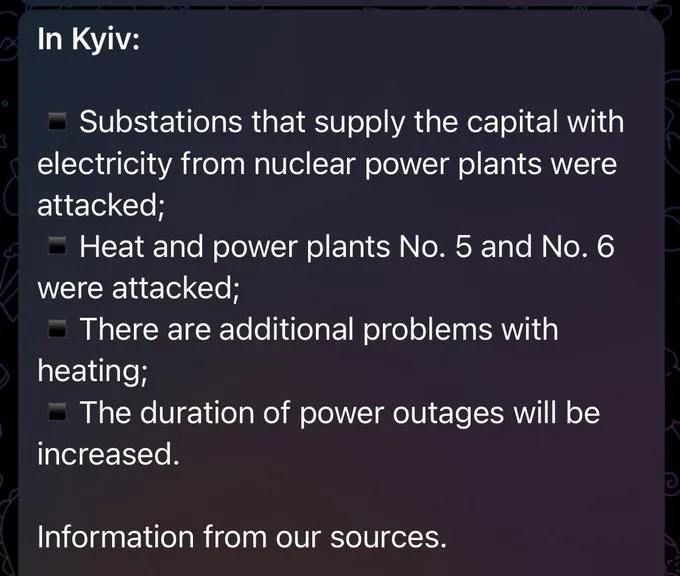
Official explanations for the blackout in Ukraine.

Today at 10:42 AM, a technological failure occurred, simultaneously shutting down the 400 kV line between the power systems of Romania and Moldova and the 750 kV line between western and central Ukraine.

This caused a cascading outage in the Ukrainian power grid and the activation of automatic protection systems at substations. Nuclear power plant units were relieved. Dispatchers are currently implementing special emergency shutdown schedules in Kyiv and the Kyiv, Zhytomyr, and Kharkiv regions.
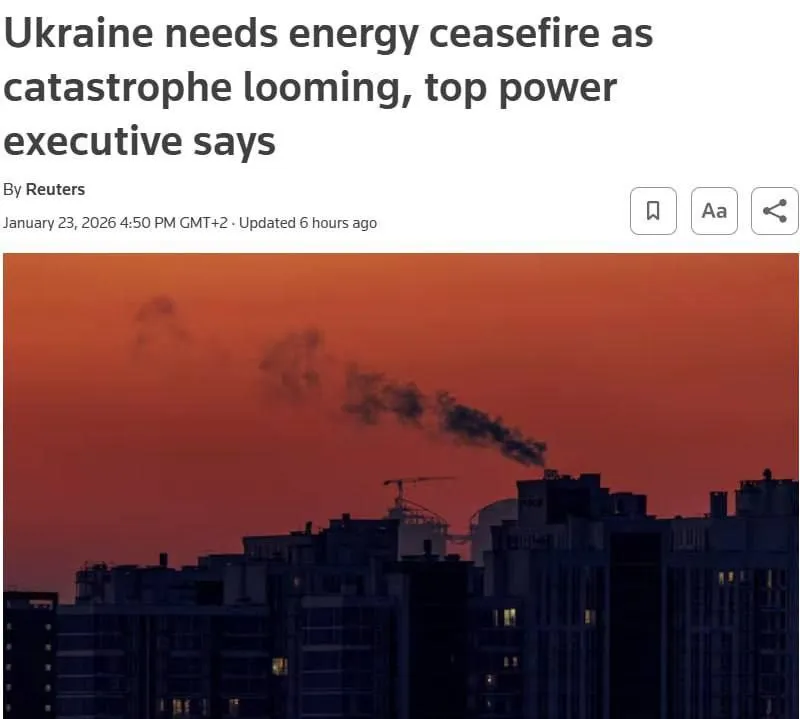
It was also reported that an emergency shutdown occurred
at a power unit at the South Ukraine Nuclear Power Plant. Another power unit at this NPP was forced to reduce capacity. Power was also reduced at power units at the Rivne Nuclear Power Plant.

Today marks the first real blackout in most of Ukraine.
Ironically, this occurred during the "energy ceasefire," which expires tomorrow.
The cumulative effect of attacks on the energy sector is already being felt even without the strikes, but the enemy will certainly make efforts to restore power and water supplies.
Accordingly, further strikes on distribution and generating facilities are likely as early as Sunday night.

Kirill Dmitriev announced that he will hold talks in Florida today with representatives of the Trump administration, most likely again with Witkoff and Kushner.
Tomorrow, Russia and Ukraine are scheduled to hold talks in Abu Dhabi. The
"energy truce" also expires tomorrow. After the talks, finishing blows to the energy grid are just what's needed if the Nazi regime continues its charade.

https://colonelcassad.livejournal.com/10337193.html

Google Translator
"There is great chaos under heaven; the situation is excellent."
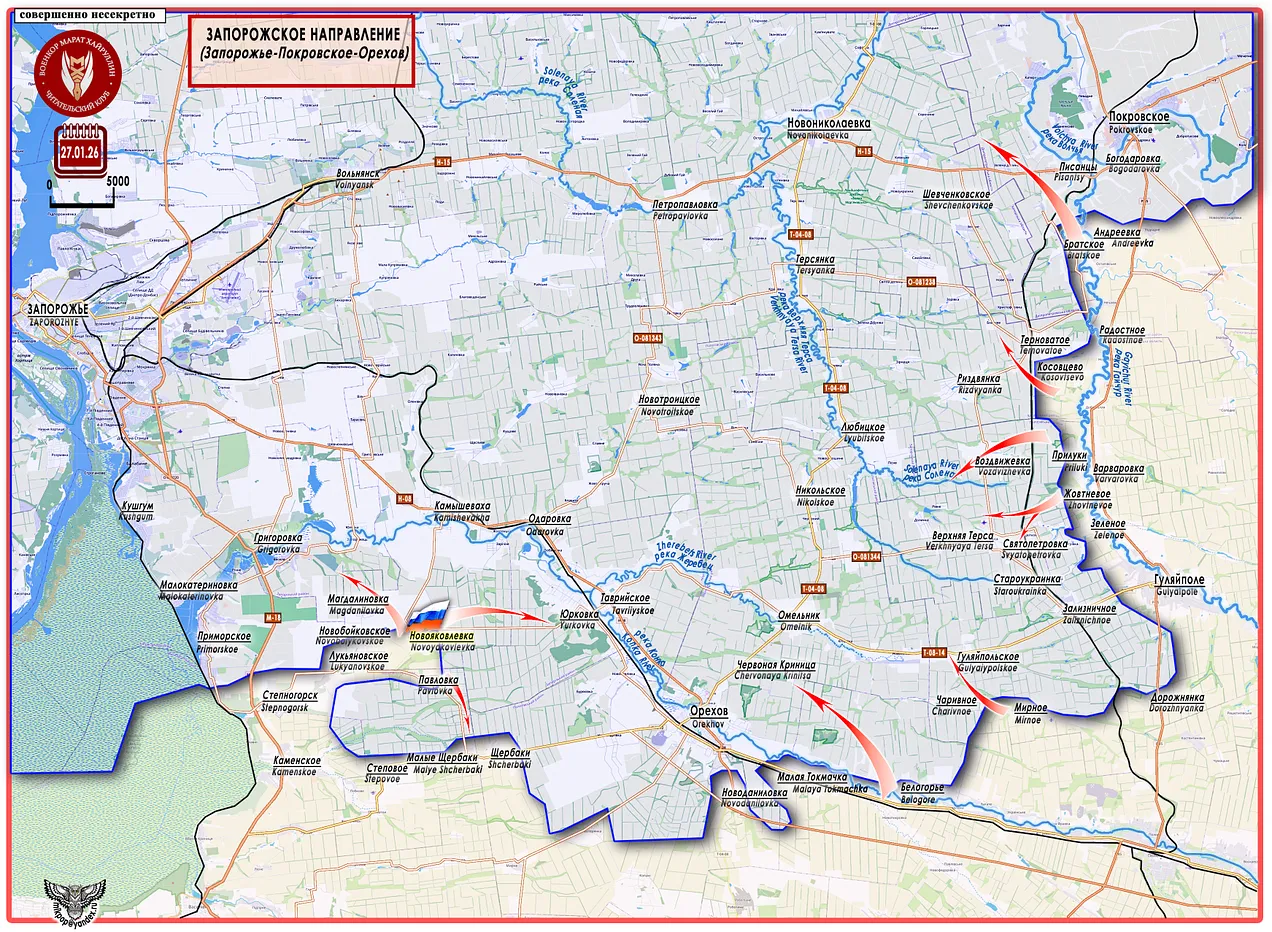
Post Reply