Footnotes from the Ukrainian "Crisis"; New High-Points in Cynicism Part V

User avatar
blindpig
Posts: 15059
Joined: Fri Jul 14, 2017 5:44 pm
Location: Turtle Island
Contact:

Re: Footnotes from the Ukrainian "Crisis"; New High-Points in Cynicism Part V

Post by blindpig » Thu Dec 25, 2025 2:58 pm

Another plan designed to be rejected
Published by @nsanzo ⋅ 25/12/2025

Image

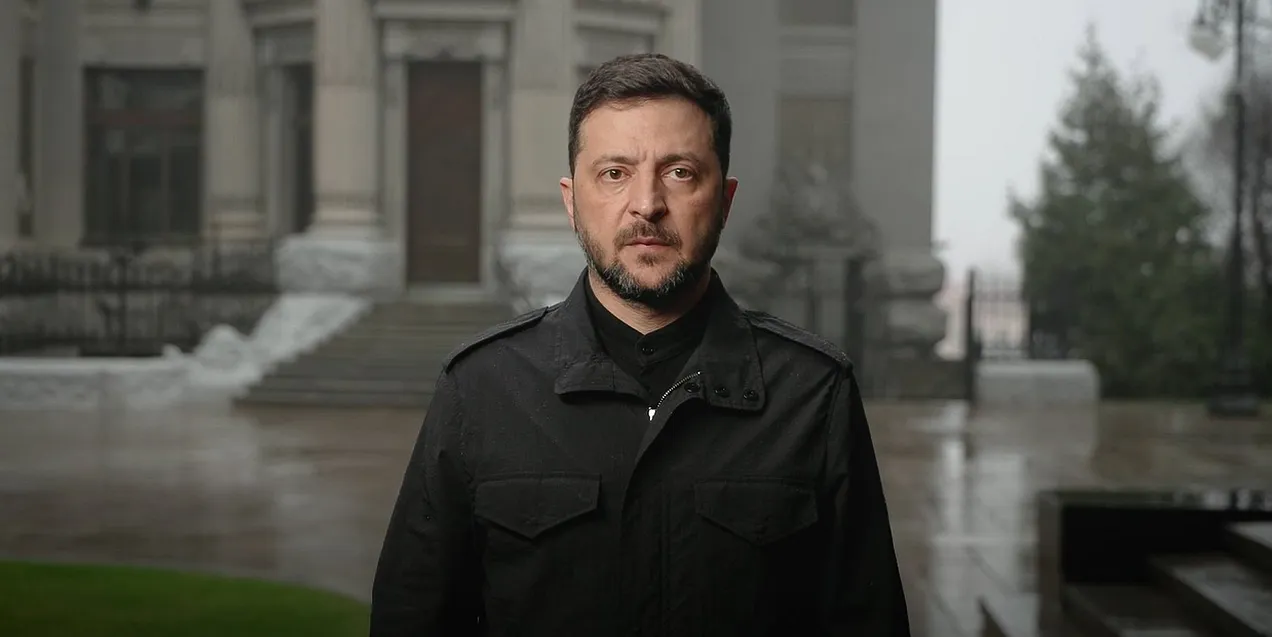
On Tuesday, in one of his many addresses to the nation, Volodymyr Zelensky highlighted the shift in recent years, seen as a tool for rapprochement with Western families , to celebrate “true Christmas” according to the Western calendar rather than the Orthodox one. Much to the chagrin of Pope Leo XIV, who condemned the move yesterday, the change has not brought about a ceasefire, which Russia has rejected as meaningless, failing to advance toward a resolution and only benefiting the side on the defensive. The change in the dates on which the Ukrainian population celebrates the holidays has also failed to bring about a ceasefire on the information front. In his speech yesterday, the Ukrainian president described the Russian population as “people without god” who have “nothing in common with Christianity or anything human.” Without mentioning the name of the person he was referring to, the Ukrainian president stated that they all share one wish: “that he dies.” Hours earlier, demanding a swift response from Moscow, Zelensky had unveiled the 20-point plan with which Ukraine is prepared to end the war. Despite the questionable nature of some points, especially the one concerning control of the Zaporizhzhia nuclear facility, which is pending the continuation of negotiations with Washington, the Ukrainian president claims it is the plan agreed upon by Kyiv and Washington. However, the content of the points published by the Ukrainian authorities makes it clear that this is a media operation with which Ukraine hopes to pressure both its American ally and its Russian opponent into a more favorable agreement for Kyiv.

As could be expected given Ukraine's absolute dependence on its allies and arms suppliers, which nullifies Kyiv's ability to say no to London, Paris, Berlin, and especially Washington, the plan that Zelensky's team is negotiating with Witkoff's and which was published yesterday—predictably prematurely and without coordination with Washington—is based on the 28-point proposal leaked to the press a few weeks ago. Since then, Zelensky has made three tours of the European Union seeking support from his most loyal electorate, Western heads of state and government, and has acted as a lobbying group to push for swift action to remove the issue of using Russian assets held in the EU from the negotiating table. The lack of an agreement has prevented the definitive freezing of these funds from putting them into the hands of Ukraine for military use, but it has eliminated the danger of them being used for reconstruction as war reparations, given the EU a sense of strength and the impression of having something to say in the negotiation, and put Kyiv in a slightly better negotiating position.


Guaranteed by a €90 billion loan from the European Union to sustain the Ukrainian state for the next two years, Kyiv can afford to press for an agreement whose chances of success under the current balance of power on the front lines tend toward zero. Aware that Donald Trump's anger is usually directed at the person he accuses of obstructing peace, Zelensky has sought to accelerate the process, directing the ultimatum to Moscow and publishing his version of the Witkoff Plan as a tool of pressure. “We will never be able to match the sacrifice of the Ukrainian people. But we will support their struggle for survival for as long as necessary. Because Ukraine's security is our security. We have already provided €193 billion in financial, military, and humanitarian support. And we have just agreed to another €90 billion for the next two years,” wrote Ursula von der Leyen, Zelensky's main supporter and representative of the European Union, the Ukrainian army's main supplier, yesterday. The message is clear: thanks to continuous and increasing European funding, Ukraine can afford to keep fighting. Hence, it can also afford to continue publishing plans that, like Zelensky's 2023 "Peace Formula" or the 2024 "Victory Plan," respond only to Ukrainian needs and lack any realism, given that, without having won the war, Ukraine does not have the necessary power to impose peace on its terms.

“The United States and Ukraine have reached consensus on several critical issues aimed at ending the conflict, but sensitive issues surrounding territorial control in the industrial heartland of eastern Ukraine remain unresolved, said the Ukrainian president,” AP reported yesterday . Russian opposition journalist Leonid Ragozin responded that he was “not sure the US side has reached a consensus with Zelensky, at least not on the version of the plan he has presented.” The plan published by Zelensky, the basis of which was negotiated by the United States in a dialogue that, as Ukraine itself admits is still incomplete, shows, is a general political framework, far less concrete than the original 28 points and lacking virtually all the details.

The document outlines the same points as previous drafts promoted by Ukraine: the plan that Zelensky claims to have agreed upon with the United States grants Kyiv everything it can achieve without having won the war: a freeze on the front line along the contact line and no further territorial losses, security guarantees from Washington, the presence of allied troops along the line of contact, future economic benefits in the form of a free trade agreement with the United States and multi-billion dollar investments for reconstruction and the exploitation of the country's natural resources, and privileged accession to the European Union and the single market. Ukraine even goes so far as to reject the US proposal for international oversight of the Energodar nuclear power plant and a 50/50 share of the energy produced. Ukraine maintains that there is still no agreement with the United States, but rejects this option. The only Russian red line that the document does not cross is the one concerning war reparations, which Ukraine has always demanded. However, given that Ukraine would only have to repay the €90 billion loan granted by the European Union if it received payment from Russia, the demand for war reparations is implicit and doesn't even need to be explicitly included in the proposal. The plan entails a heavy militarization of Ukraine, the presence of a contingent of foreign troops on the de facto border —which Kyiv will demand be from the "Coalition of the Willing," meaning NATO member states—and, predictably, omits any mention of the demand for neutrality. Therefore, the aspiration to join the Atlantic Alliance persists, a key factor in this war and Russia's main red line.

In a sham concession, Zelensky yesterday opened the door to the possibility of withdrawing Ukrainian "heavy forces" from the part of Donetsk under his control. Although the plan aims to maintain the line of separation as a de facto border in the four territories that Russia claims as its own—Kherson, Zaporizhzhia, Donetsk, and Luhansk—the Ukrainian president claims to be willing to a partial withdrawal to create a demilitarized zone or free economic zone managed by Ukraine or with a presence of international troops in the event of a similar withdrawal by Russia, an absurd proposition that has only been credible to the most gullible journalists.

“Ukraine is ready to withdraw ‘heavy forces’ from the parts of the Donbas region it still controls if Russia matches the withdrawal as part of a peace agreement, Ukrainian President Volodymyr Zelensky said in comments published Wednesday,” wrote Financial Times correspondent Christopher Miller, focusing on one of the less credible details. The willingness to see good faith and legitimate proposals seeking conflict resolution in every word Zelensky utters compels analysts and think tanks to suspend their critical thinking when faced with certain propositions specifically designed to elicit a “no” from the enemy.

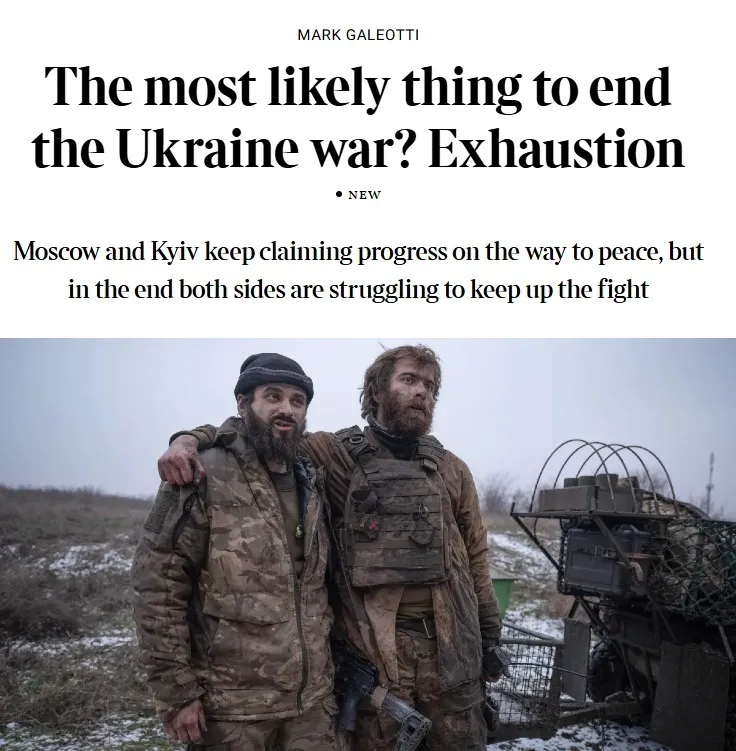
“Am I missing something? I don’t see how Zelensky’s proposed plan—that Russia not acquire that 20% of the Donetsk region, withdraw its forces, and that the Ukrainians monitor the demilitarized zone—could be even remotely acceptable to Putin. Surely, this is just a tactic to trap him into rejecting it, isn’t it?” asked Mark Galeotti, an analyst and columnist for The Times, yesterday . The terms of Zelensky’s plan are vague in many ways, but its subtext is clear: this is the kind of equivalent to the Minsk agreements that Kyiv and the European capitals were seeking to reconcile their two most important objectives: appeasing Donald Trump by offering a semblance of peace and obtaining a treaty that neither closes the door to the future recovery of lost territories nor abandons Ukraine’s irreversible Euro-Atlantic path. “There’s no mention of Ukraine’s neutrality or its withdrawal from NATO, so it seems more like what the Kremlin calls megaphone diplomacy . Unworkable. If the Americans come to Moscow with a new plan, this won’t be the right one,” added Leonid Ragozin.

“The strange, itinerant diplomacy we’ve witnessed all year has finally come to an end. It’s a waste of time for the American mediators to take notes for these parties. It’s time to bring them together in one room. Ideally, at a technical level. But time is running out,” wrote activist Almut Rochowanski, sharing the predictable news that the Kremlin will seek changes to the plan published by Zelensky. However, this stance openly contradicts the subtext of each and every Ukrainian proposal, which is always political and never technical, focused solely on a general framework for consolidating a ceasefire that allows Ukraine to stop losing territory, recover, demand reparations from both allies and the enemy, and continue to demand, through political means, what it has lost in the war and what no treaty attempts to renounce. Negotiations will continue, and Moscow is not expected to respond positively to a proposal that crosses all of Russia’s red lines, both in security and on the territorial issue, and that fails to resolve any of the essential aspects of the war. Unable to give a flat no to the United States, it is foreseeable that Moscow will try to include its demands within the framework of those 20 points, introducing, for example, the demand for neutrality in the points relating to security guarantees.

https://slavyangrad.es/2025/12/25/otro- ... rechazado/


Google Translator

*****

From Cassad's telegram account:

Colonelcassad
After the Russian Armed Forces repeatedly attacked the Kremenchug Oil Refinery in June of this year, Ukraine experienced a surge in fuel demand, and India was the first country to offer its services.

In just one month, diesel fuel supplies from India reached record levels, and by July, Indian motor fuel had already become Kyiv's top supplier via tanker shipments along the Danube from Romania.

Recently, it was announced that the Indian company Reliance has resumed purchasing Russian oil. This is the same company that supplies diesel to the Ukrainian Armed Forces.

So, when we attack Danube and Black Sea port logistics (and we are doing so right now), we are essentially attacking the final destination of our own oil's logistical journey.

Ultimately, everyone profits, except Kyiv.
@svarschiki

***

Colonelcassad
Dmitry Peskov's key statements:

- As of now, a phone call between Putin and Trump is not planned;

- The Kremlin saw Zelenskyy's Christmas speech, he "looks like a slightly inadequate person";

- Zelenskyy's Christmas speech is uncultured and embittered;

- Zelenskyy's statements call into question whether he is capable of making adequate decisions on a political and diplomatic settlement;

- Putin gave a number of instructions to the government during a meeting with businesses;

- There were no unexpected questions at Putin's meeting with businesses; the conversation was substantive and practical;

- During the meeting with businesses, Putin himself commented on issues of concern to entrepreneurs and asked the heads of the Cabinet's economic bloc to speak out.

***

Colonelcassad
Romania is heading toward war.

Several opposition politicians believe Romania is increasingly drawn into a confrontation with Russia. This was stated by Georgescu, a former presidential candidate who was disqualified from the election. He believes NATO views the country as a convenient springboard for escalating the conflict with Russia, ignoring public opinion and Romania's own reluctance to become an instrument of the alliance.

The country's geographic location plays a key role. Its proximity to Ukraine, the presence of the "buffer" state of Moldova, and its long border with the conflict zone make Romania strategically important for NATO, including for operations in the Black Sea region. The alliance views the country as a resource that can be used in the standoff with Moscow.

Following elections held amid allegations of irregularities, pro-Western President Nicusor Dan came to power. Critics argue that democratic institutions have been weakened, and the country's political system is increasingly controlled from outside. France and the United States are increasing their influence: Paris-affiliated structures are present in Romania, and American units, including the 101st Airborne Division, are conducting intensive exercises at local training grounds.

Despite Washington's stated commitment to resolving the Ukrainian conflict, the West's strategic course of containing Russia remains unchanged. As a member of NATO and the EU, Romania is aligning its policies with the decisions of Brussels and the alliance, effectively demonstrating a readiness for confrontation.

Further tensions are being created by initiatives from Paris and London to form a "coalition of the willing" and the possible deployment of Western troops to Ukraine. Europe is not yet ready for direct war, but it is rapidly increasing its military budgets, militarizing its economy, and waging an information campaign to portray Russia as the main threat.

NATO exercises are regularly held in Romania. The Dacian Fall maneuvers included rehearsals for the transfer of troops from France to the alliance's eastern borders. Russia's increased efforts to prevent arms shipments from Romanian territory to Ukraine have already led to attacks on logistics infrastructure. Further escalation, experts warn, could lead to Romania being recognized as a direct party to the conflict, with all the ensuing consequences.

***

Colonelcassad
0:56
Key points from Nebenzya's speech at the UN:

For several months, the entire world has been able to observe how the United States continues to deliberately fuel tensions around the friendly country of Venezuela under the pretext of combating drug trafficking and the terrorist threat.

This artificial smokescreen conceals the purpose of American military groups exerting pressure on an independent state whose policies Washington dislikes.

We strongly condemn the seizure of oil tankers and the de facto blockade of Venezuela, which constitute a clear act of aggression.

This intervention risks becoming a template for future actions against Latin American states in accordance with the Monroe Doctrine.

Washington respects independence only if states adapt their policies to U.S. interests. Otherwise, they will be treated the same way as Venezuela.

@genshtab24

https://t.me/s/boris_rozhin

Google Translator

*****

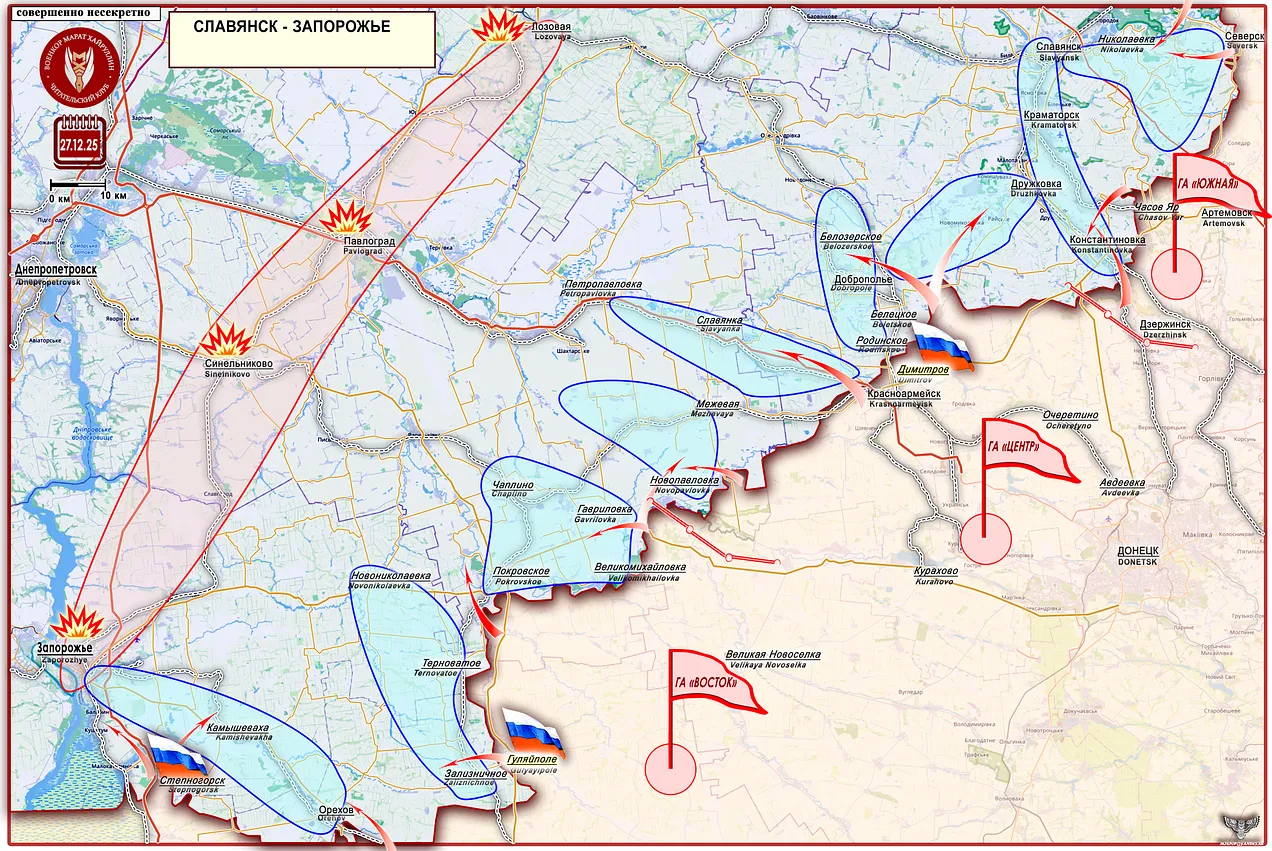
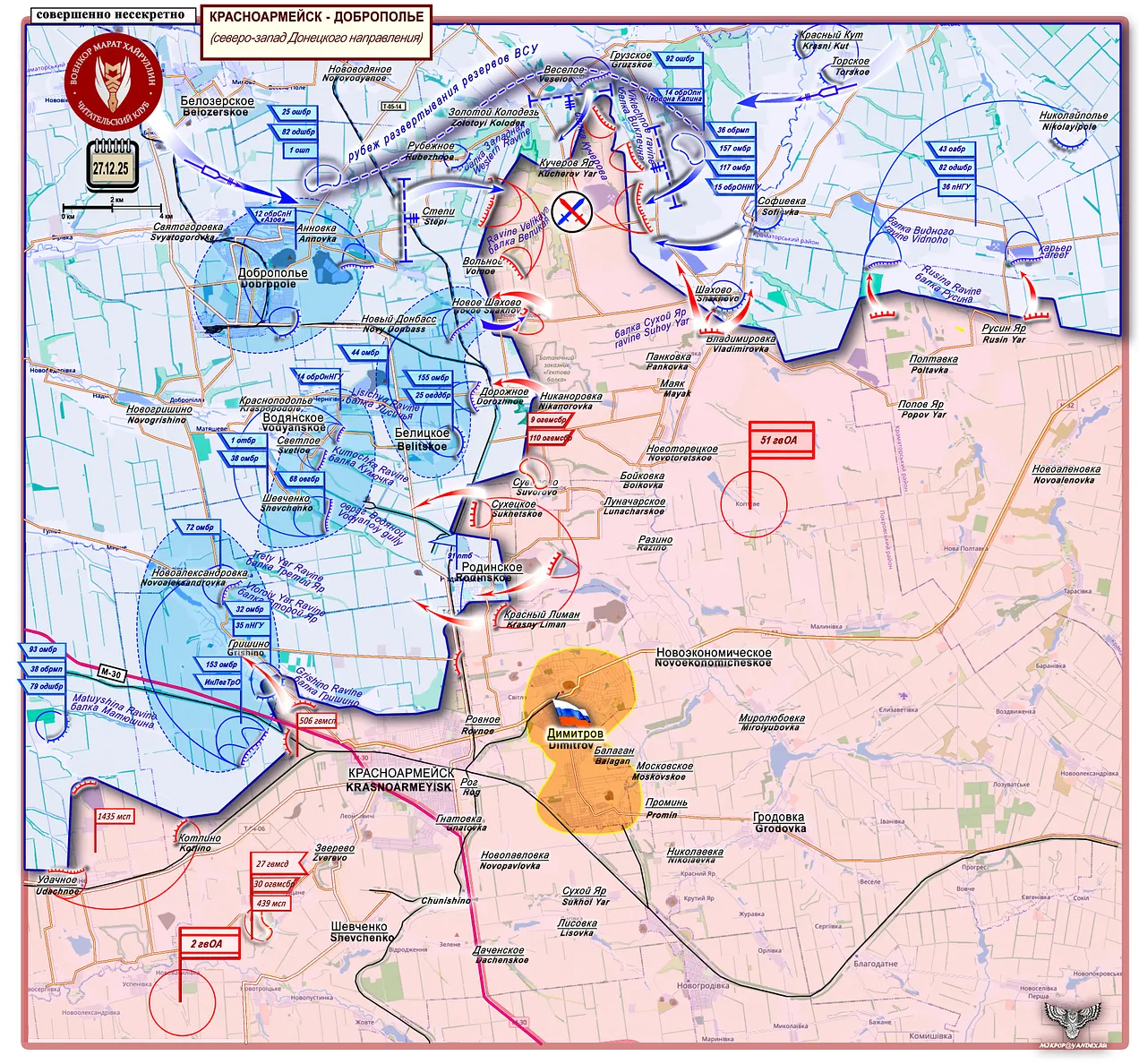
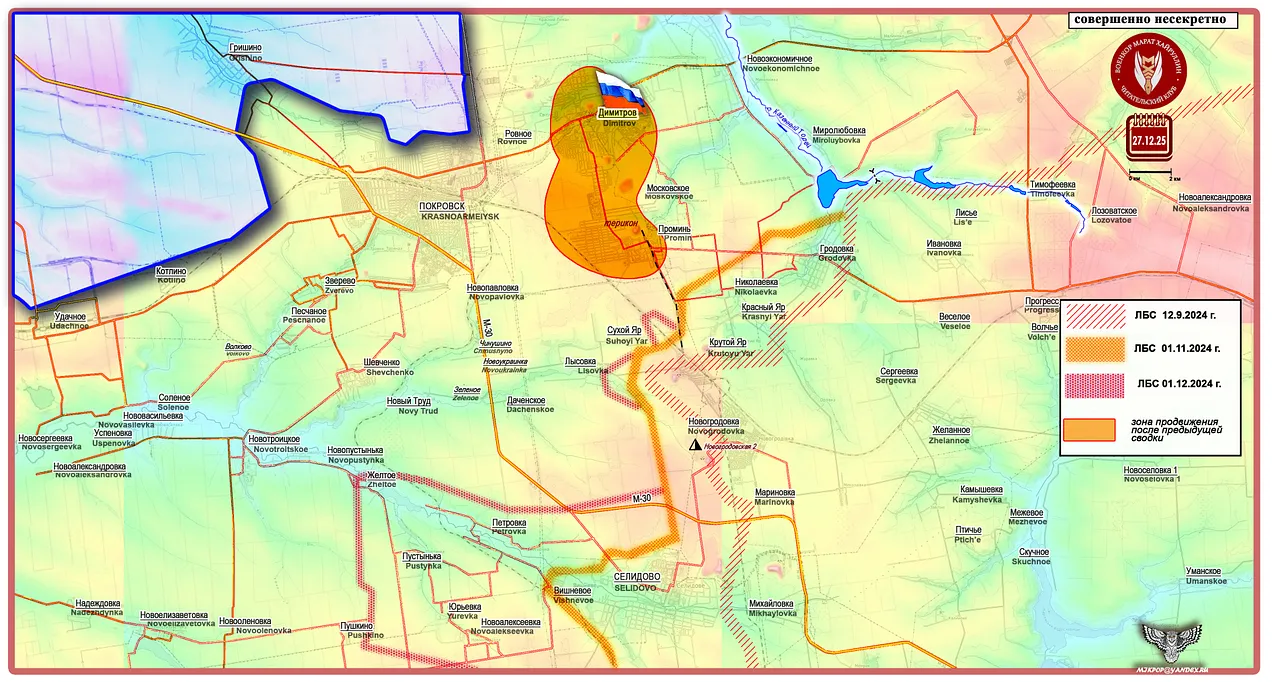
Brief Frontline Report – December 24th, 2025

Summary by Marat Khairullin and Mikhail Popov.
Zinderneuf
Dec 24, 2025

Image
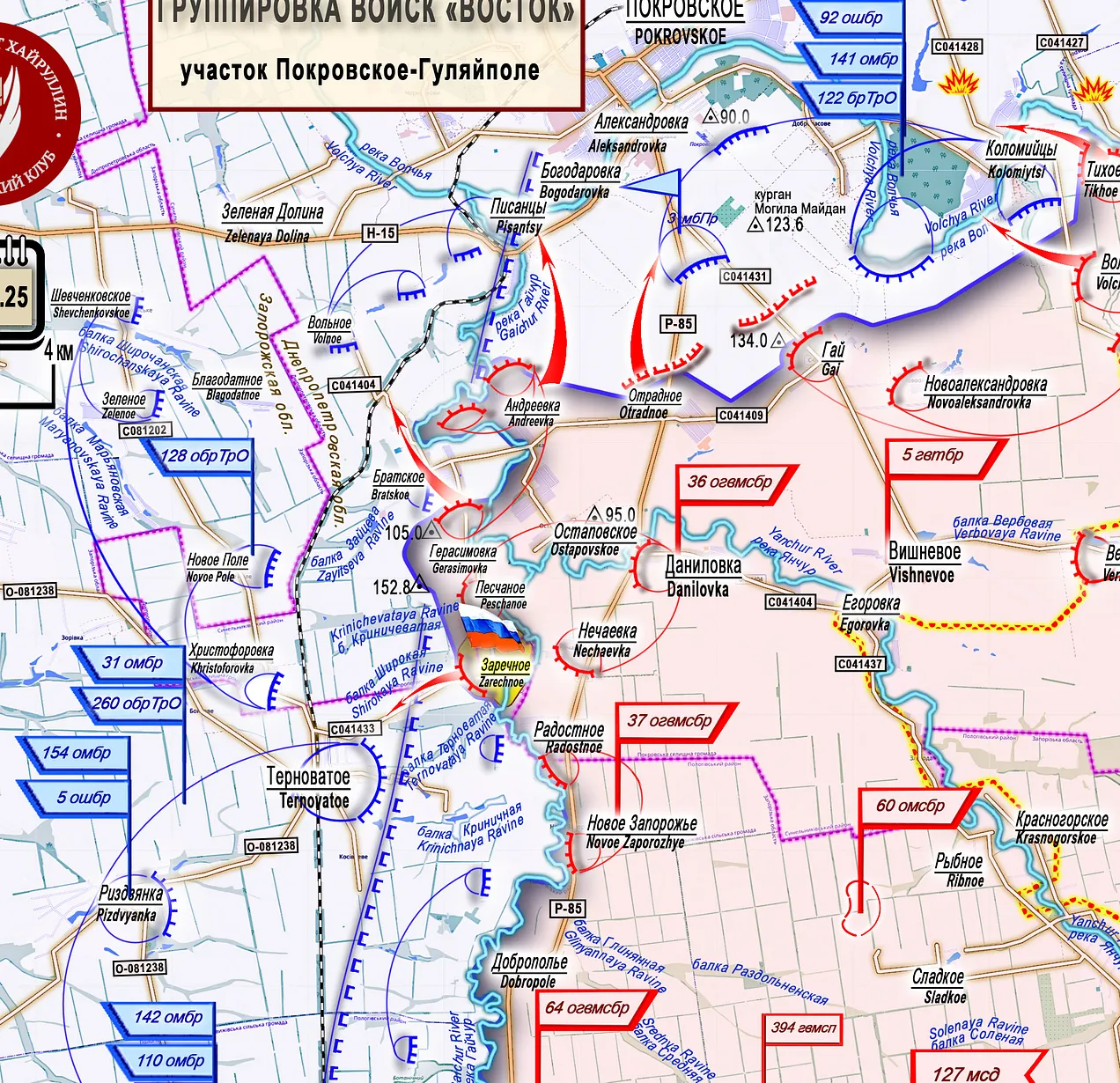
Map legend: the yellow line with red dots, ЛБС 28.10.2025=Line of Combat Contact October 28th, 2025. Yellow=Activity.

Message from the Russian Ministry of Defense: "Assault units of the 36th Separate Guards Motor Rifle Brigade of the 29th Guards Combined Arms Army of the 'East' Group, while expanding the bridgehead on the western bank of the Gaichur River, have taken control of the settlement of Zarechnoe in Zaporozhye Oblast. (Video at link.)

Personnel from the Far East have cleared an area of the enemy's defenses at the junction of Zaporozhye and Dnepropetrovsk Oblast in the Gaichur River area, spanning nine square kilometers.

Furthermore, units of the 'East' Group have taken control of a section of the road connecting the settlements of Bratskoe and Ternovatoe."
Image

The Russian Armed Forces are expanding the bridgehead on the left bank of the Gaichur River along the Gerasimovka-Peschanoe-Zarechnoe line. On December 24, the settlement of Zarechnoe (47°51′14″ N, 36°11′05″ E, approximately 15 residents) was liberated. It was once a large village in the Novonikolaevsky district of Zaporozhye Oblast but is now in decline, with no more than 5 permanent residents. The river in this area is winding, forming inlets, oxbow lakes, and marshy lakes.

After Russian units reached the Gerasimovka-Peschanoe-Zarechnoe line, they gained control over the outlets of the Krinichevataya, Shirokaya, and Ternovataya ravines. These ravines originate on the watershed of the Gaichur and Verkhnyaya Tersa rivers. Along the ridge of this watershed runs the Pokrovskoe-Ternovatoe railway line, allowing for the envelopment of the Ternovatoe transport hub from the north.

Operating from the Gerasimovka-Zarechnoe bridgehead, Russian units gain operational freedom to execute envelopments of Ukrainian Armed Forces groupings on the southern face of the Pokrovskoe sector or the northern face of the Gulyaipole sector, depending on the tactical situation.

https://maratkhairullin.substack.com/p/ ... ember-24th

*****

Russian right muzzled

The death of the 'Spaniard'. Rusich's humiliations. Drugs, arms smuggling, football hooligans.
Events in Ukraine
Dec 24, 2025

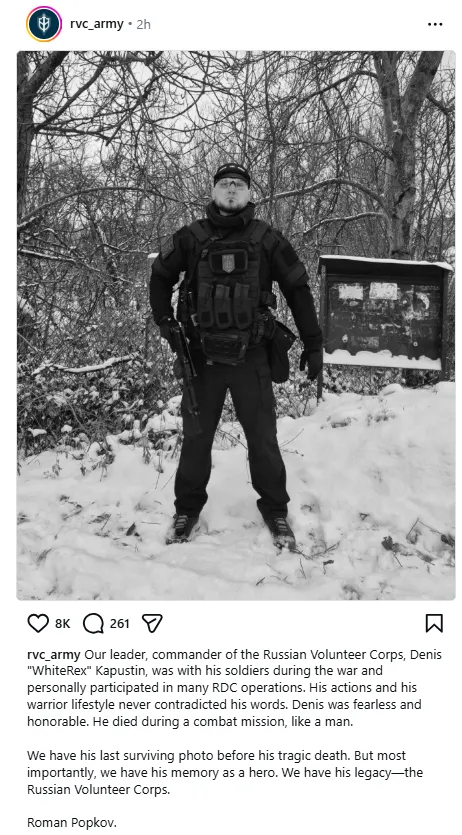
A few days ago, news emerged that the leader of Russia’s largest rightwing battalion had been killed. Not at war, but by Russian security services. This incident is quite symptomatic of the quite different relationship the Russian and Ukrainian governments have towards the use of ideologized nationalist militias.

This is also quite relevant for the future of the war. The western media likes to occasionally fantasize about another Prigozhin-style uprising. Alternatively, the press sometimes claims that the Russian government could be limited in its negotiation capacities due to putative resistance from nationalists in the military.

As the following stories should show, this is quite a misplaced fear (or hope). Unlike Ukraine, Russia’s nationalists are quite hamstrung by the security services, though some influential figures do patronize them.

Russian volunteer units
Both the Russian and Ukrainian war efforts have involved nationalist volunteer units, quite often filled with exceedingly unsavoury individuals. However, the two societies have quite different approaches towards these volunteer units, or, to call a spade a spade, neo-nazi militias.
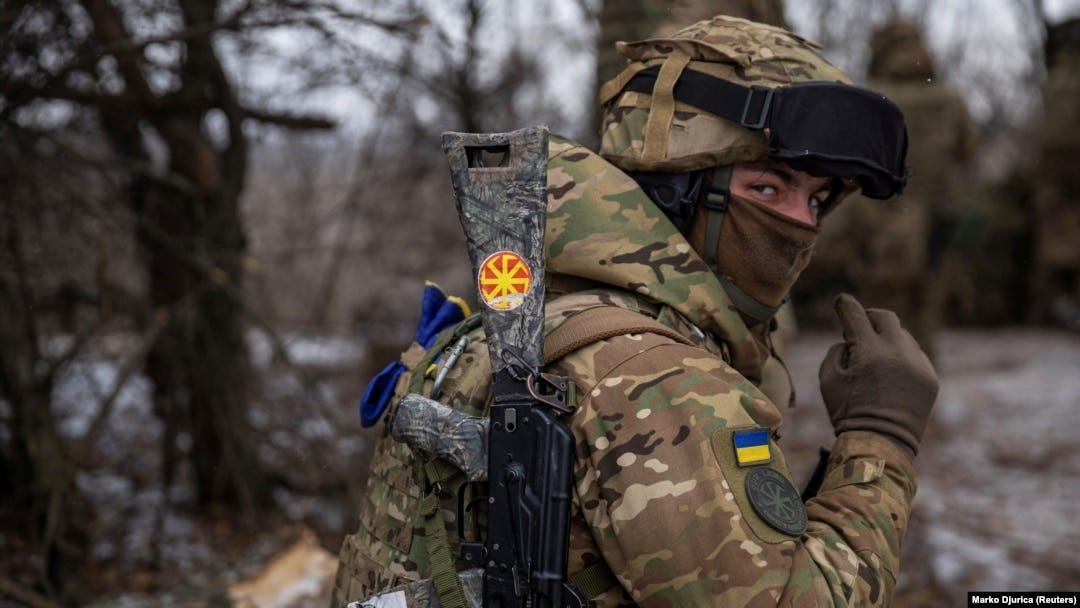
Image
An Azov fighter with a kolovrat Slavic swastika. His Russian counterparts in the some of the groups we will cover today enjoy the same symbol.

Ukraine has built its identity around a (neoliberal) disdain for the state and glorification of ‘ground-up initiatives’. This conception heroizes IT startupers and nationalist volunteer battalions alike. Indeed, the same class of people can be found in both groups.

Russia, in contrast, glorifies the power of its state. It is the regular armed forces that are expected to win wars, not ‘plucky volunteers’. Nevertheless, Tsarist Russia once employed a vast contingent of irregular Cossack troops to guard its borders.

The role of the Cossacks in the history of both countries is instructive. Cossacks in both modern-day Ukraine and Russia regularly rioted against authority.

When the Cossack Bohdan Khmelnitsky rose up against the Polish-Lithuanian Commonwealth in 1654, this gave rise to the short-lived Hetmanate. This was a vassal state to Russia that marked the highpoint of Ukrainian national sovereignty until the 20th century. Ukrainian nationalist historians have always stressed the ‘freedom-loving Cossack’ as the foundation of Ukrainian statehood.

Image
Ilya Repin’s famous painting ‘Reply of the Zaporozhian Cossacks’

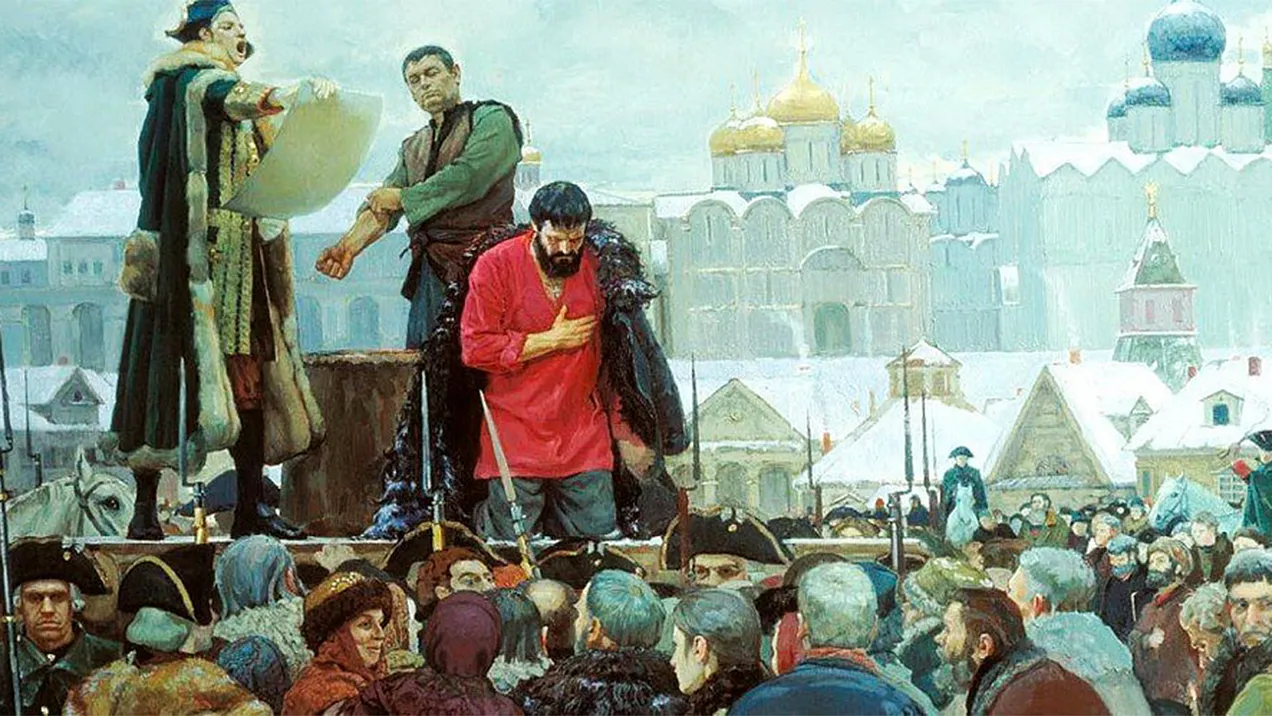
But when Russian Cossacks like Stepan Razin or Emelyan Pugachev rose up against Moscow in the 17th and 18th centuries, they were crushed by the central government. They are remembered as either traitors with possible foreign ties or misguided fighters for social justice. Russian national poet novelized Pugachev’s uprising, famously quipping:

God forbid we see a Russian revolt, senseless and merciless!
Image

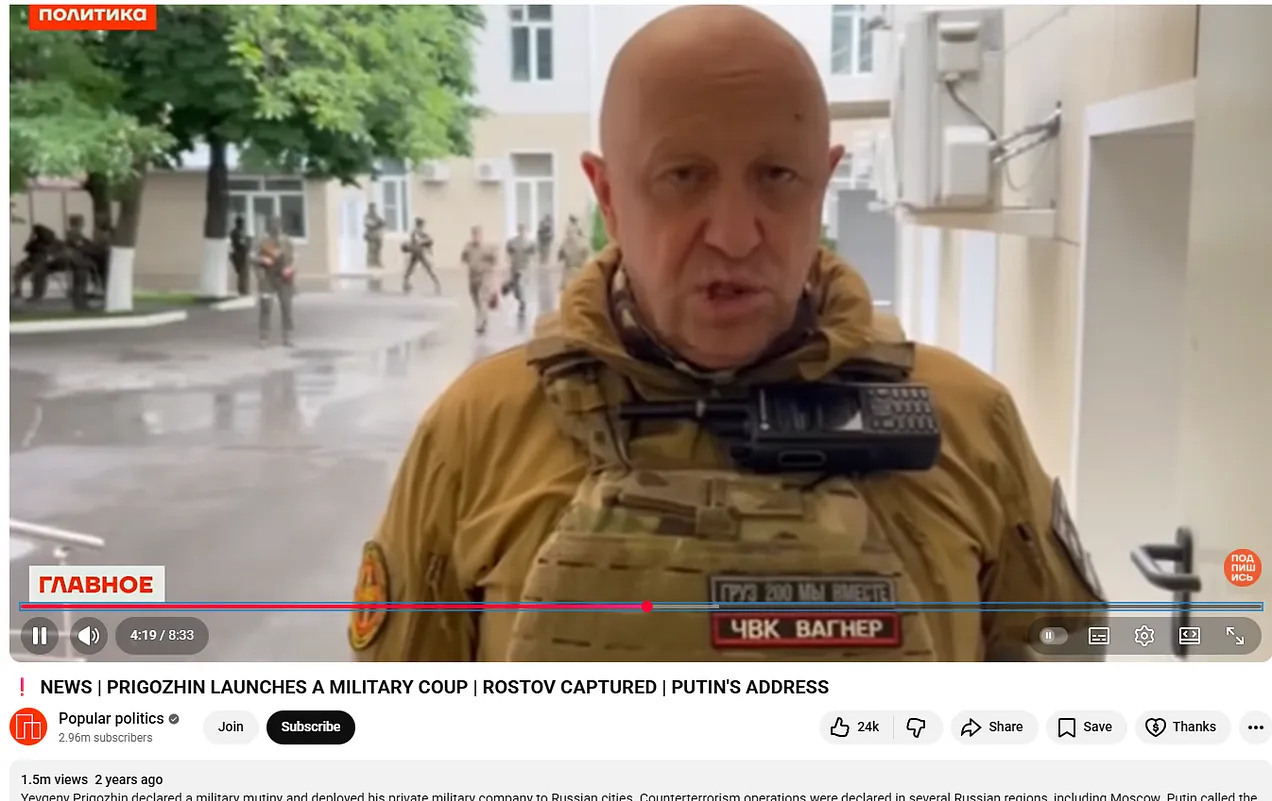
The 2023 uprising by PMC Wagner leader Evgeny Prigozhin is often compared to the mutinies of Razin and Pugachev, both by Prigozhin’s opponents in the Russian government and his nationalist admirers. The dissolution of PMC Wagner and the mysterious (or not) death of Prigozhin soon after his failed mutiny also echoes Razin and Pugachev’s fates. All the groups we will analyze today were at some point allied with Prigozhin’s PMC Wagner.
Image
Holy shit!

Now back to the present.

Ukraine’s army was extremely unenthusiastic to fight its citizens in 2014. As a result, much of the early war effort depended on the efforts of nationalist fighters in volunteer formations like Azov.

Facing the likes of Azov were mostly not opposed nationalist forces. In the 2014 to 2022 period, most of the combatants fighting the Kiev government in the Donbass were (former) Ukrainian citizens. For this reason, oligarch Igor Kolomoisky, a major sponsor of Ukrainian volunteer troops in 2014-15, called it a ‘civil conflict’ in 2018. He said the war was most similar to the Spanish Civil War, a comparison I agree with. Though it was Spaniards who did most of the fighting, all sides were significantly aided by outside forces. That didn’t negate its character as a civil war.


And if the weak Ukrainian state was probably desperate to send rebellious nationalists off to die in the war, the Russian government felt less pressure to do so.

Unlike Ukraine, Russia has been able to repress rebellious nationalists quite easily. Maxim Martsinkevich, the most famous neo-nazi of the post-soviet world, idolized by nationalists in both Ukraine and Russia, died in a Russian jail in 2020. Scores of violent Russian nationalists fled to Ukraine to escape criminal charges in Russia throughout the 2000s. After the 2014 euromaidan, even more Russian neo-nazis came to Ukraine. Many of them have gone on to play highly important roles in the development of the Azov movement.

But there were ideologized volunteer units on the side of the pro-Russian Donbass republics, as well. Unlike Ukraine, there was more ideological diversity here. On the side of the Donbass republics fought both neo-nazis in ‘Rusich’ and left-populists in ‘Prizrak’. Declared communists with their symbolism have always been able to fight on the Donbass/Russian side, unlike Ukraine.

Image
The emblem of the anti-Kiev Rusich unit. Again, the Kolovrat.

Nevertheless, in the 2014-22 period groups like Rusich were relatively tiny. Though they got plenty of PR, Rusich leader Alexey Milchakov admitted in a 2020 interview that his unit only had a few dozen members. Though Rusich was in the Donbass in 2014, after that its fighters were with Wagner in Syria.

Image
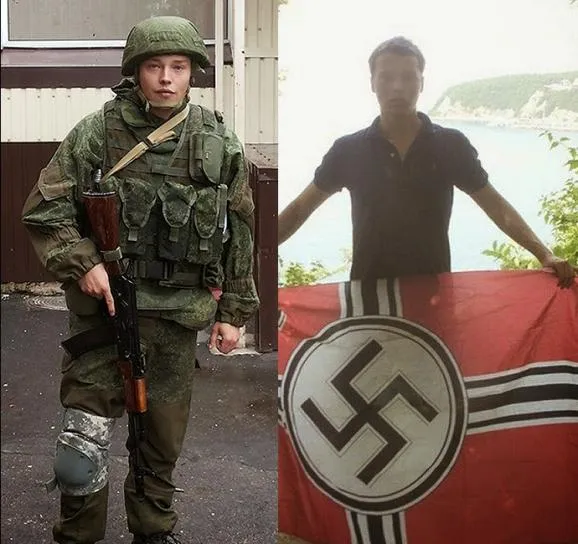
Alexey Milchakov, leader of Rusich, famously declared ‘I am a nazi and I am proud of that’ in an interview a few years back

By 2022, western media would claim that Rusich had several hundred members. It is certainly likely that Rusich has grown in wartime.

But it is still incomparable to Ukraine’s Azov, which counts many tens of thousands of members in the Ukrainian army over a range of units. The Third Army Corps alone has 20,000 troops as of 2025, and is set to grow to 40,000. And there are many other units in the Azov family, such as the 1st Azov Corps of the national Guard and special forces units in military intelligence like the Russian Volunteer Corps or Kraken.

What Rusich lacks in size, it makes up for media presence. Its telegram channel has almost 250,000 subscribers. This is at least partly due to Rusich’s PR support from the rightwing Russian oligarch Konstantin Malofeev, especially through his ‘Tsargrad’ media group. In turn, Rusich churns out the anti-migrant propaganda that Malofeev so loves.

Image

But why does such a unit exist to begin with? There’s the obvious fact that those with a passion for and experience in violence are what any state needs to fight wars. The nazi football hooligans that make up groups like Rusich certainly fit these qualifications.

Groups like Rusich — and the Wagner PMC, which was always closely associated with Rusich — also ensure that potentially oppositional white nationalists are fighting for the government, not against it. This isn’t anything particularly new. It is often hard to distinguish the ‘true nationalists’ and the ‘fake government ops’ in the Russian 2000s and 2010s. Of course, this hardly differs from the situation in the US, or any other country.
Image
Famous photos of Rusich leader Milchakov

Figures like Malofeev and groups like Rusich are also important in that they prevent all Russian nationalists from defecting to the Ukrainian side. In 2014, a significant portion of Russian nationalists did just that. Given their repression by the Russian government, pro-Ukrainian sentiments were particularly widespread among the most violent and extreme nationalists.

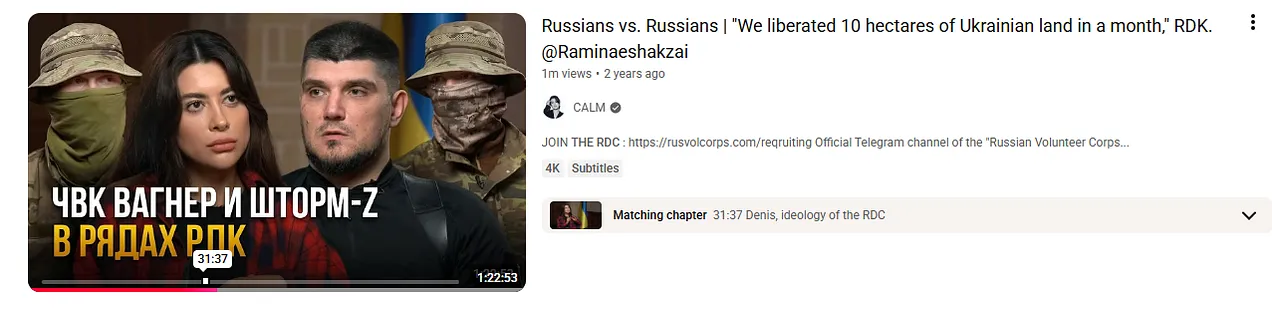
As I wrote recently, Rusich leader Alexey Milchakov’s best friend defected to Ukraine in 2014, becoming a prominent figure in Azov. Some even claim that Milchakov visited Kiev in late 2013 to check out the ongoing nationalist revolution. Rusich’s slogan ‘Glory to Rus’ is the same slogan used by Rusich’s competitors, the pro-Kiev Russian nazis in the ‘Russian Volunteer Corps’. In the interview to Ukrainian media below, Russian Volunteer Corps representative Alexei Levkin boasts that plenty of ex-Wagner troops have defected over to him.


Rusich’s humiliations
Russian rightwingers supporting the post-2022 war effort have certainly been able to grow their online reach. Rusich’s current telegram, set up in late 2022, only broke 100,000 followers in mid-2023, and currently has 250,000. The rightwing blogger/shitposter Vladislav Pozdnyakov has increased his telegram followership from 30,000 to 230,000 since 2022, and Rusich fighter Evgeny Razzkazov rose from 5,000 to 132,000 followers.

But despite this, they remain a rather embattled force in Russia’s complex world of political intrigues. Often accused of mainly existing online, Rusich seems to spend much of its time declaring it has abandoned the battlefield due to its frustrations with the Russian government. When it isn’t doing that, its fighters threaten the Russian government with race wars.

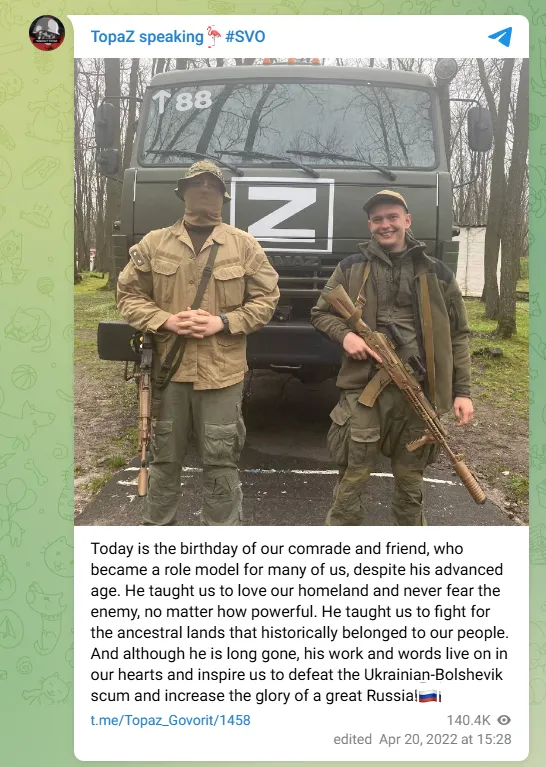
In July 2023, prominent Rusich fighter (Ukrainian-born, by the way) Evgeny Razzkazov threatened some sort of violent action unless the government punished a Muslim he accused of an attack on a military veteran:

I am issuing a direct ultimatum. The authorities have 48 hours… If this does not happen, I will take to the streets, and everyone who has the honor and courage to follow me will come out with me. And we will begin to defend our homes, our children, our wives, and our elderly ourselves.

Razzkazov, alias ‘Topaz’, is mainly known for publicly celebrating Hitler’s birthday. The following isn’t the only example.
Image

Anyway, Topaz’s grand 2023 race-war ultimatum came to… nothing. After his declared 48 hours deadline for the government to do something ran out, he met with two bloggers and announced a paid stream for ‘for subscribers of the rank ‘obscenely rich Russian’ and higher’. The two bloggers were a rightwing Muslim Dagestani (yes, they exist), and a Russian nationalist MMA fighter named Max Divnich, previously associated with Denis Nikitin’s WhiteRex tournaments. Nikitin is today the leader of Ukraine’s Russian Volunteer Corps.

In 2023, a Rusich-linked individual was arrested in St Petersburg for plotting a terrorist explosion. He claimed that his 3 kilograms of explosives and 166 rounds of ammunition belonged to Rusich. Drugs were also present. The man arrested, a 33 year-old painter, posts a range of rightwing, Nietzchean content online. He told another Russian publication that Rusich leader Milchakov had given him the weapons in 2015.

Image

As I’ve written before, Rusich was one of the few groups that openly supported Prigozhin’s July 2023 mutiny. It found itself in the company of a range of fervently anti-Putin liberals and neo-nazis living in Ukraine and western countries.

Obviously, this is unlikely to have helped Rusich’s image in the eyes of the government.

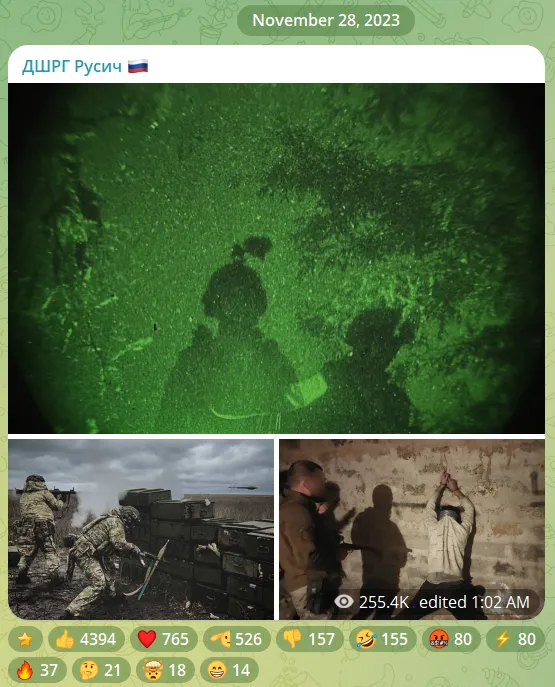
Then in August 2023, Rusich officially declared it was leaving the battlefield. Its reason for doing so was the Russian government’s inability to stop the arrest in Finland of key Rusich figure Yan Petrovsk, aka ‘Slavian’.

Image
This combat rest seems to have only lasted a few months.
Image

While Petrovsky rotted away in Finland, Kirill Rimkus, another Rusich co-founder was arrested in September 2023, this time in Russia. He was accused of kidnapping and violent extortion as part of an organized crime group. Rimkus died in Kursk in the summer of 2024. He was part of the unit Storm-Z, which is generally known for recruiting prisoners.

There’s also another fact about Rimkus. Just as Rusich leader Milchakov was close friends with pro-Ukrainian Russian neo-nazi Roman Zheleznov, Rimkus supported the Ukrainian Euromaidan in 2013. He only stopped supporting it after its victory in February 2014, because liberal nationalists came to power instead of the open neo-nazis he liked.

And in April 2024, prominent Rusich fighter and nationalist blogger Evgeny Razzkazov lost a court case against a left patriotic Russian senator. The court ordered Razzkazov to pay 500,000 rubles in compensation.

Image
A somewhat unflattering photo of Razzkazov, though his smile is unnerving in any circumstances. He also likes proclaiming his love for ‘sadism’.

The conflict between the two is all rather inane and I won’t go into it. As usual, it involves arguments over Muslims. The fact that Razzkazov lost the case is what matters. In Ukraine, it would be unthinkable for any politician to sue a top Azov fighter for slander, let alone to win the case. Razzkazov ended up fleeing to the frontlines to escape the court case, now as part of the Espanyola unit.

Rusich is also often forced to delete particularly offensive posts. In August 2024, Rusich called for its followerts to deliver it a ‘one captured Ukrainian (preferably not a true Slav, but a smoked Crimean Tatar or something similar) to perform a ritual sacrifice to the Slavic Gods’ After a protest from a Crimean Duma senator in the ruling United Russia party, they deleted the post a few days later.

There was also the declaration of cryptocurrency rewards for videos showing the execution of Ukrainian POWs recently. I covered it here, as well as the Ukrainian counter-competition. Rusich also deleted that post fairly quickly.

A particularly strange example of wikipedia’s bias can be seen in the page on ‘crimes involving the Order of the Nine Angles’. Despite the fact that the most well-known Russian adepts of this nazi satanist cult currently fight for the Ukrainian army, no mention is made of this. That is even though the bibliography for the page includes the Russian investigation into these very individuals!

Instead, Rusich is made into Russia’s chief O9A proponents. Now, I don’t doubt that Rusich is into the O9A mumbo jumbo. Maybe they’ve even committed some ritual murders. Their recent post calling to murder Ukrainian POWs contained a reference to Morena, the ‘Slavic god of death’ glorified by Russian O9A literature.

However, the wikipedia page contains bizarre allegations that Rusich forces ritually murdered and dismembered a Chechen ‘Akhmat’ soldier. The source for such claim is the New Statesman, but the only source is from Ukrainian hacker groups. Perhaps it really happened, but if it did, Akhmat would have made a massive noise about it. They are very well connected in Russia, as we will see shortly.

Rusich has had beef with the Chechen community. Quite naturally, given Rusich’s nationalist proclivities. Both Rusich and Chechen fighters accuse each other of being ‘Tik Tok fighters’.

However, this struggle has been quite squarely won by the Chechens.

In early 2014, commander of Akhmat Apti Alaudinov called Rusich a bunch of ‘fascists’ and ‘armchair warriors’. The conflict ended in January 2025 with Milchakov ‘the Serb’ sitting in Auldinov’s room in front of the Akhmat banner. Naturally, Rusich’s telegram followers weren’t impressed.

Image

Ukrainian and pro-Ukrainian Russian neo-nazis spent the next couple of months reposting the video and gleefully declaring variations of ‘Milchakov has been raped by the Chechen goatfuckers’.

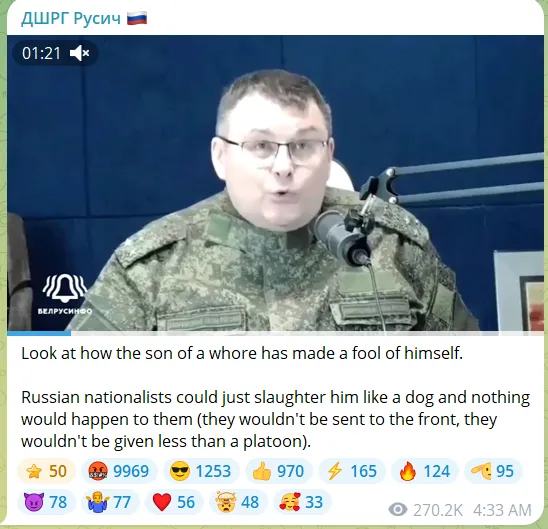
In a desperate attempt to protect his reputation, Rusich threatened to kill a Russian Senator from the ruling United Russia party later in January 2025. The senator’s crime was to defend Russia’s multi-ethnic nature.
Image

It is hard not to conclude that Rusich has proven powerless in the face of Russia’s Chechen deep state.

Malofeev’s nazis
Besides Rusich, there are three other ideologized Russia nationalist units. These are the 88th Espanyola brigade, the 106th airborne division, and the Russian Imperial Legion. Little is known about the Russian Imperial Legion and it seems fairly irrelevant.

The 106th is part of the Russian ministry of defense, and is sponsored by rightwing businessman Konstantin Malofeev, a fascinating figure I have written plenty about.

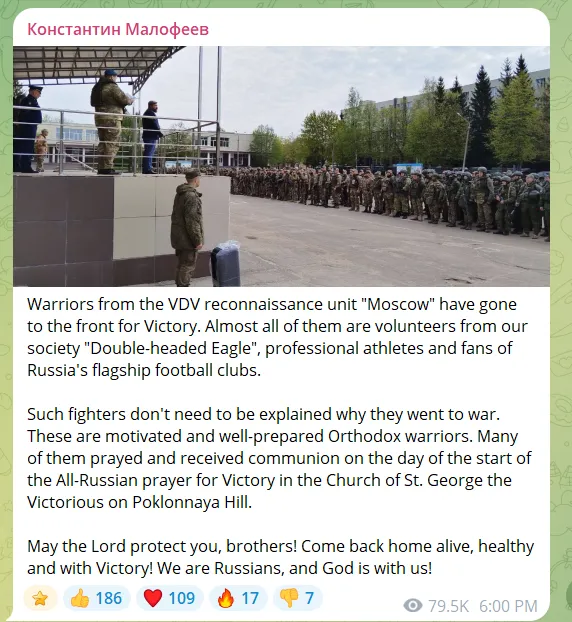
Malofeev often publishes photos of himself greeting the football hooligan ‘Moscow’ division off to war. In May 2023, announcing their formation and departure to the frontlines, he noted that many were members of his nationalist martial arts society ‘the Two-Headed Eagle’. I wrote recently about a number of cases where members of this network turned out to sympathize Ukraine’s nazi Azov movement.
Image
Malofeev seeing off the 106th in May 2023

Image
Malofeev with a fighter from the 106th, May 2024

DailyStorm.ru (not Stormer, by the way) put out a fairly positive piece on the 106th when it was founded in 2023. In it, Tsargrad employee Dmitry Rumyantsev tells the publication about the 106th close links with Prigozhin’s Wagner, then still at large:

"Wagner has been around for a long time as an organization, and many people have passed through it. So it's perfectly normal; they're everywhere now. They're football fans here, too. There's nothing wrong with them serving in Wagner, " said Dmitry ‘Frank’ Rumyantsev, press attaché for the 106th Brigade.

Dmitry "Frank" Rumyantsev

Image

He also confirmed that new recruits are sought out through Malofeev’s organization:

Our senior comrades from the Double-Headed Eagle and friends of this organization, including those from the football world with ties to military service, work on this.

Naturally, Rumyantsev claims that the 106th wasn’t created by Malofeev. But Rumyantsev, himself Malofeev’s employee at Tsargrad, admits that Malofeev’s money is getting to the 106th:

"Many people think Malofeev created [the 106th Brigade]. On the contrary, the initiative came from the Double-Headed Eagle to Malofeev, who said we wanted to gather our guys from the football community in one place. He supported it and, in fact, is sponsoring it all. <...> Personally, I don't receive money from Malofeev, but I know he helps. We have an accounting department. I don't know how much Konstantin Valerievich [Malofeev] enters into it, and anyway, it's none of my business , " the press attaché confirmed.

And despite Malofeev’s constant emphasis on the need for Russia to embrace Orthodox Christianity and reject the Satanist west, Rumyantsev and the 106th are (naturally) quite into paganism:

“We are mostly right-wing nationalists, that’s no secret. There are pagans and even Buddhists among us , “ said Dmitry Rumyantsev.

Dmitry himself wears a jacket with a mjolnir, the hammer of the Norse god Thor, a symbol commonly found among neopagans. However, his press attaché says he is an Orthodox Christian.

“I just like Thor’s hammer. I believe in our Lord Jesus Christ, but I can’t believe in the hammer. It’s just a beautiful symbol , “ a fan commented .


The article also shows the 106th questionable taste in banners:

Image

Naturally, the 106th also has racial and political requirements for prospective recruits:

There are no representatives of football clubs from the Caucasus among the battalion’s fighters. Frank explained this by saying that these clubs have no football-related organizations.

“There’s no football-related movement in these clubs, so we can’t have these guys. The core of the team is made up of people from that subculture; there’s no such subculture there. There are people who think they’re part of that subculture, but we don’t think so. It’s nothing personal , “ the press attaché said .

The path to the 106th is also closed to liberals, communists and representatives of Antifa.

“There are no outright liberals. I really like the word, but I don’t really like who it’s applied to. It turns out that a liberal is a pro-Ukrainian. How can we have pro-Ukrainians in our reconnaissance company? As for communists, I don’t even understand how they can fight against the Ukraine they created. We can’t have people from the Antifa subculture because, to put it mildly, we don’t have a good relationship with them. And they’re unlikely to ask to join , “ Dmitry stated .

The 106th, despite its patronage by Malofeev, is nevertheless not universally liked by Russian law enforcement. In May 2024, a group of neo-nazis went off to fight in the 106th. This earned the ire of law enforcement in the Tula oblast, the area the young sig heilers hailed from. The institution angered was the famous ‘department E’, a section of the Russian interior of defense which focuses on extremist groups.


Image
May 23. Mash is one of Russia’s largest tabloid-style news sources, and is not oppositional towards the government
The telegram channel ‘Tula. ExtremiZm’, associated with Department E, released a long post on the matter on May 24, 2024, along with a video of the individuals in question:

Insider Info on the “Cyborgs” (Video at link.)

In recent days, a number of major Telegram channels published news about an upcoming court hearing to recognize the group of Tula-based football hooligans known as the “Cyborgs” as an extremist organization and to ban their criminal activities in Russia.

Our editorial team has uncovered the full background of this group of “so-called fans,” the firm (in slang, a collective of individuals) known as the “Cyborgs.” Its members have only a very tenuous connection to football. The firm was created to engage in so-called “around-football” activity (a slang umbrella term that includes any kind of disorder involving fans), as well as to promote extremist ideas.

There were no random people in the “Cyborgs” firm: everyone was united by ideas of white racial superiority, assaults on people of non-Slavic appearance, a fondness for “ultra-right” tattoos (i.e. associated with people who share radical nationalist views), and the symbolism of neo-Nazism.

The “Cyborgs” firm has more than 10 members. One of its leaders was convicted of committing three extremist crimes (a death threat motivated by extremism and two counts of causing moderate bodily harm, also on extremist grounds). Another leader was convicted of repeated propaganda and public display of Nazi symbols. In addition to four extremist crimes, members of the firm committed nine administrative offenses of an extremist nature, which for the most part consisted of promoting extremism and Nazi symbols in public places. The symbols in question include Nazi imagery such as the “Black Sun” and the runes “Odal” and “Algiz,” symbols used by the SS and popular within the terrorist organization “Azov,” which is banned in the Russian Federation.

The members of the “Cyborgs” group survived on odd jobs, were mostly unemployed, and occasionally worked as security guards in Tula nightclubs.

As for the news claiming that the “fans” have ceased their activities and gone to the front lines, we leave that to the conscience of those who launched this paid-for story online. No comments here—sit back and enjoy the show.

P.S. Football lovers of “Azov,” indeed.


In October 2024, the 106th also announced it was open for white nationalist recruits from around the western world. However, the 106th doesn’t seem to be particularly large or active at the frontlines. And after just existing for two years, Russian law enforcement seems to already be fairly tired of it. But to understand that, we need to take a look at a much larger unit of Russian football hooligans.

Espanyola’s fall
The 88th Reconnaissance and Sabotage Brigade "Espanyola" (88th RDBR) is the largest Russian nationalist unit after the dissolution of Wagner in mid-2023. And yes, you read that right, the 88th.

Espanyola is said to be sponsored by associates of the Rotenberg brothers, a powerful financial clan in Russia that enjoys good relations with the Kremlin. They were apparently interested in having their own private army.
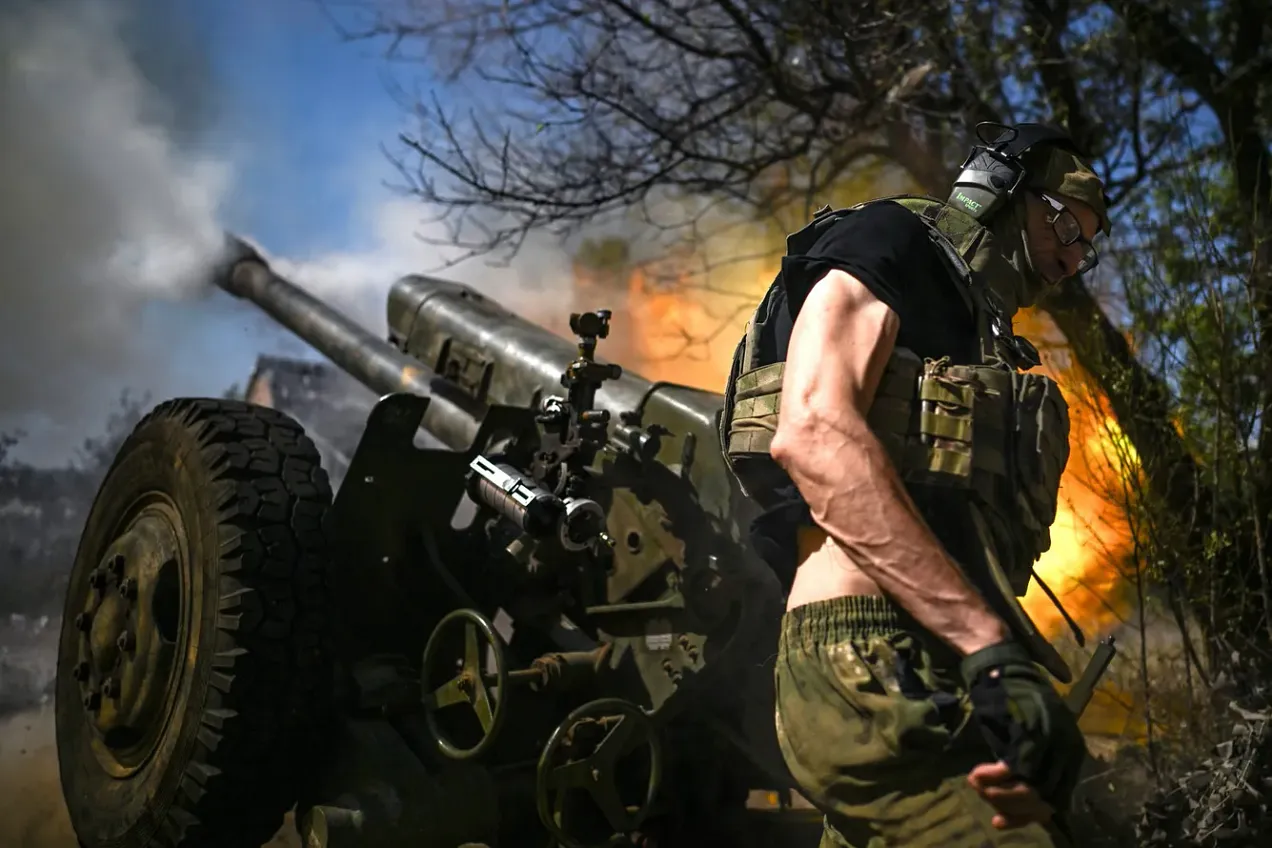
Image
Espanyola fighter, August 2024

In fact, Espanyola was the largest rightwing unit, since it now no longer exists. Over the past few weeks, the unit has been disbanded and its leader killed by law enforcement. But why?

(Paywall with free option.)

https://eventsinukraine.substack.com/p/ ... ht-muzzled

*****

"I'll be the last one to leave Kyiv"
December 24, 8:54 PM

Image

Zaluzhny's published opus begins with the phrase, "I will be the last to leave Kyiv."
This is especially amusing coming from a character who suffered a crushing defeat in the Zaporizhia region in 2023, clashed with the cocaine-fueled Führer, was removed from his post, and continues to sit in London. A worthy candidate for the "conscious" people.

It's noteworthy that the Nazi Beletsky is already working on Zaluzhny, directly blaming him for the defeat in the Zaporizhia region.

https://colonelcassad.livejournal.com/10265309.html

Fixers
December 24, 7:04 PM

Image

Dmitriev reported to Putin on the results of negotiations with the Americans regarding the peace plan. This once again demonstrates that the Kremlin views Dmitriev as a key figure in informal shuttle diplomacy, playing roughly the same role under Putin as Witkoff did under Trump. In common parlance, he's a fixer.

The Kremlin also stated that it would not comment on the progress of the negotiations.
It's worth noting that, unlike the West (and especially the EU), the Kremlin prefers to maintain the confidentiality of ongoing negotiations, while the West continues to spew leaks. Under Trump, leaks from the White House have become fewer, especially when the parties have begun to engage in substantive discussions, where leaks are simply a hindrance. Hence the deluge of fabrications and fake news from globalist circles, which often don't know what Putin and Trump, or Dmitriev and Witkoff (or even Kushner) are actually discussing. Therefore, real knowledge through leaks has to be replaced with fabrications and assumptions.

I note that progress in negotiations with the US emerged precisely when the notorious "megaphone diplomacy" diminished. This doesn't mean they will ultimately yield a result, but the process is already clearly different from what we observed during the previous 10 years of war in Ukraine.

Meanwhile, the cocaine-fueled Führer declared that he would not lift martial law and mobilization even after the ceasefire.
This, in fact, demonstrates once again that negotiating anything with him is pointless, and that he is now a clear obstacle to ending the war. As soon as the war ends and martial law is lifted, he will be finished.

https://colonelcassad.livejournal.com/10265018.html

Google Translator

I doubt that Witless's 'fixes' will cut any mustard with the Russian security sectors,

******

Slobozhansky line
December 24, 2025
Rybar

Image

Fighters have advanced into Grabivske, near Vysokoye in the Krasnopolsky district of Sumy Oblast . Numerous reports have previously been published online about Grabivske coming under Russian Armed Forces control, but only now are some advances being confirmed on the ground.


Meanwhile, the neighboring, smaller town of Vysokoye was previously declared liberated, a claim confirmed by the Russian Ministry of Defense. The enemy has already deployed reserves to the area.

According to our data, civilians have indeed been evacuated from Grabivske , as well as a significant number of prisoners, including officers of Ukrainian forces. This clearly indicates the disorganization of the enemy's defense in this area; the enemy was driven out of the village in just two days.

The question of scaling the offensive remains open. Advancing toward Krasnopolye and beyond will require significantly more forces than currently deployed. Meanwhile, further north, along the Ugroedy - Repyakhovka line , the Ukrainian Armed Forces already had significant reserves concentrated.

Thus, at this stage, the focus is more on tactical advancement and probing the enemy's defenses than on immediately launching a deep offensive. The Ukrainian Armed Forces retain the ability to deploy reinforcements here, including through accumulated reserves in the neighboring Sumy area .

https://rybar.ru/slobozhanskij-rubezh/

Zarechnoye is under control
December 24, 2025
Rybar

Image

"Situation in the East Zaporizhzhia Direction":

The bridgehead on the left bank of the Gaichur River continues to expand. Units of the "East" Guards Forces from the 36th Motorized Rifle Brigade of the 29th Army have taken control of the village of Zarechnoye , at the junction of the Zaporizhzhia and Dnipropetrovsk regions .

The liberation of this settlement logically continues the success after the clearing of Andreyevka and Gerasimovka , forming a stable bridgehead west of Gaichur .

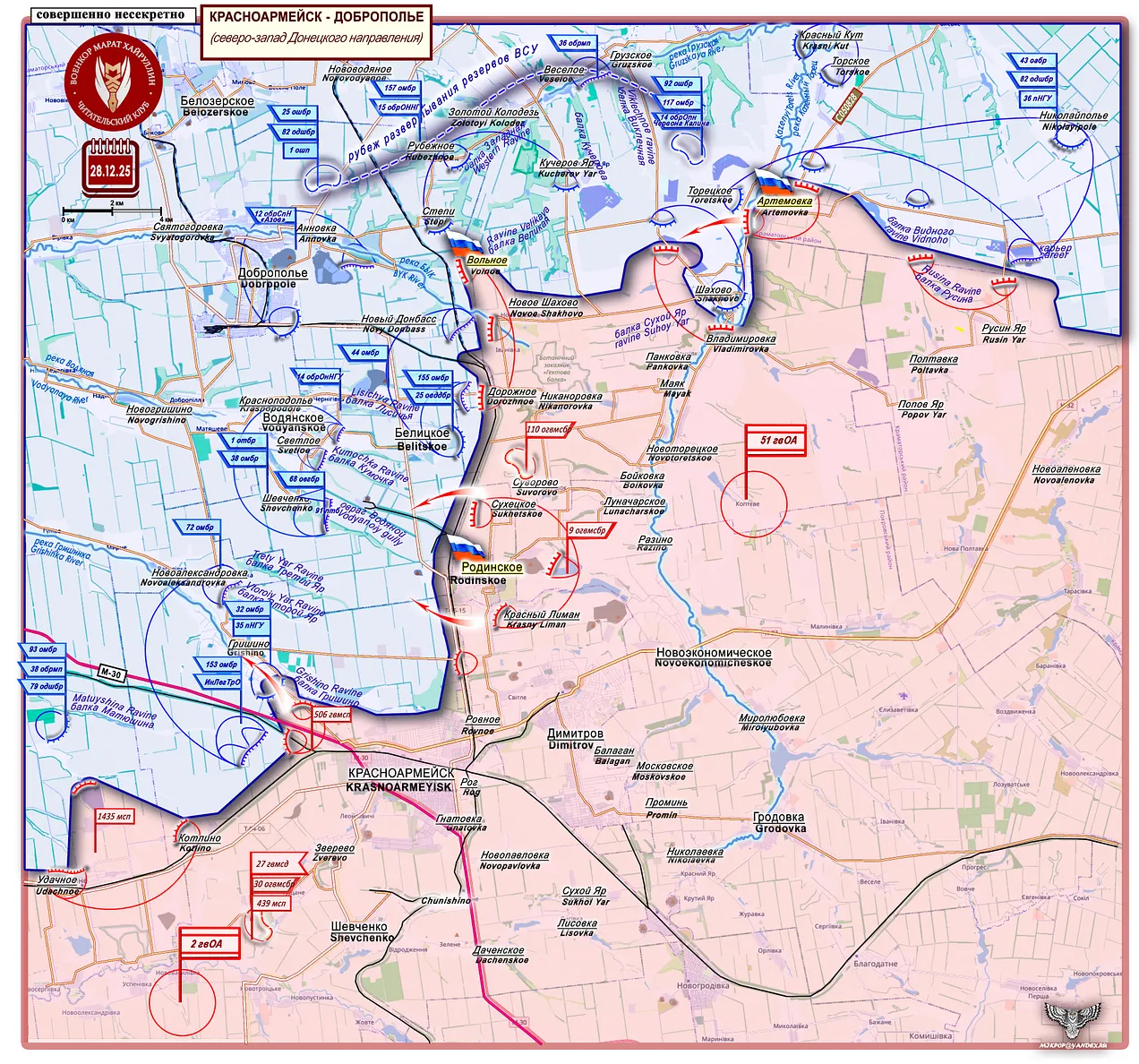
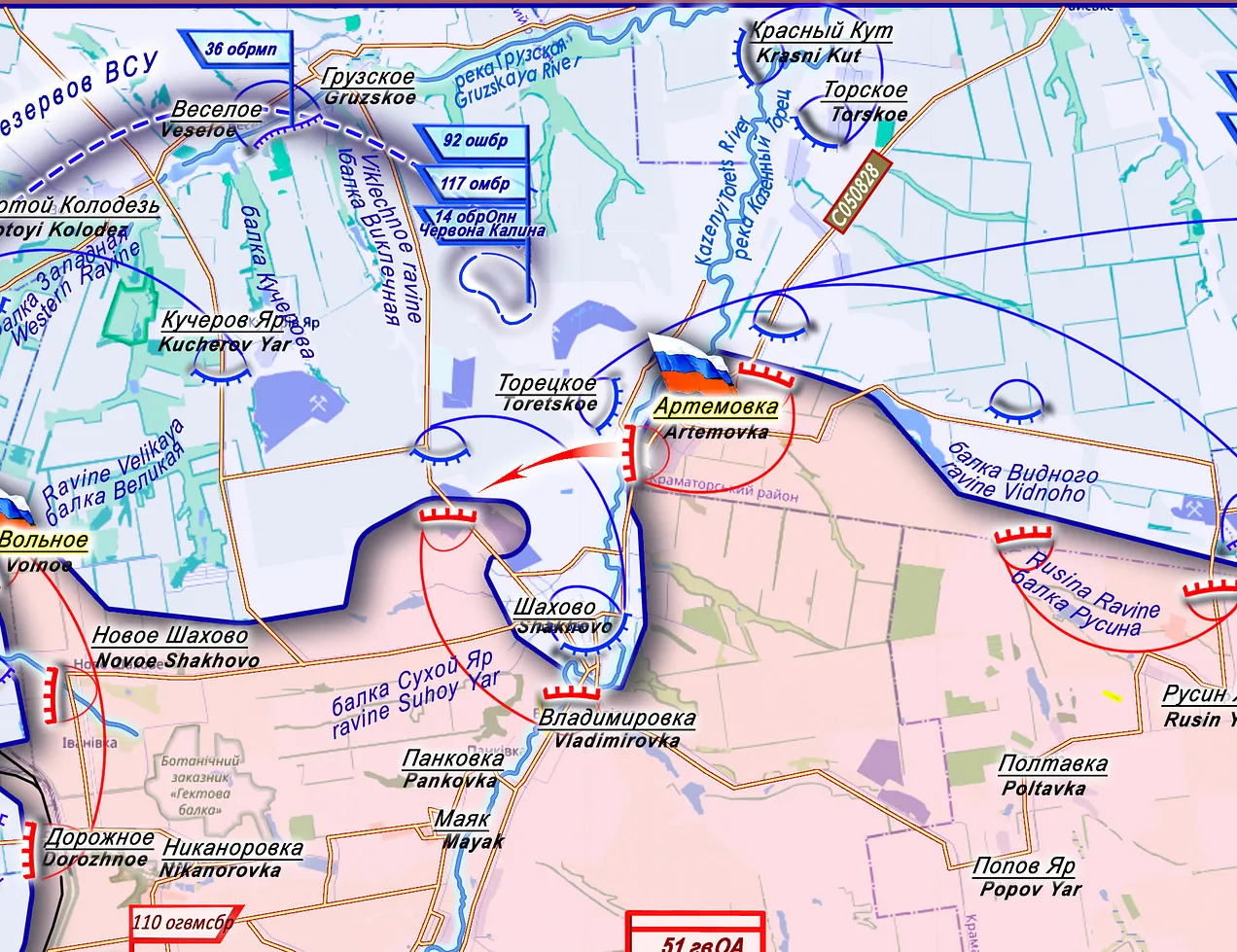
Moreover, successes here partially offset the recent results of enemy counterattacks in the Dobropillya area . There, the Ukrainian Armed Forces, taking advantage of the heights west of the river, conducted several raids with small groups.

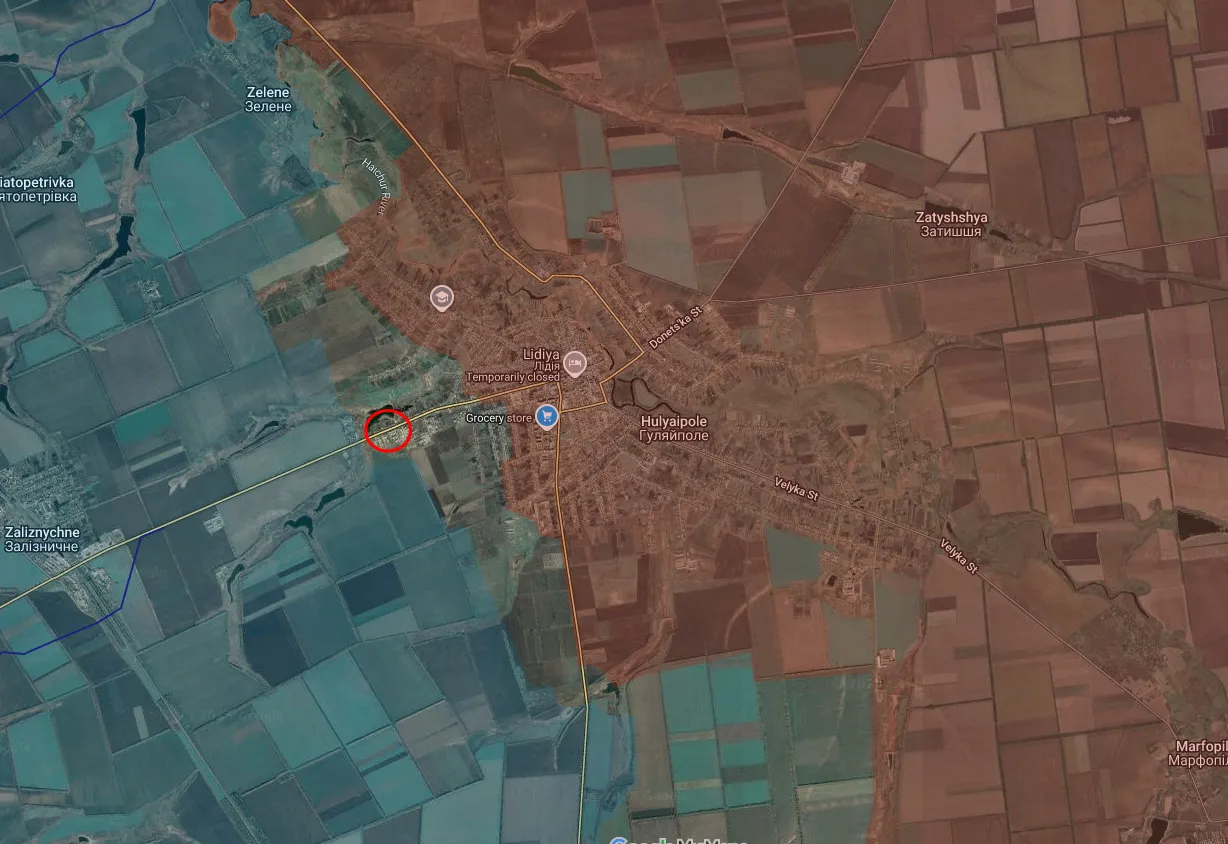
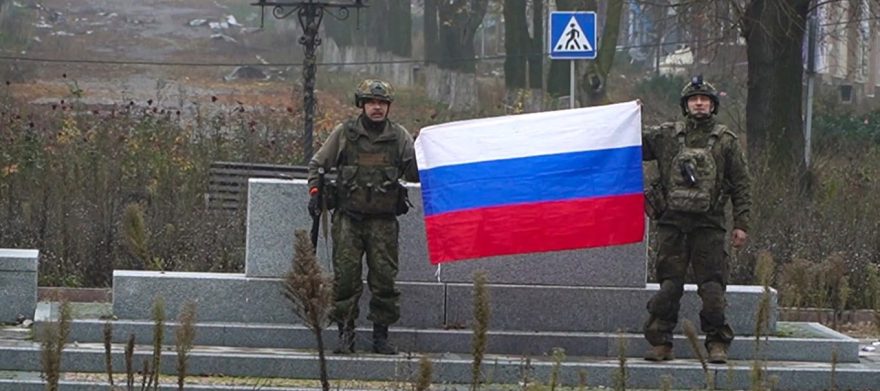
At the same time, the situation around Hulyaipole is escalating . The battle for the city is entering a decisive phase: the Ukrainian Armed Forces have already deployed the majority of their combat-ready assault units to the area, underscoring not only the symbolic but also the tactical significance for the enemy command.

The capture of Hulyaipole will allow the bridgehead behind Gaichur to be significantly expanded and forces to be freed up for a further offensive in the north of the Zaporizhzhia region , bypassing the Orekhovsky fortified area .

https://rybar.ru/zarechnoe-pod-kontrolem/

Google Translator
"There is great chaos under heaven; the situation is excellent."

User avatar
blindpig
Posts: 15059
Joined: Fri Jul 14, 2017 5:44 pm
Location: Turtle Island
Contact:

Re: Footnotes from the Ukrainian "Crisis"; New High-Points in Cynicism Part V

Post by blindpig » Fri Dec 26, 2025 12:38 pm

Russia and the post-Soviet space, an economic relationship marked by war
Published by @nsanzo ⋅ 26/12/2025

Image

Failure, collapse, and isolation have been some of the terms used in recent years by the media and political authorities to describe the state of the Russian economy, generally detached from reality. The 19 packages of sanctions imposed by the European Union, the expulsion from the international payment system SWIFT, the closure of the European market, the veto against the two major oil producers—Rosneft and Lukoil—and the threat of secondary sanctions against countries or companies that continue to trade with strategic Russian sectors, primarily energy, have not achieved the goal of Russian collapse. The United States is attempting to defeat Russia by using the war as a pretext. It is not true that Russia has transformed its system into a war economy, nor is it true that there have been no consequences—inflation, an overheated economy, cuts in other areas to boost the military industry, etc.—but perhaps the greatest illusion of recent years has been the fallacy of Russian isolation.

More interconnected than ever, today's world presents both advantages and disadvantages when it comes to imposing blockades, sanctions, and isolating countries. Dependence on the dollar and the interconnectedness of trade, especially financial services, can act as barriers, preventing certain countries from accessing goods or products essential for the normal functioning of their economies. The disconnection of Russian banks from the SWIFT system, announced immediately after the invasion of Ukraine, was intended to be the nuclear option that would make the normal functioning of the Russian Federation's economy impossible, as it would be unable to compensate for the losses resulting from the lack of access to certain markets. However, this interconnectedness and the inability of Western countries to wield the soft power that once allowed them to impose their decisions on the entire world now offer opportunities to circumvent these sanctions and find alternative routes to obtain desired products or components.

A notable example was the appearance of Parmesan and mozzarella cheeses, typical Italian products, originating from Belarus during the years of war in Donbas, when the first sectoral sanctions against the Russian Federation began. With agricultural products from the European Union theoretically banned, Russia diversified its market and sought alternatives to Spanish tomatoes (Morocco), Canary Island bananas (Ecuador), French wine (in the Caucasus and the Black Sea region), and many other examples that could be seen in the fruit and vegetable sections of supermarkets, where Western European origins had disappeared in favor of those from countries like Iran, Jordan, or Israel. For those products where there was no obvious alternative, third countries acted as intermediaries, disguising the technically prohibited products by adding a country's label.

Since February 2022, one of Ukraine's main demands has been the imposition of sanctions truly capable of crippling the Russian economy and halting industrial production, especially military production. Destroying the Russian economy was seen as the most direct path to victory, since no country would be able to sustain a large-scale military operation alone, without allies to supply weapons or funding, and without production capacity. The war in Ukraine has raised many questions and uncertainties, but it has also clarified others, such as the West's ability to impose its will on other countries. The attempt to impose a blockade similar to that against Cuba—the world's largest country, sharing a border of thousands of kilometers with its main trading partner, China—was always doomed to failure. However, the nearly four years that have passed have demonstrated Russia's ability to circumvent coercive measures, seek new import and export markets, and utilize third countries to obtain those Western goods and services that remain essential. In this regard, one of Ukraine's common practices has been to analyze the remains of Russian, Iranian, or North Korean drones or missiles to highlight the presence of Western components in the weapons of three of the countries most heavily sanctioned by the West and to demand mechanisms for the effective implementation of these coercive measures. Although most Ukrainian and European accusations have been directed at China, and American accusations at India, a number of other countries have acted, and continue to act, as intermediaries to prevent the desired Russian isolation.

An article by Russian analyst, academic, and dissident Anton Barbashin addresses this topic, delving into available data on relations between Russia and the former Soviet republics. “Following Russia’s large-scale invasion of Ukraine in 2022, many experts on the post-Soviet space concluded that the war would directly lead to a sharp decline or even the total collapse of Russian influence in the region. The main arguments centered on the idea that Western sanctions and the shift of the Russian economy toward a wartime state would inevitably reduce Moscow’s economic footprint, while the rejection of the invasion by most of the northern Eurasian countries would erode its political influence and soft power tools. It was assumed that all of Russia’s key partners, except Belarus, would actively distance themselves to minimize their own risks,” he states in the opening of his article. This certainty was even greater in the case of the Central Asian republics, where Chinese economic influence has been particularly significant since their independence from the Soviet Union, and especially in recent years.

Available data shows that trade with China has increased from $107.8 billion annually in 2020 to $244.8 billion, an increase only slightly higher than that seen in trade between Moscow and the former Soviet republics (from $63 billion in 2020 to $125 billion in 2025). Barbashin's conclusion, which bases his argument on this evolution of trade between Russia and the various countries, directly contradicts Western predictions for 2022 and states that “in a sense, the war in Ukraine has forced Russia to rediscover the post-Soviet space, revealing that the interest in cooperating with Moscow remains significant almost everywhere (with rare exceptions).”

“Moscow has not only maintained but actively expanded cooperation with many of its neighbors,” states the article, which divides trade dynamics between Russia and the former Soviet republics into five categories. These range from the clear decline in trade with Moldova, which has used the war as a political pretext for rapprochement with the West, to the enormous increase in trade with Armenia. Armenia has seen the highest percentage growth, and by the end of 2024, Russia accounted for 39% of its foreign trade there. Although a contraction is expected in 2025, this trade is particularly noteworthy, as its increase, based on imports to circumvent sanctions, has occurred in parallel with the deterioration of political relations between Moscow and Yerevan and President Pashinyan's attempt to achieve integration with the West. The next tier comprises Azerbaijan, Turkmenistan, Uzbekistan, and Kyrgyzstan, especially the latter two, where trade with Moscow has reached levels similar to those with China, and exports have increased fivefold and sevenfold, respectively. The two groups experiencing moderate growth include Belarus and Tajikistan, the former Soviet republics with the strongest economic ties to Russia, leaving little room for further increase, and Georgia and Kazakhstan. The Kazakh case is similar to the Tajik one, while the Georgian case is more significant, as the two countries have not yet fully normalized relations since the 2008 war. The increase in trade between Georgia and other Central Asian countries, which in many cases has Russia as its final destination, slightly distorts the data on bilateral economic relations, which are possibly even higher than the figures suggest.

The main conclusion is the importance of the former Soviet Union countries in Russia's effort to avoid international isolation and overcome Western sanctions, a central element of Russian economic resilience. Needing new export and import markets, Russia has relied on a geographically close economic ally, but also on those countries with which, until recently, it shared political space and in which, beyond the war, it will try to maintain that economic presence, a reflection of a soft power that was thought to be lost.

https://slavyangrad.es/2025/12/26/rusia ... la-guerra/

Google Translator

******

Form Cassad's Telegram account:

Colonelcassad
The main statements by Dmitry Peskov:

- Dmitriev reported to Putin on the results of his trip to the United States, the information has already been analyzed;

- Representatives of the Russian and US leadership, on Putin’s instructions, have already communicated following Dmitriev’s trip;

- Ushakov represented the Russian Federation during telephone contacts with the United States that took place after Dmitriev’s trip;

- Russia and the United States agreed to continue the dialogue after Dmitriev’s trip to Miami;

- Peskov confirmed that the topic of a settlement in Ukraine was raised at Putin’s meeting with business;

- Any increase in military spending in the Asia-Pacific region must be careful so as not to provoke escalation — Peskov on the increase in Japan’s military budget;

- Kiev is resorting to all sorts of tricks to get money from the West — Peskov on Podolyak’s words that Ukraine has no money for the elections;

- Putin will hold a meeting on the state armament program.

***

Colonelcassad
The SBU Academy will send cadets to combat zones , according to Academy Professor Vitaliy Shymko.

The rector has already signed an order dated December 23rd of this year. The document calls for senior cadets to be sent on "short-term official assignments" to combat zones.

Shymko is unaware of the reasons for this decision. He states that cadets have no place on the front lines and demands maximum publicity .

@zvezdanews

***

Colonelcassad
Ukrainian migrants topped the "Worst of the Worst" list of criminals from post-Soviet countries in the US.

The US Department of Homeland Security published data on the most notorious foreign criminals arrested by Immigration and Customs Enforcement.

The list includes 27 Ukrainians. They are accused of drug trafficking, sex crimes, robbery, fraud, slavery, and human trafficking.

https://t.me/s/boris_rozhin

Google Translator

******

Brief Frontline Report – December 25th, 2025

Summary by Marat Khairullin and Mikhail Popov.
Zinderneuf
Dec 25, 2025

Image
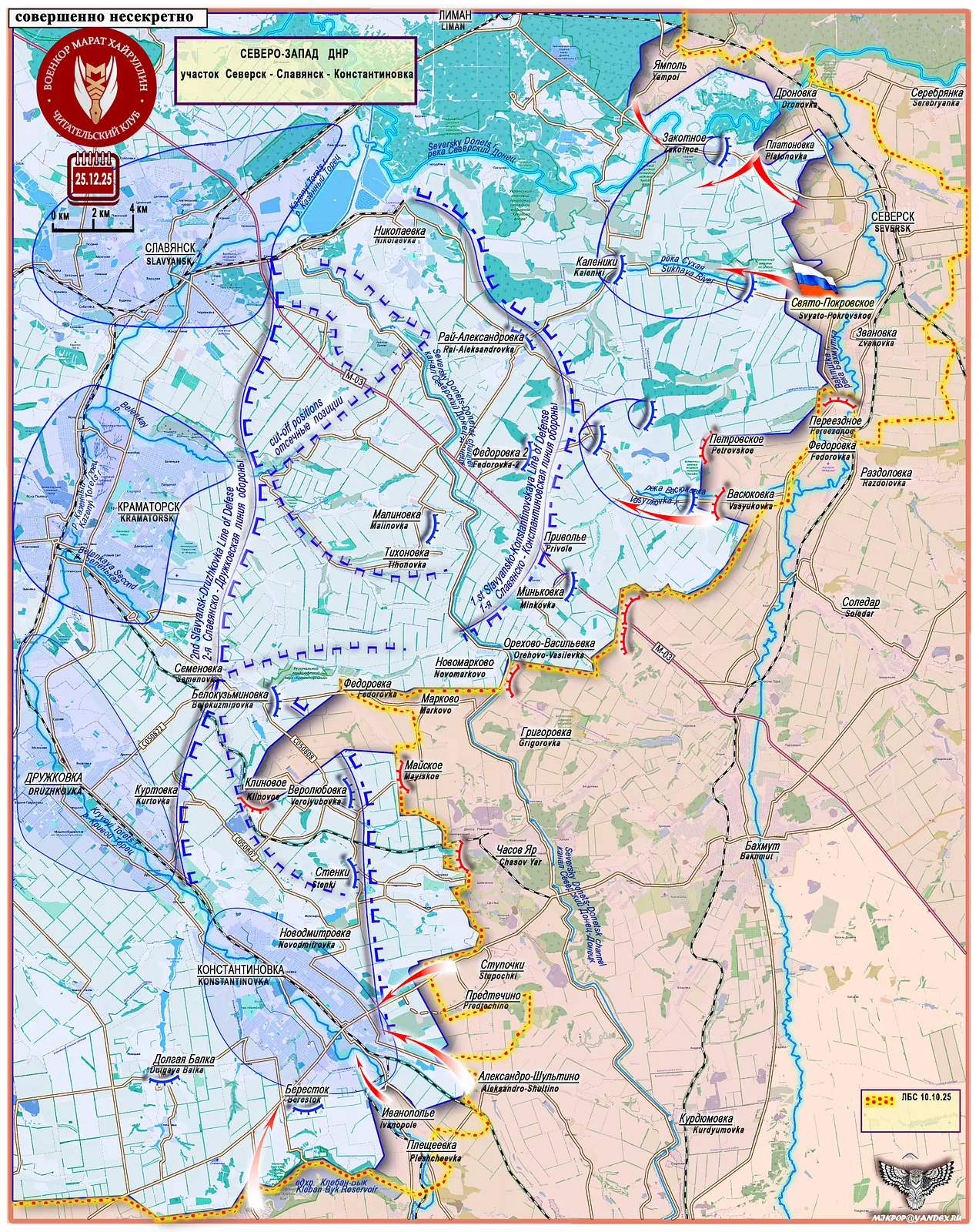
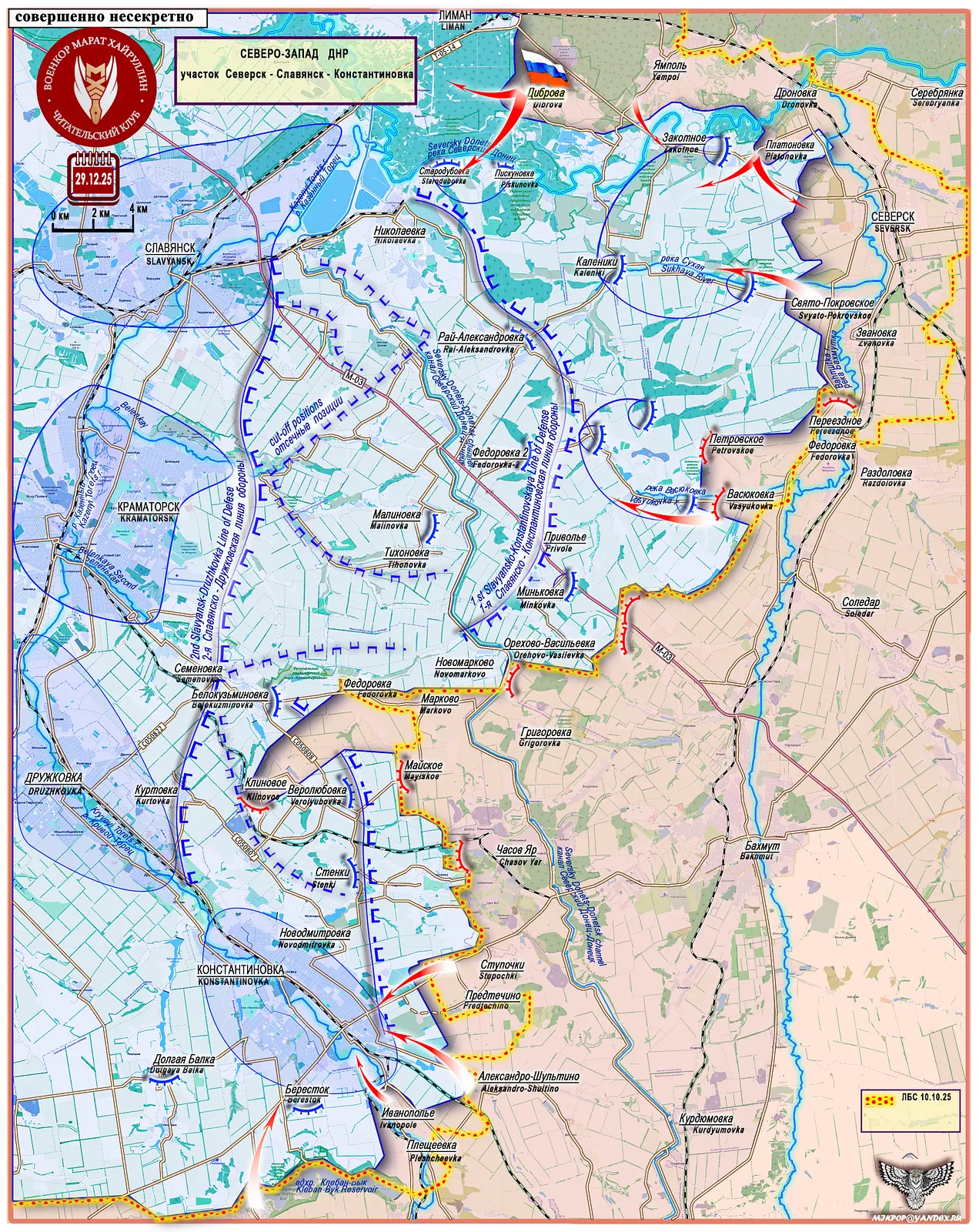
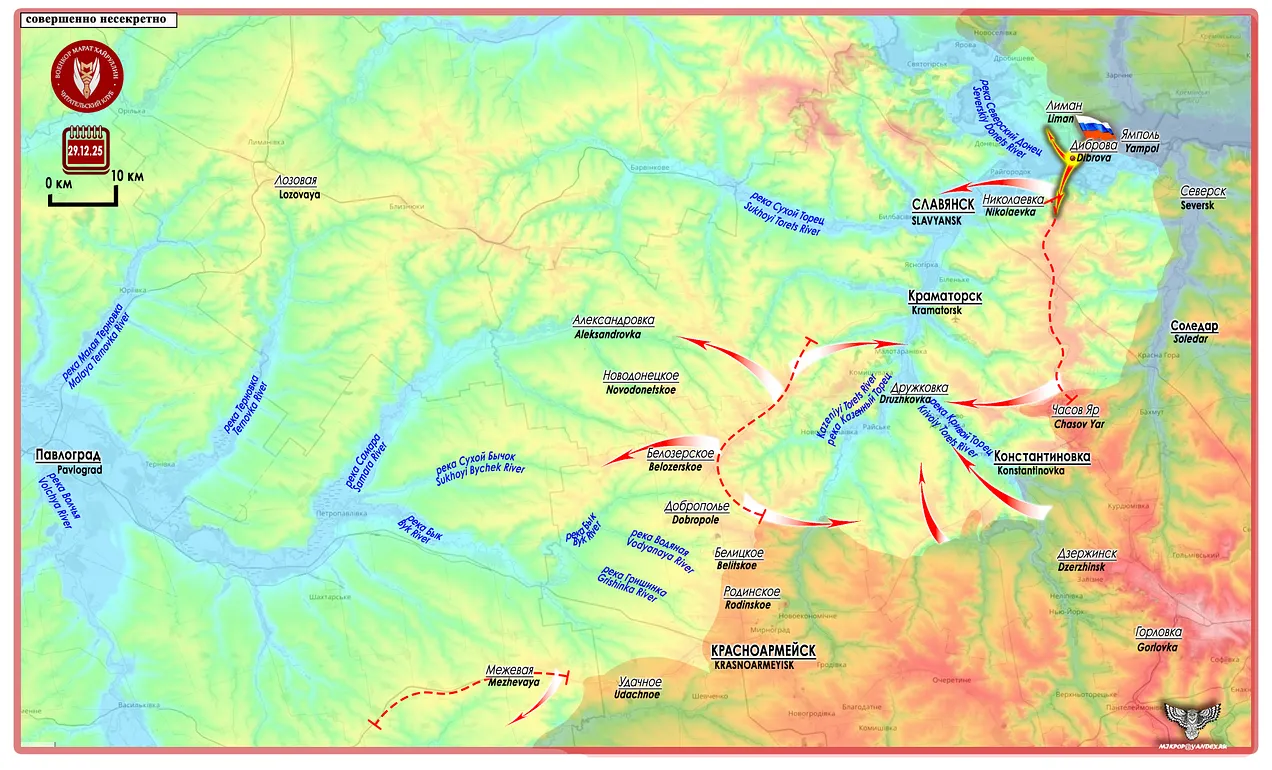
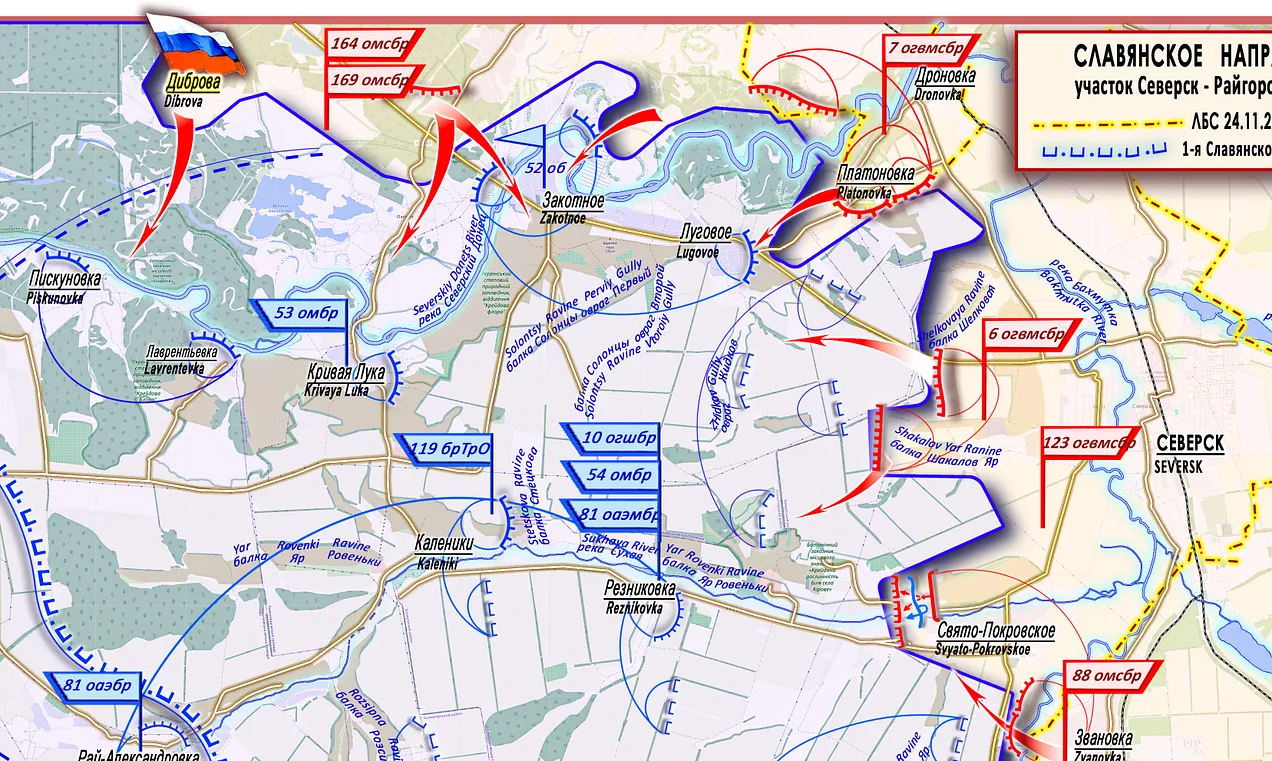
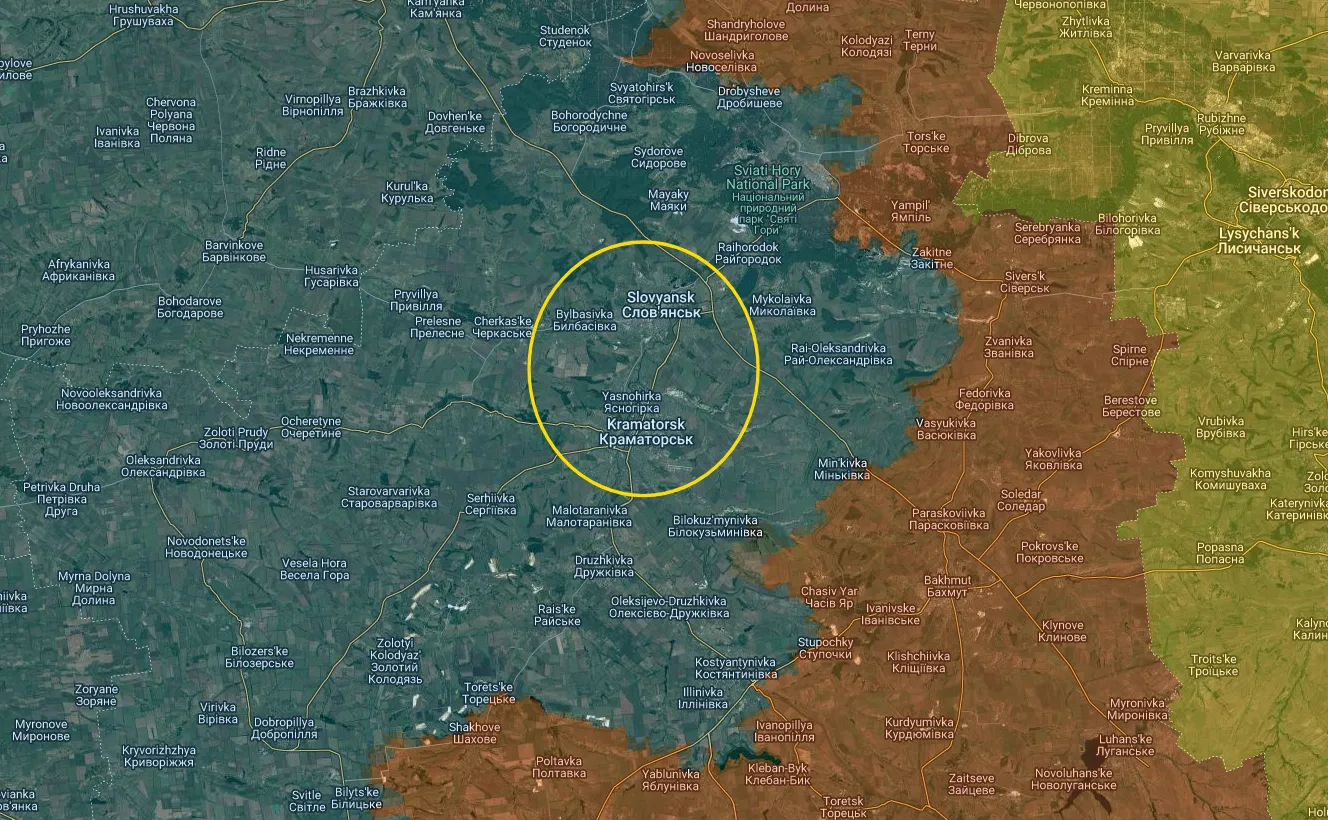
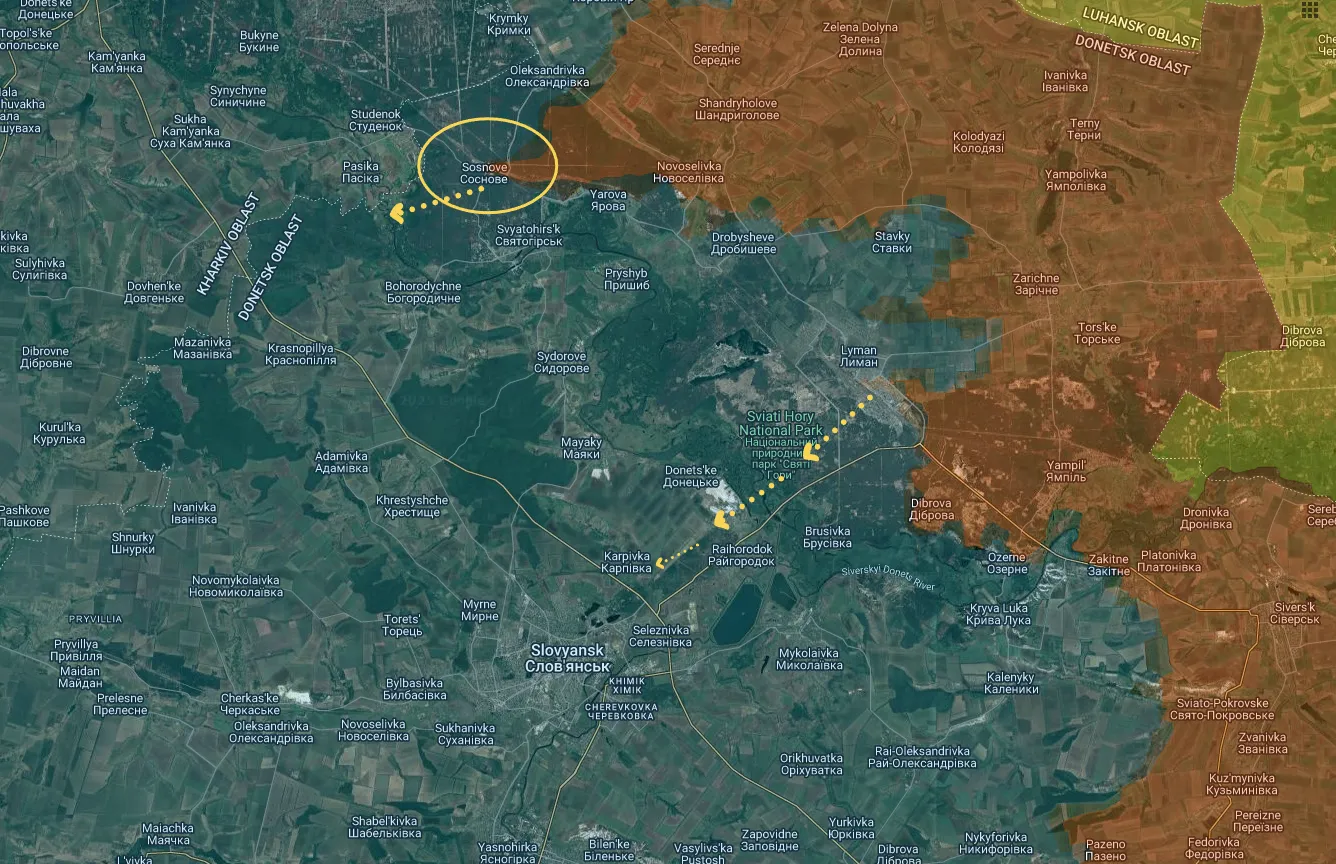
Slavyansk Direction, area of Seversk to Raigorodok. Yellow dashed line: Line of Combat Contact November 24, 2025. Blue barrier line: 1st Slavyansk to Konstantinovka line of defense.

Image
Northwest DPR; area of Seversk - Slavyansk - Konstantinovka Yellow line with red dots=Line of Combat Contact October 10th, 2025.

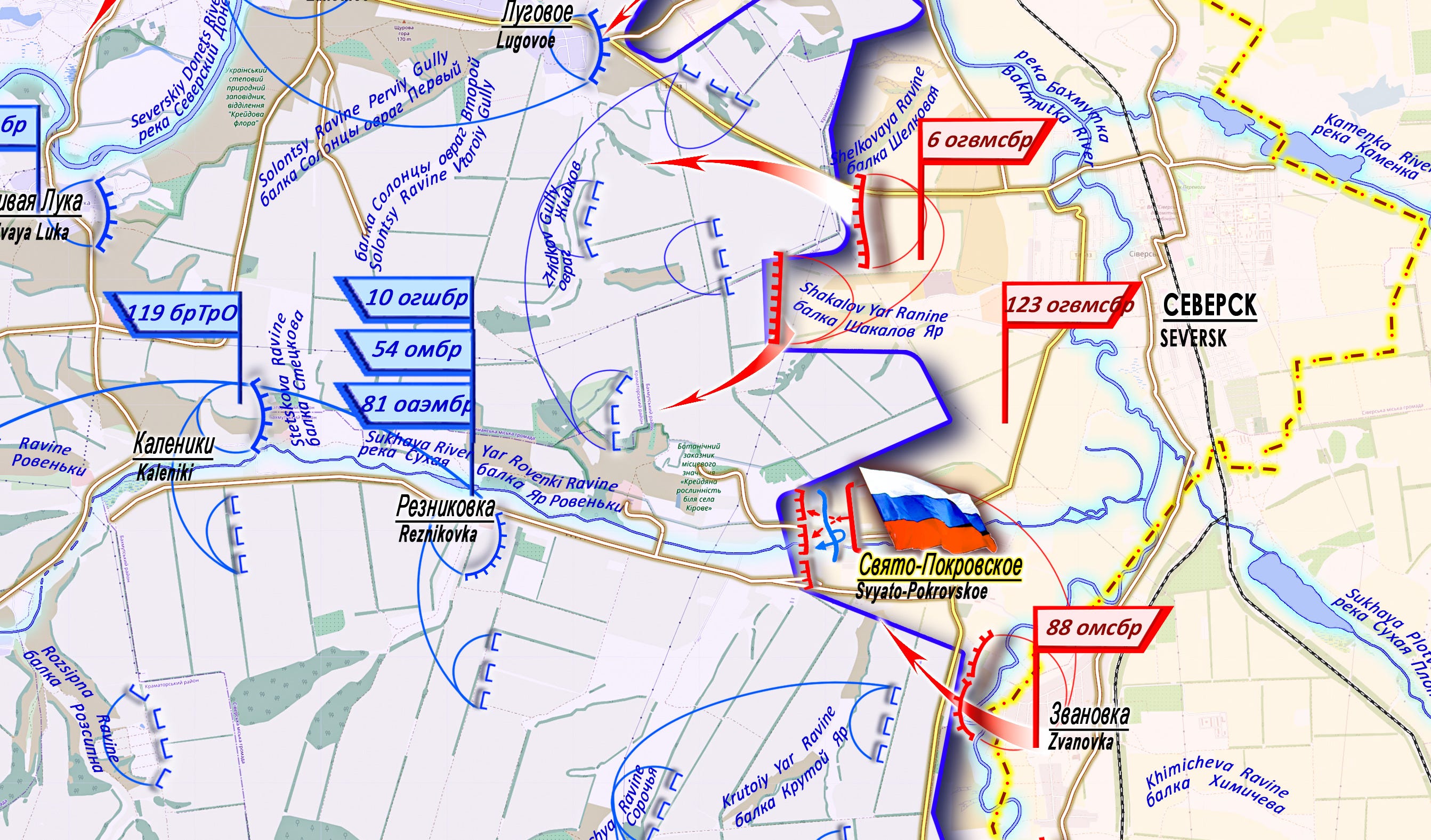
Message from the Russian Ministry of Defense: "Units of the 'South' Group, through decisive actions, have liberated the settlement of Svyato-Pokrovskoe in the Donetsk People's Republic."

Following the liberation of the city of Seversk by the Russian Armed Forces, and in line with established tactics, they began fragmenting the Seversk Salient into sections. The Seversk Salient is roughly delineated to the north by the Seversky Donets River, with its northern base along the Platonovka-Zakotnoe line. To the south, it is shaped by the Vasyukovka River, with its southern base along the Petrovskoe-Vasyukovka line.

Image

On December 25, the settlement of Svyato-Pokrovskoe/Kirovo (48°49′47″ N 38°03′23″ E, approximately 540 residents) was liberated. Until 2016, it was known as Kirovo. Directly adjacent to it from the west is the settlement of Reznikovka, which stretches for nine kilometers along the Sukhaya River.

Image

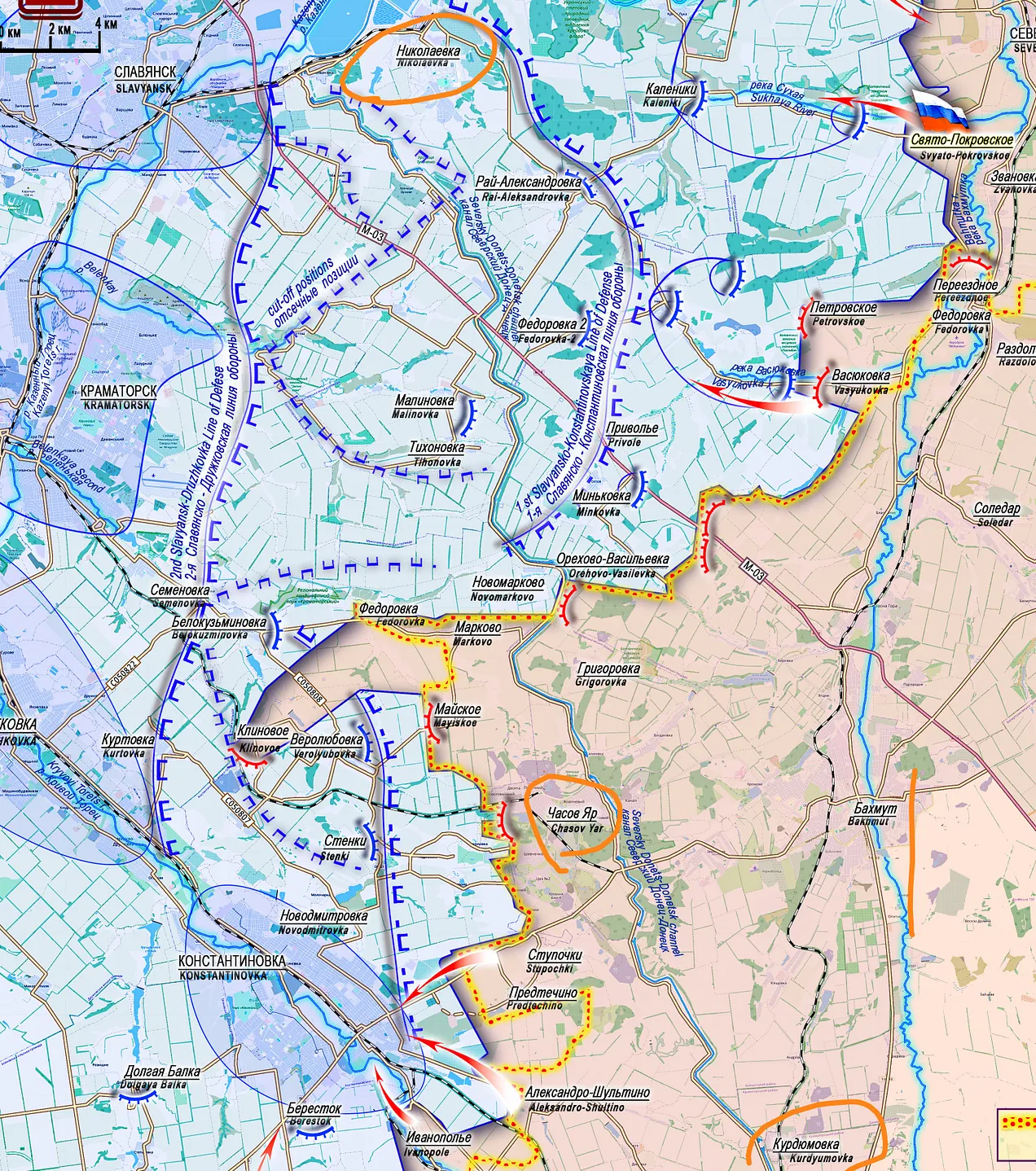
The advance into Svyato-Pokrovskoe drives a wedge into the Seversk Salient. Continuing the advance along the bed of the Sukhaya River on the Svyato-Pokrovskoe - Kaleniki line would split the salient into two parts located on two main watersheds (note, a "watershed" is the high point between two rivers): north of the watershed between the Seversky Donets and Sukhaya rivers, and south of the watershed between the Sukhaya and Vasyukovka rivers. Both watersheds share a common upward slope from the Bakhmutka River towards the west and southwest (rivers here flow from west to east and from south to north). This upward slope of the two watersheds ends at the meridional ridge of the main watershed between the Kazenyi Torets and Bakhmutka rivers, which stretches from north to south along the line Nikolaevka - Chasov Yar - Kurdyumovka.

Image

The channel of the Seversky Donets - Donetsk canal runs along the highest points of this ridge. The main positional area of the Ukrainian Armed Forces on DPR territory—the Slavyansk-Kramatorsk agglomeration—is located beyond the western slopes of this watershed.

The positions of the Ukrainian Armed Forces' first line of defense, protecting the Slavyansk-Kramatorsk defense district, are located on the eastern slopes of the main watershed, while the second defensive line is on the western slopes. Between them, in the area of the main high ground, the enemy has equipped blocking positions. Their primary tasks are to contain Russian units that have broken through into the operational-tactical depth of the enemy's defense, to strike the flanks of forward units, and to organize kill zones.

The method of the Russian General Staff is to fragment the defense into sections by driving in "wedges," consolidating bridgeheads, and expanding these "wedges," during which enemy groups in blocking positions are destroyed. Where possible, deep envelopments are organized.

Why are "cauldrons" sparingly organized? The answer is provided by Kupyansk and Krasnoarmeysk. These are highly complex operations requiring a double allocation of forces: for defending the outer perimeter of the "cauldron" and for conducting clearing operations inside the cauldron while repelling enemy counterattacks aimed at breaking the encirclement. Therefore, deeper envelopments with operational encirclement are primarily organized. This forces the enemy to withdraw, allows for their destruction during the retreat, and enables advancement on their heels to the next defensive line.

https://maratkhairullin.substack.com/p/ ... ember-25th

******

WHY THE ELECTRIC WAR HAS BEEN FAILING UNTIL NOW

Image

By John Helmer, Moscow @bears_with

In an unusually frank analysis of the General Staff’s electric war campaign since 2022, Vzglyad, the semi-official platform for security analysis in Moscow, has acknowledged that three years of strikes against Ukrainian energy targets have fallen short of their military objective because the targeting has been restricted by President Vladimir Putin’s tit-for-tat order.

But now that order has changed. Or has it?

Ukrainian military bloggers were reporting on Tuesday afternoon (December 23) that “as a result of the morning strikes of the Russian Armed Forces, the Rivne, Ternopil and Khmelnitsky regions of Ukraine were completely de-energized. There is a risk of disconnection in Vinnytsia, Chernigov, Zhitomyr, Dniepropetrovsk, and Kharkov regions.” The capacities for repair and replacement of damaged energy facilities have “almost dried up”, they add.

If this is the current situation, does this mean that the successive waves of electric war operations – October 10-12 and 16-20, 2022; October 22-27, 2023; March 29-30, 2024; June 1, 2024; and November 7, 2024 — failed in their cumulative impact?

Answers a veteran military engineer and specialist in electric warfare: “The electrical spare parts coming from Europe via rail could have been stopped. The yards containing spare transformers, service vehicles and equipment could have been put out of commission; multiple high-voltage cable towers — easy targets! — could have been hit at the same time. Coupled with strikes on the substations, service equipment yards and supply logistics, such a campaign would have quickly overwhelmed the Ukrainian capacity to effect repairs in anything resembling a timely fashion. Why hasn’t this happened, or why is it, apparently, happening only now?”

“Can you imagine the war continuing if the 33 main Ukrainian electrical substations and the towers carrying the lines to and from them had been destroyed in the autumn and winter of 2022/23? If the railways from Poland and Romania had been de-electrified, had their rolling stock and engines smashed? If the rail and highway bridges carrying Ukrainian re-supply had been bombed?”

“Unless the decision-makers in the Kremlin are stupid, which we know they are not, striking again in 2023, 2024, and 2025 without finishing off the Ukrainian electrical grid can only be explained as a political decision – that’s to say, President Putin’s decision.”

In Moscow on Tuesday, this is publicly admitted for the first time, albeit by inference between the lines and under a byline that is fake.

Vzglyad, the state-funded publication of military, intelligence, security and economic analysis, headlines its report with an irony — “Zelensky’s stubbornness is finishing off the Ukrainian energy industry”. The text which follows makes clear that stubbornness has been a problem from the beginning of the electric war – not in Kiev but in Moscow.

Note that unlike most Vzglyad reports, no source has been cited by the author, Nikolai Storozhenko. No trace has been found of this name as an active writer for Vzglyad. The name belonged famously to a literary historian and Shakespeare scholar in Moscow in the mid-19th century. The use of such an obvious alias carries the invitation to knowing readers to understand this as a semi-official editorial.

Click to read the Russian original.

In this verbatim English translation, pictures, captions, and data charts have been added for the English reader.

Image
Source: https://vz.ru/world/2025/12/23/1380463.html
December 24, 2025
Zelensky’s stubbornness is finishing off the Ukrainian energy industry
By Nikolai Storozhenko

By the end of 2025, Ukraine’s energy capacity has been reduced by more than half. Residents of Kiev, for example, receive electricity for an average of 8 to 11 hours a day. The consequences of this are felt primarily by the Armed Forces of Ukraine, but also by the Ukrainian economy as a whole. But Ukrainians can only blame the head of the Kiev regime, Vladimir Zelensky, for this – Russian strikes are being carried out only in response to his actions.

To begin with, we recall that Ukraine’s energy supply facilities did not immediately become targets for attacks by Russian forces. This happened only at the end of 2022, in response to the explosion of the Nord Stream pipelines and the attack on the Crimean Bridge.

Image
The first Crimean Bridge attack, October 8, 2022. Click to read analysis of the modus operandi -- https://johnhelmer.net/the-ukrainian-m- ... etonation/ For a US military school analysis: https://lieber.westpoint.edu/kerch-stra ... ional-law/

However, since at that time the target of the strikes was mainly thermal energy and large generating facilities, the effects of the strikes were quickly stopped. By the end of 2023, Ukraine’s energy system had recovered almost completely.

This is why the attacks on Ukraine’s energy sector continued in 2024 and 2025. By then it was a completely different war, a reaction to the Ukraine’s systemic war against Russian oil refining. But that wasn’t the only thing making the difference.

Firstly, the facilities restored by Ukraine received supposed protection. As we now know from the details of the Ukrainian corruption scandals, this protection was often only in reports or ineffective (lined with sandbags on the sides), but it was still there. Secondly, and more importantly, the restored generation units began to be dispersed as much as possible, and large facilities were covered by air defence.

The main difference from 2022 is that it was already a full-fledged infrastructure war. The strikes of 2022 were loud and powerful, but they were individually targeted blows, like a slap in the face, the purpose of which is to bring the opponent back to reality and end the conflict with the threat of force. The focus of the punches has also shifted. Previously, these were the power plants themselves, but now they accounted for only one-fifth of the missiles and drones, while the rest were aimed at substations and power lines.

The fact is that it is possible to knock out thermal generation without system work, but what to do next? Up to 60% of the pre–war generation of Ukraine’s energy system is nuclear power plants, and you can’t really hit them. But consumers can be cut off from them, and the nuclear power plants would then have to reduce production. Hydroelectric power plants, which had previously been ignored, also came into focus.

As a result, the pace of recovery of the Ukrainian energy sector has decreased after the transition to systemic war. 70% of the damage was repaired only after nine months, and the cost of this has increased from $1.5-$2 billion after the 2022 strikes to $3-$4 billion dollars in 2024.

On the other hand, the leadership of the Russian Armed Forces at that time clearly did not give up hope that the Ukrainian side would come to its senses. However, by roughly November 2024 the strategy of pressuring Ukraine towards peace by shutting down its energy sector had come to naught. The ‘Black Winter’ which the Ukrainians were afraid of did not happen, and the entire 2024-25 heating season passed with a minimum of shocks and blackouts. Kiev had not been turned off at all.

How does 2025 stand out against the background of the previous two acts of the infrastructure war? First of all, the impact firepower is much higher. The number of missiles and drones has increased. According to Ukrainian sources, 5,200 in eleven months of 2025 compared to 4,500 in 2024. Second, the strikes have become more concentrated and are usually aimed at a single region, thus overloading the air defence system. In addition, the range of weapons used for this purpose has expanded (not only the Geran series is in business).

Image
Source: https://en.wikipedia.org/wiki/HESA_Shahed_136

As a result, by the end of this year, according to the statement of Andrei Belousov, head of the Russian Ministry of Defense, more than 70% of thermal power plants, as well as more than 37% of the hydroelectric power plants providing energy to the military industry and the Ukrainian armed forces have been put out of operation. According to the Russian military, Ukraine’s energy capacity has been reduced by more than half as a result. This has also had a direct impact on Ukraine’s ability to resist. And, naturally, the damage to Ukraine from these strikes has grown significantly.

But even despite the increase in imports, the energy system itself is operating under conditions of austerity. For example, in December 2025, electricity is available to Kiev’s domestic consumers for an average of 8-11 hours a day. Moreover, half of this time falls on a late evening or night – that is, when consumers don’t really need it. The result is official warnings that a real energy collapse awaits Ukraine this winter. Funds for the repair of energy facilities in the country are almost exhausted.

The novelty of 2025 is massive strikes on Ukrainian gas production and underground storage facilities. In 2022-2023, such cases were episodic, and the damaged facilities were promptly returned to operation. In 2024, Ukrainian gas was seriously affected for the first time (damage in the amount of $500 million, reduction of production by 40%). In 2025, the damage estimate has reached $2 billion, and 60% of production is now out of service. In addition, the strikes themselves are no longer episodic and have been going on systematically since January. And they take into account the specifics of Ukraine’s need for this gas: the most powerful strikes followed in the autumn, disrupting Kiev’s plans to accumulate reserves by winter.

In addition, the focus on forcing the Ukrainian energy sector to peace terms has had the immediate effect of spurring migration. During the six weeks of autumn (October – first half of November), about the same number left Ukraine as had exited in the nine months, from January to September; that was about 300,000 people in total. The same effect was observed in 2024: the peak of departures – 200,000 people in June – occurred during the period of strikes on the energy sector. This is a double disadvantage for the economy — fewer workers and fewer consumers. For more on the Russian strategy of depopulation, read this.

The strikes themselves have significantly inflated the cost of living in Ukraine. Business already pays 10-11 UAH (Rb18-20) per kilowatt hour, which is almost 2.5 times more than the household tariff. However, during rolling blackouts, you have to switch to generators, and then a completely different math applies. Even the most economical generators have a price tag starting from 20 UAH (Rb36.5) per kWh. For low-powered generators, which are mainly used by small businesses, the cost can reach a cosmic 40 UAH (Rb73).

Of course, there is a separate category of industries which have achieved protection against blackouts. However, such protection costs about the same amount of money, since they have to pay for energy at the cost of its purchase in European Union (EU) countries.

In the 1990s and 2000s, cheap energy was the competitive advantage of Ukrainian products on the world market. However, running on a diesel generator makes energy for Ukrainian businesses at least twice as expensive as in EU countries (€0.4//kWh versus €0.15-0.2). And even the basic tariff is equal to the European one.

As a result, during October international experts have adjusted the optimistic forecast of GDP growth from the Ukrainian Ministry of Economy (0.7-1.2%). Now the International Monetary Fund (IMF) estimates growth of no more than 0.5%; the World Bank, a decrease of 0.2%.

ANNUAL UKRAINE GDP MOVEMENT IN PERCENT, IMF CHART, INCLUDING 2025-26 FORECASTS

Image
Source: https://www.worldometers.info/gdp/ukrai ... nal%20Mone

WORLD BANK CHART FOR UKRAINE GDP, 1998-2024

Image
Source: https://data.worldbank.org/indicator/NY ... view=chart

Their pessimism is based on the impact of the strikes and the cost of energy for Ukrainian businesses. With each passing day, there are fewer reasons to maintain production (processing) in Ukraine.

The EU is nearby, there are no problems with energy and labour, and the association agreement with the EU protects Ukrainian imports from duties. In this sense, there is still the big question — what will finish off the Ukrainian economy first, blows to the energy sector or Zelensky’s stubbornness.

A recent news story vividly illustrates this. It turns out that Trump’s team offered Zelensky an energy ceasefire back in July (with a guarantee that Russia would sign and maintain it). He refused and became very busy attacking Russian refineries.


So the fall in Ukrainian GDP by the end of the year can be properly attributed to Zelensky. And that may be deducted from his corrupt severance pay. It was he who, by attacking the Russian fuel infrastructure, forced Russia to respond to the Ukrainian energy sector in a truly serious way in 2025.
https://johnhelmer.net/why-the-electric ... until-now/

******

Poland & Hungary Are Threatened By Ukraine Yet Still Remain Divided By It
Andrew Korybko
Dec 25, 2025

Image

The Ukrainian ultra-nationalists and intel agents that infiltrated their societies under the cover of refugees might carry out acts of terrorism against them, which could be averted by closer cooperation between their security services, but they still remain divided by Ukraine to its geopolitical benefit.

Poland and the other EU countries like Hungary that host Ukrainian refugees are poised to face more trouble from them after the conflict ends. As of February 2025, official police data showed that Ukrainians committed more crimes in Poland than any other foreigners. Some have also been accused of carrying out national security ones on behalf of Russia, which Russia denied while its media has instead suggested that they’re either anti-Polish ultra-nationalists (fascists) or Ukrainian intel agents.

Whatever the truth may be, former President Andrzej Duda warned in an interview with the Financial Times in early 2025 that “Ukraine’s Traumatized Troops Could Pose A Security Threat To All Of Europe”. Last fall, “The Ukrainian Ambassador To Poland Admitted That His Co-Ethnics Don’t Want To Assimilate” just before one of his country’s prominent online outlets predicted that “An Ethnic Ukrainian Lobby Might Soon Take Shape In The Polish Sejm”, which could altogether pose serious threats to Poland.

Instead of trying to thwart them, Foreign Minister Radek Sikorski encouraged Ukrainians to “knock out” the Druzhba pipeline supplying Hungary and Slovakia with Russian oil, thus earning him the nickname “Osama Bin Sikorski” from Russian Foreign Ministry spokeswoman Maria Zakharova. As explained in the preceding hyperlinked analysis, this could backfire on Poland by inciting terrorism against it by those ultra-nationalists who lay claim to its southeastern parts where many Orthodox East Slavs used to live.

Circling back to his post, some of the Ukrainian ultra-nationalists and/or intel agents that infiltrated the EU under the cover of refugees could attack Druzhba infrastructure in Hungary, knowing that they could then receive sanctuary in Poland just like the Nord Stream suspect that it refused to extradite to Germany. Although Poland and Hungary have a millennium of shared history and almost 700 years of friendship, Poland’s ruling duopoly nowadays despises Hungary for its pragmatic policy towards Russia.

Taking a cue from Sikorski, they might therefore turn a blind eye towards these “refugees” planning such an attack from their territory and/or plotting Color Revolution unrest in Hungary ahead of spring’s next parliamentary elections. About that scenario, Sikorski’s Hungarian counterpart Peter Szijjarto warned in mid-August that the EU could lead this effort, which came a day after Russia’s Foreign Intelligence Service warned about the role that Ukrainians could play in advancing regime change there.

The EU, Ukraine, and Poland all want Viktor Orban out, the goal of which could be furthered by “refugees” (ultra-nationalists and/or intel agents) sabotaging the Druzhba pipeline within Hungary ahead of the next elections and then the economic consequences sparking large-scale preplanned protests. To be clear, none of this might materialize, but the point is that such a scenario is nonetheless credible for the reasons that were explained. Hungarian counter-intelligence would naturally do well to remain alert.

Closer coordination between the Polish and Hungarian security services for thwarting these threats from Ukrainian “refugees” is unlikely due to liberal-globalist Prime Minister Donald Tusk’s and new conservative President Karol Nawrocki’s shared hatred of his pragmatic policy towards Russia. A rapprochement between them through the Visegrad Group is therefore unrealistic, thus leaving their countries vulnerable to these hybrid threats and keeping them divided to Ukraine’s geopolitical benefit.

https://korybko.substack.com/p/poland-a ... threatened

******

Russian TU-95MS Bombers Conduct Patrol Flights Over Barents and Norwegian Seas

Image
A STU-95MS bomber. X/ @Alex_Oloyede2

December 25, 2025 Hour: 11:56 am

Defense Ministry also reports liberation of settlement of Sviato-Pokrovske in the Donetsk region.
On Thursday, Russia’s Defense Ministry confirmed that long-range Tu-95MS bombers of the Russian Aerospace Forces carried out a seven-hour patrol mission over neutral waters of the Barents and Norwegian seas.

The Russian military command said that at certain stages of the missile-carrying bombers’ route, the aircraft were monitored by fighter jets from other countries. During the mission, the Tu-95MS bombers were escorted by Su-33 fighter jets of the Russian Navy.

“All flights by aircraft of the Russian Aerospace Forces are conducted in strict accordance with international rules for the use of airspace,” the Defense Ministry recalled.

Russia’s strategic aviation, which includes Tu-160, Tu-95MS and Tu-22M3 bombers, regularly conducts patrol flights over neutral waters of the Arctic, the North Atlantic, the Black and Baltic seas, the Pacific Ocean and other areas. These flights have not been interrupted by the Ukrainian war.


On Thursday, the Russian Defense Ministry also informed that units of its Southern Group of Forces had liberated the settlement of Sviato-Pokrovske in the Donetsk region.

“Ukrainian collapse on the Donetsk lines. Situation on the Siversk and Soledar fronts: The Russian army continued its advance west of the Bakhmutovka River, seizing control of several positions and trenches from Sviato-Pokrovske to the wooded area north of Pazeno,” the online media Informações Mundiais e Militares reported.

“South of this village, Russian forces continued their advance toward Nykyforivka. Furthermore, Russian troops began capturing the trenches and hills between Vasyukivka and Zaliznyanske following the Ukrainian army’s withdrawal from these positions,” it added.

In addition, Russian air defense systems shot down six aerial bombs, one U.S.-made HIMARS rocket and 472 fixed-wing unmanned aerial vehicles in the special military operation zone over the past 24 hours.

https://www.telesurenglish.net/russia-s ... gian-seas/

******

He was the last to leave Kyiv for the Dominican Republic.
December 25, 6:49 PM

Image

Zaluzhny, who promised to be the last to leave Kyiv, is hanging out in the Dominican Republic.

Image

Earns a nice, even tan for the upcoming elections.

https://colonelcassad.livejournal.com/10267099.html

The Kupyansk problem
December 26, 3:09 PM

Image

Regarding our current difficulties in Kupyansk.

1. The current situation has two extremes. "Everything is bad, everything is lost," and "What do we care about Kupyansk? We don't need it at all," which isn't really what we were hoping for.

2. We need Kupyansk. There's no point in squandering our lands, especially considering how hard it was to enter Kupyansk. If the LBS freezes, Kupyansk will remain in the hands of whoever controls it. And it's not a given that it will be included in any post-war territorial swaps. Therefore, we must establish control over the entire city one way or another.

3. For now, our troops still hold part of the city, but the problems have only worsened over the past week, and stabilization of the situation in Kupyansk and the surrounding area is out of the question. Yes, the enemy is effectively sacrificing some of its positions in the Kharkiv and Sumy regions, from where it has pulled reserves near Kupyansk, so our command is already taking advantage of this and making significant progress there. But to turn the situation in its favor, the "West" group needs to stabilize the LBS in Kupyansk and on the western bank of the Oskol, so that it can begin to restore lost positions somewhat later, when the enemy is exhausted and additional reserves are transferred to the Kupyansk sector.

4. This story once again demonstrates that the enemy should not be underestimated in war, even when the overall dynamics of events at the front are in our favor. Let me remind you that even in the spring of 1945, our troops lost cities and even ended up encircled (see, for example, the battle for Bautzen in April 1945), although this did not significantly affect the overall outcome.

5. Will we experience unpleasant events at the front during the war? Of course there will be. Will they change the final outcome of the war? They will not.
One can recall Syria and the hysteria in the media after our military failures in Palmyra and Tabqa. Did these local successes save ISIS from defeat? No, they did not. Just as the overall dynamics of the war are quite clear for the Ukrainian Armed Forces, including for Ukraine itself.

6. Regarding mistakes and finger-pointing, I'm confident the military-political leadership will draw conclusions, just as they did with the previous 3rd Army leadership, which misused false reports about the situation on the front in the Seversky Salient. As we can see from the developments near Seversky in recent months, the personnel changes by the General Staff have yielded results, and Seversky has been captured.

https://colonelcassad.livejournal.com/10268660.html

The Russian Armed Forces liberated the center of Hulyaipole. December 26, 2025.
December 26, 11:02

Image

Russian troops have liberated the center of Hulyaipole.
The Russian flag has been placed on the sandbagged monument to Nestor Makhno. The ruins of the Makhno Museum near the city administration building were also occupied earlier.

Image

Drone footage shows a soldier placing a flag on a pile of sandbags surrounding the monument. (Video at link.)

Image

The enemy is retreating to the western part of the city, fighting, but having lost most of the major buildings, holding on in the private sector will be problematic, especially given the city's encirclement from the north.


Yesterday's sensational video of a battalion command post of the 102nd Brigade of the Ukrainian Armed Forces captured by our troops
sparked outrage in Ukraine, with accusations of Syrskyi lying. The capture of almost entire command posts like these is extremely rare in the news after 2022.

Overall, amid ongoing problems in Kupyansk, where the enemy continues to press, the Vostok group continues to be a reliable source of good news from Zaporizhzhia and the Dnipropetrovsk region.

https://colonelcassad.livejournal.com/10267999.html

American mercenary Kevin Kelly Jr. has been killed.
December 26, 10:09

Image

American mercenary Kevin Kelly Jr. has been killed.

On December 12, Kevin Kelly Jr., a member of the so-called "Foreign Legion" unit of the Main Intelligence Directorate (GUR), was killed in an operational area.
According to available information, he previously served in the 3rd Battalion, 75th Ranger Regiment, and also in the 20th Special Forces Group (Green Berets) of the US Armed Forces.
According to preliminary information, at the time of the incident, Kelly was in a pickup truck with five other foreign mercenaries; the vehicle was hit by a fiber-optic-guided FPV strike vehicle.

https://t.me/pristanishche_info/29321 - zinc

Earlier this week, it was reported that at least four more American mercenaries were killed in recent fighting.

https://colonelcassad.livejournal.com/10267828.html

Google Translator

******

Head-on collisions
December 25, 2025
Rybar

Image

In the Pokrovsk-Mirnograd direction, after repelling attacks by Ukrainian forces on Pokrovsk, fierce clashes continue in several areas.

Where the fighting is raging
To the west of Pokrovsk, Ukrainian formations attacked with forces from the 225th Separate Assault Regiment, and it was there that the infamous Australian Abrams was burned.

Heavy fighting continues in the Grishino area . Russian units previously managed to gain a foothold in the village, but the situation remains tense.

To the northeast, there are clashes in the forest belts where the “road of life” of the Ukrainian formations to Myrnohrad previously ran .

Cleansing operations are ongoing, and the number of Ukrainian forces remaining in the city is decreasing.

Russian units continue to occupy Rodinske . Footage of multiple strikes on the western outskirts has surfaced online . A large enemy force was intercepted by strikes on the outskirts while attempting to enter the city.

A little later, evidence was published of the same area being cleared by fighters from the 9th Separate Motorized Rifle Brigade. The city has changed hands several times, and it appears the Russian Armed Forces will soon liberate it once again.

The enemy continues to attempt counterattacks along the entire front, trying to buy time to organize a defense in Dobropillia . Ukrainian command apparently considers it the next target for the troop group's offensive in the "Center."

https://rybar.ru/vstrechnye-stolknoveniya/

Successes near Seversk
December 25, 2025
Rybar

Image

The situation in the Slavic direction

But from the former Seversky direction , which just a year ago was the source of not the best news, new reports are coming in about the advancement of Russian units.

Where did you manage to make progress?
The Russian Ministry of Defense officially announced the liberation of the village of Svyato-Pokrovskoye. Based on published videos, virtually the entire village is now under the control of the Russian Armed Forces.

The settlement became possible after Ukrainian forces were driven from the ridge of hills to the north, almost a kilometer away. The enemy had established an extensive network of fortifications there.

However, with the loss of Seversk, Ukrainian forces were no longer able to hold them. And now, effectively, the route further west through Reznikovka is open to Russian units .

The relief is similar to Svyato-Pokrovskoe : to the north of the settlement there are heights with strongholds of the Ukrainian Armed Forces, and to the south there is a rather sparse development of private houses.

A little further north, the clearing of “pockets” is underway, where Ukrainian formations have been practically blocked as a result of the offensive of Russian troops both in this direction and in the neighboring Liman direction .

On the southern flank, in the fields near Pazeno ( Petrovsky ), there are also, according to some reports, significant gains. However, there are no objective control personnel from there yet, and the information coming in is extremely contradictory.

Extremely positive reports regarding the advance of Russian troops are coming in from all over the Seversk sector . In fact, it can now be said that the enemy has completely lost the ability to counterattack toward Seversk .

This is precisely what explains the relatively “sudden” admission by the Ukrainian General Staff of the loss of control over the city, which in fact happened several weeks ago.

However, it should be noted that the successes here were the result not only of painstaking combat work, but also of the advance of neighboring forces from the "West" group near Liman , as well as the enemy's redeployment of forces to other areas. And, of course, correcting mistakes.

https://rybar.ru/uspehi-pod-severskom/

What's in Kupyansk?
December 25, 2025
Rybar

Image

The situation in the Kupyansk direction remains extremely tense.

Heavy fighting continues in Kupyansk . Ukrainian forces, taking advantage of their numerical superiority, are deploying assault groups. These are often quite large by today's standards, judging by footage from "Archangel Spetsnaz."

49.71271464, 37.60564327

The enemy is operating throughout almost the entire city, while Russian troops are maintaining a localized defense; the zones of conditional control remain the same.

In addition, small groups of Ukrainian forces are already advancing towards Holubivka , and some of them are being destroyed literally on its outskirts.

It's worth noting that Ukrainian forces didn't achieve this breakthrough in a single day—the first warning signs were already emerging in early December. Therefore, it's premature to talk about the outcome of the fighting in this area. The situation, although close to critical, can still be rectified.

https://rybar.ru/chto-v-kupyanske-2/

Google Translator
"There is great chaos under heaven; the situation is excellent."

User avatar
blindpig
Posts: 15059
Joined: Fri Jul 14, 2017 5:44 pm
Location: Turtle Island
Contact:

Re: Footnotes from the Ukrainian "Crisis"; New High-Points in Cynicism Part V

Post by blindpig » Sat Dec 27, 2025 12:58 pm

From Giuliaipole to Miami
Published by @nsanzo ⋅ 27/12/2025

Image

Yesterday, after several weeks of announced advances, Russian troops released images of one of their soldiers removing the blue and yellow Ukrainian flag and covering the main monument in the city of Guliaipole with the flag of the 1st Battalion of the 106th Territorial Defense Brigade of the Russian army. The statue commemorates Nestor Makhno, a key historical figure, in his birthplace, which served as the capital during the anarchist uprising that took place during the Russian Civil War. Yesterday, even Ukrainian media admitted that, possibly for the first time, Russian troops had captured a Ukrainian headquarters intact. Media outlets aligned with Kyiv attributed the apparent collapse of this sector of the front to the abandonment by high-ranking officers. The images were unequivocal and clearly show Russian troops calmly strolling through the central square of the devastated city, with no Ukrainian resistance detected.

Presence does not automatically mean control, and withdrawals do not necessarily imply a definitive defeat—as the Ukrainian recapture of Kupyansk demonstrates—but the Russian advance is clear and has occurred very rapidly in a sector where no progress had been possible for the previous three years. In this respect, the situation is similar to that of Seversk, whose loss has finally been announced by Ukraine, which used the excuse of bad weather to avoid admitting that its troops are being outmatched by the Russians on the key front of this stage of the war: Donbas. Although located in Zaporizhzhia, the city of Guliaipole can be considered part of the western Donetsk front, where Russian forces have highlighted the Ukrainian difficulties in filling the gaps left by losses and mobilization challenges—an argument for those who advocate for a ceasefire to prevent further losses.

Yesterday, Zelensky insisted that the US-Ukraine agreement, which according to the Ukrainian president consists of five separate documents, is 90% finalized and announced an imminent visit to Mar-a-Lago, Donald Trump's Florida mansion and the place where the American magnate usually seals his deals. What Zelensky fails to mention in his audio messages sent to the press via WhatsApp is that the remaining 10% is the most complicated part, the part where Ukraine hopes to reject its main arms supplier, especially regarding Donbas.

“There are some issues we can only discuss at the leadership level. We will talk about security guarantees. I thank both sides for producing such an excellent document. The current progress is solid. As for prosperity [the Economic Prosperity package], it's about rebuilding our state. Frankly, the 20-point plan we've been working on is 90% complete. Our task is to ensure everything is 100% ready. It's not easy, and no one claims it will be perfect immediately. However, every meeting and conversation should bring us closer to our goal,” Zelensky stated regarding the final part he hopes to agree upon with his American counterpart in order to later impose that agreement on Russia. It is telling that Zelensky does not mention the territorial issue, possibly because it is the most complicated to reach an agreement with Trump, whose position aligns with Russia's. The US president, like his vice president, has repeatedly stated that Ukraine is aware that it will lose the territory that Russia claims as its own in Donbas, which is why it has promoted a peace plan based on peace and security guarantees in exchange for territory.

The Russian advances in Seversk and Guliaipole, in contrast to Kupyansk, are indicative of the current state of the war, where some kind of ceasefire may be approaching. That, at least, is the hope of Volodymyr Zelensky, who seems aware of his troops' limitations in achieving the military objective of defeating Russia. "Russia is constantly looking for reasons not to accept," the Ukrainian president stated yesterday, referring to the peace agreement he has presented, which he demands Russia accept despite admitting that it is not even complete. It is clear that Russia, which has not only not been militarily defeated but is demonstrating daily its ability to pressure and defeat Ukraine on the front where all interest is currently focused—those territories that Ukraine might recover in Kharkiv would be recovered diplomatically in the event of an agreement, so the sole objective is to inflict casualties on the enemy—cannot blindly accept a proposal riddled with loopholes and ambiguities specifically designed to be rewritten in the same way as the Minsk agreements. However, Russia's refusal to blindly adopt the agreement offered by Zelensky is enough for the Ukrainian president to demand further sanctions. “The answer is simple: if Ukraine demonstrates its position, it is constructive. If Russia disagrees, it means the pressure is insufficient,” Zelensky added yesterday, displaying a Manichean and simplistic view in which Ukraine’s position is, by definition, constructive and Russia must automatically accept it or its allies must impose sanctions—a measure that makes it even less likely that Moscow will accept the conditions demanded by Kyiv.

Zelensky's strategy is to try to expedite an agreement with the United States, something that can only be achieved through less detailed documents. Although the terms have changed considerably from the maximalist objectives the Ukrainian president outlined in his Peace Formula and Victory Plan—two documents detailing the steps Russia would have to take to capitulate and those its allies would have to take to make it possible—the objective remains the same: to achieve an agreement imposed from above, in which Russia, the other party to the war, has no say, only the obligation to accept. This idea is favored by the limited diplomatic experience of Trump's negotiating team and its tendency to seek quick agreements, even at the cost of prematurely declaring peace. This has happened, for example, in the case of two wars resolved by Trump: the Democratic Republic of Congo-Rwanda and Cambodia-Thailand, where the signing of agreements brokered by the White House has not resulted in the resolution of the conflicts or achieved a ceasefire.

Russia, for its part, is seeking to maintain the current timeline and continue negotiations. There has been no concrete response to Zelensky's proposal, as the Kremlin maintains its stance of continuing direct contact with the White House. Moscow confirmed yesterday that Vladimir Putin has already received the documents delivered by Kirill Dmitriev, the result of his negotiations with Steve Witkoff. As Deputy Foreign Minister Sergey Ryabkov indicated, Russia is not setting time limits for the negotiations and refuses to accelerate the process in pursuit of a ceasefire. If Zelensky's plan is adopted, it would be born with expectations similar to the one agreed upon in Minsk in 2015. And while Zelensky negotiates with Donald Trump to try to get the United States to force Russia to return the Energodar nuclear power plant and freeze the Donbas front, Russia will continue trying to exert maximum pressure on northern Donetsk, a region for which the Russian government is determined to continue fighting should Washington's offer prove insufficient.

“Our ability to deliver the final push and reach an agreement will depend on our work and the political will of the other side,” insisted Ryabkov, who implied that the Russia-US negotiations are at an advanced stage and, like Ukraine, also blamed his enemy for any potential failure. The Russian deputy foreign minister, who last week suggested that Russia is prepared to legally ratify its intention not to attack the West—a way of opening the door to the “non-aggression pact” between Russia and Ukraine demanded by Zelensky—accused Ukraine’s European partners of trying to torpedo a Moscow-Washington agreement that, according to Ryabkov, differs radically from what Volodymyr Zelensky has announced.

https://slavyangrad.es/2025/12/27/de-gu ... e-a-miami/

Google Translator

*****

From Cassad's Telegram account:

Colonelcassad
The Russian Ministry of Defense reports that it is maintaining control of Kupyansk, repelling enemy attacks, and clearing areas infiltrated by enemy forces.
Reports from the field indicate that very heavy fighting continues in the city, with the enemy pressing hard, attempting to secure at least a tactical victory with a flagpole by the New Year. For both sides, Kupyansk is currently primarily a media issue. Syrsky is eager to secure at least a small victory amid the general gloom on the front, while our General Staff wants to hold Kupyansk without fail and simultaneously take advantage of the enemy's weakening of other sectors (especially Sumy and Kharkiv, from which Syrsky drew reserves for the assault on Kupyansk).
Therefore, claims by both sides of control of the city are part of a media war surrounding the ongoing battle for Kupyansk.
In fact, both the Russian and Ukrainian Armed Forces are currently in the city, with part of the city in a gray zone, where small groups of both sides operate, often experiencing problems with logistics and the delivery of even the most basic supplies.

***

Colonelcassad
0:49
About the new satellite
and the long-standing problems of the space constellation.

Yesterday, the Soyuz-2.1a launch vehicle was successfully launched from the Plesetsk Cosmodrome for the Ministry of Defense. Although they did not officially announce what exactly was launched into orbit, it is highly likely that it was the Obzor-R satellite.

What's so special about it? It's a radar reconnaissance satellite, which, thanks to its active phased array (AESA) radar, can image objects in all weather conditions on Earth. It is in polar orbit and covers Russian territory.

A key feature is the capabilities of the Kasatka-R system installed on it: according to some reports, it can capture images with a resolution of one meter —a relatively high figure by current standards.

1. Considering that radar reconnaissance satellites in the Russian orbital constellation began being launched a couple of years ago, and their number can still be counted on one hand, Obzor-R will definitely enhance its capabilities.

2. At the same time, there's room for improvement in this area, to put it mildly . We have extremely few reconnaissance satellites with the necessary resolution: the problem has long been known, but it became fully apparent during the Second World War.

Which reminds us again: drones are drones, but they won't completely replace other types of reconnaissance. Especially not space reconnaissance, which is indispensable in a modern war against a serious adversary.

@rybar

***

Colonelcassad
3:08
A homemade loudspeaker cart has become one of the most formidable weapons in the SVO zone. With its help, Russian Armed Forces soldiers are crushing the morale of Ukrainian nationalists, forcing them to surrender. Izvestia correspondent Yegor Kildibekov learned how this miracle machine works.

"Apparently, they didn't like our information. They destroyed our installation, shrapnel cut it," the soldiers noted.
The footage shows soldiers from the 1442nd Guards Motorized Rifle Unit of the 6th Motorized Rifle Division of the 3rd Army Corps of the "South" group. They assembled a robotic cart with a loudspeaker using improvised means.


"This, as paradoxical as it may sound, is perhaps the most formidable weapon in the fight against the enemy. It's a simple robotic cart, made from scrap materials: a hanger, metal corners, a screwdriver motor installed inside, and, most importantly, a loudspeaker," says Kildibekov.
Thanks to this simple machine, the Ukrainian Armed Forces listen to the Russian Ministry of Defense's daily update on the advancement of our troops in all directions of the front in the Northern Military District. Sometimes, Russian soldiers play the Russian national anthem and Russian songs for Ukrainian nationalists.


A deputy company commander with the call sign "Chuma" (Plague) explained that the loudspeaker's volume is powerful enough to be heard from a distance of approximately 400 meters. The soldiers plan to mount a camera on the robotic cart to operate like an FPV drone.

"They're sitting in their holes, hungry and cold, thinking they've been abandoned. The recording plays for an hour, two, three, and it puts pressure on a person. Back in the Great Patriotic War, Rokossovsky said: 'Solitary confinement cells, when a soldier sits, it's already putting pressure on him.
Especially when you've been sitting away for weeks,'" added the commander of the 1st Motorized Rifle Company, call sign Pioneer.
He emphasized that it's best to take an enemy position without a fight. Sometimes this happens, and Ukrainian Armed Forces fighters, unable to withstand the pressure, surrender.

@izvestia

https://t.me/s/boris_rozhin

Google Translator

******

Brief Frontline Report – December 26th, 2025

Summary by Marat Khairullin and Mikhail Popov.
Dec 26, 2025

Image
Map legend: the yellow line with red dots, ЛБС 28.10.2025=Line of Combat Contact October 28th, 2025. Yellow=Activity.

A message from the Russian Ministry of Defense: "The guardsmen of the 37th Separate Motorized Rifle Brigade of the 36th Combined Arms Army of the 'East' Group, having advanced up to four kilometers in depth and up to six kilometers along the front, have established control over the settlement of Kosovtsevo in Zaporozhye Oblast and the adjacent territory with a total area of more than 23 square kilometers.

The capture of Kosovtsevo has made it possible to form a bridgehead for further offensive actions by units of the 'East' Group in the direction of the settlement of Ternovatoe." (Video at link.)

The Russian Armed Forces are expanding the bridgehead on the left bank of the Gaichur River at the center of the Gulyaipole axis.

Image

The settlement of Kosovtsevo (47°48′36″ N 36°08′24″ E, approximately 170 inhabitants) is located about one kilometer south of the settlement of Ternovatoe, the main Ukrainian Armed Forces transport hub in this sector. This action has created a southern envelopment of Ternovatoe and driven a "wedge" into the center of the enemy's defensive line, forcing the enemy to maneuver forces and assets from the Pokrovskoe sector. The apex of the "wedge" is on the ridge of the watershed between the Gaichur and Verkhnyaya Tersa rivers, along which the Pokrovskoe-Gulyaipole railway runs. In official summaries, this is referred to as an "improvement of positions along the forward line."

https://maratkhairullin.substack.com/p/ ... ember-26th

*****

The Kupiansk infowar

Psyops vs real ops. The Russian view. Bakhmut - Krynky - Kursk... Kupiansk? Gerasimov - Prigozhin?
Events in Ukraine
Dec 26, 2025

Two days ago, the Guardian put out an article with a title and topic quite germane to our focus today:

Image

What is this political front, you may ask?

One hope for Kyiv is that Russia will somehow break over the next two years, although there are few immediate signs of resistance within the country after the failure of Yevgeny Prigozhin’s march towards Moscow.

Prigozhin’s march was justified by the supposed complacency of Russian high command in conducting the war. What foundation does Kiev have today for a repeat of this scenario?

Over the past few weeks, Ukraine has been making much of its reversal of Russian advances in the city of Kupyansk. Last week, we covered Ukrainian accounts of the Kupyansk operation. Today, we’ll examine broader motivations behind Ukraine’s Kupiansk counter-offensive.

Given that much of Ukraine’s strategy lies in the attempt to kickstart political unrest inside Russia, today we’ll also focus on how Russian military bloggers have covered the situation in Kupyansk over the past few days.

Finally, we’ll examine theories that Ukraine’s Kupyansk operation lies within a long tradition of strategically pointless but informationally destabilizing military operations — Belgorod and Bakhmut 2023, Krynky 2023-24, Kursk 2024-25, and now Kupiansk. The aim is not so much to achieve strategically significant military victories, but to encourage another Prigozhin-style mutiny. Though this is extremely unlikely, the approach is clear, and reeks of the psyops so appreciated by London’s postmodern war-planners.

Motivations
Popular enthusiasm for the war is at an all time low.

Ukrainian military telegrams often hold fundraisers for frontline units. Given the meagre capacities of the government, this is highly important for many units. However, citizens have been increasingly unwilling to donate. These complaints today from military analyst Bohdan Myroshnykov are just one of many:

Image
Image

Given this declining morale, big Ukrainian military telegrams like that run by Stanislav Buniatov of the Aidar battalion recognize the importance of publicizing what few victories do take place. Kupiansk has been ‘like a breath of fresh air’.

Image

I remember the euphoria in Ukrainian media and society at the time of the Kursk operation back in 2024, as well. Of course, we all know how that turned out.

The situation in Kupiansk
Retaking significant sections of the city of Kupiansk in the Kharkiv oblast has been Ukraine’s most significant military victory in several months.

Image

Commander-in-chief of the army Oleksandr Syrsky claimed on December 17 that 90% of the city is under Ukrainian control. I gave a more detailed look at how Ukrainian military bloggers described operations there in this recent post.

Before we get into a more detailed analysis of Kupiansk, let’s first examine a map. This is from Ukraine’s DeepState resource. I am using it to indicate Ukrainian claims of territorial control, but more importantly to give an idea of what the area looks like. Blue shows Russian positions recently retaken by Ukraine. Red is Russian positions. The grey zone shows contested territory. I drew the crucial river Oskil in red to make it more visible.

Image

The map should show why it is not particularly surprising Russia has suffered setbacks in Kupyansk.

Russia’s advances elsewhere on the frontlines, like at Pokrovsk, occurred through outflanking Ukrainian positions. The following DeepState map shows the current situation around Pokrovsk, with the caveat that it is likely an underestimate of Russian gains (more on Pokrovsk tomorrow).

Image

But the situation in Pokrovsk was very different. Russia’s control over the city was itself a deep salient, vulnerable on its flanks from Ukrainian counter-attacks.

Apart from that, the river Oskil is particularly important. Russian positions remaining in Kupyansk are forced to resupply across the river, further complicating their situation. As we will soon soo, Russian sources complain about this logistical problem at length.

Let’s now examine the situation in more detail.

Popular Russian military analyst Rybar covered Kupyansk on December 24, blaming false reports by Russian generals of Kupyansk’s fall. This is also a common complaint from Ukrainian officers about their own generals, as I cover just about every week.

And like the Ukrainians facing Russian advances, Ukrainian advances deeper into Kupyansk are being held back by Russian drone operators. Here’s Rybar:

Image


Here is Rybar’s handy English-language map in order to make sense of the settlements about to be mentioned.

Keep in mind that Rybar’s English-language map uses Ukrainian naming conventions, instead of the Russian names that you will see in the Rybar telegram posts I translated. This means that if a Russian name ends in ‘ovka’, you will see it on the map as ‘ivka’. Radkovka = Radkivka. ‘oye’ becomes ‘e. Sadovoye = Sodove. The conversion isn’t hard to figure out.

Image

Now, back to Rybar’s post.

Image

In a now deleted series of posts, the Russian soldier Anatoly Radov wrote on the 24th of Kupyansk’s loss. The term he used in Russian, ‘proeban’, means something like ‘fucking lost’, not ‘fucked up’:

Image

Many Ukrainian telegrams reposted Radov with relish. On the 25th, Radov tried to strike a more optimistic tone:

Image

But later on the 25th, Radov wrote an interesting series of posts about how the Ukrainians have successfully copied Russian tactics, advancing in small groups of two or so men under cover of fog. Though some are killed by drones (‘fipikha’ or ‘birds’), a number break through and dig in:

Image
Image

Radov is a fairly small telegram, with only about 30,000 subscribers. However, heavy hitters from Russia’s patriotic military blogger community have also been sounding the alarm about Kupyansk.

(Paywall with free option.)

https://eventsinukraine.substack.com/p/ ... sk-infowar

*****

Russia Resumes Contacts With U.S. After Reviewing Revised Peace Plan

Image
Russian servicemen amid the military operation in Ukraine. X/ @RT_com

December 26, 2025 Hour: 9:30 am

Peskov says dialogue will continue after Ukraine and European allies modify Zelensky’s 20-point proposal.
On Friday, Kremlin spokesman Dmitry Peskov said Russia has resumed contacts with the United States after reviewing a revised 20-point peace plan modified by Ukraine and its European allies.

“On instructions from President Vladimir Putin, contact took place between representatives of the Russian and U.S. governments,” Peskov said, adding that Kremlin foreign policy adviser Yuri Ushakov took part in the talks.

Peskov said the Kremlin’s envoy for Ukraine, Kirill Dmitriev, briefed Putin on the results of his trip to the U.S. and said the parties agreed to continue the dialogue.

So far, however, neither Putin nor any senior Russian official has made public comments on the 20-point peace proposal presented this week by Ukrainian President Volodymyr Zelensky. In fact, Peskov again insisted that any comments to the press could “negatively affect the progress of the negotiating process.”

A week ago, during his annual news conference, Putin said he had never rejected the plan presented by U.S. President Donald Trump and added that “the ball is in the court” of Kiev and its allies. He demanded the Ukrainian withdrawal from Donbas and said that respect for Russian security interests is the only way to avoid future special military operations in Europe.


On Friday, Axios reported that Trump is preparing to receive Zelensky on Sunday at his Florida residence. Previously, the Ukrainian president said earlier that “a lot can be decided well before the New Year.”

According to the Zelensky, the 20-point plan proposes a nonaggression pact between Russia and Ukraine, which would be overseen by a monitoring mechanism and grounded in a series of security guarantees.

These would include a Ukrainian army of 800,000 troops and binding agreements under which the United States and other allies would commit to providing defense equivalent to NATO’s Article 5.

Regarding the territorial concessions demanded by Russia, Zelensky acknowledged that there are currently two options on the table, with Kiev favoring the first one, which would involve freezing the current front line.

The second option would involve the creation of one or more economic zones in the part of the Donetsk region still controlled by Ukraine but claimed by Russia, an idea that would only be considered after Kiev has received sufficient security guarantees.

https://www.telesurenglish.net/russia-r ... eace-plan/

*****

The pace of Russian troop advances in Ukraine. 2024-2025
December 26, 7:03 PM

Image

The pace of Russian troop advances in Ukraine. 2024-2025

Image

Creamy Caprice version https://t.me/creamy_caprice/10864

https://colonelcassad.livejournal.com/10269041.html

The leader of the RDC collaborators was killed.
December 27, 3:07 PM

Image

Ukrainian sources claim that Russian military personnel have eliminated Denis Kapustin, the leader of the RDK gang.
He operated under the control of the Main Intelligence Directorate (GUR) and participated in various PR campaigns, as well as attacks on Russian border regions.
An FPV drone reportedly flew at Kapustin. There are theories that he may have been killed by his own men in a dispute over money, and his body attributed to Russian military strikes.

In Russia, Kapustin was convicted of a crime and sentenced to life imprisonment.
However he died, a good collaborator is a dead collaborator.

https://colonelcassad.livejournal.com/10270657.html

Google Translator
"There is great chaos under heaven; the situation is excellent."

User avatar
blindpig
Posts: 15059
Joined: Fri Jul 14, 2017 5:44 pm
Location: Turtle Island
Contact:

Re: Footnotes from the Ukrainian "Crisis"; New High-Points in Cynicism Part V

Post by blindpig » Sun Dec 28, 2025 1:49 pm

kyiv at a crossroads: bombings, negotiations and casualties on the front
Published by @nsanzo ⋅ 28/12/2025

Image

Volodymyr Zelensky traveled to the United States yesterday to meet today with President Donald Trump in what is expected to be the most important meeting to determine what kind of agreement Kyiv and Washington can reach, but above all, whether that understanding can be compatible with the conditions Russia is willing to accept to end the war. “I think it will go well with him. I think it will go well with Putin,” claimed Donald Trump, still optimistic almost a year after starting negotiations that he mistakenly believed would be simple, quick, and based solely on his good personal relationship with the Russian president. Ukraine arrives at the meeting with strong demands and declarations of requirements directed at its Russian enemy, which it accuses of not accepting an agreement that isn't even fully drafted, and of being its ally, from whom it always asks for more. Zelensky “has nothing until I approve it,” stated Trump, showing some annoyance with the attitude of the Ukrainian president, who this week published his plan implying that it was a joint proposal already approved by the White House.

Zelensky's trip to the United States stems from the need to finalize those remaining points on which Bankova and the White House have yet to reach an agreement. As the Ukrainian president wrote yesterday, the meeting's agenda will not be limited to the most crucial issue—security guarantees—but will also include, at least if Zelensky is able to set the agenda, the two red lines he reiterated yesterday: Donetsk and the Energodar nuclear power plant, which he hopes to gain control of through negotiations. As the largest nuclear power plant in Europe, the Energodar facilities, under Russian control since March 2022, have always been a major focus for Ukraine, but their importance is currently heightened by the level of destruction being inflicted on the country's electricity generation infrastructure. Just yesterday, the Russian missile and drone attack on Kyiv—which targeted energy and industrial facilities, as well as an apartment building—and other Ukrainian cities, once again left thousands of families without power or heating in this energy war that Kyiv and Moscow are waging almost daily. Hours earlier, Ukraine had used its Storm Shadows to attack an oil refinery in southern Russia.

The Ukrainian president left Kyiv as parts of the capital were plunged into darkness, still under Russian attack, and as the latest operation by the anti-corruption agencies he had tried to bring under his control a few months earlier was getting underway. After forcing the flight of one of Zelensky's partners in the production company that brought him fame, Kvartal 95, and the dismissal of the president's most important advisor, Andriy Ermak, yesterday's operation was aimed at uncovering an alleged corruption and abuse of power scheme in the Verkhovna Rada (Parliament). According to MPs Zheleznyak and Honcharenko, two frequent sources of leaks about the activities of NABU (National Anti-Corruption Agency) and SAPO (Special Prosecutor's Office), the anti-corruption agency and the prosecutor's office are investigating the use of bribes in exchange for votes in the national parliament. Rumors, usually well-informed, claim that the investigation will be a new blow to the inner circle of Zelensky and Andriy Ermak, the dismissed head of the President's Office, who has not yet been replaced and who is said to still be pulling the strings behind the scenes.

Hours before departing for the United States on a trip where he hopes to finalize an agreement with Donald Trump on the peace plan to be imposed on Russia, Volodymyr Zelensky held one of the many medal ceremonies that presidents perform in times of war. One of those decorated was Yevhen Karas, first the leader of C14, whose members were accused of murdering journalist Oles Buzina in cold blood in 2014, and later of the Nachtigall drone unit, which takes its name from the Nazi unit commanded during World War II by Roman Shukhevich, one of the heroes of the Ukrainian far right. Karas is known not only for his radicalism, but above all for his refusal to conceal or moderate it. Karas has stood out, for example, for praising the role of "the nationalists," without whom, in his view, "Maidan would have been a gay pride parade." Racism, homophobia, hatred of Russia, and the glorification of fascism have been some of the hallmarks of the decorated individual. Of all the radical nationalists and neo-Nazis to whom Zelensky has awarded medals, Karas may be the one who has least concealed his views, but he has not been the only one, nor will he likely be the last.

This practice cannot be relativized as an act justified by the Russian invasion, since, during his period as president of peace , before exchanging his technocratic suit for a military green shirt, Volodymyr Zelensky had already named Dmytro Kotsiubaylo, alias Da Vinci , a Hero of Ukraine . In the preceding period, Petro Poroshenko had personally handed his Ukrainian passport to Sergey Korotkij, alias Botsman , a known Russian neo-Nazi who fled to Ukraine to avoid police prosecution for his crimes in Russia. The arrival in Ukraine of Russian neo-Nazis to join pre-existing groups—primarily Azov—or to create battalions tailored to their needs has been another constant since the regime change that took place in February 2014, in which nationalist groups such as those led by Karas, Yarosh, Korchinsky, and Biletsky served as the shock troops. This is how neo-Nazis who followed Brenton Tarrant, the Christchurch killer, arrived in Ukraine, such as Alexey Levkin, leader of the gang M8l8th (Hitler's Hammer) or Denis Kapustin, whose death on the front was announced yesterday.

Image

“Tonight, while on a combat mission on the Zaporizhzhia front, our commander Denis White Rex died heroically. All details will be announced later as the circumstances of the incident are established. We will definitely avenge you, Denis. Your cause lives on,” wrote RDK, the paramilitary group created and led by Kapustin, Nikitin , or White Rex , and Levkin, which in recent years has operated in service to the troops of the General Directorate of Military Intelligence of Ukraine, that is, the GUR of Kirill Budanov.

“‘I want to show that it is possible to fight a tyrant,’ he said. ‘That Putin’s power is not unlimited, that the security services can beat, control, and torture the defenseless. But as soon as they encounter armed resistance, they flee,’” The New York Times quoted Kapustin as saying in 2023, when the first cross-border raid in Belgorod made the RDK famous, already known for acting alongside other radical far-right groups like Bratstvo or Kraken in Budanov’s suicidal adventures. “It was the rhetoric of a dissident freedom fighter, but there was a discordant note emerging as clearly as the neo-Nazi Black Sun insignia on one of the soldiers’ uniforms: Kapustin and prominent members of the armed group he leads, the Russian Volunteer Corps, openly espouse far-right views. In fact, German officials and human rights groups, including the Anti-Defamation League, have identified Kapustin as a neo-Nazi,” the article continued, failing to mention that White Rex had been banned from the Schengen Area by Germany, which described him as “one of the most influential neo-Nazi activists” in Europe.

Details surrounding Kapustin's death are scarce, with only the alleged cause of death—a Russian drone strike—and the location, Zaporozhian Zeitung, known. This information has raised doubts among those who question Russia's capacity to pursue and execute such a high-profile target in this manner, especially one who had not been particularly active on the front lines. Kapustin's death comes at a time when RDK troops are being deployed to difficult areas of the front and are suffering heavy casualties. On a single day last week, the group announced five deaths on the front lines. The death of " White Rex" coincides with that of his nemesis, Stanislav Orlov, who shared a similar fascist and racist ideology and fought on the Russian side. Both deaths share a lack of details and a strong suspicion of having been carried out by Russian authorities. In Orlov's case, it appears they sought to eliminate a problematic group that would have become even more so if demobilized due to a ceasefire. Cannon fodder in a war where the most radical battalions have formed on both sides of the front, these figures and battalions become an added danger as peace approaches. But although the presence of racist, fascist, or neo-Nazi figures or groups has occurred in both countries and in both armies, their political impact is relevant only in Ukraine, where Kapustin's comrades are announcing their revenge.

“Denis ‘WhiteRex’ Kapustin was a true right-winger who took responsibility, acted decisively, and feared nothing. And he died a true warrior. Denis created a unit that became legendary for its bold, even reckless, operations. This is a tremendous loss for our movement, for the Ukrainian army, and for the entire Ukrainian state. We remember him. Let us avenge him!” wrote Maksym Zhoryn, deputy commander of Brigadier General Andriy Biletsky’s 3rd Assault Brigade. The Brigade also remembered Kapustin as the man who helped form the first units of the 3rd Assault Brigade and as a fighter against “Imperial Russia.” After all, Kapustin, the 3rd Assault Brigade, and Ukraine itself share the goal of making Russia smaller. As he told The New York Times in 2023 , Kapustin favored a more territorially limited country, specifically one reduced to European, or white, Russia. While Zelensky seeks peace in the United States, radical Ukrainian battalions are clamoring for revenge for their fallen comrade.

https://slavyangrad.es/2025/12/28/kiev- ... el-frente/

Google Translator

******

From Cassad's telegram account:

Colonelcassad
Zaporizhzhia Front (data from @DnevnikDeZ )

Near the village of Primorskoye. Paratroopers of the 7th Mountain Air Assault Division continue to fight for the village. The fighting doesn't stop, even for a few minutes; the Ukrainian Armed Forces command continues to send its personnel back, thereby attempting to hold back the onslaught of our paratroopers. Our paratroopers continue to demonstrate heroic decisions and courage in the conditions of modern warfare; under artillery fire, through mined fields, and under constant attack from enemy FPV drones, the boys move forward. There is progress in the village; they have approached the northern part, and are clearing the central and southern parts. Near the village of Stepnogorsk. Stavropol paratroopers of the 7th Air Assault Division are giving the enemy no chance, having encircled the village. Clearing the village is difficult; there's a lot of open terrain, making movement virtually impossible due to the sheer number of enemy FPV drones. Scattered enemy groups in Stepnogorsk are being supplied from the sky using Baba Yaga-type agricultural drones. The remnants of small Ukrainian Armed Forces groups remain in the village, sheltering in basements and well-equipped positions they've been preparing for years. The destruction of the Ukrainian Armed Forces is inevitable, as the enemy has no plans to surrender voluntarily and is not responding to calls for surrender. In addition, paratroopers are rapidly breaking down the enemy's defensive line, advancing north toward the villages of Veselyanka and Grigoryevka. In the area of ​​Lukyanovka, paratroopers are working in this sector, and their advance is no less difficult than in populated areas. It's virtually impossible to move through open terrain under such a large number of enemy FPV drones. The guardsmen are not stopping, they are crushing the enemy and have reached a populated area, which will subsequently help to straighten out our front in the east of this section of the front.

***

Colonelcassad
3:05
The liberation of Hulyaipole saw the first mass use of guided rockets for the Tornado S MLRS.

The missiles, considered Russian equivalents of the HIMARS, were developed last year at the A.N. Ganichev Scientific and Production Association "SPLAV" in Tula, and have already begun regular deliveries to the SVO.

@Rogatkinlive

***

Colonelcassad
Lavrov's key statements

: The new US National Security Strategy has, for the first time, cast doubt on the idea of ​​NATO expansion;

The US National Strategy does not contradict dialogue with Russia, but Moscow will judge based on Washington's specific steps;

Russia notes that the West is "not averse to profiting" from Taiwanese money and technology;

Russia is against Taiwanese independence in any form;

It is premature to talk about establishing a lasting peace in Gaza;

Russia continues to advocate the creation of a Palestinian state;

Iran is demonstrating maximum restraint in the face of provocations;

Russia recommends that Japan "carefully weigh" its course toward accelerated militarization.

***

Colonelcassad
European contingents in Ukraine will become a legitimate target for the Russian Armed Forces, Lavrov stated.

"The ambitions [of European politicians] literally blind them: not only do they not feel sorry for the Ukrainians, but they also, it seems, do not feel sorry for their own population."

https://t.me/s/boris_rozhin

Google Translator
*******

Brief Frontline Report – December 27th, 2025

Summary by Marat Khairullin and Mikhail Popov.
Zinderneuf
Dec 27, 2025

Image
Slavyansk to Zaporozhye

Message from the Russian Ministry of Defense: "At one of the command posts of the Joint Group of Forces, Vladimir Putin held a meeting on the situation in the special military operation zone.

The Supreme Commander-in-Chief heard a report from the Chief of the General Staff of the Armed Forces, Valery Gerasimov. The commanders of the 'Center' and 'East' Groupings, as well as unit commanders, reported on the progress of combat missions, in particular regarding the liberation of the cities of Dimitrov (Mirnograd) in the Donetsk People's Republic and Gulyaipole in the Zaporozhye Oblast."

Image
Krasnoarmeysk to Dobropole

(Video at link.)

The city of Dimitrov (48°18′08″ N 37°15′41″ E, population 56,702 in 2001, approximately 1,500 as of 26.12.2025). A major mining center of the DPR.
Since December 2nd, following the liberation of the city of Krasnoarmeysk (Pokrovsk), the Ukrainian Armed Forces grouping defending the city of Dimitrov found itself in an operational encirclement, and the Russian Armed Forces began its destruction.

During the direct line on December 19th, Russian President Vladimir Putin announced that the city (Dimitrov) was completely surrounded. Over the course of eight days, the final clearing of the city and the industrial facilities located within its territory was conducted.

Image
Line with diagonal dashes: Line of Combat Contact as of September 9th, 2024. Orange dotted line: Line of Combat Contact as of November 1st, 2024. Red dotted line: Line of Combat Contact December 1st, 2024.

On December 27th, the city was liberated, and the military formations of the Russian Armed Forces involved in the operation to liquidate the encircled Ukrainian Armed Forces grouping are ready to carry out new tasks.

For clarity, we are including a map of the Krasnoarmeysk sector with the lines of combat contact going back as far as September 12, 2024.

[Translator Note: There are reports on the liberation of Sofievka and Rodinskoe that have yet to be stated by the Ministry of Defense, so we will wait to update the map.]
The Russian Minister of Defense congratulated the servicemen of the 60th and 57th Separate Motorized Rifle Brigades on the liberation of the settlement of Gulyaipole in the Zaporozhye Oblast.

Image
Map legend: the yellow line with red dots, ЛБС 28.10.2025=Line of Combat Contact October 28th, 2025. Yellow=Activity.

(Video at link.)

The Minister of Defense of the Russian Federation, Andrey Belousov, congratulated the command and personnel of the 60th Separate Red Banner Order of Kutuzov II Degree Motorized Rifle Brigade and the 57th Separate Guards Motorized Rifle Krasnograd Red Banner Order of Suvorov II Degree Brigade on the liberation of the settlement of Gulyaipole in the Zaporozhye Oblast.

"Servicemen of these formations, demonstrating resilience and courage, continue the glorious traditions of their victorious ancestors, achieving high results in the performance of combat tasks."


The Russian Armed Forces have completely liberated the territory of the interfluve between the Yanchur and Gaichur rivers.

On December 27, 2025, the city of Gulyaipole was liberated (47°39′52″ N 36°15′47″ E, population 16,829 in 2001, approximately 150 in 2025). It is a major industrial and transportation center which the Ukrainian Armed Forces had prepared for a prolonged defense. The Kusungur magnesium ore deposit is located in the area of the city.

Following the liberation of Gulyaipole, the Russian Armed Forces face the task of liberating the entire territory of the Zaporozhye Oblast. To accomplish this task, bridgeheads have been prepared on the flanks and in the center of the axis.

The Minister of Defense of the Russian Federation, Andrey Belousov, congratulated the command and personnel of the 247th Guards Air Assault Caucasian Cossack Order of Kutuzov Regiment on the liberation of the settlement of Stepnogorsk in the Zaporozhye Oblast.

Image

The yellow line with diagonal dashes: Line of Combat Contact March 3rd, 2025. Orange: Activity

Image

On the left flank of the Zaporozhye axis, in step with the right flank (where the city of Gulyaipole was liberated), the urban-type settlement of Stepnogorsk has been liberated (47°35′10″ N 35°21′50″ E, population: 6,083 in 1989, 4,510 residents in 2013, approximately 350 in 2025). The settlement was built as a satellite city for the Tavrichesky Mining and Processing Plant to develop the Velikotokmak manganese ore deposit. However, in 1995, the Ukrainian government mothballed the only mine, and the settlement ceased to develop.

Currently, demand for raw materials for ferroalloys is high, and "someone" has lost yet another deposit promised by the Zelensky junta.

https://maratkhairullin.substack.com/p/ ... ember-27th

******

SITREP 12/26/25: AFU Flees Gulyaipole, as Russia Stumbles in Murky Kupyansk
Dec 26, 2025

The biggest story the past week has been Russia’s strikes on the Odessa and Nikolayev region. These have targeted both energy grid infrastructure as well as—most surprisingly—the transport and rail infrastructure, in what appears to be an attempt to cut Odessa off from logistics from the west.

Image

Panic in the Odessa region after the attacks on the bridge over the Dniester near the village of Mayaki. The attacks on the bridge and the bridge in Zatoka have been ongoing for 9 days in a row. The south of the region may be cut off from the last functioning ports, through which gasoline is supplied to the central part of Ukraine and the Odessa region. Local entrepreneurs are already offering to transport people to the other side for 10,000 hryvnias.

Panic is spreading on both sides of the bridge, with people buying up fuel and food, and long queues at gas stations in Odessa. Other sources report that the "fever" will last for 1-2 weeks, until logistics are reorganized through Moldova and Romania. By that time, pontoon crossings may appear in Mayaki.


A few more Ukrainian reports:

Image

Image

This footage is from last week and shows Russian Gerans accurately striking either the Sarata or Zatoka bridges and other rail crossings in the Odessa region: (Videos at link.)

Russian jet assisted glide bombs and Geran-2 drones striking the Zatoka bridge in the Odessa region.

Other two videos are from other rail crossings in the Odessa region. Russia is stepping up its pressure on the region following Ukrainian strikes on Russian vessels in the Black Sea.


Keep in mind the purpose of such strikes is not to bring down the bridge, which Gerans are not strong enough to do, but rather pervasively disable the railway over and over even after it is repeatedly repaired.

Just earlier today top AFU expert Serhiy “Flash” Beskrestnov wrote this urgent update on the situation, mentioning the strikes on repair crews and providing the following map:

Russia is trying to shut down the Kovel-Kiev railway to disrupt travel between Ukraine and Poland, according to drone expert Flash.

Two days ago, Geraniums attacked a train, then a repair crew; the day before yesterday, a railway bridge; and last night, a locomotive depot.


Image

Videos have emerged of massive traffic, lines, fuel shortages, and even protests about the power outages. But we can only speculate at this point why exactly the Russian MOD has decided to begin targeting the transport infrastructure just now. The main reason for the strikes overall—particularly on the energy grid—appears to have been the tit-for-tat ‘response’ for Ukraine’s strikes on Russian “shadow fleet” tankers in both the Black Sea and Mediterranean; but Russia’s retaliation seems to go beyond even just that.

Strikes of bridge on Odessa-Reni highway could block 60% of fuel imports to Ukraine, which will lead to price increases and a shortage of gasoline, — founder of Prime group of companies, Dmitry Levushkin.

Russian analysts sought an explanation as to why such wide-scale strikes on bridges and transport infrastructure in the region did not occur long ago, which I agree with and have written at length on before:

Many people wondered what prevented them from attacking these bridges in 2022.
As of 2022, the Russian Armed Forces did not have any Geran or FABs with UMPK, which are cheap weapons. It is extremely expensive to strike bridges with Kalibrs and Kh-101 missiles. Each missile costs at least 130 million rubles, and there are many of them needed. A large bridge requires several dozen missiles, which is equivalent to almost six months of production at that time.
Currently, it is possible to launch 10-20 Gerans per day against these bridges, although they do not cause critical damage. FABs with UMPK can be launched in dozens with great effect, but this is dangerous for aircraft that enter the enemy’s air defense zone.


The last part is true about the danger of getting Su-34s close enough to unleash FABs with UMPK glide-bomb kits. However, Russia has been rolling out the new FABs capable of 200-300km. As can be seen below, this would allow striking Odessa from well beyond the safety of even Crimea itself:

Image

The only problem is, we don’t know in what number Russia has yet manufactured these extended-range kits, and we can only assume the number is not yet high.

One of the other explanations for what Russia has been doing recently in general all over Ukraine is partitioning Ukraine into multiple disconnected regions, at least in terms of the electric grid. That said, we should not over-exaggerate things: a cursory search of Odessa’s energy situation even from late 2024 showed some of the same “urgent” and “panicked” articles about how the entire region was being disconnected by strikes. It should not be expected that Russia will magically win the war by somehow bringing Ukraine to its knees via these energy grid strikes alone; at the end of the day, only battlefield advances can guarantee true victory.


And with that said, let us take a look at the frontline situation.

The other biggest news item has been Russia’s surprising continued collapse in the Kupyansk direction:

Image

What first started as ‘uncertain’ tactical retreats has now apparently turned into a major defensive collapse on the Russian side, with the Ukrainian counter-attack having reportedly retaken most of western Kupyansk on the right bank of the Oskol river.

Image

Granted, sources on both sides are in disagreement over the precise situation. Many Russian military-linked sources still claim Ukraine’s “ghost advances” have done nothing more than create a vast gray zone in the western part of the city, with only pockets of Russian resistance remaining but no real consolidation by Ukrainian troops either.

Video claiming to show Russian troops evacuating their wounded commander as they retreat from Kupyansk: (Video at link.)

Many Russian sources claim that Zelensky threw everything into this ‘meat grinder’ similar to Kursk in order to create a huge PR moment. Tons of elite AFU units plus mercenaries have been dispatched there, and the Russian side claims they are dying in droves. If this is true, then the situation is likely very similar to the Kursk one, however it still does not explain Russia’s inability to prepare for or anticipate such an attack. Only the very difficult terrain provides apt explanation, given that Russia’s “bridgehead” survived on the western side of the Oskol via pontoons and other dubious crossings, and once the main force was threatened, Russians most likely tactically retreated with a safety-first mindset so as not to get trapped.

One more ‘positive’ Russian report states:

📌In Kupyansk

We are maintaining our presence in the city. The enemy is constantly attacking. The guys are steadfastly holding the defense. The situation is extremely difficult, but not critical yet.

Our UAV crews are working at full capacity, both in the city and along the entire Kupyansk line of contact. We are doing our best to disrupt enemy reinforcements and rotations.

In Kupyansk itself, the 68th Motor Rifle Division has already amassed a large number of Ukrainian Armed Forces personnel.

In Kupyansk-Uzlovoe, Novoosinovo, Kovsharovka, and Kurilovka, there is also ongoing work on heavy equipment, pickups, and anti-tank missile systems every minute.

In Glushkovka, the enemy’s UAV control point and air defense system have been destroyed. I will publish all the footage when it’s possible.

Keep your fingers crossed for our guys.”


Another top Russian military analyst writes about the situation:

Image
122nd here refers to the 122nd Motor Rifle Regiment of the 68th Guards Motor Rifle Division of the 6th CAA from the Leningrad Military District.

Radov went on to list the tactics responsible for the AFU’s success in this counter-attack, stating that Ukrainian units used Russia’s own novel “seeping” tactics against it; i.e. they infiltrated gradually in tiny groups aided by drones. This was primarily facilitated by the fact that Kupyansk is also surrounded by a lot of forest tracts, which allowed AFU units to build up a strong covert presence just outside the city under cover. This was actually the primary reason behind the Kharkov collapse in general around Izyum and eastward in ‘22—this northern region is filled with forests which gives Ukrainian units many advantages of accumulating forces covertly.

An example of the heavy forested zone just on the city’s western outskirts, precisely from which direction Ukrainian forces infiltrated:

Image

There are many strong echoes here of the Kharkov counter-offensive of 2022, and Russians will now be forced to recapture Kupyansk for a third time.

Rybar has written up a report blaming the “false reports” of Russian commanders in this region as being responsible for what happened. I have said before the northern grouping here has seen some of the worst blunders and in general performed the poorest of any of the other groupings. While the southern and center grouping were capturing huge swaths of Zaporozhye and Donbass regions over the past year or two, this northern grouping has essentially been stuck in the Kupyansk surrounding area the entire time, with little advancement.

From Rybar: (Video at link.)

A Russian fighter reportedly on the Kupyansk front chimes in:https://substackcdn.com/image/fetch/$s_ ... x1195.jpeg

“Kupiansk. The city has not been surrendered. It may have to be taken a third time.” The situation in Kupiansk is a fighter’s perspective from this direction. It is generally accurate. Our forces are cut off, and the situation is dire.

Another reported Russian soldier chimes in from the Kupyansk front:

Image

With Russian military channel which published the above commenting:

Kupyansk... Probably everything is described in these reports. To be honest, reading the lines from my combat comrade, I feel a lump in my throat. He never complains, but he’s full of courage, heroism, and bravery. The situation, to put it mildly, is not very good. But these guys there won’t retreat, and unfortunately, no one knows their names, and they didn’t receive any awards for taking Kupyansk. And all the problems are related to the fact that they reported back, but the reserves weren’t reinforced, and the guys are now repelling wave after wave of attacks with the same forces that remained there! But someone is already proudly wearing the Hero of Russia medal!

They’re holding the defense, not demanding awards, not complaining about the lack of reinforcements. They’re just doing their duty.

And somewhere there, in warm offices, people who’ve never seen combat are sharing the glory and appropriating others’ achievements. They don’t care about those who are fighting for every inch of land at the cost of their own lives. The main thing is reporting and personal ambitions.

Reserve Pioneer🇷🇺


The irony of that is, this region is administered by one of Russia’s most elite armies, the 1st Guards Tank Army of the Western and now Moscow military districts. This was the creme-de-la-creme of Russia’s army groupings prior to the war, which included the 4th Guards Tank Division and 47th Tank Division, which were essentially meant to be Russia’s strongest tank groupings, tasked with defending Moscow itself from western NATO incursion. They were historically equipped with the best gear, including T-80Us, and were the first and only units to receive the T-90Ms.

Meanwhile, the most successful current grouping which is blazing through Zaporozhye and Dnipro regions near Gulyaipole is dubbed the ‘Eastern Express’, and corresponds to the ‘lowly’ far Eastern Military District. Specifically, this includes the 35th Combined Arms Army from far eastern Amur Oblast, 36th Combined Arms Army from Buryatia, 29th Combined Arms Army from Chita, Siberia, and the 5th Combined Arms Army from Ussuriysk, Primorsky Krai—at the furthest edge of the Pacific.

Thus, we have the irony that the pampered Moscow boys with the best equipment are getting routed, while the fightin’ Buryats, Siberians, and Far Easterners are breaking every land speed record for advancement. Sound familiar to anyone?

At the end of the day, Zelensky appears to have strategically launched this counter-offensive in order to humiliate Putin who had just announced the “complete capture” of Kupyansk. Zelensky has succeeded here, to an extent, and the Russian MOD has again lost credibility by proudly announcing this “total capture”. That being said, if Russian reports of disproportionate AFU casualties for a PR goal are true, then we can expect the same ending as in Kursk and Sumy, with Russian forces eventually re-establishing control after allowing a period of time for the overzealous AFU to exhaust themselves. This is particularly the case if Russian reports are true that much of the AFU advances are nothing more than the creation of gray zones rather than true control over any part of the city.

Lastly on this count, we can’t expect Russia to succeed everywhere at all times. It’s a game of four steps forward, one step back. Russia has just seized Seversk, Pokrovsk, Mirnograd (for the most part), and soon to be Gulyaipole within the next day or two. Many other smaller settlements fall each day, so a single setback in one area is not nearly catastrophic but simply points to weaknesses and reaffirms that this is still a war where some battles could be lost due to blunders amidst the overall scheme of ongoing victories.

If it were not for the tricky situation with the Oskol river bisecting the city and the region in general, this would likely not even have happened to begin with.

Elsewhere, Russia continues its successes, most notably in the Gulyaipole direction.

You’ll recall that a few reports back I had predicted for Russia to capture the next major zone past the Haichur river to the next defense line running north of Orekhov. The ‘Eastern Express’ forces have already breached the Haichur in full and are speeding westward as we had foreseen.

Note the yellow line running north of Gulyaipole (circled in yellow). This road was the previous Russian LoC, and Russian forces are now breaching far past it, with the main salients being on the Dobropillya and Andriivka lines:

Image
On the bottom left of the map you can see Orekhov with the main supply route running north from it toward Zalyvne, Ternivka, and eventually Novomykolaivka, which can’t be seen on this map. As you can see, Russian forces in the above salients are already nearly a quarter of the way to this next defense line and MSR.

The “Far Eastern Express” is heading towards Zaporizhia. The 37th Separate Guards Motor Rifle Brigade has taken the village of Kosovtsevo in the Zaporizhia region.

Image

In the city of Gulyaipole itself, the AFU has completely collapsed. As of this writing there are reports of the total capture of the city, with Russian forces reportedly being geolocated planting a flag at the furthest western edges of it, at least according to top Russian cartographer Creamy Caprice:

Image

26.12.25 Gulyaypole

Storming of Gulyaypole.

Russian Armed Forces units are advancing in residential areas for more than 1.5 km and taking new positions on the western outskirts of the city under fire from the Ukrainian Armed Forces.

Geolocation: 47.660768, 36.224185


To use a better map, this would put them here and essentially mark the full capture of the city:

Image

Enemy channels are reporting a crisis in the management of the Armed Forces of Ukraine's units in Gulyai-Pole. In the 102nd Separate Troops Brigade, some officers are encouraging their subordinates to leave their positions without permission, retreat, or surrender. There is a lack of coordination in the city, and there have been instances where the positions of the 102nd Brigade have been attacked by their own troops.
In an attempt to hold on to the city, assault units of the 1st, 225th and 33rd and BTG 154th mech brigade are sent to the city.

In fact, the Ukrainian troops are retreating so quickly that Russia has apparently for the first time ever captured a full active battalion headquarters of the AFU, with all its attendant paraphernalia and gear: (Video at link.)

Image

Russian forces captured the command post of a Ukrainian territorial defense battalion on Sobornaya Street in Guliaipole.

The building housed the headquarters of the 1st Line Battalion of the 106th Territorial Defense Brigade, which was transferred to the command of the 102nd Territorial Defense Brigade.


Ukrainians officially admitted to the loss but made various excuses.

There were many other smaller Russian advances but we’ll keep it to the main actions for now as the article is already over-long.

Just one exception. Russian forces apparently carried out a large scale armored assault north of Pokrovsk on the Dobropillya line (not the earlier-mentioned Dobropillya on the Gulyaipole line, which is unrelated).

The AFU claims high losses and released this video, though it’s uncertain as always due to their ‘creative editing’. But since large armored assaults are becoming rarer and rarer, it is still interesting to see for historical reasons; of particular interest is seeing the different types of new cages and anti-drone additions to the armored vehicles: (Video at link.)

Russian commentary:

Under enemy fire, our marines are landing troops in the direction of Shakhova-Sofiyivka-Dobropil, on December 22. We will learn the details. There have been partial or complete losses of 6 tanks, 9 BMPs, 5 BTRs, 1 BREM, and 10 ATVs. Despite the nightmare of such armored group attacks, it is the only way to immediately deploy large infantry groups for a decisive assault and advance, rather than sending 2 people per day.

For instance, several Russian tanks apparently sporting shipping containers as anti-drone cages were spotted elsewhere: (Video at link.)

Though Ukrainian channels laughed, some people cleverly suggested this could be an ingenious defense against the now-proliferating AI-guided drone threat. Shipping containers break up the tank “profile” which would confuse AI systems trained on classic tank profiles from being able to target the vehicles in automatic mode. That is no different to how Russians painted strange shapes on their planes, covering them with rubber tires, etc., in order to break up the AI-assisted detection by NATO satellites.

Here Sladkov showcases another of the recent ‘Dandelion’-style protections for Russian tanks: (Video at link.)

Another recent look at the steel monstrosities now going into battle on the Russian side: (Video at link.)


A last few items:

Speaking of the Zaporozhye offensives, here a Ukrainian video demonstrates the massive new main defensive line that is being built in the region:

State Special Service of Ukraine's transport published the results of its work: 2130 platoon strongholds were built, more than 3000 km of anti-tank ditches were constructed, more than 1000 km of "pyramids" were installed, 16000 km of the "Egoza" barrier line were installed, and 4.3 thousand km of low-visibility obstacles were installed.https://simplicius76.substack.com/p/sit ... gulyaipole

It is said to be somewhere on the Zapo-Dnipro border area, precisely where the ‘Eastern Express’ troops are pushing past Gulyaipole.


Budanov gave some revealing intel on Russia’s 2026 plans for conscription—from the official Ukrainian source:

Russia's mobilization plan for 2025 was to recruit 403 thousand people — this number was reached there in early December. So, the Russians in 2025 will exceed the plan for recruiting people to the troops.

He said that the main source of replenishment of the Russian army is contract soldiers.

According to Budanov, for 2026, the mobilization plan of Russians is to recruit 409 thousand people. When asked whether Russia faces problems in the process of recruiting people for the war, Kirill Budanov said::

“Of course. Therefore, they periodically increase the level of one-time payments: it varies depending on the region, but these are significant amounts. This is how they lure people to join the army, “ he said.


Lastly, as of this writing another massive Russian cruise missile and drone attack has occurred on Ukrainian power stations, prioritizing Kiev, with reports claiming that Kiev has lost power.https://simplicius76.substack.com/p/sit ... gulyaipole


Moment the blackout hit: (Video at link.)

https://simplicius76.substack.com/p/sit ... gulyaipole

******

Ben Aris: Russian pranksters trick top Biden official into admitting war in Ukraine was unnecessary
December 26, 2025
By Ben Aris, Intellinews, 12/16/25

Nearly three years into the war in Ukraine, a former senior White House official has acknowledged that the conflict might have been avoided had the United States been willing to forgo Nato membership for Ukraine.

Amanda Sloat, who served as Senior Director for Europe at the US National Security Council and lead policy on the region for President Joe Biden – directly overseeing policy on Ukraine – admitted to Russian pranksters that if Kyiv had agreed to abandon its Nato aspirations in early 2022 during a round of diplomacy or shortly after the invasion at the Istanbul peace talks, it “may well have [prevented/stopped the war].” She added, “It certainly would have prevented the destruction and the loss of life.”

The interview with Sloat was conducted by two well-known Russian pranksters who go by the aliases Vovan and Lexus — real names are Vladimir Kuznetsov (Vovan) and Alexei Stolyarov (Lexus) – who have regularly tricked western officials, often posing as foreign officials, into giving candid interviews and admitting embarrassing details as part of the deteriorating relations with Russia.

The interview with Sloat was particularly damning as she admitted that the Biden administration had no particular plan to protect Ukraine nor bring it into Nato, and simply refused to negotiate with Russia on principle in failed talks that led to war. Russian state TV aired the interview which bolsters the Kremlin’s claim that Russia is fighting a proxy war against Nato.

Sloat’s remarks prompted sharp criticism from foreign policy commentators, who described Sloat’s framing as both revealing and misleading.

“She’s being dishonest,” political commentator and IntelliNews contributor Arnaud Bertrand said. “By definition, neutrality for Ukraine wouldn’t have given Russia ‘some sort of sphere of influence’ but would have made it… neutral, i.e. in-between spheres of influence.”

Bertrand contends that the refusal to consider neutrality was based less on principle than on Washington’s reluctance to relinquish strategic leverage. “She [Sloat] was uncomfortable with the idea of implicitly giving Russia some sort of veto power,” he noted. “But that’s exactly what she wanted to preserve for the US—keeping the theoretical possibility of pulling Ukraine into Nato. It wasn’t even about an actual gain, just the optionality.”

The human cost of that decision has been catastrophic. Hundreds of thousands of men have died and Ukraine has been devastated. It stands in stark contrast to the abstract policy preferences that shaped US policy on Ukraine.

“Think about the cost equation,” Bertrand says. “Not even an actual security commitment, just the potential of one, outweighed any serious effort to prevent the war.”

The issue of Nato expansion has long been a fault line in relations between Russia and the West. Russian President Vladimir Putin has complained about Nato’s inextricable expansion eastwards that started in 1999, when Poland, Hungary and Czechia joined, eventually adding eight new members, starting with his famous speech at the Munich Security Conference (MSC) in 2007. In that speech he claimed that Nato had given verbal promises to Mikhail Gorbachev of “not one inch” expansion that was subsequently broken.

Ukraine’s supporters point to an essay that Putin wrote in July 2021 to claim that Russia wants to conquer all of Ukraine and recreate the Soviet Union. However, last year former Nato Secretary General Jens Stoltenberg admitted that the war in Ukraine began after Nato refused to respond and Russia’s security concerns were the root cause of the war in Ukraine in another embarrassing revelation. Sloat’s interview corroborates that revelation.

During the early stages of the war, Ukrainian and Russian delegations struck the Istanbul peace deal that included an agreement for Ukraine to give up its Nato ambitions. However, the deal failed after Ukrainian President Volodymyr Zelenskiy met with former UK Prime Minister Boris Johnson, who refused to sign off on security deals and told the Ukrainian president to “fight on.” Over a million men have been killed or wounded since.

At the Berlin meeting on December 14, between EU leaders, US President Donald Trump’s special envoys and Zelenskiy, all the same points that the Kremlin was pushing for in January 2022 before the invasion started have come up again.

Sloat’s comments now confirm that strategic discomfort in Washington played a direct role in foreclosing what may have been a viable diplomatic off-ramp. “She’s describing her own position and projecting it onto Russia,” Bertrand said.

https://natyliesbaldwin.com/2025/12/ben ... necessary/

******

Dimitrov, Gulyaypole and Kupyansk. 12/27/2025
December 27, 9:00 PM

Image

Dimitrov, Gulyaypole and Kupyansk. 12/27/2025

Today, Putin was informed of the liberation of four cities at once: Dimitrov and Rodinskoye in the DPR, and Hulyai-Pole and Stepnogorsk in the Zaporizhzhia region.

December 27 marks the actual loss of Hulyai-Pole to the enemy. Counterattacks over the past two days were an attempt by the enemy to reverse the tide and delay the inevitable. However, the counterattacks fizzled out with heavy losses (our Su-34s deserve special mention, as they successfully launched several attacks on enemy infantry concentrations, which largely predetermined the failure of the enemy's plans).

Again, we can commend the firm command of the "Vostok" group and the high professionalism of our soldiers, who breached the enemy's defenses in one of the key cities of the Zaporizhzhia region.

P.S. Meanwhile, in Ukraine, the search continues for those responsible for the surrender of an entire battalion command post of the 102nd Brigade of the Ukrainian Armed Forces, along with the battalion banner. They are blaming it on panic.

Stepnogorsk has long been almost entirely our troops. As was most of Rodinsky.

* * *

Things were simpler with Dimitrov – the remnants of the enemy group had long since been in their death throes, unable to break out of the encirclement, while our assault aircraft were steadily tightening the encirclement, gradually cutting it into pieces. Of course, the remaining isolated groups still need to be finished off, but it appears the Dimitrov cauldron is ceasing to exist as an operational factor.

* * *

The Russian Ministry of Defense reports that it is maintaining control of Kupyansk, repelling enemy attacks, and mopping up areas where enemy forces have penetrated.
Reports from the field indicate that very heavy fighting continues in the city; the enemy continues to press, trying to secure at least a tactical victory with a flagpole by the New Year. For both sides, Kupyansk is currently primarily important for media coverage. Syrsky wants to secure at least a small victory at any cost amid the general gloom on the front. Our General Staff wants to hold Kupyansk without fail and simultaneously take advantage of the enemy's weakening of other sectors (especially Sumske and Kharkivske, from which Syrsky drew reserves for the assault on Kupyansk).
Therefore, claims by both sides about controlling the city are part of a media war surrounding the ongoing battle for Kupyansk.
In fact, both the Russian and Ukrainian Armed Forces are currently in the city, with part of the city in a gray zone, where small groups of both sides operate, often experiencing problems with logistics and the delivery of even the most basic supplies.

* * *

And here is the price of Syrsky's assault on Kupyansk.
The Russian Armed Forces have recaptured almost all of Andreevka in the Sumy region from the enemy and are also fighting in Kondratovka.

These villages were captured by the enemy as a result of prolonged fighting during the Ukrainian Armed Forces' counterattacks in the Sumy region. The enemy achieved this with great difficulty. Then followed the transfer of forces to Kupyansk and the Russian Armed Forces again regained the initiative here and one of the previously lost villages.
The battle for Kupyansk should certainly be exploited, and it is being exploited in the Kharkiv and Sumy regions, from where Syrsky drew his reserves.

Putin was also informed today of the liberation of three towns in the Kharkiv region. I suspect that, given today's mega-betrayal, Syrsky will be even more frantic in throwing reserves into Kupyansk in the coming days, hoping to plant a flag somewhere and announce some kind of victory for the telethon. But this is unlikely to save the "father of Ukrainian democracy."

Meanwhile,

given the pace of the offensive, Russia's interest in withdrawing the Ukrainian Armed Forces from the territories it occupies is reduced to zero.
If Kyiv is unwilling to settle the matter peacefully, Russia will resolve all the objectives of the Central Military District by force. (c) Putin


https://colonelcassad.livejournal.com/10271278.html

On the situation in Kupyansk. December 28, 2025
December 28, 2:58 PM

Image

Reports from fighters in Kuupyansk about enemy efforts.

Heavy fighting for the city continues. Part of the city is ours, part is the enemy's, and part is in the gray zone. The enemy continues to commit reserves to the battle, regardless of losses, seeking to stage some kind of media victory with a flag during the New Year celebrations or during the cocaine-fuehrer's talks with Trump. They need any kind of media victory.
In addition to losses in Kupyansk itself and in the surrounding area, the price of this PR offensive will be the further loss of Ukrainian Armed Forces positions in the Kharkiv and Sumy regions. Reports that the Russian Armed Forces have completely lost Kupyansk were, frankly, premature. Yesterday, the Russian Ministry of Defense deployed objective monitoring from various districts of Kupyansk, which, however, does not negate the obvious difficulties in holding certain positions in the central and northwestern parts of the city.

Currently, work is essentially underway to halt the enemy's advance in the city and stabilize the LBS, in order to later move on to recapturing lost positions in the city and to the west.

Defeat ( https://t.me/RtrDonetsk/33292 ) of Ukrainian Armed Forces equipment near Kupyansk.

P.S. By the way, one of the wounded Nazis from Azov, who was exchanged under Abramovich's orders, was released in Kupyansk.

https://colonelcassad.livejournal.com/10272655.html

Orekhov and Volnyansk are next in line
December 28, 11:27

Image

After liberating Huliaipole (in just four weeks), Russian forces are completing the hunt for lone Ukrainian soldiers who failed to escape the city and are regrouping for further offensive operations westward toward Orekhovo. North of the city, two bridgeheads across the Gaichur River are being methodically expanded, which will undoubtedly be used to break through the flimsy Ukrainian defense line north of Huliaipole.

Besides the lack of manpower, a serious problem for the Ukrainian Armed Forces is that the main defensive lines east of Orekhov were built to repel Russian offensives from the south and southeast. To the east, the field fortifications are rather poor. Furthermore, the terrain there is not the most favorable for the Ukrainian Armed Forces.

Three cities in the Zaporizhzhia region are still in enemy hands: Zaporizhzhia, Orekhov, and Volnyansk.
Orekhov and Volnyansk are our next targets.

P.S. In the photo, one of our soldiers stands at the stele in the Hulyai-Pole district.

https://colonelcassad.livejournal.com/10272196.html

Google Translator
"There is great chaos under heaven; the situation is excellent."

User avatar
blindpig
Posts: 15059
Joined: Fri Jul 14, 2017 5:44 pm
Location: Turtle Island
Contact:

Re: Footnotes from the Ukrainian "Crisis"; New High-Points in Cynicism Part V

Post by blindpig » Mon Dec 29, 2025 12:43 pm

The year from the Russian point of view
Published by @nsanzo ⋅ 29/12/2025

Image

Although conflicts don't adhere to specific dates or change with the seasons or the years, December is traditionally a month for assessing the past twelve months, setting objectives and strategies, and expressing expectations surrounding the main issues on the agenda. Hours before Volodymyr Zelensky met with Donald Trump at his Palm Springs golf course, an interview given by Sergey Lavrov to the state news agency TASS can be considered Russia's assessment of the year in foreign policy. Naturally, given the amount of resources Russia has dedicated to the issue over the past four years, and also because of the crucial moment the negotiations are at, Ukraine features prominently in Lavrov's discourse. However, he also provides a relevant overview of the current state of international relations from the perspective of one of the five permanent members of the UN Security Council and one of the world's major nuclear powers.

Like almost everything these days, the Russian narrative stems from an attempt to achieve a better relationship with the United States, specifically with its president. “We appreciate the efforts of US President Donald Trump and his team to reach a peaceful solution. Our goal is to continue collaborating with US negotiators to develop sustainable agreements that eliminate the root causes of the conflict,” Lavrov stated. After three years of no dialogue with the West, the negotiation process between the United States, Ukraine, and Russia has been the main change of 2025, which has also brought a progressive imbalance in the military balance of power in favor of Moscow. This imbalance has finally materialized in Russia's territorial demands for a Ukrainian withdrawal from Donbas, which Zelensky again rejected yesterday in his meeting with Trump. From the Russian perspective, the war has a clear dynamic in which its troops will be able to obtain militarily what they have thus far demanded politically. “We observe that the Zelensky regime and its European proxies are not prepared for constructive negotiations,” Lavrov remarked in the interview, pointing to the side Moscow believes is sabotaging the prospects for an agreement. “Almost all of Europe, with few exceptions, is funneling money and weapons into the regime, dreaming of the collapse of the Russian economy under the pressure of sanctions. Following the change of administration in the United States, Europe and the European Union have become the main obstacle to peace. They make no secret of their plans to prepare for war with Russia,” he added, insisting that Russia is not seeking confrontation with European countries but would offer a “devastating” response to any attack.

Referring to the European political class, Lavrov stated that “ambition blinds them. Not only do they not care about Ukrainians, but they also don't seem to care about their own population. Otherwise, how can we explain the constant rumors in Europe about sending military contingents to Ukraine under the Coalition of Volunteers? We have already stated hundreds of times that, in such a case, they would become a legitimate target for our armed forces.” This comment is particularly relevant given the content of yesterday's meeting between Trump and Zelensky, Ukraine's demand for a Western military presence as a prerequisite for reaching an agreement with Russia, and the insistence of countries like France, the United Kingdom, and Germany on sending a contingent of troops as a “deterrent mission” and part of the security guarantees to Ukraine.

Russia's assessment of the year in foreign policy is not limited to Ukraine. In the interview, Sergey Lavrov also addresses other key issues on the international agenda, beginning with the situation in Gaza. Despite his attempt to avoid creating hostility between Moscow and Washington, and despite having supported, albeit with reservations, the US option for Gaza, Lavrov's skepticism is at its peak. It is premature, the head of Russian diplomacy asserts, to speak of establishing a lasting peace, and Russia insists on the establishment of a sovereign Palestinian state. Orthodox regarding the resolution of the Israeli-Palestinian conflict, Russia continues to advocate for a two-state solution. In this respect, it differs from the current Israeli position, supported by the United States, which in the case of Gaza includes the idea of ​​a Western-controlled peace council —a clearly colonial concept—that Moscow tried to eliminate with a proposal submitted to the United Nations Security Council. The Russian delegation withdrew its proposal, which was unfeasible from the moment the theoretical Palestinian government, the Palestinian Authority, showed its support for a proposal that leaves Gaza in the hands of Western powers and Israeli occupation.

As a Eurasian country stretching from Eastern Europe to the Pacific, with virtually no relations with Western nations, Russia's priority is maintaining good relations with China. Hence, Lavrov's explicit rejection of potential Taiwanese independence or the militarization of Japan is hardly surprising—a qualitative shift from the post-World War II order for the Asia-Pacific region, and one that also worries Beijing. However, while every word in favor of a world aligned with China's vision is interpreted by Western countries and media as a reflection of Russia's subordination to China, the changes occurring in the great power struggle also directly affect Moscow. The United States' National Security Strategy focuses particularly on the Americas, where Washington aims for near-total hegemony, and does not designate China as an enemy or rival. This has been misinterpreted as a de-escalation of tensions between the two countries and an admission by the White House that it cannot directly confront Beijing.

Although it is clear that the Trump administration's National Security Strategy seeks to avoid a military confrontation with China, the document also insists that the United States must dominate trade, the military, and the political spheres—a quest for global hegemony that, however, it does not intend to impose directly but, in some cases, through the use of proxies. This is the case in the Asia-Pacific region, where the role of containing China is reserved for regional allies such as Japan, the Philippines, and South Korea. The result is a militarization of the region that is also sensitive for Russia, especially considering its recent political agreements with the Democratic People's Republic of Korea.

Donald Trump's stance on Ukraine and the interest of some members of the White House foreign policy team in restoring economic relations with Moscow and regaining access, this time without European competition, to the economic resources of the Russian Federation have completely erased the hostility that Russian discourse had previously displayed toward Washington. The Kremlin seeks a direct agreement with the United States to halt NATO's expansion toward its borders, secure a favorable resolution that avoids having to negotiate with European countries on Ukraine, and reach an understanding in sectors such as oil trade. Moscow has seen this as an opening to negotiation and an agreement that could be beneficial to both sides, which is why Russian diplomacy has dedicated a significant portion of this year to redirecting the hostility it once directed at the United States toward European countries and highlighting the constructive position of Trumpism. However, the kind words exchanged between the two countries throughout the year have been accompanied by clear disagreements that will persist into next year. These include Lavrov's remarks about Russia's support for China in the event of an escalation in the Taiwan Strait, Russia's defense of Iran—which Lavrov insisted should "retain itself in the face of provocations" from the United States and Israel—and the issue of oil, a sector in which the United States has no intention of lifting sanctions against Russia regardless of what happens in Ukraine.

For the first time, Lavrov stated in the TASS interview , the United States is “publicly questioning NATO’s long-standing expansionist trajectory. In theory, some of the ideas incorporated in the Strategy do not contradict the development of the Russian-American dialogue. But we will draw our final conclusions based solely on an analysis of the practical actions of the US administration on the international stage.” Words matter and also shape the discourse of adversaries and opponents, but only actions determine how the future will unfold.

https://slavyangrad.es/2025/12/29/33728/

Google Translator

*****

From Cassad's telegram account:

Colonelcassad
Estonia has suddenly and unexpectedly acknowledged that Russia has no plans to attack the Baltic states.

The head of Estonia's foreign intelligence service stated that Russia currently has no intention of attacking any of the Baltic states or NATO as a whole, and there are no signs of direct military aggression against the Baltics.

***

Colonelcassad
Trump stated that he has no plans to visit Ukraine, wants to ensure the Zaporizhzhia Nuclear Power Plant is restored, and that he gets along well with Putin. He called the Ukrainian issue critical for Russia.

Regarding the Zaporizhzhia Nuclear Power Plant, Trump briefly mentioned the possibility of Ukraine receiving some of the Zaporizhzhia Nuclear Power Plant's electricity. In fact, Russia had previously been open to this option, as long as it retained full control of the plant.

Trump also stated that Russia did not shell the Zaporizhzhia Nuclear Power Plant. Who could have shelled it then?

***

In the Kharkiv direction (data from @DnevnikDesantnika )

, fighting continues near the villages of Staritsa, Liman, Vovchanskie Khutora, and on the Khatnensky sector of the front.
Our aviation and artillery are targeting enemy positions, supporting the advance of assault groups.
In the Kharkiv direction, units of the Russian Armed Forces defeated Ukrainian Armed Forces and National Guard brigades near the villages of Izbitskoye and Staritsa in the Kharkiv region.

Near the village of Sosnovka, the enemy set up a UAV control center for attacks on civilians in the Belgorod region.
The Russian Armed Forces identified antenna amplifiers and a drone takeoff pad, after which they launched a massive FPV drone strike by units of the 245th Motorized Rifle Regiment, the 347th Motorized Rifle Regiment, and the FSB Border Service. (Video 1)

Advancement of our units through forested areas is being recorded near the village of Staritsa.
Furthermore, assault troops are moving deeper into the Limansky Forest, capturing fourteen enemy strongholds and digging in.
We are also making progress in the vicinity of the village of Vilcha, and repelling enemy attacks south of the village.
In the area of ​​the village of Volchanskiye Khutor, Russian Armed Forces units are engaging the enemy, pushing them out of their positions daily.

Our artillery, using Krsanopol precision-guided munitions, destroyed enemy positions in the village of Grafskoye. (Video 2)

Advancement continues in the Melovoye-Khatney sector, while clearing and advancing southward are underway in the forested areas near the village of Dvurechanskoye.

https://t.me/s/boris_rozhin

Google Translator
******

Brief Frontline Report – December 28th, 2025

Summary by Marat Khairullin and Mikhail Popov.
Zinderneuf
Dec 28, 2025

Image
Krasnoarmeysk to Dobropole; Northwest Donetsk Direction

Image

Message from the Russian Ministry of Defense: "Units of the 'Center' Group, as a result of decisive actions, have liberated the settlements of Dimitrov, Rodinskoe, Artemovka, and Volnoe of the Donetsk People's Republic."

On December 27 and 28, the Russian Armed Forces liberated six settlements in the operational zones of the "Center" and "East" groupings. On December 28, the liberation of the settlements of Artemovka/Sofiyevka, Volnoe, and Rodinskoe was announced. They are all located on the Pokrovsk (Krasnoarmeysk) direction within the area of responsibility of the "Center" Group. All of them are situated at key points on the line of contact.

The populated settlement of Artemovka, called Sofiyevka since 2016 (48°29′28″ N 37°22′45″ E, population in 2001 about 540 people), a large settlement located on the right bank of the Kazenyi Torets River, through which passes the C050828 road linking the enemy's Shakhovo defense area with the city of Druzhkovka (one of the cities of the Slavyansk-Kramatorsk agglomeration). This supply route for the Ukrainian Armed Forces is now cut off.

Image

During the fighting in the Dobropole Salient, the enemy was forced to introduce a number of reserve units and military formations from other sectors into its area to eliminate the created threat of envelopment of the Slavyansk-Kramatorsk agglomeration from the west. Having completed the task of drawing out enemy forces and means, the Russian breakthrough units withdrew to the Shakhovo - Novoe Shakhovo line.

On December 28, 2025, the liberation of the settlement of Volnoe was announced (48°28′22″ N 37°13′33″ E, population in 2001 about 70 people). This is one of the settlements near which fighting took place during the Dobropole Breakthrough by the Russian Armed Forces. It is located on a small ridge separating the Byk River and the 'Western' and Velikaya Ravines, which form the source of the Gruzskaya River.

Image

Thus, by strengthening the bridgehead in the settlement of Volnoe, an option appeared to expand the wedge to the northwest, cutting off the enemy's northern grouping (on the Stepi - Kucherov Yar - Krasny Kut line) from the grouping located to the south (on the Stepi - Belitskoe - Grishino line).

Image

"Minister of Defense of the Russian Federation Andrey Belousov congratulated the command and personnel of the 9th Separate Guards Motor Rifle Mariupol-Khingan Order of the Republic Brigade on the liberation of the settlement of Rodinskoe of the Donetsk People's Republic."

The Russian Armed Forces grouping in the Dobropole sector of the Pokrovsk direction advanced beyond the line of the Novodonetskoe - Krasnoarmeysk railway branch, in the Dorozhnoe - Krasnoarmeysk section, and on December 28, 2025, the liberation of the city of Rodinskoe was announced (48°21′11″ N 37°12′36″ E, population in 2022 about 9,850 people). This is a mining city with a network of roads and railway branches connecting settlements in the operational area.

Image

With the liberation of Rodinskoe, the Russian Armed Forces have gained full control over the ridge dominating the entire territory of the sector—the watershed of the Kazenyi Torets and Samara rivers (which flows west of the map's borders). All drainage flows begin from this ridge, through a network of ravines and gullies forming the Byk, Vodyanaya, and Grishinka rivers, which flow west into the Samara River.

Image

These are strategic heights. Having gained full control over them, the Russian Armed Forces will liberate the northern part of the DPR and eliminate the Ukrainian Armed Forces nest built in the Slavyansk-Kramatorsk agglomeration.

https://maratkhairullin.substack.com/p/ ... ember-28th

******

Calculating net losses

Did the Russian and Ukrainian armies grow or shrink in 2025? WhiteRex killed. Diplomatic machinations
Events in Ukraine
Dec 27, 2025

Just a few hours ago, one of the main characters of this substack was killed.

Denis Kapustin, aka White Rex, leader of the Russian Volunteer Corps (RDK), a unit of Russian neo-nazis created by Ukrainian military intelligence. The RDK announced it on their social media, claiming that he was killed by a Russian FPV drone on the frontlines of the Zaporizhzhia oblast.

Image
Image

Kapustin was quite an important figure in the global neo-nazi scene. As a child, he received a visa to move from Russia to Germany. A rather special visa — for those of Jewish descent. This didn’t stop him from opening a white nationalist merchandise network called ‘White Rex’, which also became his nickname. Eventually wanted for violent crimes in both the EU and Russia, he found a welcome home in Ukraine. After 2022, Ukraine’s military intelligence gathered the motley crew of Russian neo-nazis around Nikitin to create the Russian Volunteer Corps.

Image
Nikitin also sometimes used the name Kapustin. Source

Nikitin’s strategy of opening MMA fight clubs for racially conscious whites only has become popular for neo-nazis around the world. Nikitin and his Russian emigre friends in Ukraine also played a major role in glorifying the 2019 Christchurch massacre, translating the racist manifesto into Russian numerous times.

Image

Nikitin also played a direct role in aiding neo-nazi forces as far away as the southern hemisphere. Australian media was already writing in 2021 of Nikitin’s influential role and even direct involvement in organizing Australia’s ‘National Socialist Network’, which nowadays is becoming more and more visible.

But what is the true significance of White Rex’s death?

So far quite little information is available about what happened. It surprised many that he was killed to begin with. I’ve seen some people speculating that Nikitin was killed in some sort of intra-Ukrainian warfare.

Some have even wondered whether Nikitin’s death is Zelensky getting rid of forces most opposed to an end to the war. Nikitin and his friends in the RDK have often said in interviews that they don’t even want to think about an end to the war.

Many in the RDK lack Ukrainian citizenship, but obviously cannot return to Russia. In the 2014-22 period, some Russian nazi emigres that came to Ukraine and are now in the RDK were even arrested and tortured as Russian spies. They are now fighting in the RDK. A peace deal with Russia could sacrifice them, extraditing them as part of a compromise.

One might even connect Nikitin’s death to the recent killing by Russian law enforcement of the Russian ultra-nationalist militia leader Stanislav Orlov, which I covered earlier in the week. Are both Ukraine and Russia killing off forces that might be opposed to peace?

But honestly, I think it’s a stretch. Nikitin and Orlov, despite all the PR support they have received at various times, are ultimately small fry. They exist to funnel violent football hooligans into the war machines of the two respective countries. Nikitin always wanted to die in battle as a true Aryan warrior, and now his wish came true.

Nikitin’s RDK has in fact lost a number of troops to frontline fighting in recent weeks. One week ago, RDK media put out obituaries for a number of its fighters.

Image

Image

All these posts came the same day. Such losses are significant, and even unexpected.

According to Ukrainian blogger Anatoly Shariy, Nikitin died fighting for the southern town of Huliaipole. I’ll cover the situation there tomorrow, but what’s important is that the city is now essentially lost to the Russians. The RDK was chucked in to try and salvage a disastrous situation.

Things are clearly bad at the frontlines if the likes of the RDK are being thrown into dangerous assault missions. There clearly just isn’t enough dispensable infantry left. Now it’s up to the RDK, which was originally intended as a psywar tool to undermine Russian society, rather than an infantry assault unit.

An ignominious fate for the RDK. This is a very well-funded unit, with support from powerful Russian (-Israeli) oligarchs like Leonid Nevzlin. The RDK is one of the star units of Ukraine’s Main Intelligence Directorate (GUR), and its leaders constantly go on interviews, playing the part of the fearless special op superhero.

Image

Image

Image

(More such images at link.)

It is particularly amusing that Ukraine’s supposedly liberal media has massively glorified Nikitin, releasing multiple long interviews with him this year. Publications like Ukrainska Pravda, Hromadske and Bukvu, which portray themselves as left-liberal publications criticizing authoritarianism and rightwing conservativism, have all put out gushing obituaries for this ‘hero’. This is a man who constantly glorifies mass murder against racial enemies.

Image

Anyway, back to the theory that Nikitin was removed in order to prepare for a peace deal.

To begin with, if there was to be any sort of ‘nationalist coup against peace’, it would be absurd for a Russian to lead it. If Zelensky were really serious about crushing the nationalists, he would be focusing on the Ukrainians, not the Russians whose only purpose, one they whole-heartedly embrace, is to wage psywar against Russia.

I’ve already made it clear elsewhere why I think any nationalist coup in Ukraine would not be against peace, but would actually support it. That’s as long as peacetime continues to give the nationalists the right to kill and imprison those they disagree with, that is. But generally, they think that a ceasefire is quite necessary to save the Ukrainian army and state. Some nationalists even harshly criticize Ukrainian liberals and Zelensky for their dogged support of self-destructive forever-war.

In a December 23 interview, leader of Ukraine’s fascist Azov movement Andriy Biletsky said that joining NATO shouldn’t be a priority. Biletsky is commander of the Third Corps, called by western media Ukraine’s most effective unit. It is set to rise to 50,000 servicemen. The RDK came out of the Azov community, though it was not formally in the Third Corps.

Image

Biletsky explained that NATO won’t defend Ukraine anyway:

I don’t really believe in Article 5 of NATO. Especially in the application of Article 5 to a country [in NATO - EIU]- how will it work, who guarantees it. Moreover, no one wants to read the Fifth Article. There, each country determines the volume and nature of assistance in the event of an attack on another NATO country. It is a myth that this is an article that forces all NATO countries to declare war, for example, on a country that attacked a NATO country

Instead of NATO, Biletsky calls on improving the Ukrainian army.

This is hardly something new from Biletsky. But since Ukraine’s NATO membership is Russia’s main issue in the peace talks besides territory (arguably more important than territory), this shows that the likes of Biletsky should hardly be seen as the main forces opposed to an end to the war. Biletsky has said many times now that he thinks a ceasefire is necessary to modernize the Ukrainian army (ie, put him in charge of it).

Peace? Again?
Back to the supposed grand peace deal imminent. Zelensky fanned the flames of the peace-hungry commentariat by his statement yesterday:

We have agreed on a meeting at the highest level – with President Trump – in the near future. A lot can be decided before the New Year.

‘A Lot Can Be Decided Before New Year’: Zelensky Eyes Mar-a-Lago Visit as Ukraine Pushes ‘Real Peace’ Plan

Image

And on the 24th, Ukraine gave Trump its version of the peace proposal the Americans had come up with.

I won’t go into the Ukrainian proposal in detail. It’s all one long groundhog day. All this has happened many times before.

Image

Trump comes up with some ‘compromise deal’ that Kyiv hates. Western media then claims on good authority that Putin personally whispered this plan into Trump’s trembling ear.

In fact, the American compromise deals are generally rather unlikely to be accepted by Moscow, given that they tend to demand Russia give up its claims on the Donbass. They also tend to leave the question of Ukraine’s relationship to NATO fairly unresolved.

But as usual, the Ukrainian response is then always to come up with a ‘Ukrainian proposal’ which Russia is certain to reject. The Ukrainians hope to accuse Moscow of ‘ruining negotiations’, and thereby get onto Trump’s good side. This doesn’t happen, but it doesn’t matter. The main Ukro-European goal is simply to continue the war.

For instance, Zelensky’s latest peace proposal contains the following ‘compromise’ on the territorial question, as the NYT sums it up:

Mr. Zelensky’s offer of a demilitarized zone came with a condition: Russia would have to pull its forces from an equivalent stretch of land in Donetsk. So far, the Kremlin has given no indication that it is willing to accept anything less than full control over the region.

Western media isn’t blind to what’s happening either. The NYT wrote on the 24th that ‘The compromises offered by Ukraine on territorial arrangements and control of the nuclear plant are likely to be rejected by Russia.’

Julian Roepcke, Bild’s Ukraine war correspondent, replied in typical German bluntness to a Ukrainian propagandist’s groan-inducing use of the ‘ball in Putin’s court’ phrase:

Image

Even western ‘Russia watchers’ like Mark Galeotti are wondering whether Zelensky is really merely aiming to drag out negotiations forever, if not to torpedo them.

Image

Yes, Mark, that is the strategy. Don’t like it? Why not move to Russia? You can criticize the leader of the free world as much as you like on the Red Square!

‘Pro-Ukrainian’ X users reminded Galeotti that this is indeed a fantastic strategy. After all, Ukraine will be able to use these months of negotiations to score more victories on the battlefield!

Galeotti’s repugnant questioning of Zelensky’s wisdom earned him almost 200 enraged replies from a range of extremely brave anglo commentators who I am sure have spent many months in the trenches of the Donbass.

Image

I left out the countless other gems, like those accusing Mr Galeotti of being on the side of ‘#pedoputler’.

Other Ukrainian politicians confirm Galeotti’s dastardly suppositions. On December 7, the influential MP and security official Roman Kostenko told Ukrainian television that the negotiations strategy must be one of playing for time: (Video at link.)

I believe that it was absolutely necessary for us to drag things out as much as possible and improve our positions. Otherwise, we would simply be forced into something we do not deserve as a nation

He also noted that Americans place great importance on the battle for Pokrovsk: “for them, Pokrovsk is a case of otherwise we lose the entire Donbass.” Kostenko claimed that the Americans say that “if Pokrovsk falls, the war is lost”. Kostenko represents Ukraine’s most pro-western militarists, a representative of the ultra-atlanticist Holos party. His status as the secretary of the parliamentary national security and defense committee also warrants attention to his words.

As I’ve covered at length, Ukraine is indeed desperately holding onto Pokrovsk and the nearby Myrnohrad, despite losses and the increasingly desperate encirclements of Ukrainian forces there. But American perceptions are what really matter.

In a December 24 post, Ukraine’s Main Intelligence Directorate (GUR) also released new footage of the (in)famous GUR raid on Pokrovsk in November. At the time, a number of videos emerged seeming to show the destruction of GUR special forces personnel in what seemed like a very miscalculated helicopter raid. (Video at link.)

But not to worry, it looked good on the internet. GUR leader Kyryllo Budanov told a television reporter how the raid changed public perceptions of Pokrovsk:

We were able to gain precious time so that the main units of the Armed Forces could come to reinforce the city, so to speak. After that, everyone stopped saying that the city was taken,

Of course, in reality, Pokrovsk is now firmly under Russian control. This is even admitted by Ukrainian resources like DeepState.

Image

As usual, the focus is PR, PR, and more PR.

Anyway, Zelensky has been quite forthright about his strategy recently. For his Christmas address, he declared that ‘All Ukrainians have one wish: for him to die’.

Image

Him, of course, being Putler. The Ukrainian strategy of fighting an unwinnable war until Russia collapses for certain ineffable reasons continues.

While they wait, there’s plenty of propaganda to watch. Ukraine’s widely derided telemarathon recently received another 100 million hryvnia ($2.3 million USD) in funding. And that’s just to last for the rest of 2025.

Image

Losses and recruitment
Both Russia and Ukraine are betting on attrition, though Kiev supplements this with a hope that Russia will randomly implode. Naturally, attrition is all about numbers. So just how many troops did Russia and Ukraine lose this year, taking into account KIA, WIA, and desertions? And how many troops did each country recruit? Did the two armies grow or shrink this year, and how much?

(Paywall with free option.)

https://eventsinukraine.substack.com/p/ ... net-losses

******

Ukraine: The erased evidence
December 28, 2025 Manlio Dinucci

Image
Ukraine’s Azov Battalion, whose Nazi identity is embodied by its emblem, a copy of that of the SS Das Reich division

Since 1991, the year Ukraine became an independent republic after the dissolution of the USSR, NATO has been building a network of ties within the Ukrainian armed forces. Simultaneously, through the CIA and other intelligence services, neo-Nazi militants are recruited, funded, trained, and armed. Photographic documentation shows young Ukrainian neo-Nazi militants from UNO-UNSO being trained in Estonia in 2006 by NATO instructors, who teach them urban combat techniques and the use of explosives for sabotage and attacks. This neo-Nazi paramilitary structure came into play on February 20, 2014, in Maidan Square in Kiev, during a political demonstration where supporters and opponents of Ukraine’s accession to the EU clashed. While armed and organized groups stormed government buildings, “unknown” gunmen (who later turned out to be snipers recruited in Georgia) fired with the same sniper rifles at both protesters and police officers, causing dozens of deaths. On the very day of the Maidan Square coup, the NATO Secretary General addressed the Ukrainian armed forces in a commanding tone, warning them to “remain neutral” under penalty of “serious negative consequences for our relations.” Abandoned by the top brass of the armed forces and by a large part of the government apparatus, President Yanukovych was forced to flee.

The Maidan Square coup was followed by an immediate attack against Russians in Ukraine and Ukrainians friendly to Russia. It was a wave of terror, organized with a precise strategy: headquarters of the Communist Party of Ukraine and other political movements were devastated, leaders were lynched, journalists were tortured and murdered; activists were burned alive in the Odessa Labor House; unarmed residents of eastern Ukraine of Russian origin were massacred in Mariupol, and white phosphorus bombed in Sloviansk, Luhansk, and Donetsk. Faced with the offensive against Russians in Ukraine, the Supreme Council of the Republic of Crimea—a Russian territory transferred to Ukraine during the Soviet era in 1954—voted for its secession from Kiev and its re-annexation to the Russian Federation. The decision was confirmed with 97% of the vote in a popular referendum. On March 18, 2014, President Putin signed the treaty granting Crimea the status of an autonomous republic in the Russian Federation.

While in the Donbass the self-proclaimed People’s Republics of Donetsk and Luhansk, inhabited by Russian populations, resist attacks from Kiev that have caused 14,000 deaths, the roadmap for NATO-Ukraine military-technical cooperation, signed in 2015, fully integrates the armed forces and the war industry into those of the Alliance under US leadership. Neo-Nazi groups are integrated into the National Guard, trained by hundreds of US instructors from the 173rd Airborne Brigade, transferred from Vicenza to Ukraine, along with others from NATO.

Kiev’s Ukraine became a breeding ground for resurgent Nazism in the heart of Europe. Neo-Nazis from all over Europe (including Italy) and the USA arrived in Kiev, recruited primarily by Pravy Sektor and the Azov Battalion, whose Nazi identity is embodied by its emblem, a copy of that of the SS Das Reich division. After being trained and tested in military actions against Russians in Ukraine in the Donbass, they were allowed to return to their country with the privilege of using Ukrainian passports. At the same time, Nazi ideology was being disseminated among younger generations in Ukraine. The Azov Battalion played a key role in this, organizing military training camps and ideological indoctrination programs for children and teenagers, who were taught above all to hate Russians.

In the 2019 Ukrainian elections, actor Volodymyr Zelensky—famous for his television series about high-level political corruption in which he played a professor who is unexpectedly elected president—actually became president of Ukraine. During his campaign, Zelensky promised to end the war in the Donbass and clean up the oligarch-dominated government system, accusing the wealthy Poroshenko, then president, of hiding his assets in foreign tax havens. But once elected president, Zelensky did everything he could to fuel the de facto NATO-led war against Russia. Regarding his second commitment, to eliminate corruption, particularly the export of capital to tax havens, the facts speak for themselves in a documented investigation by The Guardian: Zelensky is a co-owner of three companies headquartered and capitalized in Belize, the British Virgin Islands (Central America), and Cyprus. Through these companies, he receives more than $40 million from obscure financiers. An investigative documentary by Scott Ritter—a career US Marine specializing in intelligence, who headed the UN inspectors in Iraq from 1991 to 1998—shows the luxurious villas Zelensky owns in Miami (this one alone is worth $34 million), Israel, Forte dei Marmi in Italy, London, Georgia, Greece, and other countries.

This is a brief summary of an international press review from Friday, December 5, 2025, on the Italian TV channel Byoblu. Translation by Roger Lagassé.

https://www.struggle-la-lucha.org/2025/ ... -evidence/

******

Make a deal or lose even more territory and people.
December 29, 1:37

Image

The key takeaway from Trump's meeting with the cocaine Fuhrer:

Make a deal or lose even more territory and people.

1. The negotiations with the cocaine Fuhrer went well and the parties are closer to settling the conflict.
2. 95% of the contentious issues have been agreed upon. Only 1-2 issues remain to be resolved.
3. Russia demands a complete withdrawal of the Ukrainian Armed Forces from Donbas. This issue has not yet been resolved.
4. Trump wants the Zaporizhzhya NPP to be launched. Russia is ready to share electricity with Ukraine. It was not Russia that shelled the Zaporizhzhya NPP.
5. The Ukraine issue is critical for Russia. Trump gets along well with Putin on this issue.
6. Ukraine had better make a deal now, otherwise it will lose more land and people.
7. Russia will help rebuild Ukraine. Putin will be generous.
8. Europe will provide most of Ukraine's security guarantees.
9. A ceasefire for a referendum on transferring territories to Russia was not discussed at the meeting.
10. The population of Ukraine is clearly in favor of ending the war. The issue of stopping it can be decided either by a referendum or a vote in the Verkhovna Rada.
11. If nothing works out, we'll have to fight and die.

By a lucky coincidence, one of the unresolved issues is the territorial one. No one really doubted it.
Overall, the war will definitely continue in the coming weeks.
Negotiations will drag on into January, and then February will arrive...

https://colonelcassad.livejournal.com/10273926.html

Across Kupyansk. December 29, 2025
December 29, 3:11 PM

Image

Across Kupyansk. December 29, 2025

Heavy fighting continues in Kupyansk itself and in the surrounding area. The enemy hasn't yet exhausted itself and continues its attacks in hopes of pushing Russian troops out of Kupyansk. Syrsky needs at least a small tactical victory to offset the disastrous results of the year for the Ukrainian Armed Forces.

Currently, part of the city is under Russian control, part under Ukrainian control, and part is in the gray zone. Objective monitoring by the Russian Ministry of Defense clearly shows the presence of Russian troops in the city, as well as strikes on enemy equipment and assault groups in Kupyansk. It is clear that the "West" command group is making serious efforts to stabilize the situation in the city. The main objective now is to stabilize the LCS and transition the fighting to a positional phase.

Tying down enemy reserves in the fighting near Kupyansk undoubtedly facilitates the advance of our forces in other directions, so prolonging the fighting in Kupyansk indefinitely will be to our operational advantage. At some point, Syrsky and Co. will face a dilemma: go on the defensive and redeploy their remaining reserves to other areas where an operational crisis is looming, or continue the gamble at any cost, hoping to capture Kupyansk while positions in other areas are being abandoned.

As negotiations on a diplomatic settlement to the war in Ukraine indicate, there is a possibility that the front line in the Kharkiv region will freeze along the LBS. Accordingly, by that time (if it occurs), we must control Kupyansk to ensure it remains ours.

https://colonelcassad.livejournal.com/10274583.html

Google Translator
******

Battles for the heights
December 28, 2025
Rybar

Image

The situation in the Slavic direction

The outskirts of Seversk remain the scene of heavy fighting even after its liberation. Some time ago, Russian attack aircraft were spotted on a street in Zakotnoye on the northern flank of the Slavyansk direction .

According to available reports, fighters entered the village along the Seversky Donets River from the direction of Platonovka . Meanwhile, fighting continues in the vicinity of Yampol , where the enemy holds several positions in the forest belts.

The Russian Armed Forces' attacks in this sector are primarily aimed at capturing a large stronghold near Hill 170 , also known as Shchurova Gora . From this position, the Ukrainian Armed Forces maintain surveillance on the outskirts of Yampol and the routes near Platonovka .

Unconfirmed reports are coming in from the central sector of the frontline about Group of Forces "South" attack aircraft entering a chalk quarry . There is no visual evidence of this, nor is there any point for the Russian Armed Forces to assault the facility—it is located in a lowland and poses no threat to the attackers.

Some sources also report the advance of Russian units into the Melovaya Vestitelnost (Melovaya Vegetation) nature reserve near Reznikovka . By pushing Ukrainian formations out of the area, the Russian Armed Forces will be able to establish fire control over the western entrance to the town.

❗️However, there's no need to "get ahead of ourselves." The enemy is filling the new defensive line on the heights between Zakotnoye and Reznikovka with personnel and UAV units, and is also reshuffling the local group's command.

Heavy fighting continues in the area, with the front line constantly changing.

https://rybar.ru/boi-za-vysoty/

There will be more "mancatchers"
December 28, 2025
Rybar

"About the new bill in the so-called Ukraine"

"To the delight" of Ukrainian citizens, the authorities of the so-called Ukraine decided to expand the powers of the TCC. The Ukrainian government has submitted a bill to parliament proposing the creation of TCCs in villages.

Have the authorities decided to give you a New Year's gift?
According to the draft, they are proposed to be given the same powers as city TCCs, that is, to maintain records of those liable for military service and conduct mobilization activities. However, Ukrainian media are asking: for what purpose?

Mobilization in villages had been going on since the beginning of the Soviet Military District, and even in a more severe form due to the impossibility of finding shelter from military commissars, as in cities. As a result, some Ukrainian villages were literally depopulated.

A rather interesting decision from Ukrainian politicians, and the question from Ukrainians is to some extent reasonable: why grant authority to places where TCC employees are already working, even without such legislation.

However, the mobilization in rural areas did not affect all regions. The eastern and northeastern regions of the so-called Ukraine suffered the most, and with the new "busification" bill will also affect the privileged western regions of the country.

Taking into account the acute shortage of personnel on the front, where gaps in some areas reach several kilometers, the scale of mobilization will clearly increase. This, incidentally, demonstrates whether Kyiv sees the war ending anytime soon.

As for how the new bill will affect the mood of the Ukrainian people, there's no need to even guess . There will likely be new waves of refugees and new clashes with the TCC.

https://rybar.ru/lyudolovov-stanet-bolshe-2/

Frost and sun

December 28, 2025
Rybar

"Consequences of attacks on the energy sector of the Kyiv region"

Power outages are still a problem in Kyiv . According to the so-called Ukrainian authorities, they managed to partially restore power to 700,000 households after the December 27 airstrike , but the situation is still far from normal.

How are things in the city?
Power outage schedules have been reinstated in the Right Bank districts. They will last a maximum of 11 hours and may be extended throughout the day.

Local residents report that the power is being turned off without any schedule or notification from the authorities.

On the left bank of the Dnieper, emergency shutdowns are still in effect, which are introduced to reduce the load on the power grid.

To avoid public discontent, authorities resorted to a "half-power" power supply to buildings—electricity is only turned on for lighting in entrance halls and for operating elevators.

Meanwhile, residential areas still lack heating, as demonstrated by footage from "Obsessed in War" showing people warming themselves by outdoor fires. Water supply interruptions are also observed. The city's shopping and entertainment center (TCC) is not affected by the crisis—on the evening of December 27, in the Shevchenkivskyi district, men in camouflage uniforms rescued men from the street, defending themselves with stun guns and pepper spray.

Despite the obvious discontent of local residents, the enemy's primary objective is to restore power to military and industrial facilities concentrated in the Kyiv metropolitan area . Therefore, the power grid of the so-called capital of Ukraine must be destroyed before its authorities can find a way to remedy the situation.

The city's electricity supply relies not only on local power plants but also on energy from the nuclear power plant. Therefore, the destruction of not only the key Kyivskaya 750 kV substation but also the remaining 750/330 kV autotransformers at the Chernobyl Nuclear Power Plant is a priority .

https://rybar.ru/moroz-i-solncze/

Google Translator
"There is great chaos under heaven; the situation is excellent."

User avatar
blindpig
Posts: 15059
Joined: Fri Jul 14, 2017 5:44 pm
Location: Turtle Island
Contact:

Re: Footnotes from the Ukrainian "Crisis"; New High-Points in Cynicism Part V

Post by blindpig » Tue Dec 30, 2025 12:15 pm

Not losing the war, winning the peace
Published by @nsanzo ⋅ 30/12/2025

Image

The highly anticipated Trump-Zelensky meeting at the US president's Florida villa began hours before the official announcement, at 1:00 PM, when the two leaders met at Mar-a-Lago in front of the international press. As had happened a few months earlier, when Zelensky was expected to publicly ratify the agreement to deliver US Tomahawk missiles to Ukraine, Donald Trump began the day with a conversation with Vladimir Putin. On that occasion, the Russian president's arguments may have influenced Trump's change of heart, as he ultimately rejected sending the desired US missiles to Ukraine, missiles that would have allowed for a more powerful attack on Russia's rear.

“I just had a good and very productive phone conversation with President Putin of Russia,” Donald Trump announced in a post on his personal social media account, providing no further details other than the start time of the meeting with Zelensky. However, the fact that the United States, the political mediator in the conflict, sought to speak with the two presidents on the very day Ukraine was trying to finalize its part of the agreement with Washington is, in itself, significant. It is perhaps even more so considering that, according to Vladimir Putin's foreign policy advisor, Yuri Ushakov, the conversation took place at the White House's initiative.
In the conversation, which lasted for more than an hour, the US president gave his Russian counterpart the opportunity to present his arguments regarding the topics to be discussed in the meeting with Zelensky. According to the summary of the call provided by the Kremlin, Vladimir Putin's objectives can be summarized in four points: to make it clear that Russia is not an obstacle to peace; to insist on the Alaska agreement as the basis for restoring relations between the two countries; to reaffirm that it is necessary to resolve the political issues of the conflict to achieve a final cessation of hostilities; and to again reject the idea of ​​a temporary ceasefire under the pretext of holding a referendum. Also significant is the Russian mention of Donbas as an issue to be addressed in order to achieve the political resolution that would make an end to the war possible, a sign that Russian demands have not been lowered and also that, at this stage of the negotiations, it is more important for Russia to get the United States to pressure Ukraine on the territorial issue rather than on the security issue.

Unlike the talks with Russia, from the moment they began, the meeting with Zelensky focused on security, the part of the agreement that must first be reached by the United States and Ukraine before they can try to convince Moscow. “We are in the final stages of the talks,” Trump stated, standing next to a grim-looking Zelensky. “It will either end or it will continue for a long time,” he added, emphasizing the possibility of a swift peace or the continuation of the war in the long term. “Millions more people are going to die, and nobody wants that,” Trump declared, employing his characteristic hyperbole to highlight his main argument: the need to reach a peace agreement with security guarantees in exchange for territory to impose peace.

Trump's optimism at the press conference with Zelensky, when he once again asserted that the three countries were "closer than ever" to reaching an agreement and put the percentage of agreement at 95%, contrasts sharply with the meager results announced after the meeting. The smiles and insistence on progress cannot mask the fact that Zelensky insisted the territorial issue was not addressed at the meeting, and, for the moment, the meaning of the security guarantees that the Ukrainian president announced as a done deal has not been clarified. "We discussed all aspects of the peace framework, which includes the 20-point peace plan, 90% agreed; the security guarantees between the United States and Ukraine, 100% agreed; the security guarantees between the United States, Europe, and Ukraine, almost agreed; and the military dimension, 100% agreed," Zelensky stated at the press conference. Zelensky's words can be considered a summary of the meeting, and from them it can be inferred that there is no progress in the political resolution of the conflict, which currently depends on finding an accommodation to the territorial issue, an aspect in which Ukraine refuses to give in.

“There are Ukrainian territories illegally occupied, thus violating all norms of international law. They did not join Russia or become part of it through fraudulent referendums. They were illegally occupied, and that is why we maintain our clear position in the United Nations General Assembly when we vote annually on our resolutions regarding the human rights situation in the temporarily occupied territories of Ukraine, including the Autonomous Republic of Crimea and the city of Sevastopol. Ukraine will not recognize these territories as part of the Russian Federation, either de jure or de facto ,” wrote Sergey Kyslytsya, the current Deputy Prime Minister, former Ukrainian Ambassador to the United Nations, and a leading member of the Ukrainian negotiating team, shortly before the meeting. That 10% of the 20-point agreement that Zelensky admits is not yet ready is precisely what could make Trump's peace plan unworkable. Trump's plan seeks to force Russia to accept a security structure that it has always refused, considering it its main red line, and to do so, he has to offer Moscow a relevant incentive.

The US proposal, perhaps unrealistic but the only one currently on the table, is to demand that both countries accept conditions they had previously considered capitulation. The United States is offering Ukraine the security guarantees that Joe Biden denied it in 2022, and Russia the ability to retain the territory it has captured in recent years, and even some areas it has not yet managed to seize militarily. In exchange, it demands that Moscow accept what it has always considered Ukraine's de facto accession to NATO, the main cause of the war, and that Kyiv withdraw its troops from the area where it all began, Slavyansk and Kramatorsk. For now, neither side is budging on the demands Donald Trump has made them lower their expectations, which is why, for several weeks now, there has been optimistic talk of a practically agreed-upon deal, but no progress has been made and the dialogue remains in its preliminary phase.

At the moment, there is no agreement between the United States and Ukraine, nor between the United States and Russia. A Russia-Ukraine agreement would then have to be reached, determining the political, military, economic, and social details that could bring the war to an end. Demonstrating its ability to advance on the front lines daily—while awaiting the Pokrovsk counteroffensive that Ukraine has been anticipating for days—Russia feels emboldened to demand that Kyiv withdraw from Donbas and to insist on the unacceptability of NATO troops being present as part of the peace agreement. Zelensky, for his part, wasted no time and, immediately after his meeting with Donald Trump, informed his European allies of the outcome. Emmanuel Macron's words indicate that the European demand for a military presence on the ground as a prerequisite for peace persists. “We are making progress on the security guarantees that will be fundamental to building a just and lasting peace. We will bring together the countries of the Coalition of Will in Paris in early January to finalize each country’s specific contributions,” the French president wrote.

The position of European countries is one of Ukraine's main tools of pressure, and they must act in support of Ukraine's attempt to avoid losing the war. To achieve this, Ukraine needs a ceasefire, which compels it to accept an agreement with the United States, and to secure peace. For this, Ukraine is trying to obtain a document that is ambiguous on territorial matters and tightly bound on security details. "I told Trump that we would very much like to consider the possibility of 30, 40, or 50 years. And that would be a historic decision by President Trump. The President said he would think about it," stated Zelensky, who is not satisfied with the fifteen years of security guarantees that Donald Trump is willing to offer. Kyiv wants not only a bilateral agreement in which the United States commits to intervening in the event of Russian aggression, but also a NATO presence on its territory—an offer that must be permanent, not temporary.

With fewer incentives to accept an imperfect agreement that fails to resolve the political conflict between the two countries and condemns the European continent to a new arms race amidst militarization frenzy, Russia is pressing ahead with its military gains and threatening to advance westward from the captured city of Guliaipole. Any advance toward the regional capital of Zaporizhzhia or Krasny Liman, as a step toward preparing for a future assault on Slavyansk and Kramatorsk, foreshadows what Russia has been warning about for months: if Kyiv rejects the Russian offer, the next one will be less generous and will come under more pressing conditions for Ukraine. Russia is also threatening to penalize any action deemed excessive. This was reaffirmed yesterday when Sergey Lavrov announced that Moscow would reconsider its negotiating position after accusing Ukraine—without providing evidence—of a drone attack against Vladimir Putin's residence in the Novgorod region. The attack reportedly caused no injuries, but it did trigger the latest verbal escalation between the two countries. The Kremlin plans to attack government buildings in kyiv, Zelensky alleged in response to Lavrov's words, providing yet another argument to demand from his allies a greater security presence, funding for the war and postwar period, and the umpteenth tightening of sanctions against Russia.

https://slavyangrad.es/2025/12/30/no-pe ... ar-la-paz/

Google Translator
******

From Cassad's telegram account:

Colonelcassad
" Shadow fleet " tankers are ending the practice of changing flags in favor of direct registration in Russia, Lloyd's List reports.

According to the publication, the Russian ship registry has increased by 40% since February 2022.

The transition to using the Russian flag comes amid increasing EU pressure on shipping registries and a desire to inspect vessels before boarding.

The authors argue that Russia's willingness to directly register vessels operating in sanctioned trade routes indicates a more sustainable evolution of the shadow fleet, which is under Moscow's direct supervision and protection.
***

Colonelcassad
The Kremlin has announced that it considers the attack on Putin's residence in the Novgorod region a terrorist act.
The response will be military. Details will not be disclosed. Overall, we're expecting exciting events this New Year.

***

Colonelcassad
How the West is Preparing New Cannon Fodder.

Another curious piece of information has appeared in the British media, reflecting a broader pan-European trend of preparing for war with Russia.

The British Armed Forces are considering introducing a so-called gap year for young people, which would require them to complete a year of military service before entering university.

This measure is frankly unpopular, especially given the chronic personnel shortages in the British Armed Forces and the declining appeal of military service. Nevertheless, it fits perfectly with the rhetoric of the leaders of the so-called coalition of the willing and, more generally, with the pan-European commitment to creating long-term security guarantees for Ukraine.

The program is designed for young men aged 18 to 25 and offers paid service in the Army, Royal Navy, and Royal Air Force. The program is scheduled to launch in early 2026, with approximately 150 individuals initially eligible. The number is expected to increase to over 1,000 participants, depending on demand and demographic opportunities. Participants are expected to earn approximately $35,000 per year —similar to new recruits. The Ministry of Defense has already emphasized the high retention rate of young citizens. Formally, the initiative is inspired by Australia's ADF Gap Year program , which has been in operation for over a decade and was cited in the UK's Strategic Defense Review as a successful model. However, another, unspoken benchmark— the Ukrainian experience—is far more revealing. In Ukraine, young people under 23 who express a desire to participate in combat operations are already provided with extensive benefits, including free education, housing, social guarantees, and scholarships. In essence, the British scheme is just a softer version of the same logic, adapted to Western society.


As a reminder, the total number of British Armed Forces currently stands at approximately 182,000 . This figure is officially considered stable, but such initiatives indicate that London, like several other European capitals, is preparing society in advance for the scenario of a major military conflict.

In a broader context, these developments should be viewed as part of Europe's systematic preparation for a possible direct confrontation with Russia in 2029-30—and even earlier, if current trends continue. This concerns not only the rearmament of alliance countries, but also the gradual psychological and social adaptation of the population to war.


Google Translator

******

Brief Frontline Report – December 29th, 2025

Summary by Marat Khairullin and Mikhail Popov.
Zinderneuf
Dec 29, 2025

Image
Slavyansk Direction; Area of Seversk to Raigorodok. Yellow line with dashes: Line of Combat Contact November 21st, 2025. Blue line with arches and dots: 1st Slavyansk-Konstantinovka Line.


Image
Northwest DPR; Area of Seversk - Slavyansk - Konstsntinovka. Yellow line with red dots: Line of Combat Contact October 10th, 2025.

Image

Message from the Russian Ministry of Defence: "Russian Defence Minister Andrey Belousov congratulated the command and personnel of the 164th and 169th separate motorized rifle brigades on the liberation of the settlement of Dibrova in the Donetsk People's Republic."

Image

Following activity on the central sector of the Seversk Salient, where the enemy concentrated main forces to contain the advance of Russian units along the Sukhaya River line (look north of Reznikovka), the Russian Armed Forces have shifted their area of activity to the north of the sector, towards the northern base of the salient.

On December 29th, the liberation of the settlement of Dibrova was announced (coordinates: 48°55′13″ N, 37°51′01″ E; population in 2001 approx. 330 people). This small settlement is located in the lowland of the Seversky Donets River valley on the left bank, in swampy, forested terrain with numerous lakes and no developed road network. The question arises: why?

First, the line of the northern face of the Seversk Salient is being expanded, and its base is becoming deeper.

Second, if you look at a more detailed map, you can see that a bridgehead is being prepared for:

a) A tactical objective – enveloping the city of Liman from the south and cutting off supply lines along the T-05-14 highway Liman - Slavyansk;

b) An operational objective – the Yampol-Dibrova-Nikolaevka axis, reaching the left flank of the first line of defence of the Ukrainian Armed Forces' Slavyansk-Konstantinovka fortified area. This line starts from the settlement of Nikolaevka and stretches along the watershed of the Bakhmutka and Kazennyi Torets rivers, along the ridge of which runs the Seversky Donets - Donetsk channel. From the north, the settlement of Nikolaevka is covered by the enemy's defence area Piskunovka - Starodubovka, located on the right bank of the Seversky Donets River.

Image

Image

Following the logic of the proven and effective "seesaw" strategy of the Russian Armed Forces General Staff, a resurgence of activity at the southern base of the salient, in the area of Fedorovka - Klinovoe - Verolyubovka, is quite likely.

Image

https://maratkhairullin.substack.com/p/ ... ember-29th

******

Shaping of the Next End-of-Year Narrative Begins: Russia Faces "Exhaustion" in 2026

We examine media claims and crunch some numbers to evaluate Russia's prospects for 2026.
Dec 28, 2025

The next media narrative is slowly taking shape that Russia is starting to get “exhausted”, which will—naturally—culminate in some kind of breakdown in 2026. This is of course an old narrative repurposed anew now that Ukraine itself is in its least enviable shape ever, with no prospects at all of improvement.

Interestingly, for up to two years now, we have heard from top figures and publications that 2026 would be the “key year” beyond which Russia would no longer be able to sustain itself, and this from several different perspectives. Economically, Russia’s so-called ‘headwinds’ would finally prevail, and its “overheating” economy would begin to see widespread ‘structural breakdowns’ or outright collapse.

Militarily, Russia would have run out of all armor by 2026 and would no longer be able to carry out “maneuver attacks”, while troop recruitment capacity would dwindle, requiring Putin to finally launch that large-scale ‘mobilization’ he’s been putting off for so long, resulting in mass social upheavals and even a coup.

Given that we’re at the end of 2025, it is a fitting time to look ahead at some of these projections, and see where things truly stand for both sides leading into 2026.

Also, of particular significance is the fact that the Ukrainian conflict is approaching a key milestone: on January 11th, 2026 the conflict will have lasted precisely 1,418 days from its onset in February 22, 2022. 1,418 is the exact length of time that the Eastern Front war between Germany and the USSR lasted, from June 22, 1941 to May 8, 1945. And so, to some extents it is only natural that some begin to question the prospects of Russia’s longevity in this conflict.

Many new MSM publications are starting to use the word ‘exhaustion’, the latest being the Sunday Times:

Image
https://www.thetimes.com/world/russia-u ... -thwxd0qvg

They utilize the now-standard practice of couching Ukraine’s own near-terminal exhaustion in false or exaggerated descriptions of Russia’s selfsame condition. This has been the chief tactic of the West in ever admitting any of Ukraine’s faults or weaknesses: when doing so, always make sure that Russia is accused of suffering from the same or worse, in order to ‘soften the blow’ and not demoralize the Western audience too much; after all, this audience is the one coughing up its hard-earned tax dollars to keep funding the West’s proxy and war machine in one.

Conscription increasingly looks like press ganging. Ukraine’s notorious practice of “busification”, whereby recruiters forcibly round up men of conscription age and bus them to draft offices, has not only led many to flee the country, it is causing a labour shortage in the civilian economy. Desertion is rife, with more than 160,000 open criminal cases, even though in some cases this is simply a way for soldiers to transfer from one unit to the next.

The article above for instance goes down the laundry list of ways Ukrainians are losing optimism and hope for any positive outcome in the war, but then couches it all by claiming that Russia’s economy is losing steam and will “stagnate” in 2026.

One spectacular point of hypocrisy from Western publications can be highlighted here. The article notes that Russia’s economy is only growing on the basis of defense production needs:

GDP officially still grew 1 per cent this year, but that is largely on the basis of war production: building equipment shortly to be destroyed. Although Putin continues to try to talk it up, the underlying economy is already in recession and is likely to stagnate in 2026.

This is obviously characterized as a major weakness. Yet by the same token, the latest Financial Times report proudly declares that all of Europe’s economies depend entirely on German defense spending:

Image
https://archive.ph/CPUrF

From the opening sentence:

Europe’s hopes of a return to growth in 2026 rest largely on Germany’s €1tn debt-funded spending drive on infrastructure and defence, according to a Financial Times survey.

Yet the 88 economists polled are split over whether Berlin’s fiscal push will deliver a “European renaissance” or fade amid entrenched structural weaknesses and geopolitical uncertainty.


So, Russia’s war-driven economy means Russia is collapsing, but Europe’s war-driven economy heralds a forthcoming renaissance of European economic might….right.

That’s not to even mention the pathetic fact that all of Europe is looking for Germany alone to rescue it, and this all still is somehow meant to compare favorably in optics to singular Russia.

The Times article lazily concludes—without a single real data point of even remotely convincing proof—that this all means Russia will become ‘exhausted’ in 2026, leading to an entirely frozen conflict, of course ignoring the fact that Russia’s advances are literally accelerating to unseen heights:

Even if war continues throughout 2026, though, it will be increasingly hard to sustain at the current level. The choices everyone is going to have to make are getting more painful — for Putin (whether to mobilise reservists) or Zelensky (whether to lower the conscription age).

Even without a deal, the war may decline in tempo and intensity, at least on the ground. As exhaustion sets in, both sides may be willing to accept compromises currently regarded as impossible.


For instance: where do they get that Putin will have to “mobilize reservists”?

Even Ukraine’s Budanov just yesterday again reiterated that Russia is having no issues mobilizing ~410,000 men per year, and will do so again in 2026—this all while many Russian regions are now dropping their recruitment bonuses due to over-subscription. Recall that I’ve previously shared the rumor that 400k+ appears to be the max yearly amount Russia can even handle, with many recruitment offices reportedly turning people away because the training range capacity simply does not exist to train more troops per month than what is already coming in. The closer Russia gets to visibly winning, I suspect, the more recruitment will surge and things could acutely speed up.

There are contrasting takes, however. Azov’s Biletsky just stated that Russia is in fact—for the first time ever—not making up for its losses via recruitment:

Colonel Andriy Biletsky Founder Of Azov Battalion:

"For the first time in a long period, in recent months, according to all intelligence data, including from Western allies, the reinforcement of personnel in the Russian Armed Forces does not outweigh the losses,"


Note his transition to the on-message characterizations of Russian ‘exhaustion’, again couching Ukraine’s own exhaustion with comparisons to Russia suffering “the same” condition:

“We and the Russians are like boxers in the 12th round. We think about our condition and exhaustion, like, "I'm going to collapse now, and that's it." But I think the Russians are more or less in the same condition.”

“The Russians have a catastrophic situation in all major types of weapons, armored vehicles, artillery systems, etc.”

“The Russians are currently much more successful in air strikes against Ukraine than on the front lines.”

“Yes, [Ukraine] has had setbacks, there have been retreats, of course. But how reasonable is the price for this for the Russians?”

“They're running out of steam. The quality of personnel has long been extremely poor, but combat training is also objectively deteriorating further with each passing month”

- Colonel Andriy Biletsky


(Video at link.)

Recall that this is the only blog where you get an impartial view from both sides, not one-sided partisan propaganda. So we must examine the words and statistics from both ends to properly tune the analysis.

His statement about Russia “running out of steam” on the front is particularly suspect. Just today, the full and total captures of both Gulyaipole and Mirnograd were finally announced. At the same time, new transmissions from Kupyansk suggest that the situation may be improving for Russians there. Ukraine has typically lost one major city per year in prior years: Mariupol in 2022, Bakhmut in 2023, Avdeevka in 2024—though some count Severodonetsk and Lisichansk for 2022 as well.

Now in 2025, Ukraine has lost Pokrovsk, Mirnograd, Seversk, Gulyaipole, and a host of smaller ones such as Velyka Novosilka and Volchansk in the north. A string of cities remain perched to be captured, such as Konstantinovka, Kupyansk, Stepnogorsk, Novopavlovka, and the one likely to go next, given the renewed Russian advances there as of the past two days: Krasny Lyman.

Image

This, contrary to Biletsky’s words, does not indicate a “slow down” of any sort on the front. Even Roepcke is shocked at the recent speed.

Image

By the way, there are two other major problems with Biletsky’s statements. First, he says the following simply absurd line:

The enemy's objective losses are at least 6, sometimes 8 times greater than our losses. We don't have such a large difference in manpower to sustain losses 6-8 times greater and be able to conduct such a campaign for a long time.

Claiming that Russia suffers an unfavorable 8:1 loss ratio to Ukraine simply discredits the remainder of his argument.

What discredits it even more, however, is the fact that a cursory search of his previous statements can find gems like this one from early 2025:

Russia's Army Is Falling Apart: Their 2024 Offensive Capacity Was Wiped Out

In a recent interview with Yanina Sokolova, Andriy Biletsky, founder of the "Azov" Regiment and commander of Ukraine’s 3rd Assault Brigade, stated that Russia has completely burned through its offensive potential from 2024 — and hasn't built a new one.

❝The Russian army today is significantly weaker than it was last year,❞ Biletsky emphasized.


This statement is from June of 2025, long before Russia was poised to capture all the current territories, or truly began its ‘summer offensive’ in full on the Zaporozhye-Dnipro region. Thus, we can see that his previous assessments have already proven flat, which hangs a cloud over his present statements.

Other publications are taking a slightly different approach. Politico likewise invokes the spirit of ‘exhaustion’, but at least accurately identifies the threat that it is Europe and the West being “exhausted”—or in their words, bled dry—by Russia, rather than the other way around:

(Paywall with free option)

https://simplicius76.substack.com/p/sha ... -narrative

******

Ukraine – Negotiations At A Standstill, The War Progresses

Yesterday’s negotiations between U.S. President Donald Trump and the acting President of Ukraine Vladimir Zelenski about a peace agreement with Russia went nowhere (archived):

A new round of peace talks between President Volodymyr Zelensky of Ukraine and President Trump seem to have produced little beyond a promise to meet again next month and a reminder of how distant a peace deal remains.

After the meeting on Sunday, Mr. Trump signaled that he would remain engaged in the negotiations — a win for Ukraine given his repeated threats to walk away. Mr. Trump also backed away from setting another deadline to reach a peace deal, after having previously floated Thanksgiving and Christmas as target dates.

“I don’t have deadlines,” Mr. Trump told reporters as he greeted Mr. Zelensky at Mar-a-Lago in Florida for the talks. “You know what my deadline is? Getting the war ended.”


Two weeks ago we were expecting this outcome:

The current negotiated parameters can not lead to a peace agreement with Russia.

The Trump administration needs to take a step back. It can deliver the currently negotiated package to Russia which will study it and ask for negotiations of ‘details’ that will take several years to find some end point. Or it can put the whole issue aside for now and go for a retry in six to twelve months.

By then resistance to a peace agreement, be it by Ukraine or Europe, will have decreased. Only then will peace in Ukraine and Europe become a real possibility.


A big win for Russia during this round of negotiations is that Trump has rejected the ceasefire which Zelenski and his European supporters have tried to impose to then prepare for a new round of fighting:

WASHINGTON, December 29. /TASS/. US President Donald Trump said he agreed with his Russian counterpart, Vladimir Putin, that a ceasefire amid arrangements for holding a referendum in Ukraine would not work.

Reporters asked the US leader to share the details of his phone call with Putin regarding whether Russia had agreed to a ceasefire for the period of holding a referendum in Ukraine. “Not a ceasefire, and that’s one of the points that we’re working on right now. No, not a ceasefire. He (Putin – TASS) feels that. Look, you know, they’re fighting, and to stop, and then if they have to start again, which is a possibility. He doesn’t want to be in that position. I understand that position,” Trump said at a joint press conference with Vladimir Zelensky at his Mar-a-Lago residence in Florida on December 28.


The speed of progress Russian troops are making has increased. During the last weeks several significant Ukrainian cities – Kupiansk, Siversk, Pokrovsk, Myronograd, Huleipole – have fallen into Russian hands. The Ukrainian command seems to ignore this reality. It took weeks to admit that Siverks had fallen. It still claims to hold ground in Myrnograd and Huleipole. It loudly claims a successful counteroffensive in Kupiansk while its troops there get bombed to smithereens.

Meanwhile Russia has widely succeeded in de-energizing Ukraine. Electricity in Ukraine’s big cities is limited to less than 12 hours per day. The countryside has largely been turned off completely. Central heating and water supply barely function.

The Russian side keeps emphasizing that its attacks on infrastructure in Ukraine are in retaliation for Ukrainian drone attacks on oil processing facilities in Russia. Russia has a significant overcapacity in the refining business. It can afford the losses the Ukrainian side is able to inflict. Ukraine however can not afford a total blackout. Nevertheless it continues its self-destructive efforts.

The war has gone on much longer than I had expected nearly four years ago. The reasons were a very careful Russian campaign that had tried to avoid civilian casualties and damage on one side and, on the other side, an immense amount of support Ukraine has received from its allies.

Both parameters are changing. The campaign to de-energize Ukraine is hurting those civilians who so far could avoid to be impacted by the war. The U.S. has largely stopped its delivery of weapons to Ukraine. The Europeans are cutting back their provisions of arms and money.

In the new year we can expect that the Ukrainian public willingness to continue the war will break down. At the same time the Ukrainian army efforts to defend against Russian onslaughts will falter. Troops will revolt, commanders will leave their positions.

But when, where and how this will end are still open questions.

Posted by b on December 29, 2025 at 14:34 UTC | Permalink

https://www.moonofalabama.org/2025/12/u ... esses.html

*******

Humiliating retreats

Myrnohrad, Huliaipole, Hrabovske, Siversk. Delusion and reality.
Events in Ukraine
Dec 28, 2025

The pace of events on the frontlines has been rapid the past week.

A few days ago, we had a look at Ukraine’s only recent semi-victory, at the northern city of Kupyansk. Everywhere else on the frontlines, things are going very badly.

Today we will take a look at a number of locations. Lyman and Siversk (northern Donetsk oblast), Pokrovsk/Myrnohrad/Rodynske (southern Donetsk oblast), and Huliaipole (Zaporizhia oblast).

Image
And we will also examine Ukrainian retreats on the northern border with Russia, in the village of Grabosvke (Sumy oblast), and the town of Vovchansk (Kharkiv oblast):

Image

First of all, a brief overview of what has happened.

Yesterday, the Russian ministry of defense announced the taking of three towns - Myrnohrad, Guliaipole, and Rodynske. The towns had pre-2022 populations of 50,000, 12,000, and 10,000.

Apart from that, Ukraine’s war thinktank DeepState finally announced the taking of the town of Siversk (pre-war population 10,000) on December 24. In fact, it is clear that this actually took place around a month earlier. Siversk’s taking is significant because it opens the roads to the last major Ukrainian-held cities in the Donbass, Kramatorsk and Sloviansk.

How much do the Russian claims correspond to reality?

Guliaipole, a strategically located town in the south, does indeed seem to have fallen.

Rodynske, located close to Myrnograd, is also not doing very well, and has probably been captured.

Image

The current, doubtless over-optimistic view of the situation from Ukraine’s DeepState
The embattled Ukrainian garrison at Myrnohrad is at minimum surrounded and in atrocious condition. But is it captured?

Evgeny Norin, a reputable Russian nationalist military historian, had this interesting sentiment today:

Image

Judging from the most recent Ukrainian reports and Russian videos, it does seem like Myrnohrad has fallen. More on that later today. What happened to its garrison remains an interesting question.

Reality and delusion
As the frontlines spiral and diplomatic pressure doesn’t let up, Ukraine’s military is under even more pressure to fudge reality. Even DeepState, the supposedly ‘independent and critical’ mapping service, has had to tread very carefully. This is also probably not unrelated to the mobilization of some of those involved in DeepState almost exactly a year ago. DeepState has become less critical of the army’s claims since then.

Bild’s Ukraine correspondent Julian Ropcke has also noticed this discrepancy between battlefield reality and DeepState’s portrayals (let alone those of the Ukrainian General Staff):

Image

Meanwhile, Ukrainian military claims of ‘counterattacks’ at Pokrovsk, which has long since fallen to the Russians, are met with clown reactions on telegram:

Image

Now, onto the frontlines in more detail.

The south: Guliaipole
A major trend of the past year is that Ukrainian positions in the south (red) continue dissolving while attention — and effective units — are focused on the Donbass (blue) and even more-so northern regions like Kharkiv (green).

Image

On the 27th, Bild’s Ukraine war reporter claimed that the Zaporizhzhia oblast town of Guliaipole was captured after an extremely short battle, by the standards of this war:

Image

On December 26, Russian telegrams released a video of their troops replacing a Ukrainian flag in the center of the town with a Russian one. It was confirmed by nationalist Ukrainian telegrams. The flag is on a statue of anarchist leader Nestor Makhno, a symbol of Guliaipole: (Video at link.)

Image

Writing on the 28th, Ukrainian military analyst Bohdan Myroshnykov hit back with the rather unenthusiastic retort that ‘1/5 of the town is still under our control’:

Image

On the 27th, the commander of the unit responsible for holding the town assured Ukrainians that only a tiny group of Russians entered the city

Image

Writing on the 28th, the Ukrainian war telegram ‘Dnipro OSINT’ ridiculed the above claims, claiming that there are over 70 Russian servicemen in the city, and that any clear line of contact (LBZ) has disappeared:

Image


The situation in Guliaipole has certainly drastically worsened over the past week. This is not least due to the morale and organizational issues plaguing Ukrainian units in the area.

DeepState wrote on December 20 about the chaos reigning in the 102nd brigade, which is responsible for the town. A number of assault (‘shock’ is how it is incorrectly translated) units have been taking massive losses in an attempt to save the situation. Meanwhile, some of the officers of the 102nd are apparently encouraging desertion (‘SZP’) among their subordinates, and also sharing ‘Russian disinformation videos’ to further demoralize their families.

Image

Image

I would add that the Russians don’t need to create fake videos of Ukrainian officers beating and torturing their subordinates. Many quite real videos exist, shared by the most patriotic Ukrainian media out there. I covered that here and here.

Then on December 26, Russian forces released a video taking a leisurely tour through a Ukrainian command post in Guliaipole. (Video at link.)

According to Ukraine’s DeepState, this occurred on the 18th:

Image

Image

Nationalist special ops fighters like the man behind ‘Ukrainian Militant’ have been outraged at the humiliating retreat, calling for a military tribunal over those responsible. Ukrainian Militant also warns about the dangerous advantages gained by the Russians in taking control over classified military information:

Image

Image

‘Officer’ was shocked by the event. I’m not entirely sure what exactly he is hinting at in this post, but the most interesting information to me was that the captured command post was 10-15 kilometers behind the frontline. With Ukrainian infantry largely absent, it is hard to prevent leaps forward by small Russian assault groups:

Image

‘Thoughts of a Frontliner’, another special forces fighter from the Aidar batallion, was brave enough to claim that the video was somehow faked. However, he soon deleted the post, and those who reposted it in the comment section of ‘Officer’ were met with clown reactions:

Image

Who is responsible for the debacle? The comments on the post by ‘Officer’ blamed commander of the army Oleksandr Syrsky and his trusted friend, the much-despised head of the assault forces Valentin Manko.

Image

I wrote about the buffoonish Manko here and here
Manko’s assault units have been repeatedly sent to try and stem Russian advances in this area. Earlier in December, I wrote about allegations of friendly fire attacks by the 225th assault batallion on unmotivated Ukrainian troops in the 102nd territorial defense brigade. Of course, it is the 102nd brigade which was responsible for fleeing the Huliaipole command post a few days ago.

The most interesting comment on Officer’s post seemed to give insider information on what had actually happened. As usual, bizarre organizational chaos is at least partly to blame. Ukraine’s much-feted Corps reform is once again shown to have been a non-starter:

Image

In the wake of the Guliaopole affair, many of Ukraine’s nationalist officers have once again been calling to disband the Territorial Defense Units (TRO). Formed out of volunteers at the start of the war, TRO units are filled with untrained, under-motivated men that have been forced to fight for years on end without respite. They are often commanded by entirely degenerate commanders who ‘expend’ the lives of their subordinates at the frontlines ruthlessly. I wrote in October about the ‘drunk, incompetent rogue’ in charge of a territorial defense unit fighting alongside the 102nd around Huliaipole, who apparently sends his hapless troops on endless suicide missions.

Mannerheims Son wrote this about the crisis of the TRO units on December 26:

Image

In his December 26 post, military analyst Bohdan Myroshnykov warned that official silence about Guliapole heralds the approach of the frontlines to the city of Zaporizhzhia. If Russian forces start really threatening that city of 700,000, that’s when I would expect some serious negotiations.

Image

Image

Pokrovsk/Myrnohrad
Now let’s move north, to the twin cities of Pokrovsk and Myrnograd. This is how DeepState shows things as of December 28.

Image

Nationalist MP Roman Kostenko said on December 23 that Ukrainian forces at Myrnohrad are surrounded. Given that Ukrainian soldiers have been saying this for over two months now, he is rather late.

Kostenko told Radio Svoboda (the local branch of Radio Free Europe) that Ukrainian troops in the town are operationally surrounded, but not tactically surrounded. Kostenko loves sophistic arguments. But the meat of what he’s saying is clear:

Image

(Paywall with free option.)

https://eventsinukraine.substack.com/p/ ... g-retreats

******

BBC now peddling fake news from ‘fallen’ Pokrovsk, embedded with Nazis

Martin Jay

December 29, 2025

Ukraine will eventually face the same fate German units in northwest France faced during the Allied invasion of 1944.

Who was it who said that the first casualty of war is truth? In the Ukraine war, could it be that Pokrovsk—a crucial town in the Donbas—is the epitome of that adage? Many Western analysts sympathetic to Russia, even Americans, have been claiming for weeks that this strategic town has fallen to the Russian army, when the reality is that it is very close to falling—but not yet. Ukraine is holding on and, in all fairness, has put up a formidable fight. But the truth is they simply don’t have the numbers of battle-hardened soldiers, and it is infantry numbers that ultimately matter. Russia has encircled the city except for a part of the north, where the last remnants of hardcore Ukrainian soldiers are holding out.

Much has been made in Western media about Russian casualties, but little if anything is reported about Ukrainian losses in mainstream outlets. For that, you have to go to social media—like footage of a recent raid involving three American-piloted Black Hawk helicopters, which were shot down, with all Ukrainian special forces on board believed to have perished.

How much of the Pokrovsk story is told—or misrepresented—through journalists’ reporting? Quite a bit, in fact. One recent report by the BBC on December 9 is starting to draw attention in Russia for a number of odd reasons, primarily because of how revealing the dispatch was, despite its clear objective of misleading the Ukrainian army and its people.

The report was, in many ways, very poor journalism. In war zones, correspondents are often placed in a logistics or operations room, which the host army offers as a kind of privilege—it’s the heart of the action, with live feeds from monitors and commanders shouting into radios. This happened to me in Afghanistan in 2008 with the British army, and I can relate to the “live” feel of it, as well as being at the centre of communications. But at least then, everything was in English.

In Pokrovsk, a BBC correspondent took up the same offer. His report didn’t make any bold statements or provide clear facts, figures, or claims—except for one, which may have been a slip-up by the Ukrainian ministry responsible for manufacturing such “news.” A Ukrainian soldier revealed that the army was still holding part of the town’s north and had 300 soldiers there. Three hundred. What an extraordinary admission to make to the press, given that troop numbers are critical intelligence—if they were true.

We’ll never know for sure, because the nature of such BBC reporting is to do the least amount of due diligence possible when covering wars in which London has a stake. The same disinformation operates on a colossal scale in the BBC’s coverage of the war in Gaza, as a recent investigation revealed—exposing the extent of editorial influence over the language used in such reports.

We can assume the same in Ukraine. The BBC’s report on the Ukrainian army’s control centre lacked credibility on every level. It felt as though the whole point of the segment was to boost morale among Ukrainian soldiers across the country by suggesting their comrades were still holding out. One interviewee even implied as much, while the camera framed him against a neo-Nazi flag in the background. A nice touch.

The entire piece seemed constructed around a commander on the radio telling a soldier on the front line to step out of a building and wave a Ukrainian flag—just to make a point to the BBC journalist. Look: a soldier. With a flag. Surely this proves Pokrovsk hasn’t fallen and reports of Russian dominance are wildly exaggerated!

Such amateur dramatics is presented as old-school reporting, and with an English middle-class accent narrating, it can almost feel like journalism. But the piece was, at best, a diary entry—and it was written up verbatim as such on the BBC’s website. The BBC’s reporting in Gaza, and earlier in Syria, has been so shamefully biased—and in some cases fabricated—that this Ukraine “man with a flag” report must be categorised accordingly. Nothing to see here.

Given the timing of the report—nine days before the EU shamefully signed off on a €90 billion loan to keep the war going in Ukraine via its national budget—the segment put a brave face on Ukraine’s dire situation. Still fighting. But for how long? Ukraine has maintained a drone campaign there with some impressive results, but it will eventually face the same fate German units in northwest France faced during the Allied invasion of 1944. The Germans fought incredibly well, and their tanks—Panthers and Tigers—were superior to those of the Allies. But in the end, they were simply outnumbered. This will be Ukraine’s fate in Pokrovsk, whether they can hold on for a few more weeks or a few more months.

https://strategic-culture.su/news/2025/ ... ith-nazis/

******

A threatening trend
December 29, 5:02 PM

Image

Because the residents of Donbas perceive the Ukrainian Armed Forces as occupiers and the Russian Armed Forces as liberators. That's why they help.
This is also the source of the Ukrainian Armed Forces' systematic atrocities and war crimes involving the murder of civilians in the territories still occupied by the Ukrainian Armed Forces. They are angry that people don't leave and wait in basements for liberation.

Ukraine is a foreign country in Donbas. And there will be no Ukraine in Donbas. This is our land and our people.
They made their choice in favor of Russia back in 2014.

https://colonelcassad.livejournal.com/10275258.html

Google Translator

******

Greetings to the Ukrainian Air Force
December 29, 2025
Rybar

From the Russian Rubicon Center

Videos of objectively monitoring strikes on equipment in the Ukrainian rear have become so commonplace in recent years that they are difficult to surprise anyone with. However, the operators at the Rubicon Center managed to do just that.

The published footage shows the destruction of a Ukrainian Mi-24 helicopter at a parking lot in the Poltava region, 236 km from the front line, as well as an An-26 transport aircraft at Nikolaev Airport, 80 km behind the front line.

The recording also captured some of the recent attacks on ships in Odessa Oblast ports. In all of these cases, the targets were struck by relatively inexpensive fixed-wing drones like the Molniya.

How do they manage to fly so far? The answer lies in the fact that drones are equipped with LTE modems, which allow them to receive a stable signal over significant distances. Previously, the Ukrainian Armed Forces actively used them to strike air defenses and radar stations in Crimea, but now it's the Russian Armed Forces' turn.

The video shows the changes brought about by the "drone revolution." Until recently, destroying radars or aircraft behind Ukrainian lines required the use of Iskanders or Kh-35s. Today, plastic UAVs can do the job for a few hundred thousand rubles.

And considering that the Geran missiles, with their longer flight endurance and powerful warhead, can do the same, the potential for knocking out Ukrainian Armed Forces vehicles increases even more. The key is for reconnaissance capabilities to keep pace with strike capabilities.

https://rybar.ru/privet-ukrainskim-vvs/

Finally, on Bankova?
December 29, 2025
Rybar

Sergey Lavrov offered the best commentary on the results of the Zelenskyy-Trump meeting : according to him, during the negotiations, the Kyiv regime launched 91 drones at Vladimir Putin's residence in the Novgorod region, but all were shot down.

The Foreign Minister described the events as a degeneration of the Kyiv regime and a shift toward a policy of state terror. Therefore, while Russia is not withdrawing from the negotiations, it will reconsider its position, and targets for retaliatory strikes have already been identified.

This is worth exploring in more detail. On the one hand, Russia's current public position on the so-called Ukraine is hardly soft or compromising. So, the question is, how exactly will it be tightened?

On the other hand, there are almost no target types left in the territory controlled by the Kyiv regime that haven't been hit before. Targeting them has de facto long been routine, driven by military and political necessity.

The government district in Kyiv is said to be one of the targets of retaliatory strikes . This might be big news, but it would be far more effective to knock out Kyiv's thermal power plants and substations, which would be a more prominent event, even in terms of media coverage.

Overall, the strength of a negotiating position remains determined by the military-economic capabilities to implement it. And the greater these capabilities, the more options there are to tighten demands, even to the point of expanding the territorial dispute.

https://rybar.ru/nakonecz-po-bankovoj/

Google Translator
"There is great chaos under heaven; the situation is excellent."

User avatar
blindpig
Posts: 15059
Joined: Fri Jul 14, 2017 5:44 pm
Location: Turtle Island
Contact:

Re: Footnotes from the Ukrainian "Crisis"; New High-Points in Cynicism Part V

Post by blindpig » Wed Dec 31, 2025 12:47 pm

Incentives and threats: a review of the first year of diplomatic efforts
Published by @nsanzo ⋅ 31/12/2025

Image

With the fourth anniversary of the war between Russia and Ukraine approaching in a month, and almost twelve years since the Maidan victory that sparked the clashes leading to the Donbas conflict, 2025 has brought a mix of escalation and diplomacy, with no certainty yet as to which direction it will take at this seemingly decisive moment. In a few days, it will be twelve months since Donald Trump took office, coming to power with the confidence of someone who overestimates his power and his ability to control events, failing to understand that diplomacy is different when one cannot afford to use massive force against their opponent.

The shift in the United States has defined the year, as all sides have had to accommodate the peace rhetoric of the man who has bombed at least five countries—Iran, Syria, Yemen, Somalia, and Nigeria—in addition to international waters in the Caribbean and the Pacific. The end of the Biden era foreshadowed change regardless of who came to power in the United States, as Washington's ability to continue providing endless military and economic assistance to Ukraine was dwindling, and Kamala Harris was not expected to demonstrate the personal commitment to Ukraine that Biden had shown during his time as president and vice president. The rhetorical shift toward peace began before Trump's victory, when his return seemed an increasingly real possibility. Zelensky published his Victory Plan, a list of actions his allies should take to force Russia into peace—a peace understood as a victory for Ukraine, but one that allowed the Ukrainian president room to shape his discourse in response to Donald Trump's pacifist demands.

In the more than eleven months since his inauguration, Trump has not changed his view of a war he has refused to understand, deeming it stupid, but from which his country has profited and from which it still expects to reap further benefits. The objective remains the same: to end the bloodshed, although the haste and the flippant promises about how easy it would be to impose peace in a single day are long gone. Trump's work began as expected, with a diplomatic opening to Russia, to whom he promised the restoration of economic relations after peace, the first step toward Moscow's return to the Western sphere of international relations—a prospect to which European countries, a counterweight to any attempt at normalization, are vehemently resisting.

Unable to grasp the war's significance for Russia and the symbolic importance of Donbas, where a segment of the population took up arms to resist Kyiv and sought refuge in Moscow, Trump has yet to understand why the economic incentives he offered the Kremlin, along with an empty invitation to return to the G8, have failed to reduce Russia's demands for peace. The year began with incentives for Russia and threats for Ukraine. While Moscow received promises of future business, Kyiv experienced its first-ever punishment from Washington, which briefly halted arms and intelligence supplies in retaliation for what it perceived as Bankova's unconstructive approach. This implemented the tenets of the Kellogg-Fleitz Plan, which stipulated that arms deliveries to Ukraine would be contingent upon the country's willingness to negotiate peace. Those days coincided with the end of the Russian operation to recover lost territories in the Kursk region, which facilitated the pro-Ukrainian discourse that claimed that the defeat, which had been underway for weeks, was mainly due to the abandonment by the United States.

With that withdrawal, after defeat had already been sealed, Zelensky lost a crucial bargaining chip. The Kursk territories, especially the city of Suya, the largest town under Ukrainian control and where Kyiv had carried out its main public relations efforts—such as the destruction of the Lenin statue—were meant to be a guarantee for Zelensky to secure, in future negotiations, an exchange of those territories for those Ukraine considered priorities. Among these was the very area Zelensky is now fighting for: the Zaporizhzhia nuclear power plant, located in the town of Energodar, under Russian control since March 2022. The blow dealt to Ukraine by the Russian counteroffensive in Kursk ended the only victorious military argument the Ukrainian president could cling to. When reality became clear, he made the mistake of demanding too much from Donald Trump in the now infamous public humiliation in the Oval Office. “You have no cards to play,” the US president insisted, at that time convinced that it was Ukraine he should especially pressure in the search for peace.

That opinion has shifted throughout the year, with Donald Trump oscillating between criticism of Ukraine and criticism of Russia depending on the situation, making abrupt changes at the most unexpected moments. The most striking shift occurred in September, weeks after European countries had given Trump what he asked for—outrageously favorable trade agreements and a promise to invest 5% of GDP in the military—when he publicly stated that Ukraine could win the war. The situation on the front lines had not changed significantly, and not even the spectacular Operation Spiderweb , in which Ukraine inflicted heavy losses on Russian strategic aviation and even threatened its nuclear triad, had managed to divert Russia from its tactic of attrition warfare and sustained advances on the only front that remains relevant today: Donbas. Russia was accelerating its progress in some of the most fortified sectors, but Donald Trump emphasized Ukrainian capabilities. It was a time of recriminations and threats against Russia, which was equally strange considering that the Trump-Putin summit had taken place in August, and the US president used his speech before the UN General Assembly to foreshadow sanctions against Russian oil. These coercive measures against the most important sector of the Russian economy—coincidentally, an adversary of US oil in Trump's attempt to capture more international market share—were implemented and will continue beyond the war, but they have not changed the dynamics on the front lines or the rear. In recent months, Russia has achieved two successes that would have been unexpected just a few months ago: the capture of Seversk and Guliaipole, two locations where Russian troops had been unsuccessful for three years and which were captured rapidly, highlighting Ukraine's infantry shortage.

During this time, the inconsistent and discontinuous negotiations continued as usual, in their bilateral format of two delegations—the more pro-Ukrainian one engaging in dialogue with Kyiv and the more pro-Russian one traveling to Moscow—in a dramatization of diplomacy that yielded no results until the 28-point plan negotiated by Steve Witkoff marked the first time a draft addressed all the fundamental aspects of the war. The state of the negotiations is an unequivocal reflection of the war's situation and the approach chosen by Trumpism to try to bring it to an end. The strategy of incentives and threats persists, and the United States demands sacrifices from both countries that it has always considered red lines. Trump is offering Ukraine the security guarantees that Joe Biden denied it in 2022, when Moscow and Kyiv were negotiating an end to the war in Istanbul before much of the death and destruction had occurred, but he is demanding in return a territorial concession that Zelensky is trying to avoid. On the other side of the conflict, Trump is offering Russia the right to retain the territory currently under its control, and even some of what it hasn't yet captured, but he is demanding that Russia accept Ukraine's status as a militarized state with a NATO troop presence—the most extreme of Russia's positions. The US negotiating team's ability to find a middle ground where both countries see benefits in halting the fighting is crucial.

A compromise is still far off, and negotiations are still in their initial phase between Ukraine and the United States. Meanwhile, dialogue between Russia and the United States is underway, seemingly with the same optimism from Washington, which continues to insist that both countries desire peace. Without the slightest certainty that fundamental contradictions between the two proposed bilateral agreements will be avoided, and even less certain that Moscow and Kyiv will accept the conditions demanded by Trump when they still possess the capacity to continue fighting, all the battles continue: the war on the front lines, the diplomatic war, and the media battle to secure a better negotiating position for a diplomacy that will have to continue into the new year.

https://slavyangrad.es/2025/12/31/incen ... plomatico/

Google Translator

******

From Cassad's telegram account:

Colonelcassad
0:20
Kyiv is attempting to use drones to plant Ukrainian flags in Krasnoarmeysk, Dimitrov, and Rodynske, which have been liberated by the Russian army .

Russian forces shot down seven such drones in the past 24 hours, the Ministry of Defense reported. Two sabotage and reconnaissance groups attempting to plant Ukrainian flags on building facades have also been destroyed.

***

Colonelcassad
An Oreshnik strike in 2024 destroyed the Yuzhmash plant in Dnipropetrovsk in a minute, Lukashenko said.

"I'll tell you even more. When the Oreshnik was used for the first time, some hotheads (Putin told me, we discussed it) suggested to him: 'We should launch a second strike against these terrorists and so on, or even against the decision-making centers.' Putin categorically rejected this idea outright," he said.

****

Colonelcassad
The Ukrainian drones that attacked Putin's residence took off from the Sumy and Chernihiv regions, the Russian Defense Ministry reported.

Kyiv attempted to carry out the attack from several directions simultaneously; the drones were shot down over the Bryansk, Smolensk, and Novgorod regions.

The Ukrainian Armed Forces deployed 91 drones to attack Putin's residence over the Bryansk, Smolensk, Tver, and Novgorod regions, the Russian Defense Ministry reported.

"The Kyiv regime's attack was targeted, carefully planned, and multi-layered," the Defense Ministry emphasized.

No damage was caused to the presidential residence during Kyiv's attack, the Russian Defense Ministry stated.

Russian Aerospace Forces troops discovered Kyiv's drone attack on Putin's residence around 7:20 PM Moscow time, according to Major General Alexander Romanenkov, Chief of the Russian Aerospace Forces' Anti-Aircraft Missile Troops.

https://t.me/s/boris_rozhin

Google Translator

*****

Brief Frontline Report – December 30th, 2025

Summary by Marat Khairullin and Mikhail Popov.
Zinderneuf
Dec 30, 2025

A message from the Russian Ministry of Defense: "Units of the 'West' Group have taken control of the settlement of Boguslavka in the Kharkov Oblast as a result of decisive actions."

Image
Yellow line with diagonal slashes: Line of Combat Contact April 20th, 2025. Orange: Area of Activity.

The main troops of the Ukrainian Armed Forces are pinned down by attempts to retake the city of Kupyansk. In the final days of December, the enemy attempted to counterattack the northern base of the Borovaya salient to restore transport links between the right bank and the southern part of the Kupyansk sector. To achieve this, they need to regain control over the Kupyansk-Borovaya highway and connect the flanks of the Kupyansk direction via crossings in the settlements of Borovaya and Senkovo. The enemy's main axes of advance were Glushkovka - Kolesnikovka (Glushkovka is just north of Kolesnikovka) and Borovaya - Zagryzovo. Russian Armed Forces units repelled the Nazi attacks, halted them in the areas of Glushkovka and Novoplatonovka, then counterattacked themselves and liberated the settlement of Boguslavka (49°28′29″ N 37°41′01″ E, population in 2015 approx. 1,160) on December 30. The village of Boguslavka is located on the left bank of the Oskol River at the confluence of the Lozovaya River.

Image

Russian Armed Forces units retained their positions and created a threat of encirclement for the Ukrainian Armed Forces grouping positioned in the area of Novaya Kruglyakovka.

Taking advantage of the enemy's concentration of main efforts near the city of Kupyansk, Russian Armed Forces units activated the direction towards the settlement of Rubtsy further south and advanced into the area of the settlement of Koroviy Yar. This has deepened the southern base of the Borovaya salient and is pressing the enemy against the Oskol River.

Image

A message from the Russian Ministry of Defense: "Units of the 'Dnepr' Group have liberated the settlement of Lukyanovskoe in the Zaporozhye Oblast as a result of decisive operations."

Image
Zaporozhye Direction; The blue lines divided by blue dashes: anti-tank ditches. The yellow line with dashes and dots: Line of Combat Contact December 27th, 2025.

Following the liberation of the settlement of Stepnogorsk (27.12.2025), units of the 7th Guards Air Assault Division built upon their success and liberated the settlement of Lukyanovskoe (47°36′41″ N 35°26′48″ E, population in 2001: 143) on December 30. The village of Lukyanovskoye is situated at the head of the Shirokaya ravine. This ravine transitions into the Sukhaya ravine downstream, flows into the Yanchekrak River, and provides access to the highland of the watershed between the Konka River and the Shirokaya-Sukhaya-Yanchekrak River drainage system. Four kilometers to the northeast lies the settlement of Novoyakovlevka, which controls the intersection of roads С081306 (Novoyakovlevka-Kamyshevakha) and О-081342 (Novoyakovlevka-Tavriyskoye-Orekhov). East of the village of Novoyakovlevka, stretching approximately 17 kilometers from northwest to southeast to the settlement of Nesteryanka, lies an elevated interfluvial area devoid of settlements.

Image

By advancing onto this highland, Russian formations are establishing an extensive bridgehead. From this position, they can control the Н-08 highway (Zaporozhye-Kamyshevakha-Orekhov), which runs along the Konka River bed, and can execute a deep envelopment of the city of Orekhov from the northwest.

The immediate objective is likely the liberation of the settlement of Magdalinovka.

Terrain Elevation Reference:

· East of the settlement of Novoyakovlevka: Elevation point 121.0. East 8 kilometers near the settlement of Yurkovka: Elevation point 36.0. This results in an 85-meter elevation differential over 8 km.

· Settlement of Magdalinovka: Elevation point 99.0. North 5.5 kilometers near the settlement of Zaporozhets: Elevation point 28.0. This results in a 71-meter elevation differential over 5.5 km.

Image

https://maratkhairullin.substack.com/p/ ... ember-30th

******

End Of Year Ukraine Update

Roger Boyd
Dec 30, 2025

We are now less than two months away from the fourth anniversary of the Russian intervention in Ukraine to protect the Russian ethnic minority within the Donbass. After the first few months of rapid gains the war turned into a long, slow slog with Russia increasingly gaining the upper hand during 2024 as Ukrainian casualties reached a peak of 90,000 per month late in that year. Since then, Ukrainian casualties have fallen back to levels of between 40,000 and 50,000 per month as the recruitment of new troops was unable to replace the massive manpower losses, even with the intensified efforts of the military press gangs; the Ukrainian army started to dwindle in numbers. This level of losses is still higher than the average of 30,000 per month that the Ukrainian military was suffering up to early months of 2024. A situation made worse by the number of AWOL being well above 100,000.

The colossal losses in equipment have also not been replenished, with the losses of tanks, armoured fighting vehicles, infantry fighting vehicles, and even light armoured vehicles dwindling as the numbers available to the Ukrainian military has been whittled away. The same for artillery, leaving only the drones in which Russia is gaining an increasing advantage due to its ability to out produce Ukraine and its suppliers. And of course, the Russian air force dominates the skies.

But Zelensky clings to power, knowing that any end to the war would most probably lead to his own end, and the core of Azov and other fighters still manages to discipline the rest into continued fighting. While the EU, UK, Canadian and even Australian governments do their best to keep Ukraine funded and supplied after the US administration to all intents and purposes ended its financial support.

Beyond & Behind The Ukrainian “Maginot Line”
As we can see from the image below from a Weeb Union video, on the southern front the Russians have overcome all of the east facing Ukrainian defensive lines, together with taking the Hulyaipole logistics hub and the road supplying it from the south. They can now drive westwards, flanking the two south facing Ukrainian defensive lines from the north while using Hulyaipole as a major logistics hub. The Russians are also within about 10km of the T0408 road between Novomykalaivka and Omel’nyk, which is one of only two major roads left by which the Ukrainians can supply the southern front.

Image

South of the city of Zaporizhzhia, the Russian military have also taken the fortified town of Stepnogorsk

Image

As seen in the screenshot of a Weeb Union video below, the advances north and east of Stepnogorsk will allow the Russian military to outflank the first line of defences south of Zaporizhia and are threatening to breach the second line of defence. Thus, the Russian military will be able to outflank and roll up the Ukrainian southern front defences from both the east and the west.

Image

Further advances will also place the Russian troops within easy drone range of the T0803 road between Zaporizhzhia and Orikhiv, severely reducing its functionality as one of the two major logistics supply route (the other one being the T0408, as noted above). With the T0408 being physically cut and the T0803 interdicted by Russian drones, the Ukrainian troops on the southern front would be placed in an extremely precarious position.

With the taking of the Pokrovsk-Mirnograd agglomeration, the Russians now have a new large logistics base from which to supply offensives to the west, north west and north into the operational space beyond and behind the Ukrainian main emplacements. A thrust northwards from Shakhovo (north of Pokrovsk) will allow the Russians to flank the remaining dense layers of fortifications along, and to the east of, the Kostyantynivka-Kramatorsk-Slovyansk line. A drive to the north west will threaten to cut off Ukrainian forces further south from the E50 highway linkage to the Pavlohrad logistics hub, situated on the way to Dnipro.

Image

Image

Kostyantynivka is also being directly stormed from the south and east as the Russian forces also work on gaining control of the H20 highway between the city and Pokrovsk, providing a new major logistics route for the troops storming the city.

Image

The taking of both Siversk and Yampil removed the strongest parts of the defensive line in front of Slovyansk and provided strong supply lines from Bakhmut and Lysychansk through Siversk. The fall of Siversk and the heights to its west allows for a relatively rapid advance westwards which will provide for the full use of the road between Siversk and Lyman as well as bringing the Russian army much closer to Slovyansk. The fall of Dibrova also opens the way to cutting the last supply route into Lyman (aka Liman), the T0514, and an advance south to flank the forces between Siversk (aka Seversk) and Dibrova .

The completed storming of Lyman will then provide a major hub for a drive to the west to cut off the M03 highway that is the remaining major supply route into the Kostyantynivka-Kramatorsk-Slovyansk line, together with a drive to the south west directly toward Slovyansk. The second of two flanking moves to surround and cut off the whole Kostyantynivka-Kramatorsk-Slovyansk line and take the rest of Donetsk not already under Russian control..

Image

This will leave the parts of the Kherson and Zaprorizhzhia oblasts that are on the west bank of the Dniepr, together with the Odessa region. Then the only questions will be whether or not the Russian leadership expands its goals toward Dnipro and Kharkiv, the two remaining large Ukrainian urban conurbations other than Kiev. To truly win the Ukrainian War, Russia must take all that is east of the Dniepr, together with Odessa and the south, and link up with Transnistria. Anything short of that will simply produce a festering conflict that will be turned into a new war in the future. Ukraine at the least must be turned into a landlocked rump state that is no longer useful as a western proxy against Russia.

In the north, the Ukrainian army launched a major counter-attack to retake Kupyansk but this may be as doomed as the counter-attacks north of Pokrovsk. The Ukrainians took the residential areas but simply do not have the tools (e.g. massive FAB bombs and concentrated artillery) to force the Russians out of the high rise and industrial buildings in the centre of the city. All the while, the exposed Ukrainian troops are exposed to Russian artillery, air and drone strikes. It may be that the Russians will deplete the Ukrainian forces before launching a new attack of their own.

Image

North and north west of Pokrovsk, the Russian military is expanding the territory under control, as well as expanding the Vovchansk bridgehead. The latter provides the ability drive southwards and cut off the logistics routes from Kharkov to the Kupyansk area with a western flank protected by the Siverskyi Donets river which is quite wide in this area; the T2111 and P07 roads.

In the Sumy region, the Russian army has also restarted offensive operations north of the city of Sumy and crossed the border with Ukraine in other areas. With continual pressure across the whole front by the Russians, and a lack of Ukrainian reserves, the massing of troops for any local counter-offensive allows for quicker Russian advances in other areas of the front.

Image

Image

The West continues to flail while Russia changes the facts on the ground
The desperation of the US to rescue something from the impending disaster is shown by the “28 points” plan that was put forward by them, which like their other proposals has ended up with no real progress given that the West cannot stomach Russia’s basic security needs. With Europe playing the role of “spoiler” and Trump attempts to play “good cop”; something that the Russian leadership quite easily see through. With the utterly delusional Europeans still talking about what is acceptable to them, rather than what will be forced upon them by increasing Russian victories.


The Western authorities control the Ukrainian anti-corruption agency and therefore will have known about the massive levels of the skimming of Western financial and military support by the Zelensky regime for a very long time; some of which we can safely assume finds its way back into Western corrupt hands. Therefore the public airing of these issues can be seen as a US attempt to pressure Zelensky into accepting the new US negotiating position; something that seems not to be fully working. The taking out of Zelensky’s top backer and adviser, Yermak, by the anti-corruption agency can be seen as a further attempt to soften Zelensky up for major peace concessions.


We cannot discount the counter pressure from Ukrainian nationalist forces which have threatened to kill Zelensky if he gives up any Ukrainian territory. Russia can be expected to entertain any proposals, at the least performatively, as a way of playing for time as they gain what they want on the battlefield.

The War Will Continue
And so the war will continue into a fifth year as the European, Canadian and Australian vassals provide what financial and military aid that they can, as the US itself has ceased providing such aid, with the possibility of a formal stealing of the Russian state foreign assets seemingly now off the table. The EU bureaucracy bent and twisted its rule book to allow for the passing of the Euro 90 billion loan by a majority vote; a loan that will of course never be repaid and will therefore fall upon the backs of the EU population. Anything to keep the war going with the EU seeing a Euro 130 billion 2026-2027 funding shortfall for Ukraine, which would have run out of money by the Spring of 2026 without the new loan.

Agathe Demairis, a policy analyst at the European Council on Foreign Relations could not contain her joy in describing how the “reluctant” democratically elected governments of three European nations were sidestepped by the invoking of crisis-times powers to get the Ukrainian loan passed by a qualified majority. How dare the governments of Czechia, Slovakia and Hungary not want to fund the utterly corrupt Ukrainian state! And how dare the governments of Belgium and Italy not agree to the outright theft of the Russian state assets which would destroy the trust in the Euroclear system based in Belgium and open up European states to direct legal challenges and counter-confiscations by Russia! Also she seemed very happy that the loan may pave the way for EU-level “Eurobonds” that will provide fiscal heft to the supranational unelected and oligarch serving bureaucracy of the EU.

The Euro 90 billion will not last that long though, especially with the massive levels of corrupt skimming taking place, so the EU theatrics of the past weeks will have to be revisited again and again. While the EU leadership and media attempt to warm their own thoughts with delusional stories of Russian “exhaustion” as the Russian victories quicken and the only exhaustion can be seen on the Ukrainian side and within the decaying EU. Underlining Russia’s lack of exhaustion was a Putin who stated that the withdrawal of Ukrainian troops from the Russian oblasts was no longer necessary given Russian advances and capabilities.

At the same time, Russia has stepped up its campaign to disable the Ukrainian energy, transportation and production infrastructure with larger and larger attacks of drones and missiles. Being added to this arsenal are the new longer range FAB bombs, that with the use of an attached jet engine can now reach up to 200km into the Ukrainian rear instead of the previous 90-100km (already an extension from the 30-50km range when first used). Even that range is now being extended to up to 300km. Such range puts everything east of the Dniepr, together with the south of Ukraine, within the range of these precision guided weapons launched by Russian aircraft from behind Russian lines. Given the colossal stock of old “dumb” bombs of up to 3 tonnes which can be converted into FAB bombs that Russia possesses, this provides a devastating new capability with which to destroy Ukrainian facilities with precision; hundreds of kms behind the front line. Added to this will be the increasing dominance of Russian drones, as Russian production continues to ramp up and significantly exceed what is available to the Ukrainian army.

The Russians are in a position to take all of the remaining parts of the Zaporizhzhia oblast east of the Dniepr, and the remaining parts of Donestk oblast, in 2026; plus gains within the Kharkov and Sumy oblasts. With the cities of Kostyantynivka, Kramatorsk and Slovyansk, and perhaps even Zaporizhzhia taken, and the Ukrainian “Maginot Line” at their backs. With Kherson, Odessa, Dnipro, Nikolayev, Kharkov and Sumy in their sights. As time passes the eventual outcome for what remains of Ukraine, and the West, only gets worse. The Russians will keep changing the facts on the ground until they achieve what they need, either on the battlefield or at the negotiating table.

As The Duran so well puts it, the most recent discussions have simply gone full circle and returned the negotiations to the understanding that Trump and Putin had in Anchorage in August, an understanding that Trump had walked away from. No ceasefire until Russia’s security needs are met, needs which neither Zelensky nor the European leaders find acceptable.


Four months of increasing Russian gains, and many more as Zelensky and the European leaders practice their obstinacy in the face of reality and Trump becomes more and more engaged with the US mid-term elections. Perhaps the European leaders dream of just keeping Ukraine going until 2028 and a new US president who will go all in on Ukraine, but Ukraine may very not exist by then.

And then to reduce the Russian trust of the West even more, Ukraine launched a major drone attack upon the official residence of the Russian president after the latter’s phone discussion with Trump. Such an attack would require the involvement of NATO personnel and intelligence, which was either used without Trump’s knowledge or shows him to be an utterly unreliable negotiator. Given his previous notorious business reputation for negotiating in bad faith, and his disingenuous actions to facilitate the killing of senior Iranian officials by Israel, it would not be safe for Russia to assume that Trump did not know of the attack.


Ukraine denied the attack, but they have denied other major attacks previously for which they later accepted responsibility. It has been very obvious that the US administration wants to separate Russia from its close alignment with China; an alignment produced by decades of diplomatic arrogance and errors by the West. Eliminating Putin could be seen as removing a major blockage to such an alignment, and as sending a message to the other Russian leaders to reassess their positions with respect to the West. Given the previous actions taken by the first and current Trump administrations, the US can be seen as being as perfidious and as psychopathic as Albion. The Russian leadership must always remember this.

https://rogerboyd.substack.com/p/end-of ... ine-update

******

This Is A Working Hypothesis ...

... by Larry about (emphasis!!) attempt on Putin's Novgorod residence.


Did Zelensky approve the attack? I doubt it. I think this was ordered and executed by Ukrainian intelligence, with assistance from at least the British services, in order to sabotage the talks and damage Zelensky. This was not an actual attack to kill Putin because he has been living in the Kremlin for the last four years in order to reduce his vulnerability to an attack like this. The Ukrainian officials who ordered this were more intent on embarrassing Zelensky than on killing Putin. I believe this is one more indicator that Zelensky’s days are numbered as his opponents in Ukraine, with encouragement from Western intelligence operatives, appear to be maneuvering to replace him and keep the war going. News broke over the weekend that General Zaluzhny, who has been in London for more than a year as the ostensible Ukrainian ambassador to the UK, is heading back to Kiev at the end of this week. The chess pieces in this iteration of Game of Thrones are moving.

It makes political sense and we know that Ze is a dead man walking. But it must be stressed--in the last 10 years Western (lack of) intel services paraded themselves as amateurs in terms of strategic intelligence and, especially, strategic forecasting. They simply have no clue about what real war is and how strategy works. 404 is a spent entity as is European NATO whose industrial and military capabilities are puny. They hope to keep the war going but they only know PR. Some among their military top brass really think that Russians will be impressed with 60 French Rafales or 20 British obsolete Tornadoes. But Larry has a point--for them it is whatever extends the life of utterly corrupt and incompetent Western "elites". As I stress non-stop, at this stage Russians simply don't care. (Video at link, amusing.)

Diplomacy is continuation of war by other means(c) Zhou Enlai.

http://smoothiex12.blogspot.com/2025/12 ... hesis.html

******

People's Court
December 30, 10:57 PM

Image

Danil Bagrintsev's painting "People's Court."
It depicts the People's Court in the LPR in 2014. Mozgovoy and members of the "Ghost" brigade sit on the presidium.
This is a time when the LPR didn't yet have a state, and in every city, power belonged to those with guns.

A people's court was held in Alchevsk on October 25, 2014, at the initiative of Alexey Mozgovoy. Two rapists were on trial. Anyone could come to the court and vote for execution or pardon. People pardoned one, and voted for execution for the other. Ultimately, however, no execution took place; he was handed over to the LPR authorities. So, it remained simply a deterrent to criminals and an attempt to introduce popular sovereignty.

Image

Image

Image

Image

Image

An atmospheric work that well conveys the realities of the LPR in 2014.

https://colonelcassad.livejournal.com/10278206.html

The problem is no longer a problem
December 30, 7:00 PM

Image

The story shared yesterday (https://colonelcassad.livejournal.com/10275643.html ) involving a fighter from the Skif battalion has received a happy resolution after widespread publicity.

The problem is no longer a problem.

Friends, subscribers, and caring people of our vast, beautiful country! I don't know how to express in words everything we've done together.
Only 24 hours have passed since I published my post expressing my desire to help our soldier Danila resolve his issue with a residence permit and citizenship. Only 24 hours have passed since the problem seemed insurmountable in our humble circumstances as volunteer fighters defending our country in the Northern Military District.

However, thanks to the invaluable help of all of YOU, the story received significant publicity, much greater than we could have ever expected.
And... The problem ceased to be a problem and turned into a task that is being successfully solved.

Just 24 hours later, Danila was summoned to the Luhansk Migration Office, where he was formally presented with a residence permit and a thank-you for his heroic efforts. It turns out we don't have to wait until 2027. It turns out that bureaucratic obstacles aren't so significant after all and can be overcome by publicizing the situation. It turns out everything can be resolved if we apply a little pressure to the sluggish state machine in the right places.

We're keeping our fingers crossed: the story has reached the top, and I hope the direction of the situation will be finally clear after the New Year holidays. New Year's miracles happen, no doubt about it.

Happy New Year to everyone, and thank you for everything!
Sincerely, Alvarez

https://t.me/SnpSpN - zinc.

It's great that things have turned in a positive direction.
Thank you to everyone who provided informational support for this issue. Publicity and attention are yielding results on a number of issues.

https://colonelcassad.livejournal.com/10277635.html

Google Translator
"There is great chaos under heaven; the situation is excellent."

User avatar
blindpig
Posts: 15059
Joined: Fri Jul 14, 2017 5:44 pm
Location: Turtle Island
Contact:

Re: Footnotes from the Ukrainian "Crisis"; New High-Points in Cynicism Part V

Post by blindpig » Thu Jan 01, 2026 1:24 pm

The emergence of a Ukrainian hero: the case of Serhiy Sternenko
Published by @nsanzo ⋅ 01/01/2026

Image

Introduction
Following the second Minsk agreement, during the transitional period marked by the illusion of peace before the full-scale war, Serhiy Sternenko became one of the most prominent activists in post-Maidan Ukraine. A former leader of the Odessa cell of the ultranationalist group Praviy Sektor between 2014 and 2017, he subsequently established himself as one of the most influential figures in Ukrainian politics and civil society , working as a blogger, influencer, and military fundraiser.

But Sternenko also remains that shadowy figure inextricably linked to his history, deeply intertwined with the underworld of dirty business and violent mafia groups. The perpetrator of the fatal stabbing of a defenseless man, whose agony was being recorded by his partner, Natalia Usatenko, on a laptop camera, has been accused in court of receiving drug money (2014), kidnapping, torturing, and extorting a local politician in Odessa (the Sherbych case in 2015), disturbing the peace in a context related to controlling drug trafficking proceeds (2017), and murdering an unarmed man who had already tried to flee, Ivan Kuznetsov (2018). And, although he has never served prison time, he has been convicted on some of these charges at some stage of the legal proceedings.

In the political dimension, the most relevant aspect of the Sternenko case is its affirmation as an essential reference point for the part of Ukrainian nationalism most clearly linked to the defense of the European Union project and liberal values ​​in Ukraine, all that implies a firm commitment to European and Euro-Atlantic integration, democracy - which never includes the non-nationalist opposition, quickly labeled as pro-Russian and, therefore, unacceptable - economic and trade liberalization and political and market reforms.

Analyzing the figure of Sternenko requires studying - in several chapters - the different dynamics that have allowed this dubious and obscure character to transform himself in the years prior to the large-scale war into a hero of street and media activism, a kind of great anti-corruption warrior within the pro-European movement in Ukraine.

On the one hand, Sternenko's convergence with some of the forces involved in activist action, particularly the Honor group, led to a break in Azov's control of street violence in Kyiv, placing the former leader of Praviy Sektor in a leadership position. On the other hand, the growing confrontation between some pro-liberal movements and the new Zelensky administration, initially inclined to favor the participation in state life of figures prominent during the Yanukovych era, facilitated their convergence with the militant dynamics of Honor and Sternenko. These two dynamics, coupled with Sternenko's ties to some of the deep structures of the Ukrainian state, had significant implications for the reconfiguration of Ukrainian nationalist ideology, especially in the consolidation of a liquidationist view of any Russian or pro-Russian influence. In this context, the Sternenko case becomes one of the most significant in the transformation and radicalization of nationalist society in Ukraine, both before and after the 2022 Russian invasion.

The rise of Sternenko as an alternative figure in activist action in Ukraine is the main aspect of the political career of this militant who, in the mid-2000s, was known to his fellow activists in Odessa as Beria. However, the story of his participation in the repression of the Anti-Maidan opposition movement in Odessa, with the events of May 2nd as the most symbolic reference point, also sheds light on the origins of the war in Ukraine, especially its more fundamental dimension as a combat between forces clashing on a terrain with significant elements of internal civil conflict. The same can be said of the role Sternenko would come to play during the period of large-scale warfare, where, far from the front lines, he became a successful fundraiser to equip the Ukrainian army with equipment, particularly drones. These are issues before and after his rise to prominence as a liberal nationalist hero that undoubtedly deserve a more detailed examination.

The beginning of the Honor-Sternenko relationship
In an interview with the BBC in 2020, Sternenko stated that he had no political ambitions. However, the legal proceedings against him increased his visibility and popularity, facilitating his meteoric rise to fame as a blogger and activist. In the period leading up to the full-scale war, this circumstance not only paved the way for a possible future political career but also made Sternenko a leading figure among a reactionary force in the streets, supporting the dominant positions within Ukrainian nationalist groups.

In Kyiv, between 2019 and 2022, the emergence of Honor, led by Serhiy Filimonov as a splinter group of the Azov movement, proved decisive in consolidating the process. In this respect, Honor's prominence largely stemmed from the indictment of Sternenko as a support group for the Odessa activist, although the convergence of interests predated this, becoming quite evident throughout 2019.

Sternenko's arrival in kyiv
After the death of Ivan Kuznetsov on the night of May 23-24, 2018, with his agony recorded and broadcast live by Serhiy Sternenko and Natalia Usatenko—which Beria saw as an act of self-defense and Kuznetsov's family as premeditated murder (the only weapon present was Sternenko's knife)—the former leader of Praviy Sektor in Odessa began to deteriorate. Despite becoming the base for paramilitary operations against the opposition in the area, supported by some state structures, Beria 's group never garnered enough followers to become an activist political force or a political force capable of wielding any real power in Odessa. In fact, the relationship between Praviy Sektor and Sternenko became strained, and he left the movement in 2017 (according to Volodymyr Boiko, he was actually expelled from the organization for attempting to obtain, without participating in the Donbas war, a certificate of participation in Operation ATO ). Shortly thereafter, Beria founded the NGO Nebayduzhi, as Peter Korotaev notes on his blog Events in Ukraine , coinciding with his application to join the civic council of the National Anti-Corruption Bureau of Ukraine (NABU), one of the anti-corruption institutions created by and for the West, which are currently scrutinizing Zelensky's inner circle.

Between 2017 and 2018, Sternenko's notoriety began to grow outside of Odessa. This coincided with a period when legal proceedings against him for his involvement in violent or criminal acts in the city intensified, a situation for which the former Praviy Sektor militant blames the city's mayor, Gennady Trujanov—whose citizenship and mayoralty were revoked by Zelensky this year—and the police (specifically, the then-Minister of the Interior, Arsen Avakov). His repeated court appearances and three attacks in six months during 2018 further amplified his notoriety, though not particularly in Odessa, where many, even among football hooligans , accused him of hypocrisy in his dealings with former comrades and of having ties to the drug trade.

Furthermore, in 2019, the Prosecutor General's Office of Ukraine assumed control of the case concerning the attacks against Sternenko, given that the suspects might include Odessa police officers with ties to the attackers. This necessitated the transfer of the proceedings to Kyiv. Sternenko expressly thanked " Deputies Ihor Lutsenko, Andriy Denisenko, Volodymyr Parasyuk, Andriy Biletsky, Yegor Sobolev, Andriy Illienko, Mustafa Nayem, Ihor Guz, Yuriy Bereg, Oksana Korchynska, and many others for their support and their request to the Prosecutor General's Office regarding the need to transfer the investigation to an independent body in Odessa, where a clear conflict of interest has long existed between the heads of law enforcement and myself ." The transfer of his cases out of the city and the growing support he received in the capital led Sternenko to seek refuge in Kyiv in 2019. There, he became an influential blogger and critical activist , frequently clashing—from ultranationalist and anti-Russian positions—with the governments in power, both Poroshenko's and especially Zelensky's. However, in both cases, there was a common element: attacks specifically directed against the leadership of the Interior Ministry under Arsen Avakov, considered at the time to be the main patron of the Azov movement.

As Ukrainska Pravda points out , Beria is becoming increasingly involved in the nationwide actions of liberal groups in Ukraine against Interior Minister Arsen Avakov and in support of the movement demanding punishment for the murderers of Kherson activist Katya Handziuk. In 2019, Sternenko also became one of the organizers of the “Avakov is the Devil” campaign, directed against then-Interior Minister Avakov.

A series of events during that period, particularly the trials for the Sherbych case [a 2015 case marked by the kidnapping and extortion of this local politician, linked to the Rodina party, by a group with Sternenko's involvement] and the Kuznetsov case, would allow him to position himself as one of the main protagonists of the actions of nationalist and anti-Russian forces in Ukraine immediately prior to the large-scale war.

The Honor-Sternenko rapprochement in 2019
In parallel with Sternenko's arrival in Kyiv, and with its members originally involved in the activities of Azov movement groups, particularly the Civil Corps and the National Corps, between late 2018 and early 2019, Serhiy Filimonov's Honor group gradually broke away from Biletsky's bloc. This constitutes one of the most significant episodes of internal rupture within the Azov movement before the Russian invasion. The origins of this process lie in power struggles and conflicts within the National Corps, particularly in the fight with Sergei Korotkij ( Botsman ), a Belarusian-born neo-Nazi who had arrived from Russia and was then linked to the Azov movement, for control of the movement's civil actions, especially in the context of the conflict over the Protasiv Yar nature reserve.

The convergence of interests between Sternenko and Honor, Filimonov's group, became evident throughout 2019 with their joint participation in various demonstrations. While not the sole objective, the central aim of these demonstrations was to further the political exclusion of prominent figures in the so-called pro-Russian world—a label used as a weapon to delegitimize any opponent.

In this vein, an example of the actions that highlight the joint efforts of Sternenko and Honor is the demonstration of July 2, 2019, in which, under the slogan "No More Tolerance," hundreds of activists gathered in Kyiv's Independence Square to protest the Central Election Commission's decision to register blogger Anatoly Shariy and Andriy Klyuyev, former head of Viktor Yanukovych's Presidential Administration, as candidates for People's Deputies in the snap elections to the Verkhovna Rada on July 21. Furthermore, the activists called on citizens to go to the Constitutional Court on July 4 to support the legality of the law purging officials linked to the communist regime.

In the action, according to an article in Radio Svoboda and another in Canal24 , the activists claim to be protesting against " pro-Russian revenge ," carrying signs with slogans such as " We can't tolerate this anymore ," " Separatists have no place in the Rada ," " We're fed up with this crap ," and " Portnov, your trial will come soon ." A key feature of the Sternenko-Filimonov vision for the mobilization they will promote until 2022 emerges: activist uniformity. Thus, to reinforce the role of civil society , the presence of party flags or images at the event is prohibited. Ukrainian nationalist civil society must present a united front in the eyes of the new Honor-Sternenko movement.

Image
“No More Tolerance” campaign in Kiev - with Sternenko and Filimonov (2nd and 3rd from the left)

The following day, Sternenko posted the following summary of the event on his Instagram: “We can’t take it anymore. Yesterday we went to protest. It was a widespread protest. We are fed up with unscrupulous people, with Medvedchuk and his TV channels, and with the complete lack of justice. We gathered to listen to each other and feel connected. To tell each other: ‘We are ready and we will not tolerate it.’ And so it will be. If the new government doesn’t draw its own conclusions, it will have to disappear. Along with Portnov, Shariy, Klyuyev, and Avakov. Because we can’t take it anymore .”

The mention of Medvedchuk, in particular, demonstrates the activists' interest in actions aimed at dismantling his media empire. However, it's important to remember that, at the time, Medvedchuk's party was leading in the polls for the upcoming parliamentary elections. Maidan's attempt to eliminate any party considered "pro-Russian" from political life risked failing. Nationalist pressure was part of the state's strategy against Medvedchuk, who was ultimately handed over to Russia as a prisoner of war in which he had not participated.

The actions of Sternenko and Honor represent a direct attack on figures considered pro-Russian, but also extend to some people close to Zelensky in the initial stages of his first term. Particularly noteworthy is the explicit strategy of dismantling the power structures of Avakov, a matter that involved confronting the Azov movement led by Andriy Biletsky.

The confrontation with Avakov is, in fact, a defining feature of Sternenko's militant stance. Since 2014, he has become one of the most active critics of the Interior Ministry leadership in Odessa. At rallies and press conferences, he denounces the actions of the local police against activists, the lack of reforms in their favor, and the arrests he considers political, as in the case of the murder of Oles Buzina . Demonstrations against Avakov continued into 2015, sometimes even involving members of the Azov Civil Guard.

The anti-Avakov stance manifested itself in various actions during this period of convergence between Sternenko and Honor. On February 6, 2019, for example, representatives of Honor, led by Filimonov, staged an action in front of Avakov's residence in Italy. They hung portraits of murdered and beaten public figures and journalists on the fence surrounding the villa, even though the masterminds and organizers of these attacks and murders had not yet been identified.

Following the action, several participants began experiencing difficulties entering European Union countries. In connection with this, on September 13, 2019, Sternenko published a post on his Telegram channel accusing Avakov, then still Minister of the Interior, of using international intergovernmental agreements between police forces to impede the free movement of opposition members. He mentions that Nazariy Kravchenko's denial of entry to the EU is the third known case, following those of Serhiy Filimonov and Oleksandr Rudomanov, who, according to Sternenko, were also unjustifiably denied entry to the Schengen Area.

In any case, the most striking proposal for the crystallization of the joint Honor-Sternenko action in 2019 is the creation in November of that year, quickly thwarted in this case by the political system, of the so-called Academy of Street Protest.

In a Facebook post in October, Honor stated that her movement “ has long been thinking about how to transfer street action organizing skills to those willing to join us or organize events in the capital and other cities, defending justice and the right to express their views .” Thus, the Academy's functions would be to transfer the skills acquired in organizing street actions and to realize “ the power of democracy ” in the streets in the face of state repression, though more clearly as a mechanism for internal recruitment and, as Igor Malyar might more naively put it, as a way to consolidate themselves as “ specialists in this business ” of street protest.

Among the panelists at the presentation of the Academy, held at facilities owned by activist Alisa Chirva, were, in addition to Sternenko and Filimonov, Maryna Jromykh and Oleksiy Kovzhun.

This phase of Honor's history reveals an expansion of its activities beyond China, with Filimonov and members of his group, particularly Igor Malyar, participating in the anti-Chinese protests in Hong Kong and the Yellow Vest movement in France. They were also present in Barcelona during the Catalan independence movement .

https://slavyangrad.es/2026/01/01/la-em ... sternenko/

Google Translator

******

From Cassad's telegram account:

Colonelcassad
The terrorist attack in the Kherson region on January 1 clearly demonstrates the value of expectations about coexistence agreements with the Nazis. It's a routine and demonstrative war crime by the Kyiv Nazi regime, which, suffering defeats at the front, is trying to take revenge on civilians. This is all in keeping with the legacy of their Bandera ancestors, who compensated for their military incompetence by complicity in genocide and serving as police and concentration camp guards.
As long as the Kyiv Nazi regime remains in power, there will be no true peace.

https://t.me/s/boris_rozhin

Google Translator

******

A Toast to the Working Man. The third one...

By Marat Khairullin
Zinderneuf
Dec 31, 2025

Image

[Translator Note: Traditionally, the third toast is for those who have passed.]

Strange winds from the past sometimes blow in one's head. The snow fell, we took Pokrovsk and Mirnograd. And the AFU has again gone into denial. It has all happened before - snow, encirclement, and an opponent stubborn to the point of foolishness.


In February 2015, 'Slavyanka' was advancing from Uglegorsk towards Debaltsevo. The Ukrops were locked dead in the town, Putin was calling Ban Ki-moon at the UN or vice versa. Poroshenko was 'spraying spit' on TV and saying it wasn't true.

Image
Vuhlehirsk is the Ukrainian name for Uglegorsk*

And we were entering Debaltsevo from the Uglegorsk side. A tank crawled down a narrow street, paused at the crossroads as if sniffing the air, and fired thunderously somewhere. Every time, something in my head would burst from that roar.

We huddled in a small cluster near the tank. When the vehicle fired, a casing flew out the back, and we tried not to get hit by it.

We entered Uglegorsk at night across a field. There was no snow yet, only darkness and fog as thick as a cloud - you could stretch out your arm and seem to lose your fingers.

And when a couple of days later we moved out towards Debaltsevo by morning, a snowstorm began, and everything around turned white.

We crawled behind our tank all day through the virgin white snow of the private housing sector. We walked, it seems, along Krasnoarmeyska Street almost to the truck depot without encountering the enemy.

Only later did we learn that the ukrops had been driven somewhere into the station area, and there, little by little, without shooting, they began to surrender.

And we spent the whole night keeping a fire going in the ruins of an old farmyard and talking under the falling snow.

"They're kind of flimsy, you can see for yourself, not warriors...," machine gunner Grinya told me. His partner Buniya nodded. I had known them since Ilovaisk - huge Grinya and short, thin Buniya. Back then they were always lugging around an anti-tank rifle they had taken from some museum. And before that, I had seen them at Saur-Mogila with a Maxim machine gun.

Their machine gun fired with a strange sound, as if coughing "kh-kh." It would fire a short burst and fall silent.

"Not warriors," Grinya would shake his head, Buniya silently agreed with him, and the two of them would start fiddling and twisting something in the Maxim. And the machine gun would fire again with its intellectual "kh-kh"...

In Debaltsevo they already had a proper Soviet machine gun, which Grinya carried on his shoulder, and Buniya trotted behind with ammo boxes.

That night by the fire in the ruins under the snowfall, they told me about themselves for the only time.

They worked as a pair in a mine- on the combine harvester in the coal seam. I could picture them immediately; anyone who has been in a mine will understand.

A coal seam is usually a low passage where a combine harvester crawls and chews out the coal. And behind it crawl two such men on their knees, adjusting something with crowbars. If the combine gets stuck, they immediately start twisting something in it, and it comes back to life, rumbles and shakes, dumping coal onto the conveyor belt.

These were such men, serious and reliable - they had been crawling underground together for some twenty years. And everything with them was simple and somehow right.

"Why did we go to war? The foreman came up after the shift, said we had to sign up, well, so we went...," Grinya told me that night. Buniya, as usual, remained silent.

"What did you go to war for?" Grinya asked me thoughtfully.

"Well, you understand, this is the East, Westerners can't live here..."

I persisted.

"Well, how to explain it to you, who are you?"

"A Tatar."

"From where?"

"From Moscow."

"And here with us. You see - this is the East, all our peoples are here, understand - the East! They have no business here... Let them stay in their West."

Buniya spoke up, "We're not youths anymore, if not us to fight, then who? The young ones need to be spared..."

The snow fell all night. We talked and talked.

"What was the working class like under Soviet power?" Buniya recounted unhurriedly: "My partner and I, after a shift, would sometimes fly to Moscow, to 'Zhiguli' on Novy Arbat to drink beer! 'Miner' was a title! Only communists worked at the coal face. And now? They've driven the working man into poverty..."*

Image
Novy Arbat Street in Moscow

We stayed at this base for another couple of days, until the ukrops in the center were rounded up, and Poroshenko on TV finally shut up.

Grinya was killed in early March 2022 in Volnovakha. They were advancing from the Mariupol highway side towards the bus station. They had very successfully set up with their machine gun in a three-story building opposite the train station building, controlling the entire square.

The AFU set one of our tanks on fire near the station, and the wounded tank crew hid inside the building. Grinya waited for darkness and tried to go get them.

He was hit by artillery fire together with the tankers in that building.

I met Buniya a week later when he came for his comrade. He and several fighters were sorting through broken bricks on the floor of the former waiting hall.

"Remember Grinya? There he is..." Buniya pointed at corpses lying on the snow to the side. I hadn't noticed them at first. There were both ours and the enemy's.

We lit a cigarette.

"He has no family, his wife left, went to relatives in Zhytomyr with their daughter, their son-in-law is from there. The company will bury him. Come if you can." He gave me the address.

A vehicle arrived, we together with the fighters placed Grinya on a tarp and loaded him into the back.

I didn't go to the funeral.

And then I fleetingly learned that Buniya was killed somewhere near Toretsk. He was supposed to be discharged in a few weeks - upon reaching the age limit.

This happens often in the Donetsk brigades: single men, grown old in militia service (when you have nowhere to go except your own company) cling either to death or to life in this damned war... Evading the mandatory discharge right up to the very end.

I had already forgotten about Grinya and Buniya. And then suddenly the snow fell, the Ministry of Defense announced the liberation of Mirnograd and Pokrovsk. And "Führer" Zelensky, like his predecessor Poroshenko, lies and lies.

And my men appeared before my eyes, as if alive...

Soon we will all go to celebrate the New Year... But please, my dear ones, pour and drink before that without clinking glasses for Grinya and Buniya. And together with them for all the simple soldiers and officers who gave their lives for the people. They must not be forgotten.

So that they there, sitting in their heavenly 'Zhigulis,' would see this and say with a smile:

"The descendants remember, they respect the working man..."

Translation Note: *In the text, "Zhiguli" refers to a famed Soviet-era beer hall on Moscow's Novy Arbat street. The statement "В забое только коммунисты работали" ("Only communists worked at the coal face") is not a literal, factual claim about employment policy. It is a rhetorical and nostalgic exaggeration used by Buniya to make a specific point about the prestige, ethos, and social hierarchy of the Soviet past. It was not an official requirement to work at the coal face. The workforce included both Party and non-Party members. However, the culture, media, and reward systems heavily promoted the idea that the best workers were communists and the best communists were on the front lines of labor.

https://maratkhairullin.substack.com/p/ ... -the-third

******

2025: Battles and numbers

2026: the battle for the south. The Kramatorsk/Sloviansk pincers. 9 frontline sectors, 2024-25. The meaning of Kursk. Attrition levels.
Events in Ukraine
Dec 31, 2025

2025 has ticked on by. The year has seen many promises of the war’s imminent end. So far, it’s easier to imagine another year of the same.

So what happened at the frontlines this year? Today we’ll examine the progression of this war of attrition.

This means looking at two forms of change: frontline territory, and the size of both armies. We’ll explore the front in detail, and I will explain why it is the battle for the south, not the Donbass, that I believe will be most important in deciding this war. Finally, I will gather together a range of estimates and statistics from over the year about Ukrainian and Russian losses, desertion rates, and recruitment levels.

Battles
Russia’s strategy in this war is that of ‘death by a thousand cuts’, as put by Ukrainian publication strana. The aim is to thin out Ukraine’s army across a frontline of over a thousand kilometers.

Given Ukraine’s ever-worsening personnel issues, this ensures that there will always be a new weak spot where Russian forces can push further. Where this results in an excessively narrow salient, such as that around Kupyansk and Zoloty Dobropillia, Ukrainian troops have been able to retake or contest the Russian gains.

But the main trend has been for wide Russian advances, outflanking Ukrainian positions and strangling their logistics with drones. Pressure is also maintained on well-defended areas to further stretch Ukrainian resources.

Let’s begin with the big picture. Here is a comparison between late December 2024 and the present, per Ukraine’s DeepState mapping resource.

Image

Image

I’ll break that down each of the squares I drew, again with the same December 2024/December 2025 comparison.

A: Kursk/Sumy oblasts

B: Northern Kharkiv oblast (Vovchansk)

C: Eastern Kharkiv oblast (Kupyansk)

D: Southeastern Kharkiv oblast

E: Northern Donetsk oblast (Lyman)

F: Central Donetsk oblast (Kostiantynivka)

G: Southern Donetsk oblast (Pokrovsk)

H: Donetsk/Dnipropetrovsk/Zaporizhia oblast intersection

We’ll see how this year, Russian troops have advanced through outflanking and encircling Ukrainian positions. To cite two memorable Ukrainian militarists I translated this year:

It’s hard to even look at that frontline from Kupyansk to the Zaporizhzhia region—continuous potential encirclements. (October)

Ukrainian soldiers also complained that higher-ups weren’t using these Russian tactics against them:

From what I see on the front lines, we can’t even outsmart them cleverly enough to make those faggots admit: “Wow, those Ukrainians are cunning.”

It’s simple: deceive them, outmaneuver them, let them advance somewhere only to trap them in a pincer movement, hit them using their own methods, and make them feel it. (January)


Kursk/Sumy oblasts
The Kursk/Sumy oblast saw Russia’s greatest advances this year, and it is worth pausing to examine it. Ukraine had launched a surprise attack on it in August 2024, initially taking around 1000 square kilometers, per DeepState. By December 2024, that territory shrank to around 600 square kilometers. And in March of this year, Russian troops rapidly retook the remaining 400 square kilometers.

Over the course of under three months, Ukrainian troops retreated 40 kilometers, from the deepest point in Russia’s Kursk oblast to the deepest point in Ukraine’s Sumy oblast. Russian advances towards the city of Sumy were stemmed over the past few months through fierce fighting.

Image

Image

Ukrainian efforts in Sumy still faced many problems. In June, I translated Ukrainian complaints about terrible or non-existent fortifications in the area, allowing for easy Russian advances.

In early July, I covered the problem of ‘zombie units’ sent to Sumy — newly formed brigades lacking experienced commanders, staffed with unmotivated troops. Desertion, incompetence, and massive losses were widely reported. Zombie units continue to be formed, as I wrote in early December.

How did the Russians advance?

The ingenious use of gas pipes for infantry infiltration was one remarkable Russian tactic witnessed in March, one that would be repeated in Kupyansk later in the year. I covered the Kursk pipe affair in a March article here.
The dramatic operation of retaking the Kursk oblast had the inadvertent effect of honing, if not creating, the drone colossus that has terrorized Ukrainian troops this year. It was in fighting for Kursk that Russia’s elite Rubicon drone team was formed (more on which in an upcoming article on the past year of drone war).

And it was the Kursk theatre that best showcased the Russian strategy of strangling Ukrainian logistics through drones, knowing that Ukrainian troops are under strict orders not to retreat. Taking heavy losses under conditions of logistical encirclement, the remaining Ukrainian troops were finally forced to flee in conditions that the BBC described as ‘catastrophe and panic’.

The aftermath of Kursk has has only begun to be digested. Already in early March, Ukrainian militarists were complaining that ‘Kursk is a joke that has dragged on.’ Other analysts I translated were very clear that Ukraine’s adventure in Kursk was doomed.

Many believed that the Kursk adventure had dragged valuable personnel away from fighting in the Donbass. A memorable expression of this came in early January. The frontline Ukrainian military blogger ‘Mannerheims Son’ responded to an effusive statement that day by head of the presidential administration Andriy Yermak - Yermak had claimed that there was ‘good news in Kursk’ (referring to one of the many failed ‘counter-offensives’ there):

If Andriy Borysovych’s posts make you want to shoot yourself, you’re not alone.

>You’re sitting in Pokrovsk;

>Retreating for the fifth month in a row;

>FPV drones with fiber optics are flying overhead;

>The right flank, as usual, is somewhere far behind;

>The vehicle broke down;

>Kursk region, good news…


Gunshot.

There has still been no real reckoning with the meaning of the Kursk operation in Ukraine. When it was first launched in late 2024, a number of elite nationalist troops opposed it, leading to their removal by commander-in-chief Oleksandr Syrsky. In an October interview I translated here, top nationalist general ‘White Fuhrer’ Andriy Biletsky stuck to the safe claim that the operation went very well at the start, but dragged on too long. However, he refused to say when exactly Ukraine should have pulled out.

I expect the aftermath of Kursk to play a much larger role in Ukrainian political conflicts in future. Of course, Zelensky hopes to lionize it. In November, I covered news that the government was spending $50,000 USD to make a film glorifying the Kursk adventure.

(Much, much more at link.)

https://eventsinukraine.substack.com/p/ ... nd-numbers

******

Kyle Anzalone: Ukraine Takes Part in NATO War Games, Further Integrating Into Collective Defense Architecture
December 30, 2025 natyliesb
By Kyle Anzalone, Libertarian Institute, 12/28/25

Ukrainian representatives participated in NATO war games simulating the alliance’s response to an attack.

According to a NATO press release, 1,500 soldiers and civilians from multiple European countries participated in the Loyal Dolos 2025 drills that were conducted at the beginning of the month.

On Sunday, the General Staff of the Armed Forces posted on Facebook that Ukrainian officials participated in Loyal Dolos. “Ukraine is becoming part of the collective defense architecture of NATO. Ukrainian JATEC experts have, for the first time, joined the work of the mechanisms of Article 5 of the NATO Treaty on the training LOYAL DOLOS 2025,” the post explained.

Senior National Representative of Ukraine in JATEC, director of Implementation of the programs of the Joint Center NATO-Ukraine Colonel Valery Vyshnivsky said, “The participation of Ukrainian JATEC experts in the LOYAL DOLOS 2025, which is one of the key elements of NATO’s preparation according to Article 5 of the North Atlantic Treaty, has strategic significance for us, as for the first time Ukrainian representatives have been involved in the work of the Alliance’s collective security mechanisms.”

Kiev’s military ties to NATO countries are one of the primary reasons Russian President Vladimir Putin ordered the invasion of Ukraine in 2022. The Kremlin has demanded that Kiev agree to neutrality as a condition for ending the war.

President Zelensky recently announced that Ukraine would agree to stop seeking formal membership in the North Atlantic Alliance if members of the bloc agreed to bilateral agreements with Kiev that are similar to NATO’s Article 5. Article 5 is considered the mutual defense pact in the NATO charter.

That Ukraine is continuing its integration into NATO suggests that Kiev is still seeking to become an informal member of the bloc.

https://natyliesbaldwin.com/2025/12/kyl ... hitecture/

******

NY Times Expose: CIA Fights Russia – Trump’s Peace Deal Runs on Illusion

Today the NY Times published a long piece on the relations between the Trump administration and the government of Ukraine.

The Separation: Inside the Unraveling U.S.-Ukraine Partnership (archived) – NY Times, Dec 30 2025

There is a lot of gossip about the back and forth between the U.S. Ukraine and Russia in it, but also some interesting nuggets which confirm U.S. intelligence involvement in attacks on Russia and Russia related shipping:

Even as Mr. Trump bullied Mr. Zelensky, he seemed to coddle Mr. Putin. When the Russian stiff-armed peace proposals and accelerated bombing campaigns on Ukrainian cities, Mr. Trump would lash out on Truth Social and ask his aides, “Do we sanction their banks or do we sanction their energy infrastructure?” For months, he did neither.

But in secret, the Central Intelligence Agency and the U.S. military, with his blessing, supercharged a Ukrainian campaign of drone strikes on Russian oil facilities and tankers to hobble Mr. Putin’s war machine.


The CIA, like usual, seems to work at cross purpose of Pentagon policies:

In so many ways, the partnership was breaking apart. But there was a counternarrative, spooled out largely in secret. At its center was the C.I.A.

Where Mr. Hegseth had marginalized his Ukraine-supporting generals, the C.I.A. director, Mr. Ratcliffe, had consistently protected his own officers’ efforts for Ukraine. He kept the agency’s presence in the country at full strength; funding for its programs there even increased. When Mr. Trump ordered the March aid freeze, the U.S. military rushed to shut down all intelligence sharing. But when Mr. Ratcliffe explained the risk facing C.I.A. officers in Ukraine, the White House allowed the agency to keep sharing intelligence about Russian threats inside Ukraine.

Now, the agency honed a plan to at least buy time, to make it harder for the Russians to capitalize on the Ukrainians’ extraordinary moment of weakness.

One powerful tool finally employed by the Biden administration — supplying ATACMS and targeting intelligence for strikes inside Russia — had been effectively pulled from the table. But a parallel weapon had remained in place — permission for C.I.A. and military officers to share targeting intelligence and provide other assistance for Ukrainian drone strikes against crucial components of the Russian defense industrial base. These included factories manufacturing “energetics” — chemicals used in explosives — as well as petroleum-industry facilities.

In June, beleaguered U.S. military officers met with their C.I.A. counterparts to help craft a more concerted Ukrainian campaign. It would focus exclusively on oil refineries and, instead of supply tanks, would target the refineries’ Achilles’ heel: A C.I.A. expert had identified a type of coupler that was so hard to replace or repair that a refinery would remain offline for weeks. (To avoid backlash, they would not supply weapons and other equipment that Mr. Vance’s allies wanted for other priorities.)

As the campaign began to show results, Mr. Ratcliffe discussed it with Mr. Trump. The president seemed to listen to him; they had a frequent Sunday tee time. According to U.S. officials, Mr. Trump praised America’s surreptitious role in these blows to Russia’s energy industry. They gave him deniability and leverage, he told Mr. Ratcliffe, as the Russian president continued to “jerk him off.”

The energy strikes would come to cost the Russian economy as much as $75 million a day, according to one U.S. intelligence estimate. The C.I.A. would also be authorized to assist with Ukrainian drone strikes on “shadow fleet” vessels in the Black Sea and the Mediterranean. Gas lines would start forming across Russia.

“We found something that is working,” a senior U.S. official said, then had to add, “How long, we don’t know.”


But is it really working? The likely too high estimate of US $75 million damage per day is a relatively small in comparison to the total $110-150 billion per year of Russian gas- and oil sector revenue that flows towards the state.

The gas lines that had formed at a time were caused by logistical problems, not by a general lack of gasoline. It took a about a week to fix that. Russia does have more refining capacity than the country needs. Local demand is prioritized over exports. Attacks on refineries are unlikely to ever bring Russia to its knees.

Another part of the NY Times piece is about an alleged concession Putin was said to have made during peace talks with the Trump administration. It insists that Putin agreed to give up on those parts of Kherson and Zaparozhia that have not yet been captured if the Ukrainians retreat from Donetsk and Luhansk oblast. The Russian side has, to my best knowledge, never confirmed such a deal. The description of the Times on how this allegedly came to pass lets me doubt that any such deal really exists:

“I refuse to be a guilty man,” Mr. Kellogg told a colleague.

At an Oval Office meeting, still hoping to salvage some equity in Ukraine’s territorial concessions, he had offered a plan for a land swap. In this “two-plus-two plan,” Mr. Putin would withdraw from Zaporizhzhia and Kherson Oblasts. Ukraine would relinquish the rest of Donetsk and Luhansk.

The plan, Mr. Kellogg admitted, was a Hail Mary, and Mr. Trump told him, “Putin probably won’t go for it.” Still, he directed Mr. Witkoff, “Get this to Putin.”

They met on Aug. 6. Mr. Putin didn’t go for it; he was not about to cede territory voluntarily. But Mr. Witkoff heard what he interpreted as a breakthrough. According to a Trump adviser, the envoy reported back that Mr. Putin had told him: “OK, OK, we can’t figure out a cease-fire. Here’s what we will do, we will do a final peace deal, and that peace deal is the balance of Donetsk.”

Actually it was more.

In this “three-plus-two plan,” the Russians would also keep Crimea and get the last sliver of Luhansk. Instead of withdrawing from Kherson and Zaporizhzhia, as Mr. Kellogg had proposed, they would keep the territory they’d already conquered. The plan was not the total control Mr. Putin had long demanded, but it was still far more favorable to Russia.

[After the August meeting in Anchorage the presidents] took no questions, leaving the world to puzzle over just what they had agreed on. But according to two Trump advisers, Mr. Putin repeated what he had told Mr. Witkoff: He would end the war if he could get the balance of Donetsk.


I very much doubt that the Russian president agreed to this. Putin is a trained jurist and the inclusion of Kherson, Zaparozhia, Dontesk and Luhansk into the Russian Federation is a part of its constitution. Not even the president can overrule it.

The so called peace process the U.S. pursues runs on illusions. This while the Russians clearly see what the CIA is doing to them.

They surely won’t fall for the conditions the U.S. is trying to impose on them.

Posted by b on December 31, 2025 at 11:58 UTC | Permalink

https://www.moonofalabama.org/2025/12/n ... usion.html

******

Dimitrov was released on New Year's Eve.
December 31, 2025

Image

Dimitrov liberated on New Year's Eve. Its liberation ended the year-long battle for the Krasnoarmeysk agglomeration.
Krasnoarmeysk, Dimitrov, and Rodinskoye are celebrating 2026 as part of Russia.

(Video at link.)

Happy New Year!

https://colonelcassad.livejournal.com/10280327.html

Military results for December 2025
December 31, 2025

Image

In December 2025, six of the nine cities where fighting was fought were liberated:
Volchansk, Seversk, Krasnoarmeysk, Dimitrov, Gulyaipole, and Rodinskoye.

Image

Image

Image

Image

Image

Image

Image

Image

Image

https://t.me/lost_armour/7618 - zinc

Plus, they forgot Stepnogorsk. All that remains is to clear Kupyansk back, well, Konstantinovka and Krasny Liman are next in line.

Also in 2025, the cities of Sudzha, Kurakhovo, Dzerzhinsk, and Chasov Yar were liberated.

* * *

According to the calculations of the "Sofa General Staff", in 2025, the Russian Armed Forces liberated 6,254 square kilometers of territory. Of these, 542 square kilometers were liberated in December.

Image

Image

Image

Image

Image

Image

Image

https://t.me/divgen/77298 - zinc

Now we have the best pace of advance since 2022. Moving further. To the west.

https://colonelcassad.livejournal.com/10280059.html

Schematic of the attack on Putin's residence. December 30, 2025.
January 1, 11:05

Image

The Russian Ministry of Defense published a diagram yesterday of the Ukrainian Armed Forces' attempted strike on Putin's residence in the Novgorod region.
A total of 91 drones were used. All drones were shot down at various stages of the attack.
Fragments of downed drones attempting to breach the residence were also shown yesterday.

https://colonelcassad.livejournal.com/10281199.html

Google Translator
"There is great chaos under heaven; the situation is excellent."

User avatar
blindpig
Posts: 15059
Joined: Fri Jul 14, 2017 5:44 pm
Location: Turtle Island
Contact:

Re: Footnotes from the Ukrainian "Crisis"; New High-Points in Cynicism Part V

Post by blindpig » Fri Jan 02, 2026 12:49 pm

New year, same accusations
Published by @nsanzo ⋅ 02/01/2026

Image

“Zelensky claims in his New Year’s address that the peace agreement is 90% complete,” headlined the BBC yesterday in its report on the Ukrainian president’s words, who, unlike a week ago, did not wish death upon Vladimir Putin. Zelensky’s remarks regarding the peace agreement were accompanied by the usual nuances. First, that 90% figure has remained unchanged for weeks despite the optimism shown by Kyiv and Washington and the marathon negotiation sessions that have taken place in Kyiv, Moscow, Geneva, and Miami in recent months. Second, it is in those “final ten meters” mentioned some time ago by Keith Kellogg that the most complicated aspects of the resolution lie, aspects that have also defined the war throughout: territory, security, and reconstruction, directly linked to the Ukrainian and European demands for reparations from Russia.

As expected, given that Russian assets have always been viewed as a means of financing war rather than peace, neither Kyiv nor European capitals have accepted the American idea of ​​using them for Ukraine's reconstruction. Frozen until the European Union decides that Russia poses no military, political, or economic threat, Russian assets have ceased to be part of the negotiations. In parallel, and without needing to win the war—a usual prerequisite for imposing peace terms—Ukraine has increased its demands for reparations from Russia. “We are interested in Russia giving us the money, and in it as reparations. For us, the important thing is to receive the money to rebuild our state,” Zelensky wrote after urging his allies to do everything possible to remove the $100 billion in Russian funds that Witkoff's proposal had earmarked for Ukraine's reconstruction from the peace plan.

The issue of war reparations is representative of Kyiv's expectations. Thanks to the support of its allies, it feels emboldened to try to impose peace terms very different from the situation on the front lines. "We want the end of the war, not the end of Ukraine," Zelensky stated in his speech, raising the stakes of the negotiations and his demands. "Budapest's role will not satisfy Ukraine. Signing weak agreements only fuels the war. My signature will be on a solid agreement. Every meeting, every call, every decision is aimed at ensuring a lasting peace for all," he insisted. This week, the Ukrainian president introduced another element into these negotiations.

Although few details are known about the bilateral security guarantee agreement, it seems clear that the Ukrainian negotiating delegation has now achieved what it failed to do three years ago: securing US guarantees for Ukraine and direct participation in them. This leaves behind the phase in which Donald Trump implied that European countries would have to handle the financing and management of military matters related to war and peace. “I told Trump that we would very much like to consider the possibility of 30, 40, or 50 years. And that would be a historic decision by President Trump,” Zelensky commented in an interview with Fox News during his trip to the United States. Ukraine is not satisfied with the 15 years now offered by Trump, which Biden denied in 2022, and wants to be under the US umbrella for decades. But beyond the duration of those security guarantees for which Washington demands a territorial sacrifice from Zelensky that Ukraine fully rejects and intends to continue renegotiating – perhaps at the cost that the passage of time and Russian advance will mean that the territorial concession will be smaller – the Ukrainian president has wanted to play another card.

Since 2022, the presence of US companies had been considered a guarantee that Washington would not abandon Ukraine, and the mineral extraction agreement was intended to directly involve the White House in the defense of natural and strategic resources. Now, the goal is for US troops to directly protect the front lines—a new shield sought by the Ukrainian president. “We are discussing this with President Trump and representatives of the Coalition of Volunteers. This would be a strong position in terms of security guarantees.” Although Zelensky's words suggest a new Ukrainian tactic to negotiate better post-war conditions, leaders like Donald Tusk have already considered the idea a fait accompli. “The key outcome of the last few days is the US declaration of readiness to participate in security guarantees for Ukraine following a peace agreement, including the presence of US troops, for example, on the border or on the line of contact between Ukraine and Russia,” wrote the Polish prime minister, one of the leading proponents of the massive militarization of what is often referred to, in a clearly pre-war tone, as the “eastern front.”

“They tell us to leave Donbas and it will all be over. Translated from Russian, that means deception,” Zelensky insisted in his speech, adding that “when Putin says, ‘We are not going to attack you,’ that is the first warning of exactly where his tanks will go and where his drones will fly. And today we have every right to say it clearly: Ukraine is the only shield separating Europe’s comfortable way of life from the Russian world.” While announcing that the peace agreement is practically ready and the Polish prime minister speaks of its signing in weeks, not months, the specter of a major war remains a useful argument for Ukraine, its neighboring countries, and even those, though more distant, that are using the war as a justification for prioritizing military spending. In this sense, any announcement of arms purchases or commitments to increased military spending is presented as an investment in peace—an armed peace defined as the absence of war, but not of conflict—a basis on which to continue down the current path.

“The Tomahawk missiles in Ukrainian hands would prove, in fact, only one thing: that there is no alternative to peace,” Zelensky insisted in his New Year's address, a night marked by Russian drone and missile attacks, as well as a Ukrainian drone strike that, according to Russian authorities, killed 24 people, including a child, at a hotel where the New Year was being celebrated. War and peace are becoming increasingly intertwined in a narrative that is ever more divorced from reality and seeks only to impose a particular worldview, one that generally entails militarization.

Arguing that we must look “beyond Ukraine,” the final editorial of 2025 published by The New York Post stated that “Russia has long supported Iran, and this week launched three satellites for the Islamic regime. Putin backs the corrupt, drug-trafficking regime of Nicolás Maduro in Venezuela. A Russian cargo ship that sank off Spain last year was likely carrying nuclear components to North Korea.” The New York tabloid’s view aligns with that of EU leader Kaja Kallas, who, at an event in Qatar, insisted that even if a ceasefire were achieved in Ukraine, “it would start somewhere else.” “There are only two options: either the world stops Russia’s war, or Russia drags the world into its war,” declared Zelensky, firmly entrenched in the dynamic of the “self-fulfilling prophecy” risk, as warned last month in an article by the think tank Hanna Notte published in the Financial Times. “ In November, German Defense Minister Boris Pistorius invoked the warnings of military historians that ‘we have already lived through our last summer of peace.’ Shortly afterward, NATO Secretary General Mark Rutte prophesied that ‘we are Russia’s next target’ and that ‘we must be prepared for a war of the same magnitude as that suffered by our grandparents or great-grandparents.’ Sir Richard Knighton, the UK’s Chief of the Defence Staff, echoed these sentiments when he called on the nation’s ‘sons and daughters’ to be ready to fight in the event of a Russian attack on Britain, ” Notte wrote, criticizing this stance and warning of the possibility of provoking the direct confrontation with Russia they claim to be trying to avoid.

To these statements, exemplifying the attitude European countries have maintained throughout the past year—reacting not to the war in Ukraine, but to the US announcement of its withdrawal from its role as a security umbrella for the continent—must be added the actions of the most advanced countries in terms of seeking conflict with Russia. Lithuania has stated it is prepared to blow up the bridges connecting its territory with Russia (in Kaliningrad) and Belarus. “The Baltic states are preparing for a Russian invasion,” wrote a well-known pro-Ukrainian propaganda account. Anti-tank barriers, trench construction, mined borders, and a 280-kilometer wall on the Latvian-Russian border are some of the measures planned by the three Baltic states and Finland in the face of what they appear to be presenting as a potentially imminent attack.

Media propaganda, echoing the pronouncements of the most radical sectors of those countries' politics, contrasts sharply with the assessments made even by their own intelligence services. “What we continue to observe today is that Russia currently has no intention of attacking any of the Baltic states or NATO in general. We have seen that, as a result of our responses, Russia has modified its behavior following several incidents that have occurred more broadly in the region. So far, it remains clear that Russia respects NATO and is currently trying to avoid any open conflict,” stated Kaupo Rosin, Director General of Estonia’s General Service for Foreign Intelligence, in an interview published recently.

https://slavyangrad.es/2026/01/02/nuevo ... usaciones/

Google Translator

******

From Cassad's Telegram account:

Colonelcassad
The Ukrainian Armed Forces attacked the LPR's power grid six times on the night of January 2, leaving more than 85,000 people without power, the regional government reported.

The strikes knocked out a substation in the republic's northern regions, knocking out power in four cities and adjacent towns.

According to Yuriy Govtvin, head of the LPR's power supply security headquarters and first deputy prime minister, by midday, power workers had restored power to 4,900 customers using backup systems.

"According to forecasts, power will be restored to a total of 40,000 customers by the end of the day," he added.

***

Colonelcassad
The identities of 13 people killed in the Ukrainian Armed Forces attack on Khorly, which left 27 people dead, have been identified, according to Volodymyr Saldo, head of the Kherson region.

Two people injured in the Ukrainian Armed Forces attack on the Kherson region, who were taken to Crimean medical facilities, are in serious condition, the republic's Ministry of Health reported.

One of them is a child.

The Kherson regional administration reported that the regional Ministry of Labor and Social Protection has opened a hotline and a document collection point for processing compensation for the victims and families of those killed in the tragedy in the village of Khorly.

Victims are entitled to payments ranging from 250,000 to 750,000 rubles, depending on the severity of the injury. Residents who lost loved ones are entitled to compensation of 1 million rubles per family.

One of the victims of the Ukrainian Armed Forces terrorist attack in the Kherson region died in a hospital in Crimea,

the republic's Ministry of Health reported. This brings the death toll to 28.

***

Colonelcassad
The enemy launched a missile strike on the center of Belgorod. Two civilians were injured.

One woman, with a preliminary diagnosis of traumatic brain injury and barotrauma, is being transported by ambulance to the regional clinical hospital. The second victim, who suffered a shrapnel wound to the forearm, is being transported to Belgorod City Hospital No. 2. All necessary medical care is being provided.

The shelling shattered windows in a private home and approximately 40 apartments in three apartment buildings. Additionally, the roof and façade of a commercial building were damaged. Seven cars were damaged by shrapnel.

All emergency services are working on the ground. The aftermath is being determined.

@vvgladkov

***

Colonelcassad
In response to terrorist attacks by Ukraine on civilian targets in Russia, the Russian Armed Forces launched a massive strike and six group strikes using precision-guided weapons, including Kinzhal aeroballistic hypersonic missiles, the Ministry of Defense reported.

The following were struck:

- Ukrainian military industry enterprises;

- Energy facilities that supported their operation;

- Transport and port infrastructure used by the Ukrainian Armed Forces;

- Assembly shops for the production of rocket engine components;

- Production sites for long-range attack drones and their preparation for launch;

- Ammunition and fuel depots, as well as temporary deployment points for Ukrainian armed forces, nationalists, and foreign mercenaries.

https://t.me/s/boris_rozhin

Google Translator

******

2025 End of Year Wrap-Up and Battlefield Projections for 2026
Simplicius
Dec 31, 2025

As we reach the end of 2025, let us look forward to 2026 with a projection for where the battlefield will take us in the next year.

But first, let us cover the current battlefield updates in order to understand where things currently stand to contextualize the situation before we begin prognosticating the future.

We’ll jump straight into it.

The first and biggest update that many are likely already aware of, is that both Mirnograd and Gulyaipole have been entirely captured.

Below is a Russian MOD-released video showing large groups of prisoners being taken in Mirnograd during the final sweeps: (Video at link.)

Some have asked what happened to the alleged 1,000+ AFU that were surrounded in Mirnograd? No one knows for certain but it’s likely that some large portion of them were forever entombed by the mass-Russian FAB raids on the apartment blocks the AFU were hiding in: there are ‘stories’ about hundreds of AFU bodies, if not more, being buried under the rubble still. And we can assume at the minimum several hundred were captured, as well.

Most likely though, many more escaped than we’d like to admit, given that the total “encirclement” of this cauldron was not as complete as it looked on maps. Our war maps have no satisfactory way of truly indicating or expressing the modern sparsely-populated battlefield, with its many gray zones. Up to nearly the last days, Ukrainian forces were still likely able to sneak out small groups of men at a time, at night and in foggy conditions, etc., and this trickle likely enabled them to reduce the so-called 1,000+ entrapped forces by at least a few hundred, if not more. We learned in the Kupyansk debacle that Russian areas of “control” as shown on pro-Russian maps are not always as iron-clad as we’d like to believe, often being more a series of sparsely-defended gray zones than truly consolidated territories.

The map now looks like so, with Pokrovsk, Mirnograd, and even Rodynske to the north captured:

Image

The next logical move is Gryshino (Hryshyne on the map), where Russian forces are already infiltrating. And Dobropillya in the north will have to be the medium-term target, as it is the only sizable logistics node in the region, which helps supply and acts as gateway to Kramatorsk to its northeast.

In a new interview from the “front line”, Syrsky ridicules the idea that AFU in Pokrovsk should have ‘retreated’, stating that there is no where to retreat to other than either open fields or having to find other towns to hide in much farther back which would just as easily be turned to dust by Russian bombs: (Video at link.)

He appears to say that using a large agglomeration like Pokrovsk-Mirnograd made more strategic sense to hole up in and soak up Russian firepower, claiming that 50% of all Russian FAB bombs dropped across the entire front were done so on Pokrovsk.

The Commander-in-Chief of the Armed Forces of Ukraine, Syrsky, stated that Ukrainian soldiers have nowhere to retreat from Pokrovsk

He commented on the calls for the need to leave the city to save the lives of Ukrainian soldiers:

But the question arises: where to? Go out into an open field - and what next? Continue to retreat, look for the next city or settlement, which will also be razed to the ground," said Syrsky.

Where, where? Only back, surrendering cities and bringing Russia's victory close


Now let’s talk about the most important areas of advancement currently taking root.

First, the surprising west Zaporozhye sector. Russian forces have continued north of Stepnogorsk (circled in white), which itself is roughly 80-90% captured:

Image

They have nearly reached Malokaterinovka (circled in red), and are progressing along ‘Center Street’ in the furthest north portion of Primorske.

But much greater than that has been Russia’s sudden breakthrough on the Lyman sector. Here Russian forces advanced into Sosnove, capturing a large portion of it, creeping along the Siversky Donets river toward Izyum:

Image

As can be seen, Izyum is now within FPV and artillery range of about 20km. A close up for effect:

Image

And Krasny Lyman itself has had advancement. Not only consolidation of positions inside the town itself, but the new salient from the east—in the direction of Zarichne—which is now taking Lyman’s flank:

Image

With the surprise advance to Sosnove, what we are seeing is the encirclement of Lyman, which appears set to be the next town to fall in the not-too-distant future.

As for the nearby Kupyansk direction, there are signs of a turnaround there with Russian forces now having been geolocated in the below ‘Moskovka’ area, which would confirm that Ukraine has not retaken remotely as much territory as previously thought:
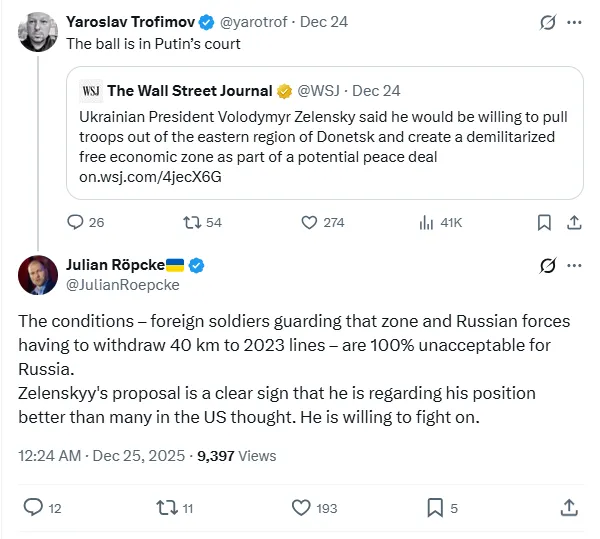
Image

During his latest meeting with high command, Putin ordered the elimination of Ukrainian units there, with the somewhat humbled (or disgraced, depending on your view) Kupyansk sector commander Colonel-General Sergei Kuzovlev again reporting that his units were cleansing Kupyansk of AFU infiltrators.
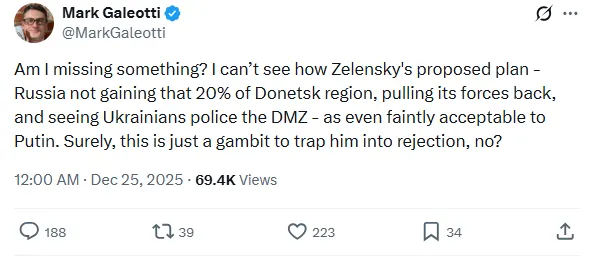
But note this interesting exchange. First, for context is the video of Kuzovlev announcing the total capture of Kupyansk on December 12th, to which even a skeptical Putin double checks with, “So, it’s completely cleared?”


Now, note how Putin gives Kuzovlev a direct but subtly reproving glare as he tells him Kupyansk must be fully cleared, and decisively so, in the latest meeting—a clear reference to Kuzovlev’s previous “not-so-decisive” mistake: (Video at link.)
Compare Kuzovlev’s body language in the second video—clearly more ‘hangdog’ and penitently bowed next to the proud demeanor of the first.

What’s more is that Kuzovlev reportedly told Putin he expects the full destruction of the AFU grouping in Kupyansk around January or February:

⚡️Putin ordered to decisively stop attempts by the Armed Forces of Ukraine to break through to Kupiansk. The enemy group under the city will be destroyed in January - February, the commander of the “West” group reported to the president.

The Supreme Commander-in-Chief noted the prospects for the complete liberation of the Donbass territory.

The Russian Armed Forces need to continue ensuring the security of Russia’s border regions next year, Putin stressed.


What’s even more interesting is the appearance of Putin micro-managing the battles of this sector—as is his right as Supreme Commander-in-Chief—seen in the following video: (Video at link.)

Note at the 1:24 mark how Putin points to the map and declares the importance of liquidating the particular group of AFU on the north bank, presumably, of the Seversky Donets river just south of Krasny Lyman. I could be wrong, but I do not recall Putin ever giving such direct battlefield management orders to his generals in such a way.

Usually, he appears to simply accept their reports, giving the impression of a passive Commander-in-Chief who lets his generals make all the decisions with little oversight. But here we get a fascinating window into the potential reality of the situation behind the scenes, where Putin himself may be much more involved in each battlefield decision and strategic stroke than we’ve previously assumed.

Lastly, Belousov and Gerasimov report that everything is “going according to plan”—and even ahead of schedule, as per Belousov—and that December saw Russia’s fastest rate of advance of the entire year: (Video at link.)

2026 Predictions
We covered the Gulyaipole front in the last paid report, and not much has changed since then. Here is an animation showing Russia’s captures on this sector just in the past two months alone, which segues us into the next section: (Video at link.)

Let us start on this sector. I have already written at length about my prediction here specifically. As can be seen by the rate of advance above, Russia is capturing one defensive block between major rivers every two or three months. The next block will take them to the Orekhov-Novomykolaivka line (circled in yellow below), and should take another 2-3 months at most, and possibly faster.

Suriyak had the same idea so I’ll use his map and analysis (follow along on his map here)—the area shaded in brighter red is the next area Russia will capture in the next couple months as it barrels toward Zaporozhye city:

Image

In spring, Russian forces will begin the battle for Orikhiv and possibly Novomykolaivka. The former will involve an intensification of the southern axes with the aim of cutting off the route to Zaporizhia from the north. However, it is also necessary to mention the Vasylivka front, as the Russian army will continue to have problems advancing due to its proximity to the oblast capital and the large number of drones, which has meant that ‘advances’ have been carried out by small units tasked with destroying enemy positions and attracting Ukrainian reinforcements while the other fronts develop.

In the second town, while the battle is brewing, the Russians will advance westward through the high ground towards the last line of defence, Vilnyansk-Novooleksandrivka, which could be reached in the summer.


Circled in blue above is the final line of defense around Vilnyansk-Novooleksandrovka, which Suriyak believes will be reached by summer. According to my stated timetable of 2-3 months per each “block” between defensive lines, this is correct. That means around summertime, at current paces, Russia will essentially be reaching the outskirts of Zaporozhye city itself; though, I will hedge by saying it could go to autumn by the latest in case of some problems or slowdowns.

Keep this in mind for later, as it will play into the much larger overall analysis.

A reminder of the defensive line Ukraine has planned for Russia precisely in this sector—good thread on it here:

Image

Twitter Link
As a brief interlude, here’s a video showcasing Russia’s latest HIMARS-killer, the guided MLRS Tornado-S system, which, according to the report below, was instrumental in the clearing out of Gulyaipole on this sector in particular: (Video at link.)

The report says the satellite-guided rockets for this system are finally being delivered in quantity to Russian forces.

Note some important translation errors in the above video: SAA = SMO. At 1:45, “trap” is meant to be “REB” which is EW (electronic jamming). The operator is stating that the 9M542 guided rocket has a capability to evade electronic warfare systems by detecting them and automatically swerving around to hit the target from another angle.


The other key sector to watch for 2026 of course will be the Slavyansk-Kramatorsk region, or the “heart of the Donbass”. This is where the entire war essentially started, with the first rebellion inside Slavyansk—so these two major cities are the symbolic heart of the entire conflict.

The jaws are slowly shutting on this agglomerate as of late 2025, but the cities are still no where near in danger of being assaulted any time soon:

Image

You can see to the north is Russia’s new salient where Sosnove was captured. That along with the coming capture of Krasny Lyman represents the northern pincer toward Slavyansk:

Image

The question is, how much progress can Russia make here in 2026? Historically, Russia had major issues approaching Slavyansk through the infamous ‘Sherwood forest’ southeast of Izyum. Likewise, Russia had never truly successfully even managed to cross the Siversky Donets river here, which forms a natural barrier just north of Slavyansk and running all the way to Izyum.

This presumably will again be a huge hurdle and creates a lot of uncertainty for Russia’s progression on this axis. The direction stemming from Seversk will likely fare better, with Russian forces possibly able to approach Slavyansk from the east and just south of the Seversky Donets.

Given that the Seversk front had been frozen for a very long time and only recently had a spurt of movement, it’s hard to make predictions as to that grouping’s combat potential for large-scale future advancement. This is particularly the case because the terrain in this entire region has always given Russia major problems, not only due to the bisection with the major river, but the fact the area is covered in dense forests which the Ukrainians have classically entrenched themselves well in.

There could be some major ‘surprise’ breakthroughs here, though. For instance, it’s reported by some sources that Syrsky utilized precious reserves from this Lyman area (as well as others) to launch the wasteful ‘counter-offensive’ in Kupyansk, which is now attriting these reserves. Some believe this is the main reason for Russia’s sudden breakthroughs near Lyman, in Sosnove, etc., as critical defense units and reserves were removed toward Kupyansk.

If this continues, this area could face more surprising ‘collapses’ just as the Zaporozhye region did when vital units were removed from there toward other areas, like the defense of Pokrovsk and counter-attacks thereof.

Here’s a map showing roughly Russia’s peak control of this area in July 2022 before the major collapse-retreat began:

Image

We can see the Seversky Donets river acted as barrier for the entire northern and northeastern front, with Russian troops only really crossing it to the northwest in the direction of Izyum.

For 2026, it’s clear that Lyman will soon be captured and Russian troops will likely continue westward: the only question is, will they again simply line the river, or will they somehow attempt to cross it this time, around Raihorodok?

This area is particularly treacherous because the Seversky Donets actually has a confluence with the Oskol river, creating even more natural barriers and difficult terrain. The yellow circle is the Oskol coming down from the Kupyansk direction, with the blue line following it toward where it meets the Seversky Donets:

Image

You can see the current location of Russian troops in Sosnove as already reaching this critical barrier that could be very difficult to bypass. At the minimum, Russian forces will likely seize the key town of Svyatogorsk (circled in red) and perhaps attempt to cross there, though that’s unlikely.

The blue shaded area below shows the natural limit of what Russians can capture on the way toward Izyum, before reaching the Oskol barrier:

Image

Sure, they did cross the Oskol north of Kupyansk, but that was aided by supply lines running directly from Russia over the border. Here it would be much trickier, but given the current rapid advancement here it will be very interesting to see what happens.

As such, I can only rate this entire area as having low potential for 2026, though there are always possibilities for big ‘surprises’ given what we said before. More likely will be Russian forces taking everything east of the Oskol in 2026, but I’m not sure how much past it they can go in this zone. Further up north in the Kharkov region is where they will likely continue down on the western bank of the river.

The more likely scenario would be Russian forces continuing up toward the Kramatorsk agglomerate from the Kontantinovka direction, given that large city captures have become much more Russia’s forte compared to the crossing of treacherous natural terrain like rivers, swamps, and forests.

Movement has stalled a bit here of late, but the natural objective of Druzhkovka will have to be the main pursuit throughout the first half of 2026:

Image

We can guess that somewhere in the second half or late 2026, Russia will begin ‘knocking at the southern gates’ of Kramatorsk. The advance westward from Seversk should come more easily, terrain-wise, so I could foresee Russian reaching the gates of Slavyansk on both sides of the Seversky river sometime in the middle of 2026, while the Konstantinovka grouping approaches Kramatorsk from the south:

Image

A situation like the above (shaded in blue) could be what the map roughly looks like sometime in Q3 or Q4 of 2026, though it could potentially happen even sooner if the AFU’s collapse in manpower accelerates.

The actual battles for and capture of the Kramatorsk-Slavyansk agglomerate could be the “big battle” of winter 2026, just as Bakhmut was the battle of winter 2022 into 2023, and Avdeevka the battle of winter 2023 into 2024.

As can be seen, the two main headline culminations for the next year will be Russia’s besiegement of Zaporozhye and that of the Kramatorsk-Slavyansk agglomerate. This will provide a huge climax for late 2026, encircling two regions with a population total of over 1.2 million pre-war. That is Zaporozhye’s ~700k plus the entire Kramatorsk agglomerate, which includes Slavyansk, Konstantinovka, Druzhkovka, etc., which totals somewhere near ~500k.

In fact, Putin stated precisely this in his latest general staff address: (Video at link.)

Of course, some will zoom out the map and complain, stating: “So, you’re telling me all throughout 2026, Russia will only liberate this shaded blue area below? How does that get any closer to winning the war, as it’s such a tiny portion of Ukraine as a whole?”

Image

Recall that war is waged across many different domains. This is discussing strictly the territorial captures, and not even mentioning the attrition war that is arguably far more important. How much will Ukraine’s manpower holdup at current loss rates throughout 2026?

On one hand, Ukraine has not had to even launch any truly end-stage mobilizations of the 18-24 cohort yet, so we can assume Ukraine still has much more fodder to spare for the long haul. On the other hand, we clearly see major breaches along the front pointing to obvious manpower shortages, as well as reports from official Ukrainian sources of record levels of desertions.

For instance, here a Ukrainian military member lambastes famed ‘analyst’ Michael Kofman for his overly-rosy depiction of the AFU’s condition:

Image


Then there is the infrastructure aspect. Ukraine’s energy grid, industrial, and economic infrastructure is being targeted by Russia like never before: from railways, ports, factories, power plants, etc. This will likewise continue to worsen to unseen levels and add to the questions of how much longer Ukraine can hold out amidst worsening conditions from all of the mentioned fields.

Image


Then there is the political aspect. This past year has brought major political pressure, from the corruption scandals slowly tightening the noose over Zelensky himself, to major figures being forced out, from Podolyak, Yermak, and many others. How much longer can Zelensky’s regime bear this pressure and societal exhaustion, particularly with the pressures of elections growing more intense as well?

So the real question is not how much territory Russia seizes, per se. That’s just one of the many elements of Russia’s overall hybrid war which will add intense pressure to the teetering structure of Ukraine as a whole.

Imagine, for a moment if Ukraine makes it to the end of 2026, politically speaking, and the AFU manages to hang on as well. The situation will likely be terminally dismal, and nearing a breaking point. Now imagine precisely at this time of greatest despair—with energy infrastructure totally destroyed, complete political and societal exhaustion, economic collapse or near-terminal hardship, etc.—and right at this moment, Russian troops capture Zaporozhye and Kramatorsk-Slavyansk. The blow from these liberations could reverberate so loudly as to finish off any remaining morale in the nation, or at least send it veering into the final death spiral.

As some top pro-Ukrainian analysts have noted of Zaporozhye in particular:

[T]he city of Zaporizhzhia is far, far more important for Ukraine militarily and politically than anything left in Donetsk Oblast. It’s a large industrial city and the Russian capture of it would be truly catastrophic for Ukraine.

Of course, some have claimed that Russia does not have the manpower to capture such “major cities” as Zaporozhye, given that to assault a city of nearly 1 million people, one needs an army of hundreds of thousands of troops. That may be the case if the defending army likewise has such a garrison there proportionate to the city size. But what will the AFU garrison in Zaporozhye look like by the time Russian troops arrive?

In fact, I propose that Zaporozhye could be one of the easiest cities for Russian troops to capture, despite its mythical size. That is because the city has its back entirely to the water like Mariupol, which means once Russian troops surround it on merely three sides, it is essentially game over, as all logistics routes will be cut off.

Once Russian troops (blue lines) have surrounded it and the bridges westward are under drone fire control (red circles), it’s pretty much game over and will likely culminate in another Azovstal-like “final holdout” and siege in some downtown industrial sector:

Image


And given that Russian troops are proceeding precisely along the main road leading to the north of Zaporozhye, one can easily see how they will encircle the city and cut it off from the north once they arrive:

Image

After that, we can probably see them proceeding toward Pavlograd and Dnipro for 2027 and beyond, should the war last that long.

None of these projections have mentioned the northern front, which has been stirring recently. And there are potentials for Russia to continue expanding the so-called ‘buffer zone’ in both Kharkov and Sumy regions.

Image

It doesn’t appear Russia has the manpower for full-fledged offensives there but that could always change should the AFU continue suffering major manpower collapses of its own.

For instance, there were reports today that many settlements in the Chernigov region were issuing mandatory evacuations for some unknown reason:

Image

For context, that’s Kiev circled in red.

Another map:

Image

This was confirmed by Ukrainian Pravda here. It appears they expect an assault from over the border here for the enlarging of the border buffer zone. This would make sense given the recent new cross-border advances Russia has made in the past couple weeks in the Sumy region near Grabovske. And in fact, just as of this writing, Gerasimov landed in this region to inspect the North grouping, which means it’s probably going to heat up soon.

Meanwhile, evacuations were ordered for the region directly northwest of Russia’s main ‘Eastern Express’ advance line:

Image

We will see how accurate these predictions are through 2026, but they represent the logical culminations of the current battlefield dynamics.

Lastly, a final New Year’s address by Defense Minister Andrey Belousov, wherein he calls the Russian Armed Forces the most ‘combat-ready’ in the world: (Video at link.)

‘In 2025, we continued to improve the combat capabilities of our Armed Forces. Today, we can surely say that the Russian army is the most combat–ready in the world. We prove in practice that we are able to ensure the sovereignty of the country and defend our national interests. During the special military operation, Russian soldiers and officers demonstrate true professionalism, dedication and bravery, and heroically fight for the country,’ Andrei Belousov said in his congratulatory message.

If we don’t see each other again until then, I wish you all Happy New Year! May 2026 bring the world—and us all—better tidings.

https://simplicius76.substack.com/p/202 ... attlefield

******

Kyle Anzalone: Ukraine Takes Part in NATO War Games, Further Integrating Into Collective Defense Architecture
December 30, 2025 natyliesb
By Kyle Anzalone, Libertarian Institute, 12/28/25

Ukrainian representatives participated in NATO war games simulating the alliance’s response to an attack.

According to a NATO press release, 1,500 soldiers and civilians from multiple European countries participated in the Loyal Dolos 2025 drills that were conducted at the beginning of the month.

On Sunday, the General Staff of the Armed Forces posted on Facebook that Ukrainian officials participated in Loyal Dolos. “Ukraine is becoming part of the collective defense architecture of NATO. Ukrainian JATEC experts have, for the first time, joined the work of the mechanisms of Article 5 of the NATO Treaty on the training LOYAL DOLOS 2025,” the post explained.

Senior National Representative of Ukraine in JATEC, director of Implementation of the programs of the Joint Center NATO-Ukraine Colonel Valery Vyshnivsky said, “The participation of Ukrainian JATEC experts in the LOYAL DOLOS 2025, which is one of the key elements of NATO’s preparation according to Article 5 of the North Atlantic Treaty, has strategic significance for us, as for the first time Ukrainian representatives have been involved in the work of the Alliance’s collective security mechanisms.”

Kiev’s military ties to NATO countries are one of the primary reasons Russian President Vladimir Putin ordered the invasion of Ukraine in 2022. The Kremlin has demanded that Kiev agree to neutrality as a condition for ending the war.

President Zelensky recently announced that Ukraine would agree to stop seeking formal membership in the North Atlantic Alliance if members of the bloc agreed to bilateral agreements with Kiev that are similar to NATO’s Article 5. Article 5 is considered the mutual defense pact in the NATO charter.

That Ukraine is continuing its integration into NATO suggests that Kiev is still seeking to become an informal member of the bloc.

https://natyliesbaldwin.com/2025/12/kyl ... hitecture/

******

NY Times Expose: CIA Fights Russia – Trump’s Peace Deal Runs on Illusion

Today the NY Times published a long piece on the relations between the Trump administration and the government of Ukraine.

The Separation: Inside the Unraveling U.S.-Ukraine Partnership (archived) – NY Times, Dec 30 2025

There is a lot of gossip about the back and forth between the U.S. Ukraine and Russia in it, but also some interesting nuggets which confirm U.S. intelligence involvement in attacks on Russia and Russia related shipping:

Even as Mr. Trump bullied Mr. Zelensky, he seemed to coddle Mr. Putin. When the Russian stiff-armed peace proposals and accelerated bombing campaigns on Ukrainian cities, Mr. Trump would lash out on Truth Social and ask his aides, “Do we sanction their banks or do we sanction their energy infrastructure?” For months, he did neither.

But in secret, the Central Intelligence Agency and the U.S. military, with his blessing, supercharged a Ukrainian campaign of drone strikes on Russian oil facilities and tankers to hobble Mr. Putin’s war machine.


The CIA, like usual, seems to work at cross purpose of Pentagon policies:

In so many ways, the partnership was breaking apart. But there was a counternarrative, spooled out largely in secret. At its center was the C.I.A.

Where Mr. Hegseth had marginalized his Ukraine-supporting generals, the C.I.A. director, Mr. Ratcliffe, had consistently protected his own officers’ efforts for Ukraine. He kept the agency’s presence in the country at full strength; funding for its programs there even increased. When Mr. Trump ordered the March aid freeze, the U.S. military rushed to shut down all intelligence sharing. But when Mr. Ratcliffe explained the risk facing C.I.A. officers in Ukraine, the White House allowed the agency to keep sharing intelligence about Russian threats inside Ukraine.

Now, the agency honed a plan to at least buy time, to make it harder for the Russians to capitalize on the Ukrainians’ extraordinary moment of weakness.

One powerful tool finally employed by the Biden administration — supplying ATACMS and targeting intelligence for strikes inside Russia — had been effectively pulled from the table. But a parallel weapon had remained in place — permission for C.I.A. and military officers to share targeting intelligence and provide other assistance for Ukrainian drone strikes against crucial components of the Russian defense industrial base. These included factories manufacturing “energetics” — chemicals used in explosives — as well as petroleum-industry facilities.

In June, beleaguered U.S. military officers met with their C.I.A. counterparts to help craft a more concerted Ukrainian campaign. It would focus exclusively on oil refineries and, instead of supply tanks, would target the refineries’ Achilles’ heel: A C.I.A. expert had identified a type of coupler that was so hard to replace or repair that a refinery would remain offline for weeks. (To avoid backlash, they would not supply weapons and other equipment that Mr. Vance’s allies wanted for other priorities.)

As the campaign began to show results, Mr. Ratcliffe discussed it with Mr. Trump. The president seemed to listen to him; they had a frequent Sunday tee time. According to U.S. officials, Mr. Trump praised America’s surreptitious role in these blows to Russia’s energy industry. They gave him deniability and leverage, he told Mr. Ratcliffe, as the Russian president continued to “jerk him off.”

The energy strikes would come to cost the Russian economy as much as $75 million a day, according to one U.S. intelligence estimate. The C.I.A. would also be authorized to assist with Ukrainian drone strikes on “shadow fleet” vessels in the Black Sea and the Mediterranean. Gas lines would start forming across Russia.

“We found something that is working,” a senior U.S. official said, then had to add, “How long, we don’t know.”


But is it really working? The likely too high estimate of US $75 million damage per day is a relatively small in comparison to the total $110-150 billion per year of Russian gas- and oil sector revenue that flows towards the state.

The gas lines that had formed at a time were caused by logistical problems, not by a general lack of gasoline. It took a about a week to fix that. Russia does have more refining capacity than the country needs. Local demand is prioritized over exports. Attacks on refineries are unlikely to ever bring Russia to its knees.

Another part of the NY Times piece is about an alleged concession Putin was said to have made during peace talks with the Trump administration. It insists that Putin agreed to give up on those parts of Kherson and Zaparozhia that have not yet been captured if the Ukrainians retreat from Donetsk and Luhansk oblast. The Russian side has, to my best knowledge, never confirmed such a deal. The description of the Times on how this allegedly came to pass lets me doubt that any such deal really exists:

“I refuse to be a guilty man,” Mr. Kellogg told a colleague.

At an Oval Office meeting, still hoping to salvage some equity in Ukraine’s territorial concessions, he had offered a plan for a land swap. In this “two-plus-two plan,” Mr. Putin would withdraw from Zaporizhzhia and Kherson Oblasts. Ukraine would relinquish the rest of Donetsk and Luhansk.

The plan, Mr. Kellogg admitted, was a Hail Mary, and Mr. Trump told him, “Putin probably won’t go for it.” Still, he directed Mr. Witkoff, “Get this to Putin.”

They met on Aug. 6. Mr. Putin didn’t go for it; he was not about to cede territory voluntarily. But Mr. Witkoff heard what he interpreted as a breakthrough. According to a Trump adviser, the envoy reported back that Mr. Putin had told him: “OK, OK, we can’t figure out a cease-fire. Here’s what we will do, we will do a final peace deal, and that peace deal is the balance of Donetsk.”

Actually it was more.

In this “three-plus-two plan,” the Russians would also keep Crimea and get the last sliver of Luhansk. Instead of withdrawing from Kherson and Zaporizhzhia, as Mr. Kellogg had proposed, they would keep the territory they’d already conquered. The plan was not the total control Mr. Putin had long demanded, but it was still far more favorable to Russia.

[After the August meeting in Anchorage the presidents] took no questions, leaving the world to puzzle over just what they had agreed on. But according to two Trump advisers, Mr. Putin repeated what he had told Mr. Witkoff: He would end the war if he could get the balance of Donetsk.


I very much doubt that the Russian president agreed to this. Putin is a trained jurist and the inclusion of Kherson, Zaparozhia, Dontesk and Luhansk into the Russian Federation is a part of its constitution. Not even the president can overrule it.

The so called peace process the U.S. pursues runs on illusions. This while the Russians clearly see what the CIA is doing to them.

They surely won’t fall for the conditions the U.S. is trying to impose on them.

Posted by b on December 31, 2025 at 11:58 UTC | Permalink

https://www.moonofalabama.org/2025/12/n ... usion.html

******

Military results for December 2025
December 31, 2025

Image

In December 2025, six of the nine cities where fighting was fought were liberated:
Volchansk, Seversk, Krasnoarmeysk, Dimitrov, Gulyaipole, and Rodinskoye.

Image

Image

Image

Image

Image

Image

Image

Image

Image

https://t.me/lost_armour/7618 - zinc

Plus, they forgot Stepnogorsk. All that remains is to clear Kupyansk back, well, Konstantinovka and Krasny Liman are next in line.

Also in 2025, the cities of Sudzha, Kurakhovo, Dzerzhinsk, and Chasov Yar were liberated.

* * *

According to the calculations of the "Sofa General Staff", in 2025, the Russian Armed Forces liberated 6,254 square kilometers of territory. Of these, 542 square kilometers were liberated in December.

Image

Image

Image

Image

Image

Image

Image

https://t.me/divgen/77298 - zinc

Now we have the best pace of advance since 2022. Moving further. To the west.

https://colonelcassad.livejournal.com/10280059.html

Schematic of the attack on Putin's residence. December 30, 2025.
January 1, 11:05

Image

The Russian Ministry of Defense published a diagram yesterday of the Ukrainian Armed Forces' attempted strike on Putin's residence in the Novgorod region.
A total of 91 drones were used. All drones were shot down at various stages of the attack.
Fragments of downed drones attempting to breach the residence were also shown yesterday.

https://colonelcassad.livejournal.com/10281199.html

Google Translator
"There is great chaos under heaven; the situation is excellent."

User avatar
blindpig
Posts: 15059
Joined: Fri Jul 14, 2017 5:44 pm
Location: Turtle Island
Contact:

Re: Footnotes from the Ukrainian "Crisis"; New High-Points in Cynicism Part V

Post by blindpig » Sat Jan 03, 2026 12:19 pm

Back to life
Published by @nsanzo ⋅ 03/01/2026

Image

His death always seemed strange, from the announcement itself to the way it supposedly occurred. His brigade, the Russian Volunteer Corps (RDK), announced it on social media with hardly any details, granting their leader a heroic end—the end of a warrior, as Maksym Zhoryn emphasized in his heartfelt tribute. Denis Kapustin, "White Rex ," had fallen on the front lines after being struck by an FPV drone somewhere on the Zaporizhzhia front, one of the two currently active fronts. Doubts began to surface immediately after the RDK's announcement, accompanied by a black and white photo of their fallen leader. Like other figures whose importance wasn't military, such as Andriy Biletsky, Kapustin hadn't been particularly active on the front lines, and his group had primarily engaged in specific operations as part of the special forces of the General Directorate of Military Intelligence of Ukraine, headed by Kirill Budanov, including raids like the one that made the group famous in purely civilian villages on the Russian side of the border.

The only detail that made Kapustin's deployment to the front lines plausible was the death of at least five soldiers from the group that same week, something that has been explained as a consequence of Ukraine's difficulty in replenishing its ranks due to casualties and recruitment challenges. Although in the interview he gave to Fox News during his visit to the United States, Zelensky stated that, for the first time in the war, Russia had suffered net losses that year (fewer recruits than deaths on the front lines), it is not Russia that is having problems replacing soldiers who are killed, wounded, or need to be relieved at the end of their rotations. The presence of groups like RDK, which was never intended to be an infantry unit, is just further evidence of this.

However, sending a group to the front lines doesn't necessarily imply the presence of leaders like Kapustin, who are more media figures than military leaders and who don't direct operations but are merely political and ideological role models for the rest of the soldiers. In that sense, the natural comparison for White Rex is Andriy Biletsky, a figure who has risen through the military ranks thanks to the war, but who has never been a strategist or a commander in charge of the day-to-day operations of Azov, neither in its initial form in 2014 nor in its current reorganization as the 3rd Assault Brigade. The chances of a Russian drone deliberately detecting and hitting Kapustin didn't seem particularly high beyond a stroke of luck in an attack—not on the person, but on the location where the RDK was detected.

The lack of details surrounding the death, the absence of a Russian statement regarding the attack, and, above all, the lack of a funeral or public tribute in which the other far-right groups that had paid their respects to the fallen comrade and vowed revenge could participate, made the initial version of a heroic death on the front lines increasingly implausible. However, the Ukrainian GUR (State Security Command) has not allowed time for rumors such as a settling of scores or Zelensky's attempt to eliminate key neo-Nazi figures to take hold. This latter hypothesis was initially put forward by the more optimistic analysts, who interpreted Kapustin's elimination by Ukrainian state security forces as the removal of groups or figures capable of hindering peace in the event of a mass demobilization of hundreds of thousands of battle-hardened men with strong ideological convictions.

The reality has turned out to be more prosaic. Kapustin hadn't fallen, neither on the front lines nor behind them, and those who saw something strange in the RDK's statement suspected they were right. Yesterday, in his provocative style and with a desire to create a spectacle, Kirilo Budanov revealed the final trick. "RDK commander Denis Kapustin is alive," the group announced yesterday on its social media. On their profile, the message appeared after the statement issued a few days ago by the group's military commander, who, in the most serious tone possible, demanded that rumors and speculation be avoided and called for trusting only the official information published by the RDK. Taking advantage of the media interest generated by the supposed heroic death , the group appealed to its followers to enlist and contribute financially to its funding. Any excuse is good enough to ask for more money from its followers, and they can't afford to miss the opportunity to financially exploit a faked death.

The plot uncovered yesterday by Kirill Budanov is a carbon copy of the SBU's 2017 special operation , the staged death of journalist Arkady Babchenko. As then, the faked death has been justified as a way to avoid a political assassination by the Russian secret services. In both cases, the person Russia supposedly wanted to kill was an irrelevant figure in the country, living in Ukraine, with no intention of returning and no followers to whom he could appeal. But also as on that occasion, reality and fiction can be interwoven to create an epic tale of a great Ukrainian victory against evil Russia, which has once again failed in its attempt to eliminate an enemy. “Failure of the Russian special services. RDK commander Denis Kapustin is alive and $500,000 has been received for his elimination, which will reinforce the special forces of the General Directorate of Intelligence,” the group claimed, using the same excuse used to justify Babchenko’s death : to prevent a Russian assassination and profit from it.

In this war where reality and fiction, facts and myths blur, nothing needs to be proven to be believable. “As a result of a complex special operation carried out by the Main Intelligence Directorate of the Ukrainian Ministry of Defense, which lasted more than a month, the life of RDK commander Denis Kapustin, whom Russian dictator Vladimir Putin considers his personal enemy, was saved, and a group of people involved in the crime within the Russian special services and their perpetrators were identified,” RDK adds to its epic description of an operation that is more imaginary than real and which it has decided to turn into the equivalent of the climax of a Western with a final duel between the protagonist and the antagonist.

“I suppose seeing Leonid Nevzlin, Khodorkovsky’s partner and a Haaretz shareholder, solemnly lamenting from Israel the death of an avowed Nazi was worth it. As were the obituaries by Western journalists who portrayed him as a complex personality who chose the right side of history. Now, especially for them, he’s alive and well, standing in front of the Spayka, a fascist symbol, a Russian version of, well, Fascism,” commented Russian opposition journalist Leonid Ragozin. “Heroes never really die,” he concluded. Especially heroes artificially created by the whims of intelligence services.

The operation to revive Denis Kapustin has turned out to be the latest stunt by Kyrylo Budanov's GUR (Ukrainian Special Forces). “I met with Kyrylo Budanov and offered him the position of Chief of Staff to the President of Ukraine. At this time, Ukraine needs greater attention to security, the development of the Ukrainian Defense and Security Forces, and the diplomatic path of negotiations, and the President's Office will be primarily responsible for fulfilling these tasks for our state. Kyrylo has specialized experience in these areas and the capacity to achieve results,” Volodymyr Zelensky wrote yesterday to announce, more than a month after Andriy Ermak's forced resignation, who will take charge of the President's Office. Budanov's negotiating credentials are highly questionable, as Russia has always considered his special operations gratuitous provocations, but his international connections could prove useful.

Budanov's appointment marks a clear change of course. Unlike Ermak, with whom he clashed and whom he repeatedly tried to remove, Kirill Budanov is close to the United States. As a 2023 article in The Washington Post highlighted , when designing the intelligence collaboration that began in 2014, the United States chose the GUR as its ally. For the CIA, the GUR was a smaller, more manageable intelligence agency, and above all, "less burdened by Soviet times, while the SBU was still perceived as infiltrated by Russian intelligence." "The GUR was our baby," says one of the former agents tasked with implementing an intelligence collaboration that entails US control and power within the inner workings of Ukraine, whose main leader now holds a key executive position at a crucial moment.

In addition to his relationship with this indispensable ally, Budanov possesses the ability to control some of the most radical and ideologically driven battalions, which have formed part of his special forces during this period. Among these battalions is Kraken, the Azov reorganization in which Maksym Zhoryn and Denis Kapustin collaborated after the defeat at Azovstal—a connection that links Budanov to another rising political figure, Andriy Biletsky. The former GUR leader is also bolstered by his close ties to figures like David Arajamia, leader of the parliamentary faction of Zelensky's party—a network of important connections that puts Budanov a step ahead of other contenders for political power, especially the increasingly isolated Zaluzhny.

https://slavyangrad.es/2026/01/03/vuelta-a-la-vida/

Google Translator

******

From Cassad's telegram account:

(It's all Venezuela.)

Google Translator

******

Five politicians of 2025

Zelensky, Yermak, Myndich, Malyuk, Shabunin.
Events in Ukraine
Jan 01, 2026

What’s the right format for a roundup of the year? Events? Far too many have transpired. Processes, reforms, intrigues? Too abstract, too complex.

So I’ve settled with a rather phallocentric list of individuals. Their affairs involve the great events of the year, the unfolding processes, the anti-climactic reforms. And all the links will take you to an article of mine on the topic. Today we’ll look at political heavyweights, and tomorrow, the leading lights of the army.

After all, it’s always easier to retell a film with reference to the characters, not the plot. And today’s cast contains plenty of show business veterans. There are few countries where the line between mass entertainment and elite politics is blurrier than Ukraine. And in the interests of made-for-TV digestibility, I’ll begin each character profile with a succinct summary.

Zelensky lives on
The president survived the year, but is more precarious than ever

Image

The year began with an embattled Zelensky attempting to hold back the tide of public criticism amidst frontline defeats.

But the new man in the White House helped out Zelensky tremendously with his March attack on the Ukrainian president. The liberal press at home and abroad once again lionized Zelensky. Top Ukrainian politicians and analysts began tearfully predicting the assassination of the president.

The year ended in much the same way. Following the corruption scandal of November, his popularity (whatever that really means in a tremendously repressive wartime society) was lower than ever. There was also Zelensky’s July attempt to quash the independence of the anti-corruption organs created and beloved by the west.

But luckily, later in November, the nefarious Trump and his attempts to push Ukraine into accepting a peace deal once again came to the rescue. Media publications critical of Zelensky began saying that with his righthand-man Andriy Yermak removed on November 28, Zelensky has returned to the ‘energetic leadership’ he displayed in early 2022.

Liberal critics stopped attacking the president. Preventing the war from ending takes precedence.

There have been many predictions of Zelensky’s imminent end. People like pointing to hit-pieces against Zelensky in the western press as sign that his days are numbered. Seymour Hersh even wrote in July that Zelensky would soon be deposed by Washington in a 1963 Vietnam-style coup, an argument I critiqued in a popular article here. Not to place myself above such a venerable figure as Hersh, but it seems to me that with six months past, I wasn’t wrong to focus on Zelensky’s stability.

Anyway, this isn’t my first rodeo, so to speak. The western press has despised Zelensky as a crypto-Russian spy ever since his 2019 election. And yet, NATO still manages to manipulate him to get their way. It isn’t that hard to play a man as egotistic, embattled and superficial as Zelensky. An actor is always desperate for the audience to like him.

Will Zelensky survive 2026? On the one hand, it may be hard for him without the comforting presence of Yermak. And the fact that Zelensky backed down in late July when he attempted to liquidate the independence of the western-funded santi-corruption organs showed both his friends and enemies that there is no need to expect the president to have a backbone.

But on the other hand, the liberal nationalist media that critiqued him so harshly until a month ago is now saying that with Yermak gone, Zelensky has reverted to his supposed 2022 peak. They now praise him for consulting with a range of figures, instead of solely relying on Yermak. The struggle will likely re-emerge with greater ferocity if or when Trump backs off from pushing Zelensky to accept a peace deal.

All in all, Zelensky has proved his naysayers wrong enough times. I suspect he will continue clinging on to power. After all, there’s nothing more powerful than the TV. And there’s no greater television character than Zelensky.

Yermak abandoned?
The eminence grise was finally forced out, but remains in the shadows.

Image

This wasn’t a good year for Andriy Yermak, head of Zelensky’s presidential administration (the President’s Office/Bankova). On November 28, he was finally forced to resign, after five years as the most powerful man in the country after Zelensky.

Who is Yermak? This is still a question that’s hard to answer. He’d been hated for years by the western press and Ukrainian liberal nationalists, accused of being Russia’s main secret agent. This didn’t prevent him from enjoying a close relationship with Alexander Soros.

In fact, I’ve always been rather partial to the theory that Yermak is London’s main asset. He’s certainly always been very opposed to any peace deal. In fact, just a few days before his removal, he gave another grand statement to the British press railing against any peace in which Ukraine didn’t return to its 1991 borders. Was it Trump who got rid of Zelensky? Is Ukraine the arena for a shadow war between MI6 and the CIA?

To be fair, I’ve always felt that Yermak was removed more due to internal political squabbles than anything else. It was Yermak’s twin passion for micromanagement and pleasing Zelensky that led to the steady centralization of power from 2020 onwards. This earned him an endlessly expanding array of enemies. Many miss the profitable government sinecures they once had, snatched away by Yermak and given to one of his cronies.

Now that he’s gone, a much wider range of power players have access to Zelensky’s ear. There’s more space for everyone to scheme and profit. Everyone’s happy. Well, other than ordinary mortals.

And while Yermak may be gone from Bankova, he still apparently pays nightly visits to Zelensky’s personal residence.

Their relationship has always been deeply strange, it must be said. A few suggestive details from a famous Financial Times piece on Yermak from earlier in the year. Yermak is a lifelong bachelor. Besides law and show business, one of his main obsessions and business activities was jewelry. He is obsessed with looking good, and worked out daily with Zelensky in their bunker. They often slept side by side. He has a high pitched voice.

Asides from whatever conclusions you may wish to make based on that data, Ukrainian media has also been reporting that Yermak continues to enjoy good relations with a number of top figures in law enforcement and the state apparatus. Oleg Tatarov, often considered one of the key ‘Yermakites’ in power, remains the man in charge of controlling Ukraine’s law enforcement.

In short, Yermak is dead, long live Yermak. Whether he’s simply staying to curate his economic schemes or he has broader plans of a return to power has yet to be seen. The first is a given, the second is rather likely, though of doubtful wisdom.

The Myndich mystery
The secretive oligarch and Zelensky-insider fled to Israel, where he now happily plays the role of Ukraine’s greatest scapegoat

Image

Timur Myndich is a man who had been friends with Yermak and Zelensky for a very long time. It was he who fatefully introduced Zelensky to oligarch Igor Kolomoisky back around 2008. This was very good for Zelensky’s show business career. By 2015, Kolomoisky’s television channel 1+1 aired Zelensky’s ‘Servant of the People’ television show, where Zelensky played Vasyl Holoborodko, an honest schoolteacher who became president. And by 2019, fiction became real life. 73% of the country voted for Holoborodko as president.

Image
‘The Servant of the People: the story of the next president’. A poster from 2015 (!!)

Back in 2016, ‘the Servant of the People’ released a prophetic episode. It featured a scene in which a Jewish oligarch and his side-locked sidekicks stride towards a plane heading for Israel, escaping a corruption scandal in Ukraine. The leader whispers into the ear of an airport official: You probably know who I am. Timur Myndich. In November 2025, the episode once again became viral.

Little was known about the real Myndich until this year. In early November, the anti-corruption organs finally released tapes detailing corruption in Zelensky’s inner circle - the first public phase of the grandly-named ‘Operation Midas’. Myndich was Midas, with everything he touched turning into gold.

According to the anti-corruption community (called Sorosites by ill-meaning detractors), Myndich became omnipresent around 2023. With his former boss Kolomoisky imprisoned that year, Myndich took over his sprawling business empire. Over the course of 2025, particularly after Zelensky’s July attack on the anti-corruption organs, endless revelations about Myndich began pouring out from the liberal ‘Sorosite’ press.

There was Myndich’s diamond empire, which operated a Russian branch until 2024. There was Fire Point, the previously unknown arms company operated by lowly Myndich/Yermak associates, which gobbled up a third of the entire defense budget in 2024. There was Fire Point’s famous Flamingo missile, which many western-funded Ukrainian journalists and sundry militarists have claimed was a massive, inexistent fraud. Everywhere you looked, there was a bit of Myndich.

Operation Midas, at least in the tapes it published on November 10, focused on Myndich’s role in a scheme that embezzled $100 million USD from Ukraine’s nuclear power system in wartime. Naturally, Myndich escaped law enforcement and is once again comfortably in Israel, his main place of residence. As for the deeper geopolitical forces behind Operation Midas, I maintain my belief it was a European operation to push Zelensky against accepting a Trumpian ceasefire, not the opposite.

Myndich-gate ended up leading to the resignation of Yermak and a massive PR hit to Zelensky. But as soon as Trump, sensing Zelensky’s weakness, began pressuring Zelensky into accepting a peace agreement, the same liberal nationalist (‘Sorosite’) anti-corruption community that was screaming Myndich day and night suddenly went quiet.

Or rather, they stopped making the eminently reasonable argument that Myndich (and Yermak) was never really an independent player, but merely an appendage of Zelensky. Now, listening to them you might sometimes be mistaken for assuming that only Myndich is responsible for corruption in Ukraine. Quite convenient, given that he is ensconced in Israel.

Western-funded Ukrainian journalists confronted Myndich on an Israeli beach last week. Myndich swore up and down that he had been framed and made into a scapegoat. In truth, it’s hard not to agree.

Image

Will we continue hearing the name Myndich in 2026? I highly doubt he will ever be extradited from Israel. There were some recent claims by Kolomoisky that there had been a (possibly Yermak-orchestrated) assassination attempt on Yermak. In fact, I believe that it is most convenient for Zelensky/Yermak if Myndich stays in Israel. There he remains the scapegoat, but without any threat of loose lips, as might happen were he tried in a court of law.

But if political contradictions ever return to Ukraine, say, after some kind of peace deal, I have no doubt that Myndich-gate will erupt once more with true fervor. And this time, Myndich’s connections with both Zelensky and top Ukrainian-Russian FSB spook Andrii Derkach will be highlighted. The security services (SBU) have already recently opened a treason investigation into Myndich for this Russian trace. Taken together, I have no doubt that Zelensky’s many opponents could reasonably hope to sink him with Myndich.

The many Malyuks
The squat spook betrayed everyone and did quite well for himself.

Image

(Paywall with free option.)

https://eventsinukraine.substack.com/p/ ... ns-of-2025

******

It’s Unsurprising That A Popular Ukrainian Outlet Laments The Loss Of “Zakerzonia” To Poland
Andrew Korybko
Jan 01, 2026

Image

Ukrainian officials are expected to encourage the popularization of these unofficial territorial claims with clandestine German support in order to wield them as leverage for rebalancing relations with Poland, whose rapid US-backed rise worries both of them, after the current conflict with Russia ends.

Ukraine’s Espreso TV, which is famous for livestreaming “EuroMaidan”, published an opinion peace in early December lamenting the loss of what ultra-nationalists consider to be “Zakerzonia”. This refers to the strip of land just west of the Curzon Line in Poland that they regard as historically Ukrainian due to the presence of many Orthodox East Slavs there till the end of World War II. It was also under the control of “Old (‘Kievan’) Rus” before becoming part of the Polish-Lithuanian Commonwealth and then Poland.
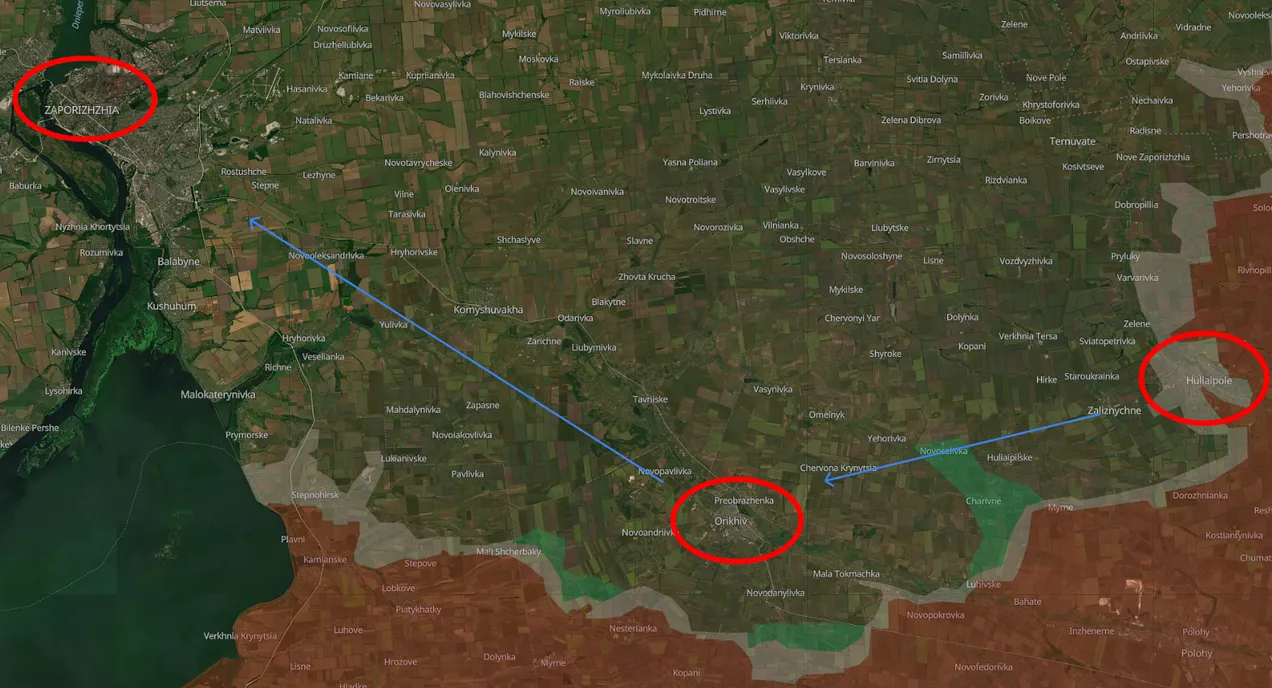
The article coincided with the anniversary of the Allied Supreme War Council’s proposal on 8 December 1919 that later became known as the Curzon Line due to the efforts of former British Foreign Secretary Lord George Curzon to make it the Polish-Bolshevik border during the height of their war in 1920. The gist is that this proposal, which later became the Polish-Soviet border after World War II at Stalin’s suggestion, legitimized Poland’s control over the “Zakerzonian” subregions of Podlasie and Chelm Land.
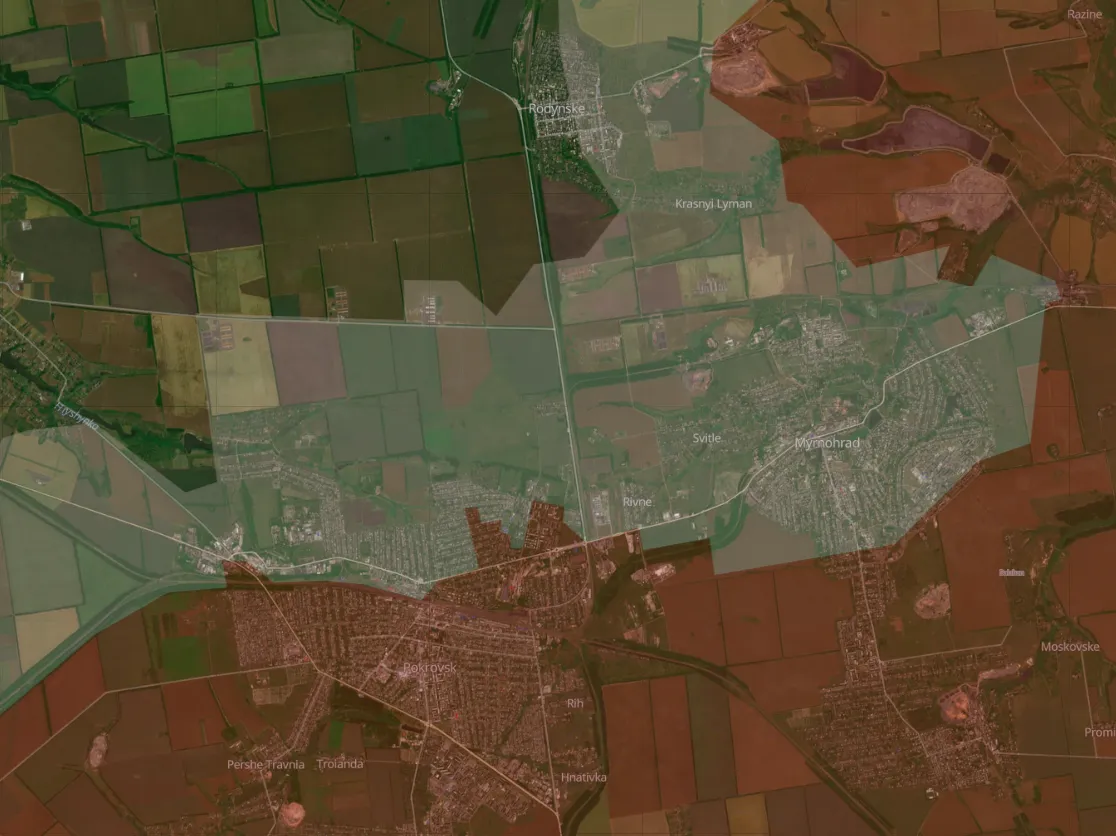
Vice President of Poland’s National Movement (Ruch Narodowy in Polish) Pawel Usiadek, who also serves as a member of the Leaders’ Council in the Confederation political alliance between his party and Slawomir Mentzen’s New Hope (Nowa Nadzieja in Polish), strongly condemned this article in a post on X. He drew attention to how it “omit[ted] obvious facts regarding the ethnic structure and history of these regions” and described the piece as “historical propaganda (for) creat[ing[] a false sense of grievance”.

This conforms with “a tendency (that) has appeared in the Ukrainian public space to present the territories of modern Poland as areas of Ukrainian identity that were supposedly lost as a result of decisions by Great Powers.” The extremist rhetoric that this narrative extends false credence to “cannot be underestimated because it builds a mental foundation for future political claims, which high-ranking Ukrainian officials are already talking about today.”

Usiadek concluded that “In a situation where Poland bears enormous costs for supporting Ukraine, tolerating a narrative that questions Poland’s historical sovereignty becomes an action to one’s own detriment”, which was warned about here in October 2024 and again here a year later in October 2025. The first details how the “Zakerzonia” issue has begun to mobilize some ultra-nationalists against Poland while the second forecast that it would become more popular as the current conflict winds down.

Espreso TV’s opinion piece was therefore unsurprising since it correlates with the aforesaid trends, which Ukrainian officials are expected to tacitly encourage as leverage for rebalancing relations with Poland, whose rapid US-backed rise worries them. Just like during the interwar period, Germany – which is once again in a zero-sum rivalry with Poland – could weaponize this ultra-nationalist issue for coercing Poland back into its junior partner role, which represents a significant threat scenario to Polish sovereignty.

Just several months ago, “The Ukrainian Ambassador To Poland Admitted That His Co-Ethnics Don’t Want To Assimilate”, which preceded Ukraine’s popular “European Pravda” predicting the formation of an ethnic Ukrainian lobby in the Polish Sejm, thus lending credence to the aforesaid threat assessment. If most of this community isn’t soon “creatively coerced” into re-migrating, then the ultra-nationalists among them might one day carry out acts of terror with partial Sejm protection in pursuit of this cause.

https://korybko.substack.com/p/its-unsu ... -ukrainian

******

Ukrainian Drone Attack Killed 24 Civilians in Kherson

Image
X/ Debris left by the Ukrainian attack in the Kherson region, Jan. 1, 2026. X/ @volkova_ma57183

January 1, 2026 Hour: 9:45 am

The terrorist action took place while dozens of people were celebrating the arrival of the New Year.
On Wednesday, Ukrainian drones killed 24 people and wounded 29 citizens in an attack on the civilian population in the town of Jorly, in Kherson region, during New Year celebrations.

“Cruelty. Meanness. Cynicism. A normal person’s vocabulary is too poor to define the actions of this scum,” said Dmitry Medvedev, Russia’s former president and current deputy chairman of the Security Council.

“Only the merciless language of revenge is suitable for this. Inevitable and swift in the course of our army’s offensive,” he said, adding that Russia’s response should affect both the “monstrous perpetrators of this attack” and their “various commanders.” “Enough ceremonies,” he urged.

Earlier, Kherson Governor Vladimir Saldo said the Ukrainian army carried out the attack using three aerial vehicles launched at a cafe and a hotel on the Black Sea coast, where civilians were celebrating the arrival of the New Year. One of the drones was carrying an incendiary mixture.


Among the 24 dead was a child, Saldo said, adding that many civilians were burned alive. Six minors were among the injured. Rescuers were unable to save more people because of the intensity of the fire, which could not be extinguished until early morning.

The Kherson governor said the Ukrainian terrorist attack was similar to the criminal action carried out against the Trade Unions House in Odesa in 2014, when Ukrainian neo-Nazis deliberately set fire to the building where citizens opposed to the coup d’etat and the policies of Kiev’s new authorities were hiding.

Russian Foreign Ministry spokeswoman Maria Zakharova said the actions of the Kiev regime show its “bestial nature,” as well as “neo-Nazi hatred, dehumanization growing at a geometric rate” and “mockery of the sacred.”

“We accuse all those who finance the Ukrainian terrorist bastards of this attack. We accuse them of the murder of children and the extermination of the civilian population. We accuse them of corrupting the Ukrainian statehood, turned into a killing machine,” she said.

Ukraine repeatedly carries out targeted attacks against the civilian population of Russia’s border regions. Drones and missiles from the Kiev regime strike civilian vehicles, homes, recreational areas, shopping centers and other civilian facilities.

https://www.telesurenglish.net/ukrainia ... n-kherson/

******

A year of silent advances on the battlefield and pointless diplomatic noise

Lucas Leiroz

January 1, 2026

Before the full liberation of the New Regions, talking about “peace” or a “ceasefire” is a waste of time.

The year 2025 consolidated an interesting dynamic in the conflict between Russia and NATO in Ukraine: while the battlefield advances in a methodical and largely unreported manner, international diplomacy produces a growing volume of statements, speculation, and headlines that rarely turn into concrete results. The contrast between silent military progress and loud diplomatic “advances” became the defining feature of 2025.

With Donald Trump’s return to the presidency of the United States, Washington began to signal renewed interest in some form of political agreement between Russia and Ukraine. Talk of a “ceasefire,” “preliminary negotiations,” and an “opportunity for peace” dominated Western media throughout the year. These narratives, however, ignore an unavoidable structural reality: there will be no agreement as long as Ukrainian forces remain in Donetsk, Lugansk, Zaporozhye, and Kherson – regions that are part of the constitutional map of the Russian Federation in the same way as Moscow or Saint Petersburg.

This factor turns any peace proposal promoted by Washington or European capitals into a purely rhetorical exercise. For Moscow, concluding negotiations under the presence of foreign military forces on its constitutional territory is not only politically unviable but legally impossible. Western media, however, persist in treating the issue as if it were a conventional territorial dispute, disregarding the centrality of Russia’s constitutional framework in the conduct of the Special Military Operation (SMO).

Meanwhile, on the ground, 2025 marked consistent advances by Russian forces. The recent liberation of Seversk, as well as earlier successful operations in the Krasnoarmeysk area and other key cities, illustrates a deliberate strategy of gradual advance, prioritizing the attrition of enemy capabilities over large-scale, huge offensives. These developments rarely receive attention in major Western outlets, which tend to report only Russian tactical withdrawals (when possible) or isolated episodes that fit the dominant narrative.

This informational asymmetry fuels the illusion of military stagnation when, in reality, the 2025 balance of the SMO points to a continuous weakening of Ukrainian capabilities, both in manpower and logistics. Growing dependence on increasingly limited external support, combined with the structural fatigue of the Ukrainian state, stands in stark contrast to Russia’s ability to sustain prolonged operations.

From a strategic standpoint, Moscow has made it clear that the slow pace is not a sign of weakness, but of choice. The Russian leadership does not view the conflict as a classic external war, but as an internal tragedy within the historical Russian space. As well known, virtually every Russian has a Ukrainian relative, which is why the careful conduct of military operations is also a way of preserving Russian families themselves – on both sides of the artificial borders created in 1991. This does not mean that Russia will not escalate its activities or that there is no popular support for a greater use of force, but it does indicate the goodwill of Moscow’s authorities in avoiding widespread violence.

In this context, Trump’s initiatives face clear limits. The only realistic scenario for diplomatic progress would be Washington’s ability to override its European allies and force Kiev into a military withdrawal without direct confrontation – an outcome that is highly unlikely, though not entirely impossible, given NATO’s internal divisions and Ukrainian political situation. Without this, any negotiated “agreement” will, in practice, be impossible and useless.

Thus, the most realistic outlook is the continuation of the conflict over a medium- to long-term horizon. If the current strategy is maintained, the war could last five to ten years, with gradual Russian advances and successive failed diplomatic attempts. Regardless of form or timing, the SMO will be concluded in the same way: through the achievement of the strategic objectives established back in 2022.

In 2025, more than at any other moment, it became evident that the outcome will not be decided at televised negotiating tables, but on the ground – silently.

https://strategic-culture.su/news/2026/ ... tic-noise/

The 91 drones of stupidity

Lorenzo Maria Pacini

December 31, 2025

It is time for Zelensky to go. Either willingly or by force.

Senseless and without dignity

Imagine you are on a cold winter afternoon, while everything around you flows normally, in the slowness dictated by the climate and the anticipation of Christmas and the new calendar year. Imagine that the whole world is slowing down to make room for the holidays that involve billions of people around the globe, and even in the mainstream media and in the movies, everyone is talking about being kinder, while children sing songs about peace. Imagine all this.

Then imagine that 91 drones were launched from Kiev on Vladimir Putin’s residence in Novgorod.

Now try not to call this act “pure stupidity.”

These are strong words, perhaps, but not as strong as those used by Dmitry Medvedev, former Russian president and deputy chairman of the Security Council, who commented harshly on X about the absurdity of the Kiev regime, which is trying to boycott any peaceful solution. Because this is exactly what Volodymyr Zelensky, with no dignity left, is constantly trying to do.

Once excluded from the negotiating table, Zelensky tried in numerous ways to tamper with the negotiations and detonate the situation: from pilgrimages to the British Court and the European Commission, to threats and incitement to murder. Now, drones against the Russian president’s residence.

Zelensky’s behavior, in addition to his lack of strategic sense and dignity—already lost during his television shows where he played the piano and guitar naked—reveals the last gasps of a character who has now reached the final act of his script.

Of course, Zelensky is currently convenient for everyone: for Russia, he is a useful enemy, easy to manage in terms of public opinion, already well known and hated by practically everyone, even outside the country; for the US, he is the right person to sacrifice, now at the end of his ‘term’, having already lost the blessing of the White House and now adrift, waiting to be liquidated ‘for better or for worse’, but not before he has finished destroying Ukraine and led the European Union to spend its last remaining cents on futile weapons for a senseless war.

What if it was all intentional?

Let’s try to think tactically and strategically for a moment. The move of the 91 drones of stupidity was indeed an amateur move. Perhaps too much so. No military officer with even a modicum of training would ever have approved such a decision (only in Europe, perhaps, would we find people capable of this). So… either it was Zelensky himself who decided to do it, or someone gave him the ‘wrong’ advice at the ‘right’ time.

Several analysts have spoken of a plot originating in London – and this certainly comes as no surprise to us. NATO wants to continue with the escalation, and as long as the Windsor crown reigns on the continent, nothing will change.

Striking a residence of Putin’s in Novgorod that is known to have been unused for about four years is such an illogical provocation that it is difficult to believe that the idea originated entirely in Zelensky’s mind, even considering his well-known hypersensitivity to any risk. It is therefore legitimate to assume that this is a maneuver aimed at getting rid of the leader in Kiev, as several actors in the Ukrainian political and oligarchic shadows now openly hope, all ready to take personal advantage of the defeat. What is presented to the most naive as an act of revenge or a sign of Ukraine’s rebirth actually confirms that Zelensky’s time is rapidly running out and that the internal opposition may have joined forces with Western intelligence, or at least with British intelligence, which has historically been obsessed with Russia and conflict.

The fact that all the drones were intercepted and destroyed well before they approached the presidential residence reinforces the idea that the operation was not entirely unexpected and that the Russian services were already aware of it. In any case, it is not surprising that Zelensky spoke of a ploy orchestrated by Moscow to consolidate its position in the negotiations. This statement is not very credible in itself, but it reveals that even for him this reckless action may have appeared sudden. The details are also revealing, as noted by Simplicissimus: if the attack took place on the night between December 28 and 29 and the first drones violated Russian airspace around 10 p.m. on the 28th, it means that the operation was launched while the Kiev leader was in Florida meeting with Trump to discuss peace. Even taking into account his well-known propensity for lying, it is plausible to believe that the order did not come under his direct control. The overall objective was clearly to sabotage any prospect of negotiation, but also to put Mr. Zelensky in serious difficulty.

And then, let’s be clear: it’s time for a change of scenery. From London, where he has been for over a year, General Zaluzhny, officially appointed as Ukrainian ambassador, is conducting the orchestra from behind the scenes. Another coincidence is that he will return to Kiev at the beginning of 2026. As we have discussed several times in Strategic Culture, Zaluzhny is the ‘perfect’ candidate to succeed Zelensky, who will either be replaced by a handover or by a transition tinged with red. Zaluzhny, moreover, is the guarantor of London and Brussels’ interests in the continuation of the war, so he is the right person for the job. It matters little that he was a terrible general and is surrounded by scandals; after all, Ukraine has put a comedian at the helm who only made European perverts laugh.

The European justification

Russia’s claims about the drone attack were instantly accepted in the West, not with an investigation, but with rhetoric aimed at justifying the Kiev regime. Western “experts” unanimously declare that such an attack “makes no sense,” trying to divert attention from the essence of what happened: a war crime aimed at intimidating and liquidating the top leadership of a sovereign country.

European leaders were quick to comment, accusing Moscow of planning this “staged event” to provoke Ukraine. It is a familiar script, and one that has already failed. Every time Kiev has used the strategy of lies, it has systematically lost miles of territory and international credibility. Supporting the narrative of Putin as the bad guy and Zelensky as the good guy but victim of all kinds of bullying seems to be a kind of heroine for EU politicians, now completely blind and devoted to the enormous sums of money they have burned in the cauldron of war.

Noteworthy are the statements by Foreign Minister Sergei Lavrov regarding the revision of the position on peace negotiations, which represent a minimal and absolutely legitimate reaction by a sovereign state to an act of terror against its leader. Russia cannot engage in dialogue with a party that uses intimidation and attacks on the lives of senior officials. Russia’s subsequent countermeasures will be entirely appropriate, legitimate, and aimed at the demilitarization and denazification of the terrorist regime in Kyiv. The peace process is now only possible after the complete disarmament of the Ukrainian Armed Forces and a change of power in Ukraine, Lavrov explained.

Translated into simple terms: it is time for Zelensky to go. Either willingly or by force.

https://strategic-culture.su/news/2025/ ... stupidity/
"There is great chaos under heaven; the situation is excellent."

Post Reply