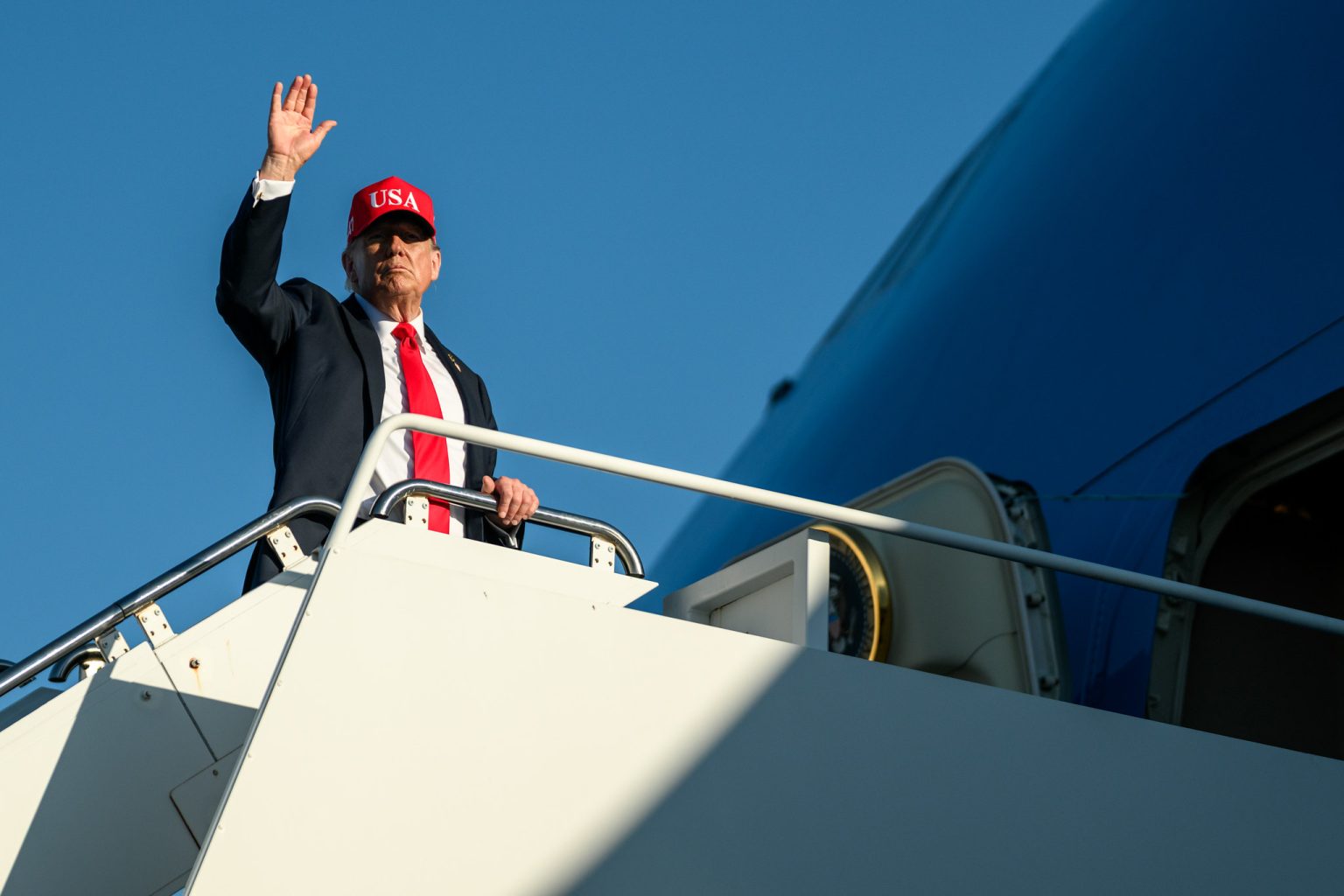
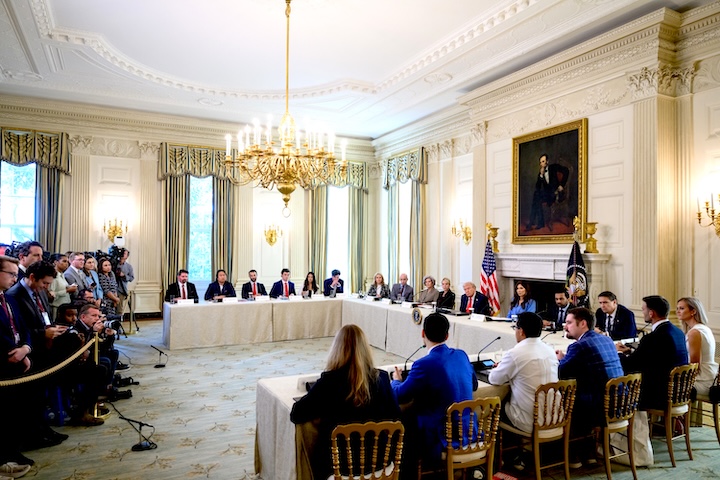
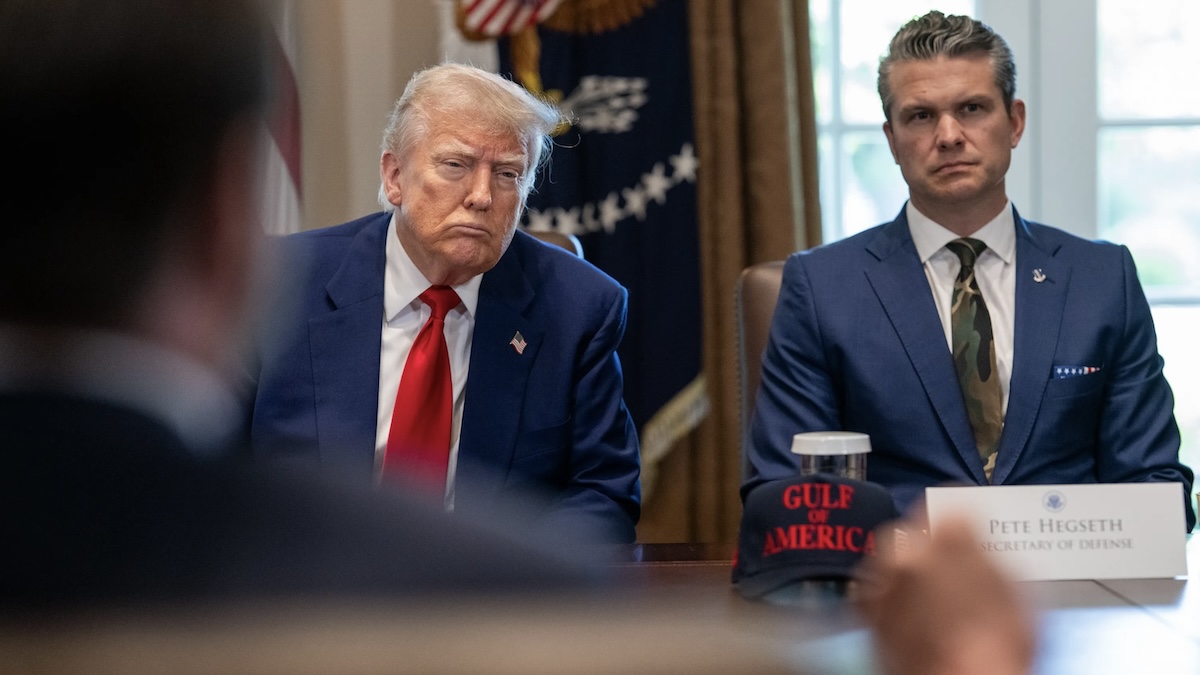
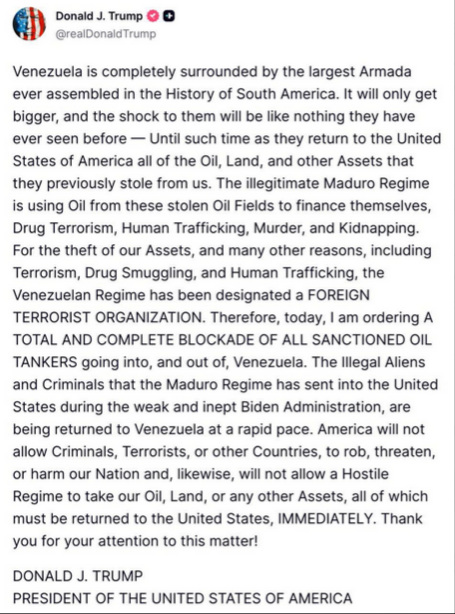
The White House website touts Trump as a "pro-gamer." It's hard to imagine a more ridiculous appeal to Zoomers.
Anyway, they won't block Minecraft.
Meanwhile:
I thought we were very close to an agreement with Russia. I thought we were very close to an agreement with Ukraine. In fact, with the exception of President Zelenskyy himself, his people admired the concept of this agreement. (c) Trump.
Well, yes, it is partly the cocaine-fuehrer who is prolonging Ukraine's suffering.
And helping the Russian Armed Forces expand their occupied territory.
Jeffrey Sachs: Trump’s Empire of Hubris and Thuggery
Posted on December 12, 2025 by Yves Smith
Yves here. Even though the recent Trump National Security Strategy document created an uproar, among other reasons for its harsh criticism of Europe and its condescension towards Russia as needing to be brought in from a presumed successful economic deep freeze.
Despite the Trump Team stating things that might be better left unsaid, like “I hate you and I want a divorce,” it’s not clear that they will be able to execute all that much, even before getting to the key point by Sachs below, that US efforts to preserve its flagging empire via brute force will continue to backfire.
The Trump Administration declared its hostility towards providing past levels of military support to Europe at the Munich Security Conference in February. Secretary of State Rubio was a no-show at a NATO meeting of foreign ministers in December. Yet Trump is too hemmed in by the permanent bureaucracy, which is firmly neocon, and hawks like Lindsay Graham to operate freely. For instance, we and others have pointed out that the US could bring Zelensky to heel by cutting off intelligence support, which includes targeting. Trump apparently fears the consequences of taking that step.
But the US may be setting out to get its aims vis-a-vis Europe and Ukraine via other means. Recall how Michael Hudson has been writing about how destructive US economic policies towards Europe have become. A new story suggests that the US has even more overt destabilization plans. From the Brussels Times (hat tip Micael T):
The United States, led by President Donald Trump, aims to persuade four EU countries to follow the UK’s example and leave the EU, according to a longer leaked version of the American national security strategy reportedly seen by US defence website Defense One.
The secret file supposedly claims that the Trump administration wants to prise four EU countries – Austria, Italy, Hungary and Poland – away from the bloc and closer to the US’ circle of influence as part of a new strategy to “Make Europe Great Again.”
Mind you, the US has denied that this draft is bona fide. From the same article:
As the leak triggered alarm across social media platforms and among media outlets in Europe, the White House denied these claims, stating that there is no other version of the NSS than the one published last week.
“No alternative, private, or classified version exists,” said Anna Kelly, a spokeswoman for the White House. “President Trump is transparent and put his signature on one National Security Strategy that clearly instructs the US government to execute on his defined principles and priorities.”
Even if this idea is under consideration, it would be yet another show of US ignorance. The reason the UK could depart, a move a majority now see as a mistake, is that it has its own currency. Italy and Austria are in the Eurozone. As we explained long form with Greece during its 2015 bailout crisis, an attempt to depart, due to the considerable lead times, would lead to bank runs and a banking system crash. Hungary is too small and integrated into the EU trade-wise for that to work. Nearly 80% of Hungary’s imports and exports are with the Union. 74% of Poland’s exports and 67% of imports were with the bloc.
The secret file supposedly claims that the Trump administration wants to prise four EU countries – Austria, Italy, Hungary and Poland – away from the bloc and closer to the US’ circle of influence as part of a new strategy to “Make Europe Great Again.”
By Jeffrey D. Sachs, a University Professor and Director of the Center for Sustainable Development at Columbia University. Originally published at Common Dreams
The 2025 National Security Strategy (NSS) recently released by President Donald Trump presents itself as a blueprint for renewed American strength. It is dangerously misconceived in four ways.
First, the NSS is anchored in grandiosity: the belief that the United States enjoys unmatched supremacy in every key dimension of power. Second, it is based on a starkly Machiavellian view of the world, treating other nations as instruments to be manipulated for American advantage. Third, it rests on a naïve nationalism that dismisses international law and institutions as encumbrances on US sovereignty rather than as frameworks that enhance US and global security together.
Fourth, it signals a thuggery in Trump’s use of the CIA and military. Within days of the NSS’s publication, the US brazenly seized a tanker carrying Venezuelan oil on the high seas—on the flimsy grounds that the vessel had previously violated US sanctions against Iran.
The seizure was not a defensive measure to avert an imminent threat. Nor is it remotely legal to seize vessels on the high seas because of unilateral US sanctions. Only the UN Security Council has such authority. Instead, the seizure is an illegal act designed to force regime change in Venezuela. It follows Trump’s declaration that he has directed the CIA to carry out covert operations inside Venezuela to destabilize the regime.
American security will not be strengthened by acting like a bully. It will be weakened—structurally, morally, and strategically. A great power that frightens its allies, coerces its neighbors, and disregards international rules ultimately isolates itself.
The NSS, in other words, is not just an exercise in hubris on paper. It is rapidly being translated into brazen practice.
A Glimmer of Realism, Then a Lurch into Hubris
To be fair, the NSS contains moments of long-overdue realism. It implicitly concedes that the United States cannot and should not attempt to dominate the entire world, and it correctly recognizes that some allies have dragged Washingtoninto costly wars of choice that were not in America’s true interests. It also steps back—at least rhetorically—from an all-consuming great-power crusade. The strategy rejects the fantasy that the United States can or should impose a universal political order.
But the modesty is short-lived. The NSS quickly reasserts that America possesses the “world’s single largest and most innovative economy,” “the world’s leading financial system,” and “the world’s most advanced and most profitable technology sector,” all backed by “the world’s most powerful and capable military.” These claims serve not simply as patriotic affirmations, but as a justification for using American dominance to impose terms on others. Smaller countries, it seems, will bear the brunt of this hubris, since the US cannot defeat the other great powers, not least because they are nuclear-armed.
Naked Machiavellianism in Doctrine
The NSS’s grandiosity is welded to a naked Machiavellianism. The question it asks is not how the United States and other countries can cooperate for mutual benefit, but how American leverage—over markets, finance, technology, and security—can be applied to extract maximal concessions from other countries.
This is most pronounced in the NSS discussion of the Western Hemisphere section, which declares a “Trump Corollary” to the Monroe Doctrine. The United States, the NSS declares, will ensure that Latin America “remains free of hostile foreign incursion or ownership of key assets,” and alliances and aid will be conditioned on “winding down adversarial outside influence.” That “influence” clearly refers to Chinese investment, infrastructure, and lending.
The NSS is explicit: US agreements with countries “that depend on us most and therefore over which we have the most leverage” must result in sole-source contracts for American firms. US policy should “make every effort to push out foreign companies” that build infrastructure in the region, and the US should reshape multilateral development institutions, such as the World Bank, so that they “serve American interests.”
Latin American governments, many of whom trade extensively with both the United States and China, are effectively being told: you must deal with us, not China—or face the consequences.
Such a strategy is strategically naive. China is the main trading partner for most of the world, including many countries in the Western hemisphere. The US will be unable to compel Latin American nations to expel Chinese firms, but will gravely damage US diplomacy in the attempt.
Thuggery So Brazen Even Close Allies Are Alarmed
The NSS proclaims a doctrine of “sovereignty and respect,” yet its behavior has already reduced that principle to sovereignty for the US, vulnerability for the rest. What makes the emerging doctrine even more extraordinary is that it is now frightening not only small states in Latin America, but even the United States’ closest allies in Europe.
In a remarkable development, Denmark—one of America’s most loyal NATO partners—has openly declared the United States a potential threat to Danish national security. Danish defense planners have stated publicly that Washington under Trump cannot be assumed to respect the Kingdom of Denmark’s sovereignty over Greenland, and that a coercive US attempt to seize the island is a contingency for which Denmark must now plan.
This is astonishing on several levels. Greenland is already host to the US Thule Air Base and firmly within the Western security system. Denmark is not anti-American, nor is it seeking to provoke Washington. It is simply responding rationally to a world in which the United States has begun to behave unpredictably—even toward its supposed friends.
That Copenhagen feels compelled to contemplate defensive measures against Washington speaks volumes. It suggests that the legitimacy of the US-led security architecture is eroding from within. If even Denmark believes it must hedge against the United States, the problem is no longer one of Latin America’s vulnerability. It is a systemic crisis of confidence among nations that once saw the US as the guarantor of stability but now view it as a possible or likely aggressor.
In short, the NSS seems to channel the energy previously devoted to great-power confrontation into bullying of smaller states. If America seems to be a bit less inclined to launch trillion-dollar wars abroad, it is more inclined to weaponize sanctions, financial coercion, asset seizures, and theft on the high seas.
The Missing Pillar: Law, Reciprocity, and Decency
Perhaps the deepest flaw of the NSS is what it omits: a commitment to international law, reciprocity, and basic decency as foundations of American security.
The NSS regards global governance structures as obstacles to US action. It dismisses climate cooperation as “ideology,” and indeed a “hoax” according to Trump’s recent speech at the UN. It downplays the UN Charter and envisions international institutions primarily as instruments to be bent toward American preferences. Yet it is precisely legal frameworks, treaties, and predictable rules that have historically protected American interests.
The founders of the United States understood this clearly. Following the American War of Independence, thirteen newly sovereign states soon adopted a constitution to pool key powers—over taxation, defense, and diplomacy—not to weaken the states’ sovereignty, but to secure it by creating the US Federal Government. The post-WWII foreign policy of the United States government did the same through the UN, the Bretton Woods institutions, the World Trade Organization, and arms-control agreements.
The Trump NSS now reverses that logic. It treats the freedom to coerce others as the essence of sovereignty. From that perspective, the Venezuelan tanker seizure and Denmark’s anxieties are manifestations of the new policy.
Athens, Melos, and Washington
Such hubris will come back to haunt the United States. The ancient Greek historian Thucydides records that when imperial Athens confronted the small island of Melos in 416 BC, the Athenians declared that “the strong do what they can and the weak suffer what they must.” Yet Athens’ hubris was also its undoing. Twelve years later, in 404 BC, Athens fell to Sparta. Athenian arrogance, overreach, and contempt for smaller states helped galvanize the alliance that ultimately brought it down.
The 2025 NSS speaks in a similar arrogant register. It is a doctrine of power over law, coercion over consent, and dominance over diplomacy. American security will not be strengthened by acting like a bully. It will be weakened—structurally, morally, and strategically. A great power that frightens its allies, coerces its neighbors, and disregards international rules ultimately isolates itself.
America’s national security strategy should be based on wholly different premises: acceptance of a plural world; recognition that sovereignty is strengthened, not diminished, through international law; acknowledgment that global cooperation on climate, health, and technology is indispensable; and understanding that America’s global influence depends more on persuasion than coercion.
Jeffrey Sachs: Trump’s Thuggish Empire
December 13, 2025
The Venezuelan tanker seizure and Denmark’s anxiety about Greenland both show the White House’s bullying 2025 National Security Strategy in brazen action.
President Donald Trump after a naval sea power demonstration on Oct. 5, 2025, aboard the USS George H.W. Bush in the Atlantic Ocean off the coast of Norfolk, Virginia. (White House /Daniel Torok)
By Jeffrey D. Sachs
Common Dreams
CN at 30
The 2025 National Security Strategy (NSS) recently released by President Donald Trump presents itself as a blueprint for renewed American strength. It is dangerously misconceived in four ways.
First, the NSS is anchored in grandiosity: the belief that the United States enjoys unmatched supremacy in every key dimension of power.
Second, it is based on a starkly Machiavellian view of the world, treating other nations as instruments to be manipulated for American advantage.
Third, it rests on a naïve nationalism that dismisses international law and institutions as encumbrances on U.S. sovereignty rather than as frameworks that enhance U.S. and global security together.
Fourth, it signals a thuggery in Trump’s use of the C.I.A. and military. Within days of the NSS’ publication, the U.S. brazenly seized a tanker carrying Venezuelan oil on the high seas — on the flimsy grounds that the vessel had previously violated U.S. sanctions against Iran.
The seizure was not a defensive measure to avert an imminent threat. Nor is it remotely legal to seize vessels on the high seas because of unilateral U.S. sanctions. Only the U.N. Security Council has such authority.
Instead, the seizure is an illegal act designed to force regime change in Venezuela. It follows Trump’s declaration that he has directed the C.I.A. to carry out covert operations inside Venezuela to destabilize the regime.
American security will not be strengthened by acting like a bully. It will be weakened — structurally, morally and strategically. A great power that frightens its allies, coerces its neighbors and disregards international rules ultimately isolates itself.
The NSS, in other words, is not just an exercise in hubris on paper. It is rapidly being translated into brazen practice.
A Glimmer of Realism, Then a Lurch into Hubris
To be fair, the NSS contains moments of long-overdue realism. It implicitly concedes that the United States cannot and should not attempt to dominate the entire world, and it correctly recognizes that some allies have dragged Washington into costly wars of choice that were not in America’s true interests. It also steps back — at least rhetorically — from an all-consuming great-power crusade.
The strategy rejects the fantasy that the United States can or should impose a universal political order.
But the modesty is short-lived. The NSS quickly reasserts that America possesses the “world’s single largest and most innovative economy,” “the world’s leading financial system,” and “the world’s most advanced and most profitable technology sector,” all backed by “the world’s most powerful and capable military.”
These claims serve not simply as patriotic affirmations, but as a justification for using American dominance to impose terms on others. Smaller countries, it seems, will bear the brunt of this hubris, since the U.S. cannot defeat the other great powers, not least because they are nuclear-armed.
Naked Machiavellianism in Doctrine
The NSS’s grandiosity is welded to a naked Machiavellianism. The question it asks is not how the United States and other countries can cooperate for mutual benefit, but how American leverage — over markets, finance, technology and security — can be applied to extract maximal concessions from other countries.
This is most pronounced in the NSS discussion of the Western Hemisphere section, which declares a “Trump Corollary” to the Monroe Doctrine. The United States, the NSS declares, will ensure that Latin America “remains free of hostile foreign incursion or ownership of key assets,” and alliances and aid will be conditioned on “winding down adversarial outside influence.”
That “influence” clearly refers to Chinese investment, infrastructure and lending.
The NSS is explicit:
“U.S. agreements with countries ‘that depend on us most and therefore over which we have the most leverage’ must result in sole-source contracts for American firms. U.S. policy should ‘make every effort to push out foreign companies’ that build infrastructure in the region, and the U.S. should reshape multilateral development institutions, such as the World Bank, so that they ‘serve American interests.’ ”
Latin American governments, many of which trade extensively with both the United States and China, are effectively being told: you must deal with us, not China — or face the consequences.
Such a strategy is strategically naive. China is the main trading partner for most of the world, including many countries in the Western hemisphere. The U.S. will be unable to compel Latin American nations to expel Chinese firms, but will gravely damage U.S. diplomacy in the attempt.
Close Allies Alarmed
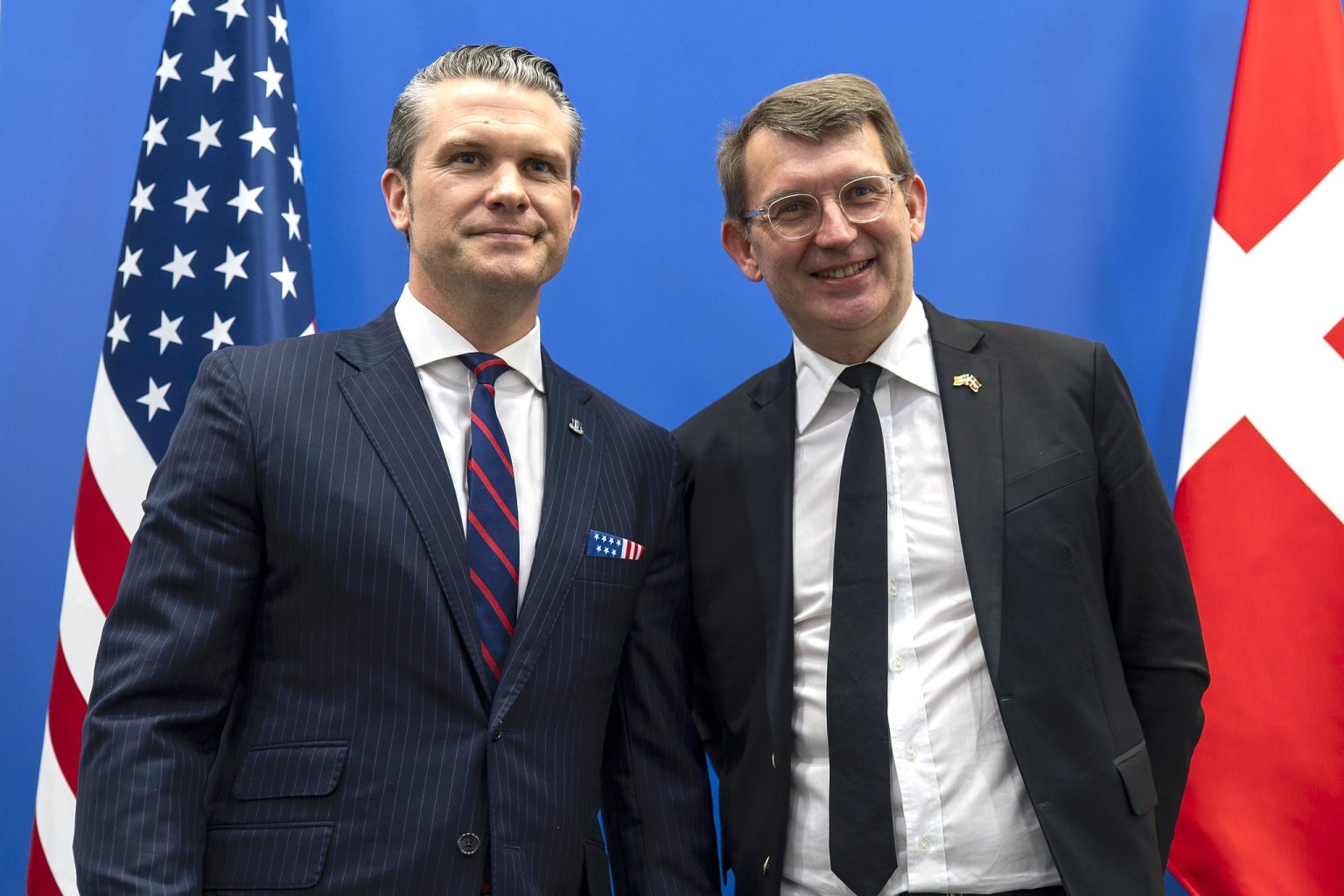
Secretary of Defense Pete Hegseth with Danish Minister of Defense Troels Lund Poulsen at NATO Headquarters in Brussels, Belgium, Feb. 12, 2025. (DoD/Alexander C. Kubitza)
The NSS proclaims a doctrine of “sovereignty and respect,” yet its behavior has already reduced that principle to sovereignty for the U.S., vulnerability for the rest. What makes the emerging doctrine even more extraordinary is that it is now frightening not only small states in Latin America, but even the United States’ closest allies in Europe.
In a remarkable development, Denmark — one of America’s most loyal NATO partners — has openly declared the United States a potential threat to Danish national security. Danish defense planners have stated publicly that Washington under Trump cannot be assumed to respect the Kingdom of Denmark’s sovereignty over Greenland, and that a coercive U.S. attempt to seize the island is a contingency for which Denmark must now plan.
This is astonishing on several levels. Greenland is already host to the Pituffik Space Base and firmly within the Western security system. Denmark is not anti-American, nor is it seeking to provoke Washington. It is simply responding rationally to a world in which the United States has begun to behave unpredictably — even toward its supposed friends.
That Copenhagen feels compelled to contemplate defensive measures against Washington speaks volumes. It suggests that the legitimacy of the U.S.-led security architecture is eroding from within. If even Denmark believes it must hedge against the United States, the problem is no longer one of Latin America’s vulnerability.
It is a systemic crisis of confidence among nations that once saw the U.S. as the guarantor of stability but now view it as a possible or likely aggressor.
In short, the NSS seems to channel the energy previously devoted to great-power confrontation into bullying of smaller states. If America seems to be a bit less inclined to launch trillion-dollar wars abroad, it is more inclined to weaponize sanctions, financial coercion, asset seizures and theft on the high seas.
The Missing Pillar: Law, Reciprocity & Decency
Perhaps the deepest flaw of the NSS is what it omits: a commitment to international law, reciprocity and basic decency as foundations of American security.
The NSS regards global governance structures as obstacles to U.S. action. It dismisses climate cooperation as “ideology,” and indeed a “hoax” according to Trump’s recent speech at the U.N. It downplays the U.N. Charter and envisions international institutions primarily as instruments to be bent toward American preferences.
Yet it is precisely legal frameworks, treaties, and predictable rules that have historically protected American interests.
The founders of the United States understood this clearly. Following the American War of Independence, 13 newly sovereign states soon adopted a constitution to pool key powers — over taxation, defense, and diplomacy — not to weaken the states’ sovereignty, but to secure it by creating the U.S. federal government. The post-WWII foreign policy of the United States government did the same through the U.N., the Bretton Woods institutions, the World Trade Organization and arms-control agreements.
The Trump NSS now reverses that logic. It treats the freedom to coerce others as the essence of sovereignty. From that perspective, the Venezuelan tanker seizure and Denmark’s anxieties are manifestations of the new policy.
Athens, Melos & Washington
Such hubris will come back to haunt the United States.
The ancient Greek historian Thucydides records that when imperial Athens confronted the small island of Melos in 416 BC, the Athenians declared that “the strong do what they can and the weak suffer what they must.” Yet Athens’ hubris was also its undoing. Twelve years later, in 404 BC, Athens fell to Sparta. Athenian arrogance, overreach, and contempt for smaller states helped galvanize the alliance that ultimately brought it down.
The 2025 NSS speaks in a similar arrogant register. It is a doctrine of power over law, coercion over consent, and dominance over diplomacy. American security will not be strengthened by acting like a bully. It will be weakened — structurally, morally, and strategically. A great power that frightens its allies, coerces its neighbors, and disregards international rules ultimately isolates itself.
America’s national security strategy should be based on wholly different premises: acceptance of a plural world; recognition that sovereignty is strengthened, not diminished, through international law; acknowledgment that global cooperation on climate, health, and technology is indispensable; and understanding that America’s global influence depends more on persuasion than coercion.
When to stop the third war with Cambodia
December 13, 3:17 PM
November 2025
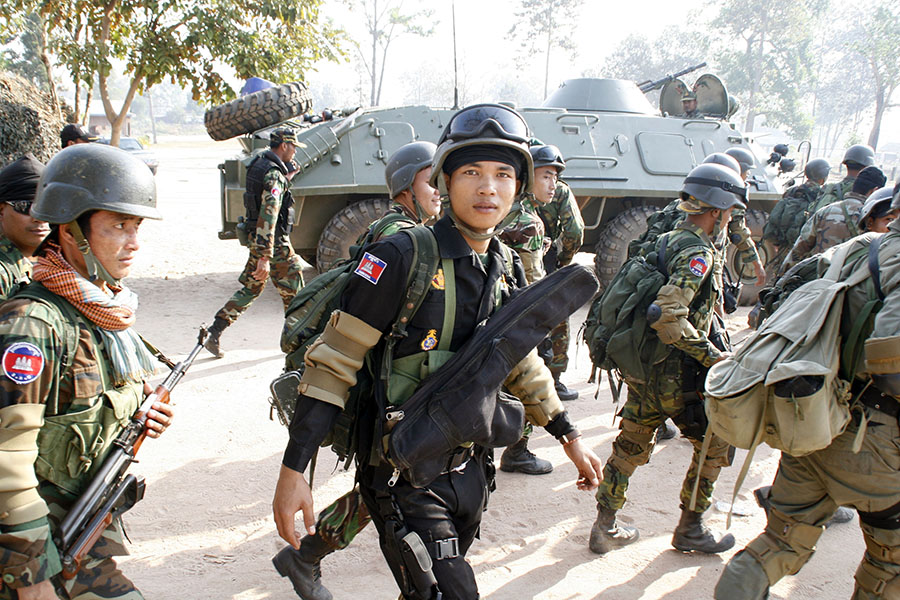
1. Thailand and Cambodia begin fighting on the border.
2. Thailand and Cambodia cease fighting on the border.
3. Trump declares that he has stopped the war and that Thailand and Cambodia will now live in peace.
December 2025
1. Thailand and Cambodia begin fighting on the border again.
2. Thailand and Cambodia cease fighting on the border again.
3. Trump declares again that he has stopped another war.
4. Thailand resumes fighting against Cambodia...
As Epstein releases near, Americans think Trump knew about Epstein’s alleged crimes
Analysis by Aaron Blake
US President Donald Trump participates in a roundtable discussion with business leaders at the White House in Washington DC, on December 10, 2025. Jonathan Ernst/Reuters
Friday featured yet another drop in the drip-drip-drip of new information from the Jeffrey Epstein files. This time: new pictures released by House Democrats that feature Donald Trump and other powerful people like Bill Clinton, Steve Bannon and Richard Branson, culled from tens of thousands of photos from Epstein’s estate.
But Epstein’s associations with these men — none of whom has been accused of wrongdoing by law enforcement — have been a matter of public record, and the pictures by themselves don’t tell us a whole lot.
Indeed, the more surprising news on this front Friday morning might have come from a different source: a poll.
The survey reinforced how troublesome impending document drops could be for Trump, especially ahead of next Friday’s big deadline for the Justice Department to turn over what it has to Congress. And that’s because lots and lots of Americans – and even Republicans – are inclined to believe, or at least entertain the idea, that Trump was aware of something unsavory.
Related article
Democrats on the House Oversight Committee released images from Jeffrey Epstein's email on Friday, December 12, 2025. Some images have had portions redacted by the Committee.
New photos released from Epstein’s estate showing Trump, Bannon, Bill Clinton and other high-profile people
The Reuters-Ipsos poll asked whether Americans believed that Trump was not aware of Epstein’s alleged crimes before they became public. Just 18% said it was “somewhat” or “very” likely that Trump didn’t know. Fully 60% said it was “not too” or “not at all” likely that Trump didn’t know. That’s a 3-to-1 margin believing Trump knew something.
Even among Republicans, slightly more felt Trump was probably aware (39%) than leaned toward him not knowing (34%).
Trump, again, has not been accused of wrongdoing in the Epstein case, and he has denied involvement.
But it’s not just this poll that has suggested the public believes he has something to hide.
A Yahoo News-YouGov survey back in July asked not just whether Trump knew about Epstein’s alleged crimes, but also engaged in crimes with Epstein. Around half of Americans (48%) said they believed Trump had.
But perhaps more remarkably, only 24% of Americans doubted that he had. The rest were neutral.
And again, even many Republicans weren’t ruling it out. Just 55% of Republicans rejected the assertion out of hand. (13% thought Trump had committed crimes with Epstein, while one-third were neutral.)
Just to underscore the remarkable things these polls are telling us: Three-quarters of Americans suggested they remained open to the possibility that the president of the United States knew about or even engaged in crimes with a notorious pedophile. And even many Republicans thought he knew something about what Epstein was up to.
That suggests that, even if there is no smoking gun linking Trump to wrongdoing, the impending release of more documents could be bad for the president, to the extent they keep mentioning Trump or including photos of him like they have before. (As for the photos and emails from the estate that House Oversight Committee Democrats have released, the White House has claimed a “Democrat hoax,” said the emails “prove absolutely nothing, other than the fact that President Trump did nothing wrong” and said the administration “has done more for Epstein’s victims that Democrats ever have.”)
There are some key caveats to what the polling shows.
One is that the poll questions didn’t specify what kind of crimes. Certainly, Epstein is known for one very specific type of crime. But perhaps the large number who entertain the idea of Trump being implicated in crimes owes in part to Americans largely just believing that very powerful people are liable to commit some kinds of crimes.
Indeed, we’ve even seen this before with Trump specifically. Polling during the 2024 campaign showed that voters said 54%-38% that they believed Trump had committed “serious federal crimes.” Even long before his indictments, a poll conducted amid the scandal in which Trump was impeached for apparently pressuring Ukraine for election help in 2020 showed 63% believed Trump had at least “probably” done illegal things during his political career.
So some of this could be baked in.
But as for the Epstein crimes, there isn’t solid evidence of Trump’s involvement or knowledge, unlike his indictments or the Ukraine scandal.
And it’s also likely that some of this owes to the way Trump has handled the Epstein files and what we’ve learned so far.
The president has, quite simply, done a bunch of things that sure made it look like he had something to hide. That includes a series of misleading statements about his past relationship with Epstein, as well as his slow disclosures about knowing Epstein accomplice Ghislaine Maxwell recruited a minor employee from Mar-a-Lago, Virginia Giuffre.
There are also multiple data points that suggest Trump knew that Epstein had a particular interest in young females, at least. And that’s not just his infamous 2002 quote about Epstein liking women “on the younger side.”
The Epstein emails released last month even showed Epstein suggesting in private that Trump knew something about Epstein and girls. “Of course he knew about the girls …” Epstein said at one point in 2019, in apparent reference to Maxwell’s recruitment. In another email from 2011, Epstein called Trump the “dog that hasn’t barked” and said Giuffre had “spent hours at my house” with Trump.
Given all of that, it shouldn’t be too surprising that lots of Americans believe the worst and that many more seem to at least be keeping an open mind that Trump was implicated in or aware of Epstein’s crimes.
But with less than a week to go until the Friday deadline for the release of the DOJ’s files, these aren’t the kinds of numbers Trump would like to see.
And they reinforce the very real political danger in all of this for the president. After all, Americans have been assuming the worst about the Epstein files for a while. Trump just gave them reason to believe he had something to hide.
Trump Administration Denies That Bombing of 21 Boats in Caribbean Amounts to Murder, But Facts Are Facts
December 14, 2025
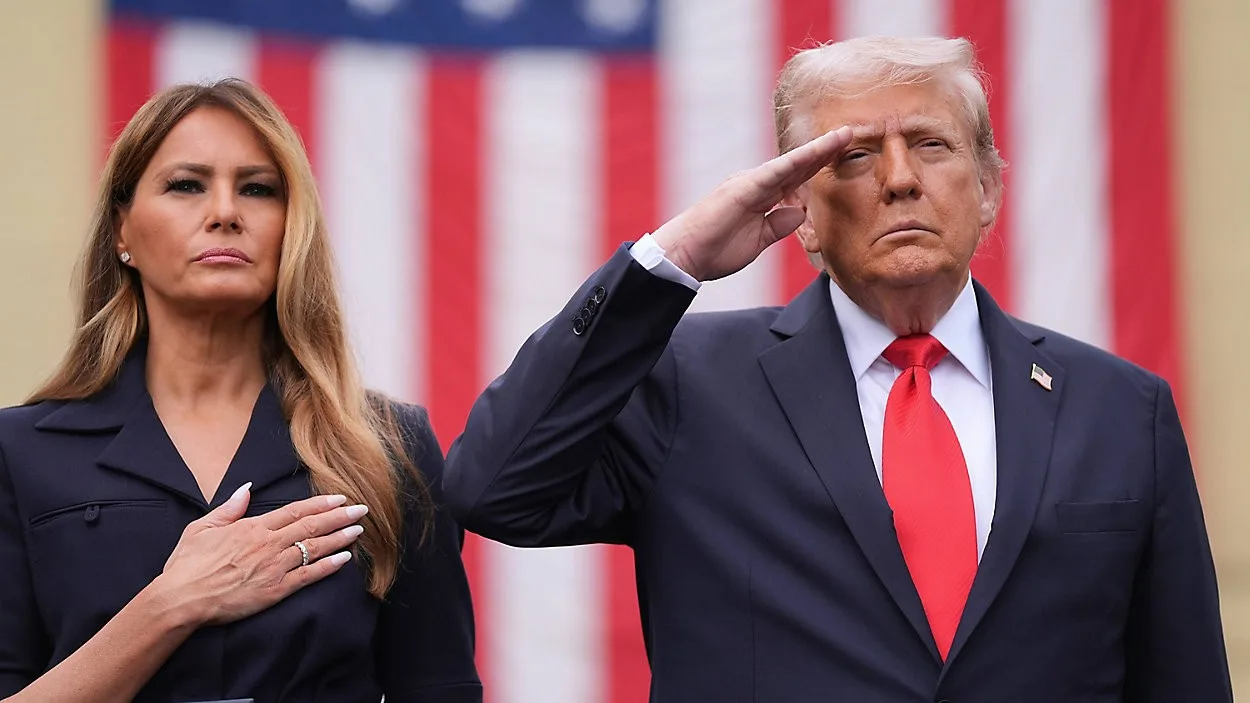
US First Lady Melania Trump and US President Donald Trump standing beside each other. Photo: AP/Evan Vucci.
By Steve Ellner – Dec 4, 2025
The Washington Post has reported that Secretary of War Pete Hegseth gave the order to not only blow up a boat in the Caribbean back on September 2, but to kill all the men in them. Hegseth at first refrained from publicly denying the statement, though the Trump administration did. The New York Times is reporting that the boat on September 2 was struck at least twice. Military norms prohibit a second strike on a vessel that has been neutralized or shipwrecked and no longer represents a military threat. That’s because once the military objective is achieved, a second strike means certain death for survivors. Given the gravity of the accusation, it is incumbent on the Secretary of War to provide details of the transcripts of the orders that were given and other specifics. Instead, Hegseth jokes about the incident.
Actually, that the Department of War was out to kill the alleged drug traffickers on September 2 should not be a matter of debate. Not if you consider Trump’s famous statement on October 23: “I think we’re just going to kill people that are bringing drugs into our country. Okay? We’re going to kill them, you know, they’re going to be like, dead.”
There is a consensus among experts on international law (excluding those in the Trump administration) that the bombings of the now 22 vessels in the Caribbean amount to extra-judicial killing without any legal justification. It’s not surprising that Hegseth did not go through legal channels. That’s because there is no such thing as “judicial killing.” No judge gives the order to kill someone and that’s basically what the second strike amounted to. Even if it were proven (which it hasn’t been) that the boats were carrying drugs, no judge would order killing the men on them. Indeed, “judicial killing” is an oxymoron.
Here is the statement in The New York Times’ article of November 29 titled “Trump Declares Venezuelan Airspace Closed:”
“On Thursday, The Washington Post reported that for the first strike, on Sept. 2, Defense Secretary Pete Hegseth gave a verbal order to kill everyone on the boat. And CNN reported that after the military detected survivors, a second attack was carried out to kill them.”
“In September, The New York Times reported there were multiple strikes during the first operation. The Times also reported that the boat that was struck had altered its course and appeared to have turned around before the attack started because the people onboard had apparently spotted a military aircraft stalking it.”
Democratic Party leaders beginning with Senate leader Chuck Schumer criticize the bombing of the boats on grounds that it represents an act of war and that the decision to go to war corresponds to Congress not the Executive. But Schumer’s statement falls far short of what needs to be said. The real issue is not legal but rather humanitarian. The Democrats need to center their critique on ethical and humanitarian grounds, not only legal ones.
The Dems don't want to tie the hands of 'their' military, much less be accused of such. And what do they know about ethics anyway?
John Helmer is sure right about one thing, Trump is one bloodthirsty sonofabitch. Not so much for the love of seeing blood spilled but for the dominance it projects. It makes his litany of 'stopping people dying' all the more ludicrous.
"There is great chaos under heaven; the situation is excellent."
Coffee Break: Trump Loses in Indiana as the MAGA Civil War Rages On
Posted on December 15, 2025 by Nat Wilson Turner
The MAGA civil war intensified as POTUS Trump lost his battle to bully Indiana Republicans into redrawing their congressional districts. Are we seeing Trump 2.0’s mojo bleeding out?
Politico sees it that way:
Indeed, Trump’s lame duck status is on full display in almost every corner of his domestic agenda. The only place his call to end the filibuster has won approval so far is in Republican primaries. Congress rejected his health care plan before the Trump administration could fully roll it out. His boat strikes off the coasts of Central and South America face congressional scrutiny. Rep. Marjorie Taylor Greene (R-Ga.) is in open rebellion. He caved on the release of the Epstein files after months of resistance. His $2,000 tariff checks for Americans seem as likely as his DOGE checks. His backed candidate for Miami mayor tanked, allowing a Democrat to win the office for the first time in nearly three decades. His handpicked Republican National Committee chair is predicting “a pending, looming disaster” in the midterms. (The caveat, of course, is that Joe Gruters said Trump is the only man who can save Republicans.) Just 31 percent of Americans approve of his handling of the economy; voters are expressing generational financial strain at a time he says the says the economy is “A+++++; and the expiration of the ACA subsidies threaten to hurt him.
All told, from the outside, Trump 2.0 appears at the nadir of its power.
Trump Took an Ugly Loss in Indiana
Indiana was on the frontlines of the MAGA civil war as Trump pushed for that state’s Republicans to help him stave off a 2026 midterm disaster by drawing new GOP districts.
Paul Blumenthal summed up the Indiana situation well for Huffington Post:
Twenty-one Republicans in the Indiana state Senate rejected President Donald Trump’s pressure campaign for new congressional maps that would have eliminated the state’s two House seats held by Democrats on Thursday.
The humiliating rejection for Trump came after he put the full weight of the White House and Republican Party apparatus to bear on the state Senate. Trump sent a dozen social media posts threatening GOP Senate President Pro Tem Rodric Bray and others for opposing redistricting with primary challenges. Vice President JD Vance made multiple trips to cajole lawmakers. White House deputy chief of staff James Blair and Speaker Mike Johnson (R-La.) called individual state senators to push them to change their votes.
The pressure campaign peaked on Thursday shortly before the vote when Heritage Action, the political arm of the Heritage Foundation, declared in a social media post on Thursday that Trump had threatened to cut off all funding to the state if the state Senate did not support redistricting. Lt. Gov. Micah Beckwith, a Republican and staunch supporter of the redistricting effort, confirmed this in a since-deleted post on X.
This all-out push predictably led to acts of intimidation and threats and acts of violence targeting GOP state senators who opposed the effort.
CNN chronicled one particularly egregious example:
Jean Leising spoke at a breakfast this fall at her 8th grade grandson’s school. Hours later, when she was set to give him a ride home from basketball practice, he bashfully told her that his entire team had received text messages about her that day — “and they were all bad.”
Recounting the moment to CNN shortly after she joined 20 other Republican state senators in rejecting President Donald Trump’s redistricting push, Leising said she laughed the moment off with her grandson — but that it ultimately led to her opposing the president.
“Boy, when I got home that night, that’s when I decided,” said Leising, a 76-year-old grandmother of eight, first elected to the Senate in 1988. “I was angry. So the next day, I said, ‘I’ve got to talk about this.’ Because this is over the top. This shouldn’t be the way it was.”
“But that was the beginning,” she added. “It only got worse from there.”
This tweet from Vice-POTUS J.D. Vance, subtweeting Donald, Jr. gives the flavor of the MAGA Civil War, Indiana front:
Donald Trump Jr.
@DonaldJTrumpJr
If Indiana Republicans side with these Never Trumpers to do the dirty work of Democrats, I'll be spending a lot of time in Indiana next year campaigning against every single one of them.
PS: These RINO consultants sabotaging MAGA need to be rooted out of the GOP!!!
The pressure campaign and the threats backfired. A majority of the 40 GOP state senators voted no. Given that Trump won Indiana in 2024 by 19 points, this is a huge loss for Trump.
And if it weren’t bad enough for Trump that he won’t get any extra GOP Congressional seats out of Indiana, there’s reason to believe he won’t get as many seats from Texas as he hoped.
Texas Redistricting Overreach?
The New York Times has the deets in their piece headlined, “Did Texas Republicans Overplay Their Hand on Redistricting?“:
When Texas Republicans redrew the state’s congressional map over the summer, they aimed to flip five districts held by Democrats and were guided by the 2024 presidential election results, which showed voters moving to the right.
…
With Hispanic voters showing signs of souring on President Trump in special elections this year and concerns mounting over the cost of living, Democrats believe they could hold on to as many as three of the redrawn seats in Texas, two in the Rio Grande Valley and possibly a third centered in and around San Antonio. The party is also looking at flipping a Republican seat in the Valley, little changed in its partisan makeup by the new map, where a popular Tejano music star is running as a moderate Democrat.
All told, the redistricting wars seem to be on pause, and at the moment appear to have been a net negative for Trump given their role in escalating the MAGA civil war and the fact that Trump no longer appears capable of redistricting his way out of losing the GOP House majority in 2026.
Meanwhile, we continue to learn more about the dysfunctional inside workings of Trump 2.0 and how they contribute to the MAGA civil war.
Barron Trump Saves the Tates
The New York Times had a piece last week describing a situation that could only happen under Trump 2.0.
For those who have been lucky enough to be oblivious of Andrew Tate, he’s a prominent member of the “manosphere” who has been under investigation in Romania for a panolopy of ugly charges including “coercing women into pornography. Andrew was also accused of rape and of having sex with and beating a 15-year-old.”
The Times piece details how he got Trump to help him out of that country:
The (Romanian) prosecutors were told to find a compromise with the Tates. Despite their misgivings, they lifted the travel restrictions, a move that Romania’s prime minister thought would appease the Trump administration.
…
Their arrival in the United States opened a rare rift among conservatives and raised suspicions over whether the White House had intervened.
The story details the Tates’ novel media and lobbying strategy:
As his notoriety grew, Andrew Tate shrewdly courted Tucker Carlson and other media stars of the right, who in turn tapped into the brothers’ loyal following to expand their own reach.
Andrew also nurtured relationships with Donald Trump Jr. and his younger brother Barron, who recognized the role that young male voters could play in their father’s return to power.
Barron, now 19, admired Andrew, and spoke with him over Zoom last year, according to Justin Waller, a mutual friend who was on the call. During the call, they discussed their shared belief that the Romanian criminal case was an effort to silence the Tates, he said.
After Mr. Trump’s re-election, some of the Tates’ supporters ascended into the new administration. One of them, the diplomatic envoy Richard Grenell, twice discussed their case with Romanian officials, The Times found.
Within days of the second conversation, the Romanian prosecutors received their marching orders and handed the Tates the freedom to travel…
The brothers’ liberation rattled many American diplomats, who feared a shadowy new era of foreign relations. And it prompted hostility from many traditional conservatives, from Florida’s governor, Ron DeSantis, to the commentator Megyn Kelly, who said, “This actually is toxic masculinity.” Some likened the Tates to the convicted sex offender Jeffrey Epstein.
This was the kind of thing Trump could get away with when he was riding high on his 2024 election but in retrospect it shows the fissures within his coalition were already forming in January.
Meanwhile another set of key Trump 2.0 insiders have been doing their part in Trump’s war on the financial establishment and federal bureaucracy.
Russell Vought’s Right Hand Man on the Frontlines vs the Federal Reserve
It’s been a while since I posted about Russell Vought, the director of the Office of Management and Budget (OMB) and acting director of the Consumer Financial Protection Bureau (CFPB) and the acting director of the United States Agency for International Development (USAID).
As his ballooning portfolio implies, Vought is one Trumper who bears close scrutiny. As such Politico’s portrait of Mark Paoletta, Vought’s legal sidekick is a must read.
Trump stacked his second administration with a mix of loud bomb-throwers like Elon Musk and quiet types like Vought and Paoletta who have equally disruptive goals.
Given Musk’s flame out this summer, it’s clear that Vought and Paoletta are the more dangerous to the status quo long-term.
The Politico piece on Paoletta helps explain why.
It’s got gobs of detail on specific deeds Paoletta has undertaken while working under Vought but let’s focus on his role in the MAGA civil war:
Paoletta has advanced sweeping views of the president’s power over Congress, including authoring a memo one week after the inauguration that ordered a pause on all federal spending. Though the memo was quickly yanked back, it landed like a bombshell at virtually every agency and was a harbinger of spending fights to come.
…
When Trump turned up the pressure on the Federal Reserve over the summer, Paoletta wrote a letter from Vought to Jerome Powell, saying the federal reserve chair was not in compliance with the approved construction plan for renovations of the Federal Reserve’s Washington, DC headquarters.
Given Trump’s open disdain for Powell, whose 2017 appointment he is blaming on “bad advice” from then Treasury Secretary Steve Mnunchin in a new Wall Street Journal interview, I’m sure that made Paoletta’s bosses’ boss happy.
But let’s pull back a bit and look at some developments in the broader MAGA civil war, which is mostly being fought by media figures outside the administration.
MAGA vs MIGA Makes the MSM
I wrote a pair of posts in November on “America First vs. Israel First” and “TACO MIGA Breaks With MAGA Over the Epstein Files” and now the MSM is catching up.
The New York Times reports on Tucker Carlson’s latest broadsides against his enemies on the right.
Key nuggets:
In his appearance on “This Past Weekend with Theo Von,” posted on Tuesday, Mr. Carlson — a longtime ally of the president — offered searing personal attacks on Bari Weiss, the newly appointed head of CBS News, and the billionaire Bill Ackman, a major supporter of the president, denigrating their intelligence and qualifications, while also questioning the F.BI.’s investigation of Mr. Kirk’s murder.
Mr. Carlson pointedly suggested that the leadership of the country itself was mediocre and malignant.
“The most depressing thing about the United States in 2025 is that we’re led not just by bad people, but by unimpressive, dumb, totally noncreative people,” Mr. Carlson said.
…
On Mr. Von’s show, Mr. Carlson, whose own show has featured conspiracy theories about everything from 9/11 to chemtrails, also waded into this debate, expressing affection for Ms. Owens and said he didn’t “understand the official story at all.”
He cautioned that he wasn’t “alleging anything,” but added that “I just don’t have a ton of confidence in the F.B.I. or the men who run it,” noting, for instance, “leaders of the F.B.I. are on Twitter,” an apparent swipe at F.B.I. director Kash Patel, who is often online.
Tucker also went after Bari Weiss, the new head of CBS News, who was handpicked by Trump ally David Ellison immediately after he purchased the network:
Mr. Carlson’s comments about Ms. Weiss came after Mr. Von, a folksy host with a credulous demeanor, showed a clip of Ms. Weiss suggesting Mr. Carlson was “anti-American and anti-Jewish,” sentiments that have also been expressed by commentators in The Free Press, the “anti-woke” media company she founded.
Mr. Carlson shot back, calling Ms. Weiss “an idiot,” mendacious, and unqualified for her post.
“In no fair system, in no ‘meritocracy’ would Bari Weiss rise above secretary,” Mr. Carlson said, adding, “There is no world in which Bari Weiss would rise to the top of a news network except a rigged world.”
Carlson also took a side in Trump’s battle with MAGA congressional stalwarts Greene and Massie:
Mr. Carlson’s seeming alienation extended to praising several of Mr. Trump’s most avid Republican opponents in Congress — Representative Marjorie Taylor Greene of Georgia and Representative Thomas Massie of Kentucky — calling them two of the “very few honest members of Congress,” and lauding their sincerity.
Mr. Carlson also seemingly faulted the president for his approach to Israel and that country’s prime minister, Benjamin Netanyahu: “I love Trump personally. I still love Trump personally. But it was like that whole election was about ‘We’ve had enough of this.’”
Politico Sees the MAGA Civil War Impacting 2028
Politico’s Ian Ward has a mammoth piece purporting to dive into the origins of “the argument over the GOP’s support for Israel and its response to the rising tide of antisemitism” by interviewing (among others) Steve Bannon, Tucker Carlson, and Marjorie Taylor Greene.
Here’s how he introduces them:
The onset of this schism coincided with the war in Gaza, but it’s no mere accident of history. In fact, it’s the work of a specific group of conservative critics of Israel who have maneuvered — sometimes in unison and sometimes on their own — to push the debate to the center of the MAGA conversation. In their own telling, they are motivated by a desire to resolve a glaring contradiction between Trump’s “America First” philosophy and the U.S.’s ongoing support for Israel. In the eyes of their pro-Israel critics, these same figures are engaged in an ugly antisemitic exercise, cynically exploiting the fallout from the war to marginalize Jewish conservatives within MAGA. To varying degrees, the leading anti-Israel voices claim to have the sympathy of Trump himself who, despite repeatedly affirming his support for Israel and cracking down on pro-Palestinian figures on the left, has permitted even the most vocal Israel critics to remain in the MAGA fold.
…
Collectively, the various people I spent time with represent a genuinely novel force in the 21st-century American right: a bloc of anti-Israel conservatives who stand squarely within the Republican mainstream.
The piece leads with a long discourse about Pat Buchanan and the paleocons by way of introducing Curt Mills, editor of The American Conservative.
The punchline isn’t long in coming:
…if Mills succeeds in turning Buchananism into the default ideology of MAGA’s young activist class, the same question that dogged Buchanan will dog them: Can the GOP become fully Buchananite without also becoming more hospitable to antisemitic figures like Fuentes?
Mounting evidence suggests that it cannot.
I shouldn’t be so quick to dismiss the piece which is well-reported and not blatantly biased, but it’s the parts about 2028, Gen Z and the future of the GOP that are the most interesting.
Ward gets this quote from Majorie Taylor Greene about her political future:
Greene may not be off the scene for very long. Her feud with Trump and abrupt resignation have fueled rumors that she may run for president in 2028, which Greene has denied. But when we spoke, she hinted at a longer-term plan. When I asked if she had a plan for capitalizing on diminishing levels of support for Israel among Gen Z conservatives, she said she was looking beyond the horizons of the Republican Party.
“I don’t know that this generation is even going to support the two-party system at this point,” she replied. “I think I think Gen Z sees the two-party system as an utter failure, and I think they hate both sides for a variety of different reasons.” She added, “They are radically for America. I am one thousand percent for them.”
Ward also analyzes the 2028 GOP presidential field through the MAGA vs MIGA lens (without using the MIGA terminology):
By the next election, the anti-Israel right will be impossible to ignore. For his own part, Trump has responded to this new reality by standing behind his support for Israel while occasionally dropping the subtlest of hints that he senses a conflict between unconditional alliance and “America First.”
…that will be a difficult posture for Trump’s would-be successors to mimic, and the fight to stake out the true MAGA position on Israel is already shaping the nascent Republican field. Cruz, who is rumored to be laying the groundwork for a bid, leapt at the opportunity to criticize Carlson for the Fuentes interview, positioning himself as the leader of the GOP’s pro-Israel camp. Bannon, who has refused to rule out a run of his own, has planted a flag as the champion of the Israel skeptics, making improbable predictions like, “You’re going to see a huge move toxifying the money put in by AIPAC” ahead of the 2028 primary, as he put it to me. Caught in the middle is Vance, who has defended his support for Israel on “America First” grounds while remaining close to anti-Israel figures like Carlson and Bannon.
Regardless of what happens in 2028, almost all the conservatives I spoke with — including supporters of Israel — acknowledge that the rise of the anti-Israel right has fundamentally changed the right’s political landscape.
Was Elon Musk’s Epstein Tweet the Inflection Point?
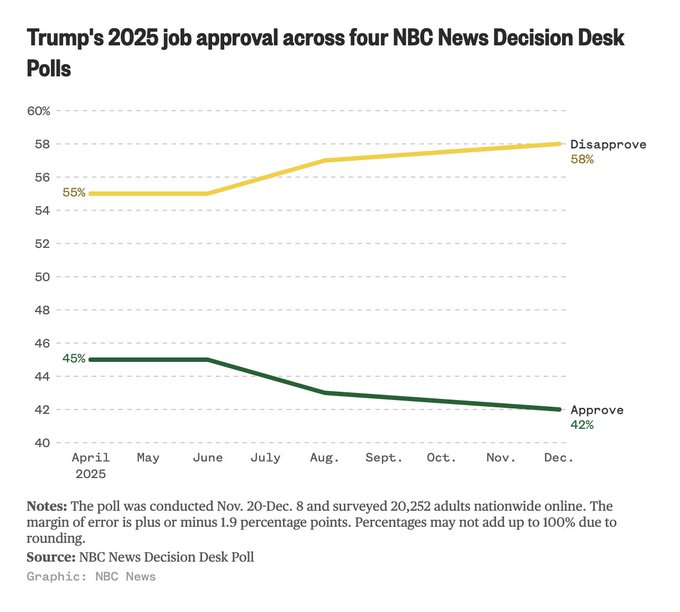
To close I wanted to point out something that struck me looking at the latest Trump polling:
Note that the decline in Trump’s numbers coincides neatly with Elon Musk’s since-deleted June 5 tweet accusing the POTUS of being in the Epstein files.
Time to drop the really big bomb:@realDonaldTrump is in the Epstein files. That is the real reason they have not been made public.
Have a nice day, DJT!
Seems like Donald Trump’s second term might have been the first casualty of the MAGA civil wars.
Trump Designates Fentanyl As ‘Mass Destruction Weapon’
U.S. President Donald Trump, Dec. 15, 2025. X/ @Partisan_12
December 16, 2025 Hour: 9:35 am
The timing of the designation coincides with the U.S. intention to carry out ground attacks against Venezuela.
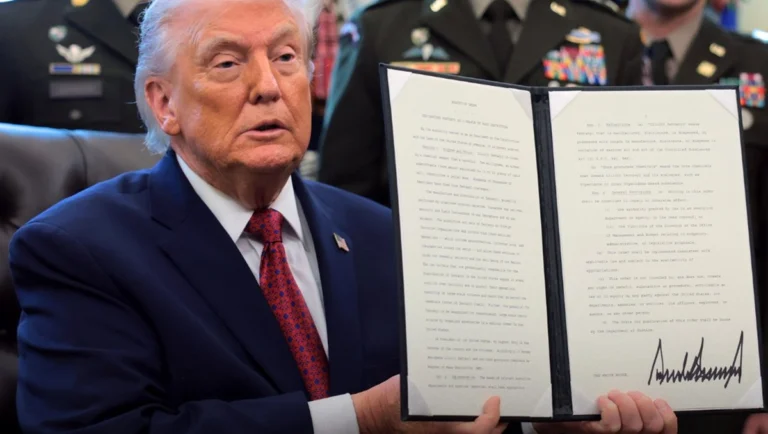
On Monday, U.S. President Donald Trump signed an executive order classifying fentanyl and its core precursor chemicals as a “weapon of mass destruction.”
The order declares illicit fentanyl as “closer to a chemical weapon than a narcotic,” noting that as little as two milligrams — “an almost undetectable trace amount equivalent to 10 to 15 grains of table salt” — constitutes a lethal dose.
“Hundreds of thousands of Americans have died from fentanyl overdoses,” the order stated. Under the directive, the Justice Department is instructed to immediately pursue investigations and prosecutions into fentanyl trafficking.
The order also directs the Departments of War and Justice to determine whether military resources should be provided to support enforcement efforts.
In a report published on Monday, Politico commented that the timing of the designation is striking, as speculation mounts that the United States will carry out land strikes against alleged drug trafficking targets on Venezuelan soil as part of its pressure campaign against Venezuelan President Nicolas Maduro.
The report said declaring fentanyl a weapon of mass destruction would “give the U.S. additional legal justification to use military force against Venezuela.”
On Monday, Trump also said that his administration is “very strongly” considering signing an executive order to reschedule marijuana to a lower drug classification, which would ease federal restrictions.
“It’s a shift that would formally recognize cannabis as having accepted medical use under federal law for the first time,” said CBS News.
teleSUR English
@telesurenglish
·
Follow
#US President Donald Trump confirms at a press conference his interference in the general elections held in #Chile on December 14 and in #Honduras on November 30. (Video at link.)
Ain't it funny that Trump tries to buy off the Youth Vote with reefer? That'll cause heartburn in thousands of cop shops where pot is a source of income and power over the populace.
******
Trump’s reaction to Reiner’s murder is indefensible — but America has been here before
Analysis by Stephen Collinson Profile
President Donald Trump in the Oval Office of the White House on December 15, 2025. Alex Brandon/AP
Of course, President Donald Trump doubled down on his tasteless social media post about murdered Hollywood director Rob Reiner.
Trump never second-guesses himself, no matter how heinous his actions or words.
He’s played this game for years, wielding insults and the consequent outrage as a tool of power that solidifies his outsider status and seeds new feuds — which his supporters adore — against political and media elites.
So the question arising from his diatribes about the “When Harry Met Sally” director is not whether they are grossly offensive. They are. Nor is the fallout likely to destroy Trump politically. Outlandish behavior has never brought him down. And his compulsion to make the tragedy all about himself by declaring Reiner died because of anger he stirred over “Trump Derangement Syndrome” will surprise no one.
But Trump’s latest assault on decency came at an unprecedented moment in his political story. He’s suffered unheard of revolts from Republicans: in Indiana over his midterm redistricting drive; in the House of Representatives over the Epstein files. He’s out of touch with voters over high prices for groceries, health care and housing. Trump’s approval ratings have also crashed. And some Republicans are envisioning a future freed from all the baggage their president brings.
Maybe his disdain for Reiner, a vocal Trump critic and Democratic fundraiser, was another one of his frequent attempts at deflection. Perhaps it was just an outlet for his ever-boiling lust for vengeance, even against deceased adversaries. (He accused Reiner of being one of the instigators of the Russia controversy during his first term.)
Trump’s first outburst on Truth Social was so offensive, it was necessary to check it was real, and not the work of some AI imposter. But his refusal to repudiate his sentiments later in the Oval Office was a window into his current mood, his diminished political state and his deteriorating public conduct after recently calling a female reporter “piggy.”
Trump’s growing political woes
History suggests that Trump will ride out the controversy over Reiner, who was found dead along with his wife Michele Singer Reiner at their Brentwood, California, home on Sunday. Many MAGA supporters in the social media swamp Monday seemed to regard his comments as truth-telling and a mark of authenticity.
But this uproar could underscore Trump’s lost connection with most of the country. It reinforces a sense that he remains obsessed with his own grievances rather than focused on working for all Americans.
Anyone in a position of authority in business or the media who’d publicly lambasted Reiner hours after his death would probably have been fired. Trump has no such worries. But ahead of midterm elections next year, Americans may begin to balk at a head of state who injects such poison into the public square ruling unchecked by his pliant party in Congress for a further two years after 2026.
These are grim times. Reiner’s horrific murder came on the same weekend as a campus shooting at Brown University and an antisemitic massacre in Australia. People are scared and demoralized. In such circumstances, presidents are counted upon to offer consolation, not political bile. Voters may look for an antidote in 2028.
Trump’s outbursts also undercut weeks of complaints by his supporters and conservative media about people who celebrated or politicized the assassination of Turning Point USA founder Charlie Kirk, as CNN’s Aaron Blake reported.
But there’s also a more sinister possibility teased out by his comments about Reiner. Across Washington, Trump is being regarded as a lame duck whose power is ebbing, like almost every other term-limited second-term president. But his behavior may be an omen that his eclipse will, as it was in 2020, be marked by abuses of power and acrimony rather than acceptance.
‘I challenge anyone to defend it’
Trump’s power base in Washington has eroded, but not crumbled, as shown by a closing of ranks in the GOP last week over controversial strikes on alleged drug trafficking boats off Venezuela.
Still, there are members of the GOP now willing to condemn Trump.
“Regardless of how you felt about Rob Reiner, this is inappropriate and disrespectful discourse about a man who was just brutally murdered,” conservative Kentucky Republican Thomas Massie, a now-frequent Trump critic, wrote on X. “I guess my elected GOP colleagues, the VP, and White House staff will just ignore it because they’re afraid? I challenge anyone to defend it.”
Another MAGA dissident, Georgia Rep. Marjorie Taylor Greene, wrote on X that the tragedy of the Reiners was “not about politics or political enemies” and that the proper response should be empathy. The Los Angeles Police Department said that the couple’s son Nick, who struggled with addiction and mental health issues, is “responsible” for their deaths.
Texas Sen. Ted Cruz posted a generous tribute to Reiner on X. He told reporters later he was “grieving” for the Hollywood director’s family but that the president could “speak for himself.”
Louisiana Sen. John Kennedy is known for his turns of phrase. But he advised the president to speak less. “A wise man once said nothing. Why? Because he’s a wise man. President Trump should have said nothing,” Kennedy told CNN’s Manu Raju.
Several House members also criticized Trump. New York Republican Rep. Nicole Malliotakis said, “I don’t think it was a proper thing to say at this time. It was a tragedy, and I don’t think he should bring politics into it. It was unfortunate.”
But House Speaker Mike Johnson, who owed his swift rise from the backbenches to Trump, displayed a classic case of GOP fence-sitting. “I don’t do ongoing commentary about everything that’s said by everybody in government every day,” he said.
A decade ago, Trump caused similar revulsion with his slander of Republican Sen. John McCain, a true American hero who spent years in the infamous “Hanoi Hilton” prison during the Vietnam War. “He’s not a war hero,” Trump said. “I like people who weren’t captured.”
Trump’s success in riding out a controversy that might have ended anyone else’s presidential campaign became a symbol of how he’d changed the GOP and the laws of politics.
The Reiner episode shows Trump hasn’t changed. But it’s the latest data point in a growing test case over the tolerance of his party and the country for his antics.
Yadda yadda, nothing new here. But something I heard on national propaganda radio caught my attention. It was from the second Reiner tweet and said to the effect that 'the kind of opposition that Reiner was stirring up was "bad for America".' Cause if it's bad for Trump it's bad for America...Orange Man is going deep, if it ain't insanity already I fear it will be screamingly too obvious soon.
Few things are inevitable but something like Trump was bound to be produced by capitalism sooner or later. The ruling class does to some degree police itself but Trump fell through the cracks, or mebbe as capitalist dominance of society runs amok that the rules are ignored as hubris comes to rule. Regardless, he should not be understood as the antichrist or cause of all evil otherwise, he is effect, not cause. Trump is a bubo on the dying body of bourgeois democracy, a stinking pustule, but the bacteria is capitalism.
"There is great chaos under heaven; the situation is excellent."
Trump chief of staff Susie Wiles says president ‘has an alcoholic’s personality’ and much more in candid interviews
By Kevin Liptak, Alejandra Jaramillo, Kristen Holmes
Updated 10 min ago
White House chief of staff Susie Wiles in the Oval Office on May 21, 2025. Chip Somodevilla/Getty Images
The White House chief of staff, Susie Wiles, delivered a series of unusually candid and at times unflattering assessments of President Donald Trump, his second-term agenda and some of his closest allies in a series of wide-ranging interviews with Vanity Fair published Tuesday.
Across more than 10 interviews, Wiles spoke frankly about working for Trump, saying the president “has an alcoholic’s personality,” despite being known as a teetotaler. She acknowledged the president’s appetite for revenge, conceding many of his second-term actions were driven by a desire for retribution. Wiles suggested Trump was pursuing regime change in Venezuela through his boat-bombing campaign, contradicting official justifications for the strikes. And she described several controversial areas where the president ignored her advice, including on deportations and pardons.
The comments, made in conversations over the past year with author Chris Whipple, are striking both in candor and topic. Wiles — who claimed Tuesday that her words were taken out of context in a “hit piece” — is known inside the White House as a careful operator with few internal detractors, unlike the men who held the job in Trump’s first term. She has retained Trump’s confidence in part by running a functional West Wing that doesn’t attempt to constrain the president’s impulses.
Trump regularly refers to his top aide as the “most powerful woman in the world,” with the ability to influence global affairs in a single phone call. While she is a near-constant presence during his meetings and public appearances, her public remarks during Trump’s second term in office have been limited to a handful of friendly interviews.
The low profile made her comments to Whipple, whose book “The Gatekeepers” is considered a seminal work on the chief of staff role, all the more striking.
Wiles said Trump governs with “a view that there’s nothing he can’t do. Nothing, zero, nothing.”
“High-functioning alcoholics or alcoholics in general, their personalities are exaggerated when they drink,” she said. “And so I’m a little bit of an expert in big personalities.” The article notes she grew up with an alcoholic father — the legendary sportscaster Pat Summerall.
In the interviews, Wiles notably admitted there “may be an element of” retribution in the prosecutions against Trump’s political opponents.
“I mean, people could think it does look vindictive,” she said in response to a question about the failed prosecution of former FBI Director James Comey. “I can’t tell you why you shouldn’t think that.”
“I don’t think he wakes up thinking about retribution. But when there’s an opportunity, he will go for it,” she added.
Writing after the interviews published in Vanity Fair, Wiles said her words were taken out of context.
“The article published early this morning is a disingenuously framed hit piece on me and the finest President, White House staff, and Cabinet in history,” Wiles wrote on X. “Significant context was disregarded and much of what I, and others, said about the team and the President was left out of the story. I assume, after reading it, that this was done to paint an overwhelmingly chaotic and negative narrative about the President and our team.”
In a separate statement, White House press secretary Karoline Leavitt said Trump “has no greater or more loyal advisor than Susie.”
“The entire Administration is grateful for her steady leadership and united fully behind her,” Leavitt wrote.
Wiles, in her interviews with Whipple, described several times when her advice went unheeded.
When asked about the mortgage fraud accusations against New York Attorney General Letitia James, she replied, “Well, that might be the one retribution.”
Wiles also acknowledged that Trump did not have evidence to support his accusation that former President Bill Clinton visited the private island of convicted sex offender Jeffrey Epstein.
“There is no evidence,” Wiles said of Clinton’s alleged visits. When Vanity Fair asked whether there was anything incriminating about Clinton in the Epstein files, she reportedly added, “The president was wrong about that.”
Wiles offered unflattering assessments of several of the president’s closest allies in the interviews. Of Vice President JD Vance, she said he has “been a conspiracy theorist for a decade,” and suggested his evolution from Trump critic to loyal ally was “sort of political.”
On tech billionaire and former Trump ally Elon Musk, Wiles said he is “an avowed ketamine” user and “an odd, odd duck, as I think geniuses are.” His action to dismantle the US Agency for International Development, however, left her “aghast.”
Turning to Attorney General Pam Bondi, Wiles said she “completely whiffed” in her handling of the Epstein files.
“I think she completely whiffed on appreciating that that was the very targeted group that cared about this,” Wiles said of Bondi giving binders of materials on the case to a group of conservative influencers. “First, she gave them binders full of nothingness. And then she said that the witness list, or the client list, was on her desk. There is no client list, and it sure as hell wasn’t on her desk.”
In another striking comment, Wiles described Russell Vought, a co-author of conservative blueprint Project 2025 and head of the Office of Management and Budget, as “a right-wing absolute zealot.”
Wiles also expressed policy reservations throughout the interviews. On deportations, she said the administration needed to “look harder” to avoid mistakes. On Venezuela, she said the president “wants to keep on blowing boats up until [President Nicolás] Maduro cries uncle,” adding, “and people way smarter than me on that say that he will.” She acknowledged that Trump would need congressional authorization to carry out strikes in Venezuela that he has been saying will come “soon.”
Wiles said she urged Trump not to pardon the most violent rioters from January 6, 2021, advice he ultimately ignored, and said she unsuccessfully pushed him to delay announcing major tariffs amid what she described as a “huge disagreement” among his advisers.
She also acknowledged she wants the president to focus more on the economy and less on Saudi Arabia, and weighed in on potential successors, distinguishing how figures such as Vance and Secretary of State Marco Rubio came to support Trump after initially opposing him.
After the interviews published Tuesday morning, White House aides, advisers and allies of Trump were reeling at some of the brutally honest assessments.
“It’s in every group chat,” one Trump ally told CNN, adding, “Everyone is shocked and confused.
“Yikes,” a senior White House adviser said of the interview.
The interview prompted intense speculation in Trump circles, with one central question: Why would Wiles do this? Was she seeking revenge on someone? Was she on her way out? Was there some miscommunication with the journalist about which of her remarks were on the record and when they could be published?
Everyone agreed on this much: Wiles is one of the most calculated and strategic people in politics — and an interview like this would have to mean something.
One adviser noted that Wiles, in the X post, did not deny making the comments. Another said that every quote sounded like her voice.
If she wasn't on her way out before she is now. Doesn't matter if she was taken out of context, whatever, appearances are everything, double that with Trump.
Again, nothing new here, except who said it. That does matter.
******
Patrick Lawrence: Trump’s ‘End of History’ Moment
December 17, 2025
Recent executive orders and presidential memorandums go beyond even the Patriot Act in facilitating nebulous and overreaching state surveillance.
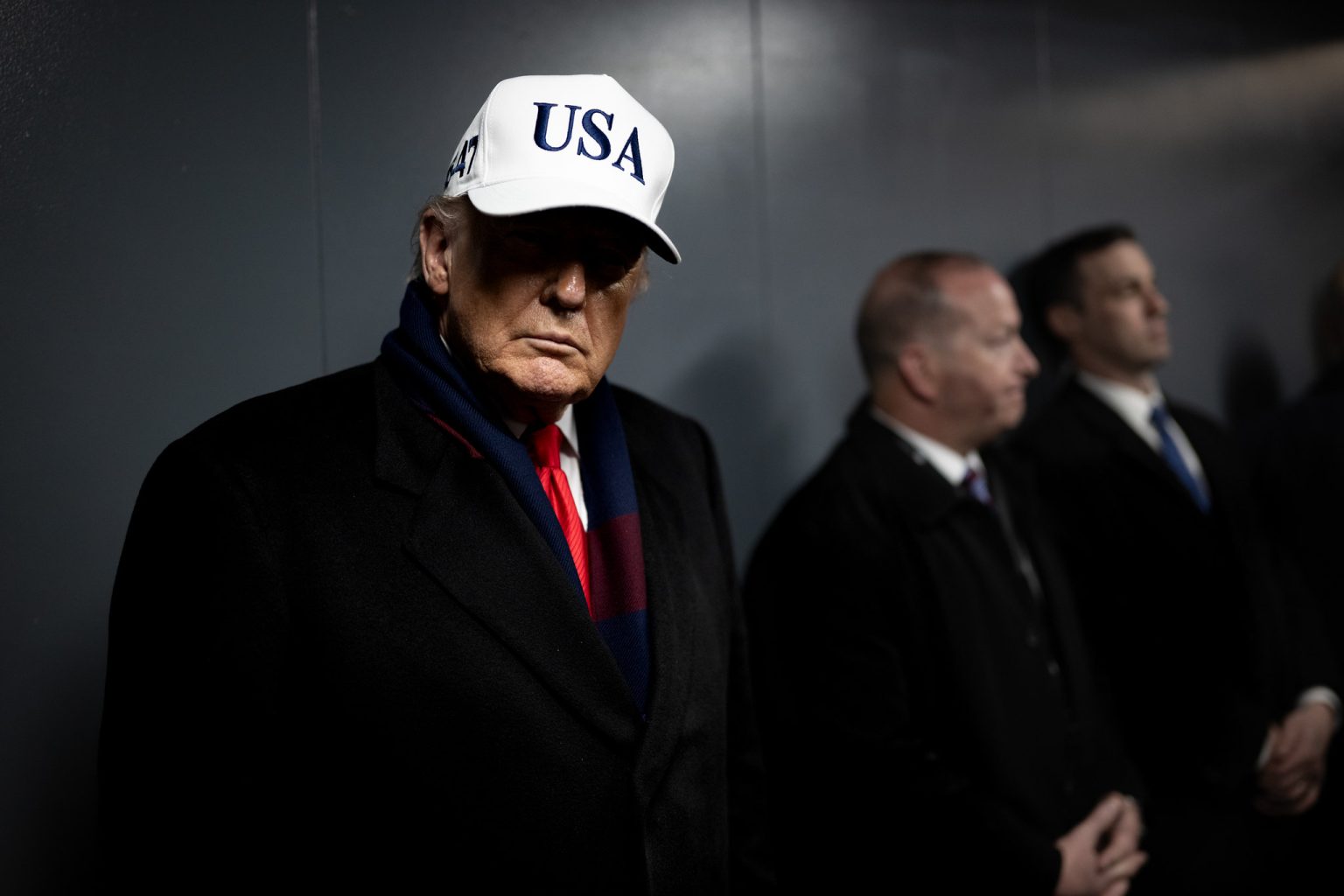
President Donald Trump at an Army Navy football game in Baltimore on Dec. 13. (White House/Daniel Torok)
By Patrick Lawrence
ScheerPost
CN at 30
The Trumpster is not yet finished his first year back in the White House, and I cannot imagine how the crumbling republic will survive three more years of this man-child and the misfits and miscreants with whom he has surrounded himself.
And it occurs to me lately that neither I nor anyone else is supposed to imagine any kind of future — good, bad, in the middle — beyond Jan. 20, 2029, when President Trump will no longer be president. The future will not be the point by then. By then we are supposed to be living in an imaginary past that we won’t have to imagine because the imaginary past will be the actual present.
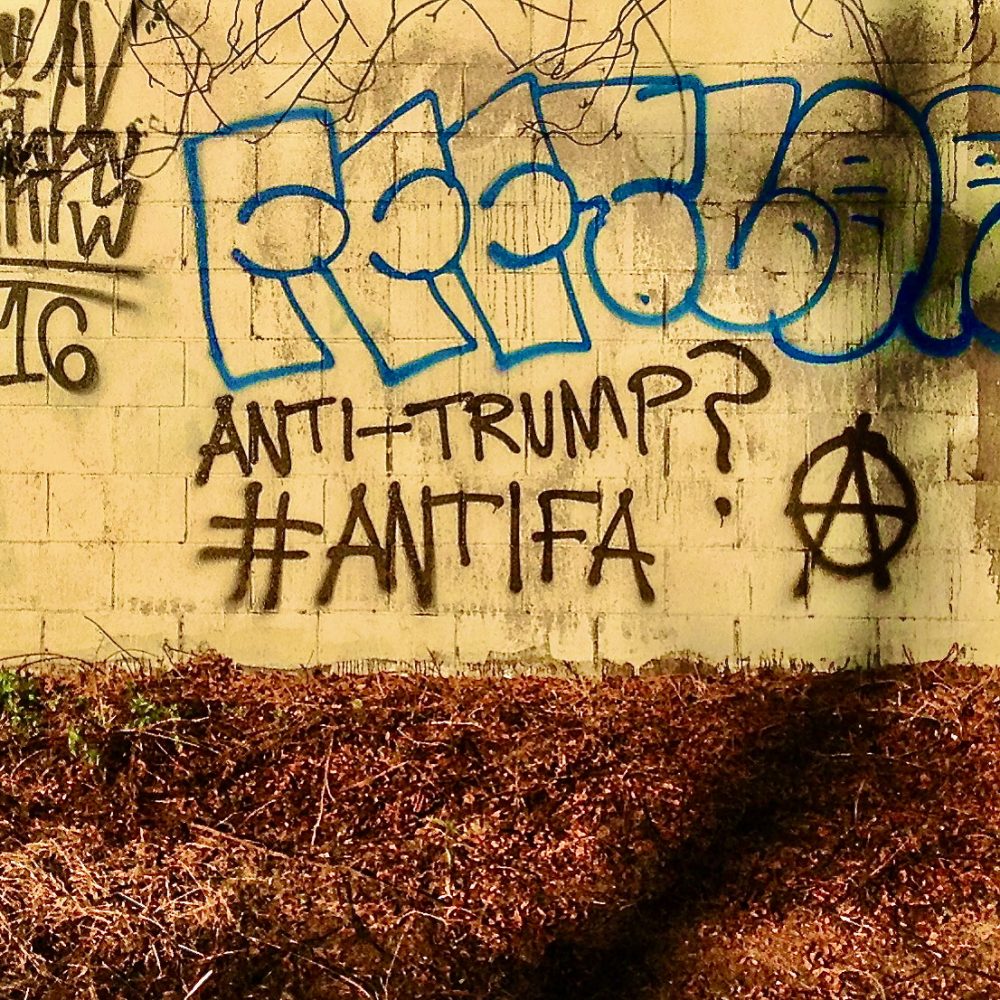
It is not quite three months since Trump issued an executive order designating “antifa,” the more or less fictitious “organization” of antifascists, a “domestic terrorist organization.” In the Trump White House’s rendering, antifa “explicitly calls for the overthrow of the United States Government, law enforcement authorities and our system of law.”
To this end, it organizes and executes vast campaigns of violence. It coordinates all this across the country. It recruits and radicalizes young people, “then employs elaborate means and mechanisms to shield the identities of its operatives, conceal its funding sources and operations in an effort to frustrate law enforcement, and recruit additional members.”
I didn’t take the executive order containing this kind of language the least bit seriously when it was issued Sept. 22. Antifa, so far as I understand it, does not actually exist. It is a state of mind, or it signifies a shared set of political sentiments vaguely in the direction of traditional anarchism — a hyper-individualistic, ultra-libertarianism when translated into the American context.
Trump’s executive order describing antifa as an organized terrorist organization reminded me of nothing so much as those flatfooted fogies back in the Cold War years who, nostalgic for a simpler time but understanding nothing, went on about “outside agitators” as the root of America’s ills.
Graffiti in New Orleans, Nov. 2016. (Bart Everson / Wikimedia Commons / CC BY 2.0)
I was wrong in one respect, maybe more, about Trump and his adjutants and what they have in mind. These people are not flatfooted. They know exactly what they are doing and they are moving swiftly to get it done.
It is time to take seriously, I mean to say, the wall-to-wall unseriousness of the Trump regime’s plans for a nation it would be impossible to live in were it ever to come to be. The saving grace here is they cannot possibly create the America they have in mind. But they will, I have to add, make an unholy mess on their way to failing.
Three days after the antifa executive order, the White House made public a National Security Presidential Memorandum titled “Countering Domestic Terrorism and Organized Political Violence.” NSPM–7, as this document is known, is formally addressed to Marco Rubio, Trump’s secretary of state, Treasury Secretary Scott Bessent, Attorney General Pam Bondi and Kristi Noem, the Homeland Security secretary.
This thing picks up where the one-page executive order leaves off. It cites various assassinations and attempted assassinations — Charlie Kirk, Brian Thompson, the United Healthcare chief executive, the two attempts on Trump’s life during his 2024 campaign — and fair enough, although casting political violence as terrorist violence is a sleight-of-hand too far. It is when NSPM–7 invokes recent protests against Immigration and Customs Enforcement agents and “riots in Los Angeles and Portland” that you sense the trouble to come.
From the first of the document’s five sections:
“This political violence is not a series of isolated incidents and does not emerge organically. Instead, it is a culmination of sophisticated, organized campaigns of targeted intimidation, radicalization, threats, and violence designed to silence opposing speech, limit political activity, change or direct policy outcomes, and prevent the functioning of a democratic society.
A new law enforcement strategy that investigates all participants in these criminal and terroristic conspiracies — including the organized structures, networks, entities, organizations, funding sources, and predicate actions behind them — is required.”
What is required, it turns out, is an institutionalized surveillance operation that goes considerably beyond the Patriot Act.
“This guidance,” Section 2 reads, “shall also include an identification of any behaviors, fact patterns, recurrent motivations, or other indicia common to organizations and entities that coordinate these acts in order to direct efforts to identify and prevent potential violent activity.”
And then NSPM–7 gets down to what the Trump regime is truly after:
“Common threads animating this violent conduct include anti-Americanism, anti-capitalism, and anti-Christianity; support for the overthrow of the United States Government; extremism on migration, race, and gender; and hostility towards those who hold traditional American views on family, religion, and morality.”
I am not letting the liberal wing of the ruling Late–Imperial War Party, commonly known as the Democrats, off the hook in this domestic terrorism business. Joe Biden banged on about this whenever it was politically expedient the whole of his discombobulated term, and we now witness the consequences of all his loose, opportunistic talk. In effect, Biden prefaced what the Trump regime is step-by-step codifying into law.
One of the more pernicious of the many objectionable features of NSPM–7 merits immediate note. This is the vagueness of its language. Whenever I see official documents of this kind my mind goes back to imperial China, whose mandarins were highly legalistic but kept written law purposely ambiguous so as to maximize the prerogatives of imperial power. A surfeit of laws, all of them to be interpreted in whatever way suited the throne.
As of last weekend we know how Pam Bondi, Trump’s patently fascistic AG, intends to interpret NSPM–7. This is by way of a Justice Department memorandum Ken Klippenstein, the exemplary investigative journalist, reported on (but did not actually publish in full) on Saturday, Dec. 6. This is Klippenstein’s exclusive. Here is the top of the piece he published in his Substack newsletter under the headline, “FBI Making List of American ‘Extremists,’ Leaked Memo Reveals:”
“Attorney General Pam Bondi is ordering the FBI to ‘compile a list of groups or entities engaging in acts that may constitute domestic terrorism’… The target is those expressing ‘opposition to law and immigration enforcement; extreme views in favor of mass migration and open borders; adherence to radical gender ideology,’ as well as ‘anti–Americanism,’ ‘anti-capitalism,’ and ‘anti–Christianity.’ ”
By way of defining all these domestic terrorism threats, Klippenstein reports, the DoJ memorandum cites “extreme viewpoints on immigration, radical gender ideology, and anti-American sentiment.” As to enforcement, the memorandum authorizes the F.B.I. to open a hotline by means of which ordinary Americans can report on other ordinary Americans, along with “a cash reward system” to go along with it.
The bureau is also to develop a legion of informants (“cooperators”); state and local governments are to be funded to develop their own programs in conformity with the DoJ’s directives. What the memorandum calls Joint Terrorism Task Forces are to “map the full network of culpable actors.”
This is more than what we now call an all-of-government surveillance and enforcement program that open-and-shut outlaws a variety of Constitutional rights. It is an all-of-society operation that prompts comparisons with regimes in history I never would have imagined summoning to mind in anything like this context.
“Extremist viewpoints” are to be criminalized? I am an outlaw if I am critical of orthodox Christianity, if I am “hostile” to the nuclear family, to traditional morality and so on? Just how close to thought control does the Trump regime plan to sail?
As I was reading Klippenstein’s excellent work, another report came across that bears mentioning here. On Tuesday, Dec. 9, the Supreme Court began hearing arguments in a case brought by Republican political advocacy groups who want the court to remove some of the last remaining limits on campaign finance.
In an excellent report on the opening day’s arguments, CBS News quoted Sonia Sotomayor, who is among the court’s liberal minority, thusly: “Once we take off this coordinated expenditure limit, then what’s left? What’s left is nothing, no control whatsoever.”
No control whatsoever — unbound by the rule of law, the Constitution, legislative oversight. Eleven months into Trump’s second term, this emerges as the agenda among those residing at Trump’s distant end of the garden.
At the Supreme Court — this case is likely to be decided next spring — the topic is the further sequestration of power by way of the more or less complete monetization and corporatization of the political process. At a time the political elites are ever less accountable to electorates, the court is weighing not to correct this but, as Sotomayor put it during the opening arguments, “to make matters worse.”
White House round table discussion about Antifa in October. (The White House /Public Domain)
Read NSPM–7 and the Klippenstein reportage again and consider what is on the minds of those in the Trump White House and Bondi’s Justice Department. “Anti–Americanism,” “open borders,” “anti-capitalism,” “radical gender ideology” and so on. These people have set themselves to returning America to a rigidly ideological, white, Christian, pre-feminist state that never existed in history but lives in their imaginations.
As my colleague Cara Marianna reflected while I wrote this commentary, “The liberals had their ‘end-of-history’ thesis at the Cold War’s end. This is the Republicans’ ‘end-of-history’ moment. They intend to destroy any vision of the future that departs from theirs. There can be no version of reality that departs from the Trump version.”
I am habitually shy of terms such as “totalitarian” and “fascistic,” hyperbole never serving the cause of understanding. But I have described Pam Bondi with the latter term, as readers will have noticed. We are drifting swiftly in this direction, these latest documents from the Trump regime prompt me to say — lawlessness in the name of the law.
Stephen Holmes, a professor at New York University and an energetic commentator on current affairs, published an interesting piece in Project Syndicate on Dec. 1 under the headline, “MAGA’s Death Wish.” Holmes makes his point with admirable clarity:
“Because the future MAGA wants cannot be attained, the movement has no constructive program. It cannot build anything, because nothing it builds would satisfy it. All it can do is destroy…. The rage that animates MAGA is the rage of impossibility — the fury that comes from wanting something that cannot be had…. This is what happens when a political movement promises to restore an irrecoverable past. Unable to deliver, it can only demolish.”
I have never understood where all this end-of-history fantasizing comes from. Francis Fukuyama, the sophomoric charlatan who made the thought popular a year into the awful triumphalism of the first post–Cold War decade, was a middling bureaucrat at the State Department when he wrote The End of History and the Last Man (Free Press, 1992). Maybe this explains it: America as the final word, the best of all possible worlds, is an ideological subset of the exceptionalist consciousness.
However this may be, it is going to wear very ridiculously, not to say dangerously, as Trump and his lumpen lieutenants try it on. History will thankfully go on once we see the end of them and the work of repairing the mess they are making begins.
There ain't no fixing bourgeois democracy because there ain't no fixing capitalism.
*****
The Arrival of Trump 2.0 and the Era of Global Turmoil
By Yang Ping
Yang Ping (杨平) is a leading scholar and editor in China’s intellectual and cultural community. He is the founder, president, and editor-in-chief of Wenhua Zongheng (文化纵横), a leading journal of contemporary political and cultural thought in China. Since its founding in 2008, the journal has grown into one of China’s most important thought platforms. He also founded the magazine Strategy and Management (战略与管理) in 1993.
The arrival of the second administration of President Donald Trump – hereafter, Trump 2.0 – has been a whirlwind. In just over a hundred days, his administration has drastically downsized the civil service, signalled a swift withdrawal from Ukraine, launched an aggressive new tariff war, and betrayed traditional allies in Europe. Trump’s new policies have thrown the United States and the world into chaos.
How should we understand the governing patterns of the Trump 2.0 era? What underlying factors are at play behind his seemingly arbitrary behaviour? What impact will the Trump 2.0 era have on China and the world? How will the world change as a result? These questions are urgent and pressing for people around the world who are filled with anxiety.
The period from Trump’s first term in office in 2016 to the dawn of the Trump 2.0 era in 2024 has made it clear that his political base consists of the vast disenfranchised segments of US society and the new right-wing conservative social movements driven by these disenfranchised groups. Trump did not emerge out of nowhere, nor does he act on a whim; he is a product of this powerful ideological movement rather than its cause. To understand the underlying logic behind Trump’s action, one must begin with his social base and ideological movement.
This new wave of right-wing conservatism, which has spread widely in Western societies, differs from traditional US neoconservatism. It is characterised by a clear anti-liberal stance, with outward manifestations such as opposition to immigration, gender relativism, and free trade. Its underlying traits, however, reflect anti-globalisation, anti-democracy, and anti-establishment sentiments. It no longer seeks the universality of Western liberal values or believes in the promises of a liberal utopia, instead retreating to the US and prioritising ‘America First’. Additionally, its behavioural values have generally returned to Christian traditions, particularly the fundamentalist traditions of white Christianity.
The sweeping rise of the new right-wing conservative movement stems from the rampant spread of free-market capitalism. Over the past thirty years since the end of the Cold War, there has been an unstoppable global expansion of capital and individualistic values under the banner of liberalism. The greed of the US bourgeoisie has reached unprecedented levels, which has led to exacerbating income inequality, eroding social morality, and the dismantling of the fabric of communities. In this context, society urgently needed a movement of social protection to counter market forces. The new right-wing conservatism is a symptom of this need for social protection.
From the perspective of Marxist political economy, capitalism is characterised by cyclical patterns of expansion and contraction. Excessive accumulation becomes widespread due to overproduction, leading to a decline in the average rate of profit and the disruption of capitalism’s internal equilibrium. In the era of globalisation, where national borders are constantly broken down, this cyclical movement manifests itself as unbalanced rapid expansion across all corners of the world, thereby driving the rise of emerging powers and the decline of traditional powers. The new right-wing conservative ideology is a feature of the decline of traditional capitalist powers.
New right-wing conservatism is a social ideology that emerges during the decline of liberal capitalism. Its emergence and development follow certain patterns. First, its emergence is on a world scale – it is a product of the global expansion of the capitalist mode of production. Secondly, it is long-lasting – as long as the wealth gap and the disintegration of communities caused by liberal capitalism remain unresolved, the ideology of new right-wing conservatism will persist. The scale and influence of this ideology are inversely proportional to the governance flaws of liberal capitalism. Thirdly, it has local characteristics – new right-wing conservatism will combine with the history and national conditions of different countries, resulting in ideologies with distinct features. Fourthly, it has the characteristics of its times – for instance, the new right-wing in Europe today cannot openly oppose the democratic system because Western-style democracy has become politically correct and denying it would come at a significant cost.
Given the long-term nature of the new right-wing conservative ideology, the Trump era is merely its beginning. Therefore, it is extremely urgent and necessary to analyse its relationship with the world and China.
The world order will undergo a drastic reorganisation, and chaos will become the norm in the face of the new right-wing conservative ideology. Because the values of the new right-wing conservatism are anti-liberal, US-led alliances based on Western liberal values will split, and friend-enemy relations in the Western world will change. The traditional allies of the US will seek strategic autonomy and break away from dependence. Some medium-sized powers in the West will form new alliances. At the same time, the new right-wing conservatism emerging worldwide will seek to establish a coalition of right-wing values – particularly between the new right-wing movements in the US and Europe – which will rapidly forge deep spiritual and material connections. In this context, Global South countries will find themselves marginalised by the new right-wing US because their development and security concerns will not be prioritised. This harsh reality will force some Global South countries that once followed the Global North to seek new avenues. More importantly, as the new right-wing conservative ideology sweeps the globe, the rules and norms that have governed the world since the end of the Cold War will be shattered (or even completely destroyed). As the world faces the narrow nationalism of ‘America First’, existing global rules will largely cease to function, and a new international system will be difficult to establish. The effectiveness of international organisations such as the World Trade Organisation and the World Health Organisation will significantly decline.
Under the influence of neo-conservative right-wing ideology, Western countries are dominated by nationalism and populism, making conflicts between nations and ethnic groups highly likely. In such an international environment, it is not difficult to imagine that contradictions and conflicts will lead to war. For China, the rise of the new right-wing conservatism will also present significant challenges while also offering numerous new opportunities.
First, under the influence of the new right-wing conservative ideology, China’s external relations will undergo profound adjustments. If the Trump administration continues to view China as its primary strategic competitor, then the EU – which previously prioritised values as its first principle in diplomacy – will distance itself from the US and readjust its relations with China for its own self-interest. Similarly, Asian allies of the US, such as Japan and South Korea, will also adjust their relations with China in response to the US narrowly pursuing its own national interests.
Second, the nature of the struggle between China and the US-led Global North will change significantly. The focus will shift from the ideological struggle, centred on Western concepts of ‘democracy, freedom, and human rights’, to a struggle over national interests characterised by the ‘America First’ policy. Because the new right-wing conservatism is anti-liberal and xenophobic, it no longer possesses a claim to universality and therefore significantly loses its appeal to human society. As a result, the primary contradiction of China’s ideological struggle in international politics will shift from one of values to one centred on national interests.
Third, China’s advocacy for a ‘community of shared future for humanity’ is a profound response to human society’s growing desire for new universal values in times of great turmoil.1 With the launch of the ‘Global Development Initiative’, ‘Global Security Initiative’, and ‘Global Civilisation Initiative’, China has proposed a set of values capable of replacing the decaying Western liberal order and charting a new direction for human society.2 At a time when new right-wing conservatism is widespread in the US, China should further advocate the concept of the ‘community of shared future for humanity’ and provide political-economic and philosophical interpretations of its profound theoretical connotations. The concept should be theorised and systematised to rally the people’s hearts and minds in this era of turmoil.
Finally, at a time when relations among friends and enemies are undergoing drastic changes, China should adhere to the Global South as its main strategic direction, unite the majority of the Global South countries, and form a united front in the new era. The reasoning behind this is not complicated. The US will not give up its strategic intention to contain China, and the EU will waver due to its liberal values. Only the Global South, especially those countries that seek to break away from the unipolar world dominated by the US, could be China’s friends in building a new multipolar international system. The difference between this and Mao Zedong’s ‘Three Worlds’ strategy lies in the fact that China’s current strategy is not merely about carving out a vast intermediate zone amid US-Soviet rivalry but about leading Global South nations in striving to create an equal and orderly multipolar world.
The arrival of the Trump 2.0 era marks the onset of a great era of chaos, with future turmoil only intensifying and constantly surpassing our expectations. Therefore, we must be prepared.
Notes
1This concept was first proposed by President Xi Jinping at the Moscow State Institute of International Relations on 23 March 2013.
2The three Global Initiatives were proposed between 2021 and 2023. They serve as strategic directions for the goal of building ‘a community with a shared future for humanity’. The initiatives focus on the main contradictions in today’s world, such as development, security, and civilisation. They aim to provide action plans for the reform and development of global governance.
Trump’s geo-politics: Correcting the imperial model & shaping the incoming economic architecture
Alastair Crooke
December 17, 2025
The NSS is not a pivot from Empire; it does, nonetheless, conclude that the means to domination requires a ‘Trump corollary to the Monroe Doctrine’.
In his speech in Riyadh in May, President Trump set out his rationale to his transactional mode of policy formulation – making peace through commerce, rather than war.
The language in the 4 December US National Security Strategy (NSS) takes this several steps further: It is couched in the terms of ‘regions of influence’, rather than hegemony, and of managing stakeholder financial interests. It abandons the phraseology of a rules-based order and eschews appeals to democracy and Western values.
But what does this ‘peace through commerce’ really mean?
The core to the Trump geo-politics is revealed in the NSS as the risk of imperial collapse looming in the future. It talks about Atlas holding the globe aloft – and emphasises that the United States can no longer continue to shoulder the burden of empire.
The NSS, therefore, is ultimately centred around resolving the economic contradictions that has brought the US to this pass – burgeoning debt and an out-of-control fiscal matrix which, absent a solution, ordains that Empire will fold.
The core issue therefore becomes how to finance ‘Empire’ against a badly skewed and distorted economic reality. Clearly, the start point was to acknowledge that sanctions have failed. The attempt to lock China (and by extension Russia) out of the economic loop has failed, because they adapted – and strengthened their internal economies; and in China’s case enhanced their relevance to international supply chains.
So, we are seeing a marked shift to a different imperial ‘model’. The NSS indirectly suggests that without the dominance which allows Big Money and infrastructure investment being coerced into the US economy, and without continued dollar hegemony, the US is in big trouble.
The NSS therefore is not a pivot from Empire; it does, nonetheless, conclude that the means to (albeit) attenuated American domination does require a ‘Trump corollary to the Monroe Doctrine’.
In its introductory remarks, the NSS states that:
“American foreign policy elites, convinced that permanent American domination of the entire world was in the best interests of our country … [had] overestimated America’s ability to fund, simultaneously, a massive welfare regulatory-administrative state alongside a massive military, diplomatic, intelligence, and foreign aid complex”.
Here, the NSS put the issue of funding US foreign policy front and foremost.
Significantly, in context of the funding shortfall, the strategy document takes a swipe at the free trade system:
“They placed hugely misguided and destructive bets on globalism and so-called ‘free trade’, that hollowed out the very middle class and industrial base on which American economic and military pre-eminence depend”.
This aspect perhaps constitutes the most radical change of course envisioned by the NSS. It concerns two alternative architectures of economics: On the one hand, the British system of ‘free trade’ as espoused by Adam Smith, versus the ‘American System’ as advocated by Alexander Hamilton. The NSS document includes an explicit rejection of the ‘free trade’ system and even mentions the name of Alexander Hamilton – giving a clear indication of the direction in which Trump is travelling (at least aspirationally).
The ‘American system’ did not originate in the United States; it was first explicitly elaborated by the German economist Friedrich List in the 19th century. But the system earned the label ‘American’ because it was practiced in the US for some 150 years. During this time, the US used tariffs, state subsidies and other barriers to trade to nurture domestic industries and to protect high-paying jobs. But in the post-war period, the US reoriented its economic policy, progressively leaning in favour of the British system of free trade. Indeed, Trump has, from time to time, referred to Hamiliton’s resort to tariffs.
But just to be clear, a shift to a closed economic model – as China (and to an extent Russia) have done to protect themselves from US financial war – takes decades, and Trump does not have time. He is in a rush.
The most obvious contradiction to Trump’s move towards a transactional mode of operating is simply how to sell the US debt instruments needed to fund the budget when demand for dollars in international trade is decreasing. And this, at a time, when Trump simultaneously insists to lower debt service payments that threaten the solvency of his prestige ‘magnificent seven’ AI mega expenditures? Interest charges now account for 25 cents on every dollar raised in the US through taxation. Such a problematic contradiction requires gaslighting people into buying US debt — despite its declining returns.
His answer is to use tariffs as the instrument behind ‘shakedowns’ both of Allies and adversaries alike – to coerce pledges of billions of dollars in foreign investment. The US Treasury Secretary separately has ordered global investors to buy US debt. The contradiction here is that tariffs ultimately are paid by US consumers, and are inflationary — further adding to American economic woes.
How does this new business approach work geo-politically? In Ukraine, the ‘business approach’ presumes that the solution to the protracted conflict requires a system where the opportunity for financial benefit continues. i.e. that the strategic problem is about dividing the ‘Ukraine economic cake’ between ‘stakeholders’.
“Written in polite diplomatic terms, the continued payments are identified as “the prosperity agenda which aims to support Ukraine’s post-war reconstruction; the mooted joint US-Ukraine economic initiatives and the Ukraine recovery projects.” (This is code speak for the US Senate and EU retaining a financial mechanism to exploit for personal benefit”. (i.e. how to continue the usual boondoggle laundering of pay-offs).
“From the language, it appears that Witkoff and Kushner are confident they can construct a financial reward system for western banks, investors, politicians and Ukraine officials that will retain the benefits of war without the ancillary ingredient of bloodshed”.
“If the U.S. delegation can pull this off, then Russia can gain the territory they want, corrupt Ukraine officials can keep skimming investment money, the EU can retain the power it wants to extract financial payments, American politicians can use the “long-term recovery projects” for money laundering and quasi-public/private investment banks can benefit from the exploitation of Ukraine resources”.
This obviously is derived from experience in putting together a New York real estate deal.
Whilst it is true that financial interests are present in the Ukraine conflict, they are not the only interests at stake: Russia has an existential interest in creating a solid, water-tight security environment and in defeating NATO and its European adherents in a lasting fashion. And the Euro-élites have an equal and opposing desperation to land a crushing defeat on Russia.
The NSS says stability in Europe is an US primary interest – but another powerful faction in the US undermines stability in Europe by insisting that the Europeans rearm and be ready for war with Russia by 2027. The Euro-élites comply, because they cannot stand the prospect of Russia ‘winning’ and then becoming a significant actor within Europe. (Sour motives of vengeance are at play too, in certain important quarters of Brussels).
So, we can espy a further evolution of this Trump business model — as Alexander Christoforou outlines —
“Instead of trying to do everything yourself, you focus on core competencies as a business – right? And then you’re going to outsource everything else to partners. So, Europe will be outsourced to the Europeans. Asia will be outsourced to proxies in Asia … It’s like a franchise … we’re [the US is] going to focus on our neighbourhood [the western hemisphere] and then we’re going to have our three, four franchises out there and they’re going to pay us their 7% in franchise fees, but they’re going to take care of their region”.
Just to make matters clear, the NSS states:
“The terms of our agreements, especially with those countries that depend on us most and therefore over which we have the most leverage, must be sole-source contracts for our [US] companies. At the same time, we should make every effort to push out foreign companies that build infrastructure in the region”.
In the context of the US asserting ‘regions of influence’, a main takeaway from the NSS is the focus on the Western Hemisphere and the Americas. It even says the US will “assert and enforce a ‘Trump Corollary’ to the Monroe Doctrine there”.
It is here that we can observe a deeper zeitgeist underpinning the NSS –
A return to the Hamiltonian economic architecture is very unlikely in today’s circumstances. Instead, what we see from US actions in Venezuela is presently cold, but potentially hot ‘competition’ over who shapes the next global system. Locking China out of Latin America is clearly on the table.
Alex Kainer reports that:
“The Venezuelan government this summer offered Washington the most generous terms any adversary has extended to the US in decades. Venezuela proposed opening all existing oil and gold projects to American companies – granting preferential contracts to US businesses – thus potentially reversing the flow of Venezuelan oil exports from China back to the United States”
“This wasn’t just a ‘deal’. Essentially, it was an unconditional surrender of resource sovereignty to American corporate interests”.
“The response from the Trump Administration: A hard ‘no’. Instead, [naval and] military assets continue to accumulate off Venezuela’s coast.
“Here is where it gets really interesting. Whilst Washington rejected Maduro’s offer, Beijing doubled down. China unveiled a zero-tariff trade agreement at the Shanghai Expo in November – and a bilateral investment treaty. Private Chinese companies, CCRC, are now investing over a billion dollars in Venezuelan oil fields under 20-year production contracts.
“So why would the US turn down exactly what it claims to want [Venezuela’s huge oil reserves], without firing a shot? The answer reveals something far more significant about how global power is likely to work in the future
“[Global power] will be about gaining control over the global economic architecture itself. And [the contest will revolve around] which system – Washington’s rules-based order or Beijing’s emerging alternative – will dominate in the Western Hemisphere and beyond. Venezuela has become the chessboard where two incompatible visions of world order are colliding.
“What China has constructed in Venezuela is not just a trading relationship. It is an integrated supply chain of loans ports and commodity corridors – a network that’s increasingly resistant to external pressure. And that’s exactly [what irks] from Washington’s perspective. Because when we talk about the emerging global order; we are discussing the competition between an American-led system and that which China espouses.
“The American approach … relies on the dollar. It depends on financial institutions like the IMF and World Bank that operate according to rules written largely in Washington. It requires countries to integrate into a trading system where the US and its allies maintain the ability to impose costs through sanctions primarily on actors who violate established rules”.
But China requires none of that: It builds on fundamentally different principles. It doesn’t require reform of political systems, nor adopting the dollar-based system. Nor does it insist on alignment with Washington’s foreign policy.
Why then did America reject the Maduro offer? Because the real issue is not oil. Oil is fungible. The key issue is as stated in the NSS: In Washington’s regional fortress, Trump’s Monroe Corollary asserts “that the US will make every effort to push out foreign companies that build infrastructure in the region”.
Trump is saying – by his naval blockade of Venezuela — that Chinese supply chains, loans, alternative payment systems and commodity corridors — will be “pushed out” from America’s fortress Western Hemisphere. Hence the naval blockade of Venezuela and Cuba.
This marks the first round in the war for who gets to shape the incoming economic architecture and system in Latin America — and of course beyond.
It is hugely symbolic — and dangerous. By what means — economic or militarily — will the Trump Corollary be enforced? Let’s see.
December 18, 2025 by M. K. BHADRAKUMAR Will Trump declare war on Venezuela tonight?
The deployment of the USS Gerald R Ford carrier group marks a significant escalation with Venezuela (File photo)
The iconic figure in contemporary American journalism Tucker Carlson said earlier today in the famous podcast Judging Freedom hosted by Judge Andrew Napolitano that US President Donald Trump will declare war on Venezuela in a speech scheduled for tonight. Gunboat diplomacy is getting a fresh lease of life.
It signifies many things. The most obvious is that the leopard can’t change its spots. Gunboat diplomacy is a historical legacy handed down by Western powers, especially the United Kingdom, France, Germany and the United States who used their superior military capabilities, particularly their naval assets, to intimidate less powerful nations into granting concessions. China was its most tragic victim.
The UK, France and Germany are erstwhile great powers who have fallen from the pedestal of great powers during the Cold War era once the US emerged as the leader of the western world. The Suez Crisis of 1956 precipitated by the UK, France and Israel in reaction to the nationalisation of the Suez Canal by Egypt was a turning point when it ran into opposition from US-sponsored resolutions in the United Nations (made in part to counter Soviet threats of intervention), which quickly put a stop to the Anglo-French aggression. France continued to practice gun boat diplomacy up until the overthrow of and gruesome murder of Muammar Gaddafi, but then, that came to an ignominious end in the Sahel following Russia’s arrival in the region as a rival power.
Gunboat diplomacy in Trump’s toolbox acquired new features due to an awareness that America is a diminished power today and it lacks the capability to impose its will on other countries. Outright aggression against sovereign states has become a perilous option, as the defeat in Iraq and Afghanistan showed. Trump is also wary of leading the US into anymore ‘forever wars’ as that would be a drain on the American economy. Besides, Axios wrote recently that Trump is “is flirting with one of the most toxic ideas in American politics — a new foreign military intervention — at one of the most precarious moments of his second term… Trump’s push toward regime change in Venezuela threatens to deepen a MAGA rift.”
Nonetheless, Venezuela is set to become the testing ground for Trump administration’s gunboat diplomacy. There is likelihood of Trump ordering an invasion but then, one can never be sure of his disposition. Even Tucker Carlson admitted so. Trump’s press secretary has not ruled out the possibility of US troops being deployed on the ground in Venezuela, telling reporters that “there’s options at the president’s disposal that are on the table”. Military analysts have noted that the US deployment in the Caribbean is on a much larger scale than needed for a counternarcotics operation, which has been his alibi. Trump has ordered “total and complete blockade of all sanctioned oil tankers going into and out of Venezuela”
Last month, the Senate narrowly voted down a War Powers Resolution that would have blocked the US from attacking Venezuela without congressional approval. Yesterday, the House of Representatives followed suit narrowly voting to reject a resolution to prevent the use of unauthorised military force against Venezuela, amid escalating hostilities. In legal terms, a blockade is an act of war. Trump himself would only say that President Nicolás Maduro’s “days are numbered.”
Meanwhile, Trump has come clean, for the first time, with another national security priority, the US’ interest in Venezuelan oil and gas. Venezuela has the world’s largest oil reserves, which the American oil companies had helped develop exactly one century ago. In Trump’s words, “You remember, they took all of our energy rights, they took all of our oil from not that long ago, and we want it back, but they took it. They illegally took it.” He was referring to the nationalisation of the foreign oil companies in 2013 by late Hugo Chavez. The cat is out of the bag, finally. Maduro hit back calling it “resource colonialism.”
Trump’s alibi of Venezuela indulging in drug trafficking all along lacked credibility. The country is only a transit corridor and the main producer of fentanyl in Latin America is actually Mexico.
At any rate, Trump’s move to block Venezuelan oil exports is misguided, at best — unlikely to lead to political change in Caracas while it may cause economic pain and will even be counterproductive, increasing Maduro’s ratio of power over the population.
That brings in a tantalising train of thought: Trump has no doubt put on real pressure on Maduro and the country, and it could be used to try and negotiate. Simply negotiating Maduro’s exit is probably not going to work, as people tend to see all this as an anti-imperialist revolution and a big slice of the country’s population may want to see the government as well as Chavismo (left-wing populist political ideology) to continue.
On the other hand, any real outcome of the sort Trump expects may not happen even with some sort of a military strike (which is being discussed in some quarters) that may ultimately only create chaotic conditions in America’s backyard, like in Haiti next-door, in which the US expeditionary force may get bogged down. Venezuela is a large country, 1.5 times the size of Texas and comparable to Pakistan or Nigeria, and with a highly diverse and often difficult terrain that includes towering mountains, dense tropical jungles, broad river plains, and swampy deltas.
Overall, therefore, as David Smilde, professor at Tulane University who has written extensively about Venezuela for over three decades puts it, “The one possibility is if President Trump could use all this pressure to try to negotiate some sort of reasonable transition that would have to include Chavismo in some way.”
But that becomes a revolutionary idea in itself — gunboat diplomacy triggering non-violent regime change allowing co-habitation with a leftist populist ideology blending Bolivarianism, socialism and socialist patriotism and characterised by strident anti-imperialism. But then, arguably, Trump has amiably accommodated New York Mayor Zohran Mamdani, whom he once called a “communist”.
Beneath the rhetoric, probably, Trump still favours a negotiated exit for Maduro even while ordering CIA covert operations inside Venezuela and reserving the option to order land strikes at any time. By the crack of dawn tomorrow, we will know which way Trump’s mind is working.
Well yeah, Trump is adverve to any action which might result in US casualties. Iran was a 'gimme', pre-arranged, that won't happen again, anywhere, I don't think. Easy to see TACO's jock strap is full of toilet tissue.
******
Trump’s primetime rant: lies, racism, and crisis at the top
December 18, 2025 Gary Wilson
Trump and his billionaire buddies don’t seem to care about the Main Street recession. About 1.17 million jobs were cut in the first 11 months of 2025, during Trump’s time in office, with more than 15,000 store closures. Bankruptcies are rising fast and are at their highest levels since 2010.
Dec. 18 — On a Wednesday night, with just hours’ notice, Donald Trump seized the airwaves for an 18-minute primetime address. Major networks cut away from scheduled programming — including the live finale of Survivor. Speculation spread across media and political circles about what could justify such an abrupt interruption. Some wondered if it signaled a major policy shift or even a declaration of war on Venezuela.
What followed was neither policy nor clarity. It was a frantic, angry, fact-free tirade that alarmed even sections of the political establishment — not because of what Trump announced, but because of how he delivered it and what it revealed about a presidency struggling to contain deepening crisis.
A performance that alarmed even allies
In moments like this, presidents are expected to project control. Trump did the opposite.
He tore through more than 2,600 words in 18 minutes — roughly double his usual pace. The delivery was widely described as manic, rushed, and angry, as if he were chasing text racing ahead of him. One observer said it looked like the teleprompter was running at triple speed and Trump was barely keeping up.
The display was disturbing enough that CNN medical analyst Dr. Jonathan Reiner, a former cardiologist to Dick Cheney, publicly said Trump appeared “unwell.” Presidential addresses are staged to project steadiness. This one projected volatility.
Some commentators have speculated that Trump may be exhibiting symptoms consistent with white matter disease — a condition that can strip away social and political filters and intensify long-standing personality traits. This remains speculation, not diagnosis. But Trump’s publicly released medical reports omit brain MRI results. As one analyst put it bluntly: Withholding them raises serious questions.
Whatever the explanation, the political reality was clear. The head of the U.S. state apparatus appeared visibly out of control.
A speech built on economic falsehoods
The stated purpose of the address was to sell an economic success story. Trump claimed inflation had been crushed, prices were falling, jobs were booming, and foreign capital was flooding into the country.
None of it holds up.
Gas prices remain near $3 a gallon nationally, food costs continue to squeeze working-class households, and unemployment has climbed to a four-year high as layoffs continue to mount — the opposite of the boom he claimed.
It was a wholesale rewriting of economic reality — an attempt to deny the widening gap between official claims and working-class life.
Racism and fascism as political strategy
Fact-checking, though, misses the point. The speech’s core was scapegoating.
Trump described immigration as an “invasion by an army of 25 million people,” claiming migrants came from prisons and “insane asylums” to “prey on Americans.” This language is deliberate. It mirrors classic fascist rhetoric, which portrays a nation as a pure body under attack by criminal outsiders and promises salvation through repression and violence.
Trump has repeatedly referred to immigrants and political opponents as “animals,” “vermin,” and “the enemy from within.” This language prepares the ground for state violence, mass detention, and the suspension of basic rights — especially as economic conditions worsen.
Racism here is not a distraction; it is a tool. Layoffs have surged — more than a million since Trump took office — while housing, food, and health care costs remain punishingly high. Jobs disappear while prices rise, even as corporate profits and military spending are protected. Rather than confront these contradictions, the administration redirects anger downward, toward immigrants and communities of color.
Trump’s attack on the Somali community in Minnesota was especially telling, echoing earlier remarks widely interpreted as threatening Rep. Ilhan Omar. Instead of addressing why working people cannot afford rent or groceries, he offered a familiar racist answer: scapegoating immigrants and communities of color.
A speech born of desperation
Behind the scenes, the address appears less strategic than panicked. It came just hours after Vanity Fair published a profile of Trump’s chief of staff, Susie Wiles, quoting her describing Trump as having an “alcoholic’s personality,” judging people by their “genes,” and dismissing Vice President JD Vance as a conspiracy theorist. The backlash inside MAGA circles was swift.
According to journalists present afterward, Trump admitted Wiles told him he had to give the speech. He then asked her, “How did I do?” Even close allies reportedly found the address baffling — not the move of a leader acting from strength.
Meanwhile, material conditions continue to undercut the White House’s claims. Unemployment is rising. Household costs remain high. Wages lag behind prices. A Reuters / Ipsos poll showing just 33% approval of Trump’s economic handling reflects lived reality, not a messaging problem.
What the interruption really revealed
This address will not be remembered for policy or persuasion. It will be remembered as a moment when the mask slipped.
It revealed a president visibly unstable, a speech built on falsehoods, an administration leaning ever harder on racist and fascist scapegoating, and a ruling apparatus acting out of panic rather than strength.
For working people, the lesson is clear. When those at the top cannot resolve capitalism’s crises, they turn to lies, fear, and division. Our task is not to be distracted by the spectacle, but to organize against the system that produced it — and against the dangerous politics now being used to defend it.
The war on terror, the war on drugs, and other bedtime stories for grown nations
If Africa has learned anything from the last century, it’s this: whenever the world’s great powers announce a new “war”, on terror, on drugs, on trafficking, it usually means Africa is about to become someone else’s battlefield again.
December 18, 2025 by Raïs Neza Boneza
US President Donald Trump and US Secretary of War Pete Hegseth in a cabinet meeting earlier this year. Photo: The White House
If everything you thought you knew about the War on Terror were nothing more than a mirage (an extravagant shadow-play staged by geopolitical puppeteers) would you really be surprised? After all, the last two decades have taught us two things: nothing sells like fear, and nothing pays like chaos. Enter the familiar cast of characters: Obama, Clinton, McCain, Brennan, Soros, and Abedin, names recited like an incantation in the global ritual of “saving democracy”, usually by destroying someone else’s democracy.
But don’t worry. This time, it’s different. That’s what they always say before dropping another bomb.
Bin Laden: the man, the myth, the perpetual asset
Let’s start with America’s favorite ghost: Osama bin Laden. Hunted for a decade, allegedly found multiple times, yet somehow always allowed to slip away, until 2011, when eliminating him finally aligned with a White House political calendar. Funny how that works.
Why wait so long if he was “Enemy Number One”? Why ignore intelligence in 2005, 2007, 2009?
Well, because a living bogeyman is a very lucrative business model. Ask Boeing. Ask Raytheon. Ask any defense stockholder who suddenly discovered the joy of quarterly dividends.
And then — poof! — the SEAL team responsible for the raid dies in a mysterious helicopter crash months later. A coincidence, of course. Washington runs on coincidences; it’s practically the city’s main export.
Emails, servers, and the occasional sexting scandal
Meanwhile, Hillary Clinton was busy deleting 33,000 emails (allegedly about yoga and wedding plans, which must make her the most flexible and socially overbooked woman in US history). Too bad some of those emails inconveniently link foreign donors, Gulf monarchies, and groups who (surprise!) funded extremist militias in Syria and Iraq.
Then Anthony Weiner’s laptop appears on stage like an unwanted comic relief character in a Shakespeare tragedy. Suddenly, classified emails resurface in places they were never supposed to be. Yet the media called the whole thing “overblown”. Of course. Nothing to see here, unless it’s your laptop, in which case the FBI shows up faster than Amazon Prime.
Syria, Libya, Daesh: the franchise
After Gaddafi fell, Libya’s weapons didn’t retire, they simply changed employers. They traveled to Syria; via networks no one officially acknowledges but everyone privately knows. McCain posed with “moderate rebels”, some of whom later turned out to be high-ranking ISIS members. Oops. But it’s fine, errors happen. Especially when your foreign policy is written by weapons manufacturers.
ISIS rose like a startup with excellent venture capital and suspiciously advanced media production skills. They blew up ancient sites (Babylonian, Assyrian, Mesopotamian), erasing the evidence of civilizations older than the Western narrative. Because when you control history, you control the future. And what better way to redesign the Middle East than by erasing anything that contradicts your blueprint?
The Sahel: the new desert of convenient enemies
Fast forward to today. The War on Terror is tired, overused, fraying at the seams. So, the international community reaches for a new franchise: The War on Drugs — Sahel Edition.
If Africa has learned anything from the last century, it’s this: whenever the world’s great powers announce a new “war”, on terror, on drugs, on trafficking, on poverty, it usually means Africa is about to become someone else’s battlefield again.
The War on Terror burned the Middle East. The War on Drugs decimated Latin America. And now both narratives have packed their bags, put on desert boots, and moved south into the Sahel, where they are sold to Africans as “security partnerships” and “stability initiatives.”
The only thing being stabilized is the flow of minerals.
Never mind that the Sahel’s instability is fueled largely by climate change, corruption, and the fallout from NATO’s Libya adventure. Never mind that drug trafficking networks have thrived because of collapsing states, not despite them.
Enter Western headlines: “Drug Cartels in the Sahel Threaten Global Security.” Translation: “We found a new justification for military bases.”
Because nothing says “humanitarian concern” like drones circling above Nigerien villages while cobalt and uranium travel safely to European factories.
The War on Drugs and the War on Terror share the same logic: Create a monster. Feed the monster. Pretend to slay the monster. Send the bill to taxpayers.
Narco-Jihadists: because two boogeymen are better than one
We now hear about “narco-terrorists” in Mali and Niger, a term so catchy it deserves. its own Netflix series. Are there traffickers? Yes. Are there extremists? Yes. Are they sometimes the same people? Sometimes. But are they the real threat?
Absolutely not. The true threat is the unholy marriage between geopolitical ambition and moral storytelling, the kind that turns tragedies into market opportunities.
But let’s be honest, the War on Terror was never about terror. The War on Drugs was never about drugs. They were both wars on inconvenient truths, and lucrative opportunities for whoever controlled the narrative. Just ask the Sahel, ask Iraq, ask Syria or ask the families of soldiers whose lives became collateral damage in classified chess games.
A Brief Moment of Lucidity, if Daesh collapsed quickly under Trump, why not under Obama? If narco-networks can be neutralized, why do they grow after every new foreign intervention?
If stability is the goal, why destabilize every country with minerals essential to global supply chains? Unless, of course, chaos is the point.
A destabilized region cannot negotiate. A fractured society cannot resist extraction.
A frightened population cannot challenge power.
In the end, all roads lead to the same desert
From the caves of Tora Bora to the dunes of the Sahel, the logic remains: Big players create the fire, then sell the fire extinguishers. And when the flames spread? Blame the locals. Call it terrorism. Call it narcotrafficking. Anything but what it really is: A war on sovereignty disguised as a war on vice.
Final Thought, they erased Assyrian history, almost destroyed Timbuktu. They erased Mesopotamian stones. Now they want to erase Sahelian voices. Because the biggest threat to empire has always been memory. And yet, memory persists.
Stories persist. People persist. The mirage is fading. Even the deserts are speaking. And this time, hopefully, the world is finally listening.
“The Truth Behind Trump’s Aggressive Venezuela Strategy”
Posted on December 19, 2025 by Yves Smith
Yves here. This post contains very useful information about the viability of the US exploiting Venezuelan oil, on the optimistic assumption that it could succeed in conquest or regime change. But it is simultaneously a peculiar exercise in messaging and thus also makes for also a useful critical thinking exercise.
The short version is that this article explains why Venezuela’s oil is not of much strategic value to the US and its infrastructure would take a lot of investment over a long time to bring up to snuff. Yet Trump has shifted his justification from narco-terrorism to, erm, retaking the oil and other assets, in going to war with Venezuela (recall a blockade is an act of war):
Recall that after the weapons of mass destruction justification for the Iraq war fell apart, the Administration then provided a series of pretexts, even as most observers argued that the oil was the reason. Iraq then had the world’s second largest proven reserves, and they were highly prized light sweet crude. And while the US still has substantial control over Iraq’s oil exports, the US were slow to invest in Iraq’s oil infrastructure. I cannot find the source, but I recall reading that the majors were not comfortable the US level of exploitation of the Iraqi resource.
A 2024 article in The Cradle describes the state of play:
In July, the Iraqi Central Bank halted all foreign transactions in Chinese Yuan, succumbing to intense pressure from the US Federal Reserve to do so. The shutdown followed a brief period during which Baghdad had allowed merchants to trade in Yuan, an initiative intended to mitigate excessive US restrictions on Iraq’s access to US dollars.
While this Yuan-based trade excluded Iraq’s oil exports, which remained in US dollars, Washington viewed it as a threat to its financial dominance over the Persian Gulf state. But how has the US managed to exert such total control over Iraqi financial policies?
The answer lies in 2003, with mechanisms established following the illegal US-led invasion of Iraq.
Since the signing of Executive Order 13303 (EO13303) by President George W Bush on 22 May 2003, all revenues from Iraq’s oil sales have been funneled directly into an account at the Federal Reserve Bank of New York.
A 2012 Aljazeera story intimated that the Western firms, even though they won the critical oil concessions after the war, had not done as well as they had hoped, confirming the idea that the exploitation of the Iraq resource was not handled in an expeditious manner.
I am sure some readers know this chapter much better than I do, so input would be very much appreciated. But my impression is that the later theories, that Iraq was a stepping stone on the way to subjugating Iran, and the oil was at most a secondary objective, are on target.
So war against Venezuela is not about narco-terrorism, and not about the oil, what is the reason? Subduing Cuba could be a justification, but this is an awfully costly way to go about it. It looks like a very badly conceived plan to restore America’s manhood, via throwing a perceived-to-be-weak country against the wall. Remember when Trump tried punching similarly-underestimated India with secondary sanctions to get them to stop importing Russian oil, that did not work out either. But Trump managed to find his way awkwardly to an off ramp. He told the Europeans that he would sanction Russian oil buyers if they did, and so when they refused, he could retreat. How does he get out of this misguided escalation?
John Mearsheimer, in a new discussion with Judge Napolitano, is bemused at the mess Trump has gotten himself into, but you will see he skipped over the issue of why we picked this fight in the first place. See starting at 2:34:
Mearsheimer: Well, I think what the administration is trying to do here is figure out a way to get out of the corner that they’ve boxed themselves into in this Venezuela situation. I mean, we decided early on that we were going to get tough with Venezuela that it was this great threat to the United States and that we would be able to deal with it rather easily. But that’s not proved to be the case at all.
And what you see the Trump administration doing is fishing around for a way to deal with this problem. And that basically means getting rid of the Maduro government and taking this huge problem that we’ve created off the table.
And you remember at first Trump was talking about the fact that the CIA was operating inside Venezuela. And then he escalated further and we started destroying those boats and killing innocent people on board those boats. Then he started talking about a land invasion or hinting at a land invasion. Then he said that the airspace over Venezuela was closed they’re seizing tankers and they’re talking about putting some form of blockade on Venezuela.
All these different approaches are due to the fact that the Trump administration is unable to figure out how to deal with the Maduro government in a way that they can save face. They are in a real pickle. The administration is in a real pickle. And that’s what explains what’s going on with the seizing of this particular ship and the blockade that’s now been announced by Trump.
Napolitano: You know, you mentioned the changing I wouldn’t even call them theories, the changing arguments advanced for the interference with Venezuela in 2017, his first year of his first term when he addressed the joint session of Congress. He famously introduced the person he said was the president of Venezuela and it was this young man Juan Guyaido who by the way today is a grad student uh in Miami, Florida. Anyway, at the time introduced him as the true president. The Congress gave him, you know, a profound and lengthy um standing ovation and we were going to get him back there because he’s the one who won the election. All right, fast forward and well, it’s fentinyl. Well, it turns out the Drug Enforcement Administration, his own, says, “No, the fentanyl is made in Mexico. Then it’s cocaine.” Then his Drug Enforcement Administration said, “No.” Venezuela once did send cocaine here, but they don’t anymore. Then two days ago, he said Venezuela stole our land and stole our oil. Could he possibly think that a natural resource under Venezuela belongs to the United States? My point is, you’re right. He’s boxed in and now scrambling for a justification for the boxing in. The boxing in, according to Colonel Wilkerson, is costing a billion dollar a day.
Mearsheimer:. But I just want to say what you said is very important and what I said is very important, but we’re talking about two different things. And it just shows you how desperate the administration is. You were talking about the rationale or the different rationales plural for what they’re doing and how that shifts and I was talking about the different strategies that they’re using and how that has been over time and what you see is that they’re flailing. He’s boxed himself into a corner.
Now to the main event.
By Matthew Smith, Oilprice.com’s Latin-America correspondent. Originally published at OilPrice
Despite accusations from Venezuelan and Colombian leaders, the immense growth in U.S. domestic oil production and reserves significantly diminishes the strategic need for Washington to seize Venezuela’s oil fields.
The U.S. Gulf Coast refining industry has largely transitioned away from Venezuelan heavy crude due to facility closures and a shift toward alternative suppliers like Canada, Mexico, and domestic shale sources.
Restoring Venezuela’s dilapidated oil infrastructure to major export levels would require over a decade of work and tens of billions in investment, making a military seizure economically impractical for the United States.
President Trump’s massive naval build-up off the coast of Venezuela and the threat of invasion was labelled by the country’s illegitimate President Nicolas Maduro as a bloody grab for oil. Other Latin American leaders, notably Colombia’s leftist President Gustavo Petro, are making similar assertions. A long history of U.S. intervention to secure vital fossil fuel resources, coupled with Venezuela controlling the world’s largest proven crude oil reserves totaling 303 billion barrels, supports this rationale. There are, however, many reasons indicating that Washington’s military campaign is not a thinly veiled attempt to seize control of Venezuela’s vast petroleum reserves.
An autocratic Maduro not only survived Trump’s strict sanctions but treated them as an opportunity to consolidate his grip on power. Even civil dissent manifesting in the form of violent protests and the threat of a coup from within Venezuela’s military failed to topple the authoritarian Maduro regime. By 2021, Venezuela’s economy had returned to growth, thanks to growing oil exports in defiance of U.S. sanctions and the regular flow of condensate from Iran. Tehran even provided the expertise and parts to refit Venezuela’s ailing refineries to boost fuel production, at a time when an energy crisis engulfed the country.
Even with the Trump White House offering a $50 million bounty and ratcheting up sanctions, Maduro thus far has maintained his grip on power. In response the White House, since August 2025, has amassed a large naval armada in the southern Caribbean, ostensibly to stop the flow of cocaine to the United States. Although Trump’s goal is unclear, many analysts claim his aggressive gunboat diplomacy is designed to topple Maduro. Venezuela’s illegitimate president and some regional leaders argued publicly that the White House campaign is a violent grab for Venezuela’s vast oil reserves, which at 303 billion barrels are the world’s largest.
Maduro, less than a month ago, accused Washington of seeking to use military force to appropriate the country’s vast petroleum resources illegally. President Petro of neighboring Colombia, at around the same time, asserted in a CNN interview that “(Oil) is at the heart of the matter,”. He went on to declare, “So, that’s a negotiation about oil. I believe that is (US President Donald) Trump’s logic. He’s not thinking about the democratization of Venezuela, let alone the narco-trafficking.”
After the U.S. Coast Guard seized a sanctioned tanker, the M/T Skipper, off the coast of the pariah South American state carrying 1.9 million barrels of Venezuelan heavy crude last week, the rhetoric intensified. Venezuela and Colombia’s presidents both strongly accused Washington of piracy and theft. Maduro called it an act of international piracy after earlier declaring that Venezuela would not become a U.S. oil colony. Petro stated, “They have just seized a ship, it is piracy, oil, oil, that is, they are demonstrating why they are doing what they do. Oil, oil and oil,”.
Both Latin American leaders ramped up their rhetoric despite the tanker operating in defiance of U.S. sanctions. The tanker was transporting 1.9 million barrels of Merey, Venezuela’s main export-grade heavy oil, with an API gravity of 15 degrees and 2.15% sulfur content, to Cuba, then to Asia, with China and India key buyers of U.S.-sanctioned oil. The Skipper’s repeated transportation of sanctioned Venezuelan crude oil led the U.S. Coast Guard to receive a court-issued warrant for the tanker, which expired only days after the seizure. This is the first tanker seized by the U.S. since strict sanctions on Venezuelan crude oil were imposed in 2019.
The White House and State Department have consistently denied accusations that the military action against Venezuela is motivated by securing control of the country’s crude oil. U.S. government representatives have repeatedly reaffirmed that the mission called Southern Spear is about preventing the flow of drugs and illegal migrants to the United States. While those goals are part of the military operation, there are signs the U.S. mission aims to pressure a highly unpopular Maduro into stepping down so Venezuela can return to democracy. Indeed, there is very little rationale for the claims that Washington needs control of Venezuela’s vast oil reserves.
The U.S., as the world’s leading petroleum producer, does not need to forcibly obtain Venezuela’s vast oil reserves. Over the last 20 years, U.S. production has grown at a stunning clip. U.S. Energy Information Administration (EIA) data show it more than tripled, from 4.2 million barrels per day in September 2005 to 13.8 million barrels per day in September 2025. Importantly, it is anticipated that U.S. oil production will continue to climb, with the EIA predicting it could reach 18 million barrels per day by the early 2030s. This tremendous expansion is supported by the solid growthof U.S. proved oil reserves, which between 2003 and 2023 doubled from 23 billion to 46 billion barrels.
The stunning growth of U.S. petroleum reserves and production over the last two decades, because of the shale oil boom, is so significant that by 2019, the world’s second-largest consumer of fossil fuels emerged as a net energy exporter. In fact, by September 2025, the U.S. EIA reported oil imports of just under 250 million barrels, which was more than a third less than the 397 million barrels imported for that month 20 years earlier. This point is important because, unlike the period from 1958 to 201,8 when the U.S. imported more oil than it produced, the country is now no longer economically reliant on foreign petroleum imports.
Some analysts argue that even with U.S. oil reserves and production expanding at such an impressive clip, demand for Venezuela’s low-cost heavy crude remains strong. You see, during the 1980s, Venezuela’s heavy crude emerged as an attractive feedstock for U.S. Gulf Coast refineries. This was due to lower prices than the WTI and Brent benchmarks, copious production volumes of around 2 to 3 million barrels per day and the close vicinity of those oilfields to the United States. Venezuela’s stable democracy, with Caracas sharing close ties with Washington as a staunch ally against communism in Latin America, enhanced the attractiveness of the country’s crude oil.
At that time, many Gulf Coast refineries were built or retrofitted with the equipment needed to process the heavy sour crude oil produced in Venezuela. This left them unable to refine lighter, sweeter petroleum grades cost-effectively, making those facilities dependent on Merey as well as other Venezuelan heavy oil grades like Hamaca and Boscan. For these reasons, some analysts claim Venezuela’s heavy oil is essential for the profitable operation of a swathe of Gulf Coast refineries and bolstering U.S. energy security. This, they assert, is the reason for Trump’s aggressive gunboat diplomacy and the planned seizure of Venezuela’s vast heavy oil reserves.
While this was true three or four decades ago, it is far from reality today. You see, plummeting refining margins and soaring operating costs led the U.S. refining industry to contract sharply from the mid to late 1990s. This forced the closure of a swathe of higher-cost Gulf Coast refineries, particularly those processing heavy sour crude oil grades, to shutter or be converted to more profitable uses over that period. EIA data shows 27 Gulf Coast refineries with a combined distillation capacity of 832,426 barrels per day were permanently shut down from January 1, 1990, and January 1, 2025. Many others were converted to refine lighter, sweeter grades of crude oil or to process biofuels.
Since the early 2000s, Gulf Coast refineries still dependent on heavy sour crude oil have been forced to find alternative supplies. It was Canada, the world’s largest producer of heavy crude, followed by Colombia and Mexico, which filled the gap. A combination of sharply weaker oil prices, malfeasance and tighter U.S. sanctions weighed heavily on Venezuela’s oil production. Between 1997, 2 years before Hugo Chavez’s revolutionary presidency, and 2015, petroleum output plummeted from 3.5 million to 2.7 million barrels per day. During 2020, it plunged further, hitting an all-time low of 570,000 barrels per day.
While Venezuela’s petroleum production has recovered, particularly after U.S. energy supermajor Chevron was granted a restricted license to lift oil in the pariah state, shipments to the U.S are at all-time lows. For September 2025, the U.S. imported 3 million barrels of Venezuelan crude oil, which is less than 1/13 of the 41 million barrels received in that month 20 years earlier. Those numbers underscore just how irrelevant Venezuelan petroleum is to a significantly diminished U.S. refining industry, particularly given that domestic production is still growing at a healthy clip. Indeed, over that period, the number of operable U.S. refineries has fallen from 148 in 2005 to 132 at the start of 2025.
Even if the U.S. seized Venezuela’s vast petroleum resources it would take at least a decade and tens of billions of dollars to rebuild shattered industry infrastructure. Venezuela’s current oil production today, which OPEC data shows to be 934,000 barrels per day, is a far cry from the nearly 3 million barrels per day lifted 30 years earlier. An investment of $58 billion is needed to lift production to a modest 1 to 2 million barrels per day, which is insufficient to return Venezuela to a major petroleum exporter. For that to occur, an investment of $10 to $12 billion annually for at least a decade, likely far longer, is required to rebuild heavily corroded wellheads, pipelines, processing plants and storage facilities.
What is at the root of Trump’s hate towards Somalis?
By David Bacon (Posted Dec 19, 2025)
Originally published: People's World on December 12, 2025 by David Bacon (more by People's World) |
Lewiston, Maine, is an old mill town on the Androscoggin River. After its mills and shoe factories closed and its downtown was abandoned, it then had an economic rejuvenation due to an influx of Somali immigrants. (Photo: David Bacon)
LEWISTON, Maine—It’s clear that Trump hates Somalis. In his first administration he included Somalia as one of his “shithole” countries, and tried to prohibit its people from coming to the U.S. “They come from hell,” he said just the other day.
We don’t want them in our country.
Trump singled out courageous Congress Member Ilhan Omar (again) and called her “garbage.” Omar, with great dignity, responded only to say she thought his attention “creepy,” as indeed it is. But his hatred of Somalis is also revealing.
Trump is afraid, and he has reason to be. Since they started coming to the U.S. in the wake of the destabilization of their country in the 1990s, Somalis have become one of the most politically engaged immigrant communities in this country. In Minnesota it’s not just Ilhan Omar. The state now has three members of its legislature who were born in Somalia.
Trump accuses them of “taking over” Minnesota, as though they’d somehow managed to produce votes by magic. But anyone can see that what Trump really has is a bad case of fear. Given the state’s size (5.8 million) and the community’s size (43,000), it’s clear that far more votes come from non-Somalis than Somalis.
Charmarke, a Somali Bantu woman, and her son Youssouf on Main Street. (Photo: David Bacon)
The other state where Somalis are getting elected is the whitest state in the country—Maine. Deqa Dhalac was elected to the South Portland City Council in 2018, and in 2021 the other councilors chose her as mayor. Now she’s in the state legislature, along with two other Somalis. 1.4 million people live in Maine; only 6000 of them were either born in Somalia, or have Somali parents.
What scares Trump is that white people are voting for Somalis in large numbers, because they have good political skills. They speak about the basic class interests that motivate most working class people to the polls. Dhalac’s program includes responding to climate change (Portland is on Maine’s coast), affordable housing, and promoting diversity, equity and inclusion.
The experience of Somalis has not been a history of easy acceptance, though. In nearby Lewiston, another Maine city where many have settled, they organized a mosque when they decided to make the city home. But in 2006 someone threw a pig’s head into it.
The mayor of Lewiston announced in 2002 that Somalis should stop coming. That made white supremacy an acceptable attitude, and 32 people demonstrated to support the mayor. Another 4000 counter-protested, however, and Dhalac announced to them, “I am a Muslim, Black immigrant woman, and I’m not going anywhere.” Fifteen years later she was on the South Portland City Council.
Mohamed Ali Ibrahim is a leader of the Somali Bantu community, and stands on Main Street, where Somali stores have taken the place of boarded-up storefronts. (Photo: David Bacon)
In Rockland, fifty miles from Lewiston, the city council responded to Trump’s anti-immigrant insults and threats by adopting, 4-1, an ordinance telling its police not to cooperate with ICE. Immigrant rights activists and immigrant communities are fighting for a similar bill, LD 1971, in the state legislature.
But Trump’s “garbage” insult is frightening. During his first term, after he’d demonized and tried to ban immigrants from African and Middle Eastern countries, someone shot into the mosque. Many Somalis are in the U.S. with Temporary Protected Status, which Trump ended for other nationalities. They worry they could be next. Still, the local imam Saleh Mahamud says,
This is my country. My children were born here. And we are not going anywhere else.
These photographs show the old mill buildings of Lewiston’s past, the slum apartments where Somalis lived when they first arrived, and a few community members in front of their new stores and businesses.
“Venezuelan President Nicolás Maduro described the detention of an oil tanker seized by US military personnel in the Caribbean Sea on Wednesday as an act of piracy” (Orinoco Tribune, 12 Dec. 2025)
Trump, the president of the most capitalist nation on Earth, has dealt a blow to the very system upon which his country—and indeed, most of the West—considers the bedrock of the economy, a blow that not even the most revolutionary person today would have foretold or thought to achieve. He has trashed the notion of private property and outright stolen a full oil tanker in international waters, like a modern pirate, and kidnapped its crew.
Since September, mighty US navy warships obliterated, with military missiles, 22 small outboard motorboats (mostly in the Caribbean but some in the Pacific), killing at least 87 people. The victims were unidentified and unarmed, and there was no evidence of drugs. One boat’s two survivors, clinging to the wreckage for an hour, were not picked up but obliterated later by a second missile. These killings were all extra-judicial, therefore illegal, as there was no due process, no chance of defence, no courts, no judges, no adherence to US laws or international laws, no respect of human rights or for age-old norms of seafaring rescue. Trump and his buffoonish “secretary of war” were judge and executioner. In other words, it was a premeditated murder. By the precedent set at the Nuremberg trials, all who follow illegal orders to murder are also guilty of murder: an individual carrying out illegal instructions on behalf of a superior is not absolved of responsibility under international law.
The killings have been denounced by most Caribbean and Latin American countries, progressive NGOs worldwide, solidarity movements and most non-aligned countries including Mexico, Colombia, Brazil, the BRICS, China, Russia, Iran, Turkey, and the United Nations. France and the UK have spoken out, but only lukewarm nods have come from Canada and the EU. However, human rights experts and international law experts invariably have pronounced that these were extrajudicial, unlawful killings.
But Wall Street remained unperturbed by the murder of seamen and fishermen. The markets were not affected in any real way: murder in the high seas is “not their department”.
Nor have the markets been affected in any significant way by the hybrid war against Venezuela these past years: the sabotages, the mercenary invasions, the cyberattacks, the exclusion from the international financial system, the UK theft of Venezuelan gold, the theft of all Venezuelan foreign assets including its oil company CITGO, and the sanctions impeding the production and sale of oil by Venezuela restricting its ability to import food and medicines. Venezuela was not even allowed to acquire Covid-19 vaccines during the pandemic. The list of actions designed to impoverish and destabilize Venezuela goes on. It includes assassination attempts on Venezuelan leaders, the promotion and recognition of a false president, and the death of more than 100,000 Venezuelans due to the 1,000+ illegal, unilateral, brutal economic sanctions. The economic cost to the country is staggering: US $232 billion to the petroleum sector and US $642 billion to the non-petroleum sector.
None of these appalling imposed sufferings of Venezuelans seemed to impress in any meaningful way geopolitics or world markets. After all, what importance did a Latin American country like Venezuela have in the broad scheme of international geopolitics and economy? It all seemed to be confined in a sort-of private “quarrel” between the US and Venezuela.
Not so the robbery of a full oil tanker in international waters on December 10, 2025.
After the news got out—with a handy PR video of the assault to demonstrate just how “tough” the US is —oil prices climbed immediately. Brent crude futures rose 0.4% to $62.21 a barrel, and US West Texas Intermediate (WTI) crude futures also gained 0.4% to close at $58.46 per barrel on the same day. Oil is very affected by supply issues and by restricting the supply of oil from Venezuela, the price of oil and price of gasoline can rise.
But that price fluctuation is minor compared with the long-term risks which Washington has visited upon international shipping, especially its safety and security and that of its cargo. Trump has said that he will seize even more tankers, increasing the already heightened insecurity and uncertainty. Will oil tankers now-on have to be heavily armed to deliver their cargo and protect their crew? The oil in that seized tanker was prepaid, so Venezuela has not lost the income from it, but since, in all likelihood, the oil’s final destination was China, Trump has stolen from China. This puts the seizure of the tanker and its cargo on a totally different scale of importance geopolitically with China as the victim.
There is more. The enormity of the US assault on a commercial, civilian oil tanker that was carrying out non-military private business in international waters, is an uncommon blow to the cornerstone of the capitalist system on which the entire economy of the West relies: that is: private property. By committing such an impudent and openly publicized assault on a private, unarmed, oil tanker, the US Navy has committed—without a doubt—an act of piracy. The Venezuelan minister of defense has said, “It is a crude, rude act of cowardly thievery to appropriate resources that do not belong to you.” And cowardly it was, as we all saw the video in which marines armed to the teeth quickly grabbed unarmed seamen.
It is worse than the piracy of old because in this case it is state-sponsored piracy. It is a grab at another country’s natural resources, as the US is obsessed with Venezuela because it has the largest proven oil reserves on the planet, and to do so it endeavours to turn its government into a lackey puppet that will do the bidding of the US and its oil corporations. The US does not want to buy Venezuelan oil, it wants to own it, as Trump openly declared in 2023. Therefore, it wants to bring down its present government and install a vassal state. No other nation save Russia, has received so many sanctions as Venezuela, and for twenty years the CIA attacks to undermine the government have not ceased. The sanctions have, however, failed, so now Washington has turned to the military “option”: to take Venezuela by force.
The United States of America is now a piratical country: an abuser of its own domestic laws and international laws. It is a lie that they took possession of the oil tanker because it was “violating sanctions”, when said sanctions are in themselves illegal and invalid. They are unilateral US instruments of harassment and interference in the sovereign affairs of other nations, not backed by the United Nations Charter, and the UN is the only mechanism to impose legal sanctions on a nation. The tanker assault also violates the UN Convention on the Law of the Sea, the UN Convention for the Suppression of Unlawful Acts against the Safety of Maritime Navigation and is demonstrably contrary to the Geneva Convention.
This armed robbery at sea was also condemned by the Non-Aligned Movement that comprises 121 countries, and which also condemned the US’s attempt to completely close Venezuela’s sovereign airspace which the US has no right to do. The US is undermining the Proclamation of Latin America the Caribbean as a Zone of Peace.
A main concern, however, is the geopolitical risk of stealing the tanker. The US has trashed the one undisputed principle of capitalism: that private property is sacrosanct. This theft, unlike murder, instantly affected markets as the assault put in peril international shipping, the international laws and protocols surrounding it, and the protection of private property. If the US can do this, so can any other nation with the military force to carry it out. Might is right in this new order that the cruelty of the Trump administration is trying to enforce upon our civilization.
Of course, Venezuelans have reacted in disgust, as recent polls show 96% of the population condemn the attack. But as well, there has been international condemnation from the Caribbean nations, China, Iran, Colombia, Mexico, Brazil, and Cuba. China has pointed out how this assault created “instability in global energy markets and undermined international economic security.” China and Russia have been solid defenders of Venezuela’s right to self-determination and have shown their solidarity by helping with Venezuela’s defence. This is no small thing, putting Venezuela’s sovereignty in the middle of geopolitical concerns. because the US clearly and outspokenly, seeks to curtail any involvement of China or Russia in Latin America.
We must put all this in context. The war of Washington against Venezuela is not just about that country, but against all of Latin America and the Caribbean which the US insists is their “back yard”—with Canada thrown into the bargain.
The new US National Security Strategy has been described as “the Monroe Doctrine on steroids” (The Hill, 15 Dec. 2025) The new Strategy is a brazen, shameful bravado of a bully that attempts to exert its will by force upon sovereign nations. It states: “After years of neglect, the United States will reassert and enforce the Monroe Doctrine to restore American pre-eminence in the Western Hemisphere, and to protect our homeland and our access to key geographies throughout the region. We will deny non-Hemispheric competitors the ability to position forces or other threatening capabilities, or to own or control strategically vital assets, in our Hemisphere.”
Trump has openly said: “You have to dominate. If you don’t dominate, you’re wasting your time.” Trump is ready to revive the belief that any problem can be solved by military force, even when other tools exist. He promises to use its “military system superior to any country in the world” to steal the hemisphere’s resources.” (V. Prashad, Counterpunch, 15 Dec. 2025)
The question of private property has long been debated in political science and philosophic discourse particularly, by men such as Proudhon, Fourier, Saint Simon, and Marx. Proudhon famously said: “Property is theft.” Karl Marx refined the concept by pointing out that it is the private property of the means of production that is a sort of theft, one that basically acts to estrange people from people, and indeed from nature itself. In other words, capitalism alienates people from one another and revolutionary movements throughout the world are concerned with the issue of private property and ownership of the means of production. The forceful theft of a commercial oil tanker in the high seas is indeed, by capitalist standards, a violation of private property and it is the seizure of a particular substance that is crucial to the means of production that are key to industrial activity. It has already increased the volatility of oil markets and oil transportation by this blow on navigational security. So private property is now a relative notion according to Trump, subject to the whims of the most powerful.
Trump has a new take on private property (or perhaps it is as old as the caveman with a club in his hand?): if we need it or want it and you have it, we will use our military strength to take it from you but you cannot take anything from us. And to gild the lily, the new, “improved” Monroe Doctrine proclaims to the world that Washington now says it owns the Hemisphere.
So, who will put the bell on the cat? How can Trump and his entourage be stopped? He must be stopped by the combined effect of good people, inside and outside the US, and courageous nations that are willing to stand up to a mendacious, murderous, thieving government, no matter how powerful. One must not cower before military technology but cast awareness to those who misuse it.
First, it is necessary that their legitimacy be widely questioned and unrecognized at every instance. The US has no right outside its own frontiers to interfere, harass and in any way influence the sovereignty of other nations. Other nations should not follow US illegal sanctions. It has no jurisdiction outside its own frontiers. As Human Rights Watch advocates, other countries should push back on lawless executions at sea as world order and peace depends on countries speaking out against violations, even when they’re committed by powerful friends.
Secondly, the prevailing international laws must be strengthened especially in terms of penalties to be applied if violated. Laws are useless unless they are enforced. The US must be sanctioned legitimately, multilaterally, by the United Nations. Washington should be fined, sanctions, or at least all nations should refuse to buy military equipment from it. Its outrageous murderous acts and larceny should be enough to ban it from international organizations upholding international laws. The US should be shunned at every venue for its state-run piracy that includes murders.
Thirdly, in view of its unparallelled military resources, the US has become, more than any other nation, a threat to world peace and security. Accordingly, it should be required to forfeit its place in the UN Security Council.
Fourth, the countries of the world should increase their trading in other currencies rather than the dollar and ignore any illegal, unilateral sanctions the US tries to impose on commerce. Freedom of navigation and freedom to trade with whomever a nation wishes should prevail.
The Trump regime is fueled by narcissistic pride: hubris.
And the ancient Greeks told us clearly that hubris ends badly.
In the 19th Century Venezuela led the way to freedom from an unjust empire. Today, in the 21st century again it is showing the way to defeat imperialism with its serene determination, its military/civil union, its communal councils, its strong network of allies in solidarity, and its fierce defence of its own sovereignty. It will prevail again. Bolívar was a greater mind and man than Monroe ever was.
Ethnic Cleansing, Trump Style: Administration Moves to Send Asylum Seekers to Uganda, Honduras and Ecuador
Posted on December 19, 2025 by Yves Smith
Yves here. The Biden era practice of allowing a large increase in undocumented migrants, as well as being what critics saw as unduly permissive towards those who started the process of regularizing their status, was one of the issues that propelled Trump into office. But voters have recoiled now that they have seen the thuggish methods the Administration is using to crack down. One development that has not gotten the attention it warrants is the plan to greatly restrict grants of asylum, and the treatment of applicants now in the pipeline.
The article below describes how the Administration is seeking to implement a scheme by which asylum seekers who come to the US are foisted on other countries, similar to the way Israel has repeatedly tried to eject Palestinians from Gaza and get Egypt, Jordan, and other countries to agree to take them. The analogy is not exact since the Palestinians do have the right to stay in Gaza….but not according to Zionists. However, Team Trump is not seeking to bar asylum seekers to prevent economic migrants from getting in on false pretexts, but because, as it has repeatedly made clear, it does not like brown and black people.
A particularly nasty element is that the Administration wants to eject the asylum seekers as fast as possible, which includes having their cases heard not in the US, but in states that have agreed to take them like Uganda. Anyone on American soil has due process rights under the Fifth and Fourteenth amendments to the Constitution. It is hard to see how that can be outsourced. But one wonders how long it would take for serious court challenges to be filed.
I did not succeed on a quick search in finding out which countries were the top sources of asylum applicants. But the number of successful applicants has risen sharply in recent years, per DocketWise:
2022: 39,023
2023: 54,659
2024: 100,394
And the countries of origin where applicants had the highest success rate:
Notice the overlap between that list and the countries whose citizens had been eligible for Temporary Protected Status. Informed readers please pipe up, but I would assume some (many?) in the TPS program were in queue for asylum applications:
Burma (Myanmar)
El Salvador
Ethiopia
Haiti
Lebanon
Somalia
South Sudan
Sudan
Syria
Ukraine
Venezuela
Yemen
However, the Department of Homeland Security is ending TPS programs for Burma (Myanmar), Ethiopia, Haiti, South Sudan, and Venezuela.
Now to the latest information on this eviction program.
By Gwynne Hogan. Originally published at THE CITY on December 18, 2025
Father Fabian Arias comforts a women leaving immigration court after she was just told the government was moving to deport her to Uganda or Honduras, neither of which she has ever been to, Dec. 18, 2025.. Credit: Gwynne Hogan/THE CITY
The Department of Homeland Security’s attorneys inside New York’s immigration courts are moving to close asylum claims en masse, arguing that people in deportation proceedings have no right to seek asylum in the United States because they’re eligible to do so in three other countries with which the U.S. has recent agreements: Honduras, Ecuador and Uganda.
Word spread of the new Trump administration tactic among the city’s immigration attorneys in recent weeks, as it’s been rolled out inside immigration courts in San Francisco, according to local media there. In New York City’s immigration courthouses, the novel strategy kicked off in full steam over the last two weeks inside, observers told THE CITY. Hellgate earlier reported on the new Trump administration tactic, which sets the stage for potential third-country removals on a large scale in the coming months.
THE CITY watched a Department of Homeland lawyer make a motion to “pretermit” asylum claims inside the courtroom of Immigration Judge Tiesha Peal in case after case on Thursday morning. The request to “pretermit” the asylum claim is an effort to toss a person’s asylum claim, leaving them defenseless against deportation to a country they are not from and may have never even entered before.
“The Department is moving to pretermit the respondent’s asylum application,” the Trump administration attorney said. “The respondent is subject to three cooperative agreements, Ecuador, Honduras, Uganda,” he went on. “And because of that, the respondent is barred from seeking asylum in the U.S.”
Peal gave people in her courtroom until Jan. 22 to respond to the motion in writing and then set another court date for early February where she would rule on it.
“Do you understand,” Judge Peal asked an Ecuadorean woman sitting before her who’d been told she would have to apply for asylum in Uganda or Honduras. “What that means is the government is saying you are not eligible for asylum here.”
“Yes,” the woman replied, bursting into tears as soon as she made it out the courtroom door moments later. “It’s so unjust,” the woman said in Spanish, asking to be identified by only her first name, Narcisa.
Another immigrant named Darlene emerged moments later also in tears. “I’m terrified,” the 33-year-old said in Spanish, adding “it’s my first court date.”
Benjamin Remy, an immigration attorney with the New York Legal Assistance Group, tried to console the women offering information about how to reply in writing.
“It’s not an order of deportation,” he told them in Spanish. “You have a chance to respond.”
It’s not yet clear if the Department of Homeland Security plans to roll the motions to pretermit across the board or target specific groups of asylum seekers.
In a written statement sent to THE CITY, DHS said it was “working to get illegal aliens out of our country as quickly as possible while ensuring they receive all available legal process, including a hearing before an immigration judge.”
“Asylum Cooperative Agreements are lawful bilateral arrangements that allow illegal aliens seeking asylum in the United States to pursue protection in a partner country that has agreed to fairly adjudicate their claims,” the statement read. “DHS is using every lawful tool available to address the backlog and abuse of the asylum system.”
In June, the U.S. Supreme Court cleared the way for the Trump administration to ramp up third-country removals, granting a stay of a lower court’s order requiring advanced written warning and a chance to provide a defense against removal to that country, but thus far the practice has not been used on a large scale.
Earlier this month, THE CITY reported between the start of the year and mid-October, just 62 people from New York had been deported to countries different from their country of origin. That figure seems poised to increase in the coming months.
Now, in order to keep their asylum claims alive, people will have to submit a written motion to the court. But exactly what to say in that motion to convince an immigration judge to keep their claim open is anyone’s guess, even for savvy immigration attorneys, let alone recent immigrants who don’t speak English and can’t afford lawyers, like many of the people in deportation proceedings.
“We have no case law,” Remy said. “We have nothing but the statute.”
The Board of Immigration Appeals, which sets precedent in the nation’s immigration courts, decided a similar case in October, finding immigration judges should grant motions to permit asylum claims unless the person could “establish by a preponderance of the evidence that he or she will more likely than not be persecuted on account of a protected ground,” in that third country.
Remy called the latest Trump administration tactic “a slaughter,” saying it’s even worse than the masked federal agents stalking immigration court hallways arresting people seemingly at random.
At least then, Remy said, “theoretically, you could still win. You could still have your final hearing, you could still be granted asylum. Now you’ve just seen asylum be completely cut off.”
The jury is still out on how immigration judges will rule on the motions to pretermit asylum claims. Most judges have been giving people between 10 and 30 days to reply in writing before ruling on the motions, so the impact of these motions on people’s asylum cases will become clearer in the coming weeks.
The move to pretermit asylum claims is the latest shake up for the nation’s immigration courts, which are part of the Executive Branch under the Department of Justice, and have been under immense pressure from the Trump administration, with waves of firings of tenured judges in New York City and across the country, particularly of those with the highest asylum grant rates.
Volunteer courtwatchers spoke to THE CITY in hushed tones in the hallway Thursday morning as they shuffled between courtrooms trying to console people and explain what steps they should take.
“I can’t tell you how many people are asking me, ‘Where is Uganda?’” one courtwatcher said, who declined to provide their full name.
“I’ve never felt this sick in here,” another added, also declining to be named.
Michael Hudson: Trump Floundering Efforts to Shore Up US Hegemony
Posted on December 20, 2025 by Yves Smith
Yves here. Michael Hudson provides a useful update on Trump’s continuing efforts to shore up US primacy in both military and economic spheres via an extract from an upcoming article. I hate to have to be a stickler, but I am bothered by Hudson taking up the trope that the US will be unable to pay principal and interest on Treasuries. A sovereign currency issuer will never need to default. It can always satisfy obligations in its own currency. It can overspend and generate too much inflation. That will lead the value of its currency to fall in relation to other currencies, reducing the value of that currency to foreign holders.
The US may choose to stiff creditors, say by force extending maturities of Treasuries. But it can always pay dollar obligations.
And the reason central banks accumulated dollars was in large measure because they set the value of their currencies low so as to run trade surpluses and accumulate foreign exchange reserves. That was deliberate policy across Asia after the 1997 Asian financial crisis. Countries like the Republic of Korea and Thailand went through IMF bailouts and did not want to be on the receiving end of its ministrations ever again. A big FX reserve means that the country can defend its currency on its own without external help during a financial crisis.
Even as late as the Obama Administration, the Treasury was criticized for not designating China as a currency manipulator for running a pegged currency pegged too low relative to the greenback. That charge continued to be made into the 2010s, when China changed to a dirty float policy and allowed gradual appreciation of the renminbi to make that claim no longer true.
I also must note that SWIFT is not a clearing system. SWIFT is messaging only; clearing and settlement is not a part of SWIFT and in the dollar, happens via Fedwire.
By Michael Hudson, a research professor of Economics at University of Missouri, Kansas City, and a research associate at the Levy Economics Institute of Bard College. His latest book is The Destiny of Civilizatio
The National Security Strategy’s Drive to Shed the Costs of Imposing Its U.S. Unipolar Empire
The one area in which the National Security Strategy makes a claim to be realistic is to recognize that the United States cannot directly be seen to impose its control by force. This task is to be delegated more to client oligarchies and their governments, by assigning responsibility (and most important, the military costs) on a regionwide basis along lines similar to how the European Union’s foreign and domestic political policies have been made subordinate to NATO Cold War policy controlled by the United States.
Replacing at least the anti-Russian rhetoric of Biden’s and the EU’s support for the war against Russia, the NSS proposes dividing the world into spheres of influence for the major regional powers: the United States (monopolizing control of all of Latin America and the Caribbean for itself), Russia (with its Central Asian and other former Soviet republics, including what formerly was eastern Ukraine), and China over mainland Asian neighbors. A Pacific NATO-like arrangement to be shepherded (and financed) by Japan, with India as the wild card. The EU under NATO are dismissed as a waning power with little influence.
This plan is not really a division of spheres of regional influence at all, in the sense that World War II’s 1945 Yalta conference was. It does carve out a uniquely U.S. control over Latin America and the Caribbean. European and Asian countries are to keep away from investing in the major resources of these countries.[1] This is Trump’s travesty of the Monroe Doctrine. That doctrine called for a reciprocity with foreign countries: Europe would stay out of political control of Latin American countries, and the United States would not interfere in European affairs. But U.S. officials had no problem with the newly independent Latin American countries going deeply into debt to British and other foreign creditors who imposed debt dependency, much as France did with Haiti as the price of its buying its political freedom to abolish domestic slavery. The effect was for many of these countries obtained political freedom from colonialism only to fall into debt dependency. But the Monroe Doctrine was only concerned with direct political and military control.
The major U.S. violation of the original Monroe Doctrine has been to maneuvere to control Eurasian affairs. It has meddled in European elections, most notably in Italy and Greece after World War II by mounting right-wing challenges to their rising Communist parties. And it has ringed Eurasia with U.S. military bases and mounted regime change coups. The effect is that U.S. diplomats have been trying for eighty years to turn the entire world into a unipolar U.S. region of influence. But the military and related costs of this effort have been largely responsible for the U.S. balance-of-payments deficit since the Korean War, and also the U.S. domestic budget deficit (at least until the neoliberal tax cuts on the revenue side of the budget). These costs are to be shifted onto foreign countries. And the NSS realizes that the costs are beyond the ability of individual nations to bear. The costs of maintaining the U.S. diplomatic empire must be assigned on a region-wide basis under the leadership of particularly loyal U.S. proxies, much as is the case with NATO countries Europe under British, French and German dominance.
In Asia, U.S. diplomacy relies on the Quad (Japan, Australia, India and the United States) along with friendly governments in South Korea and the Philippines to prevent their economies and those of China and other countries in the region from obtaining oil and gas from Russia, Iran and Venezuela to install military basis ringing China. Much as U.S. neocons are trying to convince NATO allies that these adversaries pose an imminent military threat, Asian countries are being mobilized to support a separatist political movement in Taiwan.
How does the notion of a Chinese or Russian sphere of influence cited by the NSS deal with the problem of who is to control the islands that Japan seized from Russia after its 1905 war, and the string of islands in the China sea extending southward toward Taiwan? The United States has proposed installing missiles and other arms on these islands, as it has done in Okinawa. This interference in the promised U.S. downsizing of its empire actually shifts the costs of military confrontation with China onto Japan and other countries continuing to adhere to the U.S. bloc. Will the Japan’s LDP government agree to fight to “the last Japanese,” as that of Ukraine has forced its population to fight to the last Ukrainian?
Japan has long been viewed as a candidate for establishing its own Monroe Doctrine over China and neighboring Asia on behalf of the United States. A few years ago the United States tried to add Japan to the UN Security Council. Russia opposed this, saying that this was simply giving the United States another automatic vote.[2]Just as U.S. diplomacy has used the NATO-EU and Britain as proxies: against Russia, Japan is to lead the fight against China, while the Trump Administration renews its attempts to stir up an Indian conflict with China.
The NSS strategy seeks to shoehorn Japan into what it proposes to be a five-nation leadership in a coordinated regional diplomatic alliance headed by the United States, with its two major adversaries China and Russia, The aim is to pry Russia away from China by offering to end the trade and financial sanctions against it – and even the promise of U.S. investment in its mineral development (as if this is not Russia’s nightmare, given the history of Michael Khodorkovsky, Browder and their fellow kleptocrats and U.S. sponsors).
Within the Western Hemisphere, the U.S. policy thrust is to block China, Russia and Iran from investing in and supporting Venezuela, Cuba, Brazil and other Latin American and Caribbean countries that U.S. diplomacy aims at dominating by installing or continuing to support its own client oligarchies, kleptocrats and military dictatorships.
Trump’s dream goes beyond getting other countries to support current U.S. industry. His hope is to escalate the Biden administration’s confrontational stance by imposing high enough U.S. tariffs – along with sanctions against Russia and China – to steer other countries to relocate their industry and financial fortunes to the United States. This policy was initiated by the destruction of the Nord Stream pipeline raising European energy prices to make Germany’s auto, steel, glass and other industries no longer profitable. Trump, like Biden, hopes that this will lead major German industrial companies to move to the United States, along with their technology and even much of their skilled labor. But China, with its less financialized and lower-cost economy, is the more attractive place for relocation of German industry, whose companies already have built major steel plants in Wuhan and Shanghai. Ironically, China thus may prove to be the ultimate beneficiary from the Nord Stream affair.
Dedollarization, and Trump’s Drive to Counteract It
To cap matters foreign investors are supposed to keep their savings in the United States, or at least in dollarized investments, and even to shift their stockholdings to the U.S. market. The guiding fantasy is that trade policy and investment inflows by themselves can make U.S. industrial production more competitive.
The United States has become financially dependent on other countries to invest their foreign-exchange reserves in U.S. Treasury securities to prevent the dollar’s exchange rate from plunging as a result of the monetary drain flowing from America’s foreign military spending that has been mainly responsible for its balance-of-payments deficits since 1950 (and which today is supplemented by its spending to import the manufactures that its deindustrialized economy no longer produces).
But now the international financial system has become multipolar as other countries respond to U.S. weaponization of trade and imposition of financial sanctions by decoupling from U.S. dollar. The U.S. strategy of working with its European allies to confiscate Russian and Venezuelan official monetary reserves held in Belgium’s Euroclear system (in the case of Russia’s reserves) or the Bank of England (in the case of Venezuela’s gold) has undermined confidence in the dollar as a vehicle for holding foreign-exchange reserves and the United States and Europe as places in which to hold official monetary savings. Germany asked for its gold holdings in the United States to be physical returned to it, and other countries are refraining from increasing their holdings of central-bank monetary reserves in dollars (and now in euros in light of Euroclear’s seizure of Russian savings).
Dedollarization is a defensive policy to avoid the U.S. weaponization of international finance and banking. Most central bank dollar holdings since the 1970s have been in the form of U.S. Treasury securities. But in addition to the U.S. weaponization of the dollar, there are rising worries that America’s rising foreign debt and dangerously debt-leveraged domestic economy may make these Treasury IOUs ultimately unpayable.
So the world trend toward dedollarization is proceeding on two fronts. On the one hand, countries are settling their trade balances by trading in each other’s currencies, and holding such currencies in their foreign-exchange reserves in accordance with swap agreements. This avoids the exchange-rate for such payments. In addition, countries are holding a rising proportion of their monetary reserves in gold as a long-established international standard for settling payments balances instead of buying U.S. government bonds and notes, or even leaving their gold reserves on deposit with the New York Federal Reserve or Bank of England.
The United States itself has been the great catalyst in forcing the shift to trade in non-dollar currencies. The Bank of England has confiscated Venezuela’s gold holdings kept in Britain as collateral to back its foreign-exchange credit to support its exchange rate. A few years ago Germany asked for its gold reserves to be returned from the United States. It seems that there has been some stalling in this, as financial reporters have been unable to find any information on how much gold has actually been transported back to Germany. It has become obvious that physical ownership is needed as protection against U.S., British and EU confiscation, especially since the EU has frozen Euroclear holdings of Russia’s foreign-currency reserves held in Belgium and other countries under NATO control.
Another dynamic driving countries to withdraw the dollar-centered financial system has been the U.S. threats to abruptly exclude them from being able to process bank payment transfers through the European SWIFT bank-clearing system. Russia was excluded in February 2022 when it started its special military operation to protect Russian speakers in eastern Ukraine. The aim was to paralyze its ability to process trade and investment payments. But Russia survived, of course. And a benefit to other countries shifting away from this Western system is that China has created its own electronic payments system, which charges lower fees for processing payments and exchange-rate fees for trade and other payments other than in dollars
But on the deepest level the greatest threat to dedollarization is that the dollars that are being pumped into the international economy are largely the result of America’s foreign military spending. Nations that hold U.S. Treasury securities as the main component of their central bank reserves provide an international free lunch for the United States. When gold ceased to be a politically acceptable vehicle for holding foreign-exchange reserves after the United States stopped settling its deficits in gold in 1971, the world’s central banks had no alternative to holding their foreign-exchange reserves the form of U.S. Treasury bills, notes and longer-term bonds.
What made this arrangement so predatory was that by holding central bank savings in U.S. government debt, , other countries have been financing the U.S. military spending that has been surrounding them with bases and also U.S. regime change activities. Instead of selling gold or other assets to finance its balance-of-payments deficits as other countries have to do, the United States has been able to pay for this foreign military spending – and increasingly also the industrial imports of products that it no longer produces at home – simply by issuing IOUs.
Until recently there has been seemingly no limit to this exploitative unilateral “exorbitant privilege.” Yet President Trump has floated the suggestion for a Mar-a-Lago Accord in which foreign government holdings of dollar reserves should be converted into hundred-year notes, avoiding any pressure for the United States to redeem these dollars in the foreseeable future.[3] As President Nixon’s Treasury Secretary, John Connally, quipped at a meeting of European finance ministers shortly after the United States went off gold, “It’s our dollar, but your problem.” The present U.S. position is to tell foreign central banks and other dollars to trade U.S. government IOUs among themselves as means of payment, but that actual requests for meaningful redemption will be viewed as an unfriendly act.
The increasing risk of holding international savings in the form of U.S. dollar debts has led countries to return to gold as a politically safer settlement vehicle. That is why its price is rising. China has not reduced its dollar holdings by much in quantitative terms, but all the increase in its foreign reserves have been in the form of gold and the currencies of its major trading partners, or capital investments in the countries of its Belt and Road initiative – its port development and other internal Asian transportation, and even the Panama Canal and Middle Eastern and European ports. It seems likely that capital investments in non-Western economies will be added to the repertory of non-dollar options in which China and other governments central banks can hold their international capital reserves.
Trump’s drive to attract foreign financing to the U.S. debt market via cryptocurrency
In seeking to counter other countries’ moves away from the dollar, the most recent U.S. tactic is to try to surreptitiously get other countries to hold dollars by persuading them to invest in stablecoins – cryptocurrency that is invested in U.S. Treasury securities, not bonds of China or other countries. That would support the dollar’s exchange rate. Martin Wolf in the Financial Times points out that the largest holder of U.S. debt no longer is Japan, but stablecoin. Wolf’s fellow Financial Times columnist Gillian Tett has cited Standard Chartered bank’s prediction that “the stablecoin sector will grow from $280bn to $2tn by 2028.”[4]
The problem is that rising interest rates would reduce the price of the U.S. bonds in which stablecoins are invested, leading to negative equity. Investors would sell off their holdings, moving funds out of the U.S. economy and its dollar. The Trump Administration has raised this risk by exerting pressure to prevent regulation of cryptocurrencies as financial securities by the Securities and Exchange Commission and other oversight agencies. This deregulation (“clearing away the bureaucracy”) increases the risk of defaults as market declines cause insolvency by banks that make loans backed by stablecoins. They are not regulated, are not transparent, and their valuation tends to swing wildly, as that of bitcoin has shown with its fall of over 20% in recent months.
And a major aim of cryptocurrencies is, of course, to facilitate tax evasion and criminal activities through libertarian “privacy” (that is, secrecy from public authorities) and criminal management of such currencies themselves. The Trump Administration’s support for cryptocurrencies actually is a new version of the U.S. drive to promote offshore banking centers in the 1960s.
At that time I was working at Chase Manhattan Bank and asked to estimate the balance-of-payments inflow to the dollar from U.S. moves to attract the world’s criminal income, kleptocratic embezzlement and flight capital to such locations. U.S. banks were urged to set up branches in the Caribbean and other such centers to provide safe havens for tax evaders, embezzlers, other criminals, kleptocrats and government officials to attract their “hot money” to help offset the U.S balance-of-payments deficit. Inasmuch as criminals traditionally are the most liquid business class, they are a natural target for attracting monetary inflows.
The analogue of such havens today is cryptocurrency such as stablecoin, whose sales proceeds are invested in U.S. Treasury securities as a means of attracting foreign savings to the U.S economy to support the dollar. The hope, of course, is to avoid a selloff of such cryptocurrency leading to sale of Treasury bills and bonds, driving the dollar’s exchange rate down and interest rates up.
[1] The most notable recent example is Venezuela. Trump’s insistence on monopolizing and privatizing control its oil has led him to block Chinese and Russian investment and military support, just as Trump is insisting that China divest itself of its Panama Canal port development.
[2] General Douglas MacArthur used the Japanese criminal gangs to fight the socialists to prevent a socialist government from gaining office in Japan. The NDP is a U.S. satellite, willing to sacrifice the country at the Louvre and Plaza accords in the 1970s.
[3] The proposal was designed by Stephen Miran, the head of Trump’s Council of Economic Advisors to arm-twist “allies to hold century bonds (100-year Treasuries) as a condition of continued U.S. security support.” See Mario Solovievo and Andrew Foran, “The Non-Starter Playbook of the Mar-a-Lago Accord,” https://economics.td.com/us-mar-a-lago-accord, May 1, 2025. All this requires a constant hundred-year belief that Russia, China or other adversaries pose an imminent military threat to European and other holders of such securities out of fear of losing U.S. protection against such imaginary aggression.
[4] Martin Wolf, “Why we should worry about stablecoins,” Financial Times, December 10, 2025,
Six-figure U.S. earners are living the ‘illusion of affluence’ in Trump’s gilded America
George Samuelson
December 19, 2025
Trump will spend most of next year campaigning hard and selling his economic agenda. But will voters feel relief in their wallets before they cast their ballots?
Once considered the telltale sign of wealth and affluence, a six-figure income is no longer the milestone to keep pace with the high cost of inflation as more Americans struggle with just affording the necessities.
While the Trump administration boasts about the health of the economy, and the stock market roars to new highs, even high-income earners are reportedly feeling the financial pinch, according to the findings of the latest Harris poll. A whopping 64% of six-figure earners admit their income isn’t a landmark for accomplishment but actually the basic minimum for staying above water. In other words, a six-figure income is tantamount to survival, not success.
“Our data shows that even high earners are financially anxious—they’re living the illusion of affluence while privately juggling credit cards, debt, and survival strategies,” Libby Rodney, the Harris Poll’s chief strategy officer and futurist, said in a statement to Fortune magazine.
Shockingly, those Americans making $200,000 or more have been forced to commit the same financial shenanigans that are often associated with less wealthy segment of consumers. For example, 64% said they’ve used rewards points to pay for fundamentals, 50% have used “buy now, pay later” plans for purchases under $100, and 46% rely on credit cards to make ends meet.
The Harris Poll report also showed how those top earners are going out of their way to dodge everyday expenses: nearly 50% cancelled a social event so they wouldn’t have to spend extra money they didn’t have, 48% have pretended that their favorite delivery app wasn’t working to escape a payment, and 45% delayed medical treatment – like a trip to the dentist – because of the sheer cost.
And as is the case with the majority of Americans, the upper crust of income earners also says that food and other household necessities as well as housing and medical costs are the main expenses draining their wallets.
As yet more proof as to how overspent six-figure earners feel, they are also looking for additional methods to earn extra cash or save money, according to the Harris Poll.
To stay economically afloat, they are currently engaged in or considering side jobs (61%), hawking personal items (53%), missing meals (41%), renting out all or part of their home (41%), and last but not least resorting to debt consolidation or bankruptcy (38%).
“The illusion of wealth is exhausting: Many top earners say people assume they can afford it all, yet behind the image of success are quiet sacrifices: skipped purchases, delayed plans, and a fragile sense of security,” the report said.
Currently, fifty-seven percent of Americans disapprove of how Trump is handling the economy, once viewed as one of the businessman-turned-president’s strong points. Thirty-six percent say the president is doing a good job on the economy, the lowest this poll has reported in both of his terms in office.
Americans are looking for candidates that they think will make their lives more affordable. Just consider that the democratic socialist Zohran Mamdani won the race to be mayor of New York City with promises to make housing, groceries and transportation more affordable. Virginia governor-elect Abigail Spanberger won on the promise to reduce rising electricity prices.
Make no mistake, how much cash-strapped Americans pay at the cash register is going to determine who they vote for in upcoming elections. For his part, Donald Trump recognized that affordability was a main issue for Republicans and increased his messaging on the subject while also reaching deals with drugmakers to lower prescription costs for consumers.
Trump faces a major challenge with the approaching midterm elections in November 2026 just around the corner where control of the U.S. Congress is on the line. Americans will vote for all 435 House of Representative seats and 35 Senate seats. Democrats see an opportunity to flip the House and seize control of Congress. The economy, as usual, is the battlefield.
Tax cuts from Trump’s One Beautiful Bill Act aren’t expected to hit American wallets until next year. And even Trump remains uncertain. He told the Wall Street Journal that he isn’t sure when people will start to feel the impact, or will his policies pay off politically. On paper, the economy looks solid, but clearly voters don’t feel it. Everyday prices remain high. So what’s the U.S. president’s plan? Pull every economic lever possible, including a proposed $2,000 “tariff dividend” for millions of households.
Last month, Trump rolled back tariffs on more than 200 food products over growing backlash over grocery prices. He hasn’t said what, if anything, comes next. Even if the Supreme Court rules against the government’s use of emergency powers to impose tariffs, the tariffs themselves aren’t likely to disappear entirely. Trump will spend most of next year campaigning hard and selling his economic agenda. But will voters feel relief in their wallets before they cast their ballots?
Trump will try to bribe us workers with some paltry scheme, likely a cash bonus for all IF his party wins both houses in the mid-terms. And then beg off...
*****
Trump talks about neuroses, selecting chairs and his wife’s underwear drawer in latest affordability speech
By Kevin Liptak
US President Donald Trump dances on stage during a rally at the Rocky Mount Event Center in Rocky Mount, North Carolina on December 19, 2025. Tasos Katopodis/Getty Images
President Donald Trump came to North Carolina on Friday to talk about the economy.
He ended up explaining how his wife organizes her lingerie drawer.
“I think she steams them,” he offered at one point, hoping to underscore the violation Melania Trump felt when, in his telling, FBI agents rummaged through the pristine undergarments — “sometimes referred to as panties” — during their 2022 search of Mar-a-Lago.
In the realm of Trump tangents, it wasn’t the wildest, or angriest, or most bizarre.
Yet as the president hopes to refocus the nation’s attention on his economic record ahead of next year’s critical midterm elections, it was another reminder that his own focus often remains somewhat adrift.
Trump did periodically discuss the economy in his 90-minute speech, which he called a “quick little stop” in Rocky Mount on the way to Mar-a-Lago for the holidays. He trumpeted a report this week that showed inflation unexpectedly cooling. He recounted an announcement he made earlier in the day on lowering some drug prices. He framed an uptick in the unemployment rate as a success since he’d fired so many government workers.
Supporters behind him held signs reading “Lower Prices” and “Bigger Paychecks.” But even the visual cues couldn’t keep the president from veering well off-piste — often to the delight of his crowd.
As he was explaining the negotiations that went into the drug pricing scheme, attendees listened politely, if quietly, as he assumed a French accent to mimic President Emmanuel Macron during their pharmaceutical negotiations.
The audience really came alive when he reminisced about his opponent from nearly a decade ago.
“I don’t know, beating Hillary was fun,” he said to roars. “Remember, she was a nasty person. I was going to use a B word. I said, ‘my wife would not be happy.’”
There are plenty of Trump advisers who would prefer the president focus more on the here-and-now, or — even better — the what’s-to-come. As he loses his political edge on the economy, many of his allies worry he’s lost touch with voter concerns and anxieties that propelled him into office in the first place.
Friday’s rally was the latest in a roadshow of sorts that White House advisers have planned for Trump to hone his message on bringing down prices. He also delivered a primetime address to the nation this week meant to drive the message.
Much of his argument rests on having inherited what he says was an economic disaster from Joe Biden, though inflation was at 3% when he took office and is now only slightly lower. (And economists cautioned that last month’s inflation dip had a lot to do with shutdown-related distortions of economic data.)
Yet as is so often the case, the intended content of Trump’s speech was a target that didn’t always find an arrow.
As he hit the hour mark, his grievance list grew, encompassing the news media and Georgia Republican Rep. Marjorie Taylor Greene, the onetime loyalist who has dramatically broken with him and whom Trump now calls “Marjorie Traitor Brown.”
His aside about Melania’s unmentionables came amid a diatribe over the investigations that plagued him during his time out of office. He mused about awarding himself a massive sum in connection with complaints he filed against the Justice Department.
“I am suing and I’m the one that’s supposed to settle. So maybe I’ll give myself $1 billion and give it all to charity,” he said.
Trump found ample distractions in the crowd, including a group of glamorous women from the western part of the state who volunteer at his events. When he spotted a hat he liked, he explained how he could gauge its value.
“I want gold thread, not mustard color. You know?” he said. “When you have a mustard-colored thread, don’t accept it.”
Recalling the times he came to purchase furniture in North Carolina as a hotelier, he explained the exacting nature of the task.
“The arm of a chair was very important to me. I said, ‘I like that chair, but this arm has to be a different shape,’” he said. He kept going: “I’m a very aesthetic person, believe me, except with women, I don’t care what a woman looks like. I used to say beautiful. Now I don’t care.”
He spent several minutes discussing his physical health amid questions about his stamina after appearing to doze off during multiple on-camera events recently. He pointed to the string of cognitive tests he claims to have aced. And he pledged to alert the nation should he find himself in decline.
“When that time comes, I will let you know about it. In fact, you’ll probably find out about it just by watching,” he said. “But that time is not now, because I feel the same that I felt for 50 years.”
It was, in the end, the same type of speech Trump has been delivering now for more than 10 years, the “weave” in which he takes great pride. It has less to do with a calculated political message than free-association of whatever’s on his mind — which is often the people or entities he thinks have done him wrong.
If some of his fixations cause heartburn among his allies, though, Trump has a different view.
“I think I’m probably very neurotic,” he said in Rocky Mount. “I always say controlled neuroses is good. Being neurotic, no good. But if it’s controlled, that’s okay. It gives you some energy.”